02
Definition Industrial and systems engineering is concerned with the design, improvement and installation of integrated systems of people, materials, information, equipment and energy. It draws upon specialized knowledge and skill in the mathematical, physical, and social sciences together with the principles and methods of engineering analysis and design, to specify, predict, and evaluate the results to be obtained from such systems.
--- IISE<br>
05
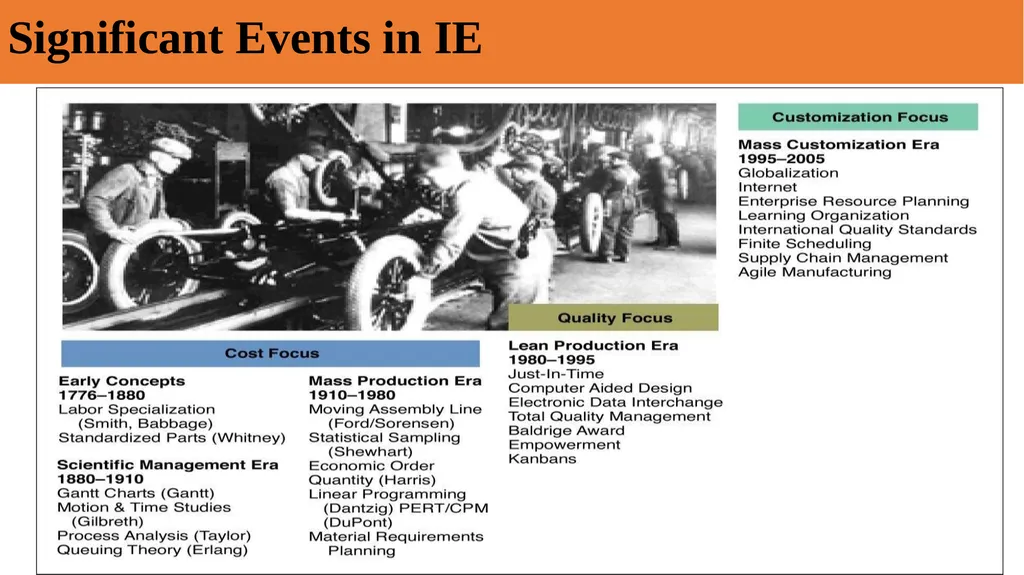
Significant Events in IE<br>
06
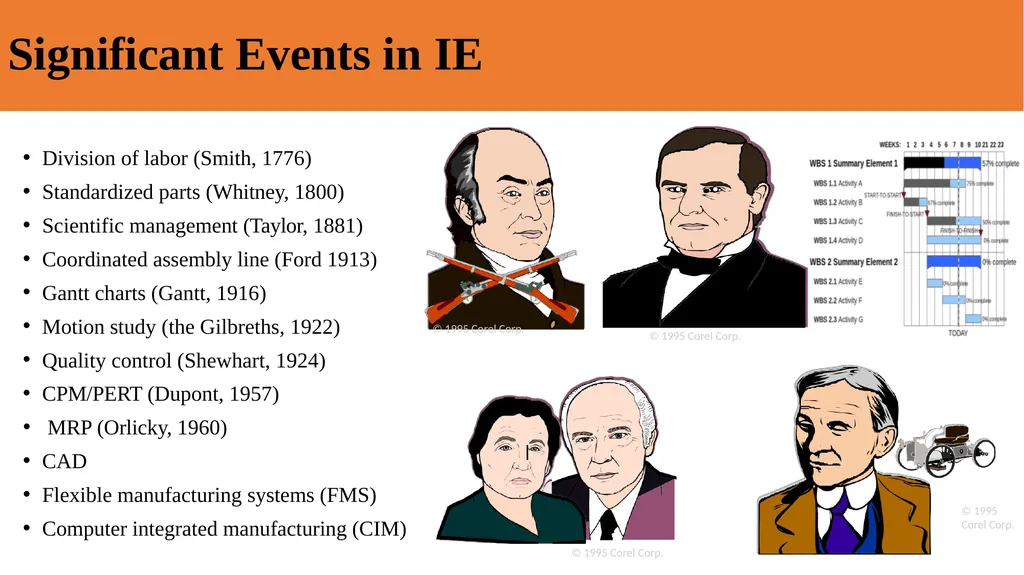
Significant Events in IE Division of labor (Smith, 1776)
Standardized parts (Whitney, 1800)
Scientific management (Taylor, 1881)
Coordinated assembly line (Ford 1913)
Gantt charts (Gantt, 1916)
Motion study (the Gilbreths, 1922)
Quality control (Shewhart, 1924)
CPM/PERT (Dupont, 1957)
MRP (Orlicky, 1960)
CAD
Flexible manufacturing systems (FMS)
Computer integrated manufacturing (CIM) © 1995 Corel Corp. © 1995 Corel Corp. © 1995 Corel Corp. © 1995
Corel Corp.<br>
07
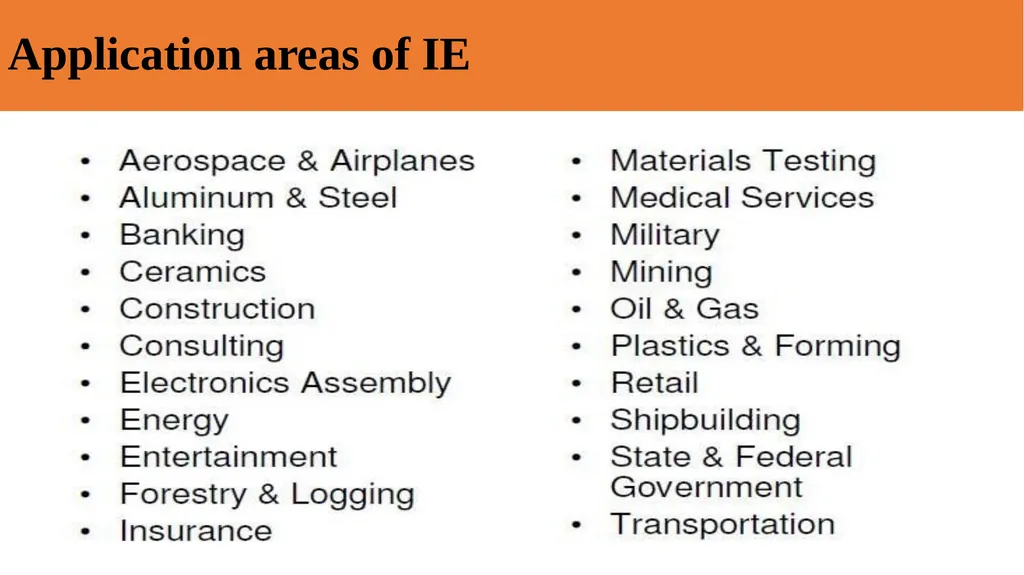
Application areas of IE<br>
08
Communities in ISE Institute of Industrial Engineers International Association of Engineers<br>
09
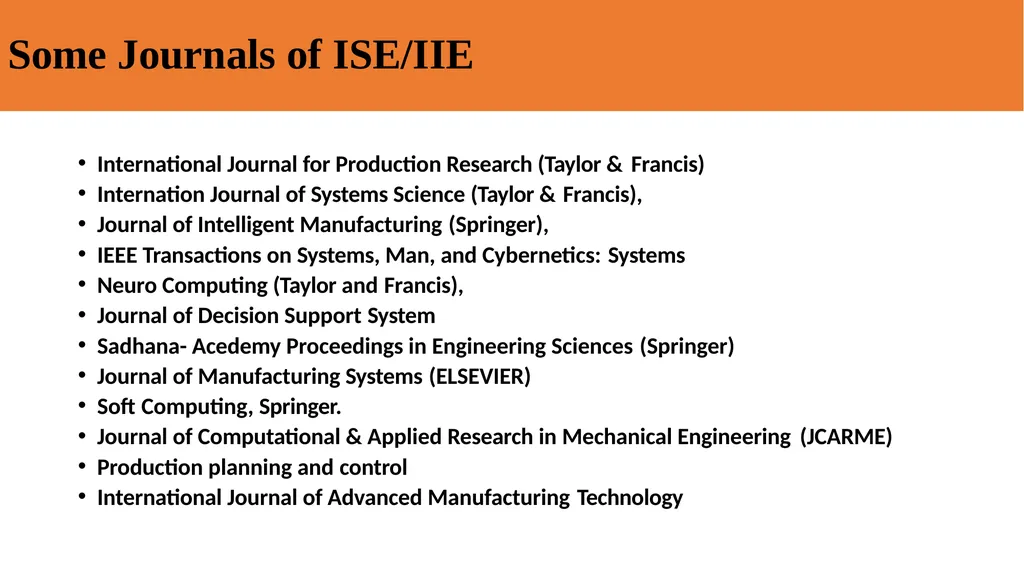
Some Journals of ISE/IIE International Journal for Production Research (Taylor & Francis)
Internation Journal of Systems Science (Taylor & Francis),
Journal of Intelligent Manufacturing (Springer),
IEEE Transactions on Systems, Man, and Cybernetics: Systems
Neuro Computing (Taylor and Francis),
Journal of Decision Support System
Sadhana- Acedemy Proceedings in Engineering Sciences (Springer)
Journal of Manufacturing Systems (ELSEVIER)
Soft Computing, Springer.
Journal of Computational & Applied Research in Mechanical Engineering (JCARME)
Production planning and control
International Journal of Advanced Manufacturing Technology<br>
10
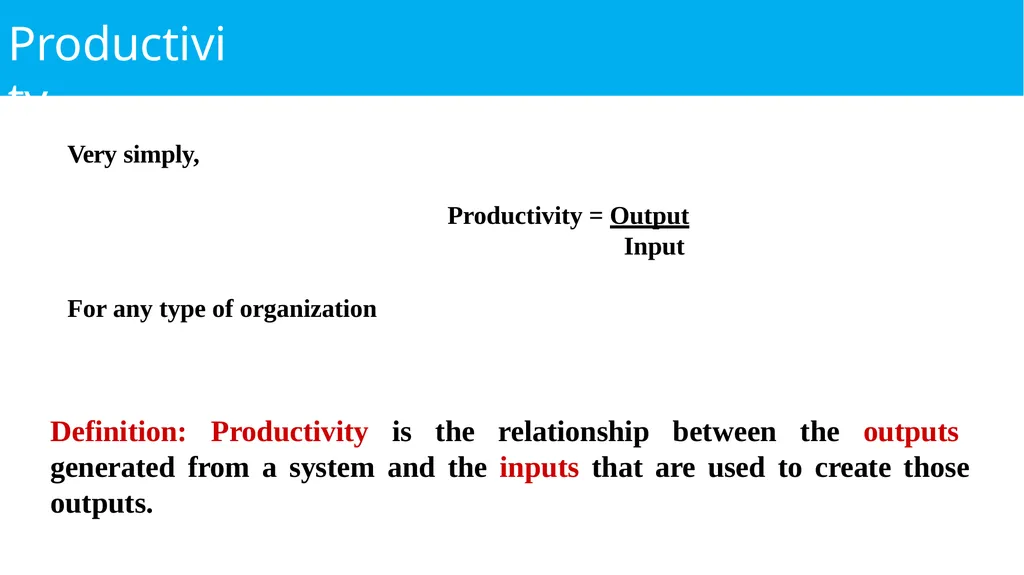
Productivity Very simply, Productivity = Output
Input
For any type of organization Definition: Productivity is the relationship between the outputs generated from a system and the inputs that are used to create those outputs.<br>
11
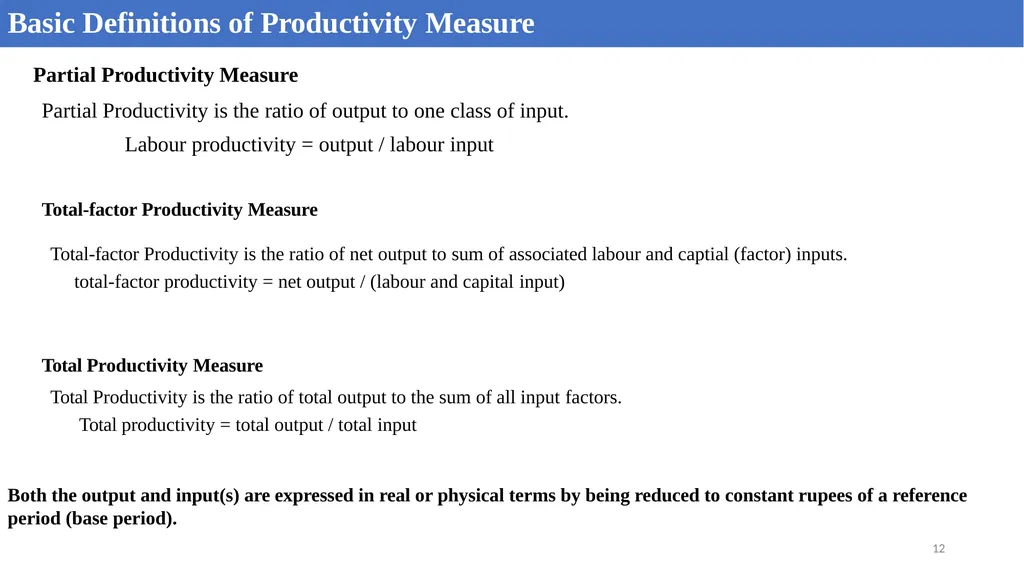
12 Basic Definitions of Productivity Measure Partial Productivity Measure
Partial Productivity is the ratio of output to one class of input.
Labour productivity = output / labour input
Total-factor Productivity Measure
Total-factor Productivity is the ratio of net output to sum of associated labour and captial (factor) inputs. total-factor productivity = net output / (labour and capital input)
Total Productivity Measure
Total Productivity is the ratio of total output to the sum of all input factors.
Total productivity = total output / total input
Both the output and input(s) are expressed in real or physical terms by being reduced to constant rupees of a reference period (base period).<br>
12
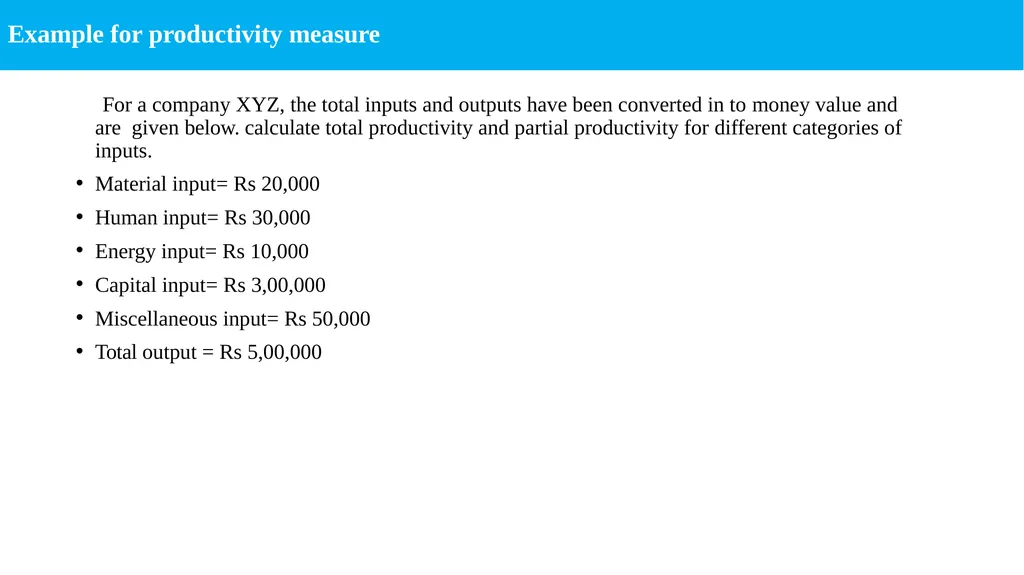
Example for productivity measure For a company XYZ, the total inputs and outputs have been converted in to money value and are given below. calculate total productivity and partial productivity for different categories of inputs.
Material input= Rs 20,000
Human input= Rs 30,000
Energy input= Rs 10,000
Capital input= Rs 3,00,000
Miscellaneous input= Rs 50,000
Total output = Rs 5,00,000<br>
13
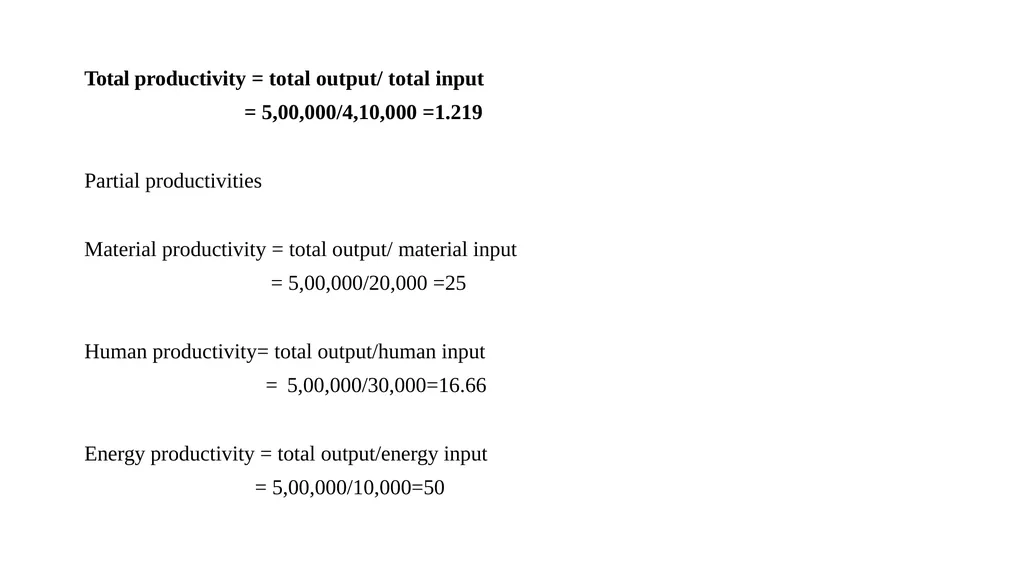
Total productivity = total output/ total input
= 5,00,000/4,10,000 =1.219
Partial productivities
Material productivity = total output/ material input
= 5,00,000/20,000 =25
Human productivity= total output/human input
= 5,00,000/30,000=16.66
Energy productivity = total output/energy input
= 5,00,000/10,000=50<br>
14
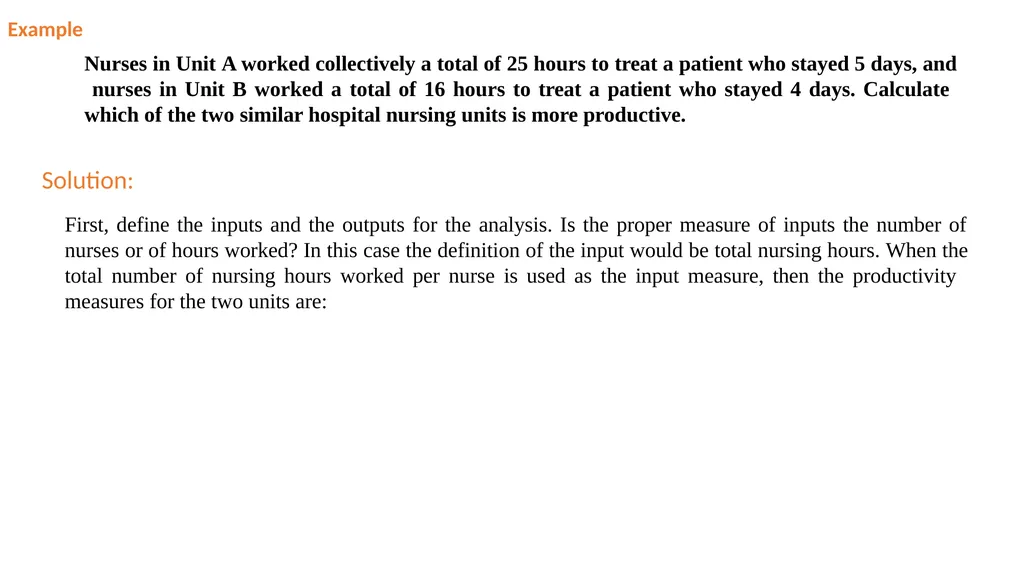
Example Nurses in Unit A worked collectively a total of 25 hours to treat a patient who stayed 5 days, and nurses in Unit B worked a total of 16 hours to treat a patient who stayed 4 days. Calculate which of the two similar hospital nursing units is more productive.
Solution:
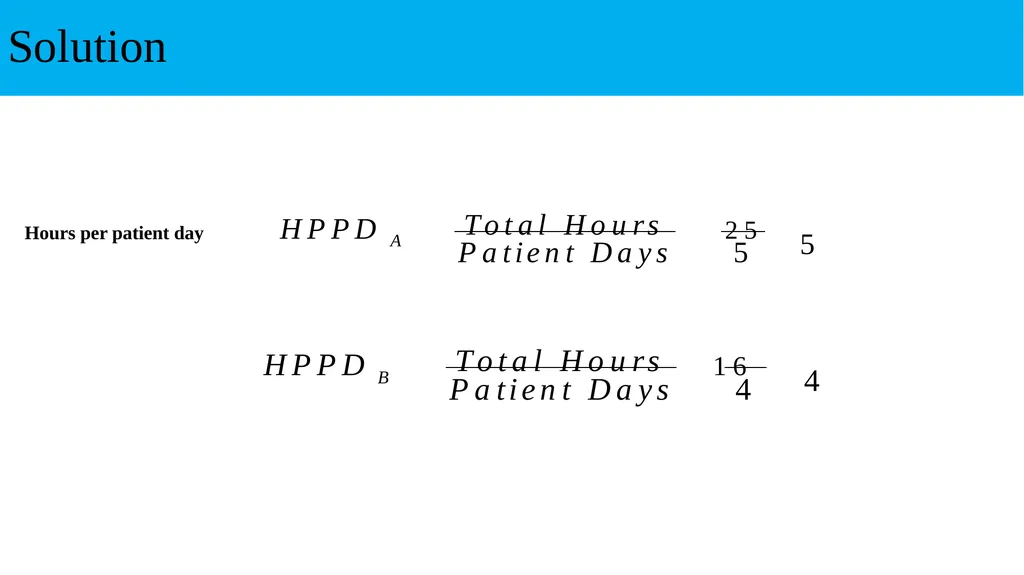
First, define the inputs and the outputs for the analysis. Is the proper measure of inputs the number of nurses or of hours worked? In this case the definition of the input would be total nursing hours. When the total number of nursing hours worked per nurse is used as the input measure, then the productivity measures for the two units are:<br>
15
Solution 5 25 5 Patient Days Total Hours HPPD A 4 16 4 Patient Days Total Hours HPPD B Hours per patient day<br>
16
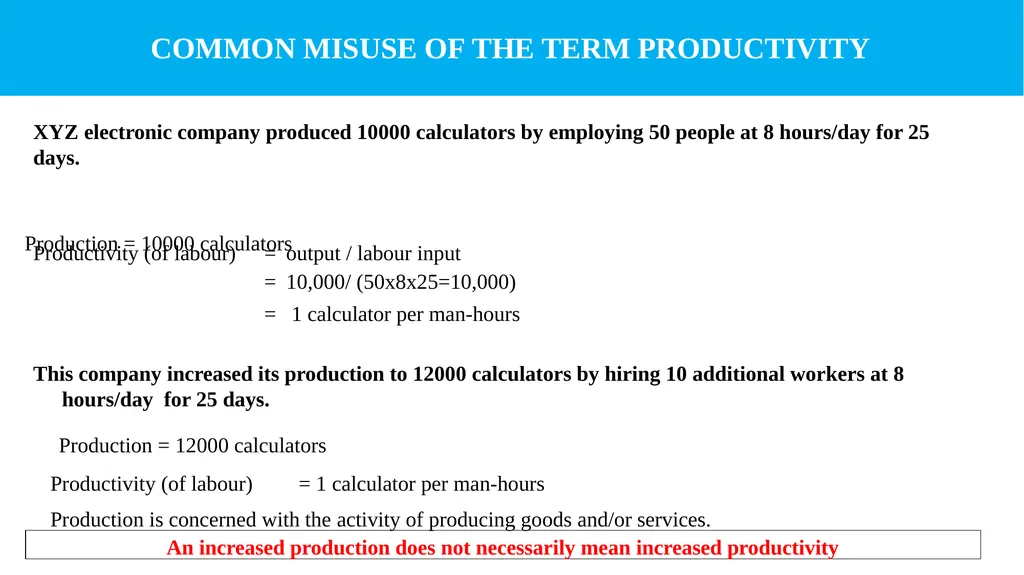
COMMON MISUSE OF THE TERM PRODUCTIVITY XYZ electronic company produced 10000 calculators by employing 50 people at 8 hours/day for 25 days.
Production = 10000 calculators This company increased its production to 12000 calculators by hiring 10 additional workers at 8 hours/day for 25 days.
Production = 12000 calculators
Productivity (of labour) = 1 calculator per man-hours
Production is concerned with the activity of producing goods and/or services. An increased production does not necessarily mean increased productivity<br>
17
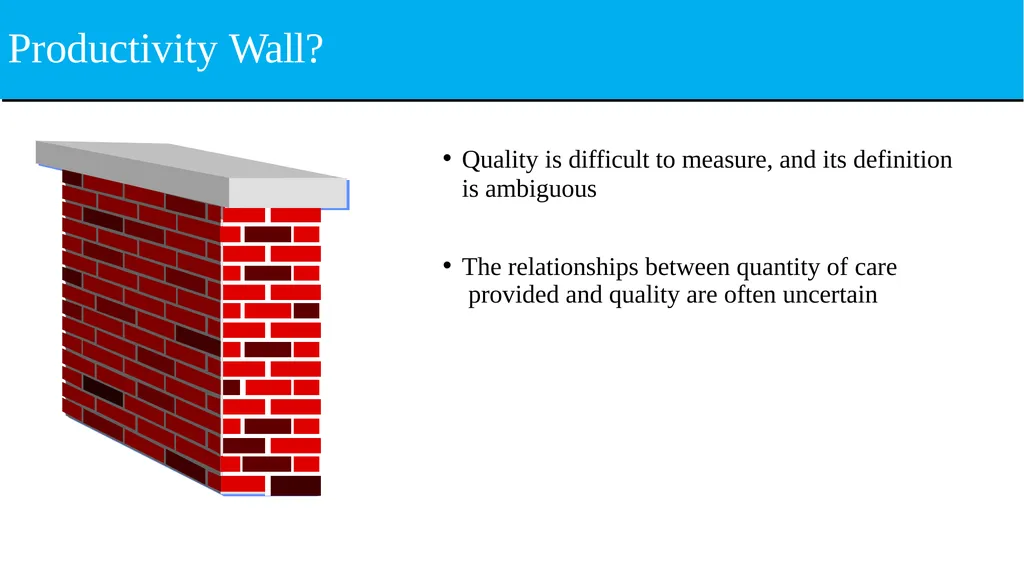
Productivity Wall? Quality is difficult to measure, and its definition
is ambiguous
The relationships between quantity of care provided and quality are often uncertain<br>
18
Many people confuse. . . The concepts of productivity, efficiency, and effectiveness.<br>
19
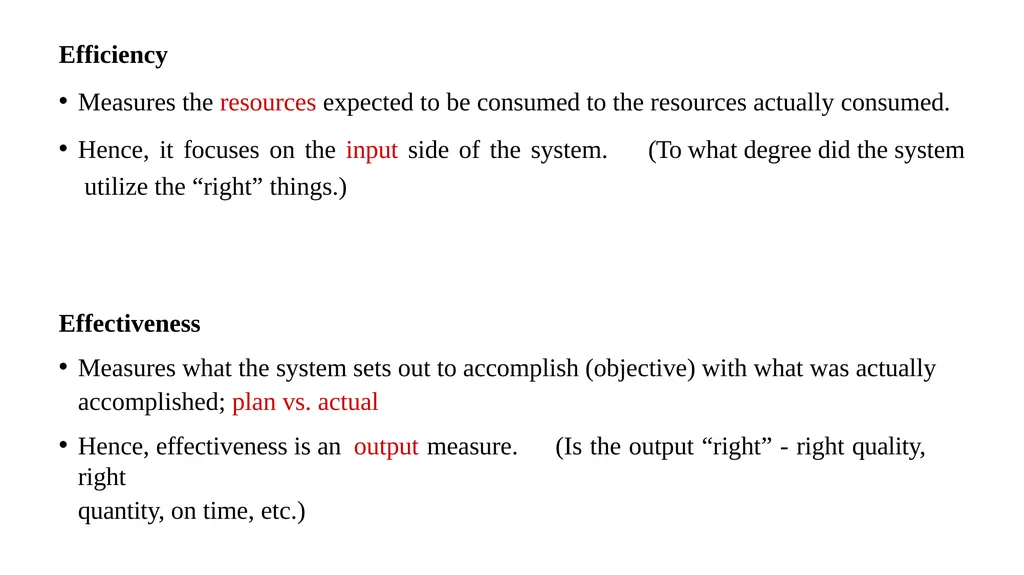
Efficiency
Measures the resources expected to be consumed to the resources actually consumed.
Hence, it focuses on the input side of the system. (To what degree did the system utilize the “right” things.) Effectiveness
Measures what the system sets out to accomplish (objective) with what was actually accomplished; plan vs. actual
Hence, effectiveness is an output measure. (Is the output “right” - right quality, right
quantity, on time, etc.)<br>
20
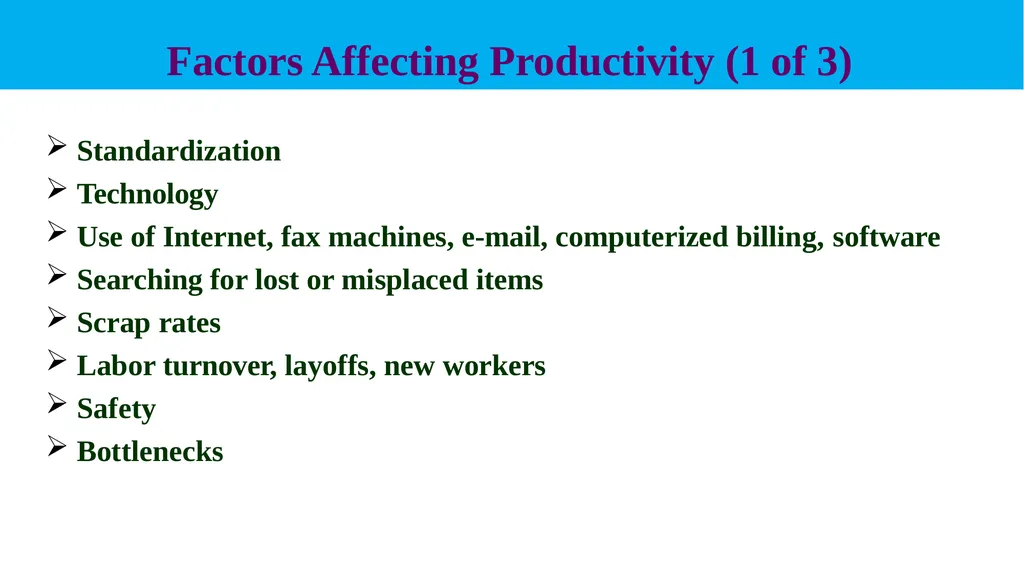
Standardization
Technology
Use of Internet, fax machines, e-mail, computerized billing, software
Searching for lost or misplaced items
Scrap rates
Labor turnover, layoffs, new workers
Safety
Bottlenecks Factors Affecting Productivity (1 of 3)<br>
21
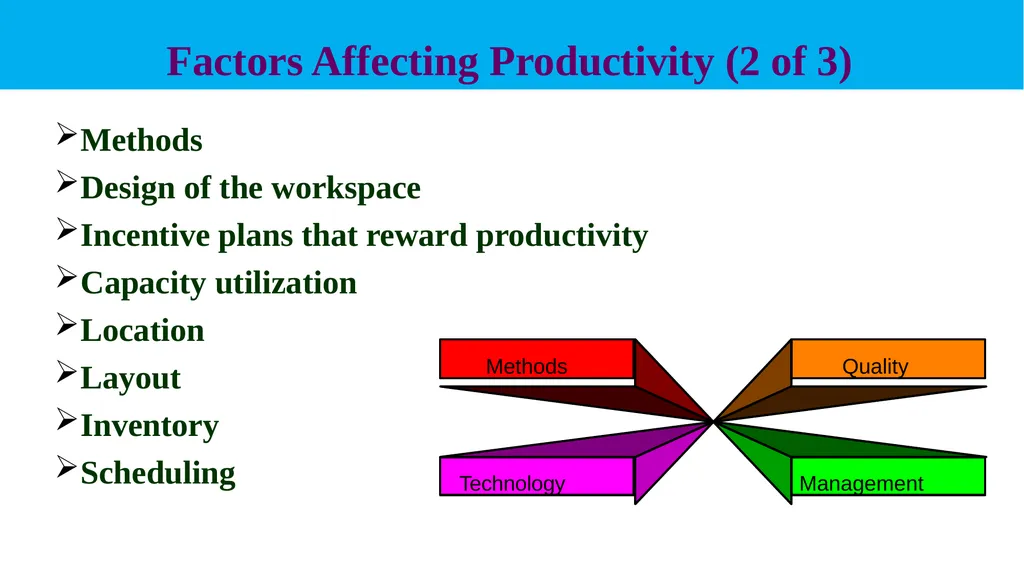
Methods
Design of the workspace
Incentive plans that reward productivity
Capacity utilization Location
Layout
Inventory
Scheduling Methods Quality Technology Management Factors Affecting Productivity (2 of 3)<br>
22
Shortage of IT workers and other technical workers
Equipment breakdowns
Part and material shortages
Inadequate investment in training & education of the employees Factors Affecting Productivity (3 of 3)<br>
23
References WWW. GOOGLE.COM
http://www.iienet2.org
Buffa E.S., (2009), Modern Production / Operational Management, John Wiley & Sons.
Nigel Slack, Stuart Chambers, Robert Johnston., (2010)Operation Management, Pearson
R. Danreid & Sanders, (2009), Operations Management, John Wiley & Sons.
Panneerselvam. R. (2006), Production/Operations Management, Prentice Hall of India Pvt Ltd.<br>