
Introduction to Isolation Forest Salvatore Di



Description: Introduction to Isolation Forest Salvatore Di Carlo 16122019 What is the Isolation forest technique: Decision trees Random forest Isolation forest Why it is useful: Example: wire scanner calibrations Outliers detection How to use it: Code
Related Topics
Download Presentation
"Introduction to Isolation Forest Salvatore Di" is the property of its rightful owner. Permission is granted to download and print the materials on this website for personal, non-commercial use only, and to display it on your personal computer provided you do not modify the materials and that you retain all copyright notices contained in the materials. By downloading content from our website, you accept the terms of this agreement.
Presentation Transcript
slide1. Introduction
to
Isolation Forest Salvatore Di Carlo
16/12/2019<br>
slide2. What is the Isolation forest technique:
Decision trees
Random forest
Isolation forest
Why it is useful:
Example: wire scanner calibrations
Outliers detection
How to use it:
Code snippet
Conclusion Outline 12/16/2019 Salvatore Di Carlo | Introduction to Isolation Forest 2<br>
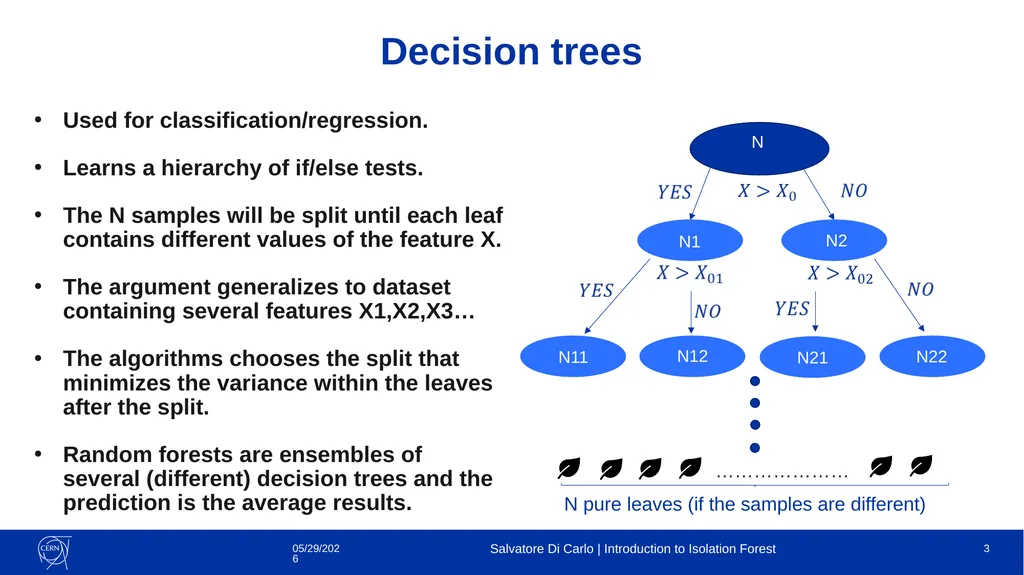
slide3. Decision trees Used for classification/regression.
Learns a hierarchy of if/else tests.
The N samples will be split until each leaf contains different values of the feature X.
The argument generalizes to dataset containing several features X1,X2,X3…
The algorithms chooses the split that minimizes the variance within the leaves after the split.
Random forests are ensembles of several (different) decision trees and the prediction is the average results. 12/16/2019 Salvatore Di Carlo | Introduction to Isolation Forest 3 N N1 N2 N11 N12 N21 N22 ………………… N pure leaves (if the samples are different)<br>
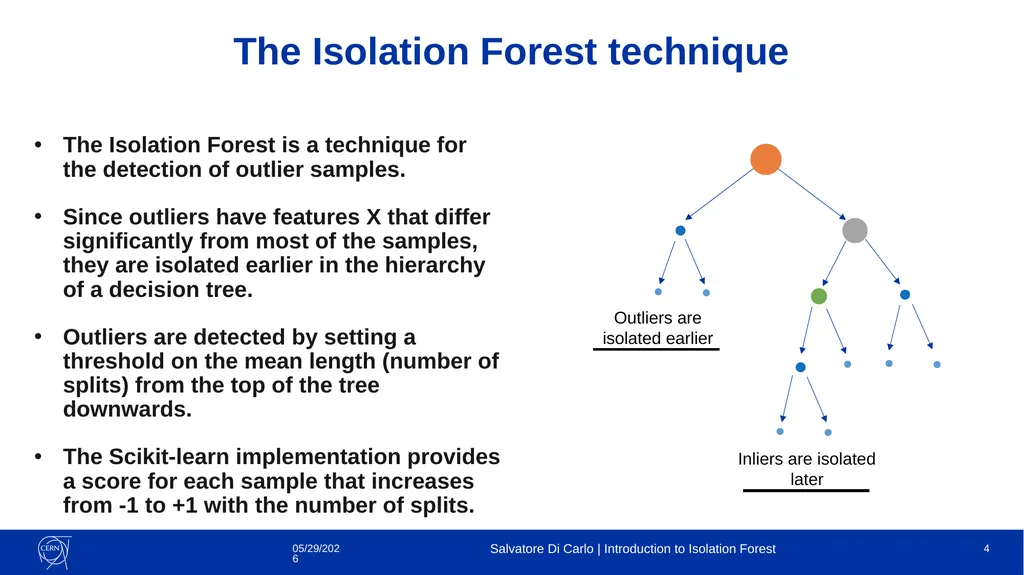
slide4. The Isolation Forest technique The Isolation Forest is a technique for the detection of outlier samples.
Since outliers have features X that differ significantly from most of the samples, they are isolated earlier in the hierarchy of a decision tree.
Outliers are detected by setting a threshold on the mean length (number of splits) from the top of the tree downwards.
The Scikit-learn implementation provides a score for each sample that increases from -1 to +1 with the number of splits. 12/16/2019 Salvatore Di Carlo | Introduction to Isolation Forest 4 Outliers are isolated earlier Inliers are isolated later<br>
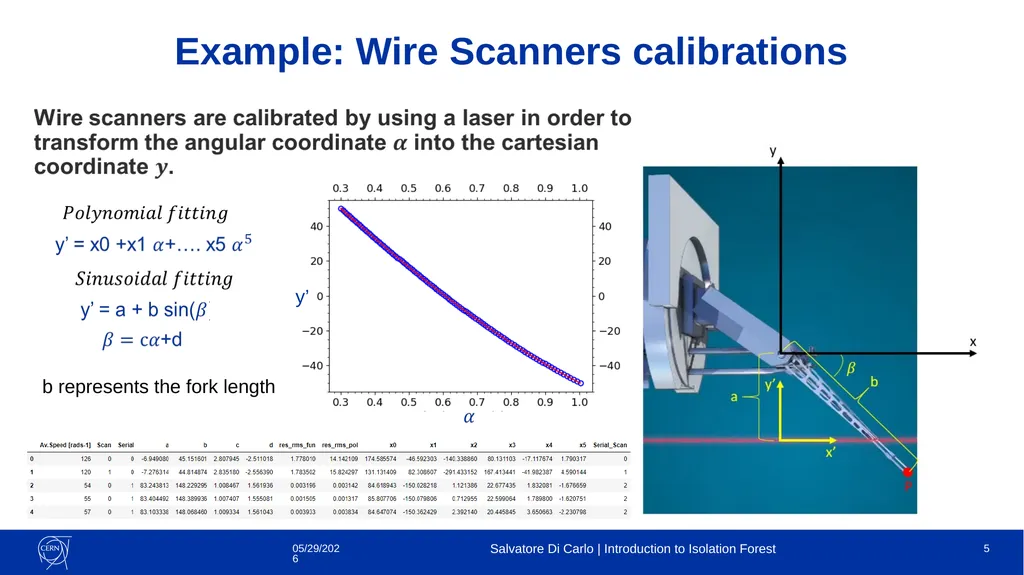
slide5. Example: Wire Scanners calibrations 12/16/2019 Salvatore Di Carlo | Introduction to Isolation Forest 5 y’ b represents the fork length<br>
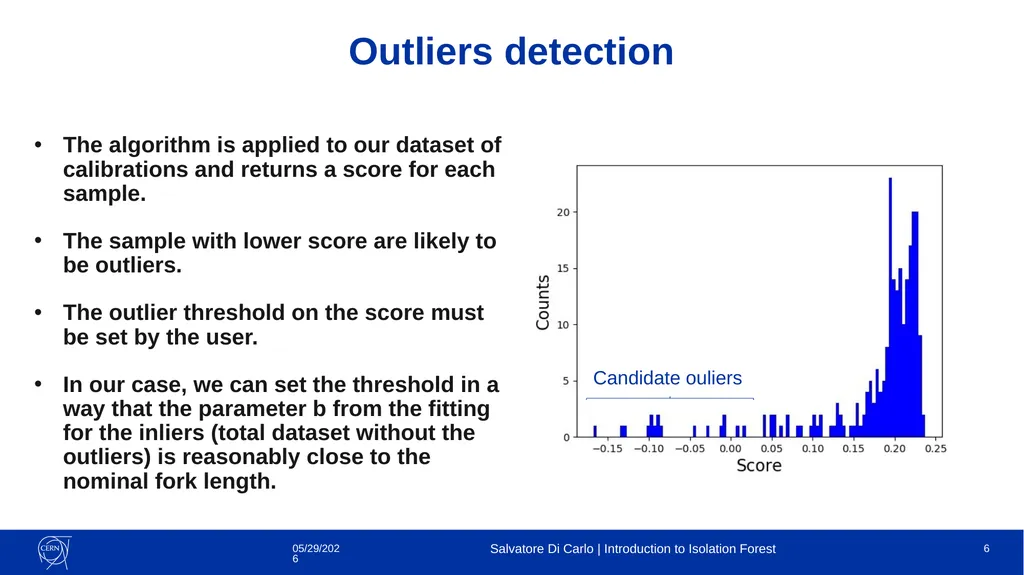
slide6. Outliers detection 12/16/2019 Salvatore Di Carlo | Introduction to Isolation Forest 6 The algorithm is applied to our dataset of calibrations and returns a score for each sample.
The sample with lower score are likely to be outliers.
The outlier threshold on the score must be set by the user.
In our case, we can set the threshold in a way that the parameter b from the fitting for the inliers (total dataset without the outliers) is reasonably close to the nominal fork length. Candidate ouliers<br>
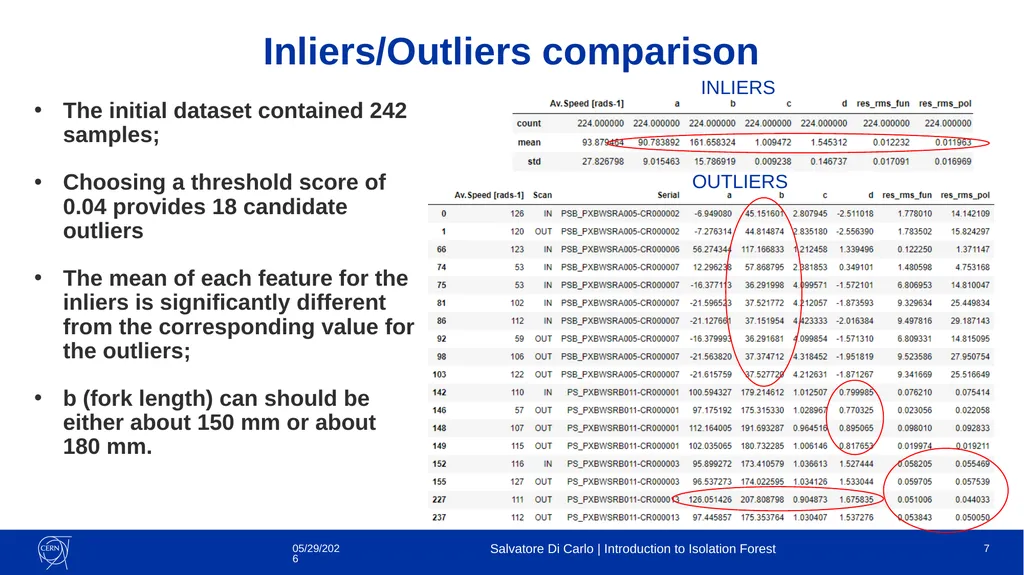
slide7. The initial dataset contained 242 samples;
Choosing a threshold score of 0.04 provides 18 candidate outliers
The mean of each feature for the inliers is significantly different from the corresponding value for the outliers;
b (fork length) can should be either about 150 mm or about 180 mm. Inliers/Outliers comparison 12/16/2019 Salvatore Di Carlo | Introduction to Isolation Forest 7 OUTLIERS INLIERS<br>
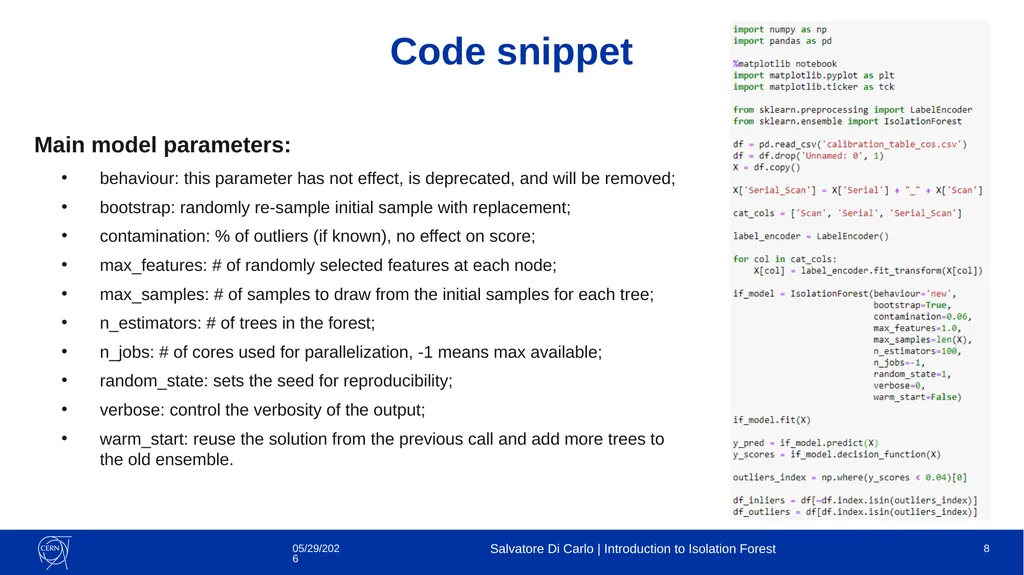
slide8. Code snippet Main model parameters:
behaviour: this parameter has not effect, is deprecated, and will be removed;
bootstrap: randomly re-sample initial sample with replacement;
contamination: % of outliers (if known), no effect on score;
max_features: # of randomly selected features at each node;
max_samples: # of samples to draw from the initial samples for each tree;
n_estimators: # of trees in the forest;
n_jobs: # of cores used for parallelization, -1 means max available;
random_state: sets the seed for reproducibility;
verbose: control the verbosity of the output;
warm_start: reuse the solution from the previous call and add more trees to the old ensemble. 12/16/2019 Salvatore Di Carlo | Introduction to Isolation Forest 8<br>
slide9. Decision trees/forests provide an intuitive and useful tool in machine learning that can be used both for data classification and regression.
The isolation forest technique is useful to isolate outliers, i.e., samples that significantly differ from the rest of the data.
As an example we isolated some outlier using the wire scanner calibrations dataset, and the corresponding code snippet was provided.
A certain degree of arbitrariness remains in setting the threshold score for outliers. Plotting a histogram of the score can help in deciding the optimal value. Conclusion 12/16/2019 Salvatore Di Carlo | Introduction to Isolation Forest 9<br>
16/12/2019<br>
slide2. What is the Isolation forest technique:
Decision trees
Random forest
Isolation forest
Why it is useful:
Example: wire scanner calibrations
Outliers detection
How to use it:
Code snippet
Conclusion Outline 12/16/2019 Salvatore Di Carlo | Introduction to Isolation Forest 2<br>
slide3. Decision trees Used for classification/regression.
Learns a hierarchy of if/else tests.
The N samples will be split until each leaf contains different values of the feature X.
The argument generalizes to dataset containing several features X1,X2,X3…
The algorithms chooses the split that minimizes the variance within the leaves after the split.
Random forests are ensembles of several (different) decision trees and the prediction is the average results. 12/16/2019 Salvatore Di Carlo | Introduction to Isolation Forest 3 N N1 N2 N11 N12 N21 N22 ………………… N pure leaves (if the samples are different)<br>
slide4. The Isolation Forest technique The Isolation Forest is a technique for the detection of outlier samples.
Since outliers have features X that differ significantly from most of the samples, they are isolated earlier in the hierarchy of a decision tree.
Outliers are detected by setting a threshold on the mean length (number of splits) from the top of the tree downwards.
The Scikit-learn implementation provides a score for each sample that increases from -1 to +1 with the number of splits. 12/16/2019 Salvatore Di Carlo | Introduction to Isolation Forest 4 Outliers are isolated earlier Inliers are isolated later<br>
slide5. Example: Wire Scanners calibrations 12/16/2019 Salvatore Di Carlo | Introduction to Isolation Forest 5 y’ b represents the fork length<br>
slide6. Outliers detection 12/16/2019 Salvatore Di Carlo | Introduction to Isolation Forest 6 The algorithm is applied to our dataset of calibrations and returns a score for each sample.
The sample with lower score are likely to be outliers.
The outlier threshold on the score must be set by the user.
In our case, we can set the threshold in a way that the parameter b from the fitting for the inliers (total dataset without the outliers) is reasonably close to the nominal fork length. Candidate ouliers<br>
slide7. The initial dataset contained 242 samples;
Choosing a threshold score of 0.04 provides 18 candidate outliers
The mean of each feature for the inliers is significantly different from the corresponding value for the outliers;
b (fork length) can should be either about 150 mm or about 180 mm. Inliers/Outliers comparison 12/16/2019 Salvatore Di Carlo | Introduction to Isolation Forest 7 OUTLIERS INLIERS<br>
slide8. Code snippet Main model parameters:
behaviour: this parameter has not effect, is deprecated, and will be removed;
bootstrap: randomly re-sample initial sample with replacement;
contamination: % of outliers (if known), no effect on score;
max_features: # of randomly selected features at each node;
max_samples: # of samples to draw from the initial samples for each tree;
n_estimators: # of trees in the forest;
n_jobs: # of cores used for parallelization, -1 means max available;
random_state: sets the seed for reproducibility;
verbose: control the verbosity of the output;
warm_start: reuse the solution from the previous call and add more trees to the old ensemble. 12/16/2019 Salvatore Di Carlo | Introduction to Isolation Forest 8<br>
slide9. Decision trees/forests provide an intuitive and useful tool in machine learning that can be used both for data classification and regression.
The isolation forest technique is useful to isolate outliers, i.e., samples that significantly differ from the rest of the data.
As an example we isolated some outlier using the wire scanner calibrations dataset, and the corresponding code snippet was provided.
A certain degree of arbitrariness remains in setting the threshold score for outliers. Plotting a histogram of the score can help in deciding the optimal value. Conclusion 12/16/2019 Salvatore Di Carlo | Introduction to Isolation Forest 9<br>