Introduction to Lathe Safety This material was produced under Susan Harwood grant number SH-31214-SH7 Occupational Safety and Health Administration, U.S. Department of Labor. The contents in this presentation do not necessarily reflect the
"Introduction to Lathe Safety This material was" is the property of its rightful owner. Permission is granted to
download and print the materials on this website for personal, non-commercial use only, and to display it
on your personal computer provided you do not modify the materials and that you retain all copyright
notices contained in the materials. By downloading content from our website, you accept the terms of this
agreement.
Presentation Transcript
01
Introduction to Lathe Safety This material was produced under Susan Harwood grant number SH-31214-SH7 Occupational Safety and Health Administration, U.S. Department of Labor. The contents in this presentation do not necessarily reflect the views or policies of the U.S. Department of Labor, nor does the mention of trade names, commercial products, or organizations imply endorsement by the U.S. Government.<br>
02
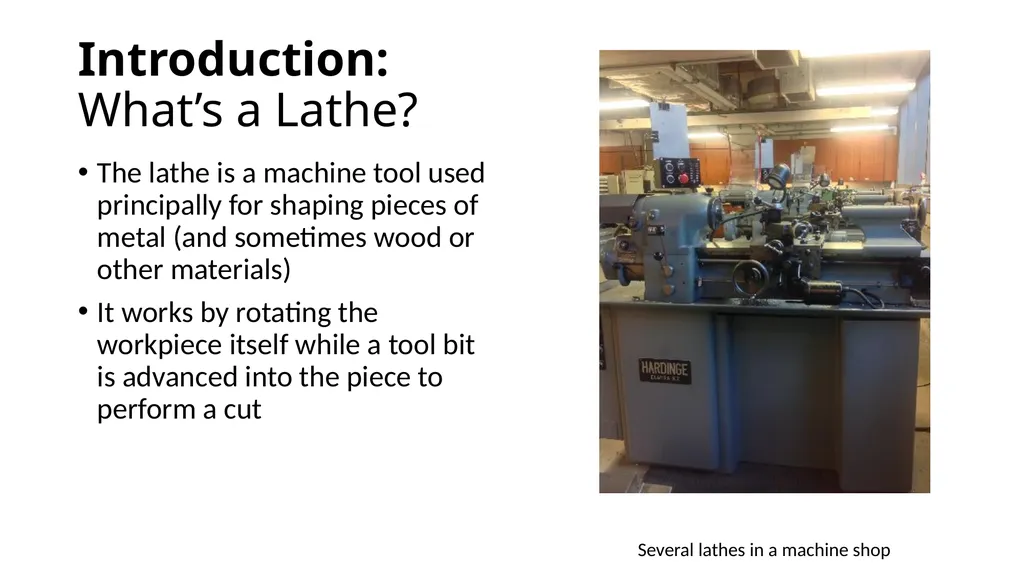
Introduction: What’s a Lathe? The lathe is a machine tool used principally for shaping pieces of metal (and sometimes wood or other materials)
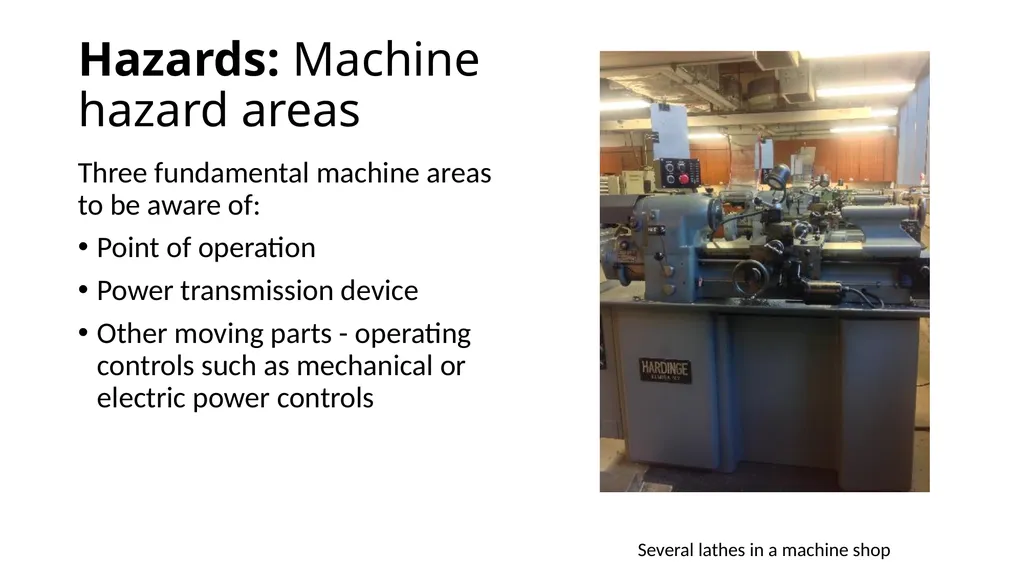
It works by rotating the workpiece itself while a tool bit is advanced into the piece to perform a cut Several lathes in a machine shop<br>
03
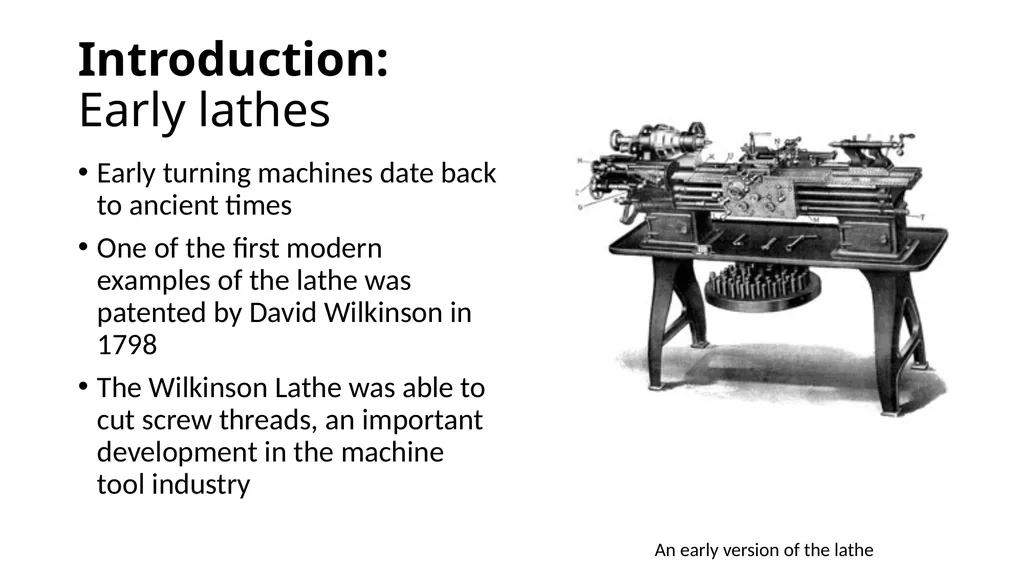
Introduction: Early lathes Early turning machines date back to ancient times
One of the first modern examples of the lathe was patented by David Wilkinson in 1798
The Wilkinson Lathe was able to cut screw threads, an important development in the machine tool industry An early version of the lathe<br>
04
Safety: Who is OSHA? With the Occupational Safety and Health Act of 1970, Congress created the Occupational Safety and Health Administration (OSHA) to assure safe and healthful working conditions for working men and women by setting and enforcing standards and by providing training, outreach, education and assistance. OSHA is part of the United States Department of Labor. The administrator for OSHA is the Assistant Secretary of Labor for Occupational Safety and Health. OSHA's administrator answers to the Secretary of Labor, who is a member of the cabinet of the President of the United States.<br>
05
Safety: Know your rights Under federal law, you are entitled to a safe workplace.
Your employer must provide a workplace free of known health and safety hazards.
If you have concerns, you have the right to speak up about them without fear of retaliation. You also have the right to: Be trained in a language you understand
Work on machines that are safe
Be provided required safety gear, such as gloves or a harness and lifeline for falls
Be protected from toxic chemicals
Request an OSHA inspection, and speak to the inspector
Report an injury or illness, and get copies of your medical records
See copies of the workplace injury and illness log
Review records of work-related injuries and illnesses
Get copies of test results done to find hazards in the workplace<br>
06
Hazards: Machine-related injuries Possible machine-related injuries include:
Crushed fingers or hands
Amputations
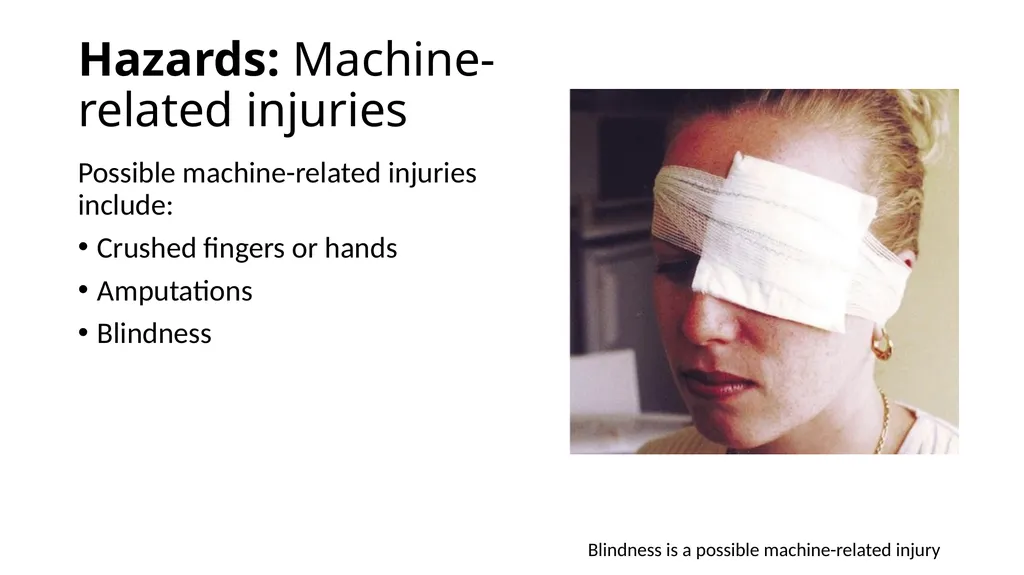
Blindness Blindness is a possible machine-related injury<br>
07
Hazards: Machine-related injuries (continued) The lathe features extremely dangerous rotating parts
Rotating motion can grip hair and clothing and can also force hand and arm into a dangerous position
Contact with rotating motion can cause severe injuries
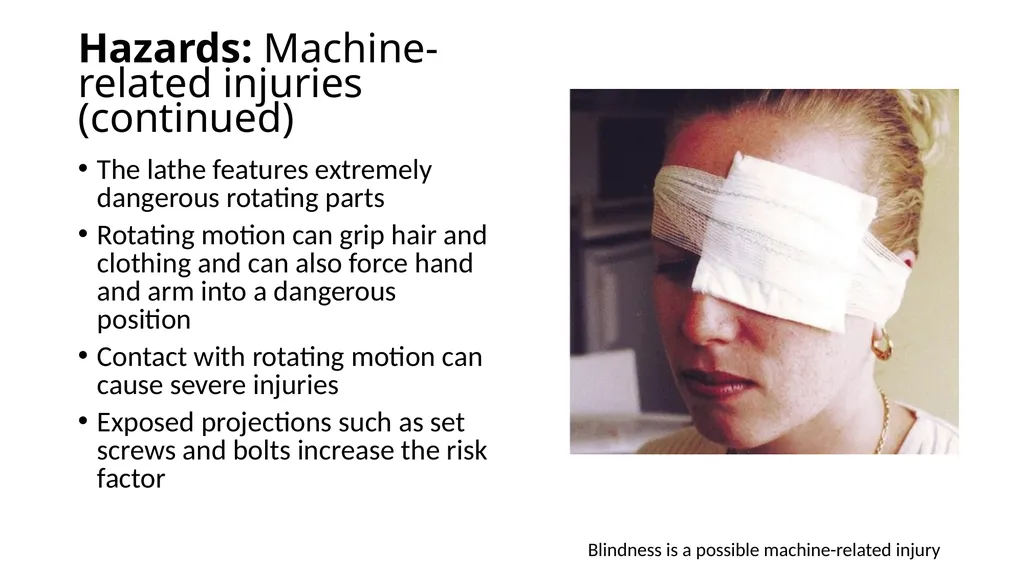
Exposed projections such as set screws and bolts increase the risk factor Blindness is a possible machine-related injury<br>
08
Hazards: Machine hazard areas Three fundamental machine areas to be aware of:
Point of operation
Power transmission device
Other moving parts - operating controls such as mechanical or electric power controls Several lathes in a machine shop<br>
09
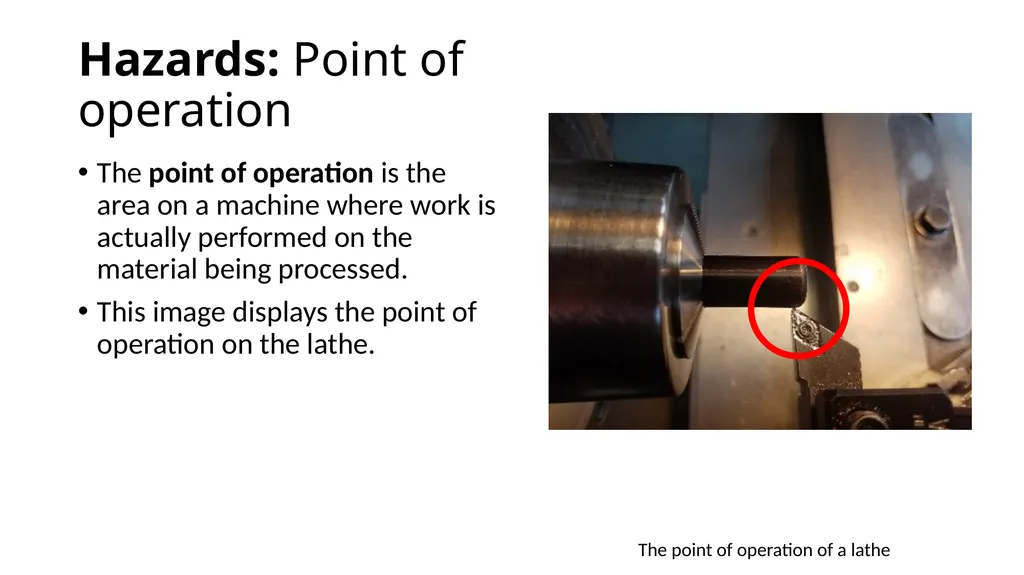
Hazards: Point of operation The point of operation is the area on a machine where work is actually performed on the material being processed.
This image displays the point of operation on the lathe. The point of operation of a lathe<br>
10
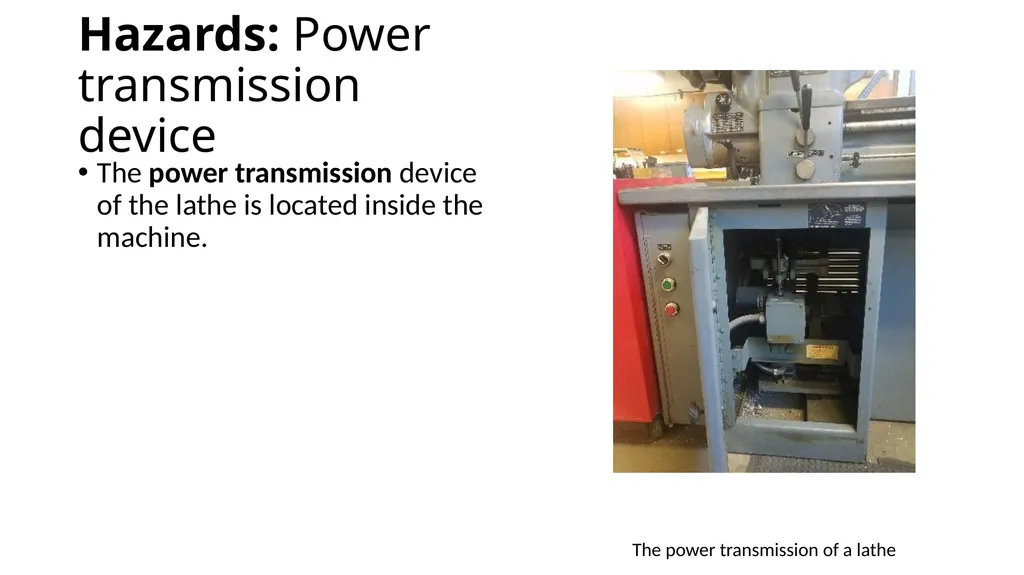
Hazards: Power transmission device The power transmission device of the lathe is located inside the machine. The power transmission of a lathe<br>
11
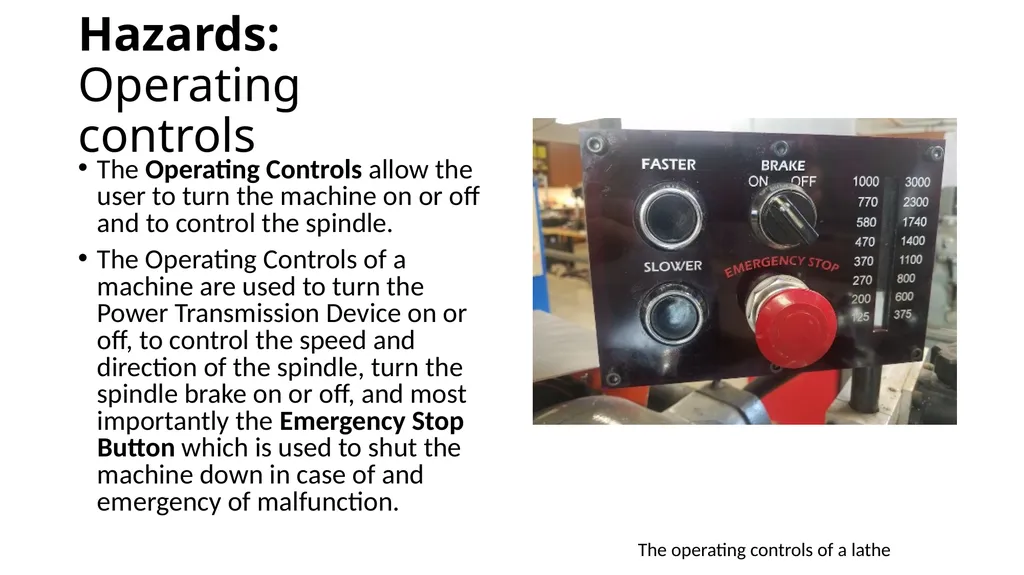
Hazards: Operating controls The Operating Controls allow the user to turn the machine on or off and to control the spindle.
The Operating Controls of a machine are used to turn the Power Transmission Device on or off, to control the speed and direction of the spindle, turn the spindle brake on or off, and most importantly the Emergency Stop Button which is used to shut the machine down in case of and emergency of malfunction. The operating controls of a lathe<br>
12
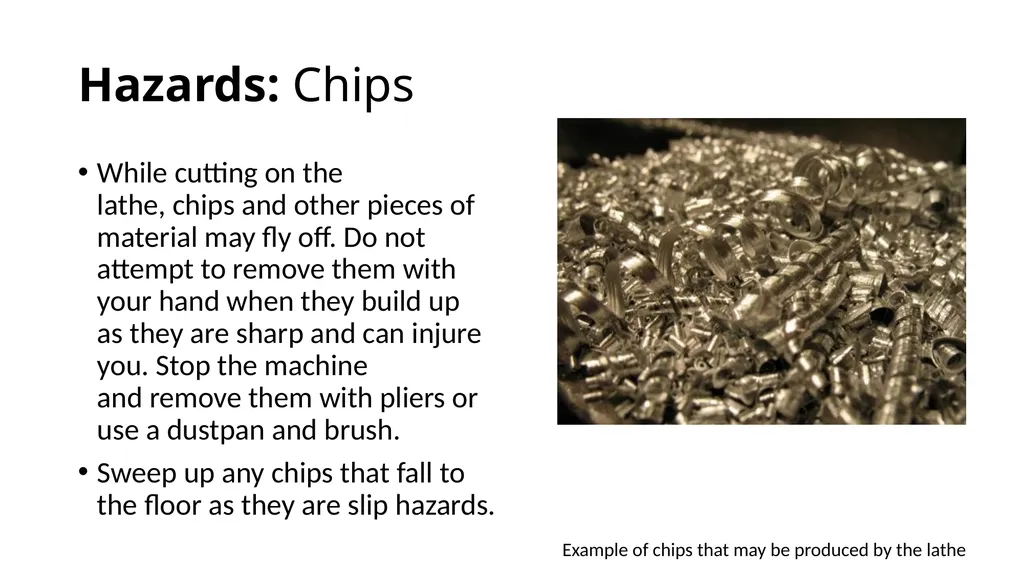
Hazards: Chips While cutting on the lathe, chips and other pieces of material may fly off. Do not attempt to remove them with your hand when they build up as they are sharp and can injure you. Stop the machine and remove them with pliers or use a dustpan and brush.
Sweep up any chips that fall to the floor as they are slip hazards. Example of chips that may be produced by the lathe<br>
13
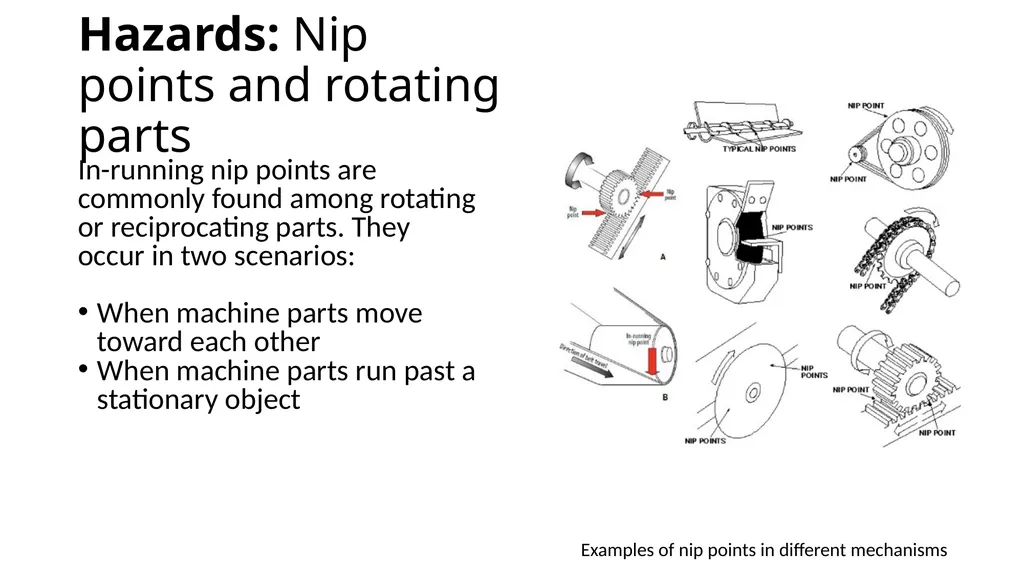
Hazards: Nip points and rotating parts In-running nip points are commonly found among rotating or reciprocating parts. They occur in two scenarios:
When machine parts move toward each other
When machine parts run past a stationary object Examples of nip points in different mechanisms<br>
14
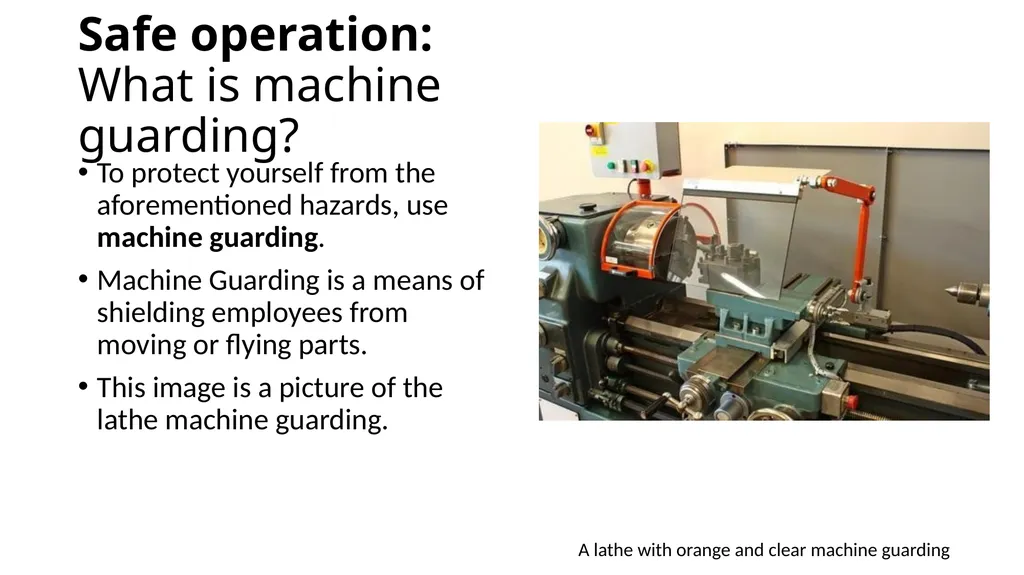
Safe operation: What is machine guarding? To protect yourself from the aforementioned hazards, use machine guarding.
Machine Guarding is a means of shielding employees from moving or flying parts.
This image is a picture of the lathe machine guarding. A lathe with orange and clear machine guarding<br>
15
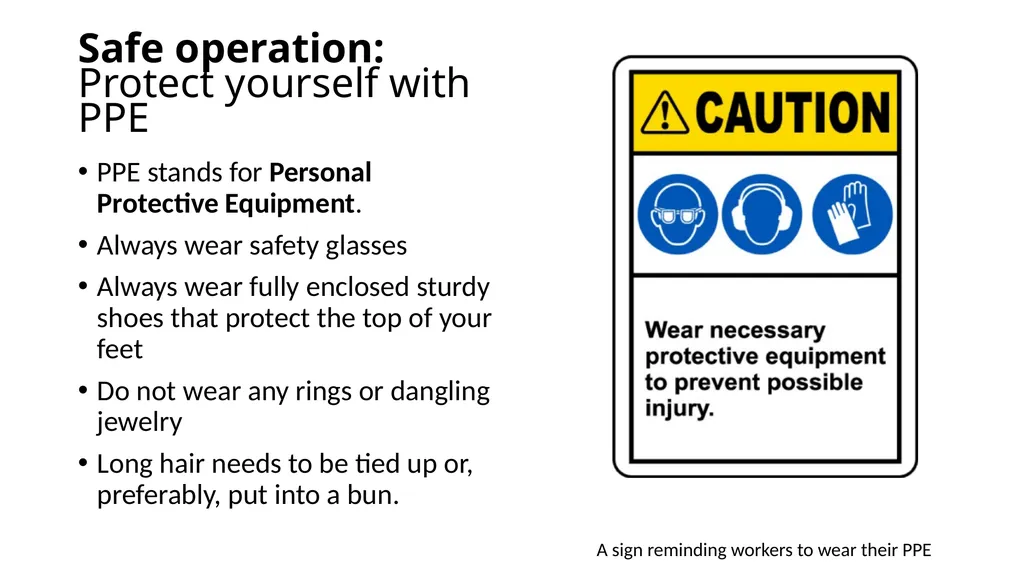
Safe operation: Protect yourself with PPE PPE stands for Personal Protective Equipment.
Always wear safety glasses
Always wear fully enclosed sturdy shoes that protect the top of your feet
Do not wear any rings or dangling jewelry
Long hair needs to be tied up or, preferably, put into a bun. A sign reminding workers to wear their PPE<br>
16
Safe operation: Preventing injuries and amputations (I) Before you begin...
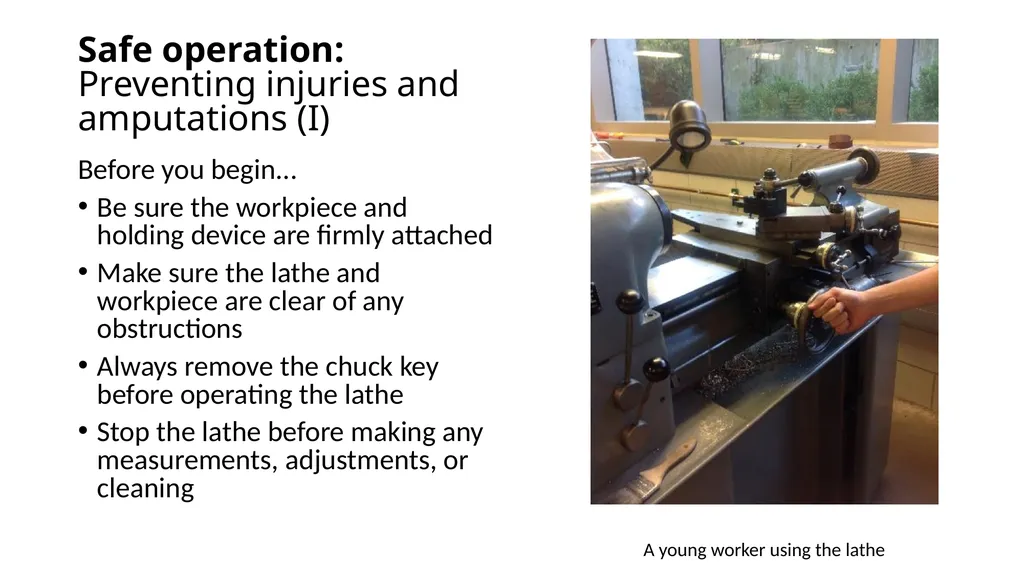
Be sure the workpiece and holding device are firmly attached
Make sure the lathe and workpiece are clear of any obstructions
Always remove the chuck key before operating the lathe
Stop the lathe before making any measurements, adjustments, or cleaning A young worker using the lathe<br>
17
Safe operation: Preventing injuries and amputations (II) Before you begin...
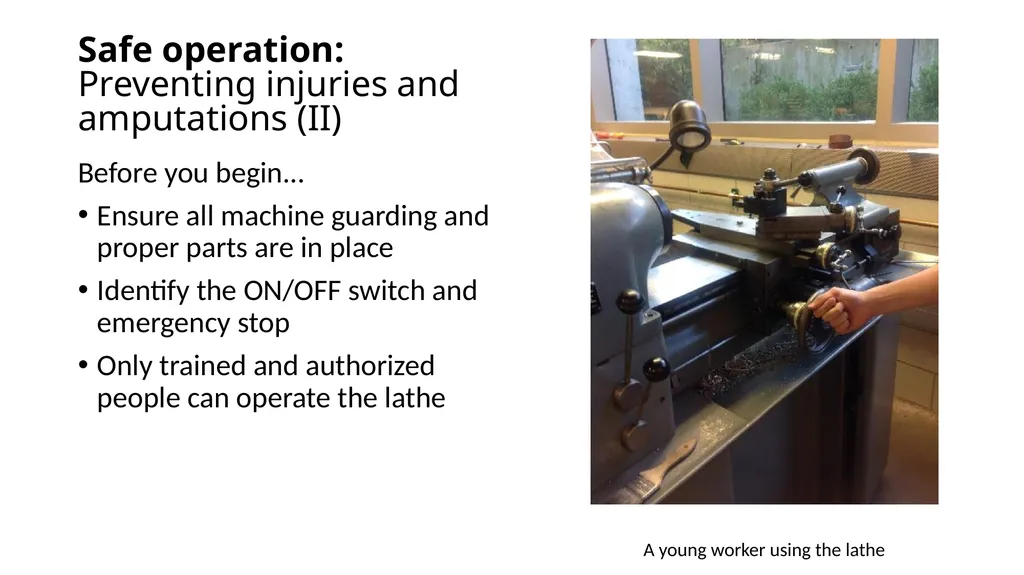
Ensure all machine guarding and proper parts are in place
Identify the ON/OFF switch and emergency stop
Only trained and authorized people can operate the lathe A young worker using the lathe<br>
18
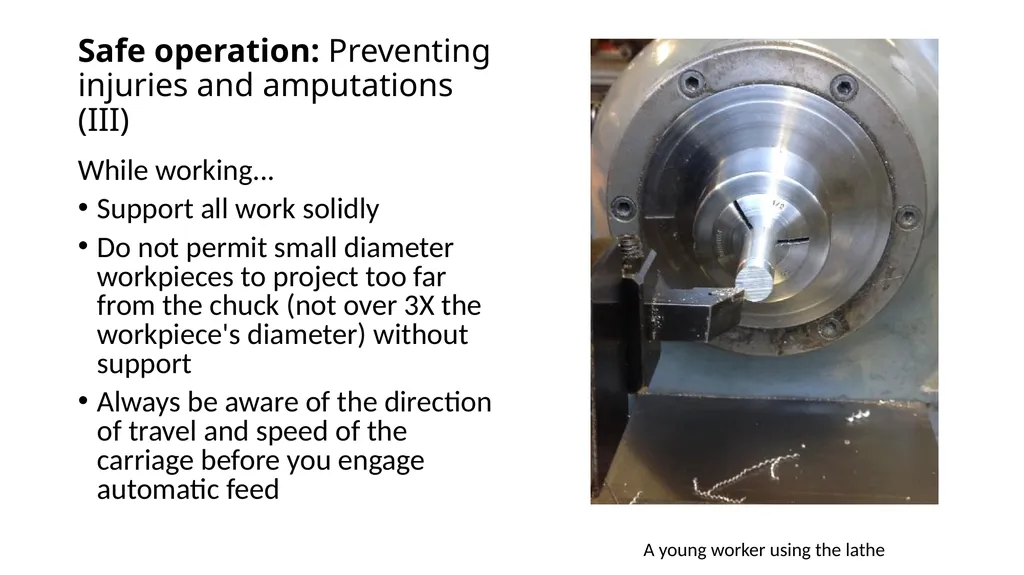
Safe operation: Preventing injuries and amputations (III) While working...
Support all work solidly
Do not permit small diameter workpieces to project too far from the chuck (not over 3X the workpiece's diameter) without support
Always be aware of the direction of travel and speed of the carriage before you engage automatic feed A young worker using the lathe<br>
19
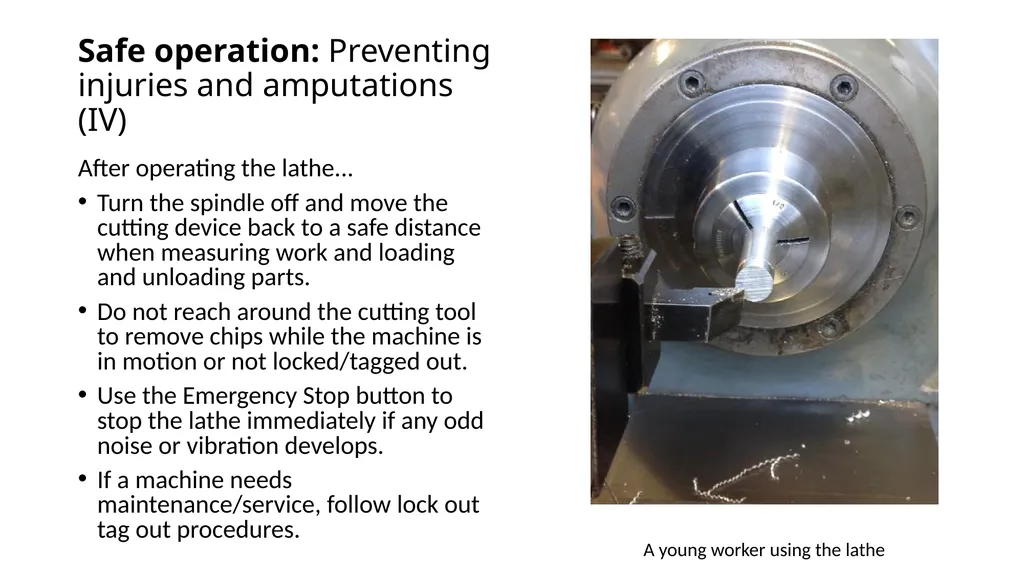
Safe operation: Preventing injuries and amputations (IV) After operating the lathe...
Turn the spindle off and move the cutting device back to a safe distance when measuring work and loading and unloading parts.
Do not reach around the cutting tool to remove chips while the machine is in motion or not locked/tagged out.
Use the Emergency Stop button to stop the lathe immediately if any odd noise or vibration develops.
If a machine needs maintenance/service, follow lock out tag out procedures. A young worker using the lathe<br>
20
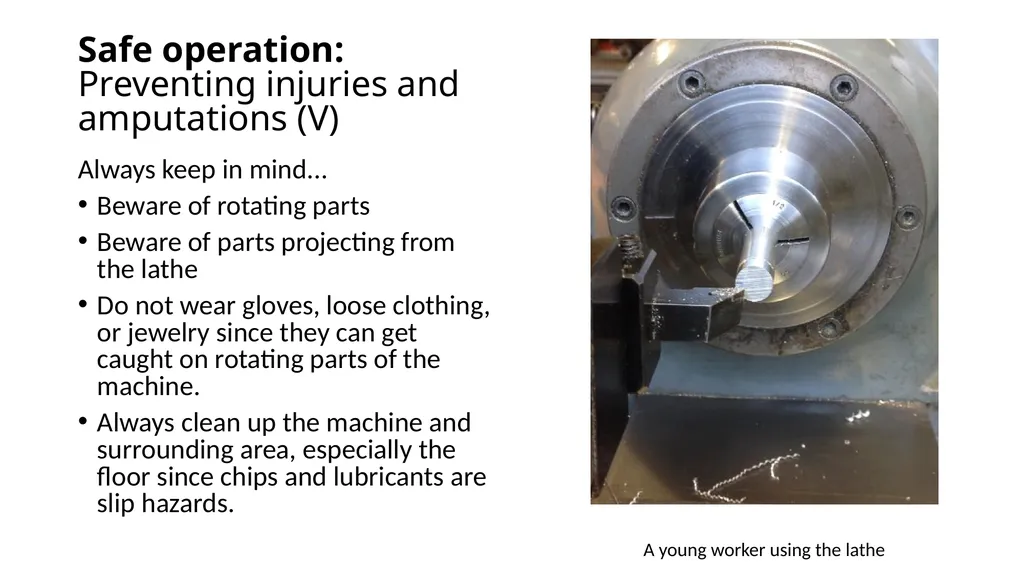
Safe operation: Preventing injuries and amputations (V) Always keep in mind...
Beware of rotating parts
Beware of parts projecting from the lathe
Do not wear gloves, loose clothing, or jewelry since they can get caught on rotating parts of the machine.
Always clean up the machine and surrounding area, especially the floor since chips and lubricants are slip hazards. A young worker using the lathe<br>
21
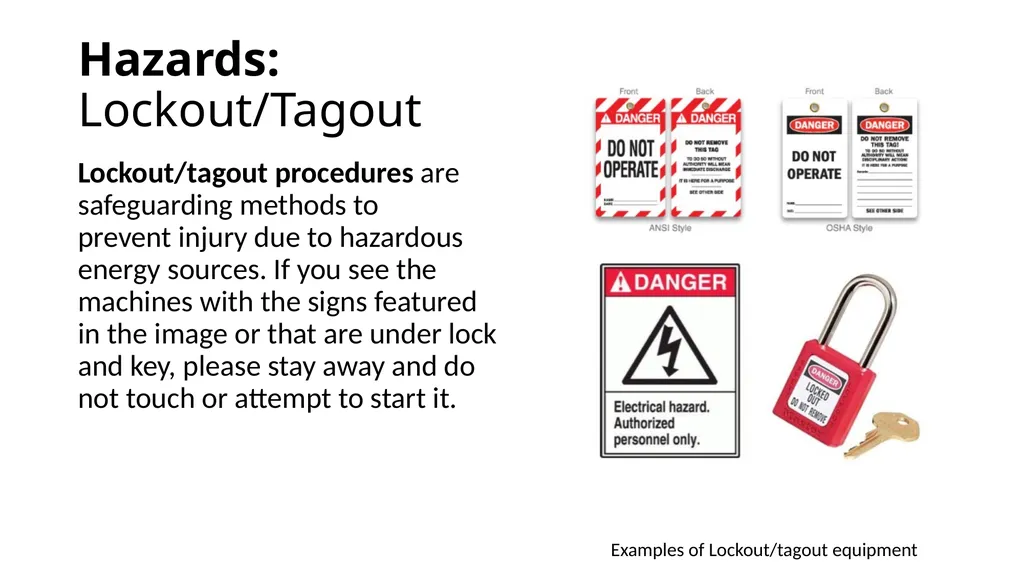
Hazards: Lockout/Tagout Lockout/tagout procedures are safeguarding methods to prevent injury due to hazardous energy sources. If you see the machines with the signs featured in the image or that are under lock and key, please stay away and do not touch or attempt to start it. Examples of Lockout/tagout equipment<br>
22
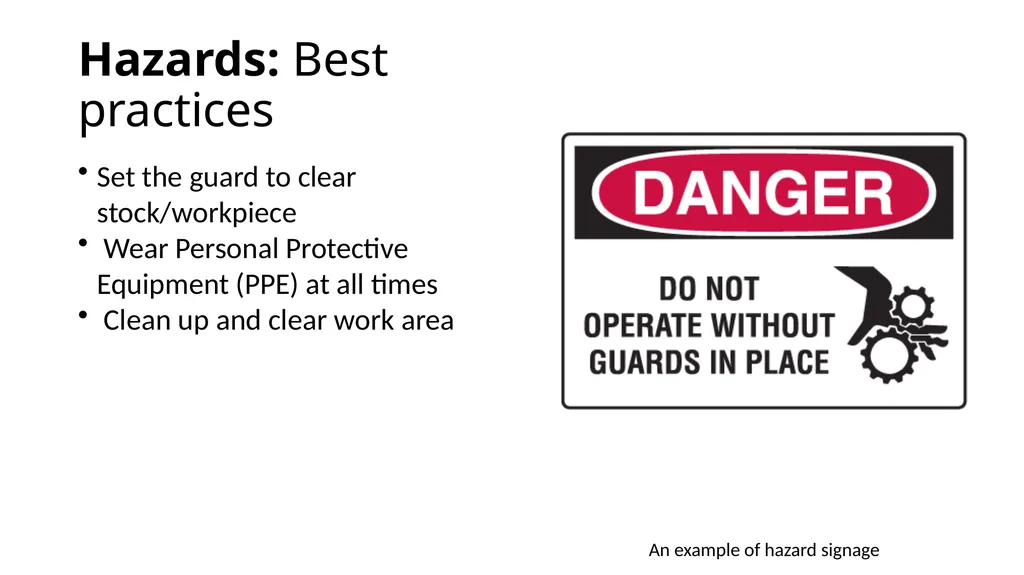
Hazards: Best practices Set the guard to clear stock/workpiece
Wear Personal Protective Equipment (PPE) at all times
Clean up and clear work area An example of hazard signage<br>