
Introduction to Management Topics What is
JO
Published · 78 slides · 0 views

1 / 1


Description
Introduction to Management Topics What is management? What do managers do? What challenges do managers at different levels face? Management The implementation of the four conditions that must be present for management to succeed: mission,
Related Topics
Share
Embed code
Download this presentation From Below
"Introduction to Management Topics What is" is the property of its rightful owner. Permission is granted to download and print the materials on this website for personal, non-commercial use only, and to display it on your personal computer provided you do not modify the materials and that you retain all copyright notices contained in the materials. By downloading content from our website, you accept the terms of this agreement.
Presentation Transcript
01
Introduction to Management<br>
02
Topics What is management?
What do managers do?
What challenges do managers
at different levels face?<br>
What do managers do?
What challenges do managers
at different levels face?<br>
03
Management – The implementation of the four conditions that must be present for management to succeed: mission, authority, resources, and accountability<br>
04
Mission – The purpose or reason for the existence of an organization.
Professional Manager – A person employed to manage someone else’s business.<br>
Professional Manager – A person employed to manage someone else’s business.<br>
05
Chief Executive Officer (CEO) – The top administrator or manager of an organization; usually reports directly to the board of directors.<br>
06
Major Management Theories
Scientific Management – The application of a systematic or scientific approach to the study of organizations.
Bureaucracy Management – The process of examining the organizational aspects of companies and their work flow to explain how institutions function and how to improve their performance.<br>
Scientific Management – The application of a systematic or scientific approach to the study of organizations.
Bureaucracy Management – The process of examining the organizational aspects of companies and their work flow to explain how institutions function and how to improve their performance.<br>
07
Organizational Behavior Management – A management approach that looks at the performance and interaction of people within organizations.
Systems Analysis Management – The analytical view of an organization as a complete, self-contained unit that interacts within itself and with its environment in a continuous process of interchange and renewal.<br>
Systems Analysis Management – The analytical view of an organization as a complete, self-contained unit that interacts within itself and with its environment in a continuous process of interchange and renewal.<br>
08
The Management Process:
Planning – The thought and analysis process that results in a formal strategy for realizing the goals of the organization.
Organizing – The process of assembling the necessary resources and people for implementing a plan of action.<br>
Planning – The thought and analysis process that results in a formal strategy for realizing the goals of the organization.
Organizing – The process of assembling the necessary resources and people for implementing a plan of action.<br>
09
The Management Process:
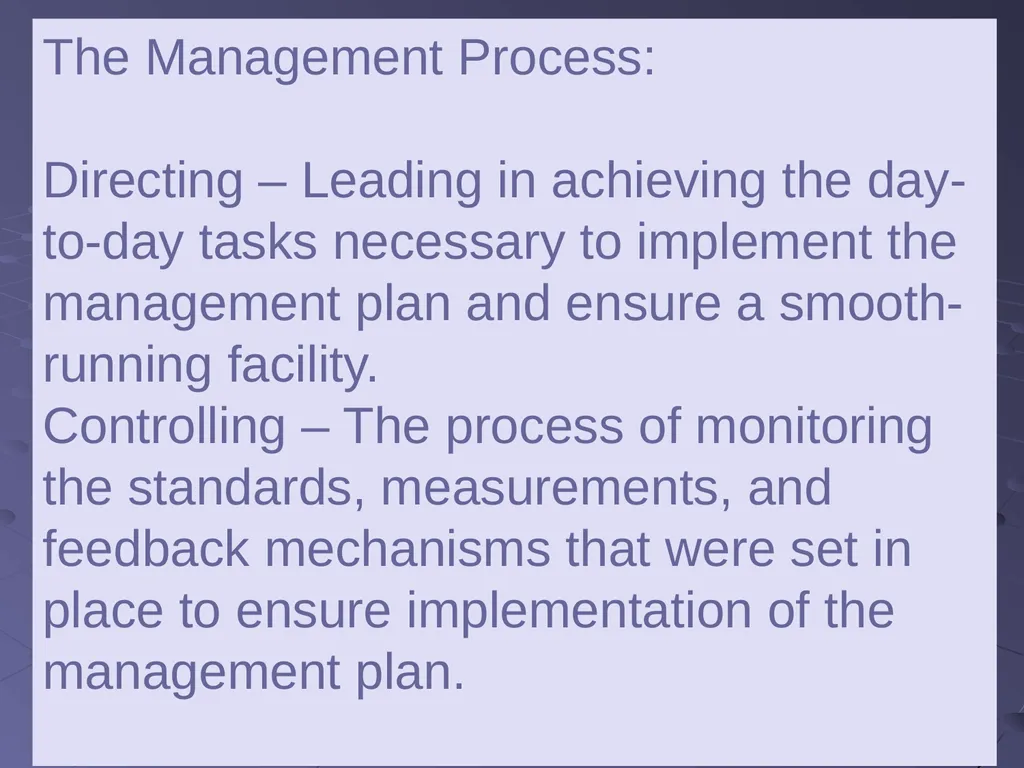
Directing – Leading in achieving the day-to-day tasks necessary to implement the management plan and ensure a smooth-running facility.
Controlling – The process of monitoring the standards, measurements, and feedback mechanisms that were set in place to ensure implementation of the management plan.<br>
Directing – Leading in achieving the day-to-day tasks necessary to implement the management plan and ensure a smooth-running facility.
Controlling – The process of monitoring the standards, measurements, and feedback mechanisms that were set in place to ensure implementation of the management plan.<br>
10
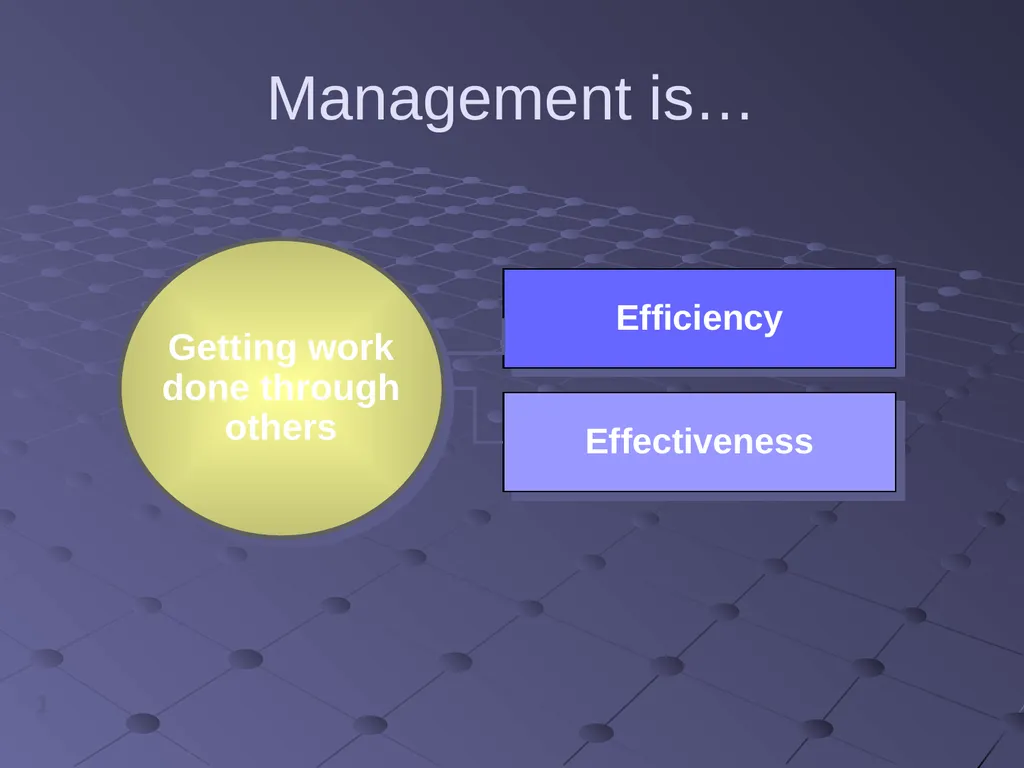
Management is… 1<br>
11
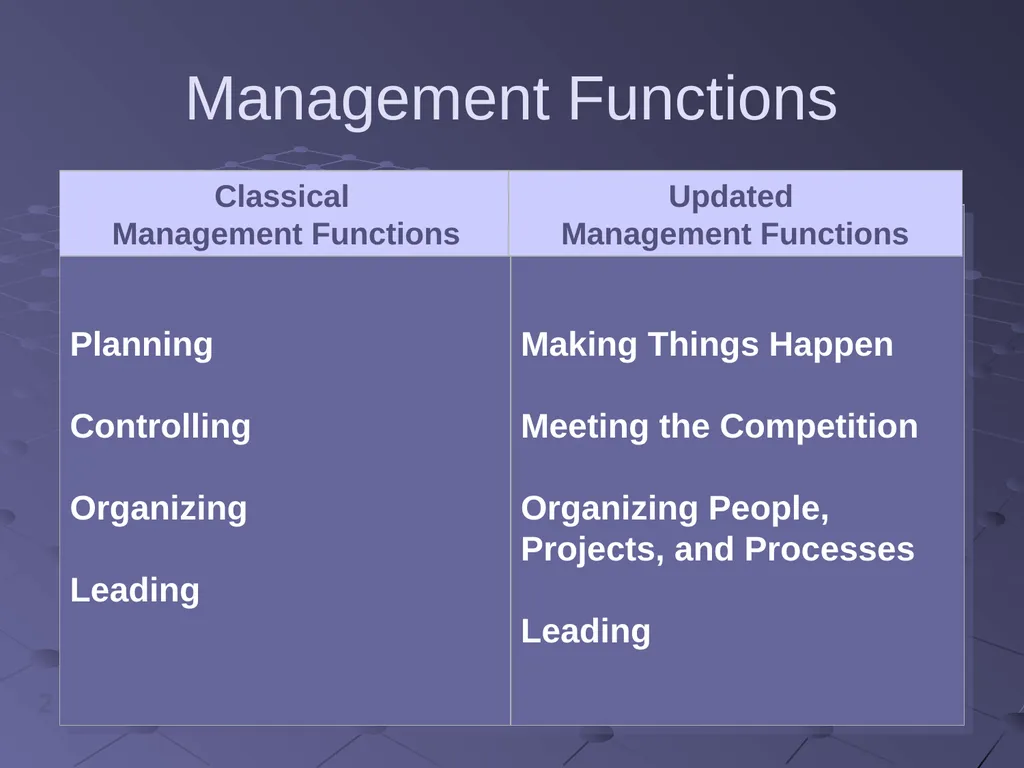
Management Functions 2<br>
12
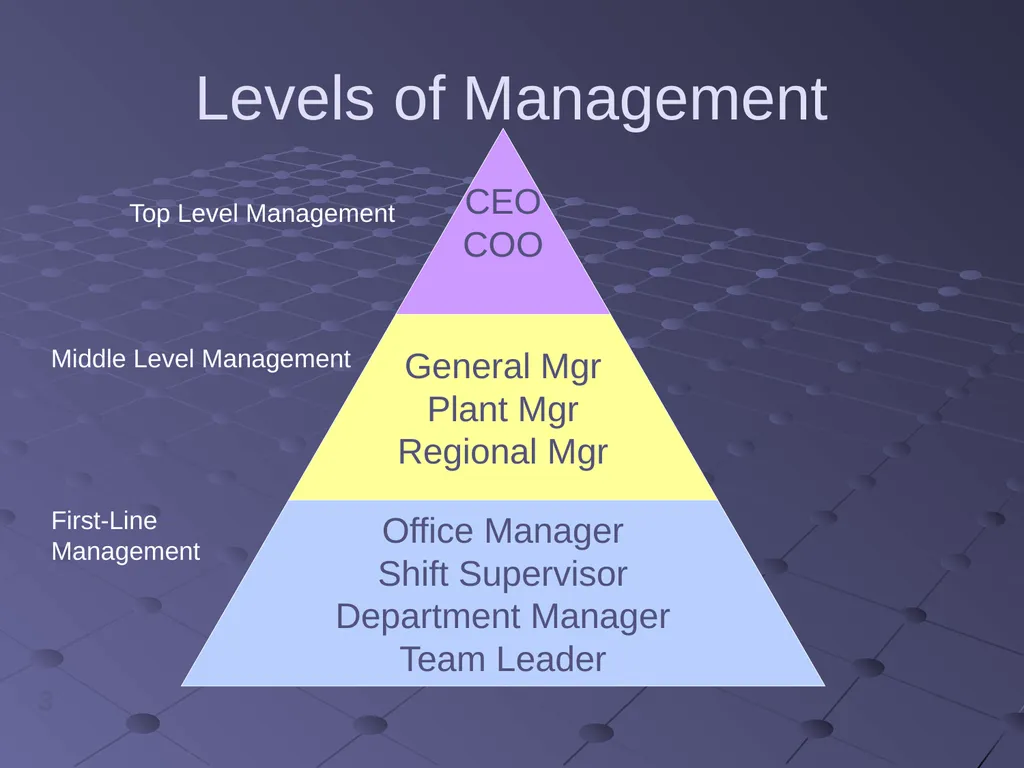
Levels of Management 3 Top Level Management Middle Level Management First-Line
Management<br>
Management<br>
13
Goal – A broad, long-term ambition of the organization.
Objective – A measurable standard or task, set in a designated time frame.<br>
Objective – A measurable standard or task, set in a designated time frame.<br>
14
Management by Objectives (MBO) – A program for managing an organization by setting and monitoring performance objectives.<br>
15
Generally, five conditions must be present for management to succeed:
A mission, or goal, that organization or subunit expects to accomplish
Leaders with the authority to direct the team toward the goal.
Necessary resources (people, equipment, supplies, and money)<br>
A mission, or goal, that organization or subunit expects to accomplish
Leaders with the authority to direct the team toward the goal.
Necessary resources (people, equipment, supplies, and money)<br>
16
Responsibility for achieving the goals assigned
Accountability for using the resources established<br>
Accountability for using the resources established<br>
17
With these five ingredients present, management can be defined as the process of coordinating and implementing these five functions.<br>
18
Roles of a Manager: People, Servant, Representative<br>
19
The Manager as a Person: Talent and Knowledge
Some people may appear to be “natural leaders” with inborn people skills. However, without an understanding of the management process, they soon fail when put in situations demanding extensive planning or technical knowledge<br>
Some people may appear to be “natural leaders” with inborn people skills. However, without an understanding of the management process, they soon fail when put in situations demanding extensive planning or technical knowledge<br>
20
There may also be “born organizers” who thrive in situations that require exacting attention to detail. They too may quickly run into trouble when required to interact with or direct a group of people<br>
21
The Manager as a Servant
Seeing that the person who actually performs the tasks and work of the institution has the resources necessary to effectively and efficiently accomplish his or her duties is the responsibility of everyone from the CEO to the immediate supervisor.<br>
Seeing that the person who actually performs the tasks and work of the institution has the resources necessary to effectively and efficiently accomplish his or her duties is the responsibility of everyone from the CEO to the immediate supervisor.<br>
22
The Manager as a Representative:
The manager is a paid representative of the owners or board of directors in both for-profit and not-for-profit organizations.
Managers must also represent those they supervise, as they are responsible for supplying their needs and presenting their concerns to the owners.<br>
The manager is a paid representative of the owners or board of directors in both for-profit and not-for-profit organizations.
Managers must also represent those they supervise, as they are responsible for supplying their needs and presenting their concerns to the owners.<br>
23
Some experts have argued that this representation function is the most important role of a manager in the successful operation of any business.<br>
24
Management skills can be divided into four groups, each of which is a focus of a separate part of this course:<br>
25
Organizational skills – include the ability to conceptualize and apply the management process, systematize work flow, make decisions, and communicate with coworkers.
People skills – an understanding of the basic theories of human needs and work motivation is essential to accomplishing the goals of the individual and the organization.<br>
People skills – an understanding of the basic theories of human needs and work motivation is essential to accomplishing the goals of the individual and the organization.<br>
26
Financial Management skills – these skills involve the effective use of and accounting for the monetary assets of the company
Technical skills – involve the synthesis of the first three skills and the management of physical resources (supplies, equipment, facilities) into the operational parameters (product/services) unique to each organization.<br>
Technical skills – involve the synthesis of the first three skills and the management of physical resources (supplies, equipment, facilities) into the operational parameters (product/services) unique to each organization.<br>
27
Major Management Theories:<br>
28
Scientific Management – represents the first orderly efforts to examine the functioning of complex organizations. The idea was to apply the scientific method of cause-and-effect analysis, used in the study of natural phenomena, to the examination of business enterprises.<br>
29
Henri Fayol (1841-1925) first introduced the concept that management should be an orderly process of tasks and duties, of which planning was the most important.<br>
30
Fayol’s thesis provides the base for the theory called the functions of management, or management process<br>
31
Frederick Taylor (1856-1915) – often called the father of scientific management, broke down each task into segments that could be analyzed for ways to improve efficiency<br>
32
Other important scientific management innovators include Mary Parker Follet (1868-1933), who pointed out that management is essentially coordination, and LyndallUrwick (1891-1983), who introduced the role of the management consultant and attempted to classify and codify the work done on management theories.<br>
33
Bureaucracy: The Study of Organizational Structure<br>
34
Bureaucracy Management – examines the organizational aspects and work flow of companies to explain how institutions function and how to improve the process.
particular attention is given to the bureaucratic characteristics of organizations as they relate to rules, regulations, impersonality, and the division of labor<br>
particular attention is given to the bureaucratic characteristics of organizations as they relate to rules, regulations, impersonality, and the division of labor<br>
35
Bureaucracy is often spoken of negatively, for example, “bureaucrat” or “red tape”<br>
36
In spite of this view, however, most academic and business consultants recommend focusing on the structure of the institutions and propose that implementing modifications in this area will improve management performance<br>
37
For example, too many management layers may hinder communications and cause huge amounts of red tape, but too few layers may result in loss of control, thereby hindering management effectiveness<br>
38
Organizational Behavior Management
This approach uses concepts from psychology and sociology as well as management theories.
The origins of these efforts lie in the studies conducted by Elton Mayo (1880-1949) between 1924 and 1932 at the Hawthorne Western Electric plant in Chicago.<br>
This approach uses concepts from psychology and sociology as well as management theories.
The origins of these efforts lie in the studies conducted by Elton Mayo (1880-1949) between 1924 and 1932 at the Hawthorne Western Electric plant in Chicago.<br>
39
Organizational Behavior Management
Mayo’s lead was followed by Douglas McGregor (1906-1964), who developed assumptions about the basic nature of man
RensisLikert (1903-1981), whose writings encouraged managers to be supportive in their relationships; and Barnard, who recommended that executives encourage a climate of cooperation.<br>
Mayo’s lead was followed by Douglas McGregor (1906-1964), who developed assumptions about the basic nature of man
RensisLikert (1903-1981), whose writings encouraged managers to be supportive in their relationships; and Barnard, who recommended that executives encourage a climate of cooperation.<br>
40
Systems Analysis Management
Analyzing businesses as a system was a natural evolution of scientific management.
The systems approach has been claimed by researchers who rely heavily on mathematical models, scientific methodology, and computer simulations to investigate management problems and recommend solutions.<br>
Analyzing businesses as a system was a natural evolution of scientific management.
The systems approach has been claimed by researchers who rely heavily on mathematical models, scientific methodology, and computer simulations to investigate management problems and recommend solutions.<br>
41
Systems Analysis Management
These specialties include operations research, management science, and systems (computer) analysis.<br>
These specialties include operations research, management science, and systems (computer) analysis.<br>
42
Peter Drucker’s five basic management operations are setting objectives; organizing; motivating and communicating; establishing standards or measurements of performance; and developing people, including the managers themselves.<br>
43
Most management texts, however, distill the management process into four main functions: planning, organizing, directing and controlling.<br>
44
Planning – Identify Goals, Evaluate Current Situation, Establish Time Frame, Set Objectives, Forecast Resource Needs, Implement Plan, Obtain Feedback
Organizing – Formal Hierarchy, Informal Relationships<br>
Organizing – Formal Hierarchy, Informal Relationships<br>
45
Directing – Leadership, Time Allocation
Controlling – Instructions, Follow-up, Modifications<br>
Controlling – Instructions, Follow-up, Modifications<br>
46
Planning –During the planning phase, managers attempt to anticipate the future and either shape it to their own ends or prepare for the coming changes.<br>
47
Planning - It is the thinking and analyzing portion of the management process; the other three phases (organizing, directing, and controlling) focus on implementation of the plan developed in this initial stage.<br>
48
The management planning process can be divided into seven steps:<br>
49
1. Determine the goals the organization wishes to accomplish.
2. Collect information and evaluate the current situation, compared with where the enterprise wishes to be.<br>
2. Collect information and evaluate the current situation, compared with where the enterprise wishes to be.<br>
50
3. Establish a time frame or period in which to achieve the goals.
4. Set objectives that will move the company toward the desired future.<br>
4. Set objectives that will move the company toward the desired future.<br>
51
5. Forecast needs and the use of resources.
6. Determine the steps necessary to implement the plan.<br>
6. Determine the steps necessary to implement the plan.<br>
52
7. Provide for a feedback mechanism to continually review the success of the plan and to implement the necessary revisions.<br>
53
Four basic characteristics of a good objective:
1. It is clearly defined and understood.
2. It is obtainable and realistic.
3. It has a strict time period in which it is to be accomplished.
4. It is measurable.<br>
1. It is clearly defined and understood.
2. It is obtainable and realistic.
3. It has a strict time period in which it is to be accomplished.
4. It is measurable.<br>
54
The manager has two basic avenues for implementing a plan or obtaining the desired performance:<br>
55
1. Tools of persuasion – can best be described by listing key words associated with this method: communication, involvement, inclusion, education, training, cooperation, building confidence, support, consultation, feedback, sharing information, and responsibility<br>
56
2. Tools of control – involves the allocation of resources. By virtue of their position and formal authority, managers have two tools of control that are crucial in obtaining and maintaining management control: (1) the allocation of financial resources (selection of equipment and supplies and number of employees) through the budgeting process and (2) the process of staffing and scheduling, or job assignments.<br>
57
Management by Objectives (MBO) – is a program that embodies all of the concepts in the management process. The idea was first introduced by Peter Drucker in the 1960s, incorporates the principles of planning, operating, directing, and controlling into everyday practice.<br>
58
At the core of MBO is communications. Its success or failure depends on how well employees understand the company’s mission and objectives.
Managers must understand where their staffs are headed and how individual employees perceive their jobs.<br>
Managers must understand where their staffs are headed and how individual employees perceive their jobs.<br>
59
Effective MBO programs require managers who are participatory in their leadership style, that is, managers who allow employees to share in the decision-making process.<br>
60
Characteristics of Objectives in MBO Programs
1. Follow well-though-out plans and long-term goals.
2. Be based on a collaborative agreement between supervisor and employee.
3. Be person-specific.<br>
1. Follow well-though-out plans and long-term goals.
2. Be based on a collaborative agreement between supervisor and employee.
3. Be person-specific.<br>
61
4. Be within the power of the individual to accomplish.
5. Be measurable.
6. Have a designated time frame.
7. Provide feedback and information to responsible employees so they know how they are progressing and can make timely and independent adjustments.<br>
5. Be measurable.
6. Have a designated time frame.
7. Provide feedback and information to responsible employees so they know how they are progressing and can make timely and independent adjustments.<br>
62
4. Be within the power of the individual to accomplish.
5. Be measurable.
6. Have a designated time frame.
7. Provide feedback and information to responsible employees so they know how they are progressing and can make timely and independent adjustments.<br>
5. Be measurable.
6. Have a designated time frame.
7. Provide feedback and information to responsible employees so they know how they are progressing and can make timely and independent adjustments.<br>
63
Implementing an MBO Program
1. Managers must set the goals and objectives for the organization in order to have a clear picture of what they wish to accomplish.<br>
1. Managers must set the goals and objectives for the organization in order to have a clear picture of what they wish to accomplish.<br>
64
Implementing an MBO Program
2. These objectives should be shared with the staff. Employees should be given the opportunity to develop their own priorities from the guidelines presented by the managers.<br>
2. These objectives should be shared with the staff. Employees should be given the opportunity to develop their own priorities from the guidelines presented by the managers.<br>
65
Implementing an MBO Program
3. The manager and each employee must meet and come to a mutual agreement on the goals and objectives of the individual. This meeting should serve as the foundation for the employee’s periodic performance evaluation. From this session, both the manager and the employee have a clear understanding of what is expected and how the employee’s work will be evaluated.<br>
3. The manager and each employee must meet and come to a mutual agreement on the goals and objectives of the individual. This meeting should serve as the foundation for the employee’s periodic performance evaluation. From this session, both the manager and the employee have a clear understanding of what is expected and how the employee’s work will be evaluated.<br>
66
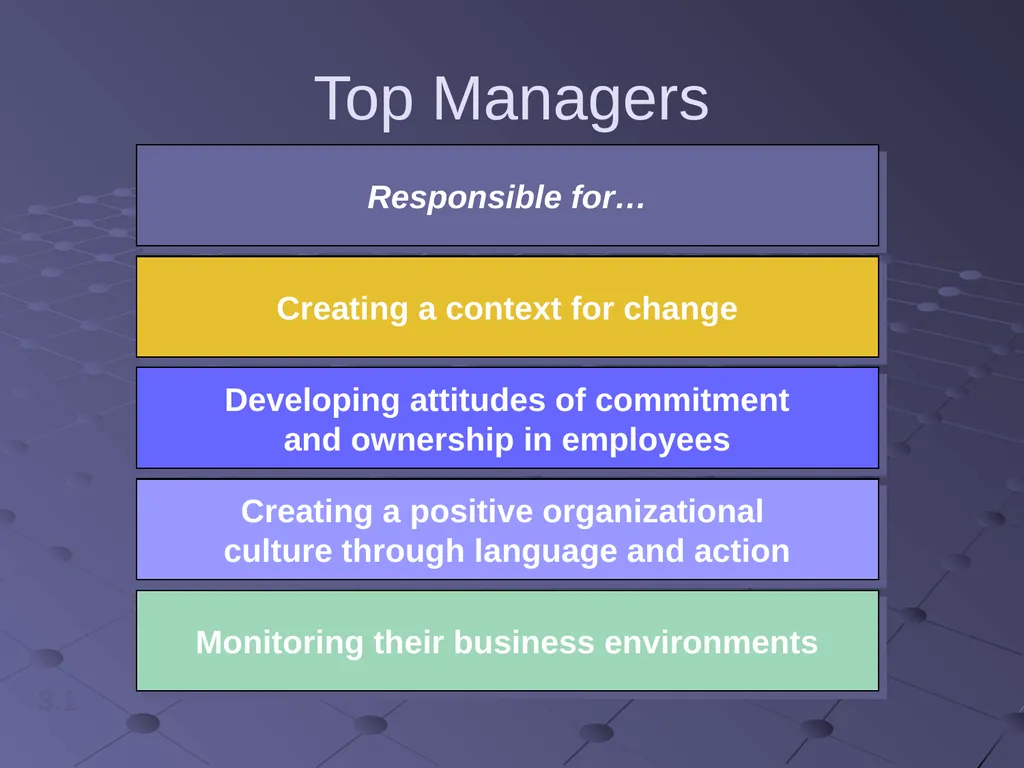
Top Managers 3.1<br>
67
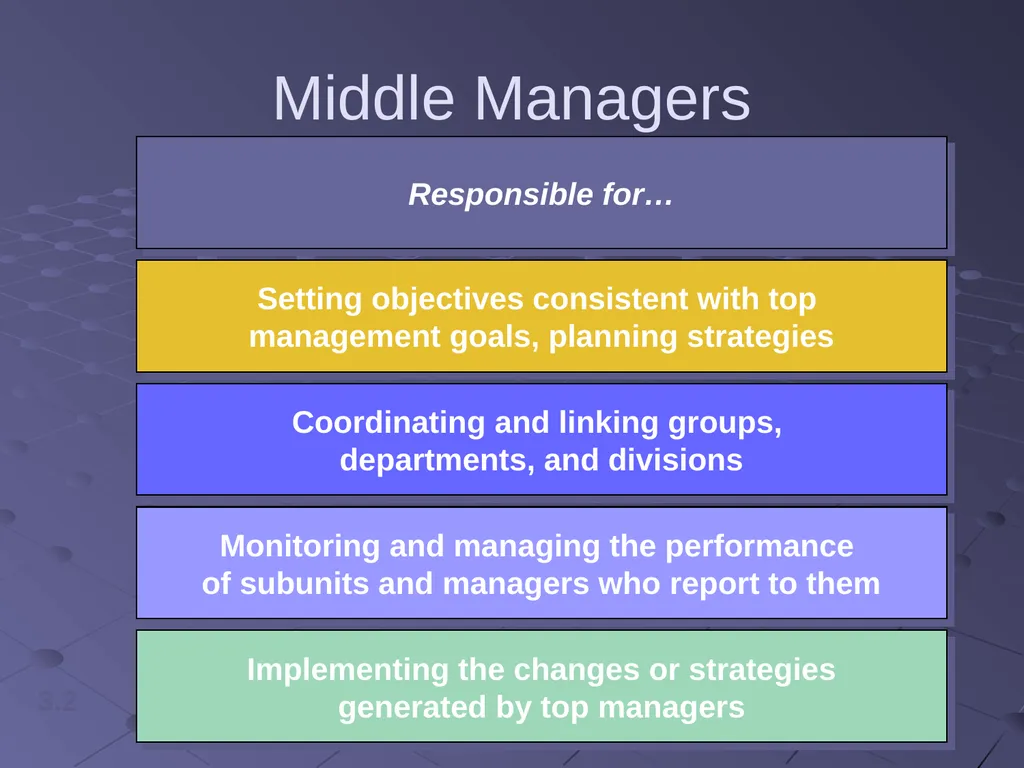
Middle Managers 3.2<br>
68
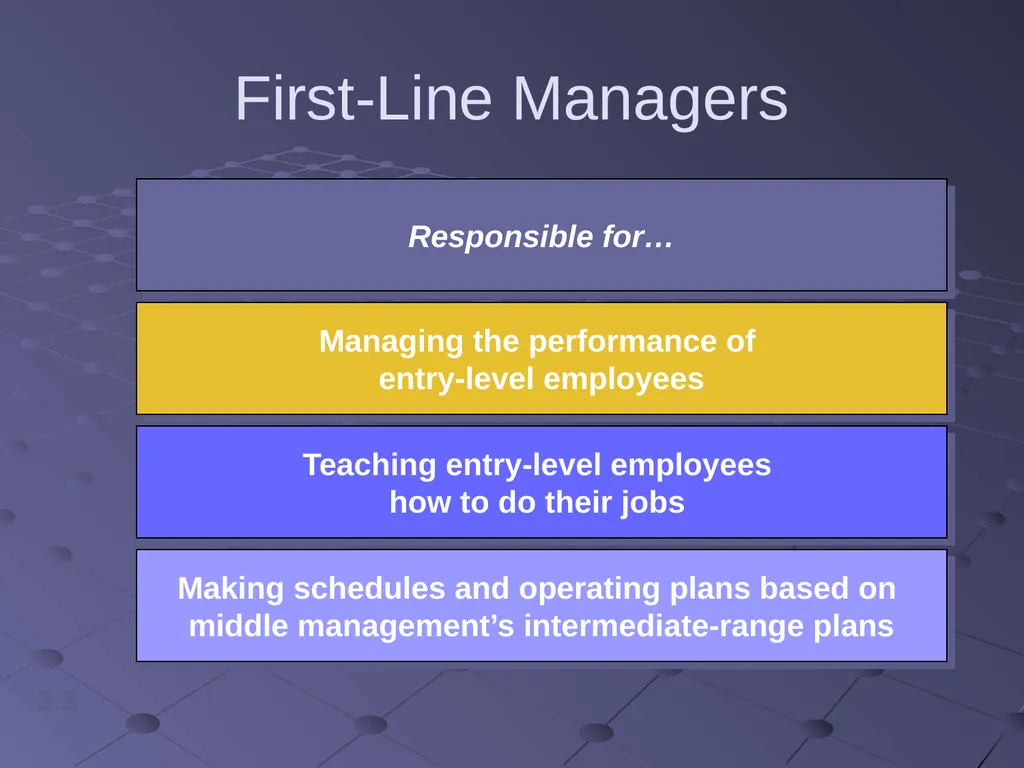
First-Line Managers 3.3<br>
69
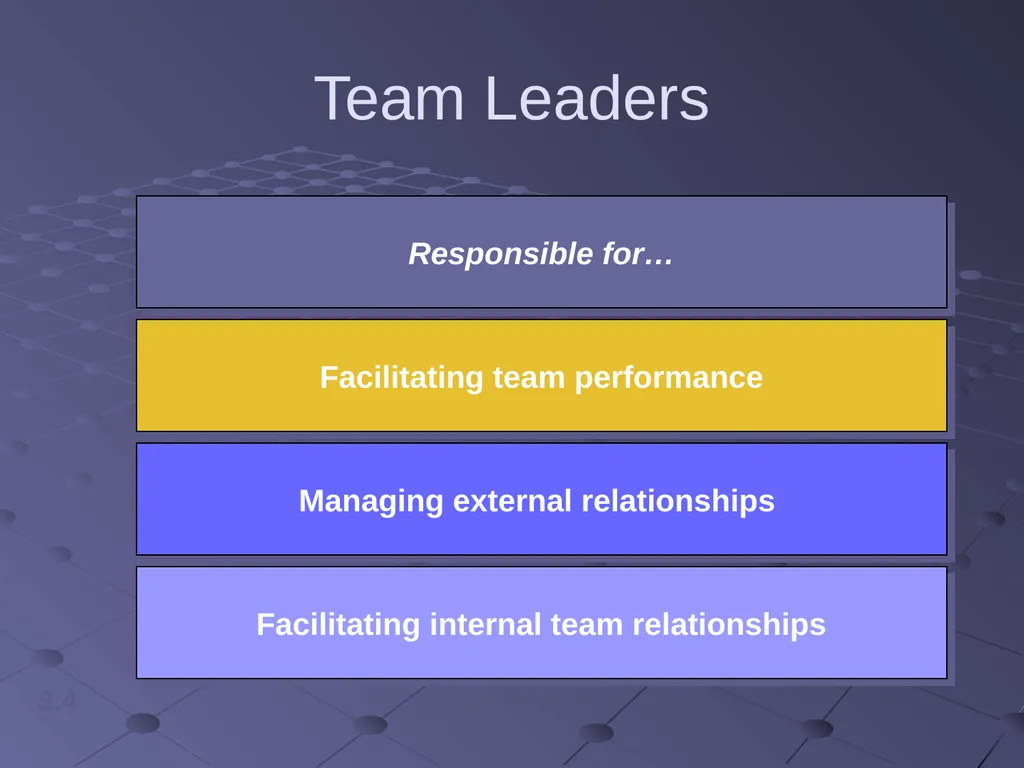
Team Leaders 3.4<br>
70
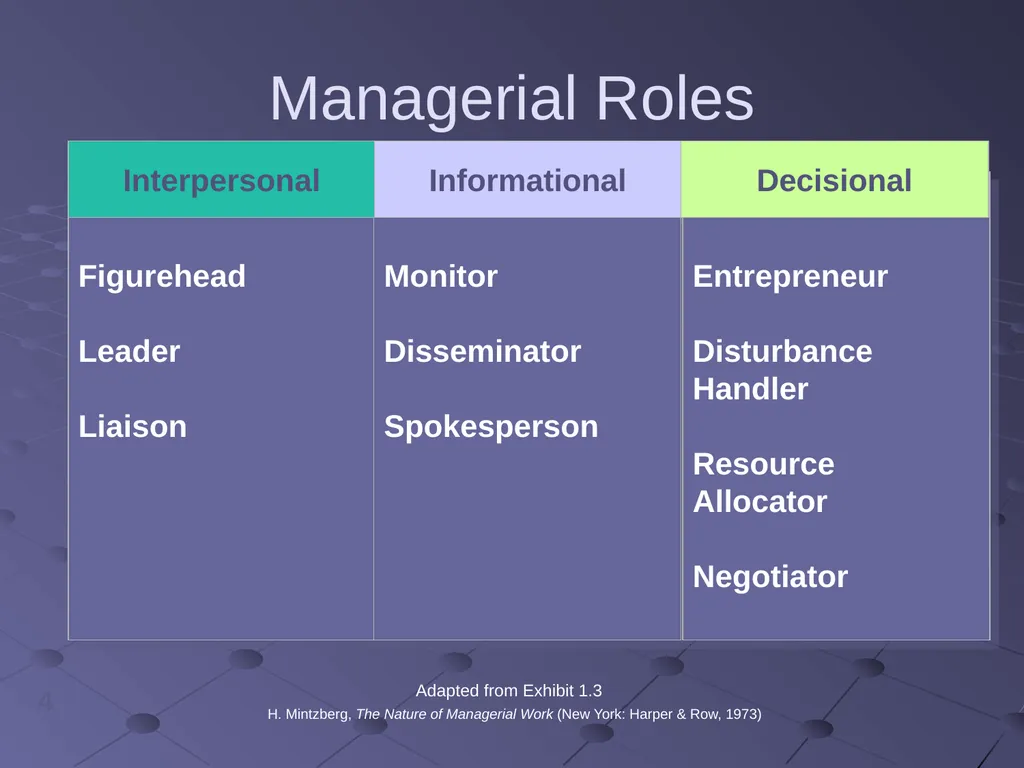
Managerial Roles 4 H. Mintzberg, The Nature of Managerial Work (New York: Harper & Row, 1973) Adapted from Exhibit 1.3<br>
71
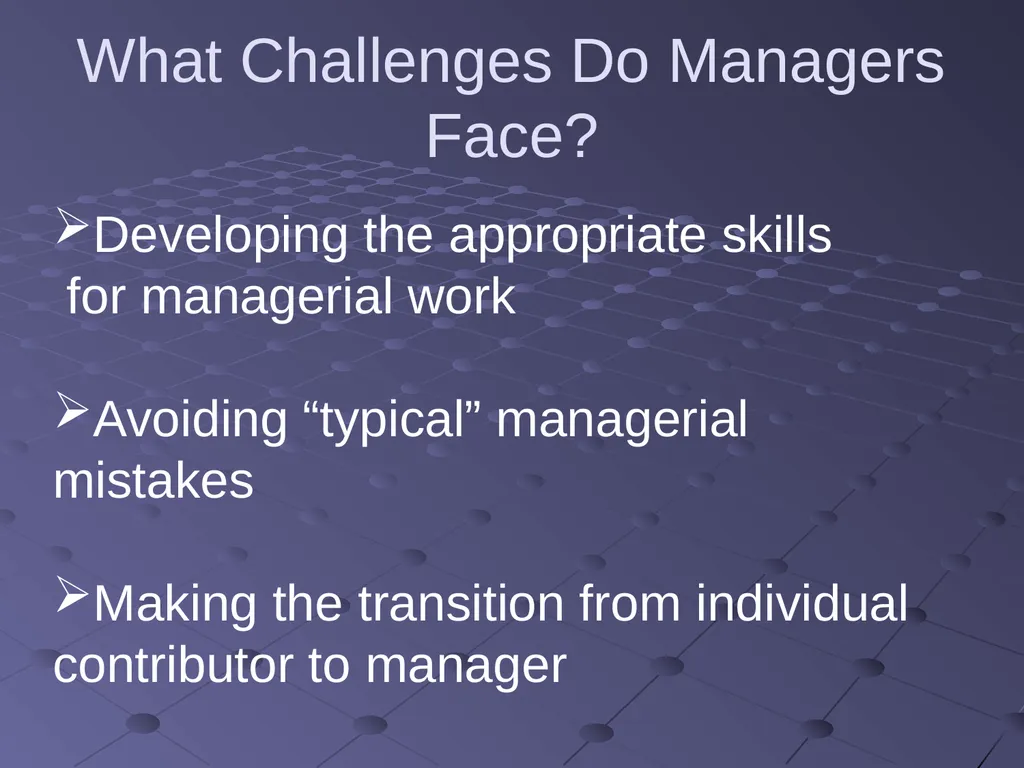
What Challenges Do Managers Face? Developing the appropriate skills
for managerial work
Avoiding “typical” managerial mistakes
Making the transition from individual contributor to manager<br>
for managerial work
Avoiding “typical” managerial mistakes
Making the transition from individual contributor to manager<br>
72
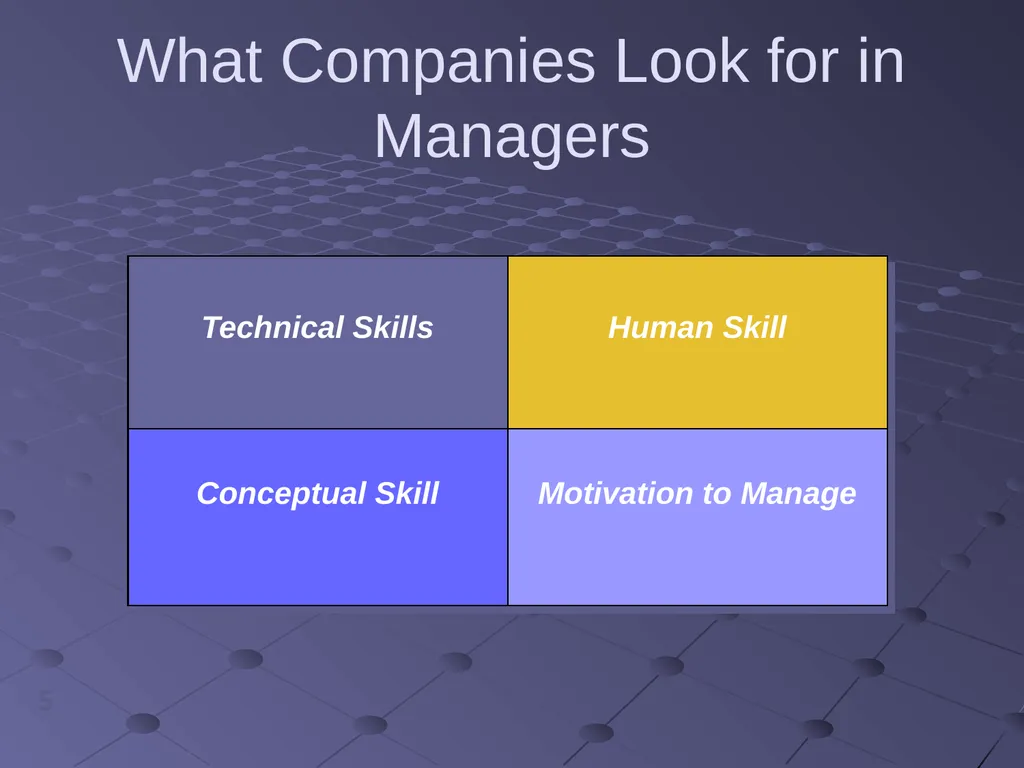
What Companies Look for in Managers 5<br>
73
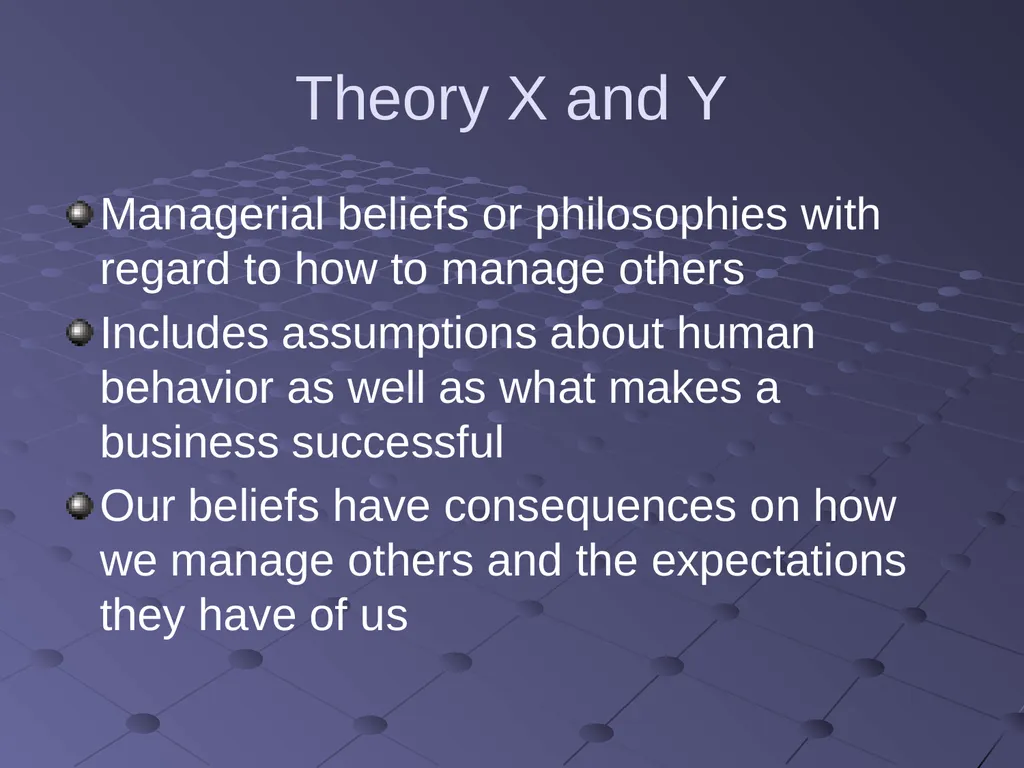
Theory X and Y Managerial beliefs or philosophies with regard to how to manage others
Includes assumptions about human behavior as well as what makes a business successful
Our beliefs have consequences on how we manage others and the expectations they have of us<br>
Includes assumptions about human behavior as well as what makes a business successful
Our beliefs have consequences on how we manage others and the expectations they have of us<br>
74
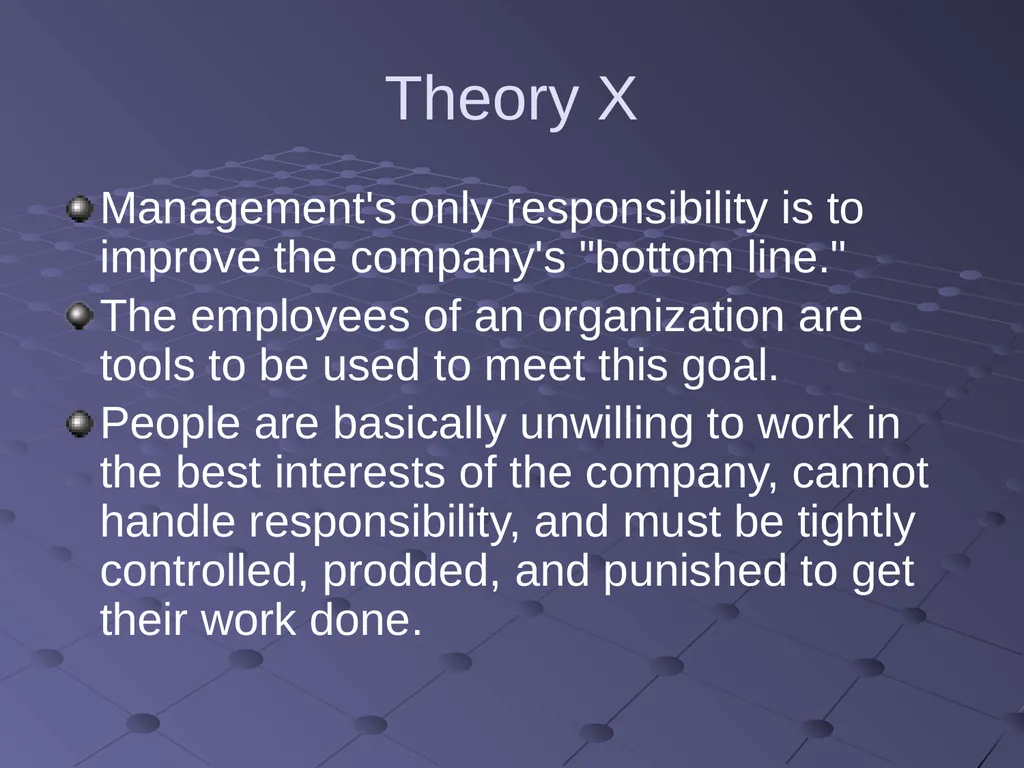
Theory X Management's only responsibility is to improve the company's "bottom line."
The employees of an organization are tools to be used to meet this goal.
People are basically unwilling to work in the best interests of the company, cannot handle responsibility, and must be tightly controlled, prodded, and punished to get their work done.<br>
The employees of an organization are tools to be used to meet this goal.
People are basically unwilling to work in the best interests of the company, cannot handle responsibility, and must be tightly controlled, prodded, and punished to get their work done.<br>
75
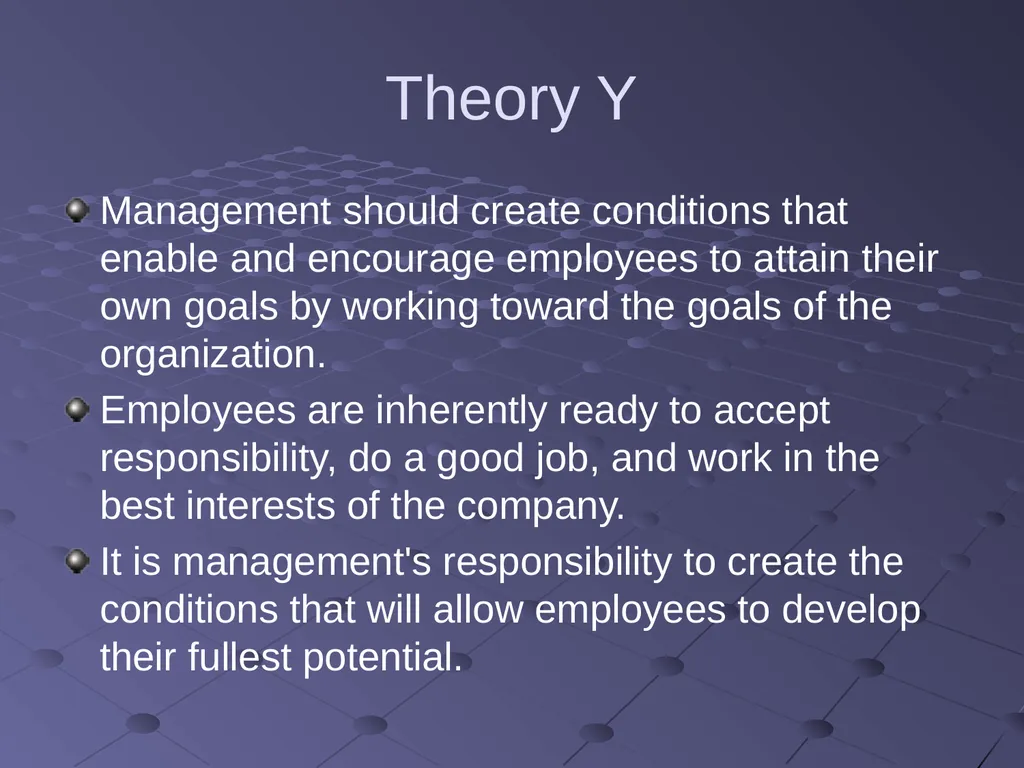
Theory Y Management should create conditions that enable and encourage employees to attain their own goals by working toward the goals of the organization.
Employees are inherently ready to accept responsibility, do a good job, and work in the best interests of the company.
It is management's responsibility to create the conditions that will allow employees to develop their fullest potential.<br>
Employees are inherently ready to accept responsibility, do a good job, and work in the best interests of the company.
It is management's responsibility to create the conditions that will allow employees to develop their fullest potential.<br>
76
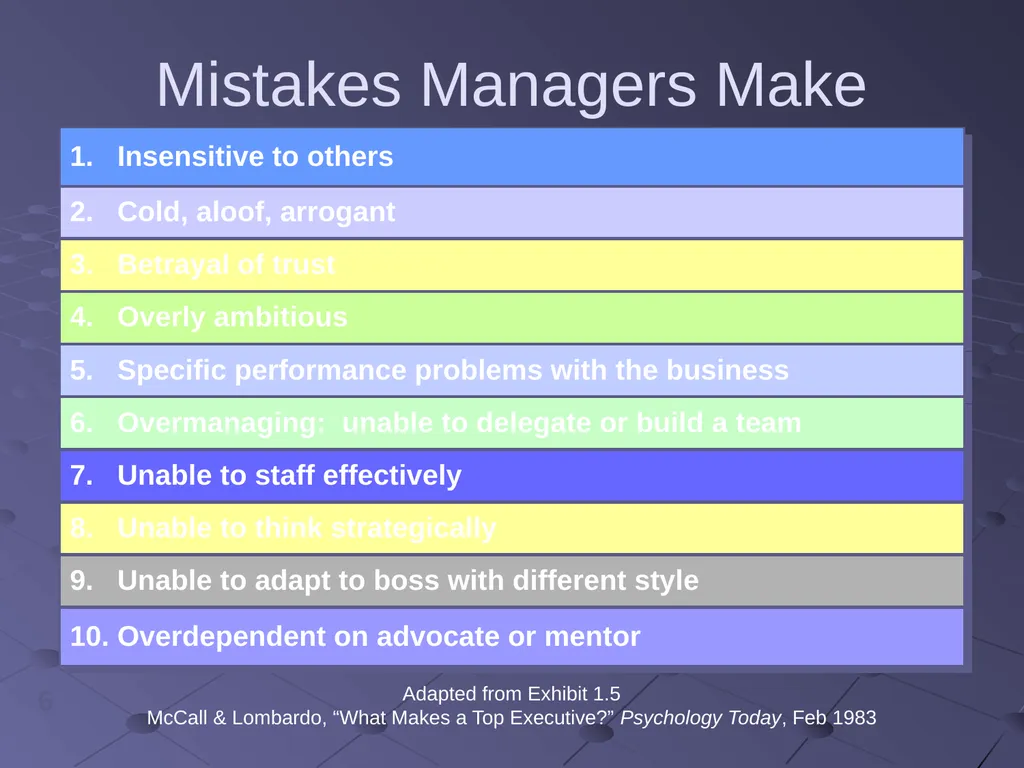
Mistakes Managers Make 6 Adapted from Exhibit 1.5
McCall & Lombardo, “What Makes a Top Executive?” Psychology Today, Feb 1983<br>
77
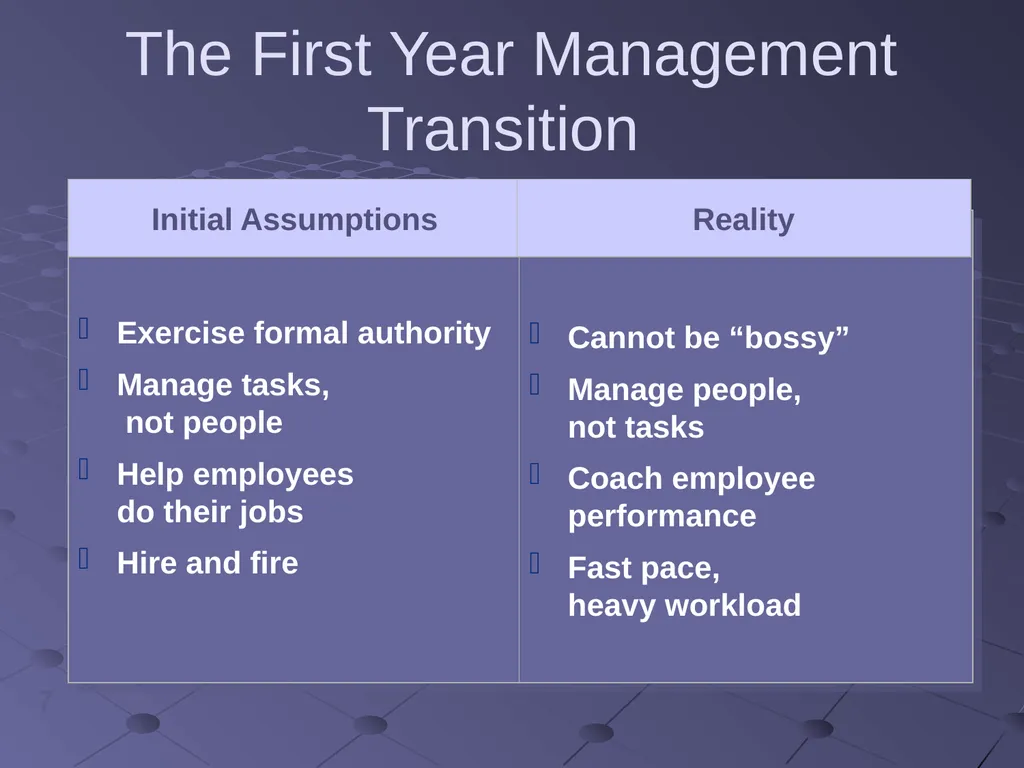
The First Year Management Transition 7<br>