05
Public-key encryption Public (encryption) key
Anyone can encrypt a message
Private (decryption) key
Only the creator can decrypt a ciphertext
Allows client to send a secret key to the bank<br>
07
Why cryptology and not cryptography A cryptosystem uses cryptography to protect either
Confidentiality
Integrity
Cryptography is the art of making cryptosystems
Cryptology is the science (math) of making cryptosystems<br>
08
How is it science? Clear definitions of security
Formal protocol descriptions
Proofs of security
Why a science?
Crypto is hard<br>
09
Bad things can happen when crypto is bad Millions of bitcoins stolen
Fake windows updates
Adobe leaked password database<br>
10
Historical perspective on computational encryption scheme Caesar cipher
Enigma
Lessons from historical perspective<br>
11
Perfect security Samuel Ranellucci 11<br>
12
Key is always assumed hidden from the adversary
One-time means that the key is discarded after use 12 Assumption<br>
13
One-time pad
One-time mac
Disavantages of perfect security 13 Overview<br>
14
Alice tells Bob either to go left or right
Eve can then place trap on either
Left side
Right side
Eve wins if
trap placed is on the same side that Bob went 14 Trap game #1<br>
15
15 How eve can win game #1 Left Goes left Left Eve reads the message and places trap based on message
Eve always wins.<br>
16
When Alice and Bob want to hide messages from Eve.
Prevents Eve from knowing where to put the trap. 16 Encryption<br>
17
17 Encryption scheme<br>
19
19 Security one-time pad<br>
20
20 m=0 m=1 0 0 k=0 k=1 1 1<br>
21
21 One-time pad vs Eve ?????????<br>
22
22 Bob could go left ?????????<br>
23
23 Bob could go right ?????????<br>
24
Eve places a trap
Alice tells which side to go to Bob
She knows where trap is
Eve wins if
Bob goes where the trap is 24 Trap game #2<br>
25
25 How eve can win game #2 Left Goes Right Eve places trap on right side. Eve always wins. Eve replaces message Right<br>
26
Allows Bob to know that a message really came from Alice
Prevents Eve from redirecting Bob towards the trap 26 Authentication<br>
27
27 Message authentication code<br>
28
28 Unforgeability game m t<br>
29
Encryption: Hide the message from Eve
Authentication: Allows Bob to verify that the message came from Alice
Message can be perfectly encrypted using one-time pad
Requires key as long as the message
One-time mac
2s bits of keys can authenticate an arbitrary long message by viewing the message as a polynomial 29 Review<br>
30
Perfect encryption
key as long as message
Perfect authentication
2s bits of key per message sent 30 Disadvantages of perfect security<br>
31
Computational cryptography Reuse the same key to encrypt multiple messages
Since it is not longer perfectly secure, what we want is the amount of effort it requires to break is larger than all the computational power in the universe<br>
32
Historical perspective Caesar cipher
Reusing one-time pad
Substitution cipher<br>
34
Very easy to break<br>
35
Permutation cipher<br>
36
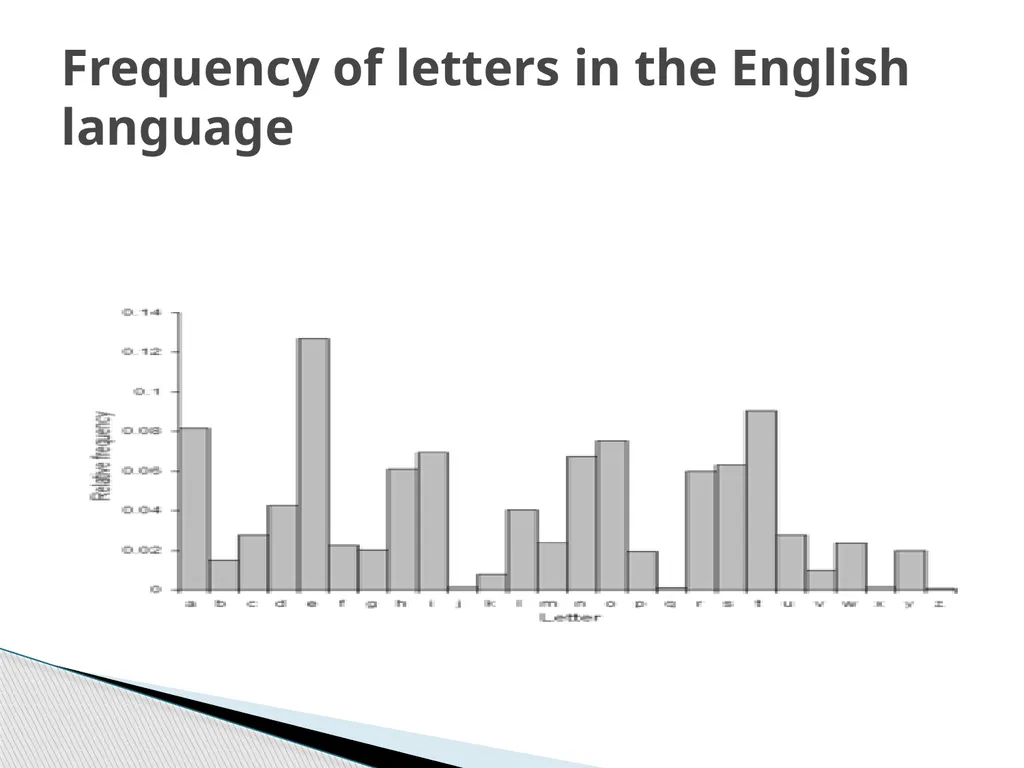
Frequency of letters in the English language<br>
37
Which princess are they plotting to kidnap? WMMW Anna Elsa<br>
38
Security of permutation cipher # Keys = 26! = 2^88
Lesson: Encryption scheme should break correlations
Lesson: Encryption scheme should not allow an attacker to distinguish between any two messages<br>
39
Computational encryption Samuel Ranellucci 39<br>
40
Computational Security Encrypt many messages using short keys
Limitations of perfect secrecy can be bypassed
We can achieve a strong but necessarily weaker notion than perfect secrecy<br>
41
Computational approach to secure encryption A computation encryption scheme can be broken given enough time
Try all the keys until you find the right one
Guess keys until you find the right one
Under certain assumptions, it should take millions of years to break an encryption scheme even given all the (current and future) computation power available on earth<br>
42
Security An cryptographic scheme is secure if
there exists no efficient algorithm which breaks the scheme with non-negligible probability.<br>
43
Encryption game c An encryption scheme is secure if any adversary can only guess with very small probability which of these two games he is playing. c<br>
44
44 Is the previous definition sufficient? c c If an encryption scheme is deterministic (a message always gets encrypted to the same ciphertext) then an adversary can learn if the same message was encrypted twice<br>
45
Midway islands (non-CPA secure) American cryptanalysts thought: * = Midway Island
Americans sent: “Midway is low on water”
Japanese sent: “* blah blah”
Americans confirmed that * = Midway Island
Lesson: Adversaries can influence what is being encrypted<br>
46
m Chosen-plaintext security c c Repeat as many times as the distinguisher wants m c c Repeat as many times as the
distinguisher wants<br>
47
On the (in)security of deterministic encryption scheme An encryption scheme is deterministic
Each plaintext maps to a unique ciphertext
Can deterministic encryption scheme be CPA-secure?
No!
Encrypting the same plaintext twice results in the same ciphertext.
Lesson: Secure encryption requires randomness<br>
48
Pseudo-random function m m Repeat as many times as the
distinguisher wants Repeat as many times as the
distinguisher wants<br>
49
CPA-secure encryption scheme from PRF<br>
50
A block cipher is simply a PRF where the input sizes and output sizes are the same 50 Block cipher m m Repeat as many times as the
distinguisher wants Repeat as many times as the
distinguisher wants<br>
51
Block cipher and mode�of encryptions<br>
52
Block cipher Other name for fixed-length encryption scheme<br>
53
Problem with just encrypting each block of the message using a randomized encryption scheme<br>
54
Solution to minimize randomness Create an initial state
May use some randomness (called Nonce or IV).
Encrypt the current block using the current state
Update the state after each use of the block cipher<br>
55
Goals of encryption Security
Is it secure?
What level of security does it have?
Parallelizable: Can we encrypt/decrypt each block in parallel
We don’t need to wait for the previous part to encrypt the next part.
Forward: Do we need to use decryption operation
Better if we don’t
Error-resilient: If one block of the ciphertext becomes corrupted<br>
57
Electronic codebook mode (ECB)<br>
58
Electronic codebook mode (ECB)<br>
59
Problem with ECB mode<br>
63
Cipher block chaining<br>
64
Cipher block chaining (CBC)<br>
65
Cipher block chaining<br>
66
Computational message authentication code<br>
67
Message authentication code<br>
68
Mac forgery game Repeat as many times
as the adversary wants<br>
70
Does encryption imply authentication Let’s take as example the one-time pad
What happens if the adversary flips a bit of the ciphertext?
Lesson: Encryption does not imply authentication<br>
71
Fixed-length mac from PRF m m t t<br>
72
Pitfalls of authenticating arbitrary length message<br>
73
CBC-mac (fixed-length extension)<br>
74
No
Take any authentication scheme and modify the authentication algorithm to produce both the tag of the original scheme and the message it authenticated
The tag in this new scheme will leak the authenticated message
This scheme is still secure 74 Does authentication imply encryption?<br>