Introduction to Nanotechnology: Insights into a
Description: Introduction to Nanotechnology: Insights into a Nano-Sized World What is nanotechnology? Definition 1: Nanotechnology is the creation of functional materials, devices, and systems through control of matter on the nanometer length scale,
Related Topics
Download Presentation
"Introduction to Nanotechnology: Insights into a" is the property of its rightful owner. Permission is granted to download and print the materials on this website for personal, non-commercial use only, and to display it on your personal computer provided you do not modify the materials and that you retain all copyright notices contained in the materials. By downloading content from our website, you accept the terms of this agreement.
Presentation Transcript
slide1. Introduction to Nanotechnology: Insights into a Nano-Sized World<br>
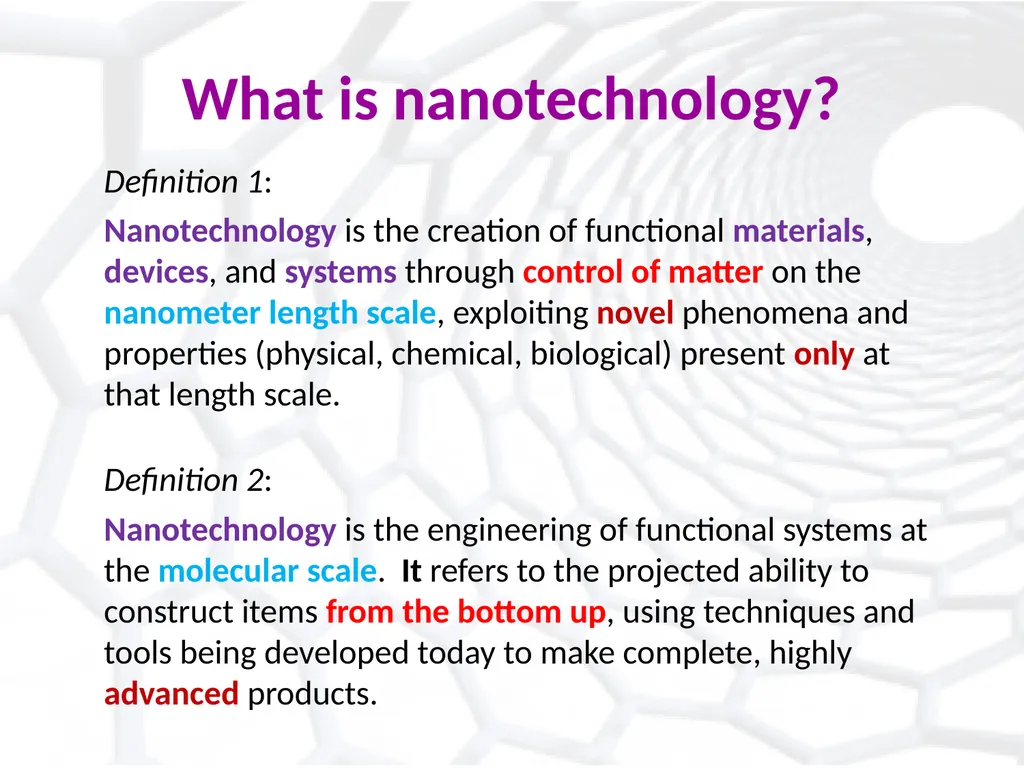
slide2. What is nanotechnology? Definition 1:
Nanotechnology is the creation of functional materials, devices, and systems through control of matter on the nanometer length scale, exploiting novel phenomena and properties (physical, chemical, biological) present only at that length scale. Definition 2:
Nanotechnology is the engineering of functional systems at the molecular scale. It refers to the projected ability to construct items from the bottom up, using techniques and tools being developed today to make complete, highly advanced products.<br>
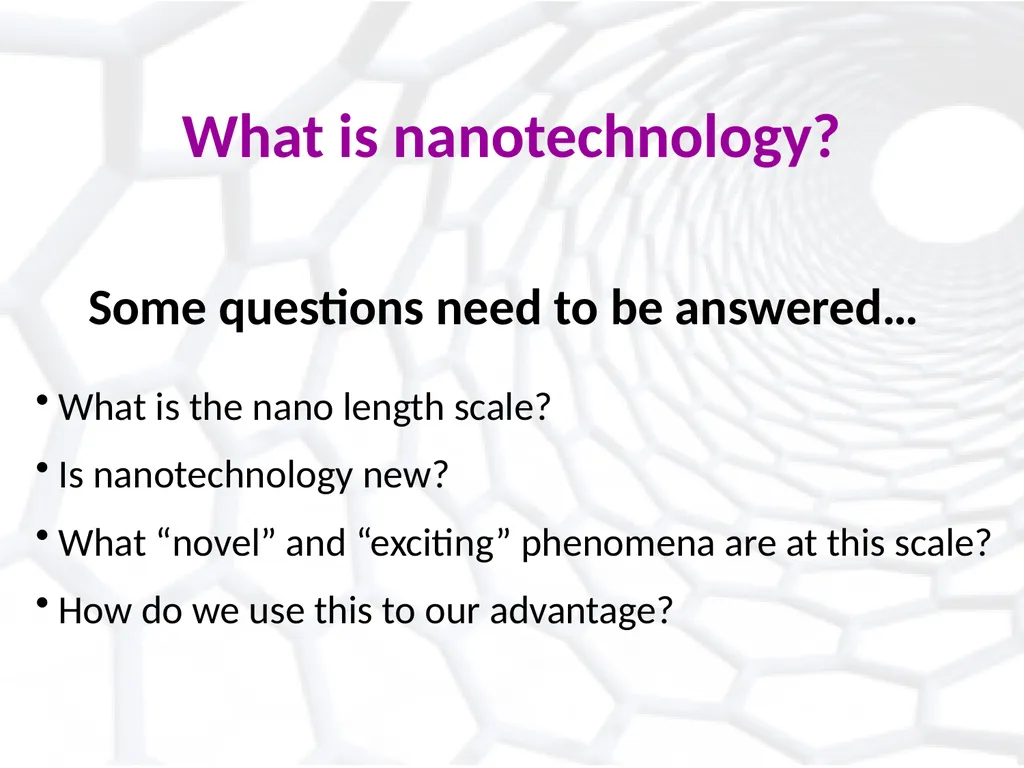
slide3. What is nanotechnology? What is the nano length scale?
Is nanotechnology new?
What “novel” and “exciting” phenomena are at this scale?
How do we use this to our advantage? Some questions need to be answered…<br>
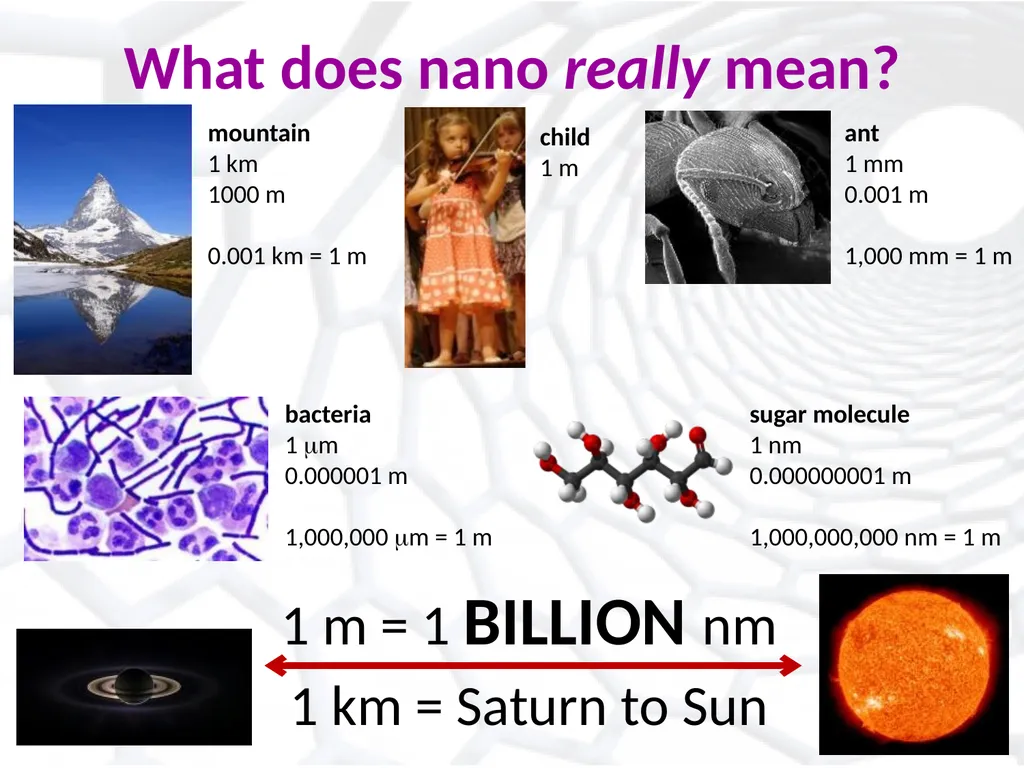
slide4. What does nano really mean? bacteria
1 m
0.000001 m
1,000,000 m = 1 m mountain
1 km
1000 m
0.001 km = 1 m child
1 m ant
1 mm
0.001 m
1,000 mm = 1 m sugar molecule
1 nm
0.000000001 m
1,000,000,000 nm = 1 m 1 m = 1 BILLION nm 1 km = Saturn to Sun<br>
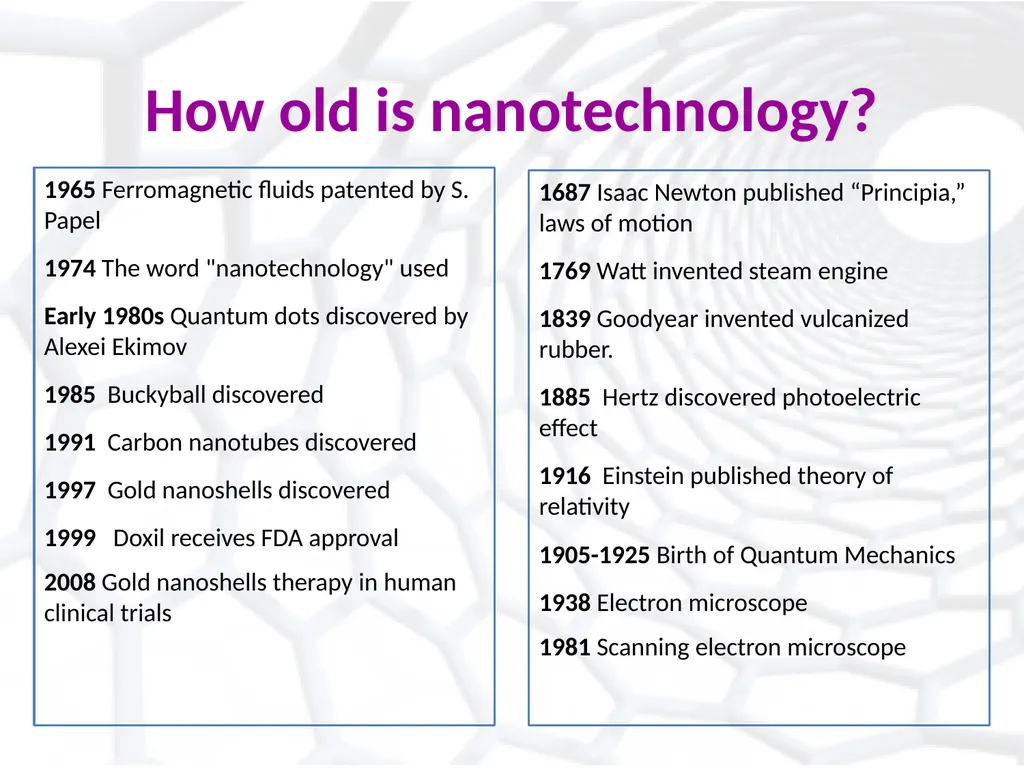
slide5. How old is nanotechnology? 1965 Ferromagnetic fluids patented by S. Papel
1974 The word "nanotechnology" used
Early 1980s Quantum dots discovered by Alexei Ekimov
1985 Buckyball discovered
1991 Carbon nanotubes discovered
1997 Gold nanoshells discovered
1999 Doxil receives FDA approval
2008 Gold nanoshells therapy in human clinical trials 1687 Isaac Newton published “Principia,” laws of motion
1769 Watt invented steam engine
1839 Goodyear invented vulcanized rubber.
1885 Hertz discovered photoelectric effect
1916 Einstein published theory of relativity
1905-1925 Birth of Quantum Mechanics
1938 Electron microscope
1981 Scanning electron microscope<br>
slide6. How old is nanotechnology? In comparison, nanotechnology is fairly young.
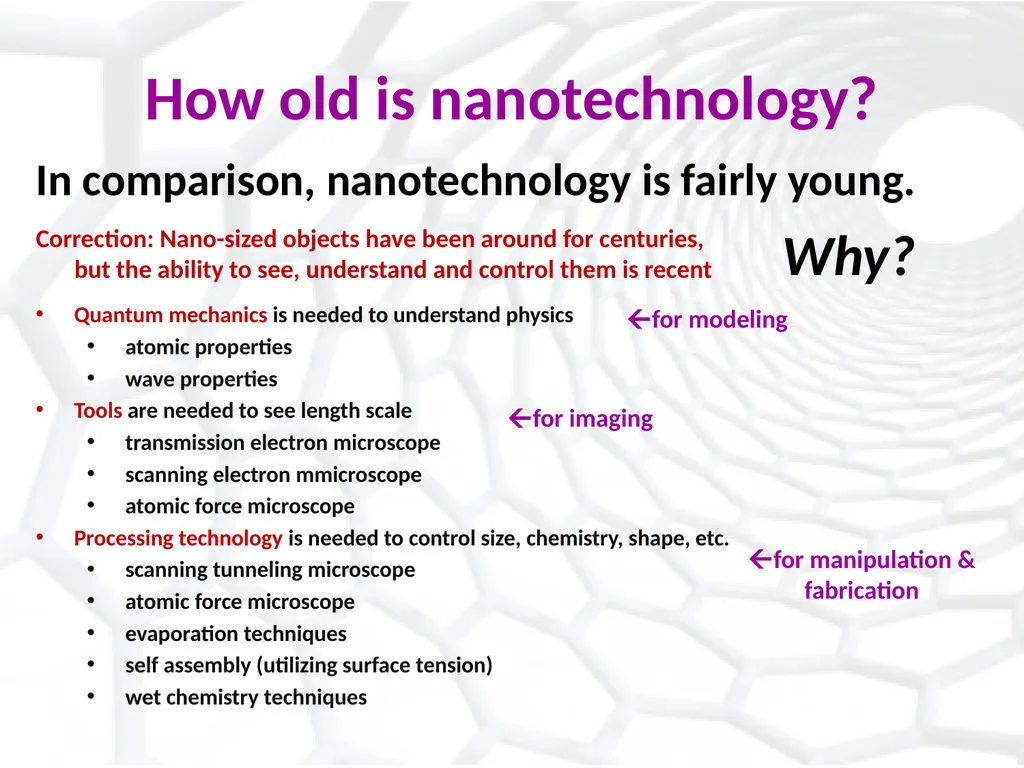
Correction: Nano-sized objects have been around for centuries, but the ability to see, understand and control them is recent Why? Quantum mechanics is needed to understand physics
atomic properties
wave properties
Tools are needed to see length scale
transmission electron microscope
scanning electron mmicroscope
atomic force microscope
Processing technology is needed to control size, chemistry, shape, etc.
scanning tunneling microscope
atomic force microscope
evaporation techniques
self assembly (utilizing surface tension)
wet chemistry techniques for modeling for imaging for manipulation & fabrication<br>
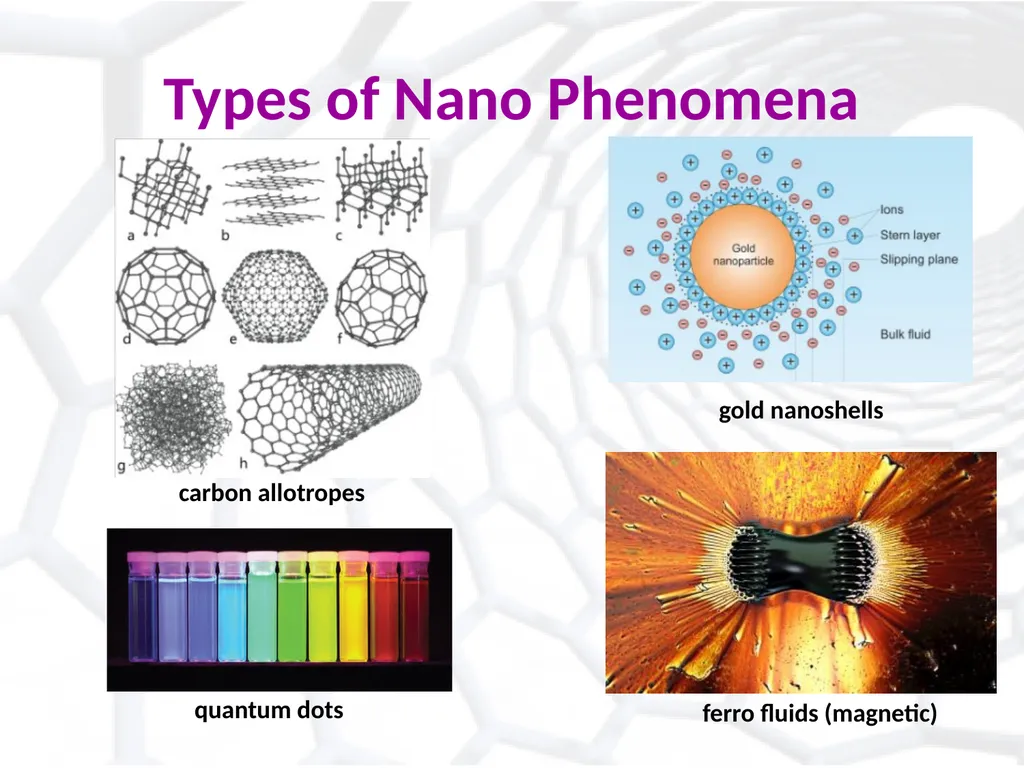
slide7. Types of Nano Phenomena carbon allotropes quantum dots ferro fluids (magnetic) gold nanoshells<br>
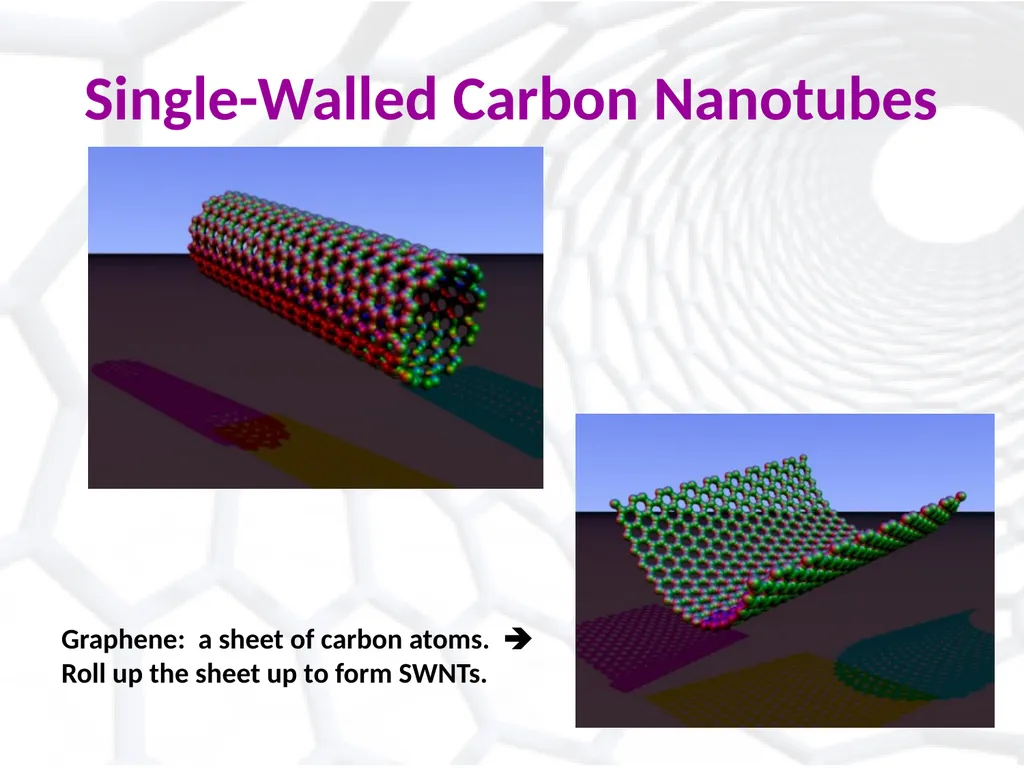
slide8. Single-Walled Carbon Nanotubes Graphene: a sheet of carbon atoms. Roll up the sheet up to form SWNTs.<br>
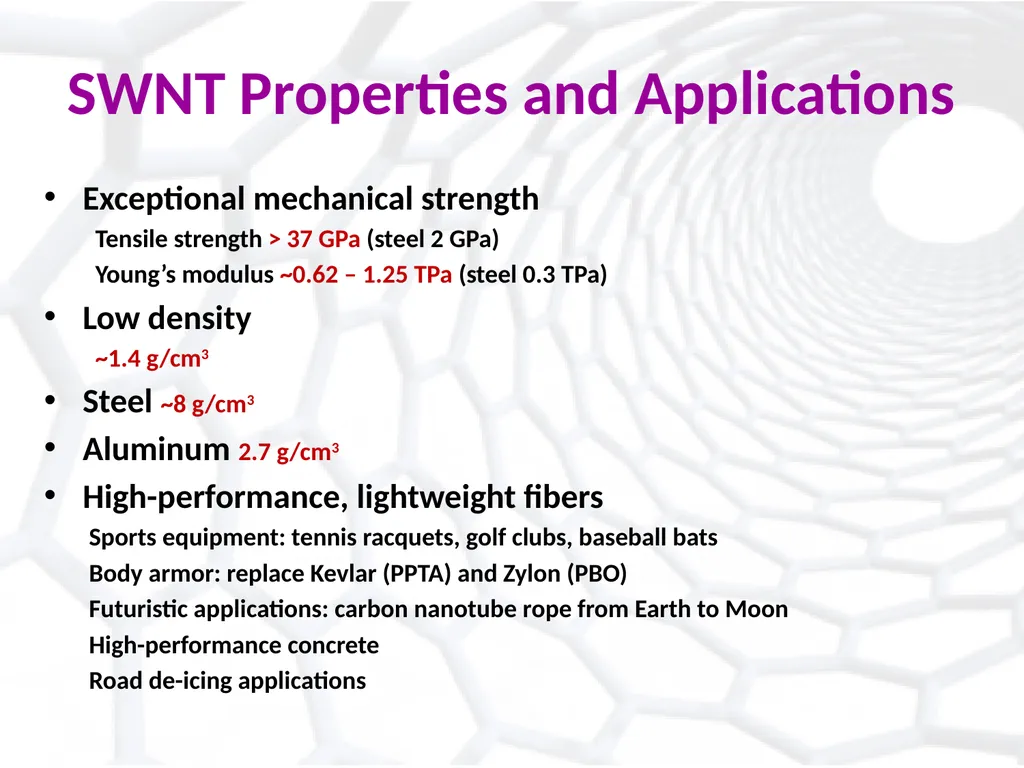
slide9. SWNT Properties and Applications Exceptional mechanical strength
Tensile strength > 37 GPa (steel 2 GPa)
Young’s modulus ~0.62 – 1.25 TPa (steel 0.3 TPa)
Low density
~1.4 g/cm3
Steel ~8 g/cm3
Aluminum 2.7 g/cm3
High-performance, lightweight fibers
Sports equipment: tennis racquets, golf clubs, baseball bats
Body armor: replace Kevlar (PPTA) and Zylon (PBO)
Futuristic applications: carbon nanotube rope from Earth to Moon
High-performance concrete
Road de-icing applications<br>
slide10. The World’s Smallest Radio Star Wars theme song played from the world’s smallest radio<br>
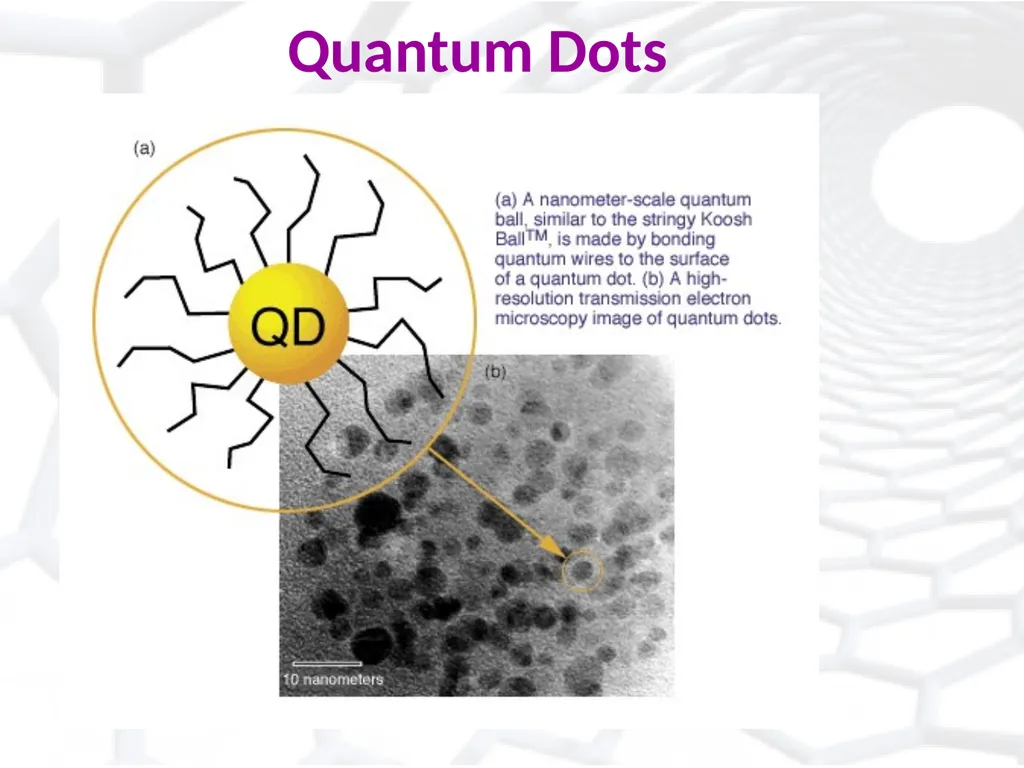
slide11. Quantum Dots<br>
slide12. Quantum Dots insert image here
http://www.onlineinvestingai.com/blog/wp-content/uploads/2009/02/quantum_dots-300x224.jpg insert image here
http://www.concepts.aero/system/files/quantum-dots.jpg
***Rotate image 90 degrees clockwise***<br>
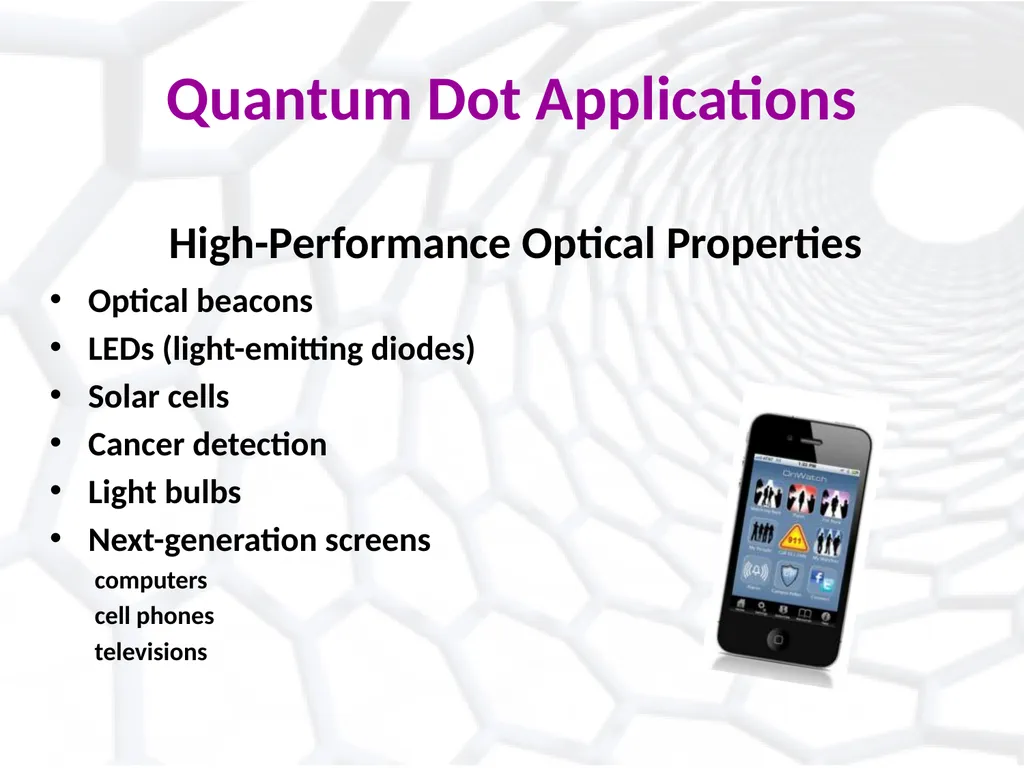
slide13. Quantum Dot Applications Optical beacons
LEDs (light-emitting diodes)
Solar cells
Cancer detection
Light bulbs
Next-generation screens
computers
cell phones
televisions High-Performance Optical Properties<br>
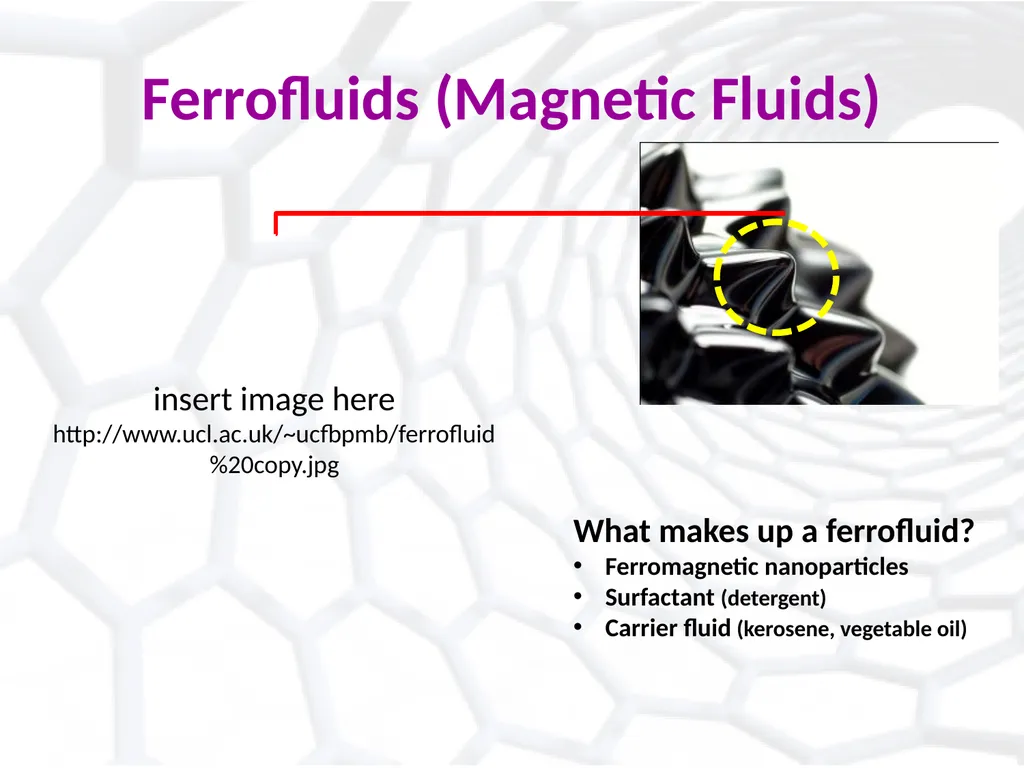
slide14. Ferrofluids (Magnetic Fluids) What makes up a ferrofluid?
Ferromagnetic nanoparticles
Surfactant (detergent)
Carrier fluid (kerosene, vegetable oil) insert image here
http://www.ucl.ac.uk/~ucfbpmb/ferrofluid%20copy.jpg<br>
slide15. Why Ferrofluids? Why Nano? Without magnetic field nanosuspension behaves as a fluid.
Under controlled magnetic fields can manipulate properties
Nanoparticles behave as permanent magnets. That’s a lot of magnets in a little fluid!!! Audio speakers
Seals (engineering applications)
Cancer treatments (use magnetic field to heat particles and cook cancer cells)
Drug delivery systems (manipulate drugs through induced magnetic field)
Toys Ferrofluid Applications<br>
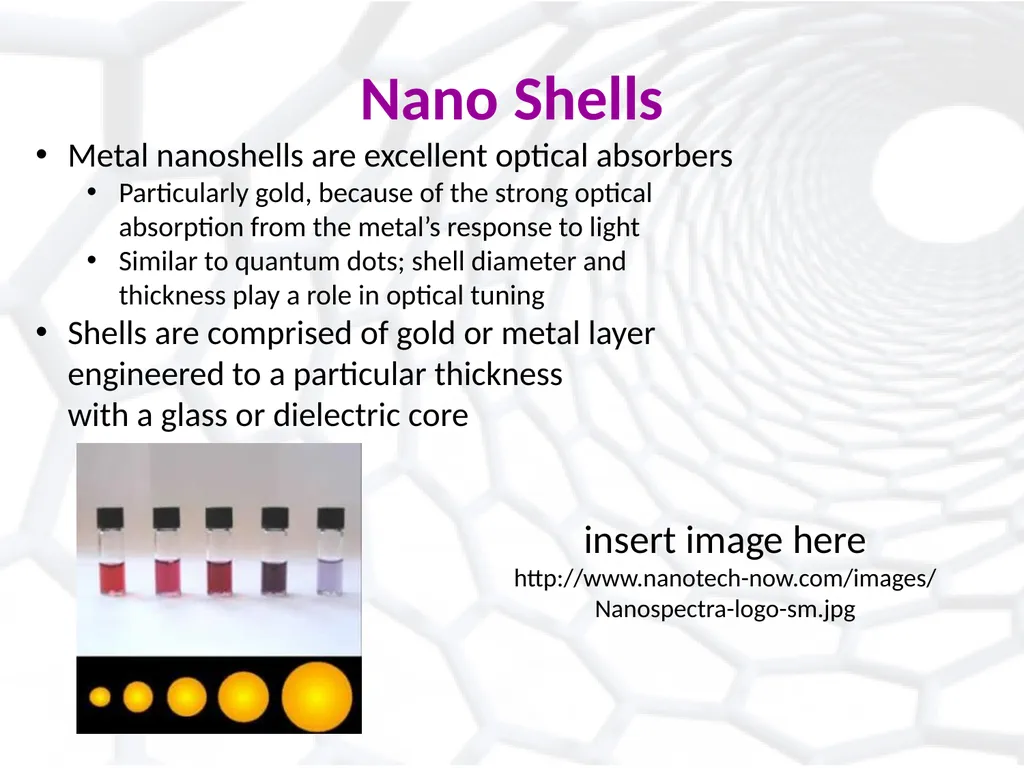
slide16. Nano Shells Metal nanoshells are excellent optical absorbers
Particularly gold, because of the strong optical absorption from the metal’s response to light
Similar to quantum dots; shell diameter and thickness play a role in optical tuning
Shells are comprised of gold or metal layer engineered to a particular thickness with a glass or dielectric core insert image here
http://www.nanotech-now.com/images/Nanospectra-logo-sm.jpg<br>
slide17. Gold Nanoshell Synthesis Near infrared peak absorption characteristics with gold shells
Wavelength that is not absorbed by skin
Important features when considering cancer treatment applications. insert image here
http://education.mrsec.wisc.edu/Edetc/SlideShow/images/nanoparticles/Au_wavelength.jpg insert image here
http://education.mrsec.wisc.edu/SlideShow/slides/nanoparticles/Au_nanoshell_synthesis.jpg<br>
slide18. Nanoshell Applications Optical imaging contrast agents
Photothermal ablation (cooking) of cancerous cells
Pharmaceutical delivery
Optically controlled microfluidics valves
Biosensing insert image here
http://english.ipc.cas.cn/ns/es/201101/W020110121336809111199.jpg<br>
slide19. Misconceptions about Nanotechnology This is science fiction!!!! insert image here
http://www.flickr.com/photos/kt/8727693/<br>
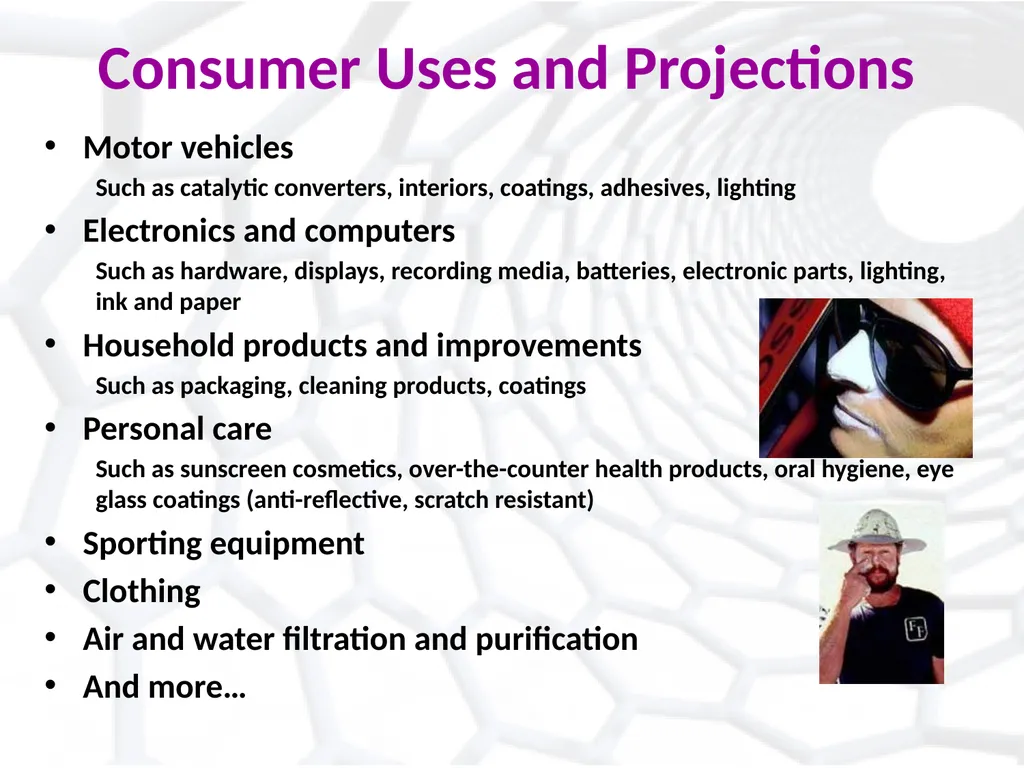
slide20. Consumer Uses and Projections Motor vehicles
Such as catalytic converters, interiors, coatings, adhesives, lighting
Electronics and computers
Such as hardware, displays, recording media, batteries, electronic parts, lighting, ink and paper
Household products and improvements
Such as packaging, cleaning products, coatings
Personal care
Such as sunscreen cosmetics, over-the-counter health products, oral hygiene, eye glass coatings (anti-reflective, scratch resistant)
Sporting equipment
Clothing
Air and water filtration and purification
And more…<br>
slide21. Nanoworld as a Whole Google “nanotechnology” and see ~24,100,000* results… and growing everyday
Nanotechnology is in emerging technology that surrounds us:
Consumer products contain it
Advanced medical treatments, renewable energy methods and consumer products use it
Our job is to understand, design, and control it
By 2015, nanotechnology revenues are estimated to reach $2.5 trillion ($2,500,000,000,000) worldwide
This is the future!!!!<br>
slide22. Acknowledgements National Science Foundation Grant #0840889 for GK12 program funding.
Dr. John S. Hutchinson and Dr. Carolyn Nichol of Rice University for supporting information and images.<br>

slide2. What is nanotechnology? Definition 1:
Nanotechnology is the creation of functional materials, devices, and systems through control of matter on the nanometer length scale, exploiting novel phenomena and properties (physical, chemical, biological) present only at that length scale. Definition 2:
Nanotechnology is the engineering of functional systems at the molecular scale. It refers to the projected ability to construct items from the bottom up, using techniques and tools being developed today to make complete, highly advanced products.<br>
slide3. What is nanotechnology? What is the nano length scale?
Is nanotechnology new?
What “novel” and “exciting” phenomena are at this scale?
How do we use this to our advantage? Some questions need to be answered…<br>
slide4. What does nano really mean? bacteria
1 m
0.000001 m
1,000,000 m = 1 m mountain
1 km
1000 m
0.001 km = 1 m child
1 m ant
1 mm
0.001 m
1,000 mm = 1 m sugar molecule
1 nm
0.000000001 m
1,000,000,000 nm = 1 m 1 m = 1 BILLION nm 1 km = Saturn to Sun<br>
slide5. How old is nanotechnology? 1965 Ferromagnetic fluids patented by S. Papel
1974 The word "nanotechnology" used
Early 1980s Quantum dots discovered by Alexei Ekimov
1985 Buckyball discovered
1991 Carbon nanotubes discovered
1997 Gold nanoshells discovered
1999 Doxil receives FDA approval
2008 Gold nanoshells therapy in human clinical trials 1687 Isaac Newton published “Principia,” laws of motion
1769 Watt invented steam engine
1839 Goodyear invented vulcanized rubber.
1885 Hertz discovered photoelectric effect
1916 Einstein published theory of relativity
1905-1925 Birth of Quantum Mechanics
1938 Electron microscope
1981 Scanning electron microscope<br>
slide6. How old is nanotechnology? In comparison, nanotechnology is fairly young.
Correction: Nano-sized objects have been around for centuries, but the ability to see, understand and control them is recent Why? Quantum mechanics is needed to understand physics
atomic properties
wave properties
Tools are needed to see length scale
transmission electron microscope
scanning electron mmicroscope
atomic force microscope
Processing technology is needed to control size, chemistry, shape, etc.
scanning tunneling microscope
atomic force microscope
evaporation techniques
self assembly (utilizing surface tension)
wet chemistry techniques for modeling for imaging for manipulation & fabrication<br>
slide7. Types of Nano Phenomena carbon allotropes quantum dots ferro fluids (magnetic) gold nanoshells<br>
slide8. Single-Walled Carbon Nanotubes Graphene: a sheet of carbon atoms. Roll up the sheet up to form SWNTs.<br>
slide9. SWNT Properties and Applications Exceptional mechanical strength
Tensile strength > 37 GPa (steel 2 GPa)
Young’s modulus ~0.62 – 1.25 TPa (steel 0.3 TPa)
Low density
~1.4 g/cm3
Steel ~8 g/cm3
Aluminum 2.7 g/cm3
High-performance, lightweight fibers
Sports equipment: tennis racquets, golf clubs, baseball bats
Body armor: replace Kevlar (PPTA) and Zylon (PBO)
Futuristic applications: carbon nanotube rope from Earth to Moon
High-performance concrete
Road de-icing applications<br>
slide10. The World’s Smallest Radio Star Wars theme song played from the world’s smallest radio<br>
slide11. Quantum Dots<br>
slide12. Quantum Dots insert image here
http://www.onlineinvestingai.com/blog/wp-content/uploads/2009/02/quantum_dots-300x224.jpg insert image here
http://www.concepts.aero/system/files/quantum-dots.jpg
***Rotate image 90 degrees clockwise***<br>
slide13. Quantum Dot Applications Optical beacons
LEDs (light-emitting diodes)
Solar cells
Cancer detection
Light bulbs
Next-generation screens
computers
cell phones
televisions High-Performance Optical Properties<br>
slide14. Ferrofluids (Magnetic Fluids) What makes up a ferrofluid?
Ferromagnetic nanoparticles
Surfactant (detergent)
Carrier fluid (kerosene, vegetable oil) insert image here
http://www.ucl.ac.uk/~ucfbpmb/ferrofluid%20copy.jpg<br>
slide15. Why Ferrofluids? Why Nano? Without magnetic field nanosuspension behaves as a fluid.
Under controlled magnetic fields can manipulate properties
Nanoparticles behave as permanent magnets. That’s a lot of magnets in a little fluid!!! Audio speakers
Seals (engineering applications)
Cancer treatments (use magnetic field to heat particles and cook cancer cells)
Drug delivery systems (manipulate drugs through induced magnetic field)
Toys Ferrofluid Applications<br>
slide16. Nano Shells Metal nanoshells are excellent optical absorbers
Particularly gold, because of the strong optical absorption from the metal’s response to light
Similar to quantum dots; shell diameter and thickness play a role in optical tuning
Shells are comprised of gold or metal layer engineered to a particular thickness with a glass or dielectric core insert image here
http://www.nanotech-now.com/images/Nanospectra-logo-sm.jpg<br>
slide17. Gold Nanoshell Synthesis Near infrared peak absorption characteristics with gold shells
Wavelength that is not absorbed by skin
Important features when considering cancer treatment applications. insert image here
http://education.mrsec.wisc.edu/Edetc/SlideShow/images/nanoparticles/Au_wavelength.jpg insert image here
http://education.mrsec.wisc.edu/SlideShow/slides/nanoparticles/Au_nanoshell_synthesis.jpg<br>
slide18. Nanoshell Applications Optical imaging contrast agents
Photothermal ablation (cooking) of cancerous cells
Pharmaceutical delivery
Optically controlled microfluidics valves
Biosensing insert image here
http://english.ipc.cas.cn/ns/es/201101/W020110121336809111199.jpg<br>
slide19. Misconceptions about Nanotechnology This is science fiction!!!! insert image here
http://www.flickr.com/photos/kt/8727693/<br>
slide20. Consumer Uses and Projections Motor vehicles
Such as catalytic converters, interiors, coatings, adhesives, lighting
Electronics and computers
Such as hardware, displays, recording media, batteries, electronic parts, lighting, ink and paper
Household products and improvements
Such as packaging, cleaning products, coatings
Personal care
Such as sunscreen cosmetics, over-the-counter health products, oral hygiene, eye glass coatings (anti-reflective, scratch resistant)
Sporting equipment
Clothing
Air and water filtration and purification
And more…<br>
slide21. Nanoworld as a Whole Google “nanotechnology” and see ~24,100,000* results… and growing everyday
Nanotechnology is in emerging technology that surrounds us:
Consumer products contain it
Advanced medical treatments, renewable energy methods and consumer products use it
Our job is to understand, design, and control it
By 2015, nanotechnology revenues are estimated to reach $2.5 trillion ($2,500,000,000,000) worldwide
This is the future!!!!<br>
slide22. Acknowledgements National Science Foundation Grant #0840889 for GK12 program funding.
Dr. John S. Hutchinson and Dr. Carolyn Nichol of Rice University for supporting information and images.<br>