
INTRODUCTION TO OPERATING THEATRE OBJECTIVES
LO
Published · 79 slides · 0 views
1 / 1
Description
INTRODUCTION TO OPERATING THEATRE OBJECTIVES Describe the development of operating theatre nursing Explain the legal aspects of operating theatre nursing Describe the operating theatre layout, the equipment and supplies required HISTORY OF
Related Topics
Share
Embed code
Download this presentation From Below
"INTRODUCTION TO OPERATING THEATRE OBJECTIVES" is the property of its rightful owner. Permission is granted to download and print the materials on this website for personal, non-commercial use only, and to display it on your personal computer provided you do not modify the materials and that you retain all copyright notices contained in the materials. By downloading content from our website, you accept the terms of this agreement.
Presentation Transcript
01
INTRODUCTION TO OPERATING THEATRE<br>
02
OBJECTIVES Describe the development of operating theatre nursing
Explain the legal aspects of operating theatre nursing
Describe the operating theatre layout, the equipment and supplies required<br>
Explain the legal aspects of operating theatre nursing
Describe the operating theatre layout, the equipment and supplies required<br>
03
HISTORY OF THEATRE NURSING Theatre nursing has developed alongside the history of surgery. Surgery is an old form of treatment that can be traced back through the history of man. In the past, there were no theatres, no trained personnel, no anaesthesia and no equipment. Operations were performed at home. Problems during this time included infection, bleeding and pain.
However, with time, efforts were made to solve these problems. For example, in 17 BC, alcohol and opium were used to relieve pain by Napoleon who performed an amputation while the patient slept for 24 hours. By 1772, Joseph Priestly discovered the use of nitrous oxide as anaesthesia, and in 1842, Dr Crawford discovered the use of ether. In 1847 James Young began to use chloroform. In the 18th century a great breakthrough was made with the use of trilene thiopentone, clytopopaine and curare, which are muscle relaxants. By the end of 19th century, pain relief was an integral part of surgery.<br>
However, with time, efforts were made to solve these problems. For example, in 17 BC, alcohol and opium were used to relieve pain by Napoleon who performed an amputation while the patient slept for 24 hours. By 1772, Joseph Priestly discovered the use of nitrous oxide as anaesthesia, and in 1842, Dr Crawford discovered the use of ether. In 1847 James Young began to use chloroform. In the 18th century a great breakthrough was made with the use of trilene thiopentone, clytopopaine and curare, which are muscle relaxants. By the end of 19th century, pain relief was an integral part of surgery.<br>
04
HISTORY CONT’D In order to control haemorrhaging, the ancient Greeks and Romans as far back as the 16th century BC, used strings as ligatures. Later on, during the Middle Ages, they came up with the use of hot iron.
This idea has been developed into the use of cautery to control bleeding. By the beginning of the 20th century, many types of ligatures were available, prepared from metal, nylon and cotton.
The control of infection dates back to the efforts of Louis Pasteur, who proved that bacteria caused infections. In 1865, Joseph Lister used carbonic acid to reduce the growth of bacteria in wounds. In 1886 Von Bergemen introduced sterilisation of dressings.<br>
05
HISTORY CONT’D You have at one time or another, used gloves while providing care. They were introduced in surgery in 1890.
You are now probably thinking back and asking where theatre nursing started? This question is answered when you look back at the history of nursing.
You will recall that in unit one on general nursing the history of nursing was discussed. The history of nursing is very much related to the history of theatre nursing.<br>
06
HISTORY CONT’D Operating theatre nursing is a special branch of nursing.
The theatre nurse has evolved together with the development of the theatre. They are a member of a bigger team, all of whom work together to provide a safe passage through the operating theatre for every patient.
However small or insignificant the task to be performed, the theatre nurse is responsible for the success of the procedure. They must, therefore, be highly skilled and trained, in order to be able to ensure a successful outcome for the patient.<br>
07
AIMS OF THE THEATRE NURSE To prepare conscientiously by study to adapt to the changing world of medicine
To allay the fears of the patient
To integrate the patient care during their period in theatre
To become highly skilled in theatre techniques
To be able to impart knowledge to others<br>
To allay the fears of the patient
To integrate the patient care during their period in theatre
To become highly skilled in theatre techniques
To be able to impart knowledge to others<br>
08
LEGAL ASPECTS IN THEATRE NURSING You will start by looking at the term ‘legal’. The dictionary defines the word legal as 'required’ or 'permitted by law'.
Therefore, when we talk of legal aspects in theatre nursing, we are referring to what the law requires us to do in the theatre before, during and after the operation.
In your clinical practice as a nurse, you may have participated in nursing a patient who was to undergo an operation. Can you remember what preoperative care was required before the patient could go for the operation?<br>
09
PREOP CARE The preoperative care requirements are: You should make sure that the surgeon explains clearly to the patient what will happen to them.
The surgeon should obtain an informed consent from the patient or parent/guardian/next of kin for those under age or not in a position to sign (e.g. unconscious person).
The nurse ensures that the patient has signed an informed consent, after the surgeon has explained the advantages and outcomes of the operation.
Make sure that the patient observes a ‘Nil by oral’ rule. The fasting should usually start six hours before the operation.
Blood works: All should be within the acceptable ranges e.g. full Haemogram including HB, urea, electrolytes and creatinine.<br>
10
PREOP CARE cont’d The patient should be counselled and reassured especially those receiving operations such as amputation, or mastectomy.
The site to be operated on should be shaved of hair and cleaned with warm soapy water, to reduce the bacteria on the patient’s skin. The area shaved should be larger than the incision site.
Catheterisation and IV branula insertion may be necessary depending on the surgery.
Observations of vital signs, urine testing for sugars, proteins and acetone should be done.
The receiving area nurse should confirm that the above preoperative measures have been taken by the ward nurse in order to allow the patient in theatre.<br>
11
PREOP CARE cont’d Some of the preparations form part of the legal requirements before surgery.
In unit one of this module you covered nursing ethics where the importance of confidentiality in nursing practice was stressed. This is another legal requirement.
In the definition of legal, the term ‘permitted by law’ implies that you can only carry out patient care within what the law permits you to do. Therefore, the law gives the patient seeking medical, surgical and nursing care, rights under which they are to be managed.<br>
12
PREOP CARE cont’d The dictionary defines rights as any claim that is morally just or legally granted as allowable or due to a person. This brings you to the term ‘legal rights of an individual during theatre nursing’.
When it is said that a person has the legal right to informed consent, what is meant is that they must be given information regarding the type of operation to be performed, why it is necessary, and its effects both bad and good, before being requested to sign the consent form for the operation.
However, you must also be aware of the fact that not all patients are given all the information regarding the type of operation they are to undergo. Before you give such information, you need to take factors such as age and level of education into consideration.<br>
13
PREOP CARE cont’d No matter how impossible it is to communicate this information to a patient, it would be against the law and their individual rights to ask them to sign the consent form for an operation when they have not fully understood the implications.
It is on this basis that those below the legal age of adulthood (18 years in Kenya) are not legally bound to sign the consent form. It is signed by the parents/guardians on their behalf. In the same way, consent for the mentally ill is sought from their parents/guardians/relatives. It is also important to note that consent for an operation should be obtained from the patient before they are pre-medicated, as pre-medication drugs have the potential of affecting their reasoning capacity, hence making consent signed not legally binding.<br>
It is on this basis that those below the legal age of adulthood (18 years in Kenya) are not legally bound to sign the consent form. It is signed by the parents/guardians on their behalf. In the same way, consent for the mentally ill is sought from their parents/guardians/relatives. It is also important to note that consent for an operation should be obtained from the patient before they are pre-medicated, as pre-medication drugs have the potential of affecting their reasoning capacity, hence making consent signed not legally binding.<br>
14
PREOP CARE cont’d Having looked at confidentiality and informed consent, it is important to mention that the custody and security of the patient before, during and after operation is vested in the theatre team. It has already been implied earlier that by signing the consent form, the patient takes some responsibility for the whole loss of life or part of their body. However, this does not take away the responsibility of the theatre team to ensure the security of the patient's life during the operation.<br>
15
PREOP CARE cont’d The legal aspect in theatre nursing involves the care of the patient from the time the patient is accepted in theatre, until they are handed over back to the ward.
For these reasons, the following procedure should be adhered to:
Any patient going to theatre must be properly prepared preoperatively.
The patient must sign an informed consent, obtained by the surgeon.
The patient must be protected from any harm, falls or eventuality, during the stay in theatre.
Confidentiality must be observed regarding the patient.
Measures must be taken to ensure that the patient taken to theatre is the right one for the intended operation.<br>
16
PREOP CARE cont’d The items to be used for the operation must be counted and recorded before and after operation to prevent loss of swabs, tubes, blades, forceps, abdominal pacts and any instrument used.
Theatre nurses must know where the exits are, for use in case of an emergency.
Sockets in theatre should be covered during scrubbing to prevent risk of conducting currents. They should also be one meter or more above the floor level.
All electrical machines must be checked to ascertain optimum function before use on the patient.<br>
17
LAYOUT OF AN OPERATING THEATRE The theatre unit is a block of buildings with a series of rooms leading off a corridor with closed doors, which separate it from the main hospital.
The doors reduce unnecessary movement to and from theatre. A theatre should be built in a central place possibly near an intensive care unit, the surgical wards and other special wards, for example, renal unit and burns unit.
All these units should be in relation to each other, but construction should be separate and independent from all traffic and air movement within the hospital.
A theatre unit is self contained with changing rooms, shower rooms, toilets, anaesthetic room, operating room, cleaning room,at least four beds, sluice room, linen room and sterilising room.<br>
18
LAYOUT cont’d Inside the theatre, the walls, floor and roof are built with labour saving materials for hygiene purposes. It has artificial ventilators, efficient artificial lights and emergency systems for use during power failure. The theatre furnishings and fittings are made of stainless materials for quick and thorough cleaning.
All the trolleys are fitted with non-electricity conducting rubbers to minimise the risk of electric conduction. The doors and corridors are wide and high for easy movement. The ceilings are high enough for proper theatre ventilation.<br>
All the trolleys are fitted with non-electricity conducting rubbers to minimise the risk of electric conduction. The doors and corridors are wide and high for easy movement. The ceilings are high enough for proper theatre ventilation.<br>
19
SAFETY AND INFECTION PREVENTION IN THEATRE<br>
20
INTRODUCTION Safety and infection prevention are of utmost importance in the operating theatre.
To ensure this, you will consider the preparation of the operating theatre, theatre nurse, patient and equipment.
You will also cover the equipment used in theatre and types of anaesthesia.<br>
To ensure this, you will consider the preparation of the operating theatre, theatre nurse, patient and equipment.
You will also cover the equipment used in theatre and types of anaesthesia.<br>
21
PRINCIPLES OF INFECTION PREVENTION IN THE OPERATION THEATRE To ensure safety and prevent infection in the theatre, you must consider the following points:
Preparation of the operation room
Preparation of a theatre nurse
Preparation of the equipment<br>
Preparation of the operation room
Preparation of a theatre nurse
Preparation of the equipment<br>
22
PREPARATION OF THE OPERATING ROOM The theatre and equipment must be cleaned thoroughly every morning to minimise the number of micro-organisms. Ensure high dusting of walls and clean trolleys, drip stand, operating tables and all equipment therein. You should also ensure that the floor is scrubbed with soapy water and then mopped with a disinfectant recommended by the hospital. After cleaning and drying the theatre floor, all the equipment must be returned to its proper place.
Prepare the operating table by drying it after cleaning and placing it in the right position directly below the overhead operating lights. It should then be draped with a clean sheet ready to receive the patient. You should then set the anaesthetic tray ready and check the anaesthetic machine to ensure it is in working order for use to cauterise any bleeding vessel during operation.<br>
Prepare the operating table by drying it after cleaning and placing it in the right position directly below the overhead operating lights. It should then be draped with a clean sheet ready to receive the patient. You should then set the anaesthetic tray ready and check the anaesthetic machine to ensure it is in working order for use to cauterise any bleeding vessel during operation.<br>
23
PREPARATION OF THE OR CONT’D The operating lights should be checked to ensure they are in good working order. The required operating set of equipment should be ordered from the theatre sterilising room/unit.
After the operation has been completed you should:
Clean all fitments and equipment thoroughly
Do high and low level dusting using the disinfectant
Clean the floor and drains with the disinfectant
Wipe the operating lights with a clean damp towel<br>
After the operation has been completed you should:
Clean all fitments and equipment thoroughly
Do high and low level dusting using the disinfectant
Clean the floor and drains with the disinfectant
Wipe the operating lights with a clean damp towel<br>
24
PREPARATION OF THE NURSE After entering the theatre unit, you should go straight to the changing rooms. Take a shower and change into your theatre suit and boots. Personal clothes should be locked in a locker within the changing room. Your head should be covered with a clean, sterile theatre cap. If you have any respiratory infection you are advised not to enter the operating room. A very high standard of personal hygiene should be maintained. You should avoid movement in and out of the theatre and any time that happens you should change into another clean theatre suit before re-entering the operating room.
It is advisable for you to visit the toilet to empty your bowels and bladder before taking a shower and putting on the sterile theatre suit to minimise the need of using this facility later during the theatre activities. However, this is just a precautionary measure and you should change your theatre suit any time the toilet facilities are used if you are to go back to the operating room.<br>
It is advisable for you to visit the toilet to empty your bowels and bladder before taking a shower and putting on the sterile theatre suit to minimise the need of using this facility later during the theatre activities. However, this is just a precautionary measure and you should change your theatre suit any time the toilet facilities are used if you are to go back to the operating room.<br>
25
SCRUBBING This is done to remove micro-organisms from the forearm and arms by mechanical washing and chemical disinfections before taking part in surgical procedure.
This helps prevent the possibility of the patient being contaminated by bacteria from the hands and arms.<br>
This helps prevent the possibility of the patient being contaminated by bacteria from the hands and arms.<br>
26
SCRUBBING Preparation for this procedure involves the following:
The theatre suit should have the top/shirt tidily tucked in. Roll the sleeves up to at least three inches above the elbow.
A cap should be worn to cover all the hair, tie the tape at the back.
A mask should be worn with the short side above the nose and the long side under the chin.
Remove all jewellery, wide wedding rings, dress rings, watches, earrings and necklaces.
Finger nails must be short and clean without nail varnish.
No cut wounds or septic wound on fingers.
No upper respiratory tract infection.
No gastroenteritis.
Wear a mackintosh apron to protect your scrub suit.
Regulate temperature and flow of water to suit you.
Scrubbing time varies according to the type of soap or chemical used. For example, if using gamophen soap, which contains hexachlorophene disinfectants, you should scrub for five minutes; if using hibiscrub, two minutes; ordinary soap, ten to fifteen minutes.<br>
27
SCRUBBING PROCEDURE Use the wall clock to time yourself.
Wet the hands and arms to the elbow.
Pick the soap and make a lot of lather on the hands and arms (the soap remains in hands until the point of drop off later).
Wash hands and arms for one minute. This is called a social wash.
Keeping the fingertips uppermost all the time, rinse hands to the elbow.
Using the elbow, press the hutch of the dispenser and pick one sterile brush. Lather the brush and keep tablet of soap at back of the brush between your palm and brush in your right hand.
Starting with the left hand put your fingers together and scrub the fingernails. Move to the fingers, and then wipe off the hand and palm. Use a circular movement inside the palm. Spend extra time at the folds of the wrist. Do this for 1½ minutes, rinsing often and starting again.<br>
28
SCRUBBING PROCEDURE Cont’d Rinse the hands from fingertips to wrists after the 1½ minutes. Rinse the brush and soap as well.
Change over to the right hand and repeat the procedures (7) – (8). Spend another 1½ minutes. Drop the bush into the correct receptacle provided. Keep the soap still in hands.
Lather hands and wash up to the wrist for another minute. Rinse the soap and drop it back into the soap dish.
Take all necessary precautions to avoid touching the tap handles during this exercise as this contaminates the hands.
Rinse the hands and arms thoroughly in one direction only starting from fingertips working down systematically to elbows.
Close the taps using elbows. Keep hands together upright, fingers higher than elbows. A total of five to ten minutes have been observed during the procedure.
The circulating nurse will remove the mackintosh apron.<br>
29
DRYING Pick up the towel and step back. Start with the left hand and blot dry the fingers, the webs of the hand and the palm well. and then move to the back of the hand, and the forearm, using a circular movement to the elbows. Change the towel to the left hand with the wet part against the left palm. Using the dry part of the towel, repeat the same procedure on the other arm. When you get to the elbow, discard the used towel in the dispenser provided.<br>
30
GOWNING The following procedure should be followed when gowning:
Pick a gown and step back.
Hold the neck-band and let the bottom hem drop.
Open the gown and slide both hands in through the arm holes.
Do not touch the outside of the gown with your bare hands.
The Runner Nurse will first tie the neck and shoulder bands then wristbands without touching the gown.<br>
31
GLOVING The following procedure should be adhered to:
Arrange gloves on the trolley with glove finger portion away from you.
Pick the glove with left hand holding at the folded part and slip in your right hand. Fold the tip of the sleeve on right hand and pass the glove over.
Using the gloved hand slip your fingers beneath the folded area of the remaining glove and slip in the left hand into the glove.
Unroll the cuff of the glove covering the cuff of the sleeve.
Do the same for the opposite hand using the same technique.
Ensure you do not contaminate any area that will come in contact with the sterile field.<br>
32
PATIENT’S SKIN PREPARATION Skin preparation depends on the area being operated.
Preparation of the skin includes vigorous sponging of the skin with a sponge soaked in strong disinfectant held in a sponge holding forceps.
Disinfectants used include centrimide and hibitine in spirit. After sponging, the area is swabbed once with iodine in spirit or hibitine 5% in 70% alcohol.<br>
33
DRAPING OF PATIENT The purpose of draping is to maintain an adequate sterile field for the surgical procedure.
The scrub nurse gives the surgeon the sterile towel to cover the area above the operation site and below and the sides.
After draping, the scrub nurse brings the operation trolley and instrument trolley next to the table.<br>
The scrub nurse gives the surgeon the sterile towel to cover the area above the operation site and below and the sides.
After draping, the scrub nurse brings the operation trolley and instrument trolley next to the table.<br>
34
POSITIONING OF PATIENT Positioning is done by the other team members who have not scrubbed up and worn sterile gowns and gloves. Patients are positioned before the skin preparation and draping described previously.
This involves placing the patient on the operating table to a desirable level for surgery and ensures that any harm to the patient, such as pressure on the nerves, is prevented. After positioning, the theatre gown is removed and skin prepared.<br>
This involves placing the patient on the operating table to a desirable level for surgery and ensures that any harm to the patient, such as pressure on the nerves, is prevented. After positioning, the theatre gown is removed and skin prepared.<br>
35
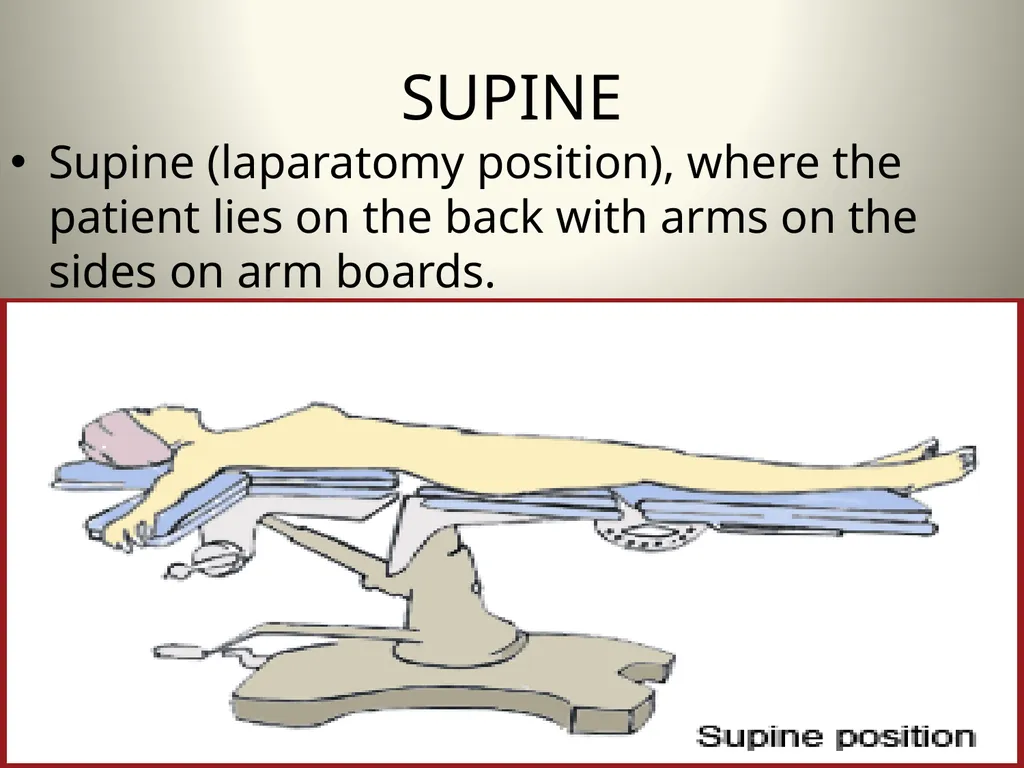
SUPINE Supine (laparatomy position), where the patient lies on the back with arms on the sides on arm boards.<br>
36
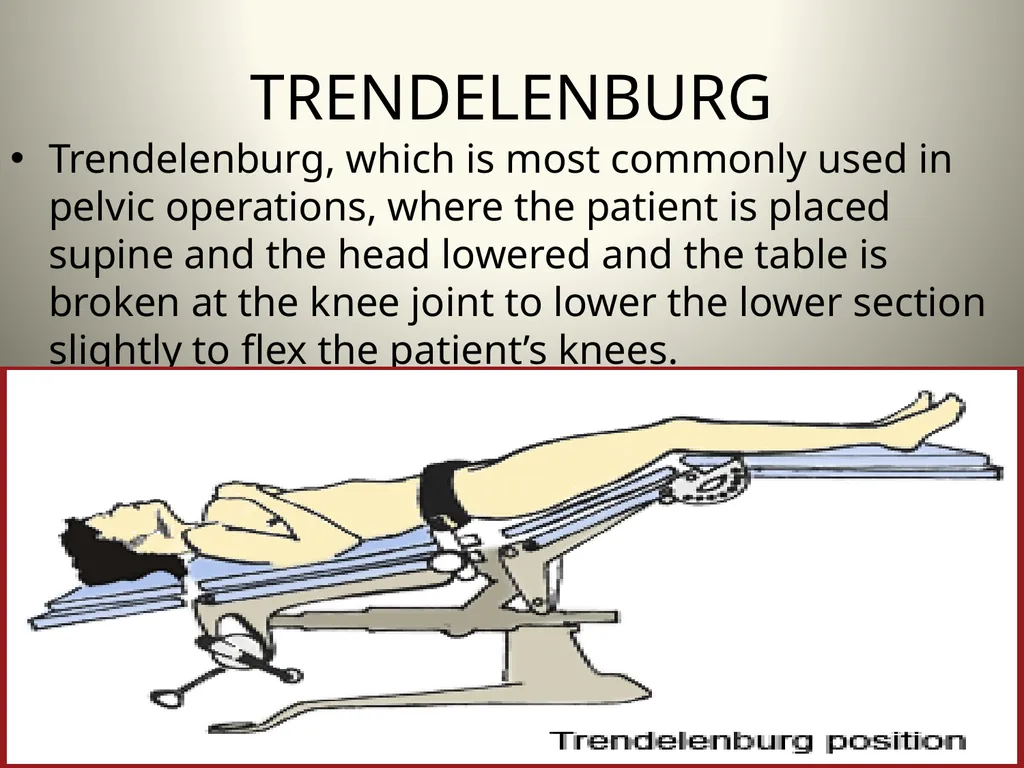
TRENDELENBURG Trendelenburg, which is most commonly used in pelvic operations, where the patient is placed supine and the head lowered and the table is broken at the knee joint to lower the lower section slightly to flex the patient’s knees.<br>
37
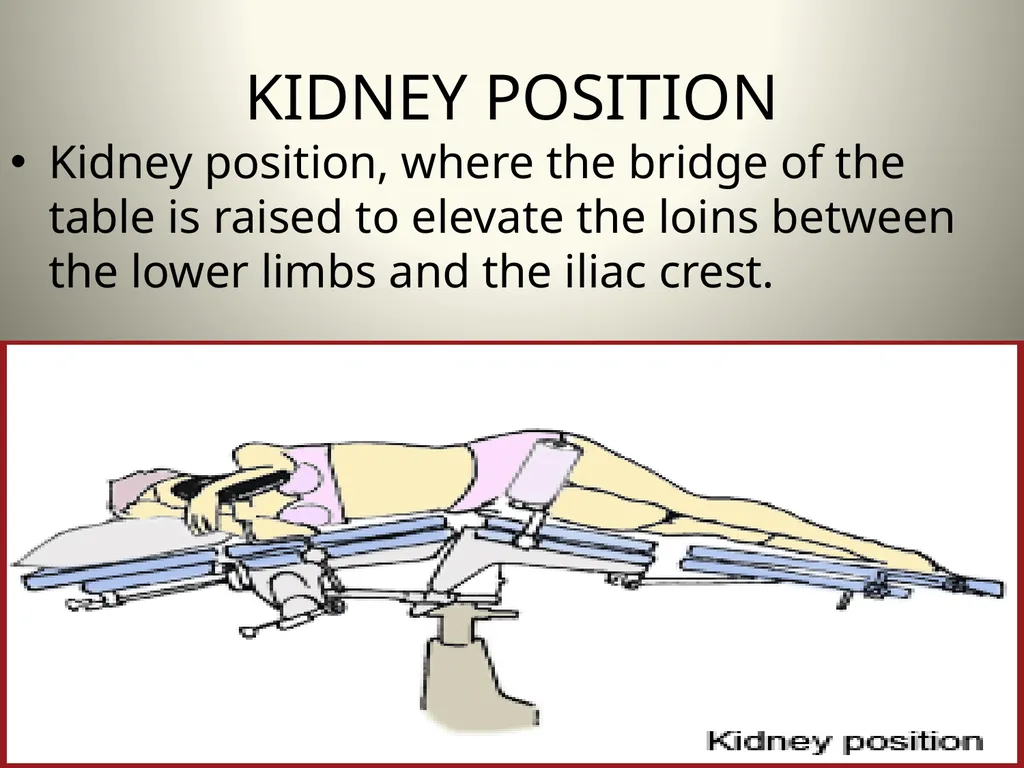
KIDNEY POSITION Kidney position, where the bridge of the table is raised to elevate the loins between the lower limbs and the iliac crest.<br>
38
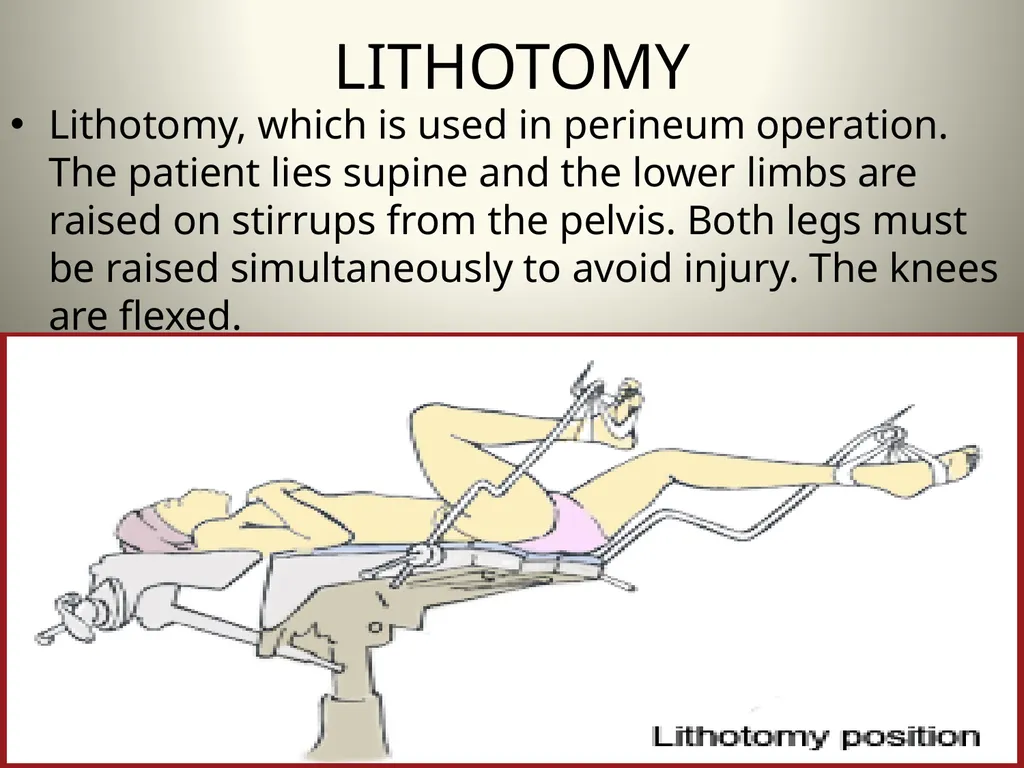
LITHOTOMY Lithotomy, which is used in perineum operation. The patient lies supine and the lower limbs are raised on stirrups from the pelvis. Both legs must be raised simultaneously to avoid injury. The knees are flexed.<br>
39
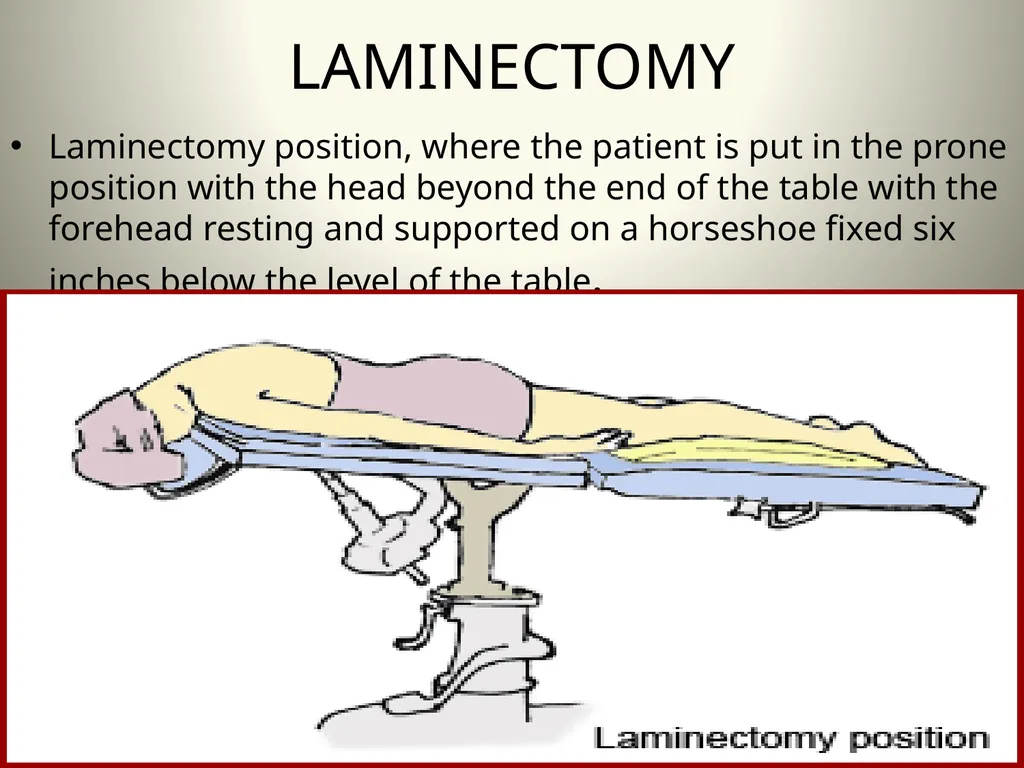
LAMINECTOMY Laminectomy position, where the patient is put in the prone position with the head beyond the end of the table with the forehead resting and supported on a horseshoe fixed six inches below the level of the table.<br>
40
EQUIPMENT USED IN THEATRE LIGATURES AND SUTURES
A suture is a stitch or series of stitches used in surgery to bring together living tissues until the normal healing process takes place. A ligature is a suture used for tying blood vessels to arrest bleeding.
There are two types of sutures. They can be absorbable, which means they dissolve in the tissue after some time, for example, catgut. They can also be non-absorbable, which means that the body tissue cannot digest the material used, for example, silkworm gut, nylon, cotton, linen, silk and metal.<br>
There are two types of sutures. They can be absorbable, which means they dissolve in the tissue after some time, for example, catgut. They can also be non-absorbable, which means that the body tissue cannot digest the material used, for example, silkworm gut, nylon, cotton, linen, silk and metal.<br>
41
LIGATURES AND SUTURES Cont’d The latter must be removed when the wound is healed. Metal clips are also available and are used in neuro-surgery to compress nerve endings, and also on skin incision to give a good grip. Traumatic sutures are used together with a needle for suturing the skin. Ligatures are lengths of suture material used without a needle to tie a blood vessel in order to control or arrest bleeding. Most ligatures are non-absorbable, for example, those made of linen, cotton, silk, polyester, wire and clips. Absorbable include chromic catgut. Metal clips can be used as ligatures.<br>
42
SURGICAL NEEDLES These are made from plated carbon steel or stainless steel. The different parts of a needle are the eye, shaft, and point. The needle is either straight or curved. There are different classes of needles. These include:
Cutting needles, which have a sharp edge, cut a crack as they pass, and are used on strong tissues, for example, skin, tendon, muscles.
Round bodied needles, which are round and smooth, cause less damage and make a puncture. They are used in delicate tissues and organs.
Atraumatic needles, which are either cutting or round bodied whose traumatising chance is minimal. These needles have no eye. Suture and needles are made joined-together.<br>
43
EQUIPMENT note It is important to note that dirty and unsterile equipment can become a source of infection. To reduce this, all dirty equipment must be soaked in a standard disinfectant preferably Jik, for ten minutes. This makes it safe for handling and cleaning. It should then be cleaned in soap water, rinsed, dried and then taken for autoclaving. The same should be done to linen, for example, towels, abdominal draping sheets, and gowns, which become contaminated during the operation.<br>
44
ANAESTHESIA Anaesthesia is the loss of pain and sensation to a part or the whole body induced by drugs.
There are two types of anaesthesia:
Local
General<br>
There are two types of anaesthesia:
Local
General<br>
45
LOCAL ANAESTHESIA Local anaesthesia induces analgesia in the region where it is administered, for example, lignocaine, procaine hydrochloride, xylocaine and lidocaine. The local anaesthesia last for forty five minutes to three hours depending on the type of anaesthesia used. It is given locally to the affected part of the body by one of the following methods:
Infiltration, nerve block, field block, refrigeration analgesia, spinal analgesia, epidural anaesthesia.<br>
Infiltration, nerve block, field block, refrigeration analgesia, spinal analgesia, epidural anaesthesia.<br>
46
LOCAL ANAESTHESIA METHODS Infiltration
The drug is injected on and around (in various points of) the affected area.
Nerve Block The nerve supplying the affected area is infiltrated by the anaesthetic drugs, inducing loss of sensation on the affected area supplied by that specific nerve.
Field Block Similar to nerve block but cover a larger area and may involve more than one nerve.
Refrigeration Analgesia It is administered by use of a vapouriser. Drugs used include: Ethyl chloride or Diethyl ether.
Spinal Analgesia Used for operations from the abdomen and below, e.g. caesarean section. A lumbar puncture is done and the local anaesthesia introduced through the spine. The drug paralyses the area below the puncture.
Epidural Anaesthesia The drug is injected in the dura mater space of the spinal cord. Used for operations of the abdomen and below.<br>
47
GA General anaesthesia causes the patient to lose consciousness, for example, thiopentone, ketalar and halothane. Anaesthesia can be categorised into: pre-medication, preoperative and postoperative procedures.<br>
48
PRE-MEDICATION The following procedures should be adhered to prior to the operation:
Atropine 0.6mg intramuscular (for adults) administered one hour before the operation to reduce Respiratory Secretion (RS) and to prevent bradycardia; Children should be given 0.3mg.
Pethidine 50 - 100mg intramuscular for adults, which has an analgesic effect on the patient; and 25 - 50mg for children depending on age and weight.
Valium can be given one night before to a very nervous patient.
Hyoscine 0.4mg for adults, which can also be given for pre-medication although it has the potential side effect of amnesia.
Morphine 10 - 15mg intramuscular can also be used.
Oral pre-medication is the best for children and should be administered two hours before operation.
Remember to make the patient observe nil by mouth for six hours prior to operation.<br>
49
PRE-OPERATIVE ANAESTHESIA (INDUCTION AGENTS) There are several types of anaesthetic agents.
Volatile agents
Intravenous agents
Muscle relaxants
Analgesics<br>
Volatile agents
Intravenous agents
Muscle relaxants
Analgesics<br>
50
VOLATILE AGENTS Volatile agents include ether, which is highly inflammable in the presence of diathermy and irritates the respiratory tract. On the other hand, it has the advantage of being cheap to administer. Halothane is very good as an induction agent but can cause halothane hepatitis. Trilene is not a very good induction agent but is a good maintenance anaesthetic agent. Its side effects include tachypnoea and vomiting. However it has a good analgesic effect postoperatively and it is cheap. A mixture of O2 and NO2 and one of the volatile anaesthetic agents, is the best way of
maintaining anaesthesia.<br>
51
INTRAVENOUS AGENTS Intravenous agents include barbiturates, for example, thiopentone, which causes sleep very quickly. Methohexitone can be used as an induction agent but cannot be used without equipment for resuscitation and is contraindicated in epilepsy.
These are mainly sedative drugs thus they do not have any analgesic effect. Ketamine can be given IV or IM. It has an analgesic effect and can be used alone in minor surgeries. Side effects include bad dreams and elevated blood pressure. Ketamine is also used with valium. It is contraindicated in hypertension.<br>
These are mainly sedative drugs thus they do not have any analgesic effect. Ketamine can be given IV or IM. It has an analgesic effect and can be used alone in minor surgeries. Side effects include bad dreams and elevated blood pressure. Ketamine is also used with valium. It is contraindicated in hypertension.<br>
52
MUSCLE RELAXANTS Muscle relaxants can be divided into two categories. Short acting (depolarising) relaxants include suxamethonium (scoline), which is mainly used for intubation. Its main side effect is that it causes bradycardia. Long acting (non-depolarising) relaxants include curare, flaxedil and pancuronium. The action of these agents has to be reversed to revive the patient by neostigmine atropine.<br>
53
ANALGESICS Analgesics are used to relieve pain and include pethidine, sosagen, morphine and fentanyl. The postoperative patient is given a drug for pain relief, for example, pethidine or valium, and an anti-emetic for instance, plasil (metoclopropamide), stemetil or phenergan.<br>
54
CARE OF PATIENTS BEFORE, DURING AND AFTER OPERATION IN THE THEATRE<br>
55
INTRODUCTION It is important to note that fear and anxiety predominate the preoperative period of the patient, hence the care of a patient who is to undergo any operation does not start in the theatre but in the ward or outpatient department, and continues to theatre.
Right from the ward, therefore, you need to reassure the patient and handle them with confidence so that their fears can be allayed.<br>
Right from the ward, therefore, you need to reassure the patient and handle them with confidence so that their fears can be allayed.<br>
56
OBJECTIVES Describe the general preoperative care for a patient
State your role as an anaesthetic nurse in the reception area, anaesthetic room, and operating room and during the postoperative period
Describe your role as scrub up nurse
State at least seven roles of a runner nurse
Describe your role as a recovery room nurse
Describe the general principles in the postoperative care of a patient<br>
57
PREOPERATIVE CARE The patient comes from the ward to the receiving area. They are then moved to the anaesthetic room, operating room, recovery ward, back transfer, and finally back to the ward.
The receiving area is where the ward nurse identifies the patient to the theatre nurse, discusses and hands over the patient’s notes, and formally hands over the patient. You should note that at this point the patient is usually apprehensive and hence needs to be reassured again.<br>
The receiving area is where the ward nurse identifies the patient to the theatre nurse, discusses and hands over the patient’s notes, and formally hands over the patient. You should note that at this point the patient is usually apprehensive and hence needs to be reassured again.<br>
58
PREOP CARE cont’d You should check the patient’s identification bands, name on the notes, and in patient number (IP No.). All these should correspond. Check whether the consent form is the correct one and is correctly signed, and that the consent obtained is relevant to the operation about to take place. Check what pre-medication was given and indicated by ticking and signing, noting the time it was given on the preoperative checklist. The patient should then be transferred from the ward trolley to the theatre trolley. Make a physical check that the patient has been prepared and tick the patient traffic in theatre list.<br>
59
PREOP CARE cont’d Check for x-rays if indicated. It is the responsibility of the ward nurse to check for blood from the blood bank and to bring it to theatre. If these things are not properly done, patients should not
be received. The recovery area nurse should observe the patients waiting to go to the wards while still under general anaesthesia. Observe for any abnormality, that is, the wound, vital signs and report any abnormalities to the anaesthetist or the surgeon.<br>
60
ANAESTHETIC ROOM NURSE The role of the anaesthetic room nurse is to offer assistance to the anaesthetist during induction, intubations and operation. You are in charge of the anaesthetic room and assist in setting up the anaesthetic equipment containing all drugs that are mandatory in anaesthesia.
As you receive the patient into the anaesthetic room, you should do your best to reassure them to allay any anxiety. You should also help during the emergencies, for example, cardiac arrest. Clean and tidy the anaesthetic room after use and see that the proper registers are available.
Keep the required forms ready, for example, the pathological and x-ray forms. The anaesthetic nurse should also fix electro cardiac monitors and catheterise the patient. They should prepare anaesthetic throat packs and take and record vital signs observations. The anaesthetic nurse monitors urinary output and hands over the patient to the recovery area nurse.<br>
Keep the required forms ready, for example, the pathological and x-ray forms. The anaesthetic nurse should also fix electro cardiac monitors and catheterise the patient. They should prepare anaesthetic throat packs and take and record vital signs observations. The anaesthetic nurse monitors urinary output and hands over the patient to the recovery area nurse.<br>
61
ANAESTHETIC ROOM NURSE Cont’d You should collect the inventory, laryngoscope introducers, artery forceps, magills forceps, arm boards, endo tracheal tube jelly, dissecting forceps and a pair of scissors.
You should also ensure that the suction machine is in good order and a sterile suction tube is available. Ascertain that the drugs and equipment for induction, reversing drugs, muscle relaxants, infusions, cannulas, Ryle’s tubes, needles and syringes are available.
Also make sure that there are various types of connectors and strapping cut in different sizes.<br>
62
DUTIES of ANAESTHETIST NURSE The following are the basic duties of the anaesthetist nurse during induction:
Help the anaesthetist to put the IV cannulas
Administer oxygen by mask
Hand over the airway and the strapping to fix the endotracheal tube
Inflate the endotracheal tube and clip it with the artery forceps
Remove the blanket cover and cover the patient with a draw sheet
Wheel the patient to the operating room, position the patient and assist in putting the patient on the operating table<br>
63
DUTIES OF ANAESTHETIST NURSE During the operation you should:
Fix the arms and secure them by strapping them to the arm board
Observe the patient during the operation, check the colour, whether sweating, restless and report to the anaesthetist or doctor
Assist the anaesthetist to remove the intubation tube after operation
Tidy the anaesthetist room, clean the anaesthetist catheters and set for the next patient
Clear all trolleys used and the trays and send them to the sluice room where they are to be thoroughly scrubbed<br>
64
SCRUB- UP NURSE You should ensure sterility by cleaning yourself thoroughly, from the tip of the fingers to the elbow and by putting on sterile gloves and a gown hence ensuring sterility around the operating table. You should arrange the sterile instruments around the operating table before the operation. Check the numbers of each instrument category and report to the runner nurse. Prepare ligatures and put them ready for different stages of the operation.
You should count all the equipment at different stages where the cavity needs to be closed to prevent any loss in the cavity and report correctness to the surgeon. Pass the cavity mops to the surgeons (a sponge for cleaning the cavity or operation area). Clear all the instruments used, count them and take them for sterilisation in preparation for the next operation.<br>
You should count all the equipment at different stages where the cavity needs to be closed to prevent any loss in the cavity and report correctness to the surgeon. Pass the cavity mops to the surgeons (a sponge for cleaning the cavity or operation area). Clear all the instruments used, count them and take them for sterilisation in preparation for the next operation.<br>
65
CIRCULATING OR RUNNER NURSE You should assist in positioning the patient. Always watch the scrub-up nurse and bring what they require and sterilise equipment as directed. Make sure any extra equipment for the operation is working properly, for example, diathermy machine, suction machine and other electric apparatus.
Bring and change lotions as required. Check the records (swabs and packs) and count the used swabs and confirm correctness. You should also record the time the tourniquet was applied or removed. The circulating nurse ensures the welfare of the entire scrub-up team and the patient plus the sterility in the operating room. Finally, you should remember to record the bandages, IV fluids, drugs, and strapping used if need be.<br>
Bring and change lotions as required. Check the records (swabs and packs) and count the used swabs and confirm correctness. You should also record the time the tourniquet was applied or removed. The circulating nurse ensures the welfare of the entire scrub-up team and the patient plus the sterility in the operating room. Finally, you should remember to record the bandages, IV fluids, drugs, and strapping used if need be.<br>
66
RECOVERY ROOM NURSE Observe the general condition of the patient and the vital signs (temperature, blood pressure, pulse, respiration) on reception of patient every fifteen minutes. A rise or fall in any of the vital signs indicates all is not well with the patient and alert the anaesthetist.
You should observe and ensure postoperative blood transfusion and other infusions are running as required. You should prepare all the equipments and medications required in the recovery area. Monitor and record both fluid input and output. This helps you to monitor kidney functions.
A decrease in urine, or lack of its production, calls for urgent action. Should this happen, inform the surgeon immediately. If excess fluid runs in intravenously, administering a diuretic drug induces diuresis. This is recommended.<br>
67
THEATRE ATTENDANT Your duties as a theatre attendant include cleaning the sluice room thoroughly and washing all the instruments after an operation. You should also clean the mackintosh and arrange all the instruments for packing ready for sterilisation.<br>
68
NURSE ADMINISTRATOR The nurse administrator is the overall administrator of the theatre and sees that all staff and patients are safe.
They ensure that every area in theatre is satisfactorily staffed for 24 hours and the staff work as required.
This person should orientate new staff in theatre, and ensure availability of equipment needed in theatre.
They should also liase with the specific wards and other departments for the smooth running of the theatre.
Finally they should maintain discipline in theatre.<br>
69
GENERAL PRINCIPLES IN POSTOPERATIVE CARE The general principles in postoperative care include:
Ensuring clear airway
Supporting circulation
Controlling bleeding
Preventing infection
Monitoring any complications
Controlling pain
Ensuring return of gastro intestinal motility
Ensuring easy ambulation
Preparing the patient for discharge and home-based care<br>
Ensuring clear airway
Supporting circulation
Controlling bleeding
Preventing infection
Monitoring any complications
Controlling pain
Ensuring return of gastro intestinal motility
Ensuring easy ambulation
Preparing the patient for discharge and home-based care<br>
70
ENSURING CLEAR AIRWAY You should place the patient in recovery position (three-quarters prone, or left-lateral).
This allows secretions from the lungs and mouth to drain out.
Suck the secretions using a suction machine if they are excessive.<br>
This allows secretions from the lungs and mouth to drain out.
Suck the secretions using a suction machine if they are excessive.<br>
71
SUPPORTING CIRCULATION This is done in order to maintain the functions of the lungs, the heart and the kidney. This is achieved through adequate blood volume. You should maintain the infusion running at the required rates.
Remember The amount of fluid required is calculated as: Maintenance requirement + fluid loss (loss during operation + normal body loss + insensible loss).<br>
Remember The amount of fluid required is calculated as: Maintenance requirement + fluid loss (loss during operation + normal body loss + insensible loss).<br>
72
Supporting Circulation cont’d In an adult, the body requires 35ml per kg body weight in 24 hours. The insensible loss (loss through skin, normal faeces and breathing) is approximately 0.5ml per kg body weight per hour. In children these figures vary by age as follows:
Below three months old, the maintenance requirement is 5mls/kg/hour, or 150ml/kg/24 hours
Infants above three months and weighing between 3-10kg require 5ml/kg/hour
Those weighing 10-20kg need 3ml/kg/hour
Children above 20kg need 2.5ml/kg/hour (Watters et al 1991)
You should select fluid that will supply the required electrolytes, for example, normal saline or ringer lactate 500ml to alternate with 1000ml of 5% dextrose and add 3g of potassium chloride per litre of dextrose (Watters et al 1991).<br>
73
CONTROLLING BLEEDING AND WOUND CARE Monitor the wound for any signs of bleeding.
Should this occur, apply a firm dressing and inform the surgeon.
24 hours, check for signs of infection, these include redness, tenderness, oedema and low grade fever.
If this occurs the sutures are removed to allow the pus to drain and the wound cleaned three times a day with antiseptic lotion.<br>
74
PREVENTING INFECTION Septicaemia is likely following an operation, due to peritonitis. Pneumonia may follow bed confinement.
This is indicated by a rise in body temperature and should this occur, you will need to administer antibiotic without delay.<br>
This is indicated by a rise in body temperature and should this occur, you will need to administer antibiotic without delay.<br>
75
MONITORING OF COMPLICATIONS You should monitor pulse, blood pressure, and respiration rate and body temperature until they are stable and within the normal ranges for the age and sex of the patient.
The recommended frequency is to observe the patient every 15 minutes for the first two hours, followed by every 30 minutes for the next two hours, then four hourly if they appear to be stable.
Other important observations to make at the same time are level of consciousness, and urine output.<br>
The recommended frequency is to observe the patient every 15 minutes for the first two hours, followed by every 30 minutes for the next two hours, then four hourly if they appear to be stable.
Other important observations to make at the same time are level of consciousness, and urine output.<br>
76
CONTROLLING PAIN This is achieved by the administration of pain relief drugs once the patient is conscious.
You should administer an intermittent bolus of pethidine 50-100mg IM or morphine 10-15mg for adult.
Other measures include correct positioning of the patient so as to avoid pressure on the nerves, administering analgesics, use of heat/cold massage and guided imagery (a process of suppressing pain by focusing on something else).<br>
77
ENSURING RETURN OF GASTRO INTESTINAL MOTILITY Postoperatively you should assess the return of gastric motility.
This is indicated by the return of bowel sounds and passing of flatus. Following abdominal surgery (laparatomy), gastro intestinal motility returns to normal in three to four days.
The patient should not take food orally before this period is over. The stomach is decompressed through nasal gastric tube suction. This should be removed when the aspirate falls bellow 400mls per day.
Should postoperative diarrhoea occur, reassure the patient, as this clears in two to three days, but ensure adequate hydration.
When bowel sounds are back give oral sips, fluid diet, light diet, then resume normal diet.<br>
78
ENSURING EARLY AMBULATION Encourage the patient to move out of bed as soon as their condition allows. This will prevent deep venous thrombosis (the development of a blood clot in a vein), which can complicate to pulmonary embolism (a circulating blood clot in the veins of the lungs).
The signs of thrombosis include, warm swollen painful limbs and low-grade fever. If noticed, the affected limb should be elevated until the swelling subsides. Heparin in a dose of 5000units, eight hourly, is administered subcutaneously when the diagnosis is confirmed.
The postoperative care should start from the recovery area of a theatre, and continue in the postoperative ward where the patient is rehabilitated then discharged.<br>
79
PREPARING THE PATIENT FOR DISCHARGE AND HOME BASED CARE The postoperative patient needs to be made aware of the expected outcome of the surgery as well as the medical and nursing care that they will require at home. This will reduce the possibility of last minute crises on the day of discharge
The patient should be given an opportunity to get ready to cope at home and in the community as they ask you how to deal with a changed body image.<br>
The patient should be given an opportunity to get ready to cope at home and in the community as they ask you how to deal with a changed body image.<br>