
Introduction to Pharmacology Topics Introduction,
T
Published · 50 slides · 0 views

1 / 1










Description
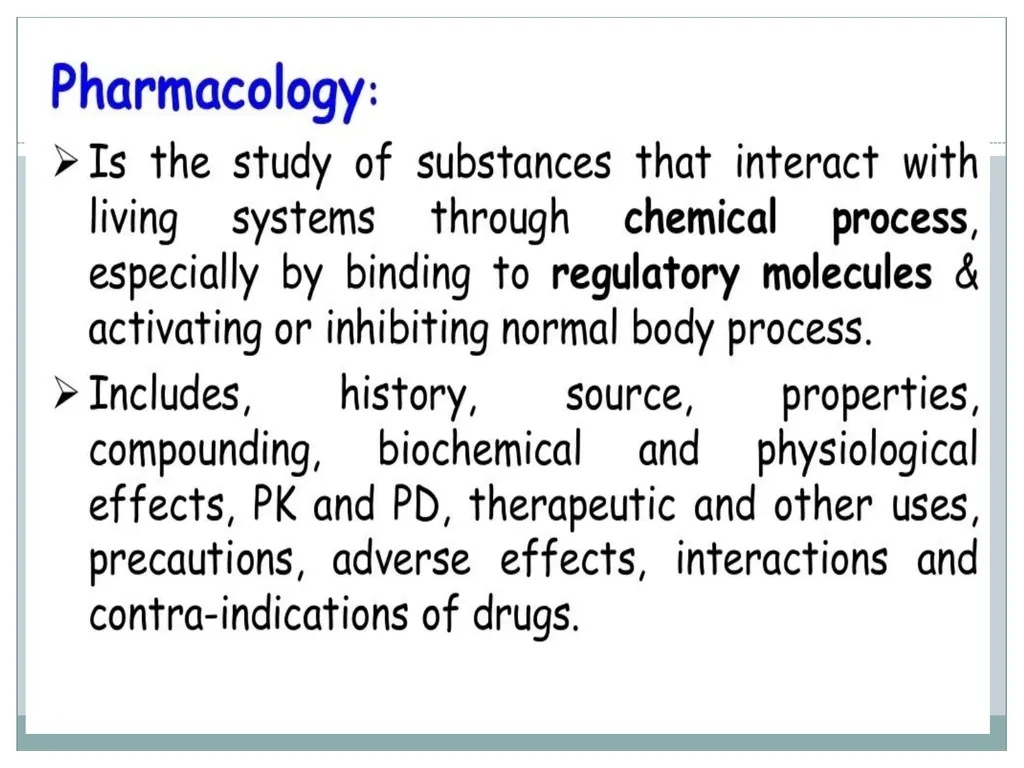
Introduction to Pharmacology Topics Introduction, historical development, branches and scope of Pharmacology. Sources and nature of drugs. Pharmacological terms and definitions, nomenclature of drugs. Principles of drug activity:
Related Topics
Share
Embed code
Download this presentation From Below
"Introduction to Pharmacology Topics Introduction," is the property of its rightful owner. Permission is granted to download and print the materials on this website for personal, non-commercial use only, and to display it on your personal computer provided you do not modify the materials and that you retain all copyright notices contained in the materials. By downloading content from our website, you accept the terms of this agreement.
Presentation Transcript
01
Introduction
to
Pharmacology<br>
02
Topics Introduction, historical development, branches and scope of Pharmacology. Sources and nature of drugs. Pharmacological terms and definitions, nomenclature of drugs.
Principles of drug activity: Pharmacokinetics - Routes of drug administration, absorption, distribution, biotransformation and excretion of drugs.
Pharmacodynamics - Concept of drug and receptor, dose-response relationship, terms related to drug activity and factors modifying the drug effect and dosage. Adverse drug reactions, drug interactions.<br>
Principles of drug activity: Pharmacokinetics - Routes of drug administration, absorption, distribution, biotransformation and excretion of drugs.
Pharmacodynamics - Concept of drug and receptor, dose-response relationship, terms related to drug activity and factors modifying the drug effect and dosage. Adverse drug reactions, drug interactions.<br>
03
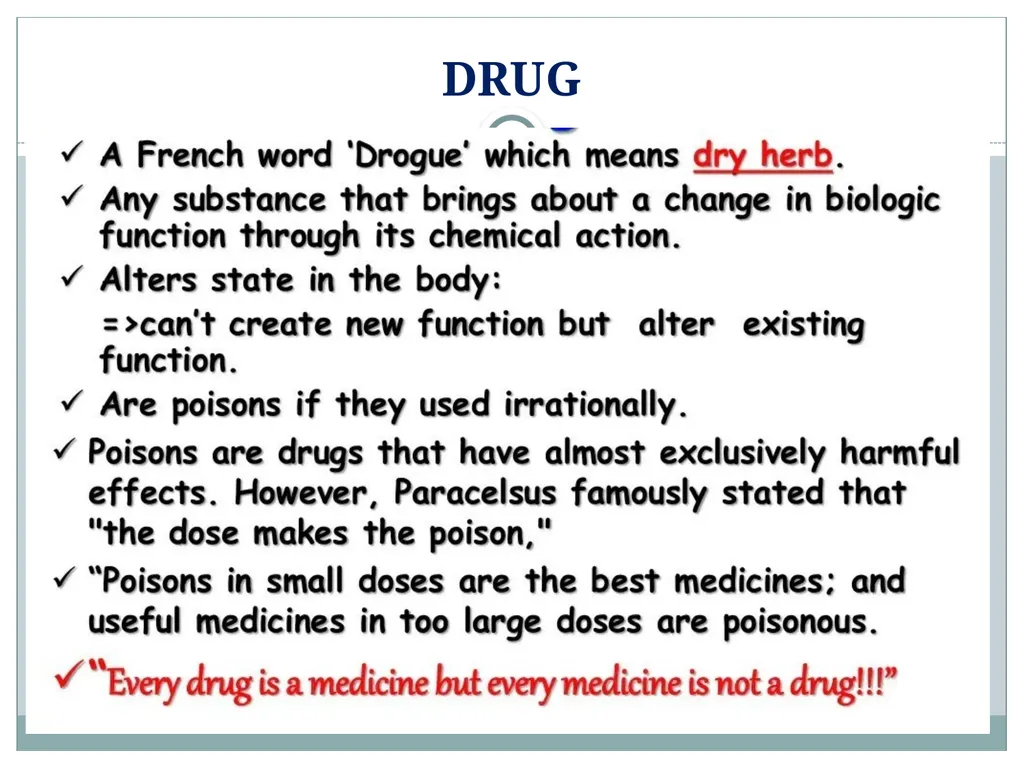
DRUG<br>
04
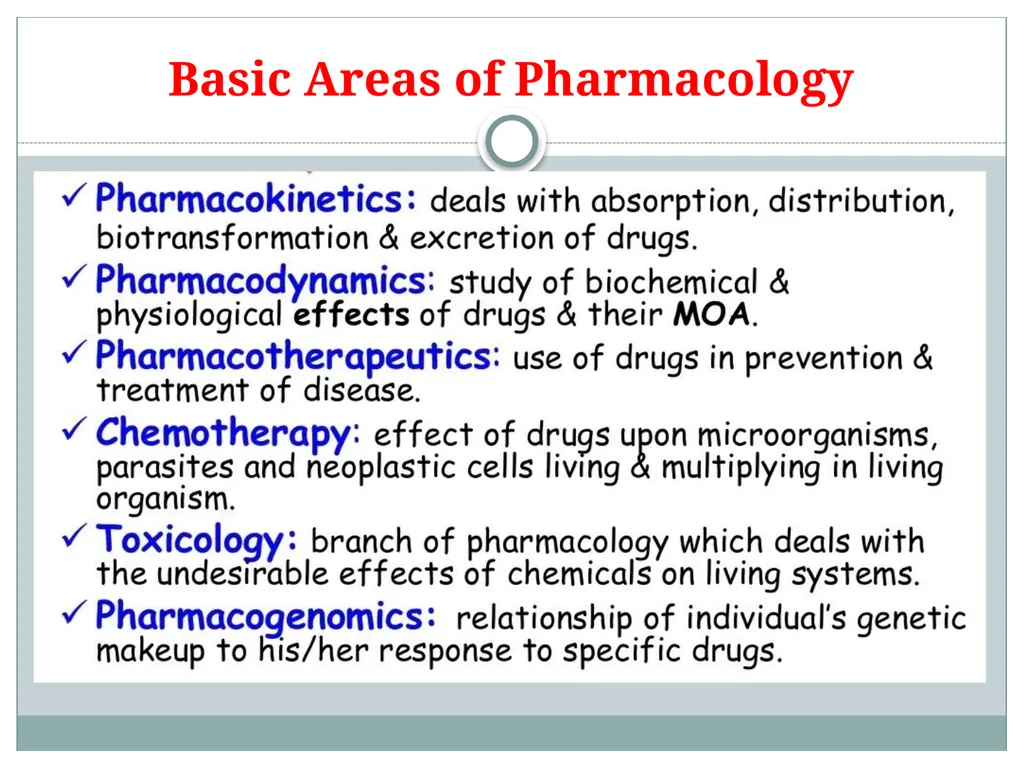
Basic Areas of Pharmacology<br>
05
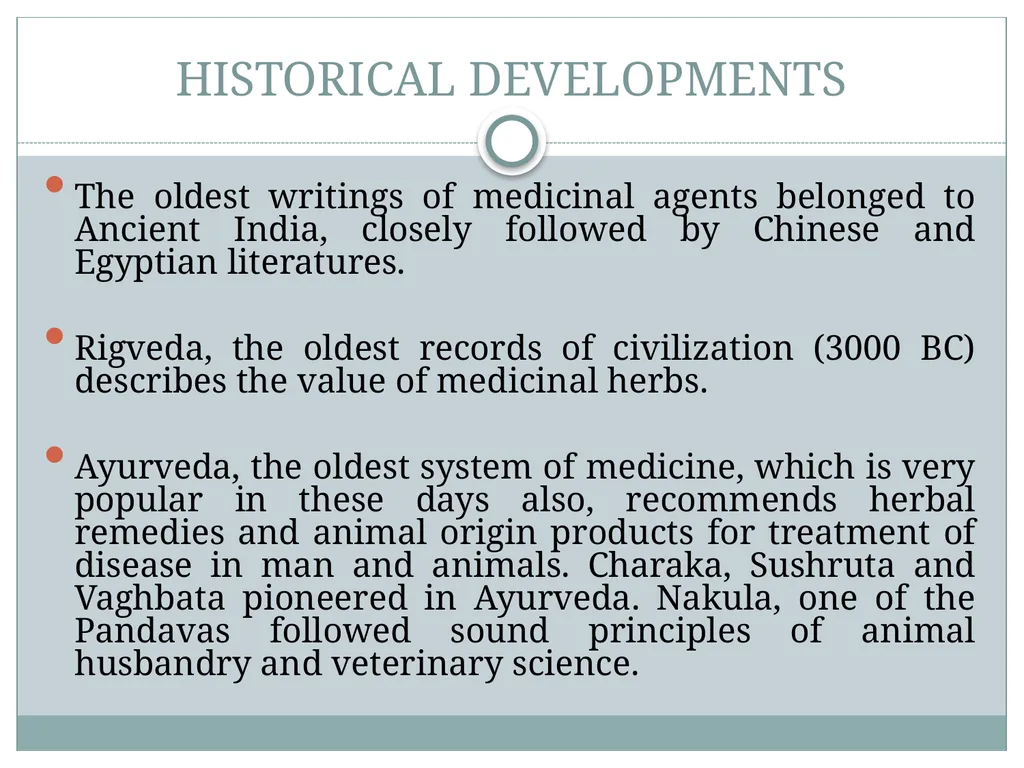
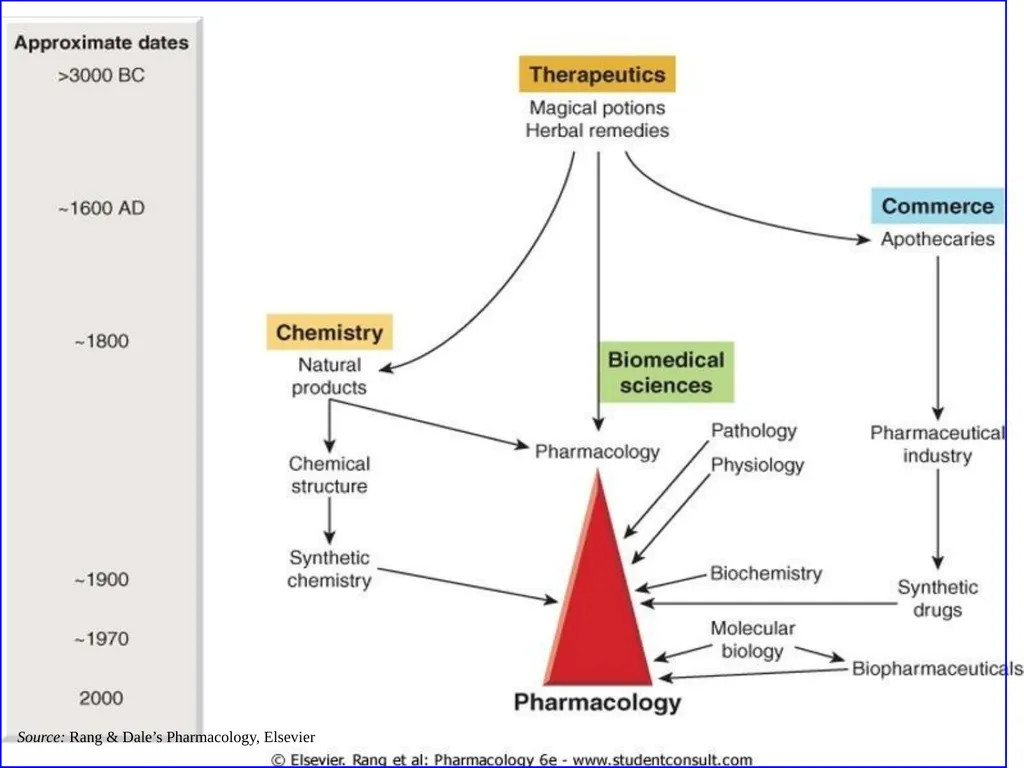
HISTORICAL DEVELOPMENTS The oldest writings of medicinal agents belonged to Ancient India, closely followed by Chinese and Egyptian literatures.
Rigveda, the oldest records of civilization (3000 BC) describes the value of medicinal herbs.
Ayurveda, the oldest system of medicine, which is very popular in these days also, recommends herbal remedies and animal origin products for treatment of disease in man and animals. Charaka, Sushruta and Vaghbata pioneered in Ayurveda. Nakula, one of the Pandavas followed sound principles of animal husbandry and veterinary science.<br>
Rigveda, the oldest records of civilization (3000 BC) describes the value of medicinal herbs.
Ayurveda, the oldest system of medicine, which is very popular in these days also, recommends herbal remedies and animal origin products for treatment of disease in man and animals. Charaka, Sushruta and Vaghbata pioneered in Ayurveda. Nakula, one of the Pandavas followed sound principles of animal husbandry and veterinary science.<br>
06
The earliest written compilation of drugs is the Chinese Herbal Formulary (Materia Medica) “Pen Tsao” which was written by Emperor Shen Nung (2700 BC). It contains many vegetables, metallic and animal products as remedies.
The oldest record of Egyptian drug codification is the Kahun Papyrus (2000 BC). It deals with veterinary medicine and uterine disease of women and contains a number of prescriptions. The Ebers Papyrus (1550 BC) is a compilation of number of disease conditions and 829 prescriptions for medicaments employed in Egyptian medicine.<br>
The oldest record of Egyptian drug codification is the Kahun Papyrus (2000 BC). It deals with veterinary medicine and uterine disease of women and contains a number of prescriptions. The Ebers Papyrus (1550 BC) is a compilation of number of disease conditions and 829 prescriptions for medicaments employed in Egyptian medicine.<br>
07
Hippocrates (460 – 375 BC), a Greek physician and a great teacher of medicine advocated little use of drugs, maintained very high ethical standards of practice (“Above all, do no harm”) and attempted to treat diseases based on four elements of nature i.e. water, fire, air and earth.
Combination of these elements gave rise to four humours of the body related to a scale of life from most alive to dead. They are – Blood (Sanguine temperament), Phlegm (Phlegmatic), Yellow Bile or Urine (Bilious) and Black Bile (Melancholic). Treatment consisted of attempting to balance these humours by replenishment of deficiencies or removing excesses. Thus arose the practices of bleeding, purging and sweating<br>
Combination of these elements gave rise to four humours of the body related to a scale of life from most alive to dead. They are – Blood (Sanguine temperament), Phlegm (Phlegmatic), Yellow Bile or Urine (Bilious) and Black Bile (Melancholic). Treatment consisted of attempting to balance these humours by replenishment of deficiencies or removing excesses. Thus arose the practices of bleeding, purging and sweating<br>
08
Aristotle (384 – 322 BC) gave scientific basis for medicine who recorded numerous observations on animals.
Theophrastus (380 – 287 BC), a pupil of Aristotle, classified systematically medicinal herbs on the basis of their individual characteristics rather than their recommended use in treatment.
Dioscorides (77), a surgeon, compiled and improved the work of Theophrastus and wrote the First Materia Medica which consisted of 6 volumes and described 600 plants. Drugs were discussed from the standpoint of name, source, identification, test for adulteration, preparation of dosage form, what it would do and for what conditions it would be used<br>
Theophrastus (380 – 287 BC), a pupil of Aristotle, classified systematically medicinal herbs on the basis of their individual characteristics rather than their recommended use in treatment.
Dioscorides (77), a surgeon, compiled and improved the work of Theophrastus and wrote the First Materia Medica which consisted of 6 volumes and described 600 plants. Drugs were discussed from the standpoint of name, source, identification, test for adulteration, preparation of dosage form, what it would do and for what conditions it would be used<br>
09
Persian writer, Geber Ibn Hajar (702 - 765) classified drugs and poisons of his time and stated that difference between a drug and a poison was just a matter of dosage. Any drug can be toxic if given in large enough amounts.
The spirit of enquiry was reestablished in Europe during Renaissance. A German person Valerius Cordus (1514 - 1544) compiled First Pharmacopoeia.
During 17th and 18th centuries, drug trade flourished and medical experimentation began. Drugs like cinchona (Quinine), coffee, tea, cocoa (methylxanthines), curare, digitalis and a variety of alkaloids were discovered.
William Withering (1741 - 1799) worked on digitalis in the treatment of dropsy (due to congestive heart failure, CHF).<br>
The spirit of enquiry was reestablished in Europe during Renaissance. A German person Valerius Cordus (1514 - 1544) compiled First Pharmacopoeia.
During 17th and 18th centuries, drug trade flourished and medical experimentation began. Drugs like cinchona (Quinine), coffee, tea, cocoa (methylxanthines), curare, digitalis and a variety of alkaloids were discovered.
William Withering (1741 - 1799) worked on digitalis in the treatment of dropsy (due to congestive heart failure, CHF).<br>
10
Edward Jenner (1749 - 1823) gave principle of prophylactic immunization against small pox and first described anaphylaxis.
William Harvey (1578 - 1657) discovered circulation of blood and indicated that drugs were distributed to various body parts via blood.
Christopher Wren (1632 - 1723) made first intravenous injection in a dog.
Alexander Wood (1817 - 1884) devised hypodermic syringe and needle.
Friedrich Surtner (1783 - 1841) isolated morphine from opium and named it after the Roman God of sleep, “Morpheus”.
Claude Bernard (1813 - 1878) and James Blake (1814 - 1893) established the foundations of modern pharmacology. They worked on dose response relationship, drug disposition in the body, mechanism of action of drugs and structure activity relationship (SAR).<br>
William Harvey (1578 - 1657) discovered circulation of blood and indicated that drugs were distributed to various body parts via blood.
Christopher Wren (1632 - 1723) made first intravenous injection in a dog.
Alexander Wood (1817 - 1884) devised hypodermic syringe and needle.
Friedrich Surtner (1783 - 1841) isolated morphine from opium and named it after the Roman God of sleep, “Morpheus”.
Claude Bernard (1813 - 1878) and James Blake (1814 - 1893) established the foundations of modern pharmacology. They worked on dose response relationship, drug disposition in the body, mechanism of action of drugs and structure activity relationship (SAR).<br>
11
Rudolph Buchheim (1820 - 1879) established the first laboratory for pharmacology at University of Dorpat, Estonia.
John J. Abel (1857 - 1938) who is regarded as the Father of Pharmacology in USA, established Departments of Pharmacology at University of Michigan and at John Hopkins University. He also founded reputed journals like Journal of Biological Chemistry and Journal of Pharmacology and Experimental Therapeutics.
During 20th Century, the science of Pharmacology flourished in the medical and pharmacy schools, and focus of leadership shifted from Europe to USA (due to two world wars and emergence of USA as industrial power). The science of Pharmacology developed exponentially thereafter due to emergence of Organic Chemistry<br>
John J. Abel (1857 - 1938) who is regarded as the Father of Pharmacology in USA, established Departments of Pharmacology at University of Michigan and at John Hopkins University. He also founded reputed journals like Journal of Biological Chemistry and Journal of Pharmacology and Experimental Therapeutics.
During 20th Century, the science of Pharmacology flourished in the medical and pharmacy schools, and focus of leadership shifted from Europe to USA (due to two world wars and emergence of USA as industrial power). The science of Pharmacology developed exponentially thereafter due to emergence of Organic Chemistry<br>
12
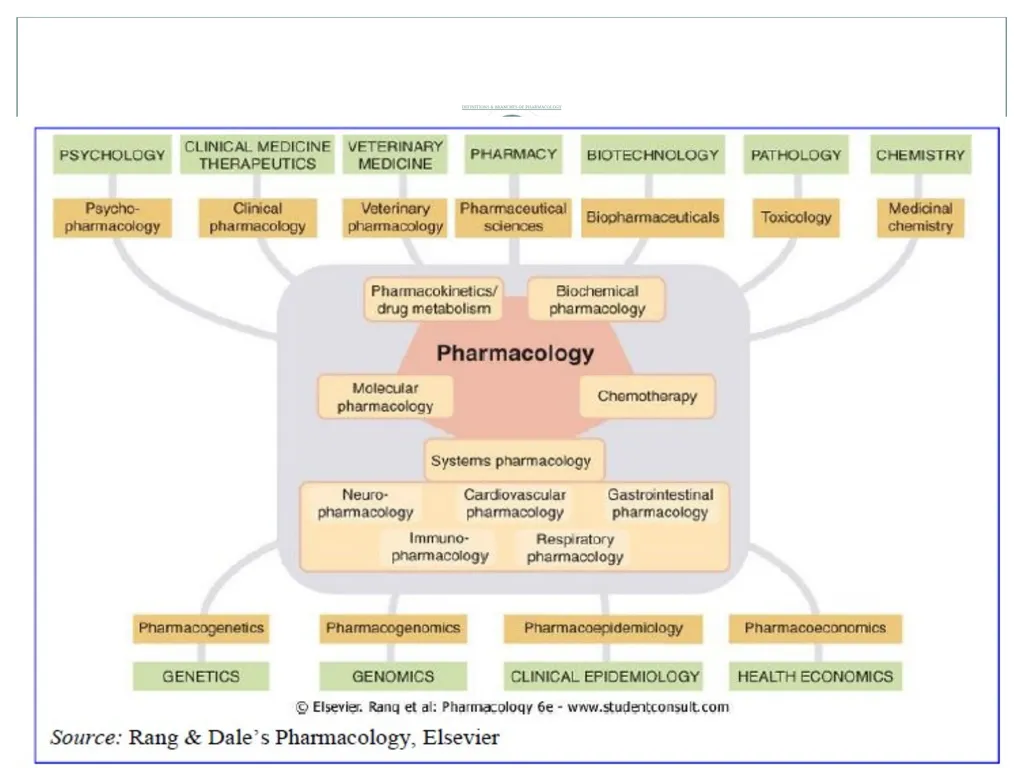
DEFINITIONS & BRANCHES OF PHARMACOLOGY<br>
13
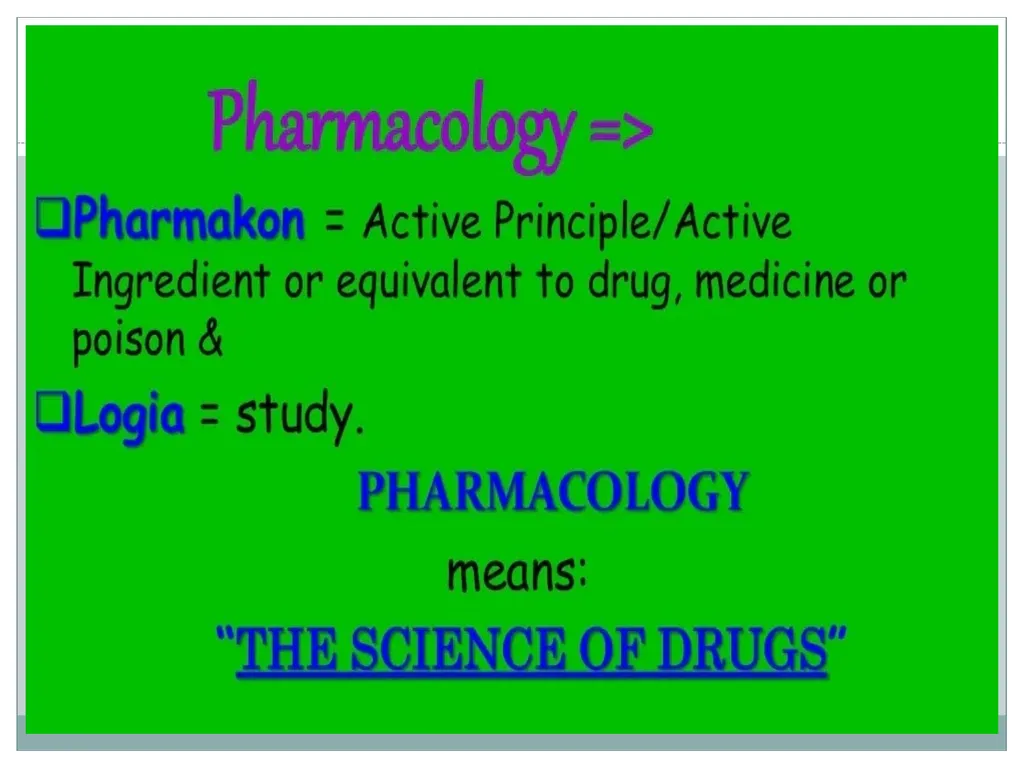
Pharmacology: It is an experimental science dealing with the properties of drugs and their effects on living systems.
Pharmacognosy: It deals with the study of sources and identification (origin) of drugs.
Pharmacodynamics: It refers to the study of response of an organism to the action of drugs in absence of disease.
Pharmacokinetics: It is defined as the mathematical description of temporal changes in concentration of drugs and/ or their metabolites within the body.
Pharmacometrics: It deals with the study of qualitative and quantitative aspects of drug effects in laboratory animals. It deals with measurement of drug responses.<br>
Pharmacognosy: It deals with the study of sources and identification (origin) of drugs.
Pharmacodynamics: It refers to the study of response of an organism to the action of drugs in absence of disease.
Pharmacokinetics: It is defined as the mathematical description of temporal changes in concentration of drugs and/ or their metabolites within the body.
Pharmacometrics: It deals with the study of qualitative and quantitative aspects of drug effects in laboratory animals. It deals with measurement of drug responses.<br>
14
Pharmacotherapy: It refers to use of drugs in treatment of diseases.
Therapeutics: It is a term describing treatment of disease in general and includes use of drugs, surgery, radiation, behavioural modification and other modalities.
Clinical Pharmacology: Much of our knowledge of pharmacodynamics, pharmacokinetics and pharmacometrics come from and continues to come from experiments performed on healthy lab animals. The difficulty of transposing this information with reliability into the realm of diseased domesticated patients gave rise to clinical pharmacology.
In this, the appropriate pharmacodynamic, pharmacometric and pharmacokinetic studies are repeated in healthy and diseased domesticated target species with resultant gain in the precision of use of remedies.
Chemotherapy: It is a branch of pharmacology dealing with drugs that selectively inhibit or destroy specific agents or disease such as bacteria, viruses, fungi and other parasites.<br>
Therapeutics: It is a term describing treatment of disease in general and includes use of drugs, surgery, radiation, behavioural modification and other modalities.
Clinical Pharmacology: Much of our knowledge of pharmacodynamics, pharmacokinetics and pharmacometrics come from and continues to come from experiments performed on healthy lab animals. The difficulty of transposing this information with reliability into the realm of diseased domesticated patients gave rise to clinical pharmacology.
In this, the appropriate pharmacodynamic, pharmacometric and pharmacokinetic studies are repeated in healthy and diseased domesticated target species with resultant gain in the precision of use of remedies.
Chemotherapy: It is a branch of pharmacology dealing with drugs that selectively inhibit or destroy specific agents or disease such as bacteria, viruses, fungi and other parasites.<br>
15
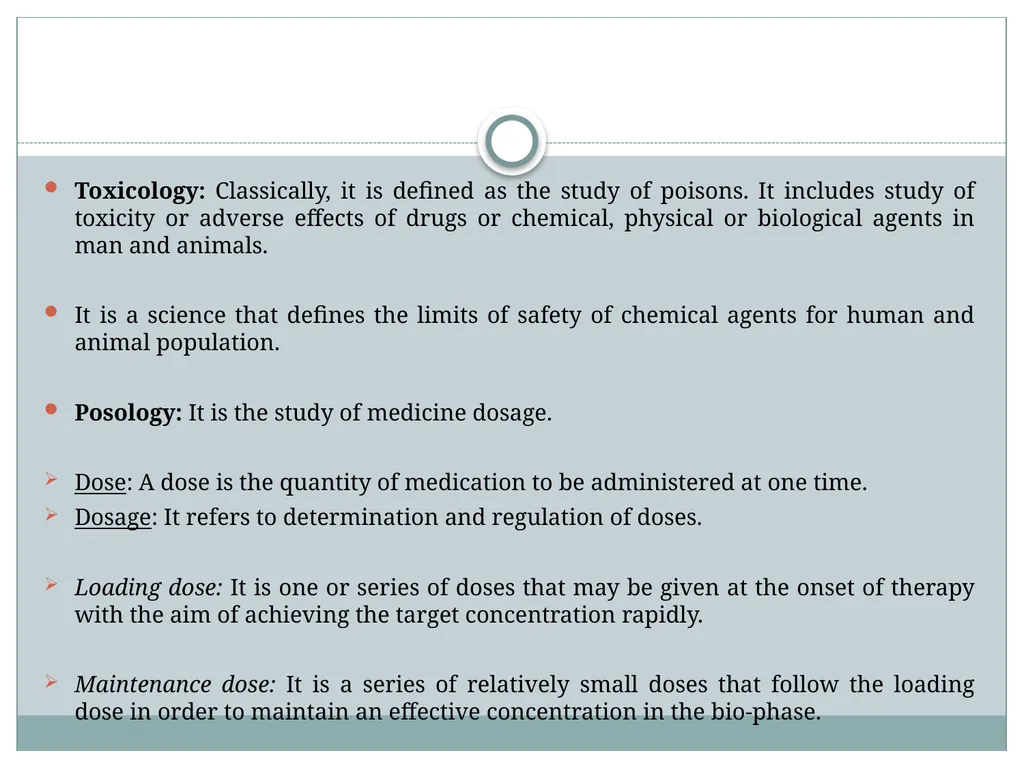
Toxicology: Classically, it is defined as the study of poisons. It includes study of toxicity or adverse effects of drugs or chemical, physical or biological agents in man and animals.
It is a science that defines the limits of safety of chemical agents for human and animal population.
Posology: It is the study of medicine dosage.
Dose: A dose is the quantity of medication to be administered at one time.
Dosage: It refers to determination and regulation of doses.
Loading dose: It is one or series of doses that may be given at the onset of therapy with the aim of achieving the target concentration rapidly.
Maintenance dose: It is a series of relatively small doses that follow the loading dose in order to maintain an effective concentration in the bio-phase.<br>
It is a science that defines the limits of safety of chemical agents for human and animal population.
Posology: It is the study of medicine dosage.
Dose: A dose is the quantity of medication to be administered at one time.
Dosage: It refers to determination and regulation of doses.
Loading dose: It is one or series of doses that may be given at the onset of therapy with the aim of achieving the target concentration rapidly.
Maintenance dose: It is a series of relatively small doses that follow the loading dose in order to maintain an effective concentration in the bio-phase.<br>
16
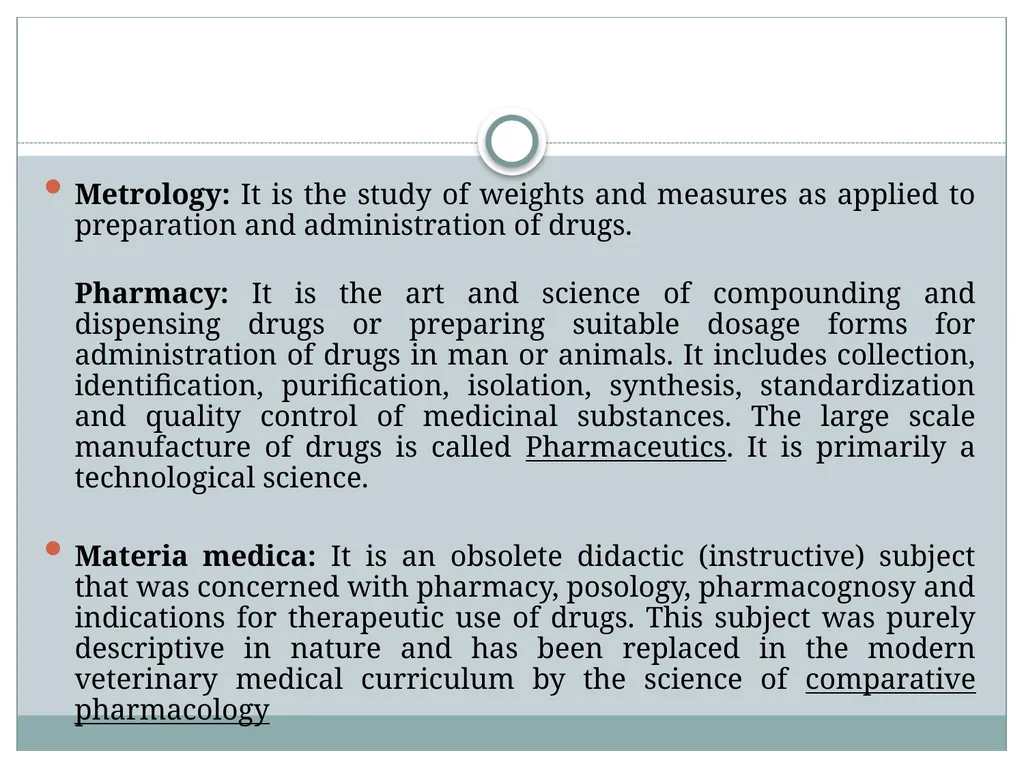
Metrology: It is the study of weights and measures as applied to preparation and administration of drugs.
Pharmacy: It is the art and science of compounding and dispensing drugs or preparing suitable dosage forms for administration of drugs in man or animals. It includes collection, identification, purification, isolation, synthesis, standardization and quality control of medicinal substances. The large scale manufacture of drugs is called Pharmaceutics. It is primarily a technological science.
Materia medica: It is an obsolete didactic (instructive) subject that was concerned with pharmacy, posology, pharmacognosy and indications for therapeutic use of drugs. This subject was purely descriptive in nature and has been replaced in the modern veterinary medical curriculum by the science of comparative pharmacology<br>
Pharmacy: It is the art and science of compounding and dispensing drugs or preparing suitable dosage forms for administration of drugs in man or animals. It includes collection, identification, purification, isolation, synthesis, standardization and quality control of medicinal substances. The large scale manufacture of drugs is called Pharmaceutics. It is primarily a technological science.
Materia medica: It is an obsolete didactic (instructive) subject that was concerned with pharmacy, posology, pharmacognosy and indications for therapeutic use of drugs. This subject was purely descriptive in nature and has been replaced in the modern veterinary medical curriculum by the science of comparative pharmacology<br>
17
Comparative pharmacology: It deals with the study of variation in drug effects in different species of animals.
Neutraceuticals: These are nutritional products which allegedly have some therapeutic value in addition to their scientifically recognized nutritional content.
Biotechnology: Originally, this was the production of drugs or other useful products by biological means (e.g. antibiotic production from microorganisms or production of monoclonal antibodies). Currently in the biomedical sphere, biotechnology refers mainly to the use of recombinant DNA technology for a wide variety of purposes, including the manufacture of therapeutic proteins, diagnostics, genotyping, production of transgenic animals, etc. The many non-medical applications include agriculture, forensics, environmental sciences, etc.<br>
Neutraceuticals: These are nutritional products which allegedly have some therapeutic value in addition to their scientifically recognized nutritional content.
Biotechnology: Originally, this was the production of drugs or other useful products by biological means (e.g. antibiotic production from microorganisms or production of monoclonal antibodies). Currently in the biomedical sphere, biotechnology refers mainly to the use of recombinant DNA technology for a wide variety of purposes, including the manufacture of therapeutic proteins, diagnostics, genotyping, production of transgenic animals, etc. The many non-medical applications include agriculture, forensics, environmental sciences, etc.<br>
18
Pharmacogenetics: This is the study of genetic influences on responses to drugs. Originally, pharmacogenetics focused on familial idiosyncratic drug reactions, where affected individuals show an abnormal-usually adverse-response to a class of drug. It now covers broader variations in drug response, where the genetic basis is more complex.
Pharmacogenomics: This recent term overlaps with pharmacogenetics, describing the use of genetic information to guide the choice of drug therapy on an individual basis. The underlying principle is that differences between individuals in their response to therapeutic drugs can be predicted from their genetic make-up.
Pharmacoepidemiology: This is the study of drug effects at the population level. It is concerned with the variability of drug effects between individuals in a population, and between populations.<br>
Pharmacogenomics: This recent term overlaps with pharmacogenetics, describing the use of genetic information to guide the choice of drug therapy on an individual basis. The underlying principle is that differences between individuals in their response to therapeutic drugs can be predicted from their genetic make-up.
Pharmacoepidemiology: This is the study of drug effects at the population level. It is concerned with the variability of drug effects between individuals in a population, and between populations.<br>
19
Pharmacoeconomics: This branch of health economics aims to quantify in economic terms the cost and benefit of drugs used therapeutically.
Nanotechnology: Nanotechnology is the study and use of structures between 1 nanometer (nm) and 100 nanometers in size. Nanotechnology is the study of phenomena and fine-tuning of materials at atomic, molecular and macromolecular scales, where properties differ significantly from those at a larger scale.
The applications of nanotechnology to pharmacology are biochips, nanosensors, bioreactors, neural stem cells, immune nanoparticles, biodegradable polymers, and convection-enhanced drug delivery in the diagnostics and treatment of diseases.<br>
Nanotechnology: Nanotechnology is the study and use of structures between 1 nanometer (nm) and 100 nanometers in size. Nanotechnology is the study of phenomena and fine-tuning of materials at atomic, molecular and macromolecular scales, where properties differ significantly from those at a larger scale.
The applications of nanotechnology to pharmacology are biochips, nanosensors, bioreactors, neural stem cells, immune nanoparticles, biodegradable polymers, and convection-enhanced drug delivery in the diagnostics and treatment of diseases.<br>
20
Drug: A drug can be defined as a chemical substance of known structure, other than a nutrient or an essential dietary ingredient, which when administered to a living organism, produces a biological effect. Drugs may be synthetic chemicals, chemicals obtained from plants or animals or products of genetic engineering.
According to WHO, “Drug is any substance or product other than food that is used or intended to be used to modify or explore physiological systems or pathological states for the benefit of the recipient”.
(To use the word ‘drug’ intending only a harmful, dangerous or addictive substance is to abuse a respectable and useful word.)<br>
According to WHO, “Drug is any substance or product other than food that is used or intended to be used to modify or explore physiological systems or pathological states for the benefit of the recipient”.
(To use the word ‘drug’ intending only a harmful, dangerous or addictive substance is to abuse a respectable and useful word.)<br>
21
Medicine: A medicine is a chemical preparation which usually but not necessarily contains one or more drugs, administered with the intention of producing a therapeutic effect. Medicines usually contain other substances (excipients, stabilizers, solvents etc.) besides the active drug to make them more convenient to use.
Over the counter drugs: These are those preparations that can be sold without any restriction because they can be adequately labeled for layman use.
Prescription drugs: Drugs that can be used only on the order of a licensed veterinarian/ physician/ dentist/ surgeon. They are also known as legend drugs.<br>
Over the counter drugs: These are those preparations that can be sold without any restriction because they can be adequately labeled for layman use.
Prescription drugs: Drugs that can be used only on the order of a licensed veterinarian/ physician/ dentist/ surgeon. They are also known as legend drugs.<br>
22
Essential drugs: Drugs that satisfy the healthcare needs of majority of the population. They should therefore be available at all times in adequate amounts and in appropriate dosage forms.
Pro-drugs: Drugs that are inactive or have a low order of activity in the form administered and are metabolized to the active form in the body.
Hard drugs: Drugs used for non-medical purposes that are liable to disable the individual seriously as a functioning member of the society by inducing severe psychological and/or physical dependence. Example - Heroin.
Soft drugs: Drugs used for non-medical purposes that are less dependence producing. There may be psychological dependence but not physical dependence, except with heavy dose. Example - Amphetamine.<br>
Pro-drugs: Drugs that are inactive or have a low order of activity in the form administered and are metabolized to the active form in the body.
Hard drugs: Drugs used for non-medical purposes that are liable to disable the individual seriously as a functioning member of the society by inducing severe psychological and/or physical dependence. Example - Heroin.
Soft drugs: Drugs used for non-medical purposes that are less dependence producing. There may be psychological dependence but not physical dependence, except with heavy dose. Example - Amphetamine.<br>
23
Nootropic drugs: Drugs that affect the intellect. These drugs are claimed to enhance learning, increase brain resistance to stress including hypoxia and stimulate brain metabolism especially in senile patients. Example – Piracetam
Orphan drugs: Orphan drugs are drugs or biological products for diagnosis/ treatment/ prevention of a rare disease condition for which there is no reasonable expectation that the cost of developing and marketing it will be recovered from sales of that drug. Examples – Acetylcysteine. These drugs may be life saving for some patients, but are not commercially available.
Empirical therapy: It is the use of certain agents that prove successful in a series of cases of the same disease, although, it is not possible to explain their actions. Their value has been demonstrated by experience.<br>
Orphan drugs: Orphan drugs are drugs or biological products for diagnosis/ treatment/ prevention of a rare disease condition for which there is no reasonable expectation that the cost of developing and marketing it will be recovered from sales of that drug. Examples – Acetylcysteine. These drugs may be life saving for some patients, but are not commercially available.
Empirical therapy: It is the use of certain agents that prove successful in a series of cases of the same disease, although, it is not possible to explain their actions. Their value has been demonstrated by experience.<br>
24
Rational therapy: It is the term used with reference to the application of remedial measures which can clearly explain the reasons for their application.
Rational therapy is based on a thorough knowledge of the normal physiology, changes in physiology due to pathological conditions and the pharmacological basis for use of the drug.
This implies a precise diagnosis and knowledge of the etiology of affection, so that we can act directly or indirectly on the causes which produce it and an intimate knowledge of the actions of the drugs which we employ.
Curative therapy: It is the therapy aimed at bringing about a cure in the patient, like the use of antimicrobials in a bacterial infection.<br>
Rational therapy is based on a thorough knowledge of the normal physiology, changes in physiology due to pathological conditions and the pharmacological basis for use of the drug.
This implies a precise diagnosis and knowledge of the etiology of affection, so that we can act directly or indirectly on the causes which produce it and an intimate knowledge of the actions of the drugs which we employ.
Curative therapy: It is the therapy aimed at bringing about a cure in the patient, like the use of antimicrobials in a bacterial infection.<br>
25
Prophylactic or preventive therapy: It is the therapy aimed at preventing the occurrence of a disease, like the use of vaccines for preventing bacterial and viral infections.
Symptomatic or palliative therapy: It aims at treating the condition based on the symptoms and providing relief to the patient without actually spending time on finding the cause of the disease, like the use of anti-convulsants in epilepsy.
Replacement therapy: It aims at replacing the constituents to the normal level when there is a reduction in the level of the constituent due to some pathological condition, like fluid and electrolyte replacement in dehydration.
Additive therapy: It is the therapy given to add on the existing level of the normal constituent even though there may not be a reduction in the level of that constituent, like the use of anabolic steroid to build up body mass.<br>
Symptomatic or palliative therapy: It aims at treating the condition based on the symptoms and providing relief to the patient without actually spending time on finding the cause of the disease, like the use of anti-convulsants in epilepsy.
Replacement therapy: It aims at replacing the constituents to the normal level when there is a reduction in the level of the constituent due to some pathological condition, like fluid and electrolyte replacement in dehydration.
Additive therapy: It is the therapy given to add on the existing level of the normal constituent even though there may not be a reduction in the level of that constituent, like the use of anabolic steroid to build up body mass.<br>
26
Iatrogenic disease: It means physician caused disease i.e. disease consequent upon following medical advice or intervention.
Iatrogenic was first applied to disorder induced in the patient by auto suggestion based on physical examination or manner of examination or discussion by the doctor.<br>
Iatrogenic was first applied to disorder induced in the patient by auto suggestion based on physical examination or manner of examination or discussion by the doctor.<br>
27
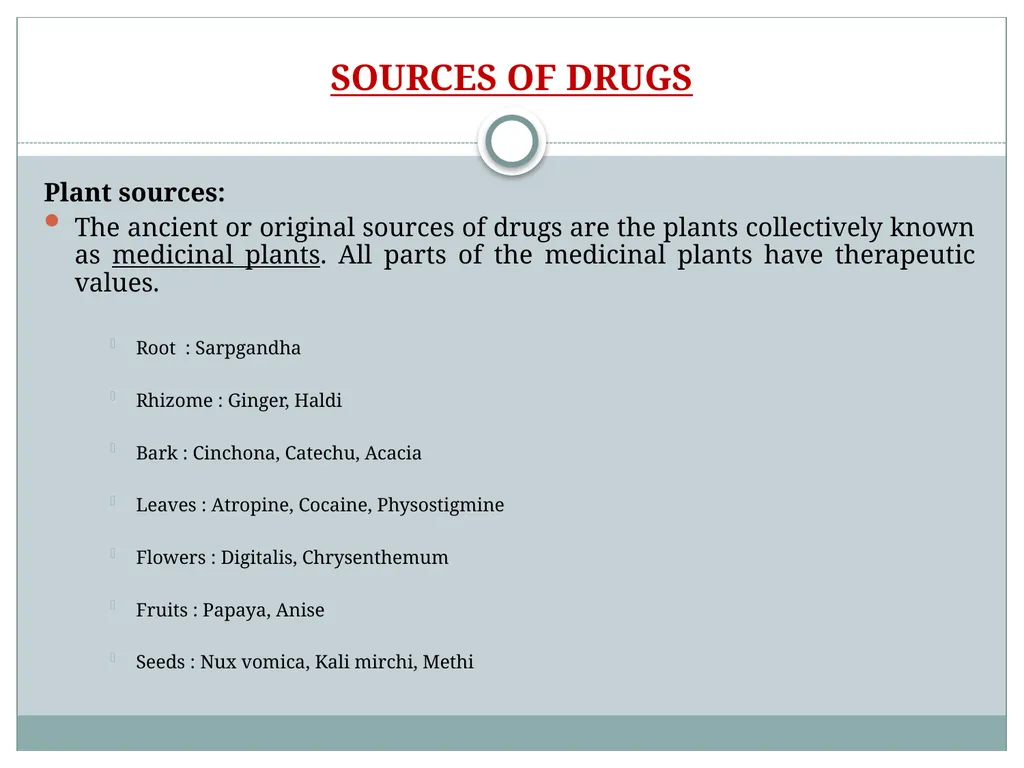
SOURCES OF DRUGS Plant sources:
The ancient or original sources of drugs are the plants collectively known as medicinal plants. All parts of the medicinal plants have therapeutic values.
Root : Sarpgandha
Rhizome : Ginger, Haldi
Bark : Cinchona, Catechu, Acacia
Leaves : Atropine, Cocaine, Physostigmine
Flowers : Digitalis, Chrysenthemum
Fruits : Papaya, Anise
Seeds : Nux vomica, Kali mirchi, Methi<br>
The ancient or original sources of drugs are the plants collectively known as medicinal plants. All parts of the medicinal plants have therapeutic values.
Root : Sarpgandha
Rhizome : Ginger, Haldi
Bark : Cinchona, Catechu, Acacia
Leaves : Atropine, Cocaine, Physostigmine
Flowers : Digitalis, Chrysenthemum
Fruits : Papaya, Anise
Seeds : Nux vomica, Kali mirchi, Methi<br>
28
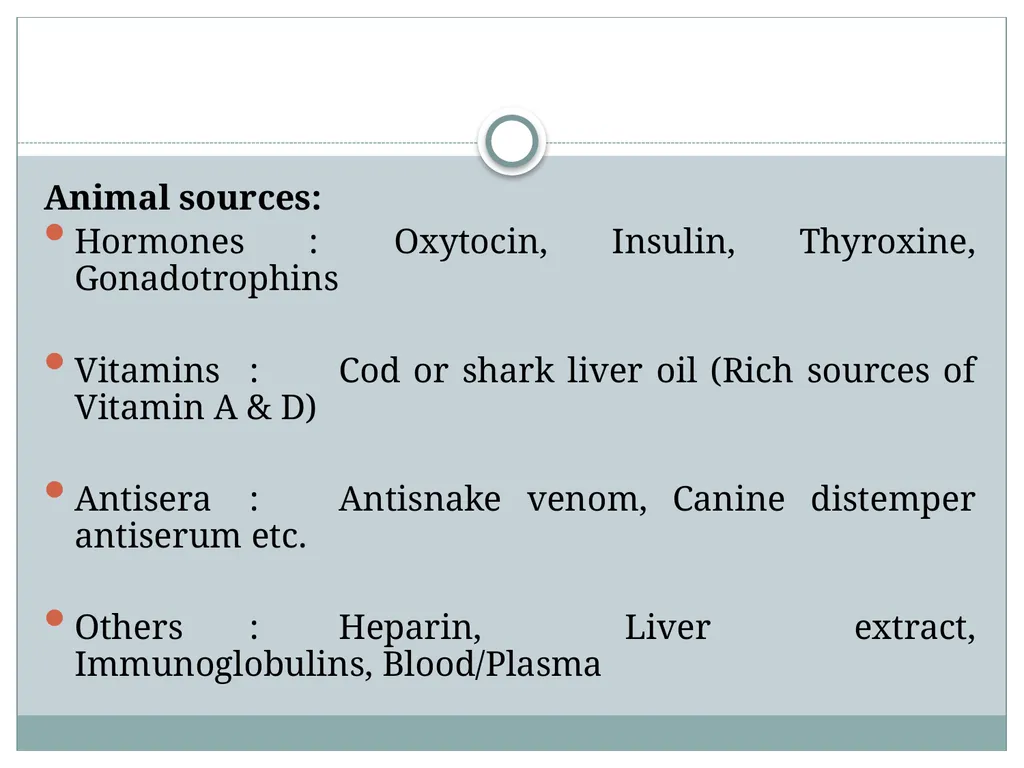
Animal sources:
Hormones : Oxytocin, Insulin, Thyroxine, Gonadotrophins
Vitamins : Cod or shark liver oil (Rich sources of Vitamin A & D)
Antisera : Antisnake venom, Canine distemper antiserum etc.
Others : Heparin, Liver extract, Immunoglobulins, Blood/Plasma<br>
Hormones : Oxytocin, Insulin, Thyroxine, Gonadotrophins
Vitamins : Cod or shark liver oil (Rich sources of Vitamin A & D)
Antisera : Antisnake venom, Canine distemper antiserum etc.
Others : Heparin, Liver extract, Immunoglobulins, Blood/Plasma<br>
29
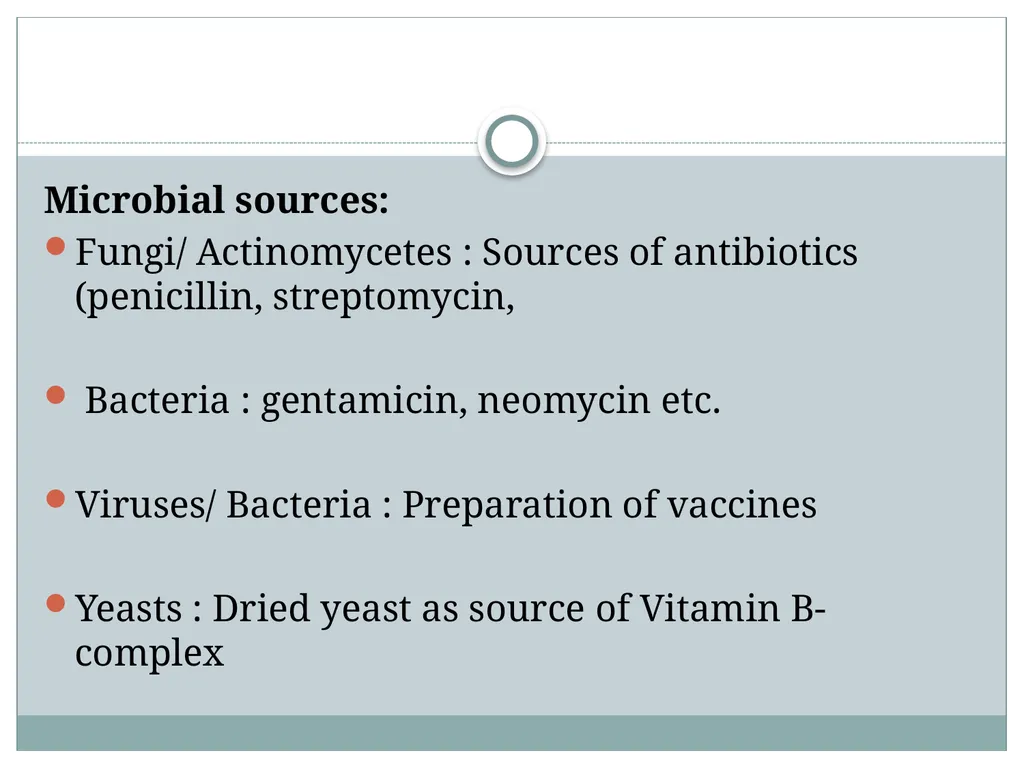
Microbial sources:
Fungi/ Actinomycetes : Sources of antibiotics (penicillin, streptomycin,
Bacteria : gentamicin, neomycin etc.
Viruses/ Bacteria : Preparation of vaccines
Yeasts : Dried yeast as source of Vitamin B-complex<br>
Fungi/ Actinomycetes : Sources of antibiotics (penicillin, streptomycin,
Bacteria : gentamicin, neomycin etc.
Viruses/ Bacteria : Preparation of vaccines
Yeasts : Dried yeast as source of Vitamin B-complex<br>
30
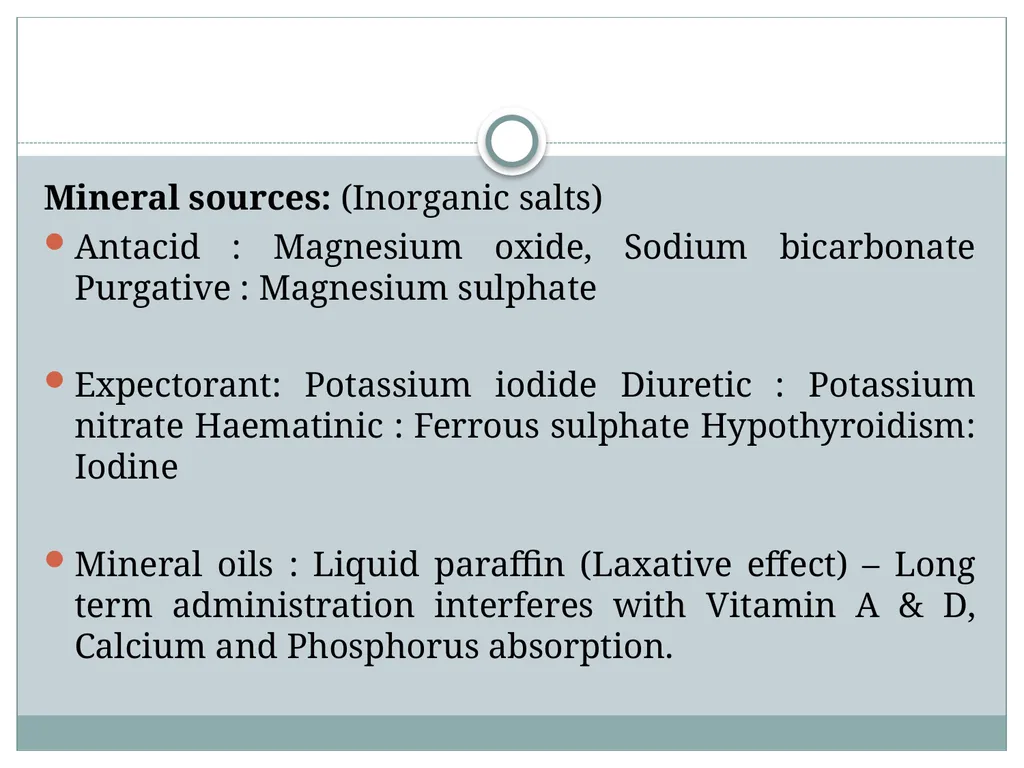
Mineral sources: (Inorganic salts)
Antacid : Magnesium oxide, Sodium bicarbonate Purgative : Magnesium sulphate
Expectorant: Potassium iodide Diuretic : Potassium nitrate Haematinic : Ferrous sulphate Hypothyroidism: Iodine
Mineral oils : Liquid paraffin (Laxative effect) – Long term administration interferes with Vitamin A & D, Calcium and Phosphorus absorption.<br>
Antacid : Magnesium oxide, Sodium bicarbonate Purgative : Magnesium sulphate
Expectorant: Potassium iodide Diuretic : Potassium nitrate Haematinic : Ferrous sulphate Hypothyroidism: Iodine
Mineral oils : Liquid paraffin (Laxative effect) – Long term administration interferes with Vitamin A & D, Calcium and Phosphorus absorption.<br>
31
Synthetic drugs:
Majority of the current day dugs are from synthetic source. Examples are –
Antipyretics
Barbiturates
Tranquillizers
Anti-inflammatory drugs
Anaesthetics
Antiseptics
Antiprotozoals
Antihistamines etc<br>
Majority of the current day dugs are from synthetic source. Examples are –
Antipyretics
Barbiturates
Tranquillizers
Anti-inflammatory drugs
Anaesthetics
Antiseptics
Antiprotozoals
Antihistamines etc<br>
32
Semi-synthetic drugs: Examples are –
Agonists and antagonists of morphine
Dihydrostreptomycin – from streptomycin
Semi-synthetic penicillins – from penicillin<br>
Agonists and antagonists of morphine
Dihydrostreptomycin – from streptomycin
Semi-synthetic penicillins – from penicillin<br>
33
Gene therapy
It means prevention or treatment of disease through manipulation of gene function.
It is insertion of specific genes (therapeutic genes) exogenously into the animal cells.
The concept of gene therapy has its origin from the fact that manipulation of gene expression could change the function of abnormal genes or supplementation of a non-functional gene or suppression of an abnormal gene.
Gene therapy refers to introduction of functional genetic material into target cells to replace or supplement defective genes, or to modify target cells so as to achieve therapeutic goals.
In contrast to all other drugs, this kind of therapy can impart new functions to a cell.
Gene therapy holds a great promise for curing a number of diseases which at present can at best be only palliated or controlled.
Gene defects result in failure to synthesize a functional protein or in the synthesis of a dysfunctional protein. Equipping the cell (specially the one which physiologically expresses it) with a normal copy of the defective gene would overcome the deficiency at the site where it is needed on a long term (may be permanent) basis.
Recombinant DNA technology forms the basis of synthesis of therapeutic genes.<br>
It means prevention or treatment of disease through manipulation of gene function.
It is insertion of specific genes (therapeutic genes) exogenously into the animal cells.
The concept of gene therapy has its origin from the fact that manipulation of gene expression could change the function of abnormal genes or supplementation of a non-functional gene or suppression of an abnormal gene.
Gene therapy refers to introduction of functional genetic material into target cells to replace or supplement defective genes, or to modify target cells so as to achieve therapeutic goals.
In contrast to all other drugs, this kind of therapy can impart new functions to a cell.
Gene therapy holds a great promise for curing a number of diseases which at present can at best be only palliated or controlled.
Gene defects result in failure to synthesize a functional protein or in the synthesis of a dysfunctional protein. Equipping the cell (specially the one which physiologically expresses it) with a normal copy of the defective gene would overcome the deficiency at the site where it is needed on a long term (may be permanent) basis.
Recombinant DNA technology forms the basis of synthesis of therapeutic genes.<br>
34
Applications of gene therapy Cystic fibrosis
Severe combined immunodeficiency disease (SCID)
Growth hormone deficiency
Parkinsonism
HIV infection
Alzheimer’s disease
Huntington’s chorea
Cancers
Hypertension
Haemophilia
Insulin dependent diabetes etc<br>
Severe combined immunodeficiency disease (SCID)
Growth hormone deficiency
Parkinsonism
HIV infection
Alzheimer’s disease
Huntington’s chorea
Cancers
Hypertension
Haemophilia
Insulin dependent diabetes etc<br>
35
Biopharmaceuticals These are therapeutic agents produced through biotechnological means, but not by conventional laboratory (chemical) synthesis.
The principle of biopharmaceuticals and the process of their development have origin from the advancement in the knowledge of molecular cell biology and biotechnology.
Therefore, biopharmaceuticals popularly known as Designer Proteins are the promising therapeutic tools of the future.
Functional human peptides: ADH, Oxytocin, GnRH, ACTH, TSH/TRH, Calcitonin, Insulin, Somatostatin, Growth hormone, Cyclosporin etc.
Enzymes/ Peptides : Streptokinase, Asparaginase, DNAase,
Erythropoietin, Clotting factors, Interferons, Monoclonal antibodies, Vaccines etc.<br>
The principle of biopharmaceuticals and the process of their development have origin from the advancement in the knowledge of molecular cell biology and biotechnology.
Therefore, biopharmaceuticals popularly known as Designer Proteins are the promising therapeutic tools of the future.
Functional human peptides: ADH, Oxytocin, GnRH, ACTH, TSH/TRH, Calcitonin, Insulin, Somatostatin, Growth hormone, Cyclosporin etc.
Enzymes/ Peptides : Streptokinase, Asparaginase, DNAase,
Erythropoietin, Clotting factors, Interferons, Monoclonal antibodies, Vaccines etc.<br>
36
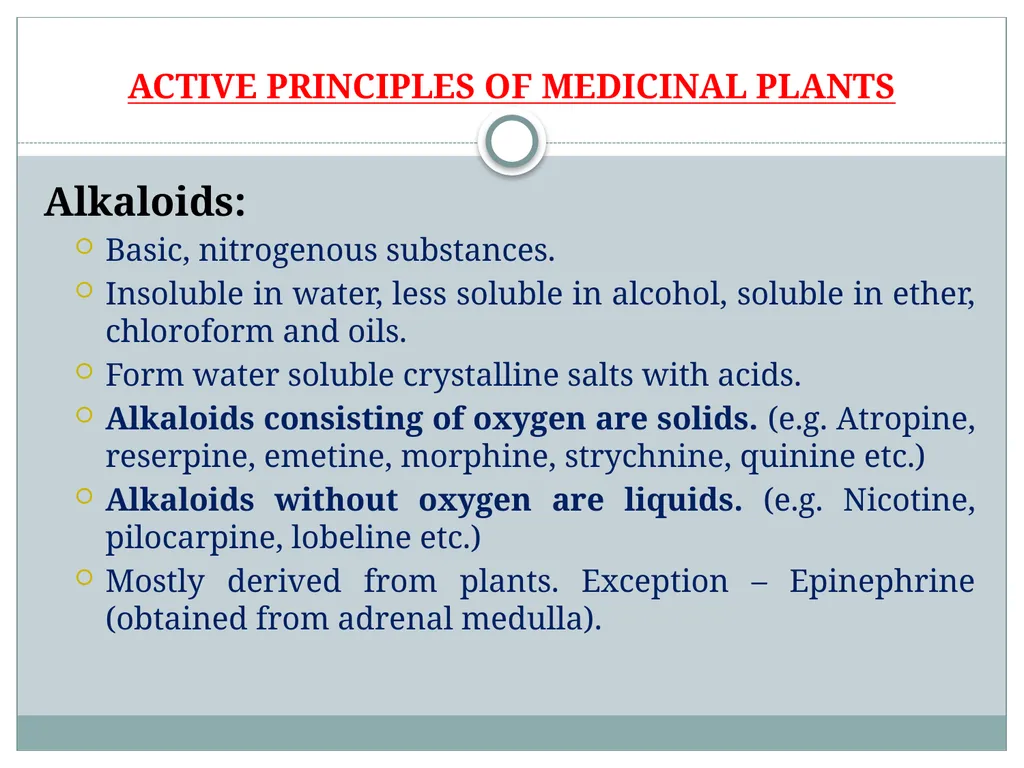
ACTIVE PRINCIPLES OF MEDICINAL PLANTS Alkaloids:
Basic, nitrogenous substances.
Insoluble in water, less soluble in alcohol, soluble in ether, chloroform and oils.
Form water soluble crystalline salts with acids.
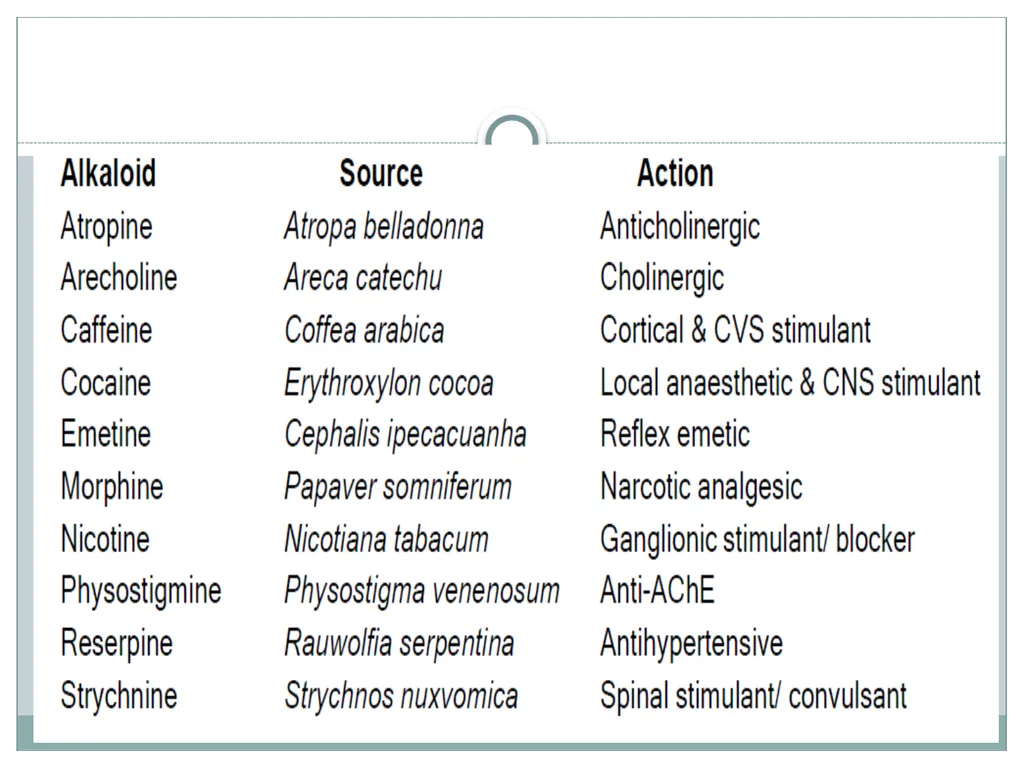
Alkaloids consisting of oxygen are solids. (e.g. Atropine, reserpine, emetine, morphine, strychnine, quinine etc.)
Alkaloids without oxygen are liquids. (e.g. Nicotine, pilocarpine, lobeline etc.)
Mostly derived from plants. Exception – Epinephrine (obtained from adrenal medulla).<br>
Basic, nitrogenous substances.
Insoluble in water, less soluble in alcohol, soluble in ether, chloroform and oils.
Form water soluble crystalline salts with acids.
Alkaloids consisting of oxygen are solids. (e.g. Atropine, reserpine, emetine, morphine, strychnine, quinine etc.)
Alkaloids without oxygen are liquids. (e.g. Nicotine, pilocarpine, lobeline etc.)
Mostly derived from plants. Exception – Epinephrine (obtained from adrenal medulla).<br>
37
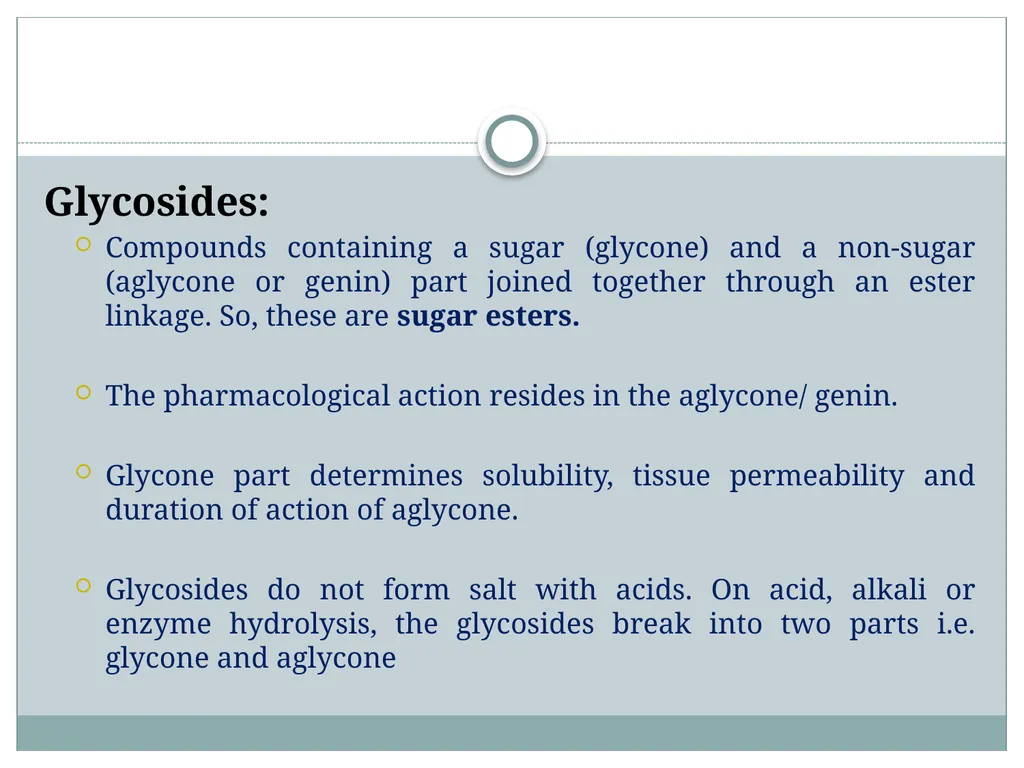
Glycosides:
Compounds containing a sugar (glycone) and a non-sugar (aglycone or genin) part joined together through an ester linkage. So, these are sugar esters.
The pharmacological action resides in the aglycone/ genin.
Glycone part determines solubility, tissue permeability and duration of action of aglycone.
Glycosides do not form salt with acids. On acid, alkali or enzyme hydrolysis, the glycosides break into two parts i.e. glycone and aglycone<br>
Compounds containing a sugar (glycone) and a non-sugar (aglycone or genin) part joined together through an ester linkage. So, these are sugar esters.
The pharmacological action resides in the aglycone/ genin.
Glycone part determines solubility, tissue permeability and duration of action of aglycone.
Glycosides do not form salt with acids. On acid, alkali or enzyme hydrolysis, the glycosides break into two parts i.e. glycone and aglycone<br>