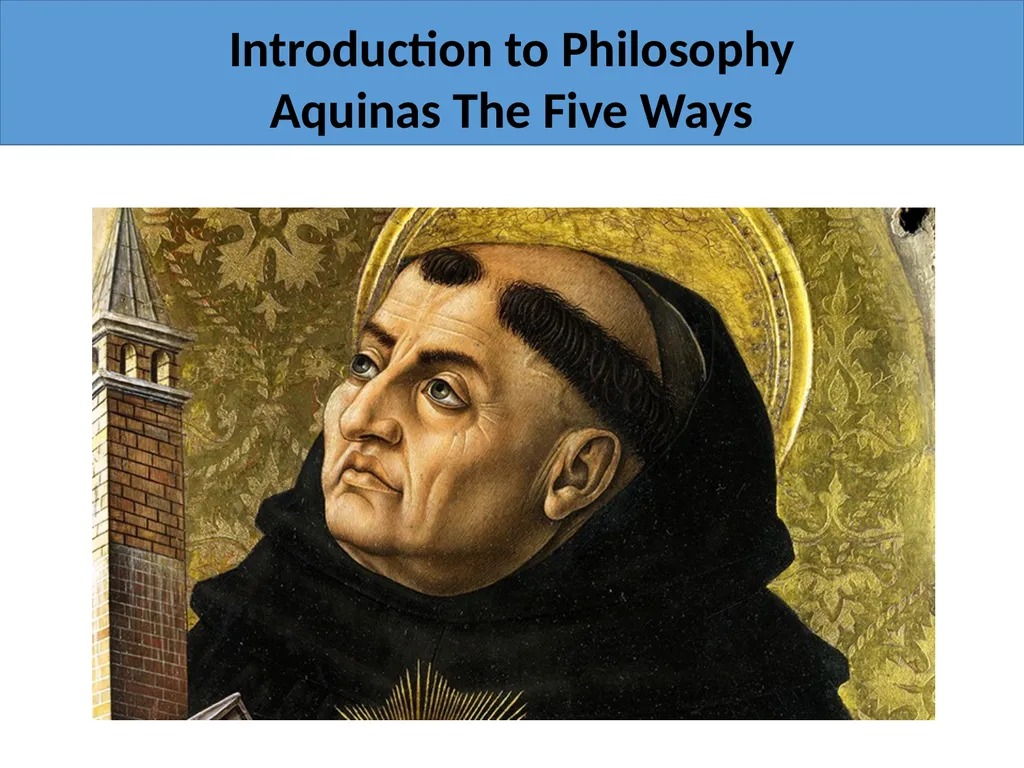
Introduction to Philosophy Aquinas The Five Ways Introduction to Philosophy Aquinas The Five Ways Saint Thomas Aquinas 1225-1274 Italian Dominican friar natural theology AristotleChristianity Introduction to Philosophy Aquinas The Five
"Introduction to Philosophy Aquinas The Five Ways" is the property of its rightful owner. Permission is granted to
download and print the materials on this website for personal, non-commercial use only, and to display it
on your personal computer provided you do not modify the materials and that you retain all copyright
notices contained in the materials. By downloading content from our website, you accept the terms of this
agreement.
Presentation Transcript
01
Introduction to Philosophy
Aquinas The Five Ways<br>
02
Introduction to Philosophy
Aquinas The Five Ways Saint Thomas Aquinas
1225-1274
Italian
Dominican friar
natural theology
Aristotle/Christianity<br>
03
Introduction to Philosophy
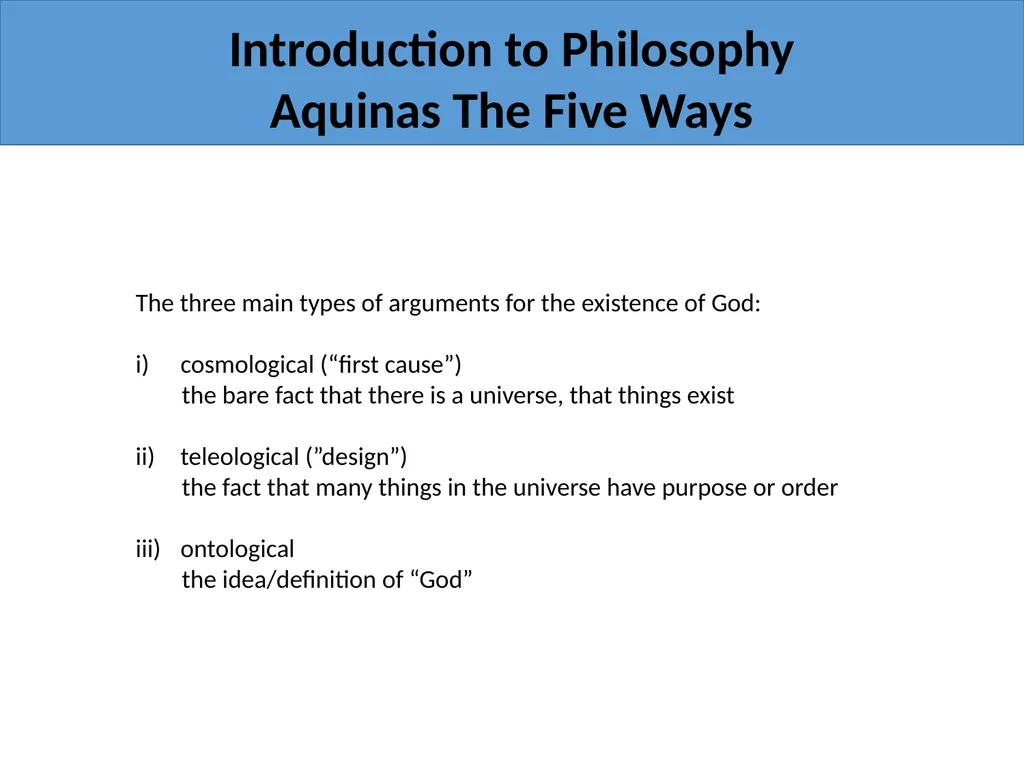
Aquinas The Five Ways The three main types of arguments for the existence of God:
cosmological (“first cause”)
the bare fact that there is a universe, that things exist
teleological (”design”)
the fact that many things in the universe have purpose or order
ontological
the idea/definition of “God”<br>
04
Introduction to Philosophy
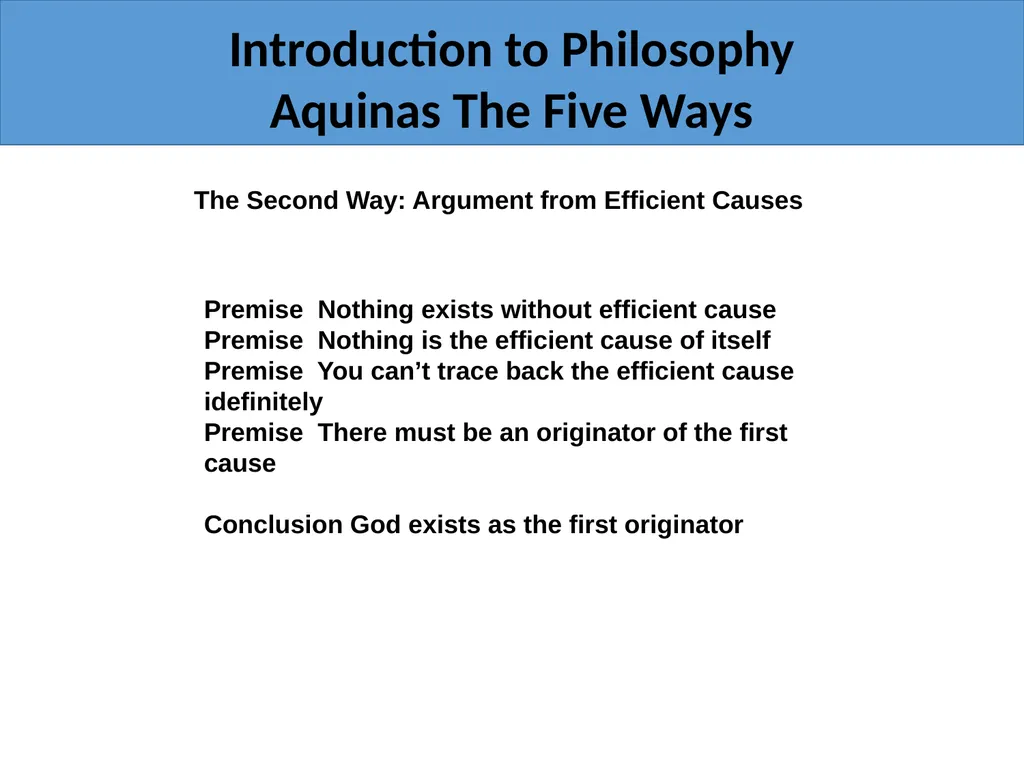
Aquinas The Five Ways The Second Way: Argument from Efficient Causes Premise Nothing exists without efficient cause
Premise Nothing is the efficient cause of itself
Premise You can’t trace back the efficient cause idefinitely
Premise There must be an originator of the first cause
Conclusion God exists as the first originator<br>
05
Introduction to Philosophy
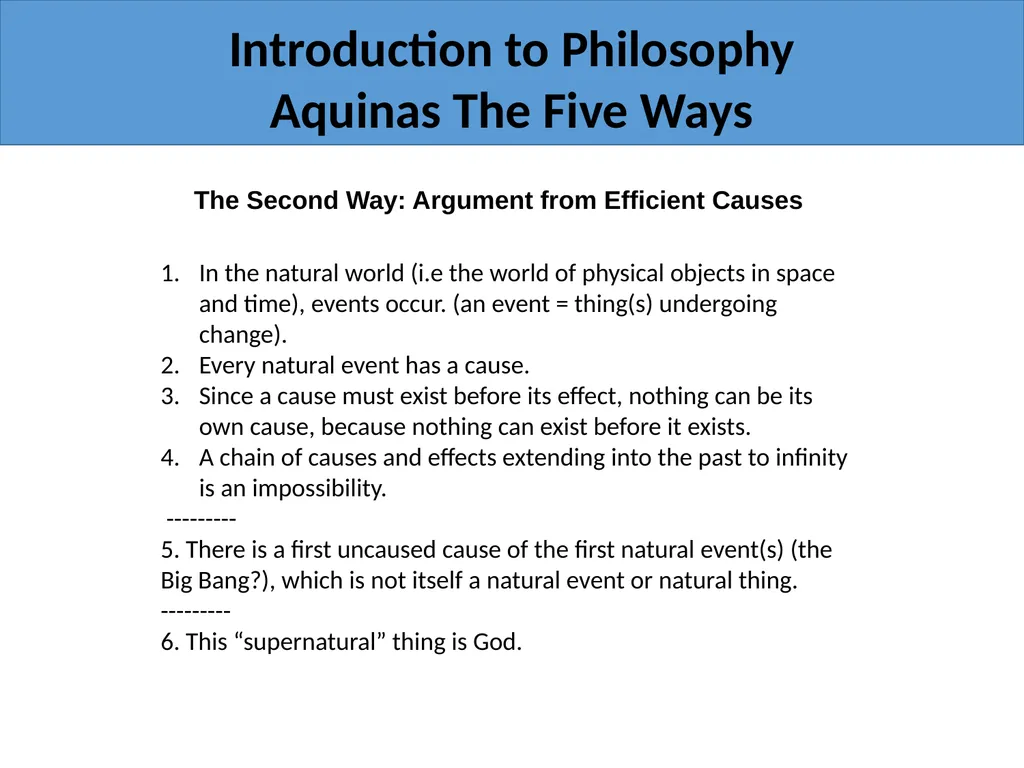
Aquinas The Five Ways In the natural world (i.e the world of physical objects in space and time), events occur. (an event = thing(s) undergoing change).
Every natural event has a cause.
Since a cause must exist before its effect, nothing can be its own cause, because nothing can exist before it exists.
A chain of causes and effects extending into the past to infinity is an impossibility.
---------
5. There is a first uncaused cause of the first natural event(s) (the Big Bang?), which is not itself a natural event or natural thing.
---------
6. This “supernatural” thing is God. The Second Way: Argument from Efficient Causes<br>
06
Introduction to Philosophy
Aquinas The Five Ways In the natural world (i.e the world of physical objects in space and time), events occur. (an event = thing(s) undergoing change).
Every natural event has a cause.
Since a cause must exist before its effect, nothing can be its own cause, because nothing can exist before it exists.
A chain of causes and effects extending into the past to infinity is an impossibility.
---------
5. There is a first uncaused cause of the first natural event(s) (the Big Bang?), which is not itself a natural event or natural thing.
---------
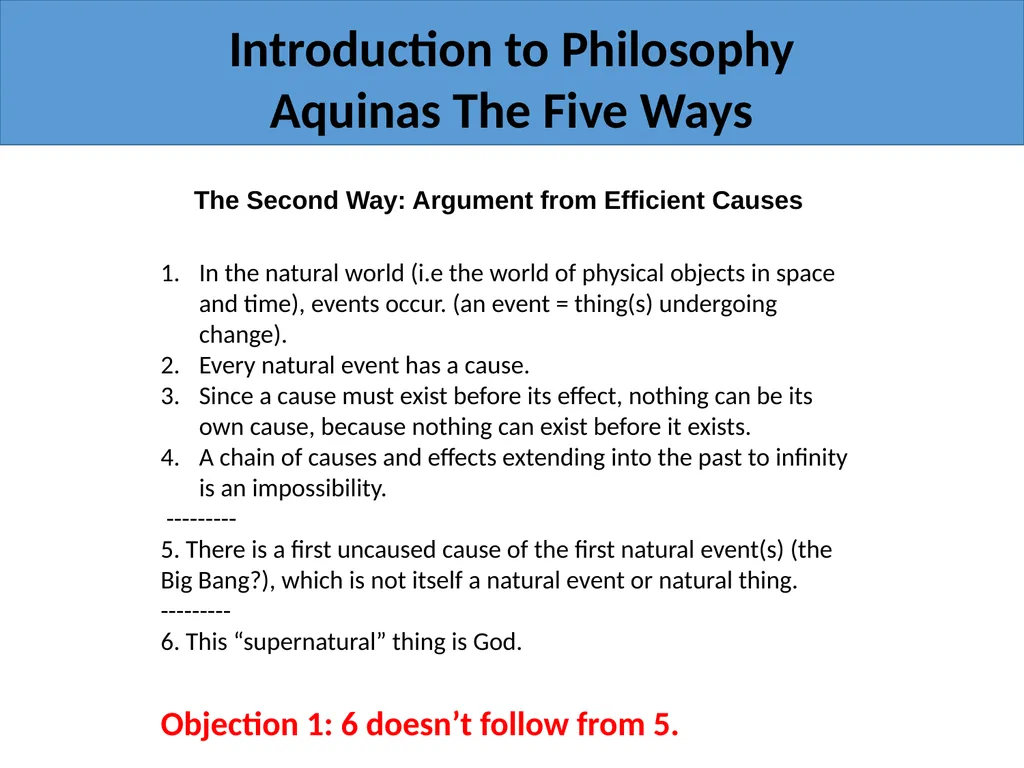
6. This “supernatural” thing is God. The Second Way: Argument from Efficient Causes Objection 1: 6 doesn’t follow from 5.<br>
07
Introduction to Philosophy
Aquinas The Five Ways In the natural world (i.e the world of physical objects in space and time), events occur. (an event = thing(s) undergoing change).
Every natural event has a cause.
Since a cause must exist before its effect, nothing can be its own cause, because nothing can exist before it exists.
A chain of causes and effects extending into the past to infinity is an impossibility.
---------
5. There is a first uncaused cause of the first natural event(s) (the Big Bang?), which is not itself a natural event or natural thing.
---------
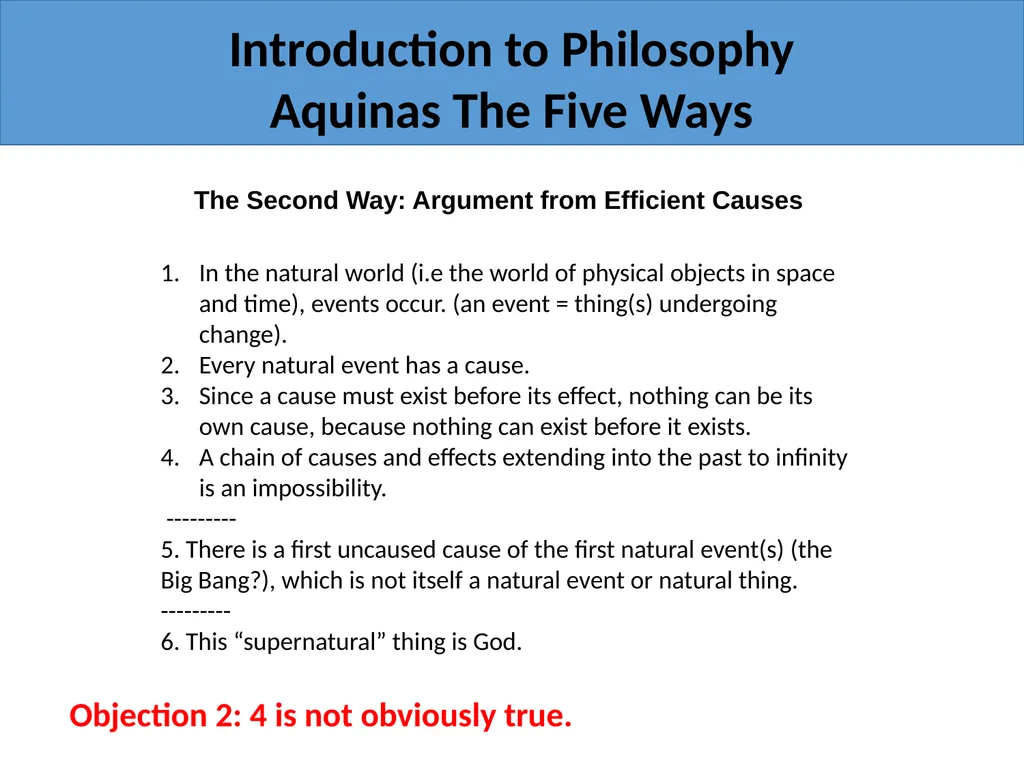
6. This “supernatural” thing is God. The Second Way: Argument from Efficient Causes Objection 2: 4 is not obviously true.<br>
08
Introduction to Philosophy
Aquinas The Five Ways In the natural world (i.e the world of physical objects in space and time), events occur. (an event = thing(s) undergoing change).
Every natural event has a cause.
Since a cause must exist before its effect, nothing can be its own cause, because nothing can exist before it exists.
A chain of causes and effects extending into the past to infinity is an impossibility.
---------
5. There is a first uncaused cause of the first natural event(s) (the Big Bang?), which is not itself a natural event or natural thing.
---------
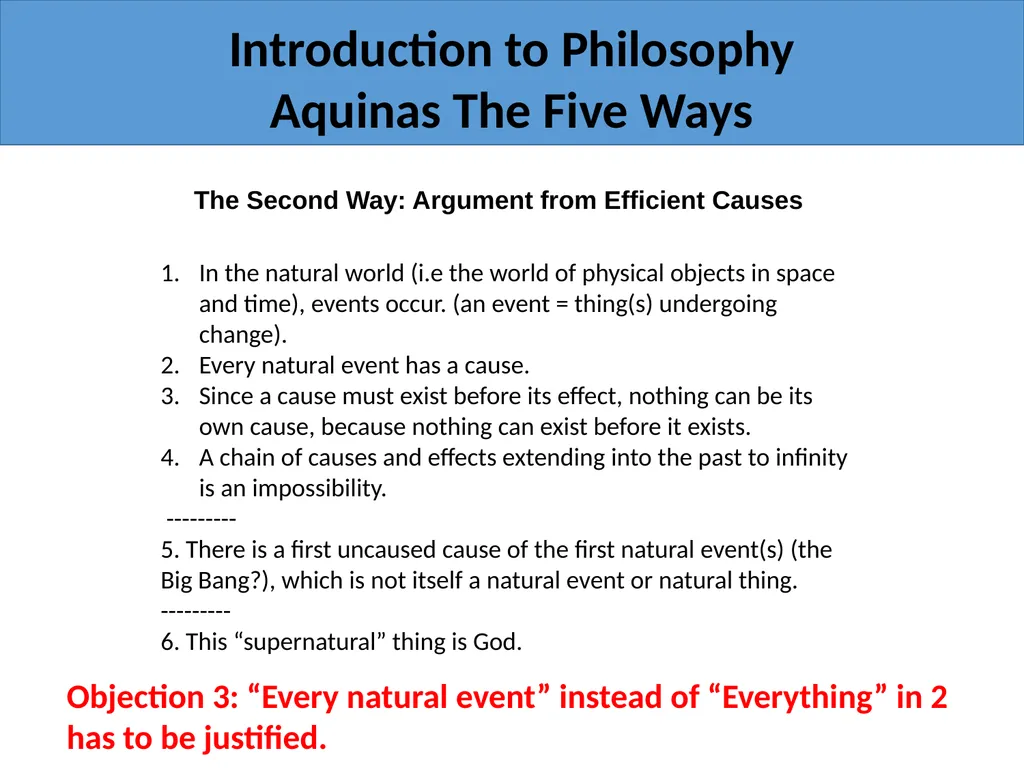
6. This “supernatural” thing is God. The Second Way: Argument from Efficient Causes Objection 3: “Every natural event” instead of “Everything” in 2 has to be justified.<br>
09
Introduction to Philosophy
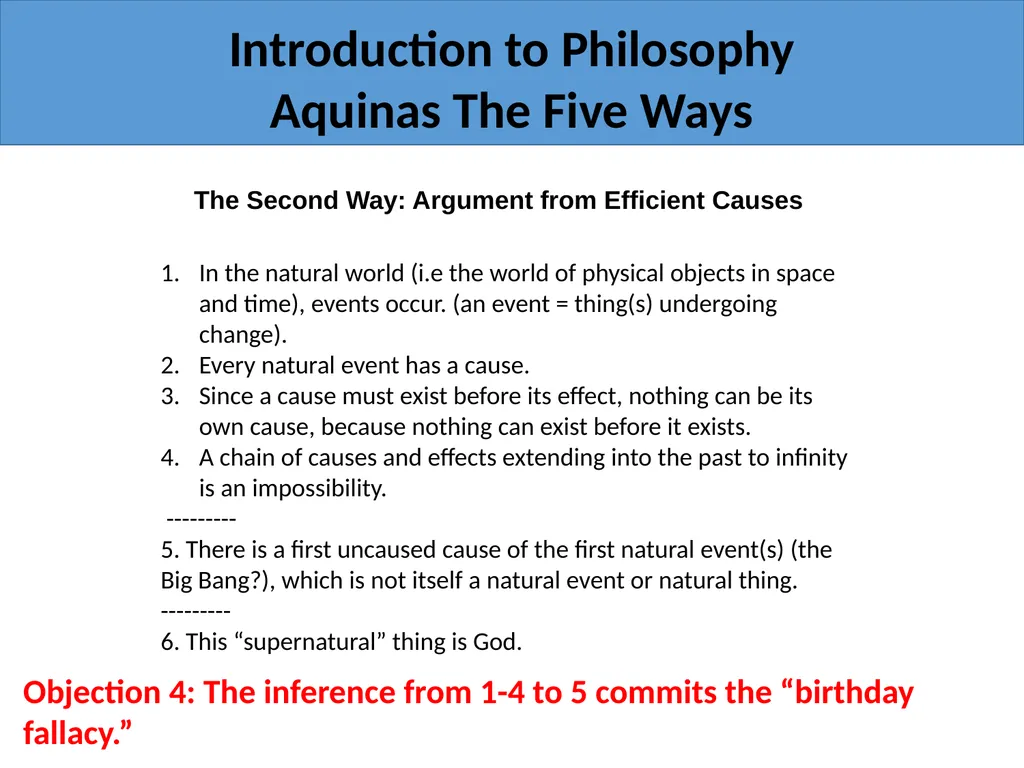
Aquinas The Five Ways Objection 4: The inference from 1-4 to 5 commits the “birthday fallacy.” In the natural world (i.e the world of physical objects in space and time), events occur. (an event = thing(s) undergoing change).
Every natural event has a cause.
Since a cause must exist before its effect, nothing can be its own cause, because nothing can exist before it exists.
A chain of causes and effects extending into the past to infinity is an impossibility.
---------
5. There is a first uncaused cause of the first natural event(s) (the Big Bang?), which is not itself a natural event or natural thing.
---------
6. This “supernatural” thing is God. The Second Way: Argument from Efficient Causes<br>
10
Introduction to Philosophy
Aquinas The Five Ways The First Way: Argument from Motion
Introduction to Philosophy
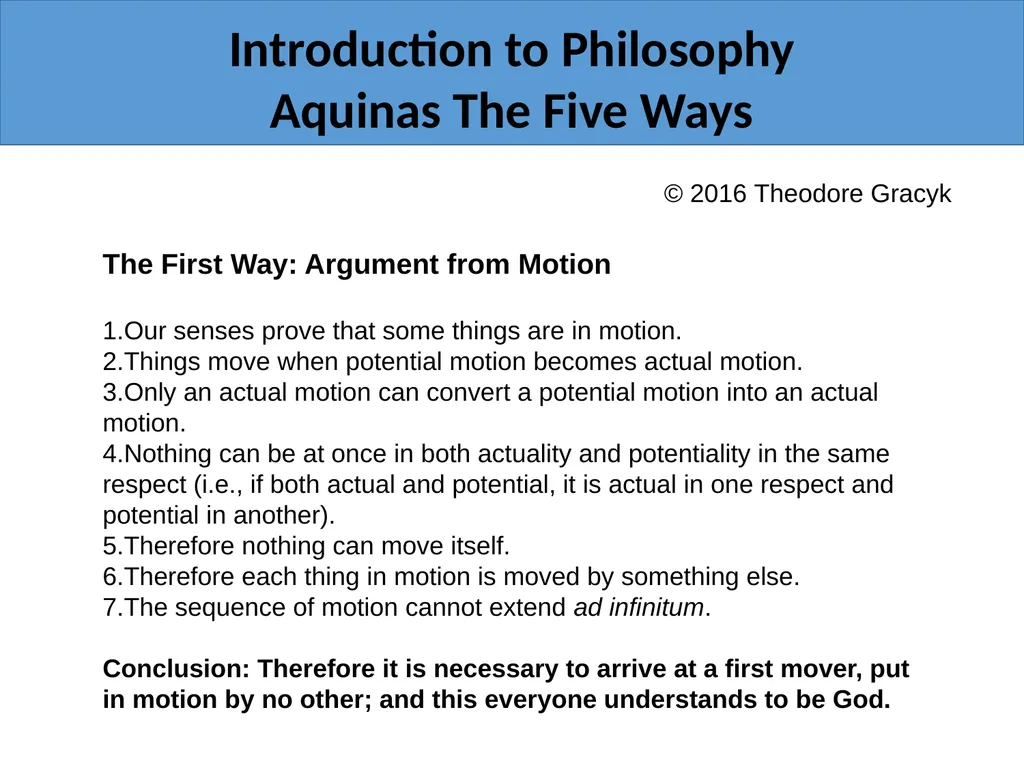
Aquinas The Five Ways The First Way: Argument from Motion
Our senses prove that some things are in motion.
Things move when potential motion becomes actual motion.
Only an actual motion can convert a potential motion into an actual motion.
Nothing can be at once in both actuality and potentiality in the same respect (i.e., if both actual and potential, it is actual in one respect and potential in another).
Therefore nothing can move itself.
Therefore each thing in motion is moved by something else.
The sequence of motion cannot extend ad infinitum.