
INTRODUCTION TO PREPARE RCS: DLA(W) 1884 (DFSC)
LS
Published · 41 slides · 0 views

1 / 1


Description
INTRODUCTION TO PREPARE RCS: DLA(W) 1884 (DFSC) BULK PETROLEUM TERMINAL MESSAGE REPORT The distribution system for bulk petroleum fuels comprises a worldwide network of bulk petroleum storage terminals that are established to meet worldwide
Related Topics
Share
Embed code
Download this presentation From Below
"INTRODUCTION TO PREPARE RCS: DLA(W) 1884 (DFSC)" is the property of its rightful owner. Permission is granted to download and print the materials on this website for personal, non-commercial use only, and to display it on your personal computer provided you do not modify the materials and that you retain all copyright notices contained in the materials. By downloading content from our website, you accept the terms of this agreement.
Presentation Transcript
01
INTRODUCTION TO PREPARE RCS: DLA(W) 1884 (DFSC) BULK
PETROLEUM TERMINAL MESSAGE REPORT
The distribution system for bulk petroleum fuels comprises a worldwide network of
bulk petroleum storage terminals that are established to meet worldwide military
requirements. These terminals are used to store Defense Logistics Agency (DLA)
owned products. These products may be either reserve stocks and operating stocks
or the products may be held for distribution to supported activities. DLA does not
own facilities. Therefore, DLA must use terminals owned by the US Government,
foreign governments, and commercial contractors. There are five general types of
terminals used in support of the worldwide military petroleum requirement:<br>
PETROLEUM TERMINAL MESSAGE REPORT
The distribution system for bulk petroleum fuels comprises a worldwide network of
bulk petroleum storage terminals that are established to meet worldwide military
requirements. These terminals are used to store Defense Logistics Agency (DLA)
owned products. These products may be either reserve stocks and operating stocks
or the products may be held for distribution to supported activities. DLA does not
own facilities. Therefore, DLA must use terminals owned by the US Government,
foreign governments, and commercial contractors. There are five general types of
terminals used in support of the worldwide military petroleum requirement:<br>
02
1. GOGO -Government Owned and Government Operated. GOGO petroleum terminals are
owned by the US Government and are operated by one of the military departments.
2. GOCO -Government Owned and Contractor Operated. GOCO petroleum terminals are
owned by the US Government and are operated by contractors.
3. COCO -Contractor Owned and Contractor Operated. COCO petroleum terminals are
owned and operated by contractors.<br>
owned by the US Government and are operated by one of the military departments.
2. GOCO -Government Owned and Contractor Operated. GOCO petroleum terminals are
owned by the US Government and are operated by contractors.
3. COCO -Contractor Owned and Contractor Operated. COCO petroleum terminals are
owned and operated by contractors.<br>
03
4. FG -Foreign Government. FG petroleum terminals are located overseas and are
owned by either foreign governments or contractors. Arrangements for the use of
foreign government facilities are normally accomplished by the use of a bilateral
agreement, by an annex to the Status of Forces Agreement, or by a contract.
5. WTO -World Treaty Organization. WTO petroleum terminals are located in
foreign countries, and are used in support of the US Government worldwide petroleum
requirement. The terminals may be owned by a treaty organization and are normally
operated by the foreign (host) country under established agreements between the
host country and the US military service (user). NATO terminals are a good
example.<br>
owned by either foreign governments or contractors. Arrangements for the use of
foreign government facilities are normally accomplished by the use of a bilateral
agreement, by an annex to the Status of Forces Agreement, or by a contract.
5. WTO -World Treaty Organization. WTO petroleum terminals are located in
foreign countries, and are used in support of the US Government worldwide petroleum
requirement. The terminals may be owned by a treaty organization and are normally
operated by the foreign (host) country under established agreements between the
host country and the US military service (user). NATO terminals are a good
example.<br>
04
PREPARE RCS: DLA(W) 1884 (DFSC) BULK PETROLEUM TERMINAL MESSAGE REPORT
In lesson 1, you will learn to draft the bulk petroleum -terminal report for
submission to DPSC by message.
To understand how to prepare the bulk petroleum terminal message report, you must
be able to:
1. Assemble information required for submitting the report in accordance with
DOD Manual 4140.25-M, Procedures for Management of Petroleum Products.
a. Prepare message heading information.
b. Gather inventory level data.
c. Tabulate tanker discharge data.
d. Identify significant changes in terminal support capability.
2. Identify discrepancies in the report.
3. Draft a message for transmission to the DFSC<br>
In lesson 1, you will learn to draft the bulk petroleum -terminal report for
submission to DPSC by message.
To understand how to prepare the bulk petroleum terminal message report, you must
be able to:
1. Assemble information required for submitting the report in accordance with
DOD Manual 4140.25-M, Procedures for Management of Petroleum Products.
a. Prepare message heading information.
b. Gather inventory level data.
c. Tabulate tanker discharge data.
d. Identify significant changes in terminal support capability.
2. Identify discrepancies in the report.
3. Draft a message for transmission to the DFSC<br>
05
Learning Event 1:
PREPARE MESSAGE HEADING
The bulk terminal message report is an operational report used by DFSC to manage
petroleum, to assist in tanker cargo scheduling review, and to enter data in the
Defense Energy Information System. In addition, the information provided by the
report is used as a ready resource to answer inquiries or to respond to requests
for information from all levels of the Federal Government. It is, therefore,
extremely important that the information furnished to DFSC by this report contain
the most accurate data available and that the information be provided on a timely
basis. Any Defense Fuel Supply Point (DFSP) operating under the Defense Fuel
Automated Management System (DFAMS) must submit a bulk petroleum terminal message report. DFAMS is a new accounting system that replaced the old system of
submitting all documents to DFSC by a monthly RCS: 1883 report (DD Form 1788 (Bulk Petroleum Terminal Report) and supporting documents). Instead of the old monthly report, individual transactions are to be reported to DFSC within 2 days of the action. The DFSP accountable records are maintained for each product by a DFSC
computer. Currently, DOD Manual 4140.25-M does not reflect DFAMS. Specific
guidelines for the bulk petroleum terminal message report contained in this lesson
indicate a departure from DOD Manual 4140.25-M to reflect the recent shift to
DFAMS.<br>
PREPARE MESSAGE HEADING
The bulk terminal message report is an operational report used by DFSC to manage
petroleum, to assist in tanker cargo scheduling review, and to enter data in the
Defense Energy Information System. In addition, the information provided by the
report is used as a ready resource to answer inquiries or to respond to requests
for information from all levels of the Federal Government. It is, therefore,
extremely important that the information furnished to DFSC by this report contain
the most accurate data available and that the information be provided on a timely
basis. Any Defense Fuel Supply Point (DFSP) operating under the Defense Fuel
Automated Management System (DFAMS) must submit a bulk petroleum terminal message report. DFAMS is a new accounting system that replaced the old system of
submitting all documents to DFSC by a monthly RCS: 1883 report (DD Form 1788 (Bulk Petroleum Terminal Report) and supporting documents). Instead of the old monthly report, individual transactions are to be reported to DFSC within 2 days of the action. The DFSP accountable records are maintained for each product by a DFSC
computer. Currently, DOD Manual 4140.25-M does not reflect DFAMS. Specific
guidelines for the bulk petroleum terminal message report contained in this lesson
indicate a departure from DOD Manual 4140.25-M to reflect the recent shift to
DFAMS.<br>
06
The message heading contains information used by communicators to transmit the bulk
petroleum terminal message report. It also identifies the person preparing the
report, the activity submitting the report, the date of the report, and any special
handling instructions for the message report. Reports are prepared as of 0800
local time each Friday. Reports will be sent by an unclassified message to arrive
at DFSC-ODD no later than 0800 Washington, DC time the following Monday. The bulk
petroleum terminal message report will be sent directly to DFSC-ODD, and an
information copy will be sent to the Joint Petroleum Office (JPO) and DFSC Defense
Fuel Region (DFR) as appropriate. Submission of the report will continue even if
MINIMIZE has been imposed on message correspondence.<br>
petroleum terminal message report. It also identifies the person preparing the
report, the activity submitting the report, the date of the report, and any special
handling instructions for the message report. Reports are prepared as of 0800
local time each Friday. Reports will be sent by an unclassified message to arrive
at DFSC-ODD no later than 0800 Washington, DC time the following Monday. The bulk
petroleum terminal message report will be sent directly to DFSC-ODD, and an
information copy will be sent to the Joint Petroleum Office (JPO) and DFSC Defense
Fuel Region (DFR) as appropriate. Submission of the report will continue even if
MINIMIZE has been imposed on message correspondence.<br>
07
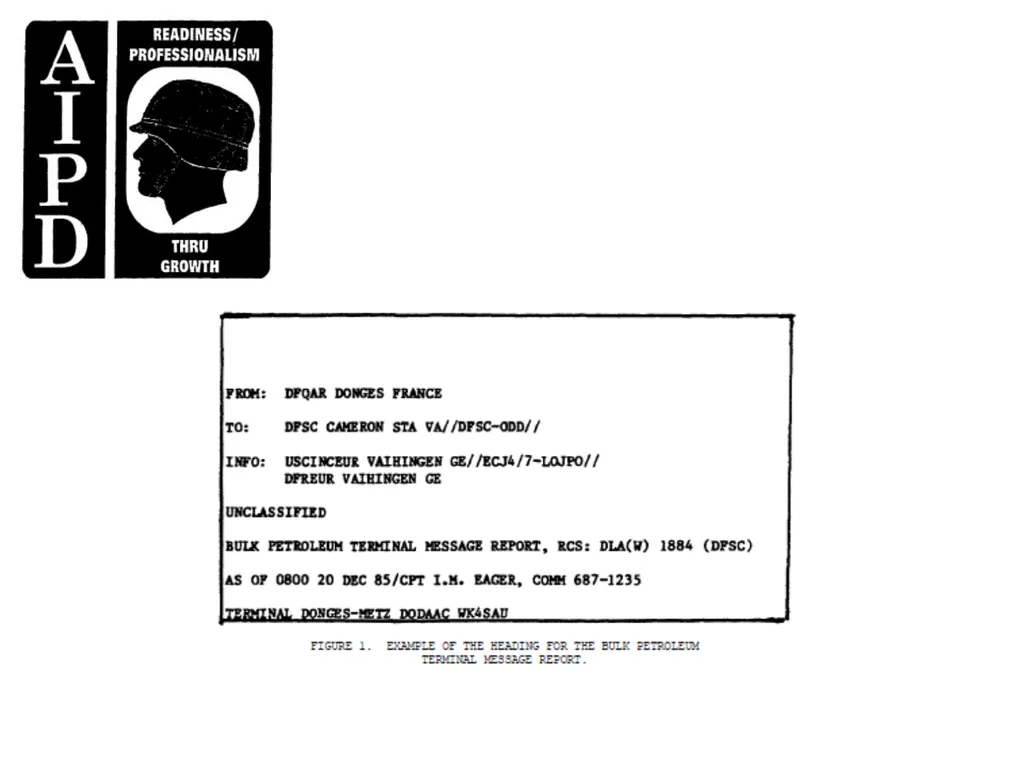
Refer to figure 1 and appendix A to determine how the following information is
included in the bulk petroleum terminal message report.
-FROM: Message address of the activity submitting the report. In some cases
this may be different from the terminals listed in the body of the report.
-TO: Message address of activity receiving the report. Enter “DFSC CAMERON STA
VA//DFSC-ODD//.”
-INFO: Message address of appropriate JPO, DFSC DFR and/or military service
headquarters to be provided with an information copy of the request.
-Message classification. The bulk petroleum terminal message report is usually
transmitted as an unclassified message unless otherwise directed.
-Report title or message subject line. Enter “bulk petroleum terminal message
report RCS: DLA(W) 1884 (DFSC) Bulk Petroleum Terminal Report."
-Report preparation information. Enter the date of the report and the name and
commercial or AUTOVON phone number of the person who prepared the report. This way
DFSC has a point of contact if any questions arise as a result of the report.
-Report terminal. Name an applicable DODAAC for terminal being reported. The
DODAAC for the report terminal is found in appendix B.
Figure 1 is an example of a correct heading for the bulk petroleum terminal message
report.<br>
included in the bulk petroleum terminal message report.
-FROM: Message address of the activity submitting the report. In some cases
this may be different from the terminals listed in the body of the report.
-TO: Message address of activity receiving the report. Enter “DFSC CAMERON STA
VA//DFSC-ODD//.”
-INFO: Message address of appropriate JPO, DFSC DFR and/or military service
headquarters to be provided with an information copy of the request.
-Message classification. The bulk petroleum terminal message report is usually
transmitted as an unclassified message unless otherwise directed.
-Report title or message subject line. Enter “bulk petroleum terminal message
report RCS: DLA(W) 1884 (DFSC) Bulk Petroleum Terminal Report."
-Report preparation information. Enter the date of the report and the name and
commercial or AUTOVON phone number of the person who prepared the report. This way
DFSC has a point of contact if any questions arise as a result of the report.
-Report terminal. Name an applicable DODAAC for terminal being reported. The
DODAAC for the report terminal is found in appendix B.
Figure 1 is an example of a correct heading for the bulk petroleum terminal message
report.<br>
08
Learning Event 2:
SUBMIT TERMINAL INVENTORY DATA
All reporting terminals must submit section I (Inventory Data) of the bulk
petroleum terminal message report. The DFSC continental United States (CONUS) fuel
region or cognizant overseas office will submit message reports for commercially
operated terminals holding DLA stocks.
In the past, data for this report was taken directly from DD Form 1788 (Bulk
Petroleum Terminal Report) but the implementation of DFAMS made the form obsolete.
Many activities, however, continue to reproduce the form locally and use it as a
memorandum for record to facilitate the preparation of the bulk petroleum terminal
message report and to maintain informal accountability. Ideally, the required
information needed to draft the message report should be available from local
records or from DFAMS records, but until DFAMS fully meets the timely objective for
reported data, field experience and practice may vary from activity to activity.
This lesson parallels the information contained in appendix A. Actual preparation
at a terminal will require familiarization with the local record keeping
procedures.<br>
SUBMIT TERMINAL INVENTORY DATA
All reporting terminals must submit section I (Inventory Data) of the bulk
petroleum terminal message report. The DFSC continental United States (CONUS) fuel
region or cognizant overseas office will submit message reports for commercially
operated terminals holding DLA stocks.
In the past, data for this report was taken directly from DD Form 1788 (Bulk
Petroleum Terminal Report) but the implementation of DFAMS made the form obsolete.
Many activities, however, continue to reproduce the form locally and use it as a
memorandum for record to facilitate the preparation of the bulk petroleum terminal
message report and to maintain informal accountability. Ideally, the required
information needed to draft the message report should be available from local
records or from DFAMS records, but until DFAMS fully meets the timely objective for
reported data, field experience and practice may vary from activity to activity.
This lesson parallels the information contained in appendix A. Actual preparation
at a terminal will require familiarization with the local record keeping
procedures.<br>
09
The bulk fuel quantities to be provided by the bulk petroleum terminal message
report are reported to the nearest thousand barrels regardless of the product being
reported. It should also be noted that a zero (0) is entered in the appropriate
column of the report for any bulk fuel when the quantity is less than 500 barrels.
BULK FUEL QUANTITIES ARE ALWAYS REPORTED TO THE NEAREST THOUSAND BARRELS. BULK
LUBE OIL QUANTITIES ARE ALWAYS ENTERED TO THE NEAREST BARREL IN THE APPROPRIATE
COLUMNS OF THE REPORT.<br>
report are reported to the nearest thousand barrels regardless of the product being
reported. It should also be noted that a zero (0) is entered in the appropriate
column of the report for any bulk fuel when the quantity is less than 500 barrels.
BULK FUEL QUANTITIES ARE ALWAYS REPORTED TO THE NEAREST THOUSAND BARRELS. BULK
LUBE OIL QUANTITIES ARE ALWAYS ENTERED TO THE NEAREST BARREL IN THE APPROPRIATE
COLUMNS OF THE REPORT.<br>
10
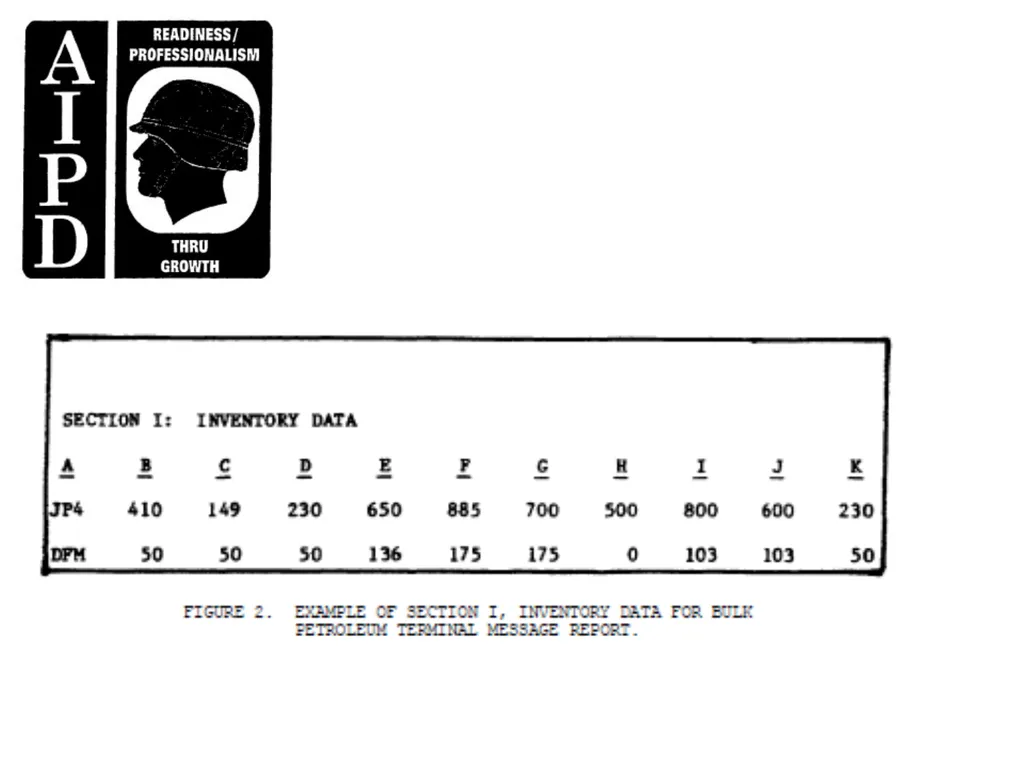
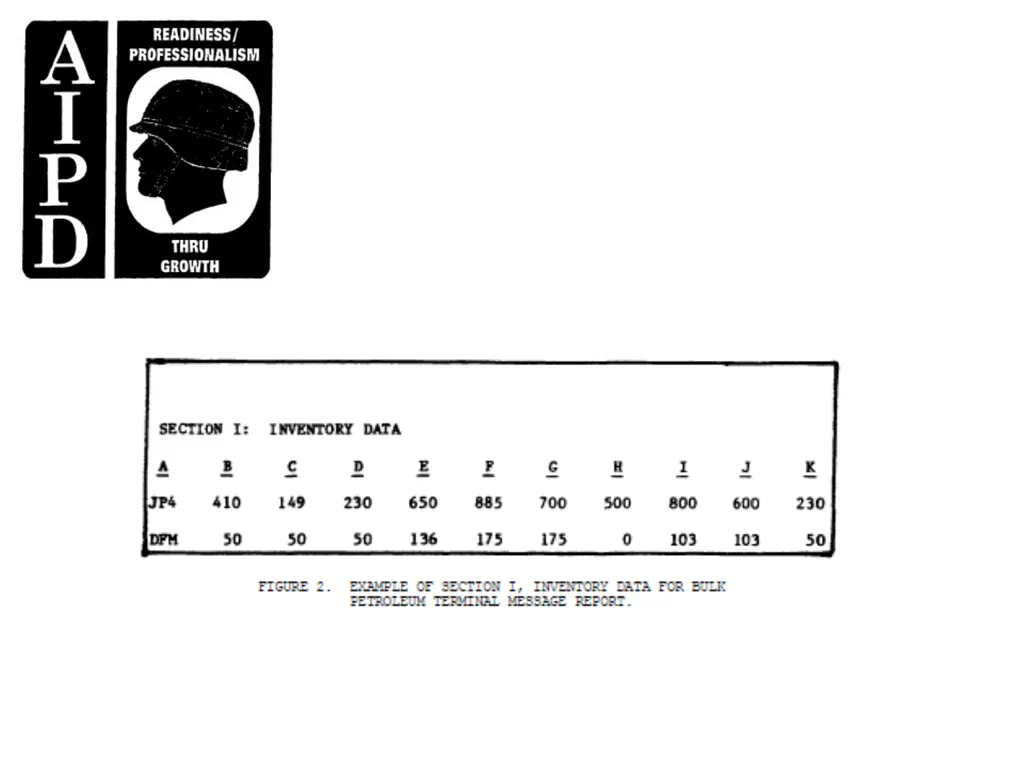
The student should refer to both figure 2 and appendix A to follow the steps
involved in the preparation of section I (Inventory Data) of the bulk petroleum
terminal message report. Section I must be completed by all reporting terminals.<br>
involved in the preparation of section I (Inventory Data) of the bulk petroleum
terminal message report. Section I must be completed by all reporting terminals.<br>
11
-Column A, Grade of Product. Each grade of product has a three-position code.
An extract of these codes may be found in appendix C. Enter the code of each
reported product in column A of the message.
-Column B, Total Receipts. Report the total quantity of each product by grade
received during the previous week. The weekly data submitted under this column
will be the same data that was used to complete line 2 of the old DD Form 1788.
Consult local records to obtain the total receipts at the terminal.<br>
An extract of these codes may be found in appendix C. Enter the code of each
reported product in column A of the message.
-Column B, Total Receipts. Report the total quantity of each product by grade
received during the previous week. The weekly data submitted under this column
will be the same data that was used to complete line 2 of the old DD Form 1788.
Consult local records to obtain the total receipts at the terminal.<br>
12
-Column C, Receipts from Procurement. Report the total quantity of product by
grade received from all contract sources during the previous week. The weekly data
submitted under this column will be the same data that was used to complete line 2A
of the old DD Form 1788. Consult local record information to obtain the total
quantity of products received from all contract sources during the previous week.
This reported quantity must be the quantity of product received free on board (FOB)
origin or destination directly from a DFSC contract source by any mode except those
deliveries made by one of the CONUS pipeline companies. Deliveries by these
pipeline companies are excluded because the terminal facilities of these companies
are contracted to serve as DFSPs, to hold US Government DFSC-owned stock, and to
ship the US Government-owned stock in response to requisitions from bases.<br>
grade received from all contract sources during the previous week. The weekly data
submitted under this column will be the same data that was used to complete line 2A
of the old DD Form 1788. Consult local record information to obtain the total
quantity of products received from all contract sources during the previous week.
This reported quantity must be the quantity of product received free on board (FOB)
origin or destination directly from a DFSC contract source by any mode except those
deliveries made by one of the CONUS pipeline companies. Deliveries by these
pipeline companies are excluded because the terminal facilities of these companies
are contracted to serve as DFSPs, to hold US Government DFSC-owned stock, and to
ship the US Government-owned stock in response to requisitions from bases.<br>
13
-Column D, Sales. Report the total quantity of product by grade issued from
DLA stocks to consuming activities during the previous week. The weekly data
submitted under this column will be the same data that was used to complete line 3A
of the old DD Form 1788. Consult local record information to obtain the total
sales at the terminal. Sales or issues to using activities are those quantities of
product issued to any activity that is required to reimburse the DLA stock fund.
Sales includes those issues to bases, fleet units, federal government
organizations, foreign governments covered by replacement-in-kind agreements, and
any other using activity for which the issue will result in the reimbursement of
the stock fund.<br>
DLA stocks to consuming activities during the previous week. The weekly data
submitted under this column will be the same data that was used to complete line 3A
of the old DD Form 1788. Consult local record information to obtain the total
sales at the terminal. Sales or issues to using activities are those quantities of
product issued to any activity that is required to reimburse the DLA stock fund.
Sales includes those issues to bases, fleet units, federal government
organizations, foreign governments covered by replacement-in-kind agreements, and
any other using activity for which the issue will result in the reimbursement of
the stock fund.<br>
14
-Column E, Physical Inventory. Report the quantity of product by grade on
hand in terminals and pipelines as of the reporting date. Terminal complexes
reporting inventories for cross-country pipelines (e.g., Spain, Italy, Germany,
United Kingdom, and Korea) will identify by footnote in section III of the bulk
petroleum terminal message report that portion of inventory shown in column E that
is held as cross-country pipeline fill within a reporting complex, as opposed to
the reportable product held within manifolds and pipelines within the terminal
complex. This data is also found in block 6 of the DD Form 1788.<br>
hand in terminals and pipelines as of the reporting date. Terminal complexes
reporting inventories for cross-country pipelines (e.g., Spain, Italy, Germany,
United Kingdom, and Korea) will identify by footnote in section III of the bulk
petroleum terminal message report that portion of inventory shown in column E that
is held as cross-country pipeline fill within a reporting complex, as opposed to
the reportable product held within manifolds and pipelines within the terminal
complex. This data is also found in block 6 of the DD Form 1788.<br>
15
-Column F, Storage Capacity. Report the total shell capacity of the tanks in
the terminal minus the total volumetric capacity of space lost within tankage
because of safe fill level limitations and/or limitations attributable to
structural loss. If exact data is not available, report the total of 95 percent of
the tank shell capacity plus 100 percent of the terminal pipeline and manifold
capacity. Cross-country 'pipeline linefill between terminals is not to be included
in the quantity reported in column F. Also, tankage taken out of service at the
terminal complex will reduce this reported storage capacity. This means that if an
80 MBBL tank of JP4 at Melun is emptied for cleaning and repairs, the storage
figure normally reported for JP4 in column F, section I of the terminal complex
must be reduced by 80 MBBLS. Such an entry must also be explained in section III
of the report. The purpose of adjusting the storage capacity in column F is to
permit DFSC to determine the existing ullage in terminal complexes.<br>
the terminal minus the total volumetric capacity of space lost within tankage
because of safe fill level limitations and/or limitations attributable to
structural loss. If exact data is not available, report the total of 95 percent of
the tank shell capacity plus 100 percent of the terminal pipeline and manifold
capacity. Cross-country 'pipeline linefill between terminals is not to be included
in the quantity reported in column F. Also, tankage taken out of service at the
terminal complex will reduce this reported storage capacity. This means that if an
80 MBBL tank of JP4 at Melun is emptied for cleaning and repairs, the storage
figure normally reported for JP4 in column F, section I of the terminal complex
must be reduced by 80 MBBLS. Such an entry must also be explained in section III
of the report. The purpose of adjusting the storage capacity in column F is to
permit DFSC to determine the existing ullage in terminal complexes.<br>
16
-Column G, Expected 30 Day Issues and Transfers. Report the total quantity of
product by grade expected to be issued and transferred by the terminal during the
next 30 days. The quantity will represent the total expected issues and transfers,
including issues to using activities, issues against replacement-in-kind
agreements, issues caused by downgrading, and transfers to other DFSPs.
-Column H, Estimated 30 Day Sales. Report that portion of the column G
quantity of product, by grade, estimated or expected to be issued to consuming
activities during the next 30 days that will require reimbursement of the DLA stock
fund.<br>
product by grade expected to be issued and transferred by the terminal during the
next 30 days. The quantity will represent the total expected issues and transfers,
including issues to using activities, issues against replacement-in-kind
agreements, issues caused by downgrading, and transfers to other DFSPs.
-Column H, Estimated 30 Day Sales. Report that portion of the column G
quantity of product, by grade, estimated or expected to be issued to consuming
activities during the next 30 days that will require reimbursement of the DLA stock
fund.<br>
17
-Column I, Estimated 30 Day Receipts. Report the total quantity of product,
by grade, estimated to be received within the next 30 days. The reported quantity
will represent the total expected receipts from contract sources, transfers from
other DFSPs, returns for credit, receipts from replacement-in-kind agreements,
product recovered from downgrading, and any capitalized stock.
-Column J, Expected 30 Day Receipts from Procurement. Report the portion of
column I quantity of product by grade estimated to be received from contract
sources within the next 30 days.<br>
by grade, estimated to be received within the next 30 days. The reported quantity
will represent the total expected receipts from contract sources, transfers from
other DFSPs, returns for credit, receipts from replacement-in-kind agreements,
product recovered from downgrading, and any capitalized stock.
-Column J, Expected 30 Day Receipts from Procurement. Report the portion of
column I quantity of product by grade estimated to be received from contract
sources within the next 30 days.<br>
18
-Column K, Total Issues/Losses. Report the total quantity of product by grade
issued and/or lost during the previous week. The weekly data submitted under this
column will be the same data that was used to complete lines 3 and 4 of the old DD
Form 1788. Consult local record information to obtain the total issues/losses to
be reported for the terminal complex<br>
issued and/or lost during the previous week. The weekly data submitted under this
column will be the same data that was used to complete lines 3 and 4 of the old DD
Form 1788. Consult local record information to obtain the total issues/losses to
be reported for the terminal complex<br>
19
Using this explanation of section I, inventory- data portion of the bulk petroleum
terminal message report and the past week's transactions, it can be determined that
figure 2 represents inventory data.
PAST WEEK'S TRANSACTIONS
OPENING INVENTORY (Column E of past week):
JP4 469,985
DFM 136,447
RECEIPTS (Columns B/C):
From DFSP by pipeline JP4 136,088 3-84 Tender
From DFSP by tanker JP4 125,107 Exxon Newark CC0892
From procurement by tanker DFM 50,235 American Eagle CC0891
JP4 149,210 American Eagle CC0891<br>
terminal message report and the past week's transactions, it can be determined that
figure 2 represents inventory data.
PAST WEEK'S TRANSACTIONS
OPENING INVENTORY (Column E of past week):
JP4 469,985
DFM 136,447
RECEIPTS (Columns B/C):
From DFSP by pipeline JP4 136,088 3-84 Tender
From DFSP by tanker JP4 125,107 Exxon Newark CC0892
From procurement by tanker DFM 50,235 American Eagle CC0891
JP4 149,210 American Eagle CC0891<br>
20
ISSUES (Columns D/K):
JP4 DFM
Trans to DFSP Ø Ø
Sales 230,155 50,226
CLOSING INV (Column E):
JP4 650,235
DFM 136,456
PROJ RECEIPTS (Columns I/J):
From procurement:
CARGO # VESSEL PROD QTY
CC0920 EGTSP JP4 210
CC0691 CVSPT DFM 103
CC0925 SEA ANT JP4 210
CC0932 SEA ARC JP4 180
From DFSP:
Pipeline Tender 3-85 200<br>
JP4 DFM
Trans to DFSP Ø Ø
Sales 230,155 50,226
CLOSING INV (Column E):
JP4 650,235
DFM 136,456
PROJ RECEIPTS (Columns I/J):
From procurement:
CARGO # VESSEL PROD QTY
CC0920 EGTSP JP4 210
CC0691 CVSPT DFM 103
CC0925 SEA ANT JP4 210
CC0932 SEA ARC JP4 180
From DFSP:
Pipeline Tender 3-85 200<br>
21
PROJ ISSUES (Columns G/H):
JP4 DFM
Issue to DFSP 200,000 175,000
Sales to Units 500,000 Ø
TOTALS 700,000 175,000<br>
JP4 DFM
Issue to DFSP 200,000 175,000
Sales to Units 500,000 Ø
TOTALS 700,000 175,000<br>
22
STORAGE DATA (Column F):
JP4:
18 Tanks 50M BBL each = 900,000
1 Tank 32M BBL each = 32,000
932,000
At 95 percent fill capacity x .95
885,400 BBL
DFM:
3 Tanks 50M BBL each = 150,000
3 Tanks 10M BBL each = 30,000
1 Tank 4.2M BBL each = 4,200
184,200
At 95 percent fill capacity x .95
174,990 BBL<br>
JP4:
18 Tanks 50M BBL each = 900,000
1 Tank 32M BBL each = 32,000
932,000
At 95 percent fill capacity x .95
885,400 BBL
DFM:
3 Tanks 50M BBL each = 150,000
3 Tanks 10M BBL each = 30,000
1 Tank 4.2M BBL each = 4,200
184,200
At 95 percent fill capacity x .95
174,990 BBL<br>
23
Learning Event 3:
SUBMIT OCEAN TERMINAL DISCHARGE INFORMATION
All ocean terminals involved in discharging and loading ocean tankers are
additionally required to submit section II of the bulk petroleum terminal message
report. Refer to both figure 3 and the past week's transactions to follow the
steps involved in the preparation of section II (Tanker Data) of the report.<br>
SUBMIT OCEAN TERMINAL DISCHARGE INFORMATION
All ocean terminals involved in discharging and loading ocean tankers are
additionally required to submit section II of the bulk petroleum terminal message
report. Refer to both figure 3 and the past week's transactions to follow the
steps involved in the preparation of section II (Tanker Data) of the report.<br>
24
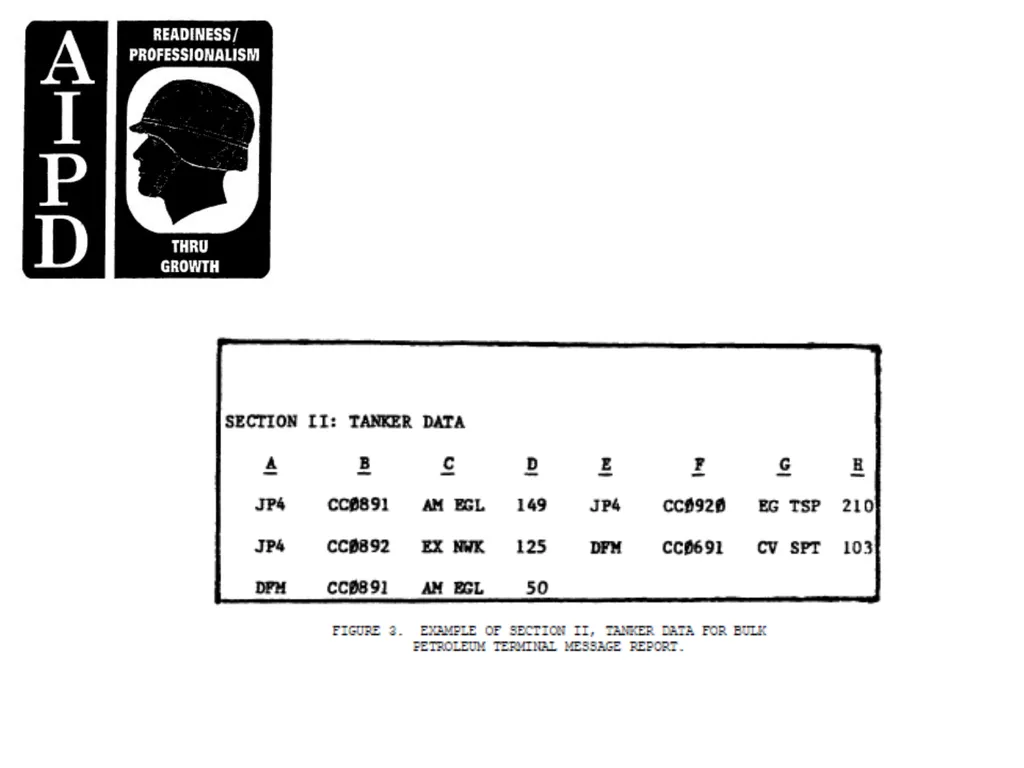
-Column A, Grade of Product. Each grade of product has a three-position code.
These codes are found in appendix C. The codes in column A list all products
discharged since the previous bulk petroleum terminal message report.
-Column B, Cargo Number(s) of Discharge(s). Enter the cargo number(s) for each
petroleum product discharged by ocean tankers since the previous weekly bulk
petroleum terminal message report. The cargo number for a product can be found in
block 14 of the applicable DD Form 250-1 (Tanker/Barge Material Inspection and
Receiving Report) reporting the cargo receipt through DFAMS.
-Column C, Vessel Name. Enter the abbreviated code for the name of the vessel
which discharged the product. The abbreviations for vessel names are found in
appendix D.<br>
These codes are found in appendix C. The codes in column A list all products
discharged since the previous bulk petroleum terminal message report.
-Column B, Cargo Number(s) of Discharge(s). Enter the cargo number(s) for each
petroleum product discharged by ocean tankers since the previous weekly bulk
petroleum terminal message report. The cargo number for a product can be found in
block 14 of the applicable DD Form 250-1 (Tanker/Barge Material Inspection and
Receiving Report) reporting the cargo receipt through DFAMS.
-Column C, Vessel Name. Enter the abbreviated code for the name of the vessel
which discharged the product. The abbreviations for vessel names are found in
appendix D.<br>
25
-Column D, Quantity Discharged. Enter the quantity of product discharged found
in block 25 of the applicable DD Form 250-1 reporting the cargo receipt through
DFAMS. The quantity discharged is determined from the terminal shore tanks. The
quantity reported will be to the nearest thousand barrels for bulk fuels.<br>
in block 25 of the applicable DD Form 250-1 reporting the cargo receipt through
DFAMS. The quantity discharged is determined from the terminal shore tanks. The
quantity reported will be to the nearest thousand barrels for bulk fuels.<br>
26
-Column E, Grade of Product. Enter the three-position code for the grade of
product being reported as in port awaiting discharge or in the processing of
discharging. These codes are-found in appendix C.
-Column F, Cargo Number(s) Awaiting Discharge. The cargo number for each
petroleum product onboard vessels in port awaiting discharge or in the process of
discharging as of the date of the weekly report are found in either the DFSC weekly
arrival message or in block 14 of the applicable DD Form 250-1. The cargo number
is entered in column F of the bulk petroleum terminal weekly message report.
-Column G, Vessel Name. Enter the abbreviated code for the name of the
vessel(s) awaiting discharge or in the process of discharge as of the time of the
report. Vessel name abbreviations are found in appendix D.<br>
product being reported as in port awaiting discharge or in the processing of
discharging. These codes are-found in appendix C.
-Column F, Cargo Number(s) Awaiting Discharge. The cargo number for each
petroleum product onboard vessels in port awaiting discharge or in the process of
discharging as of the date of the weekly report are found in either the DFSC weekly
arrival message or in block 14 of the applicable DD Form 250-1. The cargo number
is entered in column F of the bulk petroleum terminal weekly message report.
-Column G, Vessel Name. Enter the abbreviated code for the name of the
vessel(s) awaiting discharge or in the process of discharge as of the time of the
report. Vessel name abbreviations are found in appendix D.<br>
27
Column H, Quantity Awaiting Discharge. The quantity of each product being
held by various vessels is entered in column H. The quantity reported is to the
nearest thousand barrels for bulk fuels. The quantity reported in column H should
also be included in the quantities reported in columns I and J of section I. It is
important to remember that cargo reported in column H of section II is not reported
as physical inventory in column E of section I.
Using this explanation of section II, tanker data portion of the bulk petroleum
terminal message report, and data in the past week's transactions, it can be seen
that figure 3 represents the following ocean terminal discharge information:<br>
held by various vessels is entered in column H. The quantity reported is to the
nearest thousand barrels for bulk fuels. The quantity reported in column H should
also be included in the quantities reported in columns I and J of section I. It is
important to remember that cargo reported in column H of section II is not reported
as physical inventory in column E of section I.
Using this explanation of section II, tanker data portion of the bulk petroleum
terminal message report, and data in the past week's transactions, it can be seen
that figure 3 represents the following ocean terminal discharge information:<br>
28
-Two ships have discharged cargo since the last report. The American Eagle
discharged 149,210 barrels of JP4 and 50,235 barrels of DFM under cargo number
CC0891. The Exxon Newark discharged 125,107 barrels of JP4 under cargo number
CC0892.
-Two ships are either awaiting an opportunity to discharge products or are in
the process of unloading. The Eagle Transporter has 210,000 barrels of JP4 under
cargo number CC0920 and the Cove Spirit has 103,000 barrels of DFM available for
cargo number CC0691.<br>
discharged 149,210 barrels of JP4 and 50,235 barrels of DFM under cargo number
CC0891. The Exxon Newark discharged 125,107 barrels of JP4 under cargo number
CC0892.
-Two ships are either awaiting an opportunity to discharge products or are in
the process of unloading. The Eagle Transporter has 210,000 barrels of JP4 under
cargo number CC0920 and the Cove Spirit has 103,000 barrels of DFM available for
cargo number CC0691.<br>
29
Learning Event 4:
PROVIDE TERMINAL SUPPORT CAPABILITY DATA
Section III (Remarks) may be a part of the bulk petroleum terminal message report
under certain circumstances. The purpose of the remarks section is to provide all
information that significantly affects the terminal support capability to all
management levels. Section III is to be submitted by all reporting activities when
applicable. These remarks usually indicate changes in the normal terminal support
capability.<br>
PROVIDE TERMINAL SUPPORT CAPABILITY DATA
Section III (Remarks) may be a part of the bulk petroleum terminal message report
under certain circumstances. The purpose of the remarks section is to provide all
information that significantly affects the terminal support capability to all
management levels. Section III is to be submitted by all reporting activities when
applicable. These remarks usually indicate changes in the normal terminal support
capability.<br>
30
For example, assume that an ocean terminal can normally receive ocean tankers with
a maximum safe draft of 39 feet. However, due to unusually heavy spring rains, the
harbor basin has filled up with 3 feet of silt. This makes the basin shallower and
reduces the maximum safe draft in the terminal to 36 feet. Such a limitation must
be reported in section III of the report. The entry should also state when a
return to normal support levels can be expected.<br>
a maximum safe draft of 39 feet. However, due to unusually heavy spring rains, the
harbor basin has filled up with 3 feet of silt. This makes the basin shallower and
reduces the maximum safe draft in the terminal to 36 feet. Such a limitation must
be reported in section III of the report. The entry should also state when a
return to normal support levels can be expected.<br>
31
Other examples might include such events as:
-A usable storage tank taken out of service. Such an entry should identify the
date taken out of service, the reason it was taken out of service, and the date
estimated for return to service. For those tanks out of service, and for which no
actual day or month of return to service is available at the complex, the estimated
fiscal year quarter or fiscal year should be furnished. Once a tank has been
reported as out of service, no further reporting is required until a change in
status occurs (e.g., the tank is returned to service; or the estimated date of
return to service changes).<br>
-A usable storage tank taken out of service. Such an entry should identify the
date taken out of service, the reason it was taken out of service, and the date
estimated for return to service. For those tanks out of service, and for which no
actual day or month of return to service is available at the complex, the estimated
fiscal year quarter or fiscal year should be furnished. Once a tank has been
reported as out of service, no further reporting is required until a change in
status occurs (e.g., the tank is returned to service; or the estimated date of
return to service changes).<br>
32
-Converted/new usable storage being placed into service as well as the
effective date of the change in storage capability. For new tankage coming into
service it is important to also report the new tank bottom quantities, and the
usable storage and manifold quantities.
-Tanks currently in storage scheduled to be 'taken out of service during the
next 90 days. It is important, not only to provide the projected date of out of
service, but also to report the tank number, inventory capacity, grade of product,
and the reason that the tankage will be out of service.
-Anticipated inventory changes due to unusual consumption or downgrading.
-Changes to the port or terminal facilities.
-Inventories in cross-country pipelines between terminals within a reporting
complex.<br>
effective date of the change in storage capability. For new tankage coming into
service it is important to also report the new tank bottom quantities, and the
usable storage and manifold quantities.
-Tanks currently in storage scheduled to be 'taken out of service during the
next 90 days. It is important, not only to provide the projected date of out of
service, but also to report the tank number, inventory capacity, grade of product,
and the reason that the tankage will be out of service.
-Anticipated inventory changes due to unusual consumption or downgrading.
-Changes to the port or terminal facilities.
-Inventories in cross-country pipelines between terminals within a reporting
complex.<br>
33
Lesson 1/Learning Event 4
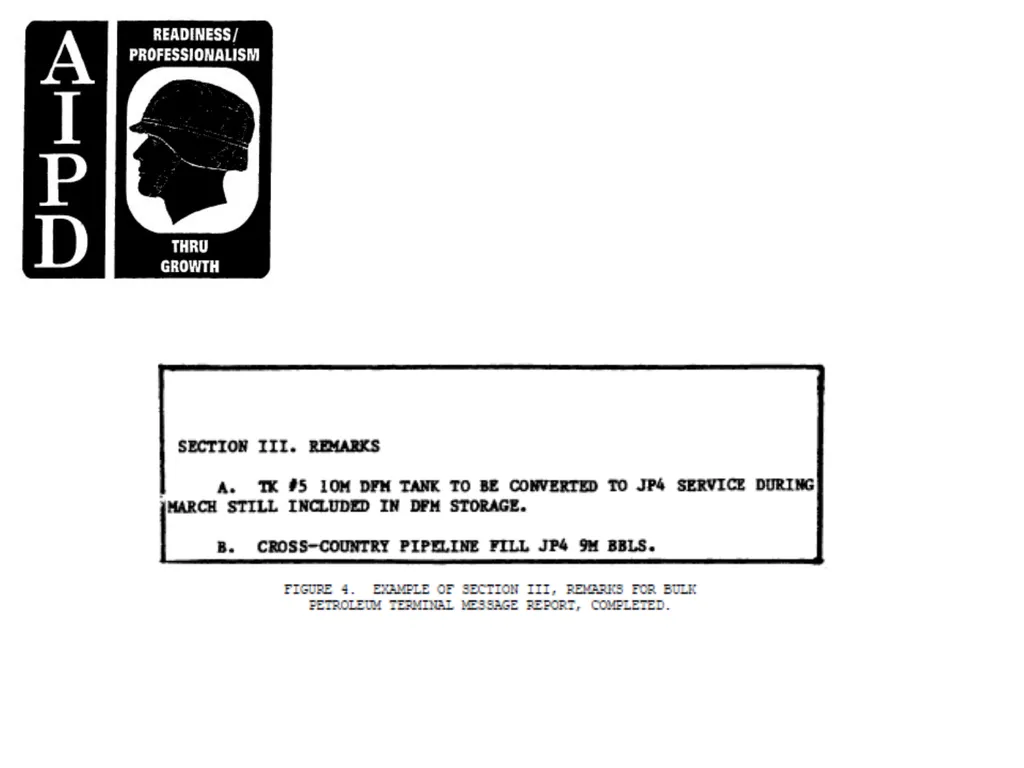
-Any unusual condition worthy of the attention of higher authority.
Examples of entries made under remarks (section III) of a bulk petroleum terminal
message report are included at figure 4.<br>
-Any unusual condition worthy of the attention of higher authority.
Examples of entries made under remarks (section III) of a bulk petroleum terminal
message report are included at figure 4.<br>
34
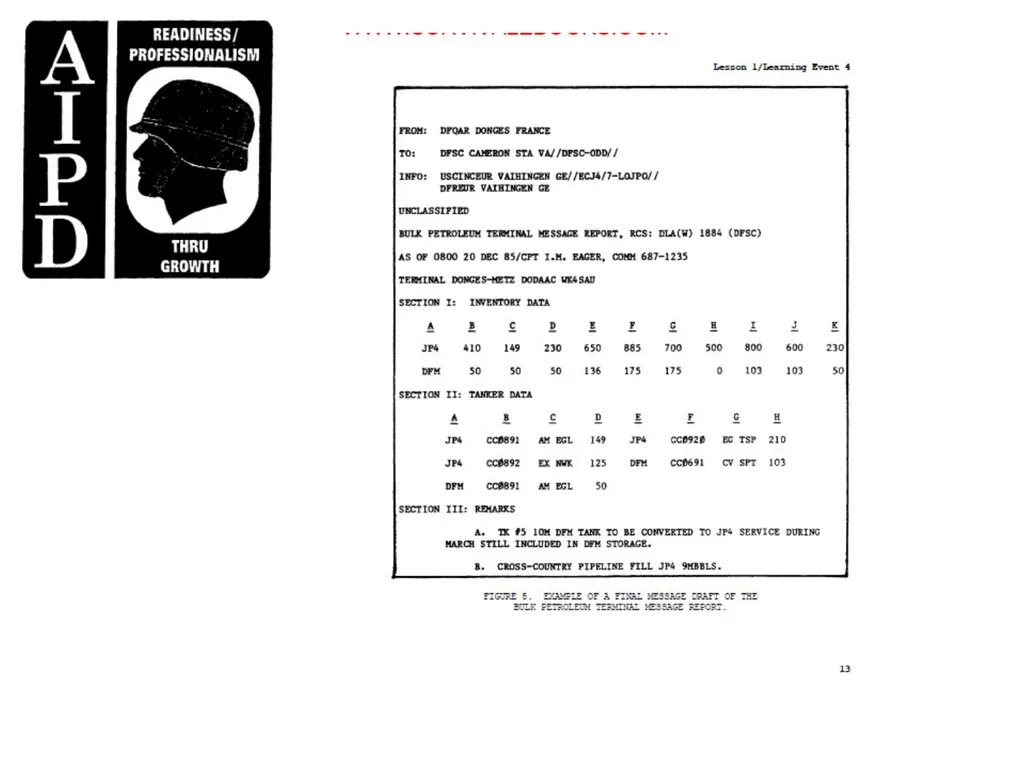
Final Sample.
The four learning events just explained how to prepare the message heading, how to
submit terminal inventory data, how to submit ocean terminal discharge information,
and how to provide terminal support capability data. These four learning events
covered all the requirements for submitting a bulk petroleum message report.
Figure 5 is the final message draft covering the examples included in this lesson.<br>
The four learning events just explained how to prepare the message heading, how to
submit terminal inventory data, how to submit ocean terminal discharge information,
and how to provide terminal support capability data. These four learning events
covered all the requirements for submitting a bulk petroleum message report.
Figure 5 is the final message draft covering the examples included in this lesson.<br>