Introduction to Probability (CSCE 317) January 22, 2015 Marco Valtorta SWRG 3A55 mgvcse.sc.edu Purpose of the Introductory Slides Review the axioms of probability: Kolmogorovs axioms Review models of the axioms Probabilities A set of
"Introduction to Probability (CSCE 317) January 22," is the property of its rightful owner. Permission is granted to
download and print the materials on this website for personal, non-commercial use only, and to display it
on your personal computer provided you do not modify the materials and that you retain all copyright
notices contained in the materials. By downloading content from our website, you accept the terms of this
agreement.
Presentation Transcript
01
Introduction to Probability (CSCE 317) January 22, 2015
Marco Valtorta
SWRG 3A55
mgv@cse.sc.edu<br>
02
Purpose of the Introductory Slides Review the axioms of probability:
Kolmogorov’s axioms
Review models of the axioms<br>
03
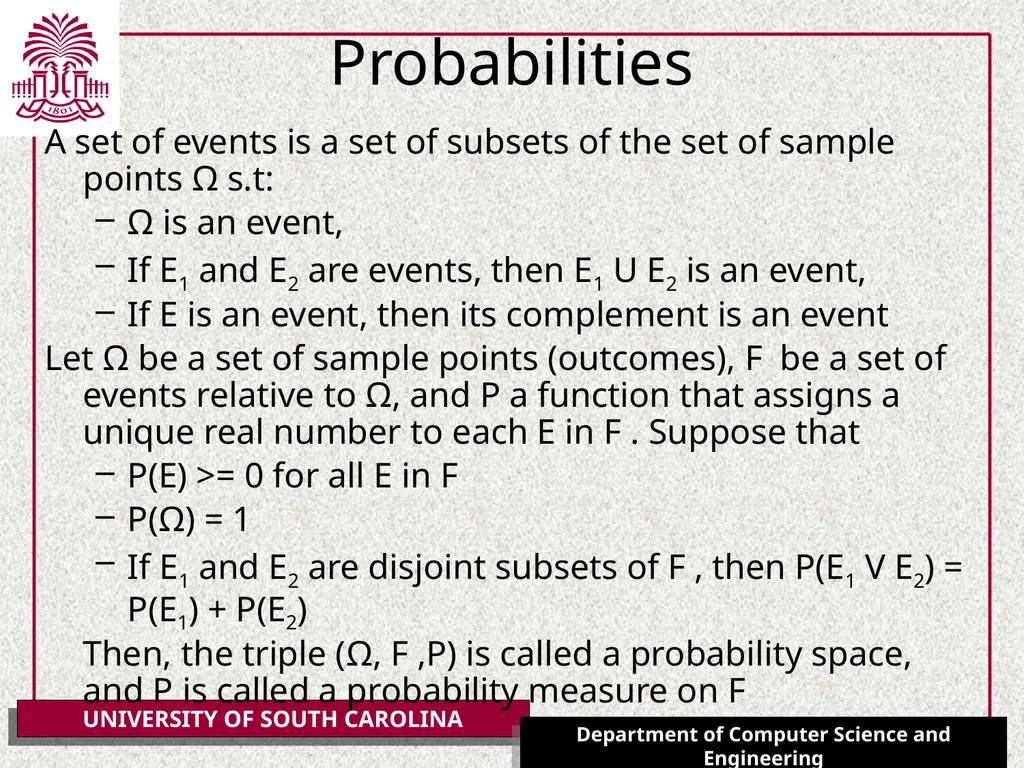
Probabilities A set of events is a set of subsets of the set of sample points Ω s.t:
Ω is an event,
If E1 and E2 are events, then E1 U E2 is an event,
If E is an event, then its complement is an event
Let Ω be a set of sample points (outcomes), F be a set of events relative to Ω, and P a function that assigns a unique real number to each E in F . Suppose that
P(E) >= 0 for all E in F
P(Ω) = 1
If E1 and E2 are disjoint subsets of F , then P(E1 V E2) = P(E1) + P(E2)
Then, the triple (Ω, F ,P) is called a probability space, and P is called a probability measure on F<br>
04
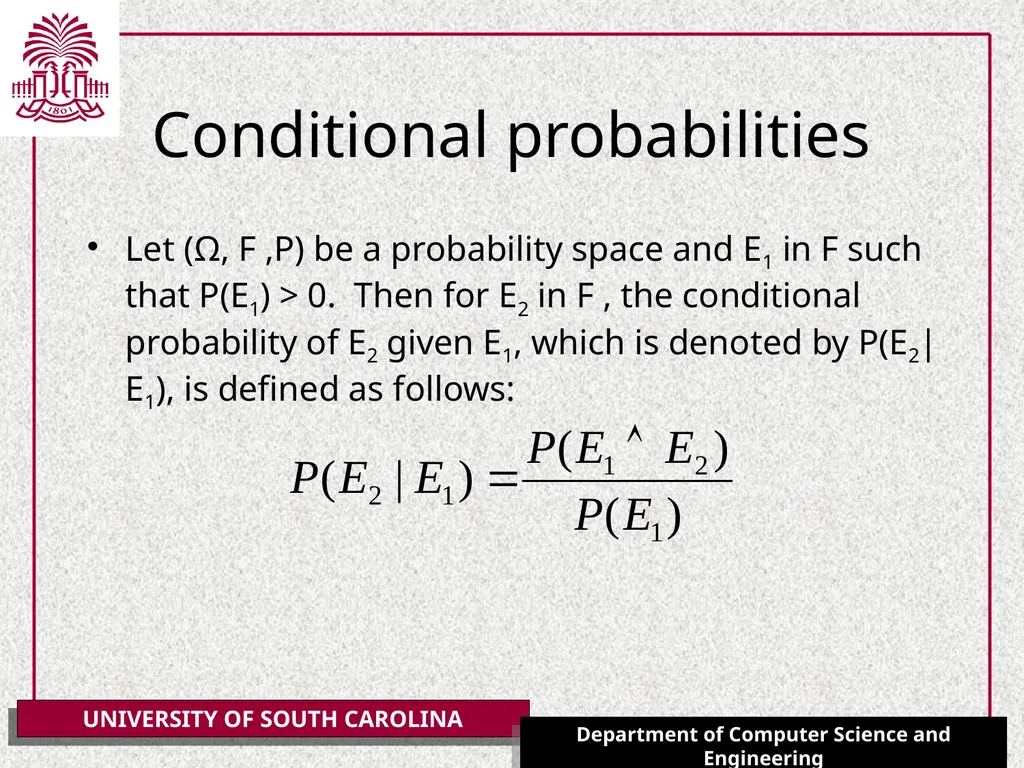
Conditional probabilities Let (Ω, F ,P) be a probability space and E1 in F such that P(E1) > 0. Then for E2 in F , the conditional probability of E2 given E1, which is denoted by P(E2| E1), is defined as follows:<br>
05
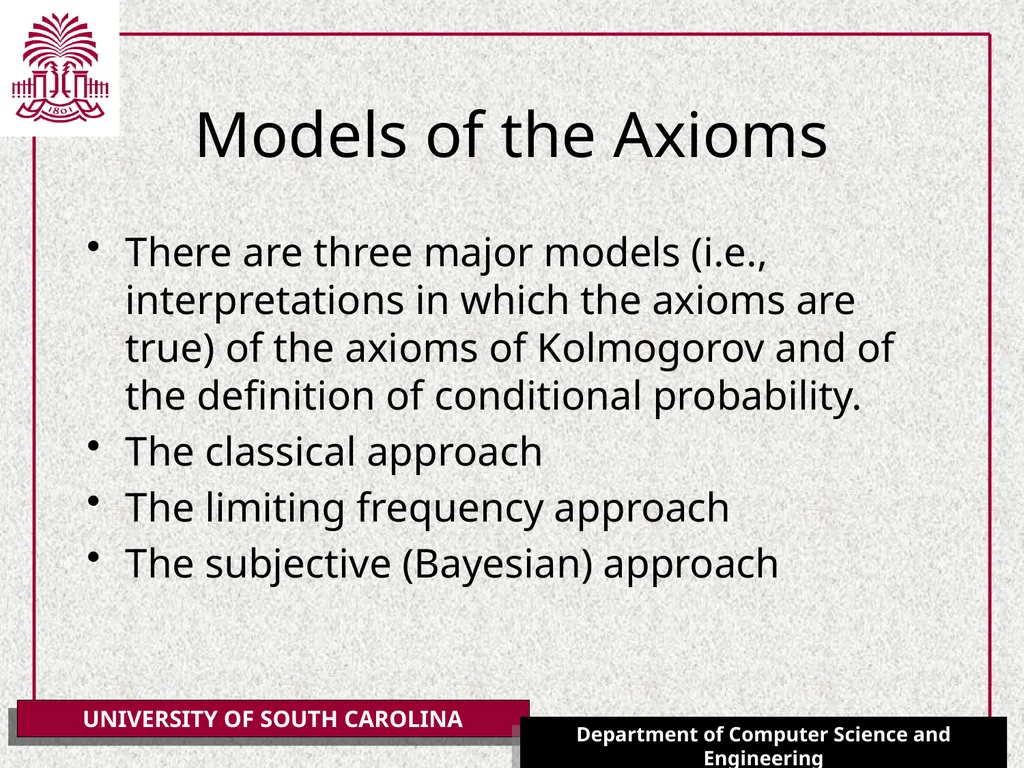
Models of the Axioms There are three major models (i.e., interpretations in which the axioms are true) of the axioms of Kolmogorov and of the definition of conditional probability.
The classical approach
The limiting frequency approach
The subjective (Bayesian) approach<br>
06
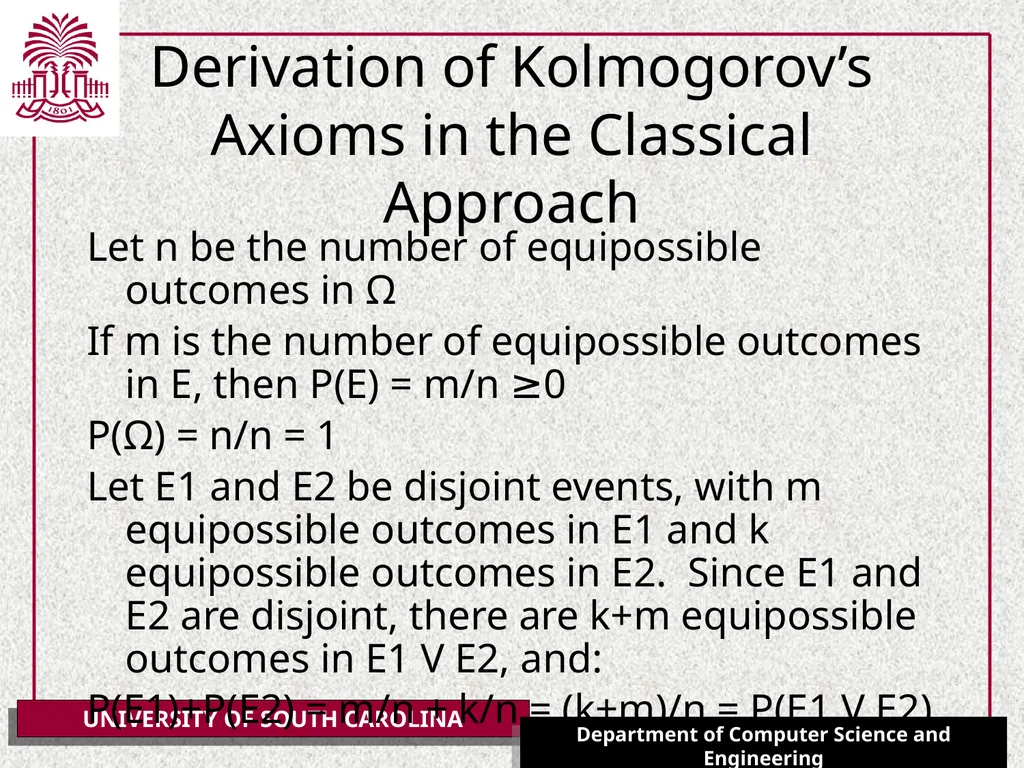
Derivation of Kolmogorov’s Axioms in the Classical Approach Let n be the number of equipossible outcomes in Ω
If m is the number of equipossible outcomes in E, then P(E) = m/n ≥0
P(Ω) = n/n = 1
Let E1 and E2 be disjoint events, with m equipossible outcomes in E1 and k equipossible outcomes in E2. Since E1 and E2 are disjoint, there are k+m equipossible outcomes in E1 V E2, and:
P(E1)+P(E2) = m/n + k/n = (k+m)/n = P(E1 V E2)<br>
07
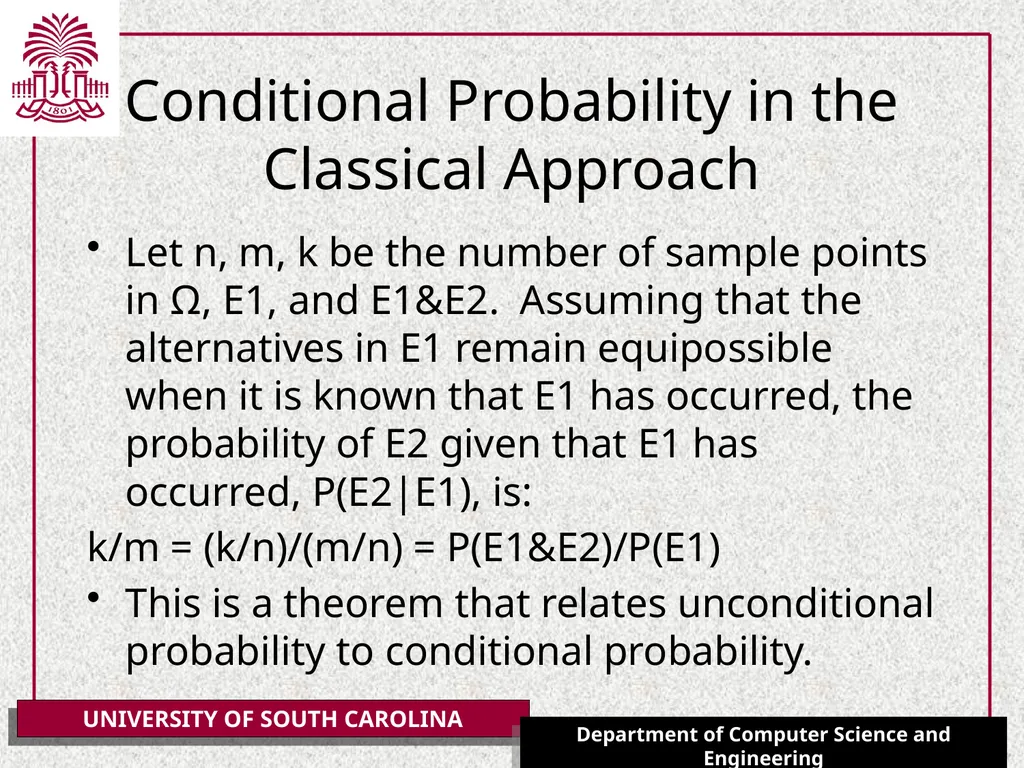
Conditional Probability in the Classical Approach Let n, m, k be the number of sample points in Ω, E1, and E1&E2. Assuming that the alternatives in E1 remain equipossible when it is known that E1 has occurred, the probability of E2 given that E1 has occurred, P(E2|E1), is:
k/m = (k/n)/(m/n) = P(E1&E2)/P(E1)
This is a theorem that relates unconditional probability to conditional probability.<br>
08
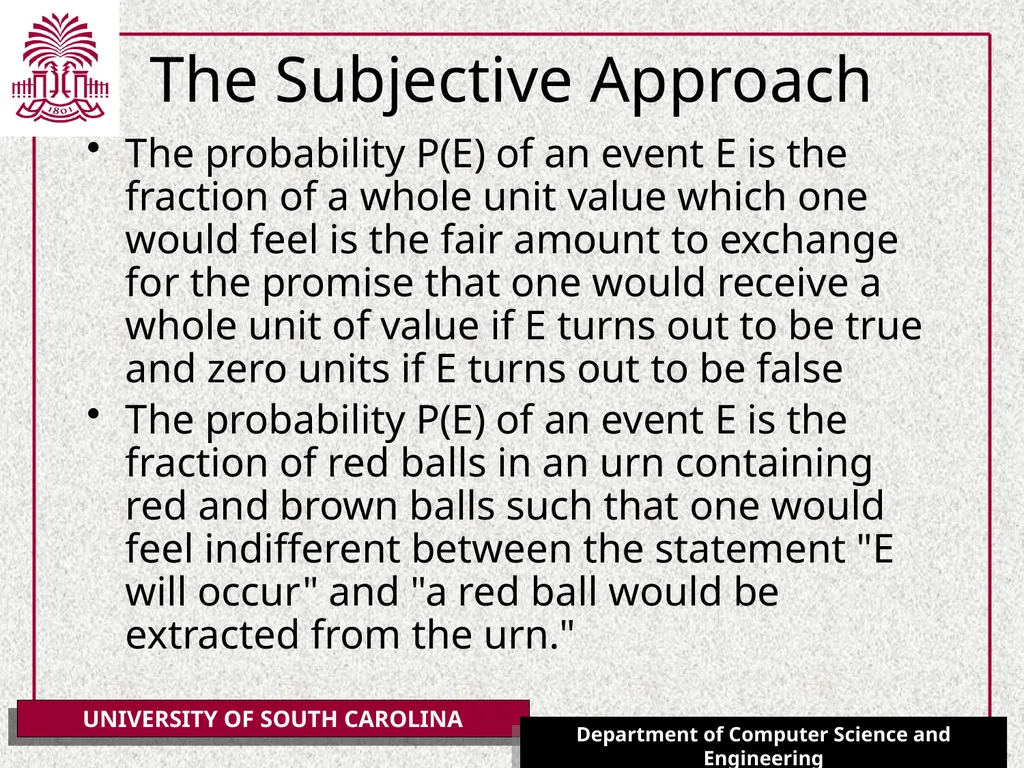
The Subjective Approach The probability P(E) of an event E is the fraction of a whole unit value which one would feel is the fair amount to exchange for the promise that one would receive a whole unit of value if E turns out to be true and zero units if E turns out to be false
The probability P(E) of an event E is the fraction of red balls in an urn containing red and brown balls such that one would feel indifferent between the statement "E will occur" and "a red ball would be extracted from the urn."<br>
09
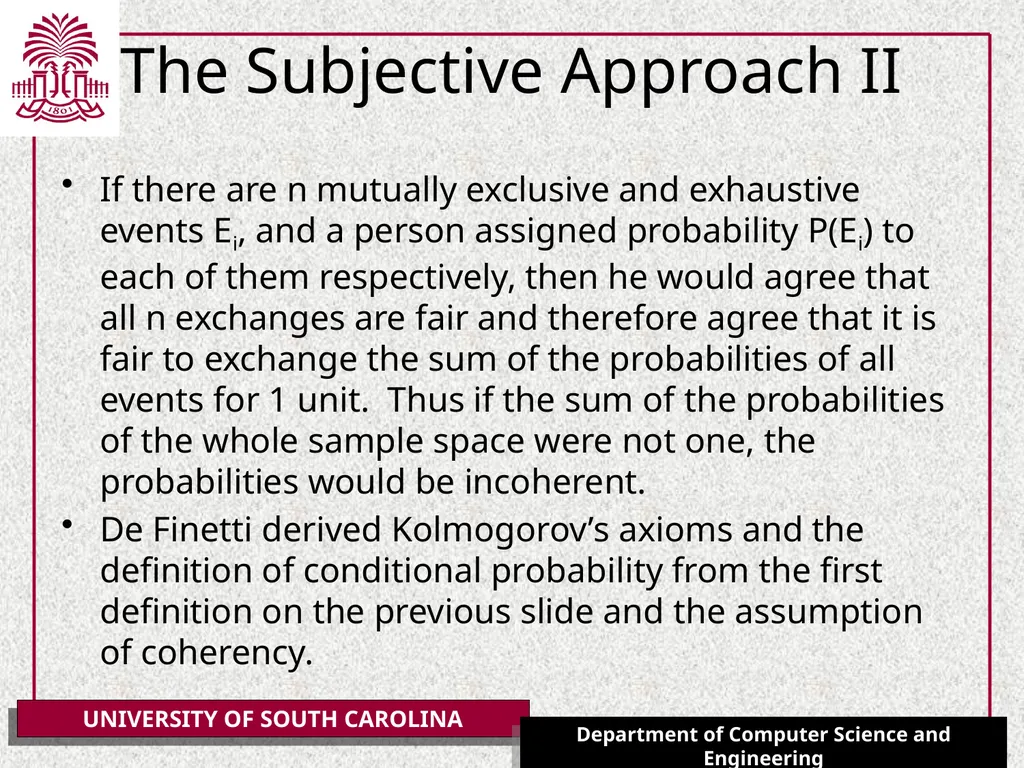
The Subjective Approach II If there are n mutually exclusive and exhaustive events Ei, and a person assigned probability P(Ei) to each of them respectively, then he would agree that all n exchanges are fair and therefore agree that it is fair to exchange the sum of the probabilities of all events for 1 unit. Thus if the sum of the probabilities of the whole sample space were not one, the probabilities would be incoherent.
De Finetti derived Kolmogorov’s axioms and the definition of conditional probability from the first definition on the previous slide and the assumption of coherency.<br>
10
Definition of Conditional Probability in the Subjective Approach Let E and H be events. The conditional probability of E given H, denoted P(E|H), is defined as follows: Once it is learned that H occurs for certain, P(E|H) is the fair amount one would exchange for the promise that one would receive a whole unit value if E turns out to be true and zero units if E turns out to be false. [Neapolitan, 1990]
Note that this is a conditional definition: we do not care about what happens when H is false.<br>
11
Derivation of Conditional Probability One would exchange P(H) units for the promise to receive 1 unit if H occurs, 0 units otherwise; therefore, by multiplication of payoffs:
One would exchange P(H)P(E|H) units for the promise to receive P(E|H) units if H occurs, 0 units if H does not occur (bet 1); furthermore, by definition of P(E|H), if H does occur:
One would exchange P(E|H) units for the promise to receive 1 unit if E occurs, and 0 units if E does not occur (bet 2)
Therefore, one would exchange P(H)P(E|H) units for the promise to receive 1 unit if both H and E occur, and 0 units otherwise (bet 3).
But bet 3 is the same that one would accept for P(E&H), i.e. one would exchange P(E&H) units for the promise to receive 1 unit if both H and E occur, and 0 otherwise, and therefore P(H)P(E|H)=P(E&H).<br>