
Introduction to Project Finance-A Lenders’
AS
Published · 26 slides · 0 views

1 / 1

Description
Introduction to Project Finance-A Lenders Perspective Investment Banking GroupUnited Bank Limited November 13, 2012 Table of Contents Introduction to Project Finance Financing Large Projects-Introduction Parameters For Evaluating a
Related Topics
Share
Embed code
Download this presentation From Below
"Introduction to Project Finance-A Lenders’" is the property of its rightful owner. Permission is granted to download and print the materials on this website for personal, non-commercial use only, and to display it on your personal computer provided you do not modify the materials and that you retain all copyright notices contained in the materials. By downloading content from our website, you accept the terms of this agreement.
Presentation Transcript
01
Introduction to Project Finance-A Lenders’ Perspective |Investment Banking Group|United Bank Limited| November 13, 2012<br>
02
Table of Contents Introduction to Project Finance
Financing Large Projects-Introduction
Parameters For Evaluating a Project
History of Project Finance
Full Recourse and Structured Finance
Non-Recourse Project Finance
Project Finance Vs Corporate Finance
Why Project Finance?
Benefits to Investors
Benefits to Public Authority
Benefits to Lenders
What makes Successful Project Finance Transaction?
Sources of Project Finance
Project Finance Methodology
Domestic Project Finance Market 2 UBL | Investment Banking Group<br>
Financing Large Projects-Introduction
Parameters For Evaluating a Project
History of Project Finance
Full Recourse and Structured Finance
Non-Recourse Project Finance
Project Finance Vs Corporate Finance
Why Project Finance?
Benefits to Investors
Benefits to Public Authority
Benefits to Lenders
What makes Successful Project Finance Transaction?
Sources of Project Finance
Project Finance Methodology
Domestic Project Finance Market 2 UBL | Investment Banking Group<br>
03
“Large” is a relative term, i.e. relative to the stakeholders capabilities.
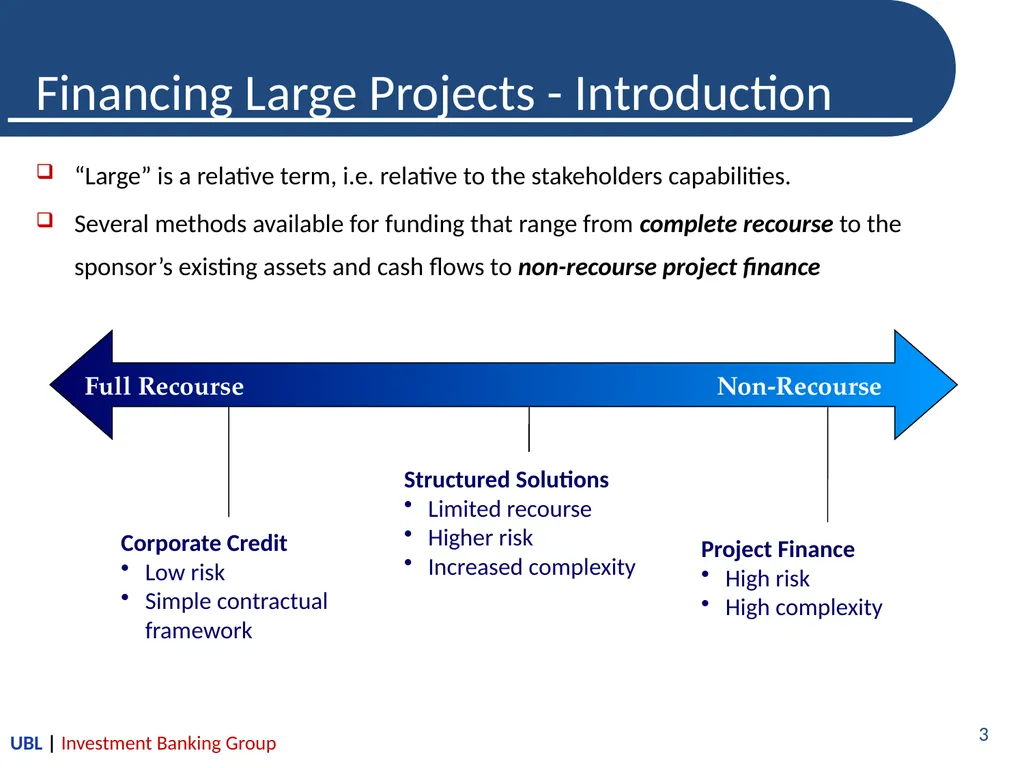
Several methods available for funding that range from complete recourse to the sponsor’s existing assets and cash flows to non-recourse project finance Financing Large Projects - Introduction Full Recourse Non-Recourse Corporate Credit
Low risk
Simple contractual framework Structured Solutions
Limited recourse
Higher risk
Increased complexity Project Finance
High risk
High complexity UBL | Investment Banking Group 3<br>
Several methods available for funding that range from complete recourse to the sponsor’s existing assets and cash flows to non-recourse project finance Financing Large Projects - Introduction Full Recourse Non-Recourse Corporate Credit
Low risk
Simple contractual framework Structured Solutions
Limited recourse
Higher risk
Increased complexity Project Finance
High risk
High complexity UBL | Investment Banking Group 3<br>
04
The choice of method depends upon:
Relative Size
Quality of Stakeholders
Sponsors
Suppliers
Financiers
Buyers
Cost of Implementation
Nature of Business Parameters For Evaluating A Project UBL | Investment Banking Group 4<br>
Relative Size
Quality of Stakeholders
Sponsors
Suppliers
Financiers
Buyers
Cost of Implementation
Nature of Business Parameters For Evaluating A Project UBL | Investment Banking Group 4<br>
05
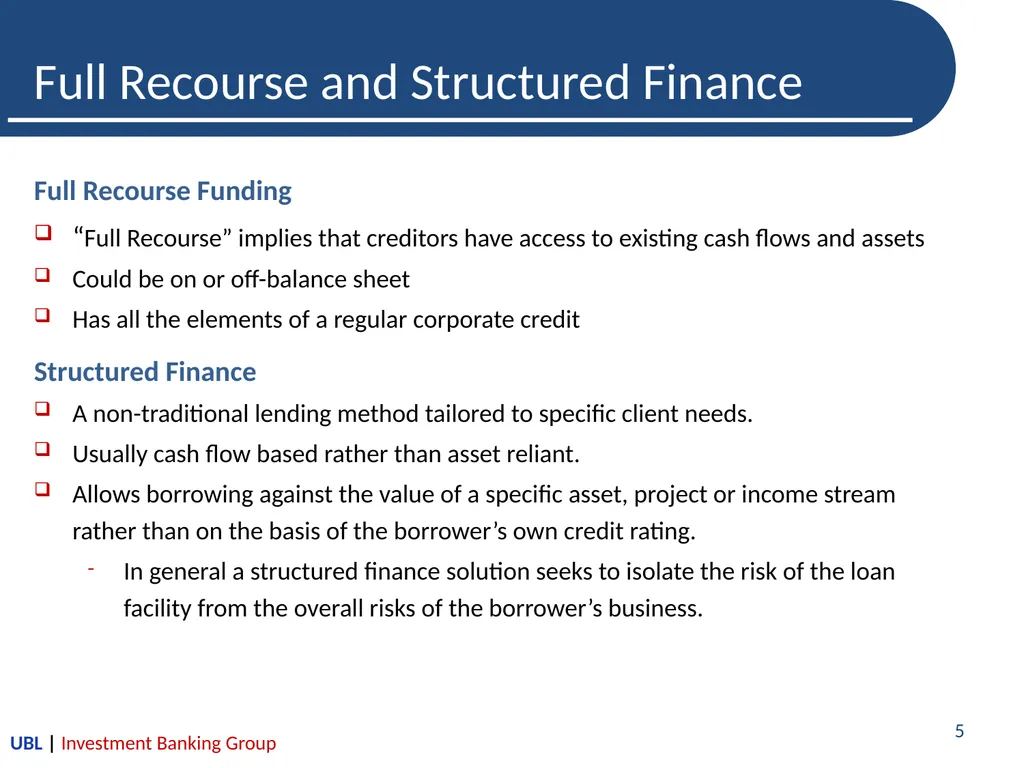
Full Recourse and Structured Finance Full Recourse Funding
“Full Recourse” implies that creditors have access to existing cash flows and assets
Could be on or off-balance sheet
Has all the elements of a regular corporate credit
Structured Finance
A non-traditional lending method tailored to specific client needs.
Usually cash flow based rather than asset reliant.
Allows borrowing against the value of a specific asset, project or income stream rather than on the basis of the borrower’s own credit rating.
In general a structured finance solution seeks to isolate the risk of the loan facility from the overall risks of the borrower’s business. 5 UBL | Investment Banking Group<br>
“Full Recourse” implies that creditors have access to existing cash flows and assets
Could be on or off-balance sheet
Has all the elements of a regular corporate credit
Structured Finance
A non-traditional lending method tailored to specific client needs.
Usually cash flow based rather than asset reliant.
Allows borrowing against the value of a specific asset, project or income stream rather than on the basis of the borrower’s own credit rating.
In general a structured finance solution seeks to isolate the risk of the loan facility from the overall risks of the borrower’s business. 5 UBL | Investment Banking Group<br>
06
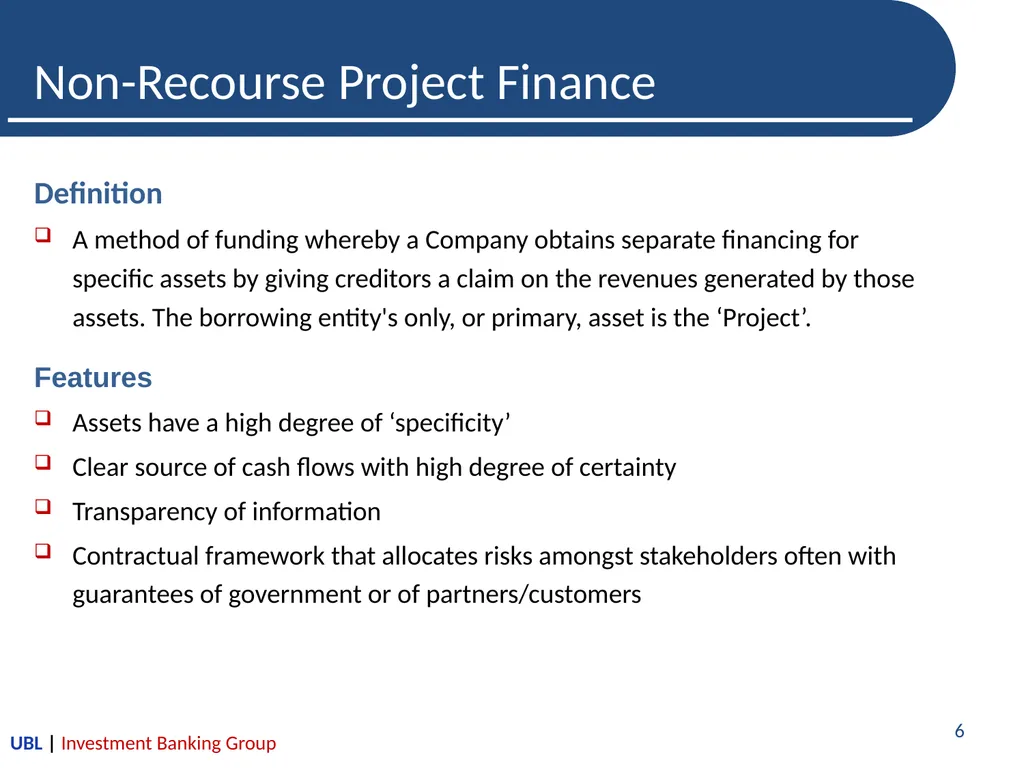
Non-Recourse Project Finance Definition
A method of funding whereby a Company obtains separate financing for specific assets by giving creditors a claim on the revenues generated by those assets. The borrowing entity's only, or primary, asset is the ‘Project’.
Features
Assets have a high degree of ‘specificity’
Clear source of cash flows with high degree of certainty
Transparency of information
Contractual framework that allocates risks amongst stakeholders often with guarantees of government or of partners/customers 6 UBL | Investment Banking Group<br>
A method of funding whereby a Company obtains separate financing for specific assets by giving creditors a claim on the revenues generated by those assets. The borrowing entity's only, or primary, asset is the ‘Project’.
Features
Assets have a high degree of ‘specificity’
Clear source of cash flows with high degree of certainty
Transparency of information
Contractual framework that allocates risks amongst stakeholders often with guarantees of government or of partners/customers 6 UBL | Investment Banking Group<br>
07
Financiers look at cash flows of a single asset (the project) for repayment.
No / limited recourse to outside support for project finance debt.
Project contracts are usually the main security for lenders; project company’s assets are likely to be worth much less than debt during construction. Features Project Finance Corporate Finance Financiers look to the overall strength of a company’s balance sheet and projections, which is usually derived not from a single asset but a range of assets and businesses.
All assets of the company can be used for security.
Access to the entire cash flow from various spread of businesses as security, thus even if project fails, corporate lenders can be repaid. Security Financing Project Finance vs Corporate Finance 7 UBL | Investment Banking Group<br>
No / limited recourse to outside support for project finance debt.
Project contracts are usually the main security for lenders; project company’s assets are likely to be worth much less than debt during construction. Features Project Finance Corporate Finance Financiers look to the overall strength of a company’s balance sheet and projections, which is usually derived not from a single asset but a range of assets and businesses.
All assets of the company can be used for security.
Access to the entire cash flow from various spread of businesses as security, thus even if project fails, corporate lenders can be repaid. Security Financing Project Finance vs Corporate Finance 7 UBL | Investment Banking Group<br>
08
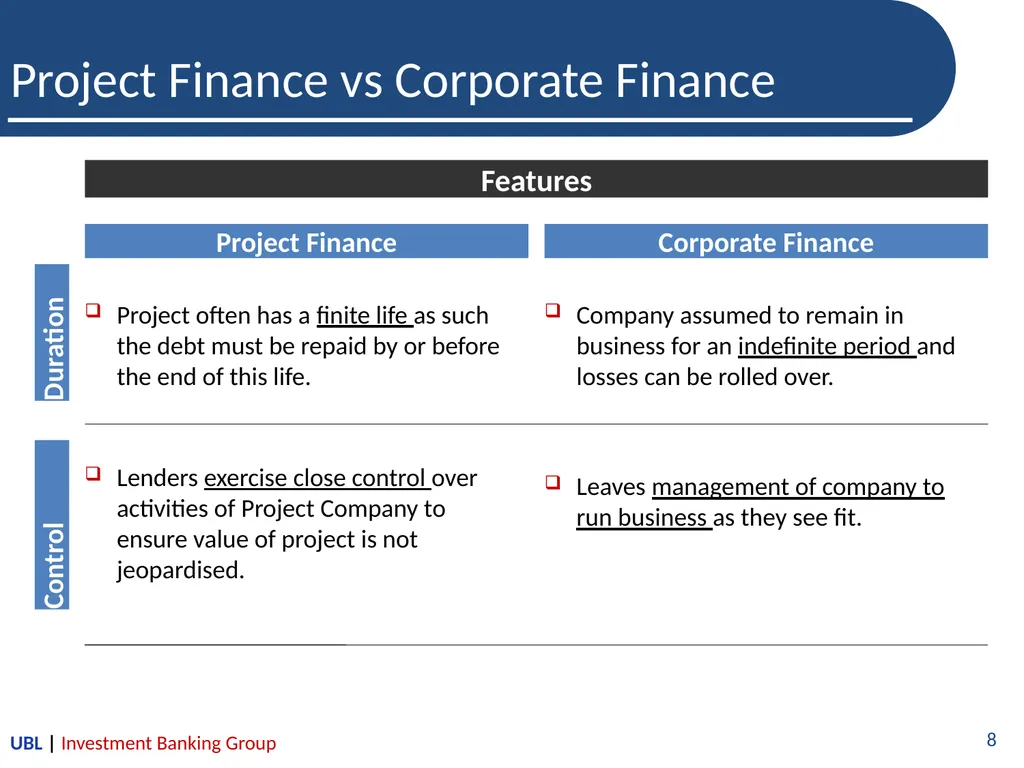
Project often has a finite life as such the debt must be repaid by or before the end of this life.
Lenders exercise close control over activities of Project Company to ensure value of project is not jeopardised. Features Project Finance Corporate Finance Company assumed to remain in business for an indefinite period and losses can be rolled over.
Leaves management of company to run business as they see fit. Duration Control Project Finance vs Corporate Finance 8 UBL | Investment Banking Group<br>
Lenders exercise close control over activities of Project Company to ensure value of project is not jeopardised. Features Project Finance Corporate Finance Company assumed to remain in business for an indefinite period and losses can be rolled over.
Leaves management of company to run business as they see fit. Duration Control Project Finance vs Corporate Finance 8 UBL | Investment Banking Group<br>
09
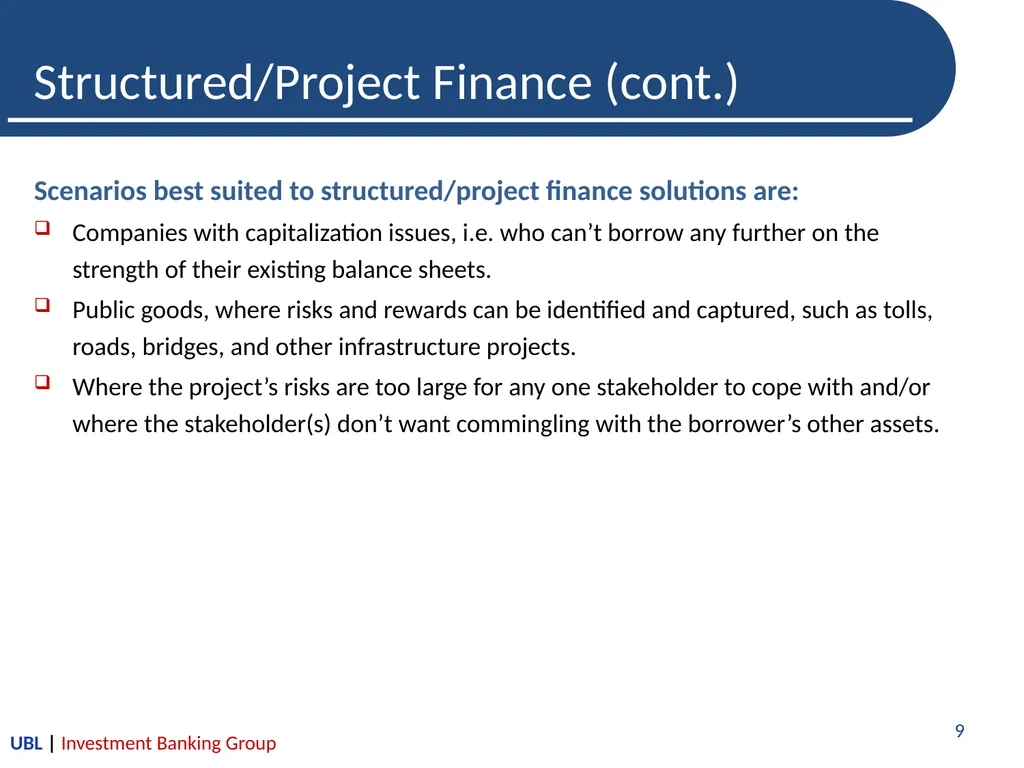
Structured/Project Finance (cont.) Scenarios best suited to structured/project finance solutions are:
Companies with capitalization issues, i.e. who can’t borrow any further on the strength of their existing balance sheets.
Public goods, where risks and rewards can be identified and captured, such as tolls, roads, bridges, and other infrastructure projects.
Where the project’s risks are too large for any one stakeholder to cope with and/or where the stakeholder(s) don’t want commingling with the borrower’s other assets. 9 UBL | Investment Banking Group<br>
Companies with capitalization issues, i.e. who can’t borrow any further on the strength of their existing balance sheets.
Public goods, where risks and rewards can be identified and captured, such as tolls, roads, bridges, and other infrastructure projects.
Where the project’s risks are too large for any one stakeholder to cope with and/or where the stakeholder(s) don’t want commingling with the borrower’s other assets. 9 UBL | Investment Banking Group<br>
10
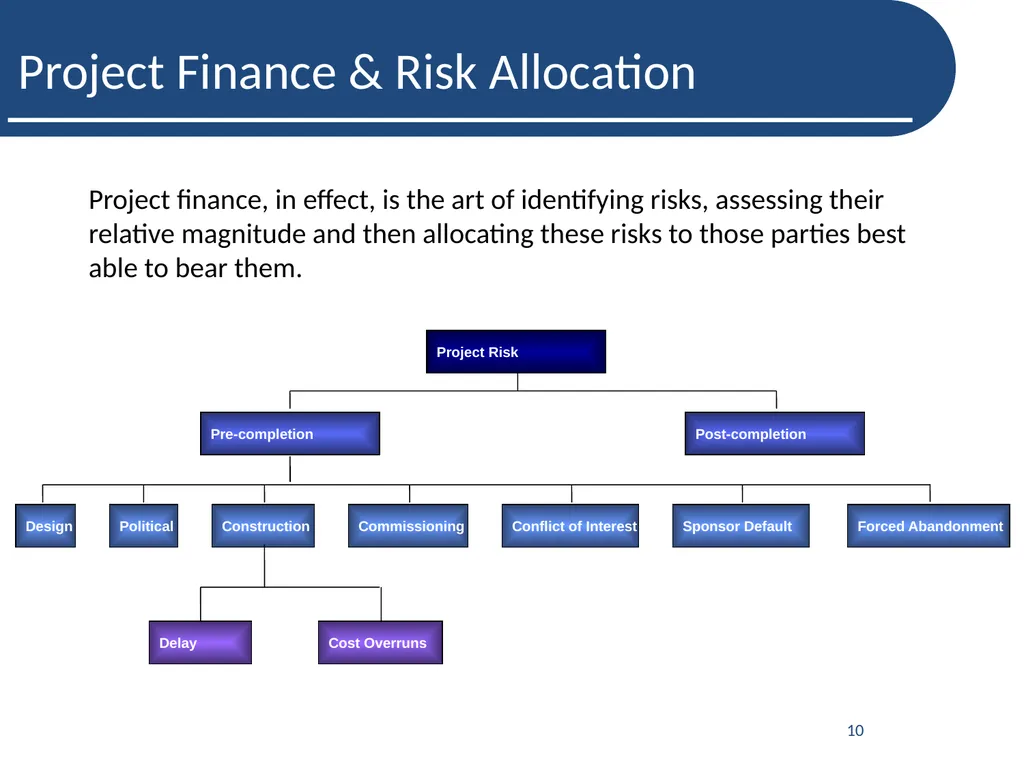
Project Finance & Risk Allocation Project finance, in effect, is the art of identifying risks, assessing their relative magnitude and then allocating these risks to those parties best able to bear them. 10 Project Risk Pre-completion Post-completion Design Political Construction Commissioning Conflict of Interest Sponsor Default Forced Abandonment Delay Cost Overruns<br>
11
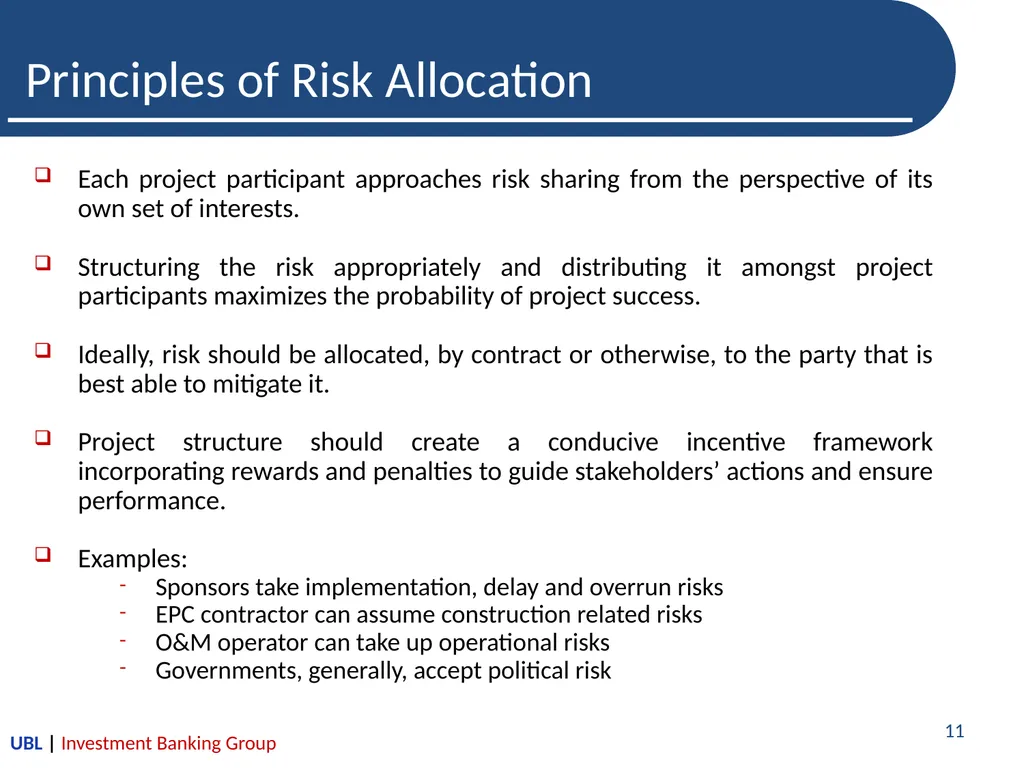
Principles of Risk Allocation Each project participant approaches risk sharing from the perspective of its own set of interests.
Structuring the risk appropriately and distributing it amongst project participants maximizes the probability of project success.
Ideally, risk should be allocated, by contract or otherwise, to the party that is best able to mitigate it.
Project structure should create a conducive incentive framework incorporating rewards and penalties to guide stakeholders’ actions and ensure performance.
Examples:
Sponsors take implementation, delay and overrun risks
EPC contractor can assume construction related risks
O&M operator can take up operational risks
Governments, generally, accept political risk 11 UBL | Investment Banking Group<br>
Structuring the risk appropriately and distributing it amongst project participants maximizes the probability of project success.
Ideally, risk should be allocated, by contract or otherwise, to the party that is best able to mitigate it.
Project structure should create a conducive incentive framework incorporating rewards and penalties to guide stakeholders’ actions and ensure performance.
Examples:
Sponsors take implementation, delay and overrun risks
EPC contractor can assume construction related risks
O&M operator can take up operational risks
Governments, generally, accept political risk 11 UBL | Investment Banking Group<br>
12
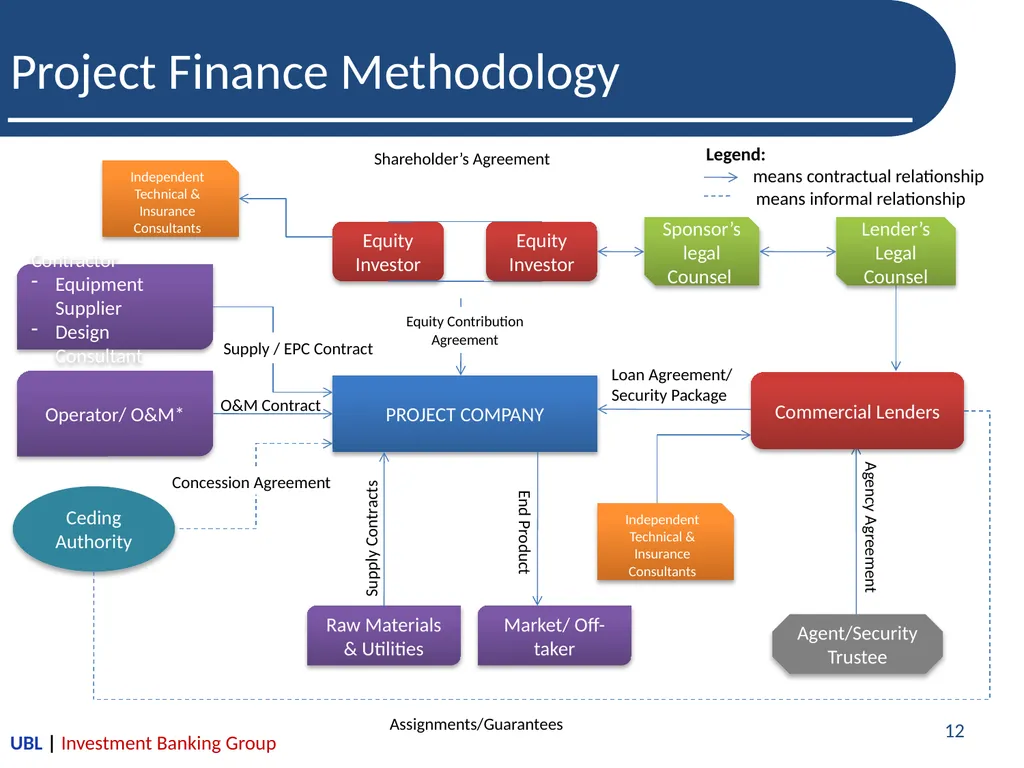
Project Finance Methodology 12 PROJECT COMPANY Equity Investor Equity Investor Equity Contribution Agreement Shareholder’s Agreement Commercial Lenders Sponsor’s legal Counsel Lender’s Legal Counsel Contractor
Equipment Supplier
Design Consultant Raw Materials & Utilities Market/ Off-taker Agent/Security Trustee Ceding Authority Independent Technical & Insurance Consultants Operator/ O&M* Loan Agreement/ Security Package Agency Agreement End Product Supply Contracts Concession Agreement Supply / EPC Contract O&M Contract Assignments/Guarantees Independent Technical & Insurance Consultants Legend:
: means contractual relationship
means informal relationship UBL | Investment Banking Group<br>
Equipment Supplier
Design Consultant Raw Materials & Utilities Market/ Off-taker Agent/Security Trustee Ceding Authority Independent Technical & Insurance Consultants Operator/ O&M* Loan Agreement/ Security Package Agency Agreement End Product Supply Contracts Concession Agreement Supply / EPC Contract O&M Contract Assignments/Guarantees Independent Technical & Insurance Consultants Legend:
: means contractual relationship
means informal relationship UBL | Investment Banking Group<br>
13
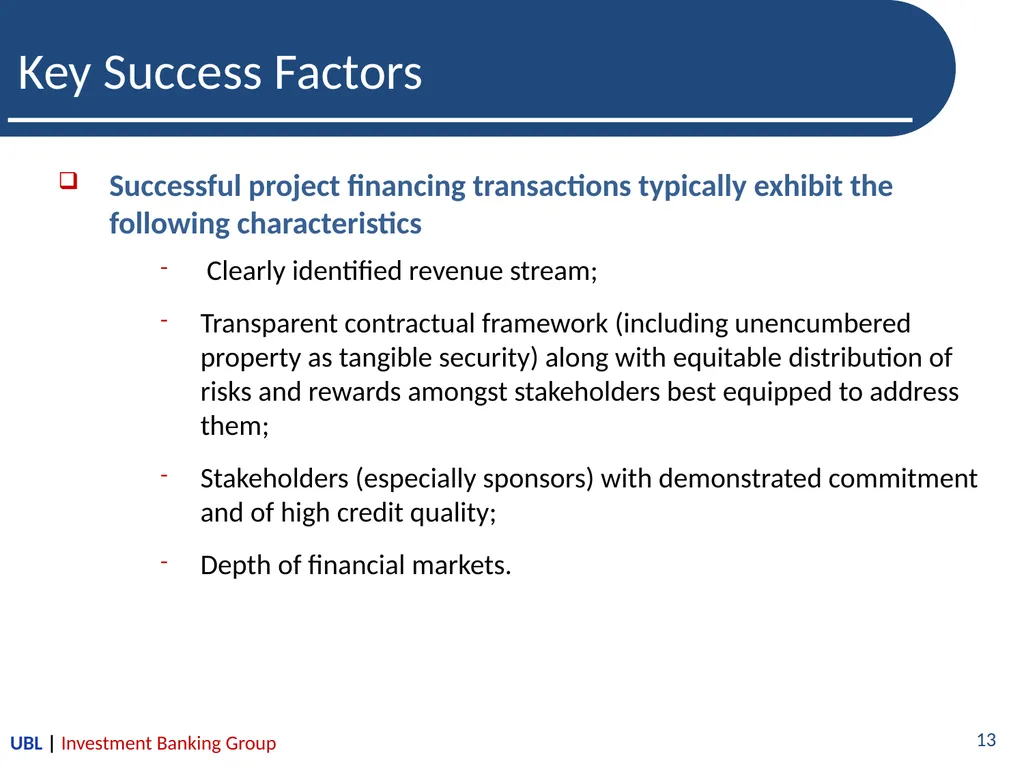
Key Success Factors Successful project financing transactions typically exhibit the following characteristics
Clearly identified revenue stream;
Transparent contractual framework (including unencumbered property as tangible security) along with equitable distribution of risks and rewards amongst stakeholders best equipped to address them;
Stakeholders (especially sponsors) with demonstrated commitment and of high credit quality;
Depth of financial markets. 13 UBL | Investment Banking Group<br>
Clearly identified revenue stream;
Transparent contractual framework (including unencumbered property as tangible security) along with equitable distribution of risks and rewards amongst stakeholders best equipped to address them;
Stakeholders (especially sponsors) with demonstrated commitment and of high credit quality;
Depth of financial markets. 13 UBL | Investment Banking Group<br>
14
Why Project Finance? Benefits to Investors
Projects are highly leveraged leads to a higher return on equity (ROE);
Risk spreading – enables risk of investment to be divided up between stakeholders who are best equipped to address the relevant risk;
Limited ‘risk contamination’ between the project and the rest of the investor’s businesses (risk is quarantined to invested equity);
Increased borrowing capacity of investors with the reallocation of project risks to other contracting parties;
Avoids restrictive covenants on the corporate balance sheet arising from a project’s debt financing;
Matches each commercial undertaking with the specific assets and skills required to build and operate it. 14 UBL | Investment Banking Group<br>
Projects are highly leveraged leads to a higher return on equity (ROE);
Risk spreading – enables risk of investment to be divided up between stakeholders who are best equipped to address the relevant risk;
Limited ‘risk contamination’ between the project and the rest of the investor’s businesses (risk is quarantined to invested equity);
Increased borrowing capacity of investors with the reallocation of project risks to other contracting parties;
Avoids restrictive covenants on the corporate balance sheet arising from a project’s debt financing;
Matches each commercial undertaking with the specific assets and skills required to build and operate it. 14 UBL | Investment Banking Group<br>
15
Why Project Finance? (contd…) Benefits to the Lenders
Higher IRR portfolio – On account of higher risk and longer tenors, project finance transactions attract higher pricing and generally drive up the banks’ IRR profile;
Portfolio diversification – Allows lenders to enter into sectors that may normally not come up for regular modes of financing, such as transport, infrastructure etc thus leading to a more diversified portfolio;
Significant cross-sell – aside from lending transaction covers working capital, trade, accounts, treasury, custodial services etc.
Acquired specialization in new areas of business – Since the primary reliance in this kind of lending is on project cash flows, advisors and consultants are engaged to provide risk evaluation of various facets of transaction viz. technical, legal, tax, accounting, insurance etc, as a result building up the financial institution’s internal expertise. 15 UBL | Investment Banking Group<br>
Higher IRR portfolio – On account of higher risk and longer tenors, project finance transactions attract higher pricing and generally drive up the banks’ IRR profile;
Portfolio diversification – Allows lenders to enter into sectors that may normally not come up for regular modes of financing, such as transport, infrastructure etc thus leading to a more diversified portfolio;
Significant cross-sell – aside from lending transaction covers working capital, trade, accounts, treasury, custodial services etc.
Acquired specialization in new areas of business – Since the primary reliance in this kind of lending is on project cash flows, advisors and consultants are engaged to provide risk evaluation of various facets of transaction viz. technical, legal, tax, accounting, insurance etc, as a result building up the financial institution’s internal expertise. 15 UBL | Investment Banking Group<br>
16
Why Project Finance? Benefits to the Public Authority (PA)
The increase in investor’s financial capacity creates a more competitive market for projects, to the benefit of the PA;
Involvement of third parties (lenders and advisers) would mean that a rigorous review of the risk transfer is carried out and any structural shortcomings unearthed and addressed (independent due diligence undertaken by financiers);
High leverage, inherent in a project finance structure, helps ensure the lowest WACC (weighted avg. cost of capital) to PA;
There is transparency as project financing is self-contained and the true costs of the service can more easily be measured/monitored. 16 UBL | Investment Banking Group<br>
The increase in investor’s financial capacity creates a more competitive market for projects, to the benefit of the PA;
Involvement of third parties (lenders and advisers) would mean that a rigorous review of the risk transfer is carried out and any structural shortcomings unearthed and addressed (independent due diligence undertaken by financiers);
High leverage, inherent in a project finance structure, helps ensure the lowest WACC (weighted avg. cost of capital) to PA;
There is transparency as project financing is self-contained and the true costs of the service can more easily be measured/monitored. 16 UBL | Investment Banking Group<br>
17
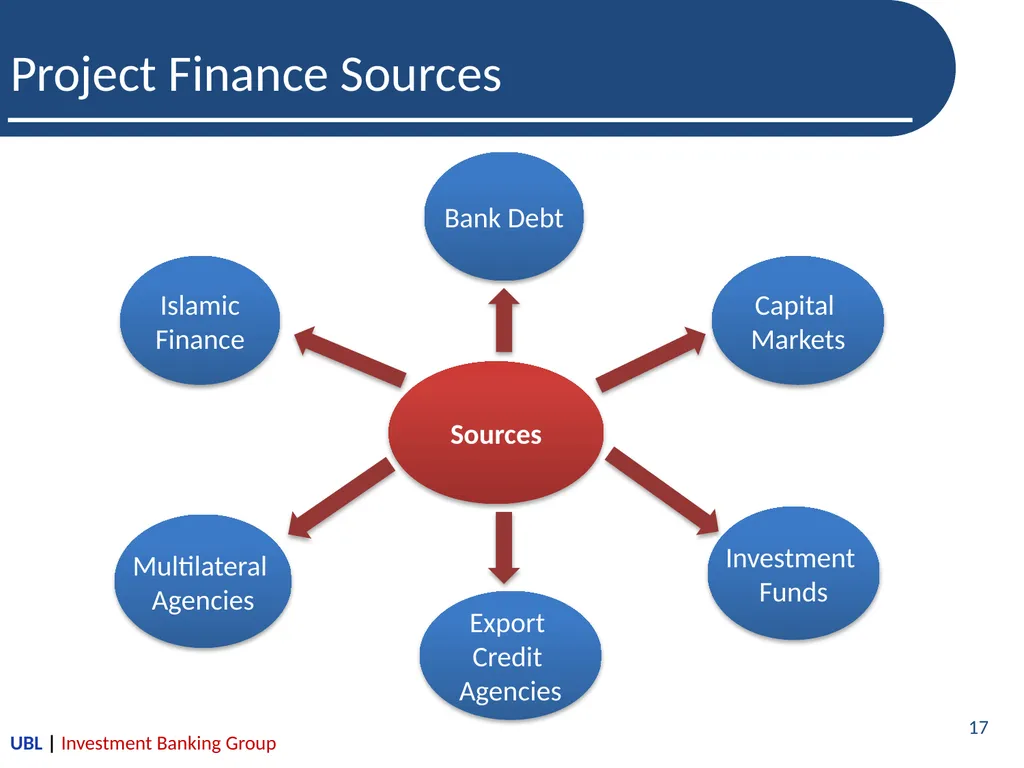
Project Finance Sources 17 UBL | Investment Banking Group<br>
18
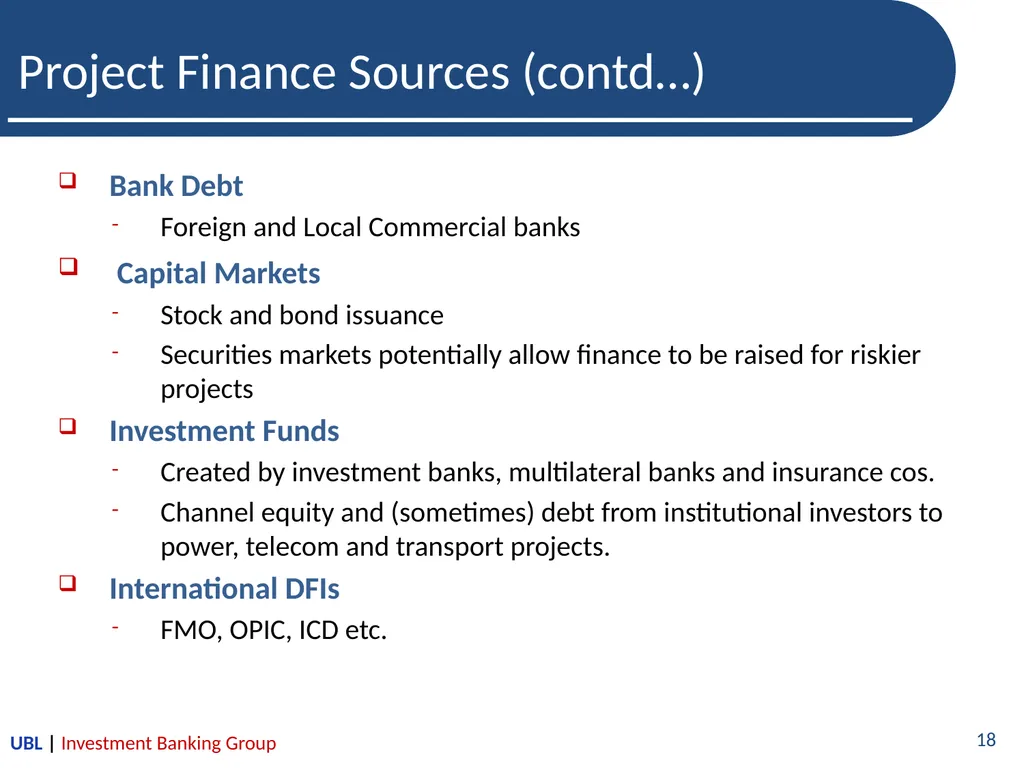
Project Finance Sources (contd…) Bank Debt
Foreign and Local Commercial banks
Capital Markets
Stock and bond issuance
Securities markets potentially allow finance to be raised for riskier projects
Investment Funds
Created by investment banks, multilateral banks and insurance cos.
Channel equity and (sometimes) debt from institutional investors to power, telecom and transport projects.
International DFIs
FMO, OPIC, ICD etc. 18 UBL | Investment Banking Group<br>
Foreign and Local Commercial banks
Capital Markets
Stock and bond issuance
Securities markets potentially allow finance to be raised for riskier projects
Investment Funds
Created by investment banks, multilateral banks and insurance cos.
Channel equity and (sometimes) debt from institutional investors to power, telecom and transport projects.
International DFIs
FMO, OPIC, ICD etc. 18 UBL | Investment Banking Group<br>
19
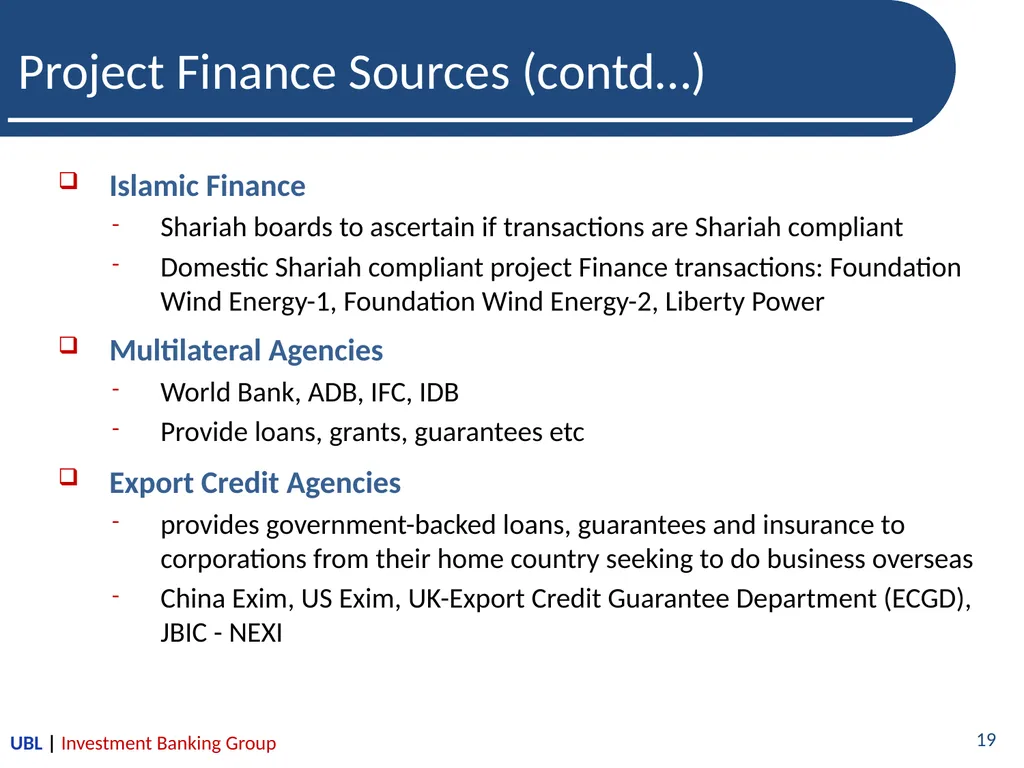
Project Finance Sources (contd…) Islamic Finance
Shariah boards to ascertain if transactions are Shariah compliant
Domestic Shariah compliant project Finance transactions: Foundation Wind Energy-1, Foundation Wind Energy-2, Liberty Power
Multilateral Agencies
World Bank, ADB, IFC, IDB
Provide loans, grants, guarantees etc
Export Credit Agencies
provides government-backed loans, guarantees and insurance to corporations from their home country seeking to do business overseas
China Exim, US Exim, UK-Export Credit Guarantee Department (ECGD), JBIC - NEXI 19 UBL | Investment Banking Group<br>
Shariah boards to ascertain if transactions are Shariah compliant
Domestic Shariah compliant project Finance transactions: Foundation Wind Energy-1, Foundation Wind Energy-2, Liberty Power
Multilateral Agencies
World Bank, ADB, IFC, IDB
Provide loans, grants, guarantees etc
Export Credit Agencies
provides government-backed loans, guarantees and insurance to corporations from their home country seeking to do business overseas
China Exim, US Exim, UK-Export Credit Guarantee Department (ECGD), JBIC - NEXI 19 UBL | Investment Banking Group<br>
20
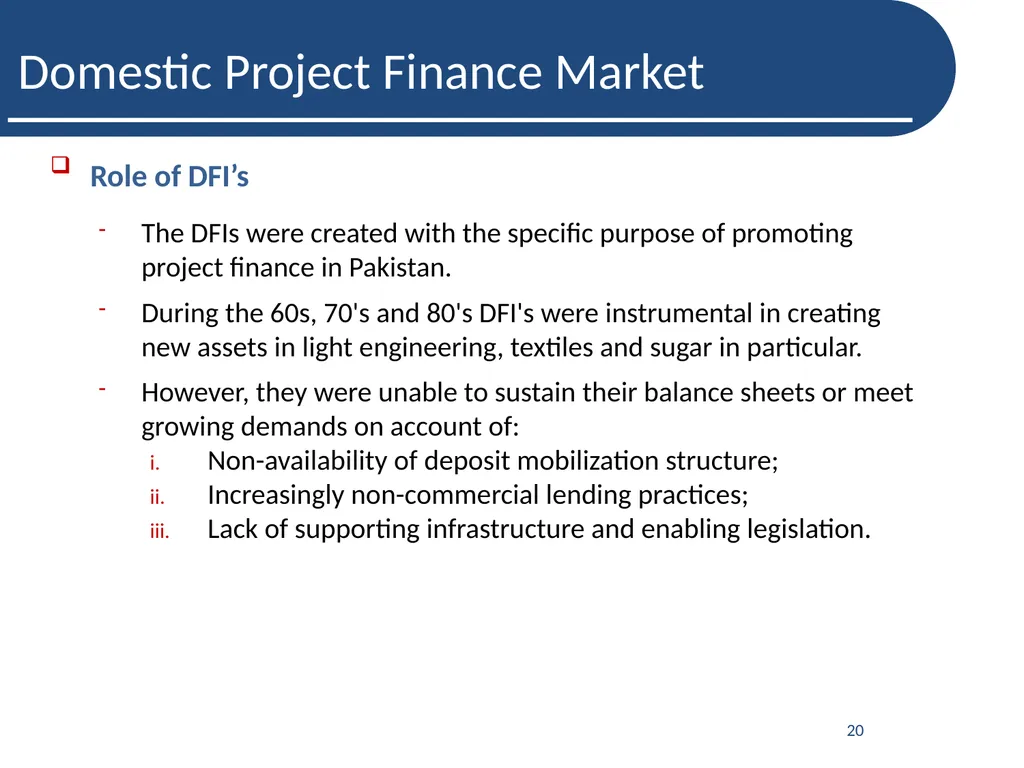
Domestic Project Finance Market Role of DFI’s
The DFIs were created with the specific purpose of promoting project finance in Pakistan.
During the 60s, 70's and 80's DFI's were instrumental in creating new assets in light engineering, textiles and sugar in particular.
However, they were unable to sustain their balance sheets or meet growing demands on account of:
Non-availability of deposit mobilization structure;
Increasingly non-commercial lending practices;
Lack of supporting infrastructure and enabling legislation. 20<br>
The DFIs were created with the specific purpose of promoting project finance in Pakistan.
During the 60s, 70's and 80's DFI's were instrumental in creating new assets in light engineering, textiles and sugar in particular.
However, they were unable to sustain their balance sheets or meet growing demands on account of:
Non-availability of deposit mobilization structure;
Increasingly non-commercial lending practices;
Lack of supporting infrastructure and enabling legislation. 20<br>
21
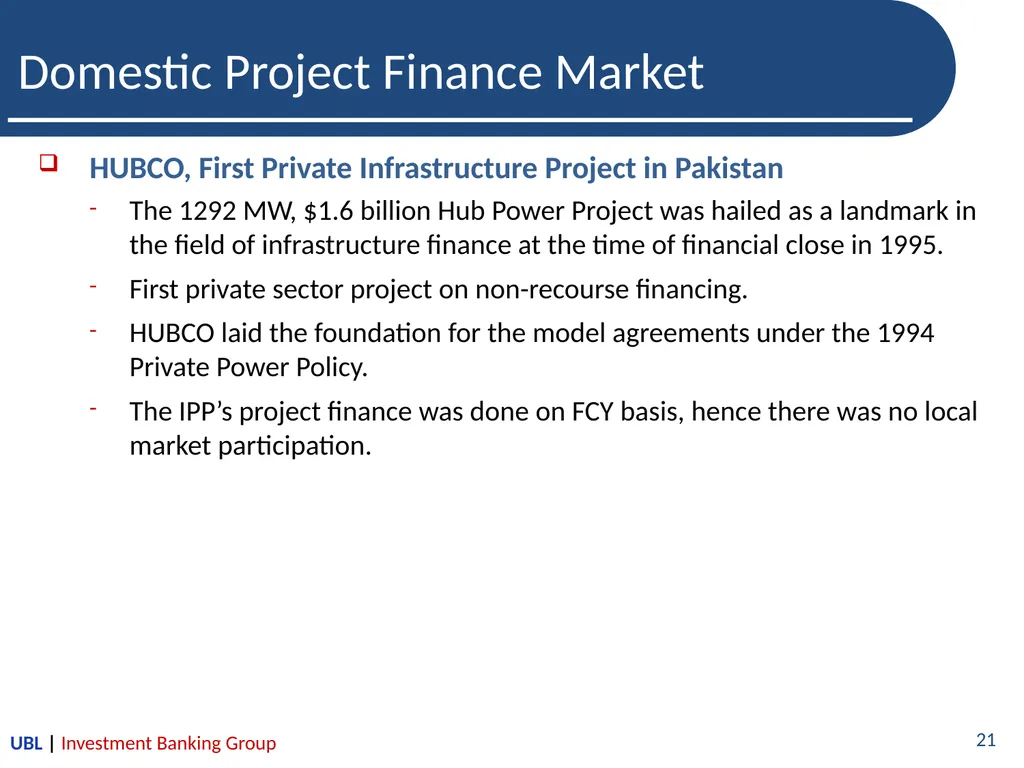
Domestic Project Finance Market HUBCO, First Private Infrastructure Project in Pakistan
The 1292 MW, $1.6 billion Hub Power Project was hailed as a landmark in the field of infrastructure finance at the time of financial close in 1995.
First private sector project on non-recourse financing.
HUBCO laid the foundation for the model agreements under the 1994 Private Power Policy.
The IPP’s project finance was done on FCY basis, hence there was no local market participation. 21 UBL | Investment Banking Group<br>
The 1292 MW, $1.6 billion Hub Power Project was hailed as a landmark in the field of infrastructure finance at the time of financial close in 1995.
First private sector project on non-recourse financing.
HUBCO laid the foundation for the model agreements under the 1994 Private Power Policy.
The IPP’s project finance was done on FCY basis, hence there was no local market participation. 21 UBL | Investment Banking Group<br>
22
Local Commercial Banks
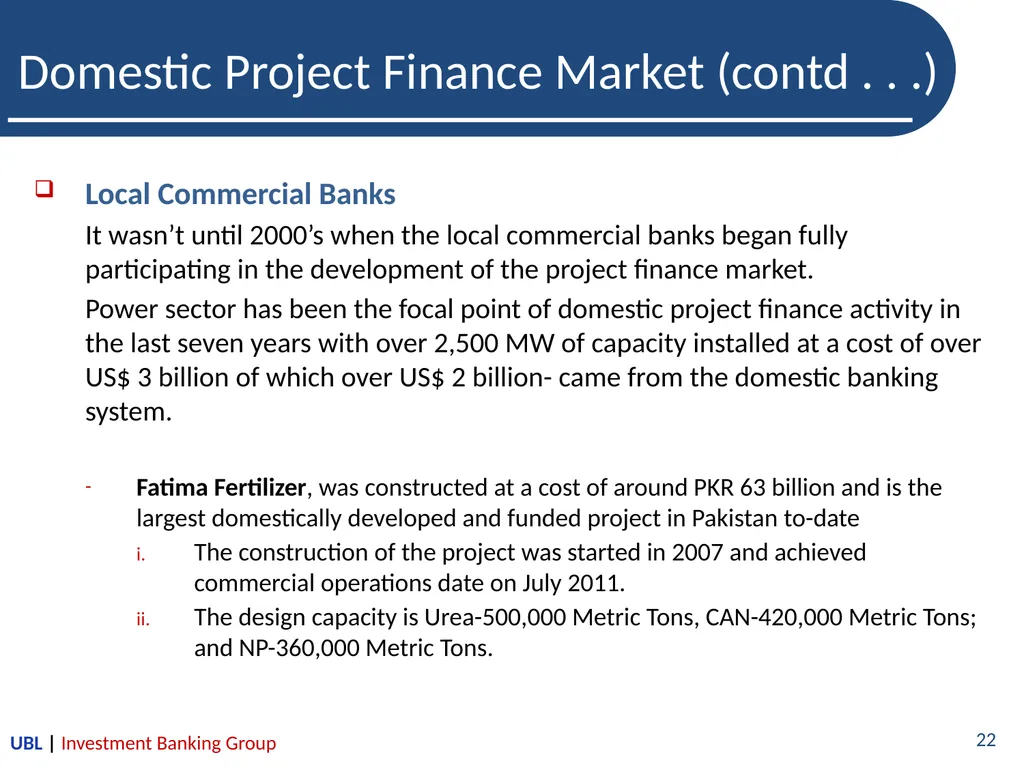
It wasn’t until 2000’s when the local commercial banks began fully participating in the development of the project finance market.
Power sector has been the focal point of domestic project finance activity in the last seven years with over 2,500 MW of capacity installed at a cost of over US$ 3 billion of which over US$ 2 billion- came from the domestic banking system.
Fatima Fertilizer, was constructed at a cost of around PKR 63 billion and is the largest domestically developed and funded project in Pakistan to-date
The construction of the project was started in 2007 and achieved commercial operations date on July 2011.
The design capacity is Urea-500,000 Metric Tons, CAN-420,000 Metric Tons; and NP-360,000 Metric Tons. 22 UBL | Investment Banking Group Domestic Project Finance Market (contd . . .)<br>
It wasn’t until 2000’s when the local commercial banks began fully participating in the development of the project finance market.
Power sector has been the focal point of domestic project finance activity in the last seven years with over 2,500 MW of capacity installed at a cost of over US$ 3 billion of which over US$ 2 billion- came from the domestic banking system.
Fatima Fertilizer, was constructed at a cost of around PKR 63 billion and is the largest domestically developed and funded project in Pakistan to-date
The construction of the project was started in 2007 and achieved commercial operations date on July 2011.
The design capacity is Urea-500,000 Metric Tons, CAN-420,000 Metric Tons; and NP-360,000 Metric Tons. 22 UBL | Investment Banking Group Domestic Project Finance Market (contd . . .)<br>
23
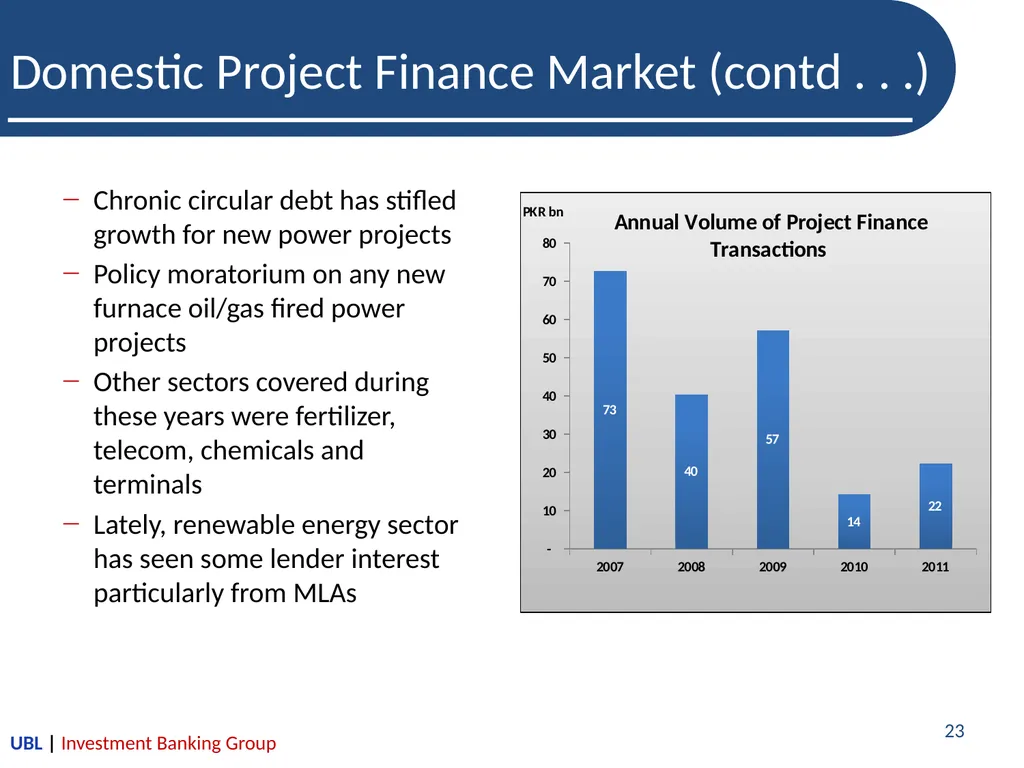
Domestic Project Finance Market (contd . . .) Chronic circular debt has stifled growth for new power projects
Policy moratorium on any new furnace oil/gas fired power projects
Other sectors covered during these years were fertilizer, telecom, chemicals and terminals
Lately, renewable energy sector has seen some lender interest particularly from MLAs 23 UBL | Investment Banking Group<br>
Policy moratorium on any new furnace oil/gas fired power projects
Other sectors covered during these years were fertilizer, telecom, chemicals and terminals
Lately, renewable energy sector has seen some lender interest particularly from MLAs 23 UBL | Investment Banking Group<br>
24
24 Thank you |Saeed Iqbal|EVP & Group Head, Investment Banking Group|
|UNITED BANK LIMITED|
|Saeed.Iqbal@ubl.com.pk|021 3241 0043| UBL | Investment Banking Group<br>
|UNITED BANK LIMITED|
|Saeed.Iqbal@ubl.com.pk|021 3241 0043| UBL | Investment Banking Group<br>
25
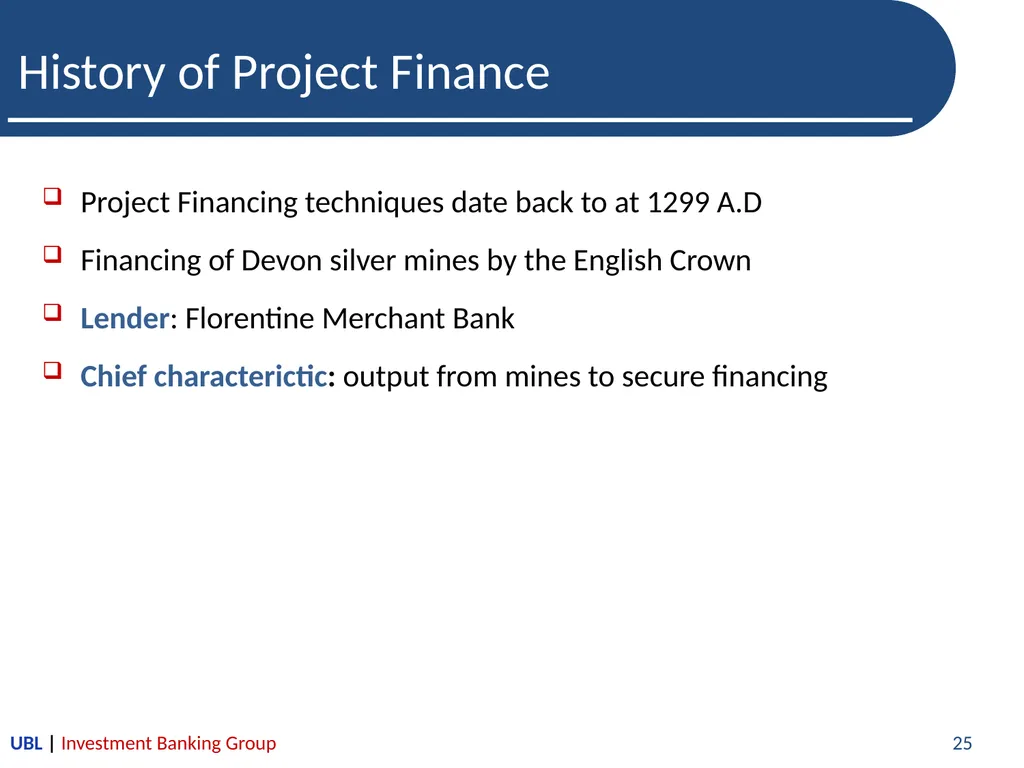
History of Project Finance Project Financing techniques date back to at 1299 A.D
Financing of Devon silver mines by the English Crown
Lender: Florentine Merchant Bank
Chief characterictic: output from mines to secure financing 25 UBL | Investment Banking Group<br>
Financing of Devon silver mines by the English Crown
Lender: Florentine Merchant Bank
Chief characterictic: output from mines to secure financing 25 UBL | Investment Banking Group<br>
26
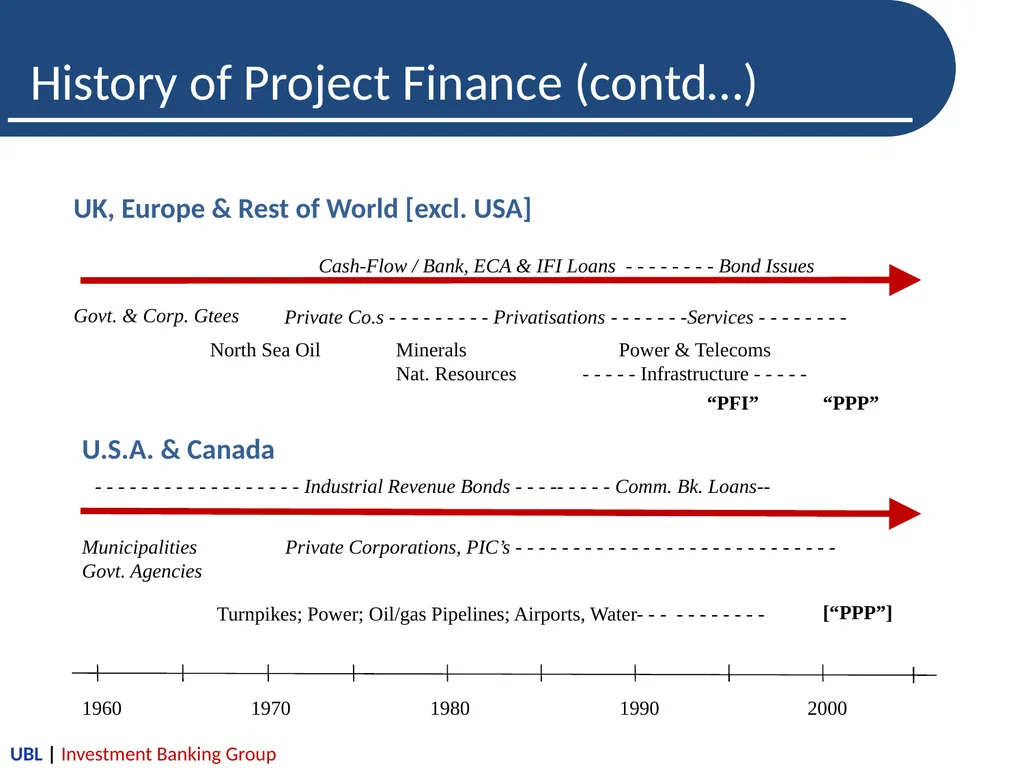
History of Project Finance (contd…) UBL | Investment Banking Group<br>