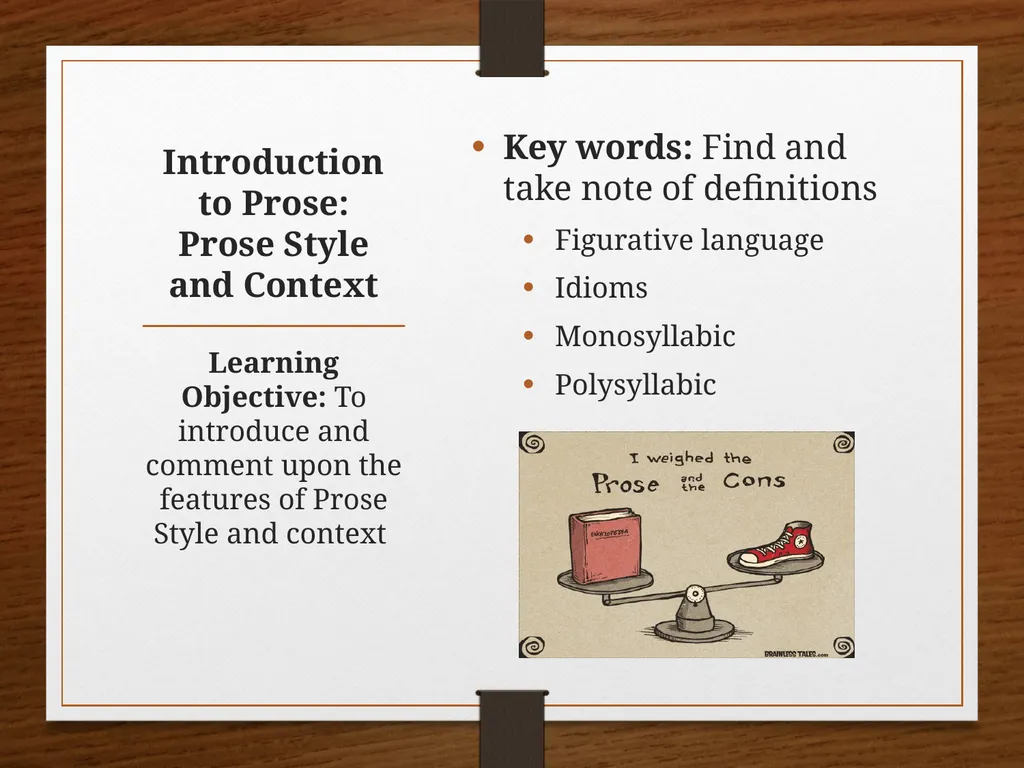
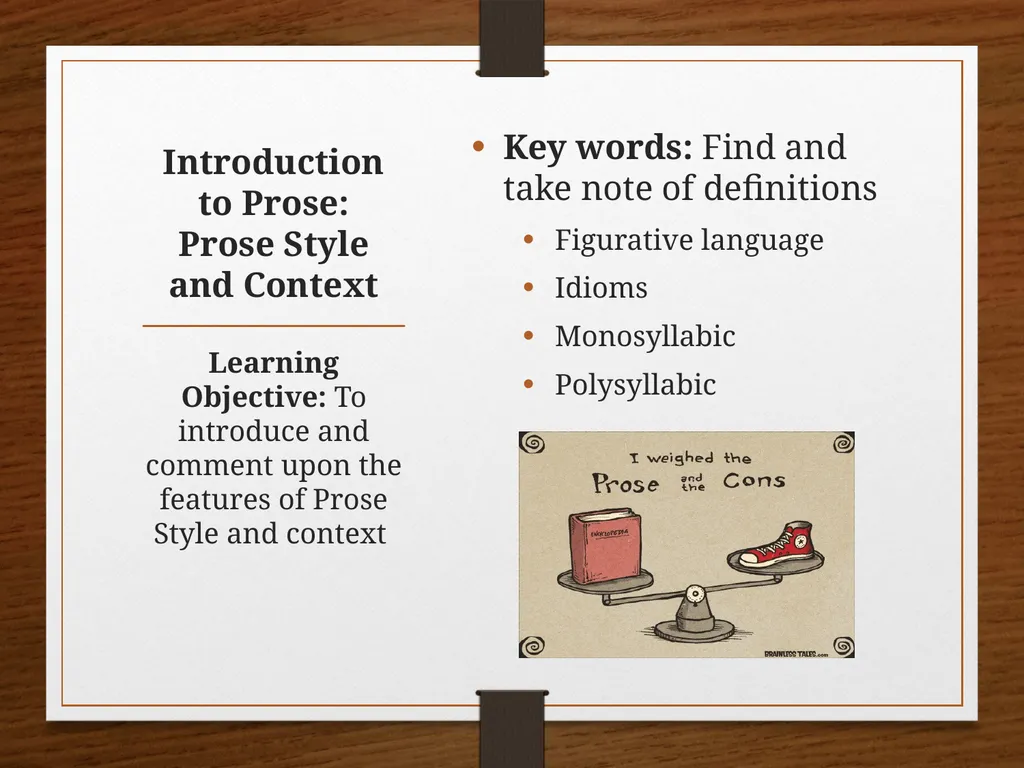
Introduction to Prose: Prose Style and Context Key words: Find and take note of definitions Figurative language Idioms Monosyllabic Polysyllabic Learning Objective: To introduce and comment upon the features of Prose Style and context
"Introduction to Prose: Prose Style and Context Key" is the property of its rightful owner. Permission is granted to
download and print the materials on this website for personal, non-commercial use only, and to display it
on your personal computer provided you do not modify the materials and that you retain all copyright
notices contained in the materials. By downloading content from our website, you accept the terms of this
agreement.
Presentation Transcript
01
Introduction to Prose: Prose Style and Context Key words: Find and take note of definitions
Figurative language
Idioms
Monosyllabic
Polysyllabic Learning Objective: To introduce and comment upon the features of Prose Style and context<br>
02
Starter: Discuss with your partner and brainstorm your ideas What is Prose? Prose is a form of language that exhibits a grammatical structure and a natural flow of speech rather than a rhythmic structure (as in traditional poetry).<br>
03
The Prose style may include: Balance of narration and dialogue
Balance of description, exploration of thoughts and feeling and action
Construction of sentences (e.g. short/long/simple/complex/questions/statements/exclamations)
Use of vocabulary (poetic/colloquial/scholarly/plain/monosyllabic/polysyllabic)
Amount of and kind of figurative language (metaphors/similes/symbols)
Use of punctuation
Length of paragraphs
Features unique to the voice of a writer (use of repetition/particular idioms/rhythm that mimics the speaking voice)<br>
04
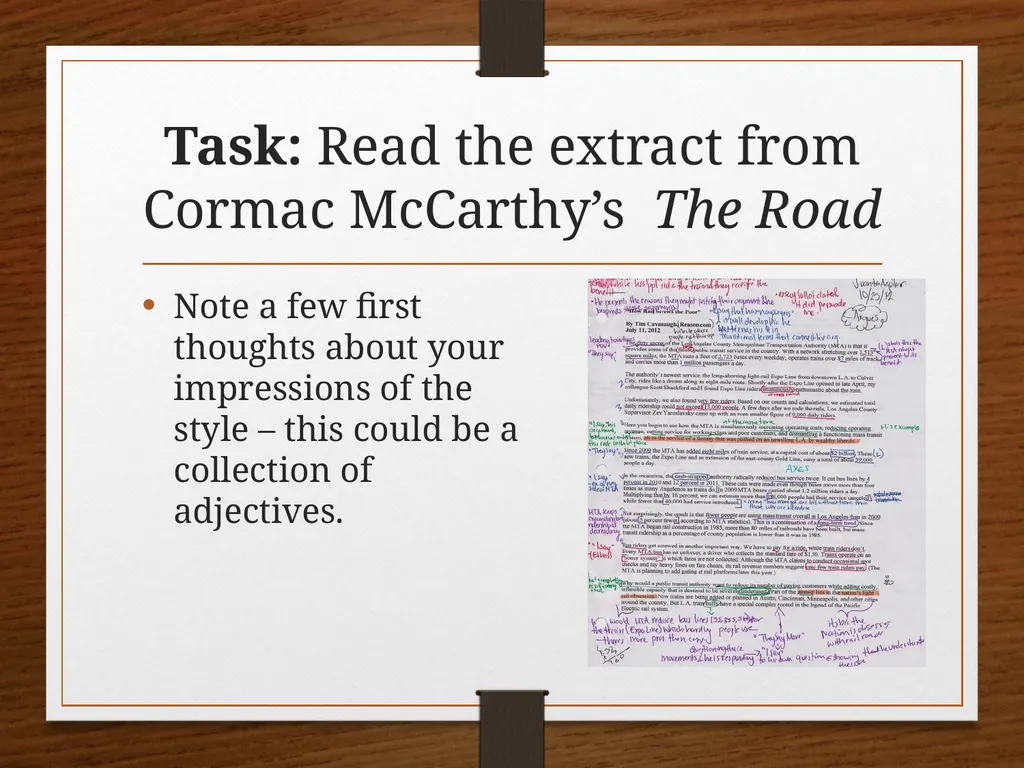
Task: Read the extract from Cormac McCarthy’s The Road Note a few first thoughts about your impressions of the style – this could be a collection of adjectives.<br>
05
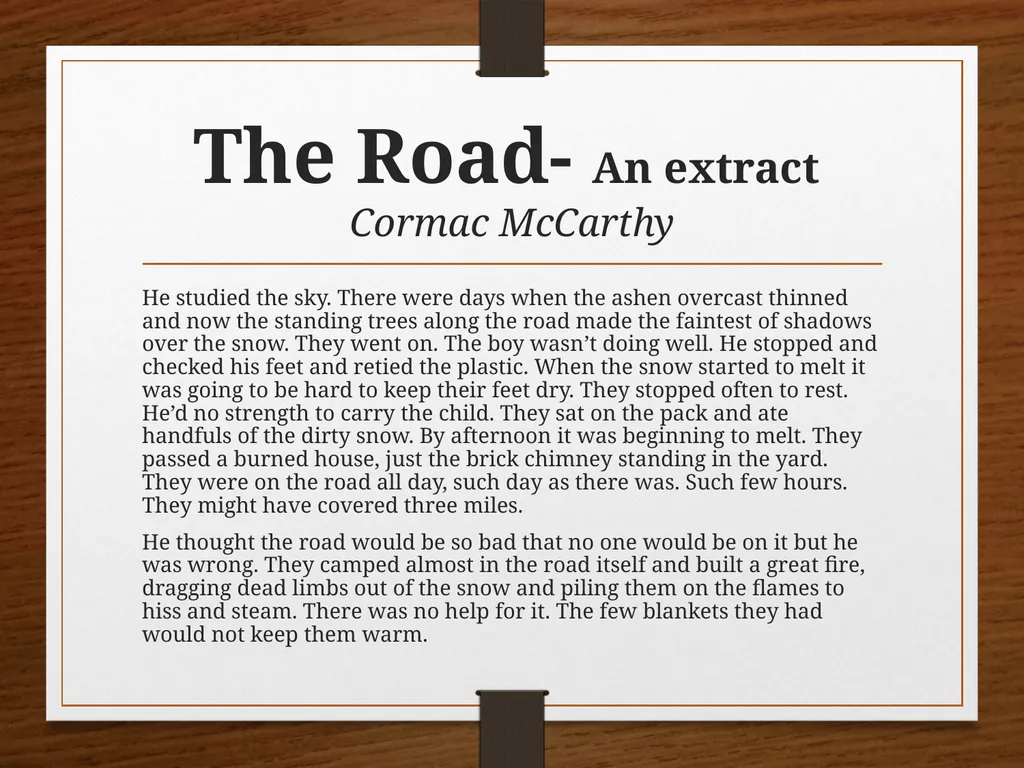
The Road- An extract Cormac McCarthy He studied the sky. There were days when the ashen overcast thinned and now the standing trees along the road made the faintest of shadows over the snow. They went on. The boy wasn’t doing well. He stopped and checked his feet and retied the plastic. When the snow started to melt it was going to be hard to keep their feet dry. They stopped often to rest. He’d no strength to carry the child. They sat on the pack and ate handfuls of the dirty snow. By afternoon it was beginning to melt. They passed a burned house, just the brick chimney standing in the yard. They were on the road all day, such day as there was. Such few hours. They might have covered three miles.
He thought the road would be so bad that no one would be on it but he was wrong. They camped almost in the road itself and built a great fire, dragging dead limbs out of the snow and piling them on the flames to hiss and steam. There was no help for it. The few blankets they had would not keep them warm.<br>
06
Task: In your pairs annotate and analyse Read the article again specifically looking at your given prose style feature. Be ready to feedback in 5 minutes Mini-Plenary: Which features of prose style do you think contribute most to your first impressions?<br>
07
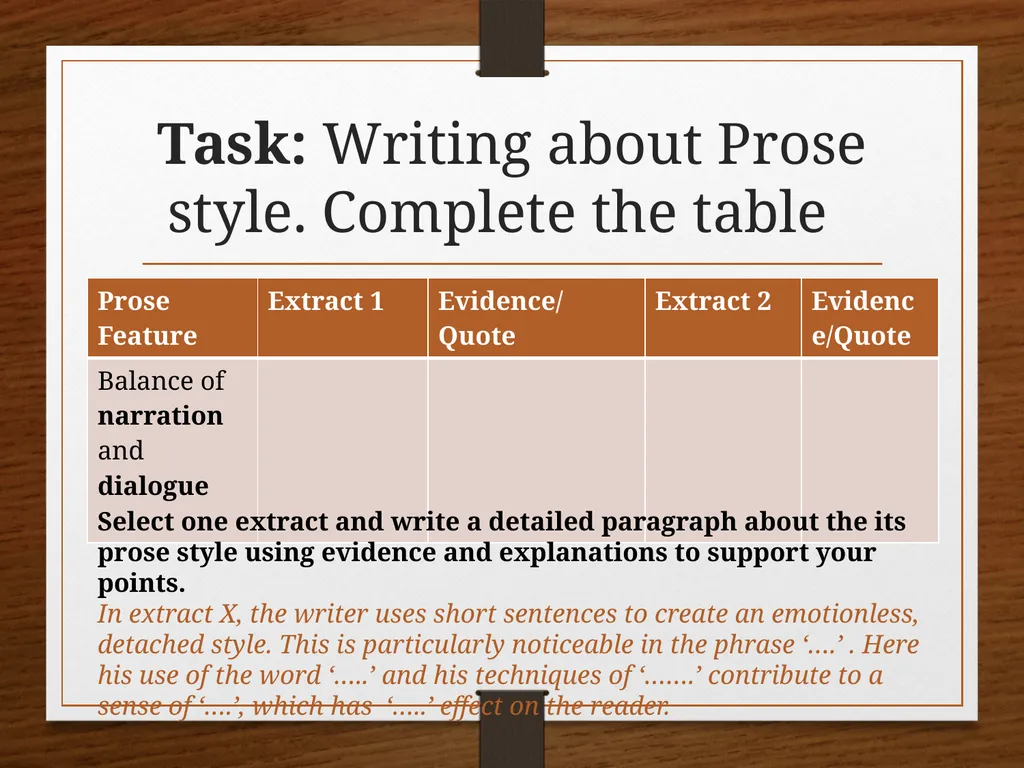
Task: Writing about Prose style. Complete the table Select one extract and write a detailed paragraph about the its prose style using evidence and explanations to support your points.
In extract X, the writer uses short sentences to create an emotionless, detached style. This is particularly noticeable in the phrase ‘….’ . Here his use of the word ‘…..’ and his techniques of ‘…….’ contribute to a sense of ‘….’, which has ‘…..’ effect on the reader.<br>
08
Plenary Read your partner’s paragraph and give feedback
Take a moment to make corrections to your paragraph
Share your amended paragraphs with the class.<br>