
Introduction to the Right to Information Act


Description: Introduction to the Right to Information Act Pralhad V. Kachare is a member of the Maharashtra State Civil Services, working in the cadre of Additional Collector. He has worked in various administrative capacities in Maharashtra. He was the
Related Topics
Download Presentation
"Introduction to the Right to Information Act" is the property of its rightful owner. Permission is granted to download and print the materials on this website for personal, non-commercial use only, and to display it on your personal computer provided you do not modify the materials and that you retain all copyright notices contained in the materials. By downloading content from our website, you accept the terms of this agreement.
Presentation Transcript
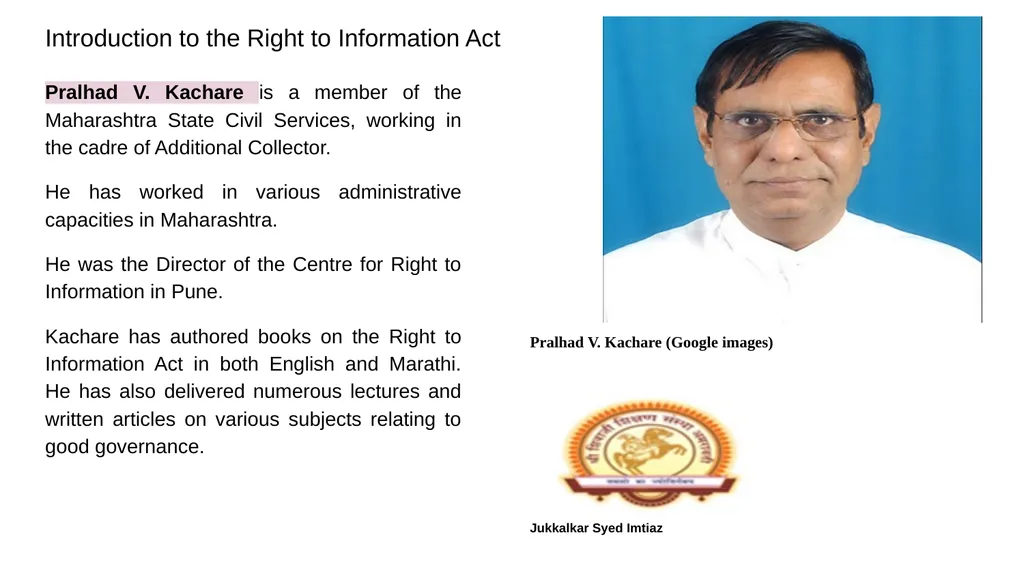
slide1. Introduction to the Right to Information Act Pralhad V. Kachare is a member of the Maharashtra State Civil Services, working in the cadre of Additional Collector.
He has worked in various administrative capacities in Maharashtra.
He was the Director of the Centre for Right to Information in Pune.
Kachare has authored books on the Right to Information Act in both English and Marathi. He has also delivered numerous lectures and written articles on various subjects relating to good governance. Pralhad V. Kachare (Google images)
Jukkalkar Syed Imtiaz<br>
slide2. The Indian Government’s website on the subject succinctly explains this right:
“The basic object of the Right to Information Act is to empower the citizens, promote transparency and accountability in the working of the government…”
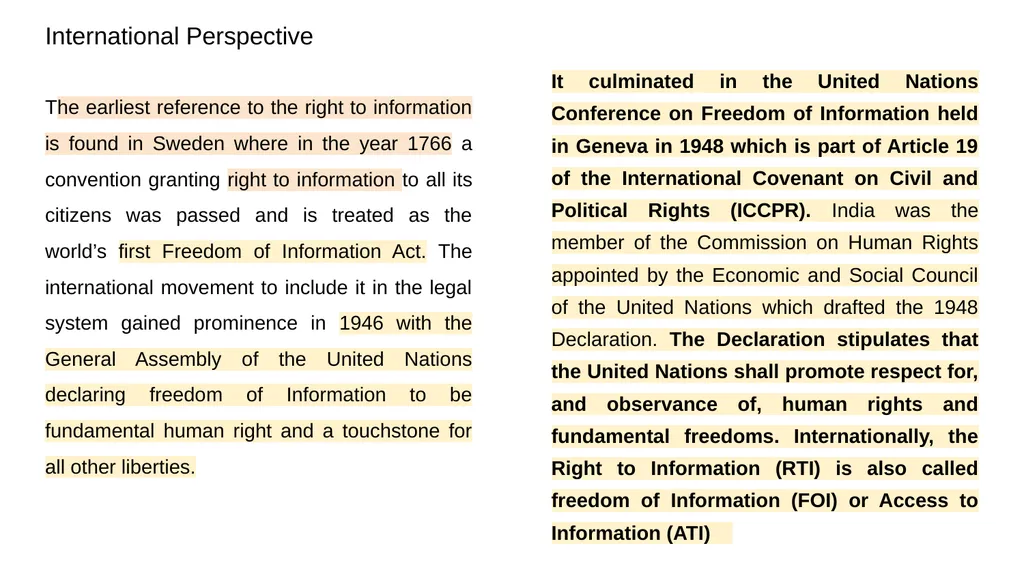
An informed citizen will be better equipped to keep necessary vigil on the instruments of government and make the government more accountable to the governed. The Act has created a practical regime through which the citizens of the country may have access to information under the control of public authorities. Google images<br>
slide3. International Perspective The earliest reference to the right to information is found in Sweden where in the year 1766 a convention granting right to information to all its citizens was passed and is treated as the world’s first Freedom of Information Act. The international movement to include it in the legal system gained prominence in 1946 with the General Assembly of the United Nations declaring freedom of Information to be fundamental human right and a touchstone for all other liberties. It culminated in the United Nations Conference on Freedom of Information held in Geneva in 1948 which is part of Article 19 of the International Covenant on Civil and Political Rights (ICCPR). India was the member of the Commission on Human Rights appointed by the Economic and Social Council of the United Nations which drafted the 1948 Declaration. The Declaration stipulates that the United Nations shall promote respect for, and observance of, human rights and fundamental freedoms. Internationally, the Right to Information (RTI) is also called freedom of Information (FOI) or Access to Information (ATI)<br>
slide4. National History The right to information is a cherished right. There is no express mention of right to information in the constitution of India. However, in a number of cases the Supreme Court of India has ruled that ‘right to information’ flows from and is implied in Article 19 of the ‘Constitution of India’, being a fundamental right ‘freedom of Speech and Expression’ and that ‘disclosure of information as regards the functioning of the government must be the rule and secrecy and exception. It was further promoted and elevated as the lifeblood of democracy. Free flow of information and ideas is essential for the health of democracy as oxygen is required for human existence. Along with judicial pronouncements, there was a long struggle causing the right to information act to be legislated. The Right to Information campaign in India begun with the Mazdoor Kisan Shakti Sanghatan (MKSS) movement to bring about transparency in village accounts via the demand for minimum vegas in rural India. Host entries in muster rolls where a sign of rampant corruption in the system, which promoted MKSS to demand official information recorded in government files. The movement soon spread across India. From a very modest beginning in the villages of Rajestan, the success of MKSS has been a source of inspiration for all in India and throughout the world. It lead to the genesis of a broder discourage on the right to information in India.<br>
slide5. Right to Information Act:
The RTI act was enacted on 15th June 2005 to ‘provide for setting out the practical regime of Right to Information for citizens to secure access to information under the control of Public Authorities, in order to promote transparency and accountability in the working of every public authority, the Constitution of a central information commission and state information commission and for matters connected therewith or incidental thereto’. The preamble to the act declares the object to be achieved by the RTI act which came into force on 12th October 2005.<br>
slide6. Objectives:
Important objectives are outlined in the preamble which seeks to bring about a balance between two conflicting interests, as harmony between them is essential for preserving democracy.
One is to bring about transparency and accountability by providing access to information under the control of public authorities,,and make our democracy work for the people in a real sense. It goes without saying that an informed citizen is better equipped to keep necessary vigil on the instruments of governance and make the government more accountable to the governed. The act is a big step towards making citizens informed about the activities of the government. In reality it is to promote participatory democracy.
The other is to ensure that the revelation of information, in actual practice, does not conflict with other public interests which include efficient operation of the governments, optimum use of limited fiscal resources and preservation of confidentiality of sensitive information. The preamble to the act specifically states that the object of the act is to harmonize these two conflicting interests.<br>
slide7. Coverage
This act is applicable all over India except Jammu and Kashmir.
The Right to Information Act is a small act containing six chapters and 31 sections. The coverage of this act is wider and it includes any authority or body or institution of self government established or constituted by or under the constitution, or by notification issued or order made by the central government or state government. The bodies owned, controlled or substantially financed by the central government or state government and non-government organisation substantially financed by the central or a state government also fall within the definition of Public Authority. The financing of the body or the NGO by the government may be direct or indirect.
All these institutions are known as public authorities. Obligation of Public Authorities
The act also lays great emphasis on ‘proactive disclosure’ so as to minimise the queries or request for access to information.
‘Proactive disclosure’ means publishing and providing maximum information sue moto i.e.without citizens seeking or demanding it.
All Public Authorities are required to disseminate as widely as possible the information as proactive disclosure seeks a democratization of publicly held information and knowledge resources which is critical for people’s empowerment, especially to realize the entitlements as well as to augment opportunities for enhancing the options for improving the quality of life.<br>
slide8. Public Authorities are also required to designate Public Information Officers (PIO), as many as required in all other offices and and administrative units to receive and deal with requests for obtaining information. To facilitate delivery of information on requests all Public Authorities are required to maintain, update and computerized their records.<br>
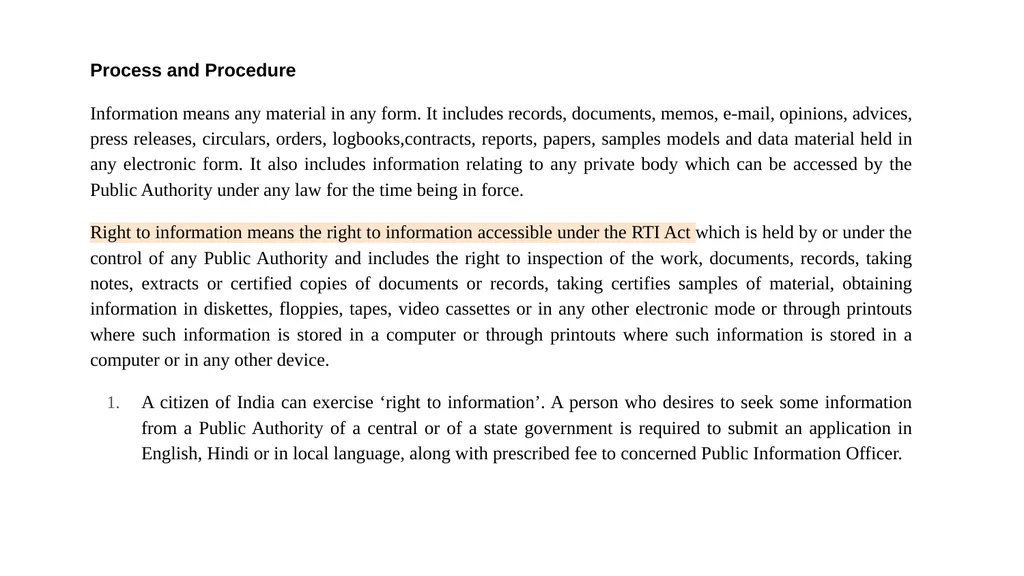
slide9. Process and Procedure
Information means any material in any form. It includes records, documents, memos, e-mail, opinions, advices, press releases, circulars, orders, logbooks,contracts, reports, papers, samples models and data material held in any electronic form. It also includes information relating to any private body which can be accessed by the Public Authority under any law for the time being in force.
Right to information means the right to information accessible under the RTI Act which is held by or under the control of any Public Authority and includes the right to inspection of the work, documents, records, taking notes, extracts or certified copies of documents or records, taking certifies samples of material, obtaining information in diskettes, floppies, tapes, video cassettes or in any other electronic mode or through printouts where such information is stored in a computer or through printouts where such information is stored in a computer or in any other device.
A citizen of India can exercise ‘right to information’. A person who desires to seek some information from a Public Authority of a central or of a state government is required to submit an application in English, Hindi or in local language, along with prescribed fee to concerned Public Information Officer.<br>
slide10. 2. If the applicant belongs to below poverty line (BPL) category, he is not required to pay any fee or cost of information. There is prescribed format of application for seeking information. The application can be made on plain paper or electronically. The applicant shall not be required to give any reason for requesting the information or any personal details except those that may be necessary for contacting him.
It is the duty of the Public Information Officer to provide the required information which is available, existing and under his control to the citizens within a prescribed period of thirty days for normal information, and within 48 hours in case of information relating to life and liberty after getting the necessary prescribed cost of information.<br>
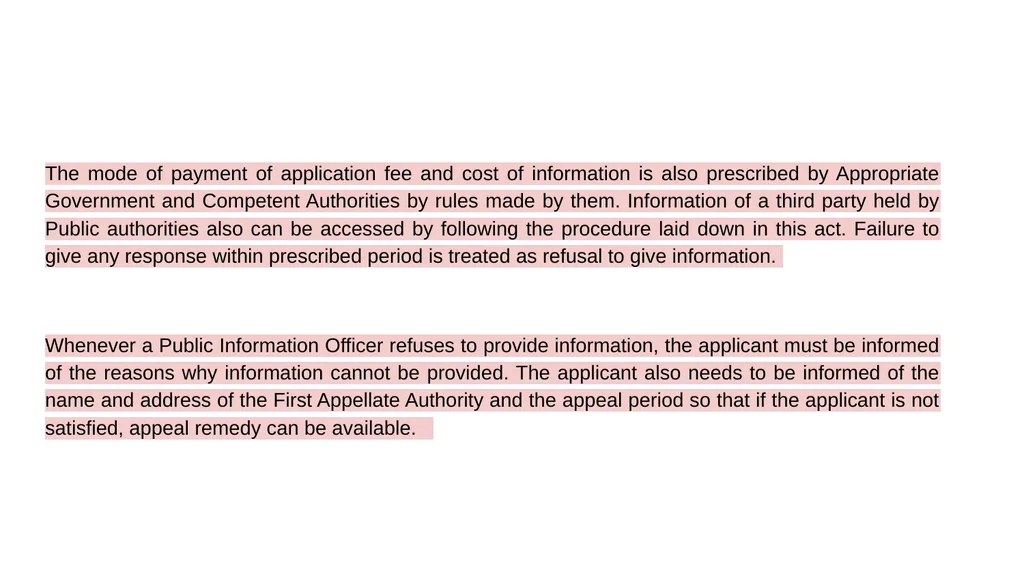
slide11. The mode of payment of application fee and cost of information is also prescribed by Appropriate Government and Competent Authorities by rules made by them. Information of a third party held by Public authorities also can be accessed by following the procedure laid down in this act. Failure to give any response within prescribed period is treated as refusal to give information.
Whenever a Public Information Officer refuses to provide information, the applicant must be informed of the reasons why information cannot be provided. The applicant also needs to be informed of the name and address of the First Appellate Authority and the appeal period so that if the applicant is not satisfied, appeal remedy can be available.<br>
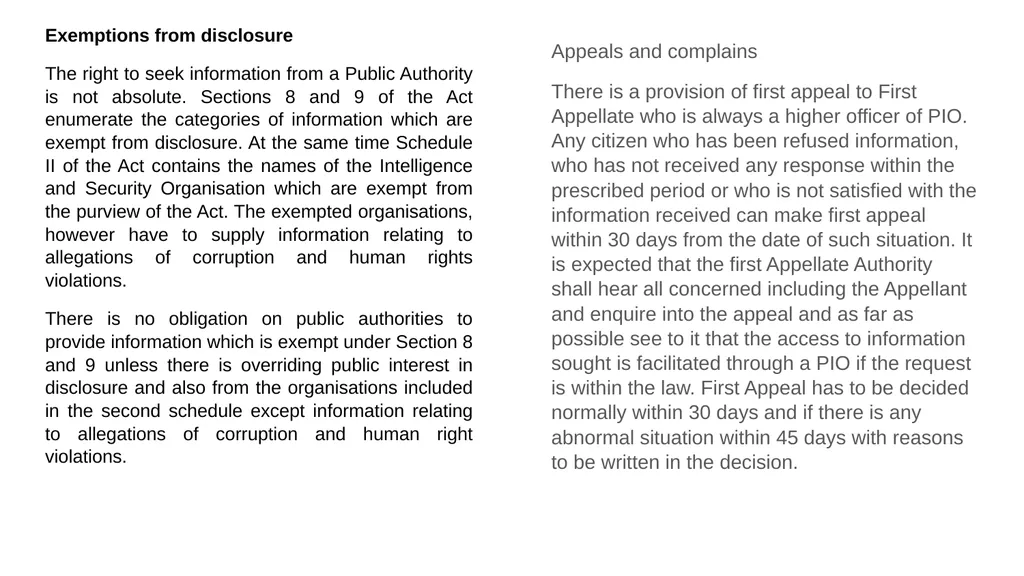
slide12. Exemptions from disclosure
The right to seek information from a Public Authority is not absolute. Sections 8 and 9 of the Act enumerate the categories of information which are exempt from disclosure. At the same time Schedule II of the Act contains the names of the Intelligence and Security Organisation which are exempt from the purview of the Act. The exempted organisations, however have to supply information relating to allegations of corruption and human rights violations.
There is no obligation on public authorities to provide information which is exempt under Section 8 and 9 unless there is overriding public interest in disclosure and also from the organisations included in the second schedule except information relating to allegations of corruption and human right violations. Appeals and complains
There is a provision of first appeal to First Appellate who is always a higher officer of PIO. Any citizen who has been refused information, who has not received any response within the prescribed period or who is not satisfied with the information received can make first appeal within 30 days from the date of such situation. It is expected that the first Appellate Authority shall hear all concerned including the Appellant and enquire into the appeal and as far as possible see to it that the access to information sought is facilitated through a PIO if the request is within the law. First Appeal has to be decided normally within 30 days and if there is any abnormal situation within 45 days with reasons to be written in the decision.<br>
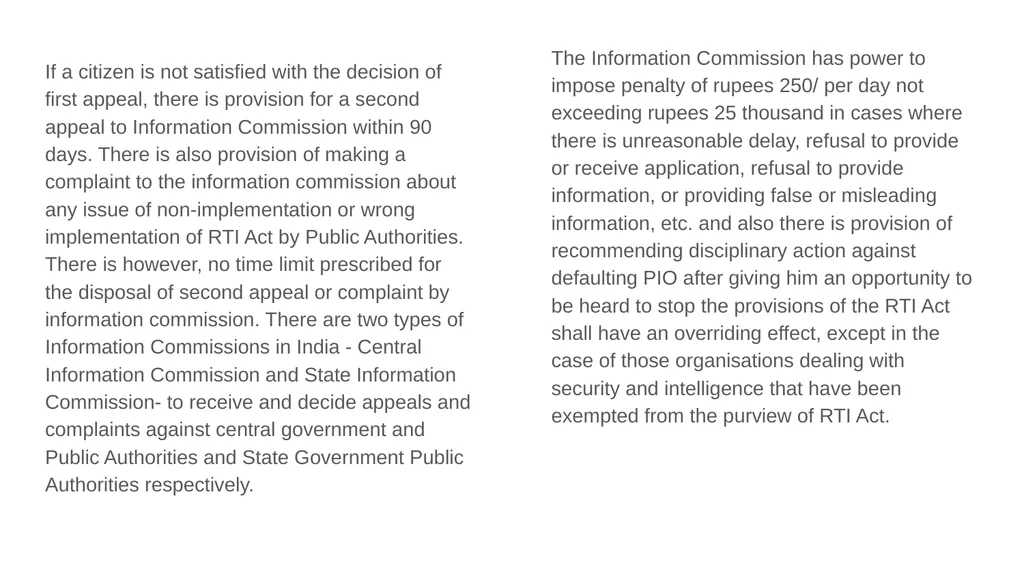
slide13. If a citizen is not satisfied with the decision of first appeal, there is provision for a second appeal to Information Commission within 90 days. There is also provision of making a complaint to the information commission about any issue of non-implementation or wrong implementation of RTI Act by Public Authorities. There is however, no time limit prescribed for the disposal of second appeal or complaint by information commission. There are two types of Information Commissions in India - Central Information Commission and State Information Commission- to receive and decide appeals and complaints against central government and Public Authorities and State Government Public Authorities respectively. The Information Commission has power to impose penalty of rupees 250/ per day not exceeding rupees 25 thousand in cases where there is unreasonable delay, refusal to provide or receive application, refusal to provide information, or providing false or misleading information, etc. and also there is provision of recommending disciplinary action against defaulting PIO after giving him an opportunity to be heard to stop the provisions of the RTI Act shall have an overriding effect, except in the case of those organisations dealing with security and intelligence that have been exempted from the purview of RTI Act.<br>
He has worked in various administrative capacities in Maharashtra.
He was the Director of the Centre for Right to Information in Pune.
Kachare has authored books on the Right to Information Act in both English and Marathi. He has also delivered numerous lectures and written articles on various subjects relating to good governance. Pralhad V. Kachare (Google images)
Jukkalkar Syed Imtiaz<br>
slide2. The Indian Government’s website on the subject succinctly explains this right:
“The basic object of the Right to Information Act is to empower the citizens, promote transparency and accountability in the working of the government…”
An informed citizen will be better equipped to keep necessary vigil on the instruments of government and make the government more accountable to the governed. The Act has created a practical regime through which the citizens of the country may have access to information under the control of public authorities. Google images<br>
slide3. International Perspective The earliest reference to the right to information is found in Sweden where in the year 1766 a convention granting right to information to all its citizens was passed and is treated as the world’s first Freedom of Information Act. The international movement to include it in the legal system gained prominence in 1946 with the General Assembly of the United Nations declaring freedom of Information to be fundamental human right and a touchstone for all other liberties. It culminated in the United Nations Conference on Freedom of Information held in Geneva in 1948 which is part of Article 19 of the International Covenant on Civil and Political Rights (ICCPR). India was the member of the Commission on Human Rights appointed by the Economic and Social Council of the United Nations which drafted the 1948 Declaration. The Declaration stipulates that the United Nations shall promote respect for, and observance of, human rights and fundamental freedoms. Internationally, the Right to Information (RTI) is also called freedom of Information (FOI) or Access to Information (ATI)<br>
slide4. National History The right to information is a cherished right. There is no express mention of right to information in the constitution of India. However, in a number of cases the Supreme Court of India has ruled that ‘right to information’ flows from and is implied in Article 19 of the ‘Constitution of India’, being a fundamental right ‘freedom of Speech and Expression’ and that ‘disclosure of information as regards the functioning of the government must be the rule and secrecy and exception. It was further promoted and elevated as the lifeblood of democracy. Free flow of information and ideas is essential for the health of democracy as oxygen is required for human existence. Along with judicial pronouncements, there was a long struggle causing the right to information act to be legislated. The Right to Information campaign in India begun with the Mazdoor Kisan Shakti Sanghatan (MKSS) movement to bring about transparency in village accounts via the demand for minimum vegas in rural India. Host entries in muster rolls where a sign of rampant corruption in the system, which promoted MKSS to demand official information recorded in government files. The movement soon spread across India. From a very modest beginning in the villages of Rajestan, the success of MKSS has been a source of inspiration for all in India and throughout the world. It lead to the genesis of a broder discourage on the right to information in India.<br>
slide5. Right to Information Act:
The RTI act was enacted on 15th June 2005 to ‘provide for setting out the practical regime of Right to Information for citizens to secure access to information under the control of Public Authorities, in order to promote transparency and accountability in the working of every public authority, the Constitution of a central information commission and state information commission and for matters connected therewith or incidental thereto’. The preamble to the act declares the object to be achieved by the RTI act which came into force on 12th October 2005.<br>
slide6. Objectives:
Important objectives are outlined in the preamble which seeks to bring about a balance between two conflicting interests, as harmony between them is essential for preserving democracy.
One is to bring about transparency and accountability by providing access to information under the control of public authorities,,and make our democracy work for the people in a real sense. It goes without saying that an informed citizen is better equipped to keep necessary vigil on the instruments of governance and make the government more accountable to the governed. The act is a big step towards making citizens informed about the activities of the government. In reality it is to promote participatory democracy.
The other is to ensure that the revelation of information, in actual practice, does not conflict with other public interests which include efficient operation of the governments, optimum use of limited fiscal resources and preservation of confidentiality of sensitive information. The preamble to the act specifically states that the object of the act is to harmonize these two conflicting interests.<br>
slide7. Coverage
This act is applicable all over India except Jammu and Kashmir.
The Right to Information Act is a small act containing six chapters and 31 sections. The coverage of this act is wider and it includes any authority or body or institution of self government established or constituted by or under the constitution, or by notification issued or order made by the central government or state government. The bodies owned, controlled or substantially financed by the central government or state government and non-government organisation substantially financed by the central or a state government also fall within the definition of Public Authority. The financing of the body or the NGO by the government may be direct or indirect.
All these institutions are known as public authorities. Obligation of Public Authorities
The act also lays great emphasis on ‘proactive disclosure’ so as to minimise the queries or request for access to information.
‘Proactive disclosure’ means publishing and providing maximum information sue moto i.e.without citizens seeking or demanding it.
All Public Authorities are required to disseminate as widely as possible the information as proactive disclosure seeks a democratization of publicly held information and knowledge resources which is critical for people’s empowerment, especially to realize the entitlements as well as to augment opportunities for enhancing the options for improving the quality of life.<br>
slide8. Public Authorities are also required to designate Public Information Officers (PIO), as many as required in all other offices and and administrative units to receive and deal with requests for obtaining information. To facilitate delivery of information on requests all Public Authorities are required to maintain, update and computerized their records.<br>
slide9. Process and Procedure
Information means any material in any form. It includes records, documents, memos, e-mail, opinions, advices, press releases, circulars, orders, logbooks,contracts, reports, papers, samples models and data material held in any electronic form. It also includes information relating to any private body which can be accessed by the Public Authority under any law for the time being in force.
Right to information means the right to information accessible under the RTI Act which is held by or under the control of any Public Authority and includes the right to inspection of the work, documents, records, taking notes, extracts or certified copies of documents or records, taking certifies samples of material, obtaining information in diskettes, floppies, tapes, video cassettes or in any other electronic mode or through printouts where such information is stored in a computer or through printouts where such information is stored in a computer or in any other device.
A citizen of India can exercise ‘right to information’. A person who desires to seek some information from a Public Authority of a central or of a state government is required to submit an application in English, Hindi or in local language, along with prescribed fee to concerned Public Information Officer.<br>
slide10. 2. If the applicant belongs to below poverty line (BPL) category, he is not required to pay any fee or cost of information. There is prescribed format of application for seeking information. The application can be made on plain paper or electronically. The applicant shall not be required to give any reason for requesting the information or any personal details except those that may be necessary for contacting him.
It is the duty of the Public Information Officer to provide the required information which is available, existing and under his control to the citizens within a prescribed period of thirty days for normal information, and within 48 hours in case of information relating to life and liberty after getting the necessary prescribed cost of information.<br>
slide11. The mode of payment of application fee and cost of information is also prescribed by Appropriate Government and Competent Authorities by rules made by them. Information of a third party held by Public authorities also can be accessed by following the procedure laid down in this act. Failure to give any response within prescribed period is treated as refusal to give information.
Whenever a Public Information Officer refuses to provide information, the applicant must be informed of the reasons why information cannot be provided. The applicant also needs to be informed of the name and address of the First Appellate Authority and the appeal period so that if the applicant is not satisfied, appeal remedy can be available.<br>
slide12. Exemptions from disclosure
The right to seek information from a Public Authority is not absolute. Sections 8 and 9 of the Act enumerate the categories of information which are exempt from disclosure. At the same time Schedule II of the Act contains the names of the Intelligence and Security Organisation which are exempt from the purview of the Act. The exempted organisations, however have to supply information relating to allegations of corruption and human rights violations.
There is no obligation on public authorities to provide information which is exempt under Section 8 and 9 unless there is overriding public interest in disclosure and also from the organisations included in the second schedule except information relating to allegations of corruption and human right violations. Appeals and complains
There is a provision of first appeal to First Appellate who is always a higher officer of PIO. Any citizen who has been refused information, who has not received any response within the prescribed period or who is not satisfied with the information received can make first appeal within 30 days from the date of such situation. It is expected that the first Appellate Authority shall hear all concerned including the Appellant and enquire into the appeal and as far as possible see to it that the access to information sought is facilitated through a PIO if the request is within the law. First Appeal has to be decided normally within 30 days and if there is any abnormal situation within 45 days with reasons to be written in the decision.<br>
slide13. If a citizen is not satisfied with the decision of first appeal, there is provision for a second appeal to Information Commission within 90 days. There is also provision of making a complaint to the information commission about any issue of non-implementation or wrong implementation of RTI Act by Public Authorities. There is however, no time limit prescribed for the disposal of second appeal or complaint by information commission. There are two types of Information Commissions in India - Central Information Commission and State Information Commission- to receive and decide appeals and complaints against central government and Public Authorities and State Government Public Authorities respectively. The Information Commission has power to impose penalty of rupees 250/ per day not exceeding rupees 25 thousand in cases where there is unreasonable delay, refusal to provide or receive application, refusal to provide information, or providing false or misleading information, etc. and also there is provision of recommending disciplinary action against defaulting PIO after giving him an opportunity to be heard to stop the provisions of the RTI Act shall have an overriding effect, except in the case of those organisations dealing with security and intelligence that have been exempted from the purview of RTI Act.<br>