
Introduction to Wheelchairs and Seating Spinal

Description: Introduction to Wheelchairs and Seating Spinal Cord Medicine Education Basic Parts of a Wheelchair A frame or a power base A seat and back support Cushion Armrests Leg rests footplates WheelsTires Brakes Motor and electronics
Related Topics
Download Presentation
"Introduction to Wheelchairs and Seating Spinal" is the property of its rightful owner. Permission is granted to download and print the materials on this website for personal, non-commercial use only, and to display it on your personal computer provided you do not modify the materials and that you retain all copyright notices contained in the materials. By downloading content from our website, you accept the terms of this agreement.
Presentation Transcript
slide1. Introduction to Wheelchairs and Seating Spinal Cord Medicine Education<br>
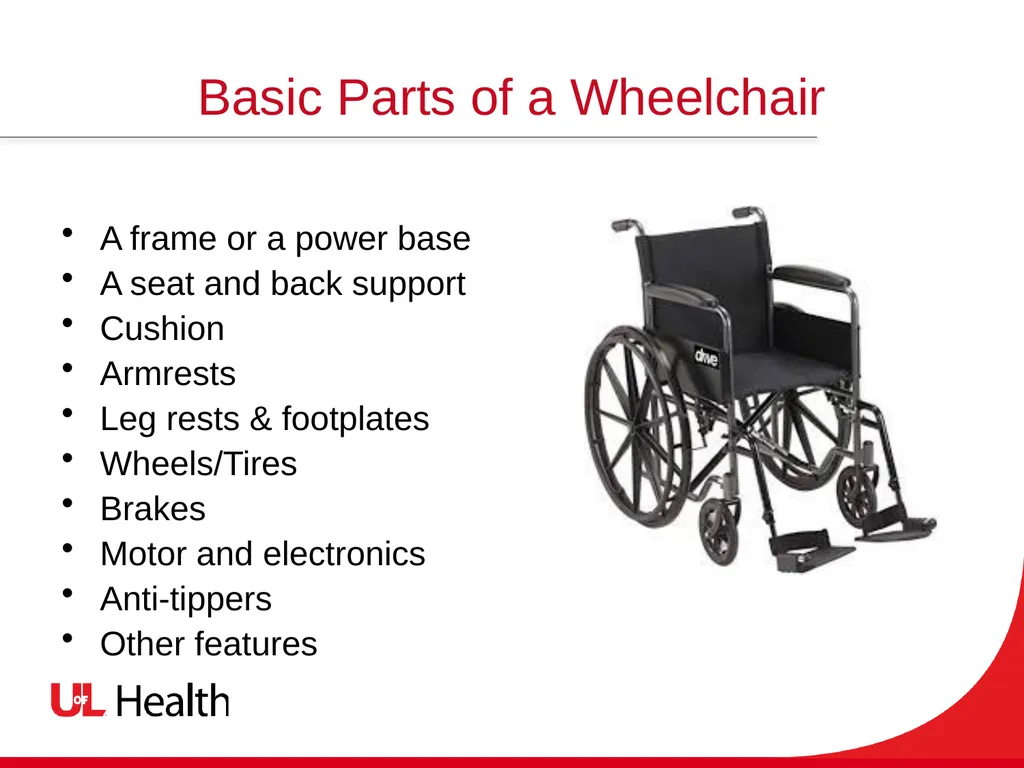
slide2. Basic Parts of a Wheelchair A frame or a power base
A seat and back support
Cushion
Armrests
Leg rests & footplates
Wheels/Tires
Brakes
Motor and electronics
Anti-tippers
Other features<br>
slide3. Types of Manual Wheelchairs Standard –temporary use ONLY
Few sizes, no adjustability
Lightweight –for temporary use
Few sizes, no adjustability of axle, no support for posture
Ultra Lightweight
Adjustable axle position
Lightest weight possible
Allow custom fit & posture support
Recommended for person with a spinal cord injury<br>
slide4. Two Types of Ultralight Frames Folding or Cross Frame
Rigid or Z Frame<br>
slide5. Why an Ultralight? Made to your body measurements
Weight is less than ½ of a standard wheelchair
Axle position is moveable
Better position for preventing injury
Easier to push and less effort
Moving requires fewer pushes
Very strong… lasts 3 times longer than standard
Designed for all day, every day use<br>
slide6. PVA Guide: Shoulder Preservation 10 years of research shows postpone or avoid repetitive strain injury to shoulder:
Best alignment for shoulder, wrist & elbows
Lightest weight wheelchair offer less resistance and require less force to push
Fewer push strokes
Also… use good transfer techniques to avoid straining shoulder ligaments and tendons<br>
slide7. Features: Armrests Tubular, swing away
Rotate to the rear
Decrease chair width
Easy access to pushrims
T-shaped, quick release
Full or desk length
Height adjustable
Flip back or easy remove for transfers
Built in side guards<br>
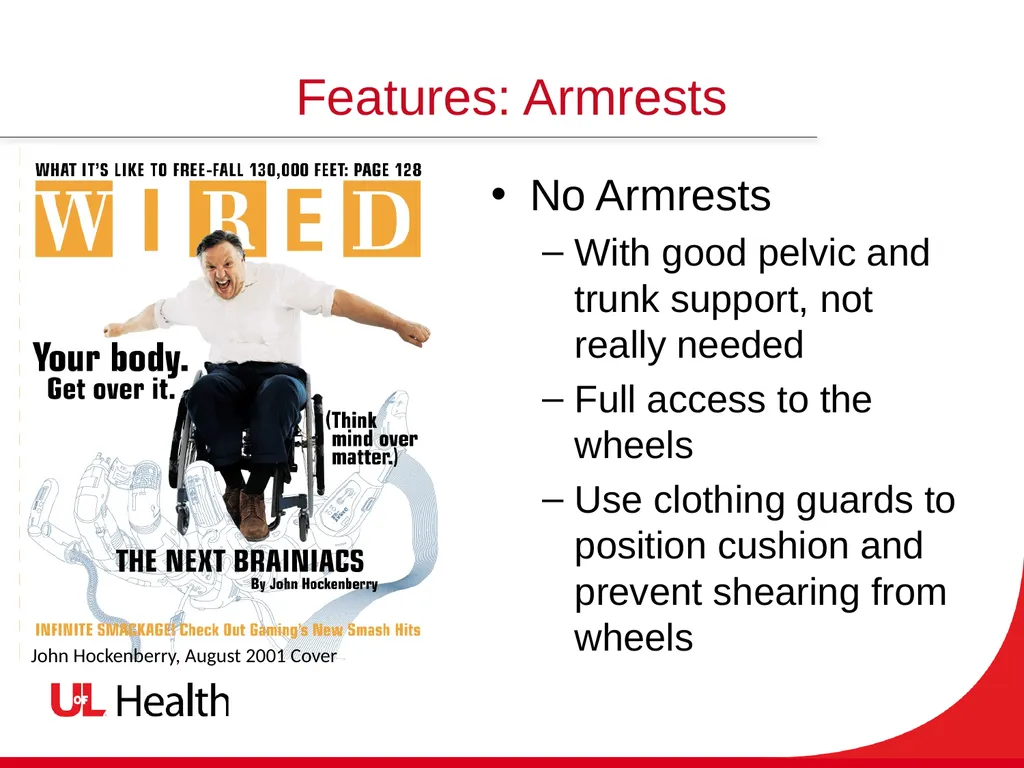
slide8. Features: Armrests No Armrests
With good pelvic and trunk support, not really needed
Full access to the wheels
Use clothing guards to position cushion and prevent shearing from wheels John Hockenberry, August 2001 Cover<br>
slide9. Features: Leg Rests Swing Away or Removable
Swing in or swing out
Can get out of way for transfers
Drop-in vs. pegs
Offer varying amounts of knee angle
Elevating
Not effective except when there is a knee problem
Heavy and hard to manage<br>
slide10. Features: Leg Rests Stationary or fixed
Preferred to shorten wheel base & control leg position
May or may not interfere with transfers
Complicate stand pivot transfers
Tapered or straight
Controls foot position
Makes it easier to maneuver in small spaces<br>
slide11. Features: Foam Cusions Foam
Inexpensive
Wears out quickly & needs to be replaced often
Amount of contour can affect pressure distribution
Can shape as desired and make use of various densities
Good transfer surface depending on cover
Doesn’t deflate or leak
Holds moisture & heat next to skin
Harder to clean<br>
slide12. Features: Gel/Viscous Fluid Cushions Gel or Viscous Fluid
Gel shapes to body for good pressure distribution and immersion of bony prominences
Deeper gel under sitting bones
Relatively easy to clean
Gel can migrate causing cushion to “bottom out”
Cools the skin at first but can hold heat after sitting for a while
Gel can freeze in cold or hold heat
Heavier than foam
Can be combined with foam cushion
Gel clumps or hardens with age & needs to be replaced<br>
slide13. Features: Air Cushions Air ROHO & Others
Interconnected air bladders allow cushion to match shape of buttocks
Good air circulation and evaporation
Can be submerged in water to clean
Proper inflation is key to good pressure distribution. ½” to 1” clearance
Will leak if punctured or hot ashes are dropped
Less stability
Transfers are more difficult<br>
slide14. Features: Orthotic Cushions Orthotic
Customized to the individual to prevent or correct collapse
Excellent stability and control of pelvic position
Off-loads pressure on ITs and moves it to tolerant areas.
Excellent air circulation and evaporation
Easy to clean
Transfers can require more strength and pelvis needs to stay in position. Doesn’t work with standing wheelchairs and only limited recline<br>
slide15. Features: Back Supports Sling
Standard
Encourages slumping and kyphotic posture
Adjustable tension
Changes support to improve seated posture
Easily adjusted
Back rest height
Tall increases support but limits arm and trunk movement
Lower better for arm and trunk movement. Does not interfere with scapular movement.<br>
slide16. Features: Back Support/Rigid Contoured Multiple sizes & shapes
Quick release or fixed hardware
Improved support for the lumbar curve and can have lateral support
Encourages upright posture
Doesn’t interfere with push stroke if low enough
A firm surface to push against when propelling<br>
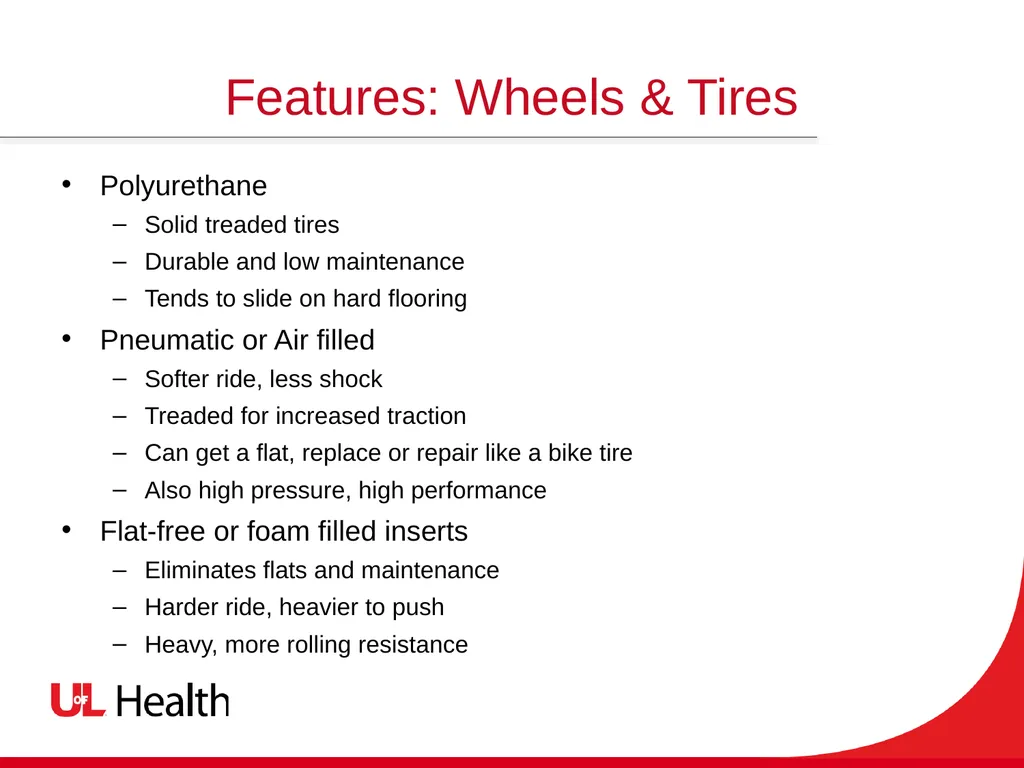
slide17. Features: Wheels & Tires Polyurethane
Solid treaded tires
Durable and low maintenance
Tends to slide on hard flooring
Pneumatic or Air filled
Softer ride, less shock
Treaded for increased traction
Can get a flat, replace or repair like a bike tire
Also high pressure, high performance
Flat-free or foam filled inserts
Eliminates flats and maintenance
Harder ride, heavier to push
Heavy, more rolling resistance<br>
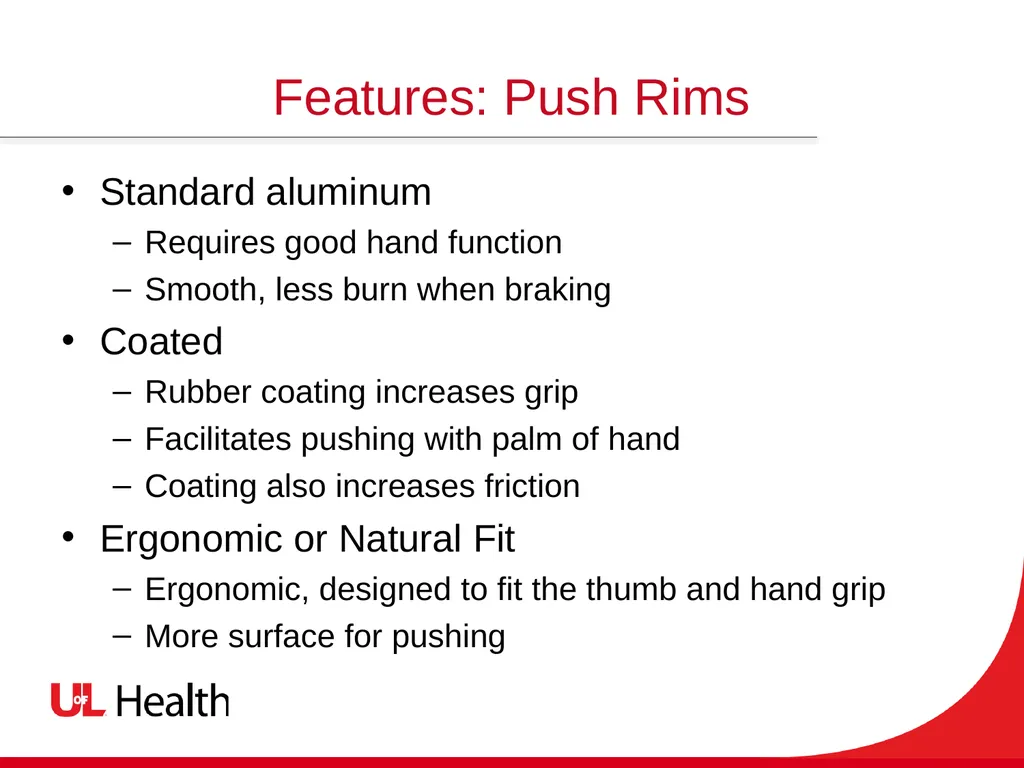
slide18. Features: Push Rims Standard aluminum
Requires good hand function
Smooth, less burn when braking
Coated
Rubber coating increases grip
Facilitates pushing with palm of hand
Coating also increases friction
Ergonomic or Natural Fit
Ergonomic, designed to fit the thumb and hand grip
More surface for pushing<br>
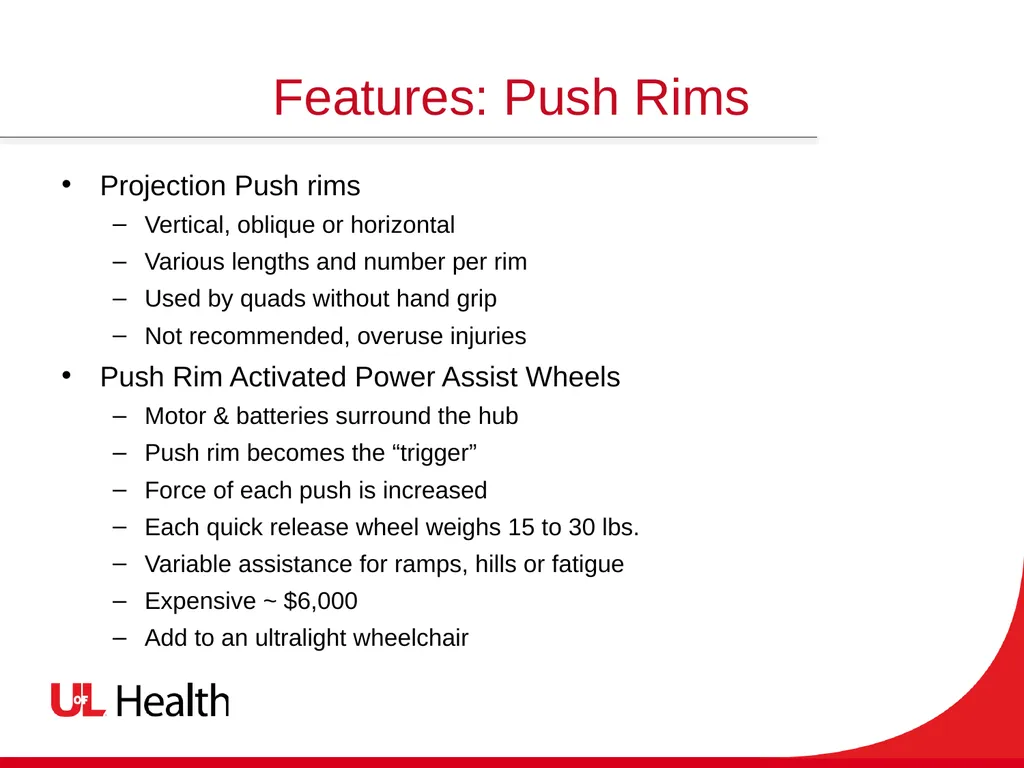
slide19. Features: Push Rims Projection Push rims
Vertical, oblique or horizontal
Various lengths and number per rim
Used by quads without hand grip
Not recommended, overuse injuries
Push Rim Activated Power Assist Wheels
Motor & batteries surround the hub
Push rim becomes the “trigger”
Force of each push is increased
Each quick release wheel weighs 15 to 30 lbs.
Variable assistance for ramps, hills or fatigue
Expensive ~ $6,000
Add to an ultralight wheelchair<br>
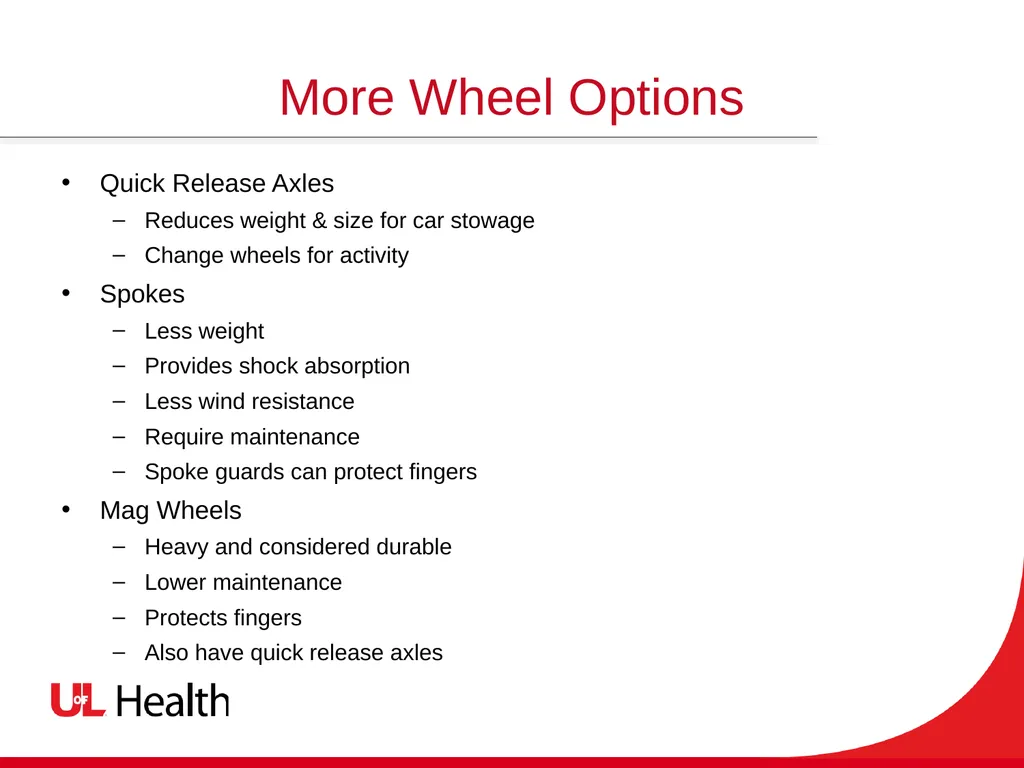
slide20. More Wheel Options Quick Release Axles
Reduces weight & size for car stowage
Change wheels for activity
Spokes
Less weight
Provides shock absorption
Less wind resistance
Require maintenance
Spoke guards can protect fingers
Mag Wheels
Heavy and considered durable
Lower maintenance
Protects fingers
Also have quick release axles<br>
slide21. Pressure Relief Please take this time to pause the presentation and complete pressure relief.<br>
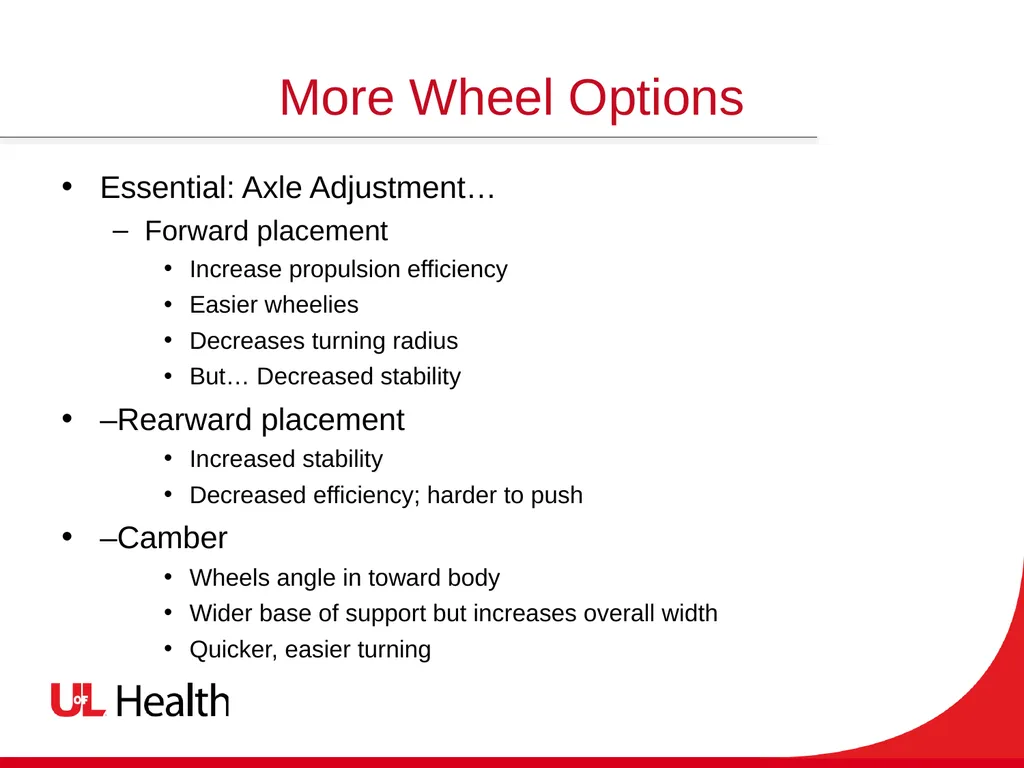
slide22. More Wheel Options Essential: Axle Adjustment…
Forward placement
Increase propulsion efficiency
Easier wheelies
Decreases turning radius
But… Decreased stability
–Rearward placement
Increased stability
Decreased efficiency; harder to push
–Camber
Wheels angle in toward body
Wider base of support but increases overall width
Quicker, easier turning<br>
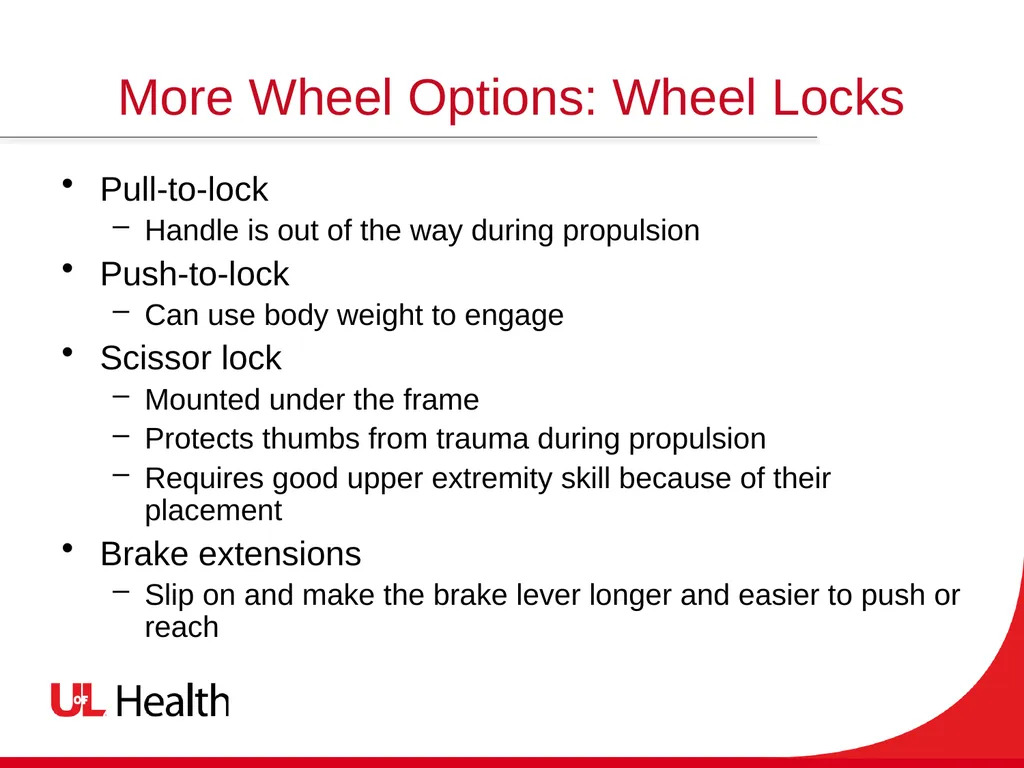
slide23. More Wheel Options: Wheel Locks Pull-to-lock
Handle is out of the way during propulsion
Push-to-lock
Can use body weight to engage
Scissor lock
Mounted under the frame
Protects thumbs from trauma during propulsion
Requires good upper extremity skill because of their placement
Brake extensions
Slip on and make the brake lever longer and easier to push or reach<br>
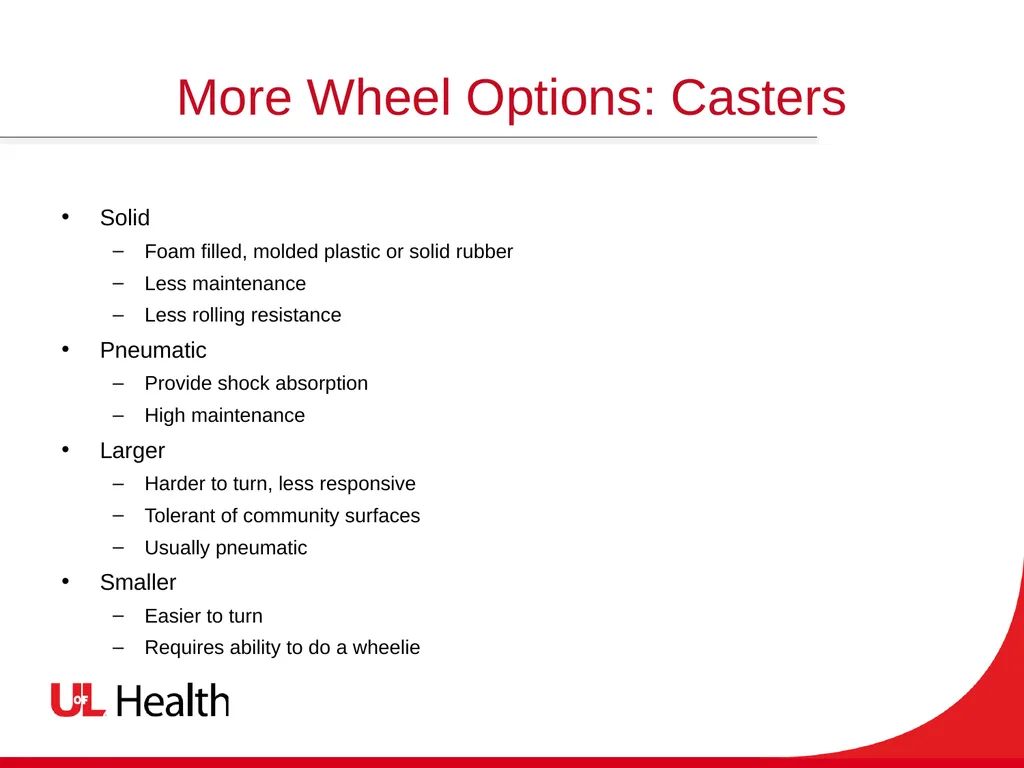
slide24. More Wheel Options: Casters Solid
Foam filled, molded plastic or solid rubber
Less maintenance
Less rolling resistance
Pneumatic
Provide shock absorption
High maintenance
Larger
Harder to turn, less responsive
Tolerant of community surfaces
Usually pneumatic
Smaller
Easier to turn
Requires ability to do a wheelie<br>
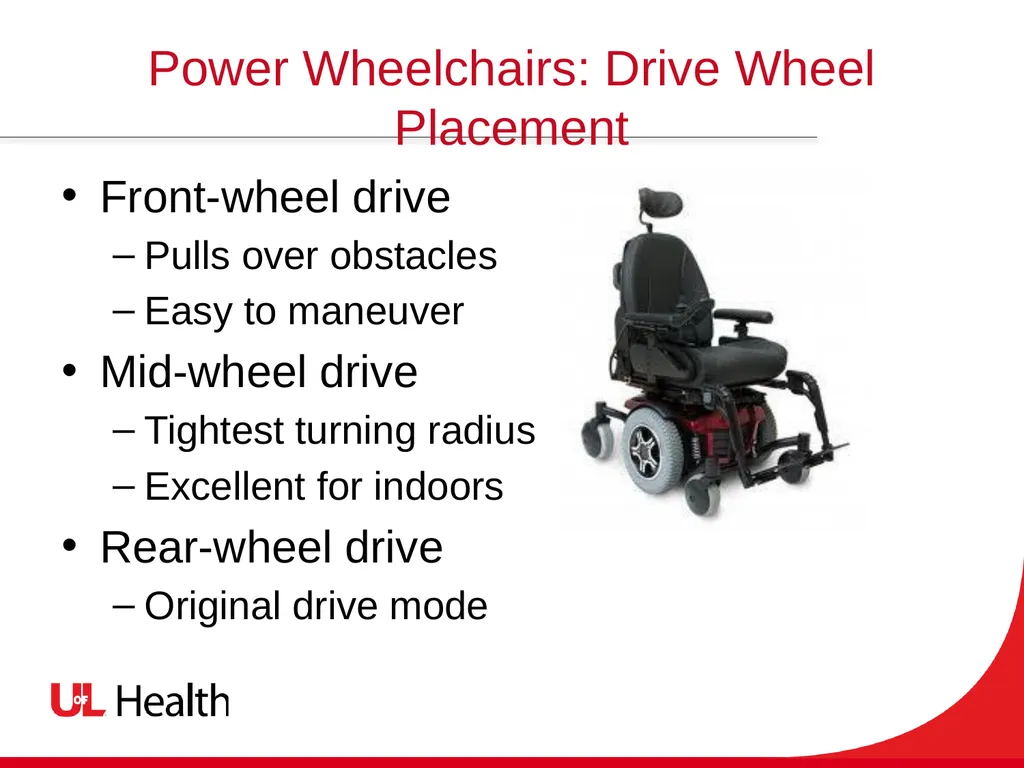
slide25. Power Wheelchairs: Drive Wheel Placement Front-wheel drive
Pulls over obstacles
Easy to maneuver
Mid-wheel drive
Tightest turning radius
Excellent for indoors
Rear-wheel drive
Original drive mode<br>
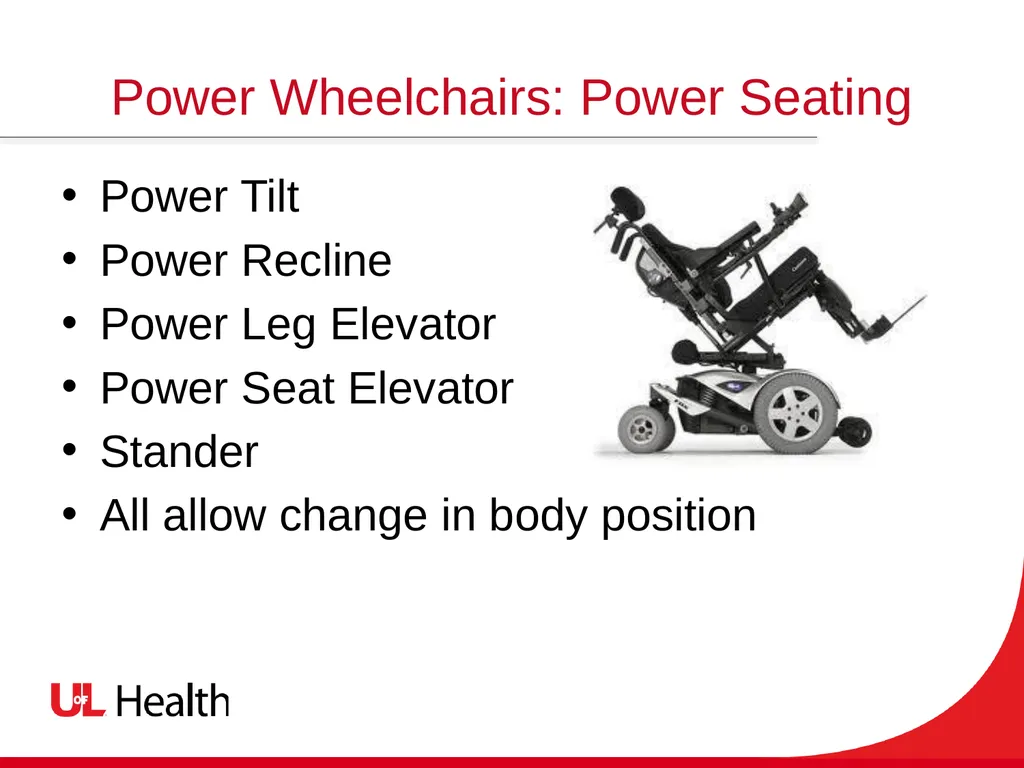
slide26. Power Wheelchairs: Power Seating Power Tilt
Power Recline
Power Leg Elevator
Power Seat Elevator
Stander
All allow change in body position<br>
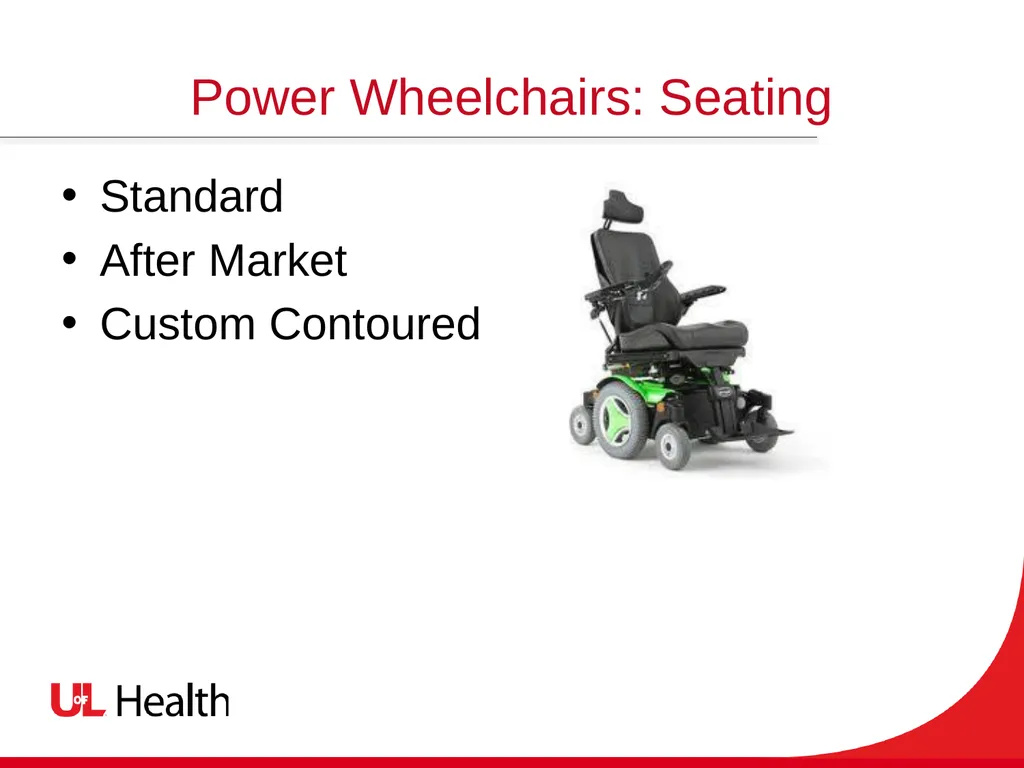
slide27. Power Wheelchairs: Seating Standard
After Market
Custom Contoured<br>
slide28. Power Wheelchairs: Seating Cushions
Use the same kinds as in manual wheelchairs
Back supports
Some minimal like manual but most offer more support and taller when using powered seating for weight shifts<br>
slide29. Power Wheelchairs: Arm Supports Chosen to meet needs for transfers, body support and pressure distribution
Standard
Flip back
Cantilevered
T-shape
Arm troughs<br>
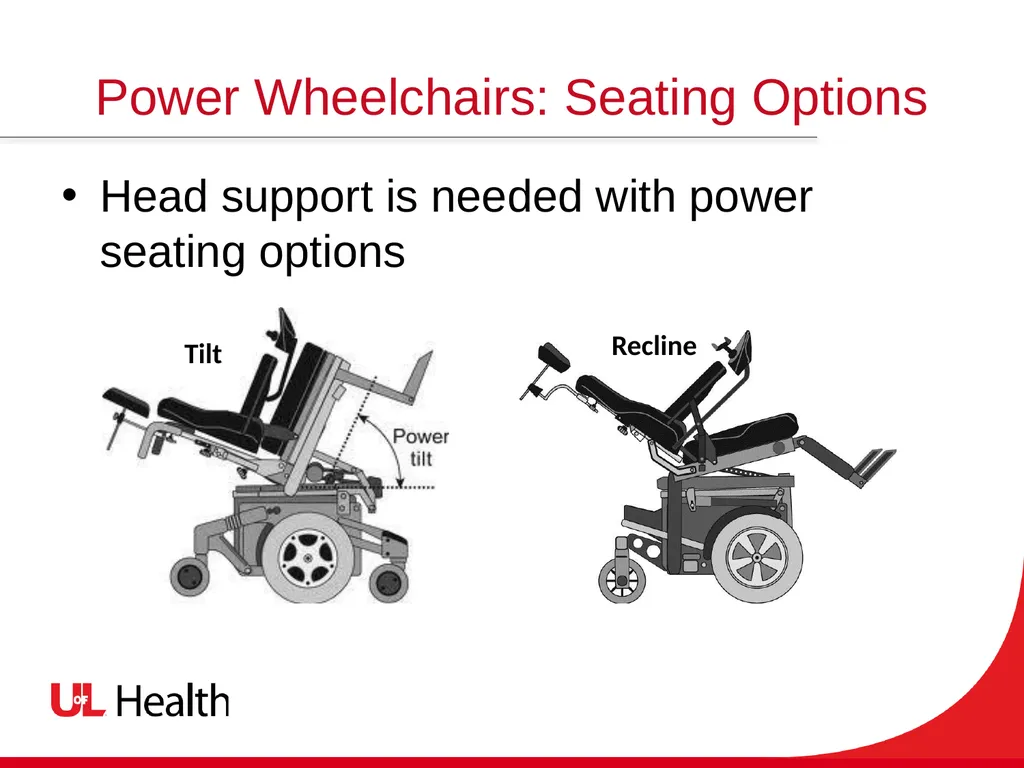
slide30. Power Wheelchairs: Seating Options Head support is needed with power seating options Tilt Recline<br>
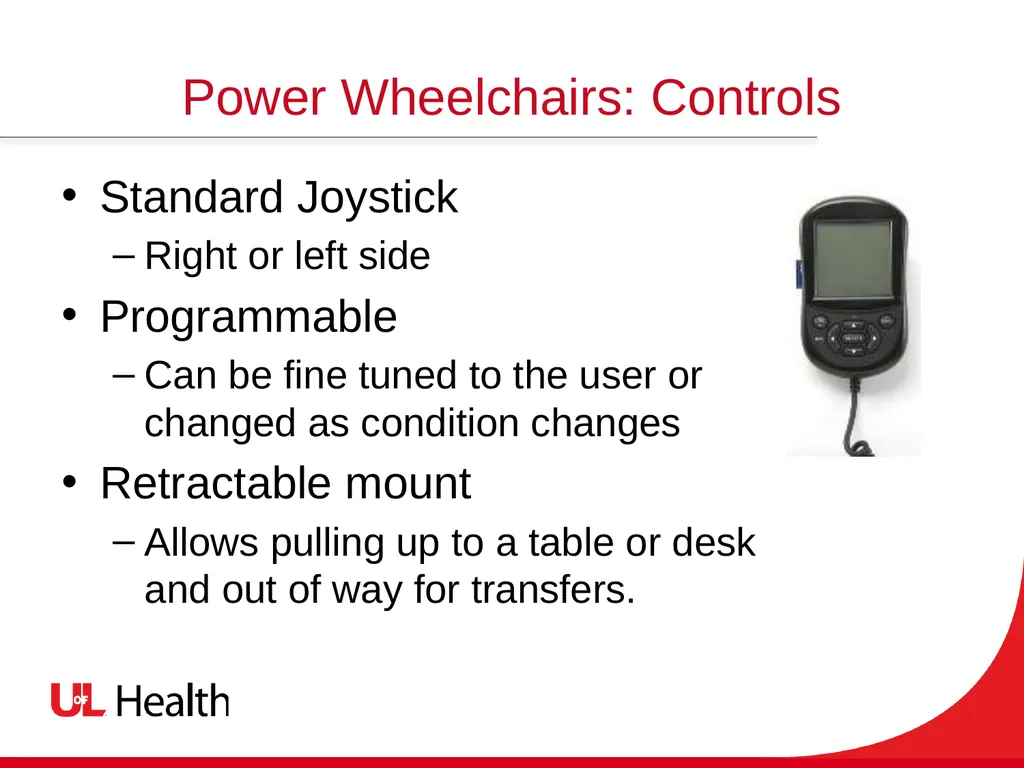
slide31. Power Wheelchairs: Controls Standard Joystick
Right or left side
Programmable
Can be fine tuned to the user or changed as condition changes
Retractable mount
Allows pulling up to a table or desk and out of way for transfers.<br>
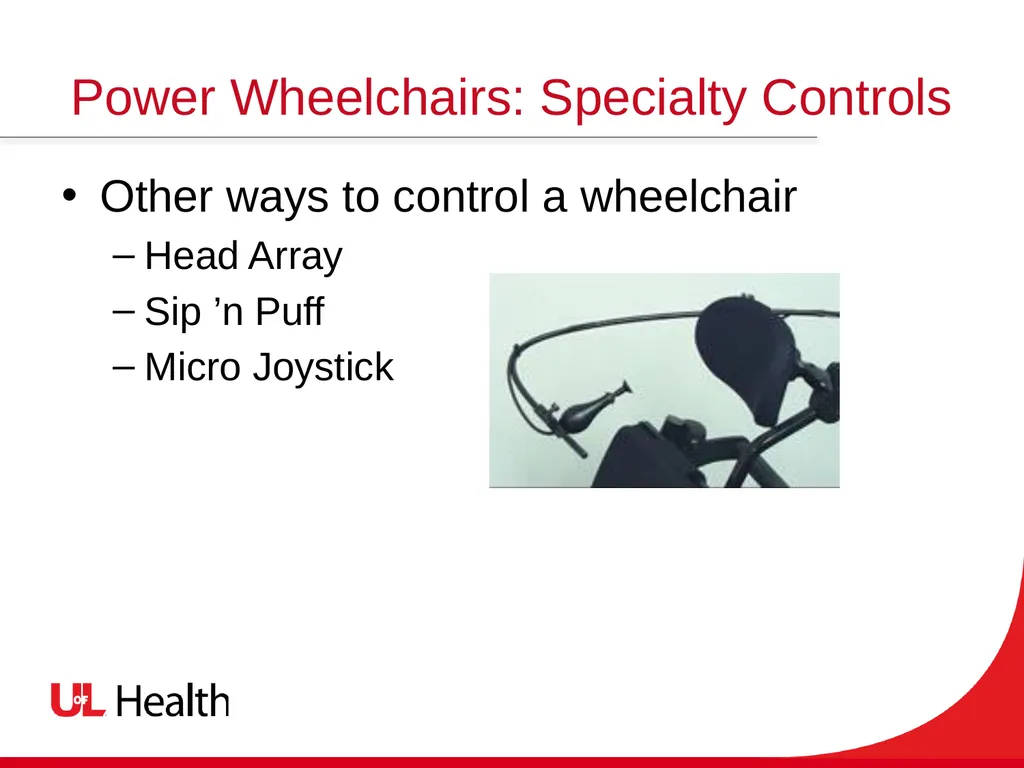
slide32. Power Wheelchairs: Specialty Controls Other ways to control a wheelchair
Head Array
Sip ’n Puff
Micro Joystick<br>
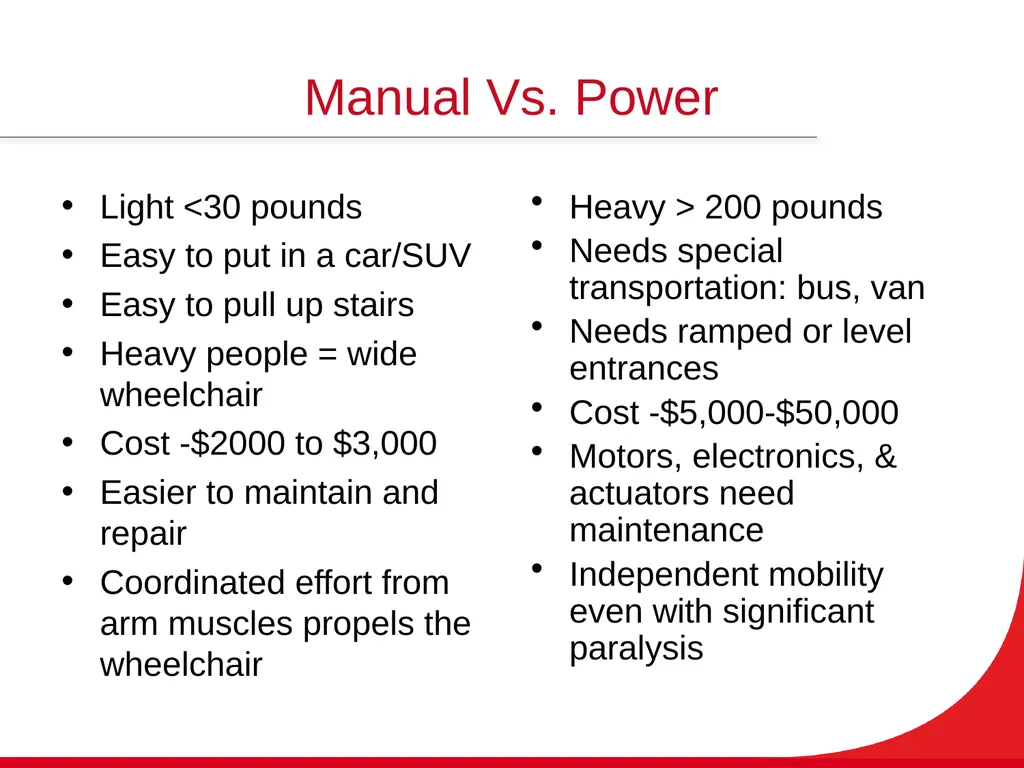
slide33. Manual Vs. Power Light <30 pounds
Easy to put in a car/SUV
Easy to pull up stairs
Heavy people = wide wheelchair
Cost -$2000 to $3,000
Easier to maintain and repair
Coordinated effort from arm muscles propels the wheelchair Heavy > 200 pounds
Needs special transportation: bus, van
Needs ramped or level entrances
Cost -$5,000-$50,000
Motors, electronics, & actuators need maintenance
Independent mobility even with significant paralysis<br>
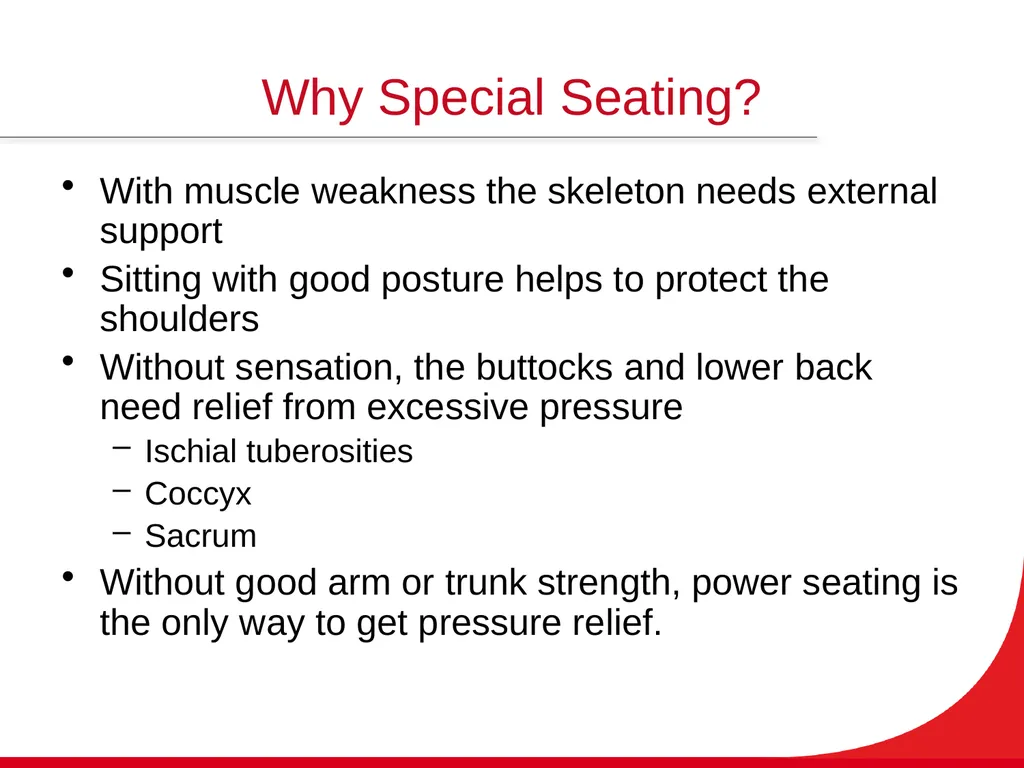
slide34. Why Special Seating? With muscle weakness the skeleton needs external support
Sitting with good posture helps to protect the shoulders
Without sensation, the buttocks and lower back need relief from excessive pressure
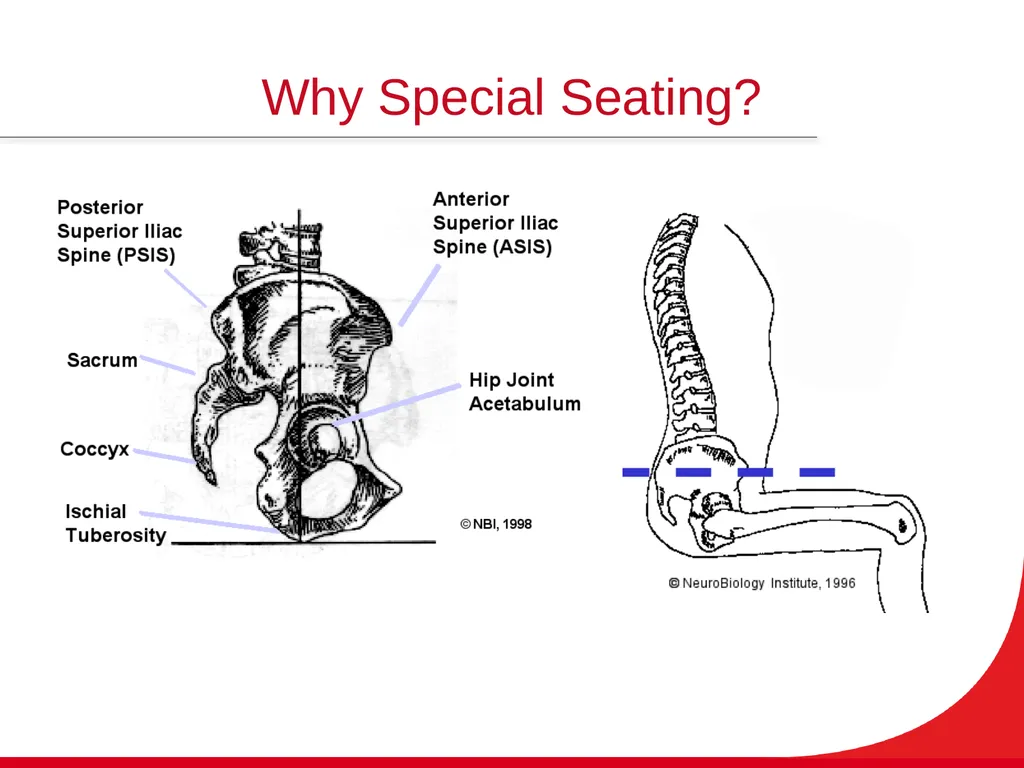
Ischial tuberosities
Coccyx
Sacrum
Without good arm or trunk strength, power seating is the only way to get pressure relief.<br>
slide35. Why Special Seating?<br>
slide36. Best Advice Work with an experienced therapist who knows your body and understands wheelchair features
Buy from an ATP certified seating and mobility specialist
Ask about their repair department
Speak up. Its your ride for the next 5 years
UofL Health - Frazier Rehab Institute Wheelchair Seating and Mobility Clinic
For an appointment, call: 502-582-7660<br>
slide2. Basic Parts of a Wheelchair A frame or a power base
A seat and back support
Cushion
Armrests
Leg rests & footplates
Wheels/Tires
Brakes
Motor and electronics
Anti-tippers
Other features<br>
slide3. Types of Manual Wheelchairs Standard –temporary use ONLY
Few sizes, no adjustability
Lightweight –for temporary use
Few sizes, no adjustability of axle, no support for posture
Ultra Lightweight
Adjustable axle position
Lightest weight possible
Allow custom fit & posture support
Recommended for person with a spinal cord injury<br>
slide4. Two Types of Ultralight Frames Folding or Cross Frame
Rigid or Z Frame<br>
slide5. Why an Ultralight? Made to your body measurements
Weight is less than ½ of a standard wheelchair
Axle position is moveable
Better position for preventing injury
Easier to push and less effort
Moving requires fewer pushes
Very strong… lasts 3 times longer than standard
Designed for all day, every day use<br>
slide6. PVA Guide: Shoulder Preservation 10 years of research shows postpone or avoid repetitive strain injury to shoulder:
Best alignment for shoulder, wrist & elbows
Lightest weight wheelchair offer less resistance and require less force to push
Fewer push strokes
Also… use good transfer techniques to avoid straining shoulder ligaments and tendons<br>
slide7. Features: Armrests Tubular, swing away
Rotate to the rear
Decrease chair width
Easy access to pushrims
T-shaped, quick release
Full or desk length
Height adjustable
Flip back or easy remove for transfers
Built in side guards<br>
slide8. Features: Armrests No Armrests
With good pelvic and trunk support, not really needed
Full access to the wheels
Use clothing guards to position cushion and prevent shearing from wheels John Hockenberry, August 2001 Cover<br>
slide9. Features: Leg Rests Swing Away or Removable
Swing in or swing out
Can get out of way for transfers
Drop-in vs. pegs
Offer varying amounts of knee angle
Elevating
Not effective except when there is a knee problem
Heavy and hard to manage<br>
slide10. Features: Leg Rests Stationary or fixed
Preferred to shorten wheel base & control leg position
May or may not interfere with transfers
Complicate stand pivot transfers
Tapered or straight
Controls foot position
Makes it easier to maneuver in small spaces<br>
slide11. Features: Foam Cusions Foam
Inexpensive
Wears out quickly & needs to be replaced often
Amount of contour can affect pressure distribution
Can shape as desired and make use of various densities
Good transfer surface depending on cover
Doesn’t deflate or leak
Holds moisture & heat next to skin
Harder to clean<br>
slide12. Features: Gel/Viscous Fluid Cushions Gel or Viscous Fluid
Gel shapes to body for good pressure distribution and immersion of bony prominences
Deeper gel under sitting bones
Relatively easy to clean
Gel can migrate causing cushion to “bottom out”
Cools the skin at first but can hold heat after sitting for a while
Gel can freeze in cold or hold heat
Heavier than foam
Can be combined with foam cushion
Gel clumps or hardens with age & needs to be replaced<br>
slide13. Features: Air Cushions Air ROHO & Others
Interconnected air bladders allow cushion to match shape of buttocks
Good air circulation and evaporation
Can be submerged in water to clean
Proper inflation is key to good pressure distribution. ½” to 1” clearance
Will leak if punctured or hot ashes are dropped
Less stability
Transfers are more difficult<br>
slide14. Features: Orthotic Cushions Orthotic
Customized to the individual to prevent or correct collapse
Excellent stability and control of pelvic position
Off-loads pressure on ITs and moves it to tolerant areas.
Excellent air circulation and evaporation
Easy to clean
Transfers can require more strength and pelvis needs to stay in position. Doesn’t work with standing wheelchairs and only limited recline<br>
slide15. Features: Back Supports Sling
Standard
Encourages slumping and kyphotic posture
Adjustable tension
Changes support to improve seated posture
Easily adjusted
Back rest height
Tall increases support but limits arm and trunk movement
Lower better for arm and trunk movement. Does not interfere with scapular movement.<br>
slide16. Features: Back Support/Rigid Contoured Multiple sizes & shapes
Quick release or fixed hardware
Improved support for the lumbar curve and can have lateral support
Encourages upright posture
Doesn’t interfere with push stroke if low enough
A firm surface to push against when propelling<br>
slide17. Features: Wheels & Tires Polyurethane
Solid treaded tires
Durable and low maintenance
Tends to slide on hard flooring
Pneumatic or Air filled
Softer ride, less shock
Treaded for increased traction
Can get a flat, replace or repair like a bike tire
Also high pressure, high performance
Flat-free or foam filled inserts
Eliminates flats and maintenance
Harder ride, heavier to push
Heavy, more rolling resistance<br>
slide18. Features: Push Rims Standard aluminum
Requires good hand function
Smooth, less burn when braking
Coated
Rubber coating increases grip
Facilitates pushing with palm of hand
Coating also increases friction
Ergonomic or Natural Fit
Ergonomic, designed to fit the thumb and hand grip
More surface for pushing<br>
slide19. Features: Push Rims Projection Push rims
Vertical, oblique or horizontal
Various lengths and number per rim
Used by quads without hand grip
Not recommended, overuse injuries
Push Rim Activated Power Assist Wheels
Motor & batteries surround the hub
Push rim becomes the “trigger”
Force of each push is increased
Each quick release wheel weighs 15 to 30 lbs.
Variable assistance for ramps, hills or fatigue
Expensive ~ $6,000
Add to an ultralight wheelchair<br>
slide20. More Wheel Options Quick Release Axles
Reduces weight & size for car stowage
Change wheels for activity
Spokes
Less weight
Provides shock absorption
Less wind resistance
Require maintenance
Spoke guards can protect fingers
Mag Wheels
Heavy and considered durable
Lower maintenance
Protects fingers
Also have quick release axles<br>
slide21. Pressure Relief Please take this time to pause the presentation and complete pressure relief.<br>
slide22. More Wheel Options Essential: Axle Adjustment…
Forward placement
Increase propulsion efficiency
Easier wheelies
Decreases turning radius
But… Decreased stability
–Rearward placement
Increased stability
Decreased efficiency; harder to push
–Camber
Wheels angle in toward body
Wider base of support but increases overall width
Quicker, easier turning<br>
slide23. More Wheel Options: Wheel Locks Pull-to-lock
Handle is out of the way during propulsion
Push-to-lock
Can use body weight to engage
Scissor lock
Mounted under the frame
Protects thumbs from trauma during propulsion
Requires good upper extremity skill because of their placement
Brake extensions
Slip on and make the brake lever longer and easier to push or reach<br>
slide24. More Wheel Options: Casters Solid
Foam filled, molded plastic or solid rubber
Less maintenance
Less rolling resistance
Pneumatic
Provide shock absorption
High maintenance
Larger
Harder to turn, less responsive
Tolerant of community surfaces
Usually pneumatic
Smaller
Easier to turn
Requires ability to do a wheelie<br>
slide25. Power Wheelchairs: Drive Wheel Placement Front-wheel drive
Pulls over obstacles
Easy to maneuver
Mid-wheel drive
Tightest turning radius
Excellent for indoors
Rear-wheel drive
Original drive mode<br>
slide26. Power Wheelchairs: Power Seating Power Tilt
Power Recline
Power Leg Elevator
Power Seat Elevator
Stander
All allow change in body position<br>
slide27. Power Wheelchairs: Seating Standard
After Market
Custom Contoured<br>
slide28. Power Wheelchairs: Seating Cushions
Use the same kinds as in manual wheelchairs
Back supports
Some minimal like manual but most offer more support and taller when using powered seating for weight shifts<br>
slide29. Power Wheelchairs: Arm Supports Chosen to meet needs for transfers, body support and pressure distribution
Standard
Flip back
Cantilevered
T-shape
Arm troughs<br>
slide30. Power Wheelchairs: Seating Options Head support is needed with power seating options Tilt Recline<br>
slide31. Power Wheelchairs: Controls Standard Joystick
Right or left side
Programmable
Can be fine tuned to the user or changed as condition changes
Retractable mount
Allows pulling up to a table or desk and out of way for transfers.<br>
slide32. Power Wheelchairs: Specialty Controls Other ways to control a wheelchair
Head Array
Sip ’n Puff
Micro Joystick<br>
slide33. Manual Vs. Power Light <30 pounds
Easy to put in a car/SUV
Easy to pull up stairs
Heavy people = wide wheelchair
Cost -$2000 to $3,000
Easier to maintain and repair
Coordinated effort from arm muscles propels the wheelchair Heavy > 200 pounds
Needs special transportation: bus, van
Needs ramped or level entrances
Cost -$5,000-$50,000
Motors, electronics, & actuators need maintenance
Independent mobility even with significant paralysis<br>
slide34. Why Special Seating? With muscle weakness the skeleton needs external support
Sitting with good posture helps to protect the shoulders
Without sensation, the buttocks and lower back need relief from excessive pressure
Ischial tuberosities
Coccyx
Sacrum
Without good arm or trunk strength, power seating is the only way to get pressure relief.<br>
slide35. Why Special Seating?<br>
slide36. Best Advice Work with an experienced therapist who knows your body and understands wheelchair features
Buy from an ATP certified seating and mobility specialist
Ask about their repair department
Speak up. Its your ride for the next 5 years
UofL Health - Frazier Rehab Institute Wheelchair Seating and Mobility Clinic
For an appointment, call: 502-582-7660<br>