
Introduction to Will Making Lucy O’Leary BCL LLM
DP
Published · 18 slides · 0 views

1 / 1

Description
Introduction to Will Making Lucy OLeary BCL LLM HDip Martin A. Harvey and Co Solicitors Components of a Will Most people think they need a detailed account of their assets before going to see a Solicitor this is not necessary A Will has
Related Topics
Share
Embed code
Download this presentation From Below
"Introduction to Will Making Lucy O’Leary BCL LLM" is the property of its rightful owner. Permission is granted to download and print the materials on this website for personal, non-commercial use only, and to display it on your personal computer provided you do not modify the materials and that you retain all copyright notices contained in the materials. By downloading content from our website, you accept the terms of this agreement.
Presentation Transcript
01
Introduction to Will Making Lucy O’Leary BCL LLM HDip
Martin A. Harvey and Co Solicitors<br>
Martin A. Harvey and Co Solicitors<br>
02
Components of a Will Most people think they need a detailed account of their assets before going to see a Solicitor – this is not necessary
A Will has not been drafted correctly if it does not ‘move’ with you;
The most important parts of a Will and what you need to know prior to seeing your Solicitor is:
Who do I want to be benefit, i.e. who are my beneficiaries
What relationship are these people to me (tax implications)
Who will administer my Estate, ( Executors)<br>
A Will has not been drafted correctly if it does not ‘move’ with you;
The most important parts of a Will and what you need to know prior to seeing your Solicitor is:
Who do I want to be benefit, i.e. who are my beneficiaries
What relationship are these people to me (tax implications)
Who will administer my Estate, ( Executors)<br>
03
Beneficiaries The most important and first question I ask every client is, ‘are you married, divorced, separated – what is your marital status?
This is important as the person who gets ‘looked after’ is a Spouse. They have an automatic entitlement to your Estate. They can choose to elect or not.
Without getting into complex legal rights, and to put it very simply – your Spouse can either ‘take’ what they are given in the Will or elect to take their Legal Right Share which is essentially either half or one third of the estate, depending on if there are children of the Testator, i.e. the person making the Will<br>
This is important as the person who gets ‘looked after’ is a Spouse. They have an automatic entitlement to your Estate. They can choose to elect or not.
Without getting into complex legal rights, and to put it very simply – your Spouse can either ‘take’ what they are given in the Will or elect to take their Legal Right Share which is essentially either half or one third of the estate, depending on if there are children of the Testator, i.e. the person making the Will<br>
04
Beneficiaries The other important question to ask is, have you children, what are their ages and do they get along!
While most people would not think this is important, it is essential for the Solicitor drafting the Will to know if there will be issues between beneficiaries prior to drafting the Will.
A child who is left out of the Will or who does not benefit in the same manner as other children in a Will, can and usually do contest the Will by either lodging a caveat in the Probate office which stops Probate and/or taking a S.117 Claim against the Estate.<br>
While most people would not think this is important, it is essential for the Solicitor drafting the Will to know if there will be issues between beneficiaries prior to drafting the Will.
A child who is left out of the Will or who does not benefit in the same manner as other children in a Will, can and usually do contest the Will by either lodging a caveat in the Probate office which stops Probate and/or taking a S.117 Claim against the Estate.<br>
05
Beneficiaries S.117 applications are very popular and extremely contentious and almost all of the time lead the Will to be changed in favour of the S.117 applicant and almost but not all the time, handled outside of court and are settled.
This is important as most of the time, testators want to benefit all of their children equally but where one child is living at home and has always lived at home – Issues arise!
With families, (and everyone is in the same boat!) there is usually one! One that will cause the issue – in larger families, this number can grow.<br>
This is important as most of the time, testators want to benefit all of their children equally but where one child is living at home and has always lived at home – Issues arise!
With families, (and everyone is in the same boat!) there is usually one! One that will cause the issue – in larger families, this number can grow.<br>
06
Beneficiaries If you have a child living at home, for whatever reason – please tell your Solicitor this so they can create a go around for the S.117.
If you have a child and you are not overly fond of their spouse – please tell your Solicitor this so again they can have a work around for the spouses inheriting.
Grandchildren – you are under no obligation to benefit Grandchildren – this is the role of their parent.
The only time you should be thinking specifically of making provision for Grandchildren is where you raised them as your own or their parent, i.e. your child has passed.<br>
If you have a child and you are not overly fond of their spouse – please tell your Solicitor this so again they can have a work around for the spouses inheriting.
Grandchildren – you are under no obligation to benefit Grandchildren – this is the role of their parent.
The only time you should be thinking specifically of making provision for Grandchildren is where you raised them as your own or their parent, i.e. your child has passed.<br>
07
Beneficaries Grandchildren are subject to tax – as are every other beneficiary who is not a Spouse.
Their CAT category ‘B’ which at present is €40,000 each for their lifetime and on death – so if the Grandchild is going to inherit from you and say an Aunt or Uncle – they will more than likely have to pay tax at any inheritance or gift over the €40,000 at 33%.
CAT threshold for children, i.e. Group A is currently at €400,000 each from BOTH parents and again this is during the lifetime of the child and on death so if you have given your child a gift for a house say, this is taken out of the €400,000 threshold and is also important information for your Solicitor<br>
Their CAT category ‘B’ which at present is €40,000 each for their lifetime and on death – so if the Grandchild is going to inherit from you and say an Aunt or Uncle – they will more than likely have to pay tax at any inheritance or gift over the €40,000 at 33%.
CAT threshold for children, i.e. Group A is currently at €400,000 each from BOTH parents and again this is during the lifetime of the child and on death so if you have given your child a gift for a house say, this is taken out of the €400,000 threshold and is also important information for your Solicitor<br>
08
Beneficiaries If you are single and do not have children and have never married, this gets more complicated as you are trying to ensure your Will is tax efficient – no one wants Revenue getting everything!
Common misconception is that 'The State’ will get your assets- this will only happen if you are survived by absolutely no blood relative and you died Intestate – i.e. no Will which would mean I have failed with this Presentation!!
If you are not survived by any blood relative – choose Charities who inherit tax free and specific bequests can always be made to Charities regardless of if you have blood relatives or not<br>
Common misconception is that 'The State’ will get your assets- this will only happen if you are survived by absolutely no blood relative and you died Intestate – i.e. no Will which would mean I have failed with this Presentation!!
If you are not survived by any blood relative – choose Charities who inherit tax free and specific bequests can always be made to Charities regardless of if you have blood relatives or not<br>
09
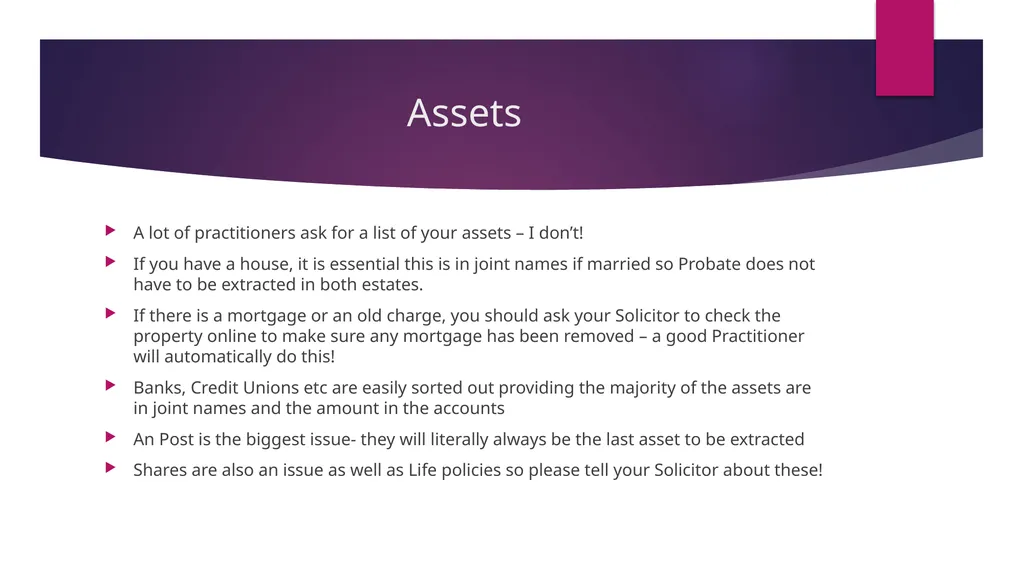
Assets A lot of practitioners ask for a list of your assets – I don’t!
If you have a house, it is essential this is in joint names if married so Probate does not have to be extracted in both estates.
If there is a mortgage or an old charge, you should ask your Solicitor to check the property online to make sure any mortgage has been removed – a good Practitioner will automatically do this!
Banks, Credit Unions etc are easily sorted out providing the majority of the assets are in joint names and the amount in the accounts
An Post is the biggest issue- they will literally always be the last asset to be extracted
Shares are also an issue as well as Life policies so please tell your Solicitor about these!<br>
If you have a house, it is essential this is in joint names if married so Probate does not have to be extracted in both estates.
If there is a mortgage or an old charge, you should ask your Solicitor to check the property online to make sure any mortgage has been removed – a good Practitioner will automatically do this!
Banks, Credit Unions etc are easily sorted out providing the majority of the assets are in joint names and the amount in the accounts
An Post is the biggest issue- they will literally always be the last asset to be extracted
Shares are also an issue as well as Life policies so please tell your Solicitor about these!<br>
10
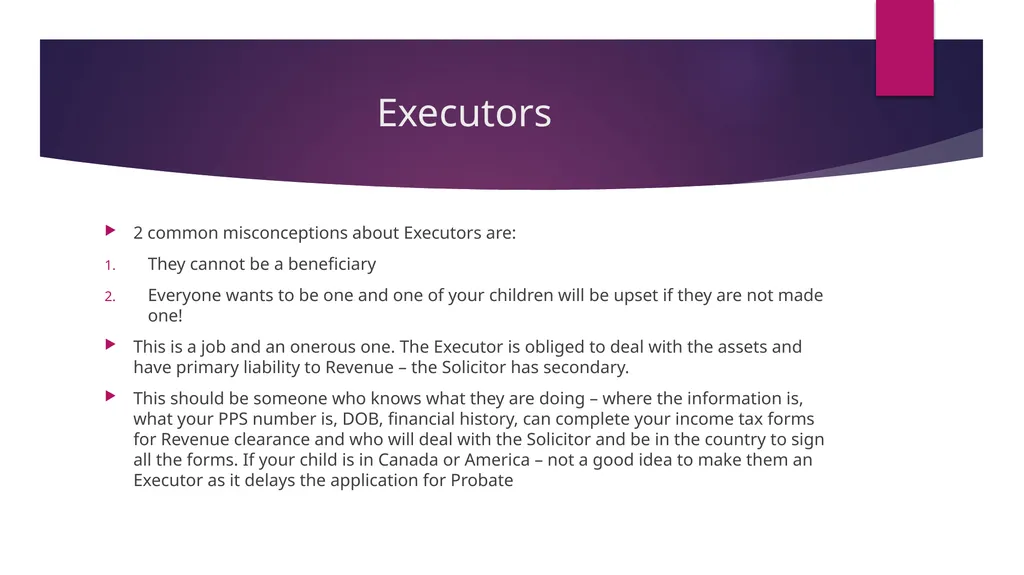
Executors 2 common misconceptions about Executors are:
They cannot be a beneficiary
Everyone wants to be one and one of your children will be upset if they are not made one!
This is a job and an onerous one. The Executor is obliged to deal with the assets and have primary liability to Revenue – the Solicitor has secondary.
This should be someone who knows what they are doing – where the information is, what your PPS number is, DOB, financial history, can complete your income tax forms for Revenue clearance and who will deal with the Solicitor and be in the country to sign all the forms. If your child is in Canada or America – not a good idea to make them an Executor as it delays the application for Probate<br>
They cannot be a beneficiary
Everyone wants to be one and one of your children will be upset if they are not made one!
This is a job and an onerous one. The Executor is obliged to deal with the assets and have primary liability to Revenue – the Solicitor has secondary.
This should be someone who knows what they are doing – where the information is, what your PPS number is, DOB, financial history, can complete your income tax forms for Revenue clearance and who will deal with the Solicitor and be in the country to sign all the forms. If your child is in Canada or America – not a good idea to make them an Executor as it delays the application for Probate<br>
11
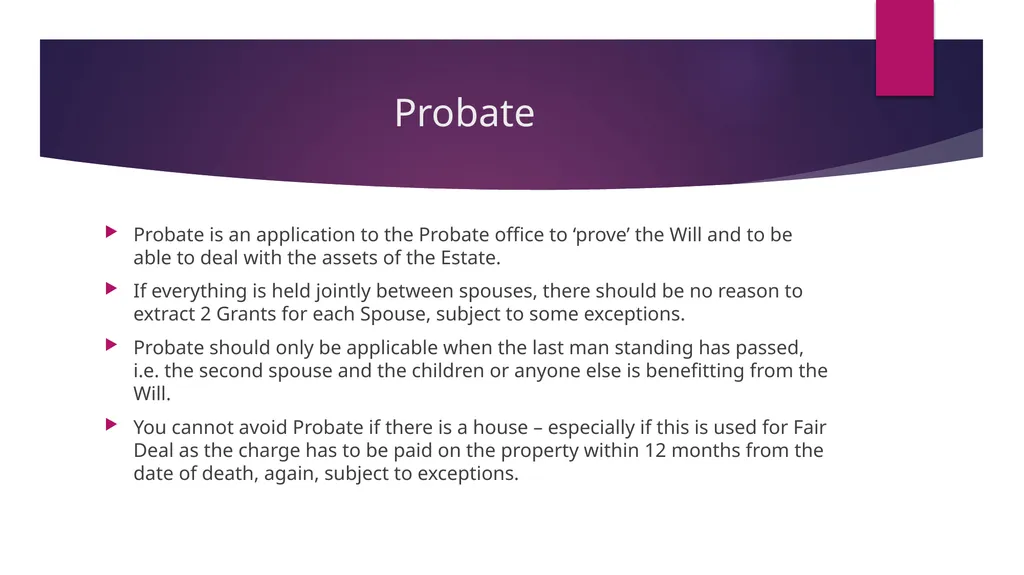
Probate Probate is an application to the Probate office to ‘prove’ the Will and to be able to deal with the assets of the Estate.
If everything is held jointly between spouses, there should be no reason to extract 2 Grants for each Spouse, subject to some exceptions.
Probate should only be applicable when the last man standing has passed, i.e. the second spouse and the children or anyone else is benefitting from the Will.
You cannot avoid Probate if there is a house – especially if this is used for Fair Deal as the charge has to be paid on the property within 12 months from the date of death, again, subject to exceptions.<br>
If everything is held jointly between spouses, there should be no reason to extract 2 Grants for each Spouse, subject to some exceptions.
Probate should only be applicable when the last man standing has passed, i.e. the second spouse and the children or anyone else is benefitting from the Will.
You cannot avoid Probate if there is a house – especially if this is used for Fair Deal as the charge has to be paid on the property within 12 months from the date of death, again, subject to exceptions.<br>
12
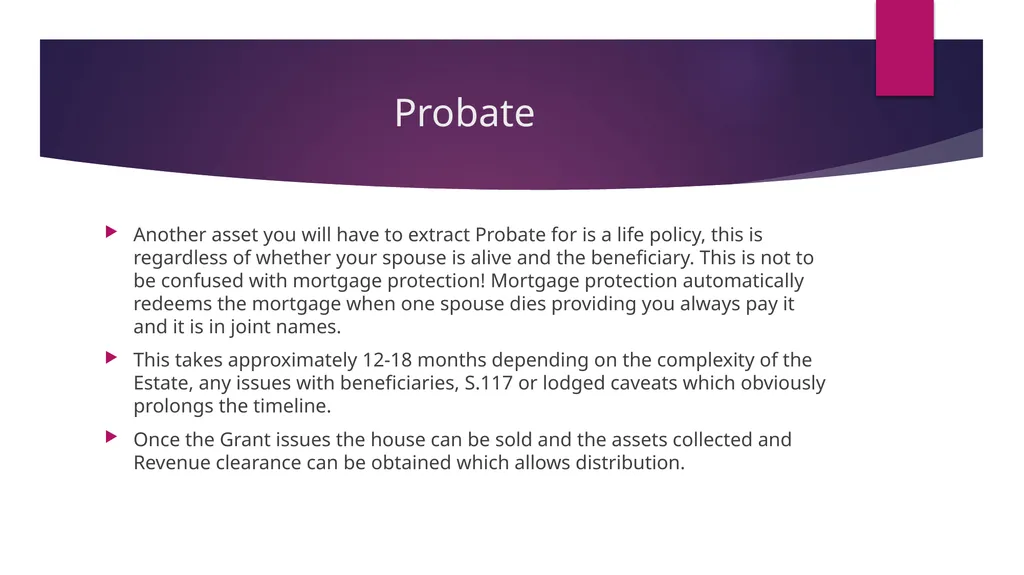
Probate Another asset you will have to extract Probate for is a life policy, this is regardless of whether your spouse is alive and the beneficiary. This is not to be confused with mortgage protection! Mortgage protection automatically redeems the mortgage when one spouse dies providing you always pay it and it is in joint names.
This takes approximately 12-18 months depending on the complexity of the Estate, any issues with beneficiaries, S.117 or lodged caveats which obviously prolongs the timeline.
Once the Grant issues the house can be sold and the assets collected and Revenue clearance can be obtained which allows distribution.<br>
This takes approximately 12-18 months depending on the complexity of the Estate, any issues with beneficiaries, S.117 or lodged caveats which obviously prolongs the timeline.
Once the Grant issues the house can be sold and the assets collected and Revenue clearance can be obtained which allows distribution.<br>
13
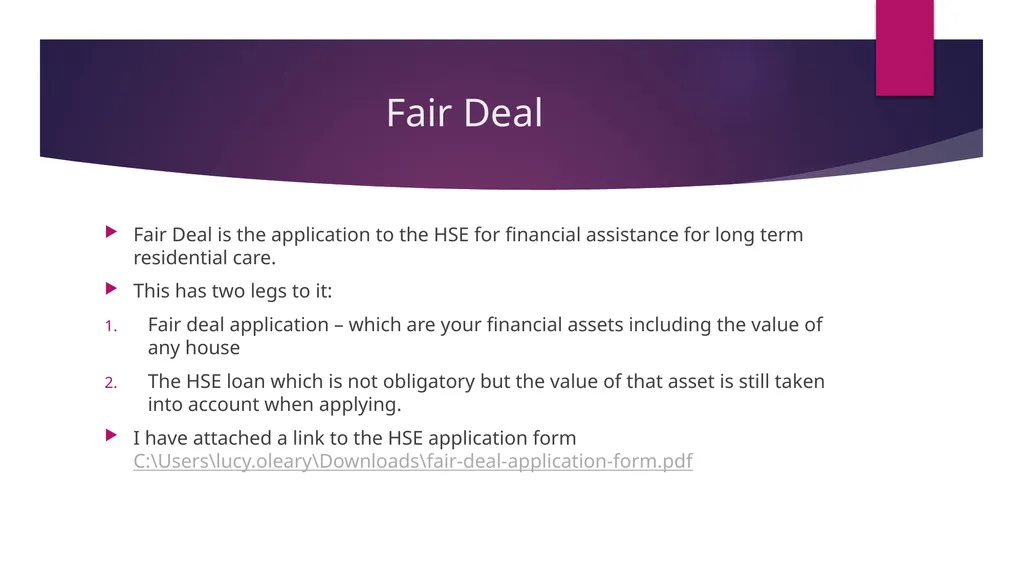
Fair Deal Fair Deal is the application to the HSE for financial assistance for long term residential care.
This has two legs to it:
Fair deal application – which are your financial assets including the value of any house
The HSE loan which is not obligatory but the value of that asset is still taken into account when applying.
I have attached a link to the HSE application form C:\Users\lucy.oleary\Downloads\fair-deal-application-form.pdf<br>
This has two legs to it:
Fair deal application – which are your financial assets including the value of any house
The HSE loan which is not obligatory but the value of that asset is still taken into account when applying.
I have attached a link to the HSE application form C:\Users\lucy.oleary\Downloads\fair-deal-application-form.pdf<br>
14
Fair Deal The HSE loan is the most important aspect for the Solicitor. This a mortgage over the property which can be deferred if the Spouse is alive after you pass. If they need care, the joint assessment will be up to 22.5%.
I have put in the link for you to review the application for the Fair Deal: https://www2.hse.ie/services/schemes-allowances/fair-deal-scheme/about/
The housing loan is important for Solicitors as interest accrues if this is not paid within 12 months from the date of death of the surviving spouse.<br>
I have put in the link for you to review the application for the Fair Deal: https://www2.hse.ie/services/schemes-allowances/fair-deal-scheme/about/
The housing loan is important for Solicitors as interest accrues if this is not paid within 12 months from the date of death of the surviving spouse.<br>
15
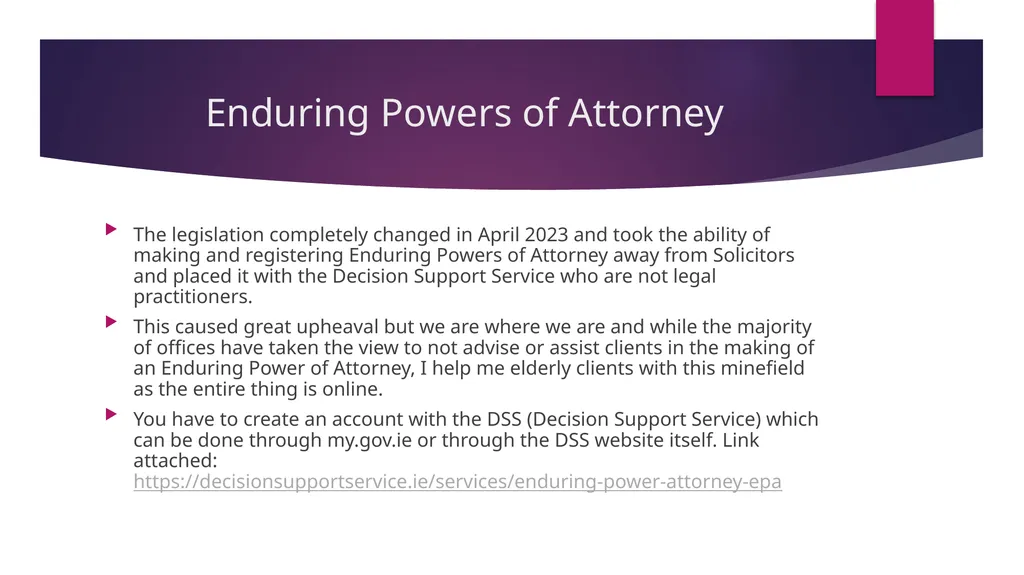
Enduring Powers of Attorney The legislation completely changed in April 2023 and took the ability of making and registering Enduring Powers of Attorney away from Solicitors and placed it with the Decision Support Service who are not legal practitioners.
This caused great upheaval but we are where we are and while the majority of offices have taken the view to not advise or assist clients in the making of an Enduring Power of Attorney, I help me elderly clients with this minefield as the entire thing is online.
You have to create an account with the DSS (Decision Support Service) which can be done through my.gov.ie or through the DSS website itself. Link attached: https://decisionsupportservice.ie/services/enduring-power-attorney-epa<br>
This caused great upheaval but we are where we are and while the majority of offices have taken the view to not advise or assist clients in the making of an Enduring Power of Attorney, I help me elderly clients with this minefield as the entire thing is online.
You have to create an account with the DSS (Decision Support Service) which can be done through my.gov.ie or through the DSS website itself. Link attached: https://decisionsupportservice.ie/services/enduring-power-attorney-epa<br>
16
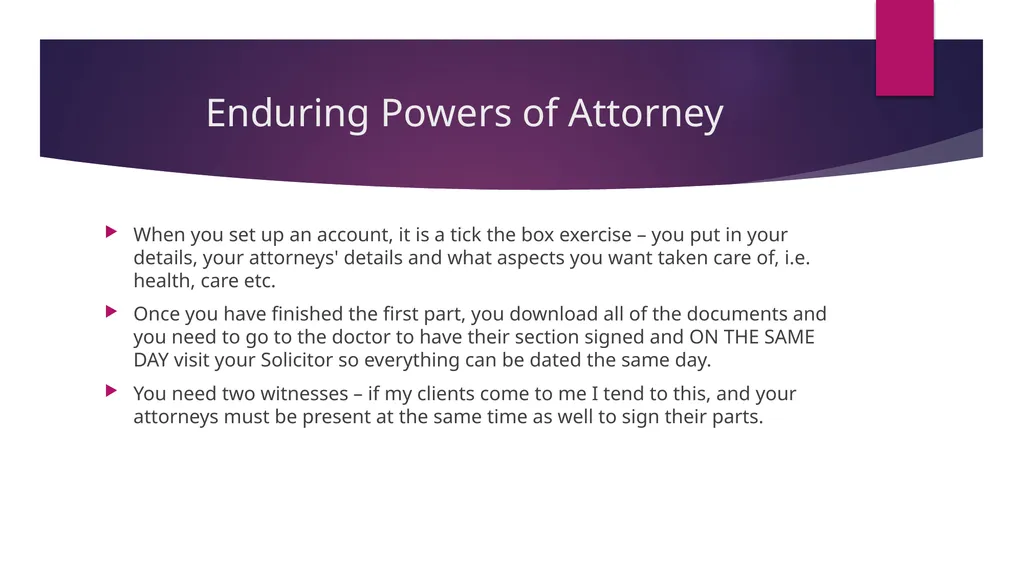
Enduring Powers of Attorney When you set up an account, it is a tick the box exercise – you put in your details, your attorneys' details and what aspects you want taken care of, i.e. health, care etc.
Once you have finished the first part, you download all of the documents and you need to go to the doctor to have their section signed and ON THE SAME DAY visit your Solicitor so everything can be dated the same day.
You need two witnesses – if my clients come to me I tend to this, and your attorneys must be present at the same time as well to sign their parts.<br>
Once you have finished the first part, you download all of the documents and you need to go to the doctor to have their section signed and ON THE SAME DAY visit your Solicitor so everything can be dated the same day.
You need two witnesses – if my clients come to me I tend to this, and your attorneys must be present at the same time as well to sign their parts.<br>
17
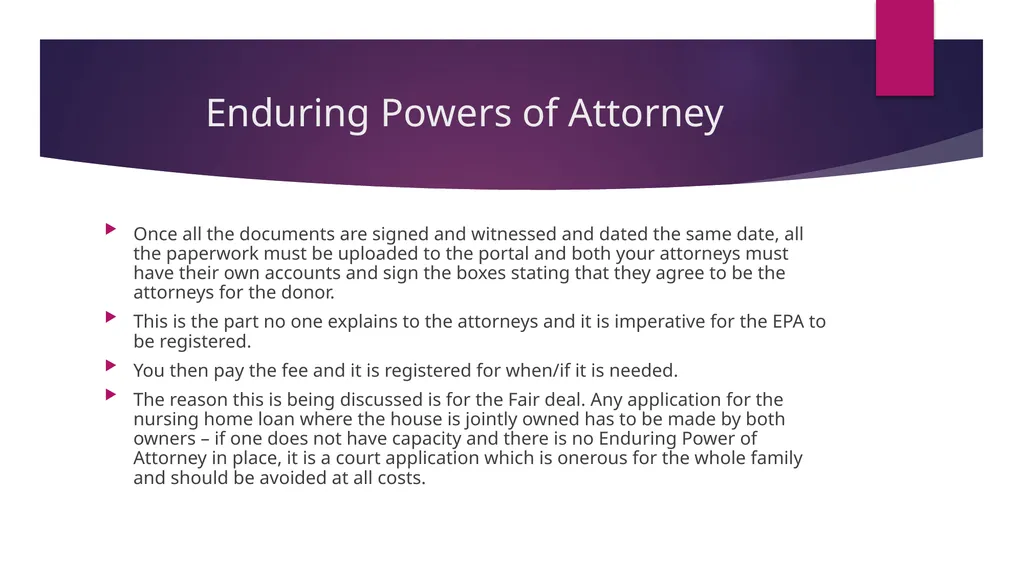
Enduring Powers of Attorney Once all the documents are signed and witnessed and dated the same date, all the paperwork must be uploaded to the portal and both your attorneys must have their own accounts and sign the boxes stating that they agree to be the attorneys for the donor.
This is the part no one explains to the attorneys and it is imperative for the EPA to be registered.
You then pay the fee and it is registered for when/if it is needed.
The reason this is being discussed is for the Fair deal. Any application for the nursing home loan where the house is jointly owned has to be made by both owners – if one does not have capacity and there is no Enduring Power of Attorney in place, it is a court application which is onerous for the whole family and should be avoided at all costs.<br>
This is the part no one explains to the attorneys and it is imperative for the EPA to be registered.
You then pay the fee and it is registered for when/if it is needed.
The reason this is being discussed is for the Fair deal. Any application for the nursing home loan where the house is jointly owned has to be made by both owners – if one does not have capacity and there is no Enduring Power of Attorney in place, it is a court application which is onerous for the whole family and should be avoided at all costs.<br>
18
Questions!<br>