
Introduction to Work-Related Fatigue Unit 3: The
A
Published · 29 slides · 0 views

1 / 1
Description
Introduction to Work-Related Fatigue Unit 3: The state of fatigue and its consequences Prepared by: Centre for Human Factors, University of Hull Commissioned and supported by: Energy Networks Association Copyright 2024 Centre for Human
Related Topics
Share
Embed code
Download this presentation From Below
"Introduction to Work-Related Fatigue Unit 3: The" is the property of its rightful owner. Permission is granted to download and print the materials on this website for personal, non-commercial use only, and to display it on your personal computer provided you do not modify the materials and that you retain all copyright notices contained in the materials. By downloading content from our website, you accept the terms of this agreement.
Presentation Transcript
01
Introduction to Work-Related Fatigue
Unit 3: The state of fatigue and its consequences Prepared by:
Centre for Human Factors, University of Hull
Commissioned and supported by:
Energy Networks Association
Copyright © 2024 Centre for Human Factors. All rights reserved<br>
Unit 3: The state of fatigue and its consequences Prepared by:
Centre for Human Factors, University of Hull
Commissioned and supported by:
Energy Networks Association
Copyright © 2024 Centre for Human Factors. All rights reserved<br>
02
Key learning points from unit 2:<br>
03
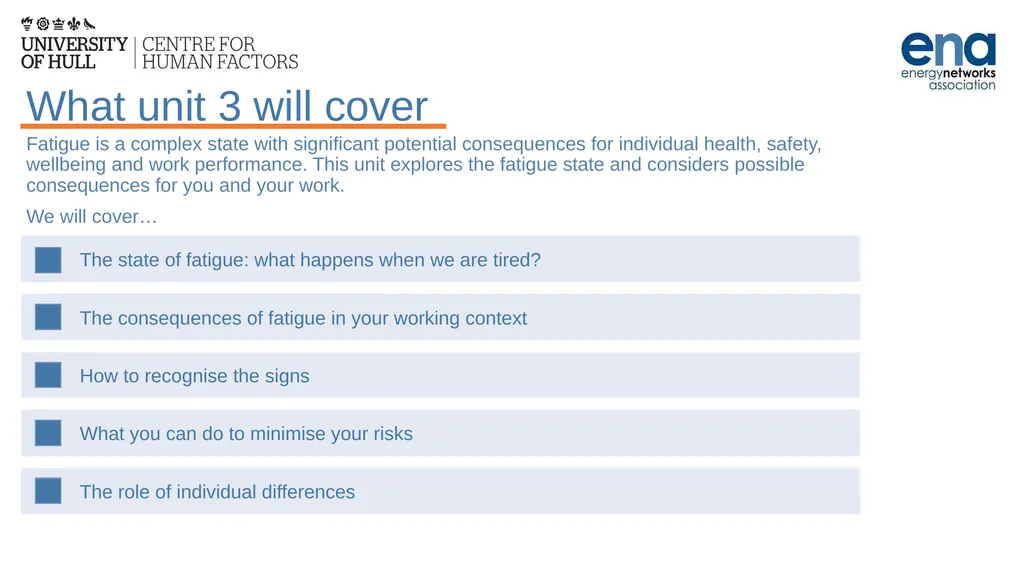
Fatigue is a complex state with significant potential consequences for individual health, safety, wellbeing and work performance. This unit explores the fatigue state and considers possible consequences for you and your work.
We will cover… What unit 3 will cover<br>
We will cover… What unit 3 will cover<br>
04
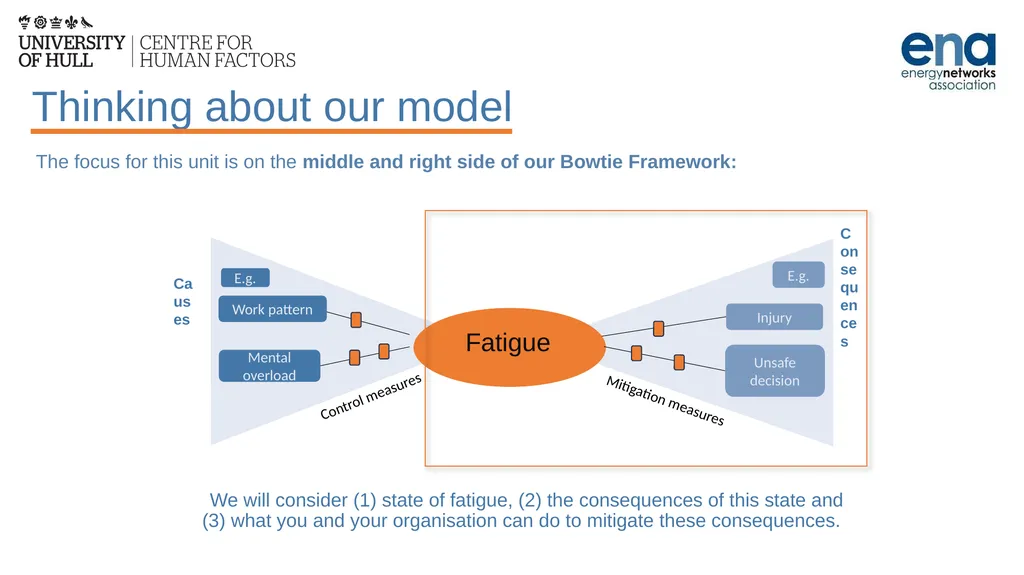
Thinking about our model Causes Consequences Fatigue Mental overload Injury Unsafe decision Control measures E.g. E.g. Mitigation measures We will consider (1) state of fatigue, (2) the consequences of this state and (3) what you and your organisation can do to mitigate these consequences. Work pattern The focus for this unit is on the middle and right side of our Bowtie Framework:<br>
05
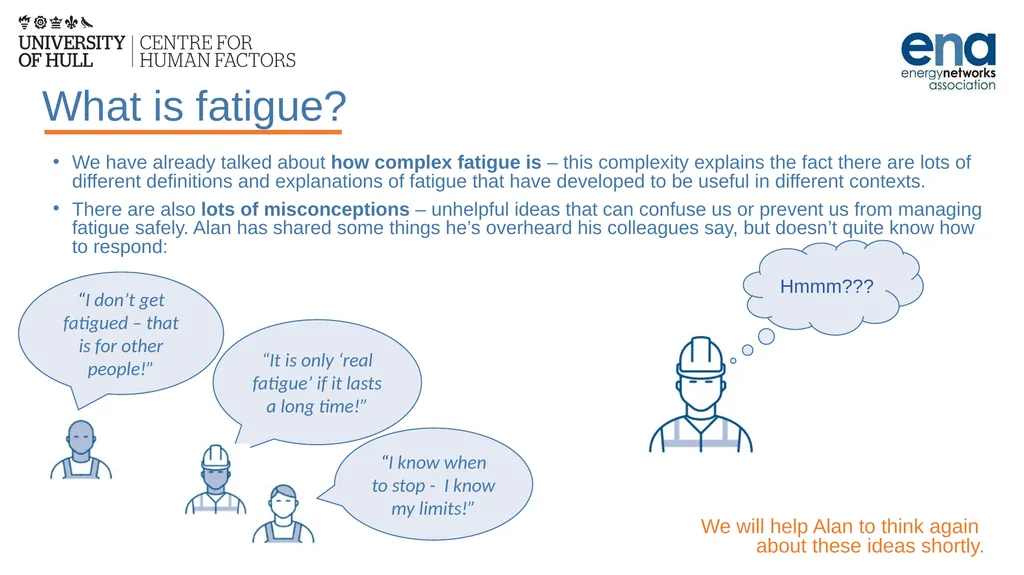
What is fatigue? We have already talked about how complex fatigue is – this complexity explains the fact there are lots of different definitions and explanations of fatigue that have developed to be useful in different contexts.
There are also lots of misconceptions – unhelpful ideas that can confuse us or prevent us from managing fatigue safely. Alan has shared some things he’s overheard his colleagues say, but doesn’t quite know how to respond:
We will help Alan to think again about these ideas shortly. “I don’t get fatigued – that is for other people!” “It is only ‘real fatigue’ if it lasts a long time!” “I know when to stop - I know my limits!” Hmmm???<br>
There are also lots of misconceptions – unhelpful ideas that can confuse us or prevent us from managing fatigue safely. Alan has shared some things he’s overheard his colleagues say, but doesn’t quite know how to respond:
We will help Alan to think again about these ideas shortly. “I don’t get fatigued – that is for other people!” “It is only ‘real fatigue’ if it lasts a long time!” “I know when to stop - I know my limits!” Hmmm???<br>
06
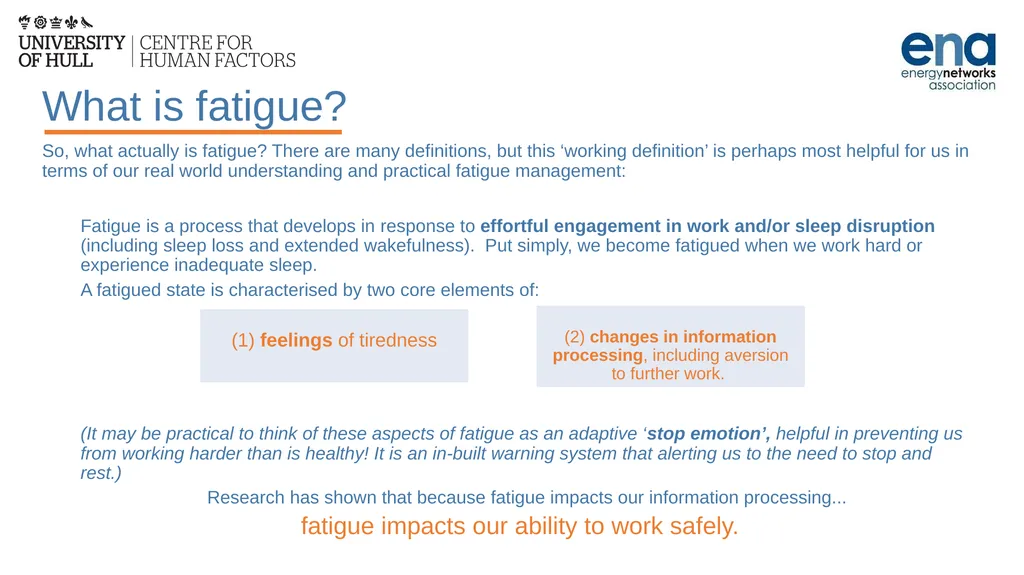
What is fatigue? So, what actually is fatigue? There are many definitions, but this ‘working definition’ is perhaps most helpful for us in terms of our real world understanding and practical fatigue management:
Fatigue is a process that develops in response to effortful engagement in work and/or sleep disruption (including sleep loss and extended wakefulness). Put simply, we become fatigued when we work hard or experience inadequate sleep.
A fatigued state is characterised by two core elements of:
(It may be practical to think of these aspects of fatigue as an adaptive ‘stop emotion’, helpful in preventing us from working harder than is healthy! It is an in-built warning system that alerting us to the need to stop and rest.)
Research has shown that because fatigue impacts our information processing...
fatigue impacts our ability to work safely. (2) changes in information processing, including aversion to further work. (1) feelings of tiredness<br>
Fatigue is a process that develops in response to effortful engagement in work and/or sleep disruption (including sleep loss and extended wakefulness). Put simply, we become fatigued when we work hard or experience inadequate sleep.
A fatigued state is characterised by two core elements of:
(It may be practical to think of these aspects of fatigue as an adaptive ‘stop emotion’, helpful in preventing us from working harder than is healthy! It is an in-built warning system that alerting us to the need to stop and rest.)
Research has shown that because fatigue impacts our information processing...
fatigue impacts our ability to work safely. (2) changes in information processing, including aversion to further work. (1) feelings of tiredness<br>
07
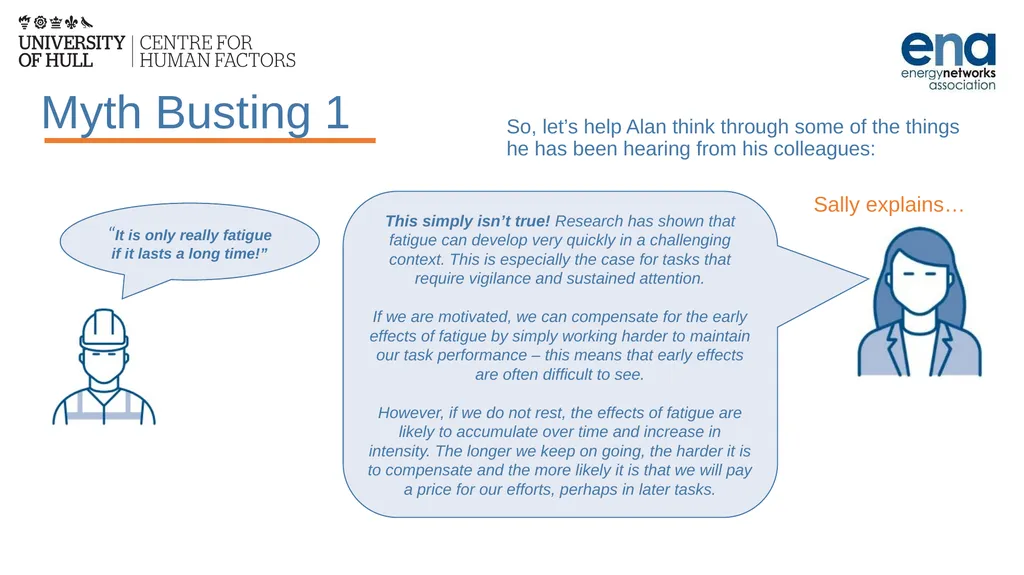
Myth Busting 1 So, let’s help Alan think through some of the things he has been hearing from his colleagues:
Sally explains… “It is only really fatigue if it lasts a long time!” This simply isn’t true! Research has shown that fatigue can develop very quickly in a challenging context. This is especially the case for tasks that require vigilance and sustained attention.
If we are motivated, we can compensate for the early effects of fatigue by simply working harder to maintain our task performance – this means that early effects are often difficult to see.
However, if we do not rest, the effects of fatigue are likely to accumulate over time and increase in intensity. The longer we keep on going, the harder it is to compensate and the more likely it is that we will pay a price for our efforts, perhaps in later tasks.<br>
Sally explains… “It is only really fatigue if it lasts a long time!” This simply isn’t true! Research has shown that fatigue can develop very quickly in a challenging context. This is especially the case for tasks that require vigilance and sustained attention.
If we are motivated, we can compensate for the early effects of fatigue by simply working harder to maintain our task performance – this means that early effects are often difficult to see.
However, if we do not rest, the effects of fatigue are likely to accumulate over time and increase in intensity. The longer we keep on going, the harder it is to compensate and the more likely it is that we will pay a price for our efforts, perhaps in later tasks.<br>
08
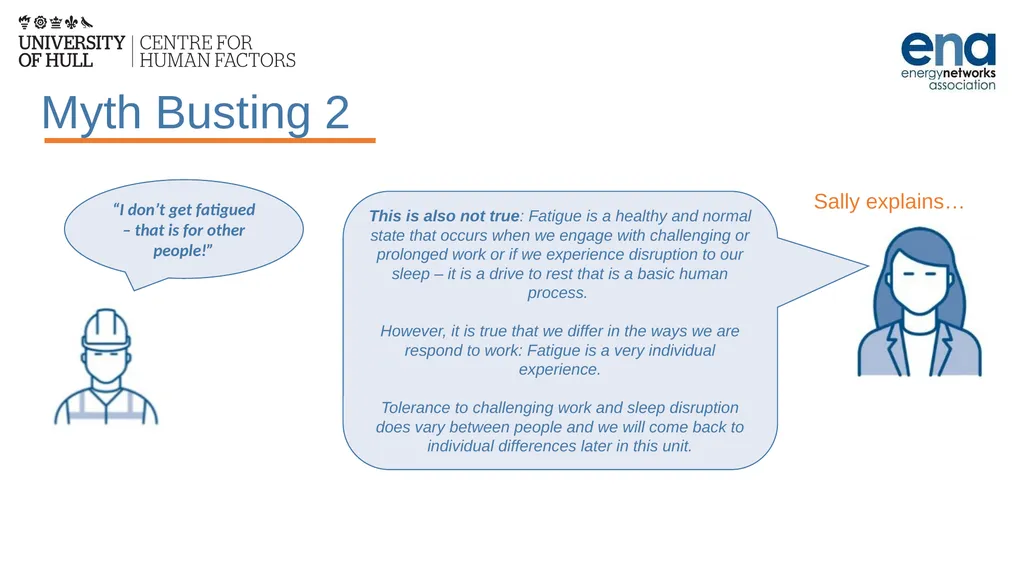
Sally explains… Myth Busting 2 “I don’t get fatigued – that is for other people!” This is also not true: Fatigue is a healthy and normal state that occurs when we engage with challenging or prolonged work or if we experience disruption to our sleep – it is a drive to rest that is a basic human process.
However, it is true that we differ in the ways we are respond to work: Fatigue is a very individual experience.
Tolerance to challenging work and sleep disruption does vary between people and we will come back to individual differences later in this unit.<br>
However, it is true that we differ in the ways we are respond to work: Fatigue is a very individual experience.
Tolerance to challenging work and sleep disruption does vary between people and we will come back to individual differences later in this unit.<br>
09
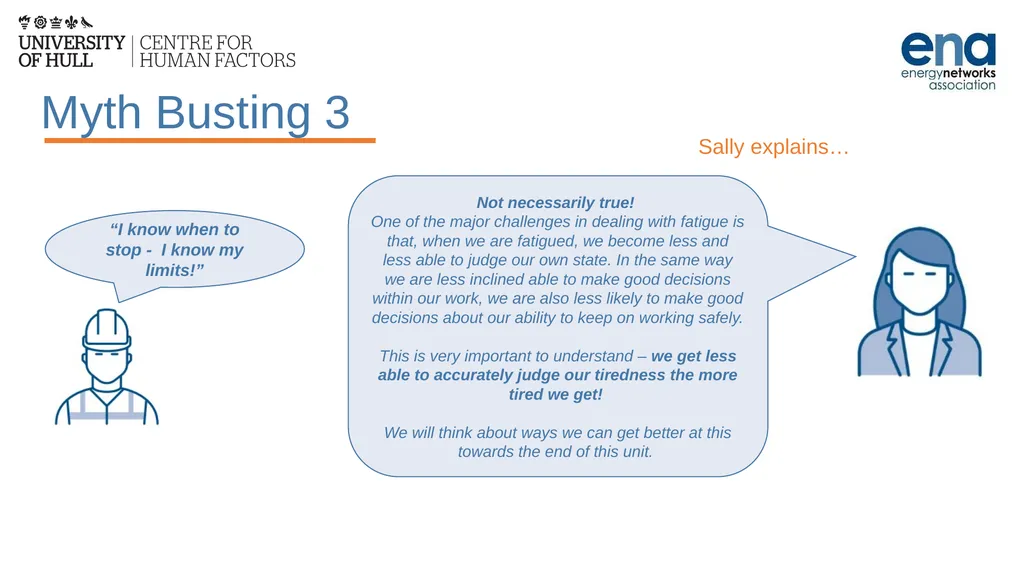
Sally explains… Myth Busting 3 “I know when to stop - I know my limits!” Not necessarily true!
One of the major challenges in dealing with fatigue is that, when we are fatigued, we become less and less able to judge our own state. In the same way we are less inclined able to make good decisions within our work, we are also less likely to make good decisions about our ability to keep on working safely.
This is very important to understand – we get less able to accurately judge our tiredness the more tired we get!
We will think about ways we can get better at this towards the end of this unit.<br>
One of the major challenges in dealing with fatigue is that, when we are fatigued, we become less and less able to judge our own state. In the same way we are less inclined able to make good decisions within our work, we are also less likely to make good decisions about our ability to keep on working safely.
This is very important to understand – we get less able to accurately judge our tiredness the more tired we get!
We will think about ways we can get better at this towards the end of this unit.<br>
10
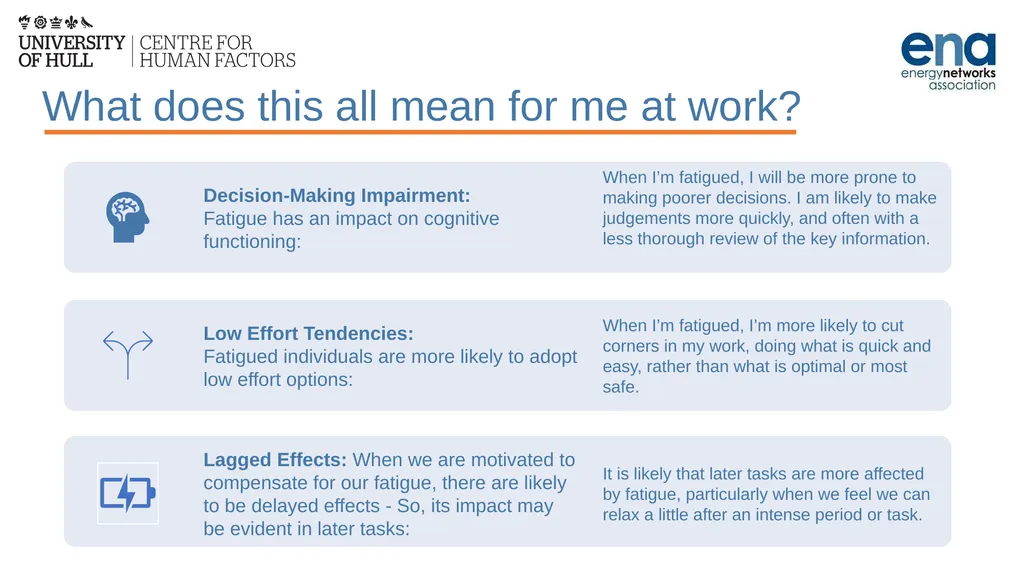
What does this all mean for me at work?<br>
11
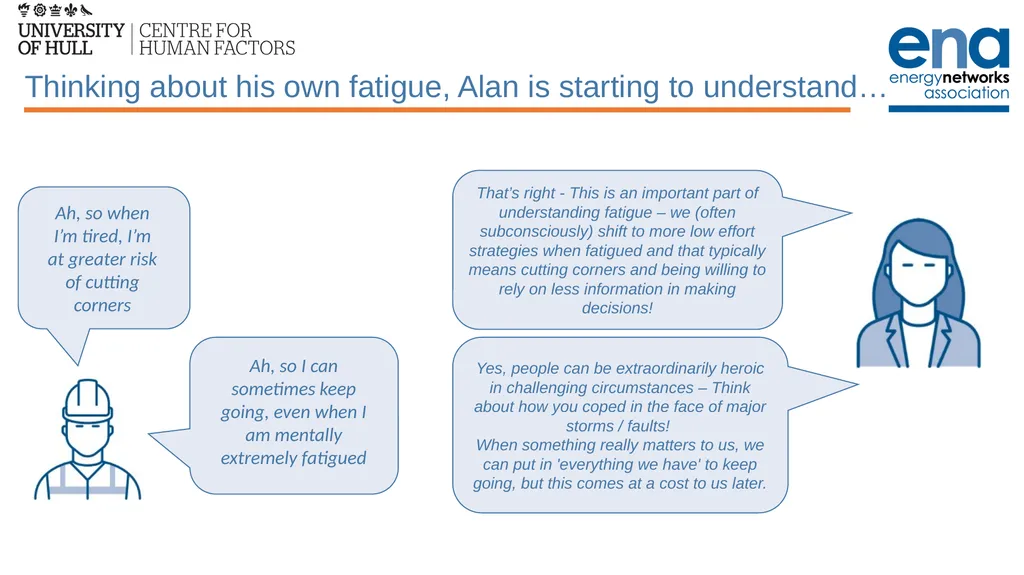
Thinking about his own fatigue, Alan is starting to understand… That’s right - This is an important part of understanding fatigue – we (often subconsciously) shift to more low effort strategies when fatigued and that typically means cutting corners and being willing to rely on less information in making decisions! Ah, so when I’m tired, I’m at greater risk of cutting corners Yes, people can be extraordinarily heroic in challenging circumstances – Think about how you coped in the face of major storms / faults!
When something really matters to us, we can put in 'everything we have' to keep going, but this comes at a cost to us later. Ah, so I can sometimes keep going, even when I am mentally extremely fatigued<br>
When something really matters to us, we can put in 'everything we have' to keep going, but this comes at a cost to us later. Ah, so I can sometimes keep going, even when I am mentally extremely fatigued<br>
12
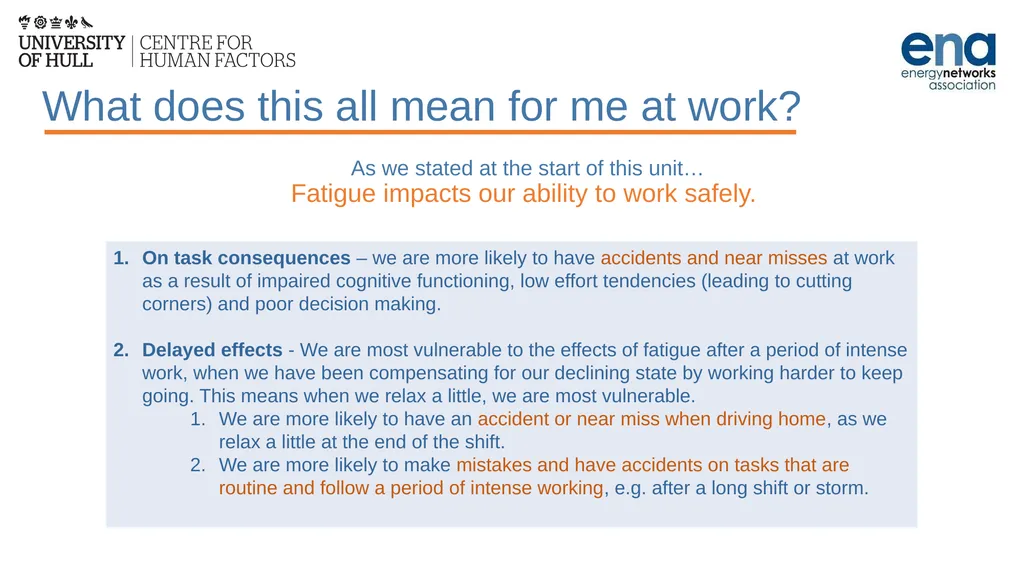
What does this all mean for me at work? As we stated at the start of this unit…
Fatigue impacts our ability to work safely. On task consequences – we are more likely to have accidents and near misses at work as a result of impaired cognitive functioning, low effort tendencies (leading to cutting corners) and poor decision making.
Delayed effects - We are most vulnerable to the effects of fatigue after a period of intense work, when we have been compensating for our declining state by working harder to keep going. This means when we relax a little, we are most vulnerable.
We are more likely to have an accident or near miss when driving home, as we relax a little at the end of the shift.
We are more likely to make mistakes and have accidents on tasks that are routine and follow a period of intense working, e.g. after a long shift or storm.<br>
Delayed effects - We are most vulnerable to the effects of fatigue after a period of intense work, when we have been compensating for our declining state by working harder to keep going. This means when we relax a little, we are most vulnerable.
We are more likely to have an accident or near miss when driving home, as we relax a little at the end of the shift.
We are more likely to make mistakes and have accidents on tasks that are routine and follow a period of intense working, e.g. after a long shift or storm.<br>
13
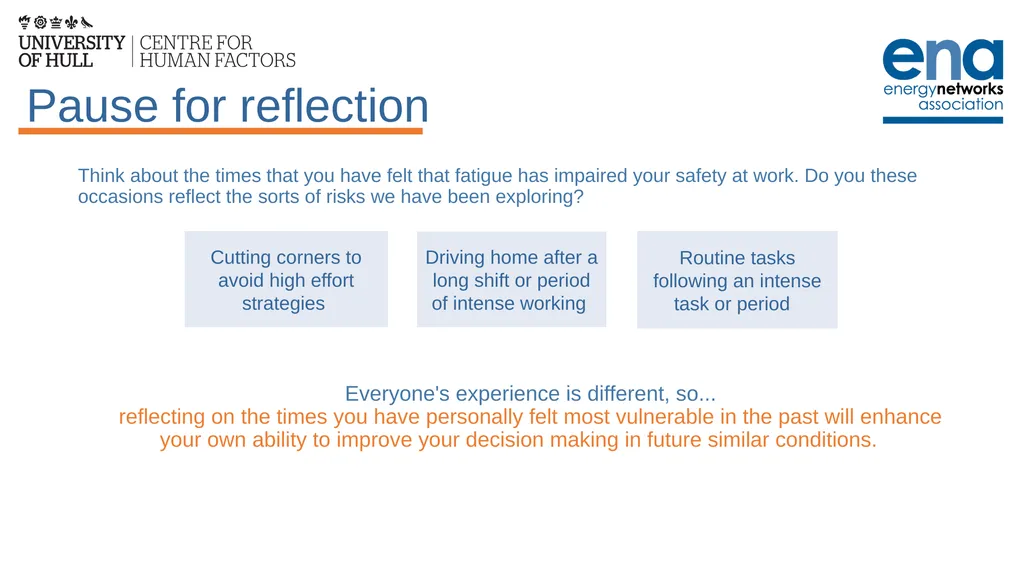
Think about the times that you have felt that fatigue has impaired your safety at work. Do you these occasions reflect the sorts of risks we have been exploring?
Everyone's experience is different, so... reflecting on the times you have personally felt most vulnerable in the past will enhance your own ability to improve your decision making in future similar conditions. Pause for reflection Cutting corners to avoid high effort strategies Driving home after a long shift or period of intense working Routine tasks following an intense task or period<br>
Everyone's experience is different, so... reflecting on the times you have personally felt most vulnerable in the past will enhance your own ability to improve your decision making in future similar conditions. Pause for reflection Cutting corners to avoid high effort strategies Driving home after a long shift or period of intense working Routine tasks following an intense task or period<br>
14
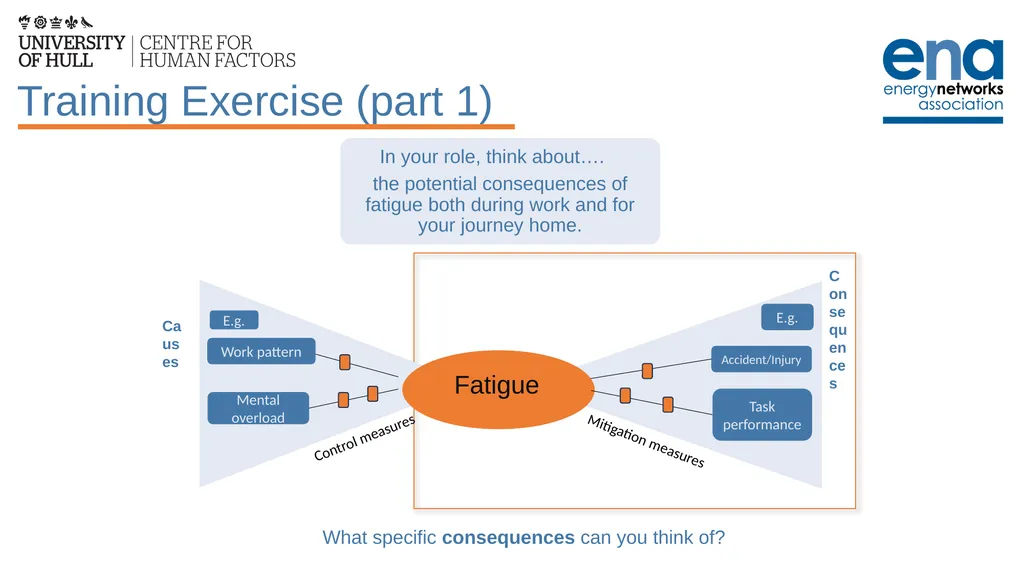
Training Exercise (part 1) Causes Consequences Fatigue Mental overload Accident/Injury Task performance Control measures E.g. E.g. Mitigation measures What specific consequences can you think of? Work pattern<br>
15
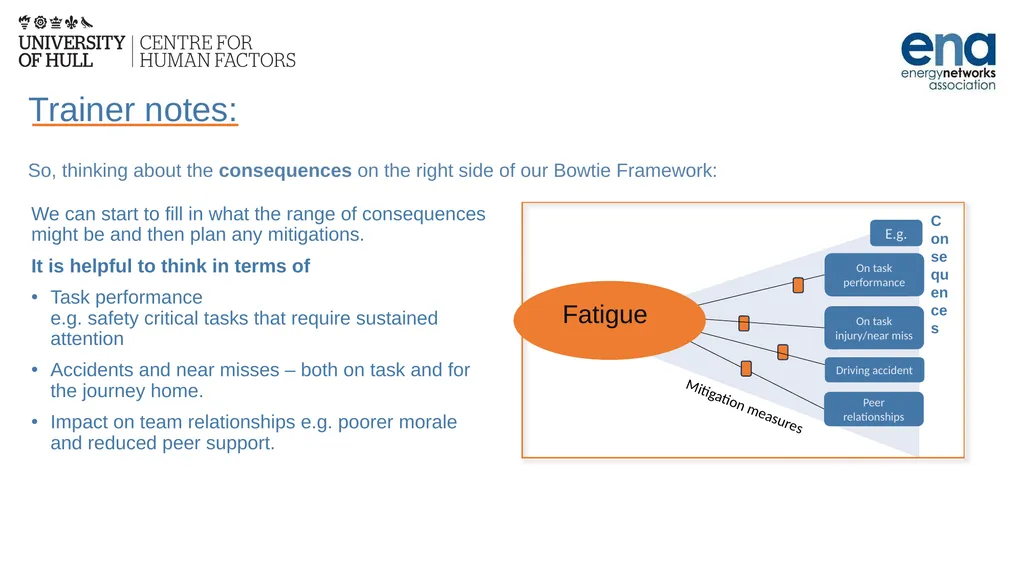
Trainer notes: Consequences On task injury/near miss Driving accident E.g. Mitigation measures We can start to fill in what the range of consequences might be and then plan any mitigations.
It is helpful to think in terms of
Task performance e.g. safety critical tasks that require sustained attention
Accidents and near misses – both on task and for the journey home.
Impact on team relationships e.g. poorer morale and reduced peer support. So, thinking about the consequences on the right side of our Bowtie Framework: On task performance Peer relationships Fatigue<br>
It is helpful to think in terms of
Task performance e.g. safety critical tasks that require sustained attention
Accidents and near misses – both on task and for the journey home.
Impact on team relationships e.g. poorer morale and reduced peer support. So, thinking about the consequences on the right side of our Bowtie Framework: On task performance Peer relationships Fatigue<br>
16
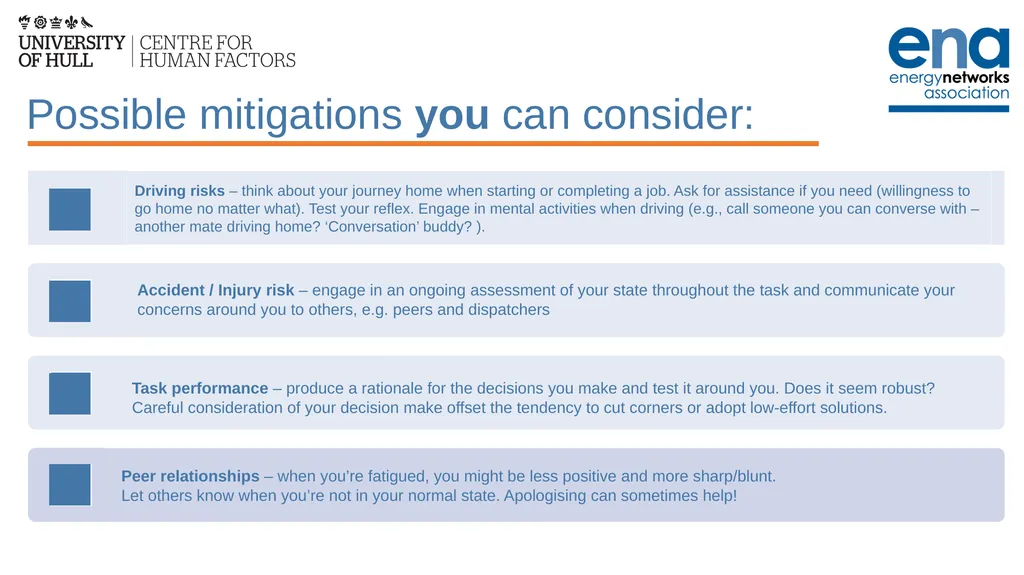
Possible mitigations you can consider:<br>
17
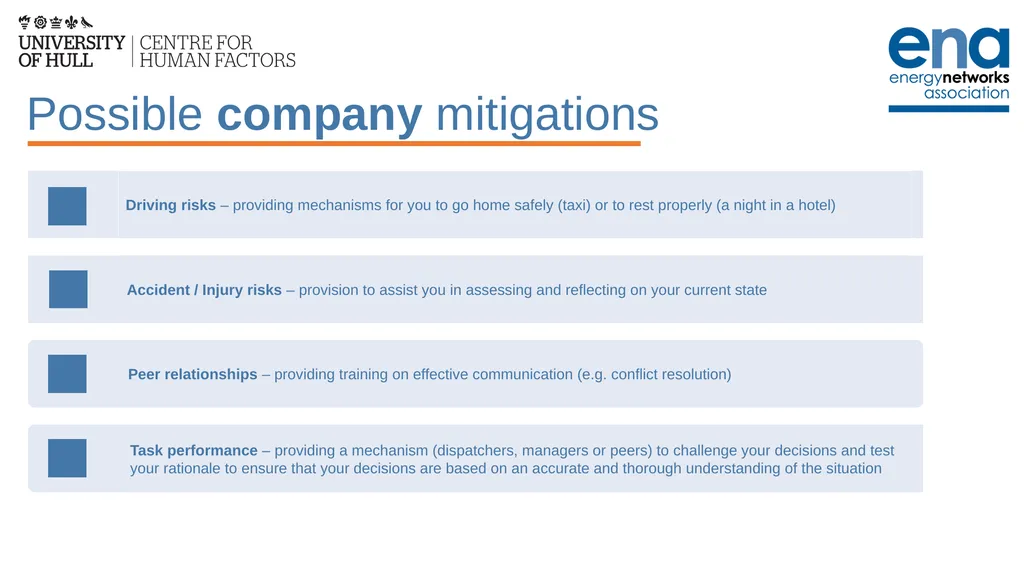
Possible company mitigations<br>
18
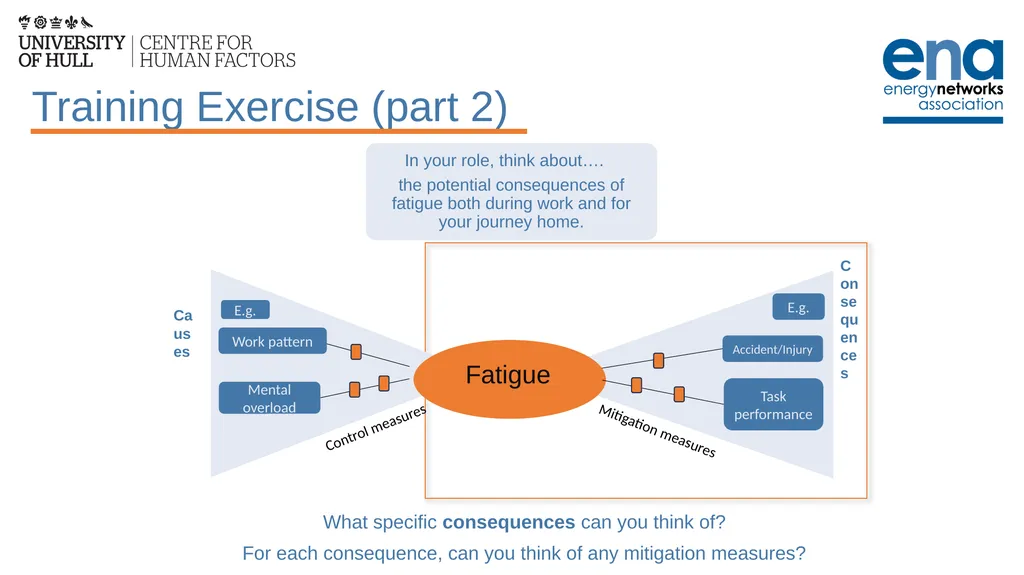
Training Exercise (part 2) Causes Consequences Fatigue Mental overload Accident/Injury Task performance Control measures E.g. E.g. Mitigation measures What specific consequences can you think of?
For each consequence, can you think of any mitigation measures? Work pattern<br>
For each consequence, can you think of any mitigation measures? Work pattern<br>
19
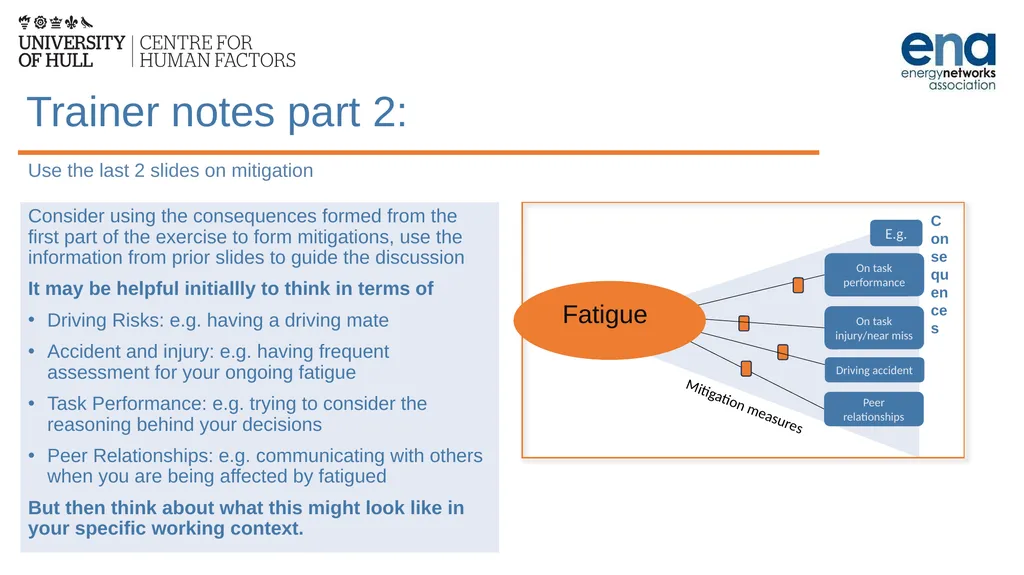
Trainer notes part 2: Consequences On task injury/near miss Driving accident E.g. Mitigation measures Consider using the consequences formed from the first part of the exercise to form mitigations, use the information from prior slides to guide the discussion
It may be helpful initiallly to think in terms of
Driving Risks: e.g. having a driving mate
Accident and injury: e.g. having frequent assessment for your ongoing fatigue
Task Performance: e.g. trying to consider the reasoning behind your decisions
Peer Relationships: e.g. communicating with others when you are being affected by fatigued
But then think about what this might look like in your specific working context. Use the last 2 slides on mitigation On task performance Peer relationships Fatigue<br>
It may be helpful initiallly to think in terms of
Driving Risks: e.g. having a driving mate
Accident and injury: e.g. having frequent assessment for your ongoing fatigue
Task Performance: e.g. trying to consider the reasoning behind your decisions
Peer Relationships: e.g. communicating with others when you are being affected by fatigued
But then think about what this might look like in your specific working context. Use the last 2 slides on mitigation On task performance Peer relationships Fatigue<br>
20
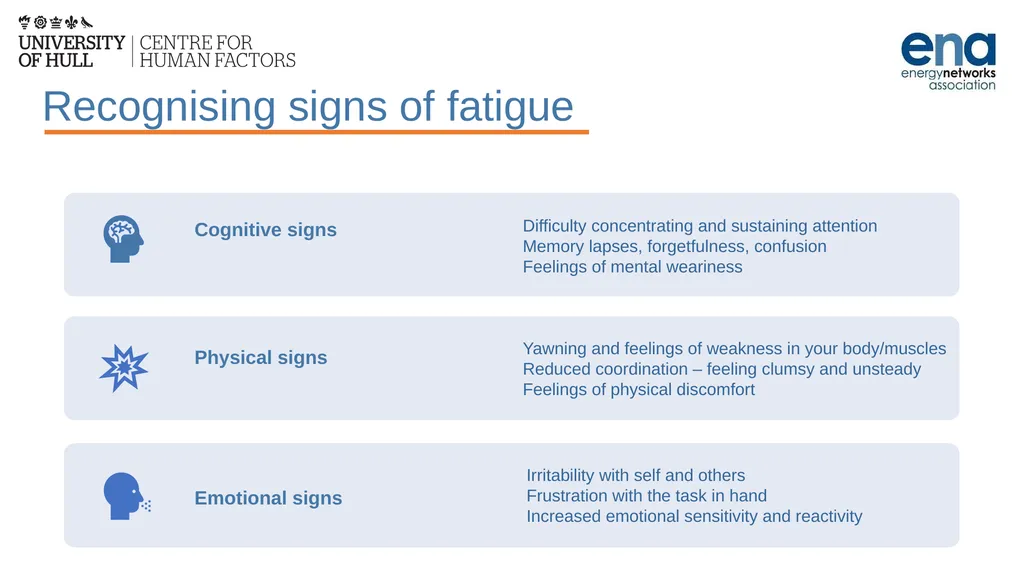
Recognising signs of fatigue Yawning and feelings of weakness in your body/muscles
Reduced coordination – feeling clumsy and unsteady
Feelings of physical discomfort Irritability with self and others
Frustration with the task in hand
Increased emotional sensitivity and reactivity<br>
Reduced coordination – feeling clumsy and unsteady
Feelings of physical discomfort Irritability with self and others
Frustration with the task in hand
Increased emotional sensitivity and reactivity<br>
21
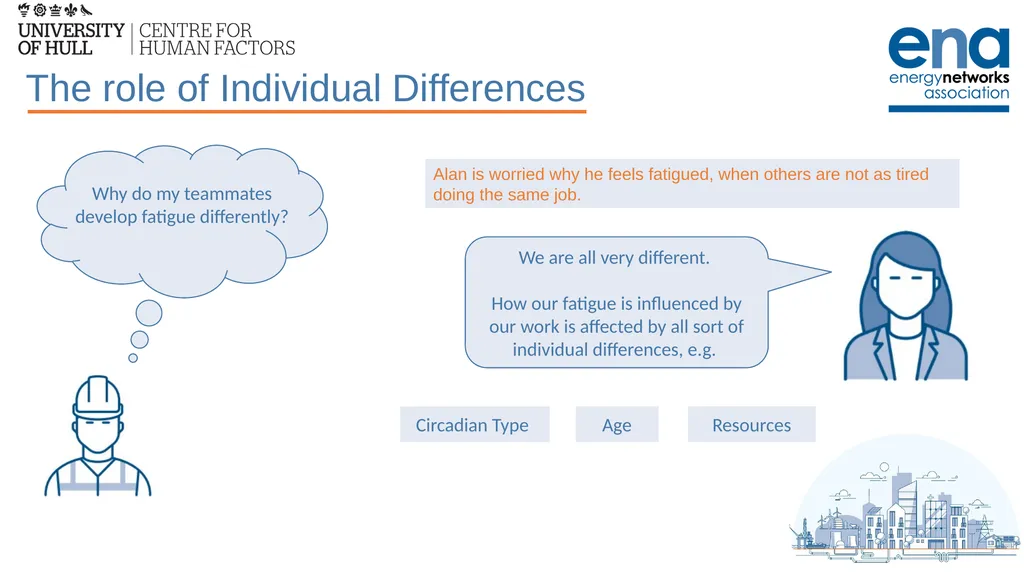
The role of Individual Differences We are all very different.
How our fatigue is influenced by our work is affected by all sort of individual differences, e.g. Alan is worried why he feels fatigued, when others are not as tired doing the same job. Why do my teammates develop fatigue differently? Circadian Type Age Resources<br>
22
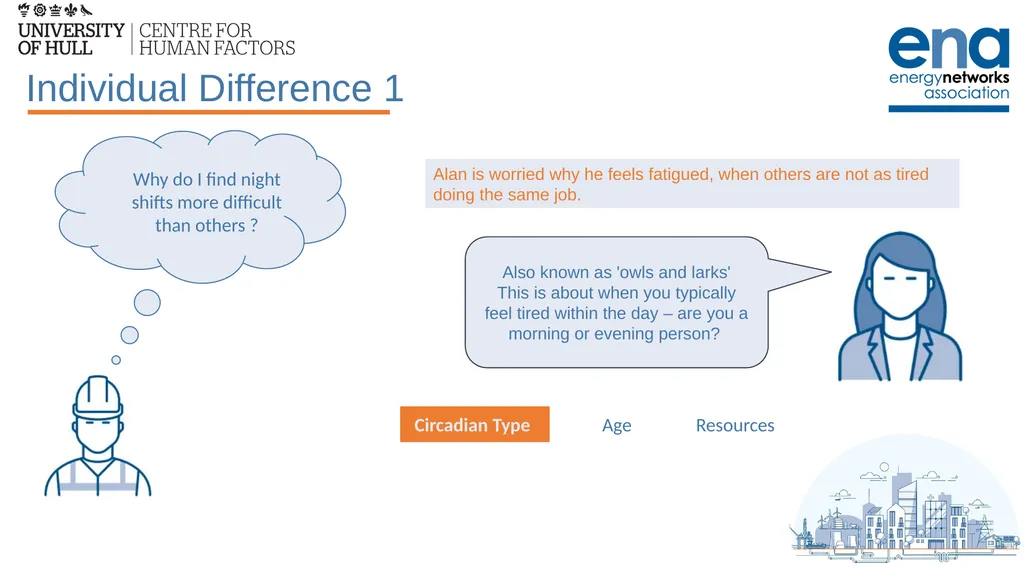
Individual Difference 1 Also known as 'owls and larks'
This is about when you typically feel tired within the day – are you a morning or evening person? Alan is worried why he feels fatigued, when others are not as tired doing the same job. Why do I find night shifts more difficult than others ? Circadian Type Age Resources<br>
This is about when you typically feel tired within the day – are you a morning or evening person? Alan is worried why he feels fatigued, when others are not as tired doing the same job. Why do I find night shifts more difficult than others ? Circadian Type Age Resources<br>
23
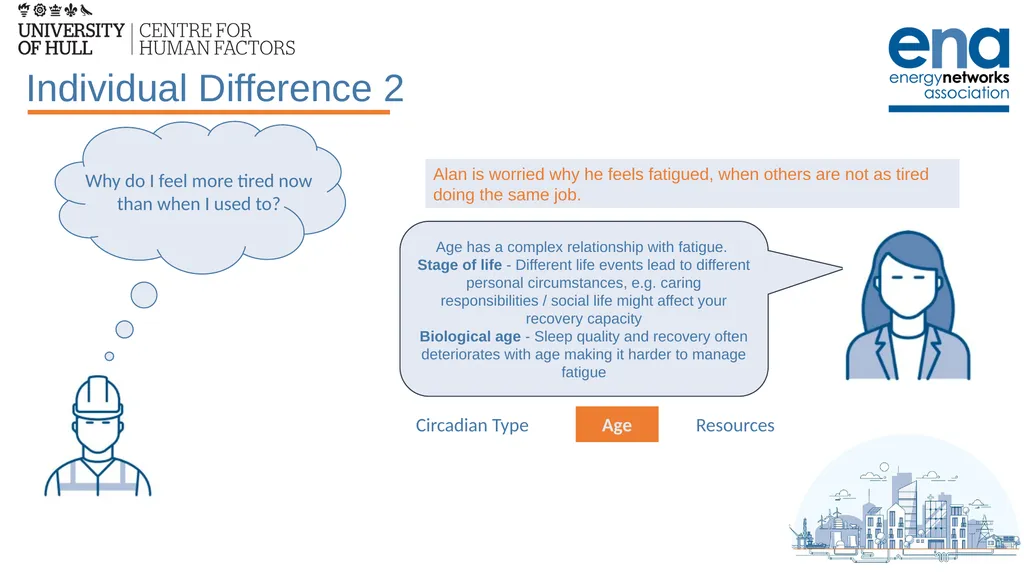
Individual Difference 2 Age has a complex relationship with fatigue.
Stage of life - Different life events lead to different personal circumstances, e.g. caring responsibilities / social life might affect your recovery capacity
Biological age - Sleep quality and recovery often deteriorates with age making it harder to manage fatigue Alan is worried why he feels fatigued, when others are not as tired doing the same job. Why do I feel more tired now than when I used to? Circadian Type Age Resources<br>
Biological age - Sleep quality and recovery often deteriorates with age making it harder to manage fatigue Alan is worried why he feels fatigued, when others are not as tired doing the same job. Why do I feel more tired now than when I used to? Circadian Type Age Resources<br>
24
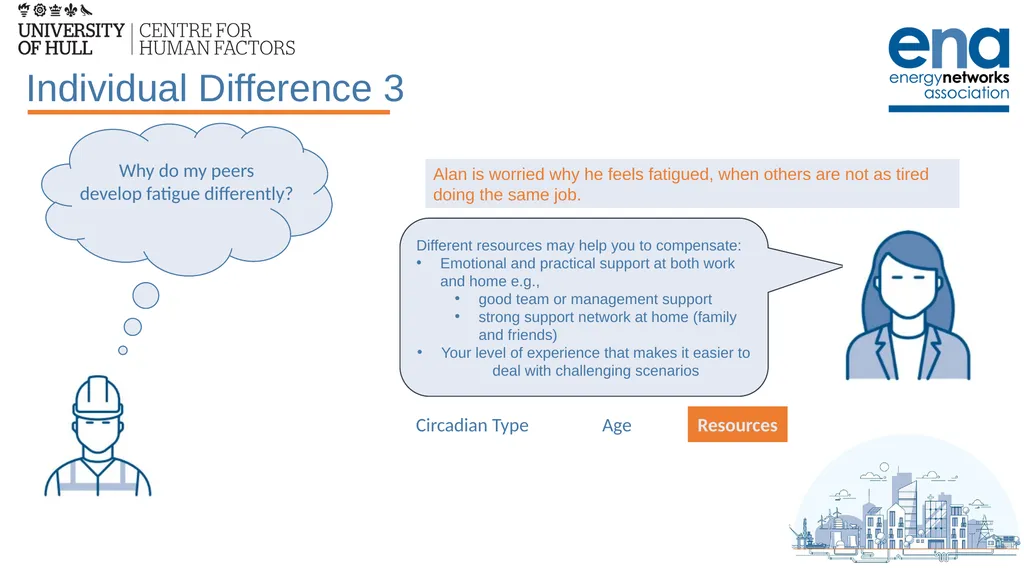
Individual Difference 3 Different resources may help you to compensate:
Emotional and practical support at both work and home e.g.,
good team or management support
strong support network at home (family and friends)
Your level of experience that makes it easier to deal with challenging scenarios Why do my peers develop fatigue differently? Circadian Type Age Resources Alan is worried why he feels fatigued, when others are not as tired doing the same job.<br>
Emotional and practical support at both work and home e.g.,
good team or management support
strong support network at home (family and friends)
Your level of experience that makes it easier to deal with challenging scenarios Why do my peers develop fatigue differently? Circadian Type Age Resources Alan is worried why he feels fatigued, when others are not as tired doing the same job.<br>
25
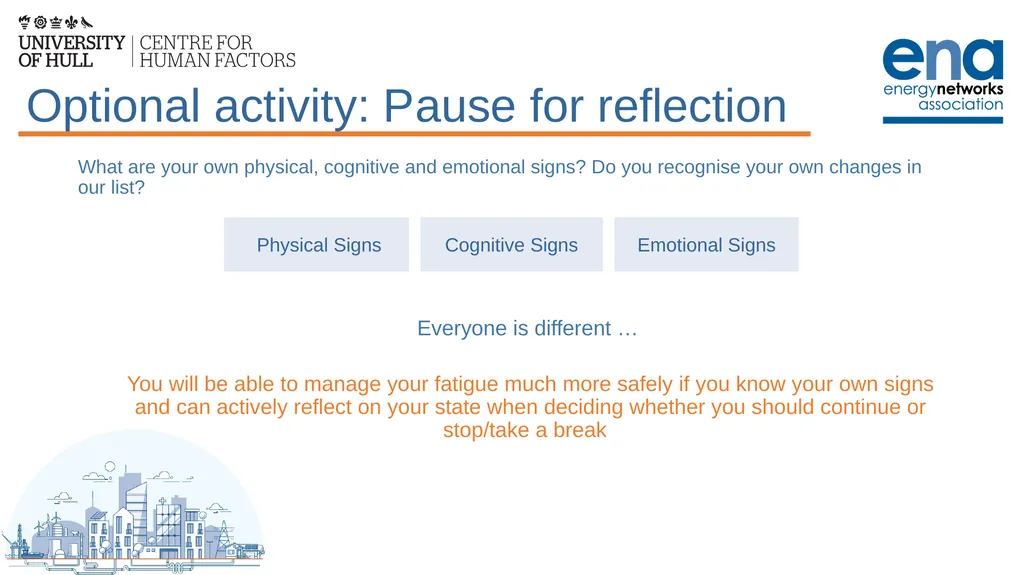
What are your own physical, cognitive and emotional signs? Do you recognise your own changes in our list?
Everyone is different …
You will be able to manage your fatigue much more safely if you know your own signs and can actively reflect on your state when deciding whether you should continue or stop/take a break Optional activity: Pause for reflection Physical Signs Cognitive Signs Emotional Signs<br>
Everyone is different …
You will be able to manage your fatigue much more safely if you know your own signs and can actively reflect on your state when deciding whether you should continue or stop/take a break Optional activity: Pause for reflection Physical Signs Cognitive Signs Emotional Signs<br>
26
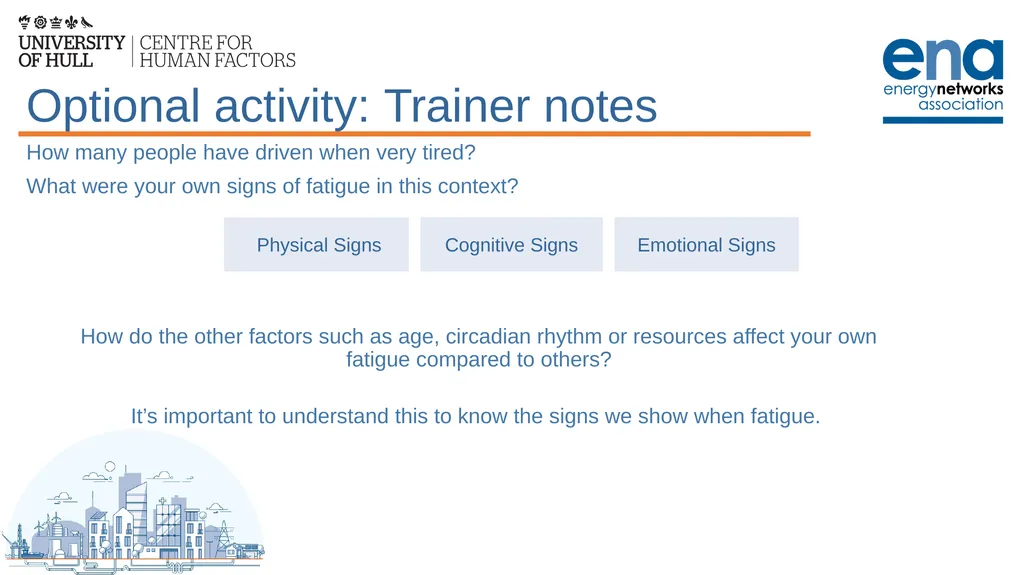
Optional activity: Trainer notes Physical Signs Cognitive Signs Emotional Signs How many people have driven when very tired?
What were your own signs of fatigue in this context?
How do the other factors such as age, circadian rhythm or resources affect your own fatigue compared to others?
It’s important to understand this to know the signs we show when fatigue.<br>
What were your own signs of fatigue in this context?
How do the other factors such as age, circadian rhythm or resources affect your own fatigue compared to others?
It’s important to understand this to know the signs we show when fatigue.<br>
27
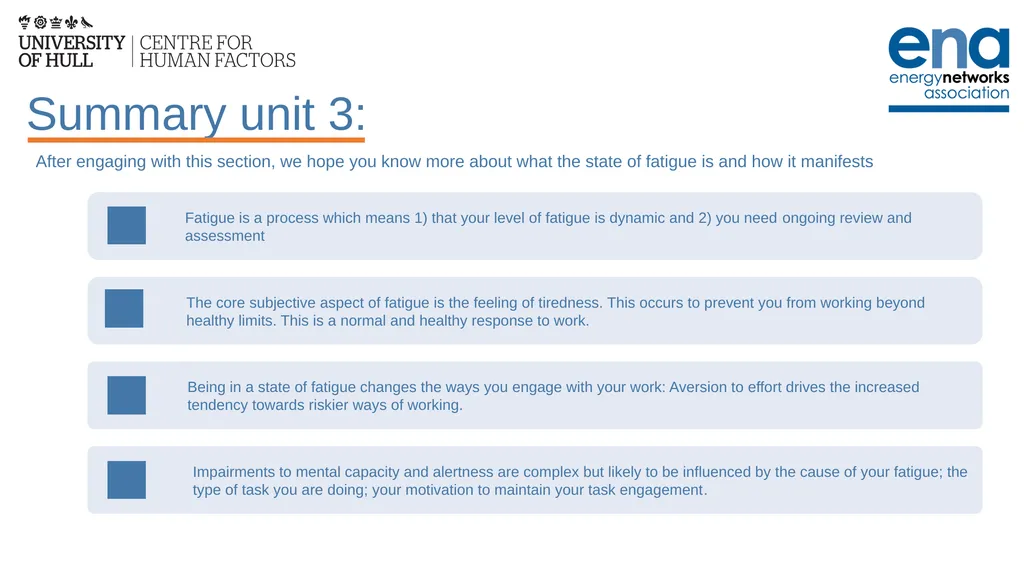
Summary unit 3: After engaging with this section, we hope you know more about what the state of fatigue is and how it manifests<br>
28
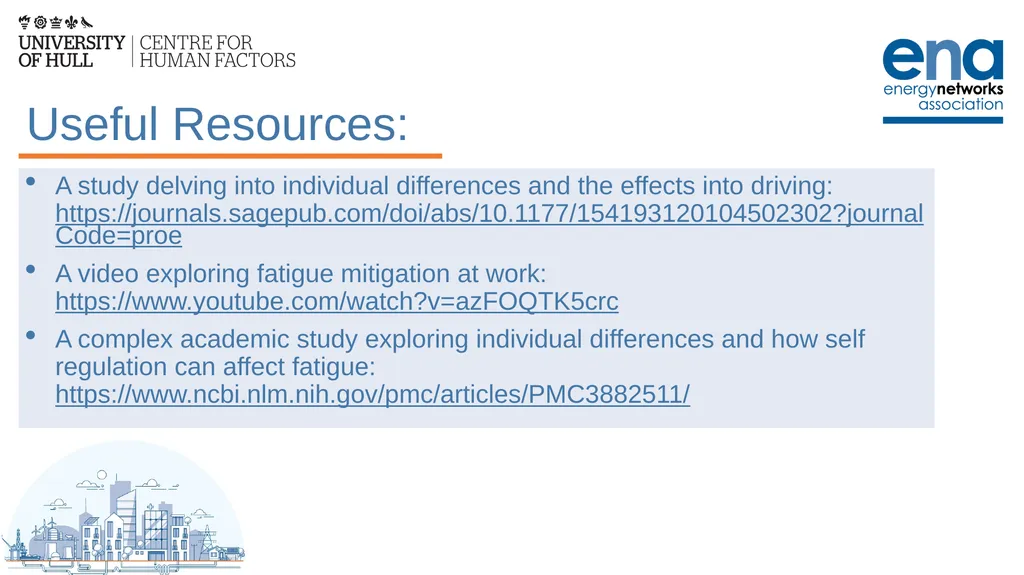
Useful Resources: A study delving into individual differences and the effects into driving: https://journals.sagepub.com/doi/abs/10.1177/154193120104502302?journalCode=proe
A video exploring fatigue mitigation at work: https://www.youtube.com/watch?v=azFOQTK5crc
A complex academic study exploring individual differences and how self regulation can affect fatigue: https://www.ncbi.nlm.nih.gov/pmc/articles/PMC3882511/<br>
A video exploring fatigue mitigation at work: https://www.youtube.com/watch?v=azFOQTK5crc
A complex academic study exploring individual differences and how self regulation can affect fatigue: https://www.ncbi.nlm.nih.gov/pmc/articles/PMC3882511/<br>
29
Prepared by:
Centre for Human Factors, University of Hull
Please contact humanfactors@hull.ac.uk if you have any questions about our work in fatigue
Copyright © 2024 Centre for Human Factors. All rights reserved<br>
Centre for Human Factors, University of Hull
Please contact humanfactors@hull.ac.uk if you have any questions about our work in fatigue
Copyright © 2024 Centre for Human Factors. All rights reserved<br>