
Introduction to Writing POGIL Learning Cycle
DJ
Published · 37 slides · 0 views
1 / 1
Description
Introduction to Writing POGIL Learning Cycle Activities Pat Ligon Broughton HS pligonwcpss.net or pligonnc.rr.com Pat Ligons website: http:pligon.scribnotes.com Sharon Winzeler swinzelncsu.edu POGIL.org February 22, 2014 Goals of
Related Topics
Share
Embed code
Download this presentation From Below
"Introduction to Writing POGIL Learning Cycle" is the property of its rightful owner. Permission is granted to download and print the materials on this website for personal, non-commercial use only, and to display it on your personal computer provided you do not modify the materials and that you retain all copyright notices contained in the materials. By downloading content from our website, you accept the terms of this agreement.
Presentation Transcript
01
Introduction to Writing POGIL Learning Cycle Activities Pat Ligon Broughton HS
pligon@wcpss.net or pligon@nc.rr.com
Pat Ligon’s website:
http://pligon.scribnotes.com/
Sharon Winzeler
swinzel@ncsu.edu
POGIL.org
February 22, 2014<br>
pligon@wcpss.net or pligon@nc.rr.com
Pat Ligon’s website:
http://pligon.scribnotes.com/
Sharon Winzeler
swinzel@ncsu.edu
POGIL.org
February 22, 2014<br>
02
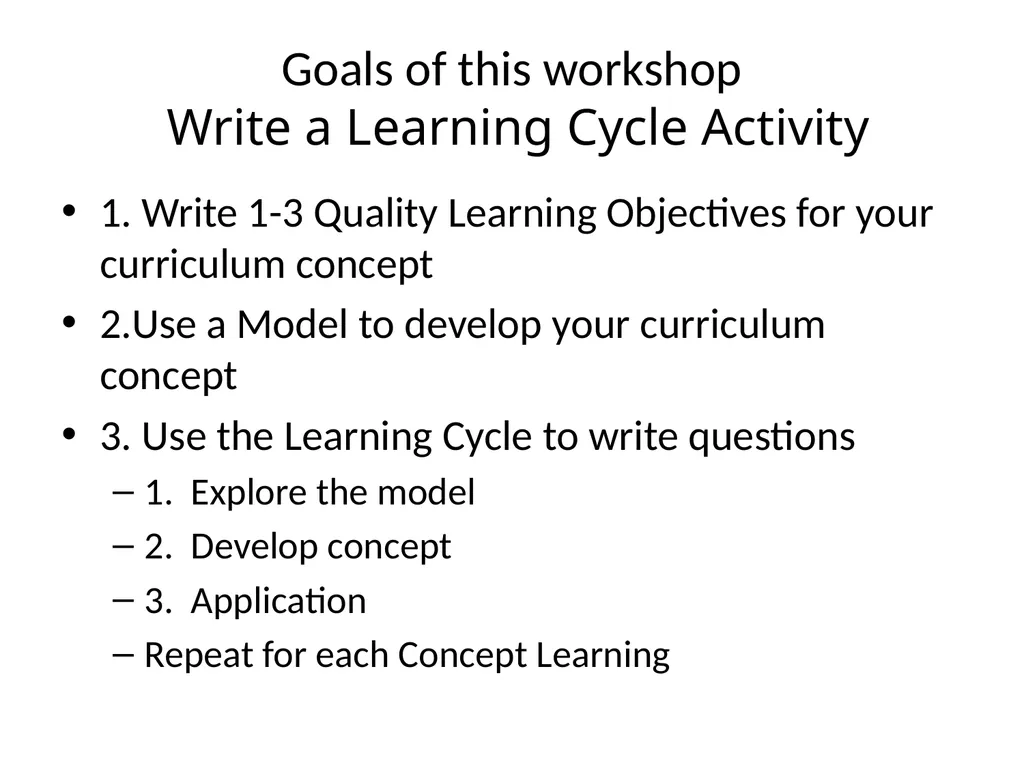
Goals of this workshop
Write a Learning Cycle Activity 1. Write 1-3 Quality Learning Objectives for your curriculum concept
2.Use a Model to develop your curriculum concept
3. Use the Learning Cycle to write questions
1. Explore the model
2. Develop concept
3. Application
Repeat for each Concept Learning<br>
2.Use a Model to develop your curriculum concept
3. Use the Learning Cycle to write questions
1. Explore the model
2. Develop concept
3. Application
Repeat for each Concept Learning<br>
03
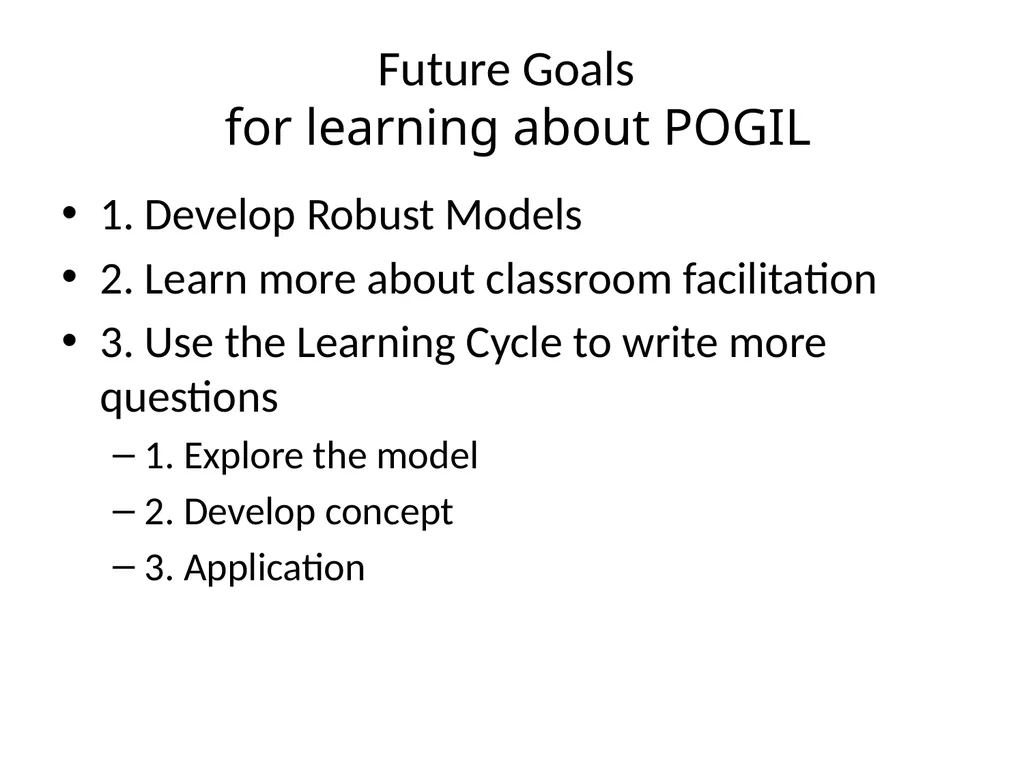
Future Goals
for learning about POGIL 1. Develop Robust Models
2. Learn more about classroom facilitation
3. Use the Learning Cycle to write more questions
1. Explore the model
2. Develop concept
3. Application<br>
2. Learn more about classroom facilitation
3. Use the Learning Cycle to write more questions
1. Explore the model
2. Develop concept
3. Application<br>
04
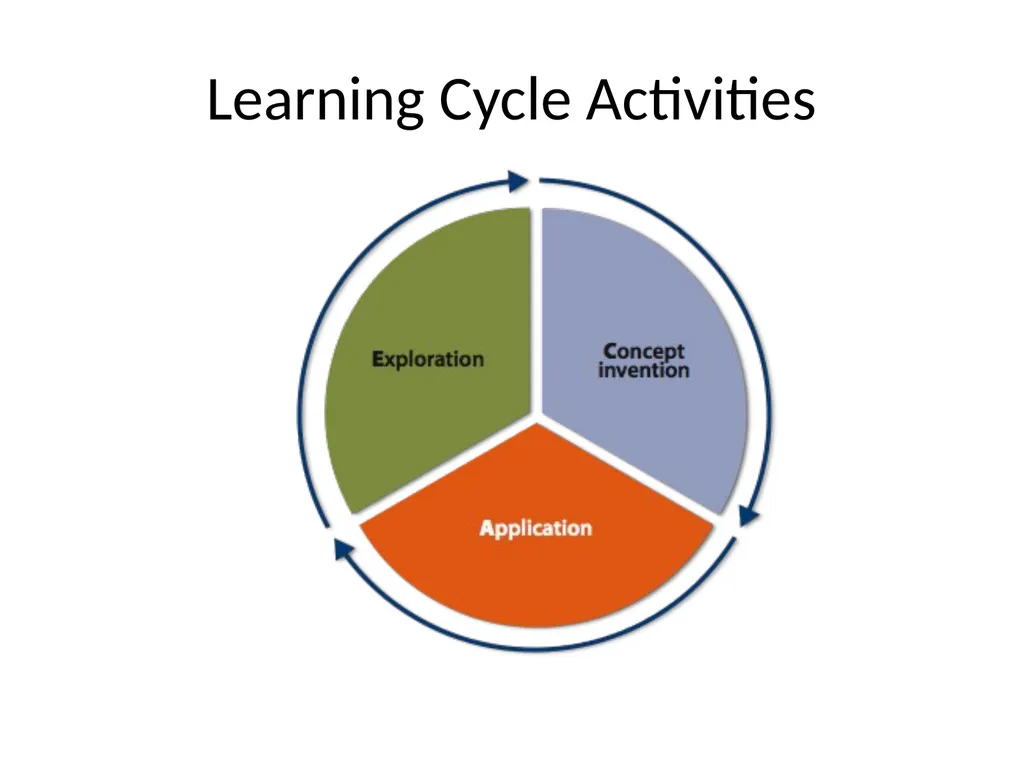
Learning Cycle Activities<br>
05
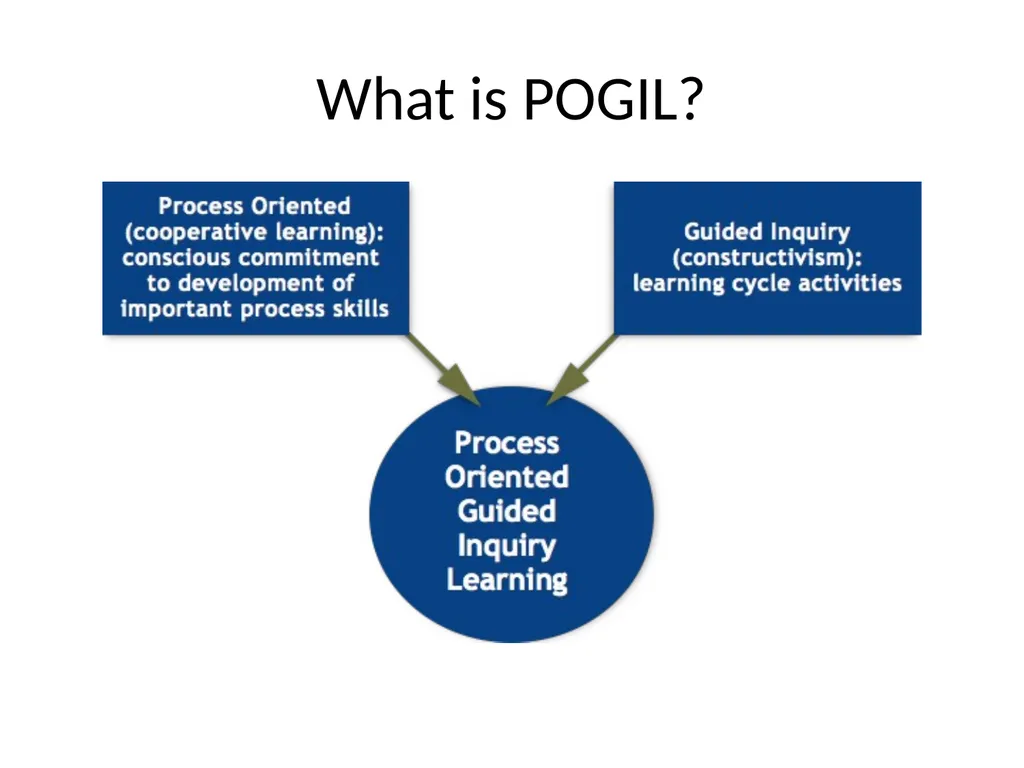
What is POGIL?<br>
06
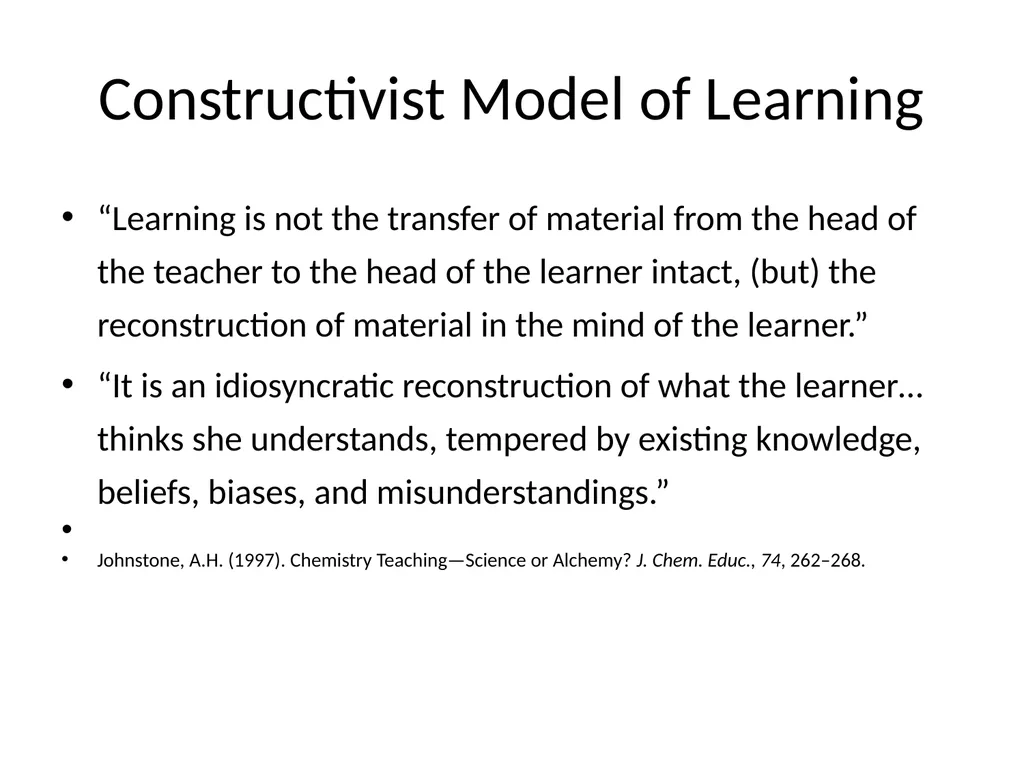
Constructivist Model of Learning “Learning is not the transfer of material from the head of the teacher to the head of the learner intact, (but) the reconstruction of material in the mind of the learner.”
“It is an idiosyncratic reconstruction of what the learner…thinks she understands, tempered by existing knowledge, beliefs, biases, and misunderstandings.”
Johnstone, A.H. (1997). Chemistry Teaching—Science or Alchemy? J. Chem. Educ., 74, 262–268.<br>
“It is an idiosyncratic reconstruction of what the learner…thinks she understands, tempered by existing knowledge, beliefs, biases, and misunderstandings.”
Johnstone, A.H. (1997). Chemistry Teaching—Science or Alchemy? J. Chem. Educ., 74, 262–268.<br>
07
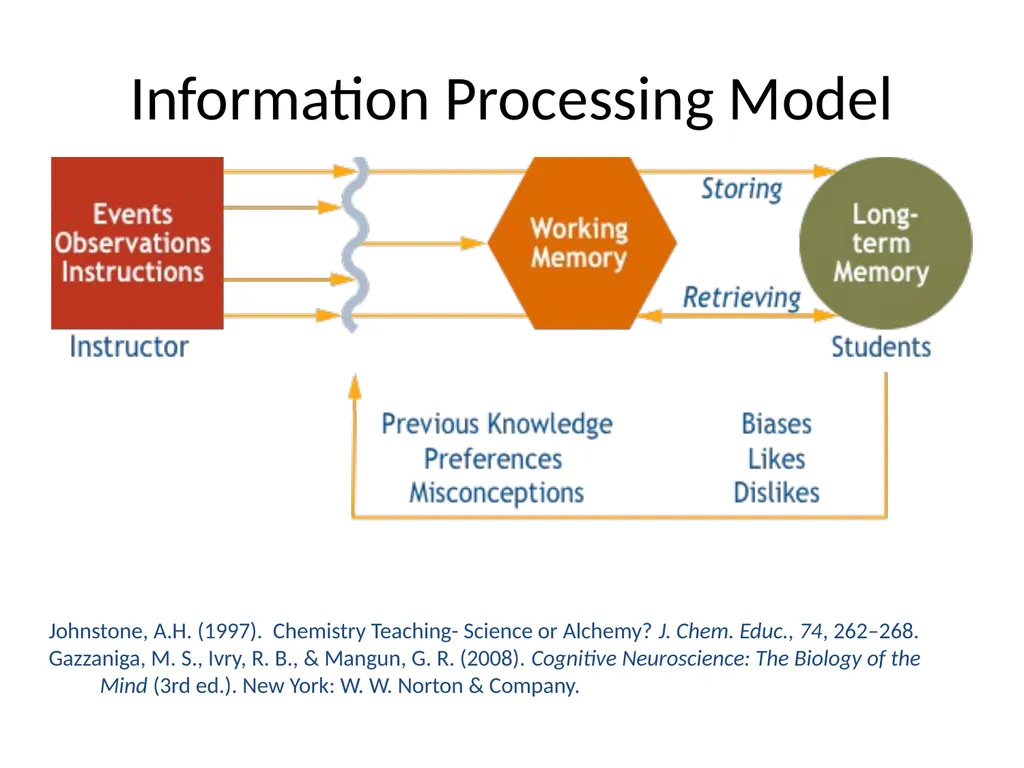
Information Processing Model Johnstone, A.H. (1997). Chemistry Teaching- Science or Alchemy? J. Chem. Educ., 74, 262–268.
Gazzaniga, M. S., Ivry, R. B., & Mangun, G. R. (2008). Cognitive Neuroscience: The Biology of the Mind (3rd ed.). New York: W. W. Norton & Company.<br>
Gazzaniga, M. S., Ivry, R. B., & Mangun, G. R. (2008). Cognitive Neuroscience: The Biology of the Mind (3rd ed.). New York: W. W. Norton & Company.<br>
08
Models One Model is used for each learning objective
Models can be:
Pictures
Maps
Graphs
Data tables
Images that represent the objective<br>
Models can be:
Pictures
Maps
Graphs
Data tables
Images that represent the objective<br>
09
Explore the Structure of a POGIL Activity By Mapping Questions Instructions:
As a group, you have completed the “DNA Structure” activity, your group will map the questions in the activity by identifying which questions are EIA.
Before identifying the question types, you will see examples of what these types of questions are:
1. Exploratory - explore the model
2. Concept Invention – develop a concept
3. Application – apply the concept<br>
As a group, you have completed the “DNA Structure” activity, your group will map the questions in the activity by identifying which questions are EIA.
Before identifying the question types, you will see examples of what these types of questions are:
1. Exploratory - explore the model
2. Concept Invention – develop a concept
3. Application – apply the concept<br>
10
#1 Exploratory Questions What are the three different units of length used
in the Model?
What type of bacteria is found on this plate?
Where on the map in Model 1 is Rome?
What is the area of a circle with a radius of 3.5 cm?<br>
in the Model?
What type of bacteria is found on this plate?
Where on the map in Model 1 is Rome?
What is the area of a circle with a radius of 3.5 cm?<br>
11
#2 Concept Development Questions Convergent – Concept Development
Which molecule in the list would you predict to have the highest boiling point?
What evidence do you have to support your conclusion?
What is the mathematical relationship represented by the data points on the graph?
What happened in Rome in 17__?”<br>
Which molecule in the list would you predict to have the highest boiling point?
What evidence do you have to support your conclusion?
What is the mathematical relationship represented by the data points on the graph?
What happened in Rome in 17__?”<br>
12
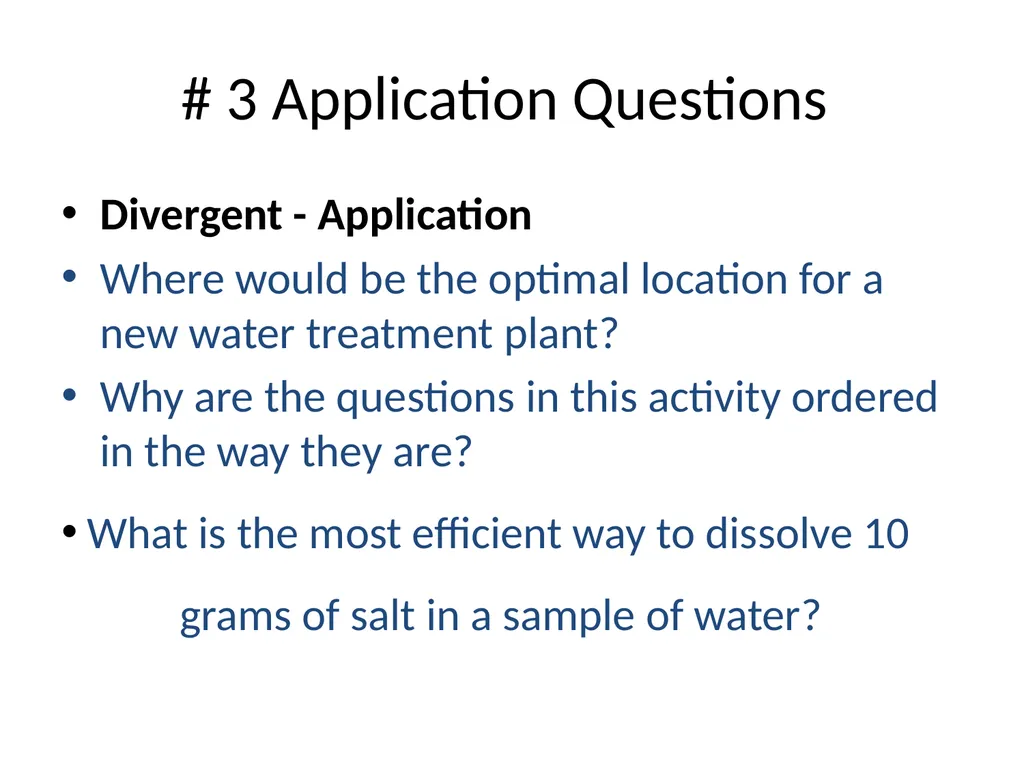
# 3 Application Questions Divergent - Application
Where would be the optimal location for a new water treatment plant?
Why are the questions in this activity ordered in the way they are?
What is the most efficient way to dissolve 10 grams of salt in a sample of water?<br>
Where would be the optimal location for a new water treatment plant?
Why are the questions in this activity ordered in the way they are?
What is the most efficient way to dissolve 10 grams of salt in a sample of water?<br>
13
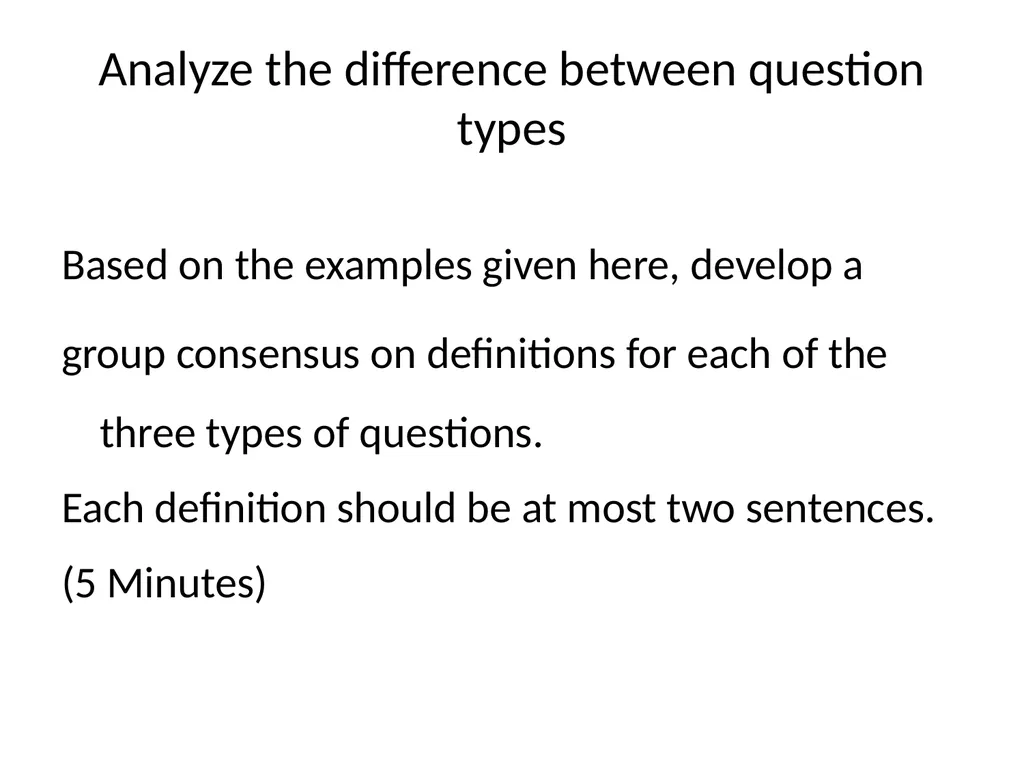
Analyze the difference between question types Based on the examples given here, develop a
group consensus on definitions for each of the three types of questions.
Each definition should be at most two sentences.
(5 Minutes)<br>
group consensus on definitions for each of the three types of questions.
Each definition should be at most two sentences.
(5 Minutes)<br>
14
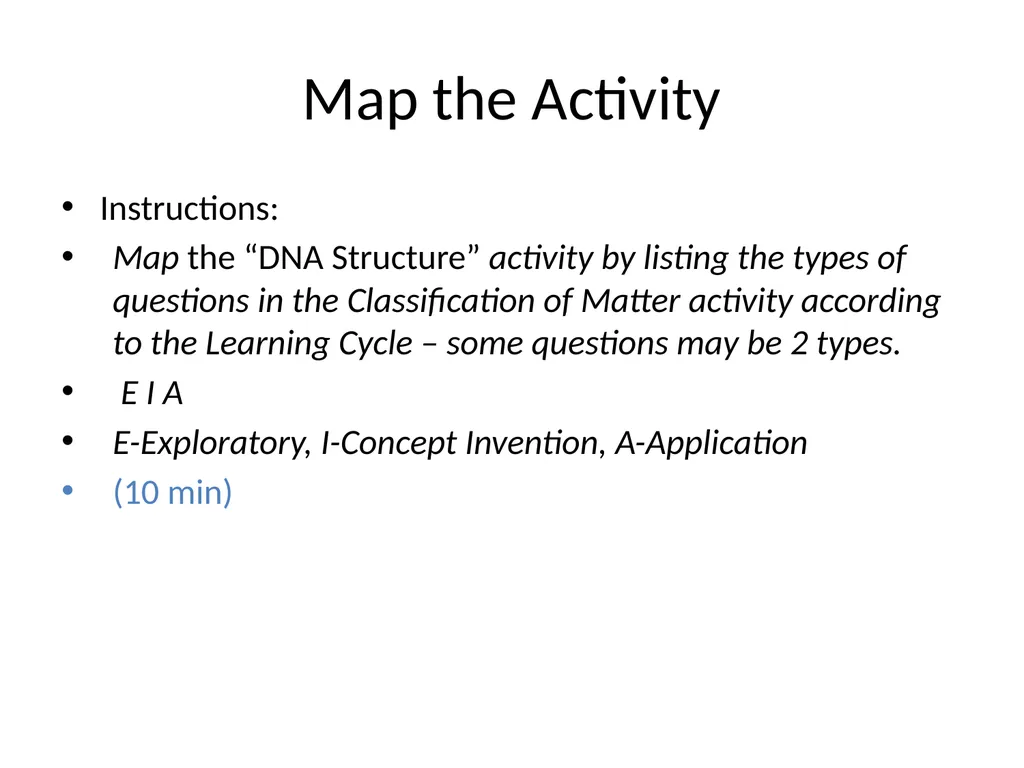
Map the Activity Instructions:
Map the “DNA Structure” activity by listing the types of questions in the Classification of Matter activity according to the Learning Cycle – some questions may be 2 types.
E I A
E-Exploratory, I-Concept Invention, A-Application
(10 min)<br>
Map the “DNA Structure” activity by listing the types of questions in the Classification of Matter activity according to the Learning Cycle – some questions may be 2 types.
E I A
E-Exploratory, I-Concept Invention, A-Application
(10 min)<br>
15
Reporting Out
question 1 Think about these questions:
Does this activity follow the Learning Cycle (EIA) repeating with each model?<br>
Does this activity follow the Learning Cycle (EIA) repeating with each model?<br>
16
Question 2 To what extent is there agreement about the assignments of the phases of the Learning Cycle (EIA)?<br>
17
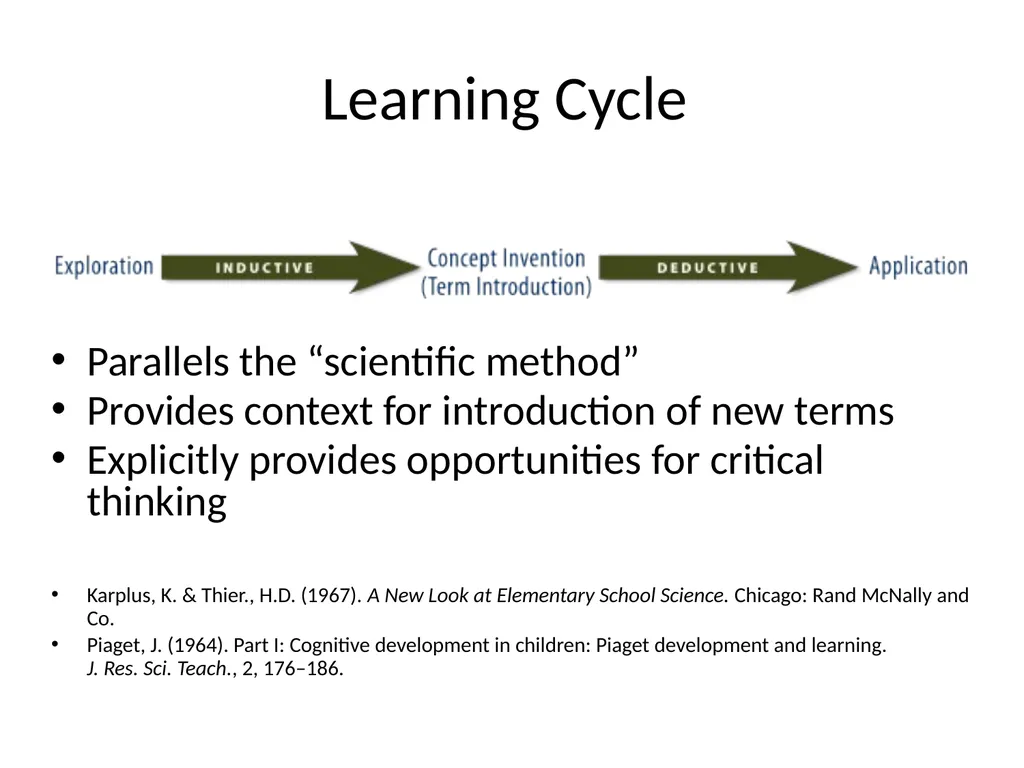
Learning Cycle Parallels the “scientific method”
Provides context for introduction of new terms
Explicitly provides opportunities for critical thinking
Karplus, K. & Thier., H.D. (1967). A New Look at Elementary School Science. Chicago: Rand McNally and Co.
Piaget, J. (1964). Part I: Cognitive development in children: Piaget development and learning. J. Res. Sci. Teach., 2, 176–186.<br>
Provides context for introduction of new terms
Explicitly provides opportunities for critical thinking
Karplus, K. & Thier., H.D. (1967). A New Look at Elementary School Science. Chicago: Rand McNally and Co.
Piaget, J. (1964). Part I: Cognitive development in children: Piaget development and learning. J. Res. Sci. Teach., 2, 176–186.<br>
18
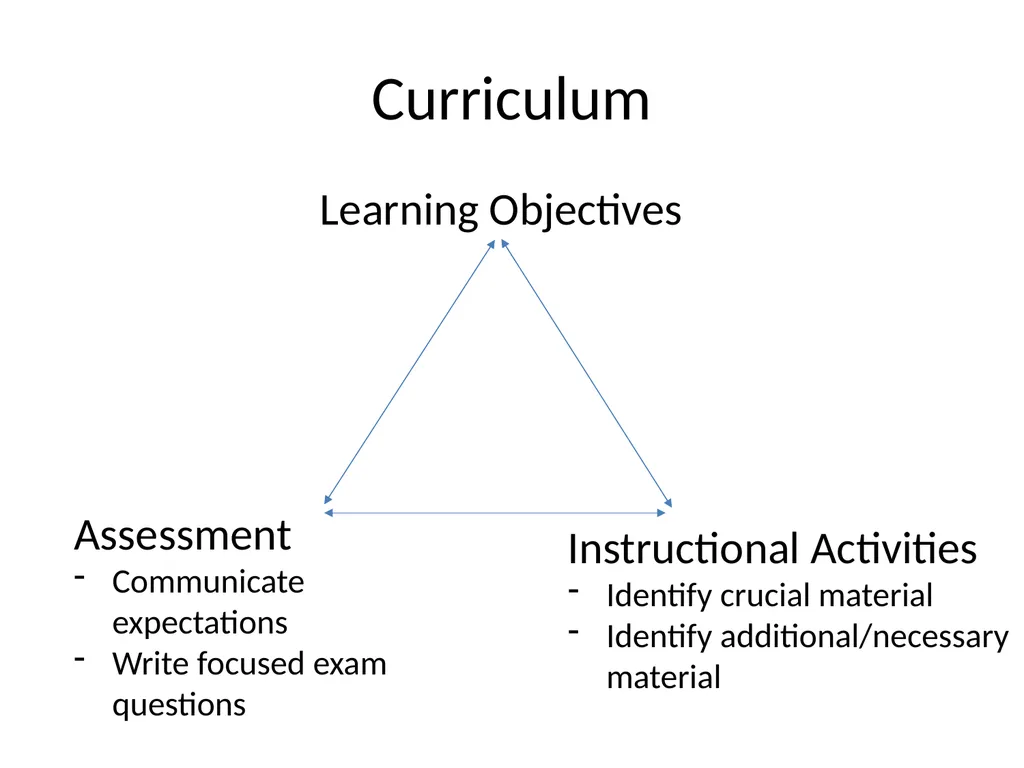
Curriculum Learning Objectives Assessment
Communicate expectations
Write focused exam questions Instructional Activities
Identify crucial material
Identify additional/necessary material<br>
Communicate expectations
Write focused exam questions Instructional Activities
Identify crucial material
Identify additional/necessary material<br>
19
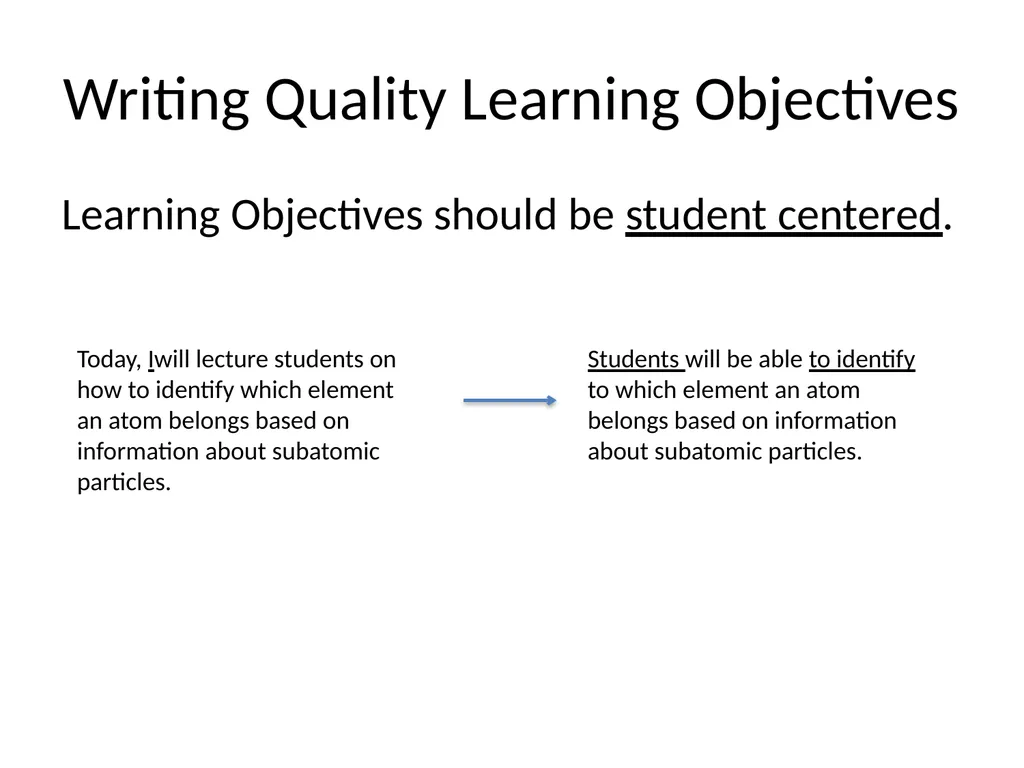
Writing Quality Learning Objectives Learning Objectives should be student centered. Today, Iwill lecture students on how to identify which element an atom belongs based on information about subatomic particles. Students will be able to identify to which element an atom belongs based on information about subatomic particles.<br>
20
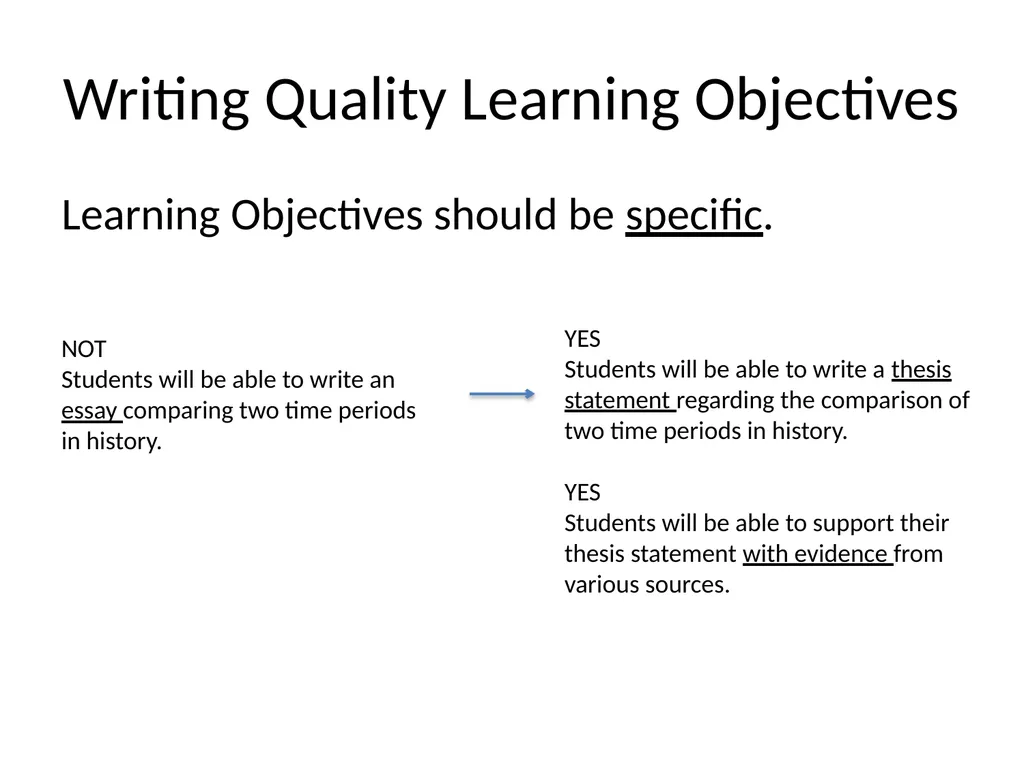
Writing Quality Learning Objectives Learning Objectives should be specific. NOT
Students will be able to write an essay comparing two time periods in history. YES
Students will be able to write a thesis statement regarding the comparison of two time periods in history.
YES
Students will be able to support their thesis statement with evidence from various sources.<br>
Students will be able to write an essay comparing two time periods in history. YES
Students will be able to write a thesis statement regarding the comparison of two time periods in history.
YES
Students will be able to support their thesis statement with evidence from various sources.<br>
21
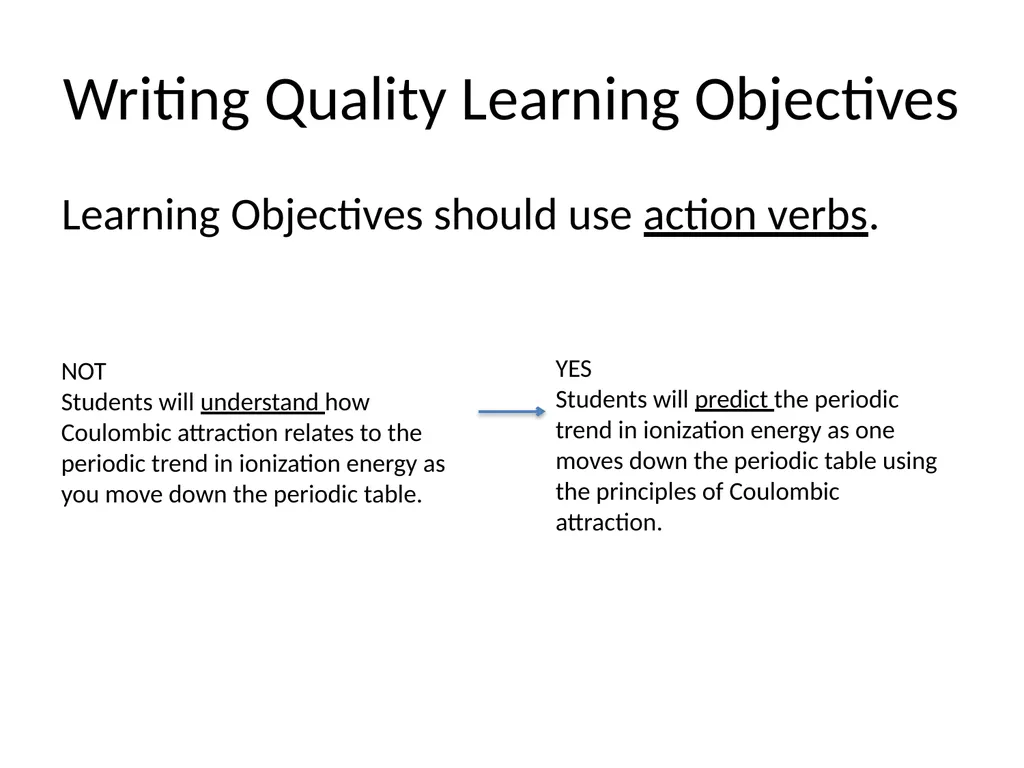
Writing Quality Learning Objectives Learning Objectives should use action verbs. NOT
Students will understand how Coulombic attraction relates to the periodic trend in ionization energy as you move down the periodic table. YES
Students will predict the periodic trend in ionization energy as one moves down the periodic table using the principles of Coulombic attraction.<br>
Students will understand how Coulombic attraction relates to the periodic trend in ionization energy as you move down the periodic table. YES
Students will predict the periodic trend in ionization energy as one moves down the periodic table using the principles of Coulombic attraction.<br>
22
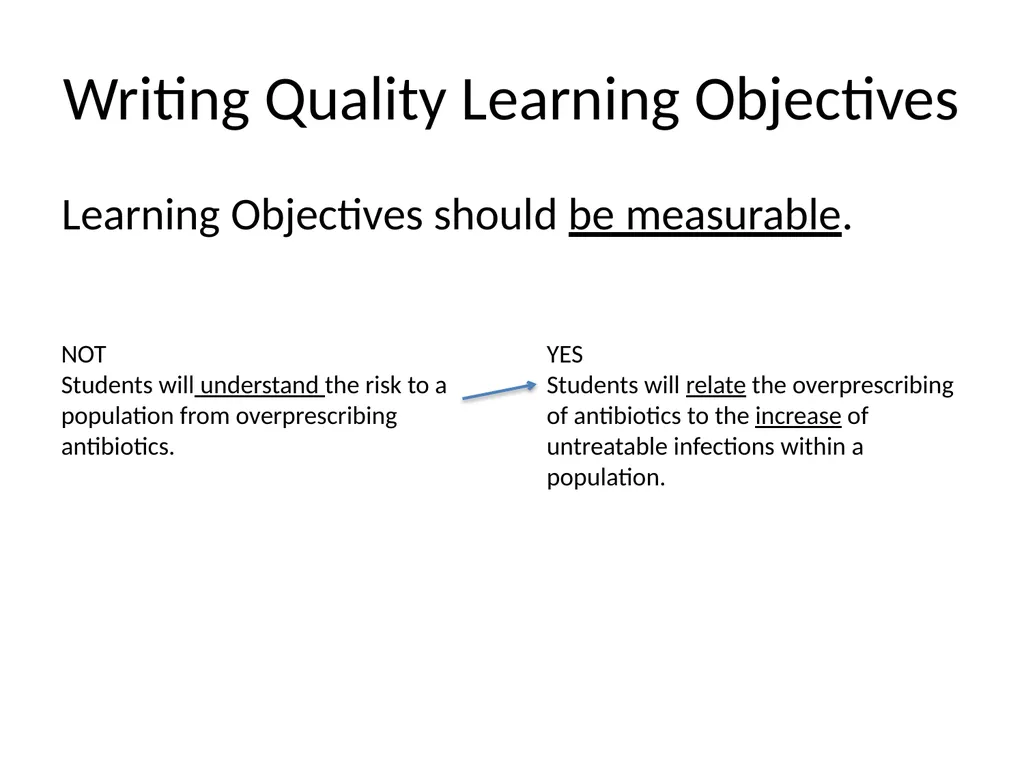
Writing Quality Learning Objectives Learning Objectives should be measurable. NOT
Students will understand the risk to a population from overprescribing antibiotics. YES
Students will relate the overprescribing of antibiotics to the increase of untreatable infections within a population.<br>
Students will understand the risk to a population from overprescribing antibiotics. YES
Students will relate the overprescribing of antibiotics to the increase of untreatable infections within a population.<br>
23
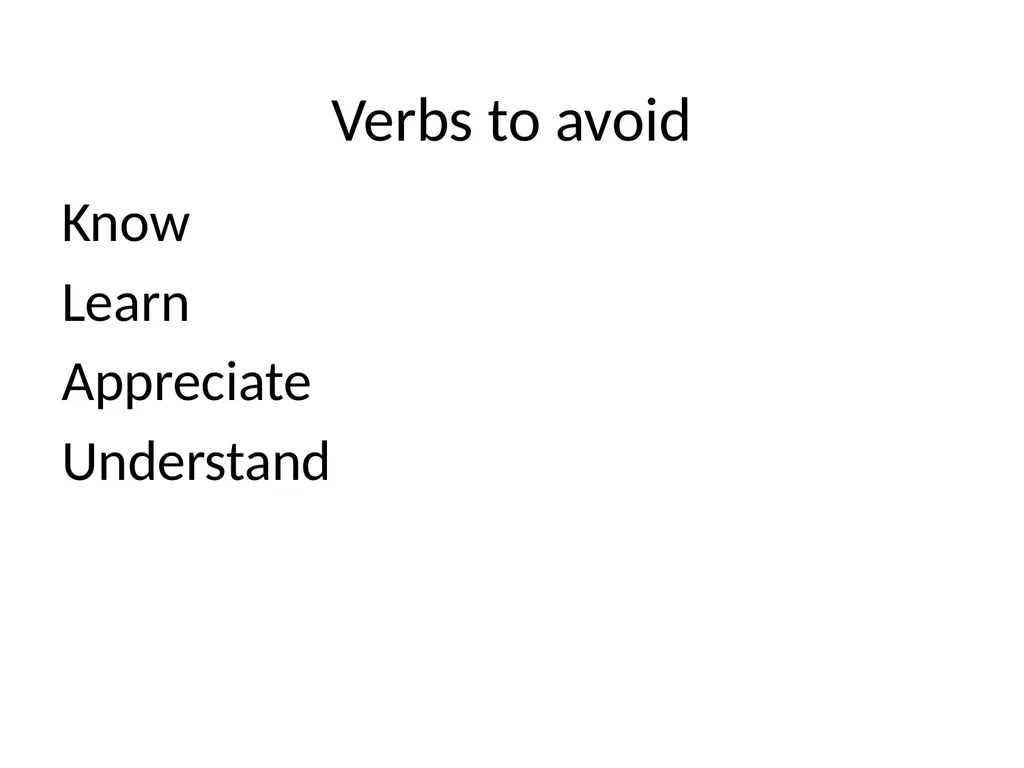
Verbs to avoid Know
Learn
Appreciate
Understand<br>
Learn
Appreciate
Understand<br>
24
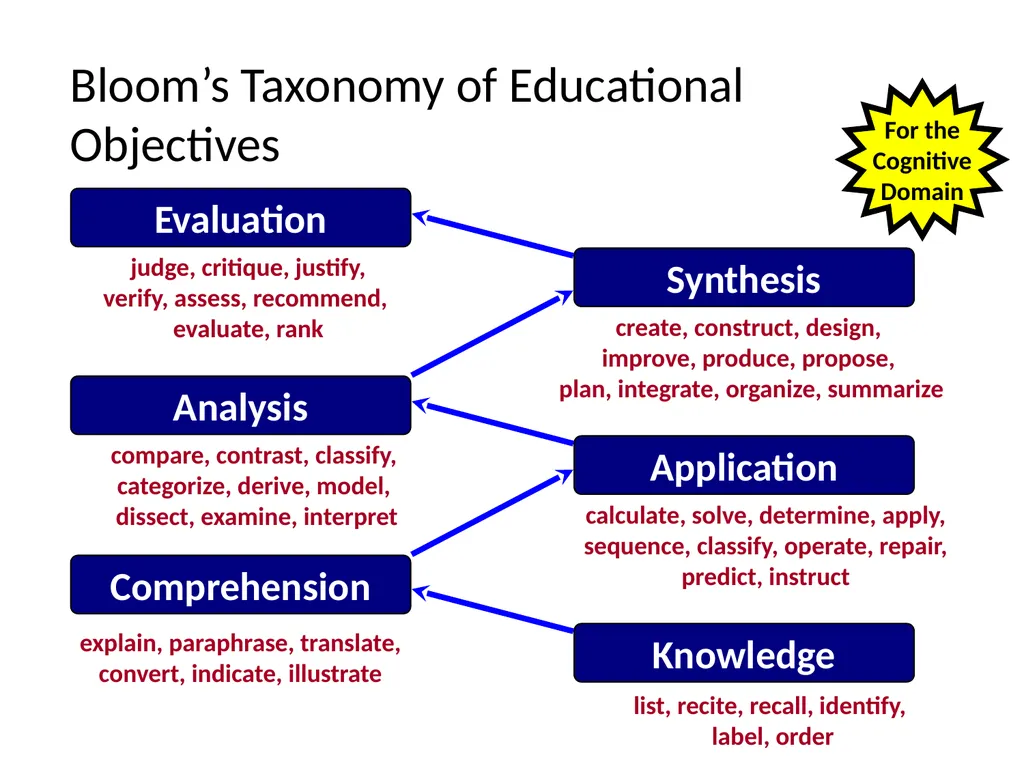
Bloom’s Taxonomy of Educational Objectives Knowledge list, recite, recall, identify,
label, order explain, paraphrase, translate,
convert, indicate, illustrate calculate, solve, determine, apply, sequence, classify, operate, repair, predict, instruct compare, contrast, classify,
categorize, derive, model,
dissect, examine, interpret create, construct, design,
improve, produce, propose,
plan, integrate, organize, summarize judge, critique, justify,
verify, assess, recommend,
evaluate, rank For the
Cognitive
Domain<br>
label, order explain, paraphrase, translate,
convert, indicate, illustrate calculate, solve, determine, apply, sequence, classify, operate, repair, predict, instruct compare, contrast, classify,
categorize, derive, model,
dissect, examine, interpret create, construct, design,
improve, produce, propose,
plan, integrate, organize, summarize judge, critique, justify,
verify, assess, recommend,
evaluate, rank For the
Cognitive
Domain<br>
25
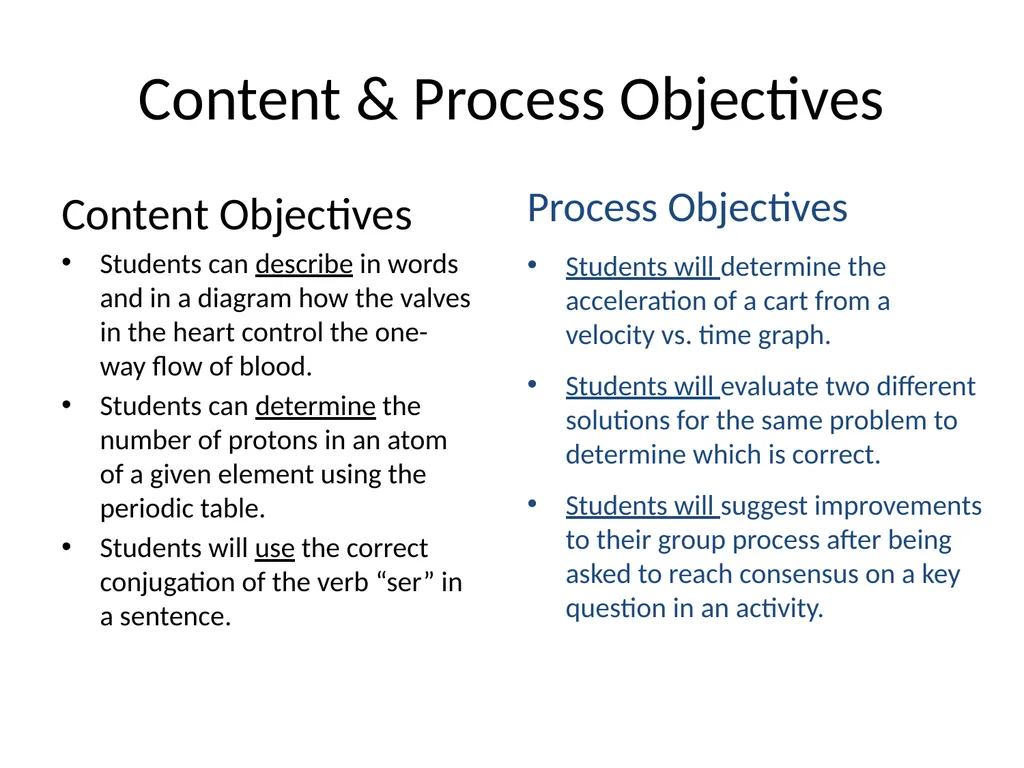
Content & Process Objectives Content Objectives
Students can describe in words and in a diagram how the valves in the heart control the one-way flow of blood.
Students can determine the number of protons in an atom of a given element using the periodic table.
Students will use the correct conjugation of the verb “ser” in a sentence. Process Objectives
Students will determine the acceleration of a cart from a velocity vs. time graph.
Students will evaluate two different solutions for the same problem to determine which is correct.
Students will suggest improvements to their group process after being asked to reach consensus on a key question in an activity.<br>
Students can describe in words and in a diagram how the valves in the heart control the one-way flow of blood.
Students can determine the number of protons in an atom of a given element using the periodic table.
Students will use the correct conjugation of the verb “ser” in a sentence. Process Objectives
Students will determine the acceleration of a cart from a velocity vs. time graph.
Students will evaluate two different solutions for the same problem to determine which is correct.
Students will suggest improvements to their group process after being asked to reach consensus on a key question in an activity.<br>
26
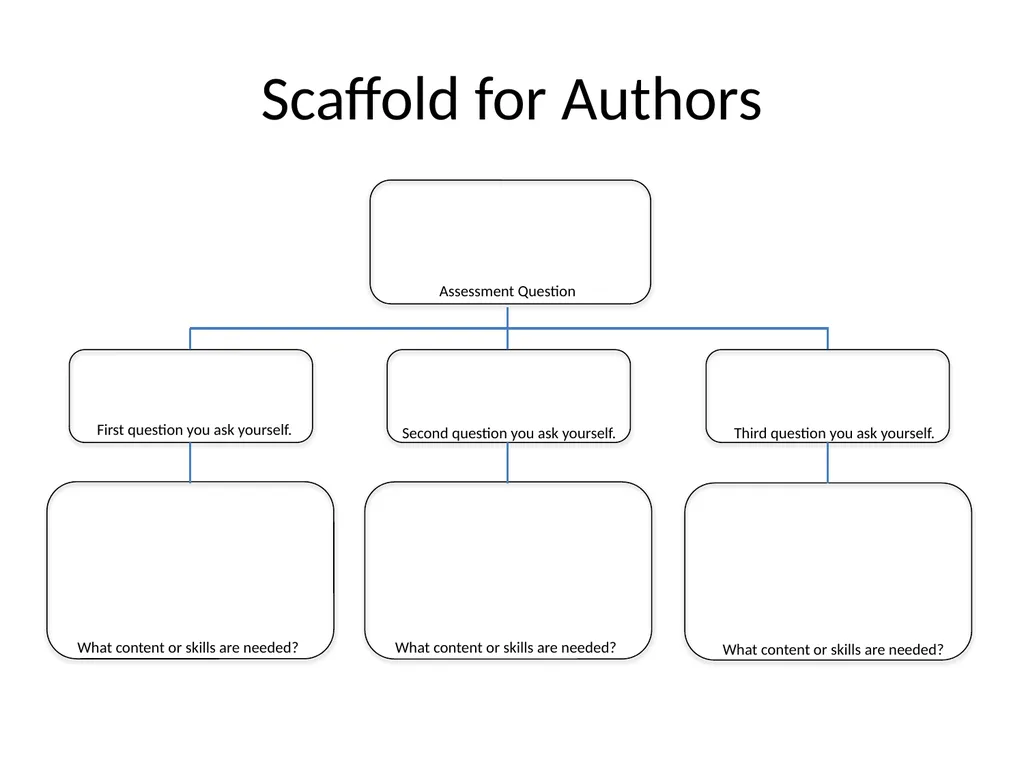
Scaffold for Authors First question you ask yourself. Second question you ask yourself. Third question you ask yourself.<br>
27
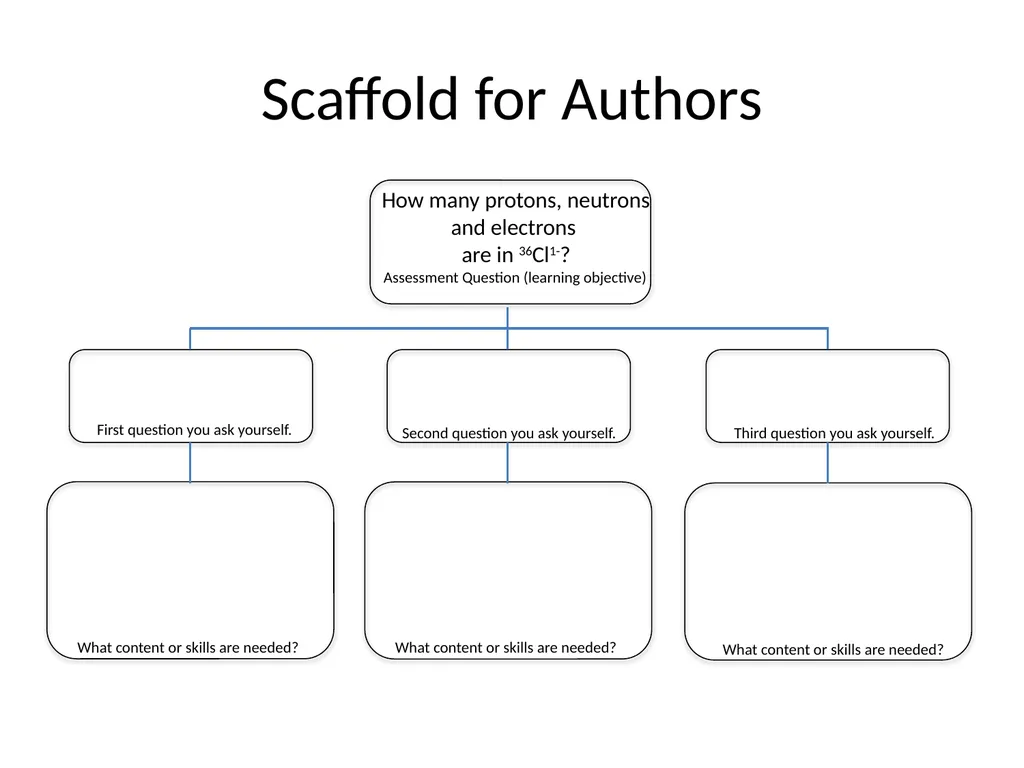
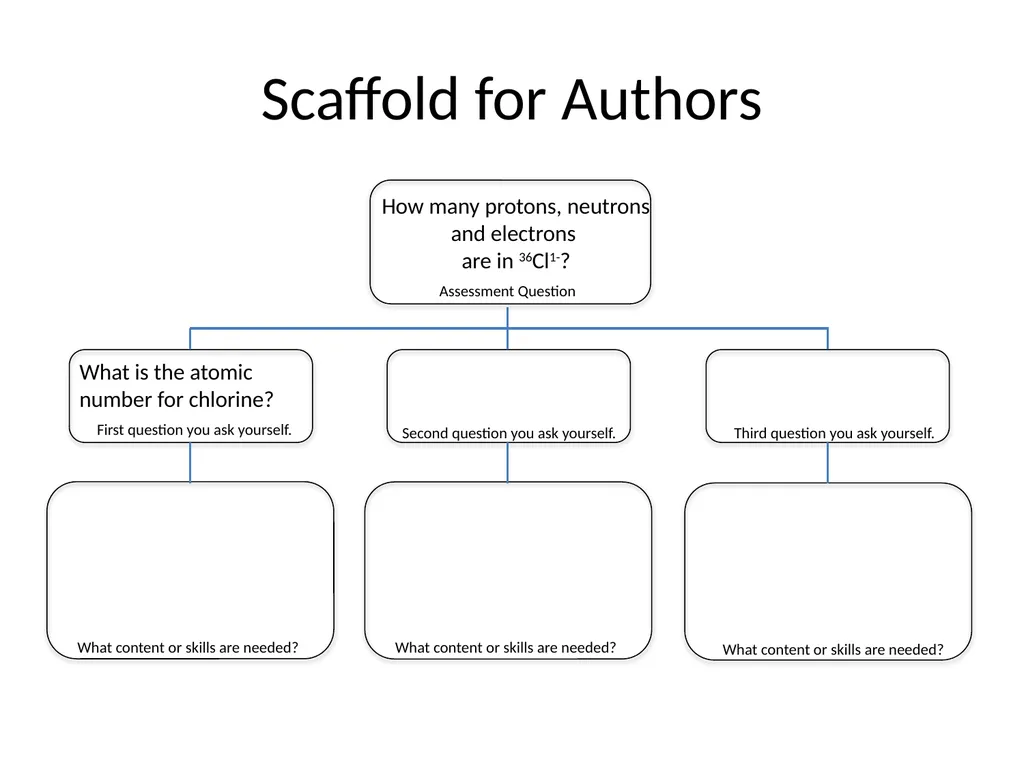
Scaffold for Authors First question you ask yourself. Second question you ask yourself. Third question you ask yourself. How many protons, neutrons and electrons
are in 36Cl1-?<br>
are in 36Cl1-?<br>
28
Scaffold for Authors First question you ask yourself. Second question you ask yourself. Third question you ask yourself. What is the atomic number for chlorine?<br>
29
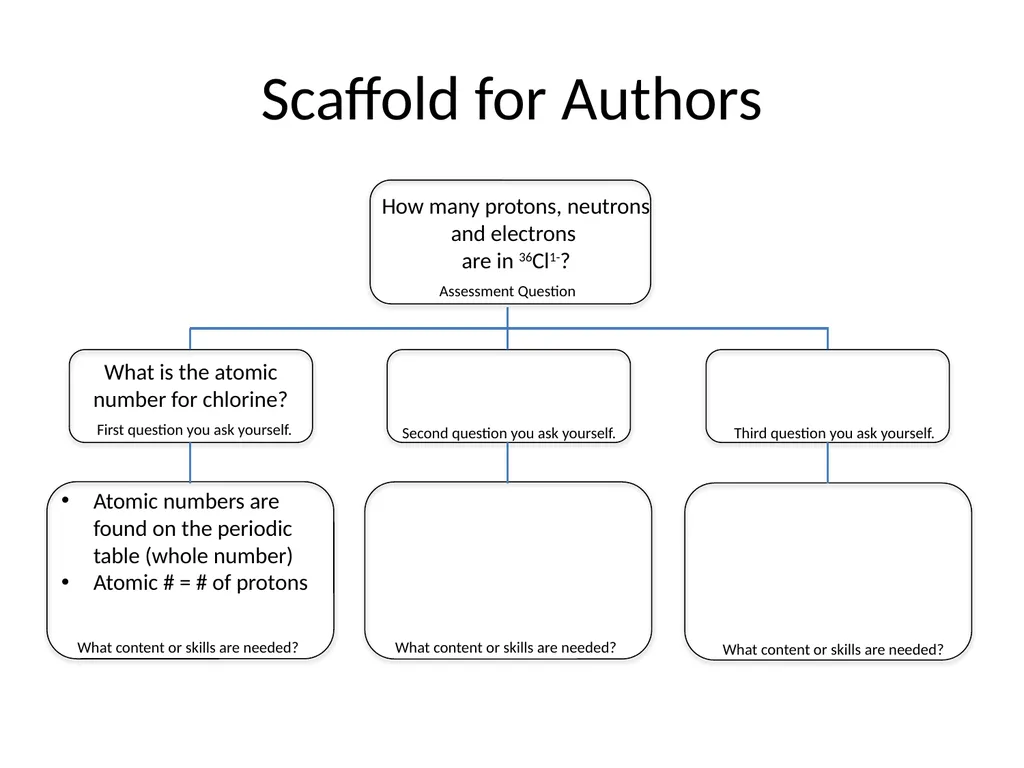
Scaffold for Authors First question you ask yourself. Second question you ask yourself. Third question you ask yourself. What is the atomic number for chlorine? Atomic numbers are found on the periodic table (whole number)
Atomic # = # of protons<br>
Atomic # = # of protons<br>
30
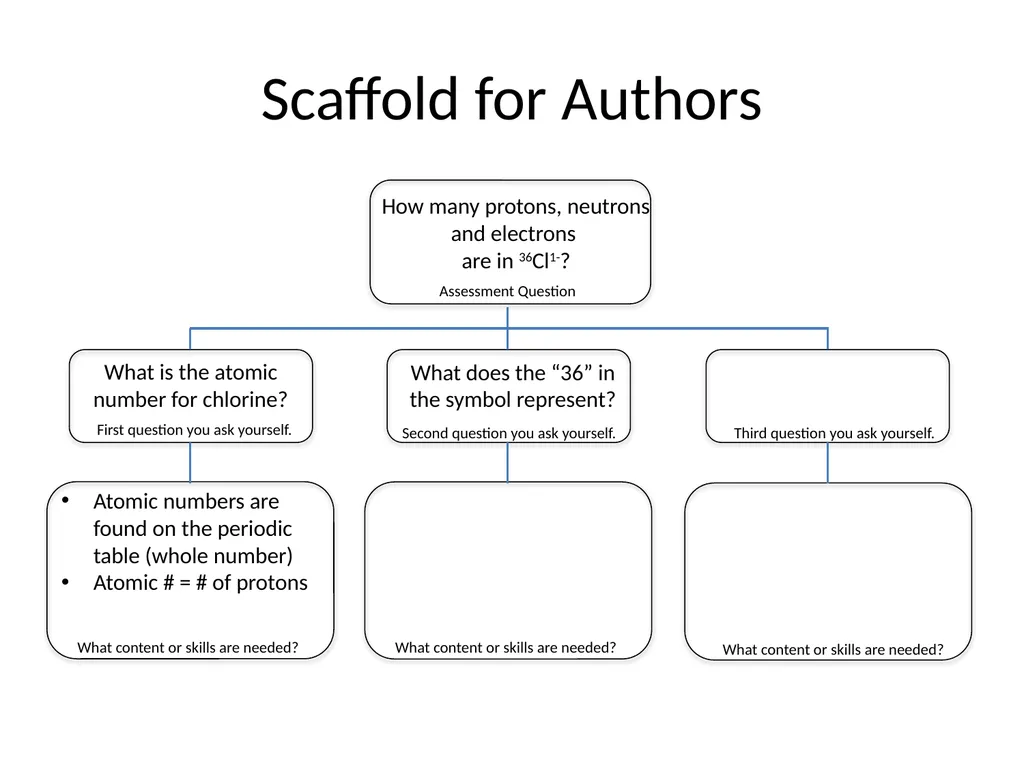
Scaffold for Authors First question you ask yourself. Second question you ask yourself. Third question you ask yourself. What is the atomic number for chlorine? Atomic numbers are found on the periodic table (whole number)
Atomic # = # of protons What does the “36” in the symbol represent?<br>
Atomic # = # of protons What does the “36” in the symbol represent?<br>
31
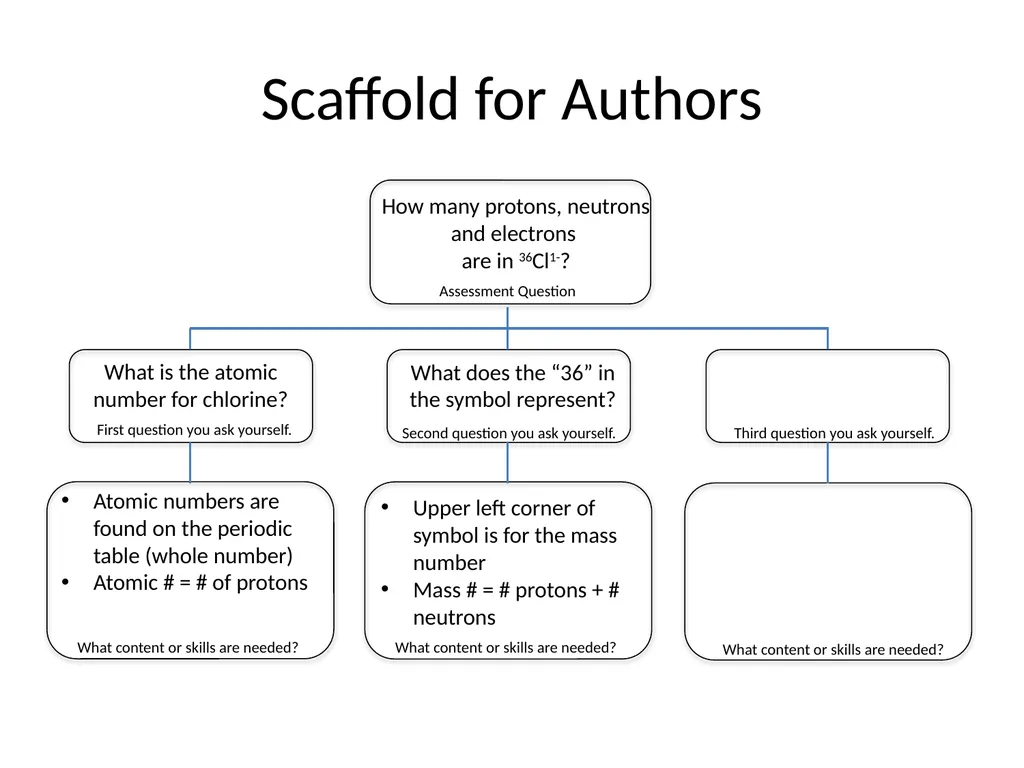
Scaffold for Authors First question you ask yourself. Second question you ask yourself. Third question you ask yourself. What is the atomic number for chlorine? Atomic numbers are found on the periodic table (whole number)
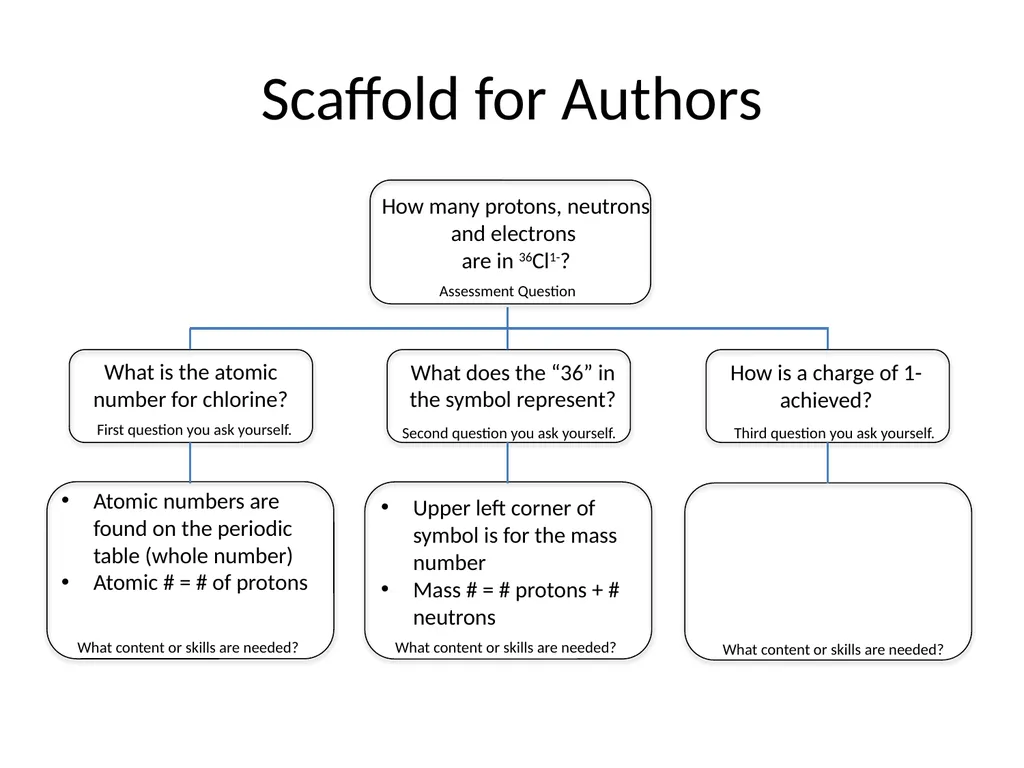
Atomic # = # of protons What does the “36” in the symbol represent? Upper left corner of symbol is for the mass number
Mass # = # protons + # neutrons<br>
Atomic # = # of protons What does the “36” in the symbol represent? Upper left corner of symbol is for the mass number
Mass # = # protons + # neutrons<br>
32
Scaffold for Authors First question you ask yourself. Second question you ask yourself. Third question you ask yourself. What is the atomic number for chlorine? Atomic numbers are found on the periodic table (whole number)
Atomic # = # of protons What does the “36” in the symbol represent? Upper left corner of symbol is for the mass number
Mass # = # protons + # neutrons How is a charge of 1- achieved?<br>
Atomic # = # of protons What does the “36” in the symbol represent? Upper left corner of symbol is for the mass number
Mass # = # protons + # neutrons How is a charge of 1- achieved?<br>
33
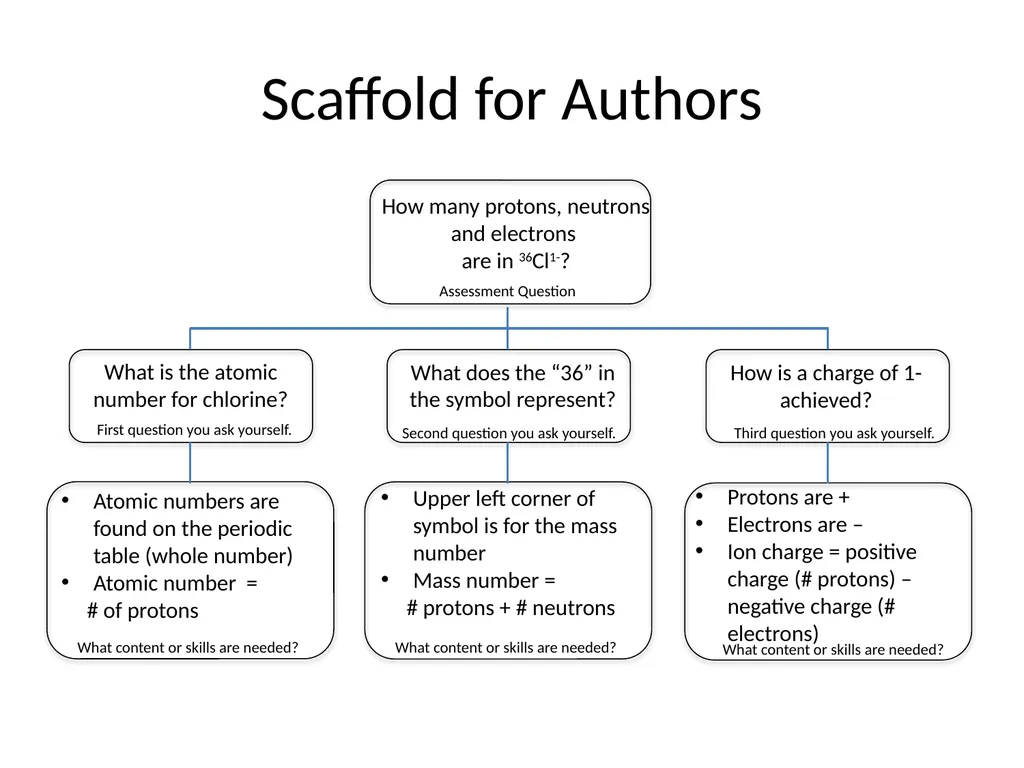
Scaffold for Authors First question you ask yourself. Second question you ask yourself. Third question you ask yourself. What is the atomic number for chlorine? Atomic numbers are found on the periodic table (whole number)
Atomic number =
# of protons What does the “36” in the symbol represent? Upper left corner of symbol is for the mass number
Mass number =
# protons + # neutrons How is a charge of 1- achieved? Protons are +
Electrons are –
Ion charge = positive charge (# protons) – negative charge (# electrons)<br>
Atomic number =
# of protons What does the “36” in the symbol represent? Upper left corner of symbol is for the mass number
Mass number =
# protons + # neutrons How is a charge of 1- achieved? Protons are +
Electrons are –
Ion charge = positive charge (# protons) – negative charge (# electrons)<br>
34
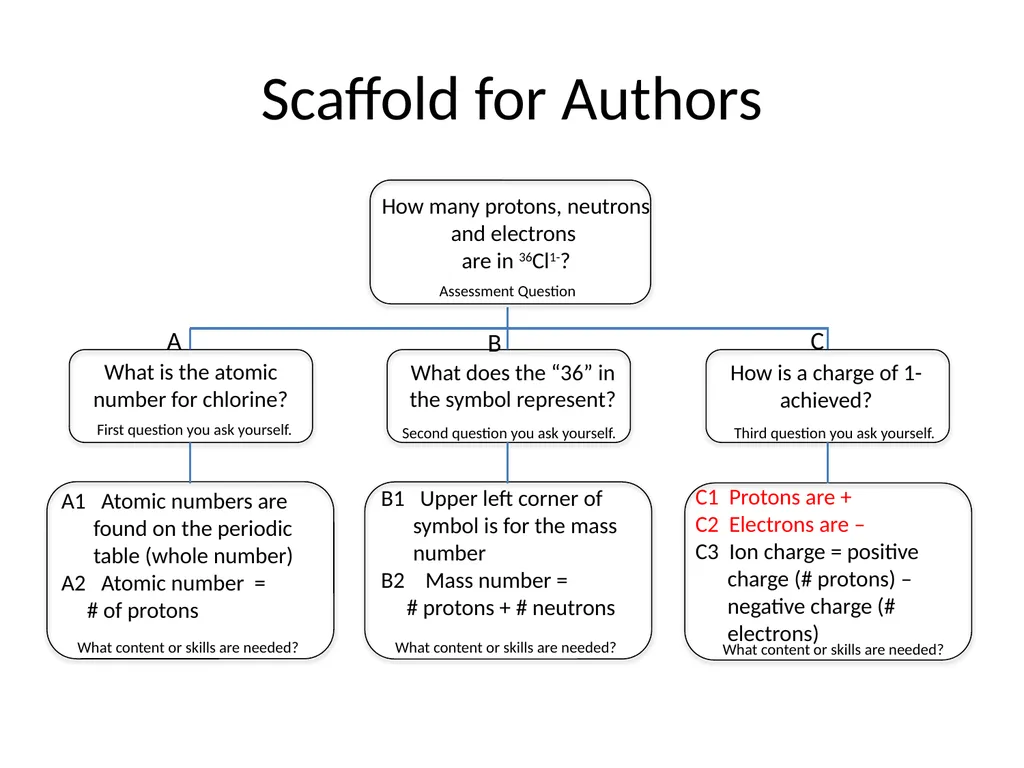
Scaffold for Authors First question you ask yourself. Second question you ask yourself. Third question you ask yourself. What is the atomic number for chlorine? A1 Atomic numbers are found on the periodic table (whole number)
A2 Atomic number =
# of protons What does the “36” in the symbol represent? B1 Upper left corner of symbol is for the mass number
B2 Mass number =
# protons + # neutrons How is a charge of 1- achieved? C1 Protons are +
C2 Electrons are –
C3 Ion charge = positive charge (# protons) – negative charge (# electrons) A B C<br>
A2 Atomic number =
# of protons What does the “36” in the symbol represent? B1 Upper left corner of symbol is for the mass number
B2 Mass number =
# protons + # neutrons How is a charge of 1- achieved? C1 Protons are +
C2 Electrons are –
C3 Ion charge = positive charge (# protons) – negative charge (# electrons) A B C<br>
35
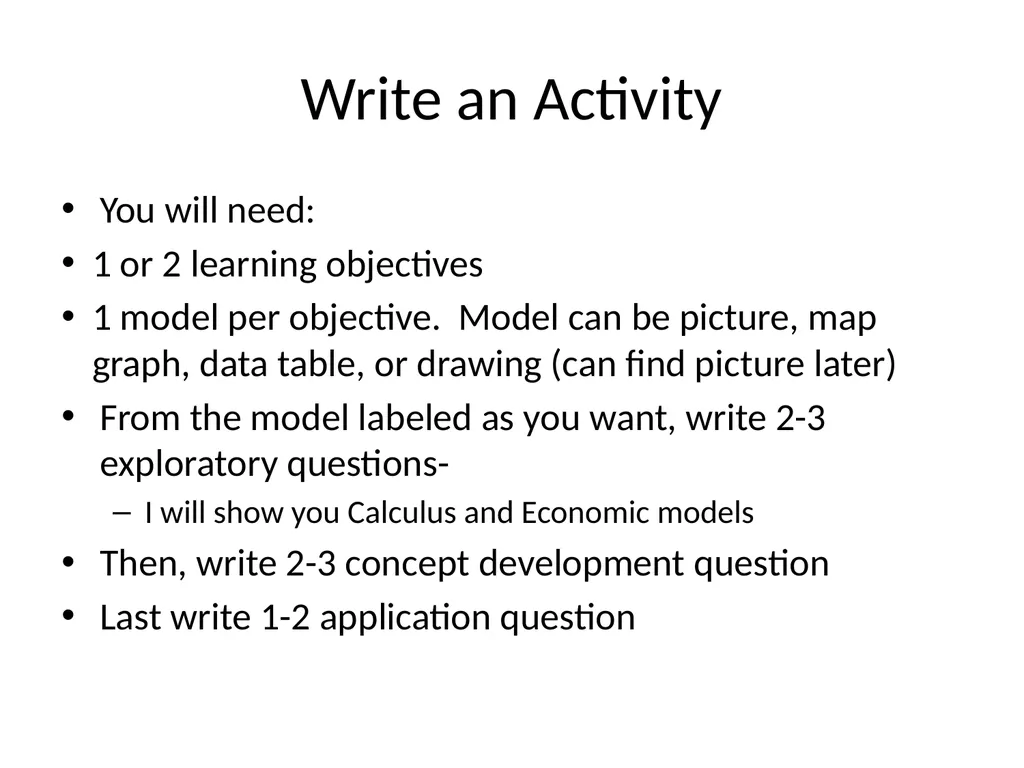
Write an Activity You will need:
1 or 2 learning objectives
1 model per objective. Model can be picture, map graph, data table, or drawing (can find picture later)
From the model labeled as you want, write 2-3 exploratory questions-
I will show you Calculus and Economic models
Then, write 2-3 concept development question
Last write 1-2 application question<br>
1 or 2 learning objectives
1 model per objective. Model can be picture, map graph, data table, or drawing (can find picture later)
From the model labeled as you want, write 2-3 exploratory questions-
I will show you Calculus and Economic models
Then, write 2-3 concept development question
Last write 1-2 application question<br>
36
Hach Videos http://www.pogil.org/resources/implementation/interpersonal-effectiveness-videos
1. Video #7 - Listening Skills (positive example of active listening)
2. Video #5 - Communicating Clearly (brusque, no eye contact)<br>
1. Video #7 - Listening Skills (positive example of active listening)
2. Video #5 - Communicating Clearly (brusque, no eye contact)<br>
37
Contact Information Pat Ligon Broughton HS
pligon@wcpss.net or pligon@nc.rr.com
Pat Ligon’s website:
http://pligon.scribnotes.com/
Sharon Winzeler
swinzel@ncsu.edu
POGIL.org
February 22, 2014<br>
pligon@wcpss.net or pligon@nc.rr.com
Pat Ligon’s website:
http://pligon.scribnotes.com/
Sharon Winzeler
swinzel@ncsu.edu
POGIL.org
February 22, 2014<br>