
Introduction: What Is Ecology? By: Alec W.





Description: Introduction: What Is Ecology? By: Alec W. Armstrong 61622 What is ecological in this image? What concept, idea, pattern, phenomenon, etc. do you see here that seems like a properly ecological thought? Examine the image and write down
Related Topics
Download Presentation
"Introduction: What Is Ecology? By: Alec W." is the property of its rightful owner. Permission is granted to download and print the materials on this website for personal, non-commercial use only, and to display it on your personal computer provided you do not modify the materials and that you retain all copyright notices contained in the materials. By downloading content from our website, you accept the terms of this agreement.
Presentation Transcript
slide1. Introduction: What Is Ecology? By: Alec W. Armstrong 6/16/22<br>
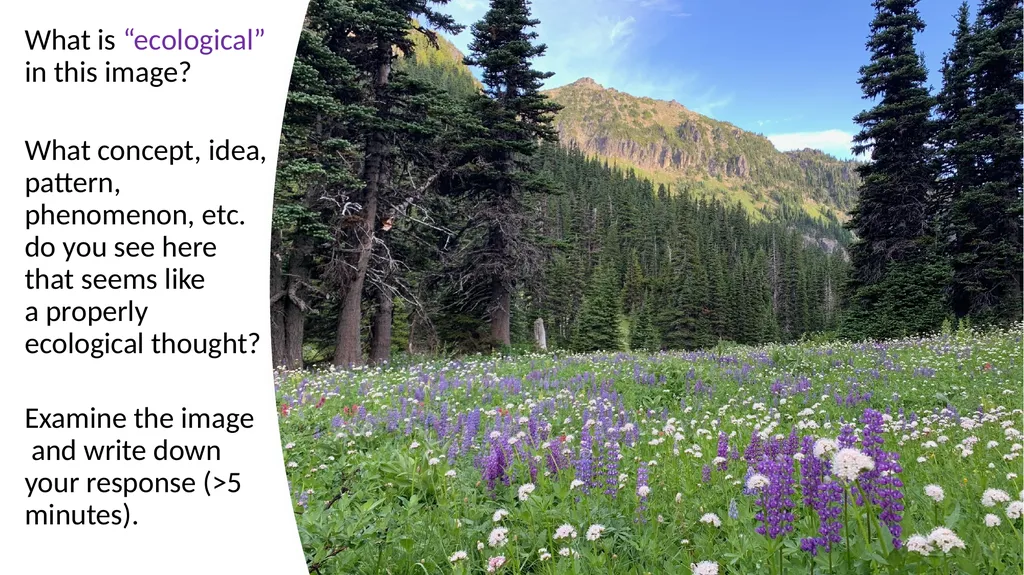
slide2. What is “ecological” in this image?
What concept, idea, pattern, phenomenon, etc. do you see here that seems like a properly ecological thought?
Examine the image and write down your response (>5 minutes). 1<br>
slide3. What Is Ecology? Usually defined in terms of its scope—which parts of the world it studies
Ecology = oikos + logos
Haeckel’s oecology (1866): “The whole science of the relations of the organism to the environment including, in the broad sense, all the ‘conditions of existence.’” – Quoted in Egerton 2010 2<br>
slide4. What Is Ecology? “The scientific study of interactions between organisms and their environment” (Cain, Bowman & Hacker 2011)
“The study of relationships between organisms and the environment” (Molles 2005)
Attempts to narrow —“the scientific study of the interactions that determine the distribution and abundance of organisms” (Krebs 2001)—and broaden— “the study of the structure and function of nature” (Odum 1963)—but definitions above are most common and persistent (from Reiners & Lockwood 2010) 3<br>
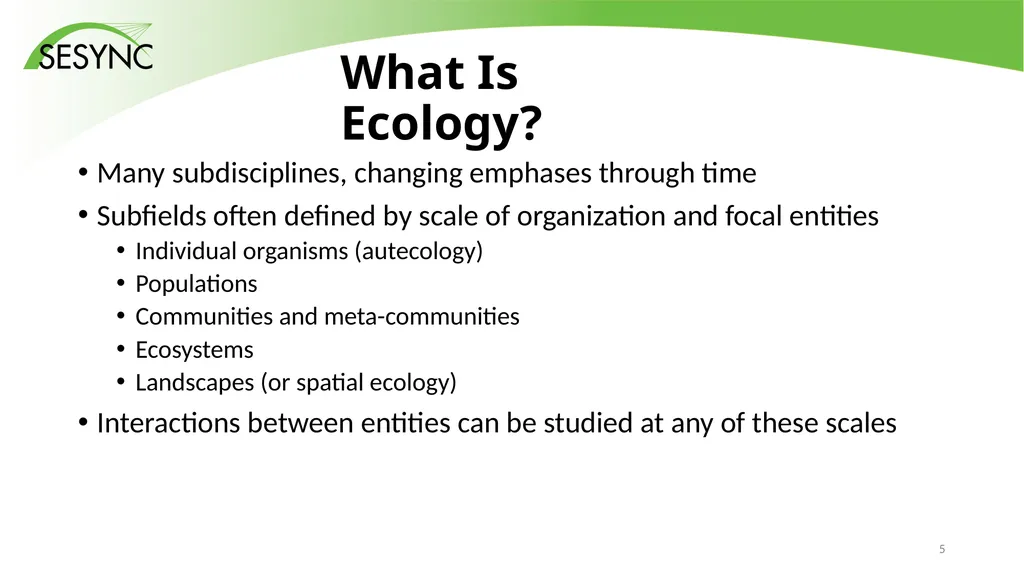
slide5. What Is Ecology? Many subdisciplines, changing emphases through time
Subfields often defined by scale of organization and focal entities
Individual organisms (autecology)
Populations
Communities and meta-communities
Ecosystems
Landscapes (or spatial ecology)
Interactions between entities can be studied at any of these scales 4<br>
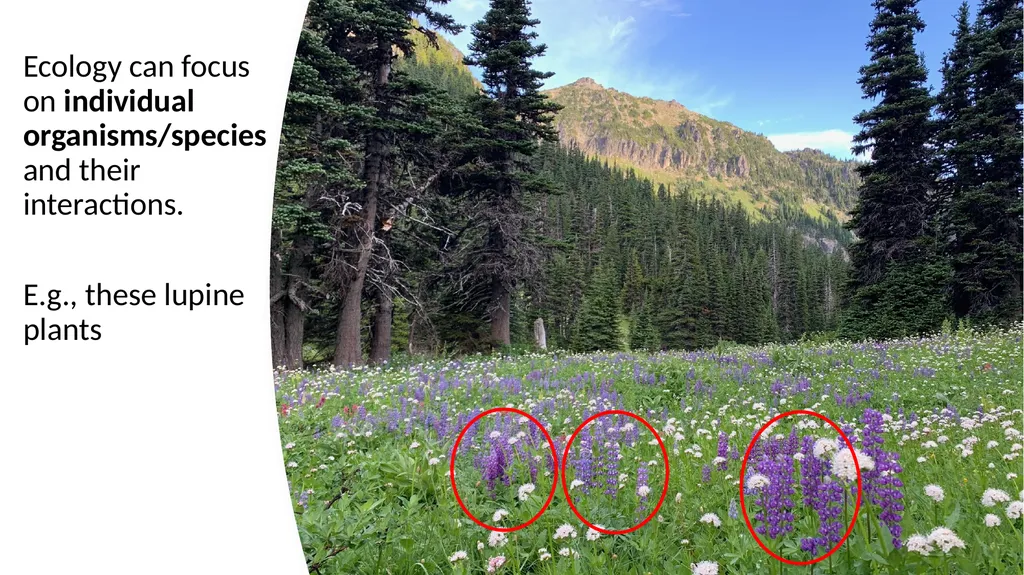
slide6. 5 Ecology can focus on individual organisms/species and their interactions.
E.g., these lupine plants<br>
slide7. Ecology can focus on individual organisms/species and their interactions. E.g., these lupine plants
What determines the growth rate of individual plants?
What interactions exist between the lupines and the valerians (white flowers)?
How does a lupine’s ability to “fix” atmospheric nitrogen affect its distribution? 6<br>
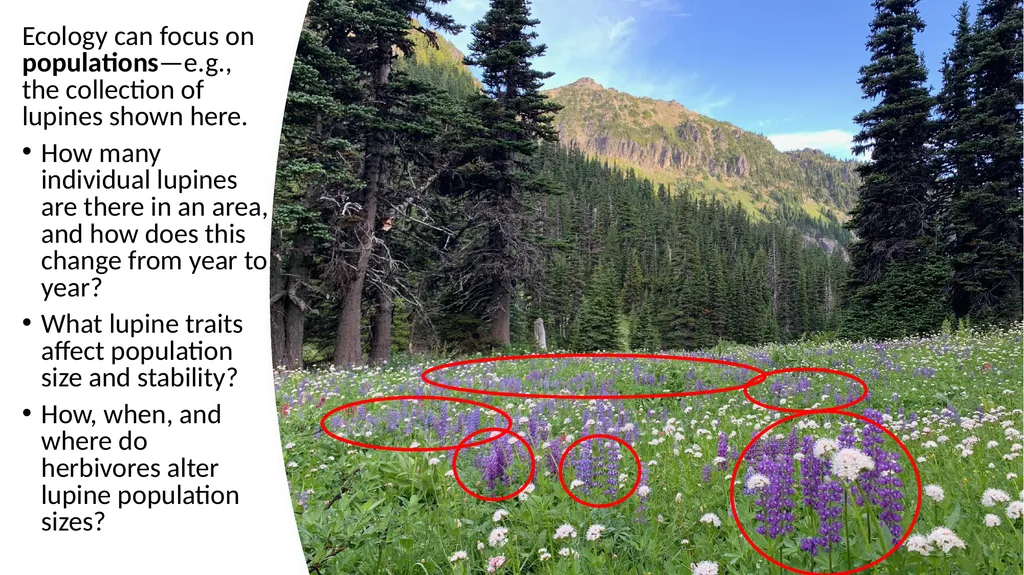
slide8. Ecology can focus on populations—e.g., the collection of lupines shown here. 7<br>
slide9. Ecology can focus on populations—e.g., the collection of lupines shown here.
How many individual lupines are there in an area, and how does this change from year to year?
What lupine traits affect population size and stability?
How, when, and where do herbivores alter lupine population sizes? 8<br>
slide10. Ecology can focus on communities—e.g., all the plants in this meadow 9<br>
slide11. Ecology can focus on communities—e.g., all the plants in this meadow
How many plant species are present in the meadow each year? Are there trends over time?
How does plant diversity affect things like herbivore population size, or soil nitrogen? 10<br>
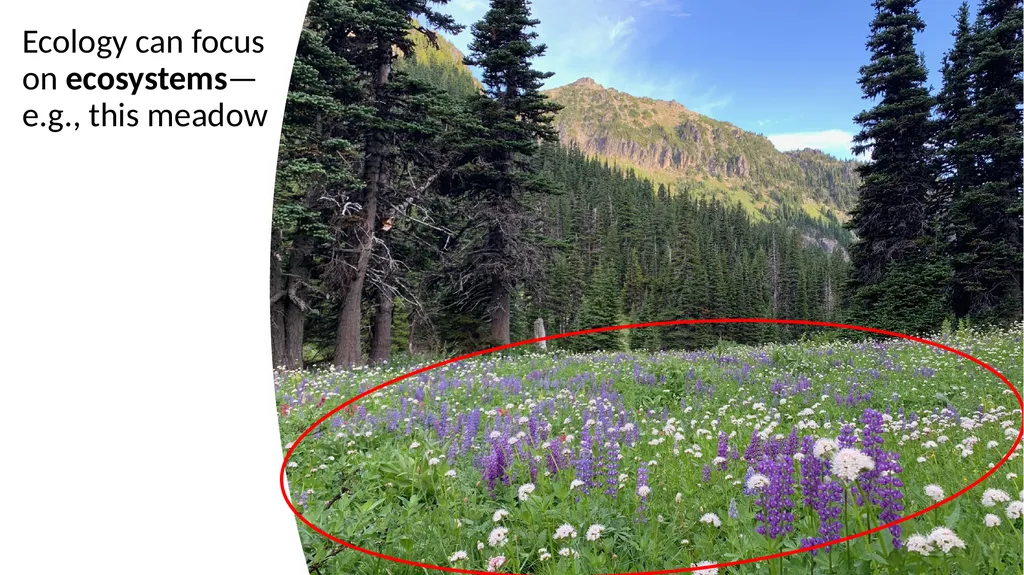
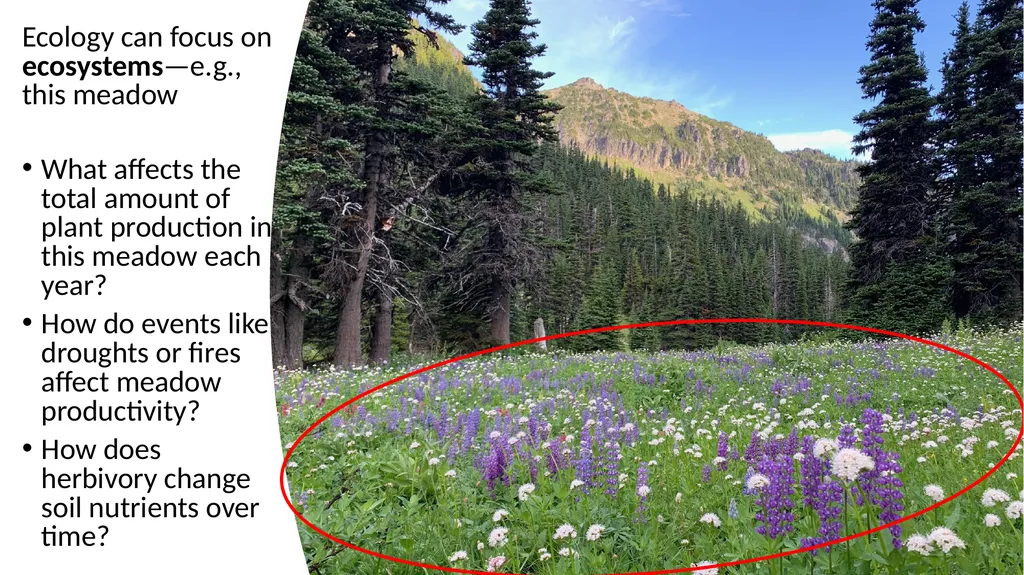
slide12. Ecology can focus on ecosystems—e.g., this meadow 11<br>
slide13. Ecology can focus on ecosystems—e.g., this meadow
What affects the total amount of plant production in this meadow each year?
How do events like droughts or fires affect meadow productivity?
How does herbivory change soil nutrients over time? 12<br>
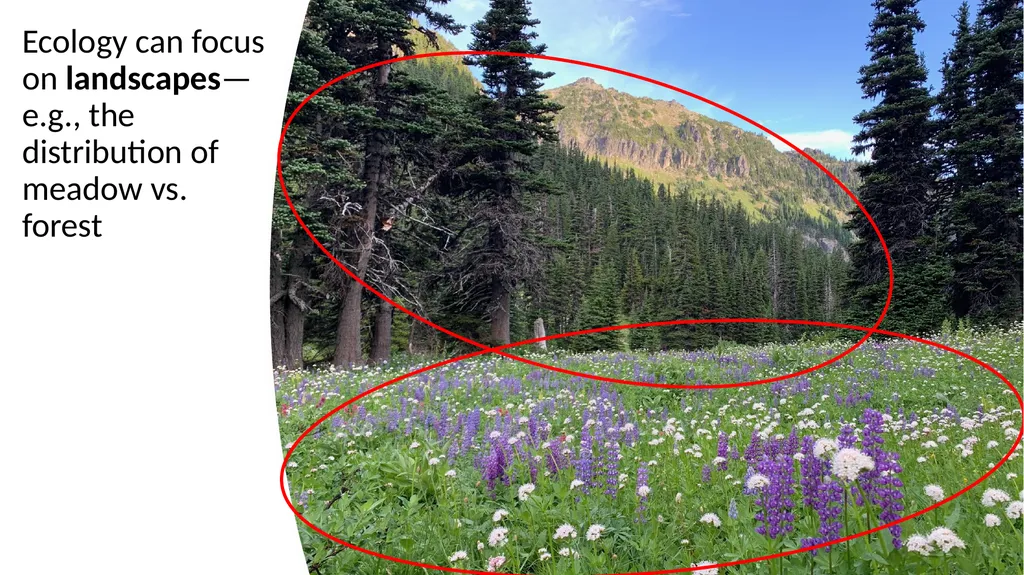
slide14. Ecology can focus on landscapes—e.g., the distribution of meadow vs. forest 13<br>
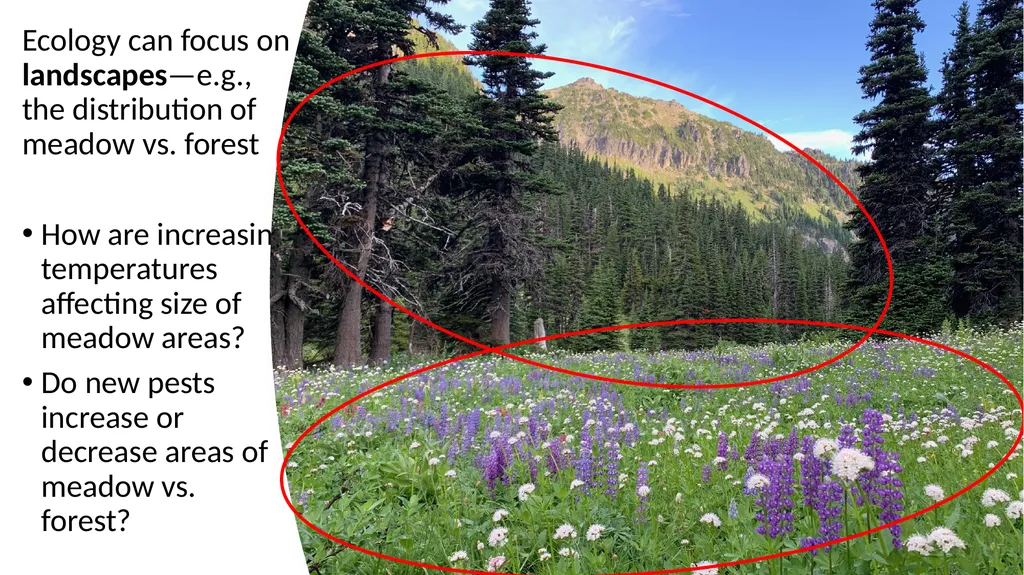
slide15. Ecology can focus on landscapes—e.g., the distribution of meadow vs. forest
How are increasing temperatures affecting size of meadow areas?
Do new pests increase or decrease areas of meadow vs. forest? 14<br>
slide16. What Is Not Ecology? Ecology is…
Biological but it’s not biology
Biogeochemical but it’s not chemistry or geology
Energetic but it’s not physics
Inclusive of society and human influences but it’s not a social science or the humanities
Boundaries between Disciplines
If there are disciplinary boundaries, who arbitrates them?
What are the boundaries between “objective” science and activism/advocacy? 15<br>
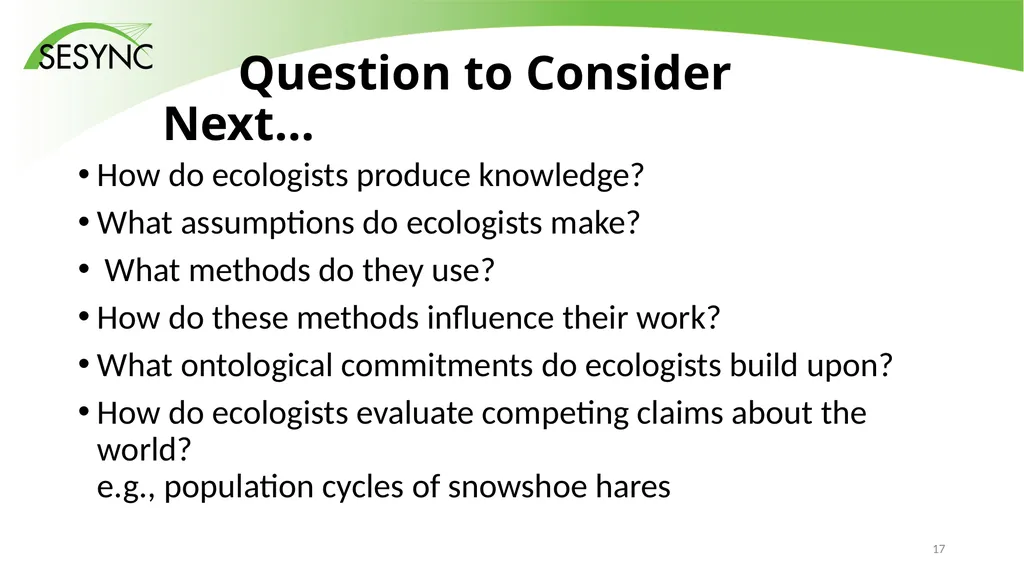
slide17. Question to Consider Next… How do ecologists produce knowledge?
What assumptions do ecologists make?
What methods do they use?
How do these methods influence their work?
What ontological commitments do ecologists build upon?
How do ecologists evaluate competing claims about the world? e.g., population cycles of snowshoe hares 16<br>
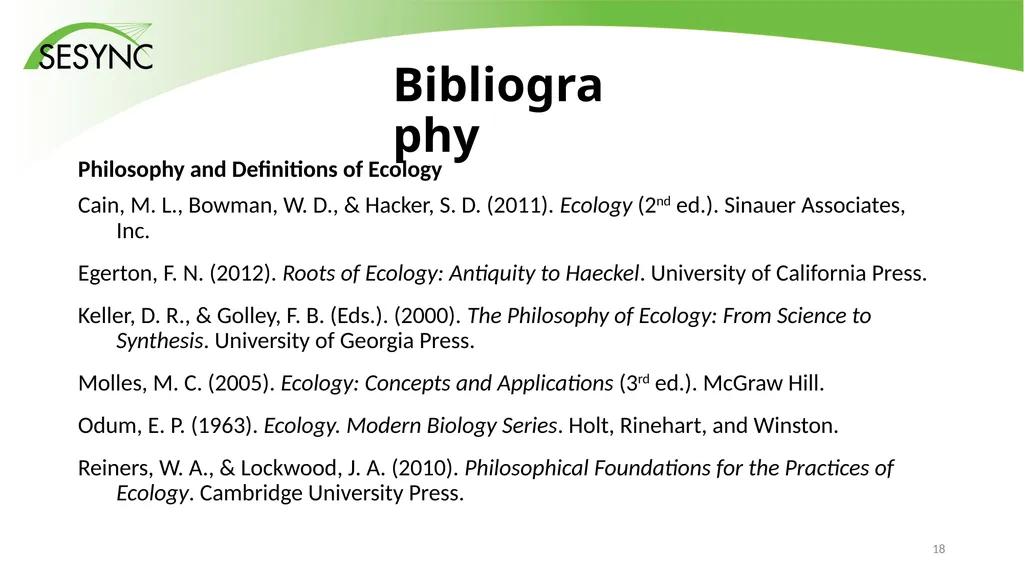
slide18. Bibliography Philosophy and Definitions of Ecology
Cain, M. L., Bowman, W. D., & Hacker, S. D. (2011). Ecology (2nd ed.). Sinauer Associates, Inc.
Egerton, F. N. (2012). Roots of Ecology: Antiquity to Haeckel. University of California Press.
Keller, D. R., & Golley, F. B. (Eds.). (2000). The Philosophy of Ecology: From Science to Synthesis. University of Georgia Press.
Molles, M. C. (2005). Ecology: Concepts and Applications (3rd ed.). McGraw Hill.
Odum, E. P. (1963). Ecology. Modern Biology Series. Holt, Rinehart, and Winston.
Reiners, W. A., & Lockwood, J. A. (2010). Philosophical Foundations for the Practices of Ecology. Cambridge University Press. 17<br>
slide2. What is “ecological” in this image?
What concept, idea, pattern, phenomenon, etc. do you see here that seems like a properly ecological thought?
Examine the image and write down your response (>5 minutes). 1<br>
slide3. What Is Ecology? Usually defined in terms of its scope—which parts of the world it studies
Ecology = oikos + logos
Haeckel’s oecology (1866): “The whole science of the relations of the organism to the environment including, in the broad sense, all the ‘conditions of existence.’” – Quoted in Egerton 2010 2<br>
slide4. What Is Ecology? “The scientific study of interactions between organisms and their environment” (Cain, Bowman & Hacker 2011)
“The study of relationships between organisms and the environment” (Molles 2005)
Attempts to narrow —“the scientific study of the interactions that determine the distribution and abundance of organisms” (Krebs 2001)—and broaden— “the study of the structure and function of nature” (Odum 1963)—but definitions above are most common and persistent (from Reiners & Lockwood 2010) 3<br>
slide5. What Is Ecology? Many subdisciplines, changing emphases through time
Subfields often defined by scale of organization and focal entities
Individual organisms (autecology)
Populations
Communities and meta-communities
Ecosystems
Landscapes (or spatial ecology)
Interactions between entities can be studied at any of these scales 4<br>
slide6. 5 Ecology can focus on individual organisms/species and their interactions.
E.g., these lupine plants<br>
slide7. Ecology can focus on individual organisms/species and their interactions. E.g., these lupine plants
What determines the growth rate of individual plants?
What interactions exist between the lupines and the valerians (white flowers)?
How does a lupine’s ability to “fix” atmospheric nitrogen affect its distribution? 6<br>
slide8. Ecology can focus on populations—e.g., the collection of lupines shown here. 7<br>
slide9. Ecology can focus on populations—e.g., the collection of lupines shown here.
How many individual lupines are there in an area, and how does this change from year to year?
What lupine traits affect population size and stability?
How, when, and where do herbivores alter lupine population sizes? 8<br>
slide10. Ecology can focus on communities—e.g., all the plants in this meadow 9<br>
slide11. Ecology can focus on communities—e.g., all the plants in this meadow
How many plant species are present in the meadow each year? Are there trends over time?
How does plant diversity affect things like herbivore population size, or soil nitrogen? 10<br>
slide12. Ecology can focus on ecosystems—e.g., this meadow 11<br>
slide13. Ecology can focus on ecosystems—e.g., this meadow
What affects the total amount of plant production in this meadow each year?
How do events like droughts or fires affect meadow productivity?
How does herbivory change soil nutrients over time? 12<br>
slide14. Ecology can focus on landscapes—e.g., the distribution of meadow vs. forest 13<br>
slide15. Ecology can focus on landscapes—e.g., the distribution of meadow vs. forest
How are increasing temperatures affecting size of meadow areas?
Do new pests increase or decrease areas of meadow vs. forest? 14<br>
slide16. What Is Not Ecology? Ecology is…
Biological but it’s not biology
Biogeochemical but it’s not chemistry or geology
Energetic but it’s not physics
Inclusive of society and human influences but it’s not a social science or the humanities
Boundaries between Disciplines
If there are disciplinary boundaries, who arbitrates them?
What are the boundaries between “objective” science and activism/advocacy? 15<br>
slide17. Question to Consider Next… How do ecologists produce knowledge?
What assumptions do ecologists make?
What methods do they use?
How do these methods influence their work?
What ontological commitments do ecologists build upon?
How do ecologists evaluate competing claims about the world? e.g., population cycles of snowshoe hares 16<br>
slide18. Bibliography Philosophy and Definitions of Ecology
Cain, M. L., Bowman, W. D., & Hacker, S. D. (2011). Ecology (2nd ed.). Sinauer Associates, Inc.
Egerton, F. N. (2012). Roots of Ecology: Antiquity to Haeckel. University of California Press.
Keller, D. R., & Golley, F. B. (Eds.). (2000). The Philosophy of Ecology: From Science to Synthesis. University of Georgia Press.
Molles, M. C. (2005). Ecology: Concepts and Applications (3rd ed.). McGraw Hill.
Odum, E. P. (1963). Ecology. Modern Biology Series. Holt, Rinehart, and Winston.
Reiners, W. A., & Lockwood, J. A. (2010). Philosophical Foundations for the Practices of Ecology. Cambridge University Press. 17<br>