
INVENTORY CONTROL Reena Vincent Professor JMCON
JO
Published · 78 slides · 0 views
1 / 1

Description
INVENTORY CONTROL Reena Vincent Professor JMCON Central objective At the end of teaching students acquire depth knowledge on inventory control and able to explain and apply this knowledge in the nursing service and education . Specific
Related Topics
Share
Embed code
Download this presentation From Below
"INVENTORY CONTROL Reena Vincent Professor JMCON" is the property of its rightful owner. Permission is granted to download and print the materials on this website for personal, non-commercial use only, and to display it on your personal computer provided you do not modify the materials and that you retain all copyright notices contained in the materials. By downloading content from our website, you accept the terms of this agreement.
Presentation Transcript
01
INVENTORY CONTROL Reena Vincent
Professor
JMCON<br>
Professor
JMCON<br>
02
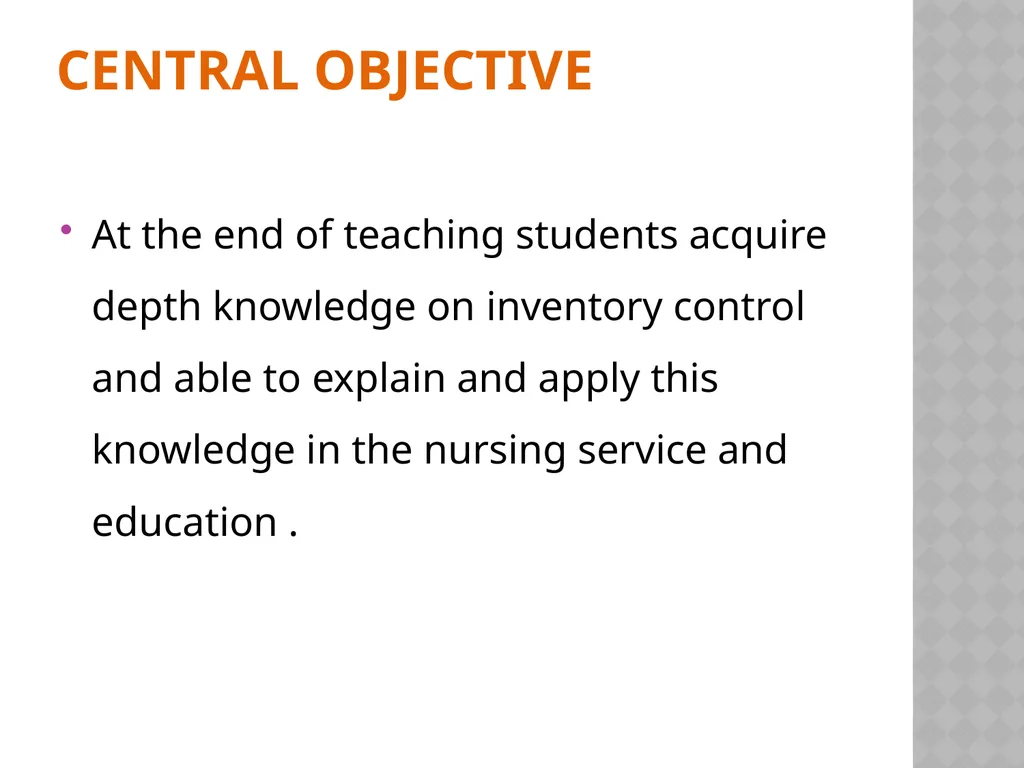
Central objective At the end of teaching students acquire depth knowledge on inventory control and able to explain and apply this knowledge in the nursing service and education .<br>
03
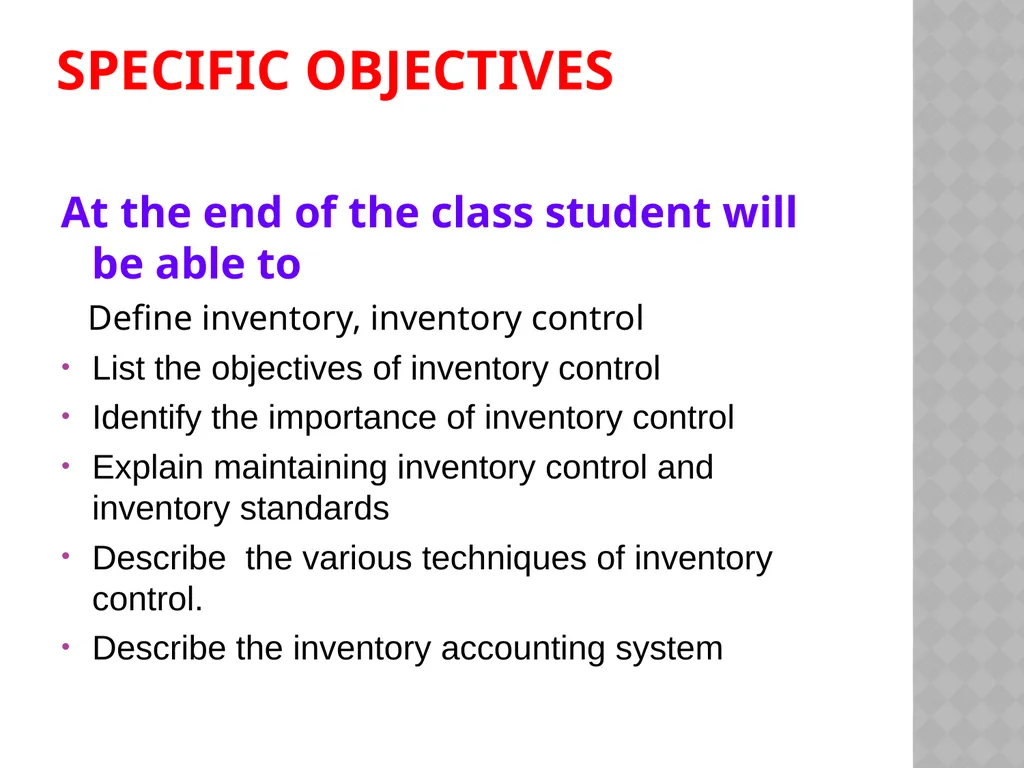
Specific objectives At the end of the class student will be able to
Define inventory, inventory control
List the objectives of inventory control
Identify the importance of inventory control
Explain maintaining inventory control and inventory standards
Describe the various techniques of inventory control.
Describe the inventory accounting system<br>
Define inventory, inventory control
List the objectives of inventory control
Identify the importance of inventory control
Explain maintaining inventory control and inventory standards
Describe the various techniques of inventory control.
Describe the inventory accounting system<br>
04
introduction The inventory is a stock to ensure uninterrupted suppliers and to have future economic value .
It provides a cushion between the estimated and actual demand for materials.
Inventory is anything that is bought and held prior to use<br>
It provides a cushion between the estimated and actual demand for materials.
Inventory is anything that is bought and held prior to use<br>
05
Inventory means all the materials, parts, supplies, expenses and in processes or finished products recorded on registers books by an organization and kept in its stocks for some period of time.<br>
06
Inventory control Inventory control is the process by which inventory is measured and regulated according to predetermined norms such as economic lot size for order, safety stock, and minimum level, Maximum level, order level etc.<br>
07
objectives of inventory control To supply the materials in time .
To give maximum clients service by meeting their requirement timely, effectively, efficiently, smoothly and satisfactorily.
To reduce or minimize investment in inventories .<br>
To give maximum clients service by meeting their requirement timely, effectively, efficiently, smoothly and satisfactorily.
To reduce or minimize investment in inventories .<br>
08
Contd.... To minimize idle time by avoiding stock out and storages .
To avoid shortage of stock .
To minimize the losses due to deterioration, obsolescence and damage of stock.
To meet unforeseen future demand .
To average out demand fluctuations .
To balance various inventory costs such as carrying cost, order costs etc.<br>
To avoid shortage of stock .
To minimize the losses due to deterioration, obsolescence and damage of stock.
To meet unforeseen future demand .
To average out demand fluctuations .
To balance various inventory costs such as carrying cost, order costs etc.<br>
09
Importance of inventory CONTROL It provides and maintains good customer’s service.
Enables smooth flow of materials through production process.
Provides protection against the uncertainty of demand and supply.
Ensures a reasonable utilization of equipment and effort .
Possibility of discount, if purchased in bulk.<br>
Enables smooth flow of materials through production process.
Provides protection against the uncertainty of demand and supply.
Ensures a reasonable utilization of equipment and effort .
Possibility of discount, if purchased in bulk.<br>
10
To provide gap between forecasted and actual demand for a material.
To have optimum level of inventory; not too large, not small.
To eliminate duplication in ordering<br>
To have optimum level of inventory; not too large, not small.
To eliminate duplication in ordering<br>
11
To take care of fluctuations in demand and lead time and price in bulk buying
To minimizes the transportation cost, inventory costs and waiting time .
It monitors the loss of material and utilization of stocks available .
To facilitate the cost accounting activities and disposes inactive and obsolete store items .<br>
To minimizes the transportation cost, inventory costs and waiting time .
It monitors the loss of material and utilization of stocks available .
To facilitate the cost accounting activities and disposes inactive and obsolete store items .<br>
12
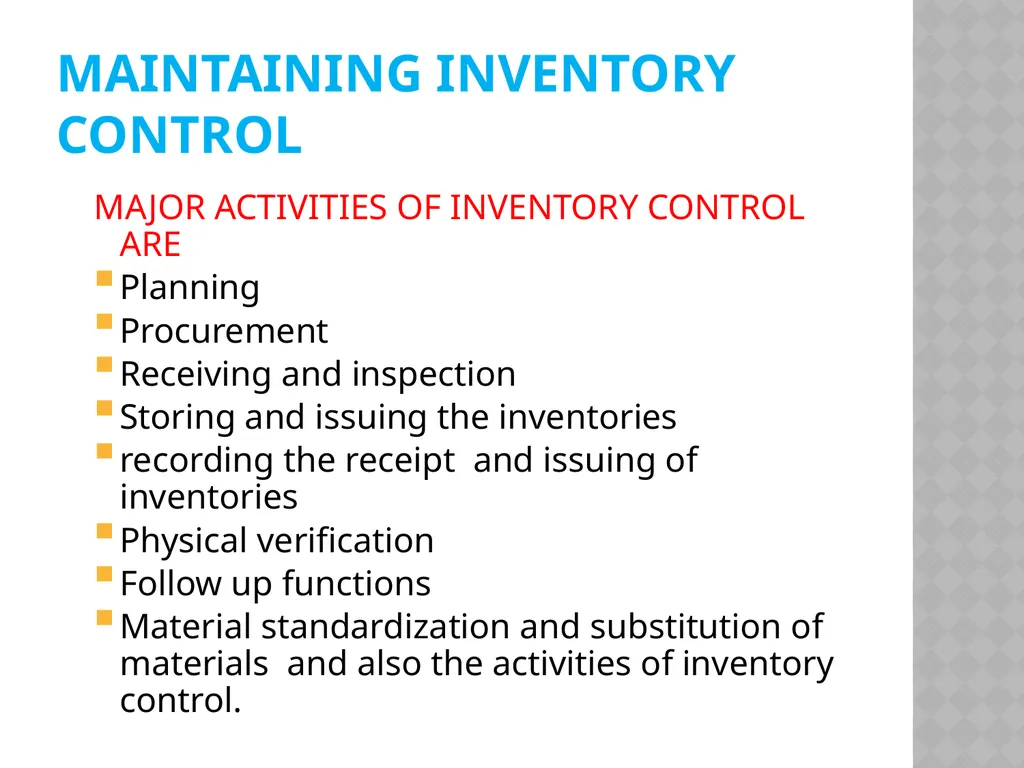
Maintaining inventory control MAJOR ACTIVITIES OF INVENTORY CONTROL ARE
Planning
Procurement
Receiving and inspection
Storing and issuing the inventories
recording the receipt and issuing of inventories
Physical verification
Follow up functions
Material standardization and substitution of materials and also the activities of inventory control.<br>
Planning
Procurement
Receiving and inspection
Storing and issuing the inventories
recording the receipt and issuing of inventories
Physical verification
Follow up functions
Material standardization and substitution of materials and also the activities of inventory control.<br>
13
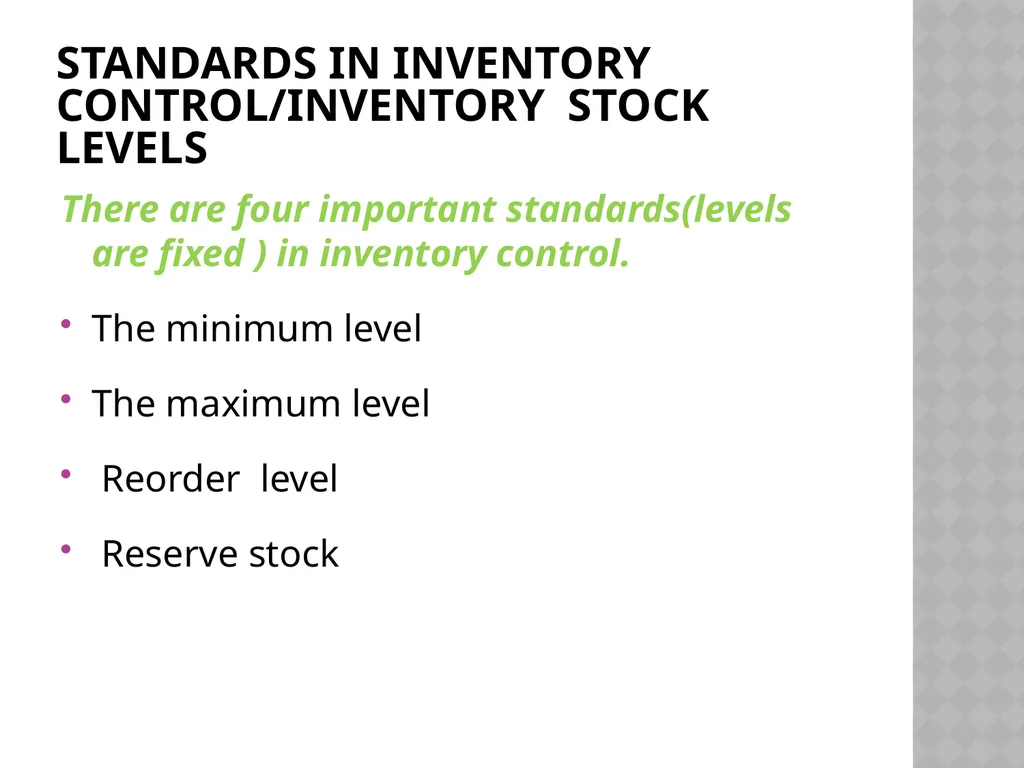
Standards in inventory control/INVENTORY STOCK LEVELS There are four important standards(levels are fixed ) in inventory control.
The minimum level
The maximum level
Reorder level
Reserve stock<br>
The minimum level
The maximum level
Reorder level
Reserve stock<br>
14
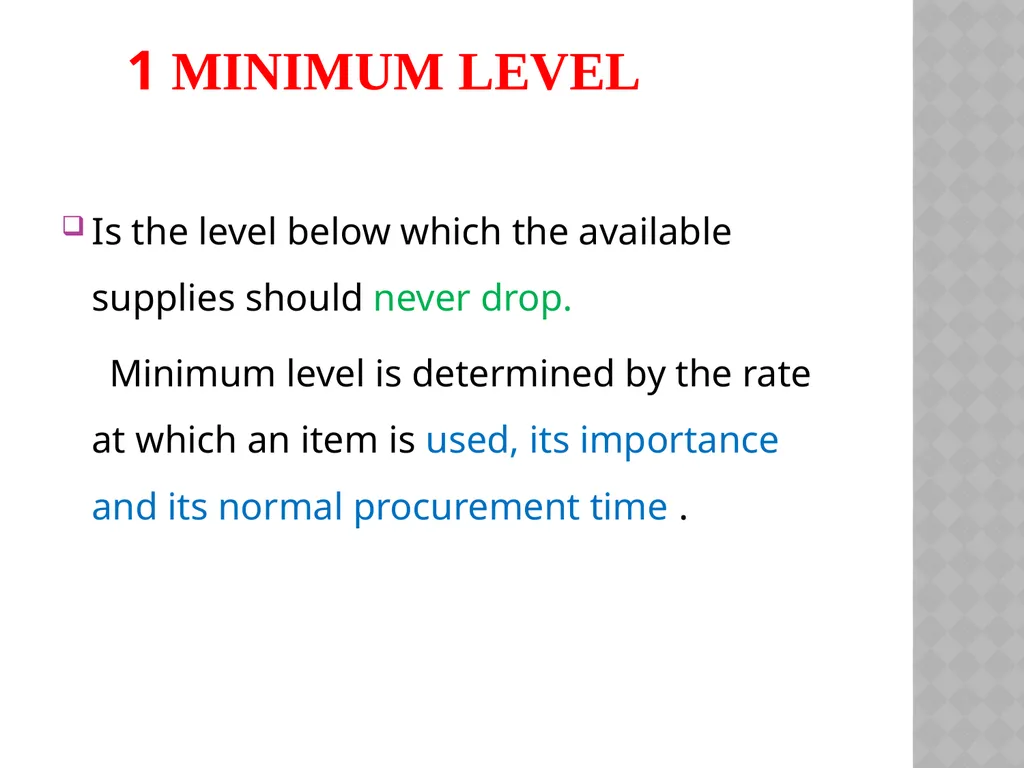
1 MINIMUM LEVEL Is the level below which the available supplies should never drop.
Minimum level is determined by the rate at which an item is used, its importance and its normal procurement time .<br>
Minimum level is determined by the rate at which an item is used, its importance and its normal procurement time .<br>
15
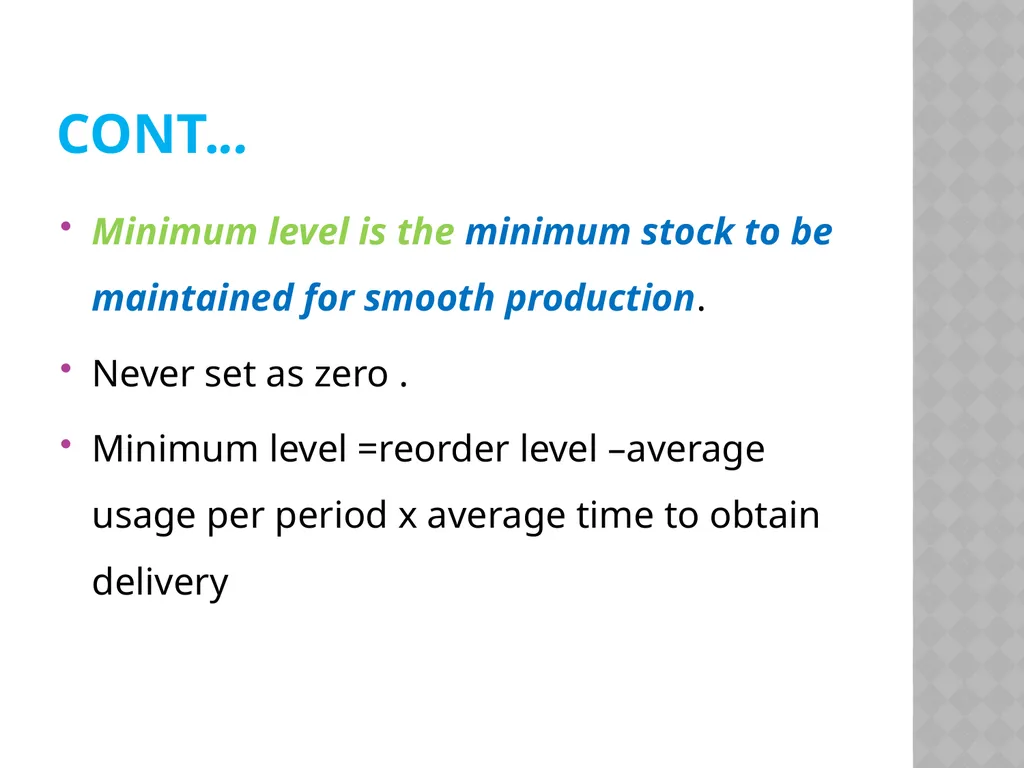
Cont... Minimum level is the minimum stock to be maintained for smooth production.
Never set as zero .
Minimum level =reorder level –average usage per period x average time to obtain delivery<br>
Never set as zero .
Minimum level =reorder level –average usage per period x average time to obtain delivery<br>
16
2 Maximum order level Is when the system is working properly.
It is the level of stock beyond which the stock is not maintained .<br>
It is the level of stock beyond which the stock is not maintained .<br>
17
contd… If the inventory is maintained beyond this point, there would be loss to the hospital by way of expiry of life items beyond the shelf life of items, loss incurred on the capital locked up in the inventory, unnecessary use of items just to exhaust the inventory.<br>
18
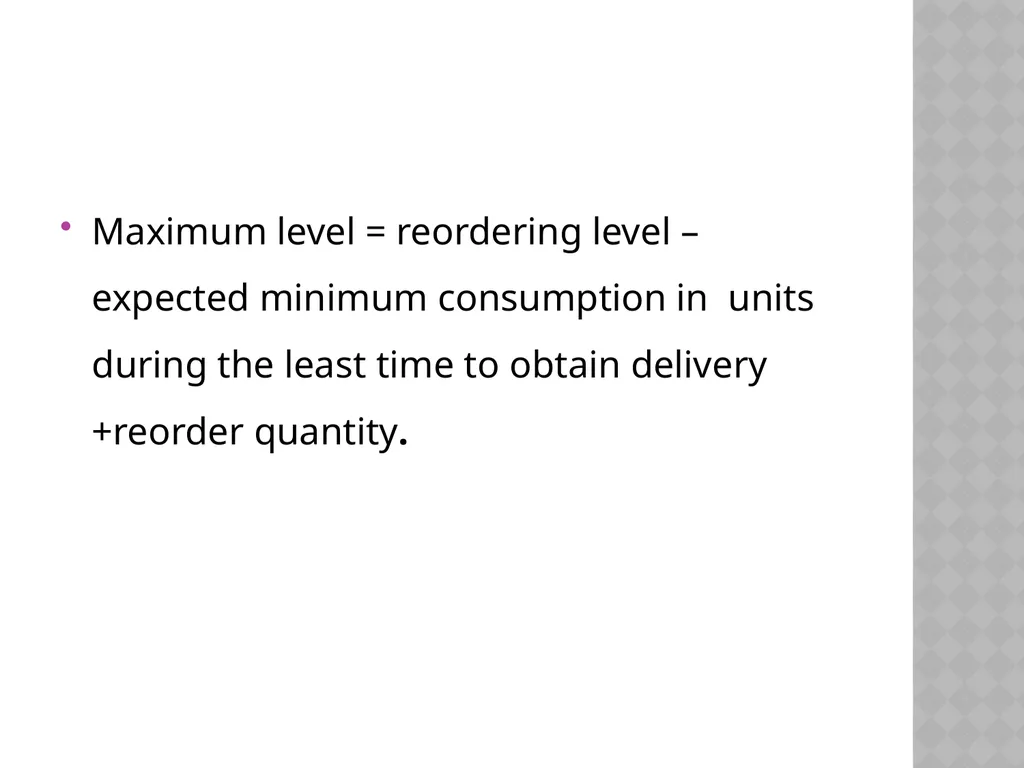
Maximum level = reordering level –expected minimum consumption in units during the least time to obtain delivery +reorder quantity.<br>
19
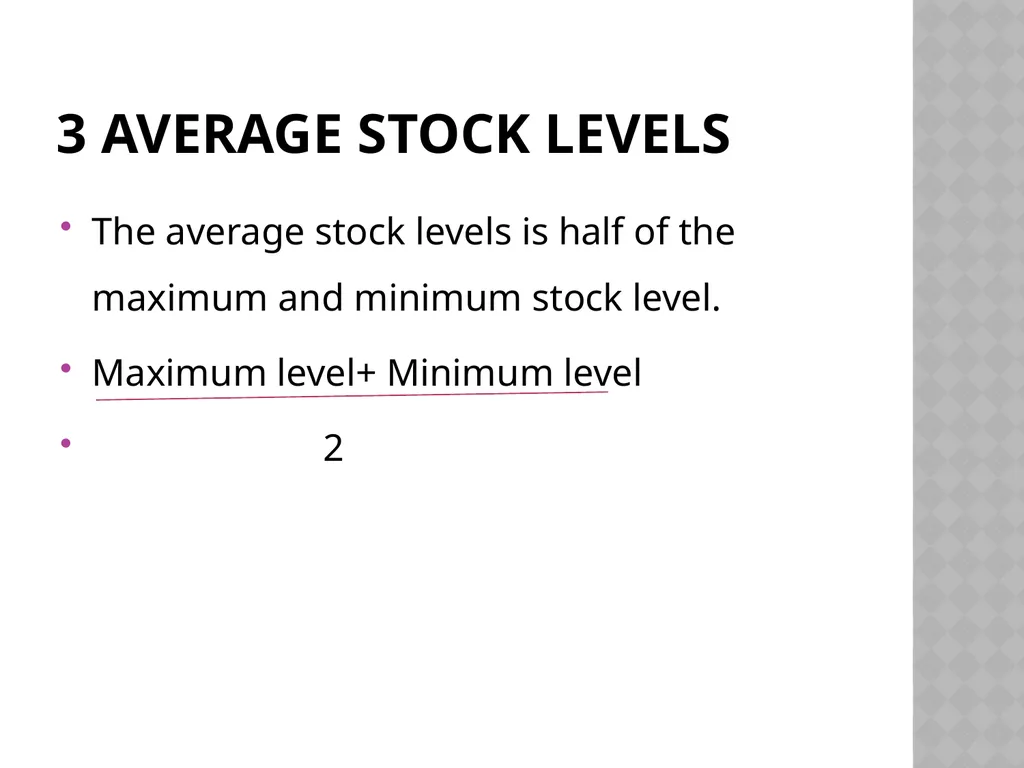
3 average stock levels The average stock levels is half of the maximum and minimum stock level.
Maximum level+ Minimum level
2<br>
Maximum level+ Minimum level
2<br>
20
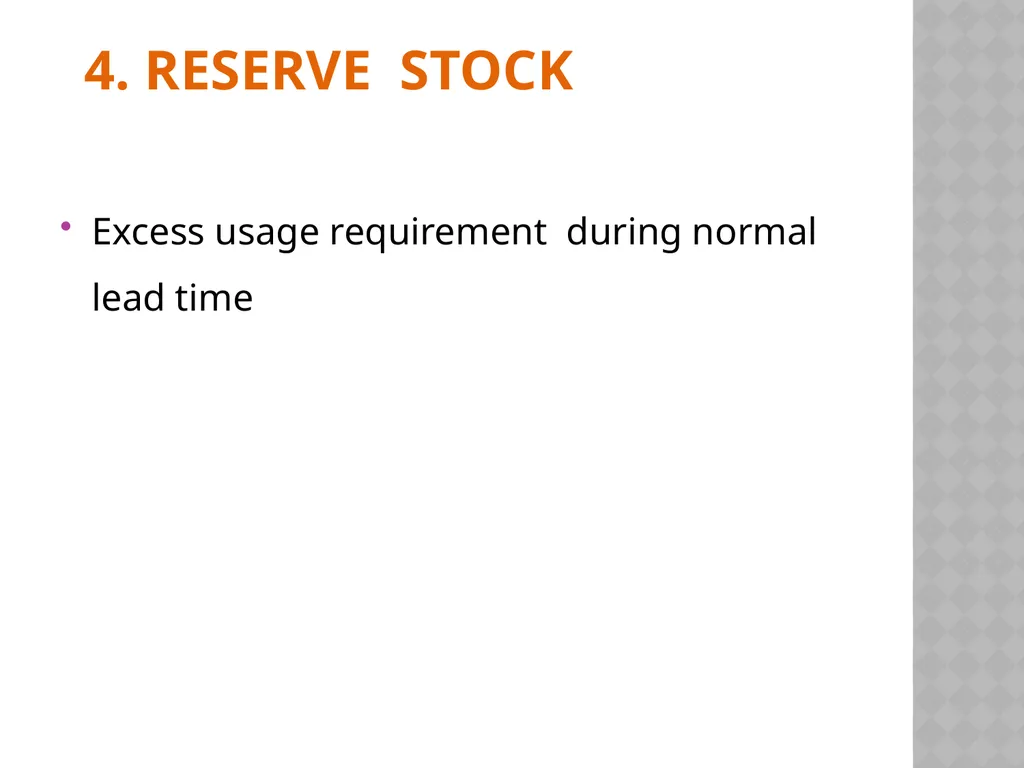
4. Reserve stock Excess usage requirement during normal lead time<br>
21
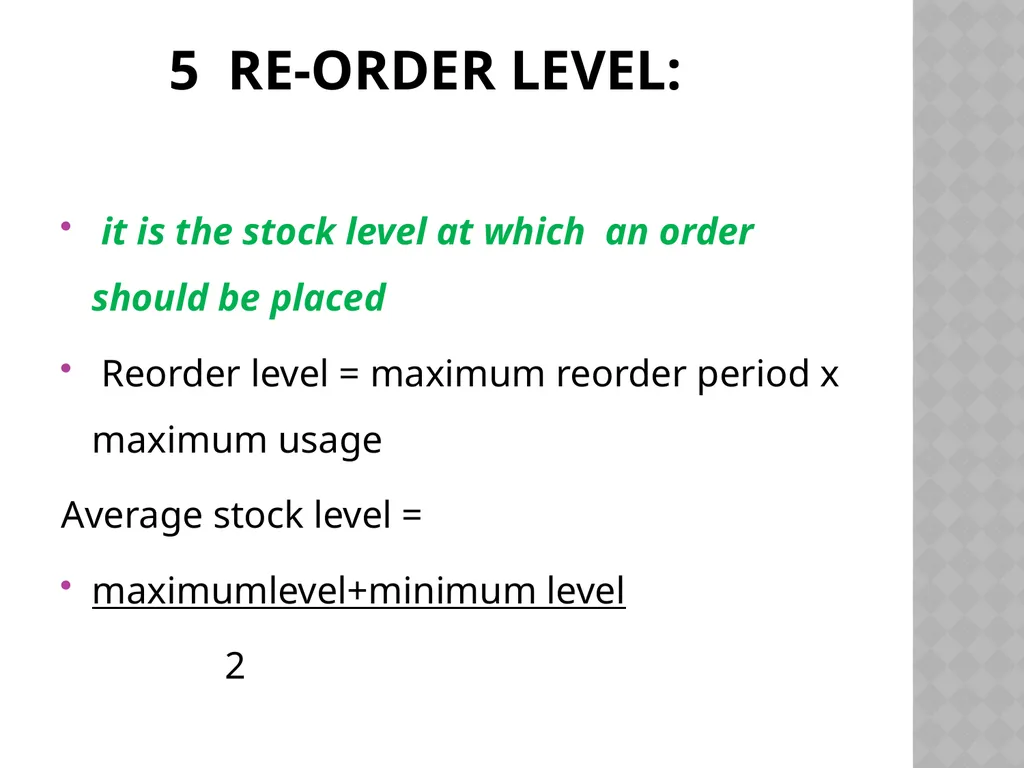
5 Re-order level: it is the stock level at which an order should be placed
Reorder level = maximum reorder period x maximum usage
Average stock level =
maximumlevel+minimum level
2<br>
Reorder level = maximum reorder period x maximum usage
Average stock level =
maximumlevel+minimum level
2<br>
22
Inventory control techniques<br>
23
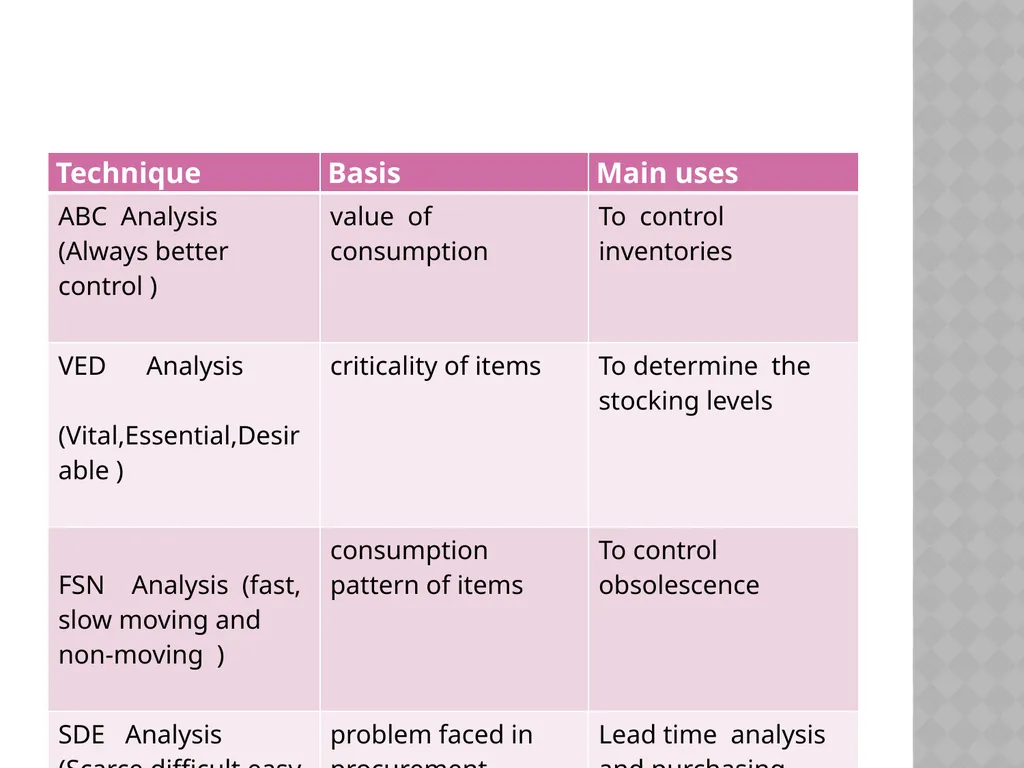
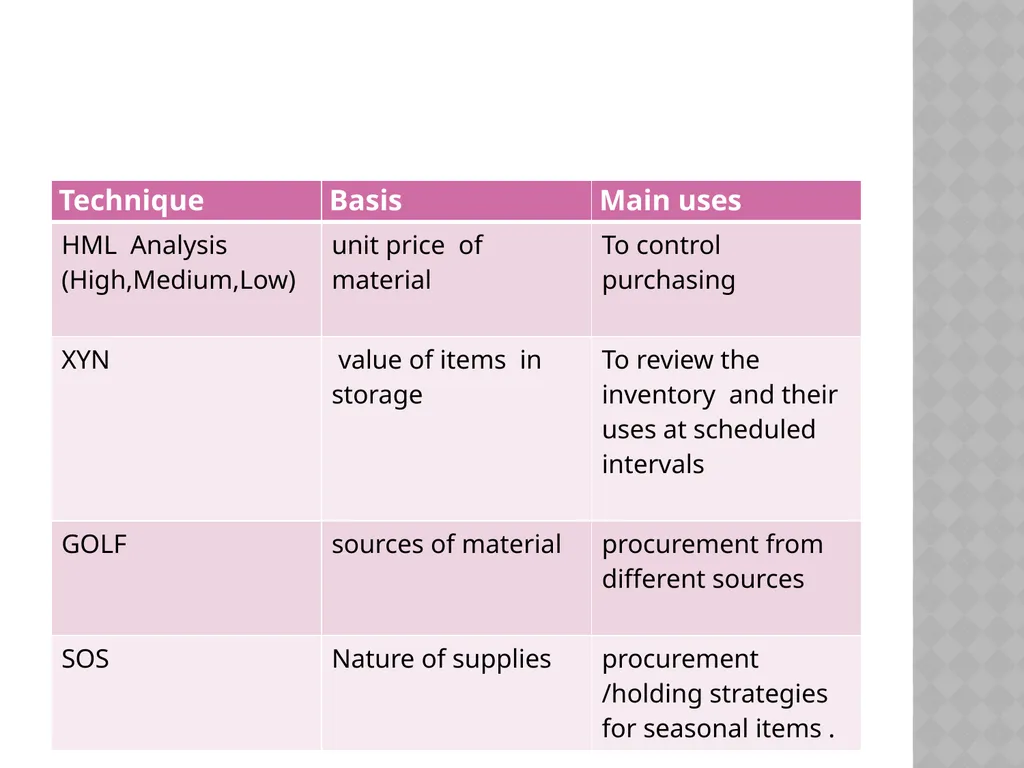
INVENTORY CONTROL TECHNIQUES,ITS BASIS AND USES<br>
24
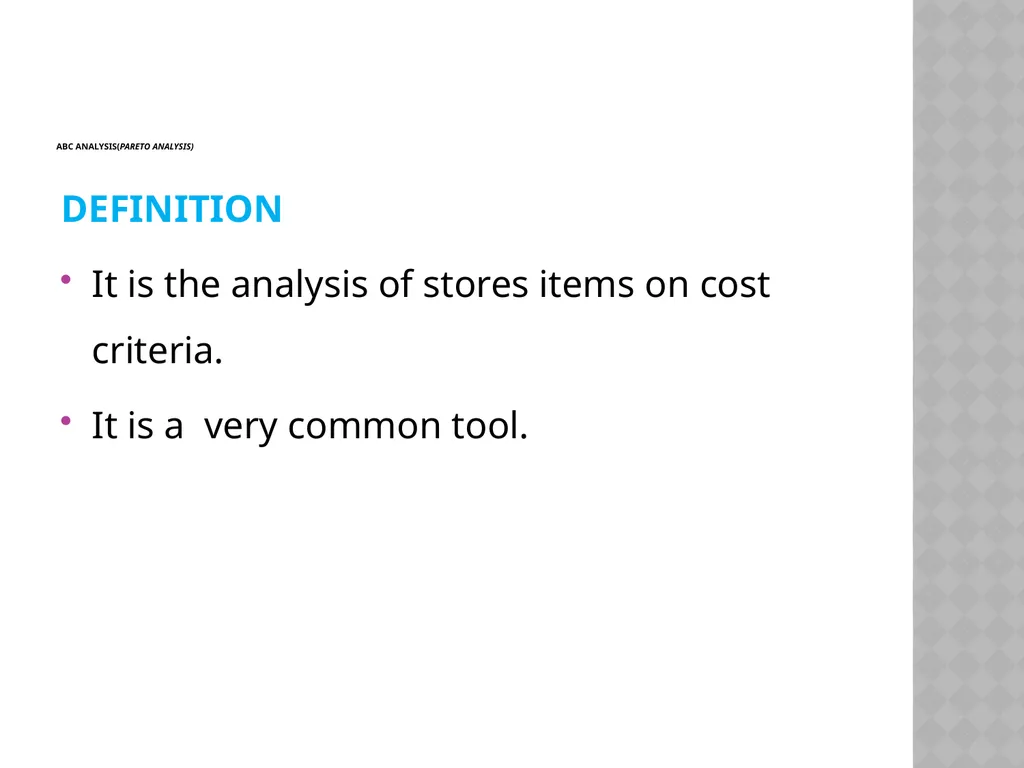
ABC ANALYSIS(Pareto analysis) DEFINITION
It is the analysis of stores items on cost criteria.
It is a very common tool.<br>
It is the analysis of stores items on cost criteria.
It is a very common tool.<br>
25
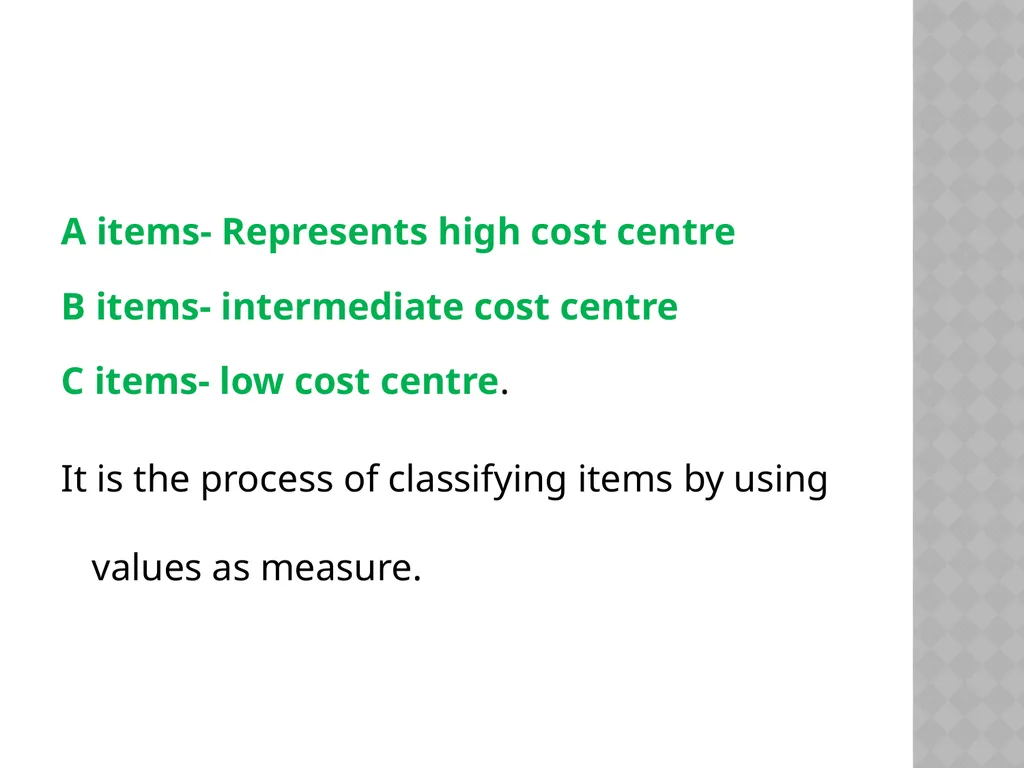
A items- Represents high cost centre
B items- intermediate cost centre
C items- low cost centre.
It is the process of classifying items by using values as measure.<br>
B items- intermediate cost centre
C items- low cost centre.
It is the process of classifying items by using values as measure.<br>
26
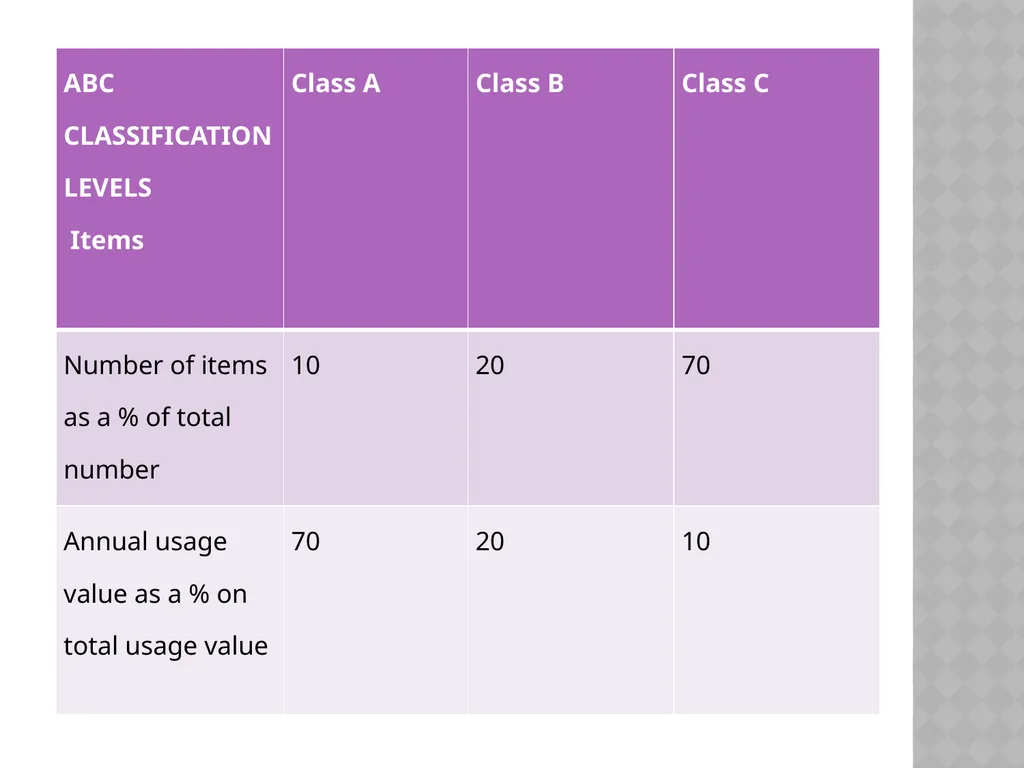
Class A: High value items, consume major portion of the funds.
Small in number, managed by top management.<br>
Small in number, managed by top management.<br>
27
A items must have
1. Rigorous value analysis .
2. Rigid estimates of requirement .
3. Strict and close watch.
4. Require low safety stocks
5. Centralized purchasing and storage.<br>
1. Rigorous value analysis .
2. Rigid estimates of requirement .
3. Strict and close watch.
4. Require low safety stocks
5. Centralized purchasing and storage.<br>
28
Class B items -Medium value items
1. Moderate controls
2.Purchase based on rigid requirement
3.Reasonably strict watch and control
4. Management be done at middle level<br>
1. Moderate controls
2.Purchase based on rigid requirement
3.Reasonably strict watch and control
4. Management be done at middle level<br>
29
Class C:
Low values items, but are required in large quantities and consists of various types and varieties like clips, washers.<br>
Low values items, but are required in large quantities and consists of various types and varieties like clips, washers.<br>
30
C items
1. Ordinarily control measures .
2. Purchased based on usage estimates .
3. Controls exercises by store keeper.
4. Management be done at lower levels.
5.Decentralized (delegated) purchasing.<br>
1. Ordinarily control measures .
2. Purchased based on usage estimates .
3. Controls exercises by store keeper.
4. Management be done at lower levels.
5.Decentralized (delegated) purchasing.<br>
31
principles of ABC analysis The analysis is depends on its annual consumption values rather than unit cost.
The limits for ABC categorization are not uniform but depend on the size of organization, its inventory as well as number of items controlled.<br>
The limits for ABC categorization are not uniform but depend on the size of organization, its inventory as well as number of items controlled.<br>
32
Contd… The analysis does not depend on the importance of items rather based on material credibility and available status of material, material physical characteristics and frequency of material usage.
4 It also depends on degree and characteristics of control to be exercised by the management<br>
4 It also depends on degree and characteristics of control to be exercised by the management<br>
33
Method of ABC analysis Gather all the inventory data and make a list of the store items with the unit price/ item and yearly consumption.
Calculate annual usage
Arrange items in the descending order according to the total value of consumption (annually )per piece in rupees .
Assign item numbers against their annual usage
Find out cumulative annual usage / consumption cost and in percentage
Classify items according to their percentage consumption value(price ).<br>
Calculate annual usage
Arrange items in the descending order according to the total value of consumption (annually )per piece in rupees .
Assign item numbers against their annual usage
Find out cumulative annual usage / consumption cost and in percentage
Classify items according to their percentage consumption value(price ).<br>
34
ADVANTAGES of ABC ANALYSIS Investment in inventory can be maintained.
Easy to control the wastage of costly items.
Helps in maintaining the safety to the cost.
Easy to maintain stock and turnover rate.
Helps to exercise selective control when confronted with large number of items.<br>
Easy to control the wastage of costly items.
Helps in maintaining the safety to the cost.
Easy to maintain stock and turnover rate.
Helps to exercise selective control when confronted with large number of items.<br>
35
Rationalize the number of orders, number of items and thus reduces the inventory.
Shows visible results in a short span of time.
The manager is able to control the inventories specially controlling the A it helps to pin point the obsolete stocks.
Helps in reducing administrative cost.<br>
Shows visible results in a short span of time.
The manager is able to control the inventories specially controlling the A it helps to pin point the obsolete stocks.
Helps in reducing administrative cost.<br>
36
disadvantages Proper standardization and codification of inventory items is required.
Consider only the money value not the importance of items for functioning.
It is challenging to have periodic reviews on ABC analysis .<br>
Consider only the money value not the importance of items for functioning.
It is challenging to have periodic reviews on ABC analysis .<br>
37
Applicability It has universal application for fields requiring selective control.
It can be used in any setting to control the cost.
it extends almost all aspects of material Management such as purchasing receiving and inspection<br>
It can be used in any setting to control the cost.
it extends almost all aspects of material Management such as purchasing receiving and inspection<br>
38
VED ANALYSIS Based on the criticability of the items .
In VED Method (vital, essential and desirable) , each stock item is classified on either vital, essential or desirable based on how critical the item is for providing health services.<br>
In VED Method (vital, essential and desirable) , each stock item is classified on either vital, essential or desirable based on how critical the item is for providing health services.<br>
39
Vital
Items without which treatment comes to standstill: i.e. non- availability cannot be tolerated.
The vital items are stocked in abundance, eg.oxygen supply.
Essential
Items without which an institution cannot function but may affect the quality of services. E.g. Antibiotics, I.V Fluids.<br>
Items without which treatment comes to standstill: i.e. non- availability cannot be tolerated.
The vital items are stocked in abundance, eg.oxygen supply.
Essential
Items without which an institution cannot function but may affect the quality of services. E.g. Antibiotics, I.V Fluids.<br>
40
Desirable:
Items whose non availability can be tolerated for a long period.
Which will not interfere the with functioning because they can be easily purchased as a and when required.
on an average vital items are 10%, essential items are 40% and desirable items make 50% of total items available.<br>
Items whose non availability can be tolerated for a long period.
Which will not interfere the with functioning because they can be easily purchased as a and when required.
on an average vital items are 10%, essential items are 40% and desirable items make 50% of total items available.<br>
41
Advantages of VED analysis It is useful for monitoring and control of stores and spares inventory.
Determine the criticality of items and its effect on production and other services.
It is useful in controlling and maintaining the stock of various types.
It classifies spare parts or objects based on the necessity of things.<br>
Determine the criticality of items and its effect on production and other services.
It is useful in controlling and maintaining the stock of various types.
It classifies spare parts or objects based on the necessity of things.<br>
42
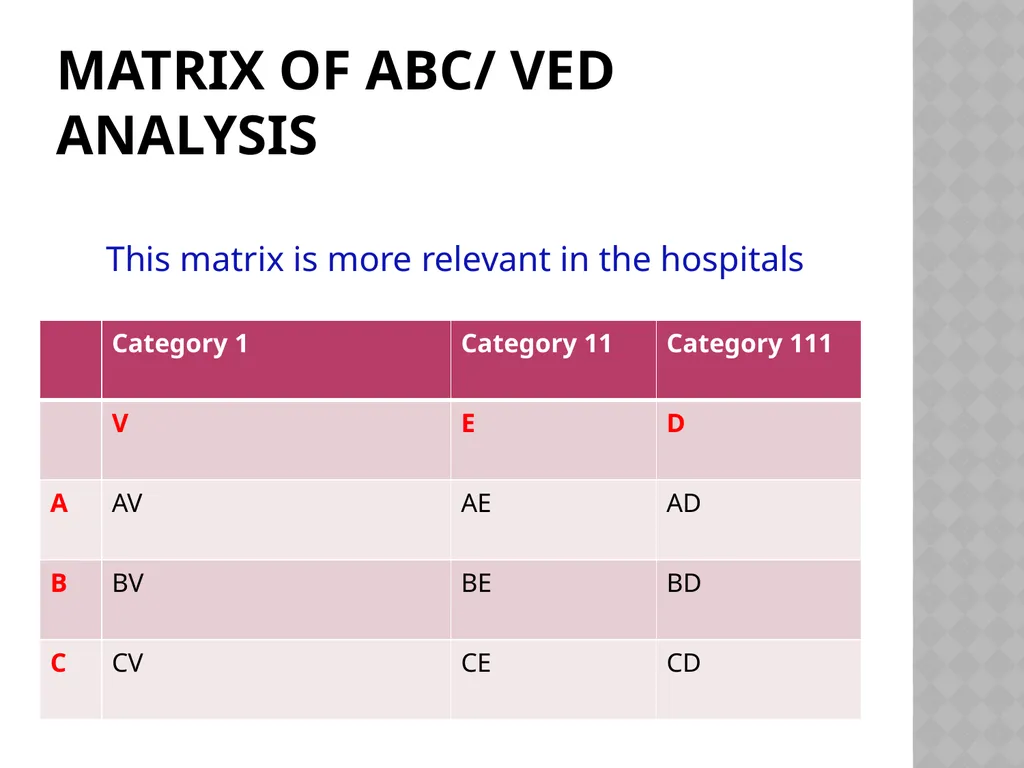
MATRIX OF ABC/ VED ANALYSIS Combination of these two categories like a matrix combining ABC and VED categories.
These items can be controlled by the top-level management.<br>
These items can be controlled by the top-level management.<br>
43
The CD category items are not very costly and at same time of desirable category.
These items can be controlled at the lower level.<br>
These items can be controlled at the lower level.<br>
44
MATRIX OF ABC/ VED ANALYSIS This matrix is more relevant in the hospitals<br>
45
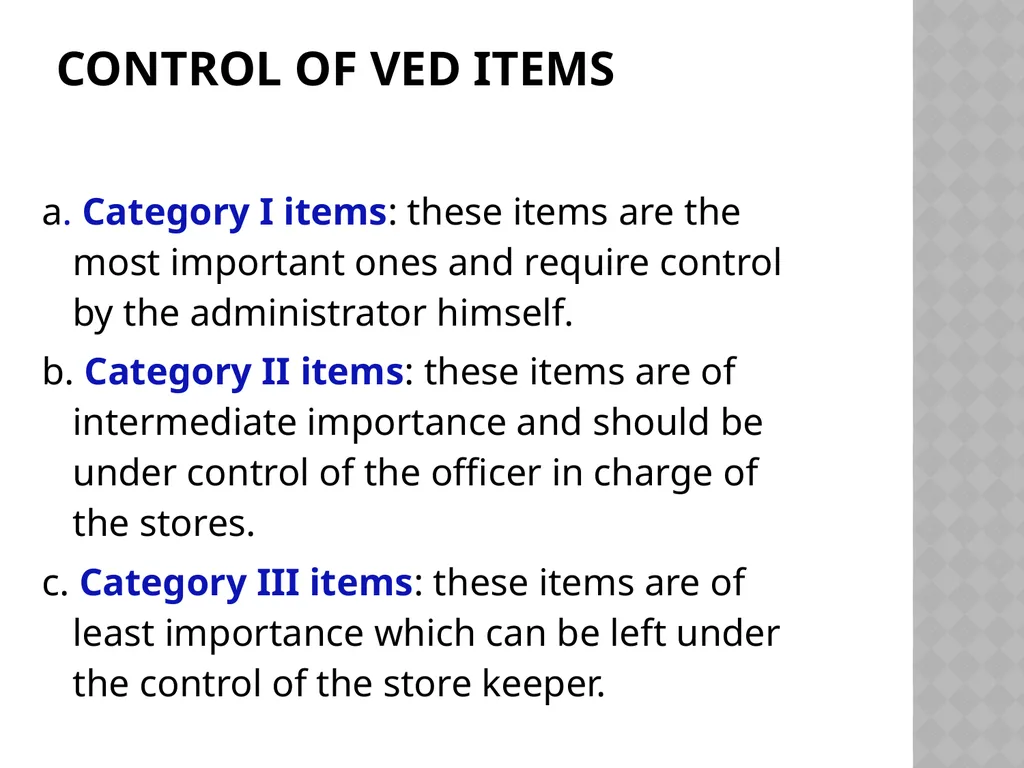
CONTROL OF VED ITEMS a. Category I items: these items are the most important ones and require control by the administrator himself.
b. Category II items: these items are of intermediate importance and should be under control of the officer in charge of the stores.
c. Category III items: these items are of least importance which can be left under the control of the store keeper.<br>
b. Category II items: these items are of intermediate importance and should be under control of the officer in charge of the stores.
c. Category III items: these items are of least importance which can be left under the control of the store keeper.<br>
46
Advantages it aids in management in materializing the policy and service standard.
To control the stock levels by visualizing the inventory carrying cost.<br>
To control the stock levels by visualizing the inventory carrying cost.<br>
47
FSN Analysis Meaning is fast moving, slow moving and non- moving classification is based on consumption pattern of the items or design of issue of items from stores.
METHOD DATE
The items are usually grouped in periods of 12 months .
Non moving items must be periodically reviewed to prevent expiry<br>
METHOD DATE
The items are usually grouped in periods of 12 months .
Non moving items must be periodically reviewed to prevent expiry<br>
48
Analysis For analysis the issuing of items in past two or three years are considered.
If there is no issuing of items during that period it is labelled N item.
10-15 issues in that period the item is S item.
The item exceeding such limits of numbers of issues during that period is F item.<br>
If there is no issuing of items during that period it is labelled N item.
10-15 issues in that period the item is S item.
The item exceeding such limits of numbers of issues during that period is F item.<br>
49
The demand for fast moving (F) items are high, thus special care should be taken in respect of these items otherwise the work may suffer due to shortage of items .
All obsolete inventories contribute to non moving (N) items.<br>
All obsolete inventories contribute to non moving (N) items.<br>
50
Advantages Helps to avoid investment in non moving or slow items .
Facilitates timely control.
Useful in controlling obsolescence.<br>
Facilitates timely control.
Useful in controlling obsolescence.<br>
51
SDE (sacrce, difficult, easy to obtain )ANALYSIS MEANING
s’ stands for scarce items those which are difficult to obtain and generally require imported, short supply managed by top level management .
A big stock is maintained for such items .
D’ stands for difficult items to procure .
items which have to come from distant places.
A safety stock is maintained for these types of items.<br>
s’ stands for scarce items those which are difficult to obtain and generally require imported, short supply managed by top level management .
A big stock is maintained for such items .
D’ stands for difficult items to procure .
items which have to come from distant places.
A safety stock is maintained for these types of items.<br>
52
E’ stands for easy items which are easy to acquire and which are readily available in the local market.
A minimum safety stock is maintained<br>
A minimum safety stock is maintained<br>
53
Criteria. SDE Analysis is generally done on the basis of problems faced in the procurement of an item and based on the availability of items.
Advantages
Vital to the lead time analysis.
Useful in the context of scarcity of supply.
To determine the method of buying and to fix up the responsibilities of buyers.<br>
Advantages
Vital to the lead time analysis.
Useful in the context of scarcity of supply.
To determine the method of buying and to fix up the responsibilities of buyers.<br>
54
HML (HIGH,MEDIUM,LOW )Analysis Criteria
The basic criterion of HML classification is the unit value of the item classified into high value materials, medium value materials and low value materials.<br>
The basic criterion of HML classification is the unit value of the item classified into high value materials, medium value materials and low value materials.<br>
55
Analysis
List out all, the items in descending order of unit value and the management may fix the limits of determining three categories.
Advantages
Used to keep control over consumption at departmental level.
For deciding the frequency of physical verification.<br>
List out all, the items in descending order of unit value and the management may fix the limits of determining three categories.
Advantages
Used to keep control over consumption at departmental level.
For deciding the frequency of physical verification.<br>
56
XYZ Analysis Criteria
XYZ classification is based on the value of the inventory stored.
The X items are those inventory values are high, while Z Items are those whose inventory values are low.
Y items are those which have moderate inventory stocks.
Usually XYZ analysis is made in conjunction with ABC Or HML analysis.<br>
XYZ classification is based on the value of the inventory stored.
The X items are those inventory values are high, while Z Items are those whose inventory values are low.
Y items are those which have moderate inventory stocks.
Usually XYZ analysis is made in conjunction with ABC Or HML analysis.<br>
57
Advantages Identify those few items which account for large amount of money locked up in the Stock.
Helps to take steps for reduction.<br>
Helps to take steps for reduction.<br>
58
GOLF Analysis GOLF stands for government .ordinary, Foreign.
Criteria
GOLF analysis is carried out on the basis of source of material.
Method
A special procedure is followed for procuring imported items. The ordinary procedure may not work in respect of these items.<br>
Criteria
GOLF analysis is carried out on the basis of source of material.
Method
A special procedure is followed for procuring imported items. The ordinary procedure may not work in respect of these items.<br>
59
SOS ANALYSIS S’ stands for seasonal and OS ;sands for off seasonal items
The analysis identifies items into
seasonal, but available only for a limited period seasonal ,but available throughout the year
Off seasonal items whose quantity is determined on different consideration.<br>
The analysis identifies items into
seasonal, but available only for a limited period seasonal ,but available throughout the year
Off seasonal items whose quantity is determined on different consideration.<br>
60
INVENTORY CONTROL SYSTEM<br>
61
The inventory management is a process of managing the flow of materials efficiently, utilizing work force and equipment effectively coordinating internal activities .<br>
62
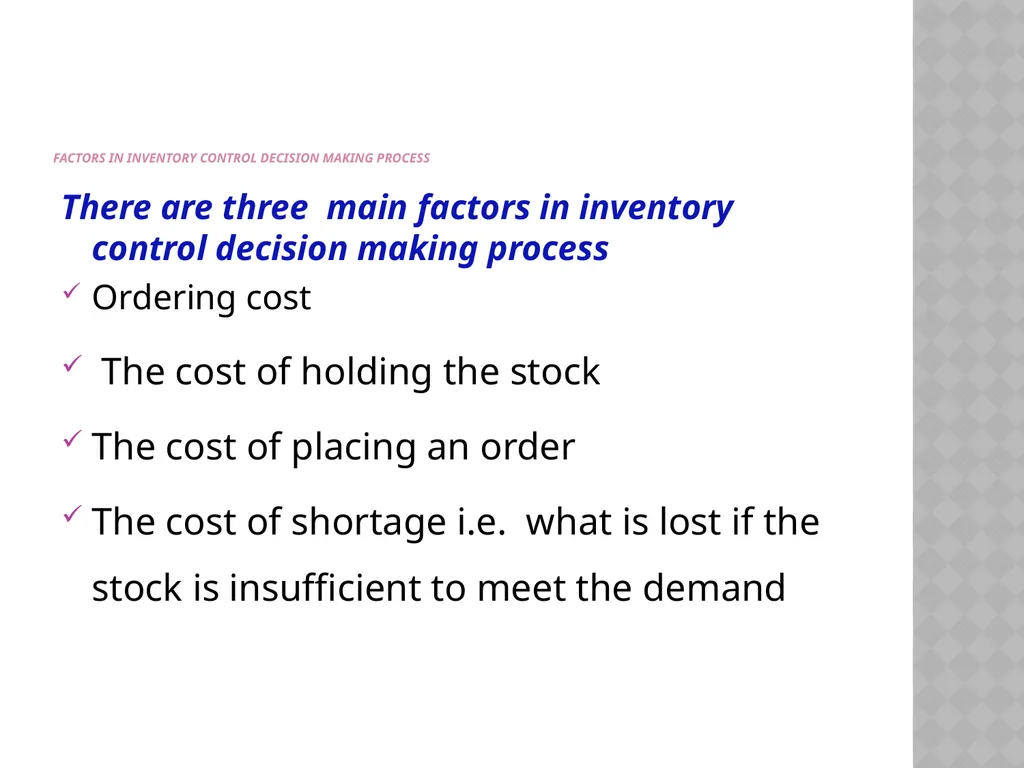
Factors in inventory control decision making process There are three main factors in inventory control decision making process
Ordering cost
The cost of holding the stock
The cost of placing an order
The cost of shortage i.e. what is lost if the stock is insufficient to meet the demand<br>
Ordering cost
The cost of holding the stock
The cost of placing an order
The cost of shortage i.e. what is lost if the stock is insufficient to meet the demand<br>
63
1 ORDERING COSTS: This is the cost of ordering the item and securing its supply.
It includes the expenses with raising requisition, placing an order, follow up, transportation, receipt and inspection, acceptance and placing in stores.<br>
It includes the expenses with raising requisition, placing an order, follow up, transportation, receipt and inspection, acceptance and placing in stores.<br>
64
2 inventory Carrying costs/holding costs: This is the cost of holding an item in the store till it is issued out or sold.
Following are the elements included-
Interest on capital cost incurred.
Cost of obsolescence, wastages, damages.
Rent, insurance, and taxes .<br>
Following are the elements included-
Interest on capital cost incurred.
Cost of obsolescence, wastages, damages.
Rent, insurance, and taxes .<br>
65
Contd… Maintenance costs of inventory like special treatment, stock taking etc.
Operating costs of store like direct labour and overheads like electricity, dust proofing etc.<br>
Operating costs of store like direct labour and overheads like electricity, dust proofing etc.<br>
66
3 Shortage costs/out of stock: it is loss which occurs or which may occur due to non availability of materials.
It includes break down or delay carrying out the work, back ordering, loss of goodwill, etc..<br>
It includes break down or delay carrying out the work, back ordering, loss of goodwill, etc..<br>
67
4 Other costs Includes overtime payments, layoffs and idle time ,set up cost and overstocking costs.<br>
68
Total inventory cost A total inventory cost consists of carrying costs and ordering costs.<br>
69
INVENTORY ACCOUNTING/recording SYSTEM Organization may use either the perpetual system or the periodic system to record the transaction involving inventory or account for inventory.<br>
70
1.Perpetual inventory systems MEANING
Perpetual inventory system implies continuous.
Perpetual inventory system may be defined as a method of recording stores balances after every receipt and issue to facilitate regular checking and to obviate down for Stock taking.<br>
Perpetual inventory system implies continuous.
Perpetual inventory system may be defined as a method of recording stores balances after every receipt and issue to facilitate regular checking and to obviate down for Stock taking.<br>
71
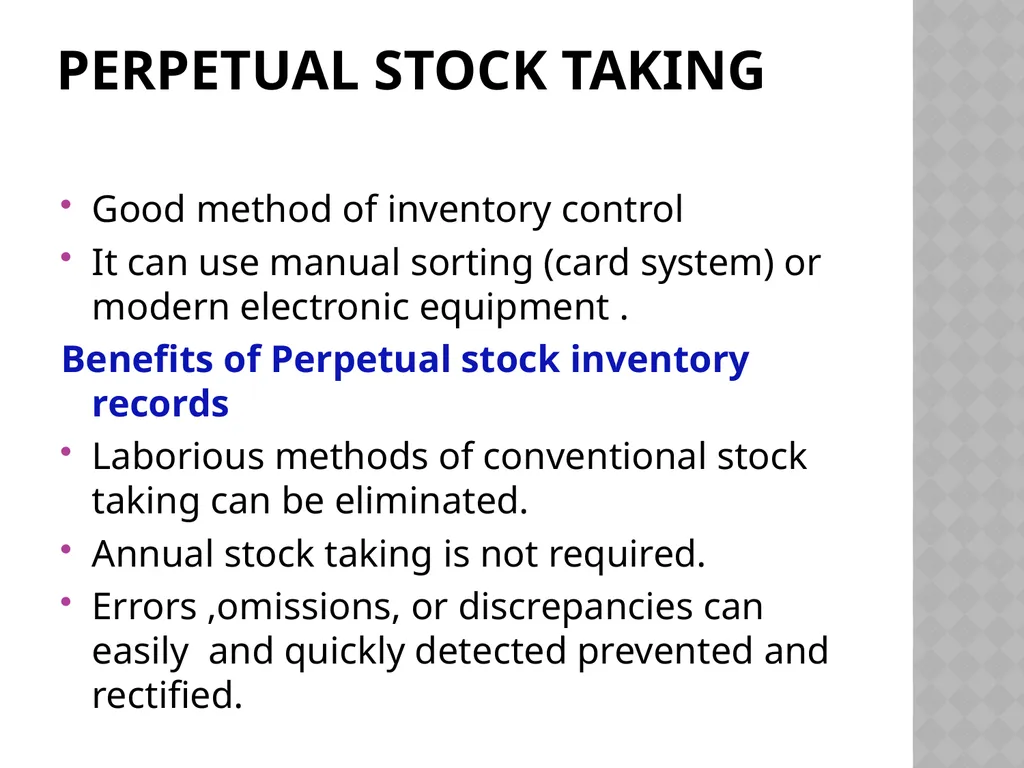
Perpetual stock taking Good method of inventory control
It can use manual sorting (card system) or modern electronic equipment .
Benefits of Perpetual stock inventory records
Laborious methods of conventional stock taking can be eliminated.
Annual stock taking is not required.
Errors ,omissions, or discrepancies can easily and quickly detected prevented and rectified.<br>
It can use manual sorting (card system) or modern electronic equipment .
Benefits of Perpetual stock inventory records
Laborious methods of conventional stock taking can be eliminated.
Annual stock taking is not required.
Errors ,omissions, or discrepancies can easily and quickly detected prevented and rectified.<br>
72
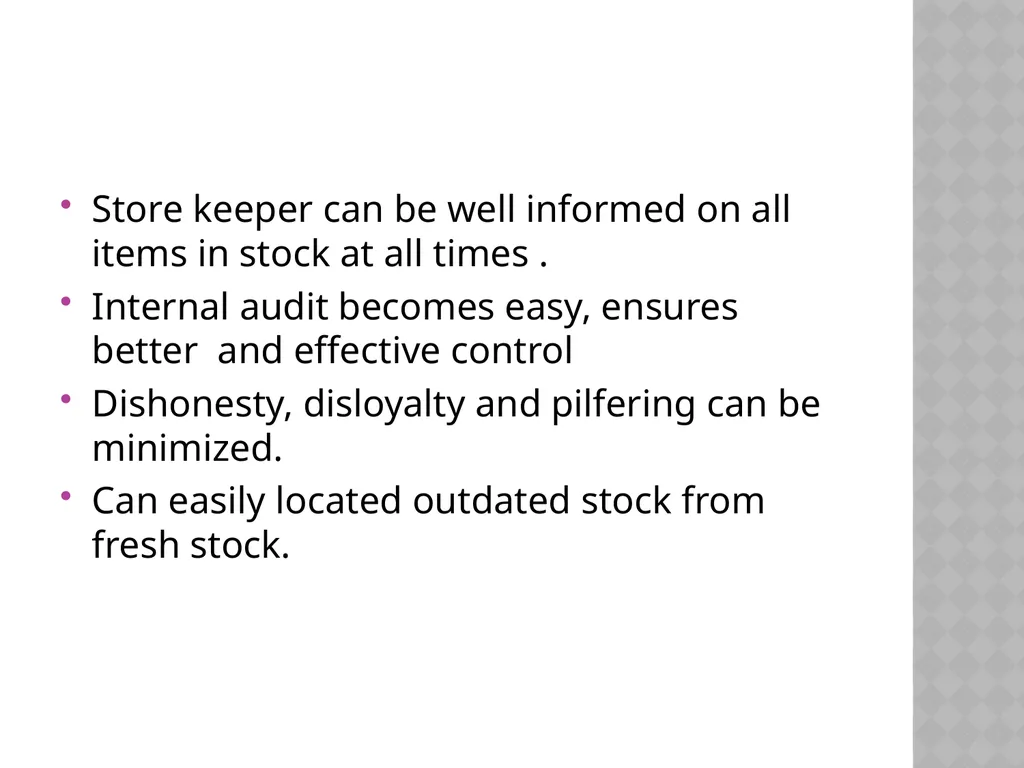
Store keeper can be well informed on all items in stock at all times .
Internal audit becomes easy, ensures better and effective control
Dishonesty, disloyalty and pilfering can be minimized.
Can easily located outdated stock from fresh stock.<br>
Internal audit becomes easy, ensures better and effective control
Dishonesty, disloyalty and pilfering can be minimized.
Can easily located outdated stock from fresh stock.<br>
73
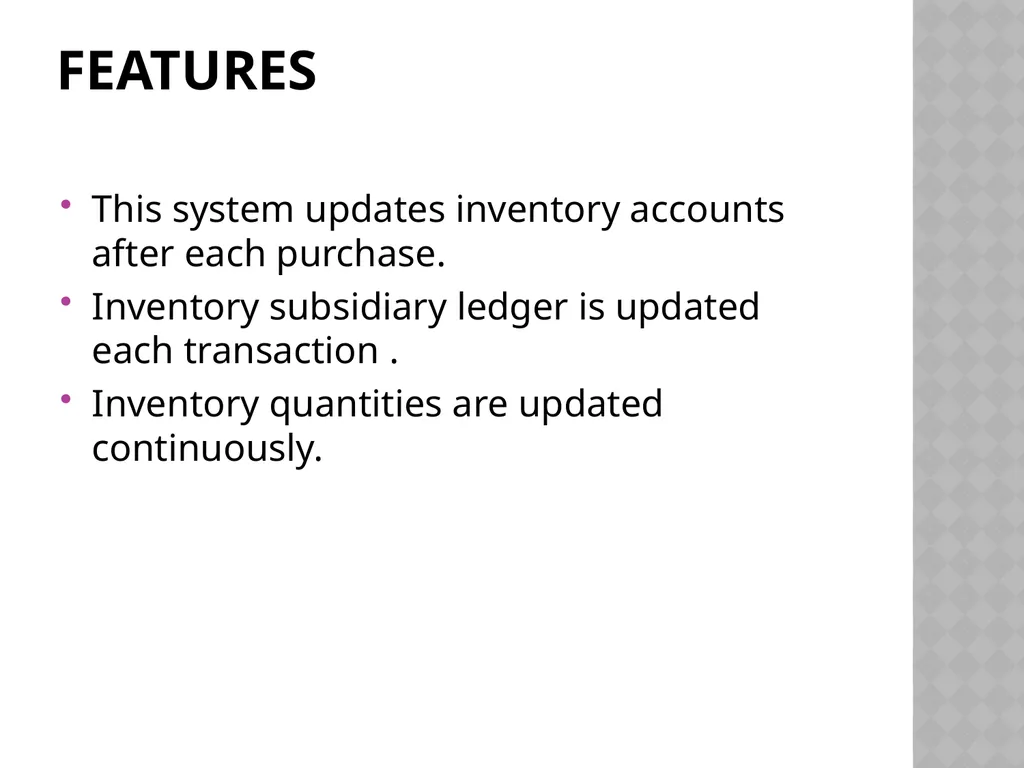
features This system updates inventory accounts after each purchase.
Inventory subsidiary ledger is updated each transaction .
Inventory quantities are updated continuously.<br>
Inventory subsidiary ledger is updated each transaction .
Inventory quantities are updated continuously.<br>
74
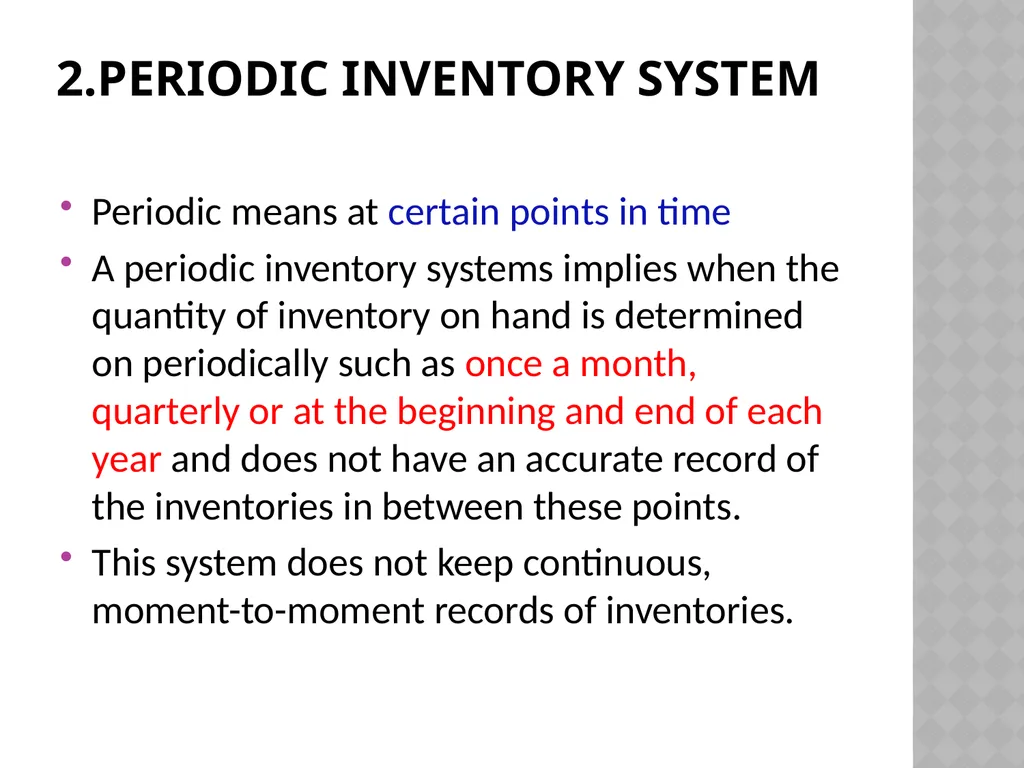
2.periodic inventory system Periodic means at certain points in time
A periodic inventory systems implies when the quantity of inventory on hand is determined on periodically such as once a month, quarterly or at the beginning and end of each year and does not have an accurate record of the inventories in between these points.
This system does not keep continuous, moment-to-moment records of inventories.<br>
A periodic inventory systems implies when the quantity of inventory on hand is determined on periodically such as once a month, quarterly or at the beginning and end of each year and does not have an accurate record of the inventories in between these points.
This system does not keep continuous, moment-to-moment records of inventories.<br>
75
features Inventory subsidiary ledger is not updated after each purchase of inventory.
Inventory quantities are not updated continuously rather updated on a periodic.<br>
Inventory quantities are not updated continuously rather updated on a periodic.<br>
76
References 1 M. Suneetha .Management of nursing services and education .Ist ed. Frontline publishers,2015 .
2 .Deepak K.Chandran Sc.Kumar.A comprehensive text book on nursing management Bangalore .Emmess medical publishers.2013.
4. Vati J. Principles and practice of nursing management and administration .Ist ed ,Jaypee publishers . New Delhi 2019.
5. Venkataraman .A.New Trends In Management Of Nursing Service And Education. The health science publisher .New Delhi,I ed.2017
.<br>
2 .Deepak K.Chandran Sc.Kumar.A comprehensive text book on nursing management Bangalore .Emmess medical publishers.2013.
4. Vati J. Principles and practice of nursing management and administration .Ist ed ,Jaypee publishers . New Delhi 2019.
5. Venkataraman .A.New Trends In Management Of Nursing Service And Education. The health science publisher .New Delhi,I ed.2017
.<br>