
Investigating the Relationships between Air
Description: Investigating the Relationships between Air Pollutants and Meteorological Parameters using TEMPO Hourly Data over Highly Polluted Cities in North America Md Masudur Rahman, Shuo Wang and Weixiong Zhao Background Earth Atmosphere Interaction
Related Topics
Download Presentation
"Investigating the Relationships between Air" is the property of its rightful owner. Permission is granted to download and print the materials on this website for personal, non-commercial use only, and to display it on your personal computer provided you do not modify the materials and that you retain all copyright notices contained in the materials. By downloading content from our website, you accept the terms of this agreement.
Presentation Transcript
slide1. Investigating the Relationships between Air Pollutants and Meteorological Parameters using TEMPO Hourly Data over Highly Polluted Cities in North America Md Masudur Rahman, Shuo Wang and Weixiong Zhao<br>
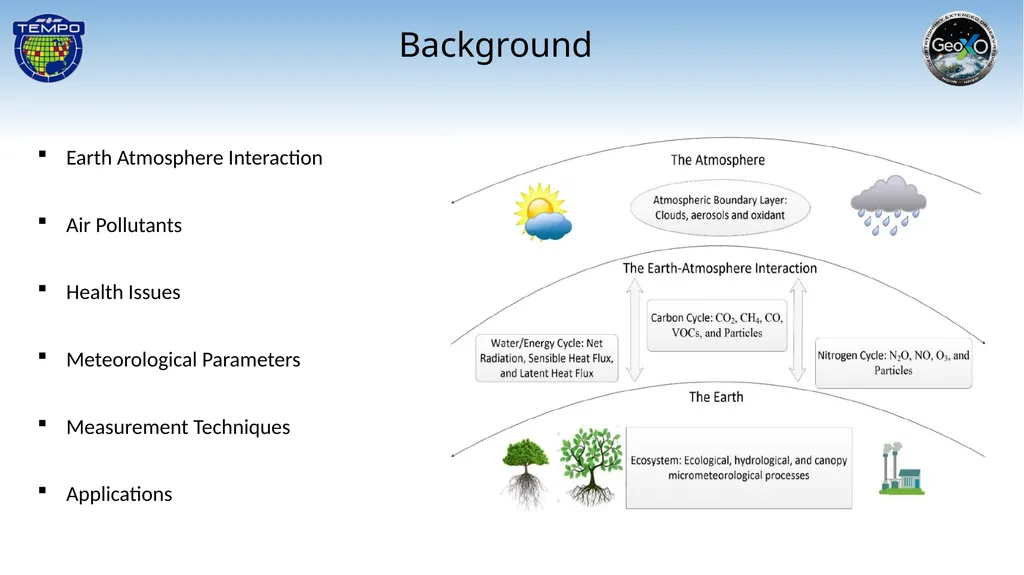
slide2. Background Earth Atmosphere Interaction
Air Pollutants
Health Issues
Meteorological Parameters
Measurement Techniques
Applications<br>
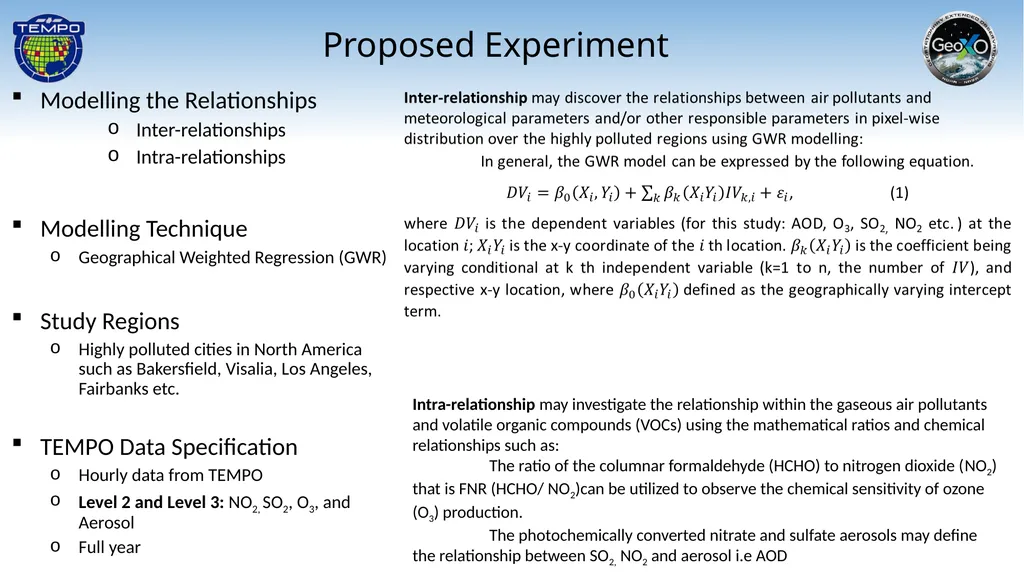
slide3. Proposed Experiment Modelling the Relationships
Inter-relationships
Intra-relationships
Modelling Technique
Geographical Weighted Regression (GWR)
Study Regions
Highly polluted cities in North America such as Bakersfield, Visalia, Los Angeles, Fairbanks etc.
TEMPO Data Specification
Hourly data from TEMPO
Level 2 and Level 3: NO2, SO2, O3, and Aerosol
Full year Intra-relationship may investigate the relationship within the gaseous air pollutants and volatile organic compounds (VOCs) using the mathematical ratios and chemical relationships such as:
The ratio of the columnar formaldehyde (HCHO) to nitrogen dioxide (NO2) that is FNR (HCHO/ NO2)can be utilized to observe the chemical sensitivity of ozone (O3) production.
The photochemically converted nitrate and sulfate aerosols may define the relationship between SO2, NO2 and aerosol i.e AOD<br>
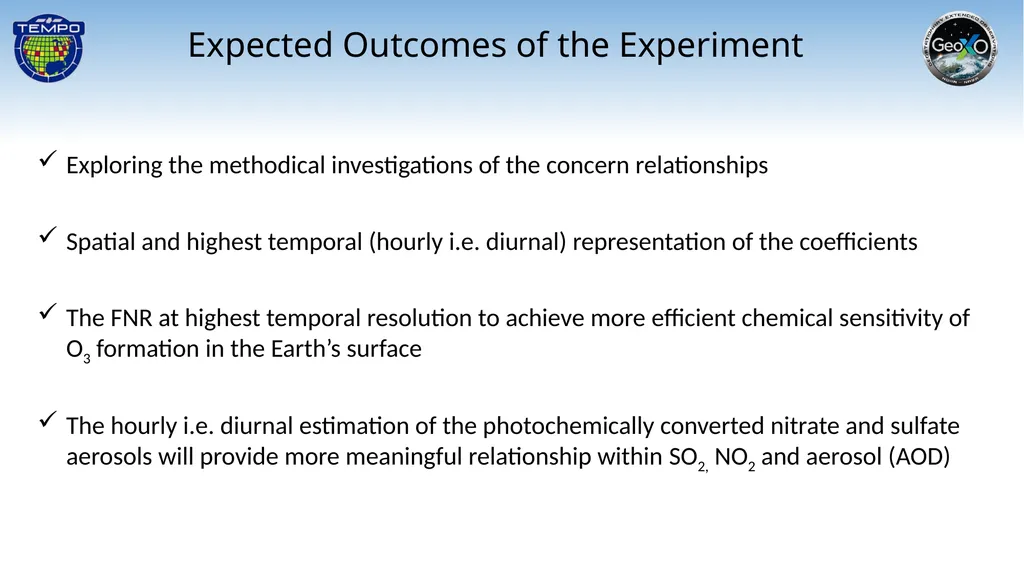
slide4. Expected Outcomes of the Experiment Exploring the methodical investigations of the concern relationships
Spatial and highest temporal (hourly i.e. diurnal) representation of the coefficients
The FNR at highest temporal resolution to achieve more efficient chemical sensitivity of O3 formation in the Earth’s surface
The hourly i.e. diurnal estimation of the photochemically converted nitrate and sulfate aerosols will provide more meaningful relationship within SO2, NO2 and aerosol (AOD)<br>
slide5. Questions and Answers THANK YOU
ASSALAMUALYKUM
DHONNOBAD
XIEXIE THANK YOU
ASSALAMUALYKUM
DHONNOBAD
XIEXIE<br>
slide2. Background Earth Atmosphere Interaction
Air Pollutants
Health Issues
Meteorological Parameters
Measurement Techniques
Applications<br>
slide3. Proposed Experiment Modelling the Relationships
Inter-relationships
Intra-relationships
Modelling Technique
Geographical Weighted Regression (GWR)
Study Regions
Highly polluted cities in North America such as Bakersfield, Visalia, Los Angeles, Fairbanks etc.
TEMPO Data Specification
Hourly data from TEMPO
Level 2 and Level 3: NO2, SO2, O3, and Aerosol
Full year Intra-relationship may investigate the relationship within the gaseous air pollutants and volatile organic compounds (VOCs) using the mathematical ratios and chemical relationships such as:
The ratio of the columnar formaldehyde (HCHO) to nitrogen dioxide (NO2) that is FNR (HCHO/ NO2)can be utilized to observe the chemical sensitivity of ozone (O3) production.
The photochemically converted nitrate and sulfate aerosols may define the relationship between SO2, NO2 and aerosol i.e AOD<br>
slide4. Expected Outcomes of the Experiment Exploring the methodical investigations of the concern relationships
Spatial and highest temporal (hourly i.e. diurnal) representation of the coefficients
The FNR at highest temporal resolution to achieve more efficient chemical sensitivity of O3 formation in the Earth’s surface
The hourly i.e. diurnal estimation of the photochemically converted nitrate and sulfate aerosols will provide more meaningful relationship within SO2, NO2 and aerosol (AOD)<br>
slide5. Questions and Answers THANK YOU
ASSALAMUALYKUM
DHONNOBAD
XIEXIE THANK YOU
ASSALAMUALYKUM
DHONNOBAD
XIEXIE<br>