
Investor Presentation Q1 2021 Update


Description: Investor Presentation Q1 2021 Update www.lancashiregroup.com NOTE REGARDING FORWARD-LOOKING STATEMENTS: CERTAIN STATEMENTS AND INDICATIVE PROJECTIONS (WHICH MAY INCLUDE MODELLED LOSS SCENARIOS) MADE IN THIS PRESENTATION OR OTHERWISE THAT
Related Topics
Download Presentation
"Investor Presentation Q1 2021 Update" is the property of its rightful owner. Permission is granted to download and print the materials on this website for personal, non-commercial use only, and to display it on your personal computer provided you do not modify the materials and that you retain all copyright notices contained in the materials. By downloading content from our website, you accept the terms of this agreement.
Presentation Transcript
slide1. Investor Presentation
Q1 2021 Update www.lancashiregroup.com<br>
slide2. NOTE REGARDING FORWARD-LOOKING STATEMENTS:
CERTAIN STATEMENTS AND INDICATIVE PROJECTIONS (WHICH MAY INCLUDE MODELLED LOSS SCENARIOS) MADE IN THIS PRESENTATION OR OTHERWISE THAT ARE NOT BASED ON CURRENT OR HISTORICAL FACTS ARE FORWARD-LOOKING IN NATURE INCLUDING, WITHOUT LIMITATION, STATEMENTS CONTAINING THE WORDS “BELIEVES”, “AIMS”, “ANTICIPATES”, “PLANS”, “PROJECTS”, “FORECASTS”, “GUIDANCE”, “INTENDS”, “EXPECTS”, “ESTIMATES”, “PREDICTS”, “MAY”, “CAN”, “LIKELY”, “WILL”, “SEEKS”, “SHOULD”, OR, IN EACH CASE, THEIR NEGATIVE OR COMPARABLE TERMINOLOGY. SUCH FORWARD-LOOKING STATEMENTS INVOLVE KNOWN AND UNKNOWN RISKS, UNCERTAINTIES AND OTHER IMPORTANT FACTORS THAT COULD CAUSE THE ACTUAL RESULTS, PERFORMANCE OR ACHIEVEMENTS OF THE GROUP TO BE MATERIALLY DIFFERENT FROM FUTURE RESULTS, PERFORMANCE OR ACHIEVEMENTS EXPRESSED OR IMPLIED BY SUCH FORWARD-LOOKING STATEMENTS. FOR A DESCRIPTION OF SOME OF THESE FACTORS, SEE THE GROUP’S ANNUAL REPORT AND ACCOUNTS FOR THE YEAR ENDED 31 DECEMBER 2020. ALL FORWARD-LOOKING STATEMENTS IN THIS PRESENTATION OR OTHERWISE SPEAK ONLY AS AT THE DATE OF PUBLICATION. LANCASHIRE EXPRESSLY DISCLAIMS ANY OBLIGATION OR UNDERTAKING (SAVE AS REQUIRED TO COMPLY WITH ANY LEGAL OR REGULATORY OBLIGATIONS INCLUDING THE RULES OF THE LONDON STOCK EXCHANGE) TO DISSEMINATE ANY UPDATES OR REVISIONS TO ANY FORWARD-LOOKING STATEMENT TO REFLECT ANY CHANGES IN THE GROUP’S EXPECTATIONS OR CIRCUMSTANCES ON WHICH ANY SUCH STATEMENT IS BASED. ALL SUBSEQUENT WRITTEN AND ORAL FORWARD-LOOKING STATEMENTS ATTRIBUTABLE TO THE GROUP OR INDIVIDUALS ACTING ON BEHALF OF THE GROUP ARE EXPRESSLY QUALIFIED IN THEIR ENTIRETY BY THIS NOTE. PROSPECTIVE INVESTORS SHOULD SPECIFICALLY CONSIDER THE FACTORS IDENTIFIED IN THIS PRESENTATION WHICH COULD CAUSE ACTUAL RESULTS TO DIFFER BEFORE MAKING AN INVESTMENT DECISION. NOTE REGARDING ALTERNATIVE PERFORMANCE MEASURES:
THE GROUP USES ALTERNATIVE PERFORMANCE MEASURES TO HELP EXPLAIN BUSINESS PERFORMANCE AND FINANCIAL POSITION. THESE MEASURES HAVE BEEN CALCULATED CONSISTENTLY WITH THOSE AS DISCLOSED IN THE GROUP’S ANNUAL REPORT AND ACCOUNTS FOR THE YEAR ENDED 31 DECEMBER 2020.
NOTE REGARDING RPI METHODOLOGY:
THE RENEWAL PRICE INDEX (“RPI”) IS AN INTERNAL METHODOLOGY THAT MANAGEMENT USES TO TRACK TRENDS IN PREMIUM RATES OF A PORTFOLIO OF INSURANCE AND REINSURANCE CONTRACTS. THE RPI WRITTEN IN THE RESPECTIVE SEGMENTS IS CALCULATED ON A PER CONTRACT BASIS AND REFLECTS MANAGEMENT’S ASSESSMENT OF RELATIVE CHANGES IN PRICE, TERMS, CONDITIONS AND LIMITS AND IS WEIGHTED BY PREMIUM VOLUME. THE CALCULATION INVOLVES A DEGREE OF JUDGEMENT IN RELATION TO COMPARABILITY OF CONTRACTS AND THE ASSESSMENT NOTED ABOVE. TO ENHANCE THE RPI METHODOLOGY, MANAGEMENT MAY REVISE THE METHODOLOGY AND ASSUMPTIONS UNDERLYING THE RPI, SO THE TRENDS IN PREMIUM RATES REFLECTED IN THE RPI MAY NOT BE COMPARABLE OVER TIME. CONSIDERATION IS ONLY GIVEN TO RENEWALS OF A COMPARABLE NATURE SO IT DOES NOT REFLECT EVERY CONTRACT IN THE PORTFOLIO OF CONTRACTS OR, FOR EXAMPLE, NEW BUSINESS LINES WITHIN A SEGMENT. THE FUTURE PROFITABILITY OF THE PORTFOLIO OF CONTRACTS WITHIN THE RPI IS DEPENDENT UPON MANY FACTORS BESIDES THE TRENDS IN PREMIUM RATES.
NOTE REGARDING COVID-19 LOSS:
OUR COVID-19 LOSS PRIMARILY RELATES TO EXPOSURES WITHIN OUR PROPERTY SEGMENT. GIVEN THE ONGOING NATURE OF THE COVID-19 PANDEMIC AND THE UNCERTAIN IMPACT ON THE INSURANCE INDUSTRY, THE GROUP’S ACTUAL ULTIMATE LOSS MAY VARY, PERHAPS MATERIALLY, FROM THE CURRENT ESTIMATE. THE FINAL SETTLEMENT OF ALL OF THESE CLAIMS IS LIKELY TO TAKE PLACE OVER A CONSIDERABLE PERIOD OF TIME. LANCASHIRE DOES NOT WRITE THE FOLLOWING LINES OF BUSINESS: TRAVEL INSURANCE; TRADE CREDIT; AND LONG-TERM LIFE AND PRIOR TO THE COVID-19 PANDEMIC DID NOT WRITE DIRECTORS’ AND OFFICERS’ LIABILITY OR MEDICAL MALPRACTICE. THE GROUP UNDERWRITES A SMALL NUMBER OF EVENT CANCELLATION CONTRACTS AND HAS MINIMAL EXPOSURE THROUGH MORTGAGE, ACCIDENT AND HEALTH BUSINESS. 2 Safe harbor statements<br>
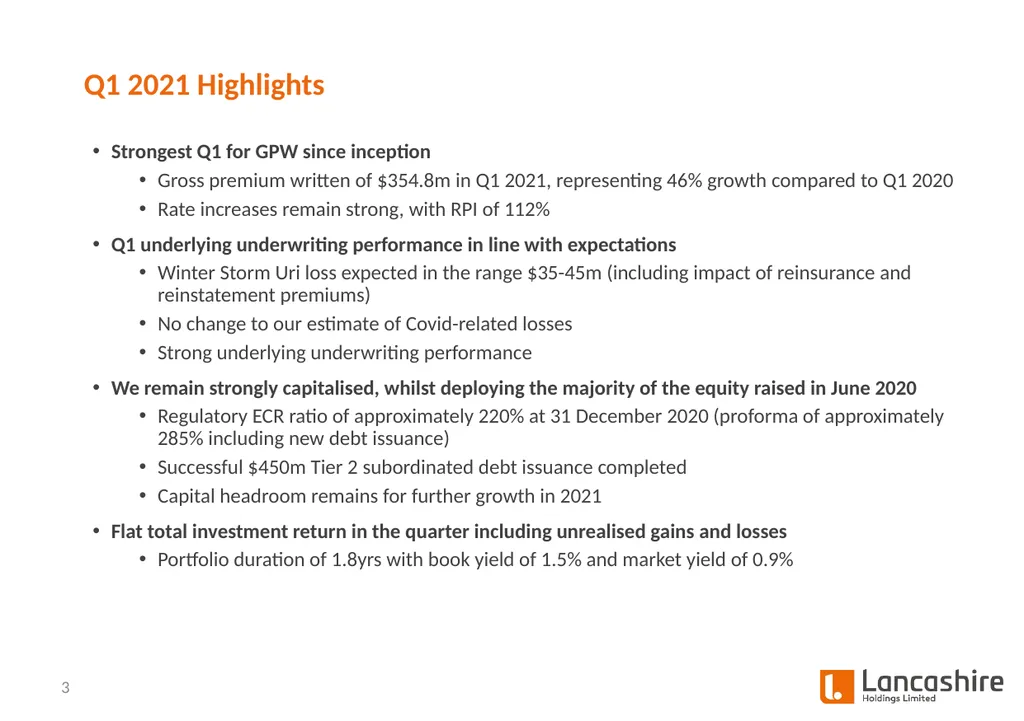
slide3. Strongest Q1 for GPW since inception
Gross premium written of $354.8m in Q1 2021, representing 46% growth compared to Q1 2020
Rate increases remain strong, with RPI of 112%
Q1 underlying underwriting performance in line with expectations
Winter Storm Uri loss expected in the range $35-45m (including impact of reinsurance and reinstatement premiums)
No change to our estimate of Covid-related losses
Strong underlying underwriting performance
We remain strongly capitalised, whilst deploying the majority of the equity raised in June 2020
Regulatory ECR ratio of approximately 220% at 31 December 2020 (proforma of approximately 285% including new debt issuance)
Successful $450m Tier 2 subordinated debt issuance completed
Capital headroom remains for further growth in 2021
Flat total investment return in the quarter including unrealised gains and losses
Portfolio duration of 1.8yrs with book yield of 1.5% and market yield of 0.9% 3 Q1 2021 Highlights<br>
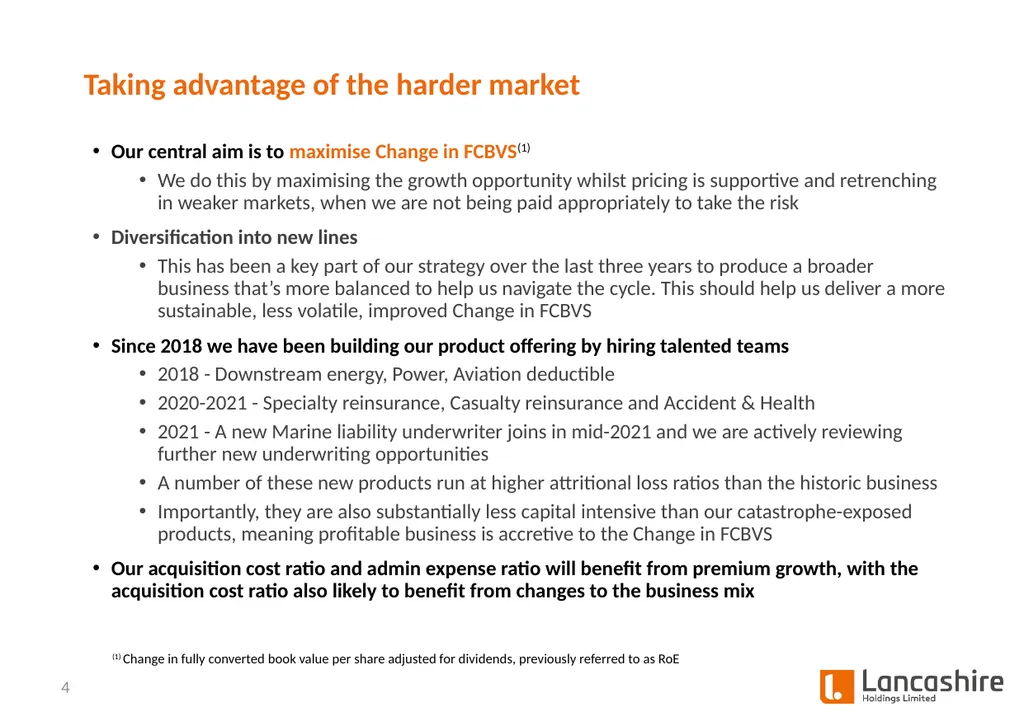
slide4. Our central aim is to maximise Change in FCBVS(1)
We do this by maximising the growth opportunity whilst pricing is supportive and retrenching in weaker markets, when we are not being paid appropriately to take the risk
Diversification into new lines
This has been a key part of our strategy over the last three years to produce a broader business that’s more balanced to help us navigate the cycle. This should help us deliver a more sustainable, less volatile, improved Change in FCBVS
Since 2018 we have been building our product offering by hiring talented teams
2018 - Downstream energy, Power, Aviation deductible
2020-2021 - Specialty reinsurance, Casualty reinsurance and Accident & Health
2021 - A new Marine liability underwriter joins in mid-2021 and we are actively reviewing further new underwriting opportunities
A number of these new products run at higher attritional loss ratios than the historic business
Importantly, they are also substantially less capital intensive than our catastrophe-exposed products, meaning profitable business is accretive to the Change in FCBVS
Our acquisition cost ratio and admin expense ratio will benefit from premium growth, with the acquisition cost ratio also likely to benefit from changes to the business mix Taking advantage of the harder market 4 (1) Change in fully converted book value per share adjusted for dividends, previously referred to as RoE<br>
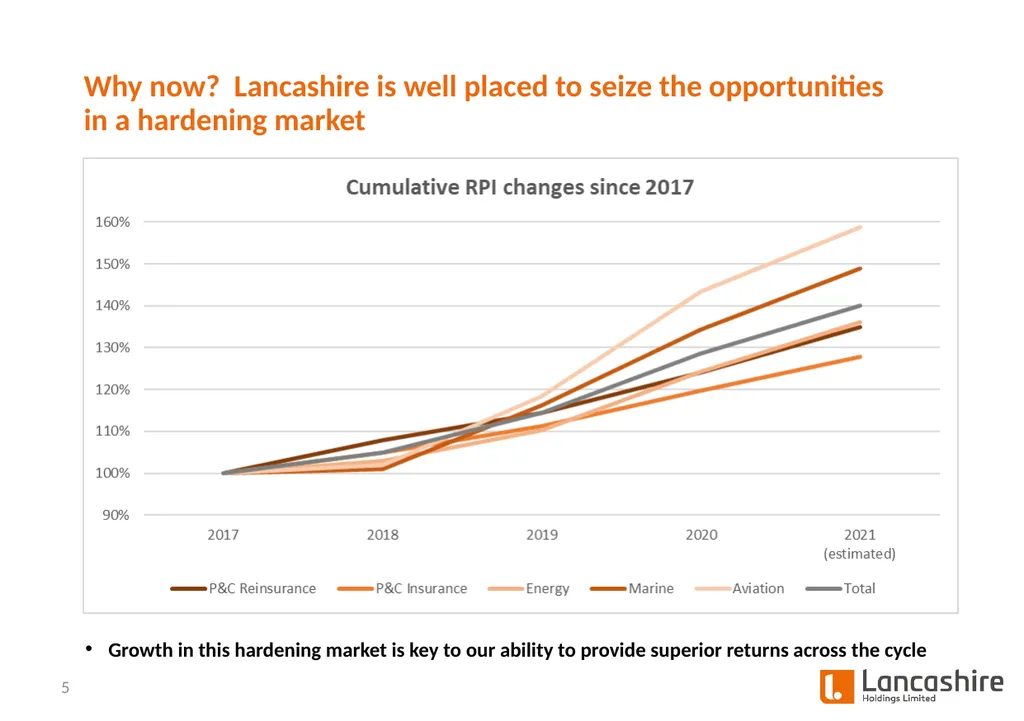
slide5. 5 Growth in this hardening market is key to our ability to provide superior returns across the cycle Why now? Lancashire is well placed to seize the opportunities
in a hardening market<br>
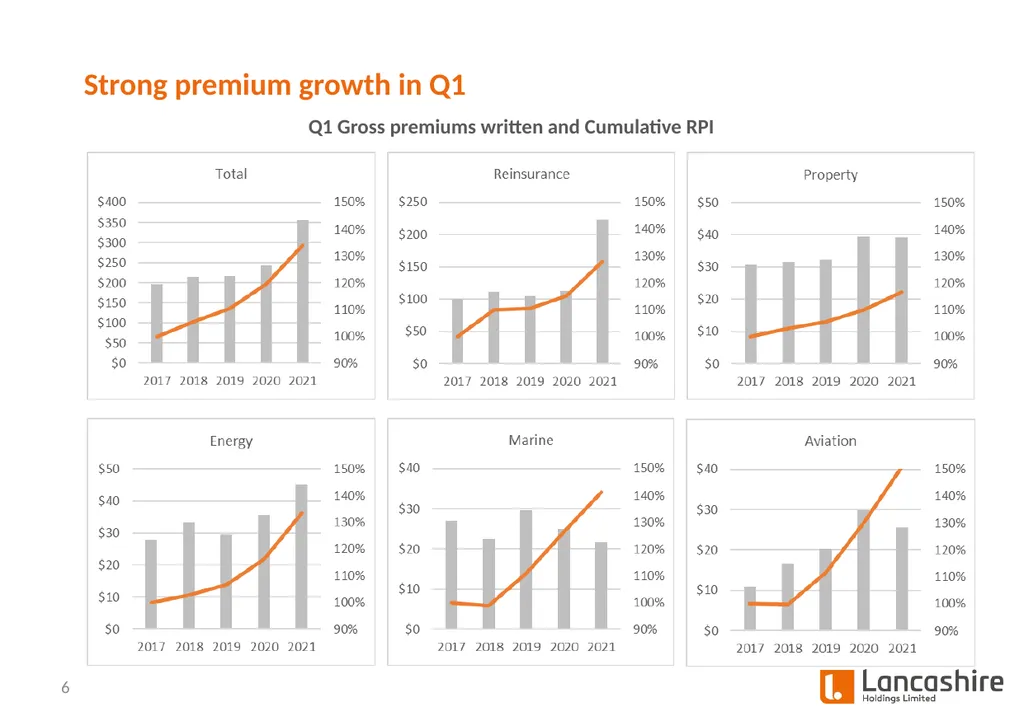
slide6. 6 Q1 Gross premiums written and Cumulative RPI Strong premium growth in Q1<br>
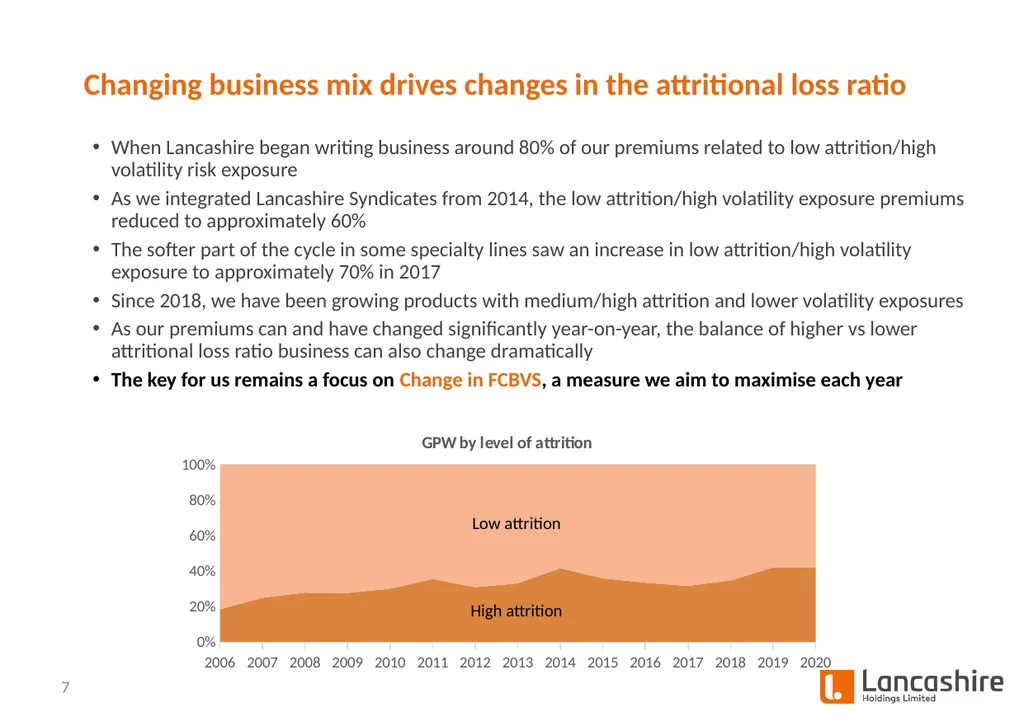
slide7. When Lancashire began writing business around 80% of our premiums related to low attrition/high volatility risk exposure
As we integrated Lancashire Syndicates from 2014, the low attrition/high volatility exposure premiums reduced to approximately 60%
The softer part of the cycle in some specialty lines saw an increase in low attrition/high volatility exposure to approximately 70% in 2017
Since 2018, we have been growing products with medium/high attrition and lower volatility exposures
As our premiums can and have changed significantly year-on-year, the balance of higher vs lower attritional loss ratio business can also change dramatically
The key for us remains a focus on Change in FCBVS, a measure we aim to maximise each year 7 Changing business mix drives changes in the attritional loss ratio Low attrition High attrition<br>
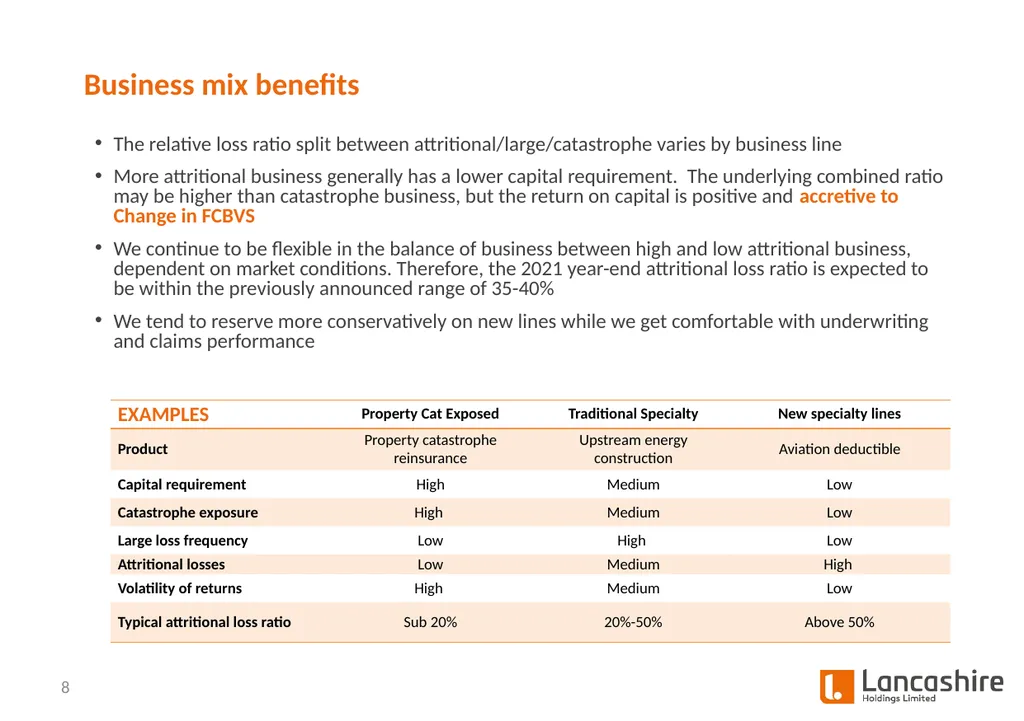
slide8. 8 The relative loss ratio split between attritional/large/catastrophe varies by business line
More attritional business generally has a lower capital requirement. The underlying combined ratio may be higher than catastrophe business, but the return on capital is positive and accretive to Change in FCBVS
We continue to be flexible in the balance of business between high and low attritional business, dependent on market conditions. Therefore, the 2021 year-end attritional loss ratio is expected to be within the previously announced range of 35-40%
We tend to reserve more conservatively on new lines while we get comfortable with underwriting and claims performance Business mix benefits<br>
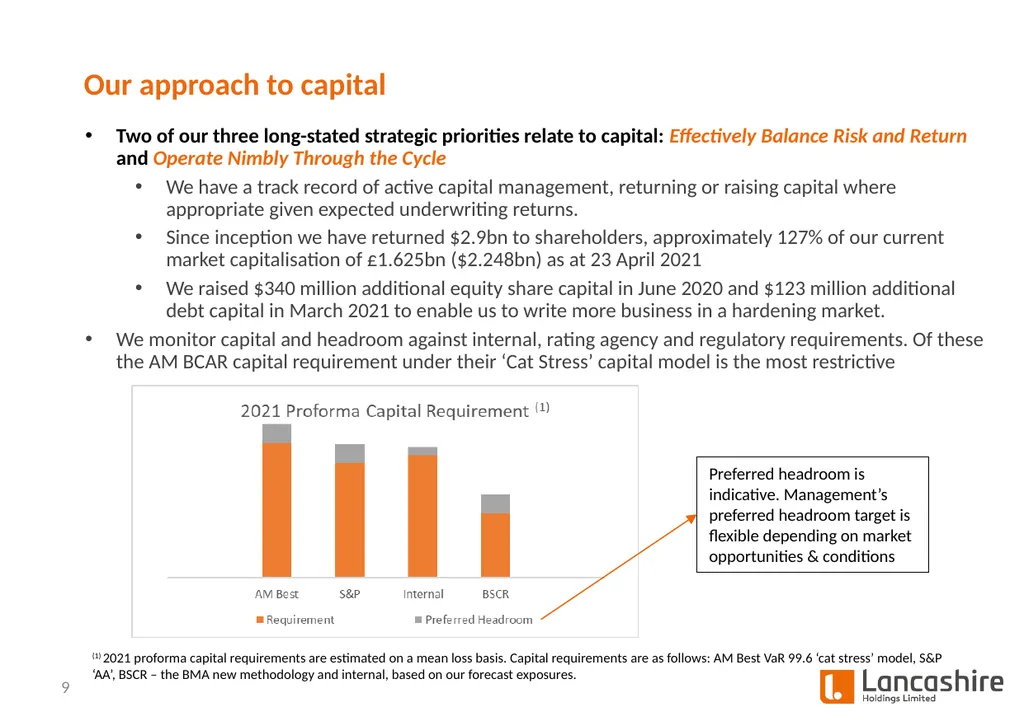
slide9. 9 Two of our three long-stated strategic priorities relate to capital: Effectively Balance Risk and Return and Operate Nimbly Through the Cycle
We have a track record of active capital management, returning or raising capital where appropriate given expected underwriting returns.
Since inception we have returned $2.9bn to shareholders, approximately 127% of our current market capitalisation of £1.625bn ($2.248bn) as at 23 April 2021
We raised $340 million additional equity share capital in June 2020 and $123 million additional debt capital in March 2021 to enable us to write more business in a hardening market.
We monitor capital and headroom against internal, rating agency and regulatory requirements. Of these the AM BCAR capital requirement under their ‘Cat Stress’ capital model is the most restrictive (1) 2021 proforma capital requirements are estimated on a mean loss basis. Capital requirements are as follows: AM Best VaR 99.6 ‘cat stress’ model, S&P ‘AA’, BSCR – the BMA new methodology and internal, based on our forecast exposures. Preferred headroom is indicative. Management’s preferred headroom target is flexible depending on market opportunities & conditions Our approach to capital<br>
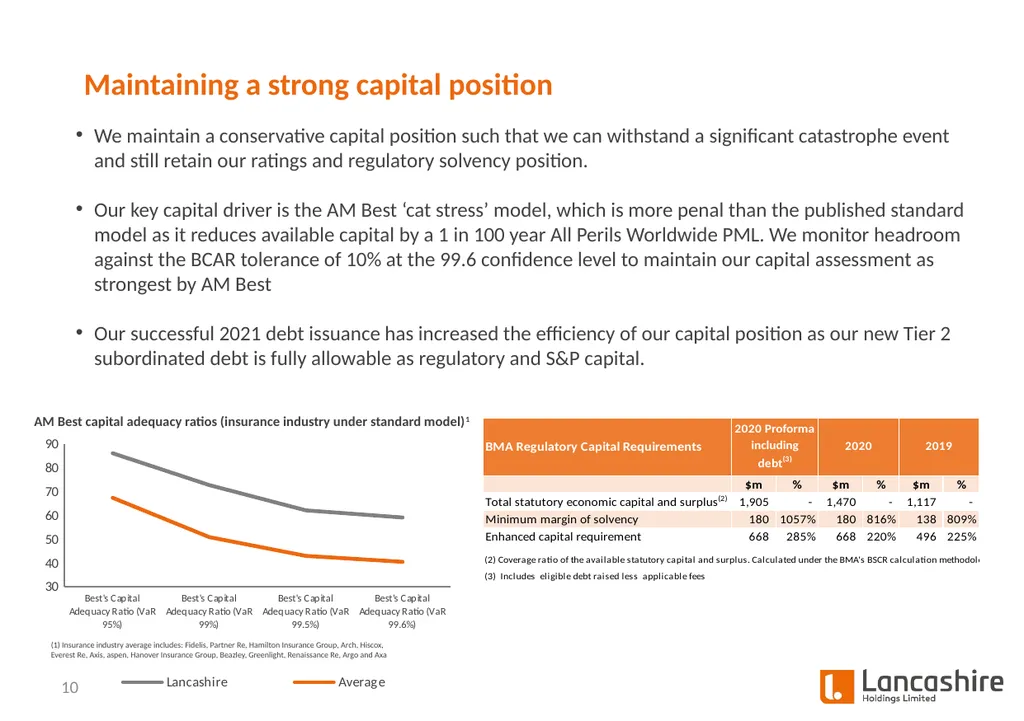
slide10. (1) Insurance industry average includes: Fidelis, Partner Re, Hamilton Insurance Group, Arch, Hiscox, Everest Re, Axis, aspen, Hanover Insurance Group, Beazley, Greenlight, Renaissance Re, Argo and Axa AM Best capital adequacy ratios (insurance industry under standard model)1 10 We maintain a conservative capital position such that we can withstand a significant catastrophe event and still retain our ratings and regulatory solvency position.
Our key capital driver is the AM Best ‘cat stress’ model, which is more penal than the published standard model as it reduces available capital by a 1 in 100 year All Perils Worldwide PML. We monitor headroom against the BCAR tolerance of 10% at the 99.6 confidence level to maintain our capital assessment as strongest by AM Best
Our successful 2021 debt issuance has increased the efficiency of our capital position as our new Tier 2 subordinated debt is fully allowable as regulatory and S&P capital. Maintaining a strong capital position<br>
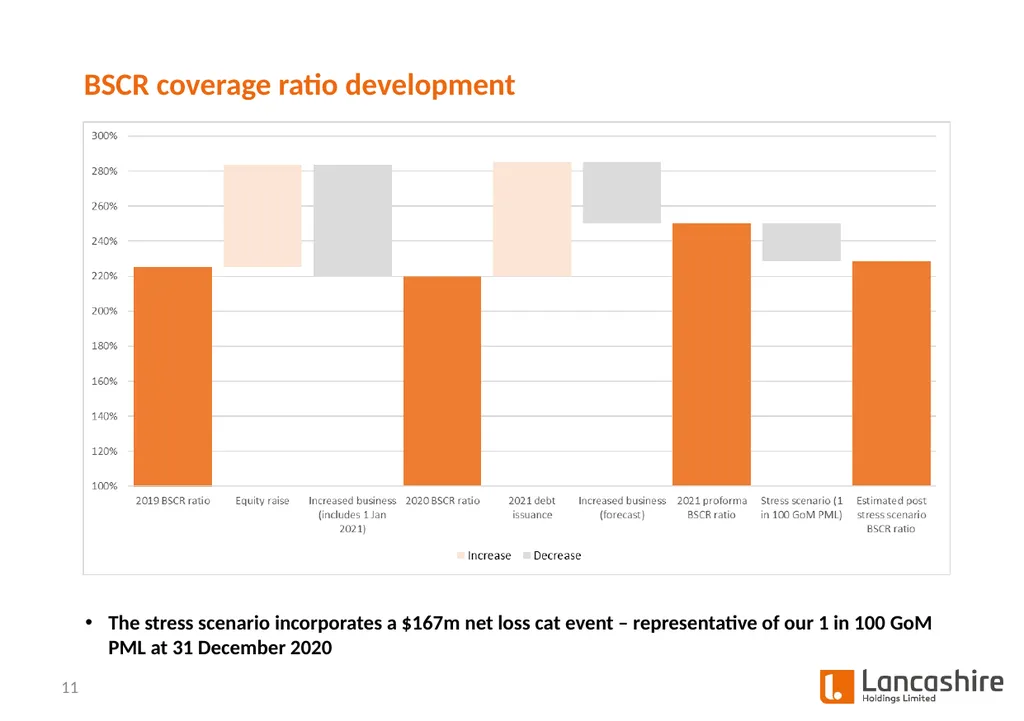
slide11. 11 BSCR coverage ratio development The stress scenario incorporates a $167m net loss cat event – representative of our 1 in 100 GoM PML at 31 December 2020<br>
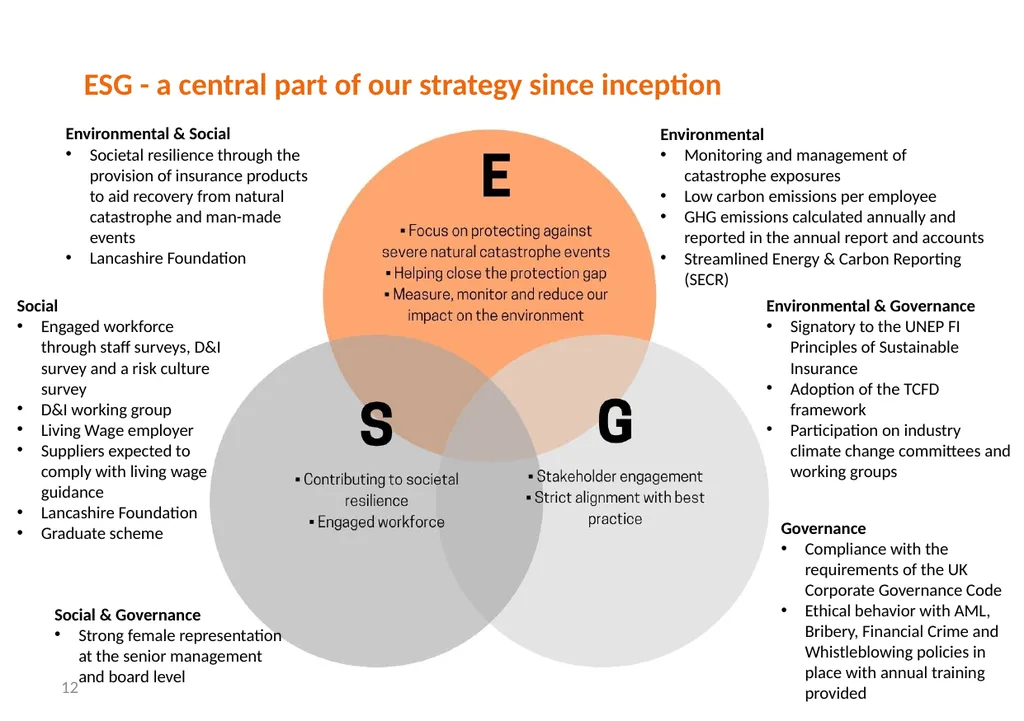
slide12. Environmental
Monitoring and management of catastrophe exposures
Low carbon emissions per employee
GHG emissions calculated annually and reported in the annual report and accounts
Streamlined Energy & Carbon Reporting (SECR) Environmental & Governance
Signatory to the UNEP FI Principles of Sustainable Insurance
Adoption of the TCFD framework
Participation on industry climate change committees and working groups Governance
Compliance with the requirements of the UK Corporate Governance Code
Ethical behavior with AML, Bribery, Financial Crime and Whistleblowing policies in place with annual training provided Environmental & Social
Societal resilience through the provision of insurance products to aid recovery from natural catastrophe and man-made events
Lancashire Foundation Social
Engaged workforce through staff surveys, D&I survey and a risk culture survey
D&I working group
Living Wage employer
Suppliers expected to comply with living wage guidance
Lancashire Foundation
Graduate scheme Social & Governance
Strong female representation at the senior management and board level ESG - a central part of our strategy since inception 12<br>
slide13. After years of soft market conditions corrective action has led to multi-year rate hardening across the majority of our underwriting portfolio
We have emerged from the soft market in a strong position and therefore have the ability to grow as the underwriting opportunity continues to improve
Growth is important now to balance returns over the longer term. Growth will allow Lancashire to mitigate the weaker years through portfolio optimisation, reducing risk levels where appropriate and enhancing returns over the cycle
Our capital raise demonstrates our capital flexibility and our ability to deploy capital into better priced opportunities across our three platforms. We write more risk as the balance of risk and return improves
We will continue to grow while the opportunity persists as we look to maximise returns for shareholders
Our core strategy has not changed – navigate the insurance cycle, manage the business for the long term, ignore the herd and be bold when we see true opportunity 13 Outlook - positioned for growth<br>
slide14. Investor Relations
Jelena Bjelanovic
Lancashire Holdings Limited
29th Floor,
20 Fenchurch Street,
London, EC3M 3BY
Telephone: +44 (0) 20 7264 4066
Fax: +44 (0) 20 7264 4077
Email: jelena.bjelanovic@lancashiregroup.com Media Contacts
FTI Consulting
200 Aldersgate,
Aldersgate Street,
London, EC1A 4HD
Email: Tom.Blackwell@fticonsulting.com Registered and Head Office, Bermuda
Lancashire Holdings Limited
Power House,
7 Par-la-Ville Road,
Hamilton HM 11,
Bermuda
Telephone: + 1 (441) 278-8950
Fax: + 1 (441) 278-8951
Email: info@lancashiregroup.com London Office, UK
Lancashire Holdings Limited
29th Floor,
20 Fenchurch Street,
London, EC3M 3BY
Telephone: + 44 (0) 20 7264 4000
Fax: + 44 (0) 20 7264 4077
Email: info@lancashiregroup.com 14 For more information:<br>
Q1 2021 Update www.lancashiregroup.com<br>
slide2. NOTE REGARDING FORWARD-LOOKING STATEMENTS:
CERTAIN STATEMENTS AND INDICATIVE PROJECTIONS (WHICH MAY INCLUDE MODELLED LOSS SCENARIOS) MADE IN THIS PRESENTATION OR OTHERWISE THAT ARE NOT BASED ON CURRENT OR HISTORICAL FACTS ARE FORWARD-LOOKING IN NATURE INCLUDING, WITHOUT LIMITATION, STATEMENTS CONTAINING THE WORDS “BELIEVES”, “AIMS”, “ANTICIPATES”, “PLANS”, “PROJECTS”, “FORECASTS”, “GUIDANCE”, “INTENDS”, “EXPECTS”, “ESTIMATES”, “PREDICTS”, “MAY”, “CAN”, “LIKELY”, “WILL”, “SEEKS”, “SHOULD”, OR, IN EACH CASE, THEIR NEGATIVE OR COMPARABLE TERMINOLOGY. SUCH FORWARD-LOOKING STATEMENTS INVOLVE KNOWN AND UNKNOWN RISKS, UNCERTAINTIES AND OTHER IMPORTANT FACTORS THAT COULD CAUSE THE ACTUAL RESULTS, PERFORMANCE OR ACHIEVEMENTS OF THE GROUP TO BE MATERIALLY DIFFERENT FROM FUTURE RESULTS, PERFORMANCE OR ACHIEVEMENTS EXPRESSED OR IMPLIED BY SUCH FORWARD-LOOKING STATEMENTS. FOR A DESCRIPTION OF SOME OF THESE FACTORS, SEE THE GROUP’S ANNUAL REPORT AND ACCOUNTS FOR THE YEAR ENDED 31 DECEMBER 2020. ALL FORWARD-LOOKING STATEMENTS IN THIS PRESENTATION OR OTHERWISE SPEAK ONLY AS AT THE DATE OF PUBLICATION. LANCASHIRE EXPRESSLY DISCLAIMS ANY OBLIGATION OR UNDERTAKING (SAVE AS REQUIRED TO COMPLY WITH ANY LEGAL OR REGULATORY OBLIGATIONS INCLUDING THE RULES OF THE LONDON STOCK EXCHANGE) TO DISSEMINATE ANY UPDATES OR REVISIONS TO ANY FORWARD-LOOKING STATEMENT TO REFLECT ANY CHANGES IN THE GROUP’S EXPECTATIONS OR CIRCUMSTANCES ON WHICH ANY SUCH STATEMENT IS BASED. ALL SUBSEQUENT WRITTEN AND ORAL FORWARD-LOOKING STATEMENTS ATTRIBUTABLE TO THE GROUP OR INDIVIDUALS ACTING ON BEHALF OF THE GROUP ARE EXPRESSLY QUALIFIED IN THEIR ENTIRETY BY THIS NOTE. PROSPECTIVE INVESTORS SHOULD SPECIFICALLY CONSIDER THE FACTORS IDENTIFIED IN THIS PRESENTATION WHICH COULD CAUSE ACTUAL RESULTS TO DIFFER BEFORE MAKING AN INVESTMENT DECISION. NOTE REGARDING ALTERNATIVE PERFORMANCE MEASURES:
THE GROUP USES ALTERNATIVE PERFORMANCE MEASURES TO HELP EXPLAIN BUSINESS PERFORMANCE AND FINANCIAL POSITION. THESE MEASURES HAVE BEEN CALCULATED CONSISTENTLY WITH THOSE AS DISCLOSED IN THE GROUP’S ANNUAL REPORT AND ACCOUNTS FOR THE YEAR ENDED 31 DECEMBER 2020.
NOTE REGARDING RPI METHODOLOGY:
THE RENEWAL PRICE INDEX (“RPI”) IS AN INTERNAL METHODOLOGY THAT MANAGEMENT USES TO TRACK TRENDS IN PREMIUM RATES OF A PORTFOLIO OF INSURANCE AND REINSURANCE CONTRACTS. THE RPI WRITTEN IN THE RESPECTIVE SEGMENTS IS CALCULATED ON A PER CONTRACT BASIS AND REFLECTS MANAGEMENT’S ASSESSMENT OF RELATIVE CHANGES IN PRICE, TERMS, CONDITIONS AND LIMITS AND IS WEIGHTED BY PREMIUM VOLUME. THE CALCULATION INVOLVES A DEGREE OF JUDGEMENT IN RELATION TO COMPARABILITY OF CONTRACTS AND THE ASSESSMENT NOTED ABOVE. TO ENHANCE THE RPI METHODOLOGY, MANAGEMENT MAY REVISE THE METHODOLOGY AND ASSUMPTIONS UNDERLYING THE RPI, SO THE TRENDS IN PREMIUM RATES REFLECTED IN THE RPI MAY NOT BE COMPARABLE OVER TIME. CONSIDERATION IS ONLY GIVEN TO RENEWALS OF A COMPARABLE NATURE SO IT DOES NOT REFLECT EVERY CONTRACT IN THE PORTFOLIO OF CONTRACTS OR, FOR EXAMPLE, NEW BUSINESS LINES WITHIN A SEGMENT. THE FUTURE PROFITABILITY OF THE PORTFOLIO OF CONTRACTS WITHIN THE RPI IS DEPENDENT UPON MANY FACTORS BESIDES THE TRENDS IN PREMIUM RATES.
NOTE REGARDING COVID-19 LOSS:
OUR COVID-19 LOSS PRIMARILY RELATES TO EXPOSURES WITHIN OUR PROPERTY SEGMENT. GIVEN THE ONGOING NATURE OF THE COVID-19 PANDEMIC AND THE UNCERTAIN IMPACT ON THE INSURANCE INDUSTRY, THE GROUP’S ACTUAL ULTIMATE LOSS MAY VARY, PERHAPS MATERIALLY, FROM THE CURRENT ESTIMATE. THE FINAL SETTLEMENT OF ALL OF THESE CLAIMS IS LIKELY TO TAKE PLACE OVER A CONSIDERABLE PERIOD OF TIME. LANCASHIRE DOES NOT WRITE THE FOLLOWING LINES OF BUSINESS: TRAVEL INSURANCE; TRADE CREDIT; AND LONG-TERM LIFE AND PRIOR TO THE COVID-19 PANDEMIC DID NOT WRITE DIRECTORS’ AND OFFICERS’ LIABILITY OR MEDICAL MALPRACTICE. THE GROUP UNDERWRITES A SMALL NUMBER OF EVENT CANCELLATION CONTRACTS AND HAS MINIMAL EXPOSURE THROUGH MORTGAGE, ACCIDENT AND HEALTH BUSINESS. 2 Safe harbor statements<br>
slide3. Strongest Q1 for GPW since inception
Gross premium written of $354.8m in Q1 2021, representing 46% growth compared to Q1 2020
Rate increases remain strong, with RPI of 112%
Q1 underlying underwriting performance in line with expectations
Winter Storm Uri loss expected in the range $35-45m (including impact of reinsurance and reinstatement premiums)
No change to our estimate of Covid-related losses
Strong underlying underwriting performance
We remain strongly capitalised, whilst deploying the majority of the equity raised in June 2020
Regulatory ECR ratio of approximately 220% at 31 December 2020 (proforma of approximately 285% including new debt issuance)
Successful $450m Tier 2 subordinated debt issuance completed
Capital headroom remains for further growth in 2021
Flat total investment return in the quarter including unrealised gains and losses
Portfolio duration of 1.8yrs with book yield of 1.5% and market yield of 0.9% 3 Q1 2021 Highlights<br>
slide4. Our central aim is to maximise Change in FCBVS(1)
We do this by maximising the growth opportunity whilst pricing is supportive and retrenching in weaker markets, when we are not being paid appropriately to take the risk
Diversification into new lines
This has been a key part of our strategy over the last three years to produce a broader business that’s more balanced to help us navigate the cycle. This should help us deliver a more sustainable, less volatile, improved Change in FCBVS
Since 2018 we have been building our product offering by hiring talented teams
2018 - Downstream energy, Power, Aviation deductible
2020-2021 - Specialty reinsurance, Casualty reinsurance and Accident & Health
2021 - A new Marine liability underwriter joins in mid-2021 and we are actively reviewing further new underwriting opportunities
A number of these new products run at higher attritional loss ratios than the historic business
Importantly, they are also substantially less capital intensive than our catastrophe-exposed products, meaning profitable business is accretive to the Change in FCBVS
Our acquisition cost ratio and admin expense ratio will benefit from premium growth, with the acquisition cost ratio also likely to benefit from changes to the business mix Taking advantage of the harder market 4 (1) Change in fully converted book value per share adjusted for dividends, previously referred to as RoE<br>
slide5. 5 Growth in this hardening market is key to our ability to provide superior returns across the cycle Why now? Lancashire is well placed to seize the opportunities
in a hardening market<br>
slide6. 6 Q1 Gross premiums written and Cumulative RPI Strong premium growth in Q1<br>
slide7. When Lancashire began writing business around 80% of our premiums related to low attrition/high volatility risk exposure
As we integrated Lancashire Syndicates from 2014, the low attrition/high volatility exposure premiums reduced to approximately 60%
The softer part of the cycle in some specialty lines saw an increase in low attrition/high volatility exposure to approximately 70% in 2017
Since 2018, we have been growing products with medium/high attrition and lower volatility exposures
As our premiums can and have changed significantly year-on-year, the balance of higher vs lower attritional loss ratio business can also change dramatically
The key for us remains a focus on Change in FCBVS, a measure we aim to maximise each year 7 Changing business mix drives changes in the attritional loss ratio Low attrition High attrition<br>
slide8. 8 The relative loss ratio split between attritional/large/catastrophe varies by business line
More attritional business generally has a lower capital requirement. The underlying combined ratio may be higher than catastrophe business, but the return on capital is positive and accretive to Change in FCBVS
We continue to be flexible in the balance of business between high and low attritional business, dependent on market conditions. Therefore, the 2021 year-end attritional loss ratio is expected to be within the previously announced range of 35-40%
We tend to reserve more conservatively on new lines while we get comfortable with underwriting and claims performance Business mix benefits<br>
slide9. 9 Two of our three long-stated strategic priorities relate to capital: Effectively Balance Risk and Return and Operate Nimbly Through the Cycle
We have a track record of active capital management, returning or raising capital where appropriate given expected underwriting returns.
Since inception we have returned $2.9bn to shareholders, approximately 127% of our current market capitalisation of £1.625bn ($2.248bn) as at 23 April 2021
We raised $340 million additional equity share capital in June 2020 and $123 million additional debt capital in March 2021 to enable us to write more business in a hardening market.
We monitor capital and headroom against internal, rating agency and regulatory requirements. Of these the AM BCAR capital requirement under their ‘Cat Stress’ capital model is the most restrictive (1) 2021 proforma capital requirements are estimated on a mean loss basis. Capital requirements are as follows: AM Best VaR 99.6 ‘cat stress’ model, S&P ‘AA’, BSCR – the BMA new methodology and internal, based on our forecast exposures. Preferred headroom is indicative. Management’s preferred headroom target is flexible depending on market opportunities & conditions Our approach to capital<br>
slide10. (1) Insurance industry average includes: Fidelis, Partner Re, Hamilton Insurance Group, Arch, Hiscox, Everest Re, Axis, aspen, Hanover Insurance Group, Beazley, Greenlight, Renaissance Re, Argo and Axa AM Best capital adequacy ratios (insurance industry under standard model)1 10 We maintain a conservative capital position such that we can withstand a significant catastrophe event and still retain our ratings and regulatory solvency position.
Our key capital driver is the AM Best ‘cat stress’ model, which is more penal than the published standard model as it reduces available capital by a 1 in 100 year All Perils Worldwide PML. We monitor headroom against the BCAR tolerance of 10% at the 99.6 confidence level to maintain our capital assessment as strongest by AM Best
Our successful 2021 debt issuance has increased the efficiency of our capital position as our new Tier 2 subordinated debt is fully allowable as regulatory and S&P capital. Maintaining a strong capital position<br>
slide11. 11 BSCR coverage ratio development The stress scenario incorporates a $167m net loss cat event – representative of our 1 in 100 GoM PML at 31 December 2020<br>
slide12. Environmental
Monitoring and management of catastrophe exposures
Low carbon emissions per employee
GHG emissions calculated annually and reported in the annual report and accounts
Streamlined Energy & Carbon Reporting (SECR) Environmental & Governance
Signatory to the UNEP FI Principles of Sustainable Insurance
Adoption of the TCFD framework
Participation on industry climate change committees and working groups Governance
Compliance with the requirements of the UK Corporate Governance Code
Ethical behavior with AML, Bribery, Financial Crime and Whistleblowing policies in place with annual training provided Environmental & Social
Societal resilience through the provision of insurance products to aid recovery from natural catastrophe and man-made events
Lancashire Foundation Social
Engaged workforce through staff surveys, D&I survey and a risk culture survey
D&I working group
Living Wage employer
Suppliers expected to comply with living wage guidance
Lancashire Foundation
Graduate scheme Social & Governance
Strong female representation at the senior management and board level ESG - a central part of our strategy since inception 12<br>
slide13. After years of soft market conditions corrective action has led to multi-year rate hardening across the majority of our underwriting portfolio
We have emerged from the soft market in a strong position and therefore have the ability to grow as the underwriting opportunity continues to improve
Growth is important now to balance returns over the longer term. Growth will allow Lancashire to mitigate the weaker years through portfolio optimisation, reducing risk levels where appropriate and enhancing returns over the cycle
Our capital raise demonstrates our capital flexibility and our ability to deploy capital into better priced opportunities across our three platforms. We write more risk as the balance of risk and return improves
We will continue to grow while the opportunity persists as we look to maximise returns for shareholders
Our core strategy has not changed – navigate the insurance cycle, manage the business for the long term, ignore the herd and be bold when we see true opportunity 13 Outlook - positioned for growth<br>
slide14. Investor Relations
Jelena Bjelanovic
Lancashire Holdings Limited
29th Floor,
20 Fenchurch Street,
London, EC3M 3BY
Telephone: +44 (0) 20 7264 4066
Fax: +44 (0) 20 7264 4077
Email: jelena.bjelanovic@lancashiregroup.com Media Contacts
FTI Consulting
200 Aldersgate,
Aldersgate Street,
London, EC1A 4HD
Email: Tom.Blackwell@fticonsulting.com Registered and Head Office, Bermuda
Lancashire Holdings Limited
Power House,
7 Par-la-Ville Road,
Hamilton HM 11,
Bermuda
Telephone: + 1 (441) 278-8950
Fax: + 1 (441) 278-8951
Email: info@lancashiregroup.com London Office, UK
Lancashire Holdings Limited
29th Floor,
20 Fenchurch Street,
London, EC3M 3BY
Telephone: + 44 (0) 20 7264 4000
Fax: + 44 (0) 20 7264 4077
Email: info@lancashiregroup.com 14 For more information:<br>