IoT System Vulnerability Analysis and Network Hardening with Shortest Attack Trace in a Weighted Attack Graph Yinxin Wan, Xuanli Lin, Abdulhakim Sabur, Alena Chang, Kuai Xu, Guoliang Xue Arizona State University May 12, 2023 1 Outline
"IoT System Vulnerability Analysis and Network" is the property of its rightful owner. Permission is granted to
download and print the materials on this website for personal, non-commercial use only, and to display it
on your personal computer provided you do not modify the materials and that you retain all copyright
notices contained in the materials. By downloading content from our website, you accept the terms of this
agreement.
Presentation Transcript
01
IoT System Vulnerability Analysis and Network Hardening with Shortest Attack Trace in a Weighted Attack Graph Yinxin Wan, Xuanli Lin, Abdulhakim Sabur, Alena Chang, Kuai Xu, Guoliang Xue
Arizona State University
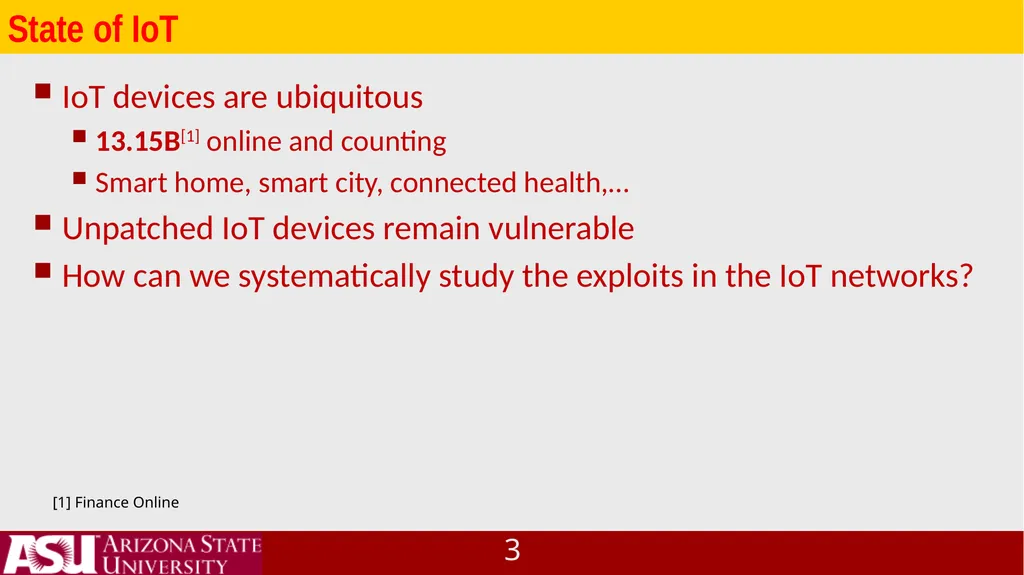
2 State of IoT IoT devices are ubiquitous
13.15B[1] online and counting
Smart home, smart city, connected health,…
Unpatched IoT devices remain vulnerable
How can we systematically study the exploits in the IoT networks? [1] Finance Online<br>
04
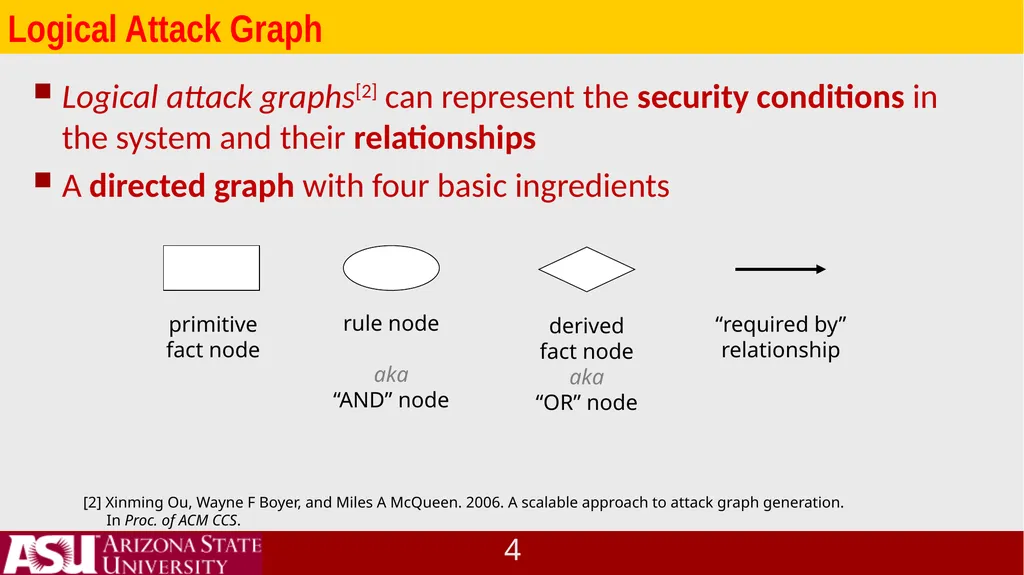
3 Logical Attack Graph Logical attack graphs[2] can represent the security conditions in the system and their relationships
A directed graph with four basic ingredients primitive fact node derived fact node aka “OR” node rule node aka “AND” node “required by” relationship [2] Xinming Ou, Wayne F Boyer, and Miles A McQueen. 2006. A scalable approach to attack graph generation. In Proc. of ACM CCS.<br>
05
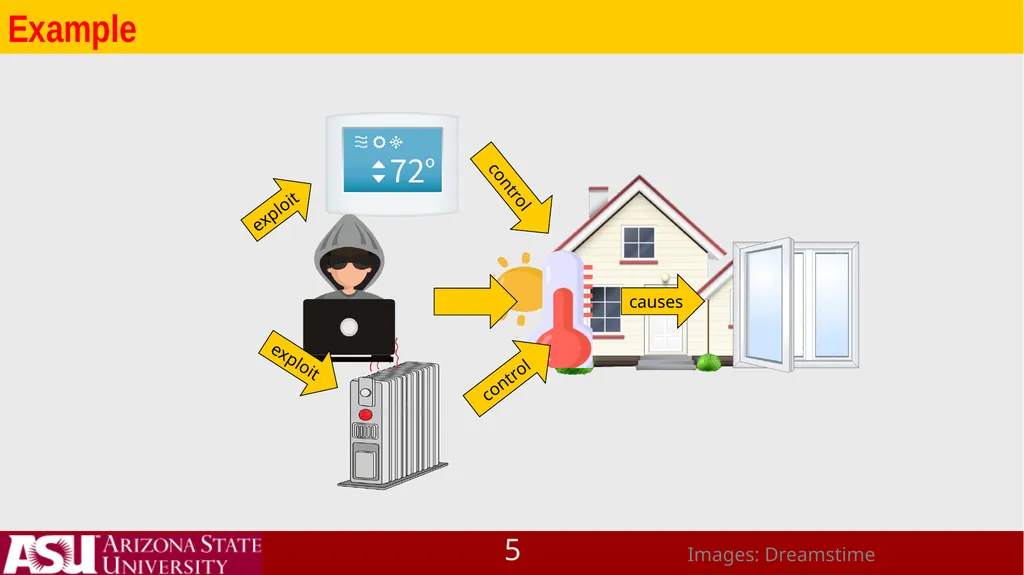
4 Example Images: Dreamstime causes exploit exploit control control<br>
06
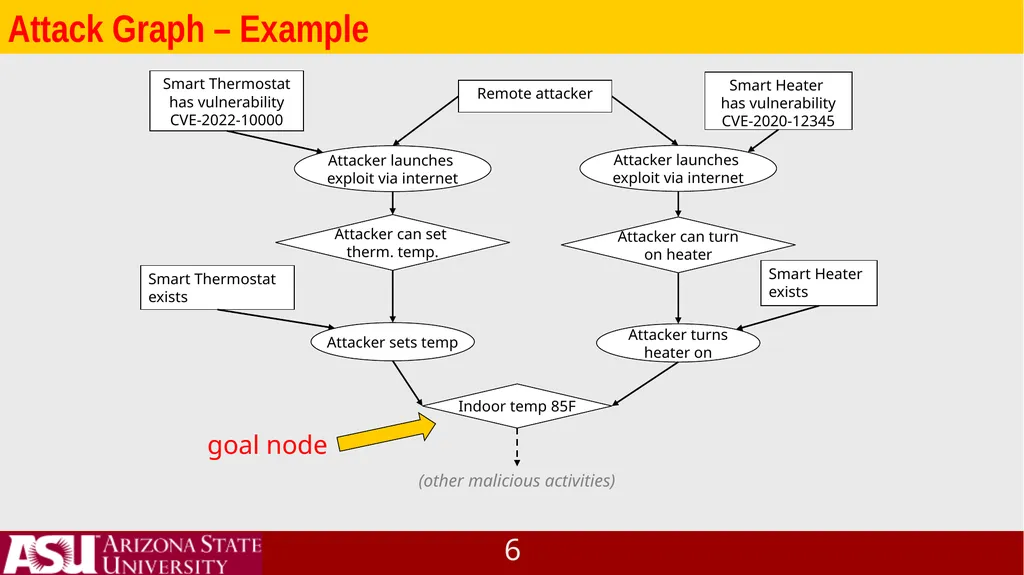
5 Attack Graph – Example Smart Thermostat has vulnerability CVE-2022-10000 Remote attacker Attacker launches exploit via internet Attacker can set therm. temp. Attacker sets temp Smart Thermostat exists Indoor temp 85F (other malicious activities) Smart Heater
has vulnerability
CVE-2020-12345 Attacker launches exploit via internet Attacker can turn on heater Smart Heater exists Attacker turns heater on goal node<br>
07
6 Attack Trace In a complex attack graph, there can be many options for attackers
Attack trace[3] helps us better understand possible routes an attacker can take [3] Zheng Fang, Hao Fu, Tianbo Gu, Pengfei Hu, Jinyue Song, Trent Jaeger, and Prasant Mohapatra. 2022. IOTA: A framework
for analyzing system-level security of IoTs. In Proc. of ACM/IEEE IoTDI.<br>
08
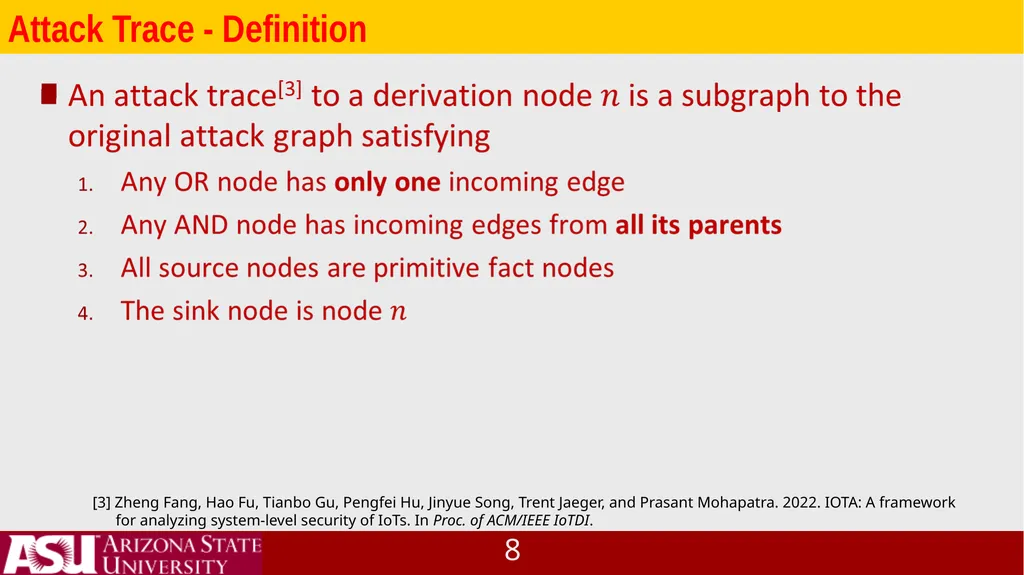
7 Attack Trace - Definition [3] Zheng Fang, Hao Fu, Tianbo Gu, Pengfei Hu, Jinyue Song, Trent Jaeger, and Prasant Mohapatra. 2022. IOTA: A framework
for analyzing system-level security of IoTs. In Proc. of ACM/IEEE IoTDI.<br>
09
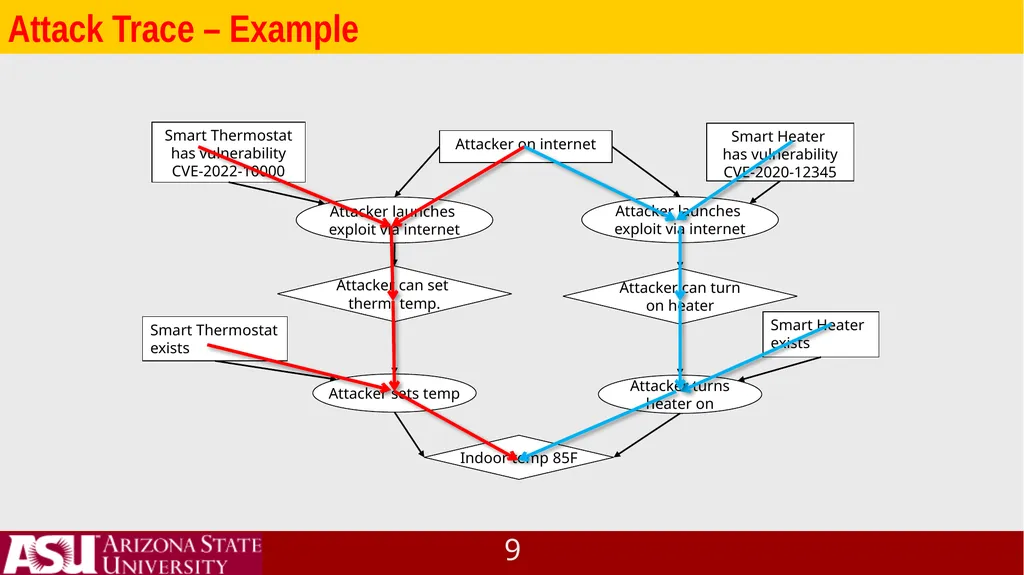
8 Attack Trace – Example Smart Thermostat has vulnerability CVE-2022-10000 Attacker on internet Attacker launches exploit via internet Attacker can set therm. temp. Attacker sets temp Smart Thermostat exists Indoor temp 85F Smart Heater
has vulnerability
CVE-2020-12345 Attacker launches exploit via internet Attacker can turn on heater Smart Heater exists Attacker turns heater on<br>
10
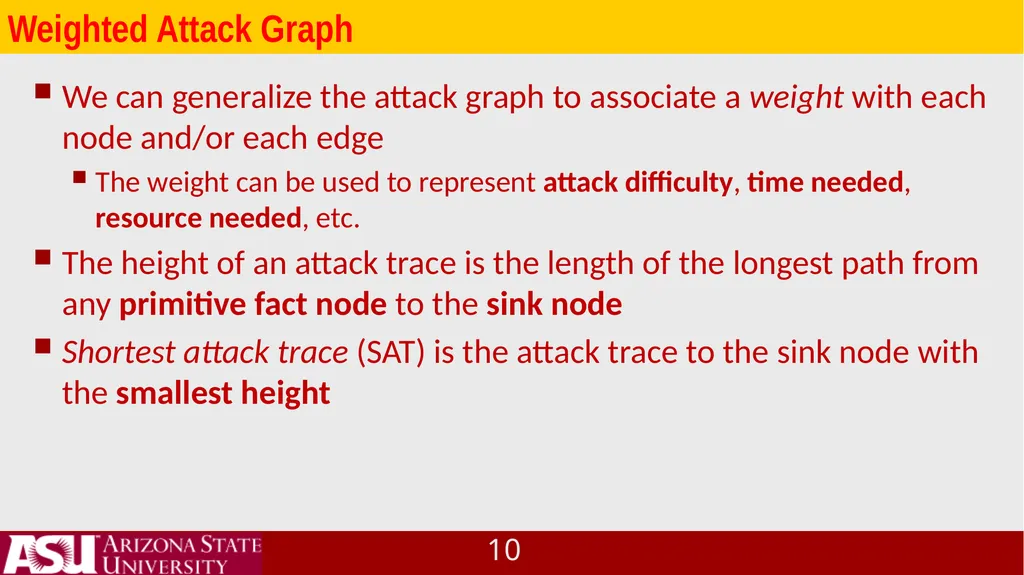
9 Weighted Attack Graph We can generalize the attack graph to associate a weight with each node and/or each edge
The weight can be used to represent attack difficulty, time needed, resource needed, etc.
The height of an attack trace is the length of the longest path from any primitive fact node to the sink node
Shortest attack trace (SAT) is the attack trace to the sink node with the smallest height<br>
11
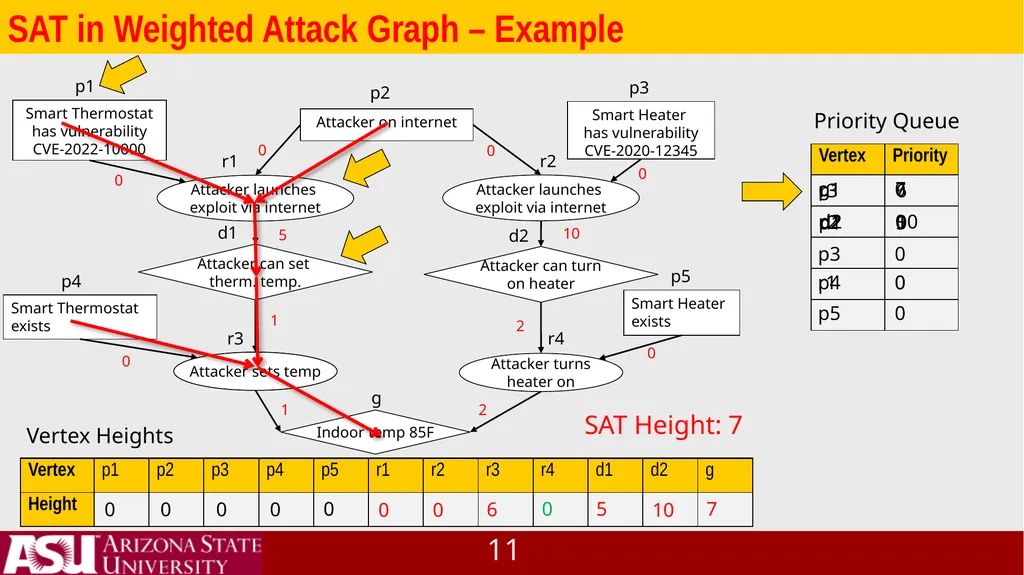
10 SAT in Weighted Attack Graph – Example Smart Thermostat has vulnerability CVE-2022-10000 Attacker on internet Attacker launches exploit via internet Attacker can set therm. temp. Attacker sets temp Smart Thermostat exists Indoor temp 85F Smart Heater
has vulnerability
CVE-2020-12345 Attacker launches exploit via internet Attacker can turn on heater Smart Heater exists Attacker turns heater on 0 0 0 0 2 5 1 0 10 0 1 2 p1 p2 p3 p4 p5 r1 r2 r3 r4 d1 d2 g Vertex Heights Priority Queue 0 0 0 0 0 0 p1 0 p2 0 p3 0 p4 0 p5 0 0 0 r1 0 0 0 0 r2 0 5 d2 10 d1 5 6 r3 6 g 7 10 Attacker sets temp 7 SAT Height: 7<br>
12
11 Network Hardening SAT can indicate the easiest way an attacker can reach his or her goal
Conversely, when we consider hardening the network, the work would be futile without hardening the nodes/edges in the SAT
We also need to consider the cost of these hardenings<br>
13
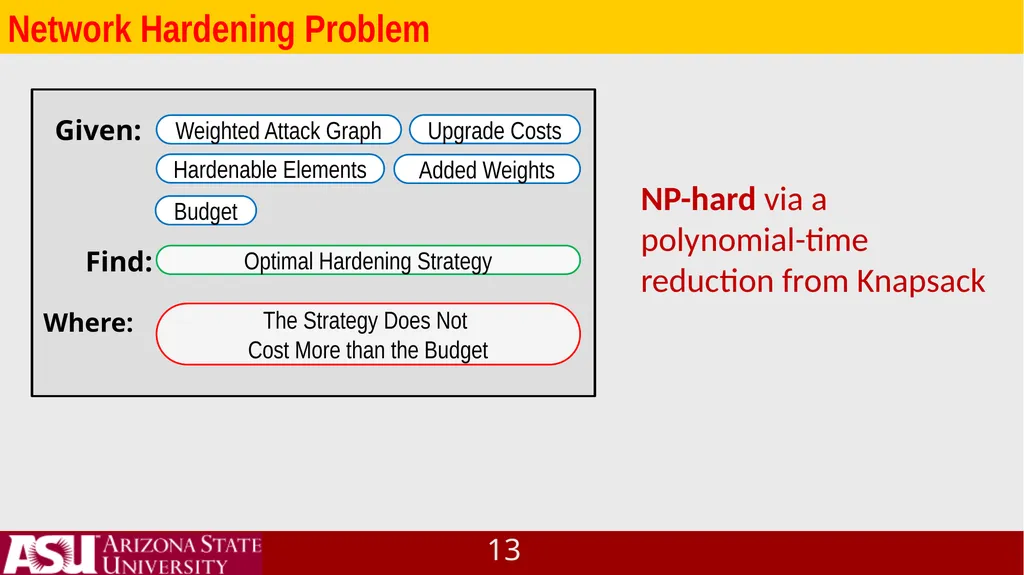
12 Network Hardening Problem NP-hard via a polynomial-time reduction from Knapsack Added Weights Hardenable Elements Budget<br>
14
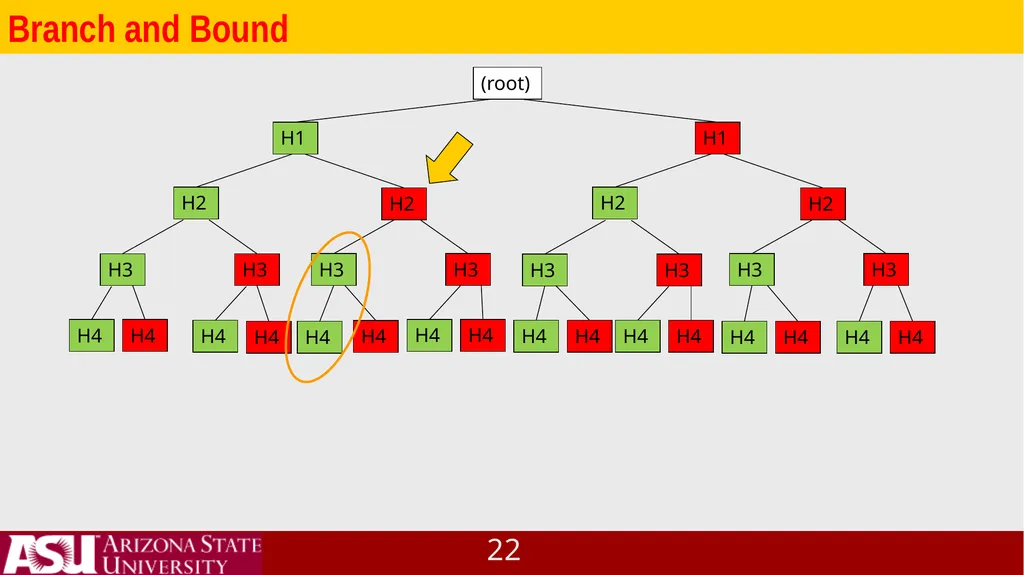
13 Exact Algorithm Idea: test out all possible combinations of hardening options and choose the one that gives the most increase in the SAT height (within the budget)
We apply branch and bound to speed up the calculation<br>
15
14 Heuristic Algorithm We can individually test out each hardenable element (within the budget) and pick the one that gives the most value
i.e., the most increase in the SAT height per cost
Repeat until we cannot afford any of the upgrade or no more upgrade is available
Polynomial time with performance close to the exact algorithm<br>
16
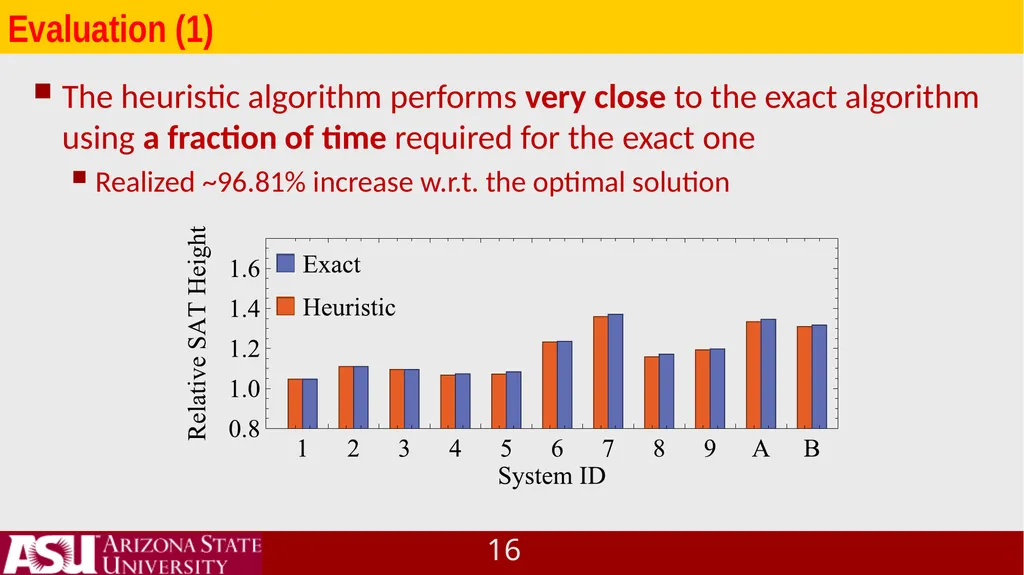
15 Evaluation (1) The heuristic algorithm performs very close to the exact algorithm using a fraction of time required for the exact one
Realized ~96.81% increase w.r.t. the optimal solution<br>
17
16 Evaluation (2) Branch is bound is proven to be effective to speed up the exact algorithm
3x~55x speedup depending on the input
We can be smart about patching
Patching a small subset of the vulnerabilities can sometimes produce the same result as patching them all<br>
18
17 Conclusions We studied the SAT in weighted attack graphs and proposed an efficient algorithm to solve it
Using SAT, we studied the problem of network hardening and proposed an exact and a heuristic algorithms
Evaluations showed the effectiveness of our algorithms<br>
19
18 Thank you!
Any questions?
Contact: xlin54@asu.edu<br>
20
19 Backup Slides<br>
21
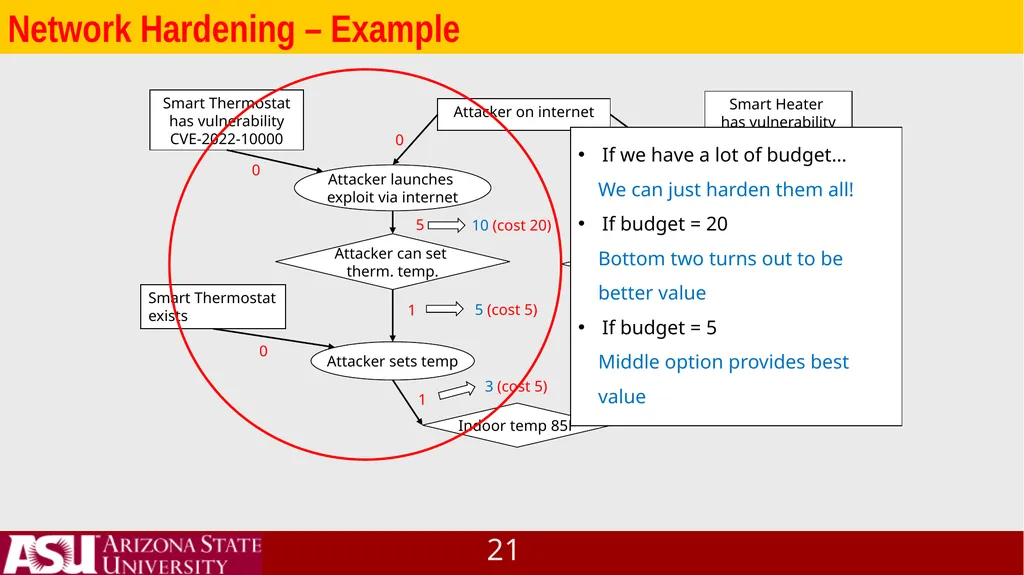
20 Network Hardening – Example Smart Thermostat has vulnerability CVE-2022-10000 Attacker on internet Attacker launches exploit via internet Attacker can set therm. temp. Attacker sets temp Smart Thermostat exists Indoor temp 85F Smart Heater
has vulnerability
CVE-2020-12345 Attacker launches exploit via internet Attacker can turn on heater Smart Heater exists Attacker turns heater on 0 0 0 0 2 5 1 0 10 0 1 2 10 (cost 20) 5 (cost 5) 3 (cost 5) If we have a lot of budget…
We can just harden them all!
If budget = 20
Bottom two turns out to be better value
If budget = 5
Middle option provides best value<br>