
Iowa HFMA July 2022 Transitional Care The
KL
Published · 47 slides · 0 views

1 / 1





Description
Iowa HFMA July 2022 Transitional Care The Underutilized Value Proposition Mark Lindsay MD is an Assistant Professor of Medicine at Mayo Clinic College of Medicine. He has practiced at Mayo Clinic Health System Eau Claire since 1997. He
Related Topics
Share
Embed code
Download this presentation From Below
"Iowa HFMA July 2022 Transitional Care The" is the property of its rightful owner. Permission is granted to download and print the materials on this website for personal, non-commercial use only, and to display it on your personal computer provided you do not modify the materials and that you retain all copyright notices contained in the materials. By downloading content from our website, you accept the terms of this agreement.
Presentation Transcript
01
Iowa HFMA
July 2022 Transitional Care
The Underutilized Value Proposition<br>
July 2022 Transitional Care
The Underutilized Value Proposition<br>
02
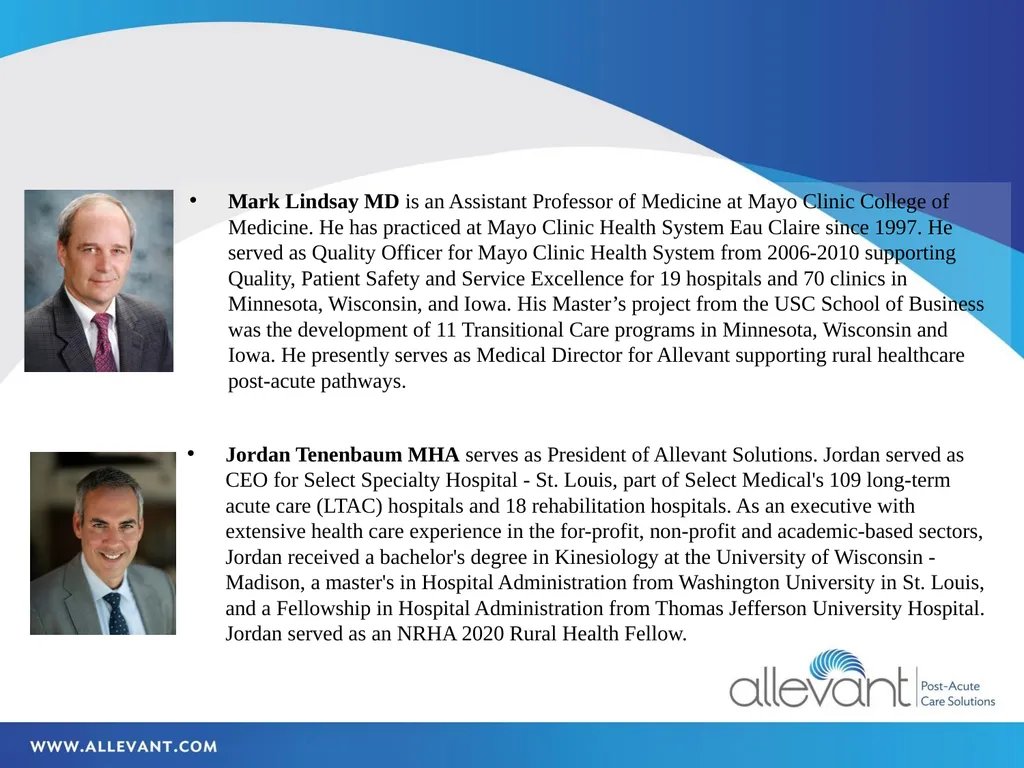
Mark Lindsay MD is an Assistant Professor of Medicine at Mayo Clinic College of Medicine. He has practiced at Mayo Clinic Health System Eau Claire since 1997. He served as Quality Officer for Mayo Clinic Health System from 2006-2010 supporting Quality, Patient Safety and Service Excellence for 19 hospitals and 70 clinics in Minnesota, Wisconsin, and Iowa. His Master’s project from the USC School of Business was the development of 11 Transitional Care programs in Minnesota, Wisconsin and Iowa. He presently serves as Medical Director for Allevant supporting rural healthcare post-acute pathways. Jordan Tenenbaum MHA serves as President of Allevant Solutions. Jordan served as CEO for Select Specialty Hospital - St. Louis, part of Select Medical's 109 long-term acute care (LTAC) hospitals and 18 rehabilitation hospitals. As an executive with extensive health care experience in the for-profit, non-profit and academic-based sectors, Jordan received a bachelor's degree in Kinesiology at the University of Wisconsin - Madison, a master's in Hospital Administration from Washington University in St. Louis, and a Fellowship in Hospital Administration from Thomas Jefferson University Hospital. Jordan served as an NRHA 2020 Rural Health Fellow.<br>
03
New Model of Care Agenda Healthcare journey, a few observations
Transitional Care, one of the highest value equations in healthcare
Overcoming barriers
Getting started
Financial and Market Opportunity
MENDS: new model for prevention, chronic disease, health, and cost containment<br>
Transitional Care, one of the highest value equations in healthcare
Overcoming barriers
Getting started
Financial and Market Opportunity
MENDS: new model for prevention, chronic disease, health, and cost containment<br>
04
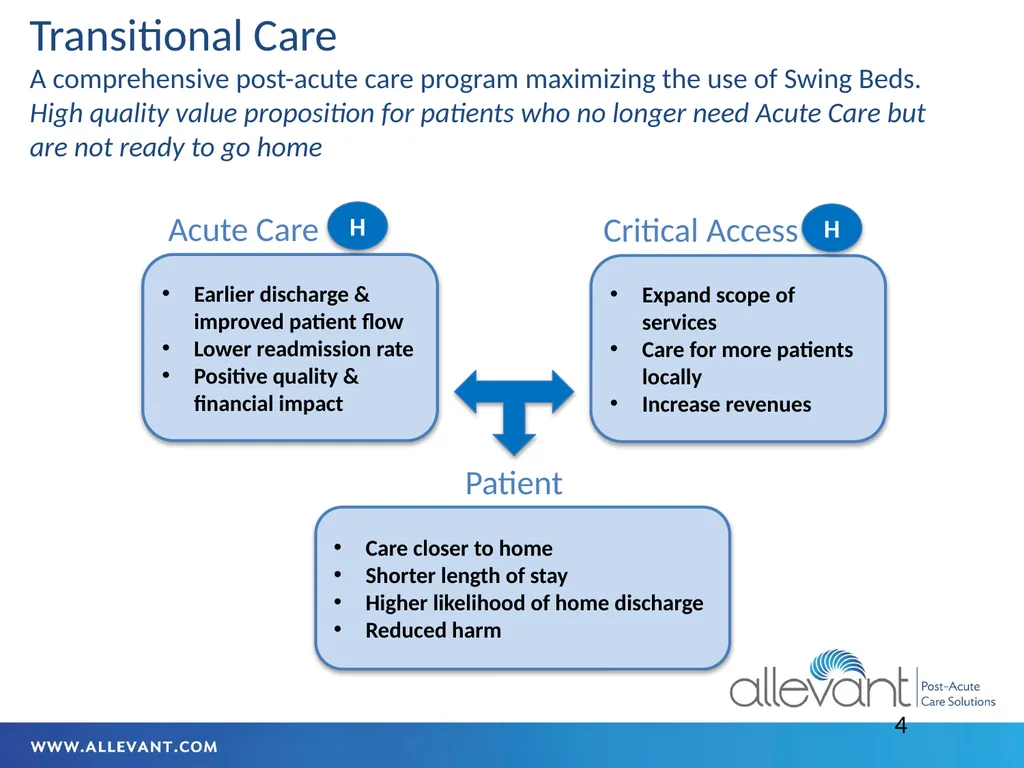
4 Transitional Care
A comprehensive post-acute care program maximizing the use of Swing Beds. High quality value proposition for patients who no longer need Acute Care but are not ready to go home<br>
A comprehensive post-acute care program maximizing the use of Swing Beds. High quality value proposition for patients who no longer need Acute Care but are not ready to go home<br>
05
Eau Claire Transitional Case Study<br>
06
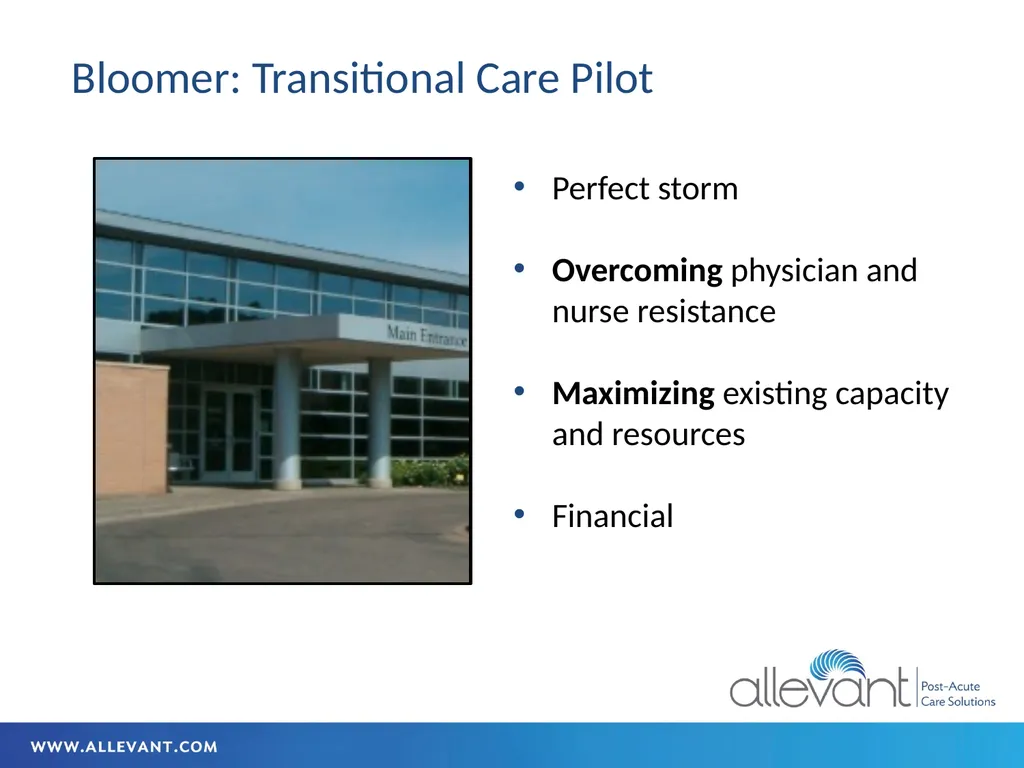
Bloomer: Transitional Care Pilot Perfect storm
Overcoming physician and nurse resistance
Maximizing existing capacity and resources
Financial<br>
Overcoming physician and nurse resistance
Maximizing existing capacity and resources
Financial<br>
07
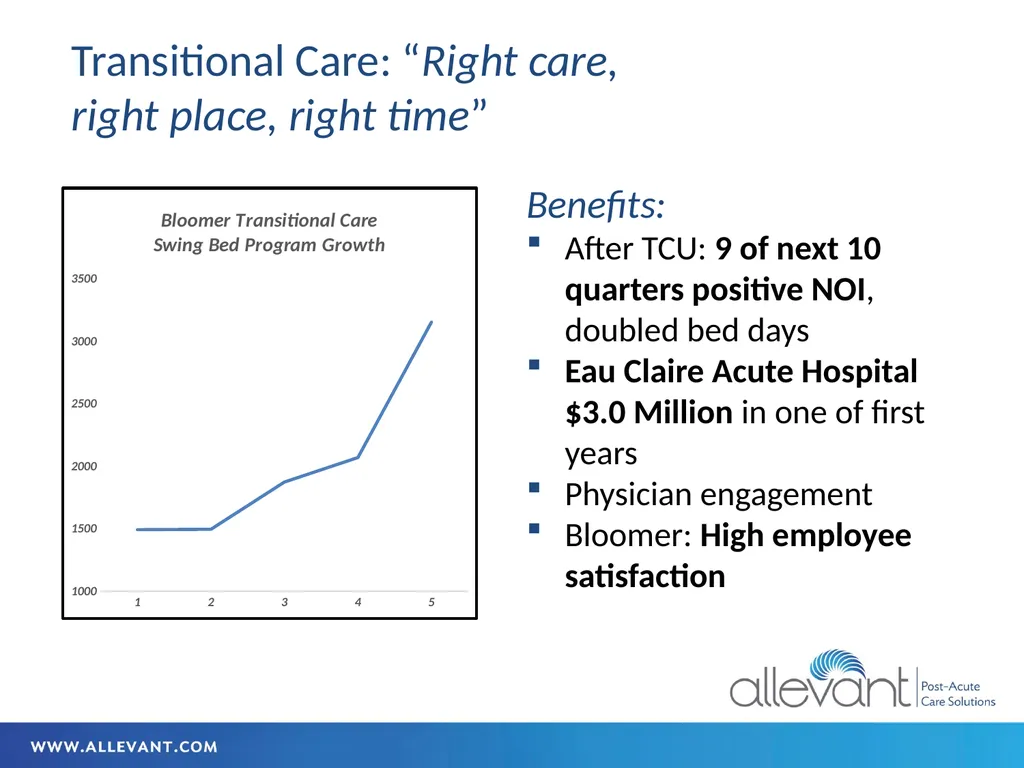
Transitional Care: “Right care,
right place, right time” Benefits:
After TCU: 9 of next 10 quarters positive NOI, doubled bed days
Eau Claire Acute Hospital $3.0 Million in one of first years
Physician engagement
Bloomer: High employee satisfaction<br>
After TCU: 9 of next 10 quarters positive NOI, doubled bed days
Eau Claire Acute Hospital $3.0 Million in one of first years
Physician engagement
Bloomer: High employee satisfaction<br>
08
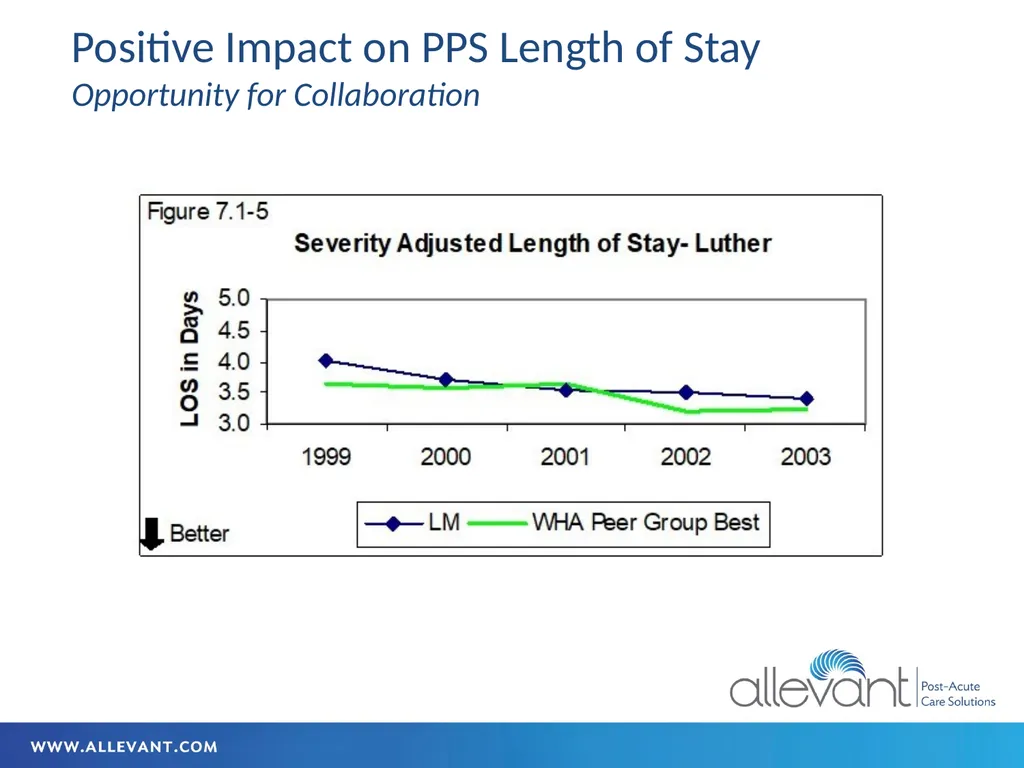
Positive Impact on PPS Length of Stay
Opportunity for Collaboration<br>
09
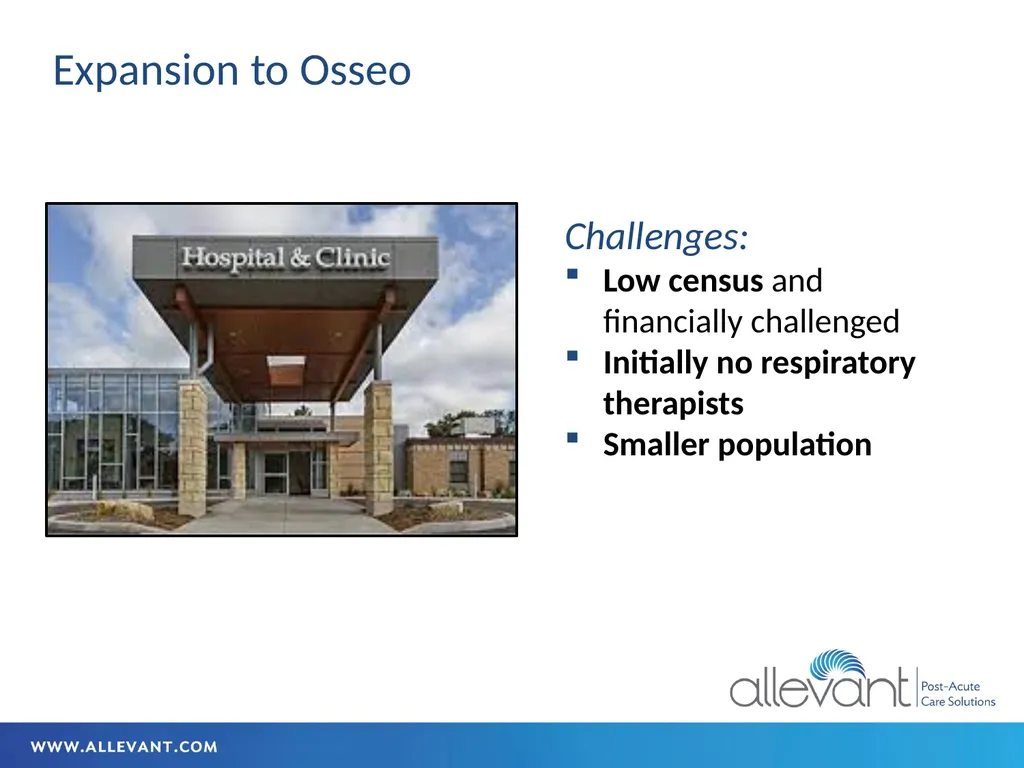
Expansion to Osseo Challenges:
Low census and financially challenged
Initially no respiratory therapists
Smaller population<br>
Low census and financially challenged
Initially no respiratory therapists
Smaller population<br>
10
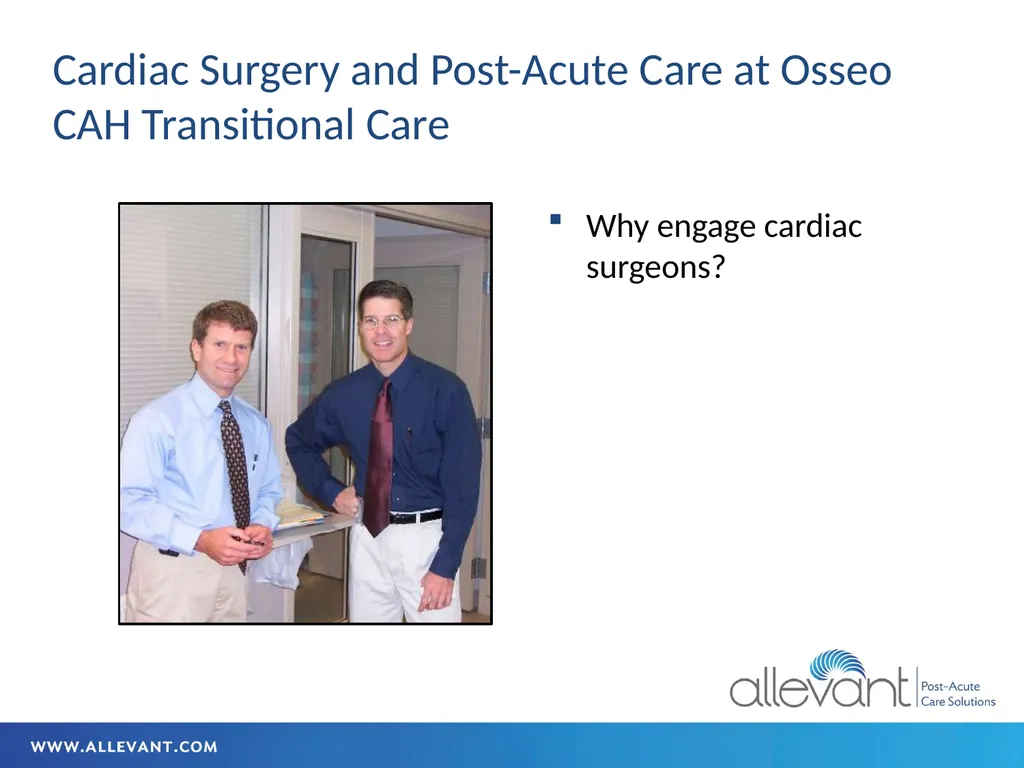
Cardiac Surgery and Post-Acute Care at Osseo CAH Transitional Care Why engage cardiac surgeons?<br>
11
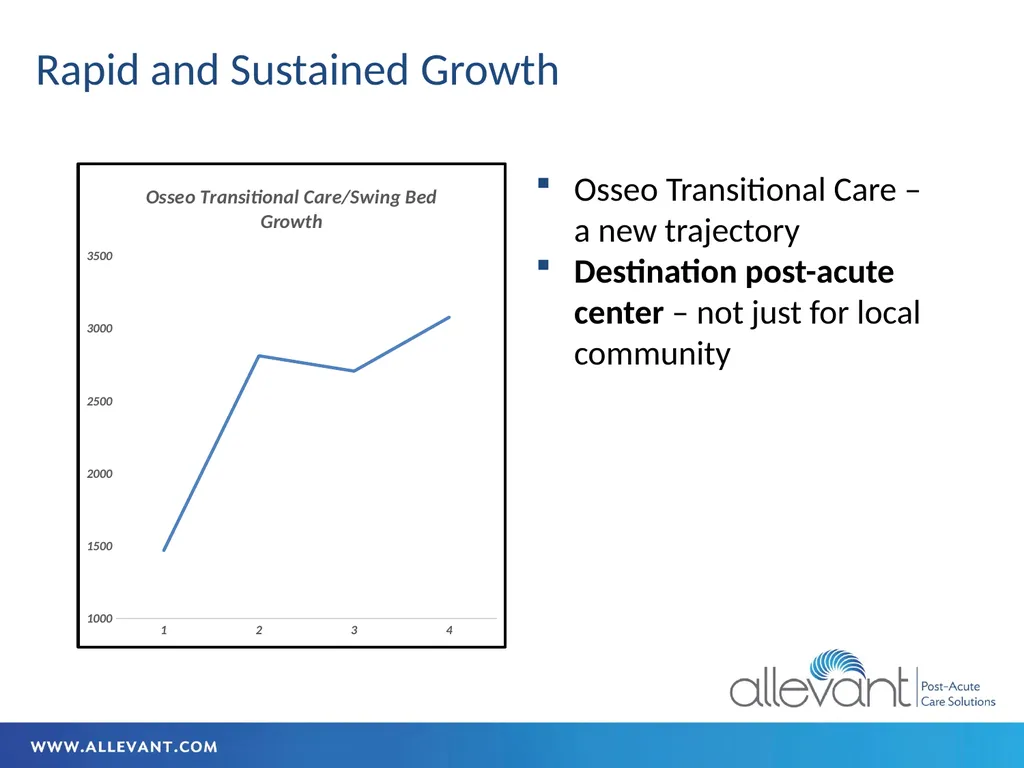
Rapid and Sustained Growth Osseo Transitional Care – a new trajectory
Destination post-acute center – not just for local community<br>
Destination post-acute center – not just for local community<br>
12
Expansion to Mayo Critical Access Hospitals<br>
13
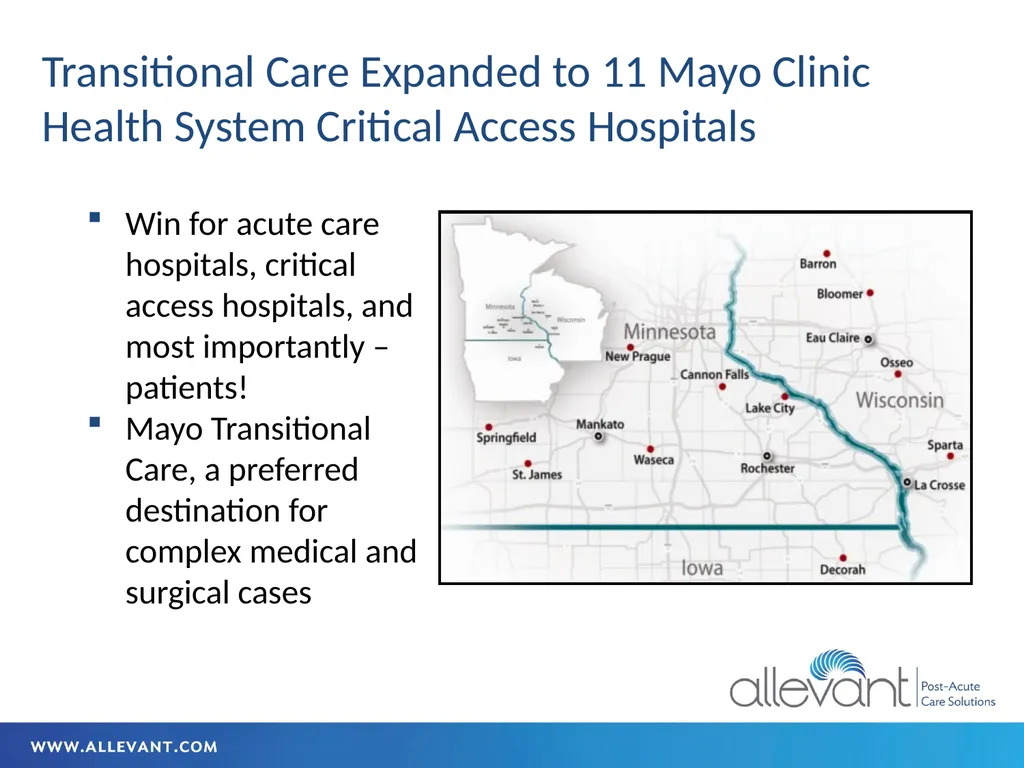
Transitional Care Expanded to 11 Mayo Clinic Health System Critical Access Hospitals Win for acute care hospitals, critical access hospitals, and most importantly – patients!
Mayo Transitional Care, a preferred destination for complex medical and surgical cases<br>
Mayo Transitional Care, a preferred destination for complex medical and surgical cases<br>
14
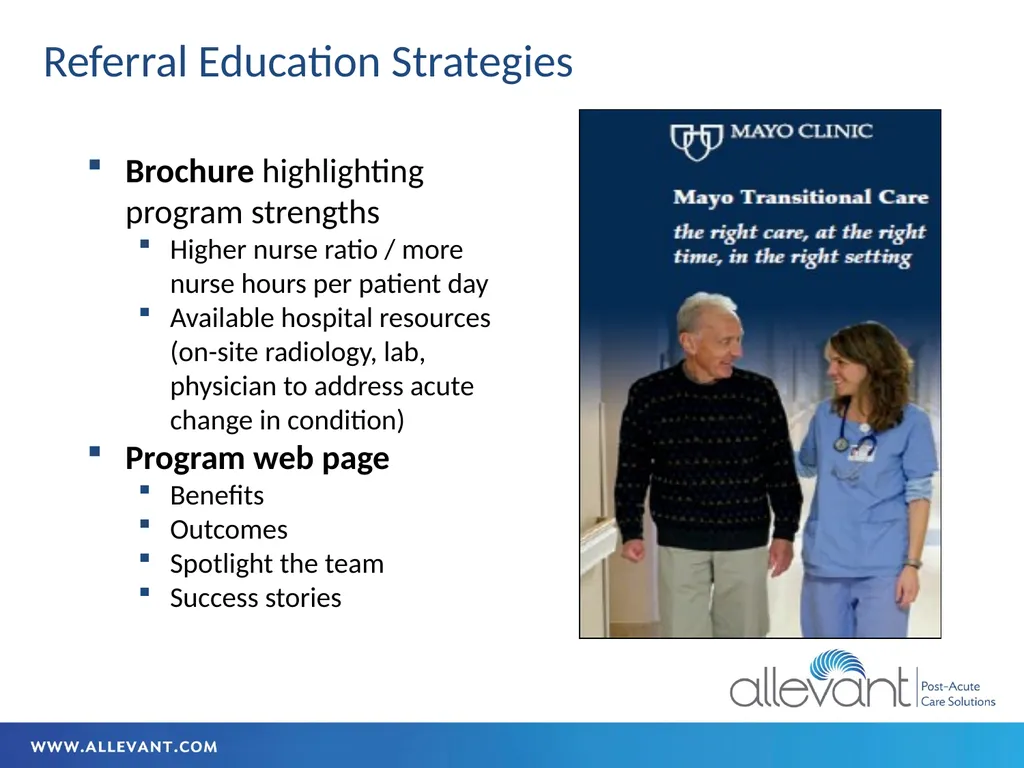
Referral Education Strategies Brochure highlighting program strengths
Higher nurse ratio / more nurse hours per patient day
Available hospital resources (on-site radiology, lab, physician to address acute change in condition)
Program web page
Benefits
Outcomes
Spotlight the team
Success stories<br>
Higher nurse ratio / more nurse hours per patient day
Available hospital resources (on-site radiology, lab, physician to address acute change in condition)
Program web page
Benefits
Outcomes
Spotlight the team
Success stories<br>
15
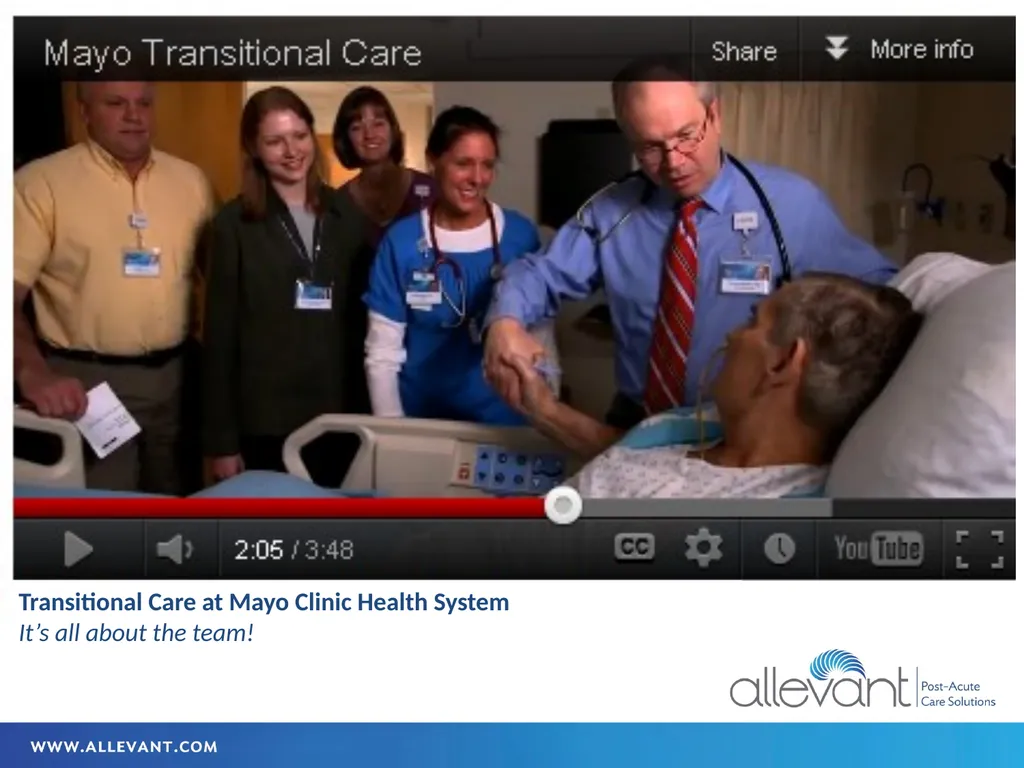
Transitional Care at Mayo Clinic Health System
It’s all about the team!<br>
It’s all about the team!<br>
16
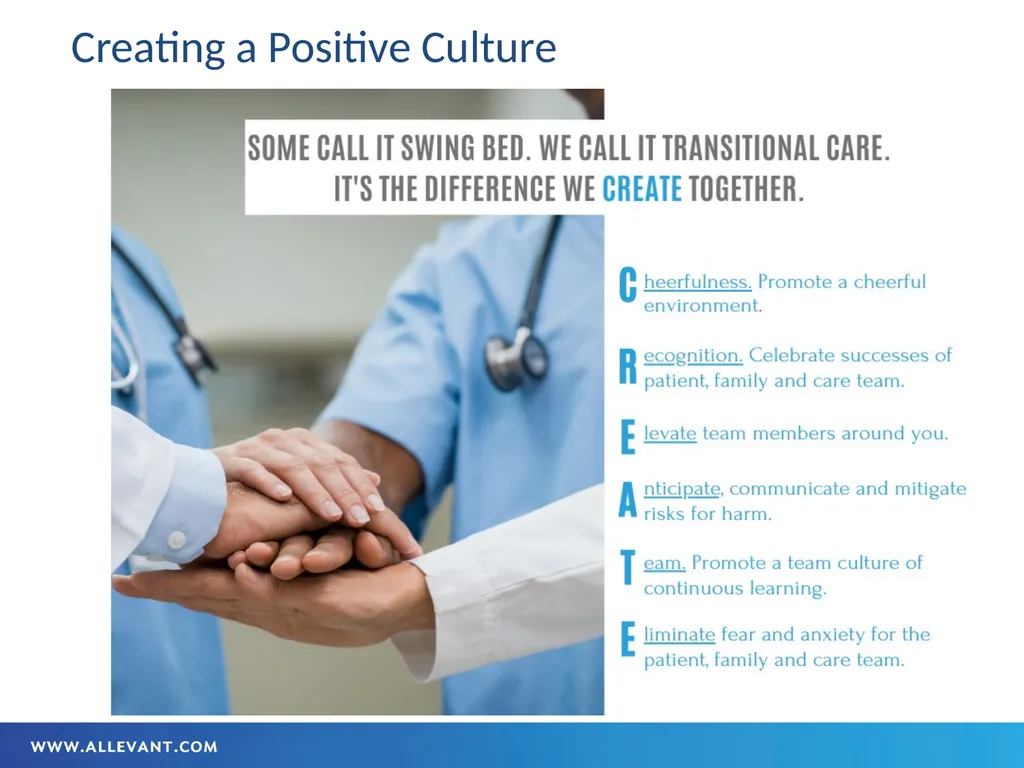
Creating a Positive Culture<br>
17
Mayo Transitional Care Program
Growth from Mayo Clinic Referrals from Mayo Clinic to Mayo CAH Transitional Care increased by over 500%
Transitional Care and respiratory patient days increased by 200% and 800% respectively from 2009 to 2011
Net Revenue + Cost Avoidance/ Centralized Resources Approximately 20/1 return
Reduced excessive acute care hospitals stays, hospital readmissions, Medicare bed days beyond mean geometric length of stay
Improved patient flow at system level<br>
Transitional Care and respiratory patient days increased by 200% and 800% respectively from 2009 to 2011
Net Revenue + Cost Avoidance/ Centralized Resources Approximately 20/1 return
Reduced excessive acute care hospitals stays, hospital readmissions, Medicare bed days beyond mean geometric length of stay
Improved patient flow at system level<br>
18
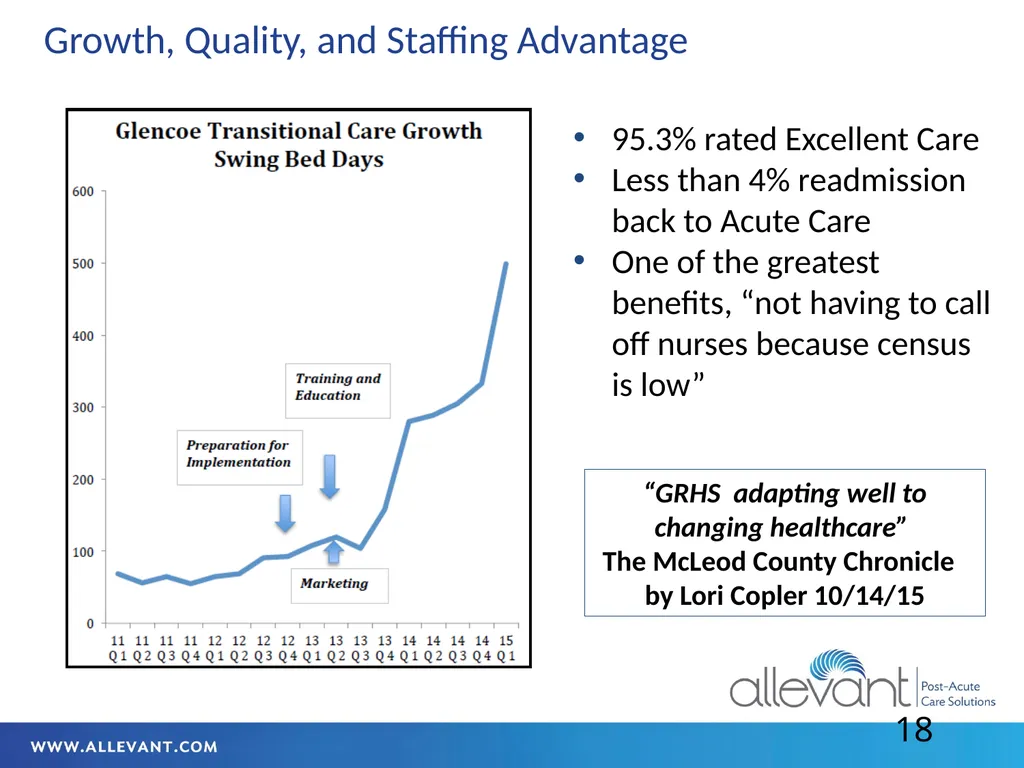
95.3% rated Excellent Care
Less than 4% readmission back to Acute Care
One of the greatest benefits, “not having to call off nurses because census is low” “GRHS adapting well to changing healthcare”
The McLeod County Chronicle
by Lori Copler 10/14/15 Growth, Quality, and Staffing Advantage 18<br>
Less than 4% readmission back to Acute Care
One of the greatest benefits, “not having to call off nurses because census is low” “GRHS adapting well to changing healthcare”
The McLeod County Chronicle
by Lori Copler 10/14/15 Growth, Quality, and Staffing Advantage 18<br>
19
Reporting, Measuring, and Improving Quality SNFs have public measures on www.carecompare.gov , no current CMS CAH Swing Bed data requirement
Internal measurement
Swing Bed days
Types of patients referred and admitted (complex medical, complex surgical, ortho, neuro, cardiac, respiratory, wound, etc.)
Number of referrals, admissions, denials (and reasons)
Discharge disposition (home, assisted living, skilled or residential nursing home, acute care hospital, hospice, deceased)
Length of stay
Transitional Care Bundle 19<br>
Internal measurement
Swing Bed days
Types of patients referred and admitted (complex medical, complex surgical, ortho, neuro, cardiac, respiratory, wound, etc.)
Number of referrals, admissions, denials (and reasons)
Discharge disposition (home, assisted living, skilled or residential nursing home, acute care hospital, hospice, deceased)
Length of stay
Transitional Care Bundle 19<br>
20
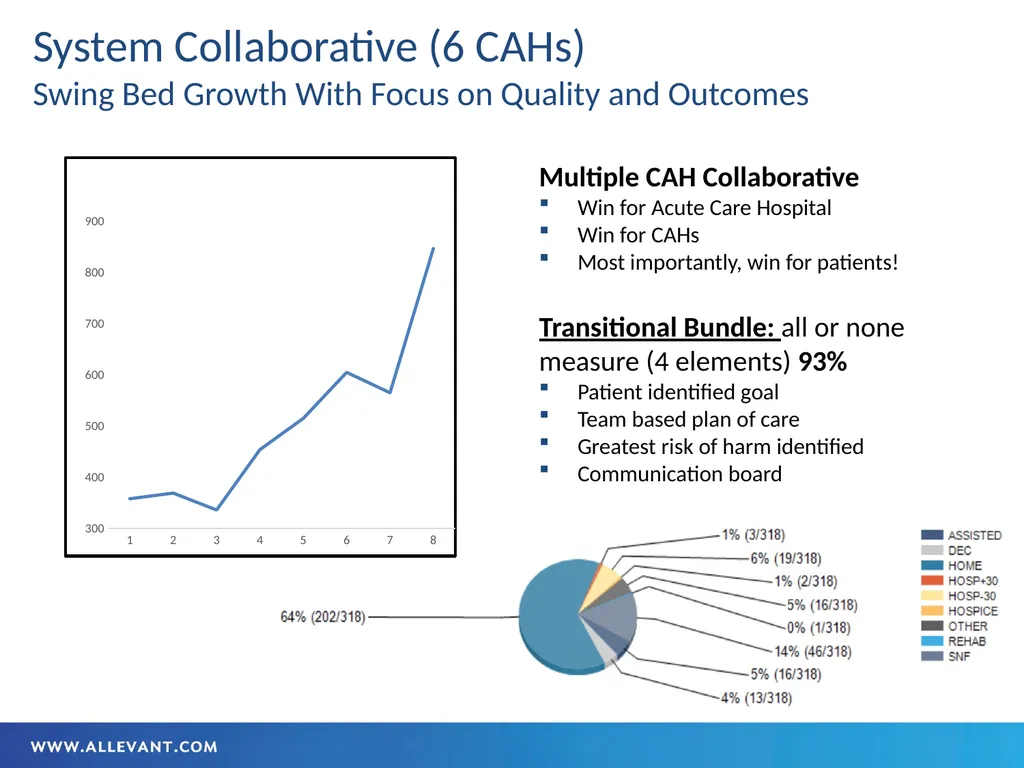
Multiple CAH Collaborative
Win for Acute Care Hospital
Win for CAHs
Most importantly, win for patients!
Transitional Bundle: all or none measure (4 elements) 93%
Patient identified goal
Team based plan of care
Greatest risk of harm identified
Communication board System Collaborative (6 CAHs) Swing Bed Growth With Focus on Quality and Outcomes<br>
Win for Acute Care Hospital
Win for CAHs
Most importantly, win for patients!
Transitional Bundle: all or none measure (4 elements) 93%
Patient identified goal
Team based plan of care
Greatest risk of harm identified
Communication board System Collaborative (6 CAHs) Swing Bed Growth With Focus on Quality and Outcomes<br>
21
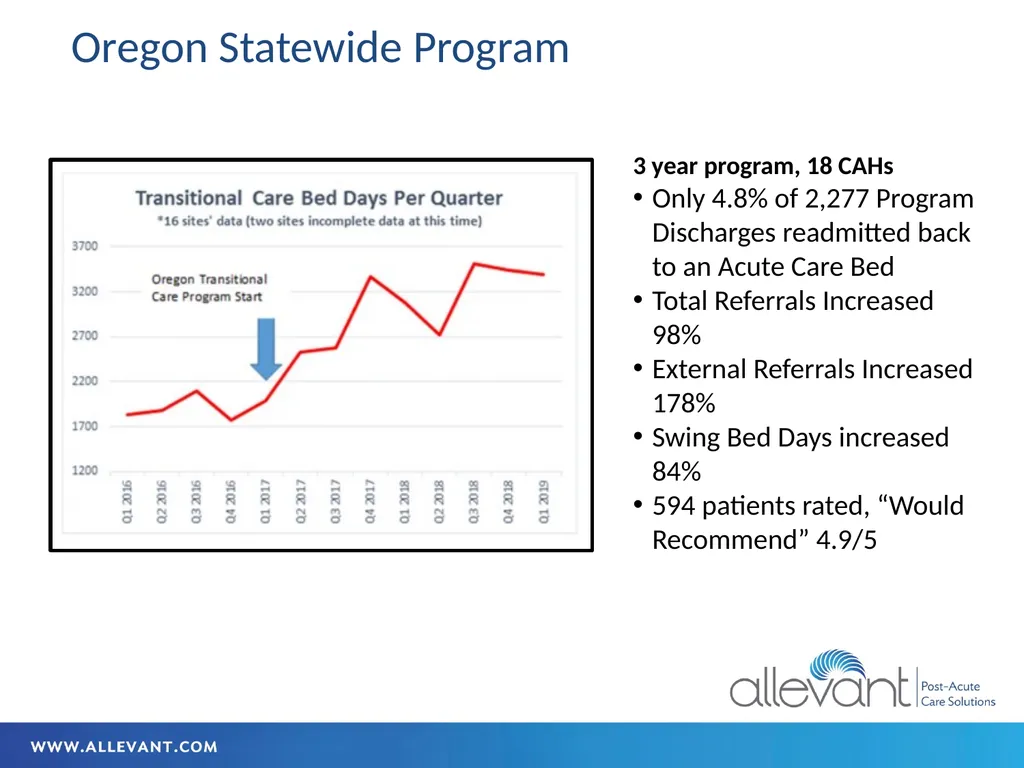
Oregon Statewide Program 3 year program, 18 CAHs
Only 4.8% of 2,277 Program Discharges readmitted back to an Acute Care Bed
Total Referrals Increased 98%
External Referrals Increased 178%
Swing Bed Days increased 84%
594 patients rated, “Would Recommend” 4.9/5<br>
Only 4.8% of 2,277 Program Discharges readmitted back to an Acute Care Bed
Total Referrals Increased 98%
External Referrals Increased 178%
Swing Bed Days increased 84%
594 patients rated, “Would Recommend” 4.9/5<br>
22
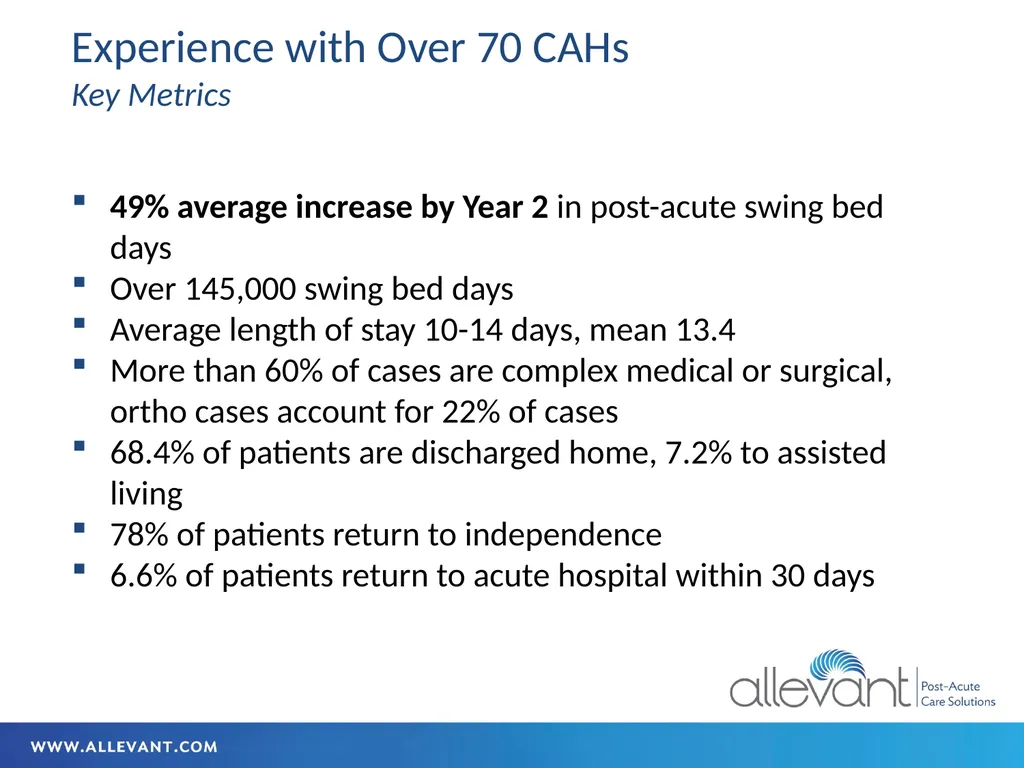
Experience with Over 70 CAHs
Key Metrics 49% average increase by Year 2 in post-acute swing bed days
Over 145,000 swing bed days
Average length of stay 10-14 days, mean 13.4
More than 60% of cases are complex medical or surgical, ortho cases account for 22% of cases
68.4% of patients are discharged home, 7.2% to assisted living
78% of patients return to independence
6.6% of patients return to acute hospital within 30 days<br>
Over 145,000 swing bed days
Average length of stay 10-14 days, mean 13.4
More than 60% of cases are complex medical or surgical, ortho cases account for 22% of cases
68.4% of patients are discharged home, 7.2% to assisted living
78% of patients return to independence
6.6% of patients return to acute hospital within 30 days<br>
23
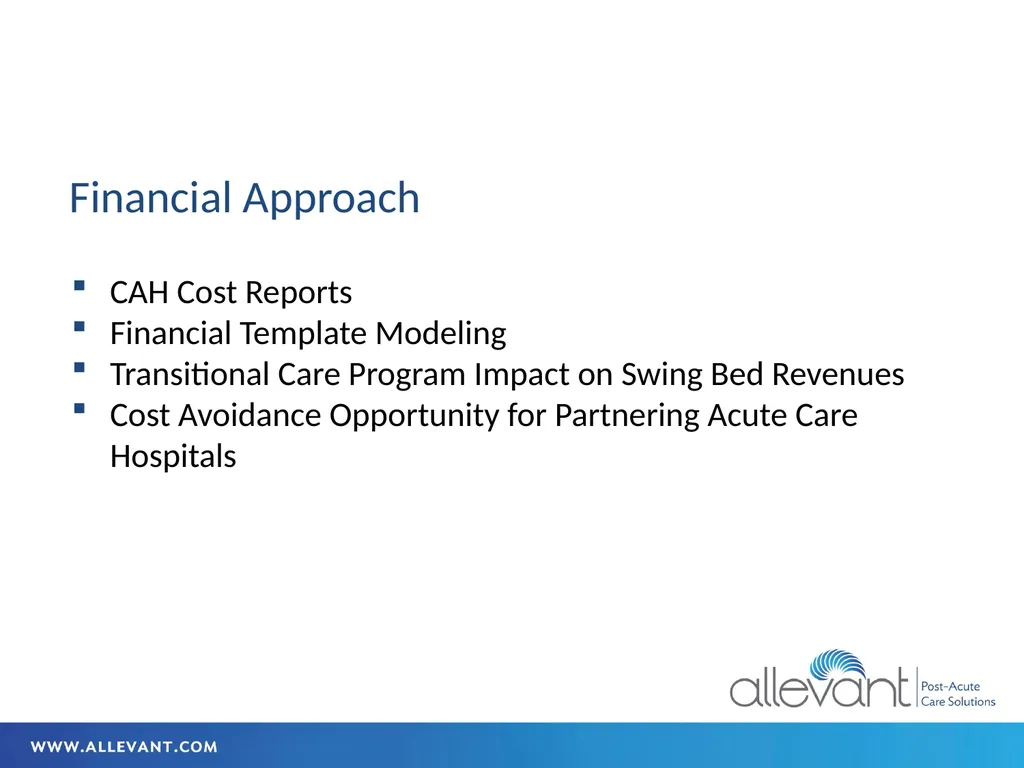
Financial Approach CAH Cost Reports
Financial Template Modeling
Transitional Care Program Impact on Swing Bed Revenues
Cost Avoidance Opportunity for Partnering Acute Care Hospitals<br>
Financial Template Modeling
Transitional Care Program Impact on Swing Bed Revenues
Cost Avoidance Opportunity for Partnering Acute Care Hospitals<br>
24
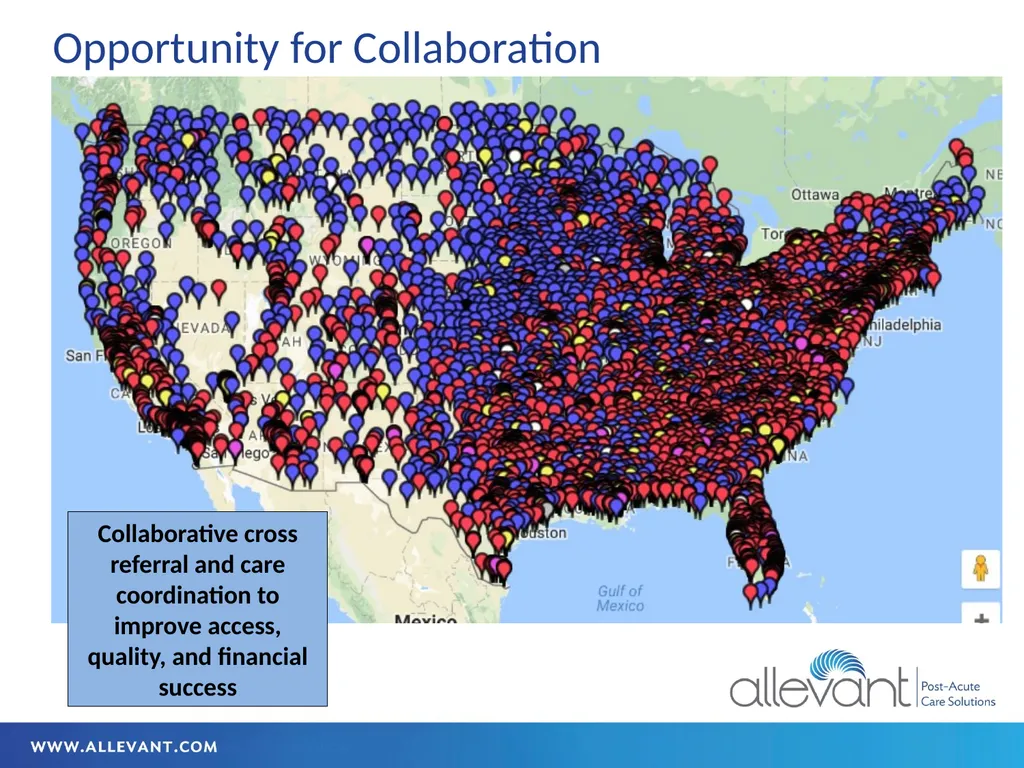
Opportunity for Collaboration Collaborative cross referral and care coordination to improve access, quality, and financial success<br>
25
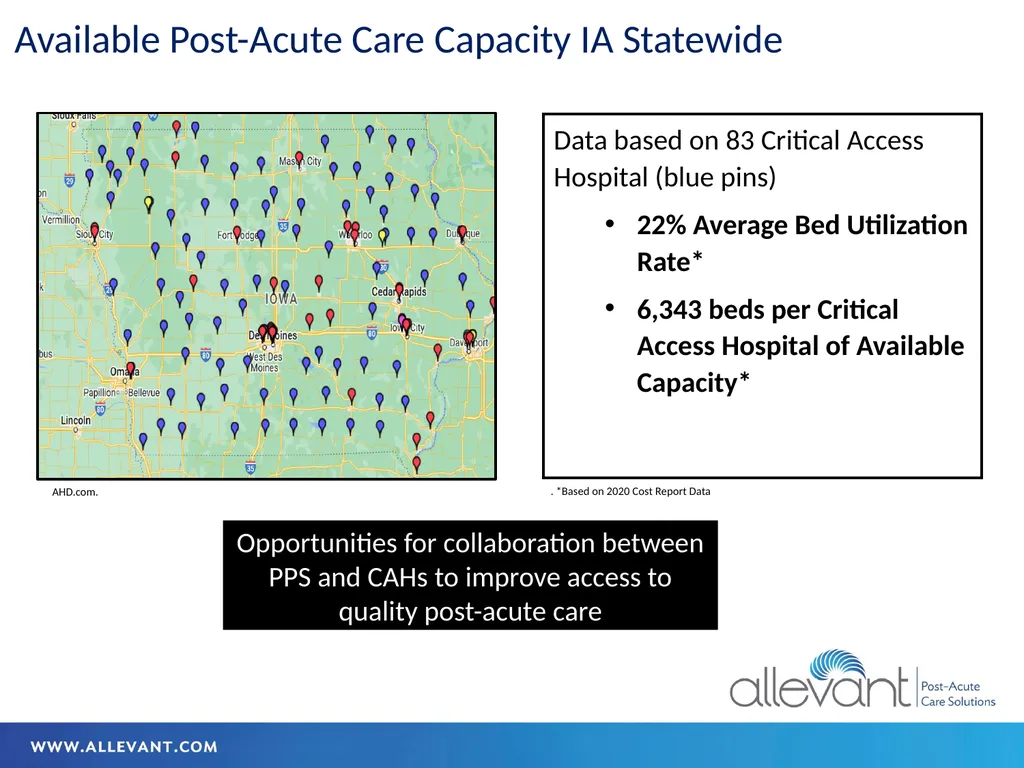
Available Post-Acute Care Capacity IA Statewide . *Based on 2020 Cost Report Data Data based on 83 Critical Access Hospital (blue pins)
22% Average Bed Utilization Rate*
6,343 beds per Critical Access Hospital of Available Capacity* AHD.com. Opportunities for collaboration between PPS and CAHs to improve access to quality post-acute care<br>
22% Average Bed Utilization Rate*
6,343 beds per Critical Access Hospital of Available Capacity* AHD.com. Opportunities for collaboration between PPS and CAHs to improve access to quality post-acute care<br>
26
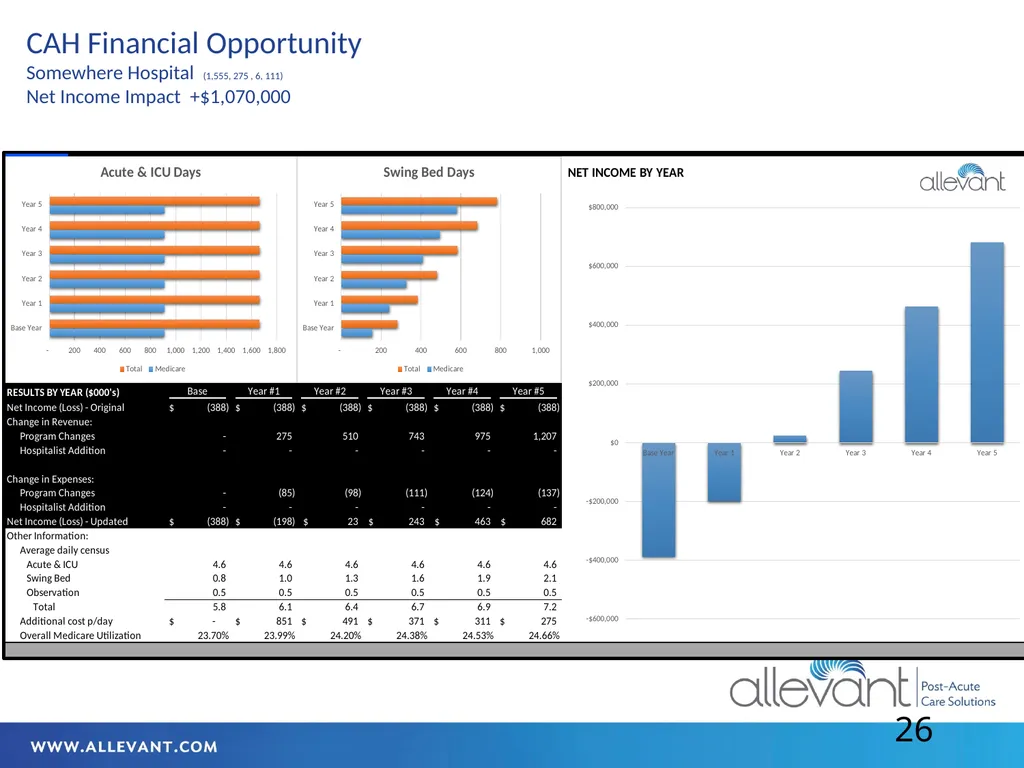
CAH Financial Opportunity
Somewhere Hospital (1,555, 275 , 6, 111)
Net Income Impact +$1,070,000 26<br>
27
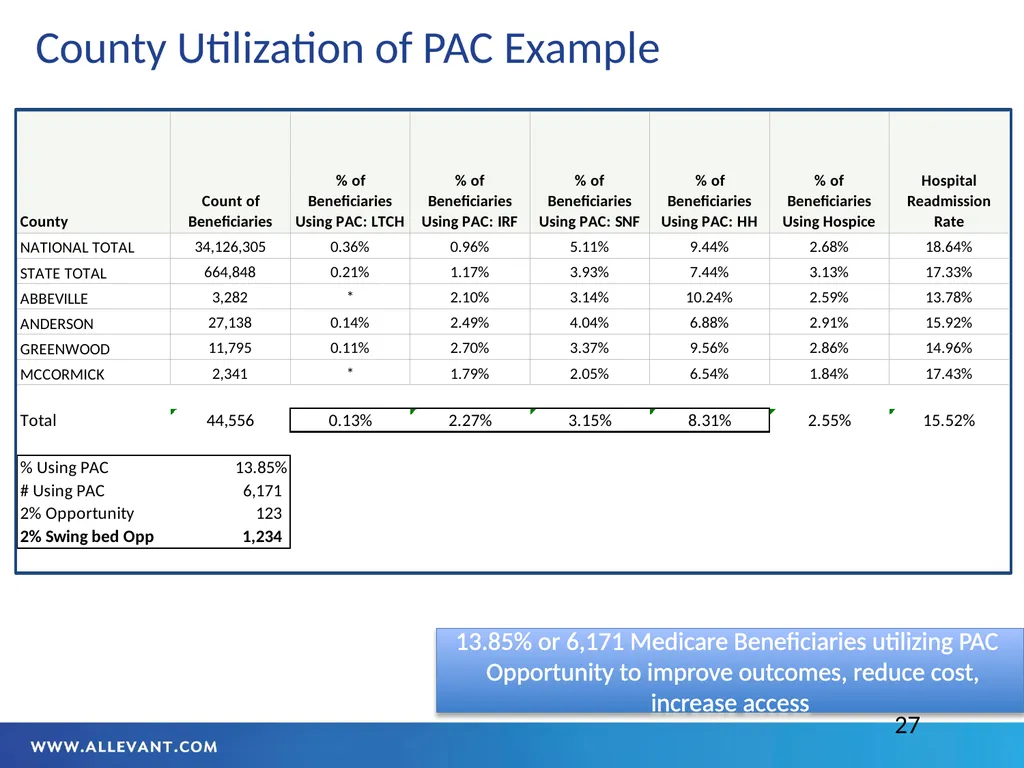
27 13.85% or 6,171 Medicare Beneficiaries utilizing PAC
Opportunity to improve outcomes, reduce cost, increase access County Utilization of PAC Example<br>
Opportunity to improve outcomes, reduce cost, increase access County Utilization of PAC Example<br>
28
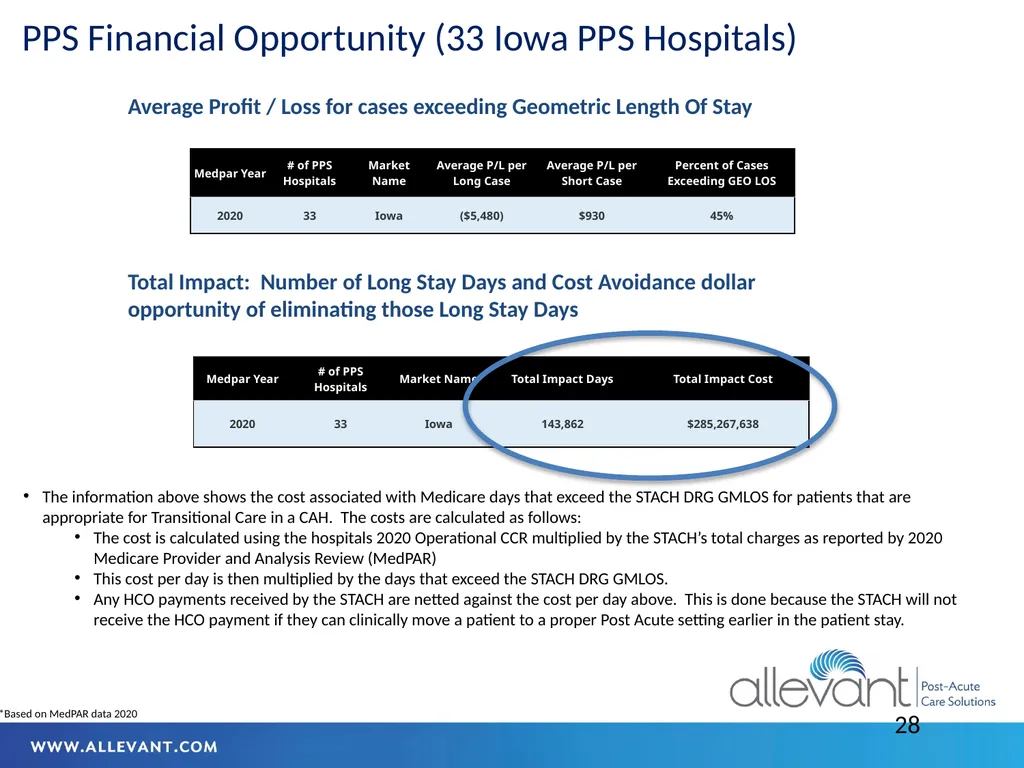
PPS Financial Opportunity (33 Iowa PPS Hospitals) The information above shows the cost associated with Medicare days that exceed the STACH DRG GMLOS for patients that are appropriate for Transitional Care in a CAH. The costs are calculated as follows:
The cost is calculated using the hospitals 2020 Operational CCR multiplied by the STACH’s total charges as reported by 2020 Medicare Provider and Analysis Review (MedPAR)
This cost per day is then multiplied by the days that exceed the STACH DRG GMLOS.
Any HCO payments received by the STACH are netted against the cost per day above. This is done because the STACH will not receive the HCO payment if they can clinically move a patient to a proper Post Acute setting earlier in the patient stay. 28 Average Profit / Loss for cases exceeding Geometric Length Of Stay Total Impact: Number of Long Stay Days and Cost Avoidance dollar opportunity of eliminating those Long Stay Days . *Based on MedPAR data 2020<br>
The cost is calculated using the hospitals 2020 Operational CCR multiplied by the STACH’s total charges as reported by 2020 Medicare Provider and Analysis Review (MedPAR)
This cost per day is then multiplied by the days that exceed the STACH DRG GMLOS.
Any HCO payments received by the STACH are netted against the cost per day above. This is done because the STACH will not receive the HCO payment if they can clinically move a patient to a proper Post Acute setting earlier in the patient stay. 28 Average Profit / Loss for cases exceeding Geometric Length Of Stay Total Impact: Number of Long Stay Days and Cost Avoidance dollar opportunity of eliminating those Long Stay Days . *Based on MedPAR data 2020<br>
29
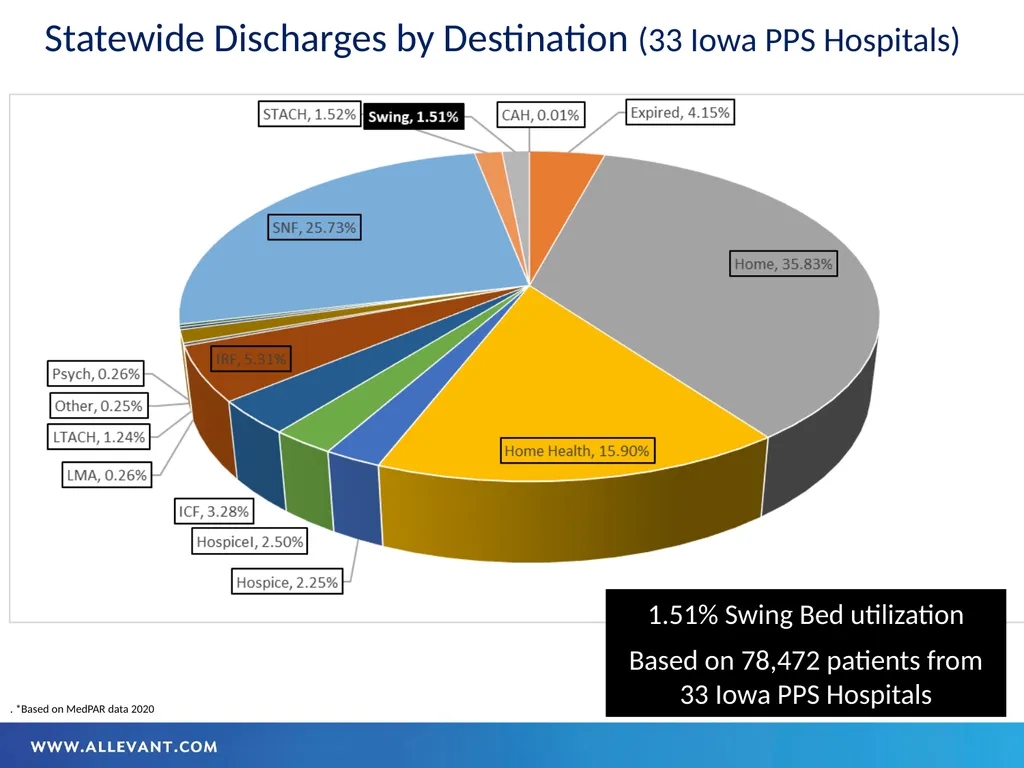
Statewide Discharges by Destination (33 Iowa PPS Hospitals) 1.51% Swing Bed utilization
Based on 78,472 patients from 33 Iowa PPS Hospitals . *Based on MedPAR data 2020<br>
Based on 78,472 patients from 33 Iowa PPS Hospitals . *Based on MedPAR data 2020<br>
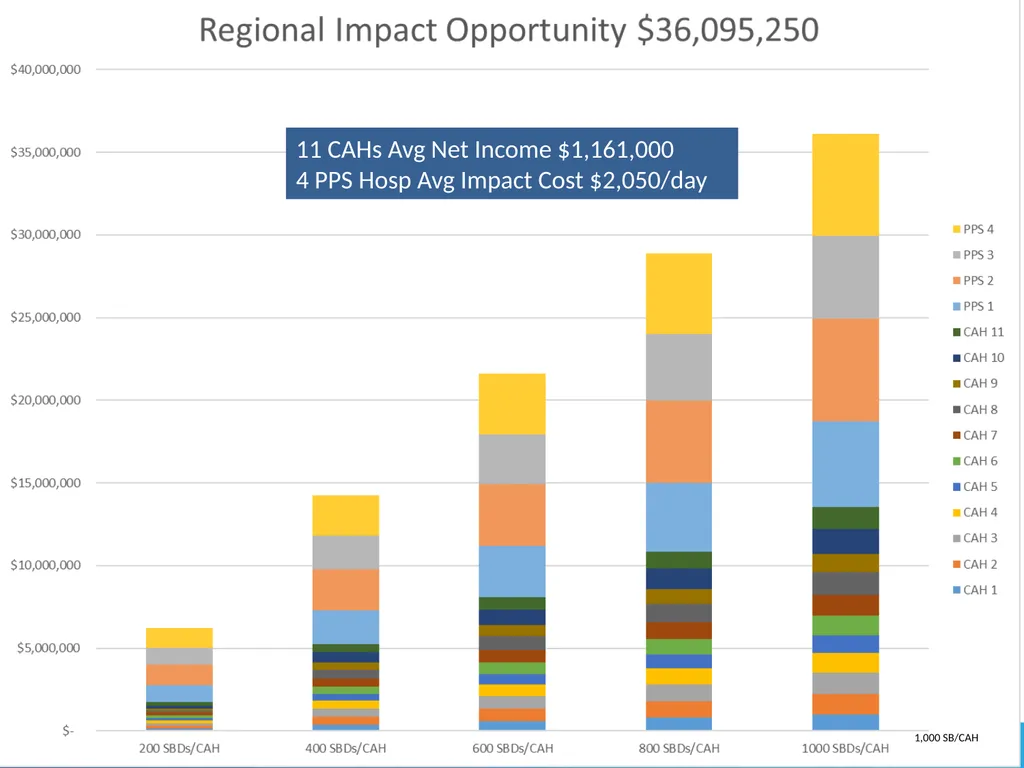
30
11 CAHs Avg Net Income $1,161,000
4 PPS Hosp Avg Impact Cost $2,050/day 1,000 SB/CAH<br>
4 PPS Hosp Avg Impact Cost $2,050/day 1,000 SB/CAH<br>
31
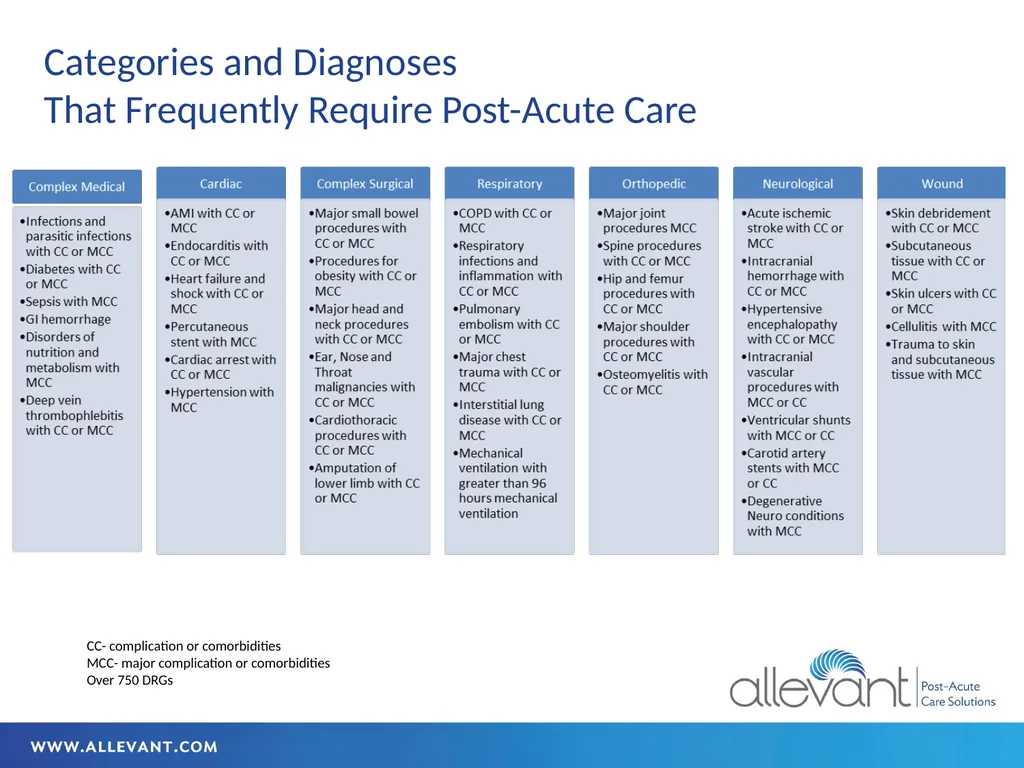
Patient Diagnosis and Types of Skilled Needs<br>
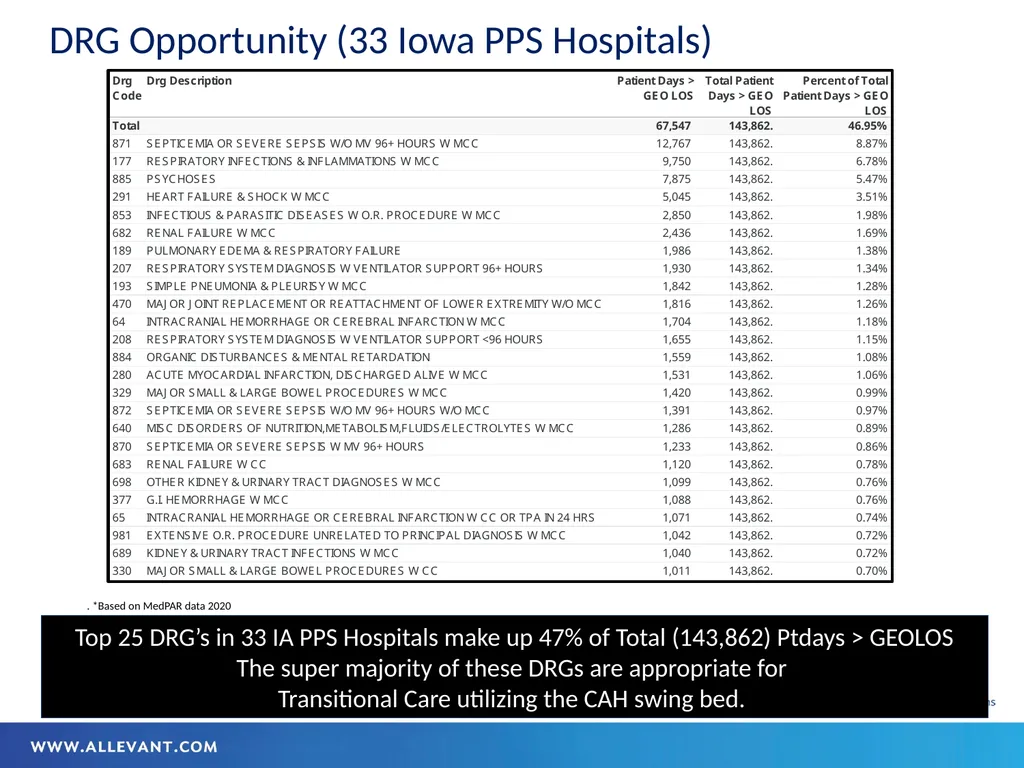
32
DRG Opportunity (33 Iowa PPS Hospitals) Top 25 DRG’s in 33 IA PPS Hospitals make up 47% of Total (143,862) Ptdays > GEOLOS
The super majority of these DRGs are appropriate for
Transitional Care utilizing the CAH swing bed. . *Based on MedPAR data 2020<br>
The super majority of these DRGs are appropriate for
Transitional Care utilizing the CAH swing bed. . *Based on MedPAR data 2020<br>
33
Categories and Diagnoses
That Frequently Require Post-Acute Care CC- complication or comorbidities
MCC- major complication or comorbidities
Over 750 DRGs<br>
MCC- major complication or comorbidities
Over 750 DRGs<br>
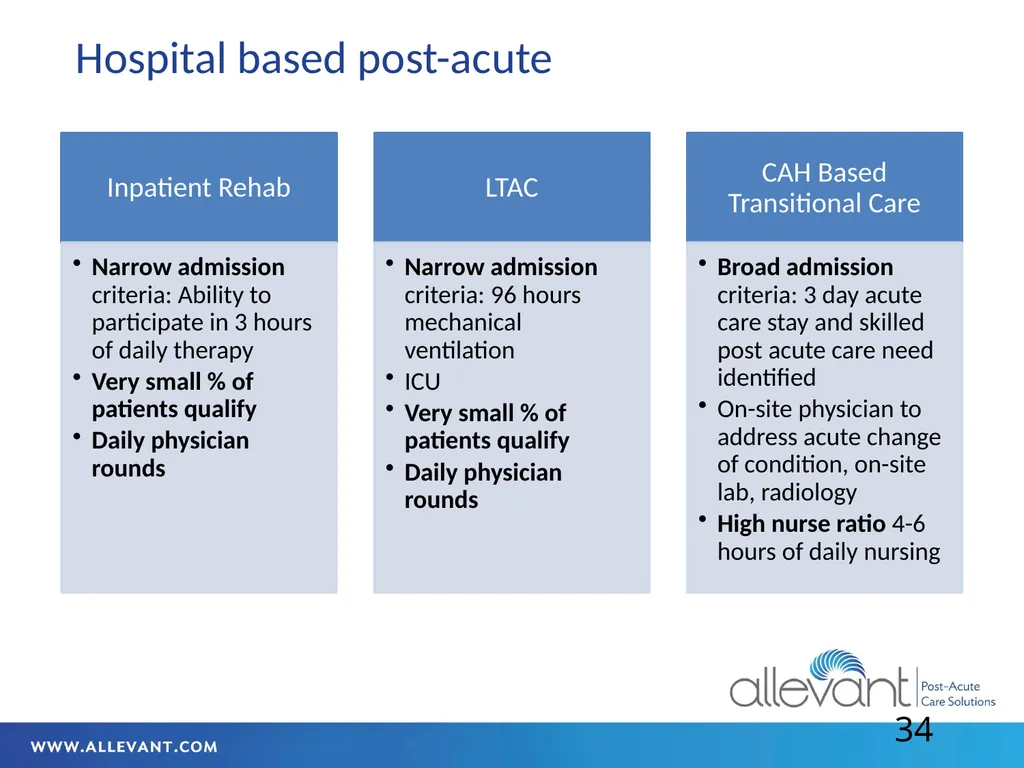
34
Hospital based post-acute 34<br>
35
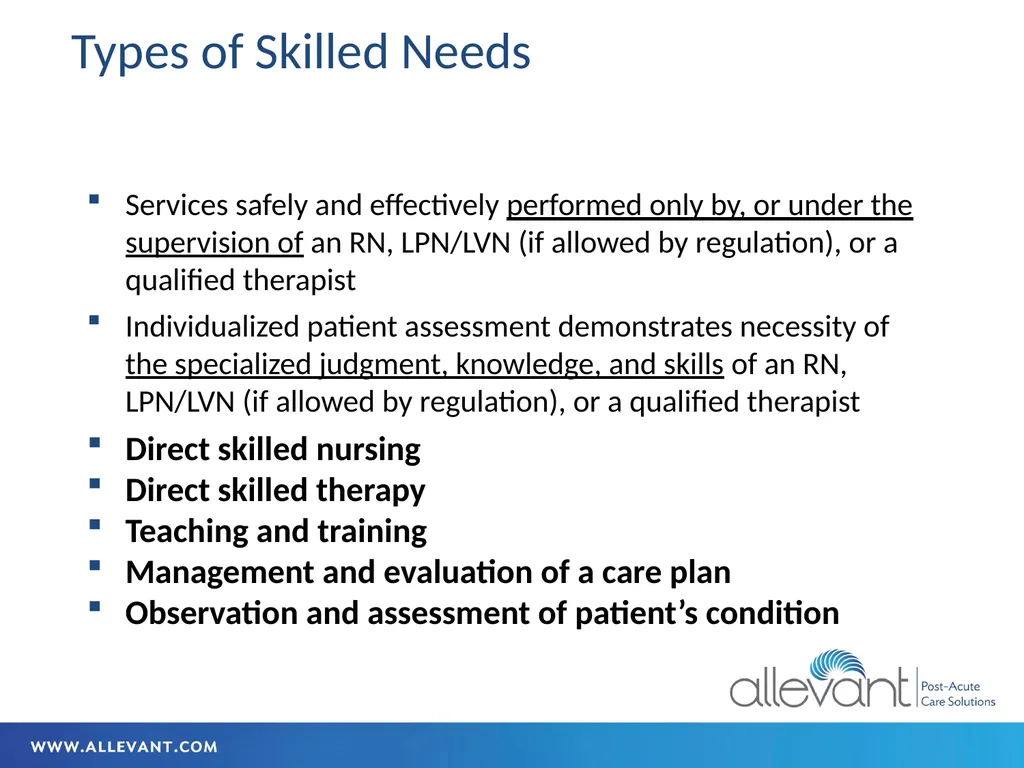
Types of Skilled Needs Services safely and effectively performed only by, or under the supervision of an RN, LPN/LVN (if allowed by regulation), or a qualified therapist
Individualized patient assessment demonstrates necessity of the specialized judgment, knowledge, and skills of an RN, LPN/LVN (if allowed by regulation), or a qualified therapist
Direct skilled nursing
Direct skilled therapy
Teaching and training
Management and evaluation of a care plan
Observation and assessment of patient’s condition<br>
Individualized patient assessment demonstrates necessity of the specialized judgment, knowledge, and skills of an RN, LPN/LVN (if allowed by regulation), or a qualified therapist
Direct skilled nursing
Direct skilled therapy
Teaching and training
Management and evaluation of a care plan
Observation and assessment of patient’s condition<br>
36
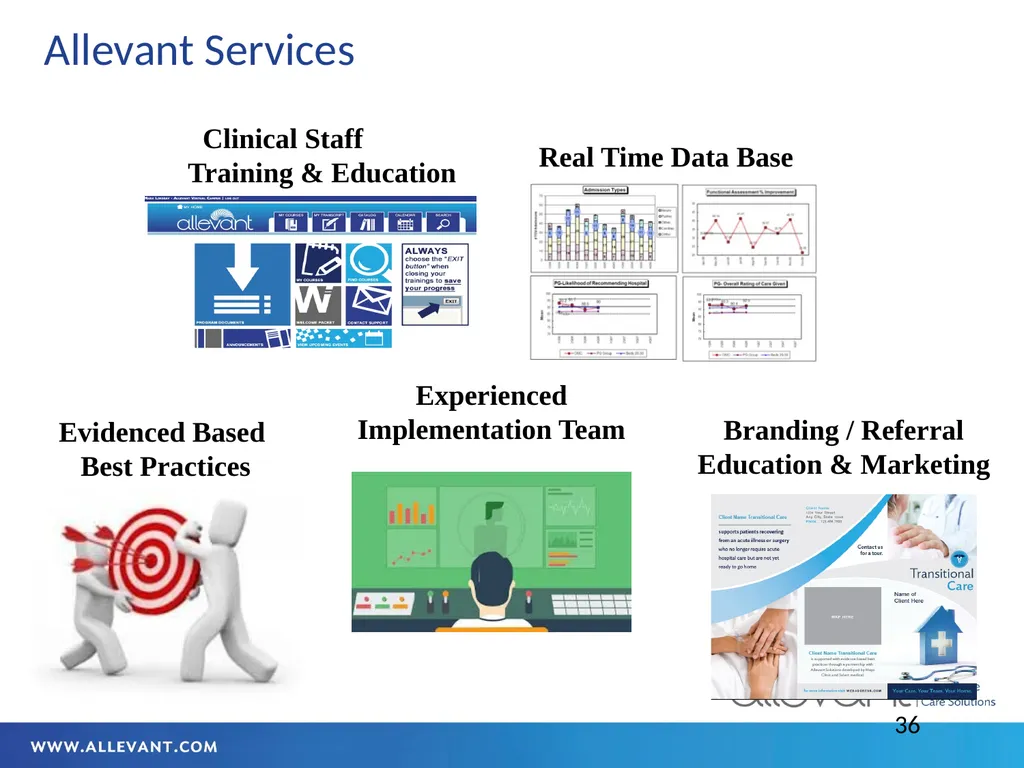
Allevant Services 36 Clinical Staff Training & Education Real Time Data Base Experienced Implementation Team Branding / Referral Education & Marketing Evidenced Based
Best Practices<br>
Best Practices<br>
37
Social Media Strategy
You need to know your audience, be familiar with the tools,
and have a good strategy!<br>
38
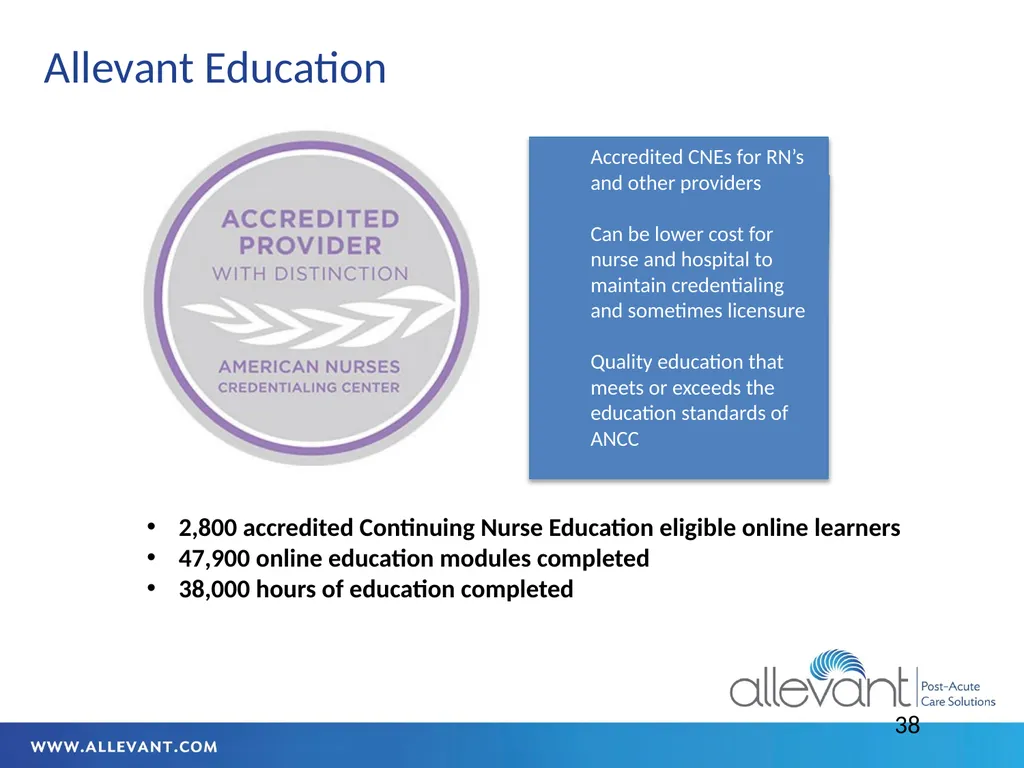
38 Accredited CNEs for RN’s and other providers
Can be lower cost for nurse and hospital to maintain credentialing and sometimes licensure
Quality education that meets or exceeds the education standards of ANCC Allevant Education 2,800 accredited Continuing Nurse Education eligible online learners
47,900 online education modules completed
38,000 hours of education completed<br>
Can be lower cost for nurse and hospital to maintain credentialing and sometimes licensure
Quality education that meets or exceeds the education standards of ANCC Allevant Education 2,800 accredited Continuing Nurse Education eligible online learners
47,900 online education modules completed
38,000 hours of education completed<br>
39
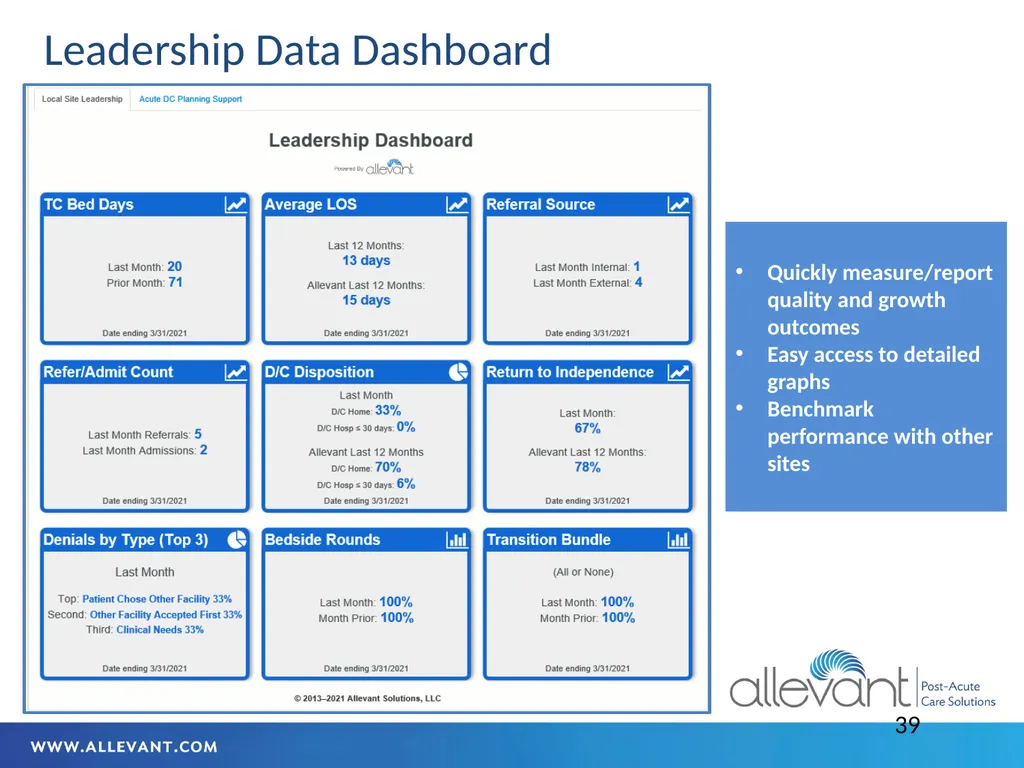
Leadership Data Dashboard 39 Quickly measure/report quality and growth outcomes
Easy access to detailed graphs
Benchmark performance with other sites<br>
Easy access to detailed graphs
Benchmark performance with other sites<br>
40
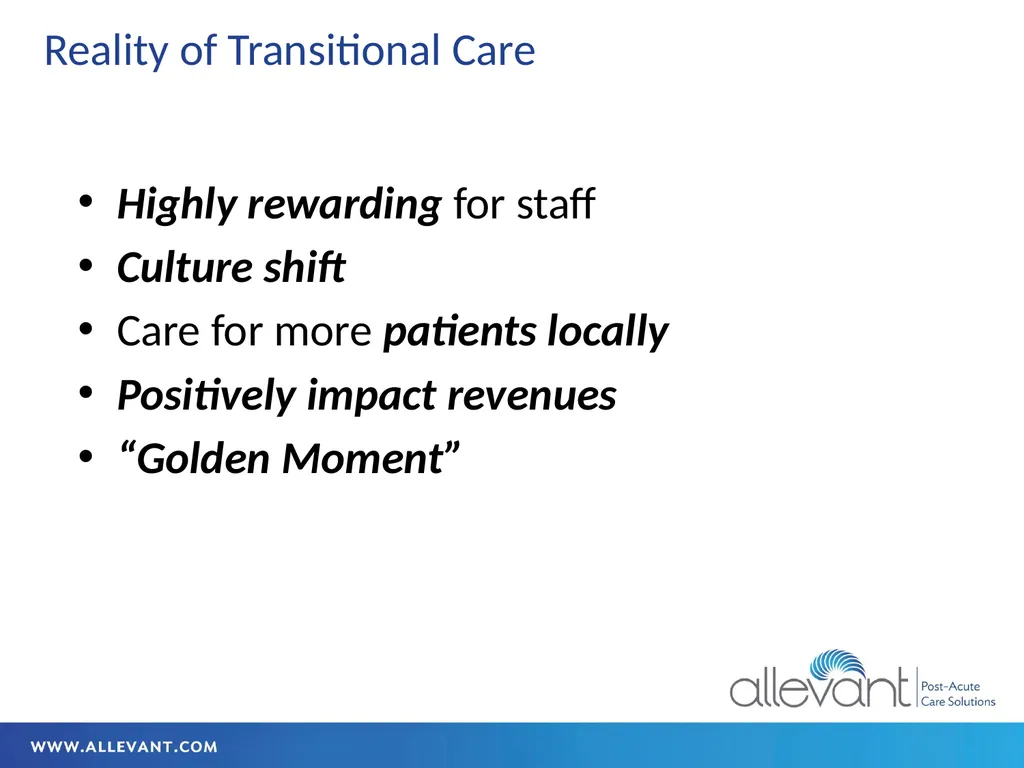
Reality of Transitional Care Highly rewarding for staff
Culture shift
Care for more patients locally
Positively impact revenues
“Golden Moment”<br>
Culture shift
Care for more patients locally
Positively impact revenues
“Golden Moment”<br>
41
Healthcare disparities in rural communities are tremendous and Life expectancy is going in the wrong direction, cancers related to obesity are going to surpass cancers related to tobacco<br>
42
MENDS® Treatment: More energy, live longer, weight loss, cholesterol reduction, improved blood flow, blood pressure reduction and a lot more ®<br>
43
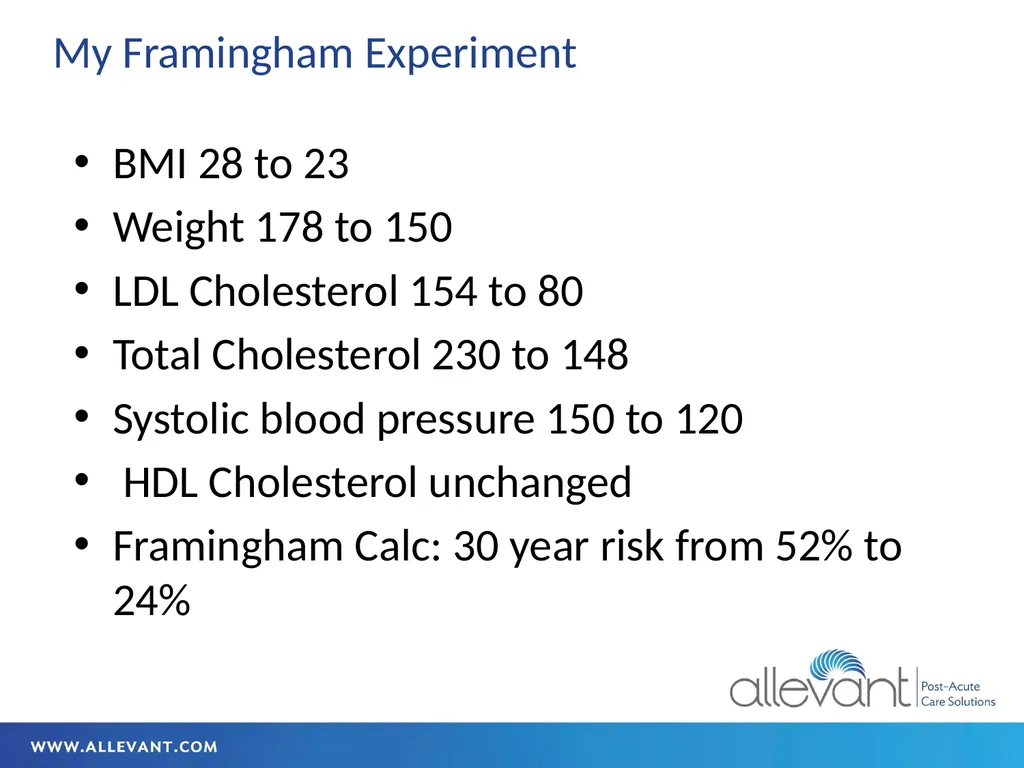
My Framingham Experiment BMI 28 to 23
Weight 178 to 150
LDL Cholesterol 154 to 80
Total Cholesterol 230 to 148
Systolic blood pressure 150 to 120
HDL Cholesterol unchanged
Framingham Calc: 30 year risk from 52% to 24%<br>
Weight 178 to 150
LDL Cholesterol 154 to 80
Total Cholesterol 230 to 148
Systolic blood pressure 150 to 120
HDL Cholesterol unchanged
Framingham Calc: 30 year risk from 52% to 24%<br>
44
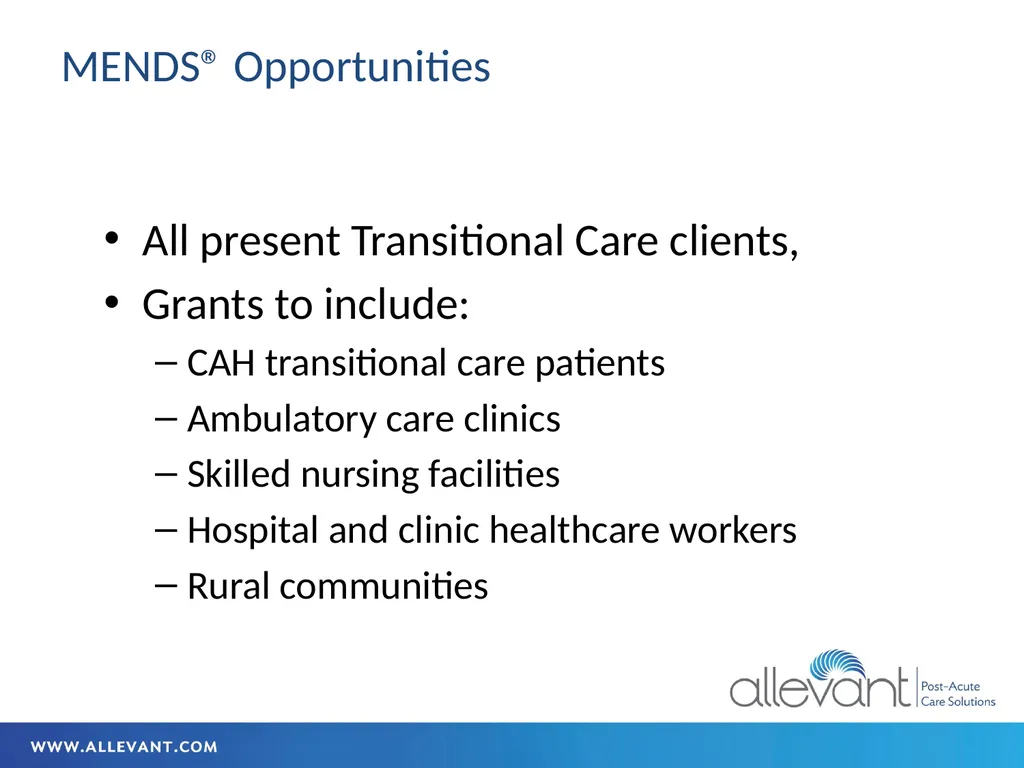
All present Transitional Care clients,
Grants to include:
CAH transitional care patients
Ambulatory care clinics
Skilled nursing facilities
Hospital and clinic healthcare workers
Rural communities MENDS® Opportunities<br>
Grants to include:
CAH transitional care patients
Ambulatory care clinics
Skilled nursing facilities
Hospital and clinic healthcare workers
Rural communities MENDS® Opportunities<br>
45
Questions?
Contact us! Mark Lindsay, MD MMM, Allevant Medical Director, Assistant Professor of Medicine at Mayo Clinic College of Medicine
Lindsay.Mark@mayo.edu
(m) 717-577-8689 Jordan Tenenbaum, MHA
President for Allevant
jtenenbaum@allevant.com
(m) 314-302-5373<br>
Lindsay.Mark@mayo.edu
(m) 717-577-8689 Jordan Tenenbaum, MHA
President for Allevant
jtenenbaum@allevant.com
(m) 314-302-5373<br>
46
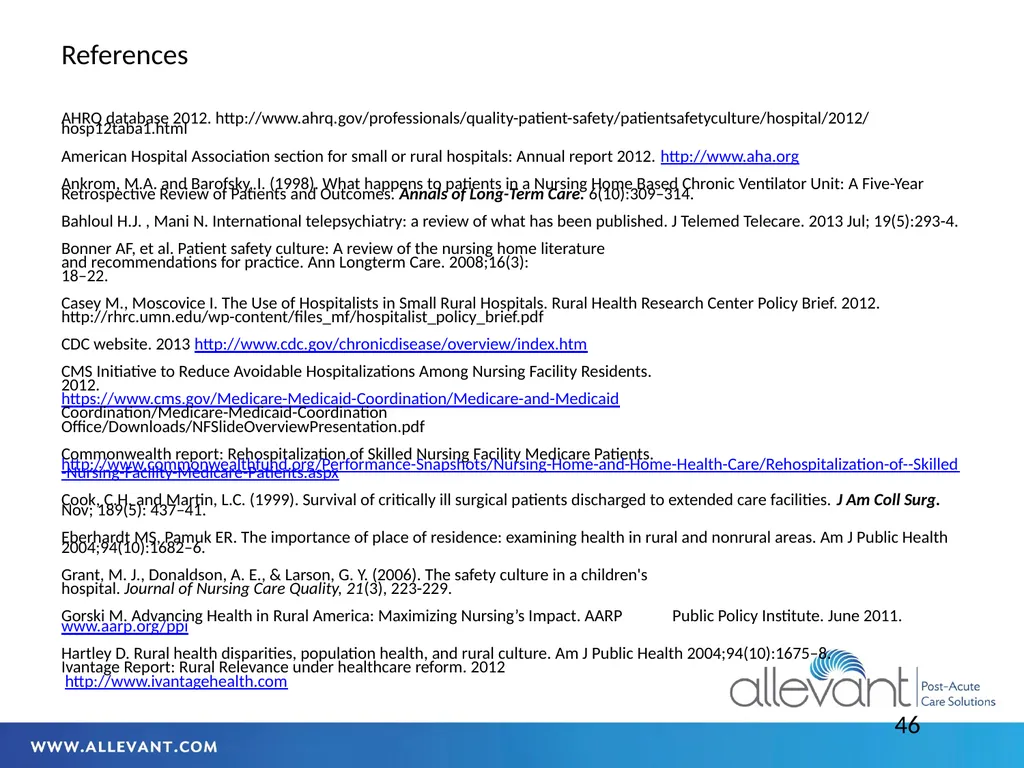
References AHRQ database 2012. http://www.ahrq.gov/professionals/quality-patient-safety/patientsafetyculture/hospital/2012/hosp12taba1.html
American Hospital Association section for small or rural hospitals: Annual report 2012. http://www.aha.org
Ankrom, M.A. and Barofsky, I. (1998). What happens to patients in a Nursing Home Based Chronic Ventilator Unit: A Five-Year Retrospective Review of Patients and Outcomes. Annals of Long-Term Care. 6(10):309–314.
Bahloul H.J. , Mani N. International telepsychiatry: a review of what has been published. J Telemed Telecare. 2013 Jul; 19(5):293-4.
Bonner AF, et al. Patient safety culture: A review of the nursing home literature
and recommendations for practice. Ann Longterm Care. 2008;16(3):
18–22.
Casey M., Moscovice I. The Use of Hospitalists in Small Rural Hospitals. Rural Health Research Center Policy Brief. 2012.
http://rhrc.umn.edu/wp-content/files_mf/hospitalist_policy_brief.pdf
CDC website. 2013 http://www.cdc.gov/chronicdisease/overview/index.htm
CMS Initiative to Reduce Avoidable Hospitalizations Among Nursing Facility Residents.
2012.
https://www.cms.gov/Medicare-Medicaid-Coordination/Medicare-and-Medicaid
Coordination/Medicare-Medicaid-Coordination
Office/Downloads/NFSlideOverviewPresentation.pdf
Commonwealth report: Rehospitalization of Skilled Nursing Facility Medicare Patients. http://www.commonwealthfund.org/Performance-Snapshots/Nursing-Home-and-Home-Health-Care/Rehospitalization-of--Skilled-Nursing-Facility-Medicare-Patients.aspx
Cook, C.H. and Martin, L.C. (1999). Survival of critically ill surgical patients discharged to extended care facilities. J Am Coll Surg. Nov; 189(5): 437–41.
Eberhardt MS, Pamuk ER. The importance of place of residence: examining health in rural and nonrural areas. Am J Public Health 2004;94(10):1682–6.
Grant, M. J., Donaldson, A. E., & Larson, G. Y. (2006). The safety culture in a children's
hospital. Journal of Nursing Care Quality, 21(3), 223-229.
Gorski M. Advancing Health in Rural America: Maximizing Nursing’s Impact. AARP Public Policy Institute. June 2011. www.aarp.org/ppi
Hartley D. Rural health disparities, population health, and rural culture. Am J Public Health 2004;94(10):1675–8.
Ivantage Report: Rural Relevance under healthcare reform. 2012
http://www.ivantagehealth.com 46<br>
American Hospital Association section for small or rural hospitals: Annual report 2012. http://www.aha.org
Ankrom, M.A. and Barofsky, I. (1998). What happens to patients in a Nursing Home Based Chronic Ventilator Unit: A Five-Year Retrospective Review of Patients and Outcomes. Annals of Long-Term Care. 6(10):309–314.
Bahloul H.J. , Mani N. International telepsychiatry: a review of what has been published. J Telemed Telecare. 2013 Jul; 19(5):293-4.
Bonner AF, et al. Patient safety culture: A review of the nursing home literature
and recommendations for practice. Ann Longterm Care. 2008;16(3):
18–22.
Casey M., Moscovice I. The Use of Hospitalists in Small Rural Hospitals. Rural Health Research Center Policy Brief. 2012.
http://rhrc.umn.edu/wp-content/files_mf/hospitalist_policy_brief.pdf
CDC website. 2013 http://www.cdc.gov/chronicdisease/overview/index.htm
CMS Initiative to Reduce Avoidable Hospitalizations Among Nursing Facility Residents.
2012.
https://www.cms.gov/Medicare-Medicaid-Coordination/Medicare-and-Medicaid
Coordination/Medicare-Medicaid-Coordination
Office/Downloads/NFSlideOverviewPresentation.pdf
Commonwealth report: Rehospitalization of Skilled Nursing Facility Medicare Patients. http://www.commonwealthfund.org/Performance-Snapshots/Nursing-Home-and-Home-Health-Care/Rehospitalization-of--Skilled-Nursing-Facility-Medicare-Patients.aspx
Cook, C.H. and Martin, L.C. (1999). Survival of critically ill surgical patients discharged to extended care facilities. J Am Coll Surg. Nov; 189(5): 437–41.
Eberhardt MS, Pamuk ER. The importance of place of residence: examining health in rural and nonrural areas. Am J Public Health 2004;94(10):1682–6.
Grant, M. J., Donaldson, A. E., & Larson, G. Y. (2006). The safety culture in a children's
hospital. Journal of Nursing Care Quality, 21(3), 223-229.
Gorski M. Advancing Health in Rural America: Maximizing Nursing’s Impact. AARP Public Policy Institute. June 2011. www.aarp.org/ppi
Hartley D. Rural health disparities, population health, and rural culture. Am J Public Health 2004;94(10):1675–8.
Ivantage Report: Rural Relevance under healthcare reform. 2012
http://www.ivantagehealth.com 46<br>
47
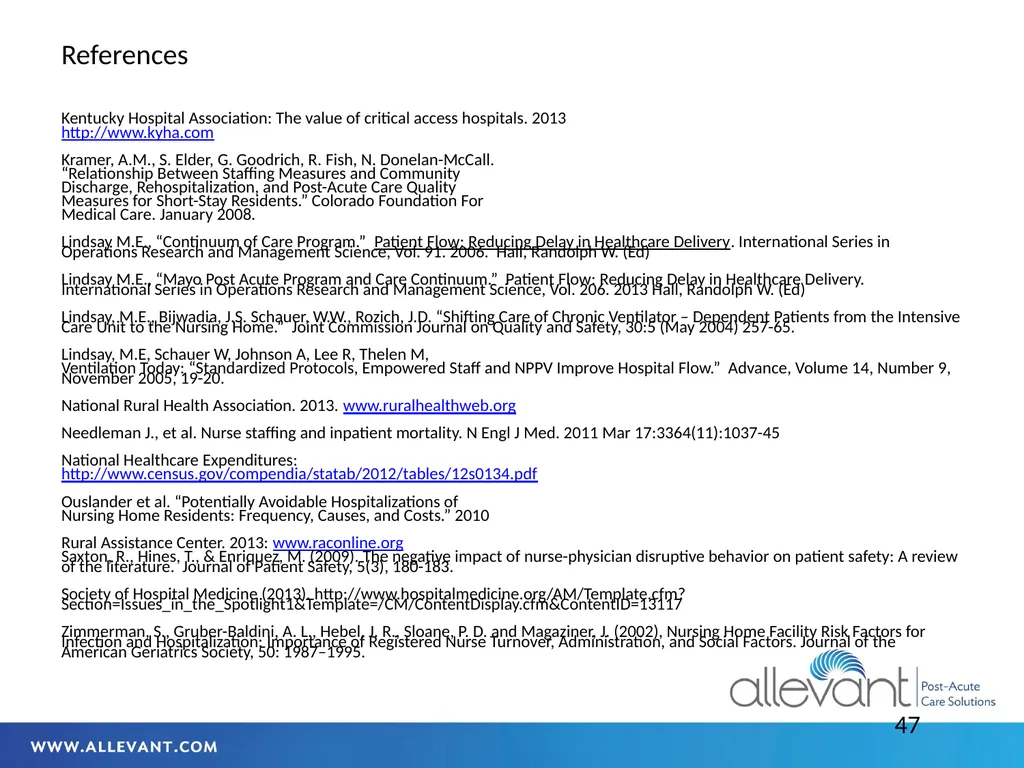
References Kentucky Hospital Association: The value of critical access hospitals. 2013
http://www.kyha.com
Kramer, A.M., S. Elder, G. Goodrich, R. Fish, N. Donelan-McCall.
“Relationship Between Staffing Measures and Community
Discharge, Rehospitalization, and Post-Acute Care Quality
Measures for Short-Stay Residents.” Colorado Foundation For
Medical Care. January 2008.
Lindsay M.E., “Continuum of Care Program.” Patient Flow: Reducing Delay in Healthcare Delivery. International Series in Operations Research and Management Science, Vol. 91. 2006. Hall, Randolph W. (Ed)
Lindsay M.E., “Mayo Post Acute Program and Care Continuum.” Patient Flow: Reducing Delay in Healthcare Delivery. International Series in Operations Research and Management Science, Vol. 206. 2013 Hall, Randolph W. (Ed)
Lindsay, M.E., Bijwadia, J.S. Schauer, W.W., Rozich, J.D. “Shifting Care of Chronic Ventilator – Dependent Patients from the Intensive Care Unit to the Nursing Home.” Joint Commission Journal on Quality and Safety, 30:5 (May 2004) 257-65.
Lindsay, M.E, Schauer W, Johnson A, Lee R, Thelen M,
Ventilation Today: “Standardized Protocols, Empowered Staff and NPPV Improve Hospital Flow.” Advance, Volume 14, Number 9, November 2005, 19-20.
National Rural Health Association. 2013. www.ruralhealthweb.org
Needleman J., et al. Nurse staffing and inpatient mortality. N Engl J Med. 2011 Mar 17:3364(11):1037-45
National Healthcare Expenditures:
http://www.census.gov/compendia/statab/2012/tables/12s0134.pdf
Ouslander et al. “Potentially Avoidable Hospitalizations of
Nursing Home Residents: Frequency, Causes, and Costs.” 2010
Rural Assistance Center. 2013: www.raconline.org
Saxton, R., Hines, T., & Enriquez, M. (2009). The negative impact of nurse-physician disruptive behavior on patient safety: A review of the literature. Journal of Patient Safety, 5(3), 180-183.
Society of Hospital Medicine (2013). http://www.hospitalmedicine.org/AM/Template.cfm?Section=Issues_in_the_Spotlight1&Template=/CM/ContentDisplay.cfm&ContentID=13117
Zimmerman, S., Gruber-Baldini, A. L., Hebel, J. R., Sloane, P. D. and Magaziner, J. (2002), Nursing Home Facility Risk Factors for Infection and Hospitalization: Importance of Registered Nurse Turnover, Administration, and Social Factors. Journal of the American Geriatrics Society, 50: 1987–1995. 47<br>
http://www.kyha.com
Kramer, A.M., S. Elder, G. Goodrich, R. Fish, N. Donelan-McCall.
“Relationship Between Staffing Measures and Community
Discharge, Rehospitalization, and Post-Acute Care Quality
Measures for Short-Stay Residents.” Colorado Foundation For
Medical Care. January 2008.
Lindsay M.E., “Continuum of Care Program.” Patient Flow: Reducing Delay in Healthcare Delivery. International Series in Operations Research and Management Science, Vol. 91. 2006. Hall, Randolph W. (Ed)
Lindsay M.E., “Mayo Post Acute Program and Care Continuum.” Patient Flow: Reducing Delay in Healthcare Delivery. International Series in Operations Research and Management Science, Vol. 206. 2013 Hall, Randolph W. (Ed)
Lindsay, M.E., Bijwadia, J.S. Schauer, W.W., Rozich, J.D. “Shifting Care of Chronic Ventilator – Dependent Patients from the Intensive Care Unit to the Nursing Home.” Joint Commission Journal on Quality and Safety, 30:5 (May 2004) 257-65.
Lindsay, M.E, Schauer W, Johnson A, Lee R, Thelen M,
Ventilation Today: “Standardized Protocols, Empowered Staff and NPPV Improve Hospital Flow.” Advance, Volume 14, Number 9, November 2005, 19-20.
National Rural Health Association. 2013. www.ruralhealthweb.org
Needleman J., et al. Nurse staffing and inpatient mortality. N Engl J Med. 2011 Mar 17:3364(11):1037-45
National Healthcare Expenditures:
http://www.census.gov/compendia/statab/2012/tables/12s0134.pdf
Ouslander et al. “Potentially Avoidable Hospitalizations of
Nursing Home Residents: Frequency, Causes, and Costs.” 2010
Rural Assistance Center. 2013: www.raconline.org
Saxton, R., Hines, T., & Enriquez, M. (2009). The negative impact of nurse-physician disruptive behavior on patient safety: A review of the literature. Journal of Patient Safety, 5(3), 180-183.
Society of Hospital Medicine (2013). http://www.hospitalmedicine.org/AM/Template.cfm?Section=Issues_in_the_Spotlight1&Template=/CM/ContentDisplay.cfm&ContentID=13117
Zimmerman, S., Gruber-Baldini, A. L., Hebel, J. R., Sloane, P. D. and Magaziner, J. (2002), Nursing Home Facility Risk Factors for Infection and Hospitalization: Importance of Registered Nurse Turnover, Administration, and Social Factors. Journal of the American Geriatrics Society, 50: 1987–1995. 47<br>