
ISBMS · PGDM 2025–27 · SEMESTER III · SESSION 1
AM
Published · 25 slides · 0 views

1 / 1
Description
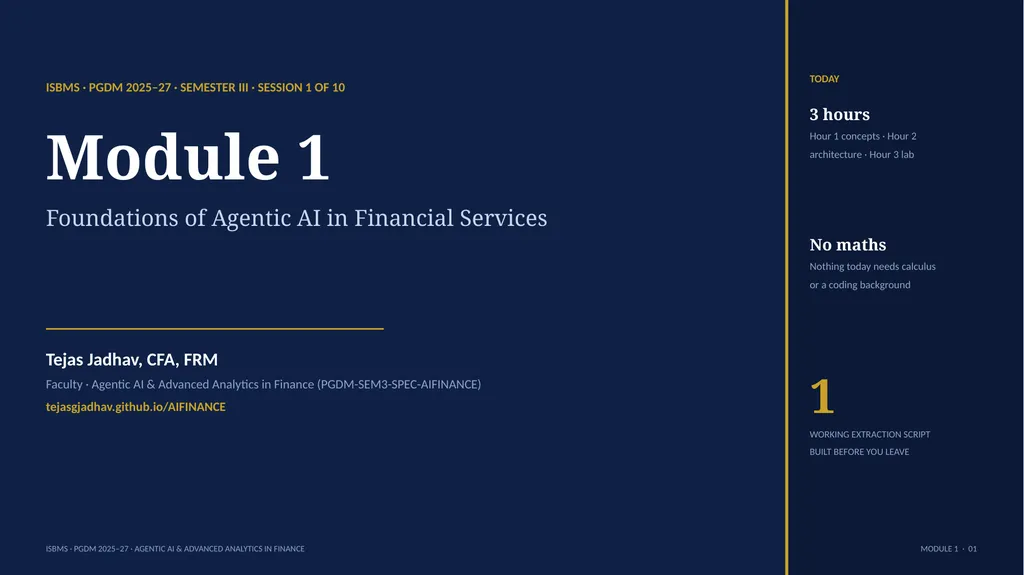
ISBMS PGDM 202527 SEMESTER III SESSION 1 OF 10 Module 1 Foundations of Agentic AI in Financial Services Tejas Jadhav, CFA, FRM Faculty Agentic AI Advanced Analytics in Finance (PGDM-SEM3-SPEC-AIFINANCE)
Related Topics
Share
Embed code
Download this presentation From Below
"ISBMS · PGDM 2025–27 · SEMESTER III · SESSION 1" is the property of its rightful owner. Permission is granted to download and print the materials on this website for personal, non-commercial use only, and to display it on your personal computer provided you do not modify the materials and that you retain all copyright notices contained in the materials. By downloading content from our website, you accept the terms of this agreement.
Presentation Transcript
01
ISBMS · PGDM 2025–27 · SEMESTER III · SESSION 1 OF 10 Module 1
Foundations of Agentic AI in Financial Services Tejas Jadhav, CFA, FRM
Faculty · Agentic AI & Advanced Analytics in Finance (PGDM-SEM3-SPEC-AIFINANCE)
tejasgjadhav.github.io/AIFINANCE TODAY 3 hours
Hour 1 concepts · Hour 2
architecture · Hour 3 lab No maths
Nothing today needs calculus
or a coding background 1
WORKING EXTRACTION SCRIPT
BUILT BEFORE YOU LEAVE ISBMS · PGDM 2025–27 · AGENTIC AI & ADVANCED ANALYTICS IN FINANCE MODULE 1 · 01<br>
Foundations of Agentic AI in Financial Services Tejas Jadhav, CFA, FRM
Faculty · Agentic AI & Advanced Analytics in Finance (PGDM-SEM3-SPEC-AIFINANCE)
tejasgjadhav.github.io/AIFINANCE TODAY 3 hours
Hour 1 concepts · Hour 2
architecture · Hour 3 lab No maths
Nothing today needs calculus
or a coding background 1
WORKING EXTRACTION SCRIPT
BUILT BEFORE YOU LEAVE ISBMS · PGDM 2025–27 · AGENTIC AI & ADVANCED ANALYTICS IN FINANCE MODULE 1 · 01<br>
02
THE PLAN What we do in these three hours HOUR 1 · 60 MIN
The machine ▪ AI, machine learning, deep learning, GenAI ▪ How an LLM works — tokens and attention ▪ Four eras of AI in finance ▪ Which model to use, and when ▪ The vocabulary you will hear all semester HOUR 2 · 60 MIN
The architecture ▪ Chatbot vs agent — answering vs doing ▪ The loop: Observe → Plan → Act → Reflect ▪ Tool definitions and function calling ▪ Agent memory: short-term, episodic, semantic ▪ Data sources: NSE, BSE, Yahoo Finance, RBI DBIE HOUR 3 · 60 MIN
The lab ▪ Python + the Codex ▪ Share price, revenue and the P&L from Python ▪ Extract a P&L from raw annual report text via Finance ▪ Codex as a Harness ▪ One working application, built in minutes Our goal for today: a prompt and a Python script that read a filing and return numbers you can check. You build it in Hour 3. ISBMS · PGDM 2025–27 · AGENTIC AI & ADVANCED ANALYTICS IN FINANCE MODULE 1 · 02<br>
The machine ▪ AI, machine learning, deep learning, GenAI ▪ How an LLM works — tokens and attention ▪ Four eras of AI in finance ▪ Which model to use, and when ▪ The vocabulary you will hear all semester HOUR 2 · 60 MIN
The architecture ▪ Chatbot vs agent — answering vs doing ▪ The loop: Observe → Plan → Act → Reflect ▪ Tool definitions and function calling ▪ Agent memory: short-term, episodic, semantic ▪ Data sources: NSE, BSE, Yahoo Finance, RBI DBIE HOUR 3 · 60 MIN
The lab ▪ Python + the Codex ▪ Share price, revenue and the P&L from Python ▪ Extract a P&L from raw annual report text via Finance ▪ Codex as a Harness ▪ One working application, built in minutes Our goal for today: a prompt and a Python script that read a filing and return numbers you can check. You build it in Hour 3. ISBMS · PGDM 2025–27 · AGENTIC AI & ADVANCED ANALYTICS IN FINANCE MODULE 1 · 02<br>
03
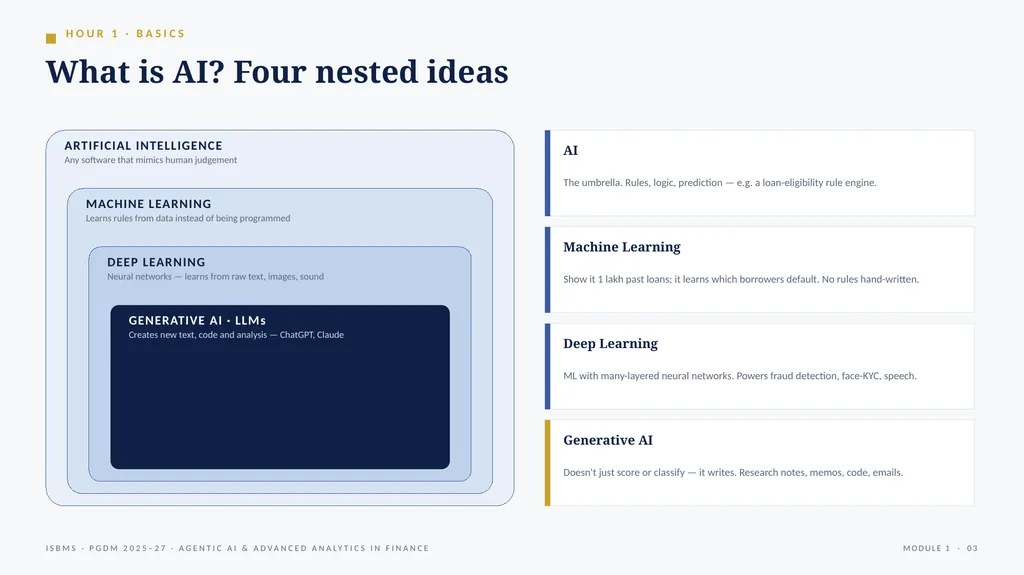
HOUR 1 · BASICS What is AI? Four nested ideas ARTIFICIAL INTELLIGENCE
Any software that mimics human judgement MACHINE LEARNING
Learns rules from data instead of being programmed DEEP LEARNING
Neural networks — learns from raw text, images, sound GENERATIVE AI · LLMs
Creates new text, code and analysis — ChatGPT, Claude AI The umbrella. Rules, logic, prediction — e.g. a loan-eligibility rule engine. Machine Learning Show it 1 lakh past loans; it learns which borrowers default. No rules hand-written. Deep Learning ML with many-layered neural networks. Powers fraud detection, face-KYC, speech. Generative AI Doesn't just score or classify — it writes. Research notes, memos, code, emails. ISBMS · PGDM 2025–27 · AGENTIC AI & ADVANCED ANALYTICS IN FINANCE MODULE 1 · 03<br>
Any software that mimics human judgement MACHINE LEARNING
Learns rules from data instead of being programmed DEEP LEARNING
Neural networks — learns from raw text, images, sound GENERATIVE AI · LLMs
Creates new text, code and analysis — ChatGPT, Claude AI The umbrella. Rules, logic, prediction — e.g. a loan-eligibility rule engine. Machine Learning Show it 1 lakh past loans; it learns which borrowers default. No rules hand-written. Deep Learning ML with many-layered neural networks. Powers fraud detection, face-KYC, speech. Generative AI Doesn't just score or classify — it writes. Research notes, memos, code, emails. ISBMS · PGDM 2025–27 · AGENTIC AI & ADVANCED ANALYTICS IN FINANCE MODULE 1 · 03<br>
04
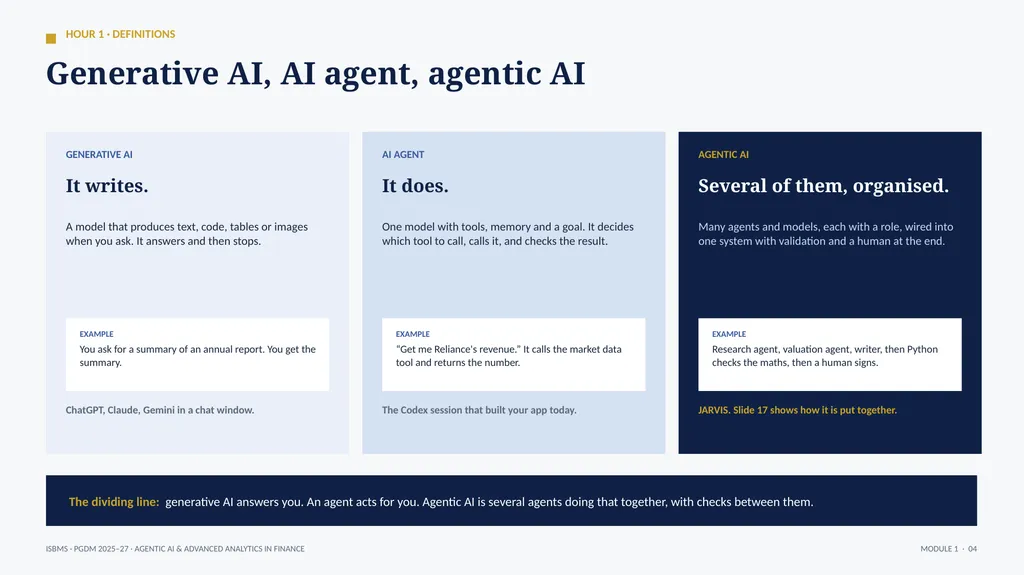
HOUR 1 · DEFINITIONS Generative AI, AI agent, agentic AI GENERATIVE AI It writes. A model that produces text, code, tables or images when you ask. It answers and then stops. EXAMPLE
You ask for a summary of an annual report. You get the summary. ChatGPT, Claude, Gemini in a chat window. AI AGENT It does. One model with tools, memory and a goal. It decides which tool to call, calls it, and checks the result. EXAMPLE
“Get me Reliance's revenue.” It calls the market data tool and returns the number. The Codex session that built your app today. AGENTIC AI Several of them, organised. Many agents and models, each with a role, wired into one system with validation and a human at the end. EXAMPLE
Research agent, valuation agent, writer, then Python checks the maths, then a human signs. JARVIS. Slide 17 shows how it is put together. The dividing line: generative AI answers you. An agent acts for you. Agentic AI is several agents doing that together, with checks between them. ISBMS · PGDM 2025–27 · AGENTIC AI & ADVANCED ANALYTICS IN FINANCE MODULE 1 · 04<br>
You ask for a summary of an annual report. You get the summary. ChatGPT, Claude, Gemini in a chat window. AI AGENT It does. One model with tools, memory and a goal. It decides which tool to call, calls it, and checks the result. EXAMPLE
“Get me Reliance's revenue.” It calls the market data tool and returns the number. The Codex session that built your app today. AGENTIC AI Several of them, organised. Many agents and models, each with a role, wired into one system with validation and a human at the end. EXAMPLE
Research agent, valuation agent, writer, then Python checks the maths, then a human signs. JARVIS. Slide 17 shows how it is put together. The dividing line: generative AI answers you. An agent acts for you. Agentic AI is several agents doing that together, with checks between them. ISBMS · PGDM 2025–27 · AGENTIC AI & ADVANCED ANALYTICS IN FINANCE MODULE 1 · 04<br>
05
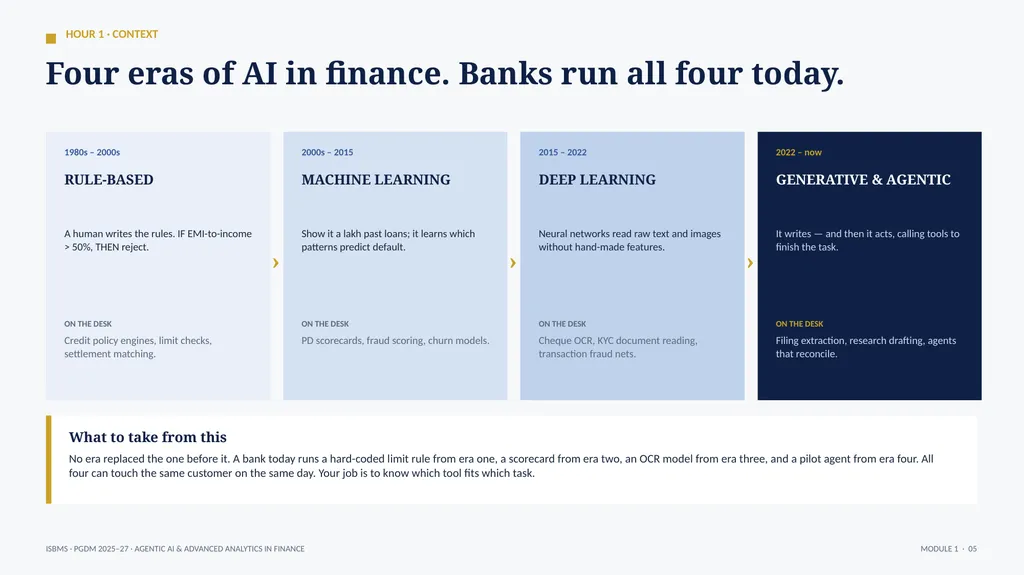
HOUR 1 · CONTEXT Four eras of AI in finance. Banks run all four today. 1980s – 2000s RULE-BASED A human writes the rules. IF EMI-to-income > 50%, THEN reject. ON THE DESK
Credit policy engines, limit checks, settlement matching. › 2000s – 2015 MACHINE LEARNING Show it a lakh past loans; it learns which patterns predict default. ON THE DESK
PD scorecards, fraud scoring, churn models. › 2015 – 2022 DEEP LEARNING Neural networks read raw text and images without hand-made features. ON THE DESK
Cheque OCR, KYC document reading, transaction fraud nets. › 2022 – now GENERATIVE & AGENTIC It writes — and then it acts, calling tools to finish the task. ON THE DESK
Filing extraction, research drafting, agents that reconcile. What to take from this
No era replaced the one before it. A bank today runs a hard-coded limit rule from era one, a scorecard from era two, an OCR model from era three, and a pilot agent from era four. All four can touch the same customer on the same day. Your job is to know which tool fits which task. ISBMS · PGDM 2025–27 · AGENTIC AI & ADVANCED ANALYTICS IN FINANCE MODULE 1 · 05<br>
Credit policy engines, limit checks, settlement matching. › 2000s – 2015 MACHINE LEARNING Show it a lakh past loans; it learns which patterns predict default. ON THE DESK
PD scorecards, fraud scoring, churn models. › 2015 – 2022 DEEP LEARNING Neural networks read raw text and images without hand-made features. ON THE DESK
Cheque OCR, KYC document reading, transaction fraud nets. › 2022 – now GENERATIVE & AGENTIC It writes — and then it acts, calling tools to finish the task. ON THE DESK
Filing extraction, research drafting, agents that reconcile. What to take from this
No era replaced the one before it. A bank today runs a hard-coded limit rule from era one, a scorecard from era two, an OCR model from era three, and a pilot agent from era four. All four can touch the same customer on the same day. Your job is to know which tool fits which task. ISBMS · PGDM 2025–27 · AGENTIC AI & ADVANCED ANALYTICS IN FINANCE MODULE 1 · 05<br>
06
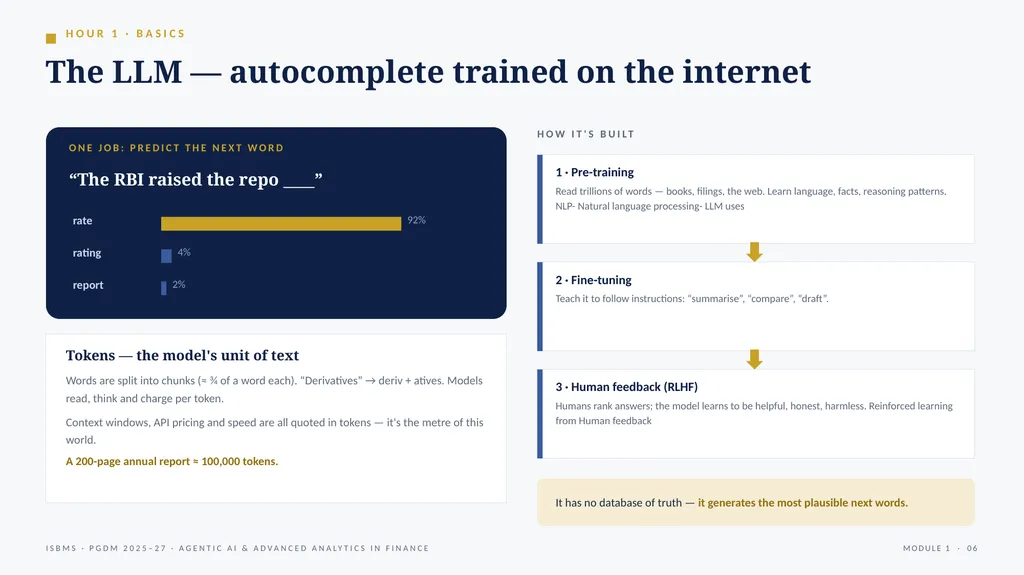
HOUR 1 · BASICS The LLM — autocomplete trained on the internet ONE JOB: PREDICT THE NEXT WORD “The RBI raised the repo ____” rate 92% rating 4% report 2% Tokens — the model's unit of text
Words are split into chunks (≈ ¾ of a word each). “Derivatives” → deriv + atives. Models read, think and charge per token.
Context windows, API pricing and speed are all quoted in tokens — it's the metre of this world.
A 200-page annual report ≈ 100,000 tokens. HOW IT'S BUILT 1 · Pre-training
Read trillions of words — books, filings, the web. Learn language, facts, reasoning patterns. NLP- Natural language processing- LLM uses 2 · Fine-tuning
Teach it to follow instructions: “summarise”, “compare”, “draft”. 3 · Human feedback (RLHF)
Humans rank answers; the model learns to be helpful, honest, harmless. Reinforced learning from Human feedback It has no database of truth — it generates the most plausible next words. ISBMS · PGDM 2025–27 · AGENTIC AI & ADVANCED ANALYTICS IN FINANCE MODULE 1 · 06<br>
Words are split into chunks (≈ ¾ of a word each). “Derivatives” → deriv + atives. Models read, think and charge per token.
Context windows, API pricing and speed are all quoted in tokens — it's the metre of this world.
A 200-page annual report ≈ 100,000 tokens. HOW IT'S BUILT 1 · Pre-training
Read trillions of words — books, filings, the web. Learn language, facts, reasoning patterns. NLP- Natural language processing- LLM uses 2 · Fine-tuning
Teach it to follow instructions: “summarise”, “compare”, “draft”. 3 · Human feedback (RLHF)
Humans rank answers; the model learns to be helpful, honest, harmless. Reinforced learning from Human feedback It has no database of truth — it generates the most plausible next words. ISBMS · PGDM 2025–27 · AGENTIC AI & ADVANCED ANALYTICS IN FINANCE MODULE 1 · 06<br>
07
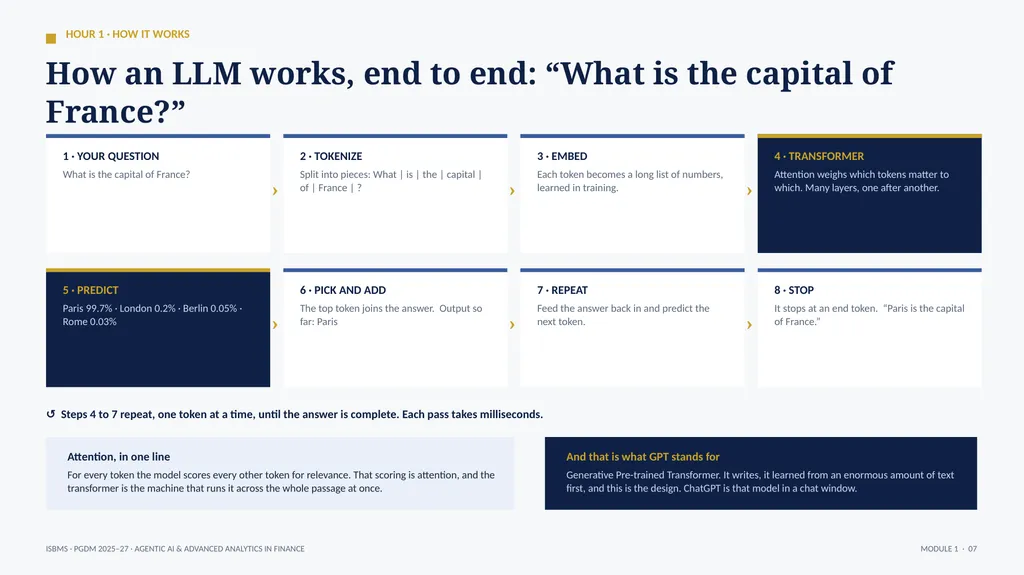
HOUR 1 · HOW IT WORKS How an LLM works, end to end: “What is the capital of France?” 1 · YOUR QUESTION
What is the capital of France? › 2 · TOKENIZE
Split into pieces: What | is | the | capital | of | France | ? › 3 · EMBED
Each token becomes a long list of numbers, learned in training. › 4 · TRANSFORMER
Attention weighs which tokens matter to which. Many layers, one after another. 5 · PREDICT
Paris 99.7% · London 0.2% · Berlin 0.05% · Rome 0.03% › 6 · PICK AND ADD
The top token joins the answer. Output so far: Paris › 7 · REPEAT
Feed the answer back in and predict the next token. › 8 · STOP
It stops at an end token. “Paris is the capital of France.” ↺ Steps 4 to 7 repeat, one token at a time, until the answer is complete. Each pass takes milliseconds. Attention, in one line
For every token the model scores every other token for relevance. That scoring is attention, and the transformer is the machine that runs it across the whole passage at once. And that is what GPT stands for
Generative Pre-trained Transformer. It writes, it learned from an enormous amount of text first, and this is the design. ChatGPT is that model in a chat window. ISBMS · PGDM 2025–27 · AGENTIC AI & ADVANCED ANALYTICS IN FINANCE MODULE 1 · 07<br>
What is the capital of France? › 2 · TOKENIZE
Split into pieces: What | is | the | capital | of | France | ? › 3 · EMBED
Each token becomes a long list of numbers, learned in training. › 4 · TRANSFORMER
Attention weighs which tokens matter to which. Many layers, one after another. 5 · PREDICT
Paris 99.7% · London 0.2% · Berlin 0.05% · Rome 0.03% › 6 · PICK AND ADD
The top token joins the answer. Output so far: Paris › 7 · REPEAT
Feed the answer back in and predict the next token. › 8 · STOP
It stops at an end token. “Paris is the capital of France.” ↺ Steps 4 to 7 repeat, one token at a time, until the answer is complete. Each pass takes milliseconds. Attention, in one line
For every token the model scores every other token for relevance. That scoring is attention, and the transformer is the machine that runs it across the whole passage at once. And that is what GPT stands for
Generative Pre-trained Transformer. It writes, it learned from an enormous amount of text first, and this is the design. ChatGPT is that model in a chat window. ISBMS · PGDM 2025–27 · AGENTIC AI & ADVANCED ANALYTICS IN FINANCE MODULE 1 · 07<br>
08
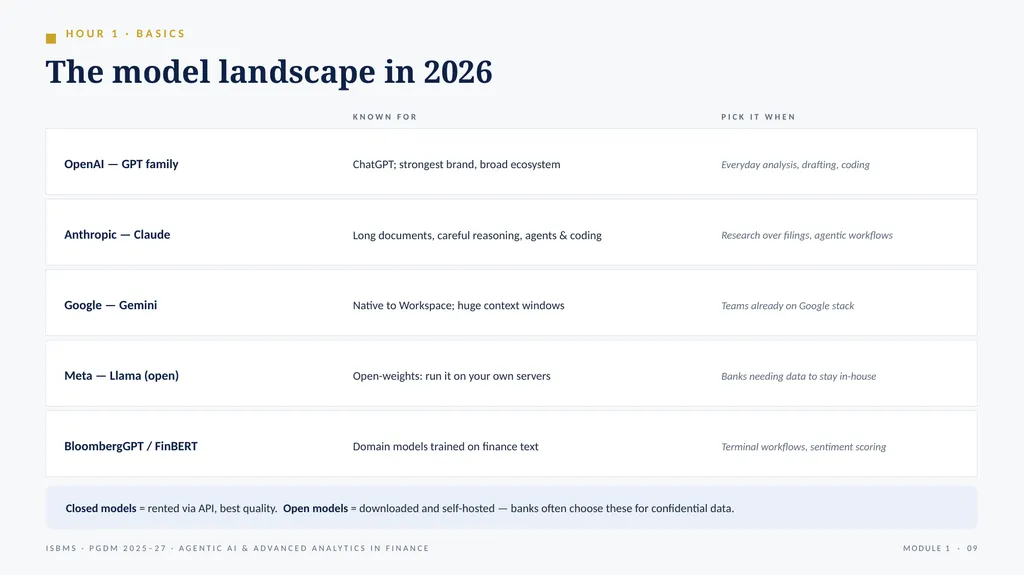
HOUR 1 · BASICS The model landscape in 2026 OpenAI — GPT family ChatGPT; strongest brand, broad ecosystem Everyday analysis, drafting, coding Anthropic — Claude Long documents, careful reasoning, agents & coding Research over filings, agentic workflows Google — Gemini Native to Workspace; huge context windows Teams already on Google stack Meta — Llama (open) Open-weights: run it on your own servers Banks needing data to stay in-house BloombergGPT / FinBERT Domain models trained on finance text Terminal workflows, sentiment scoring KNOWN FOR PICK IT WHEN Closed models = rented via API, best quality. Open models = downloaded and self-hosted — banks often choose these for confidential data. ISBMS · PGDM 2025–27 · AGENTIC AI & ADVANCED ANALYTICS IN FINANCE MODULE 1 · 09<br>
09
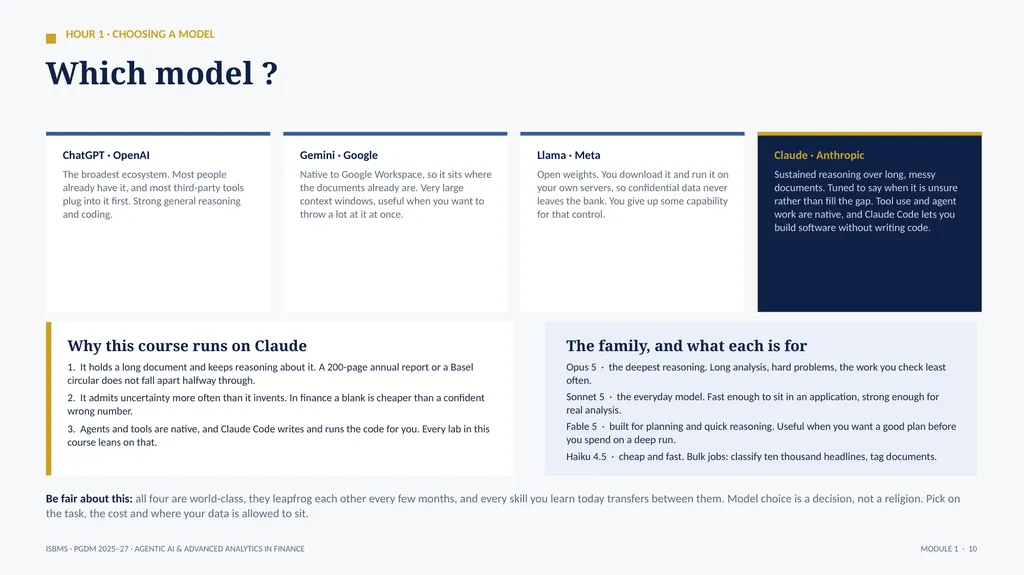
HOUR 1 · CHOOSING A MODEL Which model ? ChatGPT · OpenAI
The broadest ecosystem. Most people already have it, and most third-party tools plug into it first. Strong general reasoning and coding. Gemini · Google
Native to Google Workspace, so it sits where the documents already are. Very large context windows, useful when you want to throw a lot at it at once. Llama · Meta
Open weights. You download it and run it on your own servers, so confidential data never leaves the bank. You give up some capability for that control. Claude · Anthropic
Sustained reasoning over long, messy documents. Tuned to say when it is unsure rather than fill the gap. Tool use and agent work are native, and Claude Code lets you build software without writing code. Why this course runs on Claude
1. It holds a long document and keeps reasoning about it. A 200-page annual report or a Basel circular does not fall apart halfway through.
2. It admits uncertainty more often than it invents. In finance a blank is cheaper than a confident wrong number.
3. Agents and tools are native, and Claude Code writes and runs the code for you. Every lab in this course leans on that. The family, and what each is for
Opus 5 · the deepest reasoning. Long analysis, hard problems, the work you check least often.
Sonnet 5 · the everyday model. Fast enough to sit in an application, strong enough for real analysis.
Fable 5 · built for planning and quick reasoning. Useful when you want a good plan before you spend on a deep run.
Haiku 4.5 · cheap and fast. Bulk jobs: classify ten thousand headlines, tag documents. Be fair about this: all four are world-class, they leapfrog each other every few months, and every skill you learn today transfers between them. Model choice is a decision, not a religion. Pick on the task, the cost and where your data is allowed to sit. ISBMS · PGDM 2025–27 · AGENTIC AI & ADVANCED ANALYTICS IN FINANCE MODULE 1 · 10<br>
The broadest ecosystem. Most people already have it, and most third-party tools plug into it first. Strong general reasoning and coding. Gemini · Google
Native to Google Workspace, so it sits where the documents already are. Very large context windows, useful when you want to throw a lot at it at once. Llama · Meta
Open weights. You download it and run it on your own servers, so confidential data never leaves the bank. You give up some capability for that control. Claude · Anthropic
Sustained reasoning over long, messy documents. Tuned to say when it is unsure rather than fill the gap. Tool use and agent work are native, and Claude Code lets you build software without writing code. Why this course runs on Claude
1. It holds a long document and keeps reasoning about it. A 200-page annual report or a Basel circular does not fall apart halfway through.
2. It admits uncertainty more often than it invents. In finance a blank is cheaper than a confident wrong number.
3. Agents and tools are native, and Claude Code writes and runs the code for you. Every lab in this course leans on that. The family, and what each is for
Opus 5 · the deepest reasoning. Long analysis, hard problems, the work you check least often.
Sonnet 5 · the everyday model. Fast enough to sit in an application, strong enough for real analysis.
Fable 5 · built for planning and quick reasoning. Useful when you want a good plan before you spend on a deep run.
Haiku 4.5 · cheap and fast. Bulk jobs: classify ten thousand headlines, tag documents. Be fair about this: all four are world-class, they leapfrog each other every few months, and every skill you learn today transfers between them. Model choice is a decision, not a religion. Pick on the task, the cost and where your data is allowed to sit. ISBMS · PGDM 2025–27 · AGENTIC AI & ADVANCED ANALYTICS IN FINANCE MODULE 1 · 10<br>
10
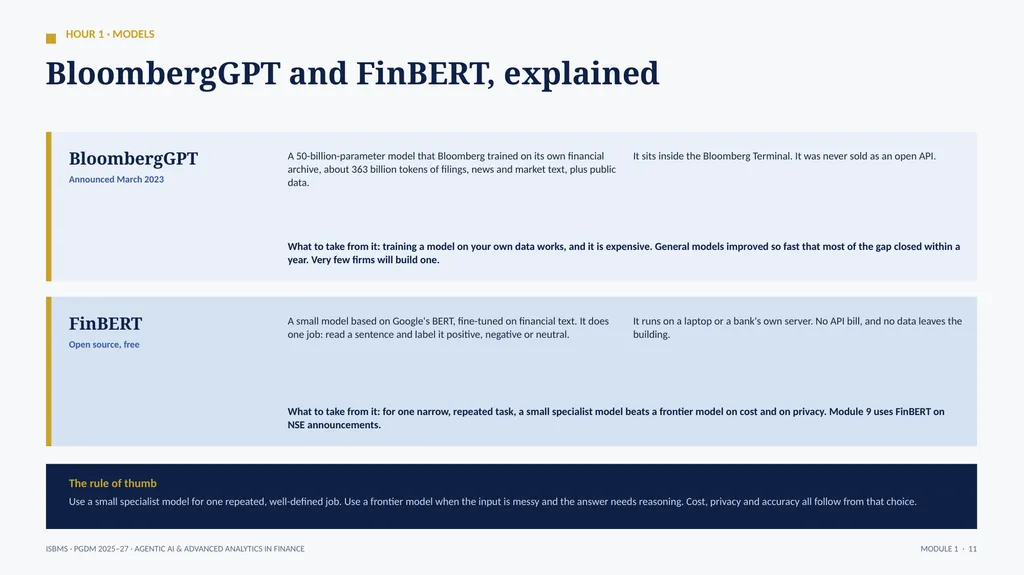
HOUR 1 · MODELS BloombergGPT and FinBERT, explained BloombergGPT
Announced March 2023 A 50-billion-parameter model that Bloomberg trained on its own financial archive, about 363 billion tokens of filings, news and market text, plus public data. It sits inside the Bloomberg Terminal. It was never sold as an open API. What to take from it: training a model on your own data works, and it is expensive. General models improved so fast that most of the gap closed within a year. Very few firms will build one. FinBERT
Open source, free A small model based on Google's BERT, fine-tuned on financial text. It does one job: read a sentence and label it positive, negative or neutral. It runs on a laptop or a bank's own server. No API bill, and no data leaves the building. What to take from it: for one narrow, repeated task, a small specialist model beats a frontier model on cost and on privacy. Module 9 uses FinBERT on NSE announcements. The rule of thumb
Use a small specialist model for one repeated, well-defined job. Use a frontier model when the input is messy and the answer needs reasoning. Cost, privacy and accuracy all follow from that choice. ISBMS · PGDM 2025–27 · AGENTIC AI & ADVANCED ANALYTICS IN FINANCE MODULE 1 · 11<br>
Announced March 2023 A 50-billion-parameter model that Bloomberg trained on its own financial archive, about 363 billion tokens of filings, news and market text, plus public data. It sits inside the Bloomberg Terminal. It was never sold as an open API. What to take from it: training a model on your own data works, and it is expensive. General models improved so fast that most of the gap closed within a year. Very few firms will build one. FinBERT
Open source, free A small model based on Google's BERT, fine-tuned on financial text. It does one job: read a sentence and label it positive, negative or neutral. It runs on a laptop or a bank's own server. No API bill, and no data leaves the building. What to take from it: for one narrow, repeated task, a small specialist model beats a frontier model on cost and on privacy. Module 9 uses FinBERT on NSE announcements. The rule of thumb
Use a small specialist model for one repeated, well-defined job. Use a frontier model when the input is messy and the answer needs reasoning. Cost, privacy and accuracy all follow from that choice. ISBMS · PGDM 2025–27 · AGENTIC AI & ADVANCED ANALYTICS IN FINANCE MODULE 1 · 11<br>
11
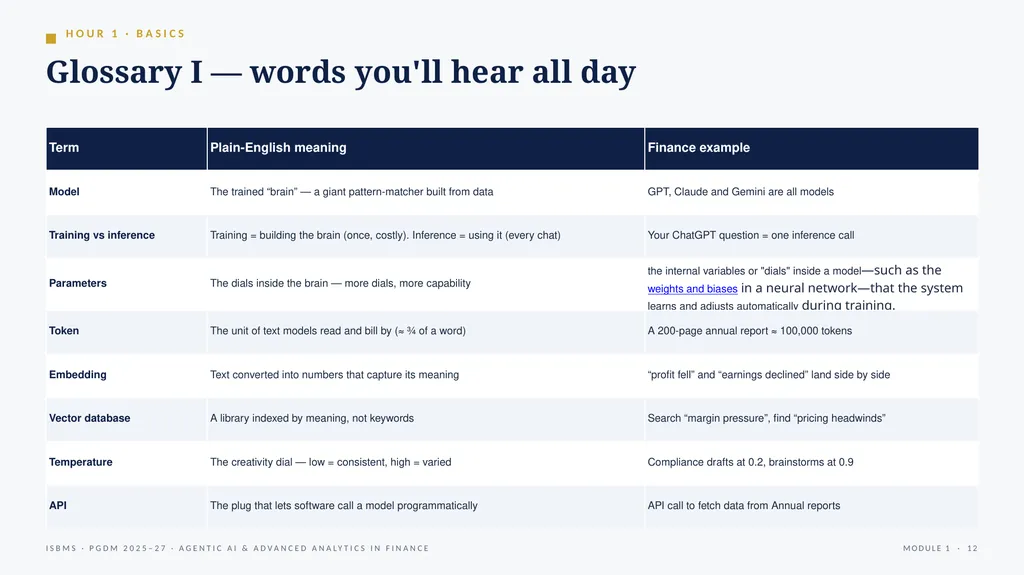
HOUR 1 · BASICS Glossary I — words you'll hear all day ISBMS · PGDM 2025–27 · AGENTIC AI & ADVANCED ANALYTICS IN FINANCE MODULE 1 · 12<br>
12
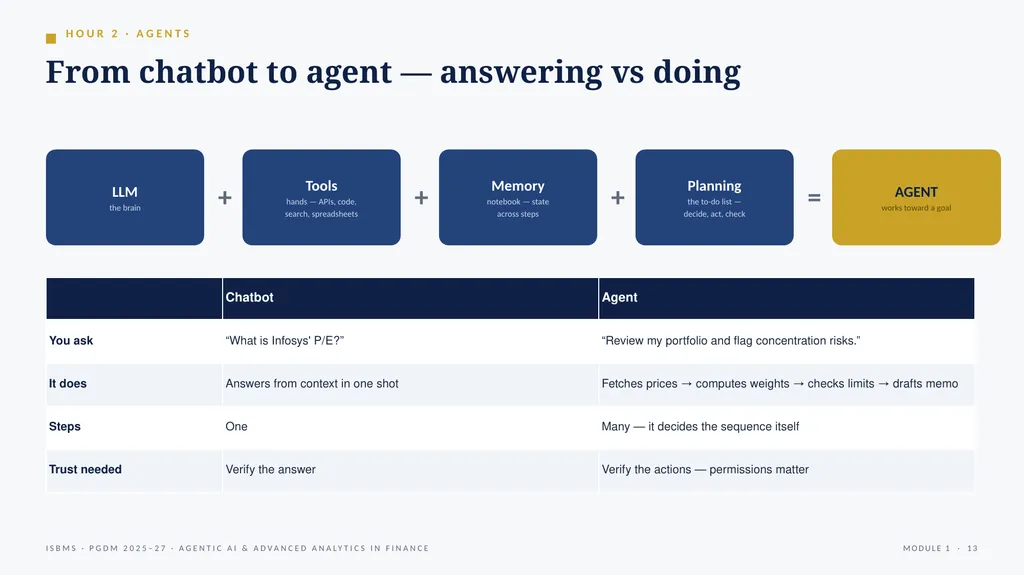
HOUR 2 · AGENTS From chatbot to agent — answering vs doing LLM
the brain + Tools
hands — APIs, code,
search, spreadsheets + Memory
notebook — state
across steps + Planning
the to-do list —
decide, act, check = AGENT
works toward a goal ISBMS · PGDM 2025–27 · AGENTIC AI & ADVANCED ANALYTICS IN FINANCE MODULE 1 · 13<br>
the brain + Tools
hands — APIs, code,
search, spreadsheets + Memory
notebook — state
across steps + Planning
the to-do list —
decide, act, check = AGENT
works toward a goal ISBMS · PGDM 2025–27 · AGENTIC AI & ADVANCED ANALYTICS IN FINANCE MODULE 1 · 13<br>
13
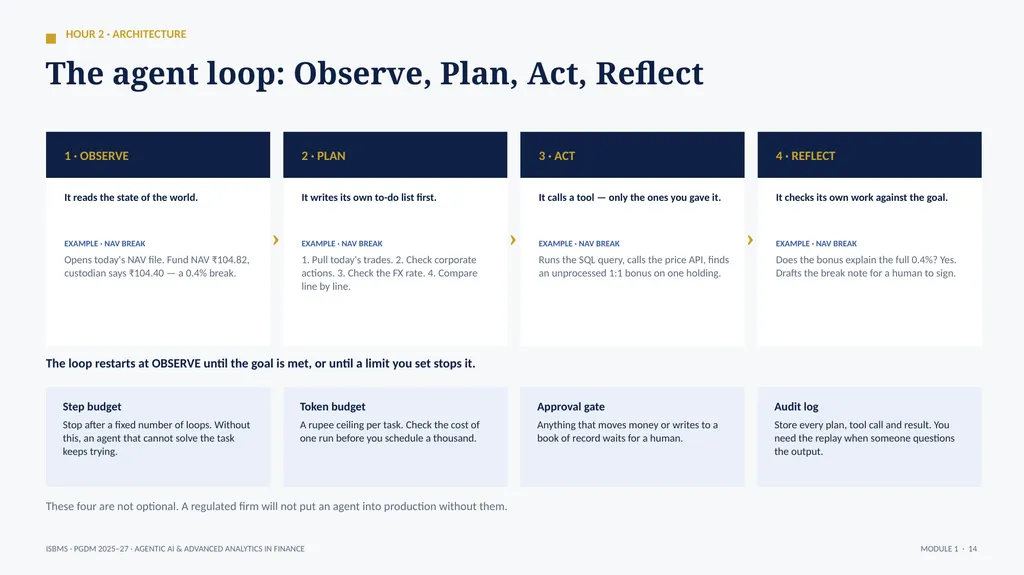
HOUR 2 · ARCHITECTURE The agent loop: Observe, Plan, Act, Reflect 1 · OBSERVE It reads the state of the world. EXAMPLE · NAV BREAK
Opens today's NAV file. Fund NAV ₹104.82, custodian says ₹104.40 — a 0.4% break. › 2 · PLAN It writes its own to-do list first. EXAMPLE · NAV BREAK
1. Pull today's trades. 2. Check corporate actions. 3. Check the FX rate. 4. Compare line by line. › 3 · ACT It calls a tool — only the ones you gave it. EXAMPLE · NAV BREAK
Runs the SQL query, calls the price API, finds an unprocessed 1:1 bonus on one holding. › 4 · REFLECT It checks its own work against the goal. EXAMPLE · NAV BREAK
Does the bonus explain the full 0.4%? Yes. Drafts the break note for a human to sign. The loop restarts at OBSERVE until the goal is met, or until a limit you set stops it. Step budget
Stop after a fixed number of loops. Without this, an agent that cannot solve the task keeps trying. Token budget
A rupee ceiling per task. Check the cost of one run before you schedule a thousand. Approval gate
Anything that moves money or writes to a book of record waits for a human. Audit log
Store every plan, tool call and result. You need the replay when someone questions the output. These four are not optional. A regulated firm will not put an agent into production without them. ISBMS · PGDM 2025–27 · AGENTIC AI & ADVANCED ANALYTICS IN FINANCE MODULE 1 · 14<br>
Opens today's NAV file. Fund NAV ₹104.82, custodian says ₹104.40 — a 0.4% break. › 2 · PLAN It writes its own to-do list first. EXAMPLE · NAV BREAK
1. Pull today's trades. 2. Check corporate actions. 3. Check the FX rate. 4. Compare line by line. › 3 · ACT It calls a tool — only the ones you gave it. EXAMPLE · NAV BREAK
Runs the SQL query, calls the price API, finds an unprocessed 1:1 bonus on one holding. › 4 · REFLECT It checks its own work against the goal. EXAMPLE · NAV BREAK
Does the bonus explain the full 0.4%? Yes. Drafts the break note for a human to sign. The loop restarts at OBSERVE until the goal is met, or until a limit you set stops it. Step budget
Stop after a fixed number of loops. Without this, an agent that cannot solve the task keeps trying. Token budget
A rupee ceiling per task. Check the cost of one run before you schedule a thousand. Approval gate
Anything that moves money or writes to a book of record waits for a human. Audit log
Store every plan, tool call and result. You need the replay when someone questions the output. These four are not optional. A regulated firm will not put an agent into production without them. ISBMS · PGDM 2025–27 · AGENTIC AI & ADVANCED ANALYTICS IN FINANCE MODULE 1 · 14<br>
14
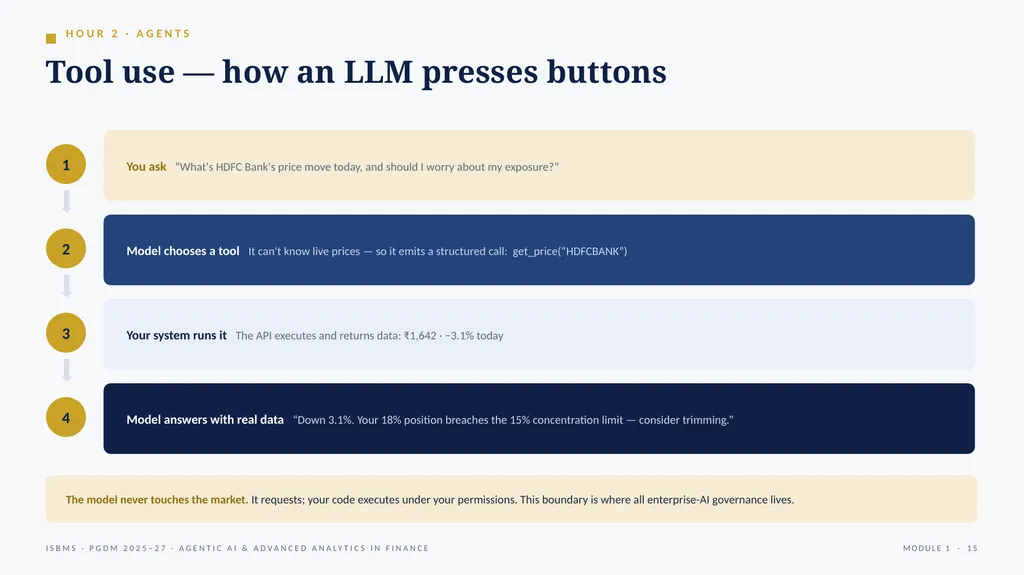
HOUR 2 · AGENTS Tool use — how an LLM presses buttons 1 You ask “What's HDFC Bank's price move today, and should I worry about my exposure?” 2 Model chooses a tool It can't know live prices — so it emits a structured call: get_price(“HDFCBANK”) 3 Your system runs it The API executes and returns data: ₹1,642 · −3.1% today 4 Model answers with real data “Down 3.1%. Your 18% position breaches the 15% concentration limit — consider trimming.” The model never touches the market. It requests; your code executes under your permissions. This boundary is where all enterprise-AI governance lives. ISBMS · PGDM 2025–27 · AGENTIC AI & ADVANCED ANALYTICS IN FINANCE MODULE 1 · 15<br>
15
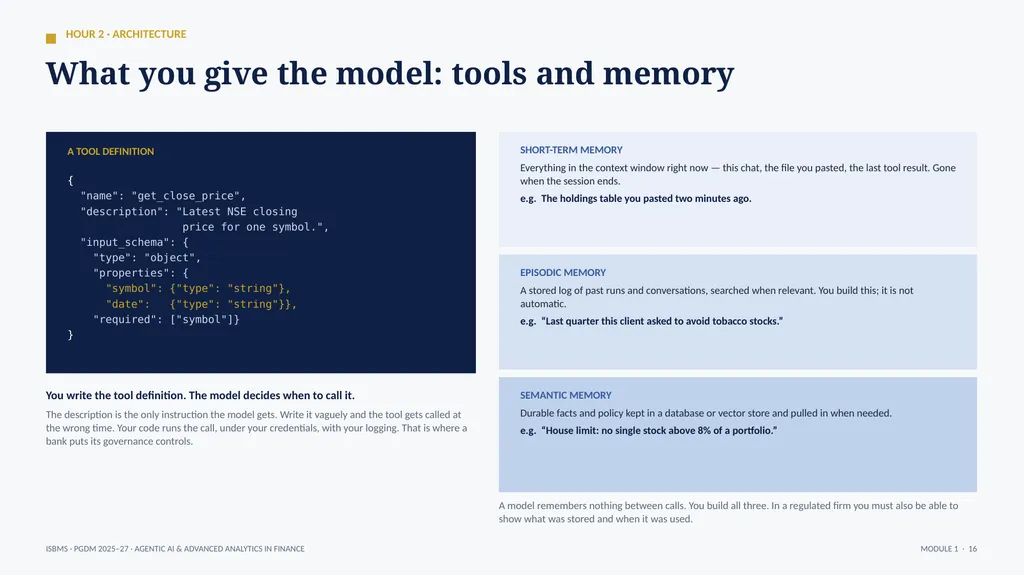
HOUR 2 · ARCHITECTURE What you give the model: tools and memory A TOOL DEFINITION {
"name": "get_close_price",
"description": "Latest NSE closing
price for one symbol.",
"input_schema": {
"type": "object",
"properties": {
"symbol": {"type": "string"},
"date": {"type": "string"}},
"required": ["symbol"]}
} You write the tool definition. The model decides when to call it.
The description is the only instruction the model gets. Write it vaguely and the tool gets called at the wrong time. Your code runs the call, under your credentials, with your logging. That is where a bank puts its governance controls. SHORT-TERM MEMORY
Everything in the context window right now — this chat, the file you pasted, the last tool result. Gone when the session ends.
e.g. The holdings table you pasted two minutes ago. EPISODIC MEMORY
A stored log of past runs and conversations, searched when relevant. You build this; it is not automatic.
e.g. “Last quarter this client asked to avoid tobacco stocks.” SEMANTIC MEMORY
Durable facts and policy kept in a database or vector store and pulled in when needed.
e.g. “House limit: no single stock above 8% of a portfolio.” A model remembers nothing between calls. You build all three. In a regulated firm you must also be able to show what was stored and when it was used. ISBMS · PGDM 2025–27 · AGENTIC AI & ADVANCED ANALYTICS IN FINANCE MODULE 1 · 16<br>
"name": "get_close_price",
"description": "Latest NSE closing
price for one symbol.",
"input_schema": {
"type": "object",
"properties": {
"symbol": {"type": "string"},
"date": {"type": "string"}},
"required": ["symbol"]}
} You write the tool definition. The model decides when to call it.
The description is the only instruction the model gets. Write it vaguely and the tool gets called at the wrong time. Your code runs the call, under your credentials, with your logging. That is where a bank puts its governance controls. SHORT-TERM MEMORY
Everything in the context window right now — this chat, the file you pasted, the last tool result. Gone when the session ends.
e.g. The holdings table you pasted two minutes ago. EPISODIC MEMORY
A stored log of past runs and conversations, searched when relevant. You build this; it is not automatic.
e.g. “Last quarter this client asked to avoid tobacco stocks.” SEMANTIC MEMORY
Durable facts and policy kept in a database or vector store and pulled in when needed.
e.g. “House limit: no single stock above 8% of a portfolio.” A model remembers nothing between calls. You build all three. In a regulated firm you must also be able to show what was stored and when it was used. ISBMS · PGDM 2025–27 · AGENTIC AI & ADVANCED ANALYTICS IN FINANCE MODULE 1 · 16<br>
16
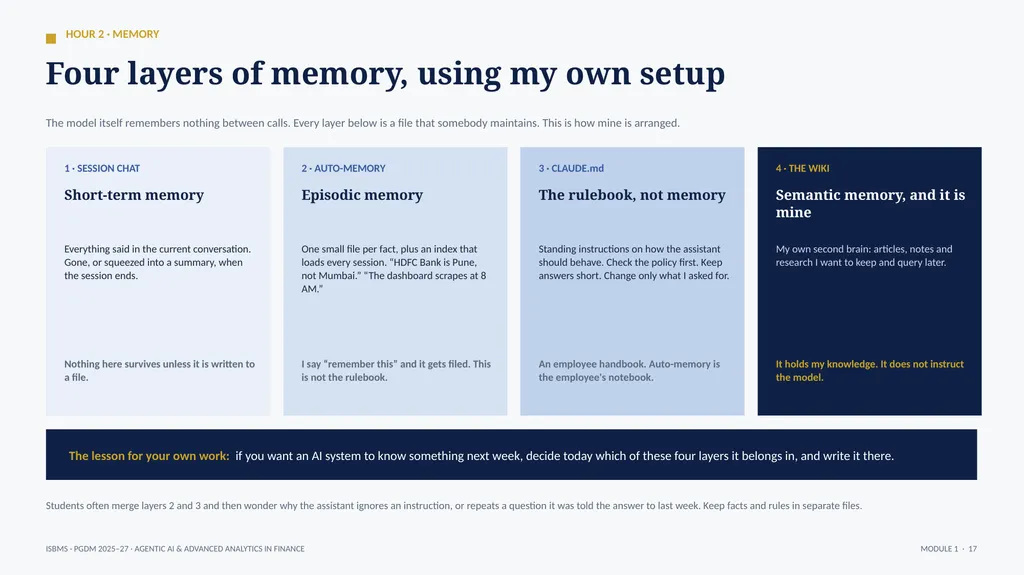
HOUR 2 · MEMORY Four layers of memory, using my own setup The model itself remembers nothing between calls. Every layer below is a file that somebody maintains. This is how mine is arranged. 1 · SESSION CHAT Short-term memory Everything said in the current conversation. Gone, or squeezed into a summary, when the session ends. Nothing here survives unless it is written to a file. 2 · AUTO-MEMORY Episodic memory One small file per fact, plus an index that loads every session. “HDFC Bank is Pune, not Mumbai.” “The dashboard scrapes at 8 AM.” I say “remember this” and it gets filed. This is not the rulebook. 3 · CLAUDE.md The rulebook, not memory Standing instructions on how the assistant should behave. Check the policy first. Keep answers short. Change only what I asked for. An employee handbook. Auto-memory is the employee's notebook. 4 · THE WIKI Semantic memory, and it is mine My own second brain: articles, notes and research I want to keep and query later. It holds my knowledge. It does not instruct the model. The lesson for your own work: if you want an AI system to know something next week, decide today which of these four layers it belongs in, and write it there. Students often merge layers 2 and 3 and then wonder why the assistant ignores an instruction, or repeats a question it was told the answer to last week. Keep facts and rules in separate files. ISBMS · PGDM 2025–27 · AGENTIC AI & ADVANCED ANALYTICS IN FINANCE MODULE 1 · 17<br>
17
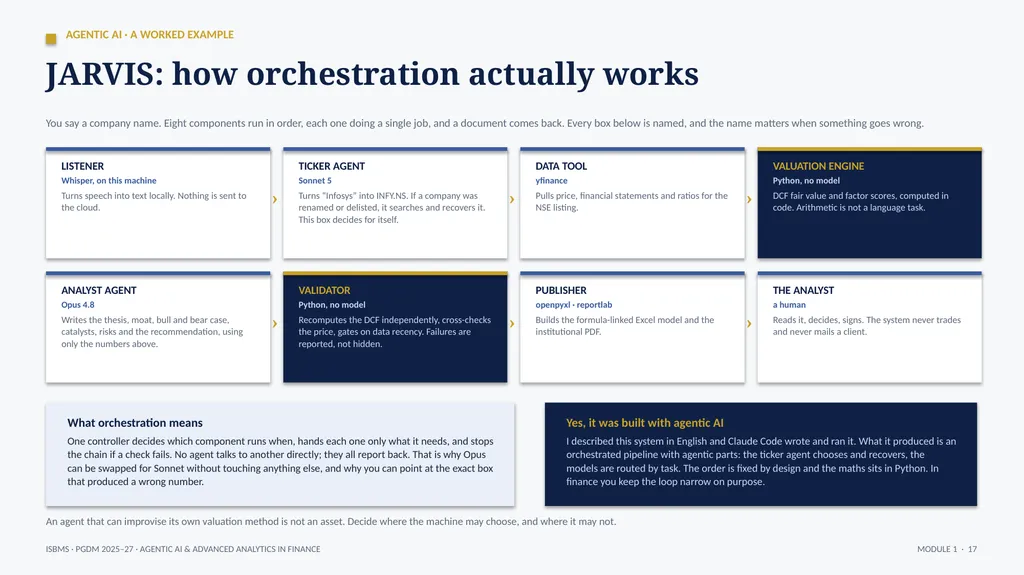
AGENTIC AI · A WORKED EXAMPLE JARVIS: how orchestration actually works You say a company name. Eight components run in order, each one doing a single job, and a document comes back. Every box below is named, and the name matters when something goes wrong. LISTENER
Whisper, on this machine
Turns speech into text locally. Nothing is sent to the cloud. › TICKER AGENT
Sonnet 5
Turns “Infosys” into INFY.NS. If a company was renamed or delisted, it searches and recovers it. This box decides for itself. › DATA TOOL
yfinance
Pulls price, financial statements and ratios for the NSE listing. › VALUATION ENGINE
Python, no model
DCF fair value and factor scores, computed in code. Arithmetic is not a language task. ANALYST AGENT
Opus 4.8
Writes the thesis, moat, bull and bear case, catalysts, risks and the recommendation, using only the numbers above. › VALIDATOR
Python, no model
Recomputes the DCF independently, cross-checks the price, gates on data recency. Failures are reported, not hidden. › PUBLISHER
openpyxl · reportlab
Builds the formula-linked Excel model and the institutional PDF. › THE ANALYST
a human
Reads it, decides, signs. The system never trades and never mails a client. What orchestration means
One controller decides which component runs when, hands each one only what it needs, and stops the chain if a check fails. No agent talks to another directly; they all report back. That is why Opus can be swapped for Sonnet without touching anything else, and why you can point at the exact box that produced a wrong number. Yes, it was built with agentic AI
I described this system in English and Claude Code wrote and ran it. What it produced is an orchestrated pipeline with agentic parts: the ticker agent chooses and recovers, the models are routed by task. The order is fixed by design and the maths sits in Python. In finance you keep the loop narrow on purpose. An agent that can improvise its own valuation method is not an asset. Decide where the machine may choose, and where it may not. ISBMS · PGDM 2025–27 · AGENTIC AI & ADVANCED ANALYTICS IN FINANCE MODULE 1 · 17<br>
Whisper, on this machine
Turns speech into text locally. Nothing is sent to the cloud. › TICKER AGENT
Sonnet 5
Turns “Infosys” into INFY.NS. If a company was renamed or delisted, it searches and recovers it. This box decides for itself. › DATA TOOL
yfinance
Pulls price, financial statements and ratios for the NSE listing. › VALUATION ENGINE
Python, no model
DCF fair value and factor scores, computed in code. Arithmetic is not a language task. ANALYST AGENT
Opus 4.8
Writes the thesis, moat, bull and bear case, catalysts, risks and the recommendation, using only the numbers above. › VALIDATOR
Python, no model
Recomputes the DCF independently, cross-checks the price, gates on data recency. Failures are reported, not hidden. › PUBLISHER
openpyxl · reportlab
Builds the formula-linked Excel model and the institutional PDF. › THE ANALYST
a human
Reads it, decides, signs. The system never trades and never mails a client. What orchestration means
One controller decides which component runs when, hands each one only what it needs, and stops the chain if a check fails. No agent talks to another directly; they all report back. That is why Opus can be swapped for Sonnet without touching anything else, and why you can point at the exact box that produced a wrong number. Yes, it was built with agentic AI
I described this system in English and Claude Code wrote and ran it. What it produced is an orchestrated pipeline with agentic parts: the ticker agent chooses and recovers, the models are routed by task. The order is fixed by design and the maths sits in Python. In finance you keep the loop narrow on purpose. An agent that can improvise its own valuation method is not an asset. Decide where the machine may choose, and where it may not. ISBMS · PGDM 2025–27 · AGENTIC AI & ADVANCED ANALYTICS IN FINANCE MODULE 1 · 17<br>
18
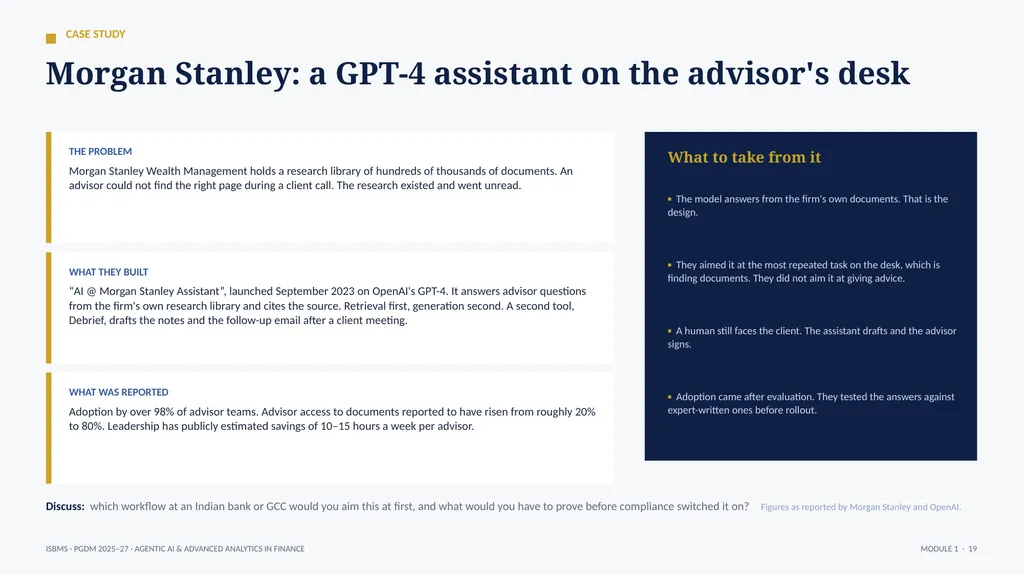
CASE STUDY Morgan Stanley: a GPT-4 assistant on the advisor's desk THE PROBLEM
Morgan Stanley Wealth Management holds a research library of hundreds of thousands of documents. An advisor could not find the right page during a client call. The research existed and went unread. WHAT THEY BUILT
“AI @ Morgan Stanley Assistant”, launched September 2023 on OpenAI's GPT-4. It answers advisor questions from the firm's own research library and cites the source. Retrieval first, generation second. A second tool, Debrief, drafts the notes and the follow-up email after a client meeting. WHAT WAS REPORTED
Adoption by over 98% of advisor teams. Advisor access to documents reported to have risen from roughly 20% to 80%. Leadership has publicly estimated savings of 10–15 hours a week per advisor. What to take from it ▪ The model answers from the firm's own documents. That is the design. ▪ They aimed it at the most repeated task on the desk, which is finding documents. They did not aim it at giving advice. ▪ A human still faces the client. The assistant drafts and the advisor signs. ▪ Adoption came after evaluation. They tested the answers against expert-written ones before rollout. Discuss: which workflow at an Indian bank or GCC would you aim this at first, and what would you have to prove before compliance switched it on? Figures as reported by Morgan Stanley and OpenAI. ISBMS · PGDM 2025–27 · AGENTIC AI & ADVANCED ANALYTICS IN FINANCE MODULE 1 · 19<br>
Morgan Stanley Wealth Management holds a research library of hundreds of thousands of documents. An advisor could not find the right page during a client call. The research existed and went unread. WHAT THEY BUILT
“AI @ Morgan Stanley Assistant”, launched September 2023 on OpenAI's GPT-4. It answers advisor questions from the firm's own research library and cites the source. Retrieval first, generation second. A second tool, Debrief, drafts the notes and the follow-up email after a client meeting. WHAT WAS REPORTED
Adoption by over 98% of advisor teams. Advisor access to documents reported to have risen from roughly 20% to 80%. Leadership has publicly estimated savings of 10–15 hours a week per advisor. What to take from it ▪ The model answers from the firm's own documents. That is the design. ▪ They aimed it at the most repeated task on the desk, which is finding documents. They did not aim it at giving advice. ▪ A human still faces the client. The assistant drafts and the advisor signs. ▪ Adoption came after evaluation. They tested the answers against expert-written ones before rollout. Discuss: which workflow at an Indian bank or GCC would you aim this at first, and what would you have to prove before compliance switched it on? Figures as reported by Morgan Stanley and OpenAI. ISBMS · PGDM 2025–27 · AGENTIC AI & ADVANCED ANALYTICS IN FINANCE MODULE 1 · 19<br>
19
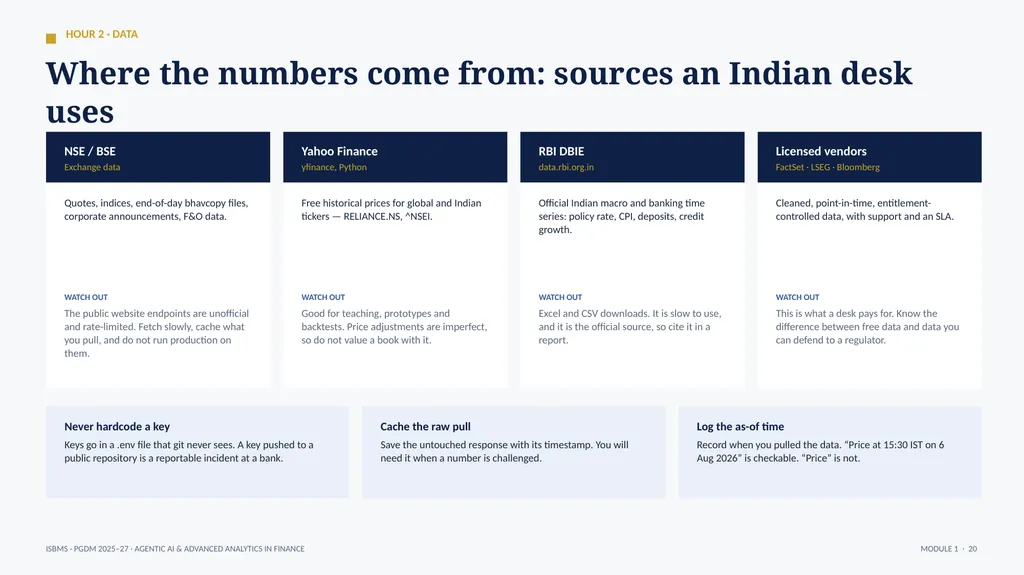
HOUR 2 · DATA Where the numbers come from: sources an Indian desk uses NSE / BSE
Exchange data Quotes, indices, end-of-day bhavcopy files, corporate announcements, F&O data. WATCH OUT
The public website endpoints are unofficial and rate-limited. Fetch slowly, cache what you pull, and do not run production on them. Yahoo Finance
yfinance, Python Free historical prices for global and Indian tickers — RELIANCE.NS, ^NSEI. WATCH OUT
Good for teaching, prototypes and backtests. Price adjustments are imperfect, so do not value a book with it. RBI DBIE
data.rbi.org.in Official Indian macro and banking time series: policy rate, CPI, deposits, credit growth. WATCH OUT
Excel and CSV downloads. It is slow to use, and it is the official source, so cite it in a report. Licensed vendors
FactSet · LSEG · Bloomberg Cleaned, point-in-time, entitlement-controlled data, with support and an SLA. WATCH OUT
This is what a desk pays for. Know the difference between free data and data you can defend to a regulator. Never hardcode a key
Keys go in a .env file that git never sees. A key pushed to a public repository is a reportable incident at a bank. Cache the raw pull
Save the untouched response with its timestamp. You will need it when a number is challenged. Log the as-of time
Record when you pulled the data. “Price at 15:30 IST on 6 Aug 2026” is checkable. “Price” is not. ISBMS · PGDM 2025–27 · AGENTIC AI & ADVANCED ANALYTICS IN FINANCE MODULE 1 · 20<br>
Exchange data Quotes, indices, end-of-day bhavcopy files, corporate announcements, F&O data. WATCH OUT
The public website endpoints are unofficial and rate-limited. Fetch slowly, cache what you pull, and do not run production on them. Yahoo Finance
yfinance, Python Free historical prices for global and Indian tickers — RELIANCE.NS, ^NSEI. WATCH OUT
Good for teaching, prototypes and backtests. Price adjustments are imperfect, so do not value a book with it. RBI DBIE
data.rbi.org.in Official Indian macro and banking time series: policy rate, CPI, deposits, credit growth. WATCH OUT
Excel and CSV downloads. It is slow to use, and it is the official source, so cite it in a report. Licensed vendors
FactSet · LSEG · Bloomberg Cleaned, point-in-time, entitlement-controlled data, with support and an SLA. WATCH OUT
This is what a desk pays for. Know the difference between free data and data you can defend to a regulator. Never hardcode a key
Keys go in a .env file that git never sees. A key pushed to a public repository is a reportable incident at a bank. Cache the raw pull
Save the untouched response with its timestamp. You will need it when a number is challenged. Log the as-of time
Record when you pulled the data. “Price at 15:30 IST on 6 Aug 2026” is checkable. “Price” is not. ISBMS · PGDM 2025–27 · AGENTIC AI & ADVANCED ANALYTICS IN FINANCE MODULE 1 · 20<br>
20
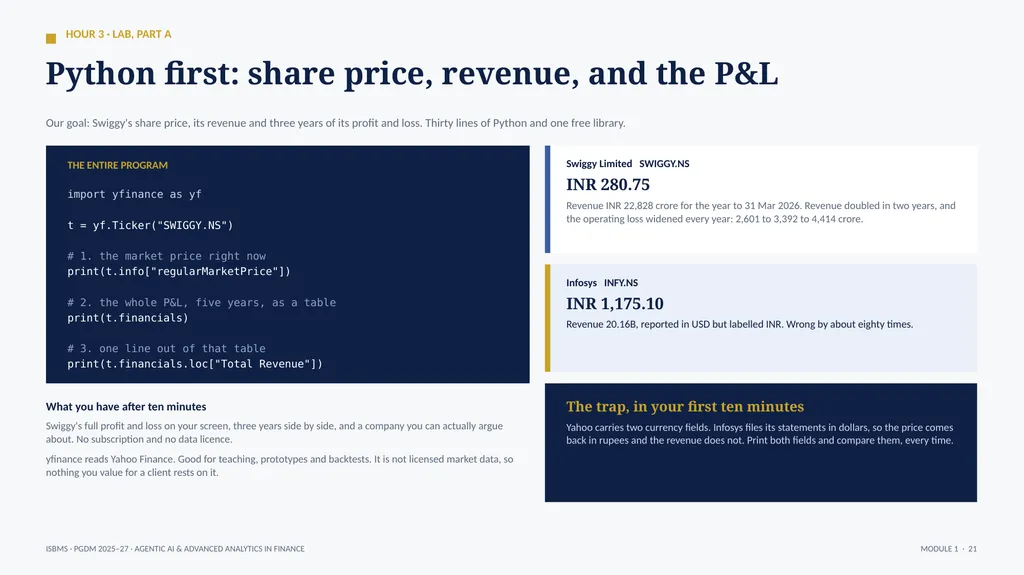
HOUR 3 · LAB, PART A Python first: share price, revenue, and the P&L Our goal: Swiggy's share price, its revenue and three years of its profit and loss. Thirty lines of Python and one free library. THE ENTIRE PROGRAM import yfinance as yf
t = yf.Ticker("SWIGGY.NS")
# 1. the market price right now
print(t.info["regularMarketPrice"])
# 2. the whole P&L, five years, as a table
print(t.financials)
# 3. one line out of that table
print(t.financials.loc["Total Revenue"]) Swiggy Limited SWIGGY.NS
INR 280.75
Revenue INR 22,828 crore for the year to 31 Mar 2026. Revenue doubled in two years, and the operating loss widened every year: 2,601 to 3,392 to 4,414 crore. Infosys INFY.NS
INR 1,175.10
Revenue 20.16B, reported in USD but labelled INR. Wrong by about eighty times. The trap, in your first ten minutes
Yahoo carries two currency fields. Infosys files its statements in dollars, so the price comes back in rupees and the revenue does not. Print both fields and compare them, every time. What you have after ten minutes
Swiggy's full profit and loss on your screen, three years side by side, and a company you can actually argue about. No subscription and no data licence.
yfinance reads Yahoo Finance. Good for teaching, prototypes and backtests. It is not licensed market data, so nothing you value for a client rests on it. ISBMS · PGDM 2025–27 · AGENTIC AI & ADVANCED ANALYTICS IN FINANCE MODULE 1 · 21<br>
t = yf.Ticker("SWIGGY.NS")
# 1. the market price right now
print(t.info["regularMarketPrice"])
# 2. the whole P&L, five years, as a table
print(t.financials)
# 3. one line out of that table
print(t.financials.loc["Total Revenue"]) Swiggy Limited SWIGGY.NS
INR 280.75
Revenue INR 22,828 crore for the year to 31 Mar 2026. Revenue doubled in two years, and the operating loss widened every year: 2,601 to 3,392 to 4,414 crore. Infosys INFY.NS
INR 1,175.10
Revenue 20.16B, reported in USD but labelled INR. Wrong by about eighty times. The trap, in your first ten minutes
Yahoo carries two currency fields. Infosys files its statements in dollars, so the price comes back in rupees and the revenue does not. Print both fields and compare them, every time. What you have after ten minutes
Swiggy's full profit and loss on your screen, three years side by side, and a company you can actually argue about. No subscription and no data licence.
yfinance reads Yahoo Finance. Good for teaching, prototypes and backtests. It is not licensed market data, so nothing you value for a client rests on it. ISBMS · PGDM 2025–27 · AGENTIC AI & ADVANCED ANALYTICS IN FINANCE MODULE 1 · 21<br>
21
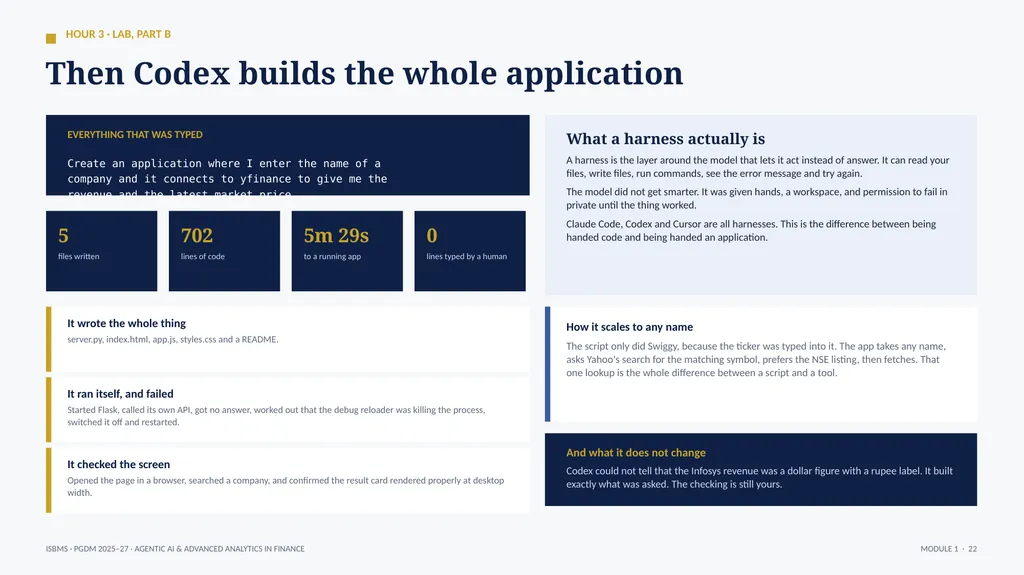
HOUR 3 · LAB, PART B Then Codex builds the whole application EVERYTHING THAT WAS TYPED Create an application where I enter the name of a
company and it connects to yfinance to give me the
revenue and the latest market price. 5
files written 702
lines of code 5m 29s
to a running app 0
lines typed by a human It wrote the whole thing
server.py, index.html, app.js, styles.css and a README. It ran itself, and failed
Started Flask, called its own API, got no answer, worked out that the debug reloader was killing the process, switched it off and restarted. It checked the screen
Opened the page in a browser, searched a company, and confirmed the result card rendered properly at desktop width. What a harness actually is
A harness is the layer around the model that lets it act instead of answer. It can read your files, write files, run commands, see the error message and try again.
The model did not get smarter. It was given hands, a workspace, and permission to fail in private until the thing worked.
Claude Code, Codex and Cursor are all harnesses. This is the difference between being handed code and being handed an application. How it scales to any name
The script only did Swiggy, because the ticker was typed into it. The app takes any name, asks Yahoo's search for the matching symbol, prefers the NSE listing, then fetches. That one lookup is the whole difference between a script and a tool. And what it does not change
Codex could not tell that the Infosys revenue was a dollar figure with a rupee label. It built exactly what was asked. The checking is still yours. ISBMS · PGDM 2025–27 · AGENTIC AI & ADVANCED ANALYTICS IN FINANCE MODULE 1 · 22<br>
company and it connects to yfinance to give me the
revenue and the latest market price. 5
files written 702
lines of code 5m 29s
to a running app 0
lines typed by a human It wrote the whole thing
server.py, index.html, app.js, styles.css and a README. It ran itself, and failed
Started Flask, called its own API, got no answer, worked out that the debug reloader was killing the process, switched it off and restarted. It checked the screen
Opened the page in a browser, searched a company, and confirmed the result card rendered properly at desktop width. What a harness actually is
A harness is the layer around the model that lets it act instead of answer. It can read your files, write files, run commands, see the error message and try again.
The model did not get smarter. It was given hands, a workspace, and permission to fail in private until the thing worked.
Claude Code, Codex and Cursor are all harnesses. This is the difference between being handed code and being handed an application. How it scales to any name
The script only did Swiggy, because the ticker was typed into it. The app takes any name, asks Yahoo's search for the matching symbol, prefers the NSE listing, then fetches. That one lookup is the whole difference between a script and a tool. And what it does not change
Codex could not tell that the Infosys revenue was a dollar figure with a rupee label. It built exactly what was asked. The checking is still yours. ISBMS · PGDM 2025–27 · AGENTIC AI & ADVANCED ANALYTICS IN FINANCE MODULE 1 · 22<br>
22
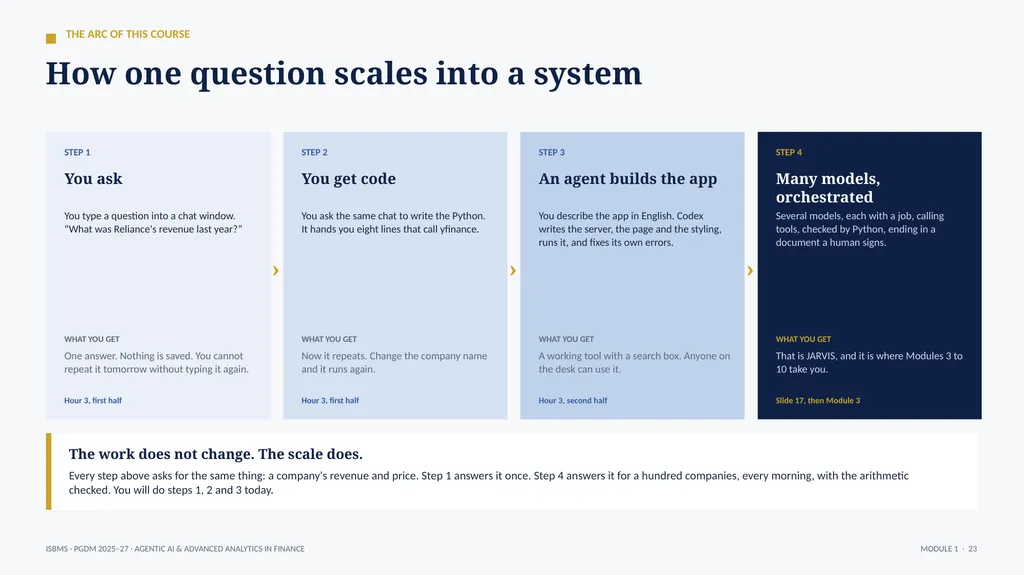
THE ARC OF THIS COURSE How one question scales into a system STEP 1 You ask You type a question into a chat window. “What was Reliance's revenue last year?” WHAT YOU GET
One answer. Nothing is saved. You cannot repeat it tomorrow without typing it again. Hour 3, first half › STEP 2 You get code You ask the same chat to write the Python. It hands you eight lines that call yfinance. WHAT YOU GET
Now it repeats. Change the company name and it runs again. Hour 3, first half › STEP 3 An agent builds the app You describe the app in English. Codex writes the server, the page and the styling, runs it, and fixes its own errors. WHAT YOU GET
A working tool with a search box. Anyone on the desk can use it. Hour 3, second half › STEP 4 Many models, orchestrated Several models, each with a job, calling tools, checked by Python, ending in a document a human signs. WHAT YOU GET
That is JARVIS, and it is where Modules 3 to 10 take you. Slide 17, then Module 3 The work does not change. The scale does.
Every step above asks for the same thing: a company's revenue and price. Step 1 answers it once. Step 4 answers it for a hundred companies, every morning, with the arithmetic checked. You will do steps 1, 2 and 3 today. ISBMS · PGDM 2025–27 · AGENTIC AI & ADVANCED ANALYTICS IN FINANCE MODULE 1 · 23<br>
One answer. Nothing is saved. You cannot repeat it tomorrow without typing it again. Hour 3, first half › STEP 2 You get code You ask the same chat to write the Python. It hands you eight lines that call yfinance. WHAT YOU GET
Now it repeats. Change the company name and it runs again. Hour 3, first half › STEP 3 An agent builds the app You describe the app in English. Codex writes the server, the page and the styling, runs it, and fixes its own errors. WHAT YOU GET
A working tool with a search box. Anyone on the desk can use it. Hour 3, second half › STEP 4 Many models, orchestrated Several models, each with a job, calling tools, checked by Python, ending in a document a human signs. WHAT YOU GET
That is JARVIS, and it is where Modules 3 to 10 take you. Slide 17, then Module 3 The work does not change. The scale does.
Every step above asks for the same thing: a company's revenue and price. Step 1 answers it once. Step 4 answers it for a hundred companies, every morning, with the arithmetic checked. You will do steps 1, 2 and 3 today. ISBMS · PGDM 2025–27 · AGENTIC AI & ADVANCED ANALYTICS IN FINANCE MODULE 1 · 23<br>
23
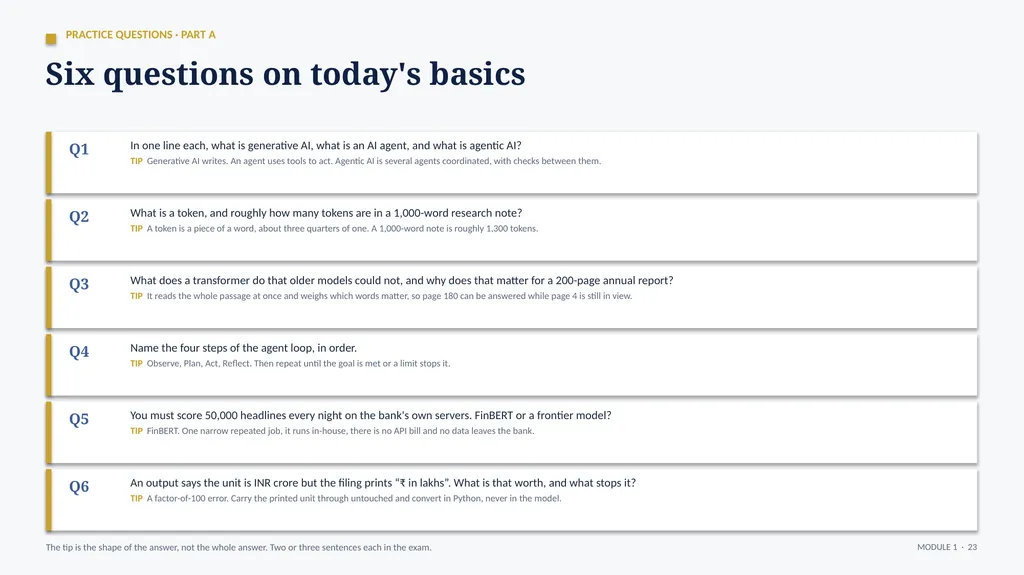
PRACTICE QUESTIONS · PART A Six questions on today's basics Q1 In one line each, what is generative AI, what is an AI agent, and what is agentic AI?
TIP Generative AI writes. An agent uses tools to act. Agentic AI is several agents coordinated, with checks between them. Q2 What is a token, and roughly how many tokens are in a 1,000-word research note?
TIP A token is a piece of a word, about three quarters of one. A 1,000-word note is roughly 1,300 tokens. Q3 What does a transformer do that older models could not, and why does that matter for a 200-page annual report?
TIP It reads the whole passage at once and weighs which words matter, so page 180 can be answered while page 4 is still in view. Q4 Name the four steps of the agent loop, in order.
TIP Observe, Plan, Act, Reflect. Then repeat until the goal is met or a limit stops it. Q5 You must score 50,000 headlines every night on the bank's own servers. FinBERT or a frontier model?
TIP FinBERT. One narrow repeated job, it runs in-house, there is no API bill and no data leaves the bank. Q6 An output says the unit is INR crore but the filing prints “₹ in lakhs”. What is that worth, and what stops it?
TIP A factor-of-100 error. Carry the printed unit through untouched and convert in Python, never in the model. The tip is the shape of the answer, not the whole answer. Two or three sentences each in the exam. MODULE 1 · 23<br>
TIP Generative AI writes. An agent uses tools to act. Agentic AI is several agents coordinated, with checks between them. Q2 What is a token, and roughly how many tokens are in a 1,000-word research note?
TIP A token is a piece of a word, about three quarters of one. A 1,000-word note is roughly 1,300 tokens. Q3 What does a transformer do that older models could not, and why does that matter for a 200-page annual report?
TIP It reads the whole passage at once and weighs which words matter, so page 180 can be answered while page 4 is still in view. Q4 Name the four steps of the agent loop, in order.
TIP Observe, Plan, Act, Reflect. Then repeat until the goal is met or a limit stops it. Q5 You must score 50,000 headlines every night on the bank's own servers. FinBERT or a frontier model?
TIP FinBERT. One narrow repeated job, it runs in-house, there is no API bill and no data leaves the bank. Q6 An output says the unit is INR crore but the filing prints “₹ in lakhs”. What is that worth, and what stops it?
TIP A factor-of-100 error. Carry the printed unit through untouched and convert in Python, never in the model. The tip is the shape of the answer, not the whole answer. Two or three sentences each in the exam. MODULE 1 · 23<br>
24
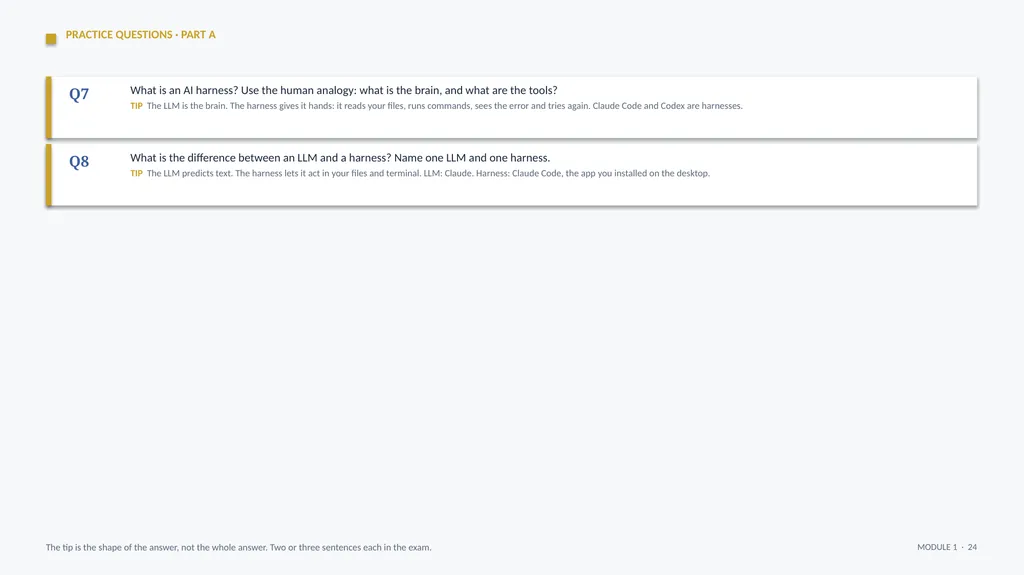
PRACTICE QUESTIONS · PART A Q7 What is an AI harness? Use the human analogy: what is the brain, and what are the tools?
TIP The LLM is the brain. The harness gives it hands: it reads your files, runs commands, sees the error and tries again. Claude Code and Codex are harnesses. Q8 What is the difference between an LLM and a harness? Name one LLM and one harness.
TIP The LLM predicts text. The harness lets it act in your files and terminal. LLM: Claude. Harness: Claude Code, the app you installed on the desktop. The tip is the shape of the answer, not the whole answer. Two or three sentences each in the exam. MODULE 1 · 24<br>
TIP The LLM is the brain. The harness gives it hands: it reads your files, runs commands, sees the error and tries again. Claude Code and Codex are harnesses. Q8 What is the difference between an LLM and a harness? Name one LLM and one harness.
TIP The LLM predicts text. The harness lets it act in your files and terminal. LLM: Claude. Harness: Claude Code, the app you installed on the desktop. The tip is the shape of the answer, not the whole answer. Two or three sentences each in the exam. MODULE 1 · 24<br>
25
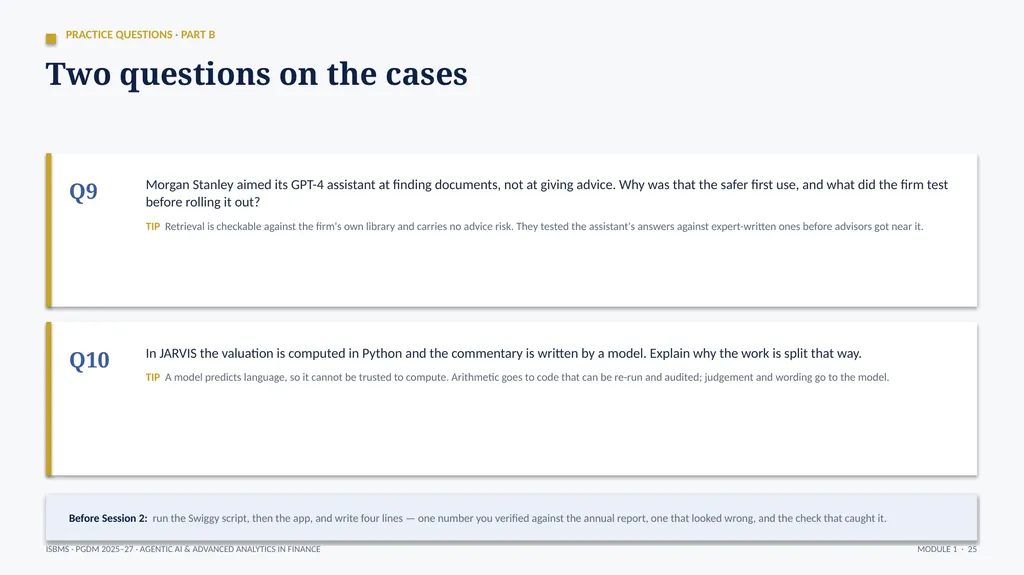
PRACTICE QUESTIONS · PART B Two questions on the cases Q9 Morgan Stanley aimed its GPT-4 assistant at finding documents, not at giving advice. Why was that the safer first use, and what did the firm test before rolling it out?
TIP Retrieval is checkable against the firm's own library and carries no advice risk. They tested the assistant's answers against expert-written ones before advisors got near it. Q10 In JARVIS the valuation is computed in Python and the commentary is written by a model. Explain why the work is split that way.
TIP A model predicts language, so it cannot be trusted to compute. Arithmetic goes to code that can be re-run and audited; judgement and wording go to the model. Before Session 2: run the Swiggy script, then the app, and write four lines — one number you verified against the annual report, one that looked wrong, and the check that caught it. ISBMS · PGDM 2025–27 · AGENTIC AI & ADVANCED ANALYTICS IN FINANCE MODULE 1 · 25<br>
TIP Retrieval is checkable against the firm's own library and carries no advice risk. They tested the assistant's answers against expert-written ones before advisors got near it. Q10 In JARVIS the valuation is computed in Python and the commentary is written by a model. Explain why the work is split that way.
TIP A model predicts language, so it cannot be trusted to compute. Arithmetic goes to code that can be re-run and audited; judgement and wording go to the model. Before Session 2: run the Swiggy script, then the app, and write four lines — one number you verified against the annual report, one that looked wrong, and the check that caught it. ISBMS · PGDM 2025–27 · AGENTIC AI & ADVANCED ANALYTICS IN FINANCE MODULE 1 · 25<br>