ISLAMOPHOBIA What is islam Islam is derived from the Arabic root Salema: peace, purity, submission and obedience. Abrahamic religions were sent down to liberate human minds and render them enlightened and mature through the divine light.
"ISLAMOPHOBIA What is islam Islam is derived from" is the property of its rightful owner. Permission is granted to
download and print the materials on this website for personal, non-commercial use only, and to display it
on your personal computer provided you do not modify the materials and that you retain all copyright
notices contained in the materials. By downloading content from our website, you accept the terms of this
agreement.
Presentation Transcript
01
ISLAMOPHOBIA<br>
02
What is islam Islam is derived from the Arabic root "Salema": peace, purity, submission and obedience.
Abrahamic religions were sent down to liberate human minds and render them enlightened and mature through the divine light. Religion is not meant to be in contrast to reason and truth. Rather, it is meant to be in harmony with reason and help develop and illuminate it.
Prophet Muhammad (peace be upon him) said in his teachings: “Allah shows Mercy to those who are merciful to others. Show mercy to those on earth and He up in heaven will show Mercy to you.”<br>
03
islamophobia Islamophobia is a term used to describe irrational hostility, fear, or hatred of Islam, Muslims, and Islamic culture, and active discrimination against these groups or individuals within them.
Muslim men get stereotyped as terrorists, violent andcriminal, For Muslim women, the most common stereotype is that they lack control over their own lives.The reality is that a lot of Muslim women view it as quite the opposite, they're proud of their gender, do have a voice and choose to celebrate some of their traditional roles.
Minorities often serve as scapegoats in times of economic and political crisis. Islam and the approximately 20 million Muslims who live in the European Union are depicted by some as inherent threats to the European way of life, even in countries where they have lived for generations. The myth of an ongoing European “Islamization” or invasion has been nurtured by xenophobic, populist parties that are on the rise across Europe.
The use of Islam by extremists to justify their terrorist acts has made many Europeans regard Islam as a threat and fear Muslims as the enemy.<br>
04
JIHAD Jihad, (Arabic: “struggle” or “effort”)also spelled jehad, in Islam, a meritorious struggle or effort. The exact meaning of the term jihad depends on context; it has often been erroneously translated in the West as “holy war.” In an Islamic context, it can refer to almost any effort to make personal and social life conform with God's guidance, such as struggle against one's evil inclinationsthe term refers to armed struggle against unbelievers,while modernist Islamic scholars generally equate military jihad with defensive warfare. Muslims use the word Jihad to describe different kinds of struggle:
A believer's internal struggle to live out the Muslim faith as well as possible
The struggle to build a good Muslim society
Holy war: the struggle to defend Islam<br>
05
What a Jihad is not A war is not a Jihad if the intention is to:
Force people to convert to Islam
Conquer other nations to colonise them
Take territory for economic gain
Settle disputes
Demonstrate a leader's power<br>
06
The rules of Jihad Military Jihad has to obey very strict rules in order to be legitimate.
The opponent must always have started the fighting.
It must not be fought to gain territory.
It must be launched by a religious leader.
It must be fought to bring about good - something that Allah will approve of.
Every other way of solving the problem must be tried before resorting to war.
Innocent people should not be killed.
Women, children, or old people should not be killed or hurt.
Women must not be raped.
Enemies must be treated with justice.
Wounded enemy soldiers must be treated in exactly the same way as one's own soldiers.
The war must stop as soon as the enemy asks for peace.
Property must not be damaged.
Poisoning wells is forbidden. The modern analogy would be chemical or biological warfare.<br>
07
The Qur'an on Jihad The Qur'an has many passages about fighting. Some of them advocate peace, while some are very warlike. The Bible, the Jewish and Christian scripture, shows a similar variety of attitudes to war.
[2:193] “You may also fight them to eliminate oppression, and to worship GOD freely. If they refrain, you shall not aggress; aggression is permitted only against the aggressors.”
[2/ 256] “There is no compulsion where the religion is concerned.”<br>
08
The Bible and the Qur’an both command and restrict violence in protection of their religious communities.
In the Bible, extreme warfare is commanded in order to establish the Jewish religious community in Israel, but then also commands that non-Jews be free to live in Israel unharmed. The Qur’an also commands warfare to protect the early Islamic community in Arabia, but also limits warfare to those who break treaties or persecute Muslims. One thing that does separate the New Testament from the Qur’an is that Jesus commands non-violent resistance and love of enemies, even at times when the individual or religious community is threatened, a principle that many of his followers neglected.<br>
09
Being respectful to each other Contrary to popular belief, the two holy books have similarities. Believers of both faiths should take the time to read and understand both holy books. When Christians take the time to read the Qu’ran, they are showing respect to their Muslim neighbors, respect enough to try and understand their religion. When Muslims take the time to read the Bible, they are also taking the time to respect to their Christian neighbors. In the process, each gains respect for each other.<br>
10
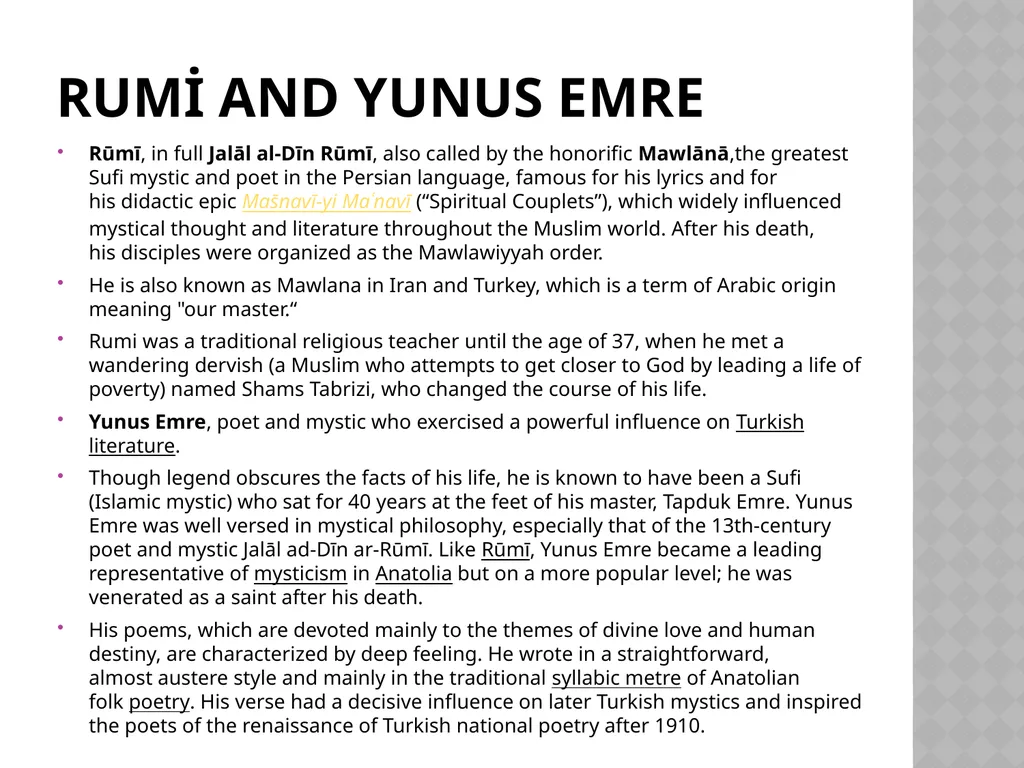
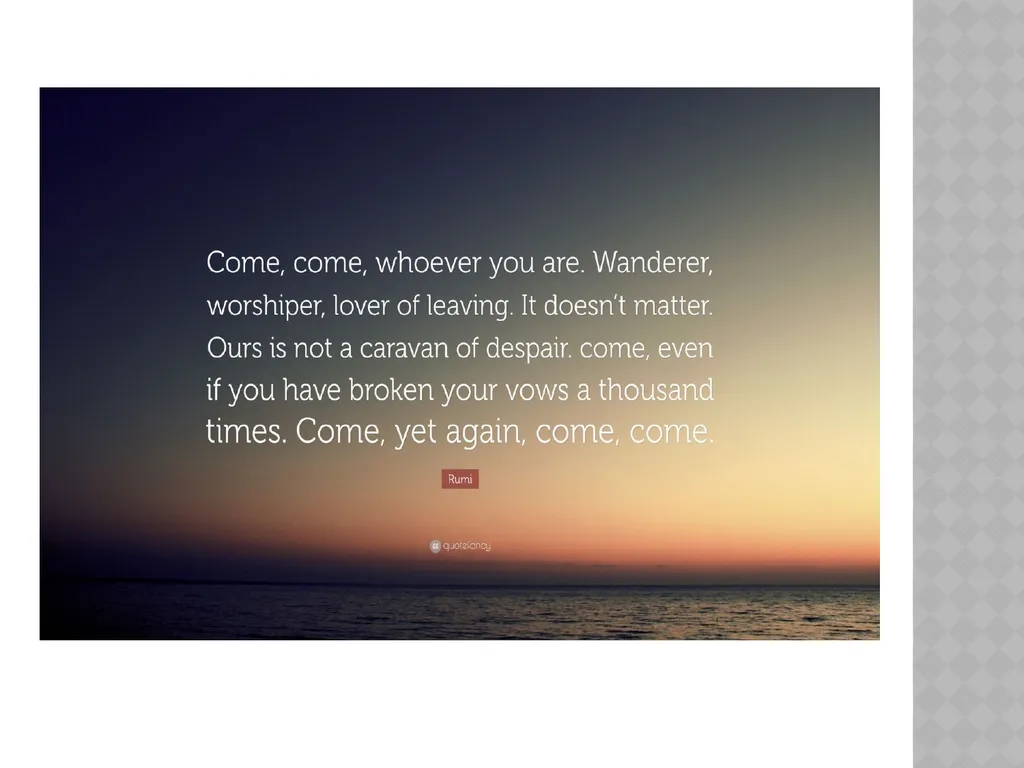
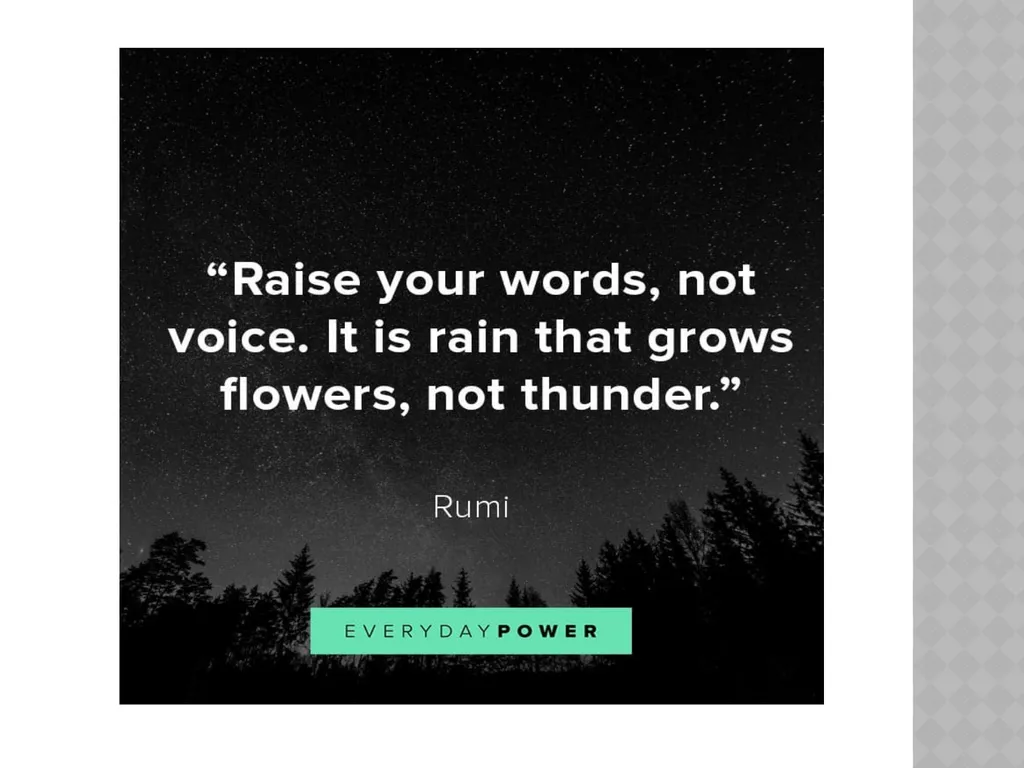
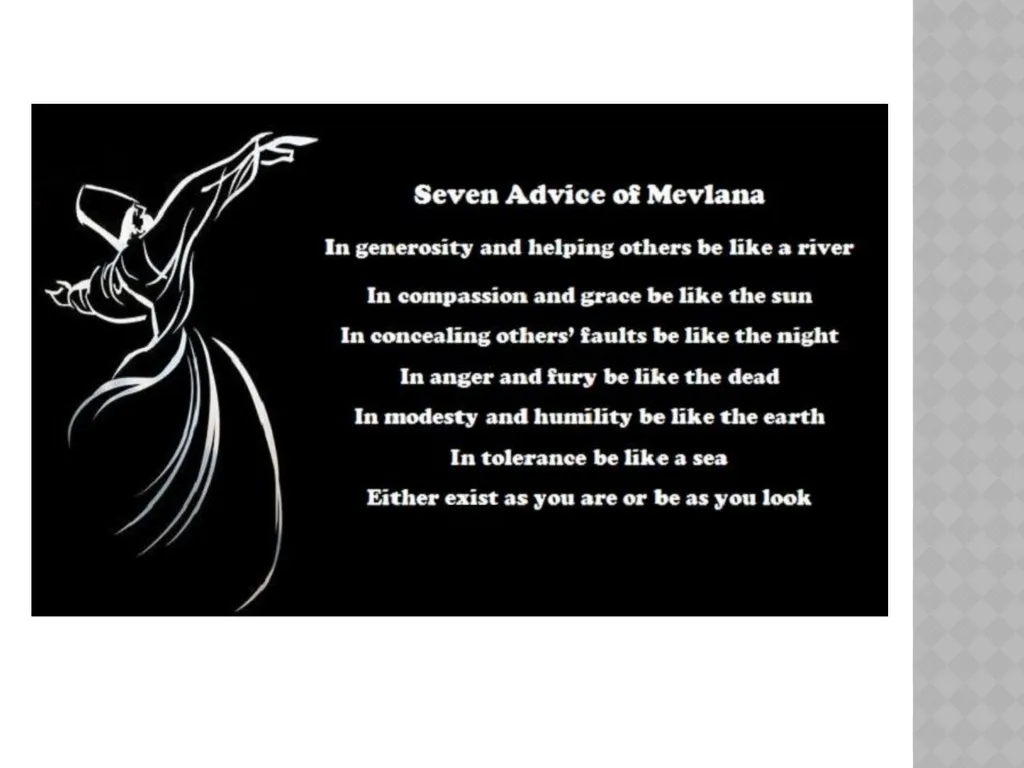
rumi and Yunus emre Rūmī, in full Jalāl al-Dīn Rūmī, also called by the honorific Mawlānā,the greatest Sufi mystic and poet in the Persian language, famous for his lyrics and for his didactic epic Mas̄navī-yi Maʿnavī (“Spiritual Couplets”), which widely influenced mystical thought and literature throughout the Muslim world. After his death, his disciples were organized as the Mawlawiyyah order.
He is also known as Mawlana in Iran and Turkey, which is a term of Arabic origin meaning "our master.“
Rumi was a traditional religious teacher until the age of 37, when he met a wandering dervish (a Muslim who attempts to get closer to God by leading a life of poverty) named Shams Tabrizi, who changed the course of his life.
Yunus Emre, poet and mystic who exercised a powerful influence on Turkish literature.
Though legend obscures the facts of his life, he is known to have been a Sufi (Islamic mystic) who sat for 40 years at the feet of his master, Tapduk Emre. Yunus Emre was well versed in mystical philosophy, especially that of the 13th-century poet and mystic Jalāl ad-Dīn ar-Rūmī. Like Rūmī, Yunus Emre became a leading representative of mysticism in Anatolia but on a more popular level; he was venerated as a saint after his death.
His poems, which are devoted mainly to the themes of divine love and human destiny, are characterized by deep feeling. He wrote in a straightforward, almost austere style and mainly in the traditional syllabic metre of Anatolian folk poetry. His verse had a decisive influence on later Turkish mystics and inspired the poets of the renaissance of Turkish national poetry after 1910.<br>