
ISO 26000 Basic training material Published by ISO
KB
Published · 59 slides · 0 views
1 / 1


Description
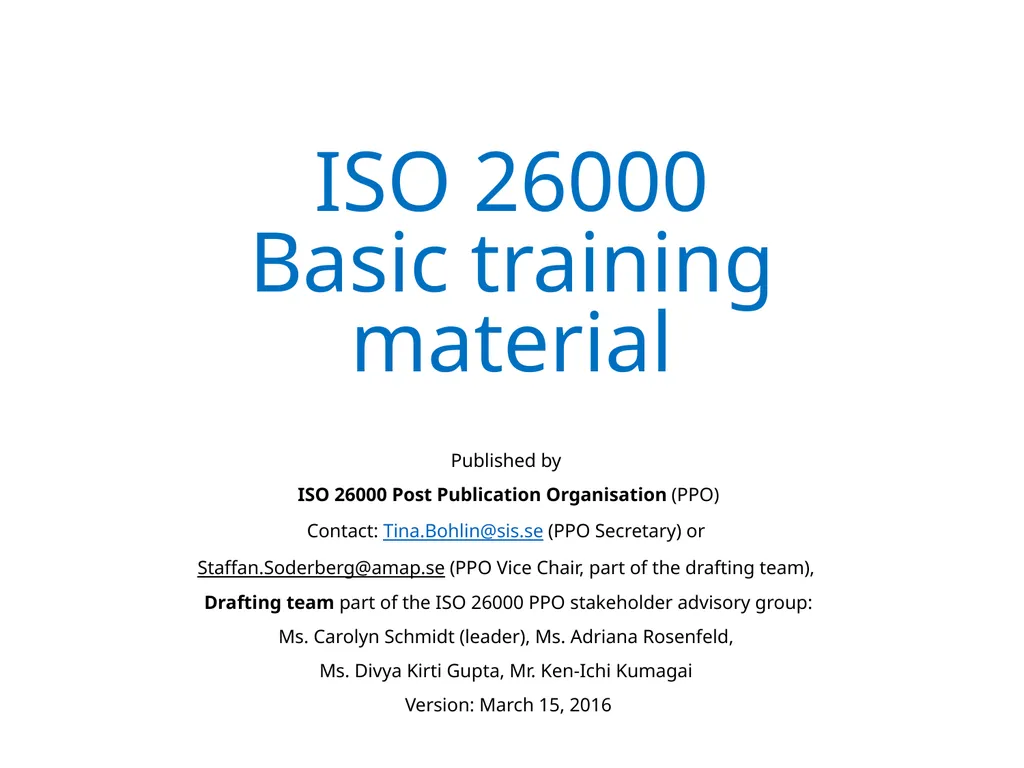
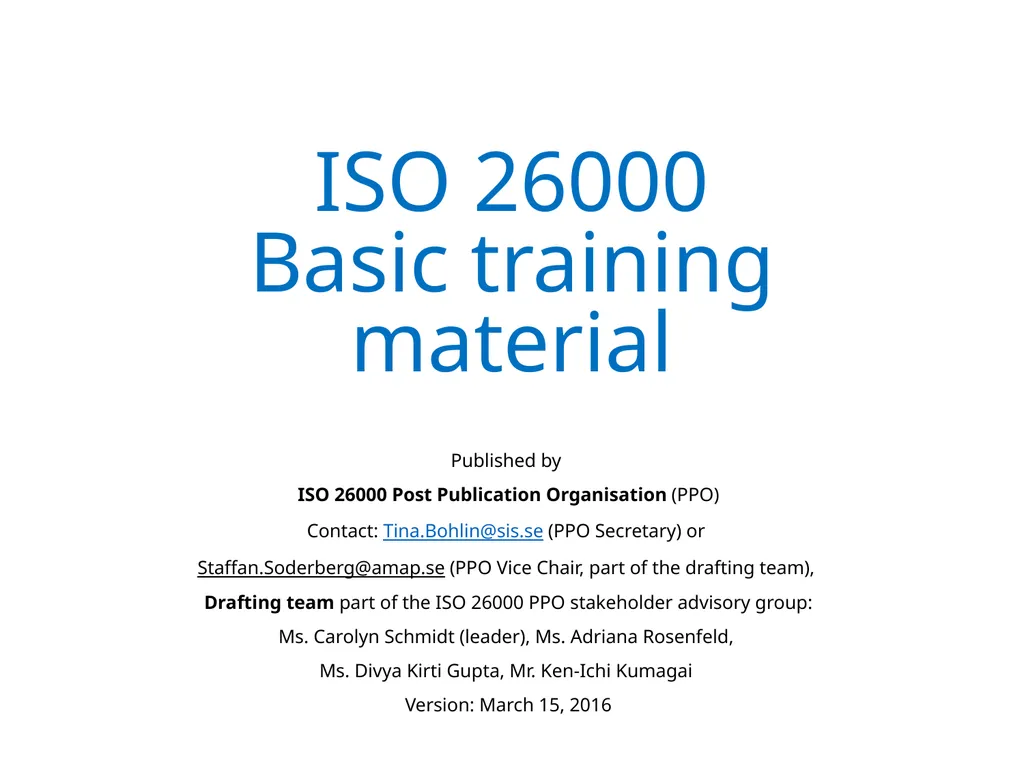
ISO 26000 Basic training material Published by ISO 26000 Post Publication Organisation (PPO) Contact: Tina.Bohlinsis.se (PPO Secretary) or Staffan.Soderbergamap.se (PPO Vice Chair, part of the drafting team), Drafting team part of the ISO
Related Topics
Share
Embed code
Download this presentation From Below
"ISO 26000 Basic training material Published by ISO" is the property of its rightful owner. Permission is granted to download and print the materials on this website for personal, non-commercial use only, and to display it on your personal computer provided you do not modify the materials and that you retain all copyright notices contained in the materials. By downloading content from our website, you accept the terms of this agreement.
Presentation Transcript
01
ISO 26000
Basic training material Published by
ISO 26000 Post Publication Organisation (PPO)
Contact: Tina.Bohlin@sis.se (PPO Secretary) or
Staffan.Soderberg@amap.se (PPO Vice Chair, part of the drafting team),
Drafting team part of the ISO 26000 PPO stakeholder advisory group:
Ms. Carolyn Schmidt (leader), Ms. Adriana Rosenfeld,
Ms. Divya Kirti Gupta, Mr. Ken-Ichi Kumagai
Version: March 15, 2016<br>
ISO 26000 Post Publication Organisation (PPO)
Contact: Tina.Bohlin@sis.se (PPO Secretary) or
Staffan.Soderberg@amap.se (PPO Vice Chair, part of the drafting team),
Drafting team part of the ISO 26000 PPO stakeholder advisory group:
Ms. Carolyn Schmidt (leader), Ms. Adriana Rosenfeld,
Ms. Divya Kirti Gupta, Mr. Ken-Ichi Kumagai
Version: March 15, 2016<br>
02
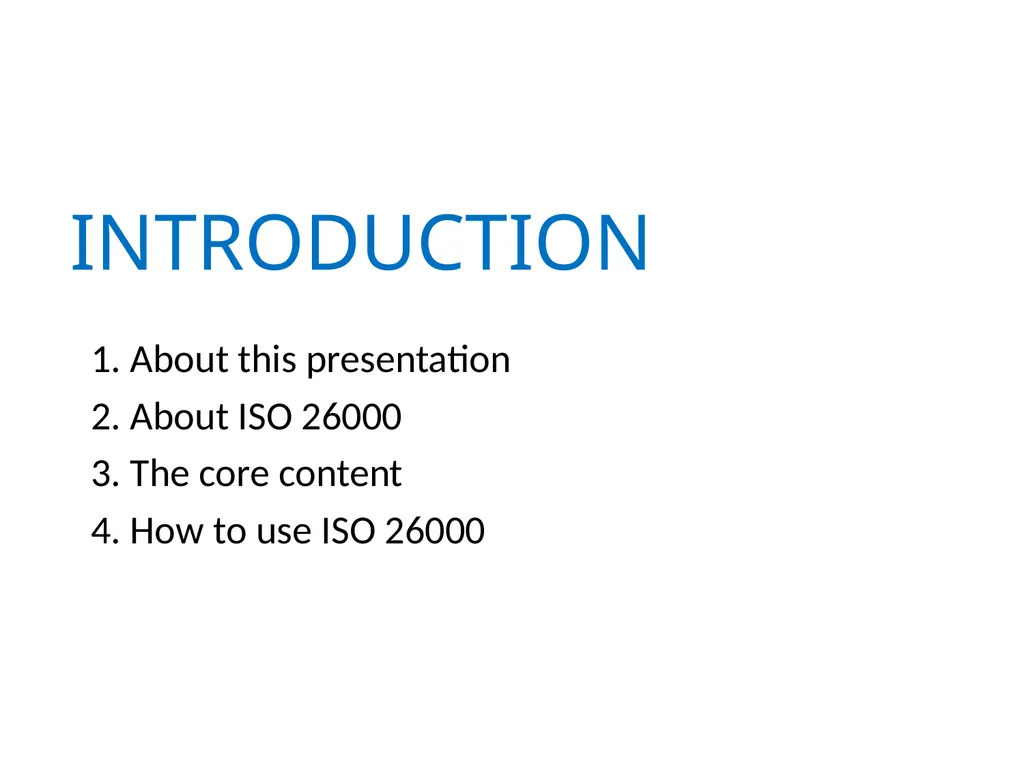
INTRODUCTION 1. About this presentation
2. About ISO 26000
3. The core content
4. How to use ISO 26000<br>
2. About ISO 26000
3. The core content
4. How to use ISO 26000<br>
03
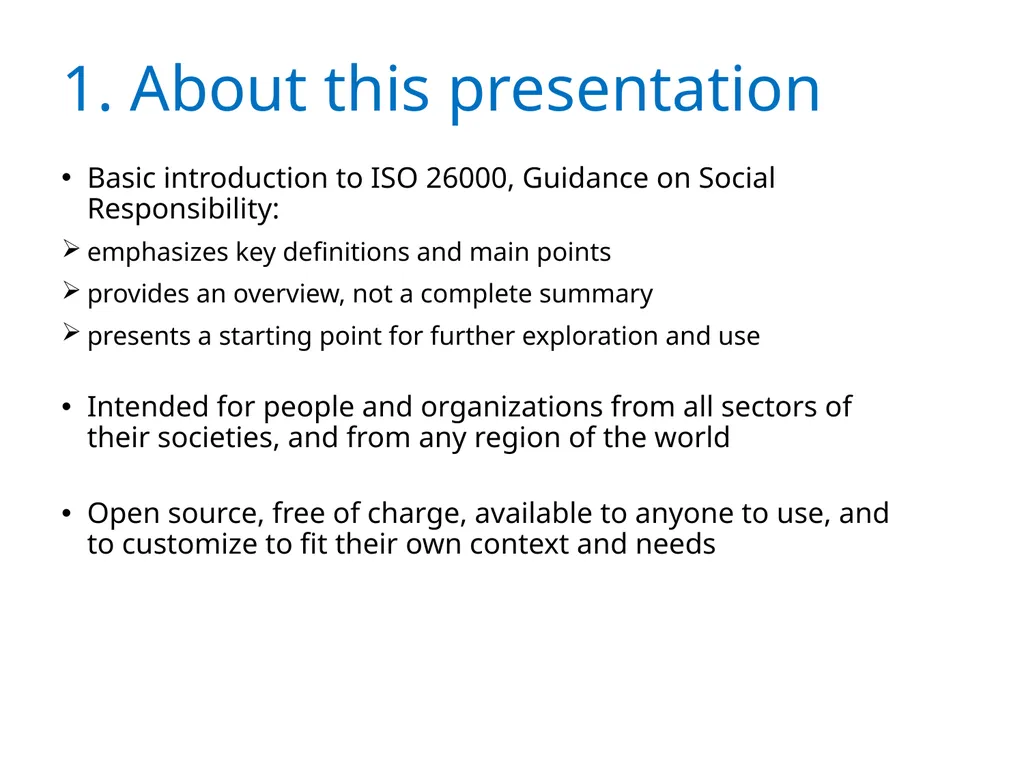
1. About this presentation Basic introduction to ISO 26000, Guidance on Social Responsibility:
emphasizes key definitions and main points
provides an overview, not a complete summary
presents a starting point for further exploration and use
Intended for people and organizations from all sectors of their societies, and from any region of the world
Open source, free of charge, available to anyone to use, and to customize to fit their own context and needs<br>
emphasizes key definitions and main points
provides an overview, not a complete summary
presents a starting point for further exploration and use
Intended for people and organizations from all sectors of their societies, and from any region of the world
Open source, free of charge, available to anyone to use, and to customize to fit their own context and needs<br>
04
How to use this presentation It is recommended to translate these slides into your local language, consulting the formal translation of ISO 26000:2010
It is recommended to add slides that are relevant to the target audience. Examples of such slides can be based on the local/regional/national/international context as well as illustrating sectors, networks, tools, initiatives etcetera. Annex A contains examples of voluntary initiatives and tools.
It is not recommended to delete any of the slides as they form a context
It is recommended that you format the slides to fit your purposes, for example by adding illustrations and photos that you have developed/own.<br>
It is recommended to add slides that are relevant to the target audience. Examples of such slides can be based on the local/regional/national/international context as well as illustrating sectors, networks, tools, initiatives etcetera. Annex A contains examples of voluntary initiatives and tools.
It is not recommended to delete any of the slides as they form a context
It is recommended that you format the slides to fit your purposes, for example by adding illustrations and photos that you have developed/own.<br>
05
2. About ISO 26000 ISO 26000 is an International Standard giving guidance/recommendations about how any organization can improve its Social Responsibility and thus contribute to sustainable environmental, social and economic development.
ISO 26000 is not certifiable, as it does not contain requirements. Its appeal is to those who, for whatever reasons, seek to improve their operating processes and impacts through socially responsible behaviour.
ISO is the world’s largest developer of voluntary International Standards, used by businesses and other organizations; its members are national standards bodies and its standards and name-recognition are global in reach. See Appendix for more information about ISO.<br>
ISO 26000 is not certifiable, as it does not contain requirements. Its appeal is to those who, for whatever reasons, seek to improve their operating processes and impacts through socially responsible behaviour.
ISO is the world’s largest developer of voluntary International Standards, used by businesses and other organizations; its members are national standards bodies and its standards and name-recognition are global in reach. See Appendix for more information about ISO.<br>
06
What makes ISO 26000 important and credible? It is designed to work in all organizational and cultural contexts – in any country or region
It is flexible and the user decides how to use it
It was internationally negotiated through ISO’s consensus method, using a multi-stakeholder approach, and balance to reflect global diversity. See Appendix for more information about this process, and the different stakeholder groups.
It incorporates the real-life experiences of its many contributors, and at the same time builds on international norms and agreements related to Social Responsibility<br>
It is flexible and the user decides how to use it
It was internationally negotiated through ISO’s consensus method, using a multi-stakeholder approach, and balance to reflect global diversity. See Appendix for more information about this process, and the different stakeholder groups.
It incorporates the real-life experiences of its many contributors, and at the same time builds on international norms and agreements related to Social Responsibility<br>
07
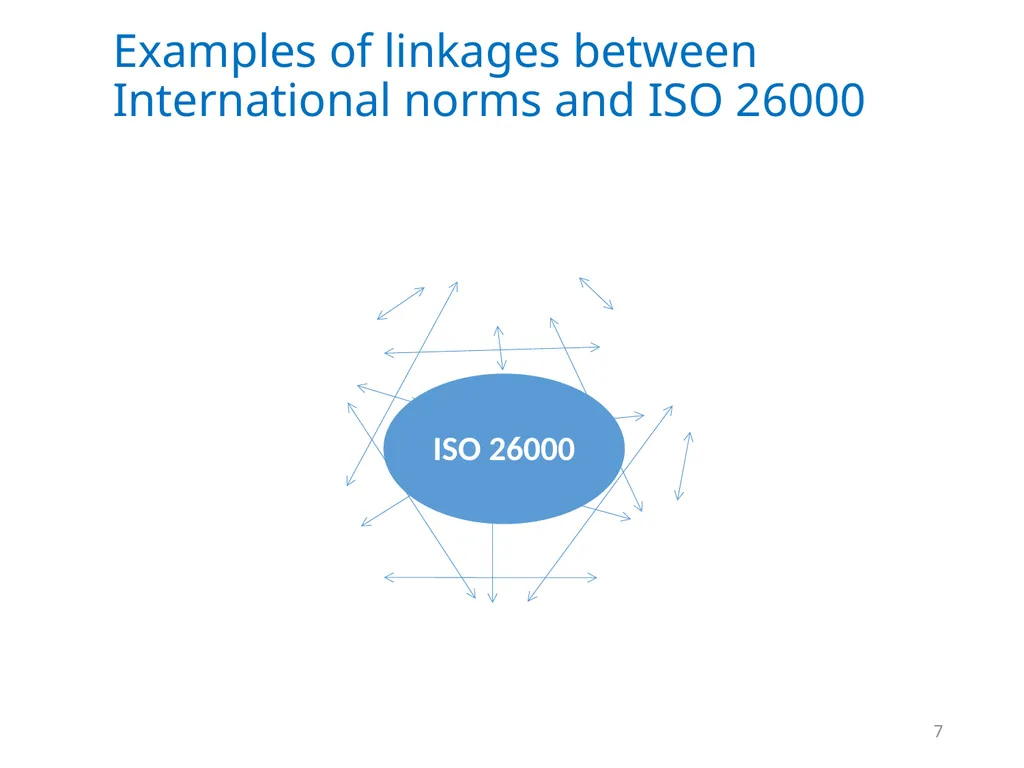
Examples of linkages between International norms and ISO 26000 7<br>
08
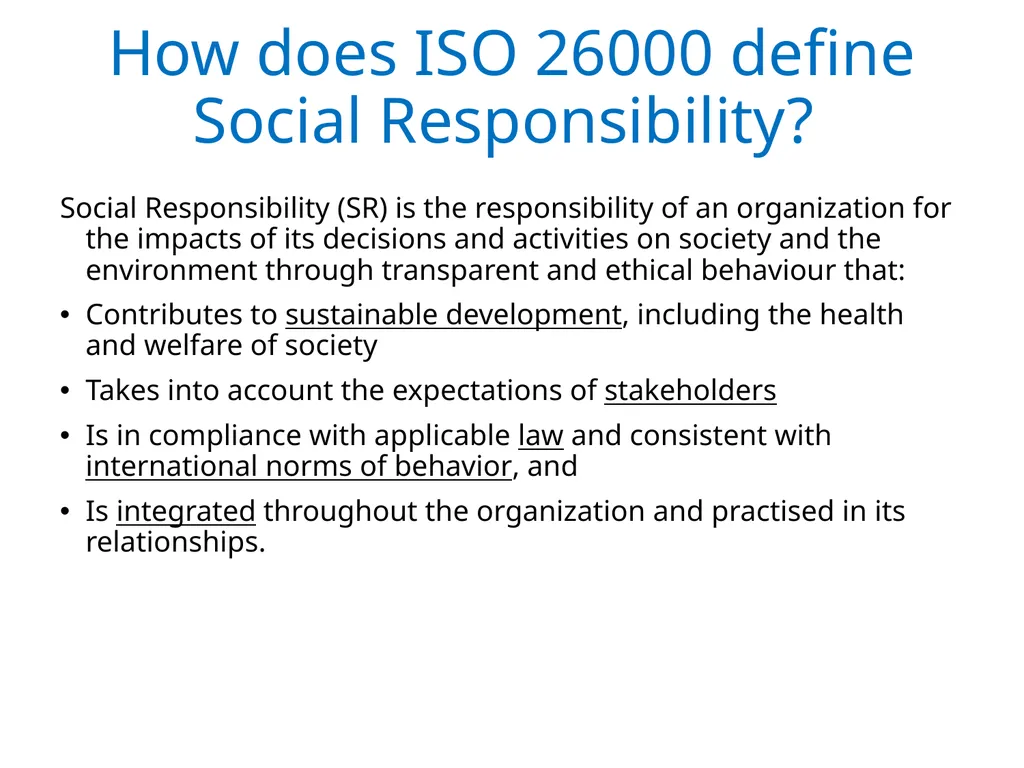
How does ISO 26000 define Social Responsibility? Social Responsibility (SR) is the responsibility of an organization for the impacts of its decisions and activities on society and the environment through transparent and ethical behaviour that:
Contributes to sustainable development, including the health and welfare of society
Takes into account the expectations of stakeholders
Is in compliance with applicable law and consistent with international norms of behavior, and
Is integrated throughout the organization and practised in its relationships.<br>
Contributes to sustainable development, including the health and welfare of society
Takes into account the expectations of stakeholders
Is in compliance with applicable law and consistent with international norms of behavior, and
Is integrated throughout the organization and practised in its relationships.<br>
09
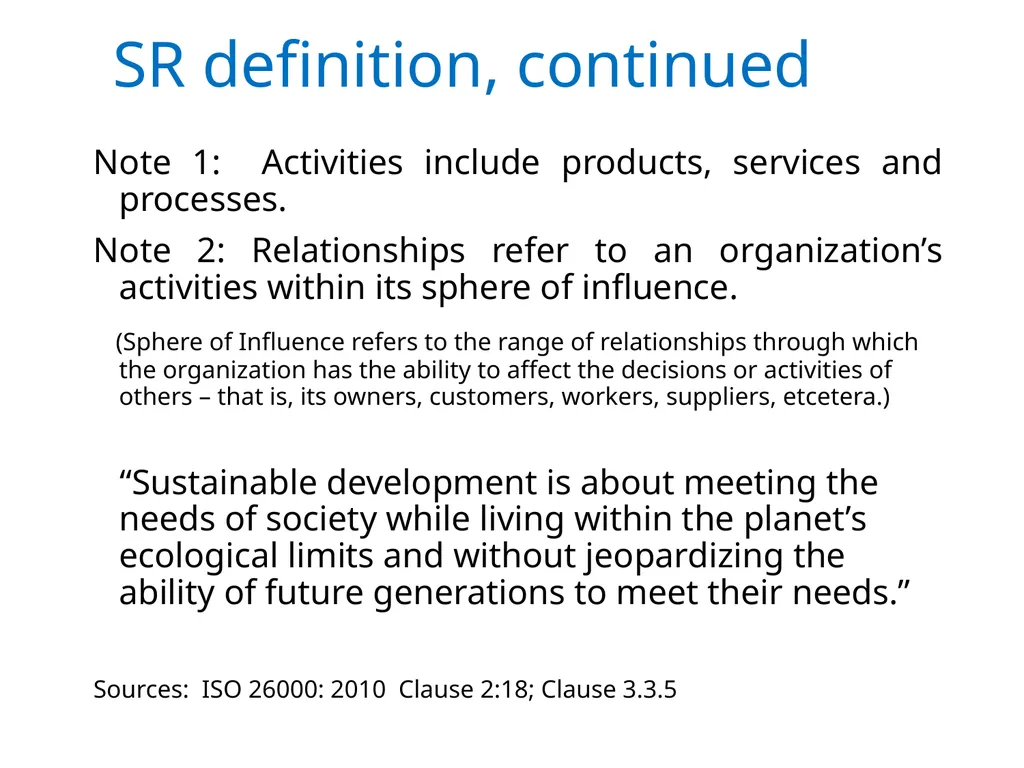
SR definition, continued Note 1: Activities include products, services and processes.
Note 2: Relationships refer to an organization’s activities within its sphere of influence.
(Sphere of Influence refers to the range of relationships through which the organization has the ability to affect the decisions or activities of others – that is, its owners, customers, workers, suppliers, etcetera.)
“Sustainable development is about meeting the needs of society while living within the planet’s ecological limits and without jeopardizing the ability of future generations to meet their needs.”
Sources: ISO 26000: 2010 Clause 2:18; Clause 3.3.5<br>
Note 2: Relationships refer to an organization’s activities within its sphere of influence.
(Sphere of Influence refers to the range of relationships through which the organization has the ability to affect the decisions or activities of others – that is, its owners, customers, workers, suppliers, etcetera.)
“Sustainable development is about meeting the needs of society while living within the planet’s ecological limits and without jeopardizing the ability of future generations to meet their needs.”
Sources: ISO 26000: 2010 Clause 2:18; Clause 3.3.5<br>
10
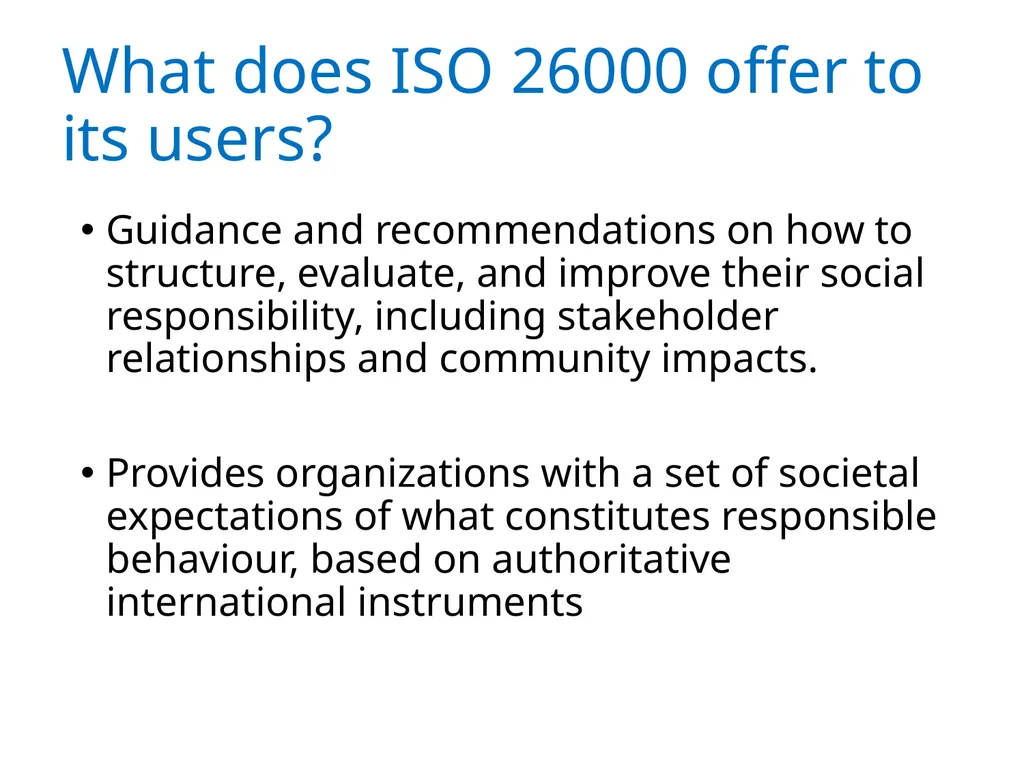
What does ISO 26000 offer to its users? Guidance and recommendations on how to structure, evaluate, and improve their social responsibility, including stakeholder relationships and community impacts.
Provides organizations with a set of societal expectations of what constitutes responsible behaviour, based on authoritative international instruments<br>
Provides organizations with a set of societal expectations of what constitutes responsible behaviour, based on authoritative international instruments<br>
11
ISO 26000 can be used by any organization, for example: large multi-national corporations
small and medium size enterprises
the public sector (hospitals, schools or others)
foundations, charities and NGOs
extractive industries, such as mining and fossil fuel companies
service and financial industries (banks, IT, insurance)
municipal governments
farmers and agribusiness
consultancies<br>
small and medium size enterprises
the public sector (hospitals, schools or others)
foundations, charities and NGOs
extractive industries, such as mining and fossil fuel companies
service and financial industries (banks, IT, insurance)
municipal governments
farmers and agribusiness
consultancies<br>
12
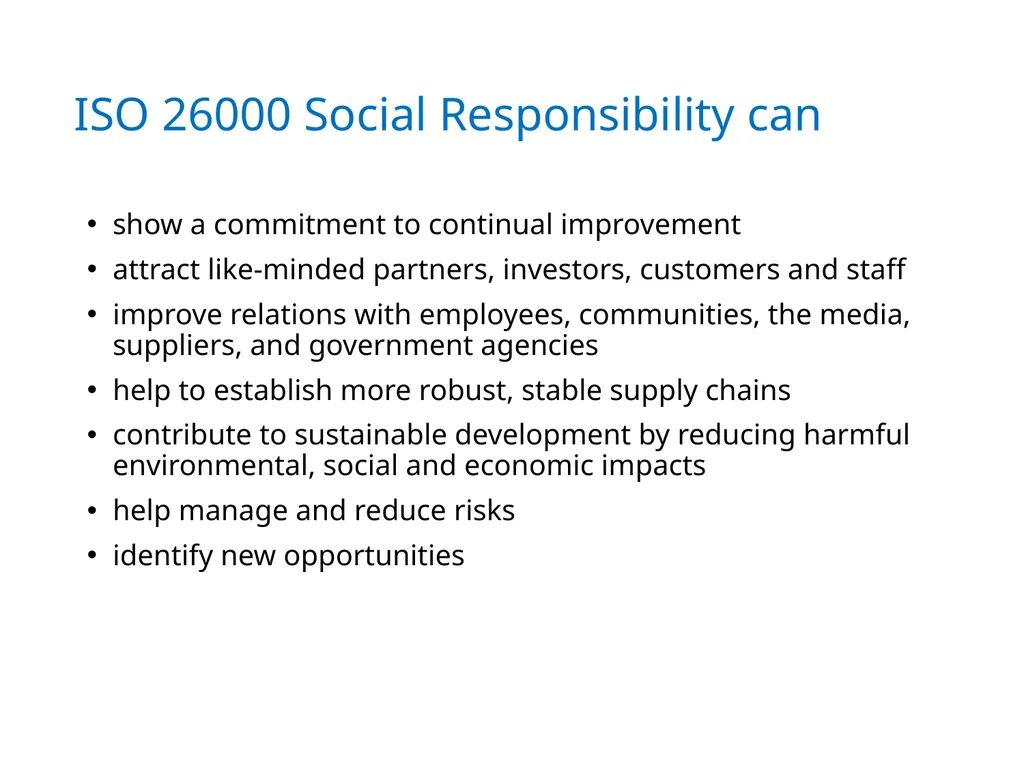
ISO 26000 Social Responsibility can show a commitment to continual improvement
attract like-minded partners, investors, customers and staff
improve relations with employees, communities, the media, suppliers, and government agencies
help to establish more robust, stable supply chains
contribute to sustainable development by reducing harmful environmental, social and economic impacts
help manage and reduce risks
identify new opportunities<br>
attract like-minded partners, investors, customers and staff
improve relations with employees, communities, the media, suppliers, and government agencies
help to establish more robust, stable supply chains
contribute to sustainable development by reducing harmful environmental, social and economic impacts
help manage and reduce risks
identify new opportunities<br>
13
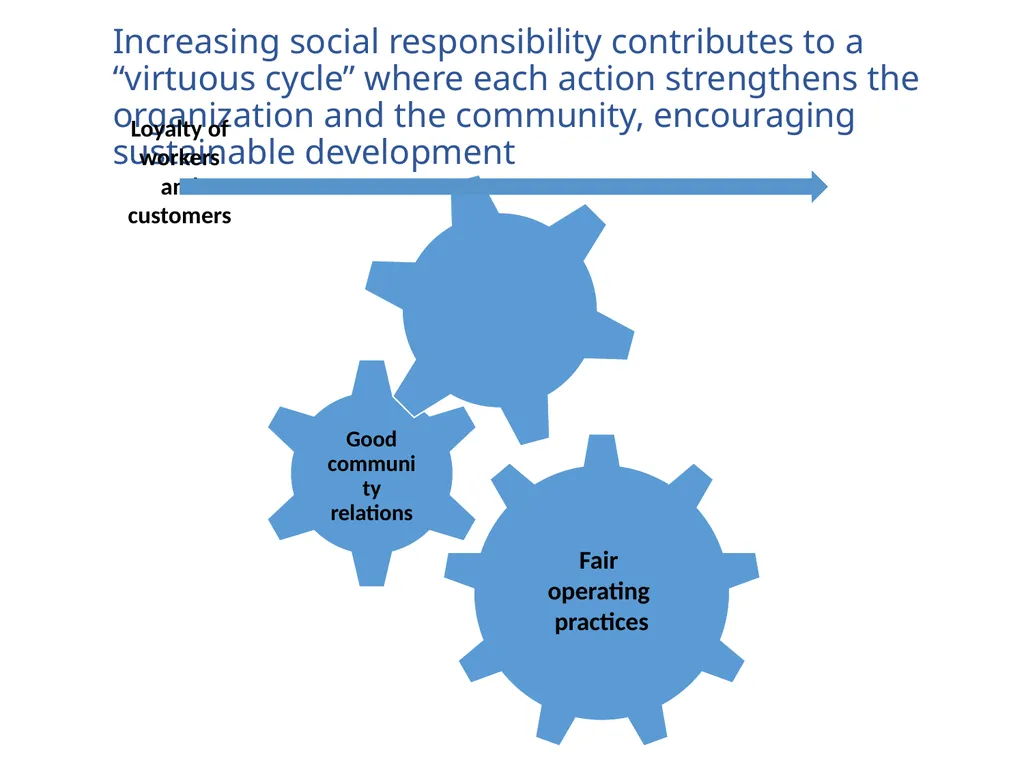
Increasing social responsibility contributes to a “virtuous cycle” where each action strengthens the organization and the community, encouraging sustainable development<br>
14
3. The core content Seven principles
Seven core subjects and their related issues
Stakeholder engagement<br>
Seven core subjects and their related issues
Stakeholder engagement<br>
15
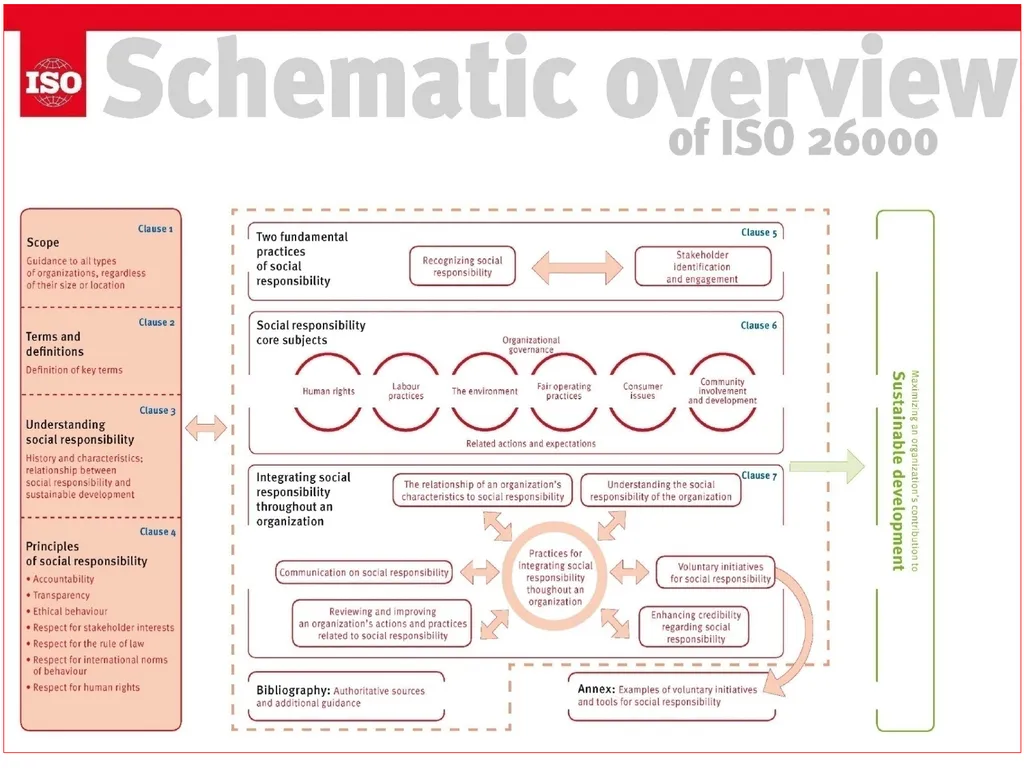
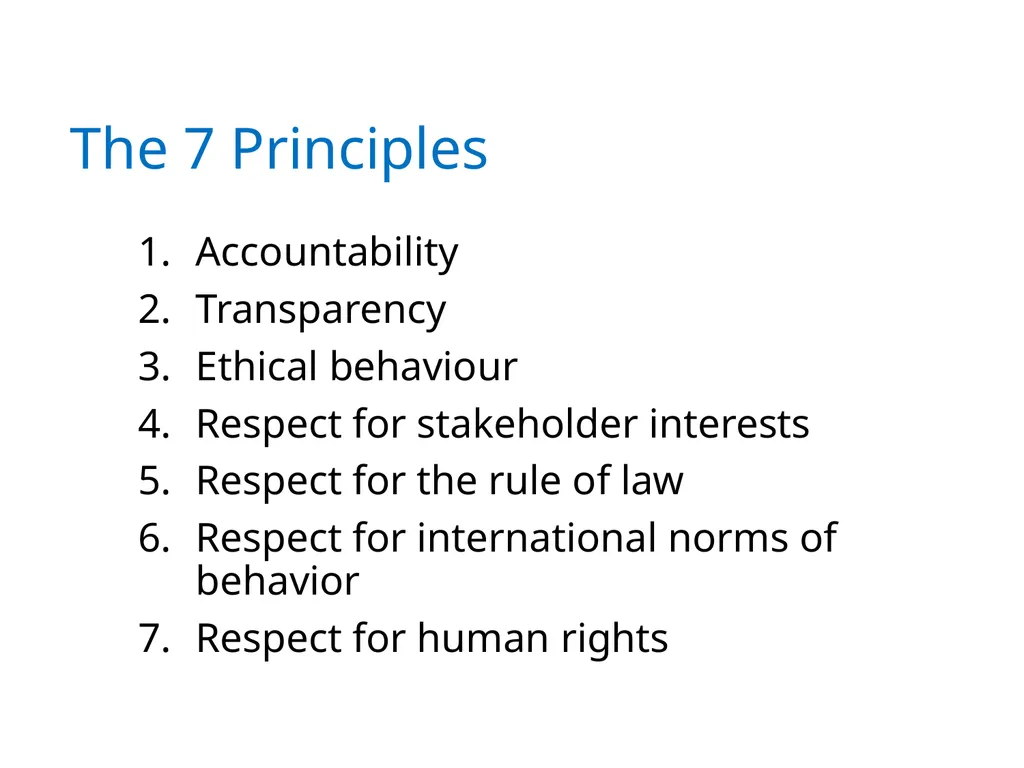
The 7 Principles Accountability
Transparency
Ethical behaviour
Respect for stakeholder interests
Respect for the rule of law
Respect for international norms of behavior
Respect for human rights<br>
Transparency
Ethical behaviour
Respect for stakeholder interests
Respect for the rule of law
Respect for international norms of behavior
Respect for human rights<br>
16
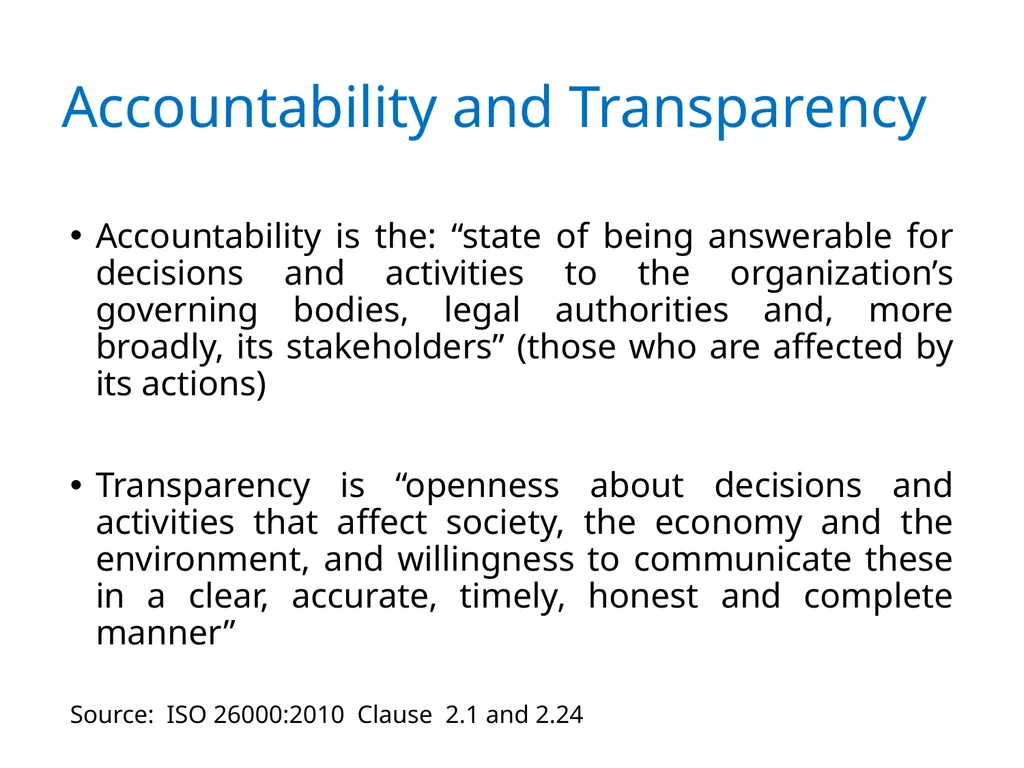
Accountability and Transparency Accountability is the: “state of being answerable for decisions and activities to the organization’s governing bodies, legal authorities and, more broadly, its stakeholders” (those who are affected by its actions)
Transparency is “openness about decisions and activities that affect society, the economy and the environment, and willingness to communicate these in a clear, accurate, timely, honest and complete manner”
Source: ISO 26000:2010 Clause 2.1 and 2.24<br>
Transparency is “openness about decisions and activities that affect society, the economy and the environment, and willingness to communicate these in a clear, accurate, timely, honest and complete manner”
Source: ISO 26000:2010 Clause 2.1 and 2.24<br>
17
Accountability and Transparency involve
taking responsibility for decisions and policies
Accountability and transparency involve the top decision-makers, as well as everyone throughout a chain of command
Leaders need to know and acknowledge who has made what specific decisions<br>
Accountability and transparency involve the top decision-makers, as well as everyone throughout a chain of command
Leaders need to know and acknowledge who has made what specific decisions<br>
18
Principle of Ethical Behaviour Ethical behaviour involves deciding what is the right course of action, day to day
Ethical behavior is defined as “behaviour that is in accordance with accepted principles of right or good conduct in the context of a particular situation…”
Ask yourself: would you be comfortable if your actions were to become public knowledge?
Source: ISO 26000:2010 Clause 2.7<br>
Ethical behavior is defined as “behaviour that is in accordance with accepted principles of right or good conduct in the context of a particular situation…”
Ask yourself: would you be comfortable if your actions were to become public knowledge?
Source: ISO 26000:2010 Clause 2.7<br>
19
Principle of Respect for stakeholder interests This involves identifying groups of stakeholders - those who are affected by your decisions and actions - and responding to their concerns.
It does not mean letting them make your decisions.
Note that, by definition, “social responsibility” is not decided in a vacuum; it always involves reference to the guiding principles, and awareness of impacts on others<br>
It does not mean letting them make your decisions.
Note that, by definition, “social responsibility” is not decided in a vacuum; it always involves reference to the guiding principles, and awareness of impacts on others<br>
20
Principle of Respect for the rule of law “In the context of social responsibility, respect for the rule of law means that an organization complies with all applicable laws and regulations….even if they are not adequately enforced.”
Source: ISO 26000:2010 Clause 4.6<br>
Source: ISO 26000:2010 Clause 4.6<br>
21
Principle of Respect for international norms of behaviour “In situations where the law or its implementation does not provide for adequate environmental or social safeguards, an organization should strive to respect, as a minimum, international norms of behaviour.”
International norms of behavior are “…derived from customary international law, generally accepted principles of international law, or intergovernmental agreements that are universally or nearly universally recognized.”
These can be found in authoritative international instruments from organizations such as the United Nations, International Labour Organization (ILO).
Sources: ISO 26000:2010 Clause 2.11 and 4.7<br>
International norms of behavior are “…derived from customary international law, generally accepted principles of international law, or intergovernmental agreements that are universally or nearly universally recognized.”
These can be found in authoritative international instruments from organizations such as the United Nations, International Labour Organization (ILO).
Sources: ISO 26000:2010 Clause 2.11 and 4.7<br>
22
Principle of Respect for human rights ISO 26000 urges its users to identify the vulnerable populations among its stakeholders, and to work to ensure their fair treatment
“..In situations where human rights are not protected, take steps to respect human rights and avoid taking advantage of these situations…”
Source: ISO 26000:2010 Clause 4.8<br>
“..In situations where human rights are not protected, take steps to respect human rights and avoid taking advantage of these situations…”
Source: ISO 26000:2010 Clause 4.8<br>
23
In summary, the 7 Principles: Establish the underlying framework for socially responsible decision-making
Link each user of ISO 26000 to a global community of those who share the principles
Emphasize that Social Responsibility is a process that develops and evolves with practice<br>
Link each user of ISO 26000 to a global community of those who share the principles
Emphasize that Social Responsibility is a process that develops and evolves with practice<br>
24
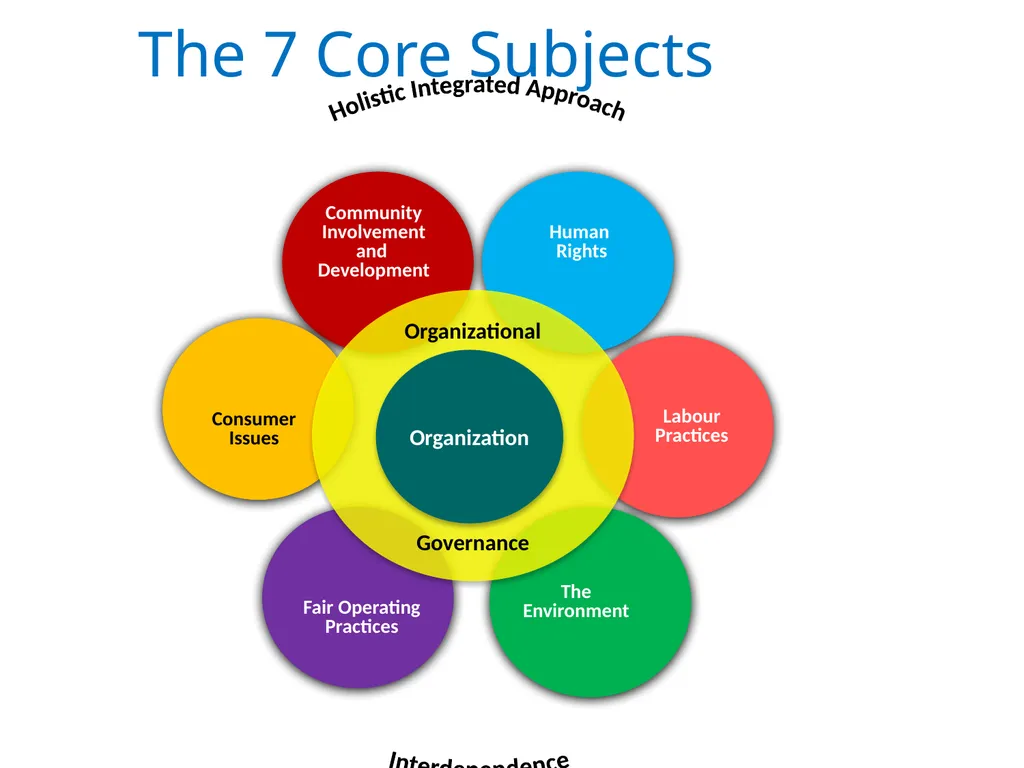
The 7 Core Subjects<br>
25
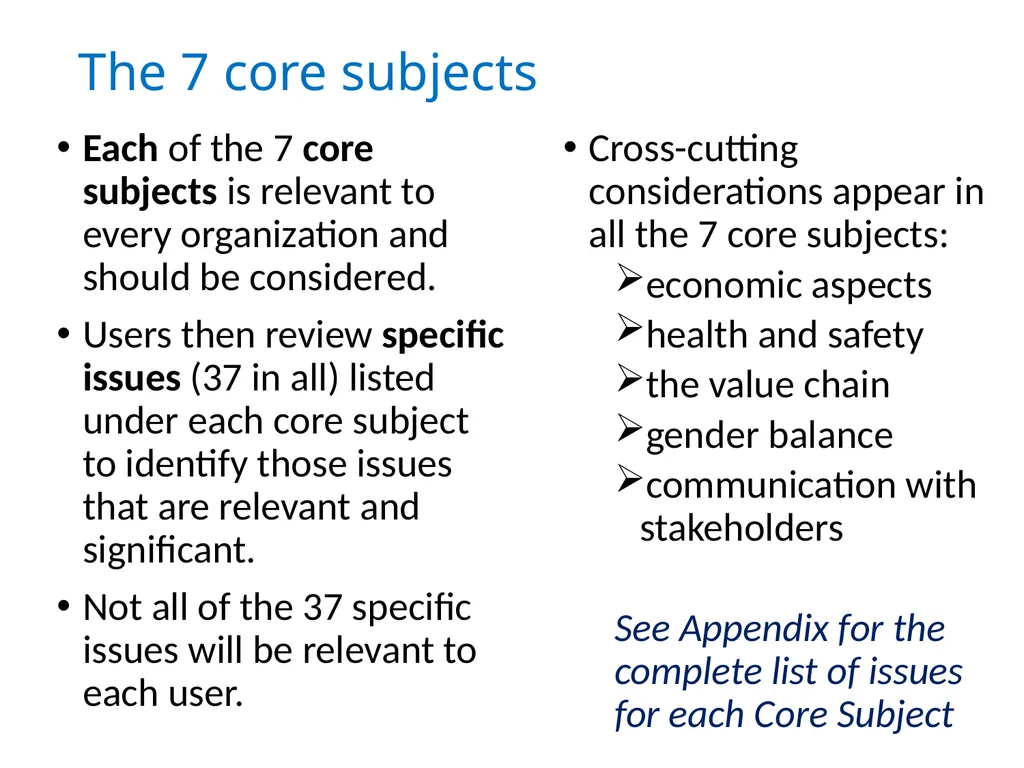
The 7 core subjects Each of the 7 core subjects is relevant to every organization and should be considered.
Users then review specific issues (37 in all) listed under each core subject to identify those issues that are relevant and significant.
Not all of the 37 specific issues will be relevant to each user. Cross-cutting considerations appear in all the 7 core subjects:
economic aspects
health and safety
the value chain
gender balance
communication with stakeholders
See Appendix for the complete list of issues for each Core Subject<br>
Users then review specific issues (37 in all) listed under each core subject to identify those issues that are relevant and significant.
Not all of the 37 specific issues will be relevant to each user. Cross-cutting considerations appear in all the 7 core subjects:
economic aspects
health and safety
the value chain
gender balance
communication with stakeholders
See Appendix for the complete list of issues for each Core Subject<br>
26
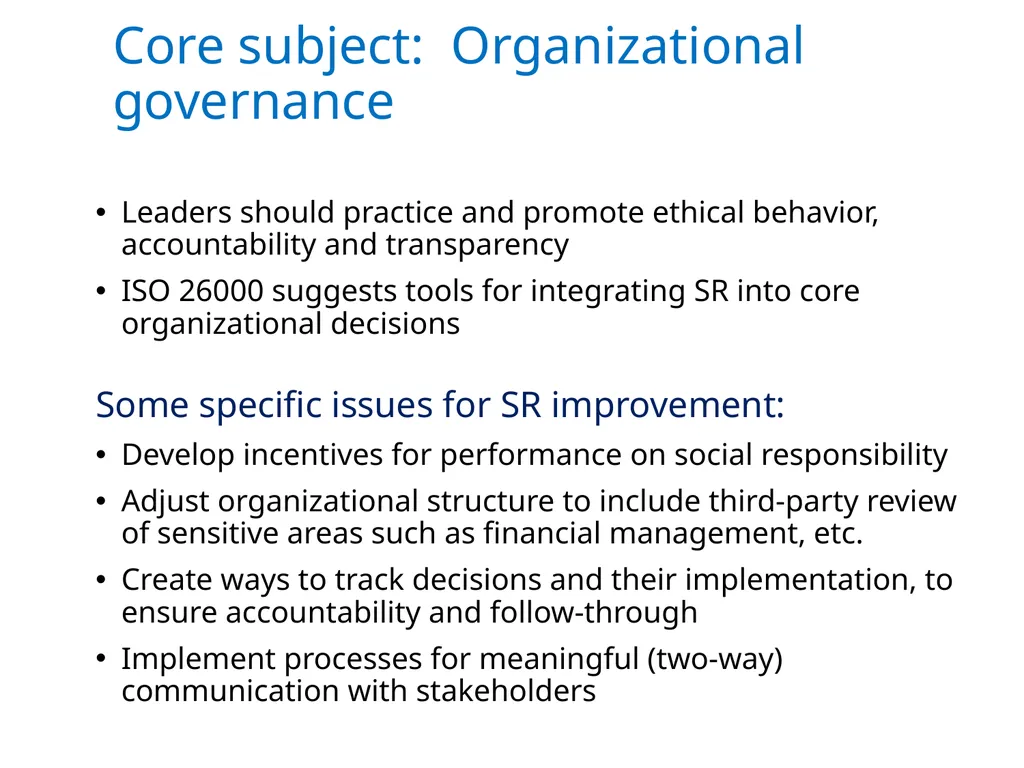
Core subject: Organizational governance Leaders should practice and promote ethical behavior, accountability and transparency
ISO 26000 suggests tools for integrating SR into core organizational decisions
Some specific issues for SR improvement:
Develop incentives for performance on social responsibility
Adjust organizational structure to include third-party review of sensitive areas such as financial management, etc.
Create ways to track decisions and their implementation, to ensure accountability and follow-through
Implement processes for meaningful (two-way) communication with stakeholders<br>
ISO 26000 suggests tools for integrating SR into core organizational decisions
Some specific issues for SR improvement:
Develop incentives for performance on social responsibility
Adjust organizational structure to include third-party review of sensitive areas such as financial management, etc.
Create ways to track decisions and their implementation, to ensure accountability and follow-through
Implement processes for meaningful (two-way) communication with stakeholders<br>
27
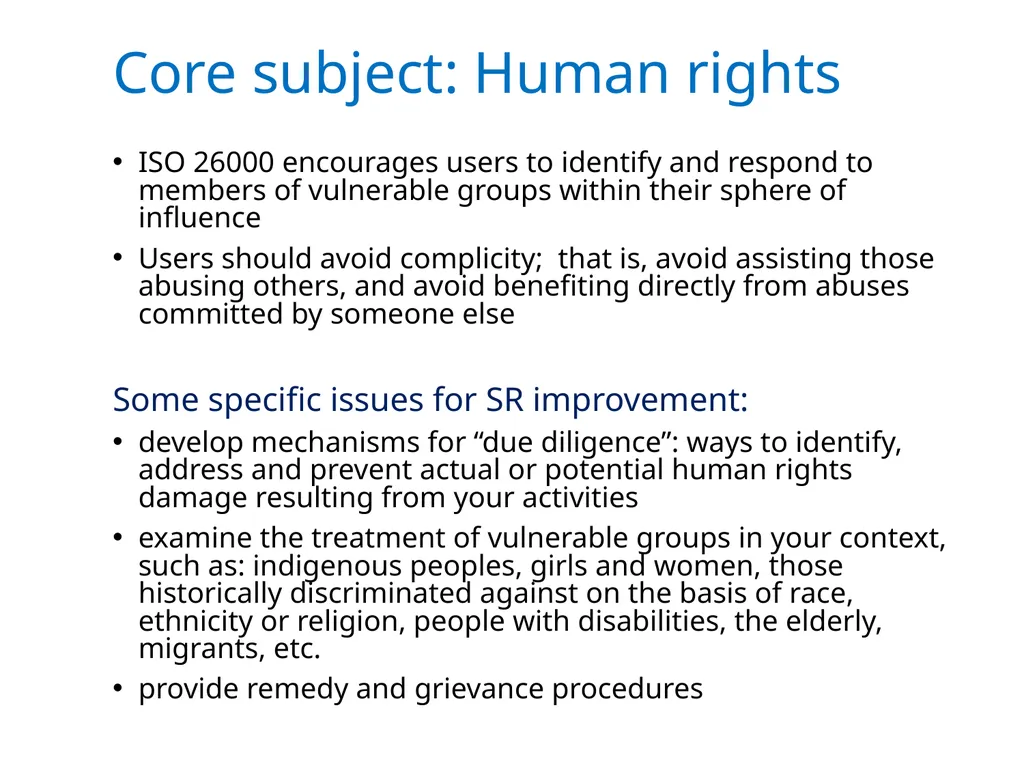
Core subject: Human rights ISO 26000 encourages users to identify and respond to members of vulnerable groups within their sphere of influence
Users should avoid complicity; that is, avoid assisting those abusing others, and avoid benefiting directly from abuses committed by someone else
Some specific issues for SR improvement:
develop mechanisms for “due diligence”: ways to identify, address and prevent actual or potential human rights damage resulting from your activities
examine the treatment of vulnerable groups in your context, such as: indigenous peoples, girls and women, those historically discriminated against on the basis of race, ethnicity or religion, people with disabilities, the elderly, migrants, etc.
provide remedy and grievance procedures<br>
Users should avoid complicity; that is, avoid assisting those abusing others, and avoid benefiting directly from abuses committed by someone else
Some specific issues for SR improvement:
develop mechanisms for “due diligence”: ways to identify, address and prevent actual or potential human rights damage resulting from your activities
examine the treatment of vulnerable groups in your context, such as: indigenous peoples, girls and women, those historically discriminated against on the basis of race, ethnicity or religion, people with disabilities, the elderly, migrants, etc.
provide remedy and grievance procedures<br>
28
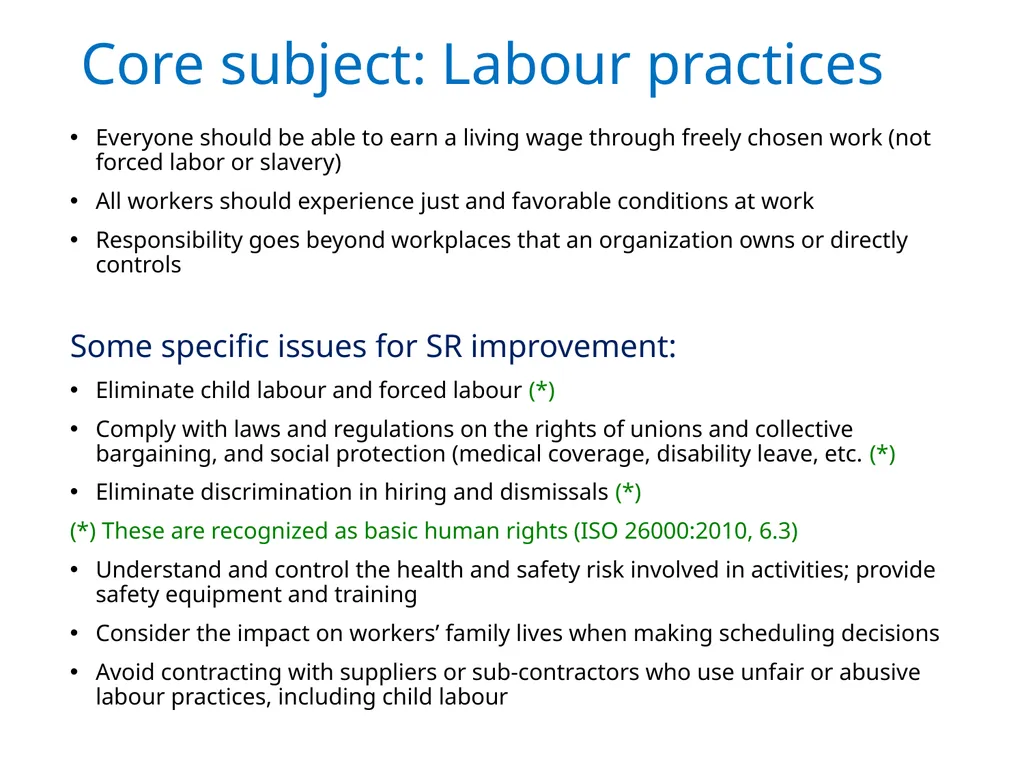
Core subject: Labour practices Everyone should be able to earn a living wage through freely chosen work (not forced labor or slavery)
All workers should experience just and favorable conditions at work
Responsibility goes beyond workplaces that an organization owns or directly controls
Some specific issues for SR improvement:
Eliminate child labour and forced labour (*)
Comply with laws and regulations on the rights of unions and collective bargaining, and social protection (medical coverage, disability leave, etc. (*)
Eliminate discrimination in hiring and dismissals (*)
(*) These are recognized as basic human rights (ISO 26000:2010, 6.3)
Understand and control the health and safety risk involved in activities; provide safety equipment and training
Consider the impact on workers’ family lives when making scheduling decisions
Avoid contracting with suppliers or sub-contractors who use unfair or abusive labour practices, including child labour<br>
All workers should experience just and favorable conditions at work
Responsibility goes beyond workplaces that an organization owns or directly controls
Some specific issues for SR improvement:
Eliminate child labour and forced labour (*)
Comply with laws and regulations on the rights of unions and collective bargaining, and social protection (medical coverage, disability leave, etc. (*)
Eliminate discrimination in hiring and dismissals (*)
(*) These are recognized as basic human rights (ISO 26000:2010, 6.3)
Understand and control the health and safety risk involved in activities; provide safety equipment and training
Consider the impact on workers’ family lives when making scheduling decisions
Avoid contracting with suppliers or sub-contractors who use unfair or abusive labour practices, including child labour<br>
29
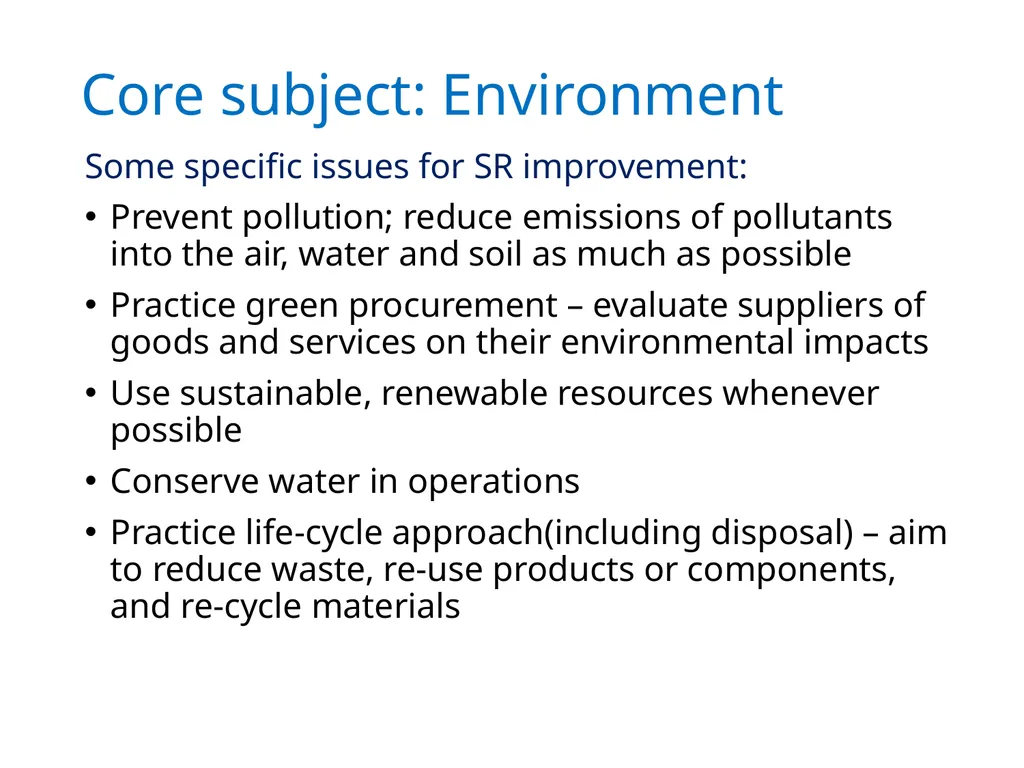
Core subject: Environment Some specific issues for SR improvement:
Prevent pollution; reduce emissions of pollutants into the air, water and soil as much as possible
Practice green procurement – evaluate suppliers of goods and services on their environmental impacts
Use sustainable, renewable resources whenever possible
Conserve water in operations
Practice life-cycle approach(including disposal) – aim to reduce waste, re-use products or components, and re-cycle materials<br>
Prevent pollution; reduce emissions of pollutants into the air, water and soil as much as possible
Practice green procurement – evaluate suppliers of goods and services on their environmental impacts
Use sustainable, renewable resources whenever possible
Conserve water in operations
Practice life-cycle approach(including disposal) – aim to reduce waste, re-use products or components, and re-cycle materials<br>
30
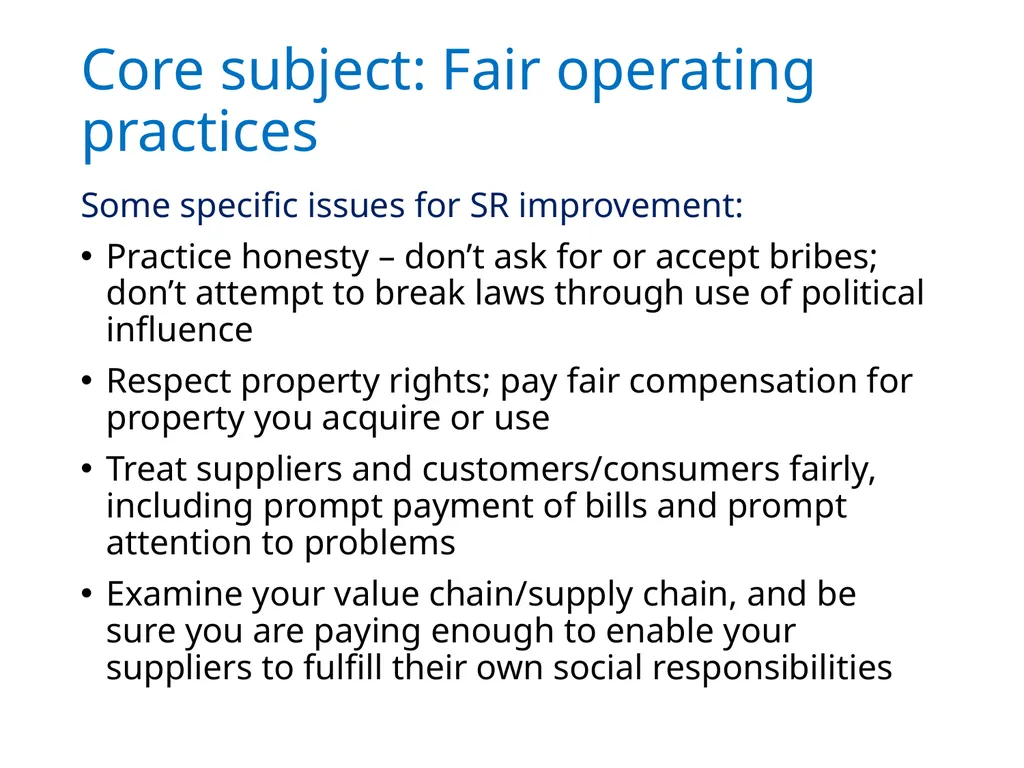
Core subject: Fair operating practices Some specific issues for SR improvement:
Practice honesty – don’t ask for or accept bribes; don’t attempt to break laws through use of political influence
Respect property rights; pay fair compensation for property you acquire or use
Treat suppliers and customers/consumers fairly, including prompt payment of bills and prompt attention to problems
Examine your value chain/supply chain, and be sure you are paying enough to enable your suppliers to fulfill their own social responsibilities<br>
Practice honesty – don’t ask for or accept bribes; don’t attempt to break laws through use of political influence
Respect property rights; pay fair compensation for property you acquire or use
Treat suppliers and customers/consumers fairly, including prompt payment of bills and prompt attention to problems
Examine your value chain/supply chain, and be sure you are paying enough to enable your suppliers to fulfill their own social responsibilities<br>
31
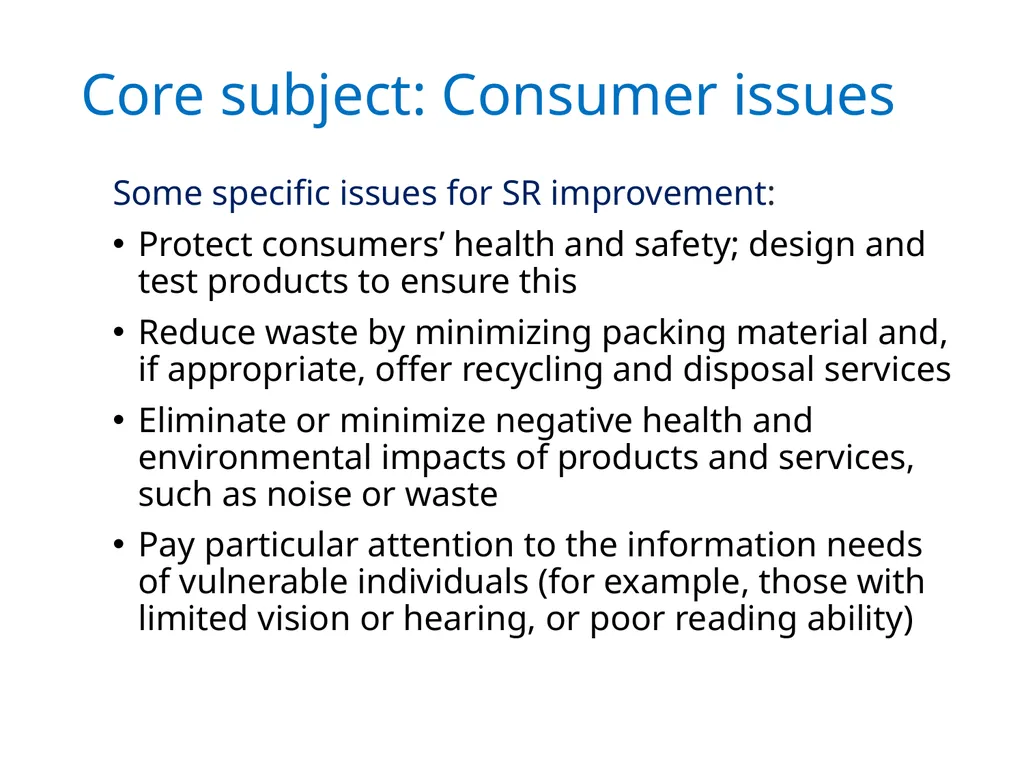
Core subject: Consumer issues Some specific issues for SR improvement:
Protect consumers’ health and safety; design and test products to ensure this
Reduce waste by minimizing packing material and, if appropriate, offer recycling and disposal services
Eliminate or minimize negative health and environmental impacts of products and services, such as noise or waste
Pay particular attention to the information needs of vulnerable individuals (for example, those with limited vision or hearing, or poor reading ability)<br>
Protect consumers’ health and safety; design and test products to ensure this
Reduce waste by minimizing packing material and, if appropriate, offer recycling and disposal services
Eliminate or minimize negative health and environmental impacts of products and services, such as noise or waste
Pay particular attention to the information needs of vulnerable individuals (for example, those with limited vision or hearing, or poor reading ability)<br>
32
Core subject: Community involvement and development Actions that benefit communities - such as job creation, skill development, and provision of health, welfare and other services - should be integrated into the core “business model”
Some specific issues for SR improvement:
Consult directly with community members before designing programs
Focus on increasing local procurement and hiring
When investing in a community, consider the economic, social, and environmental impacts of your investment
Respect the traditional uses of natural resources by local populations, especially indigenous peoples
Fulfill tax and other legal responsibilities as described in law, even when punishments are not likely
Consider “social investment”: programs and infrastructure which will improve quality of life, and which will increase the capacity of the community to develop sustainably<br>
Some specific issues for SR improvement:
Consult directly with community members before designing programs
Focus on increasing local procurement and hiring
When investing in a community, consider the economic, social, and environmental impacts of your investment
Respect the traditional uses of natural resources by local populations, especially indigenous peoples
Fulfill tax and other legal responsibilities as described in law, even when punishments are not likely
Consider “social investment”: programs and infrastructure which will improve quality of life, and which will increase the capacity of the community to develop sustainably<br>
33
A note: “Community involvement and development” is different from philanthropy Philanthropic giving is an important element of SR use of wealth, in many cultures. However, philanthropy is basically “top down” (the giver decides what projects and programs to fund).
SR in the ISO 26000 context should encourage reciprocity – benefits and obligations for all involved – rather than exalting “givers” and treating “receivers” as dependants
This is also an important point for charitable organizations to keep in mind, as their recipients are also some of their stakeholders.<br>
SR in the ISO 26000 context should encourage reciprocity – benefits and obligations for all involved – rather than exalting “givers” and treating “receivers” as dependants
This is also an important point for charitable organizations to keep in mind, as their recipients are also some of their stakeholders.<br>
34
Stakeholder engagement and communication: a crucial component “Stakeholder identification and engagement are central to addressing an organization’s social responsibility.” (ISO 26000:2010 Clause 5.3)
Communication establishes channels for exchanging knowledge, suggestions, complaints and ideas for solutions.
Identifying stakeholders and developing channels of communication with them is one of the most rewarding and most challenging parts of Social Responsibility.
Start to communicate respect and willingness to engage before a crisis emerges.
The goal is to build trust and credibility for the long term, not to find “quick fixes” for problems.<br>
Communication establishes channels for exchanging knowledge, suggestions, complaints and ideas for solutions.
Identifying stakeholders and developing channels of communication with them is one of the most rewarding and most challenging parts of Social Responsibility.
Start to communicate respect and willingness to engage before a crisis emerges.
The goal is to build trust and credibility for the long term, not to find “quick fixes” for problems.<br>
35
What is meant by the term “stakeholder”? ISO 26000 defines a “stakeholder” as “an individual or group that has an interest in any decision or activity of an organization.”
“Stakeholder engagement” is defined as “activity undertaken to create opportunities for dialogue between an organization and one or more of its stakeholders, with the aim of providing an informed basis for the organization’s decisions.”
Source: ISO 26000:2010, Clause 2.20; 2.21<br>
“Stakeholder engagement” is defined as “activity undertaken to create opportunities for dialogue between an organization and one or more of its stakeholders, with the aim of providing an informed basis for the organization’s decisions.”
Source: ISO 26000:2010, Clause 2.20; 2.21<br>
36
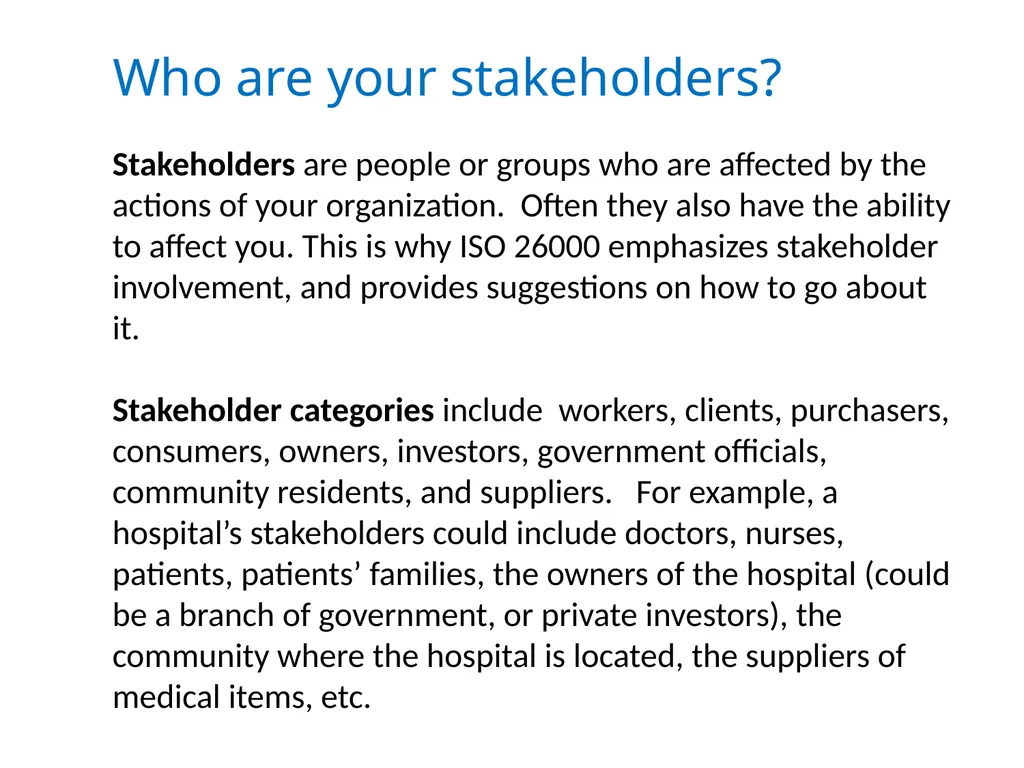
Who are your stakeholders? Stakeholders are people or groups who are affected by the actions of your organization. Often they also have the ability to affect you. This is why ISO 26000 emphasizes stakeholder involvement, and provides suggestions on how to go about it.
Stakeholder categories include workers, clients, purchasers, consumers, owners, investors, government officials, community residents, and suppliers. For example, a hospital’s stakeholders could include doctors, nurses, patients, patients’ families, the owners of the hospital (could be a branch of government, or private investors), the community where the hospital is located, the suppliers of medical items, etc.<br>
Stakeholder categories include workers, clients, purchasers, consumers, owners, investors, government officials, community residents, and suppliers. For example, a hospital’s stakeholders could include doctors, nurses, patients, patients’ families, the owners of the hospital (could be a branch of government, or private investors), the community where the hospital is located, the suppliers of medical items, etc.<br>
37
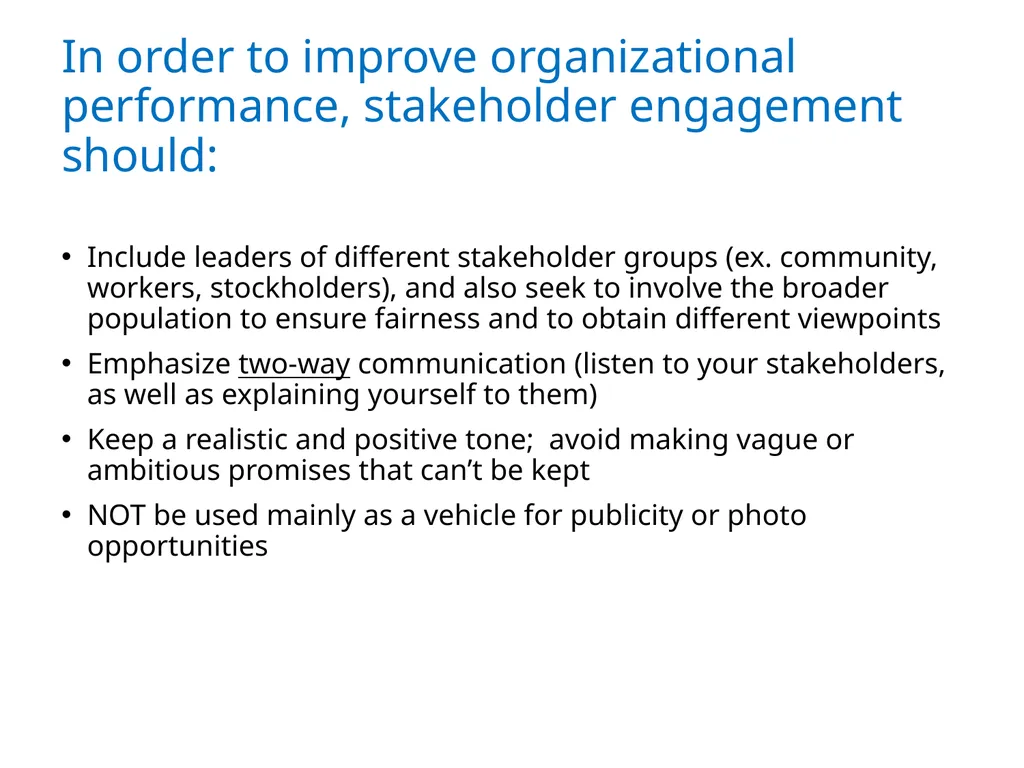
In order to improve organizational performance, stakeholder engagement should: Include leaders of different stakeholder groups (ex. community, workers, stockholders), and also seek to involve the broader population to ensure fairness and to obtain different viewpoints
Emphasize two-way communication (listen to your stakeholders, as well as explaining yourself to them)
Keep a realistic and positive tone; avoid making vague or ambitious promises that can’t be kept
NOT be used mainly as a vehicle for publicity or photo opportunities<br>
Emphasize two-way communication (listen to your stakeholders, as well as explaining yourself to them)
Keep a realistic and positive tone; avoid making vague or ambitious promises that can’t be kept
NOT be used mainly as a vehicle for publicity or photo opportunities<br>
38
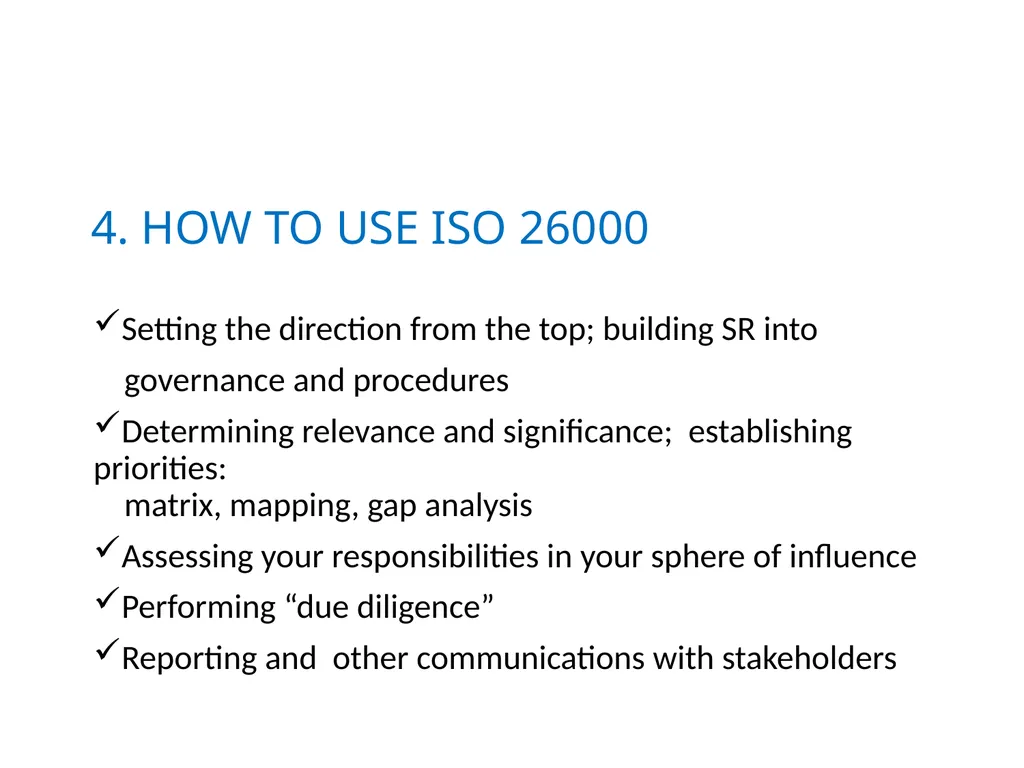
4. HOW TO USE ISO 26000 Setting the direction from the top; building SR into
governance and procedures
Determining relevance and significance; establishing priorities: matrix, mapping, gap analysis
Assessing your responsibilities in your sphere of influence
Performing “due diligence”
Reporting and other communications with stakeholders<br>
governance and procedures
Determining relevance and significance; establishing priorities: matrix, mapping, gap analysis
Assessing your responsibilities in your sphere of influence
Performing “due diligence”
Reporting and other communications with stakeholders<br>
39
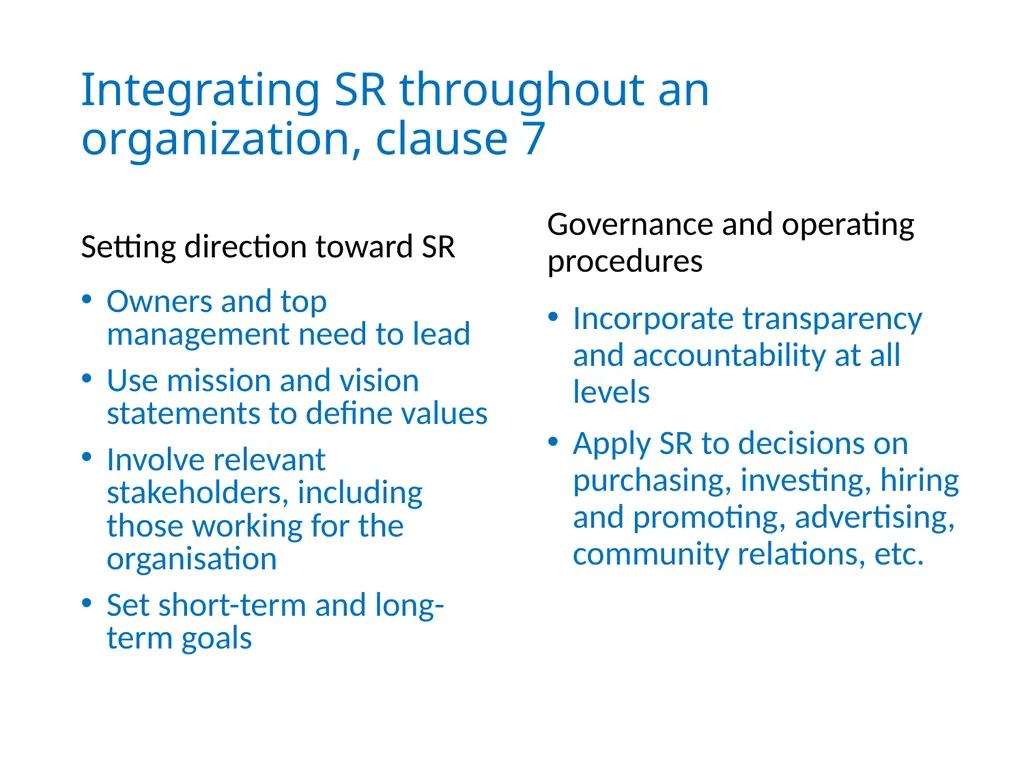
Integrating SR throughout an organization, clause 7 Setting direction toward SR Governance and operating procedures Owners and top management need to lead
Use mission and vision statements to define values
Involve relevant stakeholders, including those working for the organisation
Set short-term and long-term goals Incorporate transparency and accountability at all levels
Apply SR to decisions on purchasing, investing, hiring and promoting, advertising, community relations, etc.<br>
Use mission and vision statements to define values
Involve relevant stakeholders, including those working for the organisation
Set short-term and long-term goals Incorporate transparency and accountability at all levels
Apply SR to decisions on purchasing, investing, hiring and promoting, advertising, community relations, etc.<br>
40
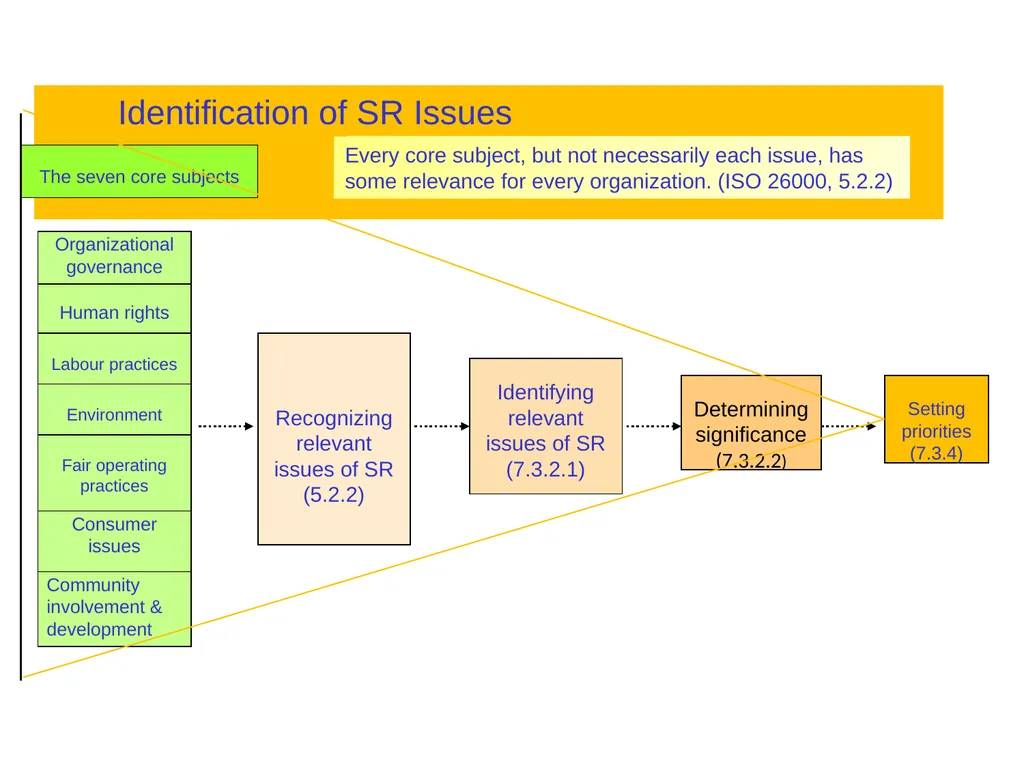
Identification of SR Issues
(ISO 26000 Clauses 5.2.2, 7.3.2, 7.3.4) The seven core subjects Determining significance
(7.3.2.2) Setting priorities
(7.3.4) Human rights Organizational governance Labour practices Environment Fair operating practices Consumer issues Community involvement & development Identifying relevant issues of SR
(7.3.2.1) Every core subject, but not necessarily each issue, has some relevance for every organization. (ISO 26000, 5.2.2) Recognizing relevant issues of SR
(5.2.2)<br>
(ISO 26000 Clauses 5.2.2, 7.3.2, 7.3.4) The seven core subjects Determining significance
(7.3.2.2) Setting priorities
(7.3.4) Human rights Organizational governance Labour practices Environment Fair operating practices Consumer issues Community involvement & development Identifying relevant issues of SR
(7.3.2.1) Every core subject, but not necessarily each issue, has some relevance for every organization. (ISO 26000, 5.2.2) Recognizing relevant issues of SR
(5.2.2)<br>
41
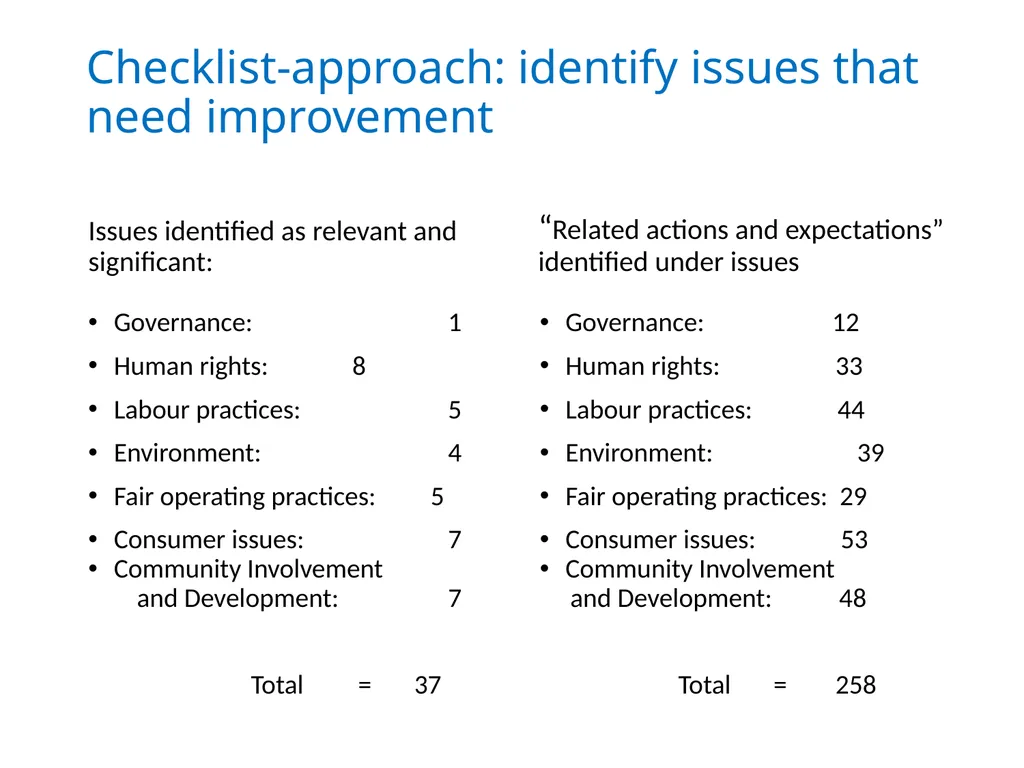
Checklist-approach: identify issues that need improvement Issues identified as relevant and significant: “Related actions and expectations” identified under issues Governance: 1
Human rights: 8
Labour practices: 5
Environment: 4
Fair operating practices: 5
Consumer issues: 7
Community Involvement
and Development: 7
Total = 37 Governance: 12
Human rights: 33
Labour practices: 44
Environment: 39
Fair operating practices: 29
Consumer issues: 53
Community Involvement
and Development: 48
Total = 258<br>
Human rights: 8
Labour practices: 5
Environment: 4
Fair operating practices: 5
Consumer issues: 7
Community Involvement
and Development: 7
Total = 37 Governance: 12
Human rights: 33
Labour practices: 44
Environment: 39
Fair operating practices: 29
Consumer issues: 53
Community Involvement
and Development: 48
Total = 258<br>
42
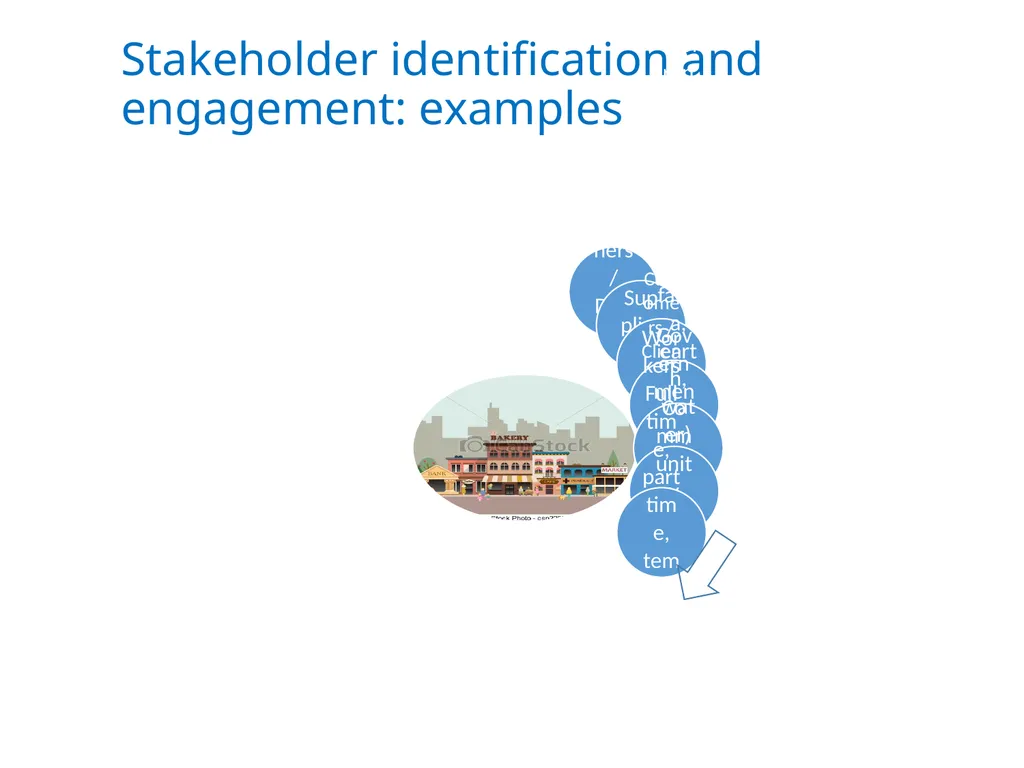
Stakeholder identification and engagement: examples<br>
43
Who are your stakeholders? These are some questions to help you identify them. To whom does your organization have legal obligations?
Who might be positively or negatively affected by your decisions or activities?
Who would be disadvantaged if excluded from the engagement?
Who in your value chain is affected?
Who is likely to express concerns about the decisions and activities of the organization?
Who can help the organization address specific impacts?<br>
Who might be positively or negatively affected by your decisions or activities?
Who would be disadvantaged if excluded from the engagement?
Who in your value chain is affected?
Who is likely to express concerns about the decisions and activities of the organization?
Who can help the organization address specific impacts?<br>
44
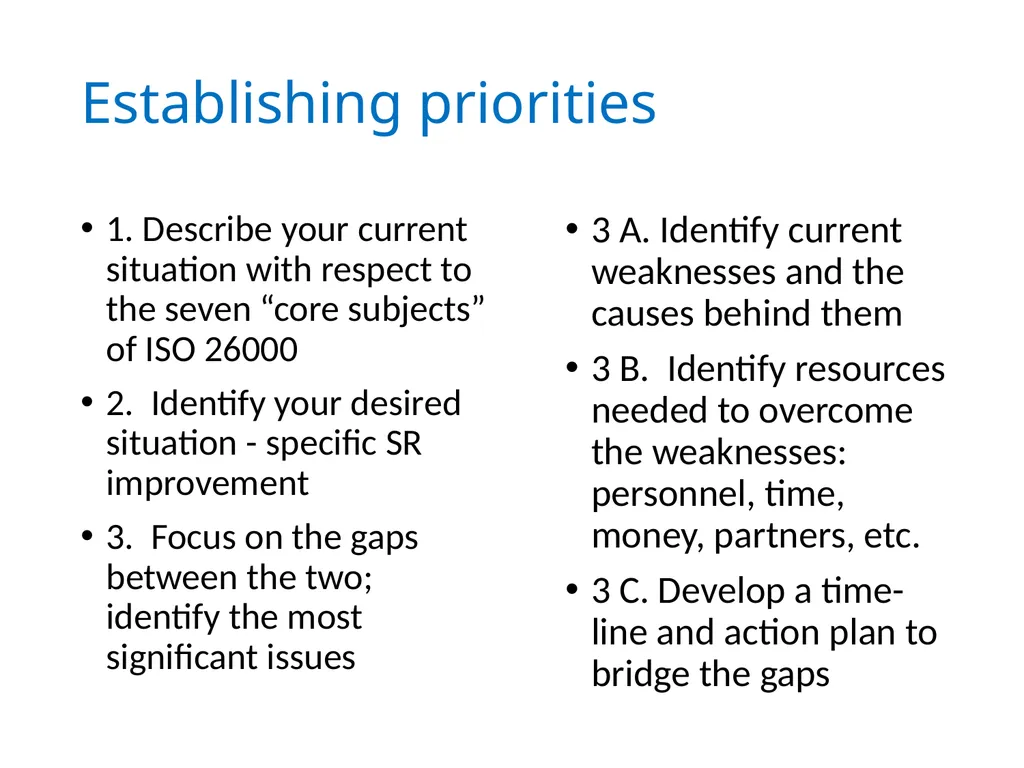
Establishing priorities 1. Describe your current situation with respect to the seven “core subjects” of ISO 26000
2. Identify your desired situation - specific SR improvement
3. Focus on the gaps between the two; identify the most significant issues 3 A. Identify current weaknesses and the causes behind them
3 B. Identify resources needed to overcome the weaknesses: personnel, time, money, partners, etc.
3 C. Develop a time-line and action plan to bridge the gaps<br>
2. Identify your desired situation - specific SR improvement
3. Focus on the gaps between the two; identify the most significant issues 3 A. Identify current weaknesses and the causes behind them
3 B. Identify resources needed to overcome the weaknesses: personnel, time, money, partners, etc.
3 C. Develop a time-line and action plan to bridge the gaps<br>
45
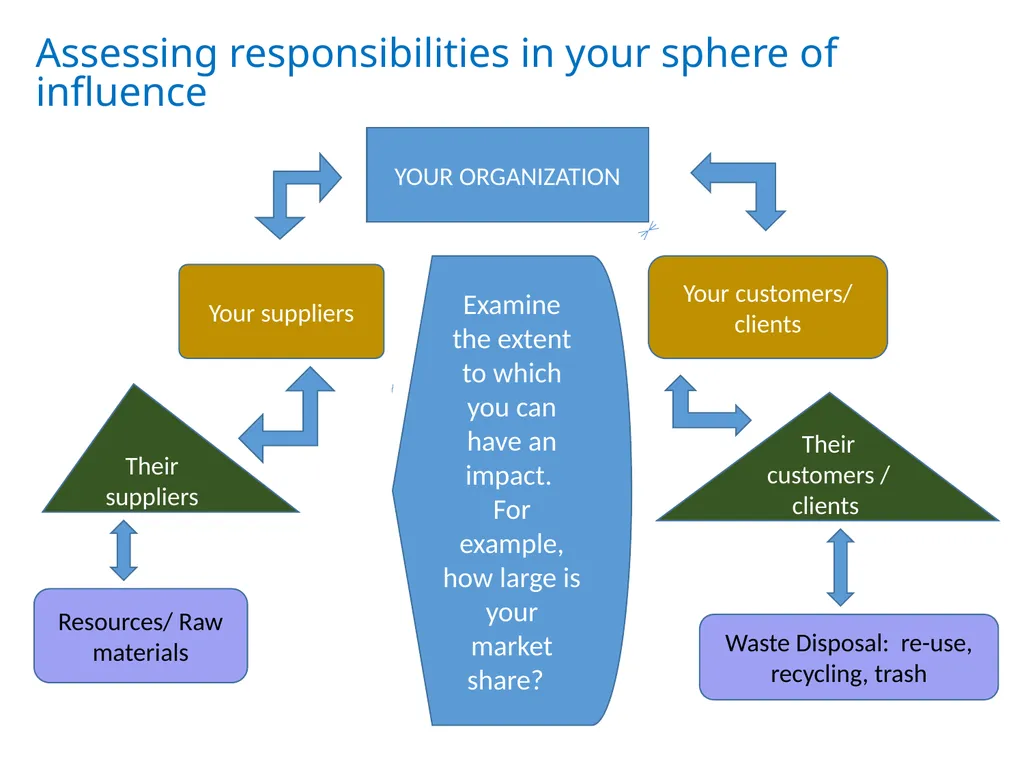
Assessing responsibilities in your sphere of influence YOUR ORGANIZATION Your suppliers Their suppliers Their customers / clients Your customers/ clients Resources/ Raw materials Waste Disposal: re-use, recycling, trash Examine the extent to which you can have an impact.
For example, how large is your market share?<br>
For example, how large is your market share?<br>
46
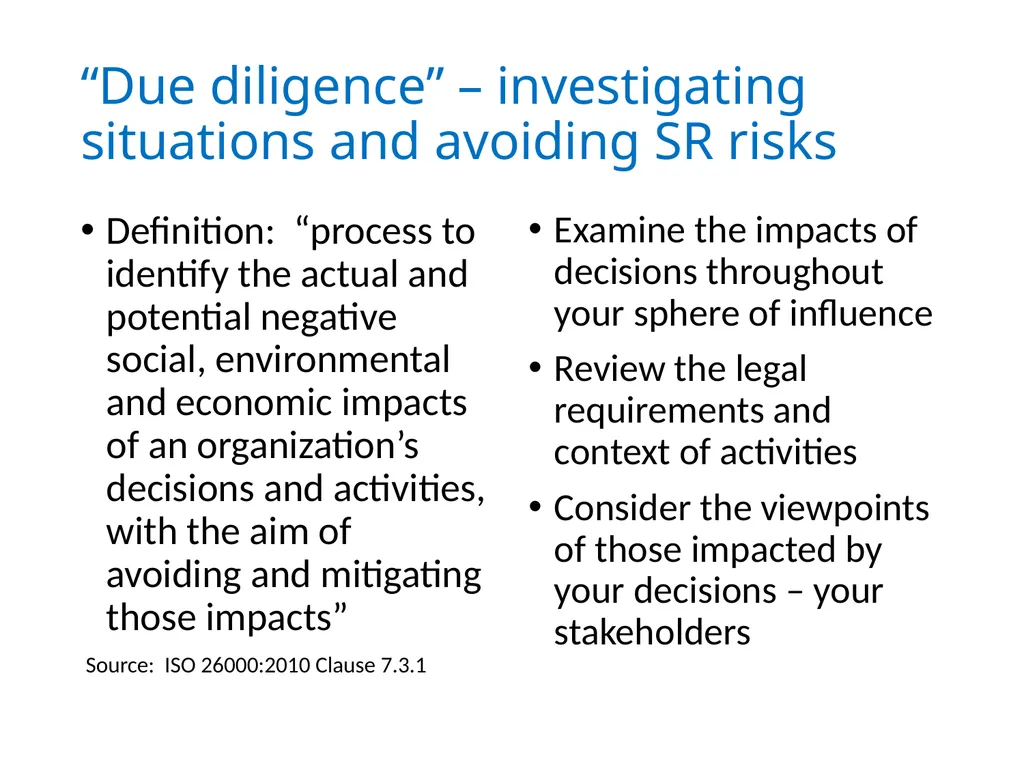
“Due diligence” – investigating situations and avoiding SR risks Definition: “process to identify the actual and potential negative social, environmental and economic impacts of an organization’s decisions and activities, with the aim of avoiding and mitigating those impacts”
Source: ISO 26000:2010 Clause 7.3.1 Examine the impacts of decisions throughout your sphere of influence
Review the legal requirements and context of activities
Consider the viewpoints of those impacted by your decisions – your stakeholders<br>
Source: ISO 26000:2010 Clause 7.3.1 Examine the impacts of decisions throughout your sphere of influence
Review the legal requirements and context of activities
Consider the viewpoints of those impacted by your decisions – your stakeholders<br>
47
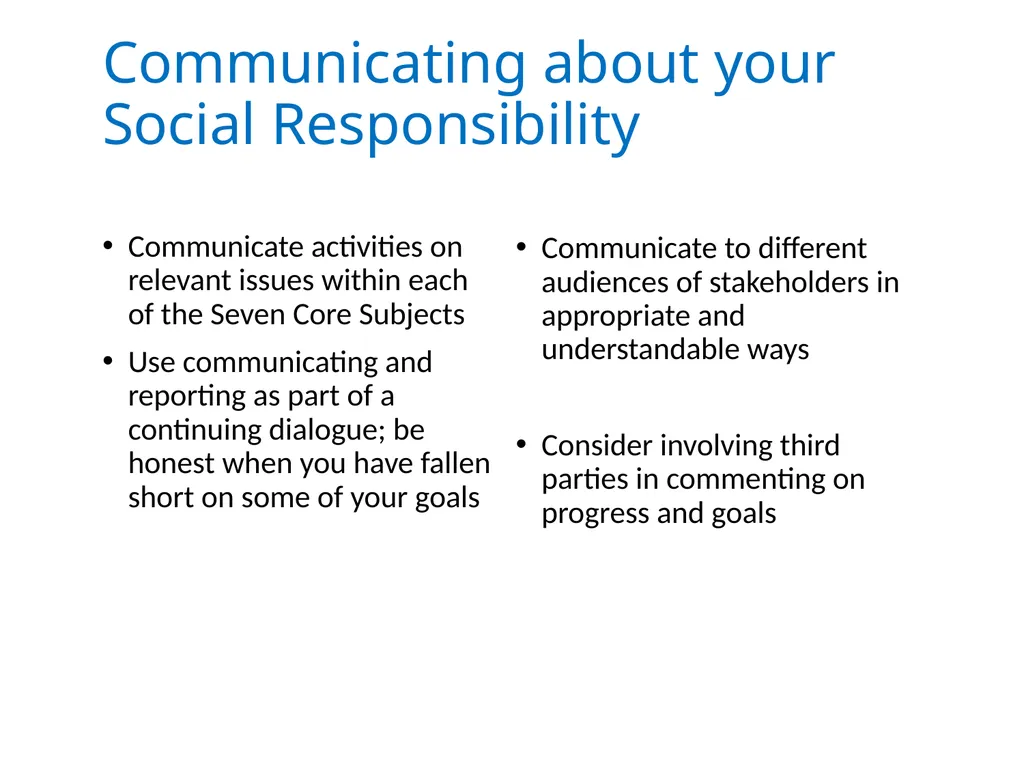
Communicating about your Social Responsibility Communicate activities on relevant issues within each of the Seven Core Subjects
Use communicating and reporting as part of a continuing dialogue; be honest when you have fallen short on some of your goals Communicate to different audiences of stakeholders in appropriate and understandable ways
Consider involving third parties in commenting on progress and goals<br>
Use communicating and reporting as part of a continuing dialogue; be honest when you have fallen short on some of your goals Communicate to different audiences of stakeholders in appropriate and understandable ways
Consider involving third parties in commenting on progress and goals<br>
48
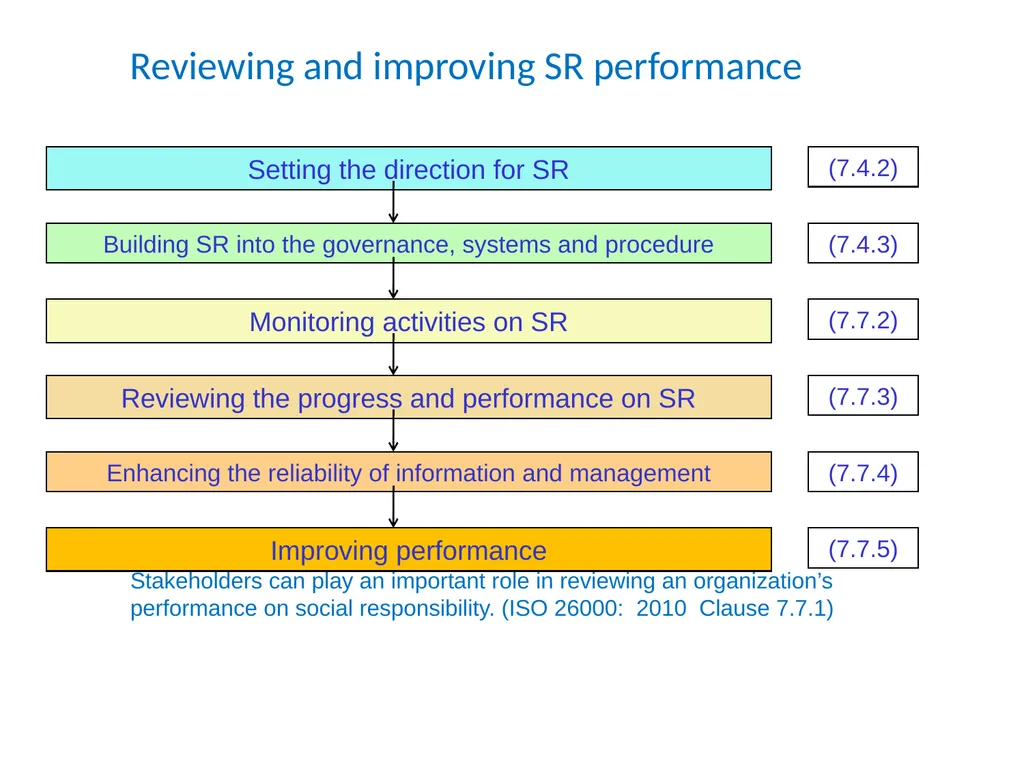
Setting the direction for SR Building SR into the governance, systems and procedure Monitoring activities on SR Reviewing the progress and performance on SR Improving performance (7.4.2) (7.4.3) (7.7.2) (7.7.3) (7.7.5) Enhancing the reliability of information and management (7.7.4) Reviewing and improving SR performance
Stakeholders can play an important role in reviewing an organization’s performance on social responsibility. (ISO 26000: 2010 Clause 7.7.1)<br>
Stakeholders can play an important role in reviewing an organization’s performance on social responsibility. (ISO 26000: 2010 Clause 7.7.1)<br>
49
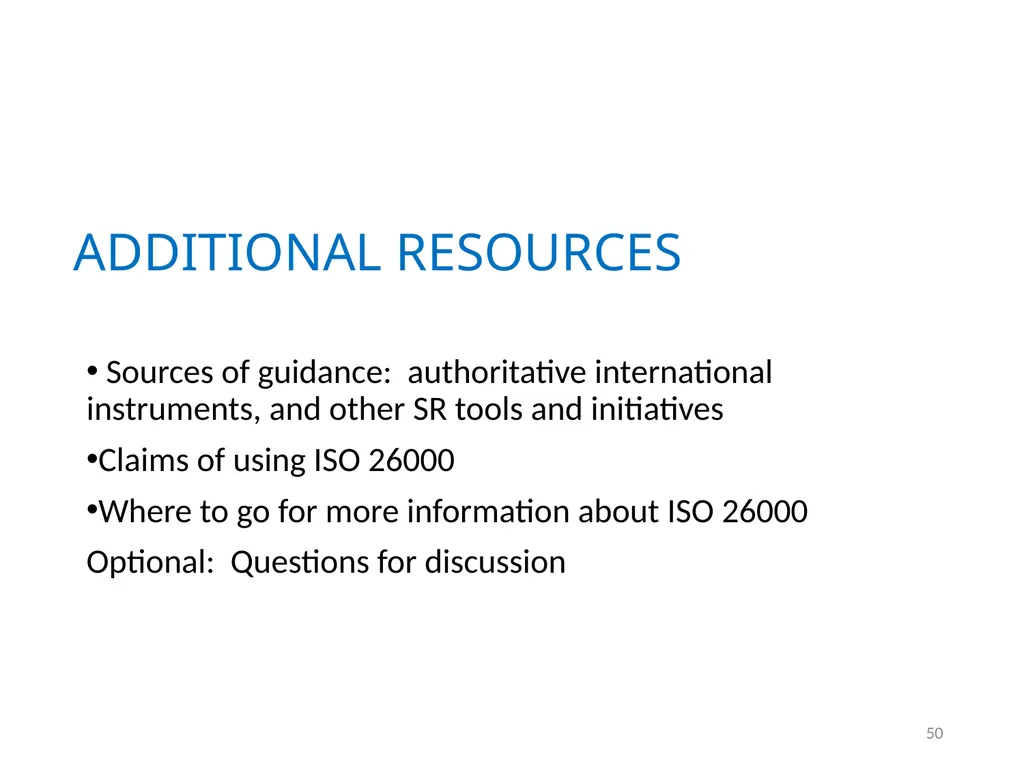
ADDITIONAL RESOURCES Sources of guidance: authoritative international instruments, and other SR tools and initiatives
Claims of using ISO 26000
Where to go for more information about ISO 26000
Optional: Questions for discussion 50<br>
Claims of using ISO 26000
Where to go for more information about ISO 26000
Optional: Questions for discussion 50<br>
50
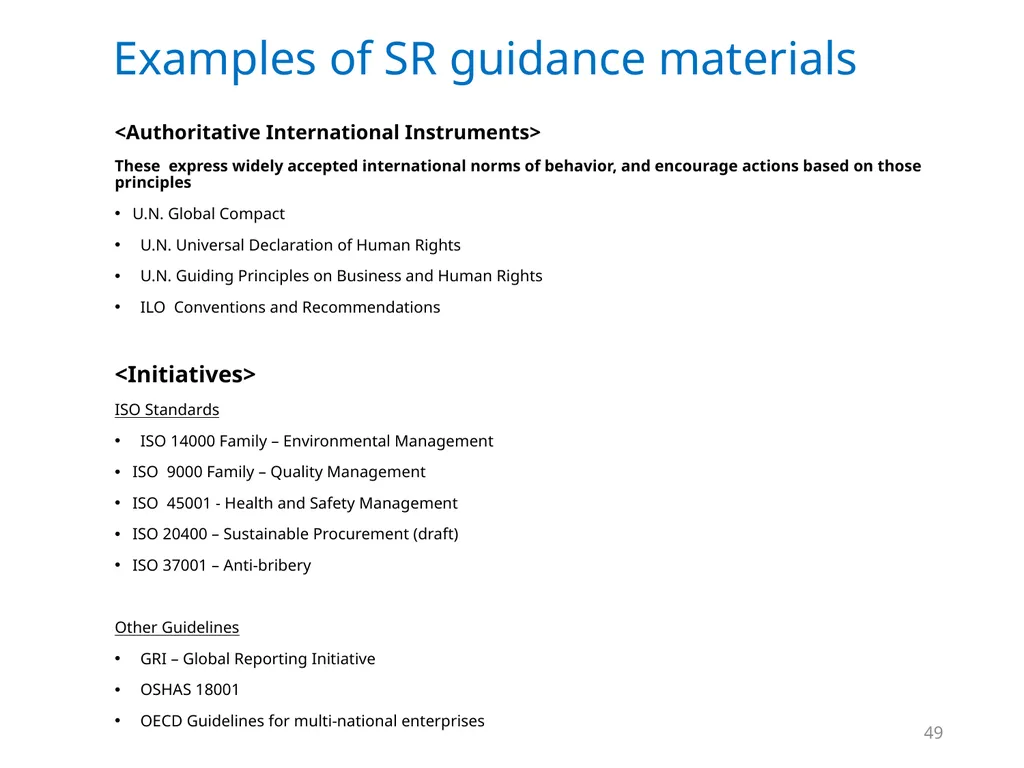
Examples of SR guidance materials 49 <Authoritative International Instruments>
These express widely accepted international norms of behavior, and encourage actions based on those principles
U.N. Global Compact
U.N. Universal Declaration of Human Rights
U.N. Guiding Principles on Business and Human Rights
ILO Conventions and Recommendations
<Initiatives>
ISO Standards
ISO 14000 Family – Environmental Management
ISO 9000 Family – Quality Management
ISO 45001 - Health and Safety Management
ISO 20400 – Sustainable Procurement (draft)
ISO 37001 – Anti-bribery
Other Guidelines
GRI – Global Reporting Initiative
OSHAS 18001
OECD Guidelines for multi-national enterprises<br>
These express widely accepted international norms of behavior, and encourage actions based on those principles
U.N. Global Compact
U.N. Universal Declaration of Human Rights
U.N. Guiding Principles on Business and Human Rights
ILO Conventions and Recommendations
<Initiatives>
ISO Standards
ISO 14000 Family – Environmental Management
ISO 9000 Family – Quality Management
ISO 45001 - Health and Safety Management
ISO 20400 – Sustainable Procurement (draft)
ISO 37001 – Anti-bribery
Other Guidelines
GRI – Global Reporting Initiative
OSHAS 18001
OECD Guidelines for multi-national enterprises<br>
51
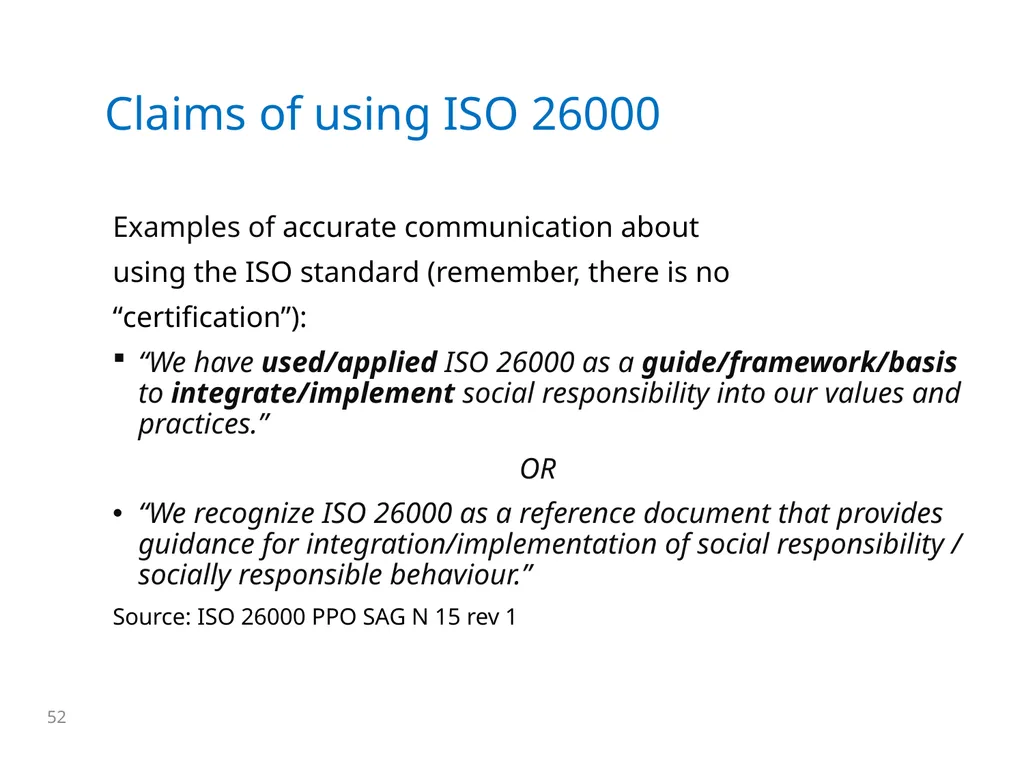
Claims of using ISO 26000 52 Examples of accurate communication about
using the ISO standard (remember, there is no
“certification”):
“We have used/applied ISO 26000 as a guide/framework/basis to integrate/implement social responsibility into our values and practices.”
OR
“We recognize ISO 26000 as a reference document that provides guidance for integration/implementation of social responsibility / socially responsible behaviour.”
Source: ISO 26000 PPO SAG N 15 rev 1<br>
using the ISO standard (remember, there is no
“certification”):
“We have used/applied ISO 26000 as a guide/framework/basis to integrate/implement social responsibility into our values and practices.”
OR
“We recognize ISO 26000 as a reference document that provides guidance for integration/implementation of social responsibility / socially responsible behaviour.”
Source: ISO 26000 PPO SAG N 15 rev 1<br>
52
Where to obtain ISO 26000 and other resources 53 General information about ISO 26000 can be obtained from the ISO SR website www.iso.org/sr
ISO 26000 is available in over 30 languages, including Arabic, Chinese, English, Farsi, French, German, Hebrew, Japanese, Portuguese, Russian, Spanish, Vietnamese…
ISO 26000 may be purchased from ISO’s national member bodies, which are listed with full contact details on the ISO website at www.iso.org
ISO 26000 can also be purchased from the ISO webstore on ISO’s website at www.iso.org<br>
ISO 26000 is available in over 30 languages, including Arabic, Chinese, English, Farsi, French, German, Hebrew, Japanese, Portuguese, Russian, Spanish, Vietnamese…
ISO 26000 may be purchased from ISO’s national member bodies, which are listed with full contact details on the ISO website at www.iso.org
ISO 26000 can also be purchased from the ISO webstore on ISO’s website at www.iso.org<br>
53
Optional: Questions for Discussion
Discuss arguments and examples that both support and oppose each statement. There is no “right” or “wrong”.
This can work well when participants divide into small groups. 55 (1) SR only makes sense when there is a clear “business case” - economic justification in terms of increased profit.
(2) SR encourages companies and other organisations to take on the obligations and responsibilities that should be done by governments.
(3) Anyone can become more Socially Responsible even when some others in their sphere of influence - e.g. suppliers, communities, customers, workers - are not.
(4) Integrating ISO 26000 with the operations of an organization is challenging, but not impossible.<br>
(2) SR encourages companies and other organisations to take on the obligations and responsibilities that should be done by governments.
(3) Anyone can become more Socially Responsible even when some others in their sphere of influence - e.g. suppliers, communities, customers, workers - are not.
(4) Integrating ISO 26000 with the operations of an organization is challenging, but not impossible.<br>
54
Appendix More about ISO
More about the multi-stakeholder process of the Working Group on Social Responsibility that developed ISO 26000
More about the Core Subjects: complete list of issues 55<br>
More about the multi-stakeholder process of the Working Group on Social Responsibility that developed ISO 26000
More about the Core Subjects: complete list of issues 55<br>
55
More about ISO, www.iso.org 56 The International Organization for Standardization (ISO) is an independent, non-governmental membership organization, and the world’s largest developer of voluntary International Standards, based on global and market relevance
Founded in 1947, ISO now has more than 160 members, one per member country (National Standards Bodies (NSBs)) coordinated by a Central Secretariat based in Geneva Switzerland. About 75% of ISO members today are NSBs of developing countries.
ISO standards (now over 20,000) are designed to encourage international trade, safety and quality in creation and production of goods and services.
There are different types of ISO standards, e.g. specifications, measurement, guidance, assessment, processes and management systems.
ISO relates to sustainability http://www.iso.org/iso/home/news_index/iso-in-action/sustainable_development.htm<br>
Founded in 1947, ISO now has more than 160 members, one per member country (National Standards Bodies (NSBs)) coordinated by a Central Secretariat based in Geneva Switzerland. About 75% of ISO members today are NSBs of developing countries.
ISO standards (now over 20,000) are designed to encourage international trade, safety and quality in creation and production of goods and services.
There are different types of ISO standards, e.g. specifications, measurement, guidance, assessment, processes and management systems.
ISO relates to sustainability http://www.iso.org/iso/home/news_index/iso-in-action/sustainable_development.htm<br>
56
More about the multi-stakeholder process of developing ISO 26000
www.iso.org/wgsr ISO 26000 was internationally negotiated through ISO’s consensus method, and developed by a multi-stakeholder process that took over five years (2005-2010). There was a Working Group involving over 450 representatives from 100 countries and 40 international organisations.
Representatives were from developing and developed countries.
Representatives were from six “stakeholder groups”: Industry, Labour, Consumer, Government, NGO, and SSRO (service, support, research and other).
Specific provision was made to achieve gender balance, including in the leadership.
Leadership of the entire process, and of separate committees within the Working Group, followed a “twinning” process: representatives from a developing and a developed country shared leadership responsibilities. For the entire Working Group, leadership came from Brazil and Sweden (ABNT and SIS, the Brazilian and Swedish National Standards Bodies).
Many participating countries replicated the international process through their national mirror committees. 57<br>
Representatives were from developing and developed countries.
Representatives were from six “stakeholder groups”: Industry, Labour, Consumer, Government, NGO, and SSRO (service, support, research and other).
Specific provision was made to achieve gender balance, including in the leadership.
Leadership of the entire process, and of separate committees within the Working Group, followed a “twinning” process: representatives from a developing and a developed country shared leadership responsibilities. For the entire Working Group, leadership came from Brazil and Sweden (ABNT and SIS, the Brazilian and Swedish National Standards Bodies).
Many participating countries replicated the international process through their national mirror committees. 57<br>
57
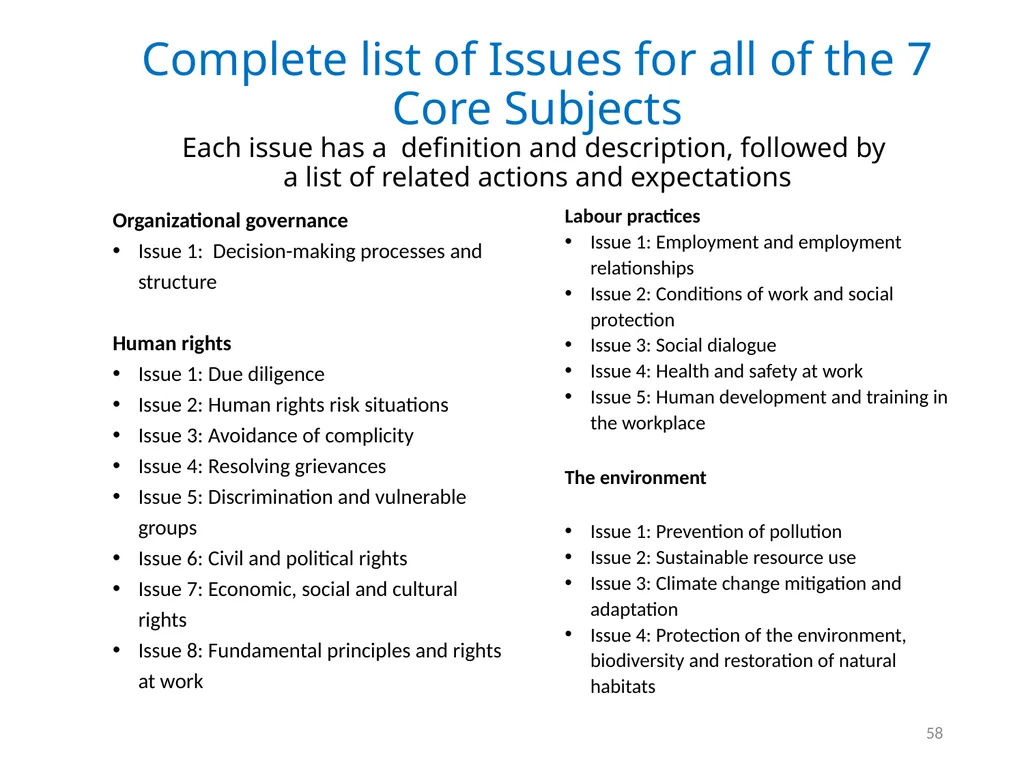
Complete list of Issues for all of the 7 Core Subjects
Each issue has a definition and description, followed by
a list of related actions and expectations 58 Organizational governance
Issue 1: Decision-making processes and structure
Human rights
Issue 1: Due diligence
Issue 2: Human rights risk situations
Issue 3: Avoidance of complicity
Issue 4: Resolving grievances
Issue 5: Discrimination and vulnerable groups
Issue 6: Civil and political rights
Issue 7: Economic, social and cultural rights
Issue 8: Fundamental principles and rights at work Labour practices
Issue 1: Employment and employment relationships
Issue 2: Conditions of work and social protection
Issue 3: Social dialogue
Issue 4: Health and safety at work
Issue 5: Human development and training in the workplace
The environment
Issue 1: Prevention of pollution
Issue 2: Sustainable resource use
Issue 3: Climate change mitigation and adaptation
Issue 4: Protection of the environment, biodiversity and restoration of natural habitats<br>
Issue 1: Decision-making processes and structure
Human rights
Issue 1: Due diligence
Issue 2: Human rights risk situations
Issue 3: Avoidance of complicity
Issue 4: Resolving grievances
Issue 5: Discrimination and vulnerable groups
Issue 6: Civil and political rights
Issue 7: Economic, social and cultural rights
Issue 8: Fundamental principles and rights at work Labour practices
Issue 1: Employment and employment relationships
Issue 2: Conditions of work and social protection
Issue 3: Social dialogue
Issue 4: Health and safety at work
Issue 5: Human development and training in the workplace
The environment
Issue 1: Prevention of pollution
Issue 2: Sustainable resource use
Issue 3: Climate change mitigation and adaptation
Issue 4: Protection of the environment, biodiversity and restoration of natural habitats<br>
58
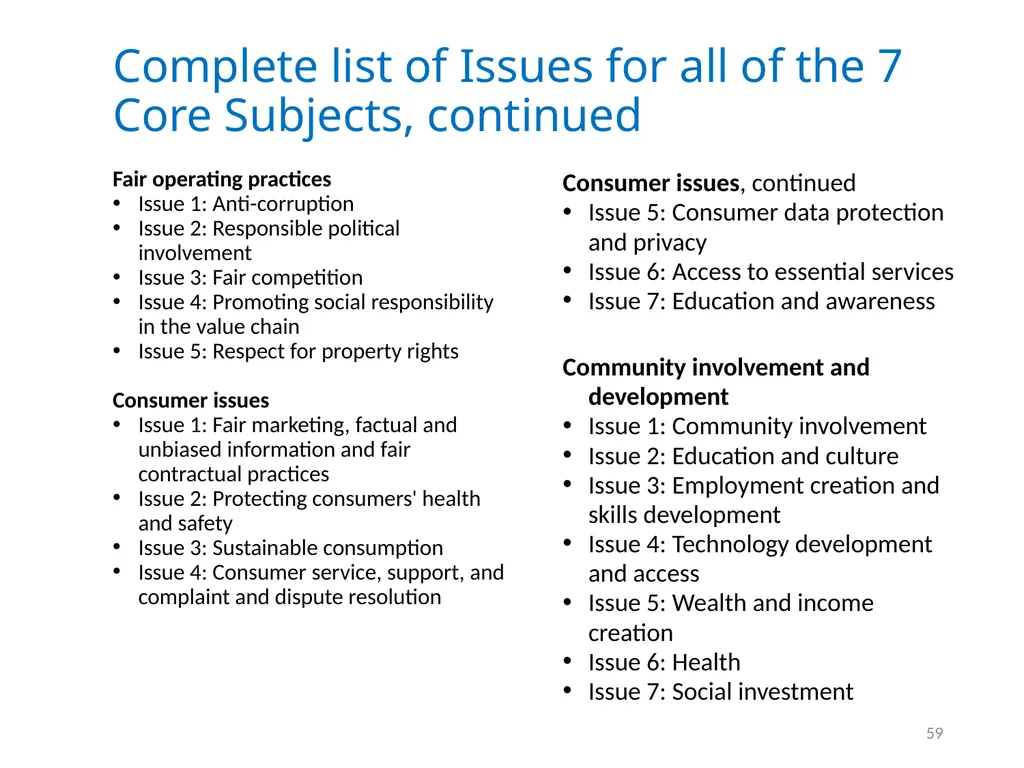
Complete list of Issues for all of the 7 Core Subjects, continued 59 Fair operating practices
Issue 1: Anti-corruption
Issue 2: Responsible political involvement
Issue 3: Fair competition
Issue 4: Promoting social responsibility in the value chain
Issue 5: Respect for property rights
Consumer issues
Issue 1: Fair marketing, factual and unbiased information and fair contractual practices
Issue 2: Protecting consumers' health and safety
Issue 3: Sustainable consumption
Issue 4: Consumer service, support, and complaint and dispute resolution Consumer issues, continued
Issue 5: Consumer data protection and privacy
Issue 6: Access to essential services
Issue 7: Education and awareness
Community involvement and development
Issue 1: Community involvement
Issue 2: Education and culture
Issue 3: Employment creation and skills development
Issue 4: Technology development and access
Issue 5: Wealth and income creation
Issue 6: Health
Issue 7: Social investment<br>
Issue 1: Anti-corruption
Issue 2: Responsible political involvement
Issue 3: Fair competition
Issue 4: Promoting social responsibility in the value chain
Issue 5: Respect for property rights
Consumer issues
Issue 1: Fair marketing, factual and unbiased information and fair contractual practices
Issue 2: Protecting consumers' health and safety
Issue 3: Sustainable consumption
Issue 4: Consumer service, support, and complaint and dispute resolution Consumer issues, continued
Issue 5: Consumer data protection and privacy
Issue 6: Access to essential services
Issue 7: Education and awareness
Community involvement and development
Issue 1: Community involvement
Issue 2: Education and culture
Issue 3: Employment creation and skills development
Issue 4: Technology development and access
Issue 5: Wealth and income creation
Issue 6: Health
Issue 7: Social investment<br>