Isotopes, Relative Atomic Mass and Mass Spectrometry IUPAC Nuclear Notation The accepted convention for representing isotopes X the symbol of the element A Mass number Z Atomic number Atomic number number of protons Z N(p) Mass
"Isotopes, Relative Atomic Mass and Mass" is the property of its rightful owner. Permission is granted to
download and print the materials on this website for personal, non-commercial use only, and to display it
on your personal computer provided you do not modify the materials and that you retain all copyright
notices contained in the materials. By downloading content from our website, you accept the terms of this
agreement.
Presentation Transcript
01
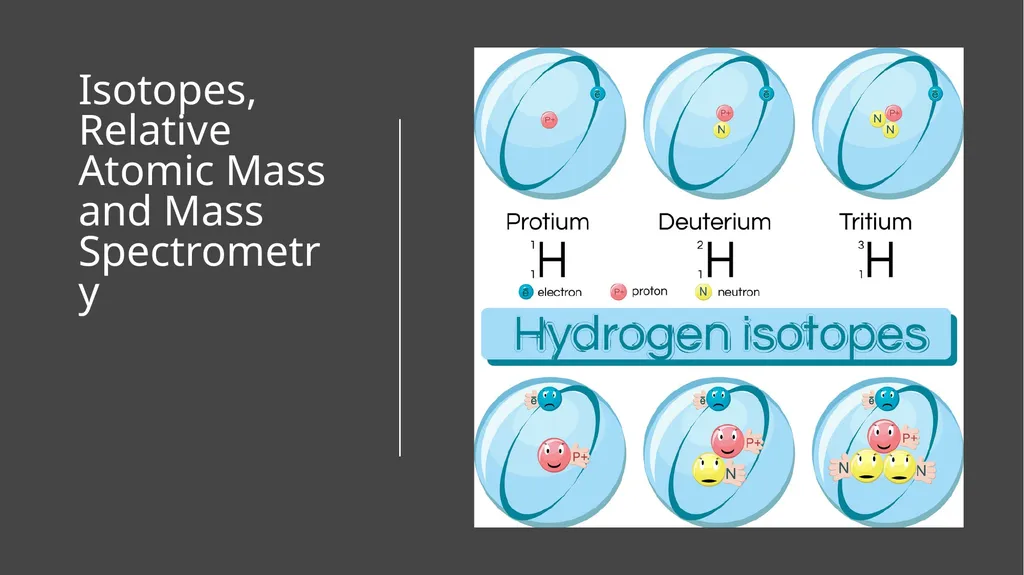
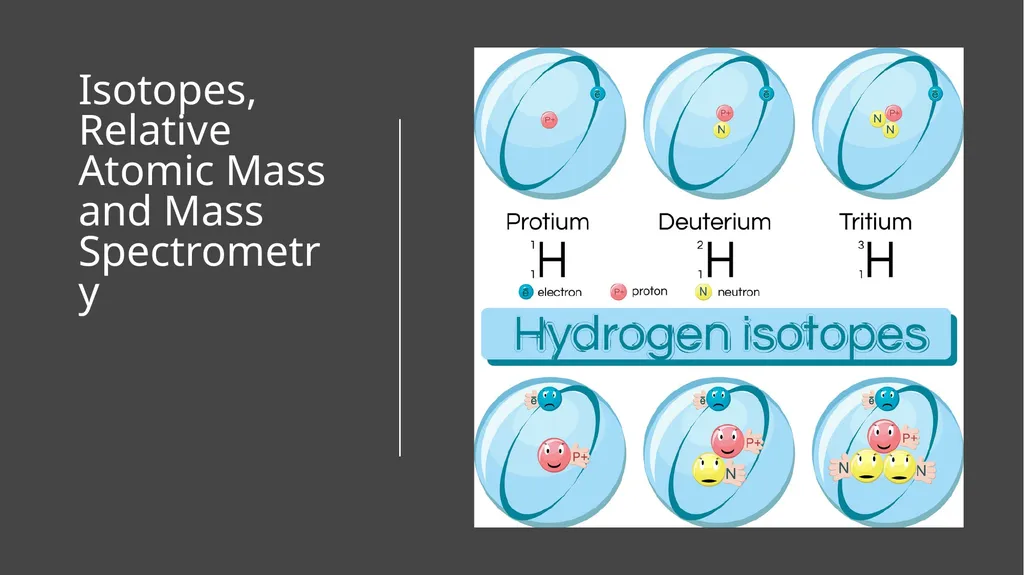
Isotopes, Relative Atomic Mass and Mass Spectrometry<br>
02
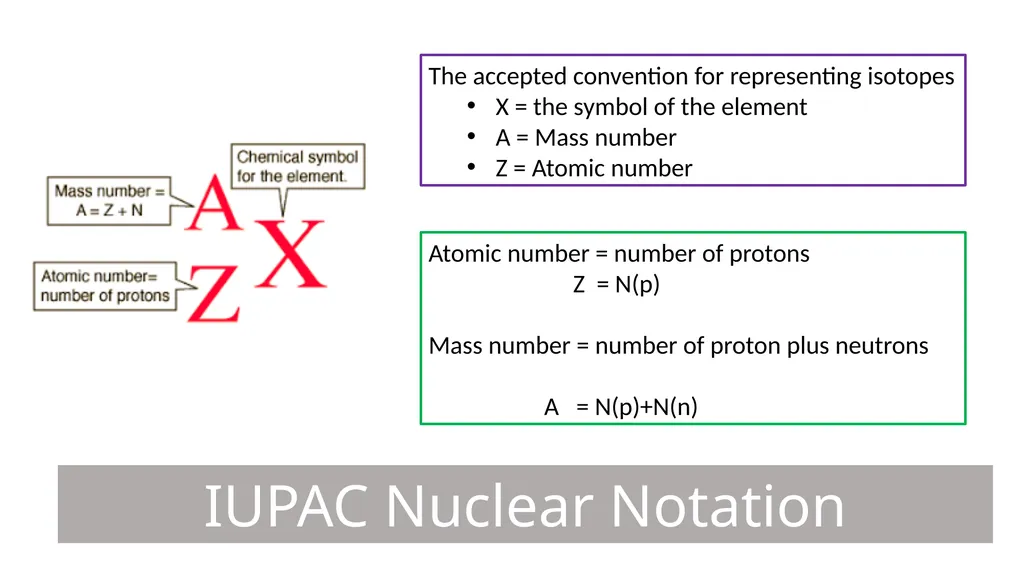
IUPAC Nuclear Notation The accepted convention for representing isotopes
X = the symbol of the element
A = Mass number
Z = Atomic number Atomic number = number of protons
Z = N(p)
Mass number = number of proton plus neutrons
A = N(p)+N(n)<br>
03
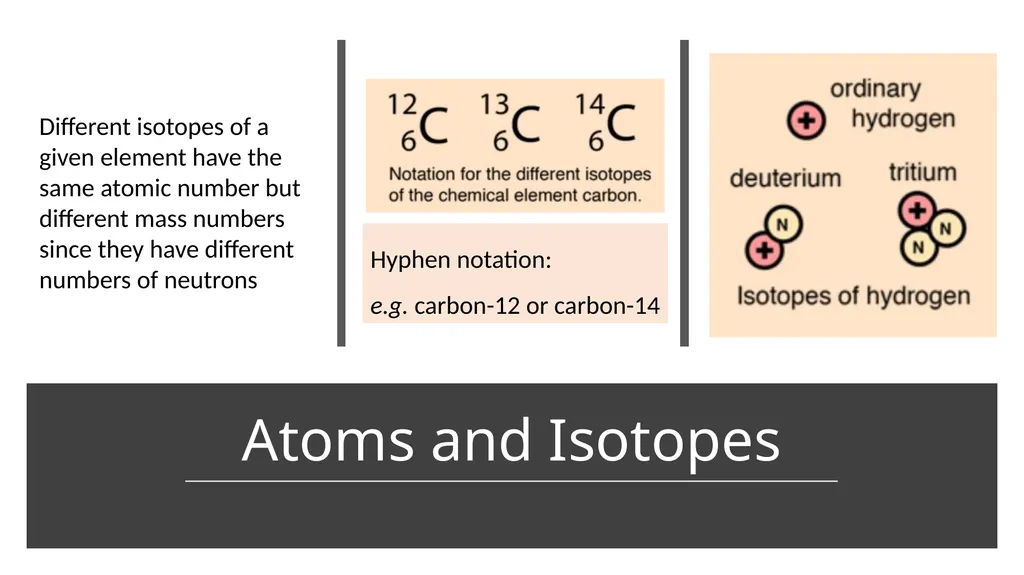
Atoms and Isotopes Different isotopes of a given element have the same atomic number but different mass numbers since they have different numbers of neutrons Hyphen notation:
e.g. carbon-12 or carbon-14<br>
04
Isotopes Isotopes have the same chemical properties (as they have the same number of electrons)
Isotopes may have different physical properties such as density, boiling point (due to the different mass of the atom)
Larger isotopes can have an unstable nucleus and may be radioactive<br>
05
Relative atomic mass (Ar) Recall – scientists discovered that elements combined in specific ratios to form compounds. {Proust – Law of Definite proportions}
Dalton (1766-1844) used this to calculate the relative atomic mass of different elements
For example: calcium and oxygen always combined in a mass ratio of 2.5 g calcium to 1.0 g oxygen. Assuming the atomic ratio is 1:1, that would make an atom of calcium 2.5 times heavier than an atom of oxygen.
Relative atomic mass is the mass of the atom compared to 1/12th the mass of a carbon-12 atom<br>
06
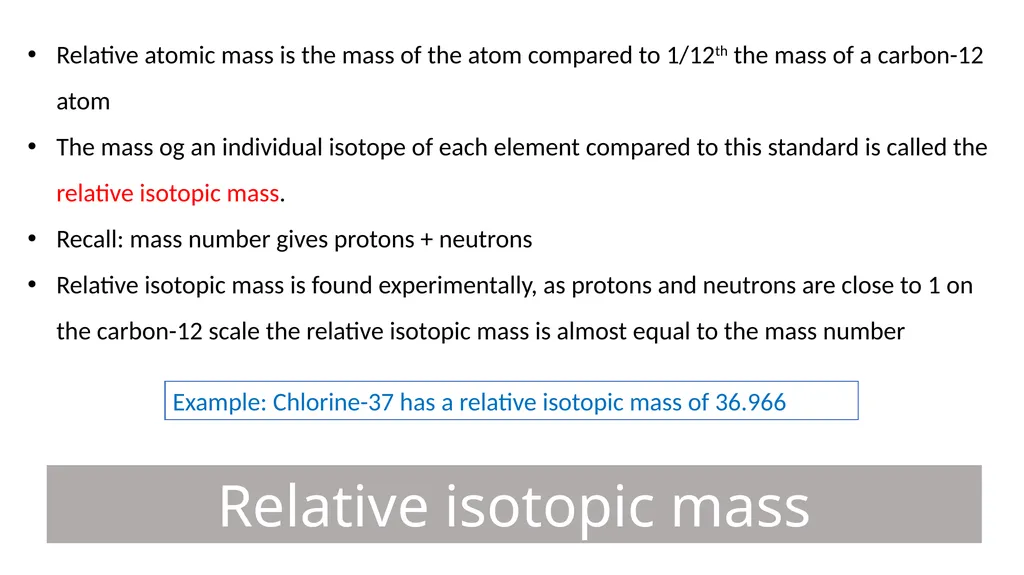
Relative isotopic mass Relative atomic mass is the mass of the atom compared to 1/12th the mass of a carbon-12 atom
The mass og an individual isotope of each element compared to this standard is called the relative isotopic mass.
Recall: mass number gives protons + neutrons
Relative isotopic mass is found experimentally, as protons and neutrons are close to 1 on the carbon-12 scale the relative isotopic mass is almost equal to the mass number Example: Chlorine-37 has a relative isotopic mass of 36.966<br>
07
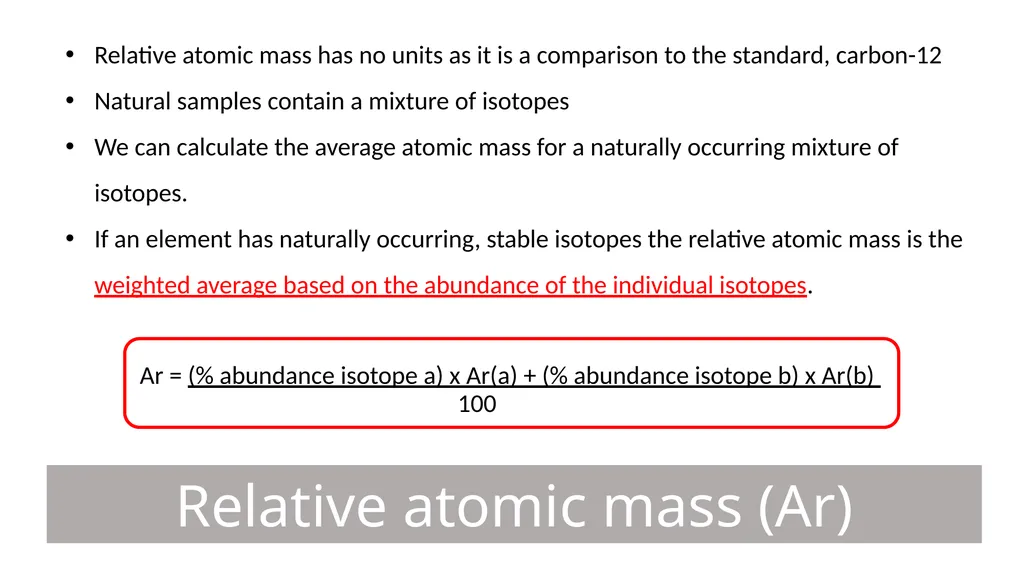
Relative atomic mass (Ar) Relative atomic mass has no units as it is a comparison to the standard, carbon-12
Natural samples contain a mixture of isotopes
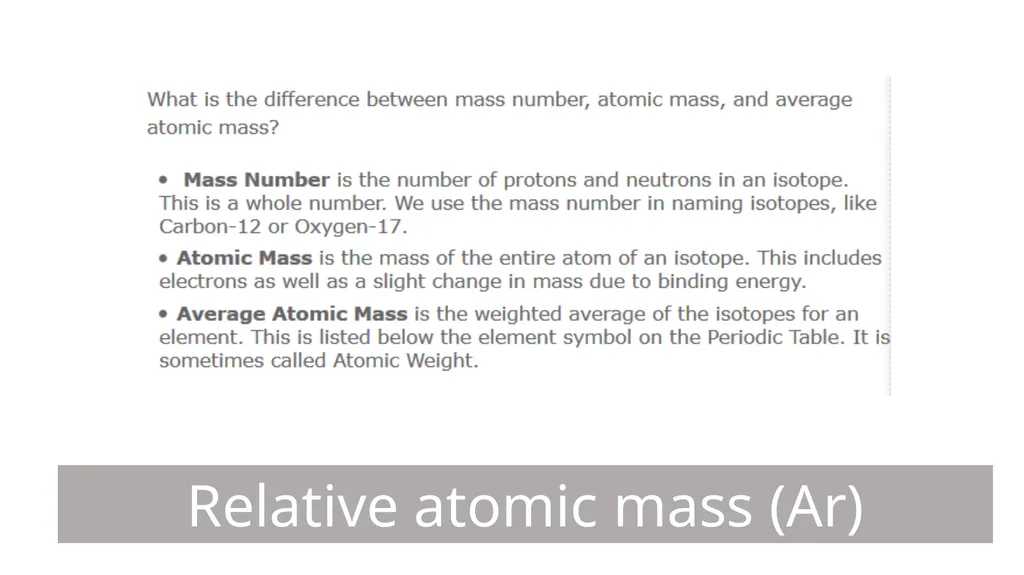
We can calculate the average atomic mass for a naturally occurring mixture of isotopes.
If an element has naturally occurring, stable isotopes the relative atomic mass is the weighted average based on the abundance of the individual isotopes.<br>
08
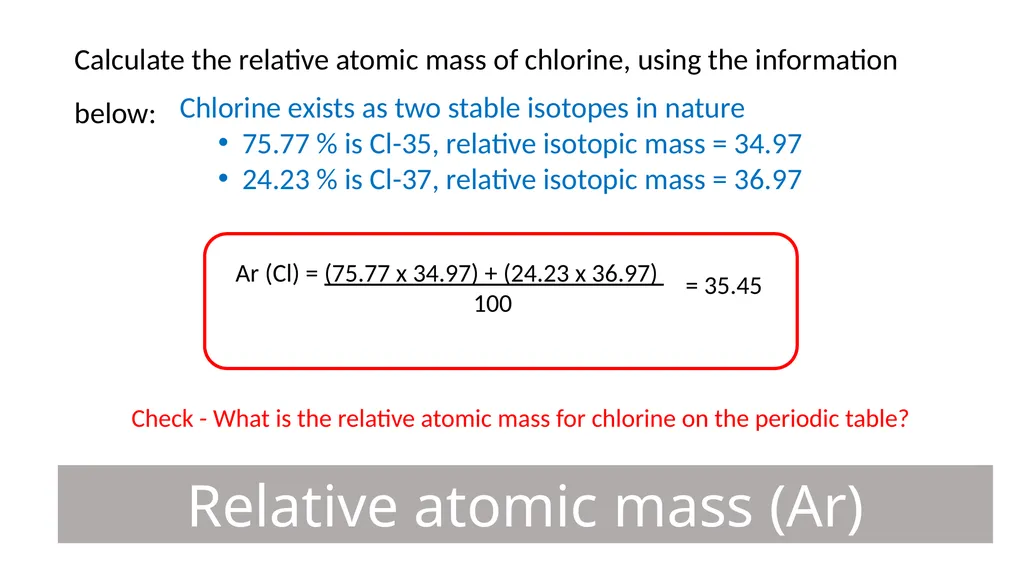
Relative atomic mass (Ar) Calculate the relative atomic mass of chlorine, using the information below: Ar (Cl) = (75.77 x 34.97) + (24.23 x 36.97) 100 = 35.45 Check - What is the relative atomic mass for chlorine on the periodic table? Chlorine exists as two stable isotopes in nature
75.77 % is Cl-35, relative isotopic mass = 34.97
24.23 % is Cl-37, relative isotopic mass = 36.97<br>
09
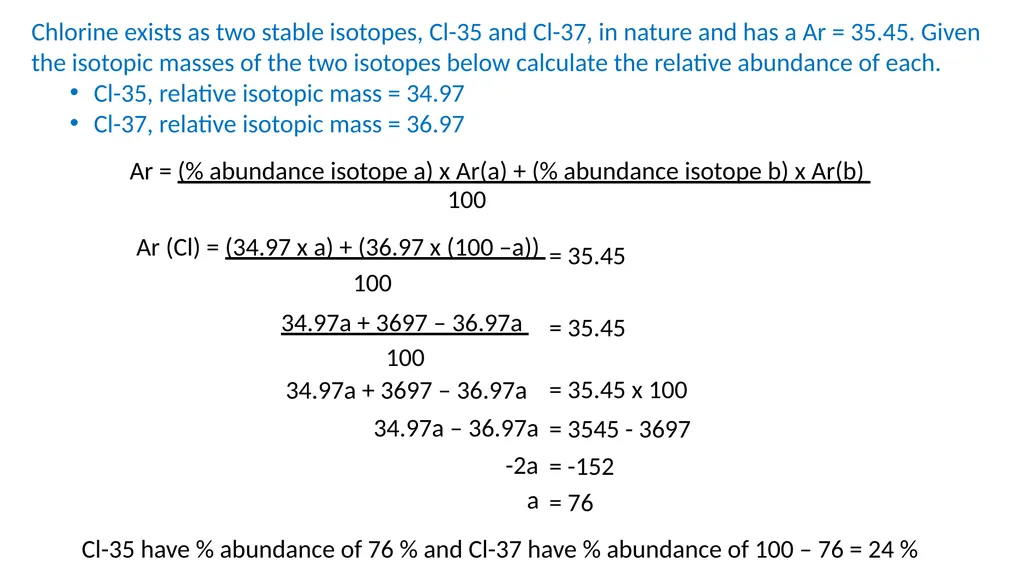
Chlorine exists as two stable isotopes, Cl-35 and Cl-37, in nature and has a Ar = 35.45. Given the isotopic masses of the two isotopes below calculate the relative abundance of each.
Cl-35, relative isotopic mass = 34.97
Cl-37, relative isotopic mass = 36.97 Ar (Cl) = (34.97 x a) + (36.97 x (100 –a)) 100 = 35.45 34.97a + 3697 – 36.97a 100 = 35.45 34.97a + 3697 – 36.97a = 35.45 x 100 34.97a – 36.97a = 3545 - 3697 -2a = -152 a = 76 Cl-35 have % abundance of 76 % and Cl-37 have % abundance of 100 – 76 = 24 %<br>
10
Relative atomic mass (Ar)<br>
11
Mass spectrometry<br>
12
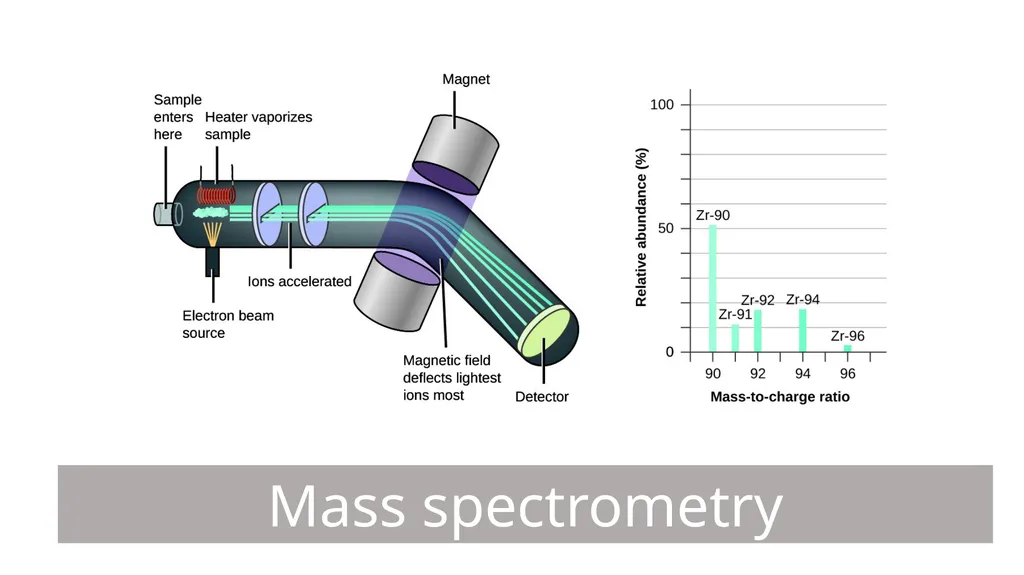
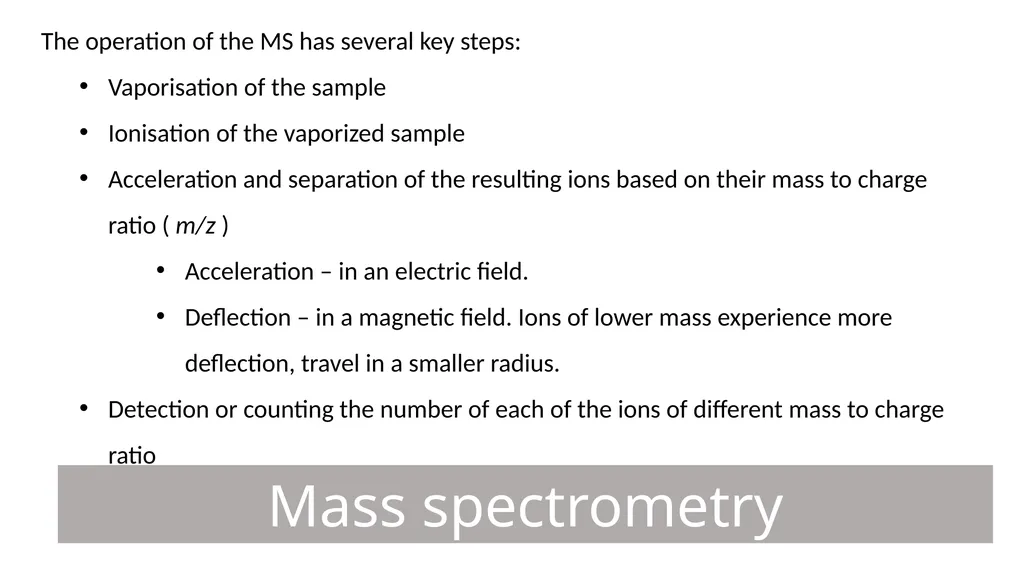
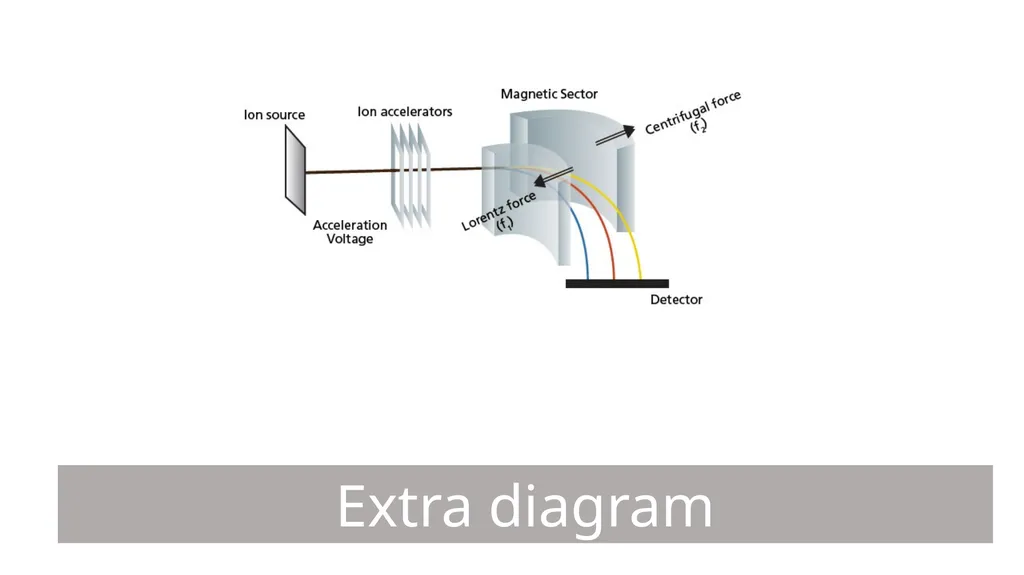
Mass spectrometry The operation of the MS has several key steps:
Vaporisation of the sample
Ionisation of the vaporized sample
Acceleration and separation of the resulting ions based on their mass to charge ratio ( m/z )
Acceleration – in an electric field.
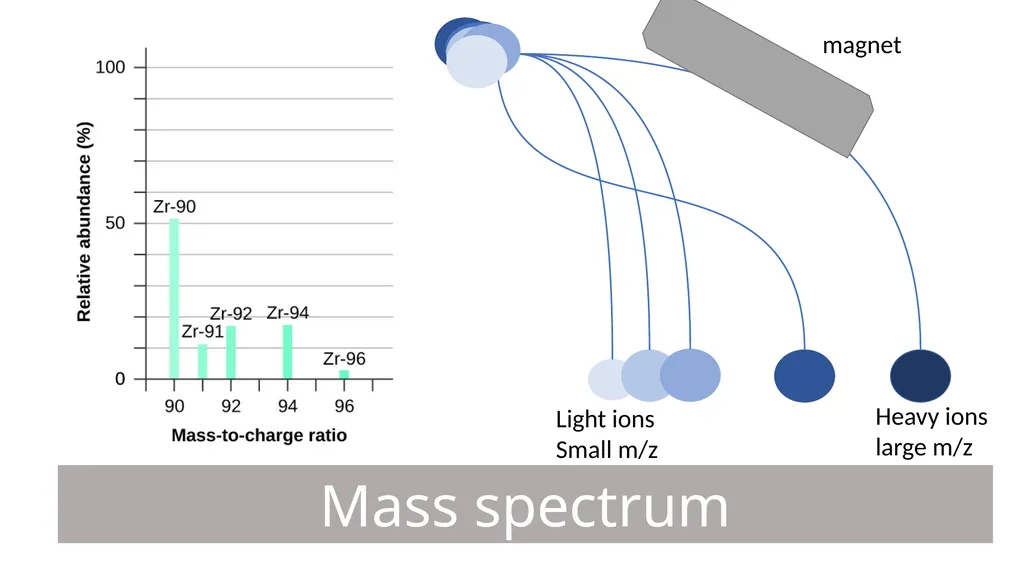
Deflection – in a magnetic field. Ions of lower mass experience more deflection, travel in a smaller radius.
Detection or counting the number of each of the ions of different mass to charge ratio<br>
13
Mass spectrum Light ions
Small m/z Heavy ions
large m/z magnet<br>
14
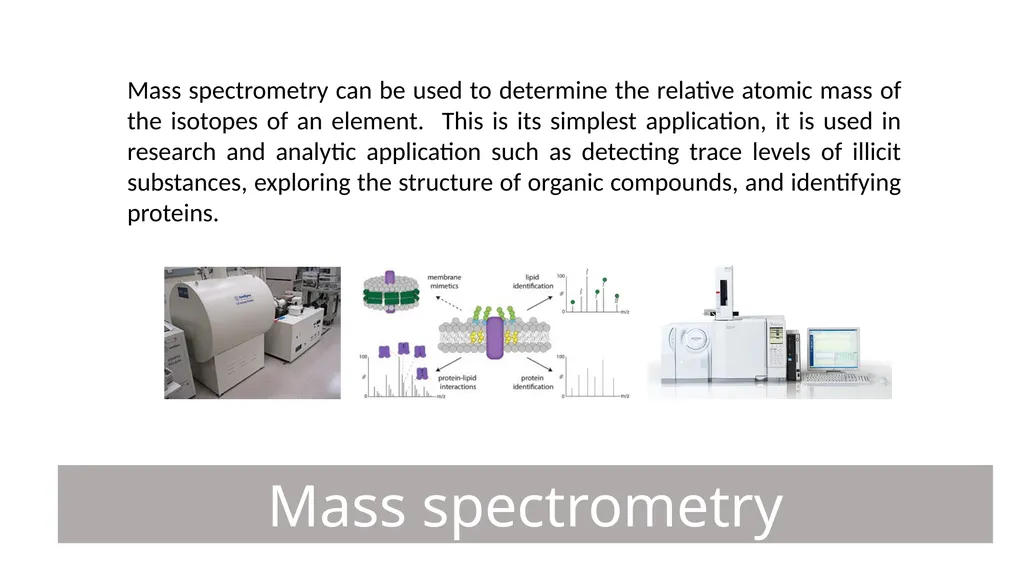
Mass spectrometry Mass spectrometry can be used to determine the relative atomic mass of the isotopes of an element. This is its simplest application, it is used in research and analytic application such as detecting trace levels of illicit substances, exploring the structure of organic compounds, and identifying proteins.<br>
15
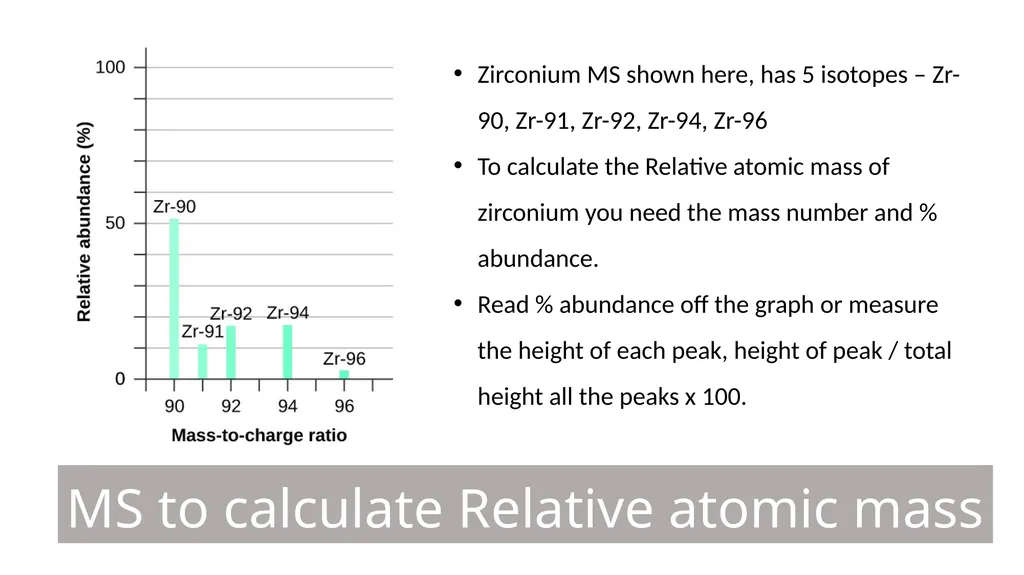
MS to calculate Relative atomic mass Zirconium MS shown here, has 5 isotopes – Zr-90, Zr-91, Zr-92, Zr-94, Zr-96
To calculate the Relative atomic mass of zirconium you need the mass number and % abundance.
Read % abundance off the graph or measure the height of each peak, height of peak / total height all the peaks x 100.<br>