
Issues in RTI Implementation - the Rajasthan
Description: Issues in RTI Implementation - the Rajasthan Experience 12th Annual Convention on RTI New Delhi December 6, 2017 Implementation of RTI in Rajasthan RTI Act 2005 made effective in Rajasthan w.e.f. October 12, 2005 Estimated current state
Related Topics
Download Presentation
"Issues in RTI Implementation - the Rajasthan" is the property of its rightful owner. Permission is granted to download and print the materials on this website for personal, non-commercial use only, and to display it on your personal computer provided you do not modify the materials and that you retain all copyright notices contained in the materials. By downloading content from our website, you accept the terms of this agreement.
Presentation Transcript
slide1. Issues in RTI Implementation
- the Rajasthan Experience 12th Annual Convention on RTI
New Delhi – December 6, 2017<br>
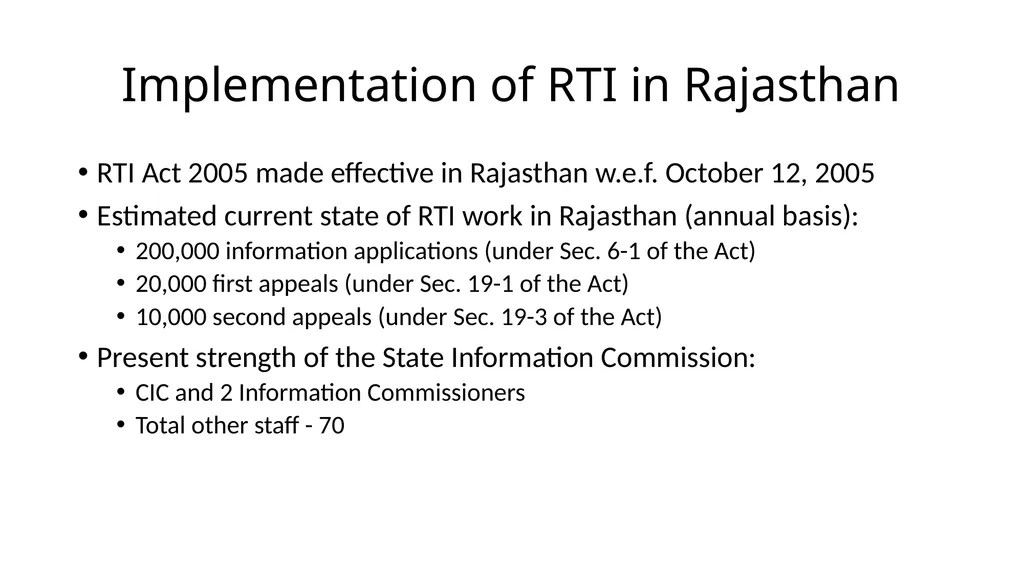
slide2. Implementation of RTI in Rajasthan RTI Act 2005 made effective in Rajasthan w.e.f. October 12, 2005
Estimated current state of RTI work in Rajasthan (annual basis):
200,000 information applications (under Sec. 6-1 of the Act)
20,000 first appeals (under Sec. 19-1 of the Act)
10,000 second appeals (under Sec. 19-3 of the Act)
Present strength of the State Information Commission:
CIC and 2 Information Commissioners
Total other staff - 70<br>
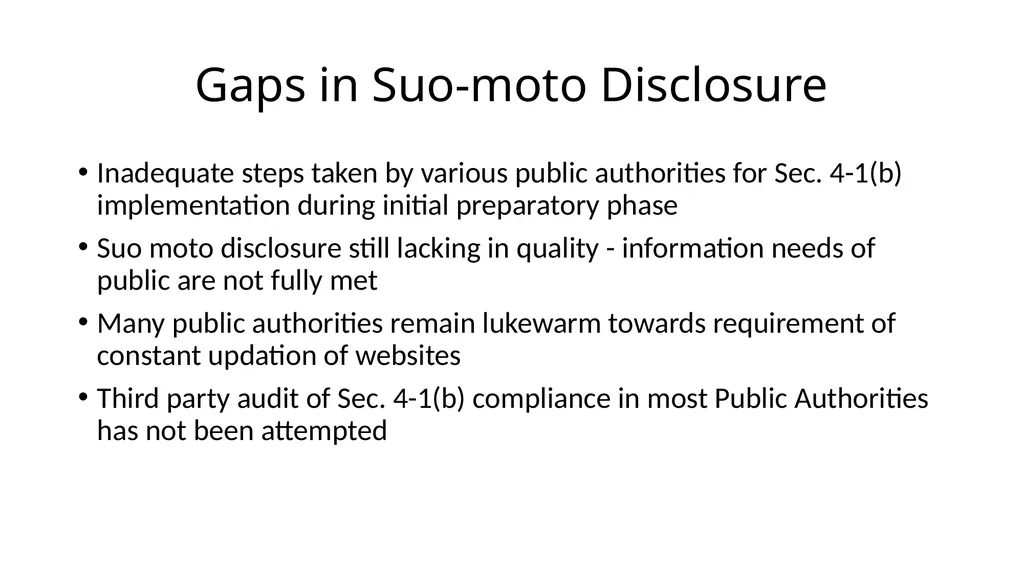
slide3. Gaps in Suo-moto Disclosure Inadequate steps taken by various public authorities for Sec. 4-1(b) implementation during initial preparatory phase
Suo moto disclosure still lacking in quality - information needs of public are not fully met
Many public authorities remain lukewarm towards requirement of constant updation of websites
Third party audit of Sec. 4-1(b) compliance in most Public Authorities has not been attempted<br>
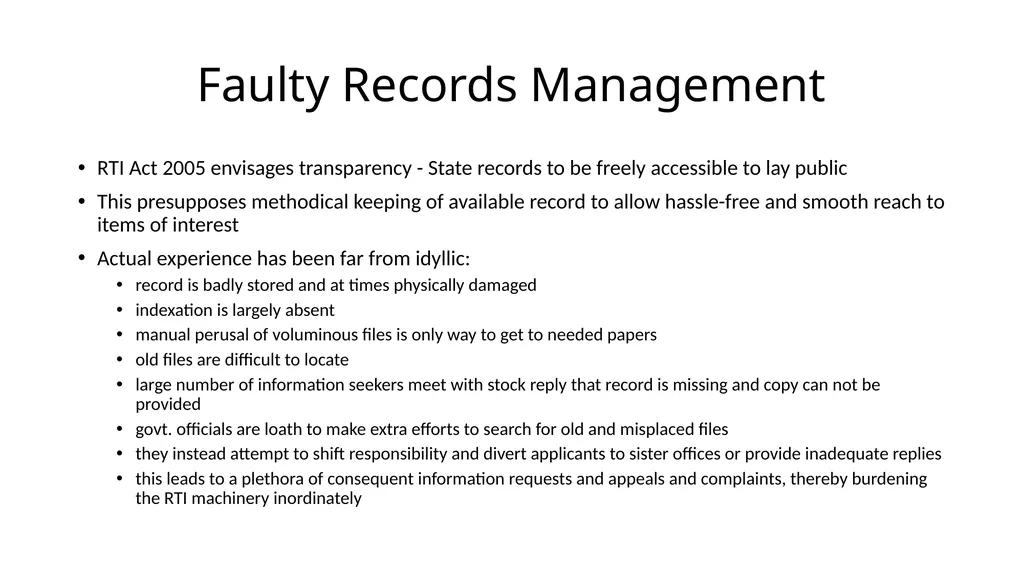
slide4. Faulty Records Management RTI Act 2005 envisages transparency - State records to be freely accessible to lay public
This presupposes methodical keeping of available record to allow hassle-free and smooth reach to items of interest
Actual experience has been far from idyllic:
record is badly stored and at times physically damaged
indexation is largely absent
manual perusal of voluminous files is only way to get to needed papers
old files are difficult to locate
large number of information seekers meet with stock reply that record is missing and copy can not be provided
govt. officials are loath to make extra efforts to search for old and misplaced files
they instead attempt to shift responsibility and divert applicants to sister offices or provide inadequate replies
this leads to a plethora of consequent information requests and appeals and complaints, thereby burdening the RTI machinery inordinately<br>
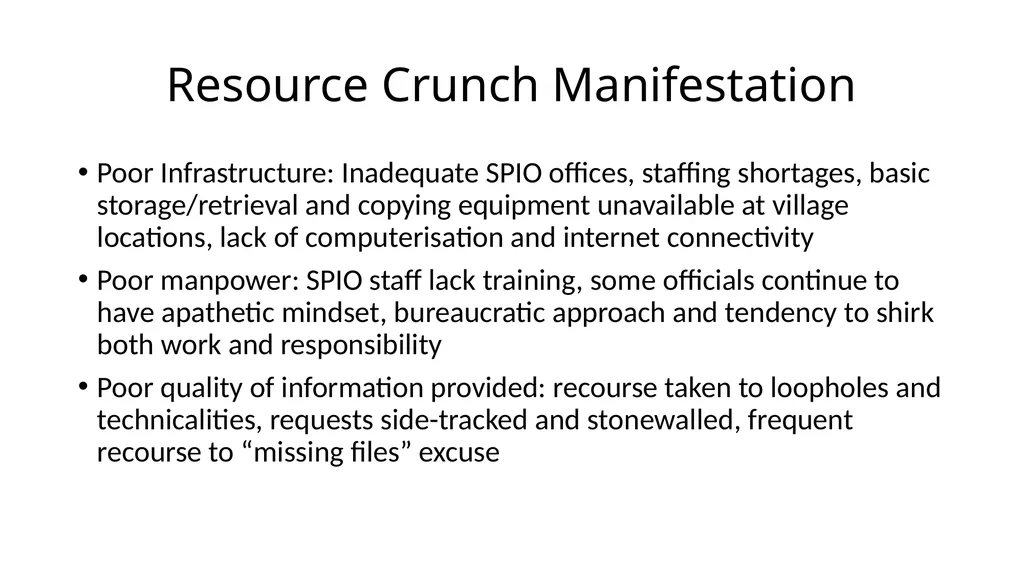
slide5. Resource Crunch Manifestation Poor Infrastructure: Inadequate SPIO offices, staffing shortages, basic storage/retrieval and copying equipment unavailable at village locations, lack of computerisation and internet connectivity
Poor manpower: SPIO staff lack training, some officials continue to have apathetic mindset, bureaucratic approach and tendency to shirk both work and responsibility
Poor quality of information provided: recourse taken to loopholes and technicalities, requests side-tracked and stonewalled, frequent recourse to “missing files” excuse<br>
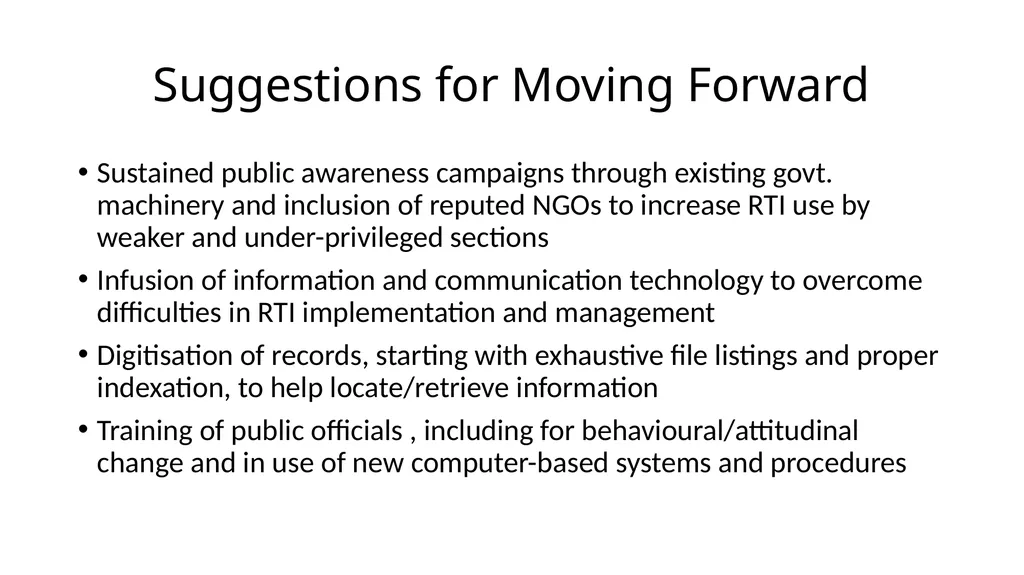
slide6. Suggestions for Moving Forward Sustained public awareness campaigns through existing govt. machinery and inclusion of reputed NGOs to increase RTI use by weaker and under-privileged sections
Infusion of information and communication technology to overcome difficulties in RTI implementation and management
Digitisation of records, starting with exhaustive file listings and proper indexation, to help locate/retrieve information
Training of public officials , including for behavioural/attitudinal change and in use of new computer-based systems and procedures<br>
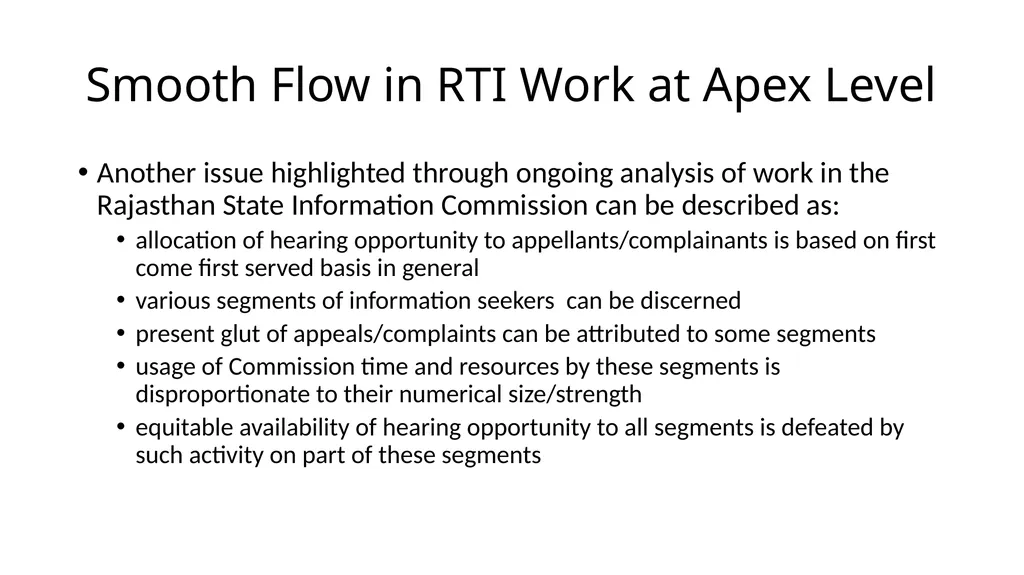
slide7. Smooth Flow in RTI Work at Apex Level Another issue highlighted through ongoing analysis of work in the Rajasthan State Information Commission can be described as:
allocation of hearing opportunity to appellants/complainants is based on first come first served basis in general
various segments of information seekers can be discerned
present glut of appeals/complaints can be attributed to some segments
usage of Commission time and resources by these segments is disproportionate to their numerical size/strength
equitable availability of hearing opportunity to all segments is defeated by such activity on part of these segments<br>
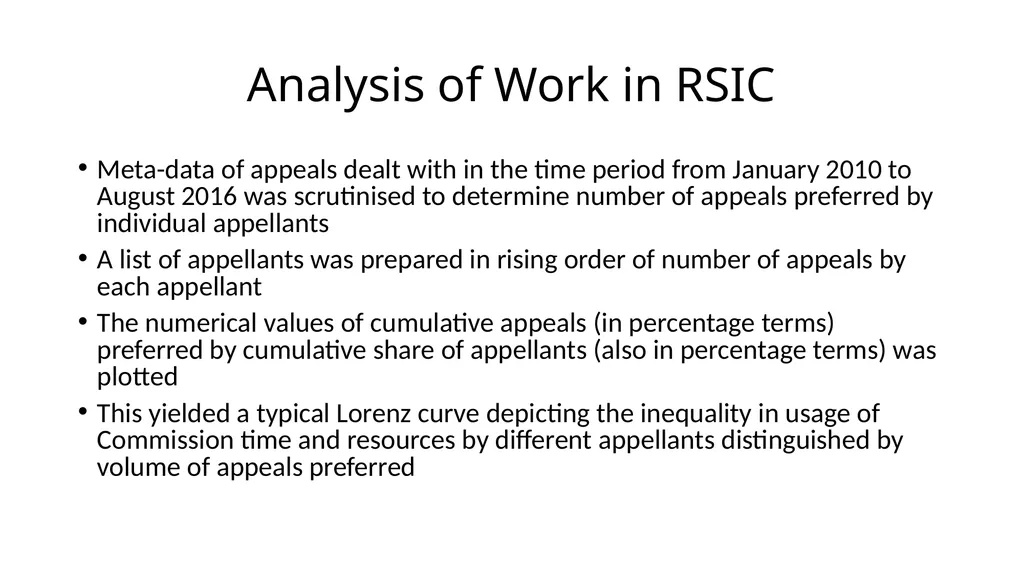
slide8. Analysis of Work in RSIC Meta-data of appeals dealt with in the time period from January 2010 to August 2016 was scrutinised to determine number of appeals preferred by individual appellants
A list of appellants was prepared in rising order of number of appeals by each appellant
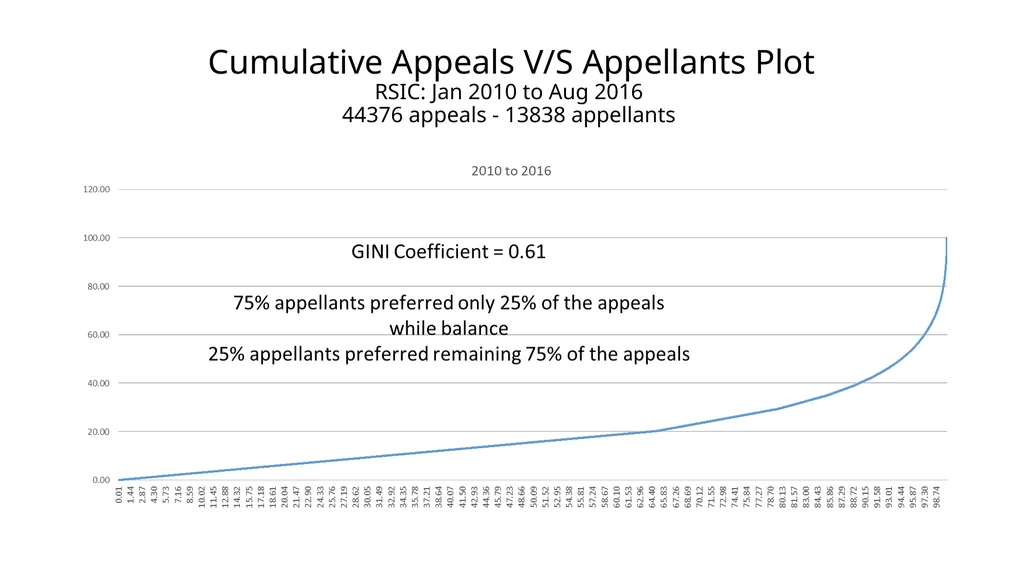
The numerical values of cumulative appeals (in percentage terms) preferred by cumulative share of appellants (also in percentage terms) was plotted
This yielded a typical Lorenz curve depicting the inequality in usage of Commission time and resources by different appellants distinguished by volume of appeals preferred<br>
slide9. Cumulative Appeals V/S Appellants Plot RSIC: Jan 2010 to Aug 2016 44376 appeals - 13838 appellants<br>
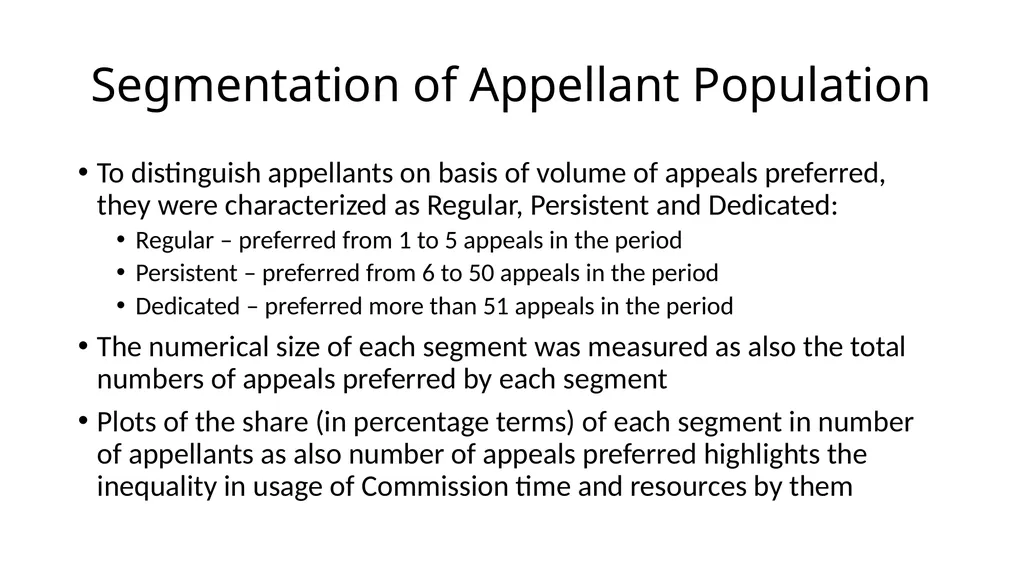
slide10. Segmentation of Appellant Population To distinguish appellants on basis of volume of appeals preferred, they were characterized as Regular, Persistent and Dedicated:
Regular – preferred from 1 to 5 appeals in the period
Persistent – preferred from 6 to 50 appeals in the period
Dedicated – preferred more than 51 appeals in the period
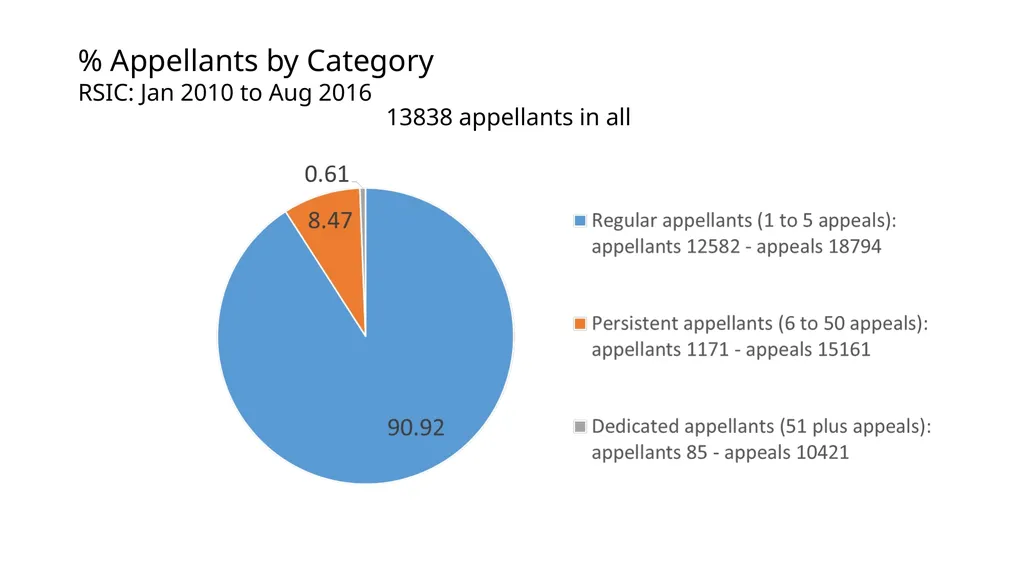
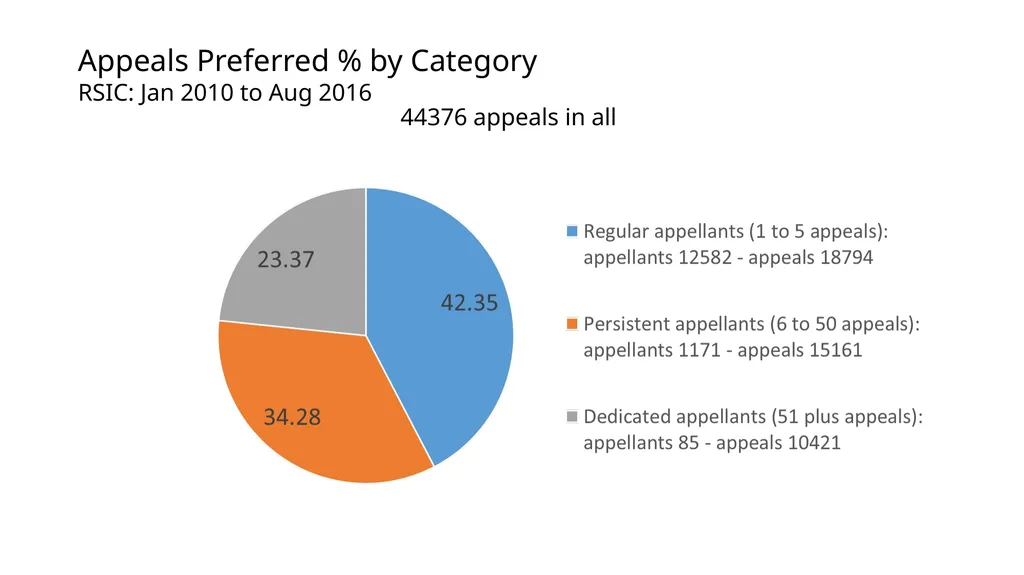
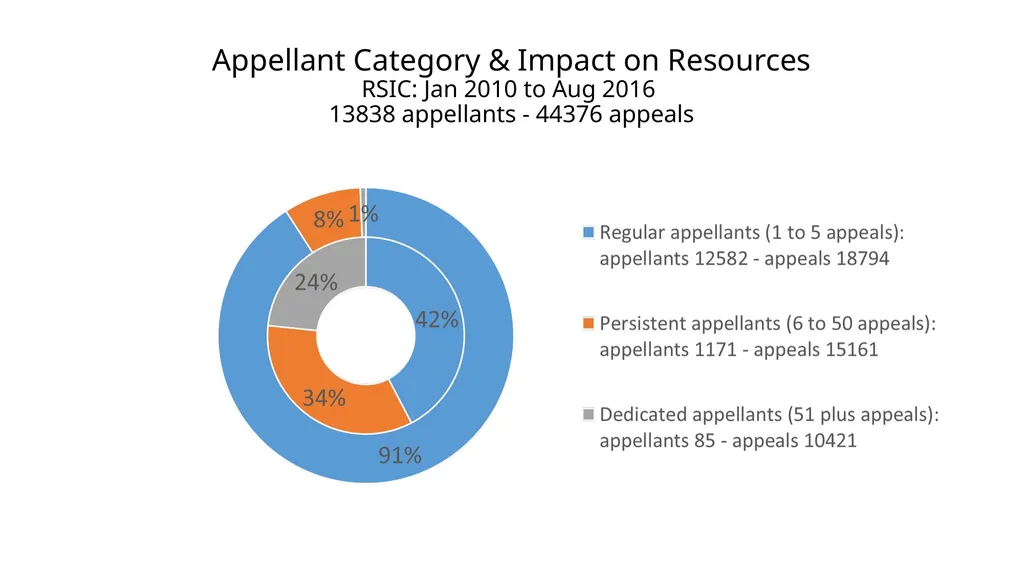
The numerical size of each segment was measured as also the total numbers of appeals preferred by each segment
Plots of the share (in percentage terms) of each segment in number of appellants as also number of appeals preferred highlights the inequality in usage of Commission time and resources by them<br>
slide11. % Appellants by Category
RSIC: Jan 2010 to Aug 2016
13838 appellants in all<br>
slide12. Appeals Preferred % by Category
RSIC: Jan 2010 to Aug 2016
44376 appeals in all<br>
slide13. Appellant Category & Impact on Resources RSIC: Jan 2010 to Aug 2016 13838 appellants - 44376 appeals<br>
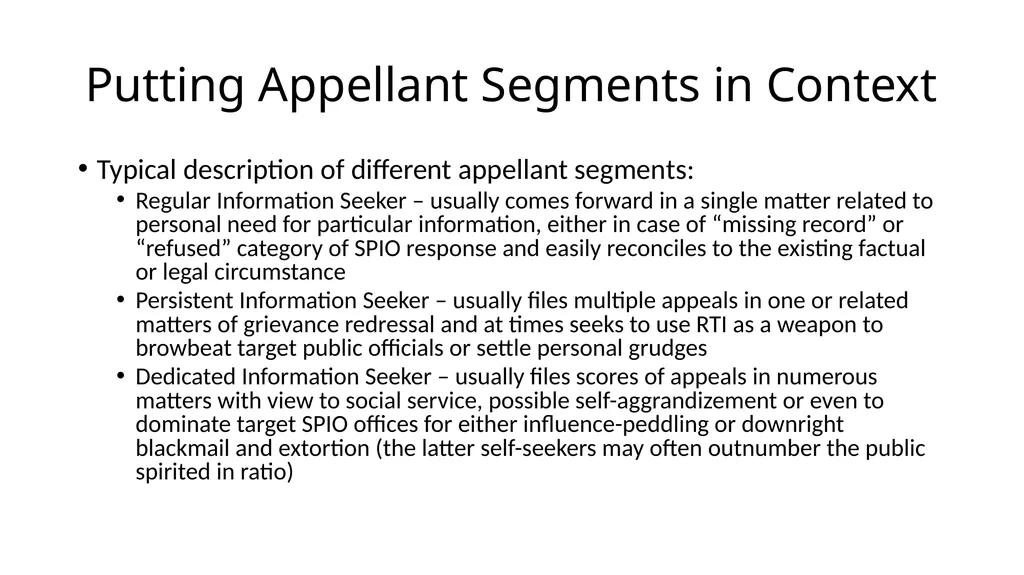
slide14. Putting Appellant Segments in Context Typical description of different appellant segments:
Regular Information Seeker – usually comes forward in a single matter related to personal need for particular information, either in case of “missing record” or “refused” category of SPIO response and easily reconciles to the existing factual or legal circumstance
Persistent Information Seeker – usually files multiple appeals in one or related matters of grievance redressal and at times seeks to use RTI as a weapon to browbeat target public officials or settle personal grudges
Dedicated Information Seeker – usually files scores of appeals in numerous matters with view to social service, possible self-aggrandizement or even to dominate target SPIO offices for either influence-peddling or downright blackmail and extortion (the latter self-seekers may often outnumber the public spirited in ratio)<br>
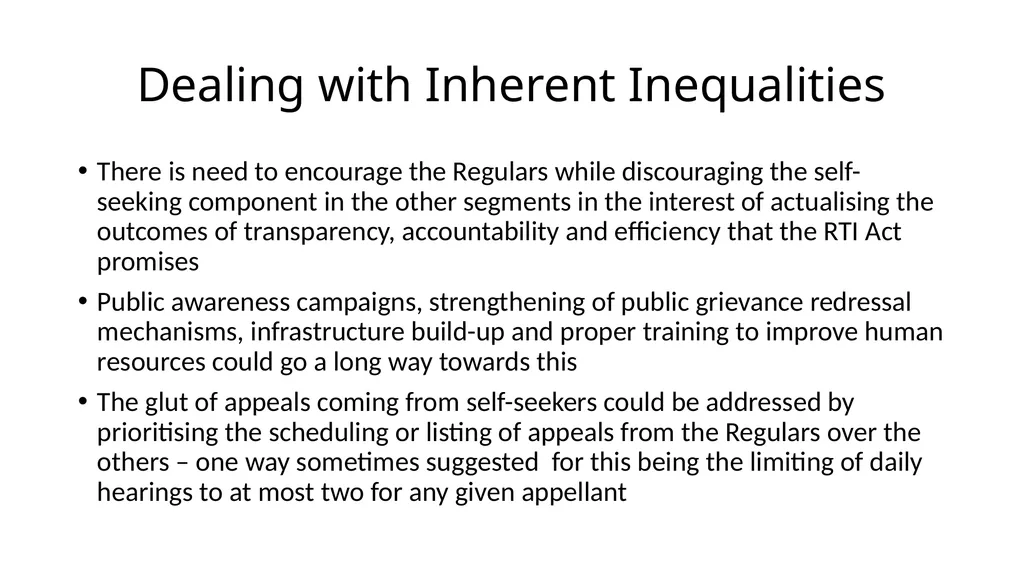
slide15. Dealing with Inherent Inequalities There is need to encourage the Regulars while discouraging the self-seeking component in the other segments in the interest of actualising the outcomes of transparency, accountability and efficiency that the RTI Act promises
Public awareness campaigns, strengthening of public grievance redressal mechanisms, infrastructure build-up and proper training to improve human resources could go a long way towards this
The glut of appeals coming from self-seekers could be addressed by prioritising the scheduling or listing of appeals from the Regulars over the others – one way sometimes suggested for this being the limiting of daily hearings to at most two for any given appellant<br>
slide16. Thank You<br>
New Delhi – December 6, 2017<br>
slide2. Implementation of RTI in Rajasthan RTI Act 2005 made effective in Rajasthan w.e.f. October 12, 2005
Estimated current state of RTI work in Rajasthan (annual basis):
200,000 information applications (under Sec. 6-1 of the Act)
20,000 first appeals (under Sec. 19-1 of the Act)
10,000 second appeals (under Sec. 19-3 of the Act)
Present strength of the State Information Commission:
CIC and 2 Information Commissioners
Total other staff - 70<br>
slide3. Gaps in Suo-moto Disclosure Inadequate steps taken by various public authorities for Sec. 4-1(b) implementation during initial preparatory phase
Suo moto disclosure still lacking in quality - information needs of public are not fully met
Many public authorities remain lukewarm towards requirement of constant updation of websites
Third party audit of Sec. 4-1(b) compliance in most Public Authorities has not been attempted<br>
slide4. Faulty Records Management RTI Act 2005 envisages transparency - State records to be freely accessible to lay public
This presupposes methodical keeping of available record to allow hassle-free and smooth reach to items of interest
Actual experience has been far from idyllic:
record is badly stored and at times physically damaged
indexation is largely absent
manual perusal of voluminous files is only way to get to needed papers
old files are difficult to locate
large number of information seekers meet with stock reply that record is missing and copy can not be provided
govt. officials are loath to make extra efforts to search for old and misplaced files
they instead attempt to shift responsibility and divert applicants to sister offices or provide inadequate replies
this leads to a plethora of consequent information requests and appeals and complaints, thereby burdening the RTI machinery inordinately<br>
slide5. Resource Crunch Manifestation Poor Infrastructure: Inadequate SPIO offices, staffing shortages, basic storage/retrieval and copying equipment unavailable at village locations, lack of computerisation and internet connectivity
Poor manpower: SPIO staff lack training, some officials continue to have apathetic mindset, bureaucratic approach and tendency to shirk both work and responsibility
Poor quality of information provided: recourse taken to loopholes and technicalities, requests side-tracked and stonewalled, frequent recourse to “missing files” excuse<br>
slide6. Suggestions for Moving Forward Sustained public awareness campaigns through existing govt. machinery and inclusion of reputed NGOs to increase RTI use by weaker and under-privileged sections
Infusion of information and communication technology to overcome difficulties in RTI implementation and management
Digitisation of records, starting with exhaustive file listings and proper indexation, to help locate/retrieve information
Training of public officials , including for behavioural/attitudinal change and in use of new computer-based systems and procedures<br>
slide7. Smooth Flow in RTI Work at Apex Level Another issue highlighted through ongoing analysis of work in the Rajasthan State Information Commission can be described as:
allocation of hearing opportunity to appellants/complainants is based on first come first served basis in general
various segments of information seekers can be discerned
present glut of appeals/complaints can be attributed to some segments
usage of Commission time and resources by these segments is disproportionate to their numerical size/strength
equitable availability of hearing opportunity to all segments is defeated by such activity on part of these segments<br>
slide8. Analysis of Work in RSIC Meta-data of appeals dealt with in the time period from January 2010 to August 2016 was scrutinised to determine number of appeals preferred by individual appellants
A list of appellants was prepared in rising order of number of appeals by each appellant
The numerical values of cumulative appeals (in percentage terms) preferred by cumulative share of appellants (also in percentage terms) was plotted
This yielded a typical Lorenz curve depicting the inequality in usage of Commission time and resources by different appellants distinguished by volume of appeals preferred<br>
slide9. Cumulative Appeals V/S Appellants Plot RSIC: Jan 2010 to Aug 2016 44376 appeals - 13838 appellants<br>
slide10. Segmentation of Appellant Population To distinguish appellants on basis of volume of appeals preferred, they were characterized as Regular, Persistent and Dedicated:
Regular – preferred from 1 to 5 appeals in the period
Persistent – preferred from 6 to 50 appeals in the period
Dedicated – preferred more than 51 appeals in the period
The numerical size of each segment was measured as also the total numbers of appeals preferred by each segment
Plots of the share (in percentage terms) of each segment in number of appellants as also number of appeals preferred highlights the inequality in usage of Commission time and resources by them<br>
slide11. % Appellants by Category
RSIC: Jan 2010 to Aug 2016
13838 appellants in all<br>
slide12. Appeals Preferred % by Category
RSIC: Jan 2010 to Aug 2016
44376 appeals in all<br>
slide13. Appellant Category & Impact on Resources RSIC: Jan 2010 to Aug 2016 13838 appellants - 44376 appeals<br>
slide14. Putting Appellant Segments in Context Typical description of different appellant segments:
Regular Information Seeker – usually comes forward in a single matter related to personal need for particular information, either in case of “missing record” or “refused” category of SPIO response and easily reconciles to the existing factual or legal circumstance
Persistent Information Seeker – usually files multiple appeals in one or related matters of grievance redressal and at times seeks to use RTI as a weapon to browbeat target public officials or settle personal grudges
Dedicated Information Seeker – usually files scores of appeals in numerous matters with view to social service, possible self-aggrandizement or even to dominate target SPIO offices for either influence-peddling or downright blackmail and extortion (the latter self-seekers may often outnumber the public spirited in ratio)<br>
slide15. Dealing with Inherent Inequalities There is need to encourage the Regulars while discouraging the self-seeking component in the other segments in the interest of actualising the outcomes of transparency, accountability and efficiency that the RTI Act promises
Public awareness campaigns, strengthening of public grievance redressal mechanisms, infrastructure build-up and proper training to improve human resources could go a long way towards this
The glut of appeals coming from self-seekers could be addressed by prioritising the scheduling or listing of appeals from the Regulars over the others – one way sometimes suggested for this being the limiting of daily hearings to at most two for any given appellant<br>
slide16. Thank You<br>