ITU Spectrum Management Training Program (SMTP) Concept Presentation Addressed problem Efficient running of Spectrum Management (SM) requires well educated professionals Today there are no formal holistic SM education programs, except some
"ITU Spectrum Management Training Program (SMTP)" is the property of its rightful owner. Permission is granted to
download and print the materials on this website for personal, non-commercial use only, and to display it
on your personal computer provided you do not modify the materials and that you retain all copyright
notices contained in the materials. By downloading content from our website, you accept the terms of this
agreement.
Presentation Transcript
01
ITU Spectrum Management Training Program (SMTP) Concept Presentation<br>
02
Addressed problem Efficient running of Spectrum Management (SM) requires well educated professionals
Today there are no formal holistic SM education programs, except some ad hoc commercial or public courses such as ITU BR seminars, USTTI
Large administrations train SM staff by seconding them to experienced workers, but this offers narrowed vision and no formal quality check
Many smaller administrations, especially in developing countries, do not have even such option, but must rely solely on ad hoc courses 2<br>
03
The solution ITU establishing Spectrum Management Training Program:
Unified course, offering students across the globe access to state-of-the-art holistic SM training and forward-looking professional vision
Formalised assessment ensuring minimal quality of professional education
Certification to give international recognition, with possible option of university credits/diploma 3<br>
04
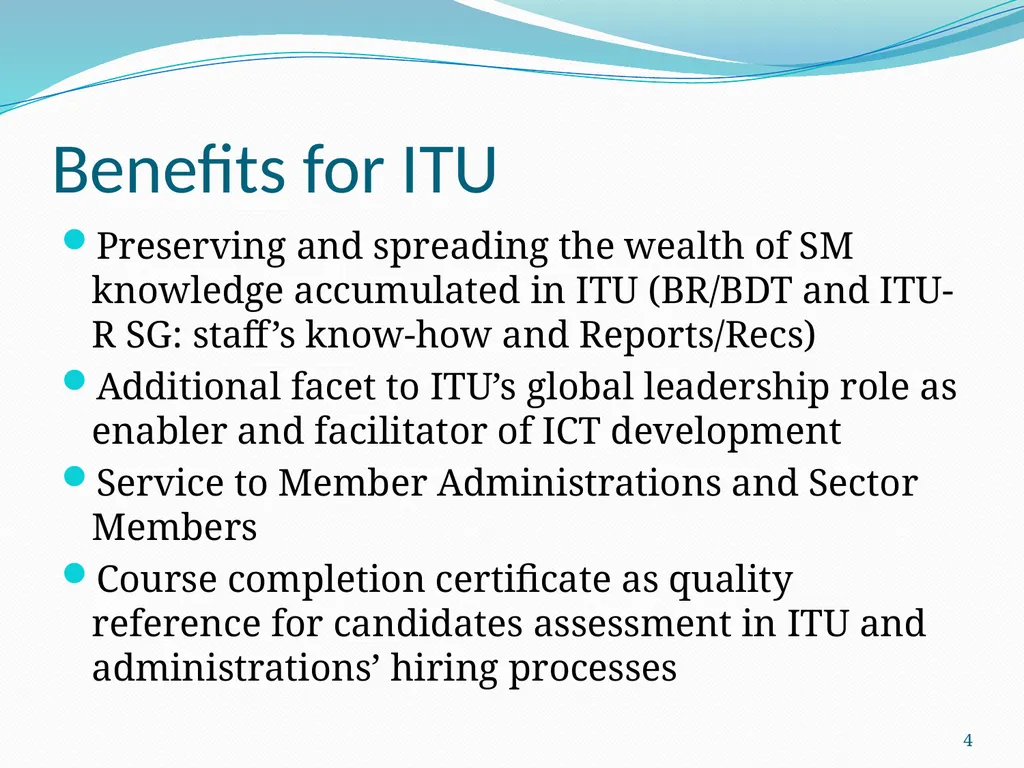
Benefits for ITU Preserving and spreading the wealth of SM knowledge accumulated in ITU (BR/BDT and ITU-R SG: staff’s know-how and Reports/Recs)
Additional facet to ITU’s global leadership role as enabler and facilitator of ICT development
Service to Member Administrations and Sector Members
Course completion certificate as quality reference for candidates assessment in ITU and administrations’ hiring processes 4<br>
05
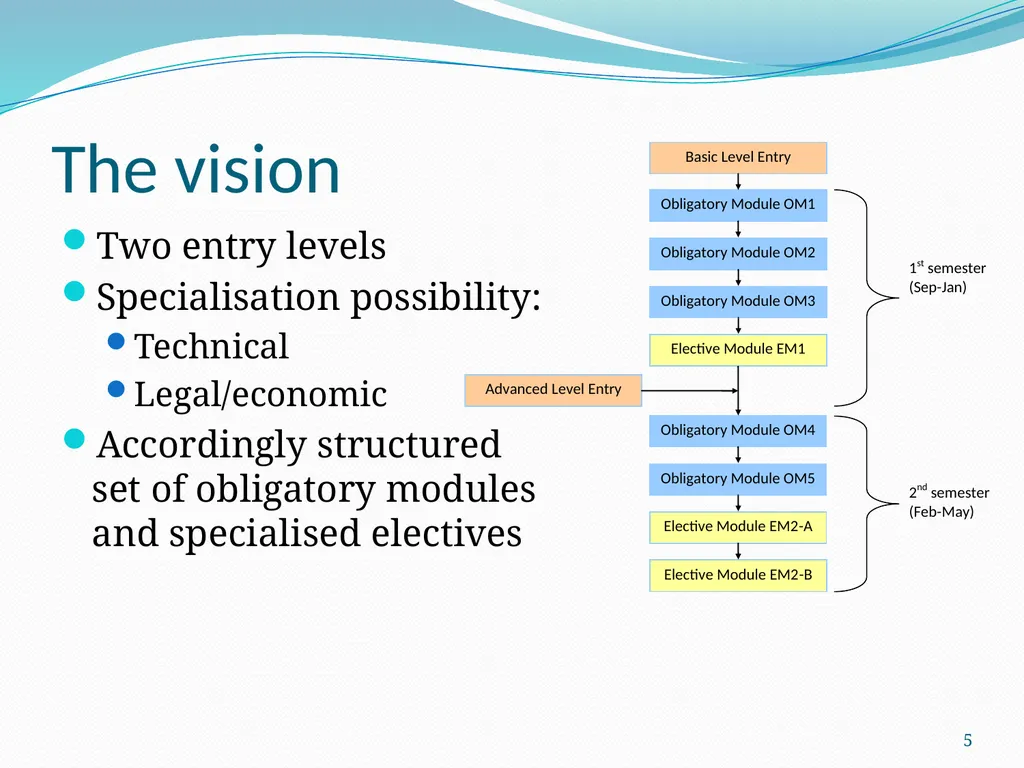
The vision Two entry levels
Specialisation possibility:
Technical
Legal/economic
Accordingly structured set of obligatory modules and specialised electives 5<br>
06
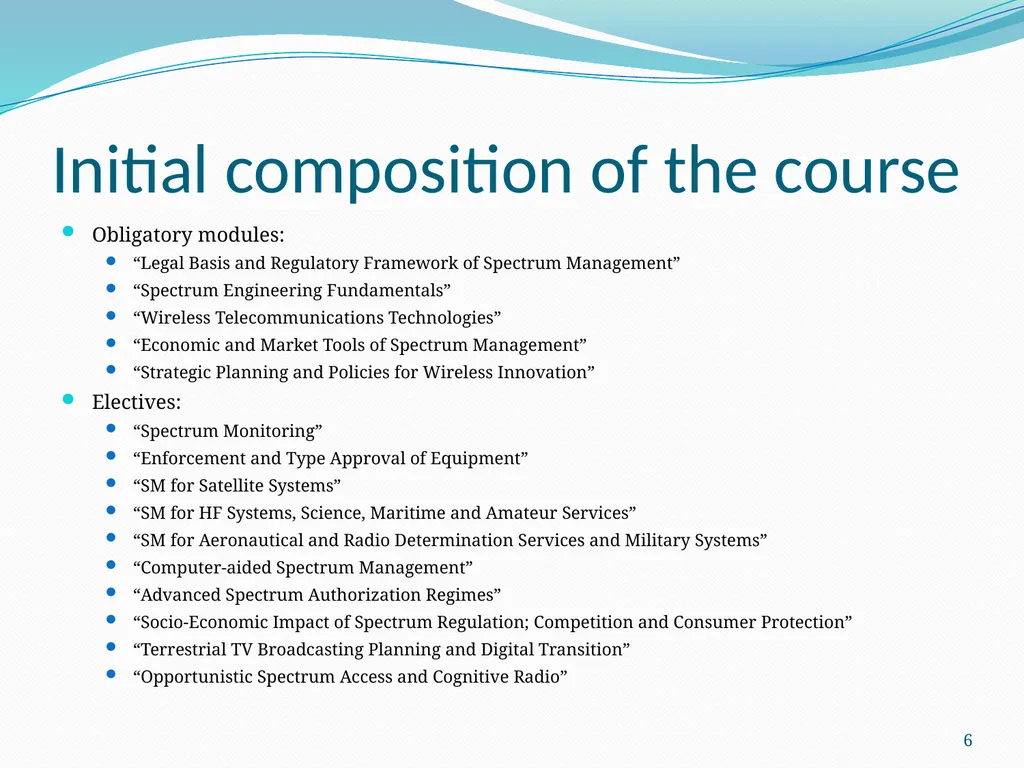
Initial composition of the course Obligatory modules:
“Legal Basis and Regulatory Framework of Spectrum Management”
“Spectrum Engineering Fundamentals”
“Wireless Telecommunications Technologies”
“Economic and Market Tools of Spectrum Management”
“Strategic Planning and Policies for Wireless Innovation”
Electives:
“Spectrum Monitoring”
“Enforcement and Type Approval of Equipment”
“SM for Satellite Systems”
“SM for HF Systems, Science, Maritime and Amateur Services”
“SM for Aeronautical and Radio Determination Services and Military Systems”
“Computer-aided Spectrum Management”
“Advanced Spectrum Authorization Regimes”
“Socio-Economic Impact of Spectrum Regulation; Competition and Consumer Protection”
“Terrestrial TV Broadcasting Planning and Digital Transition”
“Opportunistic Spectrum Access and Cognitive Radio” 6<br>
07
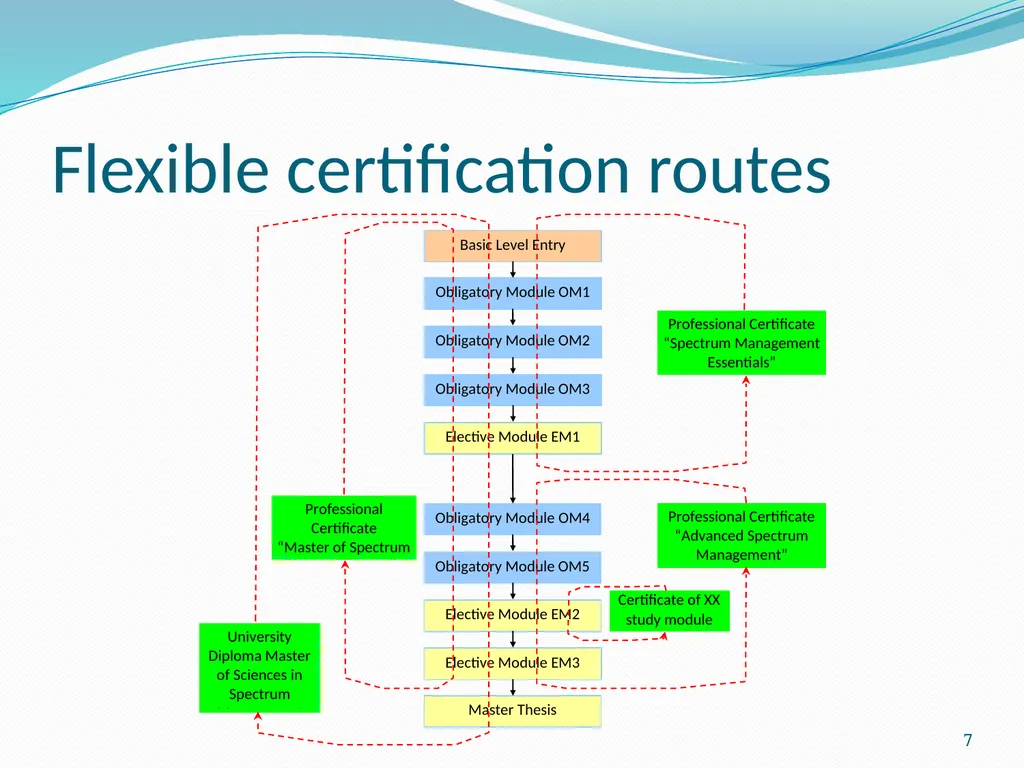
Flexible certification routes 7<br>
08
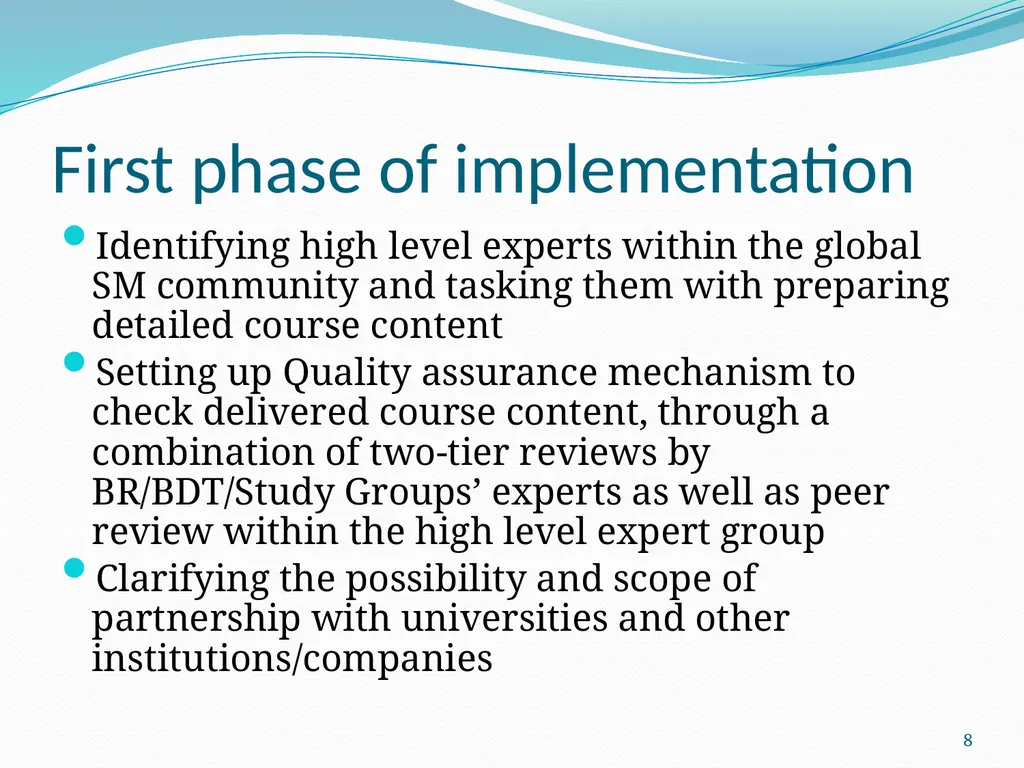
First phase of implementation Identifying high level experts within the global SM community and tasking them with preparing detailed course content
Setting up Quality assurance mechanism to check delivered course content, through a combination of two-tier reviews by BR/BDT/Study Groups’ experts as well as peer review within the high level expert group
Clarifying the possibility and scope of partnership with universities and other institutions/companies 8<br>
09
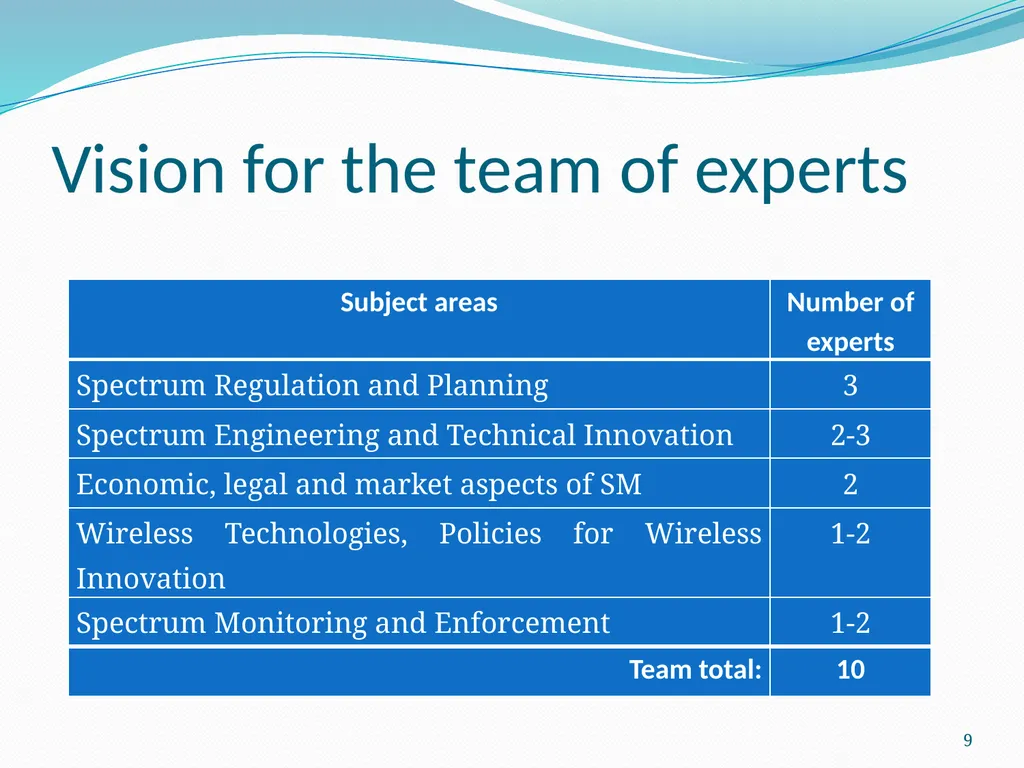
Vision for the team of experts 9<br>
10
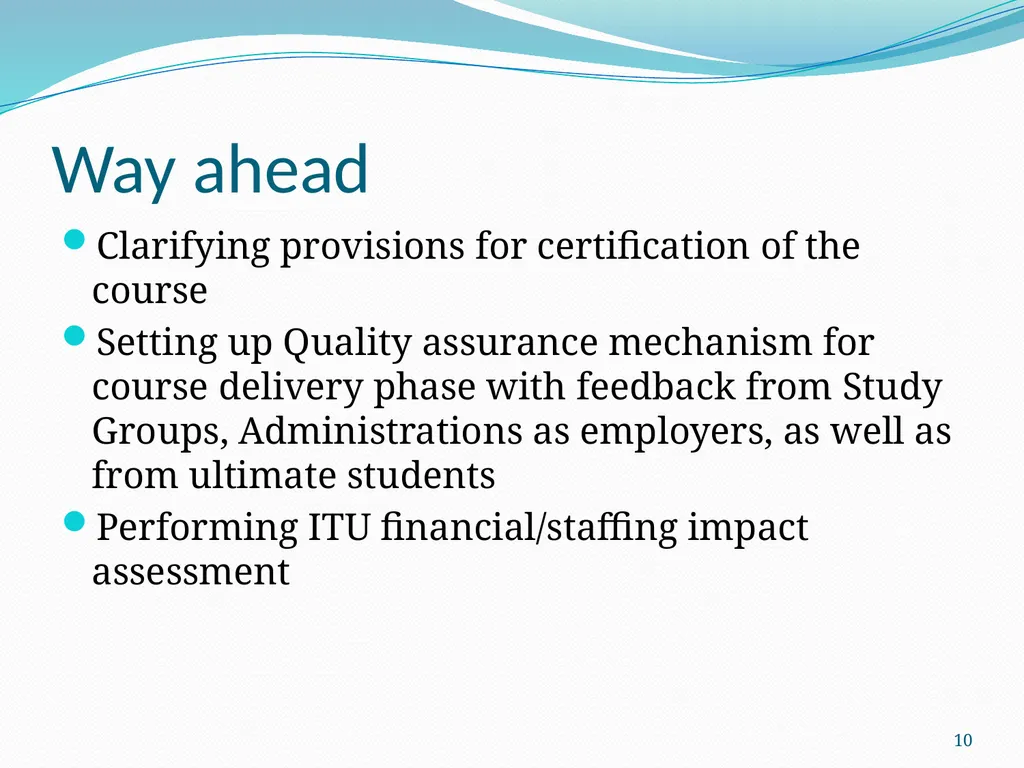
Way ahead Clarifying provisions for certification of the course
Setting up Quality assurance mechanism for course delivery phase with feedback from Study Groups, Administrations as employers, as well as from ultimate students
Performing ITU financial/staffing impact assessment 10<br>
11
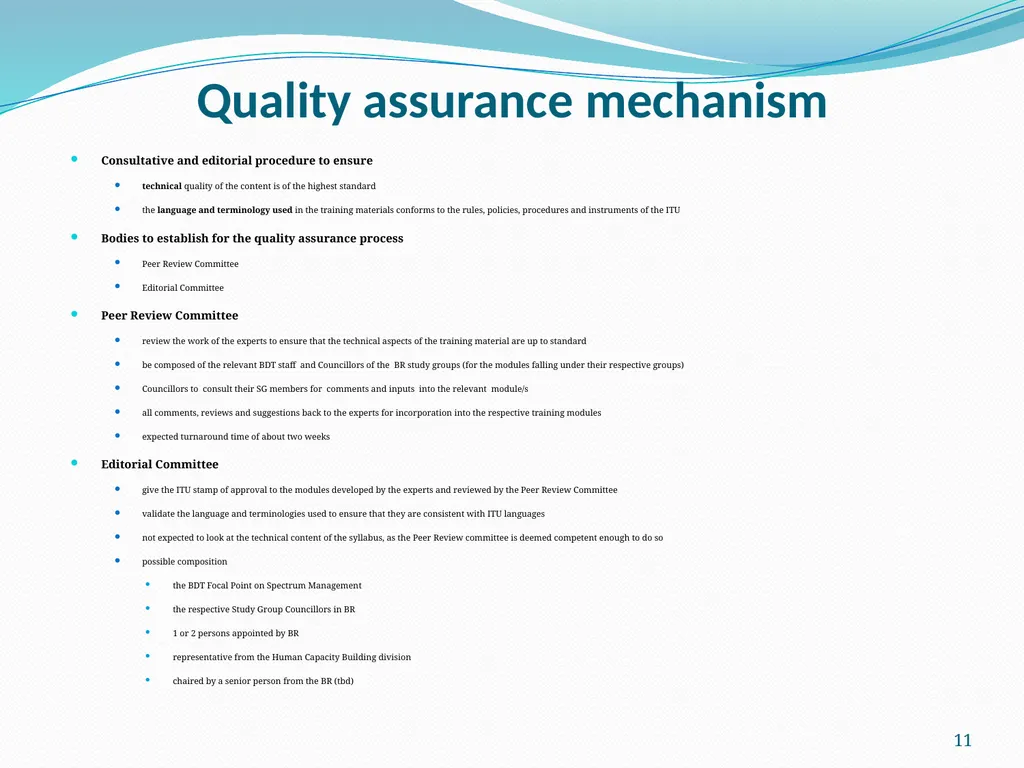
Quality assurance mechanism Consultative and editorial procedure to ensure
technical quality of the content is of the highest standard
the language and terminology used in the training materials conforms to the rules, policies, procedures and instruments of the ITU
Bodies to establish for the quality assurance process
Peer Review Committee
Editorial Committee
Peer Review Committee
review the work of the experts to ensure that the technical aspects of the training material are up to standard
be composed of the relevant BDT staff and Councillors of the BR study groups (for the modules falling under their respective groups)
Councillors to consult their SG members for comments and inputs into the relevant module/s
all comments, reviews and suggestions back to the experts for incorporation into the respective training modules
expected turnaround time of about two weeks
Editorial Committee
give the ITU stamp of approval to the modules developed by the experts and reviewed by the Peer Review Committee
validate the language and terminologies used to ensure that they are consistent with ITU languages
not expected to look at the technical content of the syllabus, as the Peer Review committee is deemed competent enough to do so
possible composition
the BDT Focal Point on Spectrum Management
the respective Study Group Councillors in BR
1 or 2 persons appointed by BR
representative from the Human Capacity Building division
chaired by a senior person from the BR (tbd) 11<br>
12
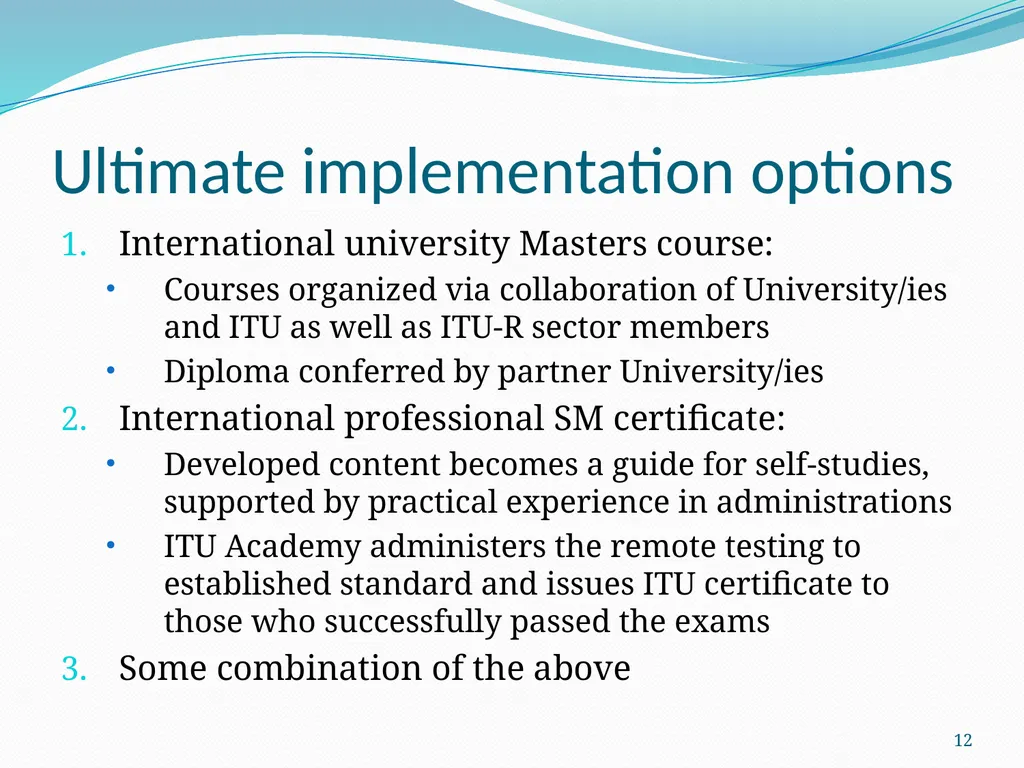
Ultimate implementation options International university Masters course:
Courses organized via collaboration of University/ies and ITU as well as ITU-R sector members
Diploma conferred by partner University/ies
International professional SM certificate:
Developed content becomes a guide for self-studies, supported by practical experience in administrations
ITU Academy administers the remote testing to established standard and issues ITU certificate to those who successfully passed the exams
Some combination of the above 12<br>
13
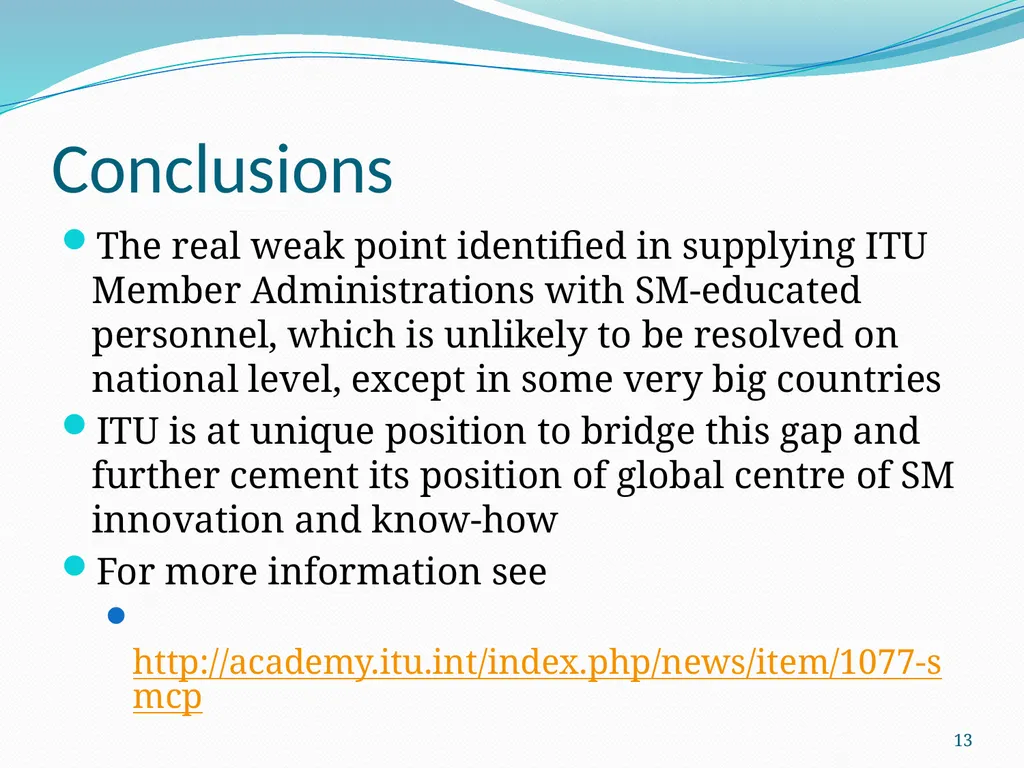
Conclusions The real weak point identified in supplying ITU Member Administrations with SM-educated personnel, which is unlikely to be resolved on national level, except in some very big countries
ITU is at unique position to bridge this gap and further cement its position of global centre of SM innovation and know-how
For more information see
http://academy.itu.int/index.php/news/item/1077-smcp 13<br>