
IUPAP 100th ANNIVERSARY TESTIMONIALS FROM THE PAST
MS
Published · 14 slides · 0 views

1 / 1
Description
IUPAP 100th ANNIVERSARY TESTIMONIALS FROM THE PAST Yves Petroff - 1999-2002: President Elect - 2002-2005: President - 2005-2008: Past President In 1999, I was a member of the SLAC (Stanford) Science Advisory Committee when Burt Richter,
Related Topics
Share
Embed code
Download this presentation From Below
"IUPAP 100th ANNIVERSARY TESTIMONIALS FROM THE PAST" is the property of its rightful owner. Permission is granted to download and print the materials on this website for personal, non-commercial use only, and to display it on your personal computer provided you do not modify the materials and that you retain all copyright notices contained in the materials. By downloading content from our website, you accept the terms of this agreement.
Presentation Transcript
01
IUPAP 100th ANNIVERSARY
TESTIMONIALS FROM THE PAST
Yves Petroff
- 1999-2002: President Elect
- 2002-2005: President
- 2005-2008: Past President<br>
TESTIMONIALS FROM THE PAST
Yves Petroff
- 1999-2002: President Elect
- 2002-2005: President
- 2005-2008: Past President<br>
02
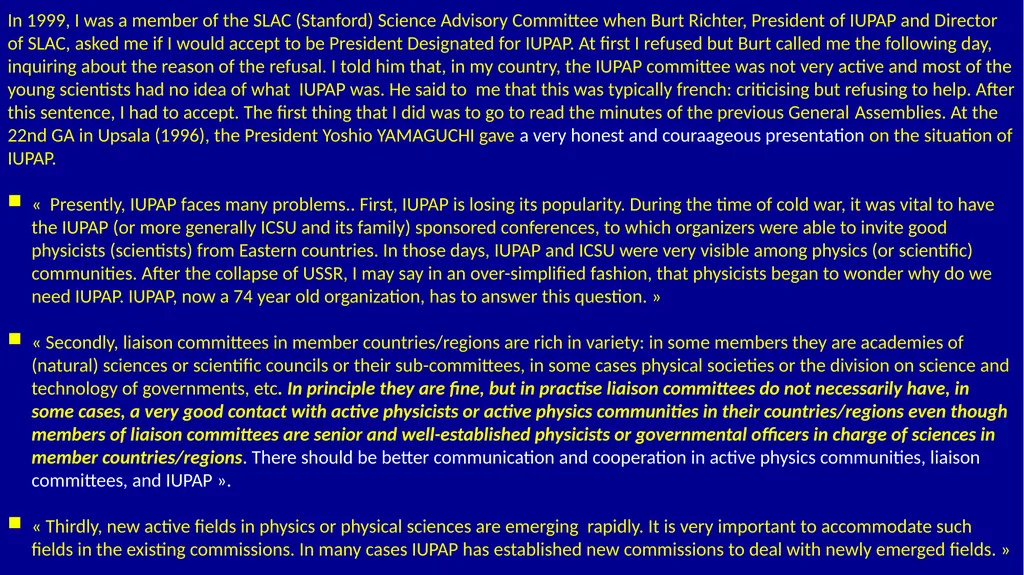
In 1999, I was a member of the SLAC (Stanford) Science Advisory Committee when Burt Richter, President of IUPAP and Director of SLAC, asked me if I would accept to be President Designated for IUPAP. At first I refused but Burt called me the following day, inquiring about the reason of the refusal. I told him that, in my country, the IUPAP committee was not very active and most of the young scientists had no idea of what IUPAP was. He said to me that this was typically french: criticising but refusing to help. After this sentence, I had to accept. The first thing that I did was to go to read the minutes of the previous General Assemblies. At the 22nd GA in Upsala (1996), the President Yoshio YAMAGUCHI gave a very honest and couraageous presentation on the situation of IUPAP.
« Presently, IUPAP faces many problems.. First, IUPAP is losing its popularity. During the time of cold war, it was vital to have the IUPAP (or more generally ICSU and its family) sponsored conferences, to which organizers were able to invite good physicists (scientists) from Eastern countries. In those days, IUPAP and ICSU were very visible among physics (or scientific) communities. After the collapse of USSR, I may say in an over-simplified fashion, that physicists began to wonder why do we need IUPAP. IUPAP, now a 74 year old organization, has to answer this question. »
« Secondly, liaison committees in member countries/regions are rich in variety: in some members they are academies of (natural) sciences or scientific councils or their sub-committees, in some cases physical societies or the division on science and technology of governments, etc. In principle they are fine, but in practise liaison committees do not necessarily have, in some cases, a very good contact with active physicists or active physics communities in their countries/regions even though members of liaison committees are senior and well-established physicists or governmental officers in charge of sciences in member countries/regions. There should be better communication and cooperation in active physics communities, liaison committees, and IUPAP ».
« Thirdly, new active fields in physics or physical sciences are emerging rapidly. It is very important to accommodate such fields in the existing commissions. In many cases IUPAP has established new commissions to deal with newly emerged fields. »<br>
« Presently, IUPAP faces many problems.. First, IUPAP is losing its popularity. During the time of cold war, it was vital to have the IUPAP (or more generally ICSU and its family) sponsored conferences, to which organizers were able to invite good physicists (scientists) from Eastern countries. In those days, IUPAP and ICSU were very visible among physics (or scientific) communities. After the collapse of USSR, I may say in an over-simplified fashion, that physicists began to wonder why do we need IUPAP. IUPAP, now a 74 year old organization, has to answer this question. »
« Secondly, liaison committees in member countries/regions are rich in variety: in some members they are academies of (natural) sciences or scientific councils or their sub-committees, in some cases physical societies or the division on science and technology of governments, etc. In principle they are fine, but in practise liaison committees do not necessarily have, in some cases, a very good contact with active physicists or active physics communities in their countries/regions even though members of liaison committees are senior and well-established physicists or governmental officers in charge of sciences in member countries/regions. There should be better communication and cooperation in active physics communities, liaison committees, and IUPAP ».
« Thirdly, new active fields in physics or physical sciences are emerging rapidly. It is very important to accommodate such fields in the existing commissions. In many cases IUPAP has established new commissions to deal with newly emerged fields. »<br>
03
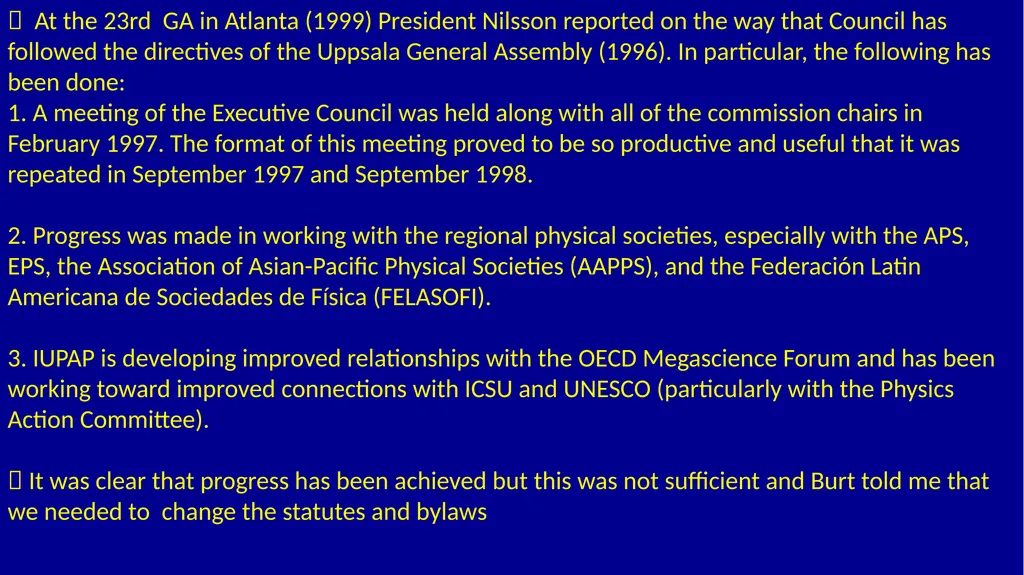
At the 23rd GA in Atlanta (1999) President Nilsson reported on the way that Council has followed the directives of the Uppsala General Assembly (1996). In particular, the following has been done:
1. A meeting of the Executive Council was held along with all of the commission chairs in February 1997. The format of this meeting proved to be so productive and useful that it was repeated in September 1997 and September 1998.
2. Progress was made in working with the regional physical societies, especially with the APS, EPS, the Association of Asian-Pacific Physical Societies (AAPPS), and the Federación Latin Americana de Sociedades de Física (FELASOFI).
3. IUPAP is developing improved relationships with the OECD Megascience Forum and has been working toward improved connections with ICSU and UNESCO (particularly with the Physics Action Committee).
It was clear that progress has been achieved but this was not sufficient and Burt told me that we needed to change the statutes and bylaws<br>
1. A meeting of the Executive Council was held along with all of the commission chairs in February 1997. The format of this meeting proved to be so productive and useful that it was repeated in September 1997 and September 1998.
2. Progress was made in working with the regional physical societies, especially with the APS, EPS, the Association of Asian-Pacific Physical Societies (AAPPS), and the Federación Latin Americana de Sociedades de Física (FELASOFI).
3. IUPAP is developing improved relationships with the OECD Megascience Forum and has been working toward improved connections with ICSU and UNESCO (particularly with the Physics Action Committee).
It was clear that progress has been achieved but this was not sufficient and Burt told me that we needed to change the statutes and bylaws<br>
04
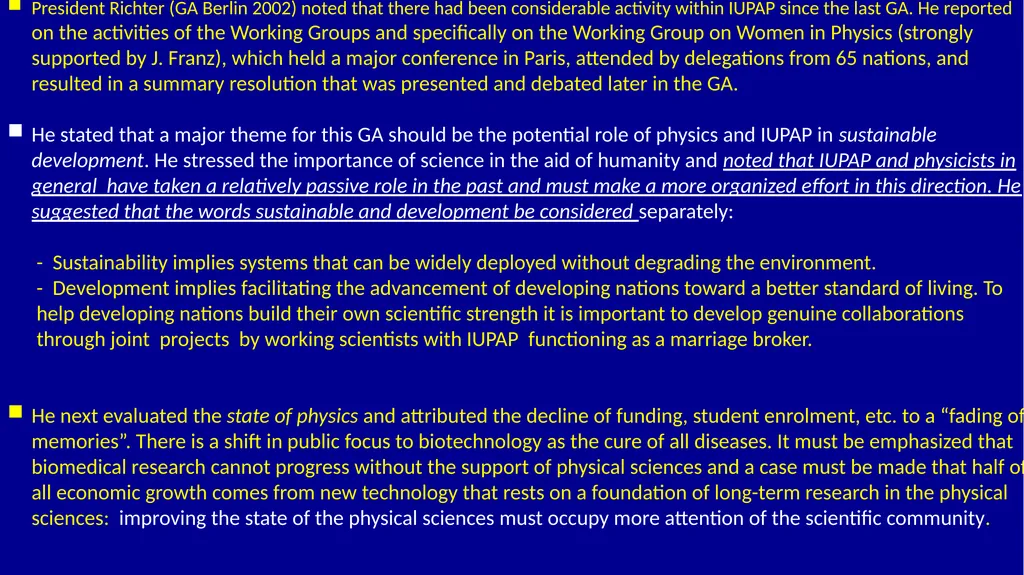
President Richter (GA Berlin 2002) noted that there had been considerable activity within IUPAP since the last GA. He reported on the activities of the Working Groups and specifically on the Working Group on Women in Physics (strongly supported by J. Franz), which held a major conference in Paris, attended by delegations from 65 nations, and resulted in a summary resolution that was presented and debated later in the GA.
He stated that a major theme for this GA should be the potential role of physics and IUPAP in sustainable development. He stressed the importance of science in the aid of humanity and noted that IUPAP and physicists in general have taken a relatively passive role in the past and must make a more organized effort in this direction. He suggested that the words sustainable and development be considered separately:
- Sustainability implies systems that can be widely deployed without degrading the environment.
- Development implies facilitating the advancement of developing nations toward a better standard of living. To
help developing nations build their own scientific strength it is important to develop genuine collaborations
through joint projects by working scientists with IUPAP functioning as a marriage broker.
He next evaluated the state of physics and attributed the decline of funding, student enrolment, etc. to a “fading of memories”. There is a shift in public focus to biotechnology as the cure of all diseases. It must be emphasized that biomedical research cannot progress without the support of physical sciences and a case must be made that half of all economic growth comes from new technology that rests on a foundation of long-term research in the physical sciences: improving the state of the physical sciences must occupy more attention of the scientific community.<br>
He stated that a major theme for this GA should be the potential role of physics and IUPAP in sustainable development. He stressed the importance of science in the aid of humanity and noted that IUPAP and physicists in general have taken a relatively passive role in the past and must make a more organized effort in this direction. He suggested that the words sustainable and development be considered separately:
- Sustainability implies systems that can be widely deployed without degrading the environment.
- Development implies facilitating the advancement of developing nations toward a better standard of living. To
help developing nations build their own scientific strength it is important to develop genuine collaborations
through joint projects by working scientists with IUPAP functioning as a marriage broker.
He next evaluated the state of physics and attributed the decline of funding, student enrolment, etc. to a “fading of memories”. There is a shift in public focus to biotechnology as the cure of all diseases. It must be emphasized that biomedical research cannot progress without the support of physical sciences and a case must be made that half of all economic growth comes from new technology that rests on a foundation of long-term research in the physical sciences: improving the state of the physical sciences must occupy more attention of the scientific community.<br>
05
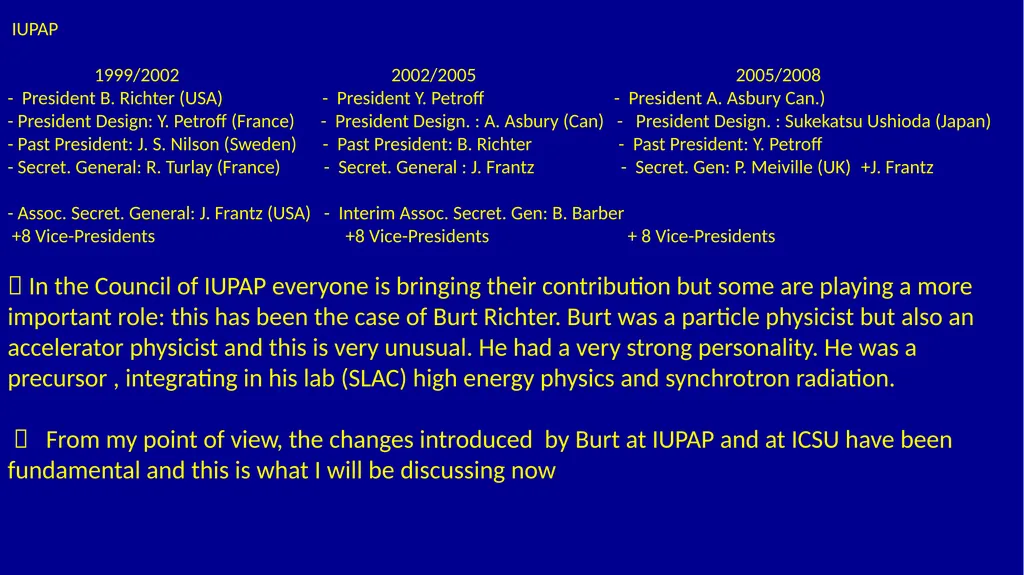
IUPAP
1999/2002 2002/2005 2005/2008
- President B. Richter (USA) - President Y. Petroff - President A. Asbury Can.)
- President Design: Y. Petroff (France) - President Design. : A. Asbury (Can) - President Design. : Sukekatsu Ushioda (Japan)
- Past President: J. S. Nilson (Sweden) - Past President: B. Richter - Past President: Y. Petroff
- Secret. General: R. Turlay (France) - Secret. General : J. Frantz - Secret. Gen: P. Meiville (UK) +J. Frantz
- Assoc. Secret. General: J. Frantz (USA) - Interim Assoc. Secret. Gen: B. Barber
+8 Vice-Presidents +8 Vice-Presidents + 8 Vice-Presidents
In the Council of IUPAP everyone is bringing their contribution but some are playing a more important role: this has been the case of Burt Richter. Burt was a particle physicist but also an accelerator physicist and this is very unusual. He had a very strong personality. He was a precursor , integrating in his lab (SLAC) high energy physics and synchrotron radiation.
From my point of view, the changes introduced by Burt at IUPAP and at ICSU have been fundamental and this is what I will be discussing now<br>
1999/2002 2002/2005 2005/2008
- President B. Richter (USA) - President Y. Petroff - President A. Asbury Can.)
- President Design: Y. Petroff (France) - President Design. : A. Asbury (Can) - President Design. : Sukekatsu Ushioda (Japan)
- Past President: J. S. Nilson (Sweden) - Past President: B. Richter - Past President: Y. Petroff
- Secret. General: R. Turlay (France) - Secret. General : J. Frantz - Secret. Gen: P. Meiville (UK) +J. Frantz
- Assoc. Secret. General: J. Frantz (USA) - Interim Assoc. Secret. Gen: B. Barber
+8 Vice-Presidents +8 Vice-Presidents + 8 Vice-Presidents
In the Council of IUPAP everyone is bringing their contribution but some are playing a more important role: this has been the case of Burt Richter. Burt was a particle physicist but also an accelerator physicist and this is very unusual. He had a very strong personality. He was a precursor , integrating in his lab (SLAC) high energy physics and synchrotron radiation.
From my point of view, the changes introduced by Burt at IUPAP and at ICSU have been fundamental and this is what I will be discussing now<br>
06
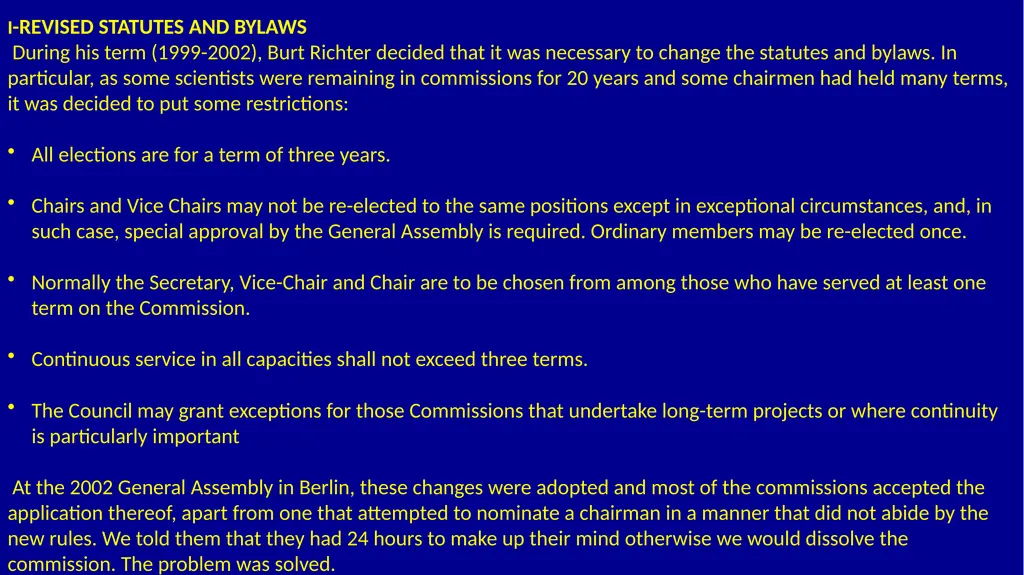
I-REVISED STATUTES AND BYLAWS
During his term (1999-2002), Burt Richter decided that it was necessary to change the statutes and bylaws. In particular, as some scientists were remaining in commissions for 20 years and some chairmen had held many terms, it was decided to put some restrictions:
All elections are for a term of three years.
Chairs and Vice Chairs may not be re-elected to the same positions except in exceptional circumstances, and, in such case, special approval by the General Assembly is required. Ordinary members may be re-elected once.
Normally the Secretary, Vice-Chair and Chair are to be chosen from among those who have served at least one term on the Commission.
Continuous service in all capacities shall not exceed three terms.
The Council may grant exceptions for those Commissions that undertake long-term projects or where continuity is particularly important
At the 2002 General Assembly in Berlin, these changes were adopted and most of the commissions accepted the application thereof, apart from one that attempted to nominate a chairman in a manner that did not abide by the new rules. We told them that they had 24 hours to make up their mind otherwise we would dissolve the commission. The problem was solved.<br>
During his term (1999-2002), Burt Richter decided that it was necessary to change the statutes and bylaws. In particular, as some scientists were remaining in commissions for 20 years and some chairmen had held many terms, it was decided to put some restrictions:
All elections are for a term of three years.
Chairs and Vice Chairs may not be re-elected to the same positions except in exceptional circumstances, and, in such case, special approval by the General Assembly is required. Ordinary members may be re-elected once.
Normally the Secretary, Vice-Chair and Chair are to be chosen from among those who have served at least one term on the Commission.
Continuous service in all capacities shall not exceed three terms.
The Council may grant exceptions for those Commissions that undertake long-term projects or where continuity is particularly important
At the 2002 General Assembly in Berlin, these changes were adopted and most of the commissions accepted the application thereof, apart from one that attempted to nominate a chairman in a manner that did not abide by the new rules. We told them that they had 24 hours to make up their mind otherwise we would dissolve the commission. The problem was solved.<br>
07
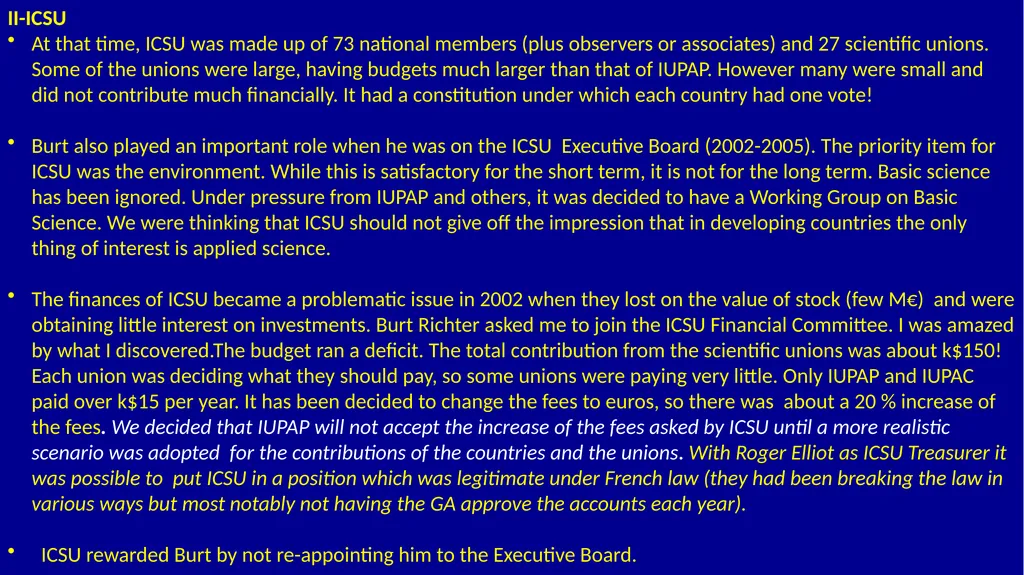
II-ICSU
At that time, ICSU was made up of 73 national members (plus observers or associates) and 27 scientific unions. Some of the unions were large, having budgets much larger than that of IUPAP. However many were small and did not contribute much financially. It had a constitution under which each country had one vote!
Burt also played an important role when he was on the ICSU Executive Board (2002-2005). The priority item for ICSU was the environment. While this is satisfactory for the short term, it is not for the long term. Basic science has been ignored. Under pressure from IUPAP and others, it was decided to have a Working Group on Basic Science. We were thinking that ICSU should not give off the impression that in developing countries the only thing of interest is applied science.
The finances of ICSU became a problematic issue in 2002 when they lost on the value of stock (few M€) and were obtaining little interest on investments. Burt Richter asked me to join the ICSU Financial Committee. I was amazed by what I discovered.The budget ran a deficit. The total contribution from the scientific unions was about k$150! Each union was deciding what they should pay, so some unions were paying very little. Only IUPAP and IUPAC paid over k$15 per year. It has been decided to change the fees to euros, so there was about a 20 % increase of the fees. We decided that IUPAP will not accept the increase of the fees asked by ICSU until a more realistic scenario was adopted for the contributions of the countries and the unions. With Roger Elliot as ICSU Treasurer it was possible to put ICSU in a position which was legitimate under French law (they had been breaking the law in various ways but most notably not having the GA approve the accounts each year).
ICSU rewarded Burt by not re-appointing him to the Executive Board.<br>
At that time, ICSU was made up of 73 national members (plus observers or associates) and 27 scientific unions. Some of the unions were large, having budgets much larger than that of IUPAP. However many were small and did not contribute much financially. It had a constitution under which each country had one vote!
Burt also played an important role when he was on the ICSU Executive Board (2002-2005). The priority item for ICSU was the environment. While this is satisfactory for the short term, it is not for the long term. Basic science has been ignored. Under pressure from IUPAP and others, it was decided to have a Working Group on Basic Science. We were thinking that ICSU should not give off the impression that in developing countries the only thing of interest is applied science.
The finances of ICSU became a problematic issue in 2002 when they lost on the value of stock (few M€) and were obtaining little interest on investments. Burt Richter asked me to join the ICSU Financial Committee. I was amazed by what I discovered.The budget ran a deficit. The total contribution from the scientific unions was about k$150! Each union was deciding what they should pay, so some unions were paying very little. Only IUPAP and IUPAC paid over k$15 per year. It has been decided to change the fees to euros, so there was about a 20 % increase of the fees. We decided that IUPAP will not accept the increase of the fees asked by ICSU until a more realistic scenario was adopted for the contributions of the countries and the unions. With Roger Elliot as ICSU Treasurer it was possible to put ICSU in a position which was legitimate under French law (they had been breaking the law in various ways but most notably not having the GA approve the accounts each year).
ICSU rewarded Burt by not re-appointing him to the Executive Board.<br>
08
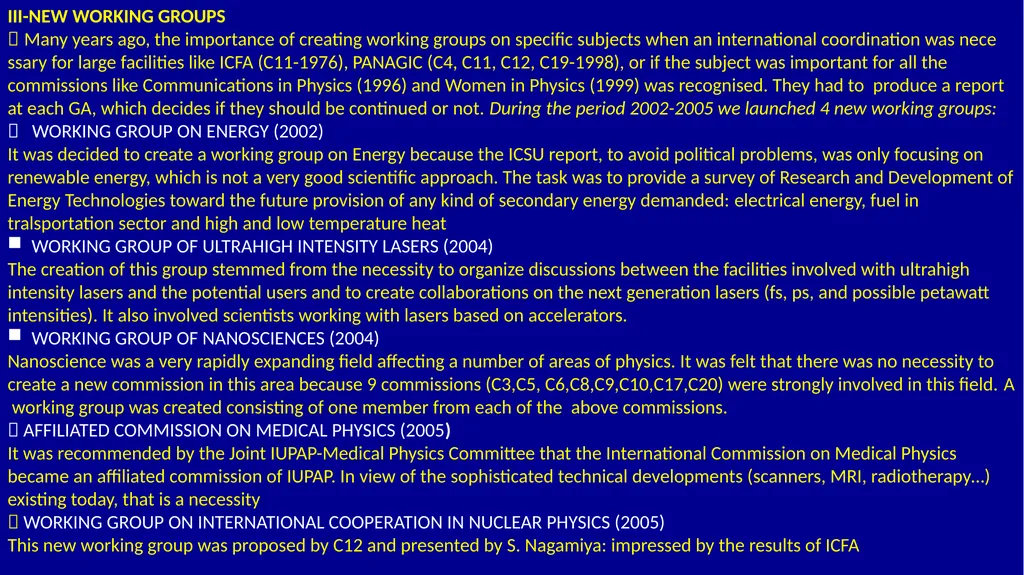
III-NEW WORKING GROUPS
Many years ago, the importance of creating working groups on specific subjects when an international coordination was nece ssary for large facilities like ICFA (C11-1976), PANAGIC (C4, C11, C12, C19-1998), or if the subject was important for all the commissions like Communications in Physics (1996) and Women in Physics (1999) was recognised. They had to produce a report at each GA, which decides if they should be continued or not. During the period 2002-2005 we launched 4 new working groups:
WORKING GROUP ON ENERGY (2002)
It was decided to create a working group on Energy because the ICSU report, to avoid political problems, was only focusing on renewable energy, which is not a very good scientific approach. The task was to provide a survey of Research and Development of Energy Technologies toward the future provision of any kind of secondary energy demanded: electrical energy, fuel in tralsportation sector and high and low temperature heat
WORKING GROUP OF ULTRAHIGH INTENSITY LASERS (2004)
The creation of this group stemmed from the necessity to organize discussions between the facilities involved with ultrahigh intensity lasers and the potential users and to create collaborations on the next generation lasers (fs, ps, and possible petawatt intensities). It also involved scientists working with lasers based on accelerators.
WORKING GROUP OF NANOSCIENCES (2004)
Nanoscience was a very rapidly expanding field affecting a number of areas of physics. It was felt that there was no necessity to create a new commission in this area because 9 commissions (C3,C5, C6,C8,C9,C10,C17,C20) were strongly involved in this field. A working group was created consisting of one member from each of the above commissions.
AFFILIATED COMMISSION ON MEDICAL PHYSICS (2005)
It was recommended by the Joint IUPAP-Medical Physics Committee that the International Commission on Medical Physics became an affiliated commission of IUPAP. In view of the sophisticated technical developments (scanners, MRI, radiotherapy…) existing today, that is a necessity
WORKING GROUP ON INTERNATIONAL COOPERATION IN NUCLEAR PHYSICS (2005)
This new working group was proposed by C12 and presented by S. Nagamiya: impressed by the results of ICFA<br>
Many years ago, the importance of creating working groups on specific subjects when an international coordination was nece ssary for large facilities like ICFA (C11-1976), PANAGIC (C4, C11, C12, C19-1998), or if the subject was important for all the commissions like Communications in Physics (1996) and Women in Physics (1999) was recognised. They had to produce a report at each GA, which decides if they should be continued or not. During the period 2002-2005 we launched 4 new working groups:
WORKING GROUP ON ENERGY (2002)
It was decided to create a working group on Energy because the ICSU report, to avoid political problems, was only focusing on renewable energy, which is not a very good scientific approach. The task was to provide a survey of Research and Development of Energy Technologies toward the future provision of any kind of secondary energy demanded: electrical energy, fuel in tralsportation sector and high and low temperature heat
WORKING GROUP OF ULTRAHIGH INTENSITY LASERS (2004)
The creation of this group stemmed from the necessity to organize discussions between the facilities involved with ultrahigh intensity lasers and the potential users and to create collaborations on the next generation lasers (fs, ps, and possible petawatt intensities). It also involved scientists working with lasers based on accelerators.
WORKING GROUP OF NANOSCIENCES (2004)
Nanoscience was a very rapidly expanding field affecting a number of areas of physics. It was felt that there was no necessity to create a new commission in this area because 9 commissions (C3,C5, C6,C8,C9,C10,C17,C20) were strongly involved in this field. A working group was created consisting of one member from each of the above commissions.
AFFILIATED COMMISSION ON MEDICAL PHYSICS (2005)
It was recommended by the Joint IUPAP-Medical Physics Committee that the International Commission on Medical Physics became an affiliated commission of IUPAP. In view of the sophisticated technical developments (scanners, MRI, radiotherapy…) existing today, that is a necessity
WORKING GROUP ON INTERNATIONAL COOPERATION IN NUCLEAR PHYSICS (2005)
This new working group was proposed by C12 and presented by S. Nagamiya: impressed by the results of ICFA<br>
09
V-WORLD YEAR OF PHYSICS 2005
Over 1000 participants, including eight Nobel Prize Laureates, personalities from the world of science and close to 500 students from 70 countries took part in the "Physics for Tomorrow" conference at UNESCO headquarters in Paris on 13 January 2005. The event marked the official launch of the International Year of Physics, proclaimed by the United Nations. The International Year aims to highlight the importance of physics and its contribution to the development of many other scientific disciplines. It was also to help fight the current lack of enthusiasm for sciences among young people. Throughout 2005, events were organized across the world to debate physics and it implications to society.
The conference , organized by UNESCO, the lead UN organization for the International Year, was initiated by the EPS, and supported by the physics community, in particular by CERN, CNRS and CEA, EU Commission, IUPAP and others.<br>
Over 1000 participants, including eight Nobel Prize Laureates, personalities from the world of science and close to 500 students from 70 countries took part in the "Physics for Tomorrow" conference at UNESCO headquarters in Paris on 13 January 2005. The event marked the official launch of the International Year of Physics, proclaimed by the United Nations. The International Year aims to highlight the importance of physics and its contribution to the development of many other scientific disciplines. It was also to help fight the current lack of enthusiasm for sciences among young people. Throughout 2005, events were organized across the world to debate physics and it implications to society.
The conference , organized by UNESCO, the lead UN organization for the International Year, was initiated by the EPS, and supported by the physics community, in particular by CERN, CNRS and CEA, EU Commission, IUPAP and others.<br>
10
VI-US VISAS PROBLEMS
In 2003, we started to have serious concerns about the situation of US visas and the major problems that are arising from free circulation of scientists and the international character of conferences. Professor Vera Lüth (Chair of C11) presented a detailed report on the new procedures that were enforced in the US visa applications and the impact that they had on the attendance at the International Symposium on Lepton-Photon interactions. I reported on a letter sent by Professor J. Dorfan (Chair of ICFA) pointing out that the situation was more general and concerned not only access to conferences, but also to international collaborative activities and large scale facilities. Professor Elisa Molinari (Associate Secretay General) mentioned that other Conference organizers reported problems in the attendance of foreign scientists working in the US to Conferences held ouside the US, owing to worries about re-entry visas. After extensive discussion , we decided that IUPAP would not guarantee approval to any future Conference in the US unless the situation changed. This should be true for other countries if similar situation should arise.
The following actions were proposed:
- To prepare an official motion and send it to ICSU requesting to take action.
- To include information on the situation on the IUPAP website, together with practical recommendations in
order to help Conference organizers and individual scientists in facing this situation.
- To write to Dr John Marburger, Science Advisor to the US president with a copy to the National Academy of
Sciences, and to other US and international bodies to inform them about the situation and the very serious
implications for the development of science. The letter was sent on 03/12/2003 and we received a positive
answer … 3 months later.
The situation improved substantially under the pressure of the US and International scientific communities<br>
In 2003, we started to have serious concerns about the situation of US visas and the major problems that are arising from free circulation of scientists and the international character of conferences. Professor Vera Lüth (Chair of C11) presented a detailed report on the new procedures that were enforced in the US visa applications and the impact that they had on the attendance at the International Symposium on Lepton-Photon interactions. I reported on a letter sent by Professor J. Dorfan (Chair of ICFA) pointing out that the situation was more general and concerned not only access to conferences, but also to international collaborative activities and large scale facilities. Professor Elisa Molinari (Associate Secretay General) mentioned that other Conference organizers reported problems in the attendance of foreign scientists working in the US to Conferences held ouside the US, owing to worries about re-entry visas. After extensive discussion , we decided that IUPAP would not guarantee approval to any future Conference in the US unless the situation changed. This should be true for other countries if similar situation should arise.
The following actions were proposed:
- To prepare an official motion and send it to ICSU requesting to take action.
- To include information on the situation on the IUPAP website, together with practical recommendations in
order to help Conference organizers and individual scientists in facing this situation.
- To write to Dr John Marburger, Science Advisor to the US president with a copy to the National Academy of
Sciences, and to other US and international bodies to inform them about the situation and the very serious
implications for the development of science. The letter was sent on 03/12/2003 and we received a positive
answer … 3 months later.
The situation improved substantially under the pressure of the US and International scientific communities<br>
11
In 2017, I was in Brazil helping my Brazilian colleagues to build a 4 th generation storage ring with a very low emittance. I learned that, in Brazil, the budget for research of the Ministry of Science, Technology, Innovations, and Communications had a cut of 44% in 2017, and a new cut of 15.5% was expected for 2018. This was a real disaster. I contacted the President of the French Academy of Science and a former President of the American Physical Society, inquiring if they could send a letter to the Brazilian President Temer and the Minister of Research. I realized very quickly that it would take months to have these heavy bodies reacting. Knowing that, I contacted 40 Nobel Prize laureates in various fields (physics, chemistry, medicine) and within a week 25 of them accepted to sign a letter, prepared with C. Cohen Tannoudji, that was sent to the President Temer and the Minister Kassab.
Knowing that the General Assembly of the International Union of Pure and Applied Physics
(IUPAP) was taking place in São Paulo from 11th October 2017 to 13 October 2017, I
contacted the president of IUPAP, Bruce MacKellar who accepted that IUPAP discuss the
problem and send a letter to the President Temer and the Minister Kassab explaining that
the dismantling of internationally renowned research groups and a brain drain involving
some of Brazil’s best scientists will occur.
I was very happy to see this quick reaction.<br>
Knowing that the General Assembly of the International Union of Pure and Applied Physics
(IUPAP) was taking place in São Paulo from 11th October 2017 to 13 October 2017, I
contacted the president of IUPAP, Bruce MacKellar who accepted that IUPAP discuss the
problem and send a letter to the President Temer and the Minister Kassab explaining that
the dismantling of internationally renowned research groups and a brain drain involving
some of Brazil’s best scientists will occur.
I was very happy to see this quick reaction.<br>
12
VII-EFFORTS IN FAVOR OF THE DEVELOPING COUNTRIES
When I was President-Designate, I realized that IUPAP General Assemblies have taken place in Europe, US and Asia but never in Africa. At that time among the 24 General Assemblies, 19 took place in Europe, 4 in US-Canada and 1 in Asia. This is why we decided to have the next one in Africa.
The 25th GA took place at Cape Town, South Africa on October 24-25, 2005.
The World Conference on Physics and Sustainable Development in Durban-South Africa on 31/10-2/11/2005 organized by IUPAP-UNESCO-ICTP and the South African Physics Society (SAIP) followed the GA. The goal was to convince the governments all over the world, and especially in the developing world, that physics and science education are a priority. There were 330 participants with two third from developing countries. Four topics were discussed:
- Teaching Physics
- Physics and Economical Development
- Energy and Environment
- Physics and Health
We realized that the number of Asia, Africa and South America countries belonging to IUPAP was very small and that
something has to be done. ICSU was setting up regional offices, with the first one to be in South Africa, the next one in
Malaysia, followed by one in Rio. We were thinking that this opportunity should be exploited by IUPAP. In that direction we
considered the possibility to allow a limited number of countries from Asia, Africa and South America to join IUPAP under a
special arrangement. The Council and Commission Chairs meetings in London in February 2006 looked at how to bring more
developing countries into IUPAP membership. This was developed further at the meeting in Prague in October 2006:
developing countries were offered reduced rates initially on joining IUPAP and they were permitted to bid to host IUPAP
sponsored workshops in their countries. These initiatives have proved successful and a number of countries have become
members.<br>
When I was President-Designate, I realized that IUPAP General Assemblies have taken place in Europe, US and Asia but never in Africa. At that time among the 24 General Assemblies, 19 took place in Europe, 4 in US-Canada and 1 in Asia. This is why we decided to have the next one in Africa.
The 25th GA took place at Cape Town, South Africa on October 24-25, 2005.
The World Conference on Physics and Sustainable Development in Durban-South Africa on 31/10-2/11/2005 organized by IUPAP-UNESCO-ICTP and the South African Physics Society (SAIP) followed the GA. The goal was to convince the governments all over the world, and especially in the developing world, that physics and science education are a priority. There were 330 participants with two third from developing countries. Four topics were discussed:
- Teaching Physics
- Physics and Economical Development
- Energy and Environment
- Physics and Health
We realized that the number of Asia, Africa and South America countries belonging to IUPAP was very small and that
something has to be done. ICSU was setting up regional offices, with the first one to be in South Africa, the next one in
Malaysia, followed by one in Rio. We were thinking that this opportunity should be exploited by IUPAP. In that direction we
considered the possibility to allow a limited number of countries from Asia, Africa and South America to join IUPAP under a
special arrangement. The Council and Commission Chairs meetings in London in February 2006 looked at how to bring more
developing countries into IUPAP membership. This was developed further at the meeting in Prague in October 2006:
developing countries were offered reduced rates initially on joining IUPAP and they were permitted to bid to host IUPAP
sponsored workshops in their countries. These initiatives have proved successful and a number of countries have become
members.<br>
13
VIII- FINANCIAL PROBLEMS
J. Franz reported a positive balance of $47,000 for 2000. She attributed this to high interest rates and back dues being paid. She said that in 2001, income and expenditures were roughly equal. Membership dues paid were less but investment interest rates remained high. 2002 showed a projected deficit of $76,000. Guaranteed Income from ICSU disappeared, interest rates declined, and conference grants were higher. Franz summarized the IUPAP financial situation by noting that IUPAP currently has assets $717,000 or twice the annual budget. She pointed out that this amount fluctuates during the year because of payments to conferences and uncertainties in payment of membership dues. Discussion then focused on calculating dues in Euros instead of Swiss Francs and it was decided that: IUPAP membership dues will be denominated in Euros henceforth. The change over will take place on November 1, 2002 using the ICSU exchange rate in the month of September 2002. Dues of 2500 CHF become 1700 Euros per share.
At the GA in 2005 , It was therefore proposed that there be no increases in the dues for the years 2006-2007-2007.
IX- IUPAP YOUNG SCIENTIST PRIZE
IUPAP was well known amongst physicists above 35 years old but often-young physicists had no knowledge of it. To try to improve that we decided:
- to ask the conference organisers to set-up a sufficient budget for students
- to create an IUPAP Prize for young scientists having up to eight years of research experience following Ph.D. (excluding career
interruptions). Each commission could deliver one prize per year.
- That was done during the next period by A. Asbury (2006). The Prize consisted of a bronze medal and an award of 1000 €.
There were being awarded at the rate of 11/12 a year. On the 27 to receive the prize, three were women.<br>
J. Franz reported a positive balance of $47,000 for 2000. She attributed this to high interest rates and back dues being paid. She said that in 2001, income and expenditures were roughly equal. Membership dues paid were less but investment interest rates remained high. 2002 showed a projected deficit of $76,000. Guaranteed Income from ICSU disappeared, interest rates declined, and conference grants were higher. Franz summarized the IUPAP financial situation by noting that IUPAP currently has assets $717,000 or twice the annual budget. She pointed out that this amount fluctuates during the year because of payments to conferences and uncertainties in payment of membership dues. Discussion then focused on calculating dues in Euros instead of Swiss Francs and it was decided that: IUPAP membership dues will be denominated in Euros henceforth. The change over will take place on November 1, 2002 using the ICSU exchange rate in the month of September 2002. Dues of 2500 CHF become 1700 Euros per share.
At the GA in 2005 , It was therefore proposed that there be no increases in the dues for the years 2006-2007-2007.
IX- IUPAP YOUNG SCIENTIST PRIZE
IUPAP was well known amongst physicists above 35 years old but often-young physicists had no knowledge of it. To try to improve that we decided:
- to ask the conference organisers to set-up a sufficient budget for students
- to create an IUPAP Prize for young scientists having up to eight years of research experience following Ph.D. (excluding career
interruptions). Each commission could deliver one prize per year.
- That was done during the next period by A. Asbury (2006). The Prize consisted of a bronze medal and an award of 1000 €.
There were being awarded at the rate of 11/12 a year. On the 27 to receive the prize, three were women.<br>
14
CONCLUSIONS
WE HAVE A NEW SITUATION IN EUROPE: THE WAR. IUPAP MUST TRY TO HELP :
OUR UKRAINIAN COLLEAGUES
BUT ALSO THOUSANDS OF RUSSIAN SCIENTISTS WHO HAVE TAKEN POSITION AGAINST THE INVASION AND DESTRUCTION OF UKRAINE<br>
WE HAVE A NEW SITUATION IN EUROPE: THE WAR. IUPAP MUST TRY TO HELP :
OUR UKRAINIAN COLLEAGUES
BUT ALSO THOUSANDS OF RUSSIAN SCIENTISTS WHO HAVE TAKEN POSITION AGAINST THE INVASION AND DESTRUCTION OF UKRAINE<br>