
Jake Michaels HCE Coalition: Collaborative Action
DP
Published · 24 slides · 0 views
1 / 1
Description
Jake Michaels HCE Coalition: Collaborative Action Strategy Socialization Materials This slide deck is intended to provide HCE Coalition Leadership Team organizations and partners with an overview of the Coalitions background, its progress
Related Topics
Share
Embed code
Download this presentation From Below
"Jake Michaels HCE Coalition: Collaborative Action" is the property of its rightful owner. Permission is granted to download and print the materials on this website for personal, non-commercial use only, and to display it on your personal computer provided you do not modify the materials and that you retain all copyright notices contained in the materials. By downloading content from our website, you accept the terms of this agreement.
Presentation Transcript
01
Jake Michaels HCE Coalition: Collaborative Action Strategy
Socialization Materials This slide deck is intended to provide HCE Coalition Leadership Team organizations and partners with an overview of the Coalition's background, its progress to date, anticipated outcomes, and the details of the CAS<br>
Socialization Materials This slide deck is intended to provide HCE Coalition Leadership Team organizations and partners with an overview of the Coalition's background, its progress to date, anticipated outcomes, and the details of the CAS<br>
02
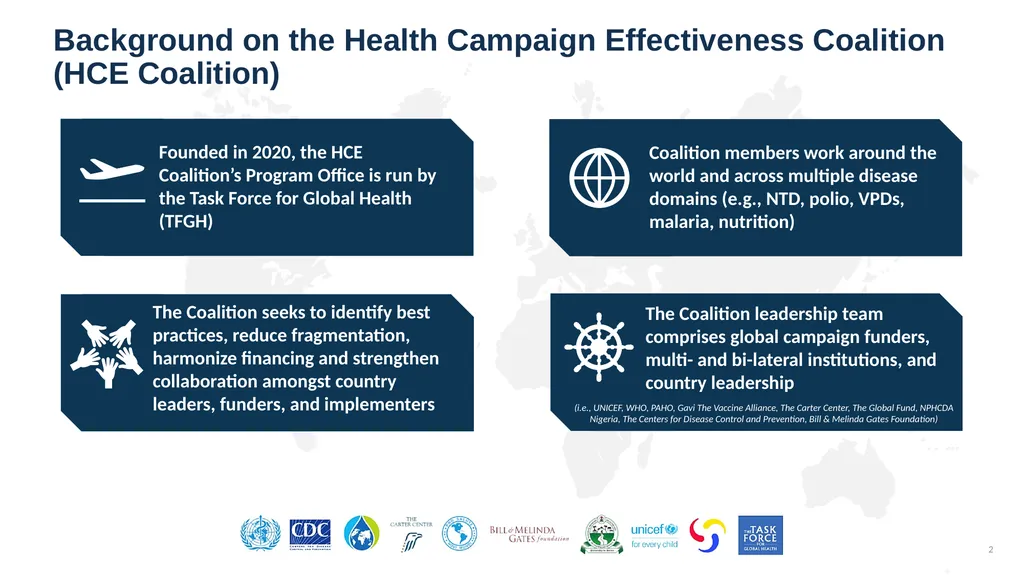
Founded in 2020, the HCE Coalition’s Program Office is run by the Task Force for Global Health (TFGH) Background on the Health Campaign Effectiveness Coalition (HCE Coalition) The Coalition leadership team comprises global campaign funders, multi- and bi-lateral institutions, and country leadership The Coalition seeks to identify best practices, reduce fragmentation, harmonize financing and strengthen collaboration amongst country leaders, funders, and implementers Coalition members work around the world and across multiple disease domains (e.g., NTD, polio, VPDs, malaria, nutrition) (i.e., UNICEF, WHO, PAHO, Gavi The Vaccine Alliance, The Carter Center, The Global Fund, NPHCDA Nigeria, The Centers for Disease Control and Prevention, Bill & Melinda Gates Foundation)<br>
03
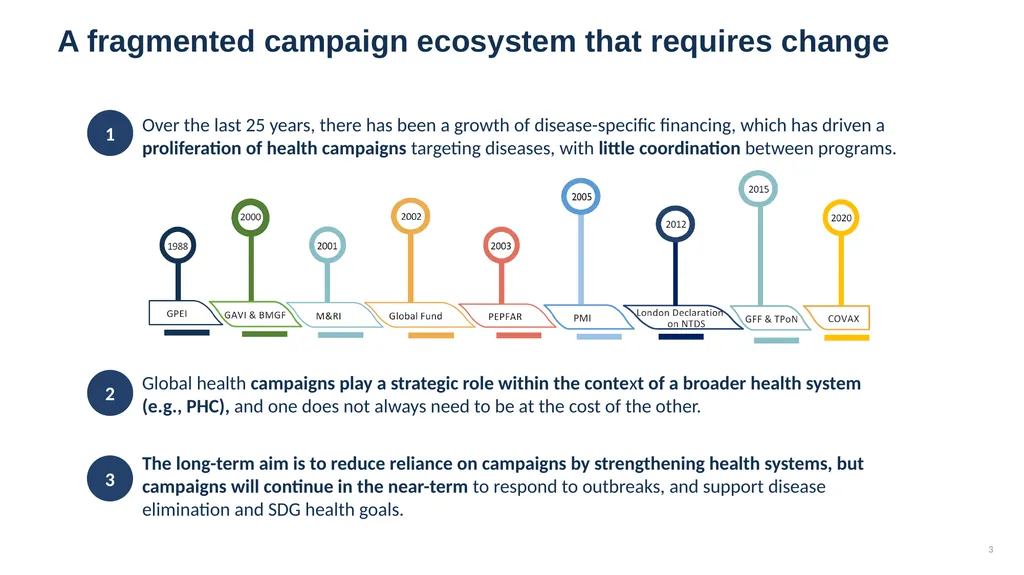
A fragmented campaign ecosystem that requires change Over the last 25 years, there has been a growth of disease-specific financing, which has driven a proliferation of health campaigns targeting diseases, with little coordination between programs. 1 Global health campaigns play a strategic role within the context of a broader health system (e.g., PHC), and one does not always need to be at the cost of the other. 2 The long-term aim is to reduce reliance on campaigns by strengthening health systems, but campaigns will continue in the near-term to respond to outbreaks, and support disease elimination and SDG health goals. 3<br>
04
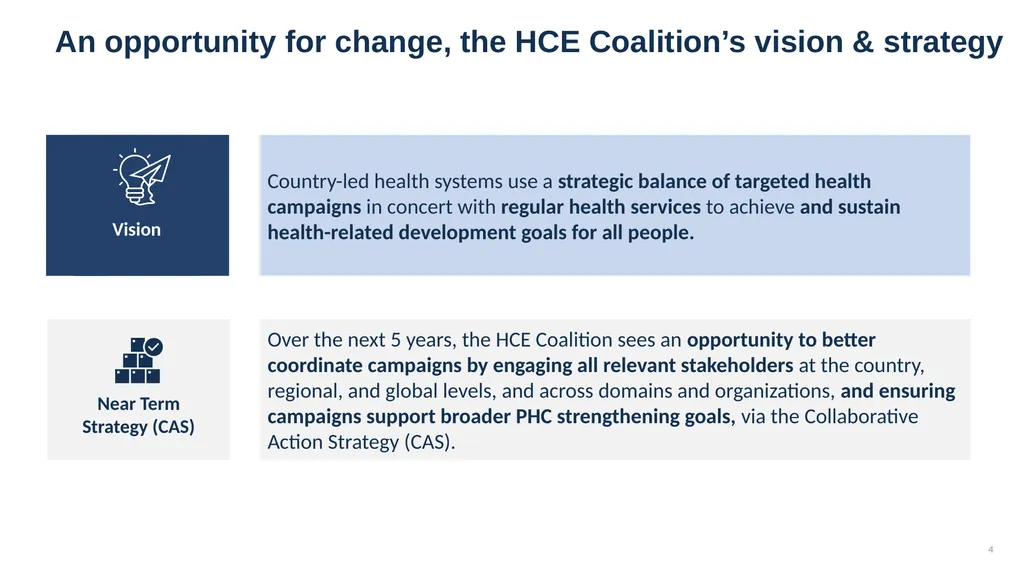
Vision An opportunity for change, the HCE Coalition’s vision & strategy Country-led health systems use a strategic balance of targeted health campaigns in concert with regular health services to achieve and sustain health-related development goals for all people. Near Term Strategy (CAS) Over the next 5 years, the HCE Coalition sees an opportunity to better coordinate campaigns by engaging all relevant stakeholders at the country, regional, and global levels, and across domains and organizations, and ensuring campaigns support broader PHC strengthening goals, via the Collaborative Action Strategy (CAS).<br>
05
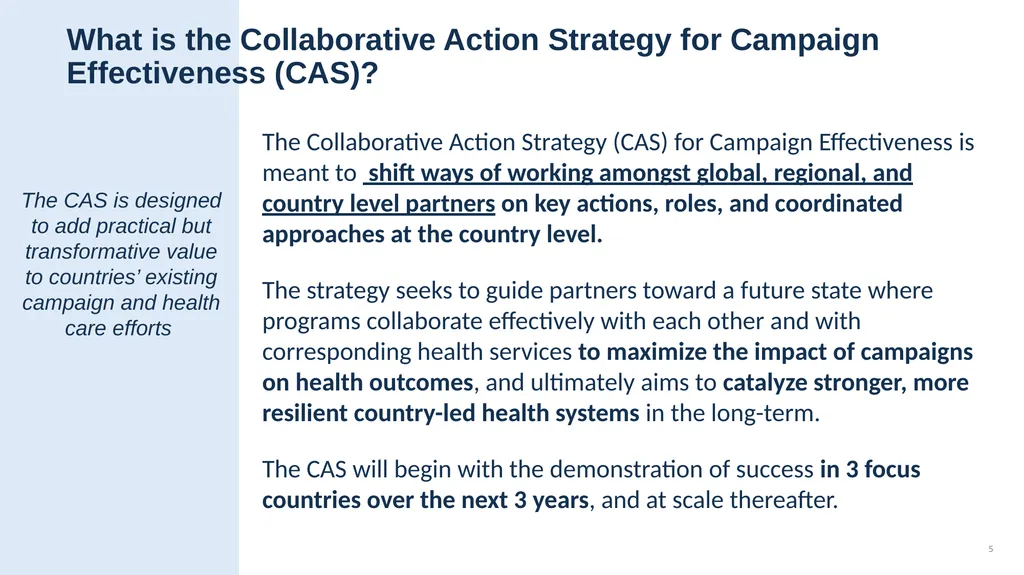
What is the Collaborative Action Strategy for Campaign Effectiveness (CAS)? 5 The Collaborative Action Strategy (CAS) for Campaign Effectiveness is meant to shift ways of working amongst global, regional, and country level partners on key actions, roles, and coordinated approaches at the country level.
The strategy seeks to guide partners toward a future state where programs collaborate effectively with each other and with corresponding health services to maximize the impact of campaigns on health outcomes, and ultimately aims to catalyze stronger, more resilient country-led health systems in the long-term.
The CAS will begin with the demonstration of success in 3 focus countries over the next 3 years, and at scale thereafter. The CAS is designed to add practical but transformative value to countries’ existing campaign and health care efforts<br>
The strategy seeks to guide partners toward a future state where programs collaborate effectively with each other and with corresponding health services to maximize the impact of campaigns on health outcomes, and ultimately aims to catalyze stronger, more resilient country-led health systems in the long-term.
The CAS will begin with the demonstration of success in 3 focus countries over the next 3 years, and at scale thereafter. The CAS is designed to add practical but transformative value to countries’ existing campaign and health care efforts<br>
06
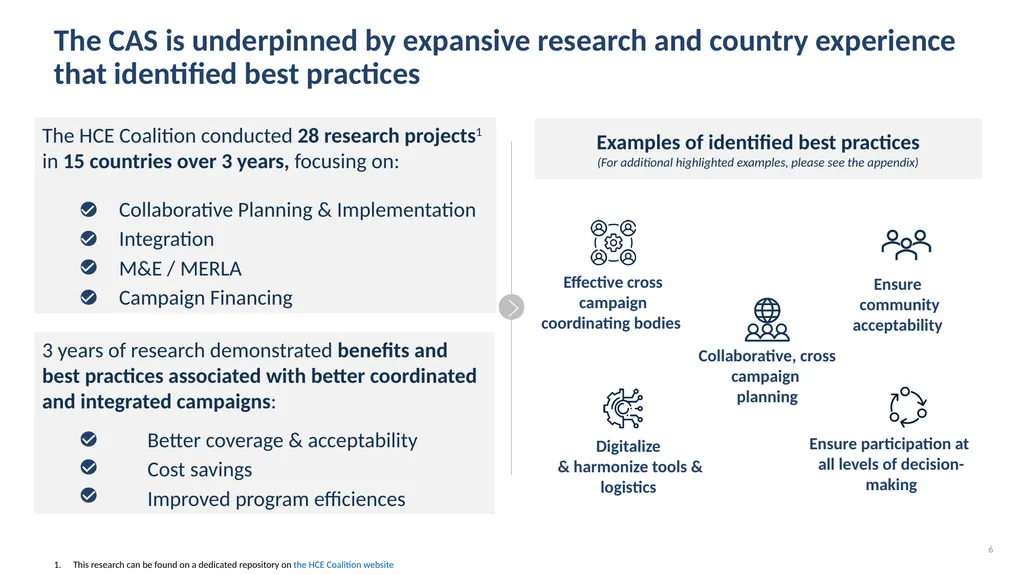
The CAS is underpinned by expansive research and country experience that identified best practices The HCE Coalition conducted 28 research projects1 in 15 countries over 3 years, focusing on:
Collaborative Planning & Implementation
Integration
M&E / MERLA
Campaign Financing This research can be found on a dedicated repository on the HCE Coalition website 3 years of research demonstrated benefits and best practices associated with better coordinated and integrated campaigns:
Better coverage & acceptability
Cost savings
Improved program efficiences Examples of identified best practices
(For additional highlighted examples, please see the appendix) Collaborative, cross campaign
planning Effective cross campaign coordinating bodies Ensure participation at
all levels of decision-making Digitalize
& harmonize tools & logistics Ensure
community acceptability<br>
Collaborative Planning & Implementation
Integration
M&E / MERLA
Campaign Financing This research can be found on a dedicated repository on the HCE Coalition website 3 years of research demonstrated benefits and best practices associated with better coordinated and integrated campaigns:
Better coverage & acceptability
Cost savings
Improved program efficiences Examples of identified best practices
(For additional highlighted examples, please see the appendix) Collaborative, cross campaign
planning Effective cross campaign coordinating bodies Ensure participation at
all levels of decision-making Digitalize
& harmonize tools & logistics Ensure
community acceptability<br>
07
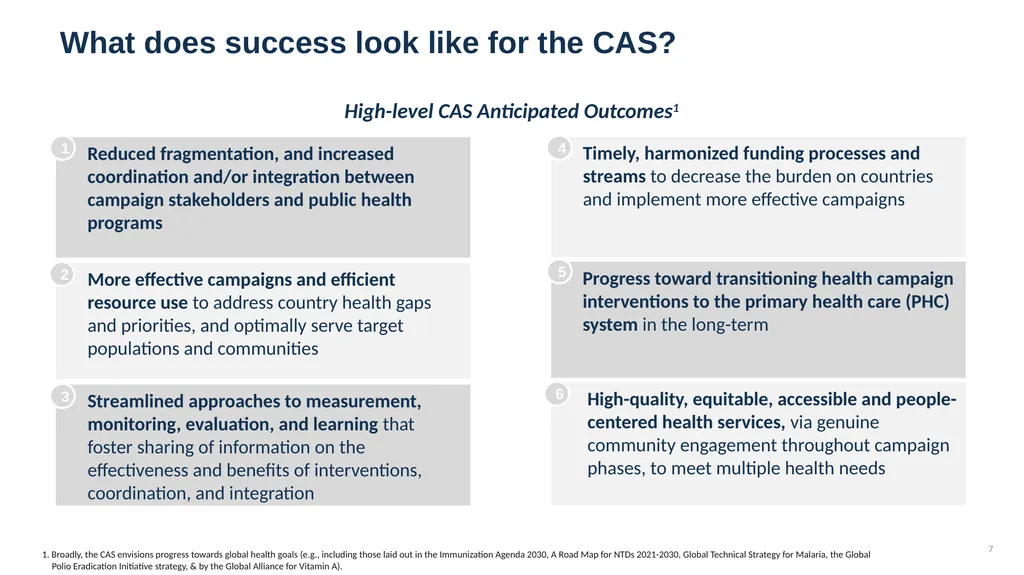
What does success look like for the CAS? High-level CAS Anticipated Outcomes1 Reduced fragmentation, and increased coordination and/or integration between campaign stakeholders and public health programs More effective campaigns and efficient resource use to address country health gaps and priorities, and optimally serve target populations and communities Streamlined approaches to measurement, monitoring, evaluation, and learning that foster sharing of information on the effectiveness and benefits of interventions, coordination, and integration Timely, harmonized funding processes and streams to decrease the burden on countries and implement more effective campaigns Progress toward transitioning health campaign interventions to the primary health care (PHC) system in the long-term 1 1. Broadly, the CAS envisions progress towards global health goals (e.g., including those laid out in the Immunization Agenda 2030, A Road Map for NTDs 2021-2030, Global Technical Strategy for Malaria, the Global Polio Eradication Initiative strategy, & by the Global Alliance for Vitamin A). High-quality, equitable, accessible and people-centered health services, via genuine community engagement throughout campaign phases, to meet multiple health needs 2 3 6 4 5<br>
08
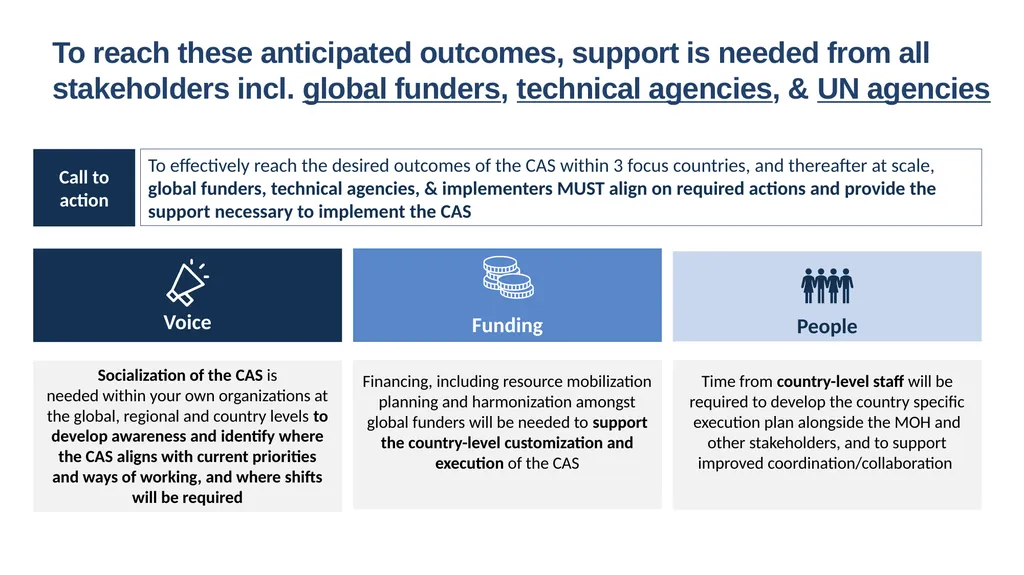
8 To reach these anticipated outcomes, support is needed from all stakeholders incl. global funders, technical agencies, & UN agencies Socialization of the CAS is needed within your own organizations at the global, regional and country levels to develop awareness and identify where the CAS aligns with current priorities and ways of working, and where shifts will be required Financing, including resource mobilization planning and harmonization amongst global funders will be needed to support the country-level customization and execution of the CAS Time from country-level staff will be required to develop the country specific execution plan alongside the MOH and other stakeholders, and to support improved coordination/collaboration To effectively reach the desired outcomes of the CAS within 3 focus countries, and thereafter at scale, global funders, technical agencies, & implementers MUST align on required actions and provide the support necessary to implement the CAS Call to action<br>
09
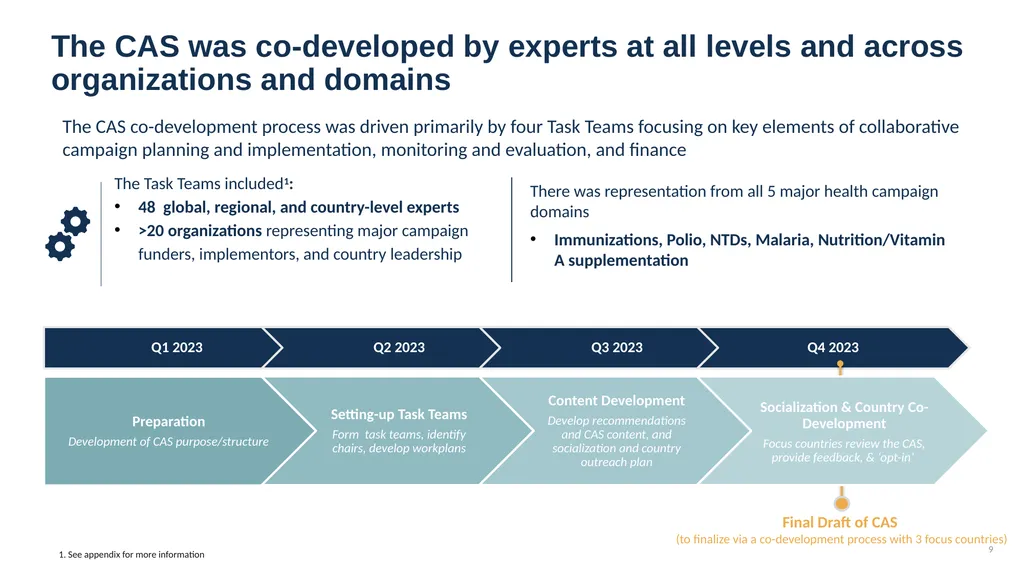
The CAS was co-developed by experts at all levels and across organizations and domains The CAS co-development process was driven primarily by four Task Teams focusing on key elements of collaborative campaign planning and implementation, monitoring and evaluation, and finance Final Draft of CAS
(to finalize via a co-development process with 3 focus countries) The Task Teams included1:
48 global, regional, and country-level experts
>20 organizations representing major campaign funders, implementors, and country leadership There was representation from all 5 major health campaign domains
Immunizations, Polio, NTDs, Malaria, Nutrition/Vitamin A supplementation 1. See appendix for more information<br>
(to finalize via a co-development process with 3 focus countries) The Task Teams included1:
48 global, regional, and country-level experts
>20 organizations representing major campaign funders, implementors, and country leadership There was representation from all 5 major health campaign domains
Immunizations, Polio, NTDs, Malaria, Nutrition/Vitamin A supplementation 1. See appendix for more information<br>
10
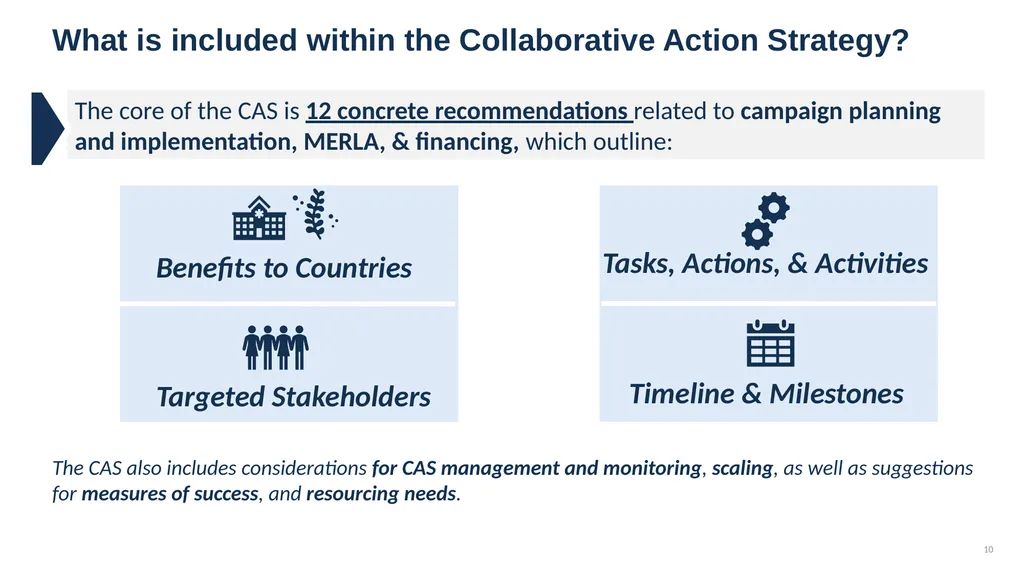
What is included within the Collaborative Action Strategy? The core of the CAS is 12 concrete recommendations related to campaign planning and implementation, MERLA, & financing, which outline: The CAS also includes considerations for CAS management and monitoring, scaling, as well as suggestions for measures of success, and resourcing needs.<br>
11
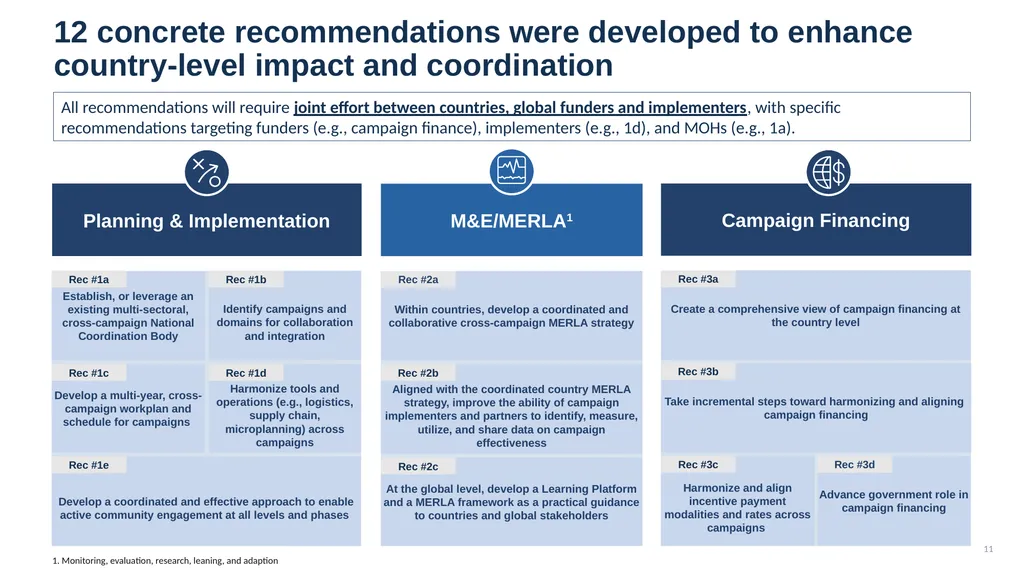
12 concrete recommendations were developed to enhance country-level impact and coordination Advance government role in campaign financing Harmonize and align incentive payment modalities and rates across campaigns Take incremental steps toward harmonizing and aligning campaign financing Aligned with the coordinated country MERLA strategy, improve the ability of campaign implementers and partners to identify, measure, utilize, and share data on campaign effectiveness Planning & Implementation M&E/MERLA1 Campaign Financing Within countries, develop a coordinated and collaborative cross-campaign MERLA strategy Create a comprehensive view of campaign financing at the country level At the global level, develop a Learning Platform and a MERLA framework as a practical guidance to countries and global stakeholders Harmonize tools and operations (e.g., logistics, supply chain, microplanning) across campaigns Develop a multi-year, cross-campaign workplan and schedule for campaigns Identify campaigns and domains for collaboration and integration Establish, or leverage an existing multi-sectoral, cross-campaign National Coordination Body Develop a coordinated and effective approach to enable active community engagement at all levels and phases Rec #1a Rec #1c Rec #1e Rec #1b Rec #1d Rec #3a Rec #3c Rec #3b Rec #3d Rec #2b Rec #2a Rec #2c 1. Monitoring, evaluation, research, leaning, and adaption All recommendations will require joint effort between countries, global funders and implementers, with specific recommendations targeting funders (e.g., campaign finance), implementers (e.g., 1d), and MOHs (e.g., 1a).<br>
12
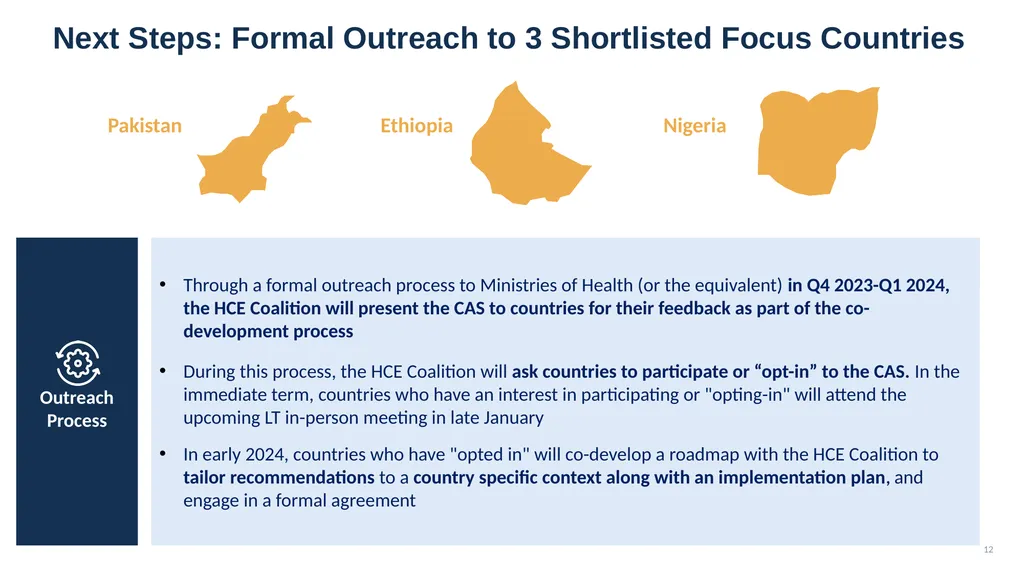
Next Steps: Formal Outreach to 3 Shortlisted Focus Countries Outreach Process Through a formal outreach process to Ministries of Health (or the equivalent) in Q4 2023-Q1 2024, the HCE Coalition will present the CAS to countries for their feedback as part of the co-development process
During this process, the HCE Coalition will ask countries to participate or “opt-in” to the CAS. In the immediate term, countries who have an interest in participating or "opting-in" will attend the upcoming LT in-person meeting in late January
In early 2024, countries who have "opted in" will co-develop a roadmap with the HCE Coalition to tailor recommendations to a country specific context along with an implementation plan, and engage in a formal agreement<br>
During this process, the HCE Coalition will ask countries to participate or “opt-in” to the CAS. In the immediate term, countries who have an interest in participating or "opting-in" will attend the upcoming LT in-person meeting in late January
In early 2024, countries who have "opted in" will co-develop a roadmap with the HCE Coalition to tailor recommendations to a country specific context along with an implementation plan, and engage in a formal agreement<br>
13
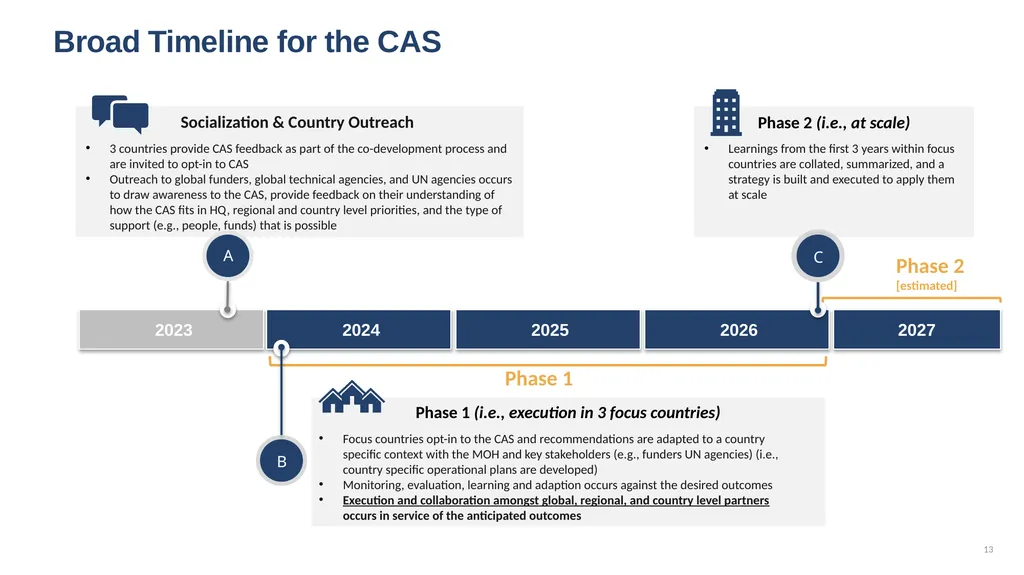
Broad Timeline for the CAS 2027 2026 2023 2024 Phase 1 Phase 1 (i.e., execution in 3 focus countries)
Focus countries opt-in to the CAS and recommendations are adapted to a country specific context with the MOH and key stakeholders (e.g., funders UN agencies) (i.e., country specific operational plans are developed)
Monitoring, evaluation, learning and adaption occurs against the desired outcomes
Execution and collaboration amongst global, regional, and country level partners occurs in service of the anticipated outcomes Socialization & Country Outreach
3 countries provide CAS feedback as part of the co-development process and are invited to opt-in to CAS
Outreach to global funders, global technical agencies, and UN agencies occurs to draw awareness to the CAS, provide feedback on their understanding of how the CAS fits in HQ, regional and country level priorities, and the type of support (e.g., people, funds) that is possible 2025 Phase 2 (i.e., at scale)
Learnings from the first 3 years within focus countries are collated, summarized, and a strategy is built and executed to apply them at scale Phase 2
[estimated]<br>
Focus countries opt-in to the CAS and recommendations are adapted to a country specific context with the MOH and key stakeholders (e.g., funders UN agencies) (i.e., country specific operational plans are developed)
Monitoring, evaluation, learning and adaption occurs against the desired outcomes
Execution and collaboration amongst global, regional, and country level partners occurs in service of the anticipated outcomes Socialization & Country Outreach
3 countries provide CAS feedback as part of the co-development process and are invited to opt-in to CAS
Outreach to global funders, global technical agencies, and UN agencies occurs to draw awareness to the CAS, provide feedback on their understanding of how the CAS fits in HQ, regional and country level priorities, and the type of support (e.g., people, funds) that is possible 2025 Phase 2 (i.e., at scale)
Learnings from the first 3 years within focus countries are collated, summarized, and a strategy is built and executed to apply them at scale Phase 2
[estimated]<br>
14
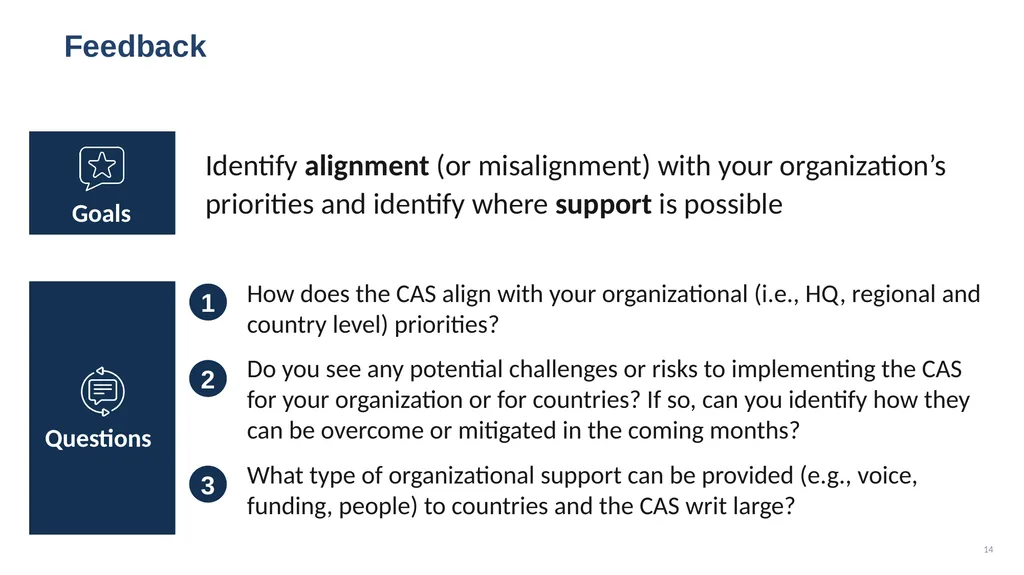
Feedback 1 How does the CAS align with your organizational (i.e., HQ, regional and country level) priorities?
Do you see any potential challenges or risks to implementing the CAS for your organization or for countries? If so, can you identify how they can be overcome or mitigated in the coming months?
What type of organizational support can be provided (e.g., voice, funding, people) to countries and the CAS writ large? Identify alignment (or misalignment) with your organization’s priorities and identify where support is possible Goals Questions 3 2<br>
Do you see any potential challenges or risks to implementing the CAS for your organization or for countries? If so, can you identify how they can be overcome or mitigated in the coming months?
What type of organizational support can be provided (e.g., voice, funding, people) to countries and the CAS writ large? Identify alignment (or misalignment) with your organization’s priorities and identify where support is possible Goals Questions 3 2<br>
15
Appendix Health campaign and integration definitions
Details for each of the CAS recommendations
List of CAS development Task Team members
List of CAS Contributors
Examples of key research projects and their promising practices<br>
Details for each of the CAS recommendations
List of CAS development Task Team members
List of CAS Contributors
Examples of key research projects and their promising practices<br>
16
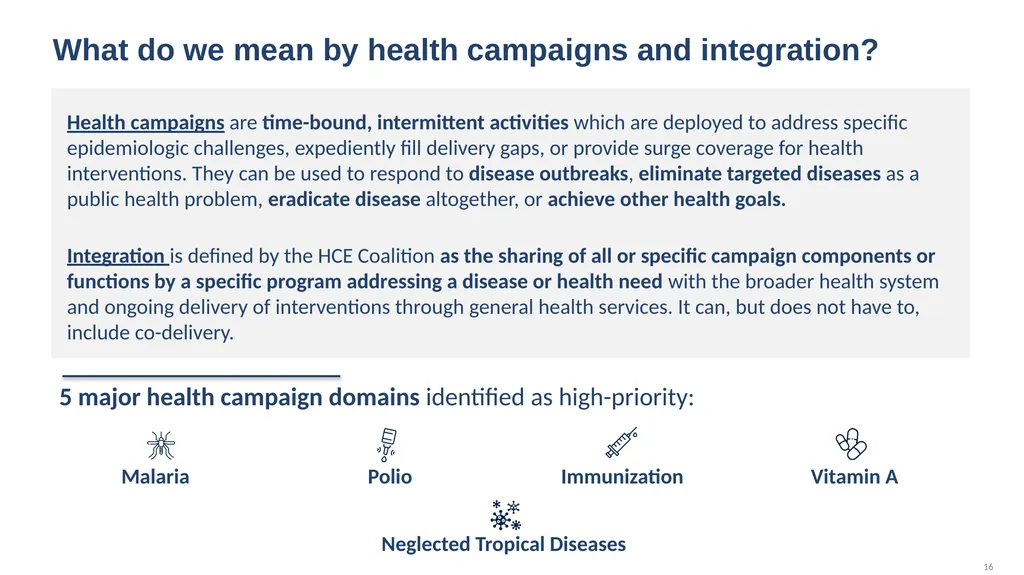
Health campaigns are time-bound, intermittent activities which are deployed to address specific epidemiologic challenges, expediently fill delivery gaps, or provide surge coverage for health interventions. They can be used to respond to disease outbreaks, eliminate targeted diseases as a public health problem, eradicate disease altogether, or achieve other health goals.
Integration is defined by the HCE Coalition as the sharing of all or specific campaign components or functions by a specific program addressing a disease or health need with the broader health system and ongoing delivery of interventions through general health services. It can, but does not have to, include co-delivery. 16 What do we mean by health campaigns and integration? 5 major health campaign domains identified as high-priority:<br>
Integration is defined by the HCE Coalition as the sharing of all or specific campaign components or functions by a specific program addressing a disease or health need with the broader health system and ongoing delivery of interventions through general health services. It can, but does not have to, include co-delivery. 16 What do we mean by health campaigns and integration? 5 major health campaign domains identified as high-priority:<br>
17
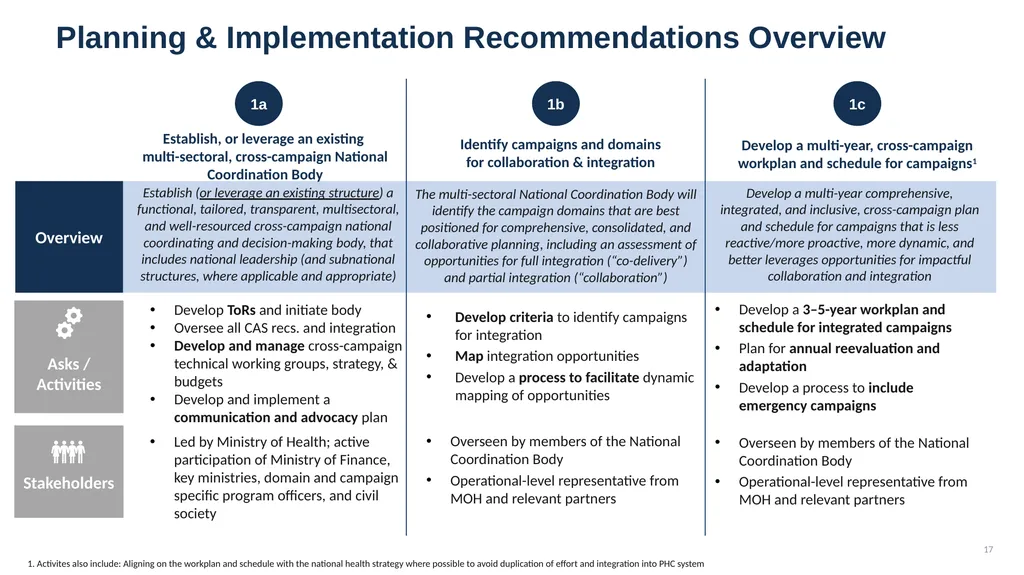
Planning & Implementation Recommendations Overview Establish, or leverage an existing
multi-sectoral, cross-campaign National Coordination Body 1a Establish (or leverage an existing structure) a functional, tailored, transparent, multisectoral, and well-resourced cross-campaign national coordinating and decision-making body, that includes national leadership (and subnational structures, where applicable and appropriate) Stakeholders Led by Ministry of Health; active participation of Ministry of Finance, key ministries, domain and campaign specific program officers, and civil society Asks /
Activities Develop ToRs and initiate body
Oversee all CAS recs. and integration
Develop and manage cross-campaign technical working groups, strategy, & budgets
Develop and implement a communication and advocacy plan The multi-sectoral National Coordination Body will identify the campaign domains that are best positioned for comprehensive, consolidated, and collaborative planning, including an assessment of opportunities for full integration (“co-delivery”) and partial integration (“collaboration”) Overseen by members of the National Coordination Body
Operational-level representative from MOH and relevant partners Develop criteria to identify campaigns for integration
Map integration opportunities
Develop a process to facilitate dynamic mapping of opportunities Develop a multi-year comprehensive, integrated, and inclusive, cross-campaign plan and schedule for campaigns that is less reactive/more proactive, more dynamic, and better leverages opportunities for impactful collaboration and integration Overseen by members of the National Coordination Body
Operational-level representative from MOH and relevant partners Develop a 3–5-year workplan and schedule for integrated campaigns
Plan for annual reevaluation and adaptation
Develop a process to include emergency campaigns Identify campaigns and domains for collaboration & integration Develop a multi-year, cross-campaign workplan and schedule for campaigns1 1. Activites also include: Aligning on the workplan and schedule with the national health strategy where possible to avoid duplication of effort and integration into PHC system Overview Overview 1b 1c<br>
multi-sectoral, cross-campaign National Coordination Body 1a Establish (or leverage an existing structure) a functional, tailored, transparent, multisectoral, and well-resourced cross-campaign national coordinating and decision-making body, that includes national leadership (and subnational structures, where applicable and appropriate) Stakeholders Led by Ministry of Health; active participation of Ministry of Finance, key ministries, domain and campaign specific program officers, and civil society Asks /
Activities Develop ToRs and initiate body
Oversee all CAS recs. and integration
Develop and manage cross-campaign technical working groups, strategy, & budgets
Develop and implement a communication and advocacy plan The multi-sectoral National Coordination Body will identify the campaign domains that are best positioned for comprehensive, consolidated, and collaborative planning, including an assessment of opportunities for full integration (“co-delivery”) and partial integration (“collaboration”) Overseen by members of the National Coordination Body
Operational-level representative from MOH and relevant partners Develop criteria to identify campaigns for integration
Map integration opportunities
Develop a process to facilitate dynamic mapping of opportunities Develop a multi-year comprehensive, integrated, and inclusive, cross-campaign plan and schedule for campaigns that is less reactive/more proactive, more dynamic, and better leverages opportunities for impactful collaboration and integration Overseen by members of the National Coordination Body
Operational-level representative from MOH and relevant partners Develop a 3–5-year workplan and schedule for integrated campaigns
Plan for annual reevaluation and adaptation
Develop a process to include emergency campaigns Identify campaigns and domains for collaboration & integration Develop a multi-year, cross-campaign workplan and schedule for campaigns1 1. Activites also include: Aligning on the workplan and schedule with the national health strategy where possible to avoid duplication of effort and integration into PHC system Overview Overview 1b 1c<br>
18
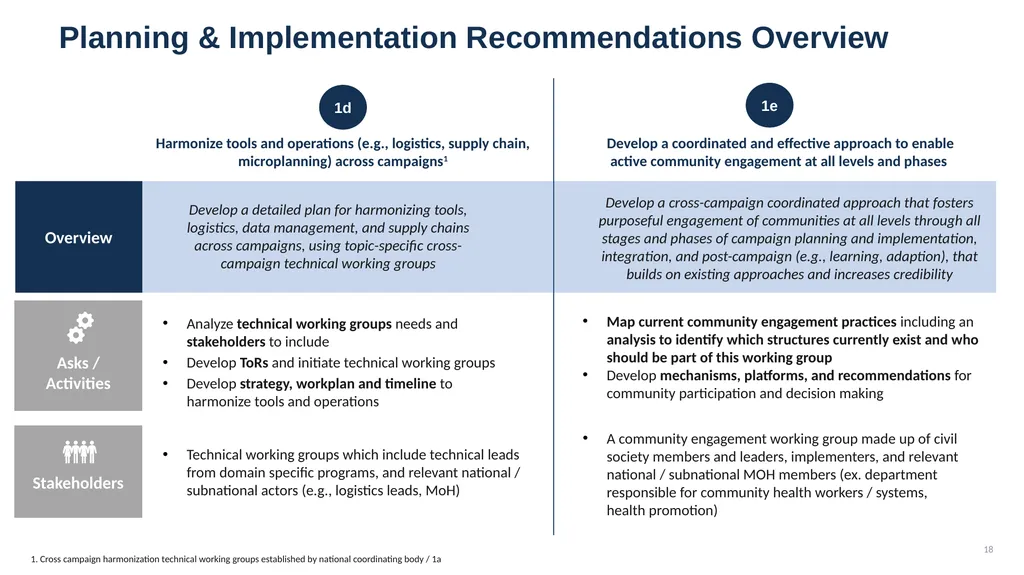
Overview Planning & Implementation Recommendations Overview Develop a coordinated and effective approach to enable active community engagement at all levels and phases Develop a cross-campaign coordinated approach that fosters purposeful engagement of communities at all levels through all stages and phases of campaign planning and implementation, integration, and post-campaign (e.g., learning, adaption), that builds on existing approaches and increases credibility Stakeholders A community engagement working group made up of civil society members and leaders, implementers, and relevant national / subnational MOH members (ex. department responsible for community health workers / systems, health promotion) Asks /
Activities Map current community engagement practices including an analysis to identify which structures currently exist and who should be part of this working group
Develop mechanisms, platforms, and recommendations for community participation and decision making Harmonize tools and operations (e.g., logistics, supply chain, microplanning) across campaigns1 Develop a detailed plan for harmonizing tools, logistics, data management, and supply chains across campaigns, using topic-specific cross-campaign technical working groups Technical working groups which include technical leads from domain specific programs, and relevant national / subnational actors (e.g., logistics leads, MoH) Analyze technical working groups needs and stakeholders to include
Develop ToRs and initiate technical working groups
Develop strategy, workplan and timeline to harmonize tools and operations 1. Cross campaign harmonization technical working groups established by national coordinating body / 1a 1d 1e<br>
Activities Map current community engagement practices including an analysis to identify which structures currently exist and who should be part of this working group
Develop mechanisms, platforms, and recommendations for community participation and decision making Harmonize tools and operations (e.g., logistics, supply chain, microplanning) across campaigns1 Develop a detailed plan for harmonizing tools, logistics, data management, and supply chains across campaigns, using topic-specific cross-campaign technical working groups Technical working groups which include technical leads from domain specific programs, and relevant national / subnational actors (e.g., logistics leads, MoH) Analyze technical working groups needs and stakeholders to include
Develop ToRs and initiate technical working groups
Develop strategy, workplan and timeline to harmonize tools and operations 1. Cross campaign harmonization technical working groups established by national coordinating body / 1a 1d 1e<br>
19
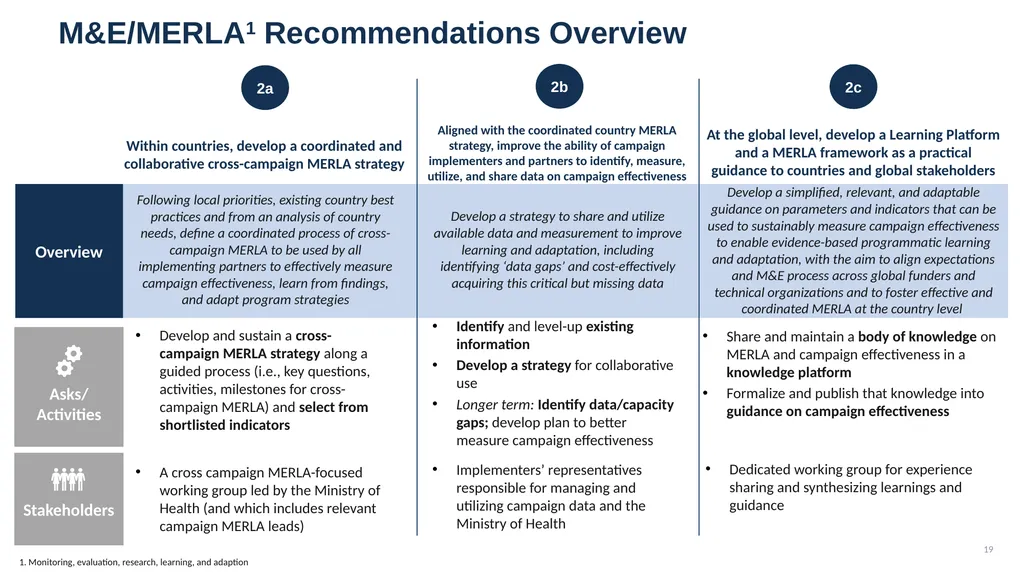
Overview M&E/MERLA1 Recommendations Overview Within countries, develop a coordinated and collaborative cross-campaign MERLA strategy Aligned with the coordinated country MERLA strategy, improve the ability of campaign implementers and partners to identify, measure, utilize, and share data on campaign effectiveness At the global level, develop a Learning Platform and a MERLA framework as a practical guidance to countries and global stakeholders Following local priorities, existing country best practices and from an analysis of country needs, define a coordinated process of cross-campaign MERLA to be used by all implementing partners to effectively measure campaign effectiveness, learn from findings, and adapt program strategies A cross campaign MERLA-focused working group led by the Ministry of Health (and which includes relevant campaign MERLA leads) Develop and sustain a cross-campaign MERLA strategy along a guided process (i.e., key questions, activities, milestones for cross-campaign MERLA) and select from shortlisted indicators Develop a strategy to share and utilize available data and measurement to improve learning and adaptation, including identifying ‘data gaps’ and cost-effectively acquiring this critical but missing data Implementers’ representatives responsible for managing and utilizing campaign data and the Ministry of Health Identify and level-up existing information
Develop a strategy for collaborative use
Longer term: Identify data/capacity gaps; develop plan to better measure campaign effectiveness Develop a simplified, relevant, and adaptable guidance on parameters and indicators that can be used to sustainably measure campaign effectiveness to enable evidence-based programmatic learning and adaptation, with the aim to align expectations and M&E process across global funders and technical organizations and to foster effective and coordinated MERLA at the country level Dedicated working group for experience sharing and synthesizing learnings and guidance Share and maintain a body of knowledge on MERLA and campaign effectiveness in a knowledge platform
Formalize and publish that knowledge into guidance on campaign effectiveness Stakeholders Asks/
Activities 2a 2b 2c 1. Monitoring, evaluation, research, learning, and adaption<br>
Develop a strategy for collaborative use
Longer term: Identify data/capacity gaps; develop plan to better measure campaign effectiveness Develop a simplified, relevant, and adaptable guidance on parameters and indicators that can be used to sustainably measure campaign effectiveness to enable evidence-based programmatic learning and adaptation, with the aim to align expectations and M&E process across global funders and technical organizations and to foster effective and coordinated MERLA at the country level Dedicated working group for experience sharing and synthesizing learnings and guidance Share and maintain a body of knowledge on MERLA and campaign effectiveness in a knowledge platform
Formalize and publish that knowledge into guidance on campaign effectiveness Stakeholders Asks/
Activities 2a 2b 2c 1. Monitoring, evaluation, research, learning, and adaption<br>
20
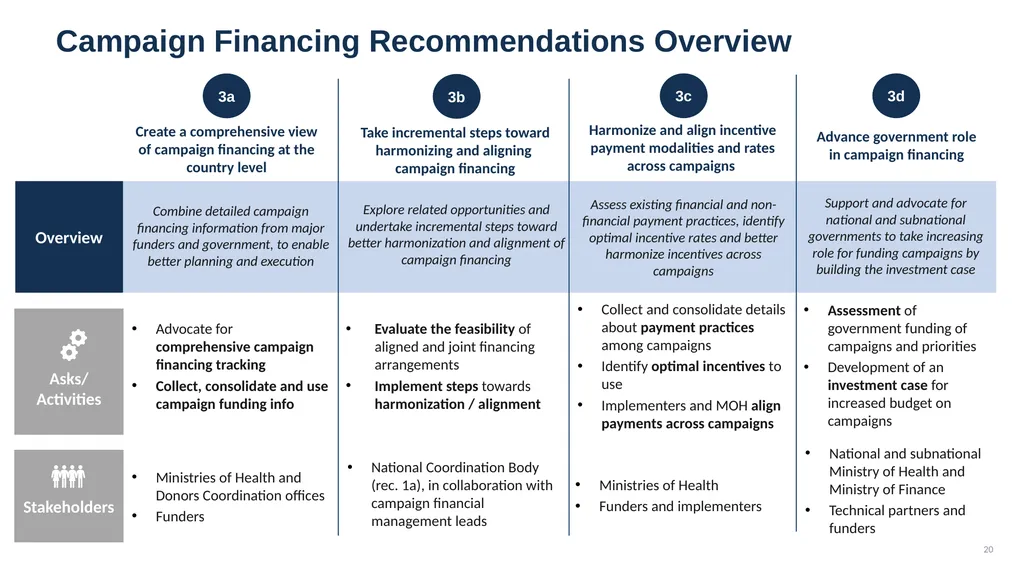
Overview Campaign Financing Recommendations Overview Create a comprehensive view of campaign financing at the country level Combine detailed campaign financing information from major funders and government, to enable better planning and execution Stakeholders Ministries of Health and Donors Coordination offices
Funders Asks/
Activities Advocate for comprehensive campaign financing tracking
Collect, consolidate and use campaign funding info Explore related opportunities and undertake incremental steps toward better harmonization and alignment of campaign financing National Coordination Body (rec. 1a), in collaboration with campaign financial management leads Evaluate the feasibility of aligned and joint financing arrangements
Implement steps towards harmonization / alignment Assess existing financial and non-financial payment practices, identify optimal incentive rates and better harmonize incentives across campaigns Ministries of Health
Funders and implementers Collect and consolidate details about payment practices among campaigns
Identify optimal incentives to use
Implementers and MOH align payments across campaigns Take incremental steps toward harmonizing and aligning campaign financing Harmonize and align incentive payment modalities and rates across campaigns Advance government role in campaign financing Support and advocate for national and subnational governments to take increasing role for funding campaigns by building the investment case National and subnational Ministry of Health and Ministry of Finance
Technical partners and funders Assessment of government funding of campaigns and priorities
Development of an investment case for increased budget on campaigns 3a 3b 3c 3d<br>
Funders Asks/
Activities Advocate for comprehensive campaign financing tracking
Collect, consolidate and use campaign funding info Explore related opportunities and undertake incremental steps toward better harmonization and alignment of campaign financing National Coordination Body (rec. 1a), in collaboration with campaign financial management leads Evaluate the feasibility of aligned and joint financing arrangements
Implement steps towards harmonization / alignment Assess existing financial and non-financial payment practices, identify optimal incentive rates and better harmonize incentives across campaigns Ministries of Health
Funders and implementers Collect and consolidate details about payment practices among campaigns
Identify optimal incentives to use
Implementers and MOH align payments across campaigns Take incremental steps toward harmonizing and aligning campaign financing Harmonize and align incentive payment modalities and rates across campaigns Advance government role in campaign financing Support and advocate for national and subnational governments to take increasing role for funding campaigns by building the investment case National and subnational Ministry of Health and Ministry of Finance
Technical partners and funders Assessment of government funding of campaigns and priorities
Development of an investment case for increased budget on campaigns 3a 3b 3c 3d<br>
21
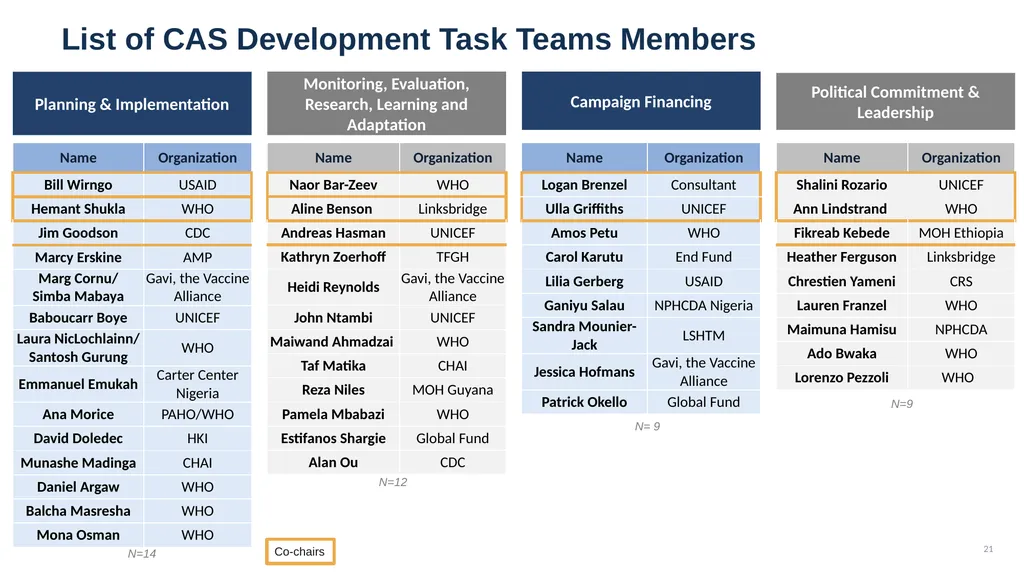
List of CAS Development Task Teams Members Planning & Implementation Monitoring, Evaluation, Research, Learning and Adaptation Campaign Financing Political Commitment & Leadership Co-chairs N=14 N=12 N= 9 N=9<br>
22
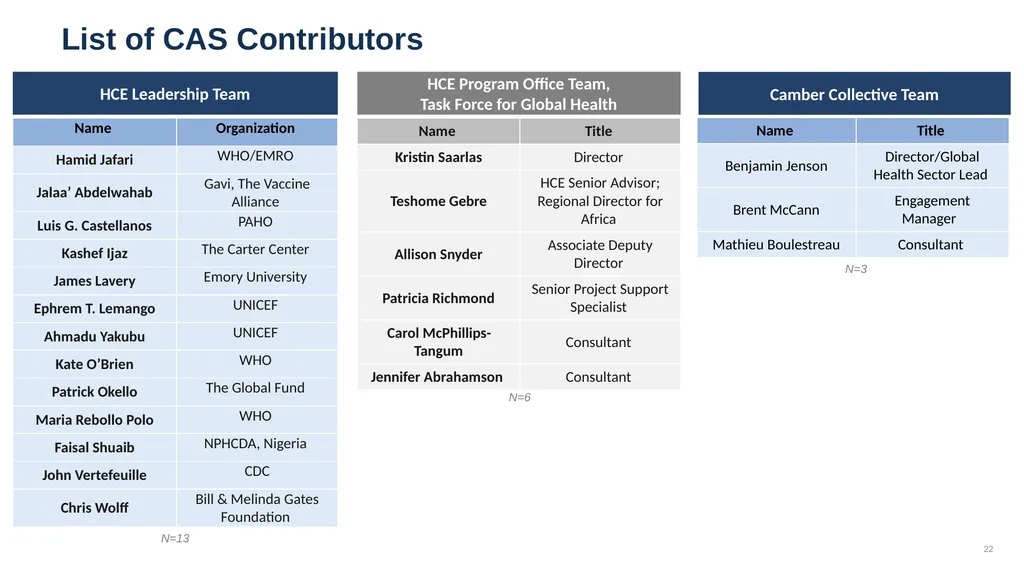
List of CAS Contributors HCE Leadership Team N=13 HCE Program Office Team,
Task Force for Global Health N=6 Camber Collective Team N=3<br>
Task Force for Global Health N=6 Camber Collective Team N=3<br>
23
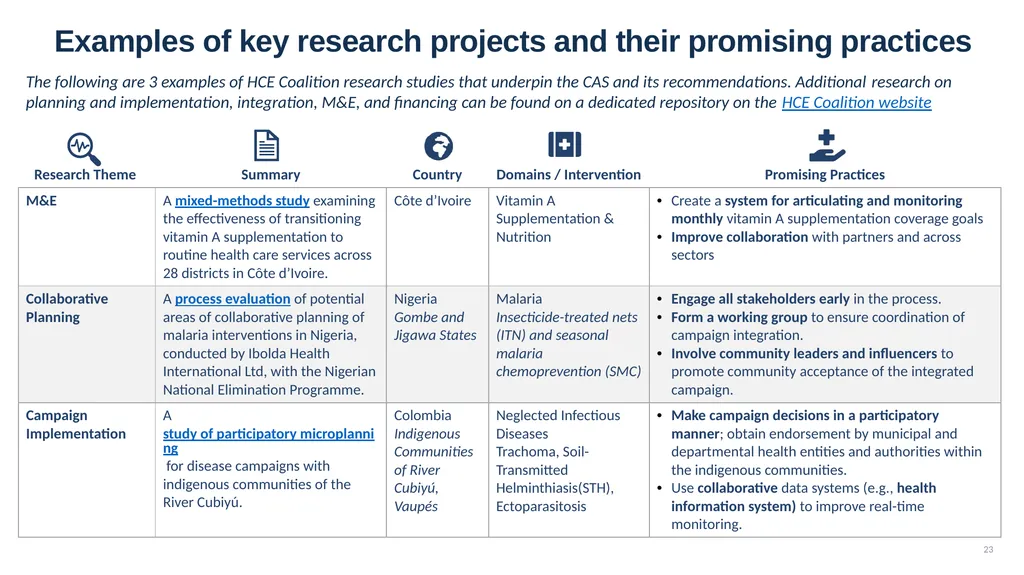
Examples of key research projects and their promising practices The following are 3 examples of HCE Coalition research studies that underpin the CAS and its recommendations. Additional research on planning and implementation, integration, M&E, and financing can be found on a dedicated repository on the HCE Coalition website<br>
24
HCE Reference Materials & Resources
Links to a subset of the HCE knowledge base HCE-Produced Technical Briefs & Reports
Considerations for Integrating Health Campaigns: A Synthesis of Findings from Implementation Research Studies in Immunization, Neglected Tropical Diseases, Malaria, and Vitamin A Supplementation
Synthesis Report: Considerations for Health Campaigns’ Transition to and Linkages with the Primary Health Care System
Coordination Mechanisms for Integrated Health Campaigns: A Descriptive Review
Campaign financing analysis: opportunities for cross-campaign integration
Individual Implementation Research Projects (from Nigeria, Vanuatu, Ghana, Rwanda, Mauritania and Sierra Leone, Ethiopia, Cameroon, Indonesia, Bangladesh, Guinea, Cote d'Ivoire, Colombia, and other global studies)
Achieving Equitable and Feasible Campaign Integration through SMC and Vitamin A Collaboration: Findings from Bauchi State Nigeria
Health Campaign Integration: A Scoping Review (Sub-Saharan Africa)
Beyond Coverage: Measuring Vitamin A Supplementation Program Effectiveness in Mauritania and Sierra Leone
Country Campaign Manager Perspectives on Health Campaign Integration: A Snapshot in 2022 (Africa, Americas, Europe, Southeast Asia)
Case Studies on Collaborative Planning (from Guinea, India, Nigeria, Nepal, India, Nigeria, Colombia, and Ghana)
HCE Publications
Rethinking public health campaigns in the COVID-19 era: a call to improve effectiveness, equity and impact
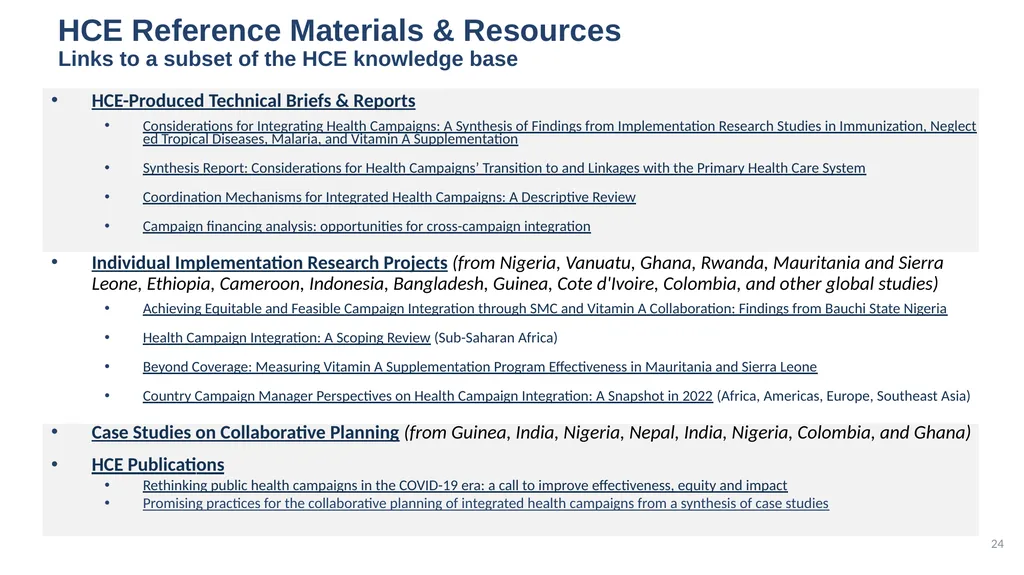
Promising practices for the collaborative planning of integrated health campaigns from a synthesis of case studies 24<br>
Considerations for Integrating Health Campaigns: A Synthesis of Findings from Implementation Research Studies in Immunization, Neglected Tropical Diseases, Malaria, and Vitamin A Supplementation
Synthesis Report: Considerations for Health Campaigns’ Transition to and Linkages with the Primary Health Care System
Coordination Mechanisms for Integrated Health Campaigns: A Descriptive Review
Campaign financing analysis: opportunities for cross-campaign integration
Individual Implementation Research Projects (from Nigeria, Vanuatu, Ghana, Rwanda, Mauritania and Sierra Leone, Ethiopia, Cameroon, Indonesia, Bangladesh, Guinea, Cote d'Ivoire, Colombia, and other global studies)
Achieving Equitable and Feasible Campaign Integration through SMC and Vitamin A Collaboration: Findings from Bauchi State Nigeria
Health Campaign Integration: A Scoping Review (Sub-Saharan Africa)
Beyond Coverage: Measuring Vitamin A Supplementation Program Effectiveness in Mauritania and Sierra Leone
Country Campaign Manager Perspectives on Health Campaign Integration: A Snapshot in 2022 (Africa, Americas, Europe, Southeast Asia)
Case Studies on Collaborative Planning (from Guinea, India, Nigeria, Nepal, India, Nigeria, Colombia, and Ghana)
HCE Publications
Rethinking public health campaigns in the COVID-19 era: a call to improve effectiveness, equity and impact
Promising practices for the collaborative planning of integrated health campaigns from a synthesis of case studies 24<br>