Japans Depopulation and Workforce Shortage Crisis: 11 Strategies and a Macro-Research Agenda Cullen T. Hayashida, Ph.D. Sociology - University of Hawaii Countries are Depopulating Japan is at the Leading Edge of Change FACTORS CAUSING
"Japan's Depopulation and Workforce Shortage" is the property of its rightful owner. Permission is granted to
download and print the materials on this website for personal, non-commercial use only, and to display it
on your personal computer provided you do not modify the materials and that you retain all copyright
notices contained in the materials. By downloading content from our website, you accept the terms of this
agreement.
Presentation Transcript
01
Japan's Depopulation and Workforce Shortage Crisis: 11 Strategies and a Macro-Research Agenda Cullen T. Hayashida, Ph.D.
Sociology - University of Hawaii<br>
02
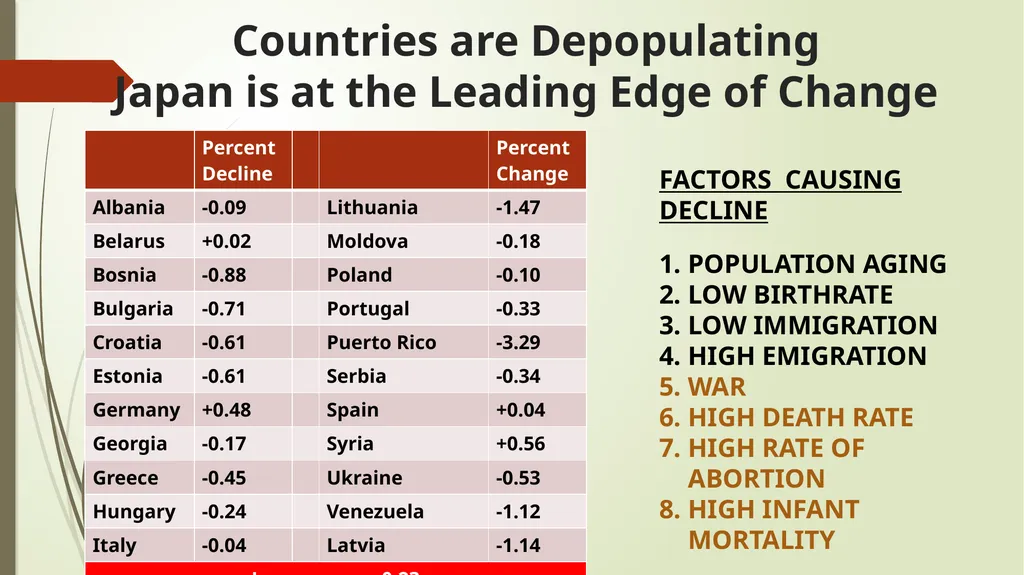
Countries are Depopulating Japan is at the Leading Edge of Change FACTORS CAUSING DECLINE
POPULATION AGING
LOW BIRTHRATE
LOW IMMIGRATION
HIGH EMIGRATION
WAR
HIGH DEATH RATE
HIGH RATE OF ABORTION
HIGH INFANT MORTALITY<br>
03
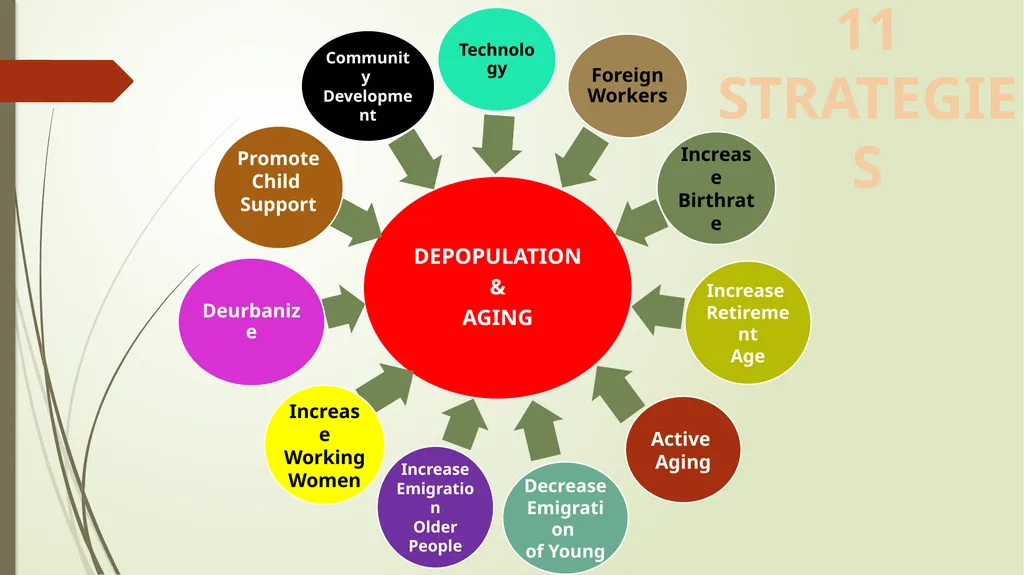
11 STRATEGIES<br>
04
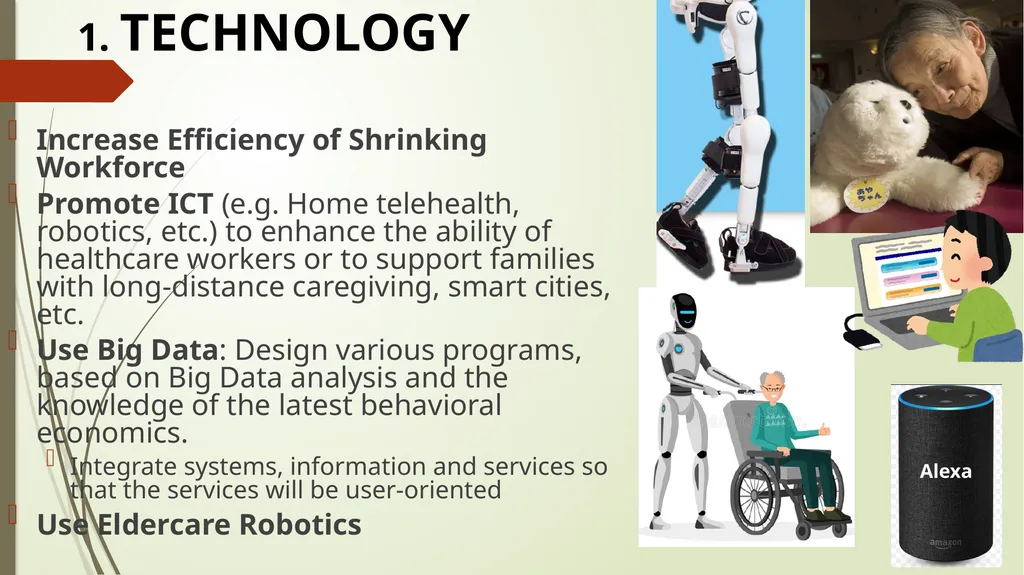
1. TECHNOLOGY Increase Efficiency of Shrinking Workforce
Promote ICT (e.g. Home telehealth, robotics, etc.) to enhance the ability of healthcare workers or to support families with long-distance caregiving, smart cities, etc.
Use Big Data: Design various programs, based on Big Data analysis and the knowledge of the latest behavioral economics.
Integrate systems, information and services so that the services will be user-oriented
Use Eldercare Robotics Alexa<br>
05
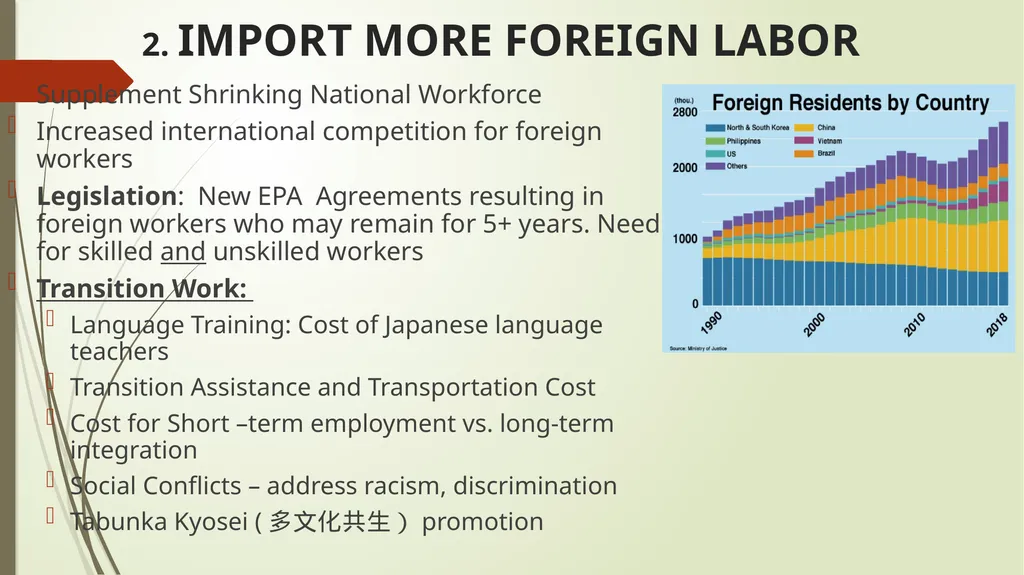
2. IMPORT MORE FOREIGN LABOR Supplement Shrinking National Workforce
Increased international competition for foreign workers
Legislation: New EPA Agreements resulting in foreign workers who may remain for 5+ years. Need for skilled and unskilled workers
Transition Work:
Language Training: Cost of Japanese language teachers
Transition Assistance and Transportation Cost
Cost for Short –term employment vs. long-term integration
Social Conflicts – address racism, discrimination
Tabunka Kyosei (多文化共生)promotion<br>
06
3. INCREASE BIRTHRATE Increase fertility rate from 1.4 to 2.1 births per woman
Programs
Social Marketing
Financial Incentives: Cash payments, loans, tax deductions, housing subsidies, child medical care, pre-natal care
Work and Family Initiatives: Maternity & Paternity leaves, Childcare services, Flexible work hours, leaves for family issues, anti-discrimination laws, gender equality in labor laws
Policy Changes: Employment – more part-time work, tele-work); child-friendly businesses, gender equality, marriage support counseling, positive attitudes towards children & parenting
However: 20-years to take effect<br>
07
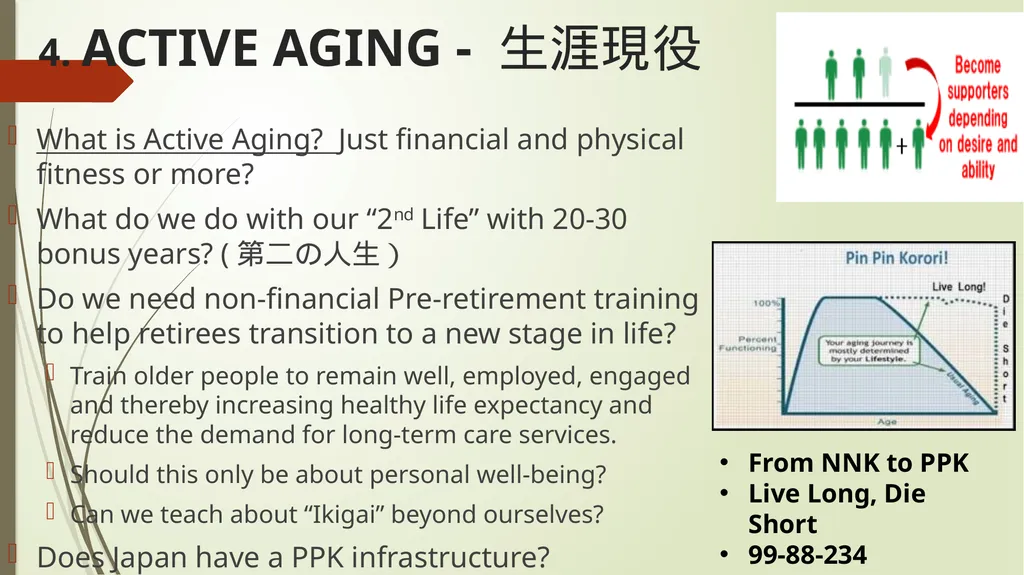
4. ACTIVE AGING - 生涯現役 What is Active Aging? Just financial and physical fitness or more?
What do we do with our “2nd Life” with 20-30 bonus years? (第二の人生)
Do we need non-financial Pre-retirement training to help retirees transition to a new stage in life?
Train older people to remain well, employed, engaged and thereby increasing healthy life expectancy and reduce the demand for long-term care services.
Should this only be about personal well-being?
Can we teach about “Ikigai” beyond ourselves?
Does Japan have a PPK infrastructure? From NNK to PPK
Live Long, Die Short
99-88-234<br>
08
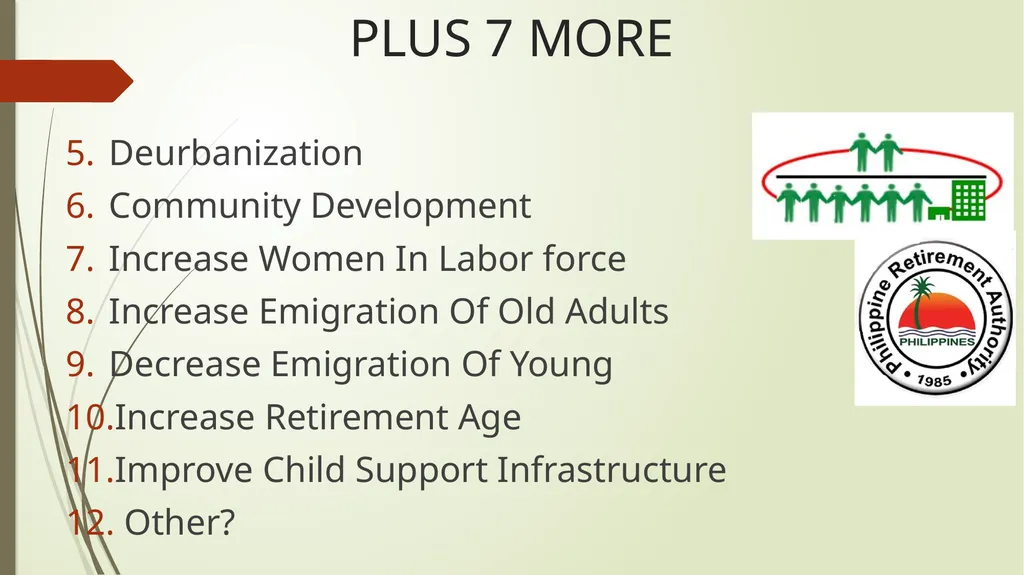
PLUS 7 MORE Deurbanization
Community Development
Increase Women In Labor force
Increase Emigration Of Old Adults
Decrease Emigration Of Young
Increase Retirement Age
Improve Child Support Infrastructure
Other?<br>
09
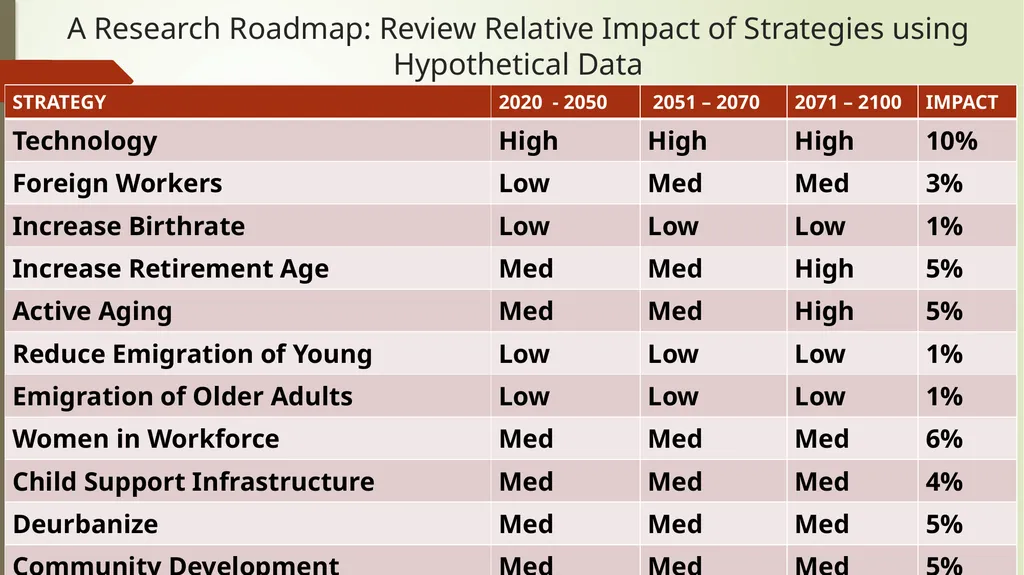
A Research Roadmap: Review Relative Impact of Strategies using Hypothetical Data<br>
10
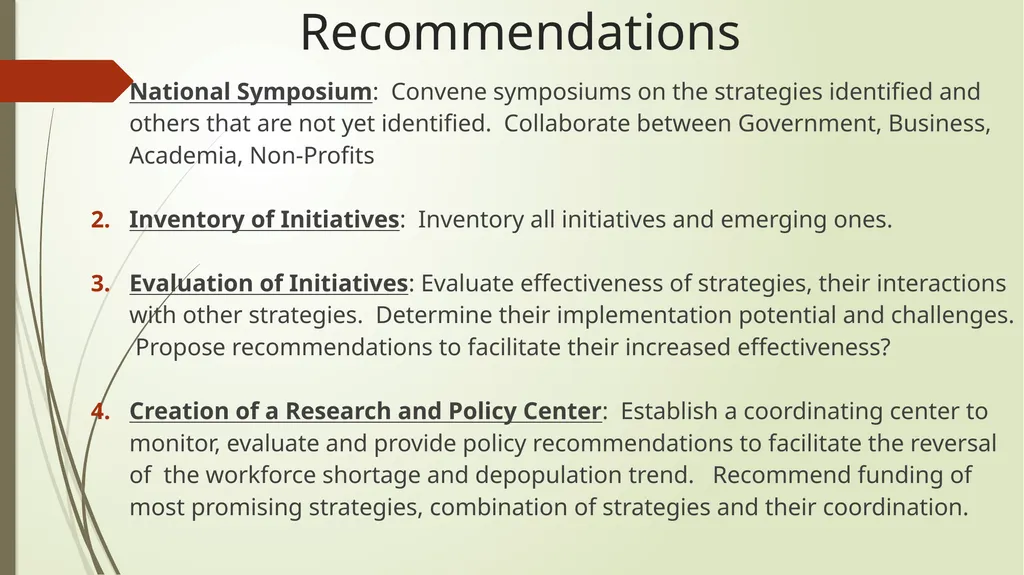
Recommendations National Symposium: Convene symposiums on the strategies identified and others that are not yet identified. Collaborate between Government, Business, Academia, Non-Profits
Inventory of Initiatives: Inventory all initiatives and emerging ones.
Evaluation of Initiatives: Evaluate effectiveness of strategies, their interactions with other strategies. Determine their implementation potential and challenges. Propose recommendations to facilitate their increased effectiveness?
Creation of a Research and Policy Center: Establish a coordinating center to monitor, evaluate and provide policy recommendations to facilitate the reversal of the workforce shortage and depopulation trend. Recommend funding of most promising strategies, combination of strategies and their coordination.<br>