
Jargon Madness: A plain language exercise Laura
SB
Published · 34 slides · 0 views
1 / 1

Description
Jargon Madness: A plain language exercise Laura Rabuck Seattle Epidemiologic Research and Information Center (ERIC) Cooperative Studies Program (CSP) Office of Research and Development (ORD) Department of Veterans Affairs (VA) August 2022
Related Topics
Share
Embed code
Download this presentation From Below
"Jargon Madness: A plain language exercise Laura" is the property of its rightful owner. Permission is granted to download and print the materials on this website for personal, non-commercial use only, and to display it on your personal computer provided you do not modify the materials and that you retain all copyright notices contained in the materials. By downloading content from our website, you accept the terms of this agreement.
Presentation Transcript
01
Jargon Madness:
A plain language exercise Laura Rabuck
Seattle Epidemiologic Research and Information Center (ERIC)
Cooperative Studies Program (CSP)
Office of Research and Development (ORD)
Department of Veterans Affairs (VA)
August 2022<br>
Cooperative Studies Program (CSP)
Office of Research and Development (ORD)
Department of Veterans Affairs (VA)
August 2022<br>
02
Disclaimer The views expressed here are those of the author and do not necessarily reflect the position or policy of the Department of Veterans Affairs or the United States Government. 2<br>
03
Disclaimer (2) 3 Can’t name commercial products, services, or non-federal organizations allowed
We use lots of those and as a result context might be missing
Email me if something is unclear or to fill in the blanks: Laura.Rabuck (at) va.gov<br>
We use lots of those and as a result context might be missing
Email me if something is unclear or to fill in the blanks: Laura.Rabuck (at) va.gov<br>
04
This will cover Why do something like Jargon Madness?
What is Jargon Madness?
Developing your own Jargon Madness event using our experiences as a starting point 4<br>
What is Jargon Madness?
Developing your own Jargon Madness event using our experiences as a starting point 4<br>
05
So why Jargon Madness? Having a response to jargon is universal (or so says my experience)
It’s a plain language appetizer
It’s a conversation starter that cuts across the org chart
It’s part engagement, part education
It’s a fun way to get people to think about
the volume of jargon in our work
how jargon can be unclear
how it conflicts with our efforts to communicate clearly
It allows for asynchronous participation
It fits well with remote or hybrid offices 5<br>
It’s a plain language appetizer
It’s a conversation starter that cuts across the org chart
It’s part engagement, part education
It’s a fun way to get people to think about
the volume of jargon in our work
how jargon can be unclear
how it conflicts with our efforts to communicate clearly
It allows for asynchronous participation
It fits well with remote or hybrid offices 5<br>
06
What is jargon? Special words or expressions that are used by a particular profession or group and are difficult for others to understand (Source)
The technical terminology or characteristic idiom of a special activity or group (Source)
Obscure and often pretentious language marked by circumlocutions and long words, confused unintelligible language (Source) Our winner! 6<br>
The technical terminology or characteristic idiom of a special activity or group (Source)
Obscure and often pretentious language marked by circumlocutions and long words, confused unintelligible language (Source) Our winner! 6<br>
07
College basketball event Jargon Madness is loosely based on the college basketball event of a similar, trademarked name
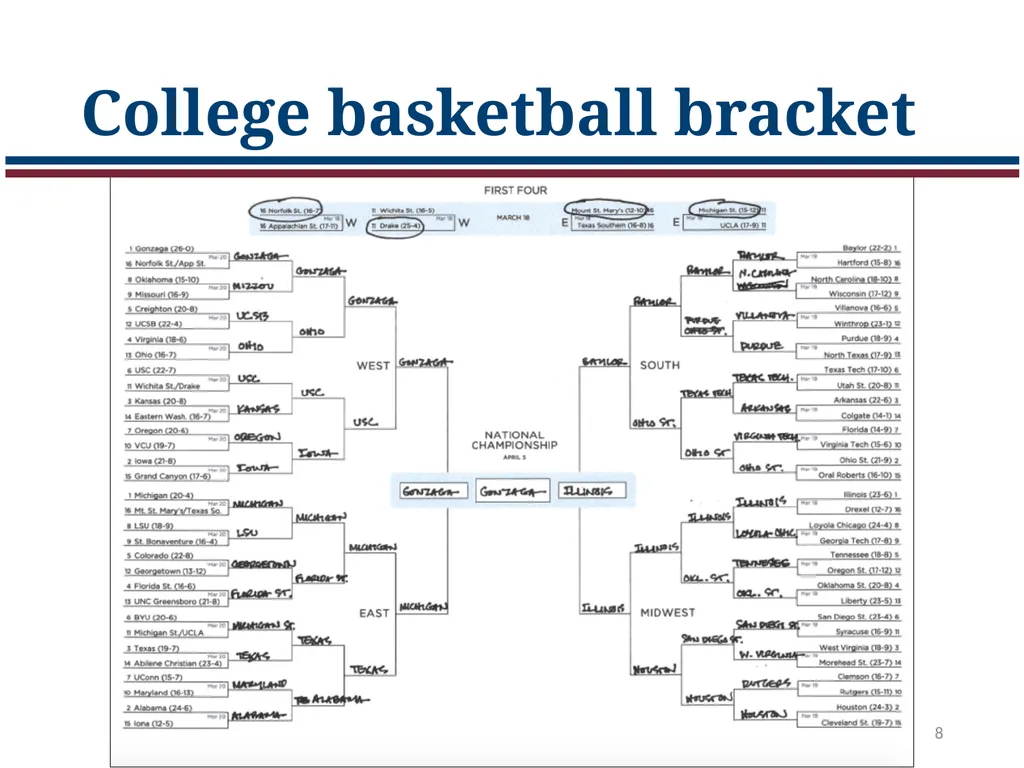
In the college basketball version 64 teams are put into a bracket. Each pair plays one game, winner advances to the next round. The bracket decreases by half with each round (64 teams to 32 teams to 16 to 8 to 4 to 2) until there’s a champion
Takes place over (only!) 2 weeks 7<br>
In the college basketball version 64 teams are put into a bracket. Each pair plays one game, winner advances to the next round. The bracket decreases by half with each round (64 teams to 32 teams to 16 to 8 to 4 to 2) until there’s a champion
Takes place over (only!) 2 weeks 7<br>
08
College basketball bracket 8<br>
09
Business version A popular business magazine started Jargon Madness in 2012 and modeled it on the college basketball event
Their goal: “identify the single most annoying example of business jargon and thoroughly embarrass all who employ it and any of these other ridiculous expressions”
They chose 32 “abominable expressions”
Participants voted on one matchup daily via a bird themed social media app
Took place over just a month 9<br>
Their goal: “identify the single most annoying example of business jargon and thoroughly embarrass all who employ it and any of these other ridiculous expressions”
They chose 32 “abominable expressions”
Participants voted on one matchup daily via a bird themed social media app
Took place over just a month 9<br>
10
Our Jargon Madness Took place in
2013 (Champion: Giving 110%)
2014 (Champion: Bandwidth)
2020 (cancelled due to COVID-19)
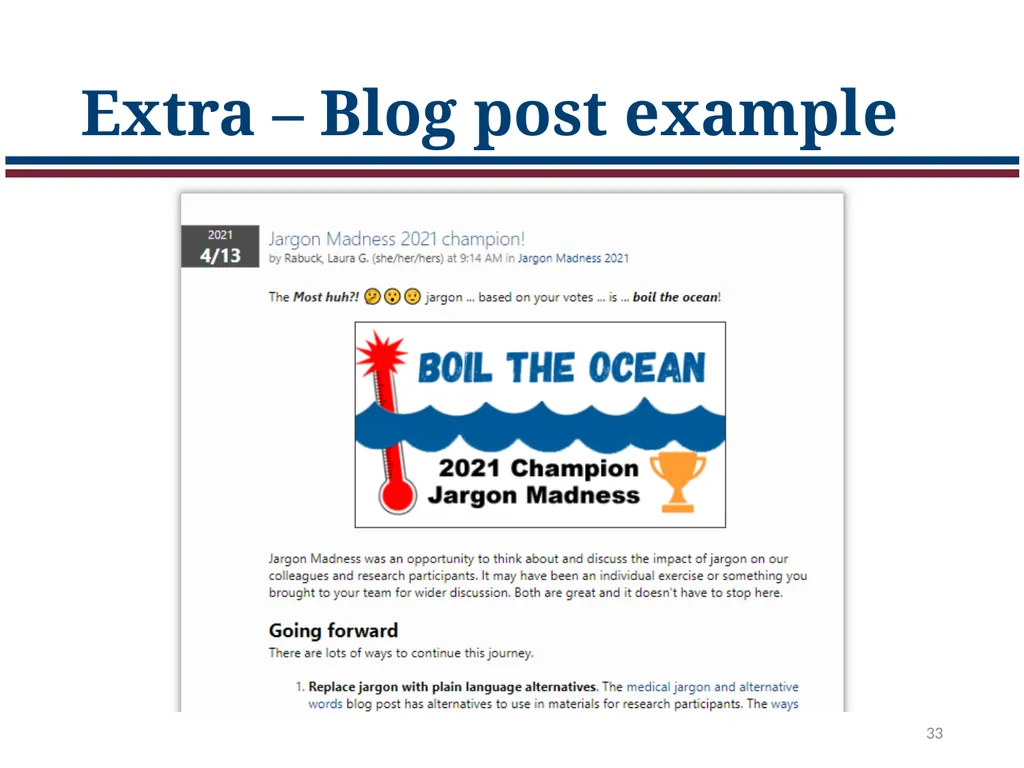
2021 (Champion: Boil the ocean)
2022 (Champion: Bleeding edge)
Used different approaches each time – started with a large printed bracket, paper voting via a decorated shoe box and moved to everything being online
All started thanks to a former colleague, Margaret 🙌 10<br>
2013 (Champion: Giving 110%)
2014 (Champion: Bandwidth)
2020 (cancelled due to COVID-19)
2021 (Champion: Boil the ocean)
2022 (Champion: Bleeding edge)
Used different approaches each time – started with a large printed bracket, paper voting via a decorated shoe box and moved to everything being online
All started thanks to a former colleague, Margaret 🙌 10<br>
11
Preparation checklist Confirm leadership buy-in and if there’s an audience
Confirm your champions/sponsors and partners
Confirm staffing support
Confirm language
Decide bracket size and corresponding timeline
Decide (and test) where you’ll host it and how voting will work
Decide how to identify jargon
Develop a marketing plan, however small (but mighty!)
Research and draft ideas for education
Decide on post-event survey
Start now! 3/16/2023 will arrive quickly 11<br>
Confirm your champions/sponsors and partners
Confirm staffing support
Confirm language
Decide bracket size and corresponding timeline
Decide (and test) where you’ll host it and how voting will work
Decide how to identify jargon
Develop a marketing plan, however small (but mighty!)
Research and draft ideas for education
Decide on post-event survey
Start now! 3/16/2023 will arrive quickly 11<br>
12
Leadership and audience Leadership
Confirm with necessary levels of leadership
When explaining Jargon Madness, tie it to existing education, employee engagement, or other known leadership goals or efforts
Audience
Understand the audience(s) you’re trying to reach so you can create an experience that works for them
Consider starting small as proof of concept and then expand 12<br>
Confirm with necessary levels of leadership
When explaining Jargon Madness, tie it to existing education, employee engagement, or other known leadership goals or efforts
Audience
Understand the audience(s) you’re trying to reach so you can create an experience that works for them
Consider starting small as proof of concept and then expand 12<br>
13
Champions and partners Identify a champion: A fierce supporter who provides resources, expertise, and moral support. An informal role held by an executive or someone in senior management
Identify partner(s): People, groups, or offices who will collaborate with you on some or all tasks
Neither are required, but could be instrumental in leading Jargon Madness across a wide audience 13<br>
Identify partner(s): People, groups, or offices who will collaborate with you on some or all tasks
Neither are required, but could be instrumental in leading Jargon Madness across a wide audience 13<br>
14
Staffing We’ve used a team of 2 by default
First year is the most time consuming, subsequent ones can be somewhat faster/easier
The more you prepare the better
Education posts, style guide, voice/tone, images, etc
It moves fast
And you have the rest of your job to manage as well 14<br>
First year is the most time consuming, subsequent ones can be somewhat faster/easier
The more you prepare the better
Education posts, style guide, voice/tone, images, etc
It moves fast
And you have the rest of your job to manage as well 14<br>
15
Confirm language (1) Don’t use these trademarked phrases
NCAA March Madness
March Madness
Sweet Sixteen
Elite Eight
Final Four
Work with your agency legal office on specifics
Use alternatives to break up rounds: Smashing Sixteen, Epic Eight, Fabulous Four 15<br>
NCAA March Madness
March Madness
Sweet Sixteen
Elite Eight
Final Four
Work with your agency legal office on specifics
Use alternatives to break up rounds: Smashing Sixteen, Epic Eight, Fabulous Four 15<br>
16
Confirm language (2) Be purposeful in your voice and tone
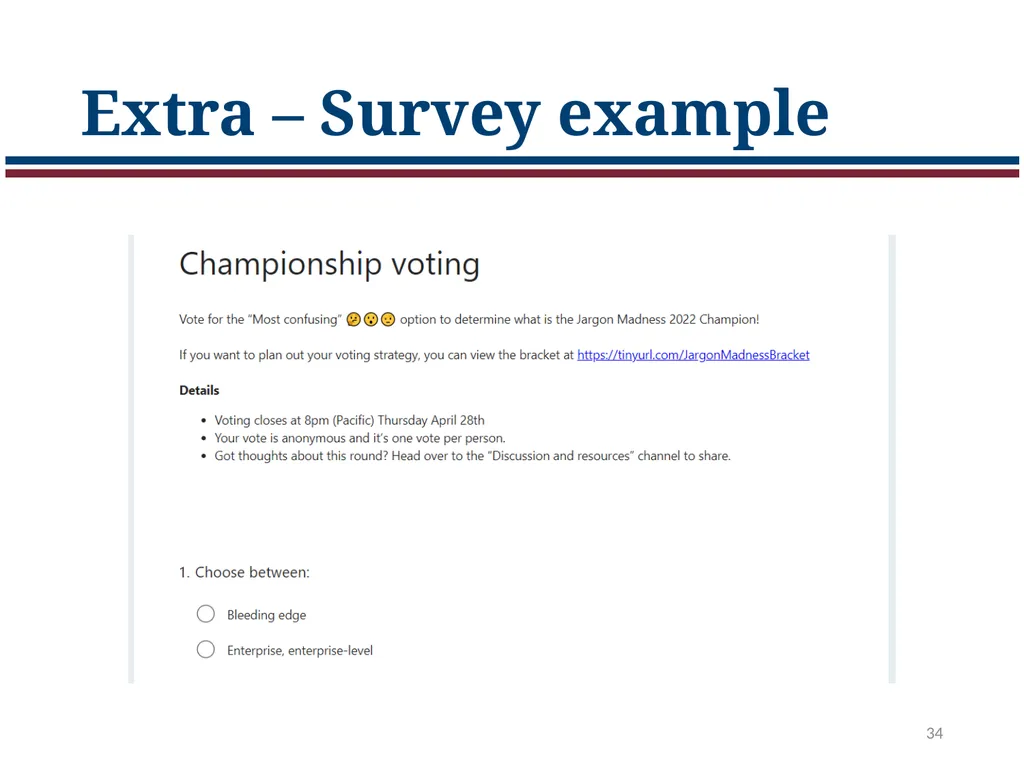
We set up the voting to be for the most confusing contender in each pair. That fit our goal to encourage dialogue instead of shaming.
Most people use jargon and what’s considered jargon isn’t universal. Create a reflective space to encourage change! 16<br>
We set up the voting to be for the most confusing contender in each pair. That fit our goal to encourage dialogue instead of shaming.
Most people use jargon and what’s considered jargon isn’t universal. Create a reflective space to encourage change! 16<br>
17
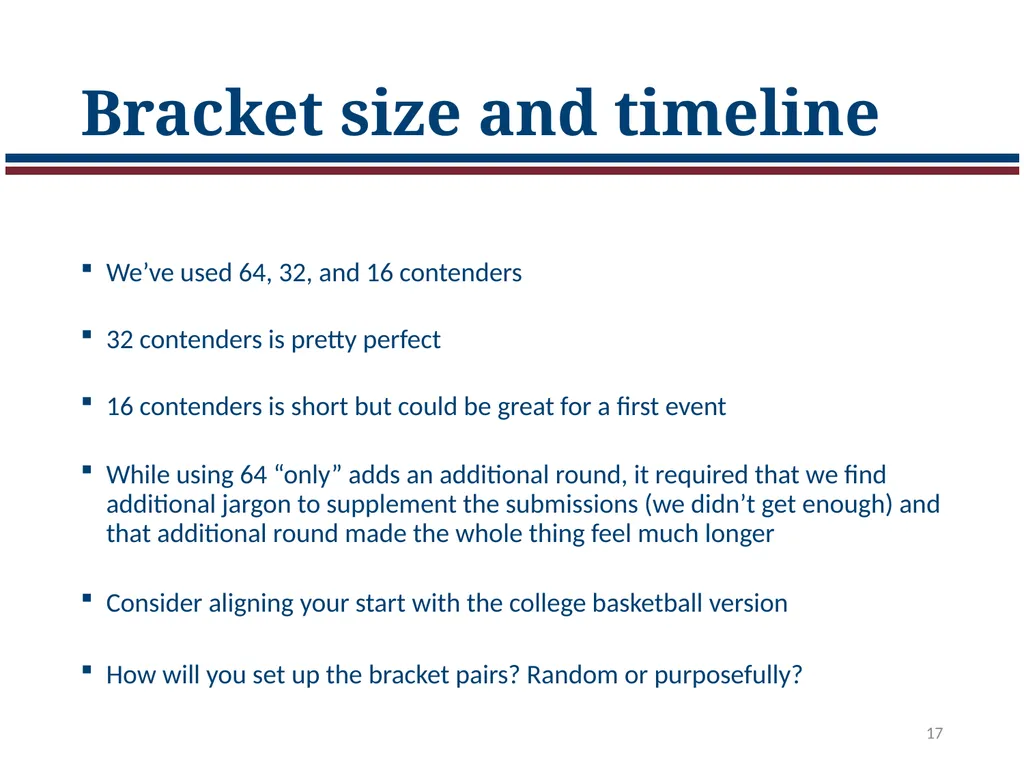
Bracket size and timeline We’ve used 64, 32, and 16 contenders
32 contenders is pretty perfect
16 contenders is short but could be great for a first event
While using 64 “only” adds an additional round, it required that we find additional jargon to supplement the submissions (we didn’t get enough) and that additional round made the whole thing feel much longer
Consider aligning your start with the college basketball version
How will you set up the bracket pairs? Random or purposefully? 17<br>
32 contenders is pretty perfect
16 contenders is short but could be great for a first event
While using 64 “only” adds an additional round, it required that we find additional jargon to supplement the submissions (we didn’t get enough) and that additional round made the whole thing feel much longer
Consider aligning your start with the college basketball version
How will you set up the bracket pairs? Random or purposefully? 17<br>
18
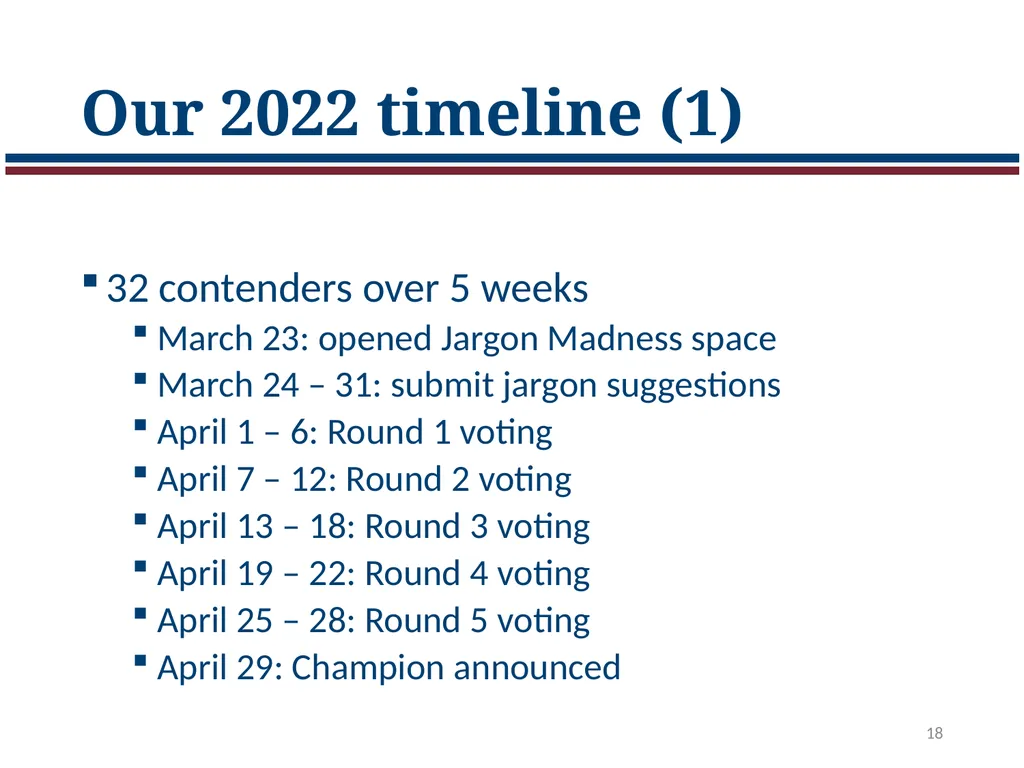
Our 2022 timeline (1) 32 contenders over 5 weeks
March 23: opened Jargon Madness space
March 24 – 31: submit jargon suggestions
April 1 – 6: Round 1 voting
April 7 – 12: Round 2 voting
April 13 – 18: Round 3 voting
April 19 – 22: Round 4 voting
April 25 – 28: Round 5 voting
April 29: Champion announced 18<br>
March 23: opened Jargon Madness space
March 24 – 31: submit jargon suggestions
April 1 – 6: Round 1 voting
April 7 – 12: Round 2 voting
April 13 – 18: Round 3 voting
April 19 – 22: Round 4 voting
April 25 – 28: Round 5 voting
April 29: Champion announced 18<br>
19
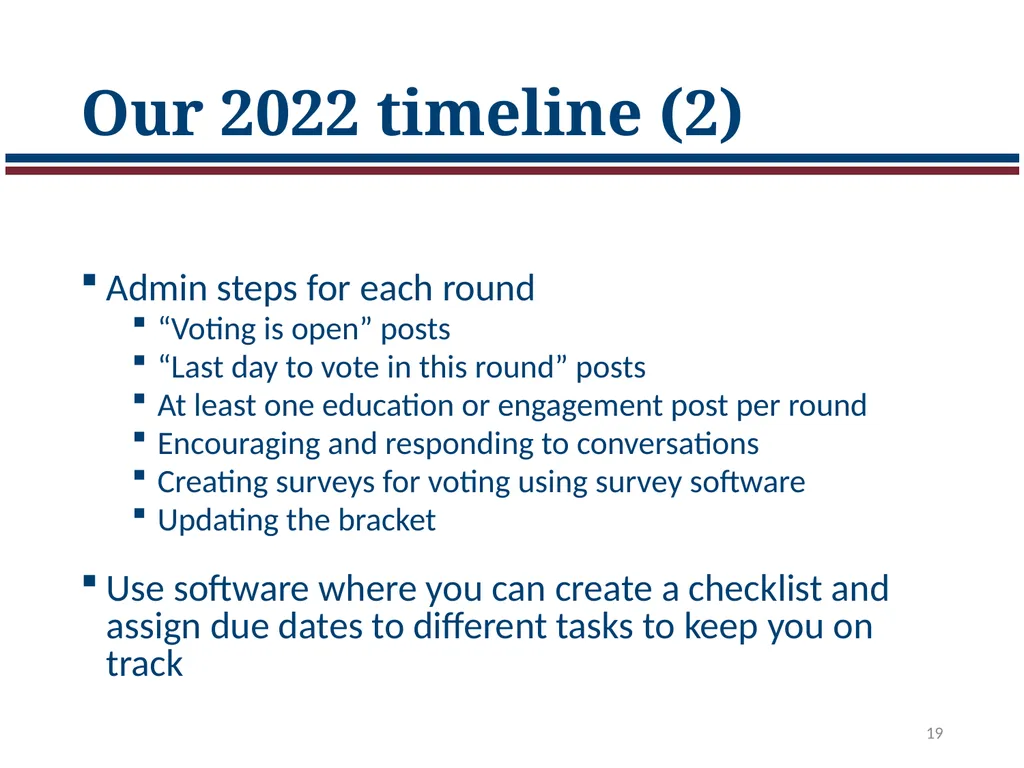
Our 2022 timeline (2) Admin steps for each round
“Voting is open” posts
“Last day to vote in this round” posts
At least one education or engagement post per round
Encouraging and responding to conversations
Creating surveys for voting using survey software
Updating the bracket
Use software where you can create a checklist and assign due dates to different tasks to keep you on track 19<br>
“Voting is open” posts
“Last day to vote in this round” posts
At least one education or engagement post per round
Encouraging and responding to conversations
Creating surveys for voting using survey software
Updating the bracket
Use software where you can create a checklist and assign due dates to different tasks to keep you on track 19<br>
20
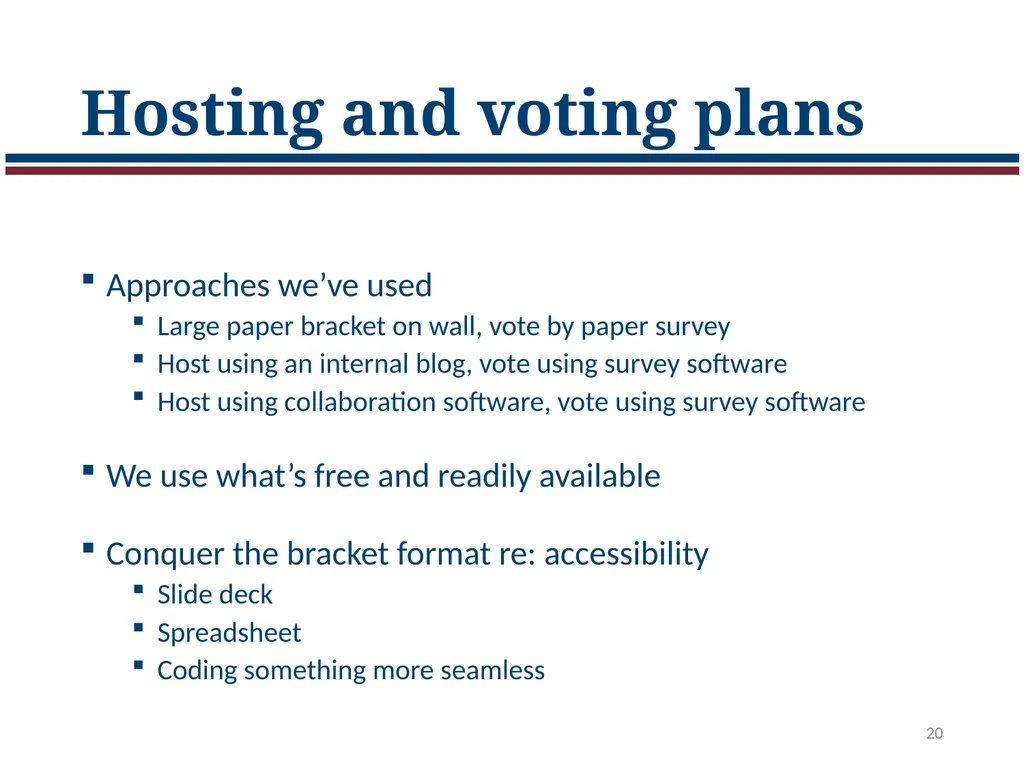
Hosting and voting plans Approaches we’ve used
Large paper bracket on wall, vote by paper survey
Host using an internal blog, vote using survey software
Host using collaboration software, vote using survey software
We use what’s free and readily available
Conquer the bracket format re: accessibility
Slide deck
Spreadsheet
Coding something more seamless 20<br>
Large paper bracket on wall, vote by paper survey
Host using an internal blog, vote using survey software
Host using collaboration software, vote using survey software
We use what’s free and readily available
Conquer the bracket format re: accessibility
Slide deck
Spreadsheet
Coding something more seamless 20<br>
21
Identify jargon contenders Ask for suggestions from the audience
Decide in advance if there are boundaries. Are contenders limited to the technical definition of jargon or are buzzwords, idioms, metaphors, and analogies also allowed?
Also doubles as marketing
Be prepared to supplement suggestions if you don’t get enough
Search online for “business jargon”, “corporate jargon”, “office jargon”, “office buzzwords” to find articles and lists
Since our first Jargon Madness people have sent suggestions in the “off-season” 21<br>
Decide in advance if there are boundaries. Are contenders limited to the technical definition of jargon or are buzzwords, idioms, metaphors, and analogies also allowed?
Also doubles as marketing
Be prepared to supplement suggestions if you don’t get enough
Search online for “business jargon”, “corporate jargon”, “office jargon”, “office buzzwords” to find articles and lists
Since our first Jargon Madness people have sent suggestions in the “off-season” 21<br>
22
Marketing plan Guest blog posts, newsletter blips, announcements at meetings, ask people to forward marketing emails to email groups they manage
Sky is the limit. We’ve only been treading water 22<br>
Sky is the limit. We’ve only been treading water 22<br>
23
Education (1) You’ll have a somewhat captive audience for multiple weeks!
If you use a digital format, having educational posts breaks up the voting has started/voting is ending soon posts
Consider varying the type 23<br>
If you use a digital format, having educational posts breaks up the voting has started/voting is ending soon posts
Consider varying the type 23<br>
24
Education (2) Introduce jargon alternatives
For us that has been medical/healthcare jargon, academic jargon, business jargon
Introduce jargon awareness events
Two Australian efforts: Drop the Jargon Day and Jargon Free Fridays
Introduce research about why we use jargon
Adult learners like to know why
Introduce research about the impacts of jargon
Preferably that’s specific to your audience
Introduce humorous things for levity
Introduce the history of jargon
Connect jargon to agency values, characteristics, customer experience, or similar efforts
Introduce other blogs or newsletters that continue the conversation
Email me for a full list of resources we’ve used 24<br>
For us that has been medical/healthcare jargon, academic jargon, business jargon
Introduce jargon awareness events
Two Australian efforts: Drop the Jargon Day and Jargon Free Fridays
Introduce research about why we use jargon
Adult learners like to know why
Introduce research about the impacts of jargon
Preferably that’s specific to your audience
Introduce humorous things for levity
Introduce the history of jargon
Connect jargon to agency values, characteristics, customer experience, or similar efforts
Introduce other blogs or newsletters that continue the conversation
Email me for a full list of resources we’ve used 24<br>
25
Post-event survey Consider when to make it available
On a thank you page of the final vote?
After the champion is announced?
Take the “ongoing” approach and have survey available throughout so someone can complete it if they don’t stick with the whole bracket 25<br>
On a thank you page of the final vote?
After the champion is announced?
Take the “ongoing” approach and have survey available throughout so someone can complete it if they don’t stick with the whole bracket 25<br>
26
Things to anticipate Be ready to intercept and redirect things
But “X” isn’t jargon. It’s a {insert metaphor, idiom, analogy}.
But “X” isn’t jargon. It’s the name of my office and I’m the Director.
But “X” isn’t jargon. I use “X”. Are you saying I’m confusing?
But “X” isn’t jargon. Everyone knows what it means
But “X” isn’t jargon. Everyone should know what it means
“X” jargon is the worst. Why does anyone use it? 26<br>
But “X” isn’t jargon. It’s a {insert metaphor, idiom, analogy}.
But “X” isn’t jargon. It’s the name of my office and I’m the Director.
But “X” isn’t jargon. I use “X”. Are you saying I’m confusing?
But “X” isn’t jargon. Everyone knows what it means
But “X” isn’t jargon. Everyone should know what it means
“X” jargon is the worst. Why does anyone use it? 26<br>
27
Challenges (1) Accessible brackets
Accessible brackets that also work with our digital platforms
Striking a balance with education material that’s useful for new participants without boring those who’ve participated for several years 27<br>
Accessible brackets that also work with our digital platforms
Striking a balance with education material that’s useful for new participants without boring those who’ve participated for several years 27<br>
28
Challenges (2) Having good graphics for branding and visual interest
Planning sufficiently far enough in advance for marketing that would reach a wider audience
But this might also speak to a need for additional staffing or partnership 28<br>
Planning sufficiently far enough in advance for marketing that would reach a wider audience
But this might also speak to a need for additional staffing or partnership 28<br>
29
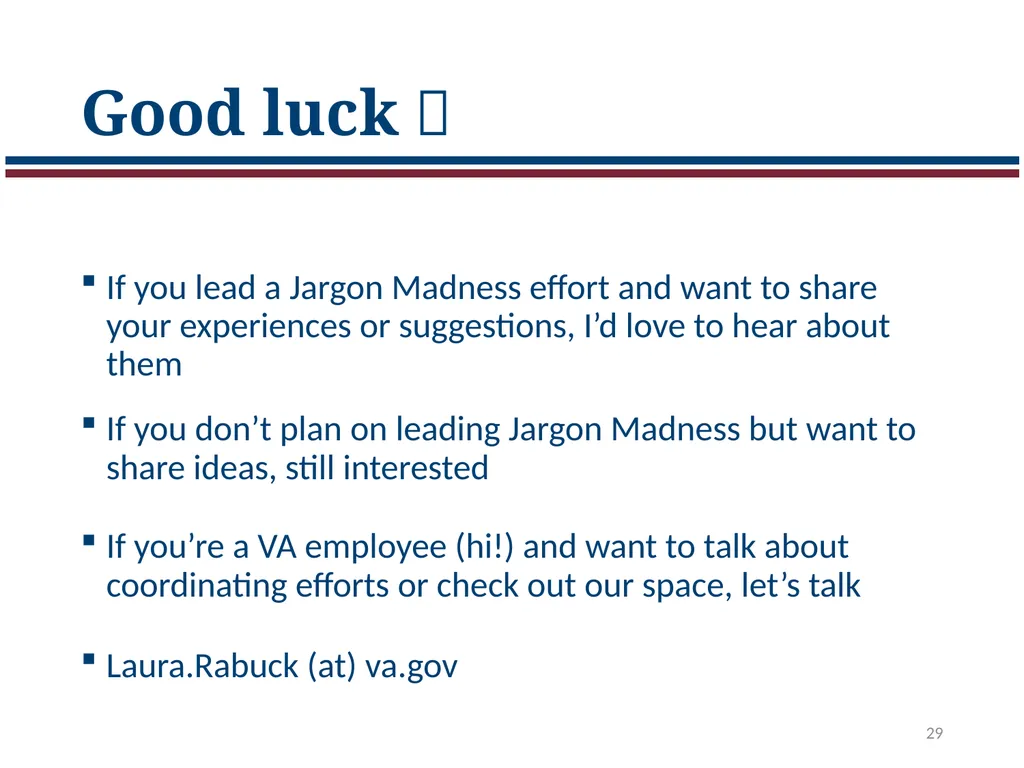
Good luck 🍀 If you lead a Jargon Madness effort and want to share your experiences or suggestions, I’d love to hear about them
If you don’t plan on leading Jargon Madness but want to share ideas, still interested
If you’re a VA employee (hi!) and want to talk about coordinating efforts or check out our space, let’s talk
Laura.Rabuck (at) va.gov 29<br>
If you don’t plan on leading Jargon Madness but want to share ideas, still interested
If you’re a VA employee (hi!) and want to talk about coordinating efforts or check out our space, let’s talk
Laura.Rabuck (at) va.gov 29<br>
30
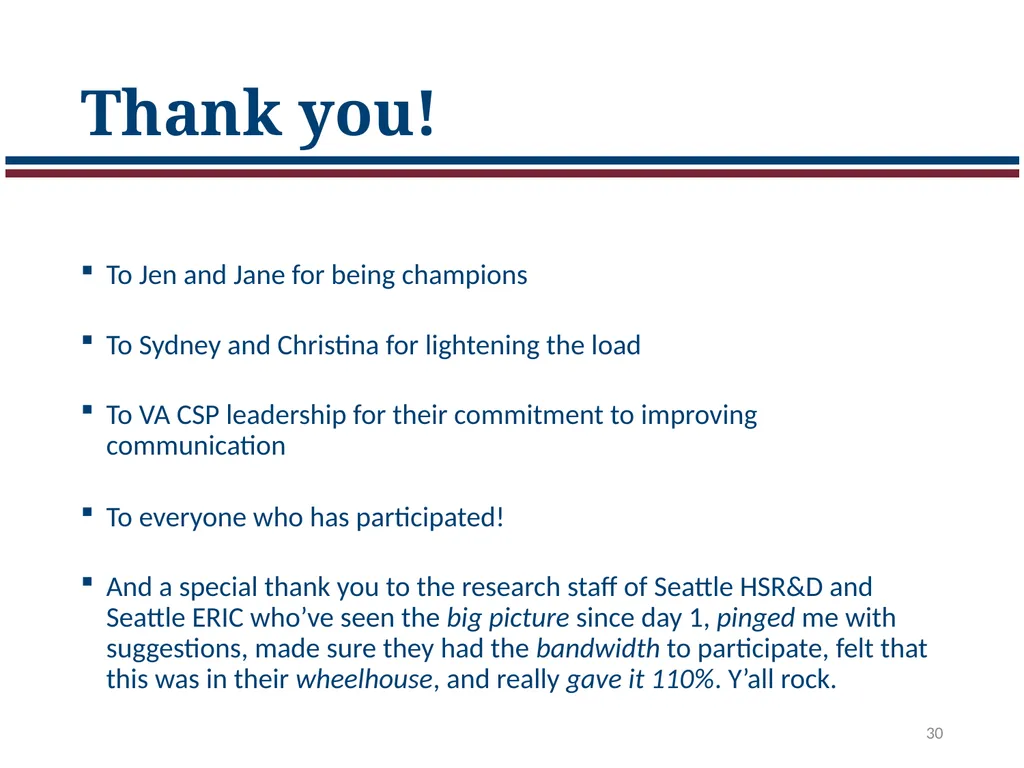
Thank you! To Jen and Jane for being champions
To Sydney and Christina for lightening the load
To VA CSP leadership for their commitment to improving communication
To everyone who has participated!
And a special thank you to the research staff of Seattle HSR&D and Seattle ERIC who’ve seen the big picture since day 1, pinged me with suggestions, made sure they had the bandwidth to participate, felt that this was in their wheelhouse, and really gave it 110%. Y’all rock. 30<br>
To Sydney and Christina for lightening the load
To VA CSP leadership for their commitment to improving communication
To everyone who has participated!
And a special thank you to the research staff of Seattle HSR&D and Seattle ERIC who’ve seen the big picture since day 1, pinged me with suggestions, made sure they had the bandwidth to participate, felt that this was in their wheelhouse, and really gave it 110%. Y’all rock. 30<br>
31
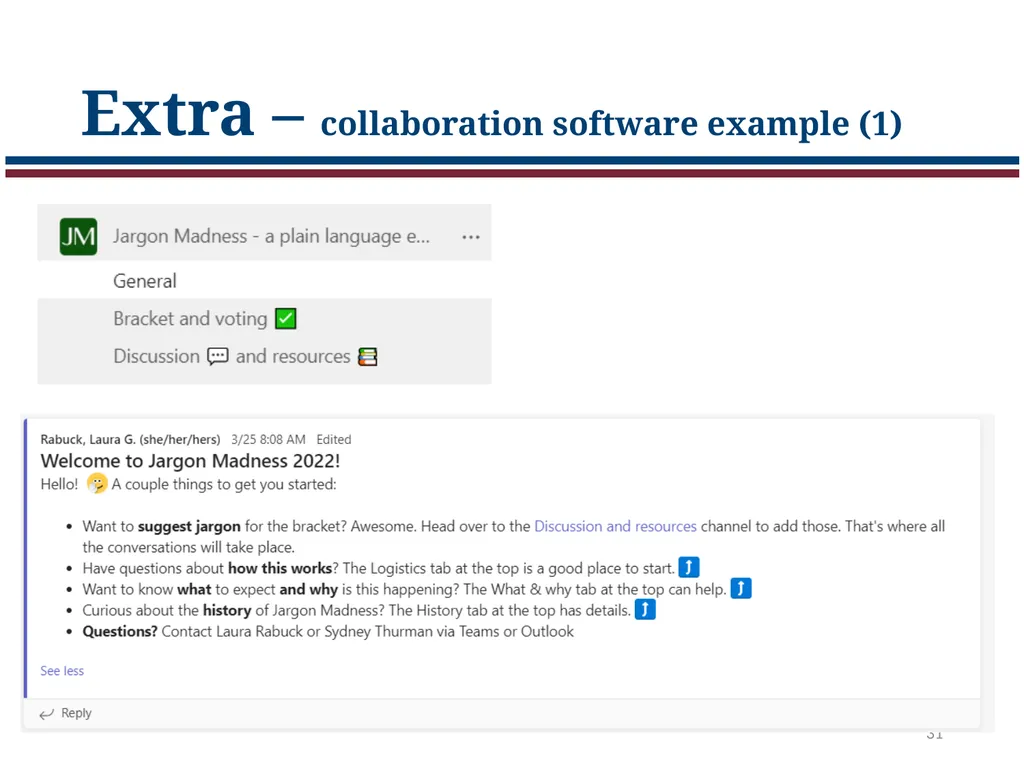
Extra – collaboration software example (1) 31<br>
32
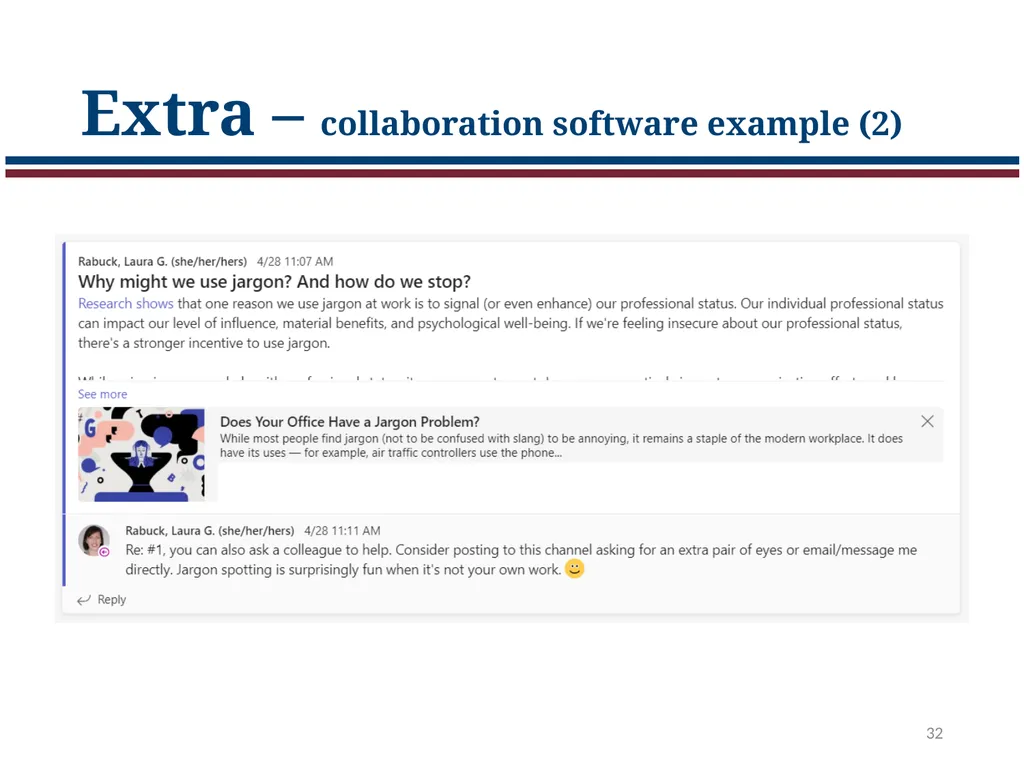
Extra – collaboration software example (2) 32<br>
33
Extra – Blog post example 33<br>
34
Extra – Survey example 34<br>