Jelly Roll Background In a cylindrical or prismatic battery cell, the active layers, current collector metal foils and separators are wound into a jelly roll Additional tabs (metal strips) are welded to the current collector foils in
"Jelly Roll Background In a cylindrical or" is the property of its rightful owner. Permission is granted to
download and print the materials on this website for personal, non-commercial use only, and to display it
on your personal computer provided you do not modify the materials and that you retain all copyright
notices contained in the materials. By downloading content from our website, you accept the terms of this
agreement.
Presentation Transcript
01
Jelly Roll<br>
02
Background In a cylindrical or prismatic battery cell, the active layers, current collector metal foils and separators are wound into a “jelly roll”
Additional tabs (metal strips) are welded to the current collector foils in order to conduct the current to the exterior of the cell can
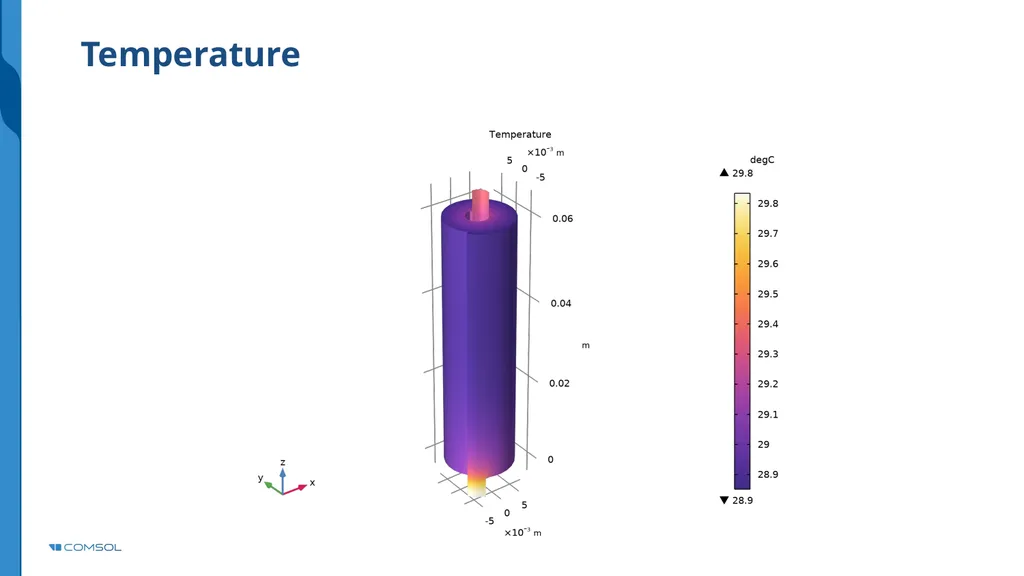
The interplay of the various dimensions of the layers and the tabs, in combination with the magnitude of the cell current, governs the temperature and current distribution in the battery cell
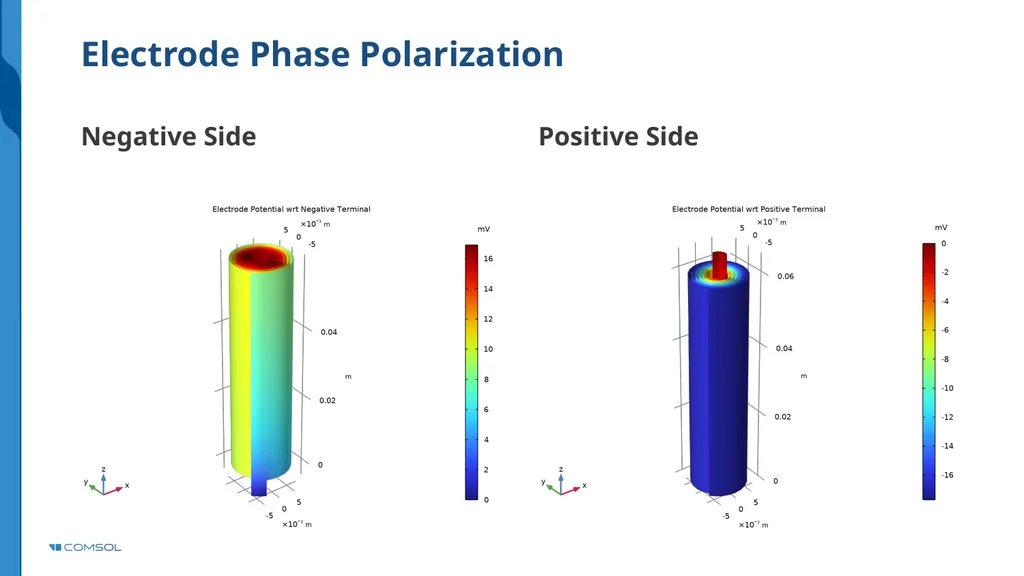
This tutorial models the ohmic and activation losses, and the resulting temperature distribution, in a jelly roll for a pseudo-stationary case at a constant cell current<br>
03
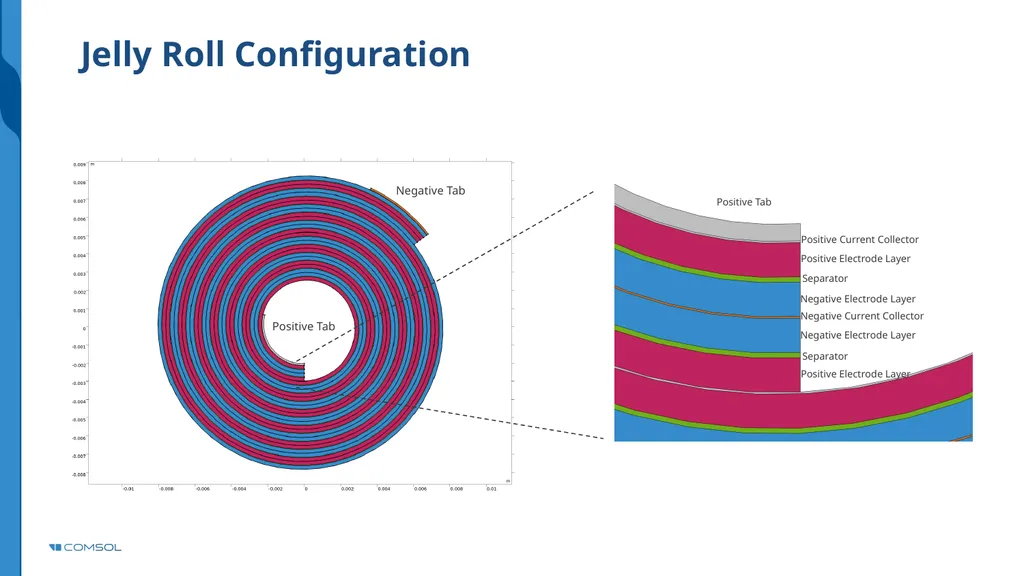
Jelly Roll Configuration Positive Current Collector Positive Electrode Layer Separator Negative Electrode Layer Negative Current Collector Negative Electrode Layer Separator Positive Electrode Layer Positive Tab Negative Tab Positive Tab<br>
04
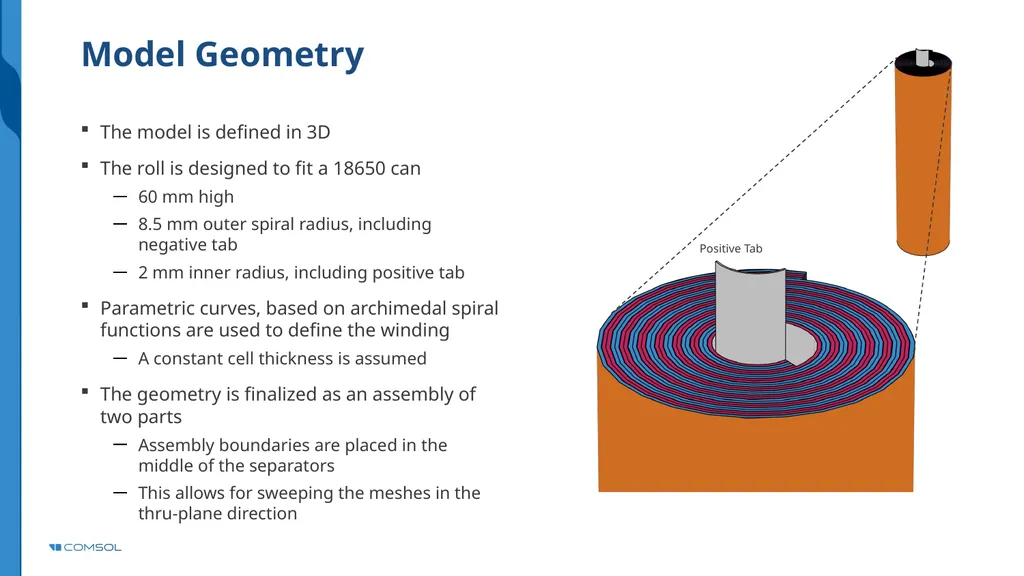
Model Geometry The model is defined in 3D
The roll is designed to fit a 18650 can
60 mm high
8.5 mm outer spiral radius, including negative tab
2 mm inner radius, including positive tab
Parametric curves, based on archimedal spiral functions are used to define the winding
A constant cell thickness is assumed
The geometry is finalized as an assembly of two parts
Assembly boundaries are placed in the middle of the separators
This allows for sweeping the meshes in the thru-plane direction Positive Tab<br>
05
Positive Tab
Aluminum, 100 mm thick, 4 mm wide
Positive Current Collector
Aluminum, 10 mm thick
Positive Electrode
NMC 111, 200 mm thick
Separator
30 mm thick
Negative Electrode
Graphite, 200 mm thick
Negative Current Collector
Copper, 10 mm thick
Negative Tab
Nickel, 100 mm thick, 4 mm wide Materials Material nodes in the model builder<br>
06
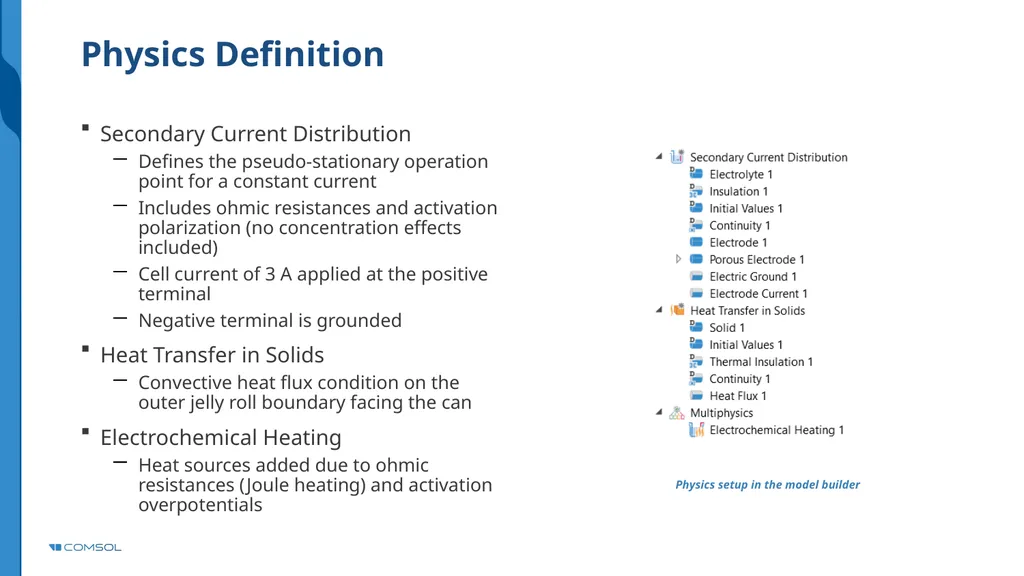
Secondary Current Distribution
Defines the pseudo-stationary operation point for a constant current
Includes ohmic resistances and activation polarization (no concentration effects included)
Cell current of 3 A applied at the positive terminal
Negative terminal is grounded
Heat Transfer in Solids
Convective heat flux condition on the outer jelly roll boundary facing the can
Electrochemical Heating
Heat sources added due to ohmic resistances (Joule heating) and activation overpotentials Physics Definition Physics setup in the model builder<br>
07
Negative Side Positive Side Electrode Phase Polarization<br>