
Jhumpa Lahiri: The Third And Final Continent. By






Description: Jhumpa Lahiri: The Third And Final Continent. By Tais, Lucie, Zoe, Bassma. Context of composition: Plan: Author. Summary Analysis: One Interesting Quote. The Big 5. POint of view Gender Roles Characters Conclusion. Comparison between A
Related Topics
Download Presentation
"Jhumpa Lahiri: The Third And Final Continent. By" is the property of its rightful owner. Permission is granted to download and print the materials on this website for personal, non-commercial use only, and to display it on your personal computer provided you do not modify the materials and that you retain all copyright notices contained in the materials. By downloading content from our website, you accept the terms of this agreement.
Presentation Transcript
slide1. Jhumpa Lahiri: The Third And Final Continent. By Tais, Lucie, Zoe, Bassma. Context of composition:<br>
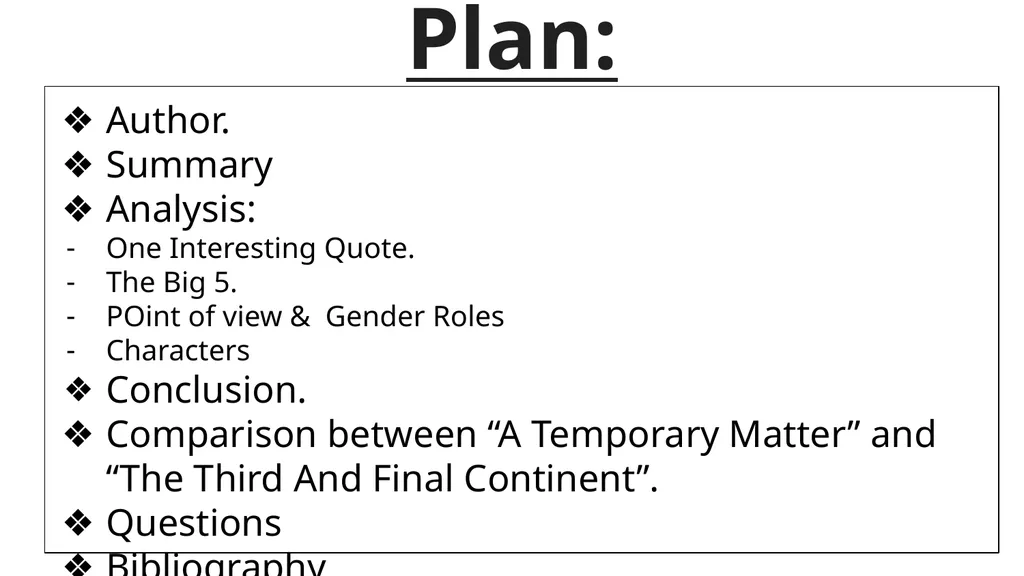
slide2. Plan: Author.
Summary
Analysis:
One Interesting Quote.
The Big 5.
POint of view & Gender Roles
Characters
Conclusion.
Comparison between “A Temporary Matter” and “The Third And Final Continent”.
Questions
Bibliography<br>
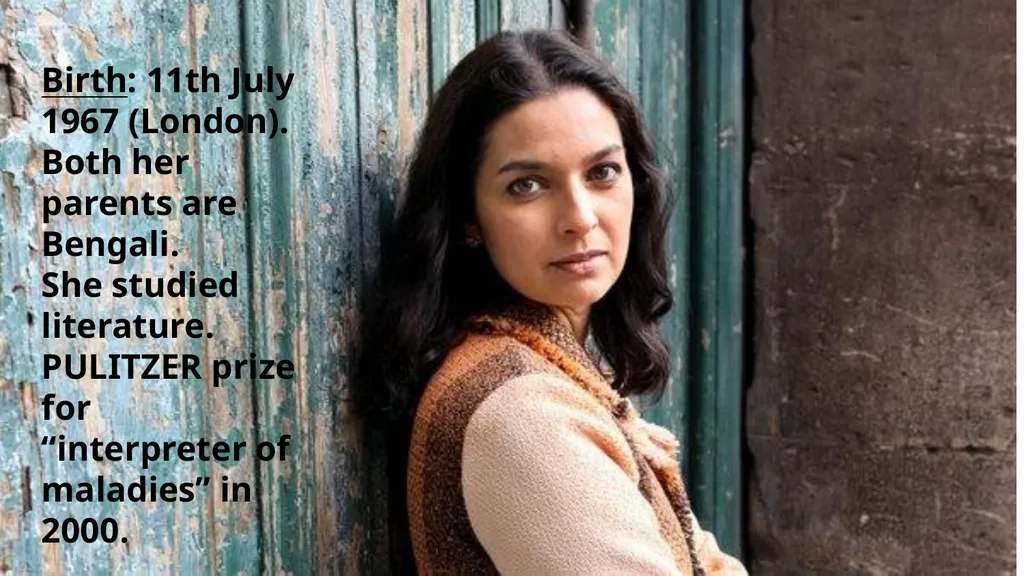
slide3. Birth: 11th July 1967 (London).
Both her parents are Bengali.
She studied literature.
PULITZER prize for “interpreter of maladies” in 2000.<br>
slide4. Summary of the short story The narrator is a Bengali man.
Left India and went to London (to study).
Went to Calcutta to marry Mala.
Found a job in Boston.
Rent a room in Mrs Croft’s house (to save money).
Mala (his wife but a “stranger” to him)joined him in Boston and they started living together.
Mrs Croft Died (more than 103 years old).
They had a child.<br>
slide5. ANALYSIS<br>
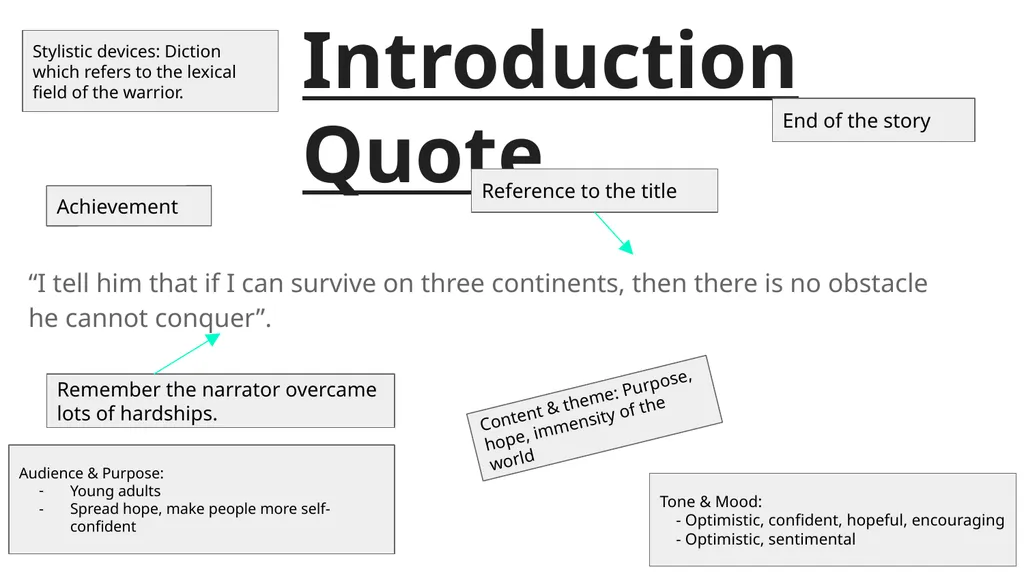
slide6. Introduction Quote “I tell him that if I can survive on three continents, then there is no obstacle he cannot conquer”. Reference to the title Achievement End of the story Remember the narrator overcame lots of hardships. Tone & Mood:
- Optimistic, confident, hopeful, encouraging
- Optimistic, sentimental Audience & Purpose:
Young adults
Spread hope, make people more self-confident Content & theme: Purpose, hope, immensity of the world Stylistic devices: Diction which refers to the lexical field of the warrior.<br>
slide7. THE BIG 5<br>
slide8. Tone And Mood TONE: Serious,resigned, hopeful, nostalgic.
Mood: Serious, ominous, hopeful.<br>
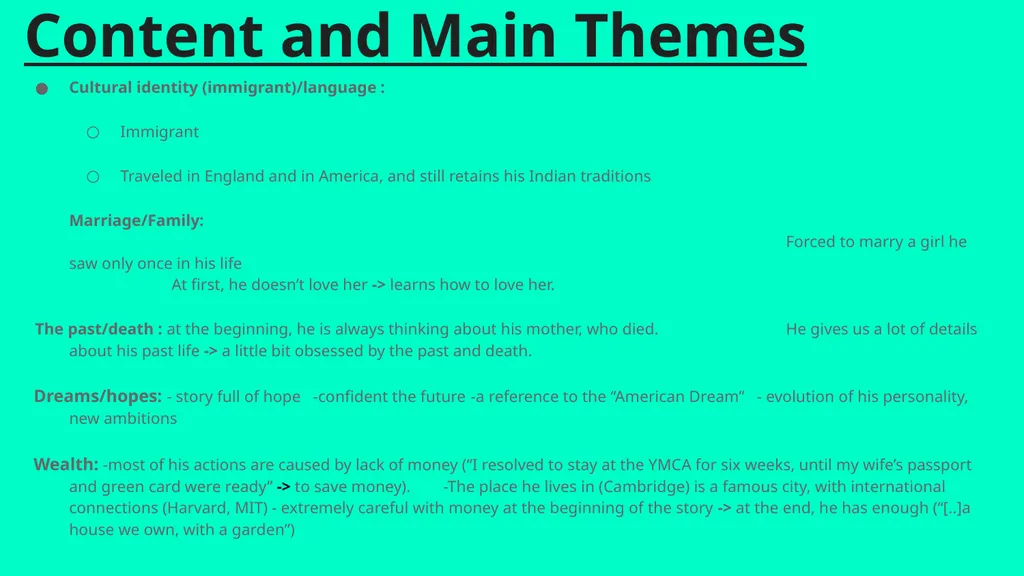
slide9. Content and Main Themes Cultural identity (immigrant)/language :
Immigrant
Traveled in England and in America, and still retains his Indian traditions
Marriage/Family: Forced to marry a girl he saw only once in his life At first, he doesn’t love her -> learns how to love her.
The past/death : at the beginning, he is always thinking about his mother, who died. He gives us a lot of details about his past life -> a little bit obsessed by the past and death.
Dreams/hopes: - story full of hope -confident the future -a reference to the “American Dream” - evolution of his personality, new ambitions
Wealth: -most of his actions are caused by lack of money (“I resolved to stay at the YMCA for six weeks, until my wife’s passport and green card were ready” -> to save money). -The place he lives in (Cambridge) is a famous city, with international connections (Harvard, MIT) - extremely careful with money at the beginning of the story -> at the end, he has enough (“[..]a house we own, with a garden”)<br>
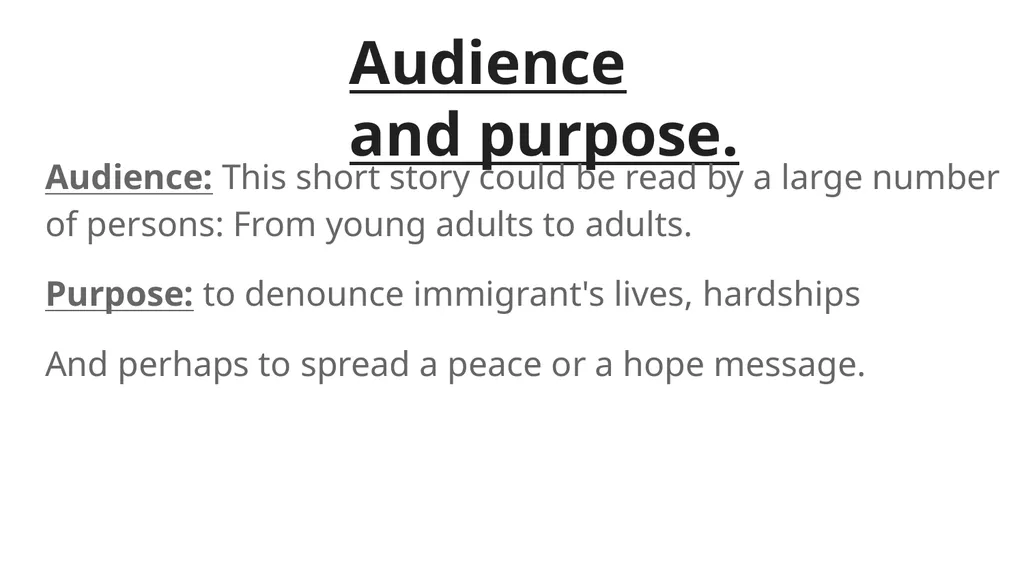
slide10. Audience and purpose. Audience: This short story could be read by a large number of persons: From young adults to adults.
Purpose: to denounce immigrant's lives, hardships
And perhaps to spread a peace or a hope message.<br>
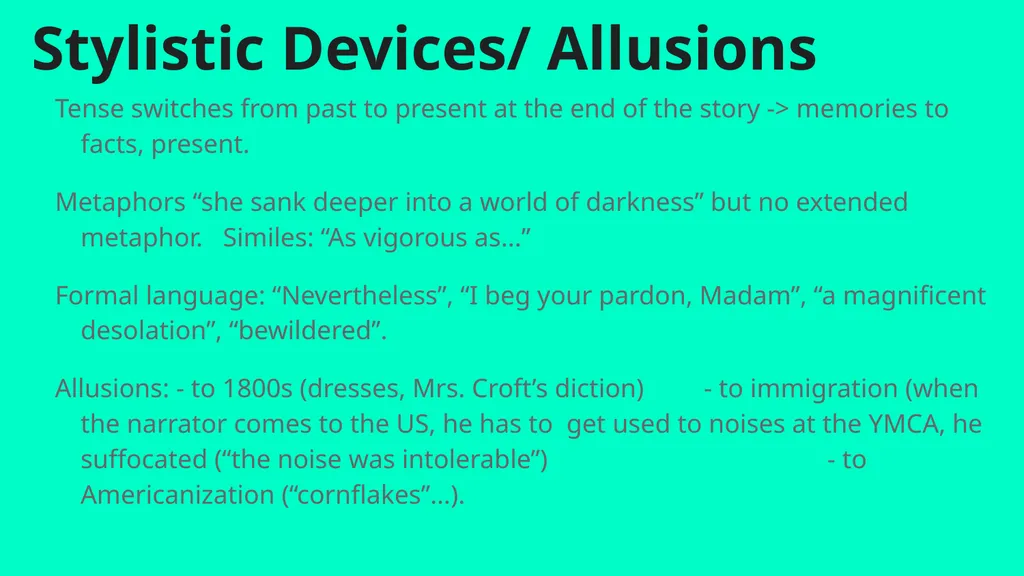
slide11. Stylistic Devices/ Allusions Tense switches from past to present at the end of the story -> memories to facts, present.
Metaphors “she sank deeper into a world of darkness” but no extended metaphor. Similes: “As vigorous as...”
Formal language: “Nevertheless”, “I beg your pardon, Madam”, “a magnificent desolation”, “bewildered”.
Allusions: - to 1800s (dresses, Mrs. Croft’s diction) - to immigration (when the narrator comes to the US, he has to get used to noises at the YMCA, he suffocated (“the noise was intolerable”) - to Americanization (“cornflakes”…).<br>
slide12. Structure No particular structure, even if, when he gets into a new place, he establishes a certain routine (ex: in the middle of the story, the narrator always sits beside Mrs. Croft when he returns to her house, then he screams “Yes, Madam, splendid!”).<br>
slide13. POint of view & Gender Roles It is written from a first person point of view. This is the narrator’s point of view (we do not know his name!). Indeed, the narrator uses “I”, we think that he is telling HIS story. In “The third and final continent”, the man and the woman have a defined role. Indeed, both characters were resigned to marry each other: “I regarded the proposition with neither objection nor enthusiasm. It was a duty expected of me, as it was expected of every man.” They do not expect it to change.
The woman had to cook, raise children (“I was told that she could cook, knit, embroider, sketch landscapes, and recite poems by Tagore”), and to be attractive whereas the man had to earn money, support his wife
“The salary was generous enough to support a wife”.<br>
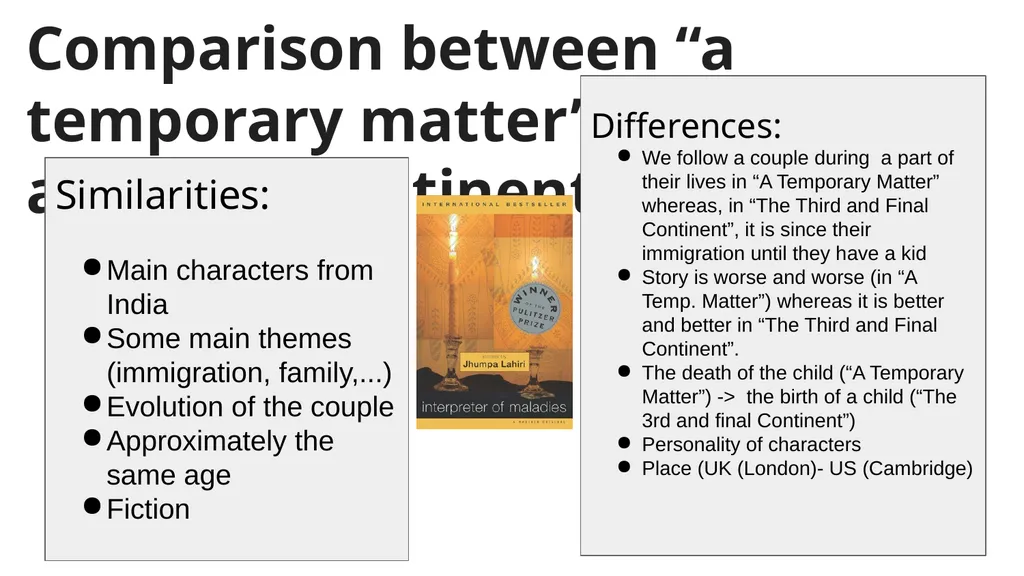
slide14. Comparison between “a temporary matter” & “The Third and final continent” Similarities:
Main characters from India
Some main themes (immigration, family,...)
Evolution of the couple
Approximately the same age
Fiction Differences:
We follow a couple during a part of their lives in “A Temporary Matter” whereas, in “The Third and Final Continent”, it is since their immigration until they have a kid
Story is worse and worse (in “A Temp. Matter”) whereas it is better and better in “The Third and Final Continent”.
The death of the child (“A Temporary Matter”) -> the birth of a child (“The 3rd and final Continent”)
Personality of characters
Place (UK (London)- US (Cambridge)<br>
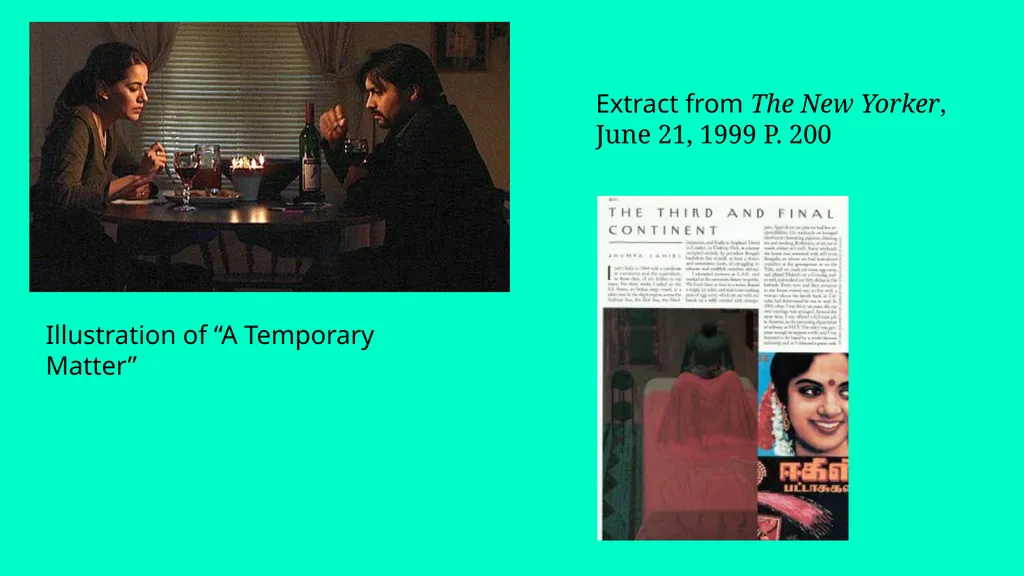
slide15. Illustration of “A Temporary Matter” Extract from The New Yorker, June 21, 1999 P. 200<br>
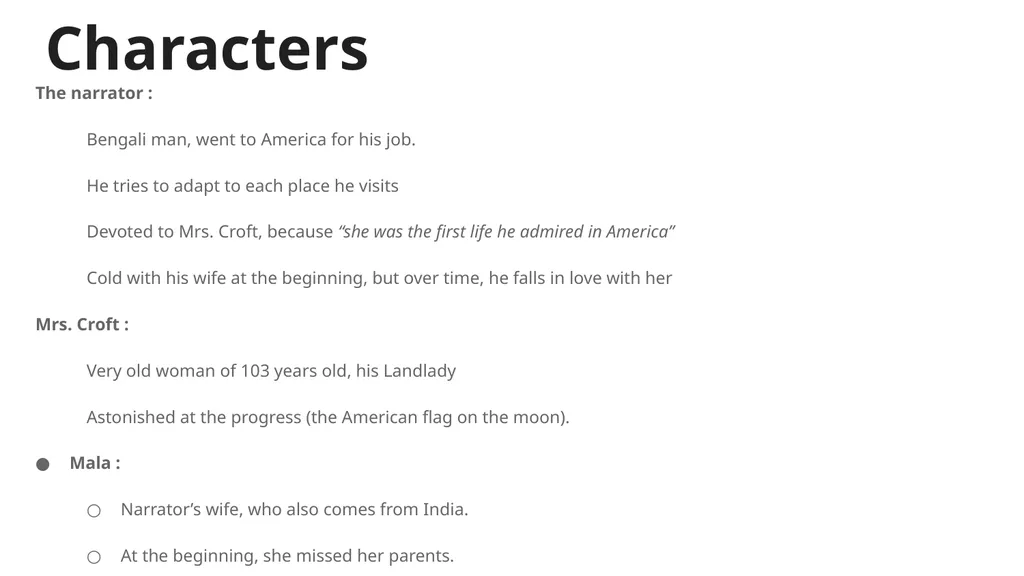
slide16. Characters The narrator :
Bengali man, went to America for his job.
He tries to adapt to each place he visits
Devoted to Mrs. Croft, because “she was the first life he admired in America”
Cold with his wife at the beginning, but over time, he falls in love with her
Mrs. Croft :
Very old woman of 103 years old, his Landlady
Astonished at the progress (the American flag on the moon).
Mala :
Narrator’s wife, who also comes from India.
At the beginning, she missed her parents.
Helen :
Mrs. Croft’s daughter. She takes care of her mother.
She look after the rooms of the foyer<br>
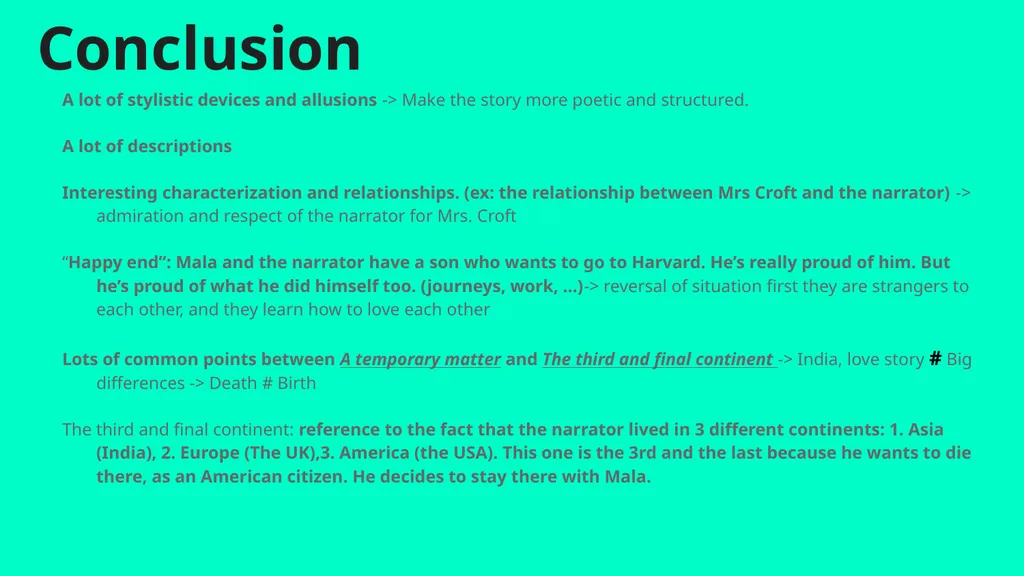
slide17. Conclusion A lot of stylistic devices and allusions -> Make the story more poetic and structured.
A lot of descriptions
Interesting characterization and relationships. (ex: the relationship between Mrs Croft and the narrator) -> admiration and respect of the narrator for Mrs. Croft
“Happy end”: Mala and the narrator have a son who wants to go to Harvard. He’s really proud of him. But he’s proud of what he did himself too. (journeys, work, …)-> reversal of situation first they are strangers to each other, and they learn how to love each other
Lots of common points between A temporary matter and The third and final continent -> India, love story # Big differences -> Death # Birth
The third and final continent: reference to the fact that the narrator lived in 3 different continents: 1. Asia (India), 2. Europe (The UK),3. America (the USA). This one is the 3rd and the last because he wants to die there, as an American citizen. He decides to stay there with Mala.<br>
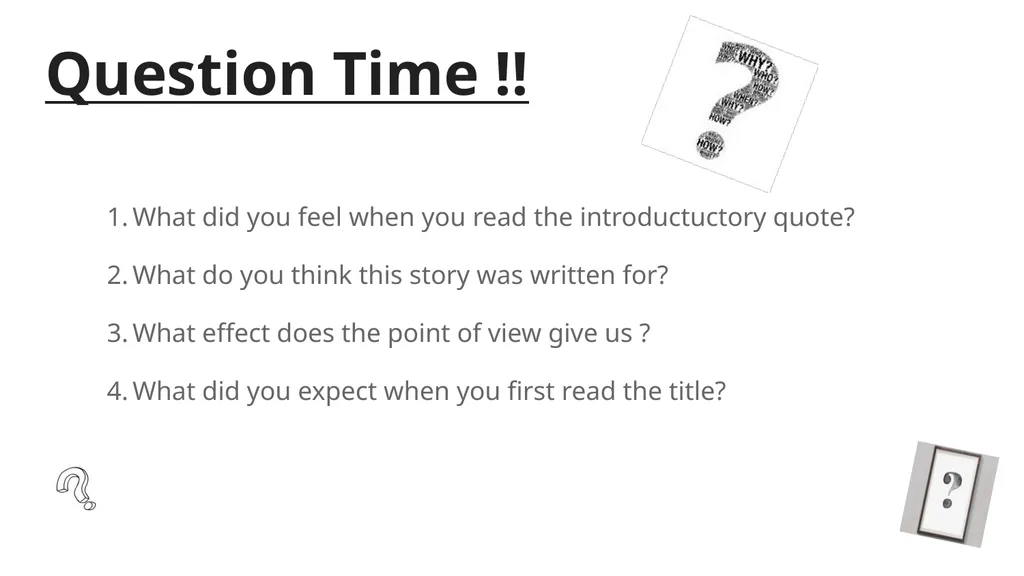
slide18. Question Time !! What did you feel when you read the introductuctory quote?
What do you think this story was written for?
What effect does the point of view give us ?
What did you expect when you first read the title?<br>
slide19. Hope you enjoyed The PRESENtation!!!<br>
slide20. DO YOU HAVE ANY QUESTIONS ?????<br>
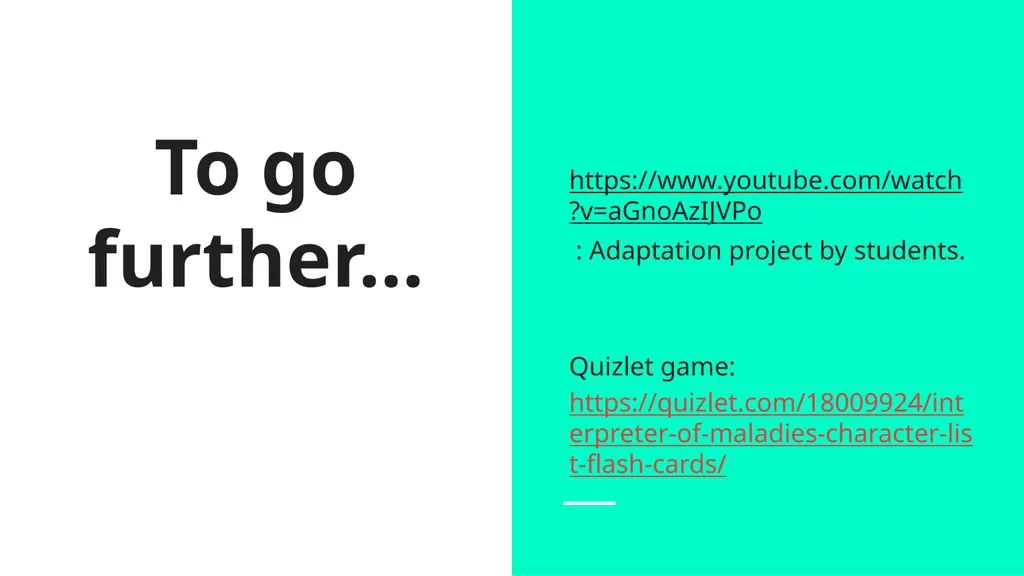
slide21. To go further... https://www.youtube.com/watch?v=aGnoAzIJVPo : Adaptation project by students.
Quizlet game: https://quizlet.com/18009924/interpreter-of-maladies-character-list-flash-cards/<br>
slide22. Bibliography Story: http://jhou.weebly.com/uploads/3/0/8/0/30800919/interpreter_of_maladies.pdf
Pictures:
“Google Images”: http://images.google.fr/imgres?imgurl=https%3A%2F%2Fstatic01.nyt.com%2Fimages%2F2013%2F09%2F20%2Farts%2F20BOOK1_SPAN%2FJPBOOKLAHIRI-videoSixteenByNine600.jpg&imgrefurl=http%3A%2F%2Fwww.nytimes.com%2F2013%2F09%2F20%2Fbooks%2Fjhumpa-lahiris-new-novel-the-lowland.html&h=338&w=600&tbnid=PwyFa3KbnixX0M%3A&docid=Dl9UlXIxetdTLM&ei=gikZWOWMEMqRaLTYkcAB&tbm=isch&iact=rc&uact=3&dur=473&page=1&start=20&ndsp=27&ved=0ahUKEwjl1f-M34jQAhXKCBoKHTRsBBgQMwhBKB4wHg&bih=662&biw=1366
https://writingonwomenwriters.files.wordpress.com/2013/04/temporary-matter.jpg
http://www.newyorker.com/magazine/1999/06/21/the-third-and-final-continent
http://bookanista.com/wp-content/uploads/2014/05/Interpreter_of_Maladies_US_290.jpg<br>
slide2. Plan: Author.
Summary
Analysis:
One Interesting Quote.
The Big 5.
POint of view & Gender Roles
Characters
Conclusion.
Comparison between “A Temporary Matter” and “The Third And Final Continent”.
Questions
Bibliography<br>
slide3. Birth: 11th July 1967 (London).
Both her parents are Bengali.
She studied literature.
PULITZER prize for “interpreter of maladies” in 2000.<br>
slide4. Summary of the short story The narrator is a Bengali man.
Left India and went to London (to study).
Went to Calcutta to marry Mala.
Found a job in Boston.
Rent a room in Mrs Croft’s house (to save money).
Mala (his wife but a “stranger” to him)joined him in Boston and they started living together.
Mrs Croft Died (more than 103 years old).
They had a child.<br>
slide5. ANALYSIS<br>
slide6. Introduction Quote “I tell him that if I can survive on three continents, then there is no obstacle he cannot conquer”. Reference to the title Achievement End of the story Remember the narrator overcame lots of hardships. Tone & Mood:
- Optimistic, confident, hopeful, encouraging
- Optimistic, sentimental Audience & Purpose:
Young adults
Spread hope, make people more self-confident Content & theme: Purpose, hope, immensity of the world Stylistic devices: Diction which refers to the lexical field of the warrior.<br>
slide7. THE BIG 5<br>
slide8. Tone And Mood TONE: Serious,resigned, hopeful, nostalgic.
Mood: Serious, ominous, hopeful.<br>
slide9. Content and Main Themes Cultural identity (immigrant)/language :
Immigrant
Traveled in England and in America, and still retains his Indian traditions
Marriage/Family: Forced to marry a girl he saw only once in his life At first, he doesn’t love her -> learns how to love her.
The past/death : at the beginning, he is always thinking about his mother, who died. He gives us a lot of details about his past life -> a little bit obsessed by the past and death.
Dreams/hopes: - story full of hope -confident the future -a reference to the “American Dream” - evolution of his personality, new ambitions
Wealth: -most of his actions are caused by lack of money (“I resolved to stay at the YMCA for six weeks, until my wife’s passport and green card were ready” -> to save money). -The place he lives in (Cambridge) is a famous city, with international connections (Harvard, MIT) - extremely careful with money at the beginning of the story -> at the end, he has enough (“[..]a house we own, with a garden”)<br>
slide10. Audience and purpose. Audience: This short story could be read by a large number of persons: From young adults to adults.
Purpose: to denounce immigrant's lives, hardships
And perhaps to spread a peace or a hope message.<br>
slide11. Stylistic Devices/ Allusions Tense switches from past to present at the end of the story -> memories to facts, present.
Metaphors “she sank deeper into a world of darkness” but no extended metaphor. Similes: “As vigorous as...”
Formal language: “Nevertheless”, “I beg your pardon, Madam”, “a magnificent desolation”, “bewildered”.
Allusions: - to 1800s (dresses, Mrs. Croft’s diction) - to immigration (when the narrator comes to the US, he has to get used to noises at the YMCA, he suffocated (“the noise was intolerable”) - to Americanization (“cornflakes”…).<br>
slide12. Structure No particular structure, even if, when he gets into a new place, he establishes a certain routine (ex: in the middle of the story, the narrator always sits beside Mrs. Croft when he returns to her house, then he screams “Yes, Madam, splendid!”).<br>
slide13. POint of view & Gender Roles It is written from a first person point of view. This is the narrator’s point of view (we do not know his name!). Indeed, the narrator uses “I”, we think that he is telling HIS story. In “The third and final continent”, the man and the woman have a defined role. Indeed, both characters were resigned to marry each other: “I regarded the proposition with neither objection nor enthusiasm. It was a duty expected of me, as it was expected of every man.” They do not expect it to change.
The woman had to cook, raise children (“I was told that she could cook, knit, embroider, sketch landscapes, and recite poems by Tagore”), and to be attractive whereas the man had to earn money, support his wife
“The salary was generous enough to support a wife”.<br>
slide14. Comparison between “a temporary matter” & “The Third and final continent” Similarities:
Main characters from India
Some main themes (immigration, family,...)
Evolution of the couple
Approximately the same age
Fiction Differences:
We follow a couple during a part of their lives in “A Temporary Matter” whereas, in “The Third and Final Continent”, it is since their immigration until they have a kid
Story is worse and worse (in “A Temp. Matter”) whereas it is better and better in “The Third and Final Continent”.
The death of the child (“A Temporary Matter”) -> the birth of a child (“The 3rd and final Continent”)
Personality of characters
Place (UK (London)- US (Cambridge)<br>
slide15. Illustration of “A Temporary Matter” Extract from The New Yorker, June 21, 1999 P. 200<br>
slide16. Characters The narrator :
Bengali man, went to America for his job.
He tries to adapt to each place he visits
Devoted to Mrs. Croft, because “she was the first life he admired in America”
Cold with his wife at the beginning, but over time, he falls in love with her
Mrs. Croft :
Very old woman of 103 years old, his Landlady
Astonished at the progress (the American flag on the moon).
Mala :
Narrator’s wife, who also comes from India.
At the beginning, she missed her parents.
Helen :
Mrs. Croft’s daughter. She takes care of her mother.
She look after the rooms of the foyer<br>
slide17. Conclusion A lot of stylistic devices and allusions -> Make the story more poetic and structured.
A lot of descriptions
Interesting characterization and relationships. (ex: the relationship between Mrs Croft and the narrator) -> admiration and respect of the narrator for Mrs. Croft
“Happy end”: Mala and the narrator have a son who wants to go to Harvard. He’s really proud of him. But he’s proud of what he did himself too. (journeys, work, …)-> reversal of situation first they are strangers to each other, and they learn how to love each other
Lots of common points between A temporary matter and The third and final continent -> India, love story # Big differences -> Death # Birth
The third and final continent: reference to the fact that the narrator lived in 3 different continents: 1. Asia (India), 2. Europe (The UK),3. America (the USA). This one is the 3rd and the last because he wants to die there, as an American citizen. He decides to stay there with Mala.<br>
slide18. Question Time !! What did you feel when you read the introductuctory quote?
What do you think this story was written for?
What effect does the point of view give us ?
What did you expect when you first read the title?<br>
slide19. Hope you enjoyed The PRESENtation!!!<br>
slide20. DO YOU HAVE ANY QUESTIONS ?????<br>
slide21. To go further... https://www.youtube.com/watch?v=aGnoAzIJVPo : Adaptation project by students.
Quizlet game: https://quizlet.com/18009924/interpreter-of-maladies-character-list-flash-cards/<br>
slide22. Bibliography Story: http://jhou.weebly.com/uploads/3/0/8/0/30800919/interpreter_of_maladies.pdf
Pictures:
“Google Images”: http://images.google.fr/imgres?imgurl=https%3A%2F%2Fstatic01.nyt.com%2Fimages%2F2013%2F09%2F20%2Farts%2F20BOOK1_SPAN%2FJPBOOKLAHIRI-videoSixteenByNine600.jpg&imgrefurl=http%3A%2F%2Fwww.nytimes.com%2F2013%2F09%2F20%2Fbooks%2Fjhumpa-lahiris-new-novel-the-lowland.html&h=338&w=600&tbnid=PwyFa3KbnixX0M%3A&docid=Dl9UlXIxetdTLM&ei=gikZWOWMEMqRaLTYkcAB&tbm=isch&iact=rc&uact=3&dur=473&page=1&start=20&ndsp=27&ved=0ahUKEwjl1f-M34jQAhXKCBoKHTRsBBgQMwhBKB4wHg&bih=662&biw=1366
https://writingonwomenwriters.files.wordpress.com/2013/04/temporary-matter.jpg
http://www.newyorker.com/magazine/1999/06/21/the-third-and-final-continent
http://bookanista.com/wp-content/uploads/2014/05/Interpreter_of_Maladies_US_290.jpg<br>