
Johna Wright Sr. Academic Advisor College of

Description: Johna Wright Sr. Academic Advisor College of medicine Distance Non-Traditional Students: The Other, Other, special Population Contact Information: johnatamu.edu 979-436-0626 At the end of this presentation, you will be able to: Recognize
Related Topics
Download Presentation
"Johna Wright Sr. Academic Advisor College of" is the property of its rightful owner. Permission is granted to download and print the materials on this website for personal, non-commercial use only, and to display it on your personal computer provided you do not modify the materials and that you retain all copyright notices contained in the materials. By downloading content from our website, you accept the terms of this agreement.
Presentation Transcript
slide1. Johna Wright
Sr. Academic Advisor
College of medicine Distance Non-Traditional Students: The Other, Other, special Population Contact Information:
johna@tamu.edu
979-436-0626<br>
slide2. At the end of this presentation, you will be able to: Recognize the definition of a non-traditional distance student
Identify the advisor's role with this student population
Explore strategies to successful advising with this student population<br>
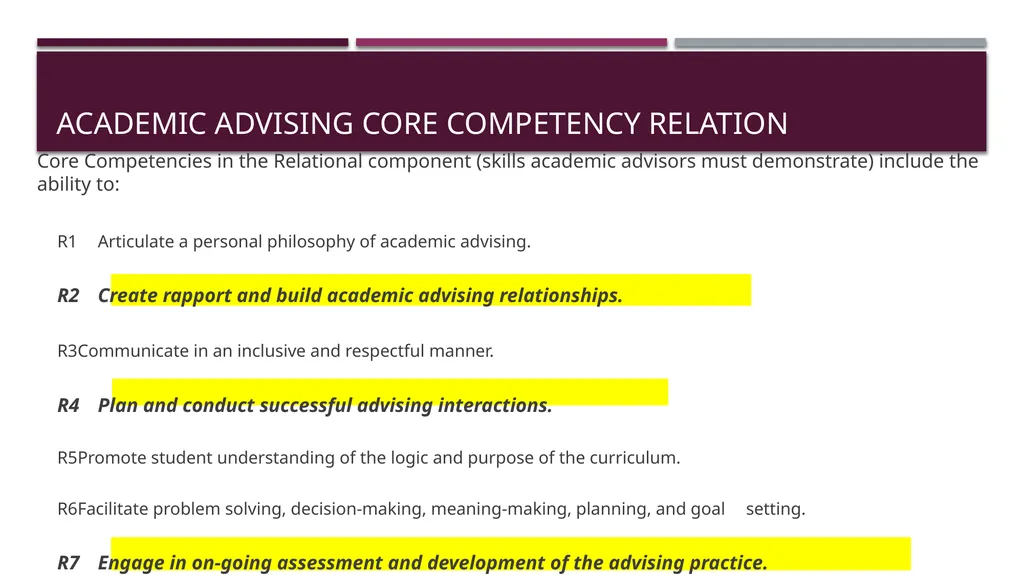
slide3. Academic Advising Core Competency Relation Core Competencies in the Relational component (skills academic advisors must demonstrate) include the ability to:
R1 Articulate a personal philosophy of academic advising.
R2 Create rapport and build academic advising relationships.
R3 Communicate in an inclusive and respectful manner.
R4 Plan and conduct successful advising interactions.
R5 Promote student understanding of the logic and purpose of the curriculum.
R6 Facilitate problem solving, decision-making, meaning-making, planning, and goal setting.
R7 Engage in on-going assessment and development of the advising practice.<br>
slide4. How do you define a non-traditional student?<br>
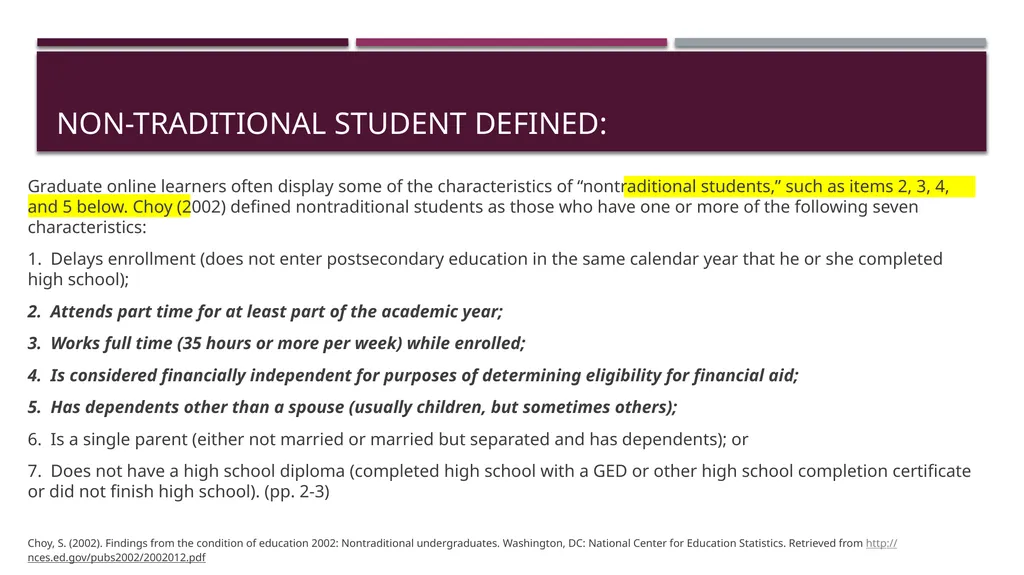
slide5. Non-traditional student defined: Graduate online learners often display some of the characteristics of “nontraditional students,” such as items 2, 3, 4, and 5 below. Choy (2002) defined nontraditional students as those who have one or more of the following seven characteristics:
1. Delays enrollment (does not enter postsecondary education in the same calendar year that he or she completed high school);
2. Attends part time for at least part of the academic year;
3. Works full time (35 hours or more per week) while enrolled;
4. Is considered financially independent for purposes of determining eligibility for financial aid;
5. Has dependents other than a spouse (usually children, but sometimes others);
6. Is a single parent (either not married or married but separated and has dependents); or
7. Does not have a high school diploma (completed high school with a GED or other high school completion certificate or did not finish high school). (pp. 2-3)
Choy, S. (2002). Findings from the condition of education 2002: Nontraditional undergraduates. Washington, DC: National Center for Education Statistics. Retrieved from http://nces.ed.gov/pubs2002/2002012.pdf<br>
slide6. How do you define distance education?<br>
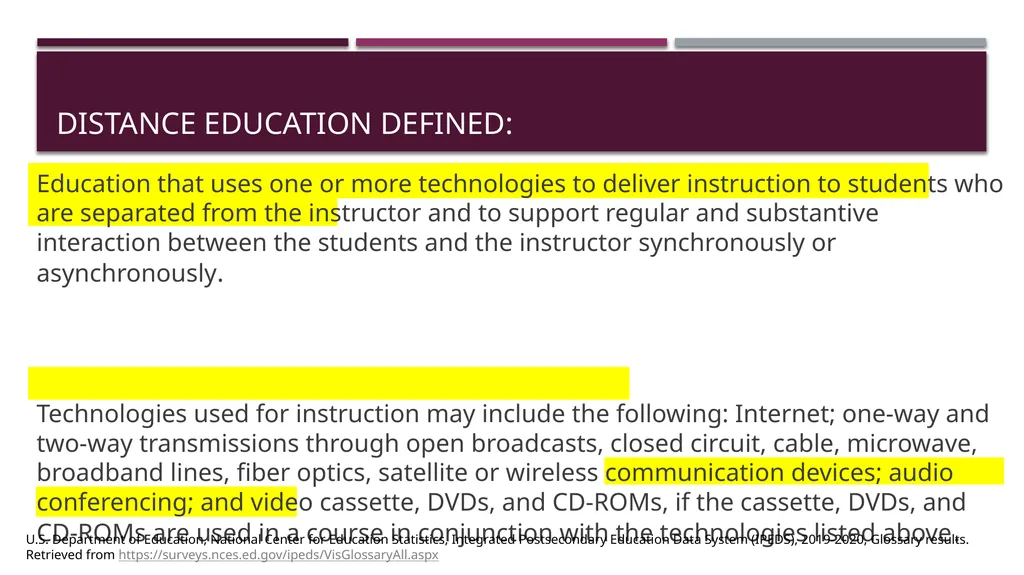
slide7. Distance Education defined: Education that uses one or more technologies to deliver instruction to students who are separated from the instructor and to support regular and substantive interaction between the students and the instructor synchronously or asynchronously.
Technologies used for instruction may include the following: Internet; one-way and two-way transmissions through open broadcasts, closed circuit, cable, microwave, broadband lines, fiber optics, satellite or wireless communication devices; audio conferencing; and video cassette, DVDs, and CD-ROMs, if the cassette, DVDs, and CD-ROMs are used in a course in conjunction with the technologies listed above. U.S. Department of Education, National Center for Education Statistics, Integrated Postsecondary Education Data System (IPEDS), 2019-2020, Glossary results. Retrieved from https://surveys.nces.ed.gov/ipeds/VisGlossaryAll.aspx<br>
slide8. Simplistic definition:
Non-traditional distance student –
Really busy<br>
slide9. Definition of a non-traditional distance student:<br>
slide10. Non-traditional distance student –
A student who is completing an educational program using technology and has other responsibilities other than their education.<br>
slide11. What are some advising needs of non-traditional students?
Think about their experiences!<br>
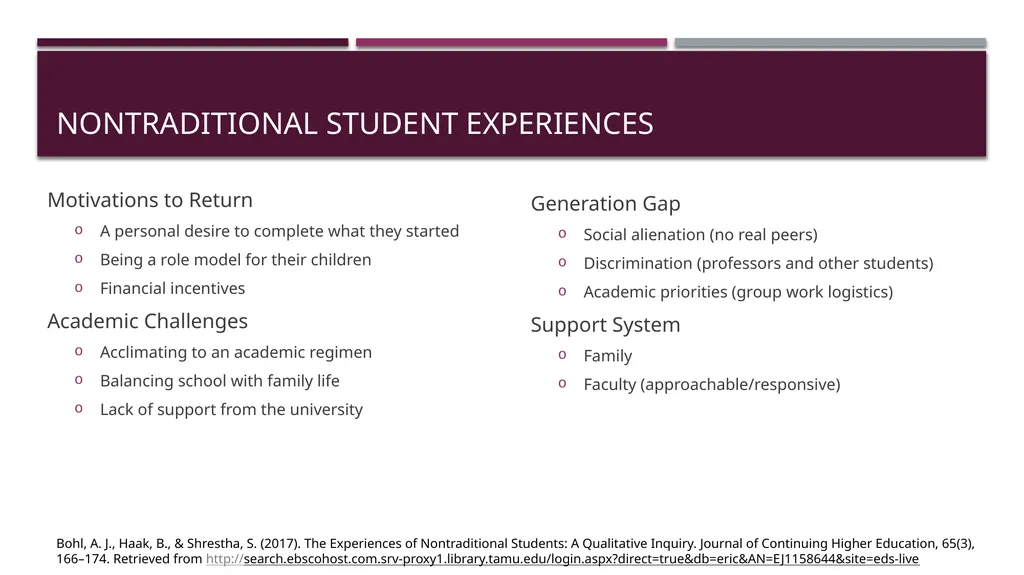
slide12. Nontraditional Student Experiences Motivations to Return
A personal desire to complete what they started
Being a role model for their children
Financial incentives
Academic Challenges
Acclimating to an academic regimen
Balancing school with family life
Lack of support from the university Generation Gap
Social alienation (no real peers)
Discrimination (professors and other students)
Academic priorities (group work logistics)
Support System
Family
Faculty (approachable/responsive) Bohl, A. J., Haak, B., & Shrestha, S. (2017). The Experiences of Nontraditional Students: A Qualitative Inquiry. Journal of Continuing Higher Education, 65(3), 166–174. Retrieved from http://search.ebscohost.com.srv-proxy1.library.tamu.edu/login.aspx?direct=true&db=eric&AN=EJ1158644&site=eds-live<br>
slide13. Important Services for Distance Students Advising
Student development – social, personal, and academic competencies (relationship impacts student persistence)
Academic Support
Online academic support services (tutoring & library access)
Technical Support
Access to support, user friendliness, and prior experience
Financial Aid
Increase in subsidized loans and family contribution Stevenson, T. ts1085@nova. ed. (2013). Online Student Persistence: What Matters is Outside the Classroom. Journal of Applied Learning Technology, 3(1), 21–25. Retrieved from http://search.ebscohost.com.srv-proxy2.library.tamu.edu/login.aspx?direct=true&db=eue&AN=90043854&site=eds-live<br>
slide14. Successful Advising Techniques Build Relationships
Communication strategies
Flexible Advisement and Early Registration Options
Schedule logistics
Partners for Advocacy
Collaborative support services
Specialized Resources
Non-traditional handbook/guidebook, list of peer groups
Training and Professional Development
Specific to student population needs Distance students Communication – Web conferencing
Verbal and nonverbal cues Non-traditional students Sapps, L., and Williams, S., (12 November 2015). Best practices in advising nontraditional students. Retrieved from: https://nacada.ksu.edu/Resources/Academic-Advising-Today/View-Articles/Best-Practices-in-Advising-Non-traditional-Students.aspx Mueller, D., and Meyer, A., (23 August 2017). Design a sustainable online advising option. Retrieved from: https://nacada.ksu.edu/Resources/Academic-Advising-Today/View-Articles/Design-a-Sustainable-Online-Advising-Option.aspx Communication - Email
Be available
Treat an email response as an advising session
Comprehensive
Fight the temptation to just give quick answers to quick questions
Timely
Prompt response saves you time in the long run Fusch, D., (9 August 2013). Email advising: Doing it wrong, doing it right. Retrieved from: https://www.academicimpressions.com/blog/email-advising-doing-it-wrong-doing-it-right/<br>
slide15. Think about some advising techniques you use?<br>
Sr. Academic Advisor
College of medicine Distance Non-Traditional Students: The Other, Other, special Population Contact Information:
johna@tamu.edu
979-436-0626<br>
slide2. At the end of this presentation, you will be able to: Recognize the definition of a non-traditional distance student
Identify the advisor's role with this student population
Explore strategies to successful advising with this student population<br>
slide3. Academic Advising Core Competency Relation Core Competencies in the Relational component (skills academic advisors must demonstrate) include the ability to:
R1 Articulate a personal philosophy of academic advising.
R2 Create rapport and build academic advising relationships.
R3 Communicate in an inclusive and respectful manner.
R4 Plan and conduct successful advising interactions.
R5 Promote student understanding of the logic and purpose of the curriculum.
R6 Facilitate problem solving, decision-making, meaning-making, planning, and goal setting.
R7 Engage in on-going assessment and development of the advising practice.<br>
slide4. How do you define a non-traditional student?<br>
slide5. Non-traditional student defined: Graduate online learners often display some of the characteristics of “nontraditional students,” such as items 2, 3, 4, and 5 below. Choy (2002) defined nontraditional students as those who have one or more of the following seven characteristics:
1. Delays enrollment (does not enter postsecondary education in the same calendar year that he or she completed high school);
2. Attends part time for at least part of the academic year;
3. Works full time (35 hours or more per week) while enrolled;
4. Is considered financially independent for purposes of determining eligibility for financial aid;
5. Has dependents other than a spouse (usually children, but sometimes others);
6. Is a single parent (either not married or married but separated and has dependents); or
7. Does not have a high school diploma (completed high school with a GED or other high school completion certificate or did not finish high school). (pp. 2-3)
Choy, S. (2002). Findings from the condition of education 2002: Nontraditional undergraduates. Washington, DC: National Center for Education Statistics. Retrieved from http://nces.ed.gov/pubs2002/2002012.pdf<br>
slide6. How do you define distance education?<br>
slide7. Distance Education defined: Education that uses one or more technologies to deliver instruction to students who are separated from the instructor and to support regular and substantive interaction between the students and the instructor synchronously or asynchronously.
Technologies used for instruction may include the following: Internet; one-way and two-way transmissions through open broadcasts, closed circuit, cable, microwave, broadband lines, fiber optics, satellite or wireless communication devices; audio conferencing; and video cassette, DVDs, and CD-ROMs, if the cassette, DVDs, and CD-ROMs are used in a course in conjunction with the technologies listed above. U.S. Department of Education, National Center for Education Statistics, Integrated Postsecondary Education Data System (IPEDS), 2019-2020, Glossary results. Retrieved from https://surveys.nces.ed.gov/ipeds/VisGlossaryAll.aspx<br>
slide8. Simplistic definition:
Non-traditional distance student –
Really busy<br>
slide9. Definition of a non-traditional distance student:<br>
slide10. Non-traditional distance student –
A student who is completing an educational program using technology and has other responsibilities other than their education.<br>
slide11. What are some advising needs of non-traditional students?
Think about their experiences!<br>
slide12. Nontraditional Student Experiences Motivations to Return
A personal desire to complete what they started
Being a role model for their children
Financial incentives
Academic Challenges
Acclimating to an academic regimen
Balancing school with family life
Lack of support from the university Generation Gap
Social alienation (no real peers)
Discrimination (professors and other students)
Academic priorities (group work logistics)
Support System
Family
Faculty (approachable/responsive) Bohl, A. J., Haak, B., & Shrestha, S. (2017). The Experiences of Nontraditional Students: A Qualitative Inquiry. Journal of Continuing Higher Education, 65(3), 166–174. Retrieved from http://search.ebscohost.com.srv-proxy1.library.tamu.edu/login.aspx?direct=true&db=eric&AN=EJ1158644&site=eds-live<br>
slide13. Important Services for Distance Students Advising
Student development – social, personal, and academic competencies (relationship impacts student persistence)
Academic Support
Online academic support services (tutoring & library access)
Technical Support
Access to support, user friendliness, and prior experience
Financial Aid
Increase in subsidized loans and family contribution Stevenson, T. ts1085@nova. ed. (2013). Online Student Persistence: What Matters is Outside the Classroom. Journal of Applied Learning Technology, 3(1), 21–25. Retrieved from http://search.ebscohost.com.srv-proxy2.library.tamu.edu/login.aspx?direct=true&db=eue&AN=90043854&site=eds-live<br>
slide14. Successful Advising Techniques Build Relationships
Communication strategies
Flexible Advisement and Early Registration Options
Schedule logistics
Partners for Advocacy
Collaborative support services
Specialized Resources
Non-traditional handbook/guidebook, list of peer groups
Training and Professional Development
Specific to student population needs Distance students Communication – Web conferencing
Verbal and nonverbal cues Non-traditional students Sapps, L., and Williams, S., (12 November 2015). Best practices in advising nontraditional students. Retrieved from: https://nacada.ksu.edu/Resources/Academic-Advising-Today/View-Articles/Best-Practices-in-Advising-Non-traditional-Students.aspx Mueller, D., and Meyer, A., (23 August 2017). Design a sustainable online advising option. Retrieved from: https://nacada.ksu.edu/Resources/Academic-Advising-Today/View-Articles/Design-a-Sustainable-Online-Advising-Option.aspx Communication - Email
Be available
Treat an email response as an advising session
Comprehensive
Fight the temptation to just give quick answers to quick questions
Timely
Prompt response saves you time in the long run Fusch, D., (9 August 2013). Email advising: Doing it wrong, doing it right. Retrieved from: https://www.academicimpressions.com/blog/email-advising-doing-it-wrong-doing-it-right/<br>
slide15. Think about some advising techniques you use?<br>