Jorg Wenninger Update on polarization and RDP for LCC V107 Acknowledgements : M. Jebramzik, G. Iadarola Polarization in Xsuite with radiation Depolarization with LCC V107 at Z, W and HZ Polarization checks with LCC V107 A check of the
"Jorg Wenninger Update on polarization and RDP for" is the property of its rightful owner. Permission is granted to
download and print the materials on this website for personal, non-commercial use only, and to display it
on your personal computer provided you do not modify the materials and that you retain all copyright
notices contained in the materials. By downloading content from our website, you accept the terms of this
agreement.
Presentation Transcript
01
Jorg Wenninger Update on polarization and RDP for LCC V107 Acknowledgements :
M. Jebramzik, G. Iadarola<br>
02
Polarization in Xsuite with radiation Depolarization with LCC V107 at Z, W and HZ<br>
03
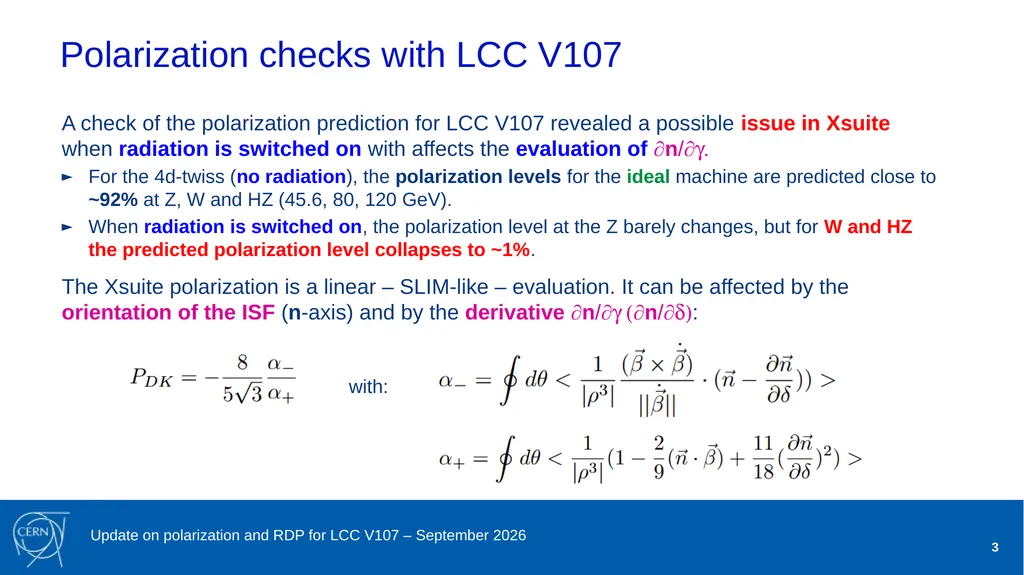
Polarization checks with LCC V107 A check of the polarization prediction for LCC V107 revealed a possible issue in Xsuite when radiation is switched on with affects the evaluation of n/g.
For the 4d-twiss (no radiation), the polarization levels for the ideal machine are predicted close to ~92% at Z, W and HZ (45.6, 80, 120 GeV).
When radiation is switched on, the polarization level at the Z barely changes, but for W and HZ the predicted polarization level collapses to ~1%.
The Xsuite polarization is a linear – SLIM-like – evaluation. It can be affected by the orientation of the ISF (n-axis) and by the derivative n/g (n/d): with:<br>
04
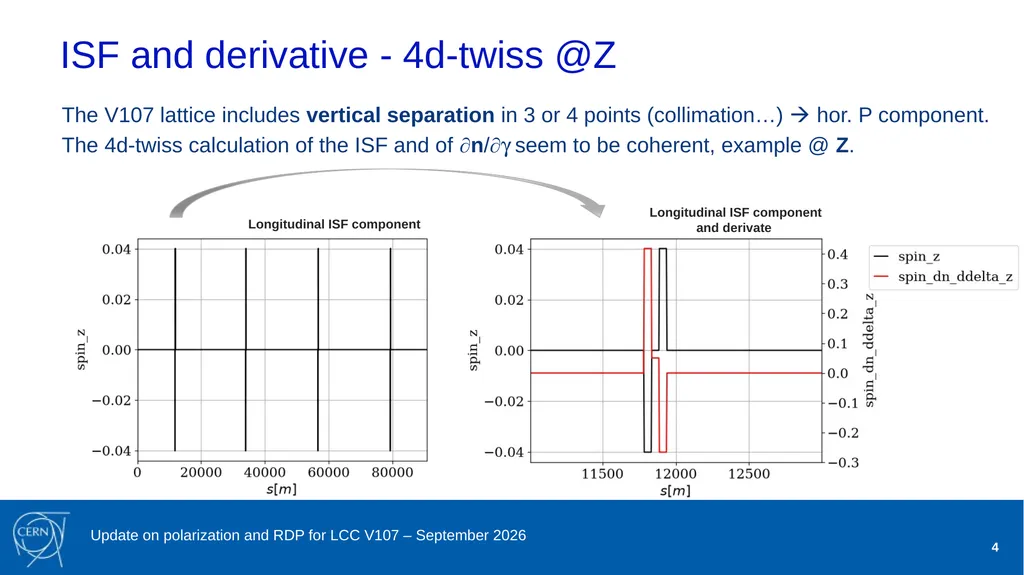
ISF and derivative - 4d-twiss @Z The V107 lattice includes vertical separation in 3 or 4 points (collimation…) hor. P component.
The 4d-twiss calculation of the ISF and of n/g seem to be coherent, example @ Z. Longitudinal ISF component Longitudinal ISF component
and derivate<br>
05
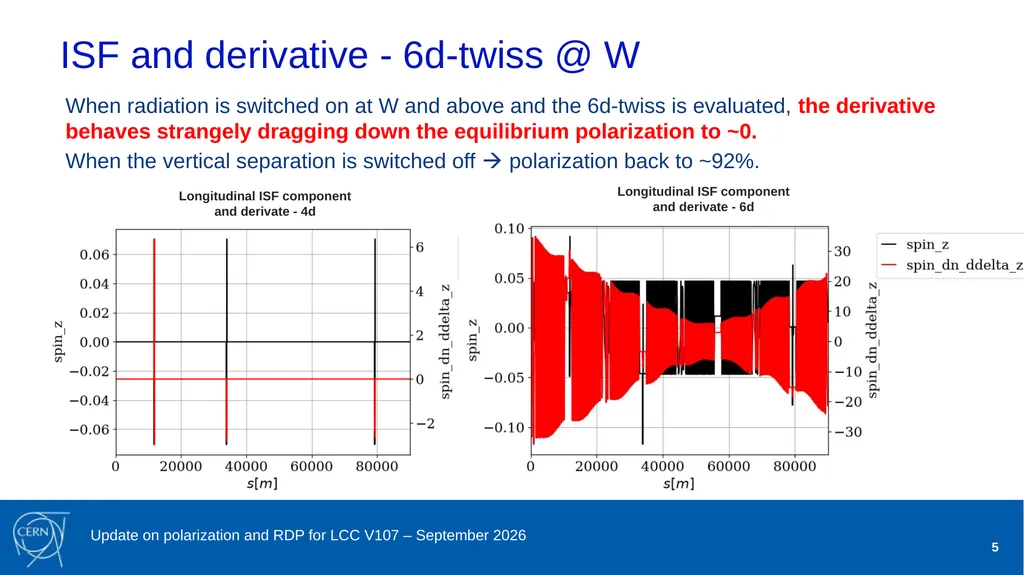
ISF and derivative - 6d-twiss @ W When radiation is switched on at W and above and the 6d-twiss is evaluated, the derivative behaves strangely dragging down the equilibrium polarization to ~0.
When the vertical separation is switched off polarization back to ~92%. Longitudinal ISF component
and derivate - 6d Longitudinal ISF component
and derivate - 4d<br>
06
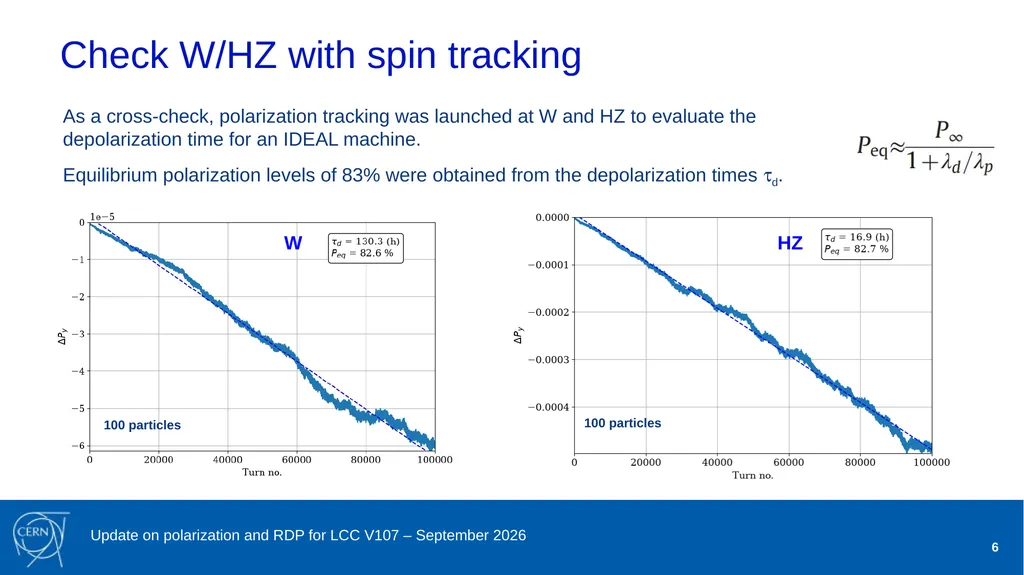
Check W/HZ with spin tracking As a cross-check, polarization tracking was launched at W and HZ to evaluate the depolarization time for an IDEAL machine.
Equilibrium polarization levels of 83% were obtained from the depolarization times td. W HZ 100 particles 100 particles<br>
07
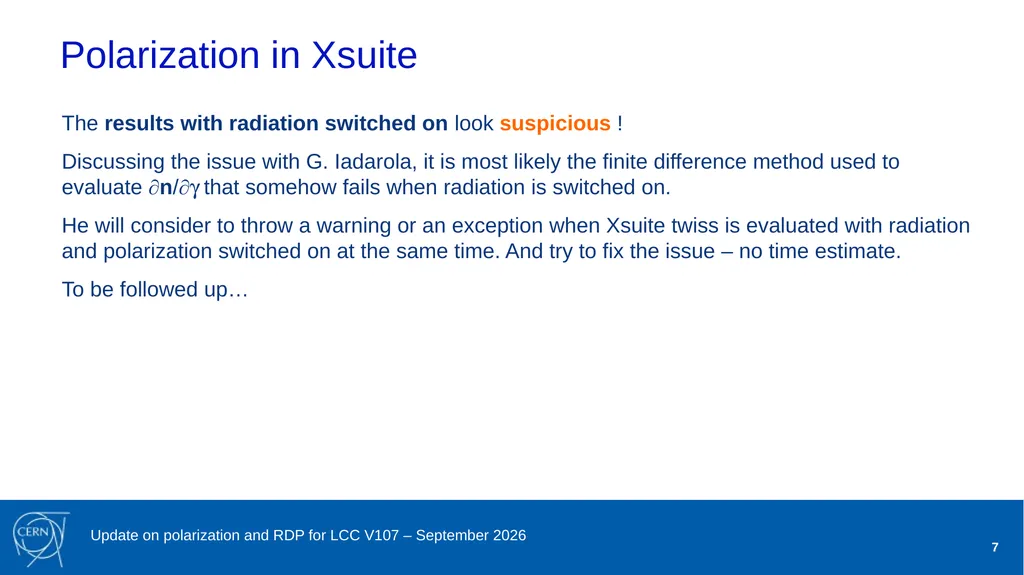
Polarization in Xsuite The results with radiation switched on look suspicious !
Discussing the issue with G. Iadarola, it is most likely the finite difference method used to evaluate n/g that somehow fails when radiation is switched on.
He will consider to throw a warning or an exception when Xsuite twiss is evaluated with radiation and polarization switched on at the same time. And try to fix the issue – no time estimate.
To be followed up…<br>
08
Polarization in Xsuite with radiation Depolarization with LCC V107 at Z, W and HZ<br>
09
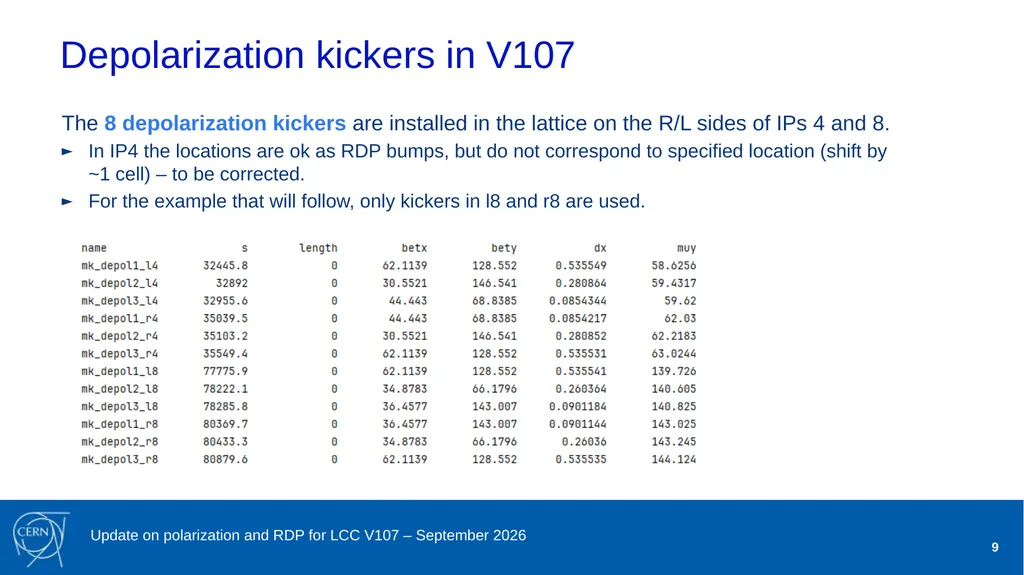
Depolarization kickers in V107 The 8 depolarization kickers are installed in the lattice on the R/L sides of IPs 4 and 8.
In IP4 the locations are ok as RDP bumps, but do not correspond to specified location (shift by ~1 cell) – to be corrected.
For the example that will follow, only kickers in l8 and r8 are used.<br>
10
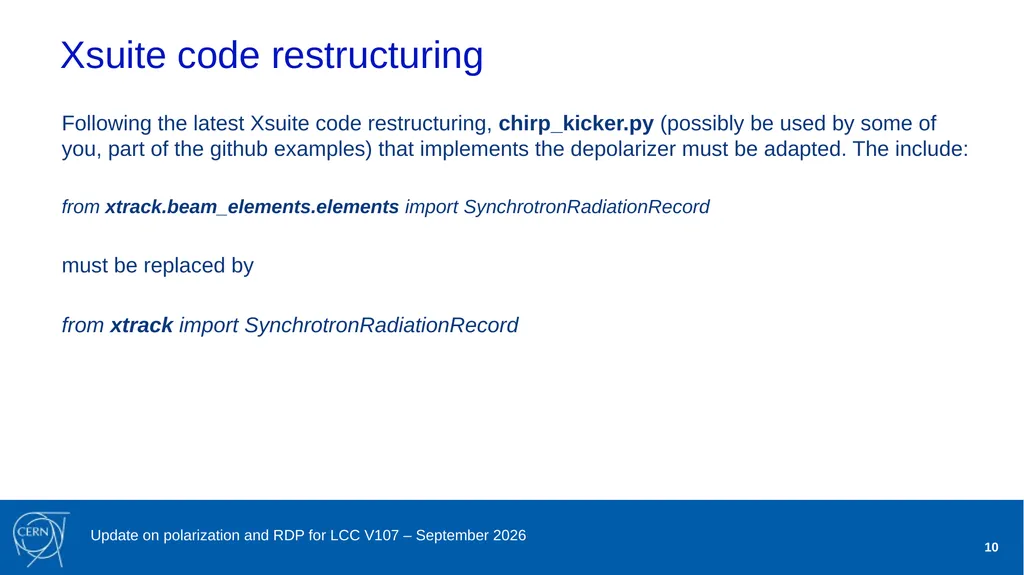
Xsuite code restructuring Following the latest Xsuite code restructuring, chirp_kicker.py (possibly be used by some of you, part of the github examples) that implements the depolarizer must be adapted. The include:
from xtrack.beam_elements.elements import SynchrotronRadiationRecord
must be replaced by
from xtrack import SynchrotronRadiationRecord<br>
11
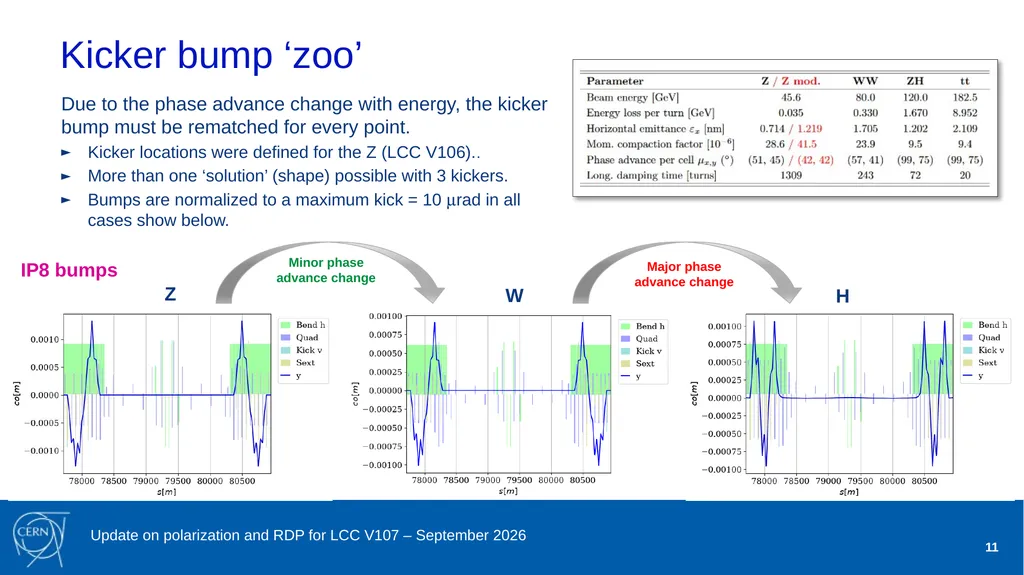
Kicker bump ‘zoo’ Due to the phase advance change with energy, the kicker bump must be rematched for every point.
Kicker locations were defined for the Z (LCC V106)..
More than one ‘solution’ (shape) possible with 3 kickers.
Bumps are normalized to a maximum kick = 10 mrad in all cases show below. Z W H Minor phase advance change Major phase advance change IP8 bumps<br>
12
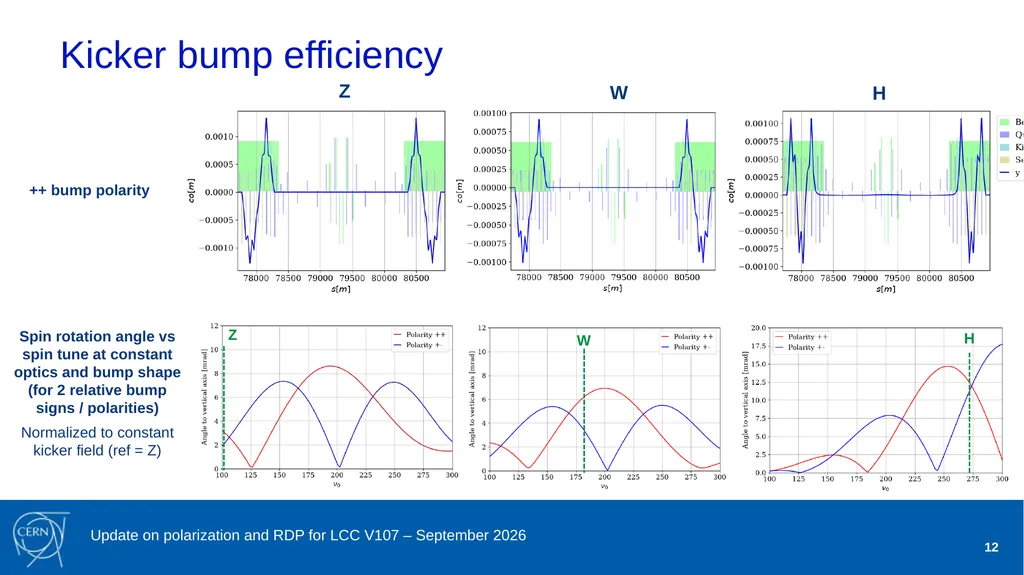
Kicker bump efficiency Spin rotation angle vs spin tune at constant optics and bump shape
(for 2 relative bump signs / polarities)
Normalized to constant kicker field (ref = Z) ++ bump polarity<br>
13
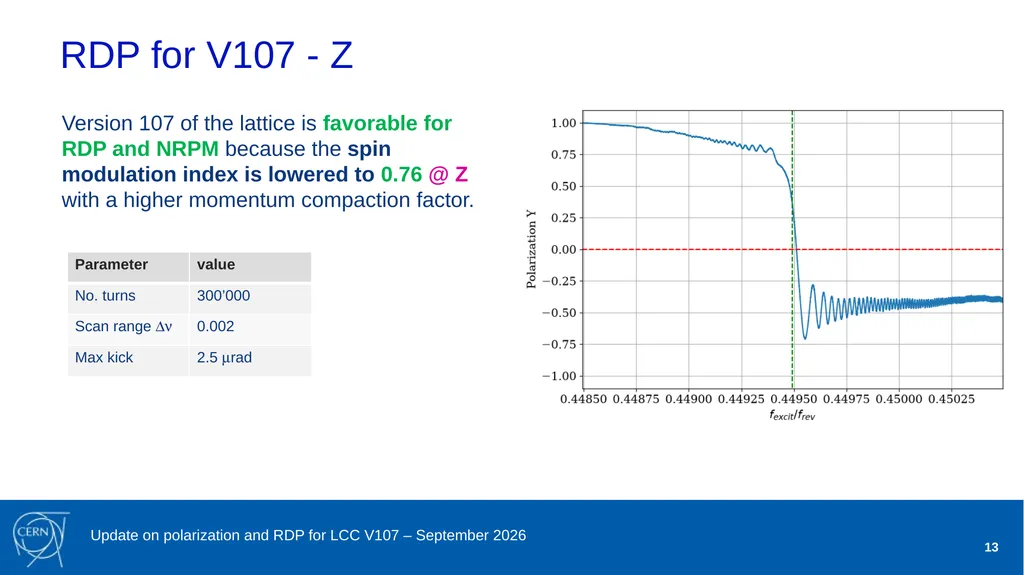
RDP for V107 - Z Version 107 of the lattice is favorable for RDP and NRPM because the spin modulation index is lowered to 0.76 @ Z with a higher momentum compaction factor.<br>
14
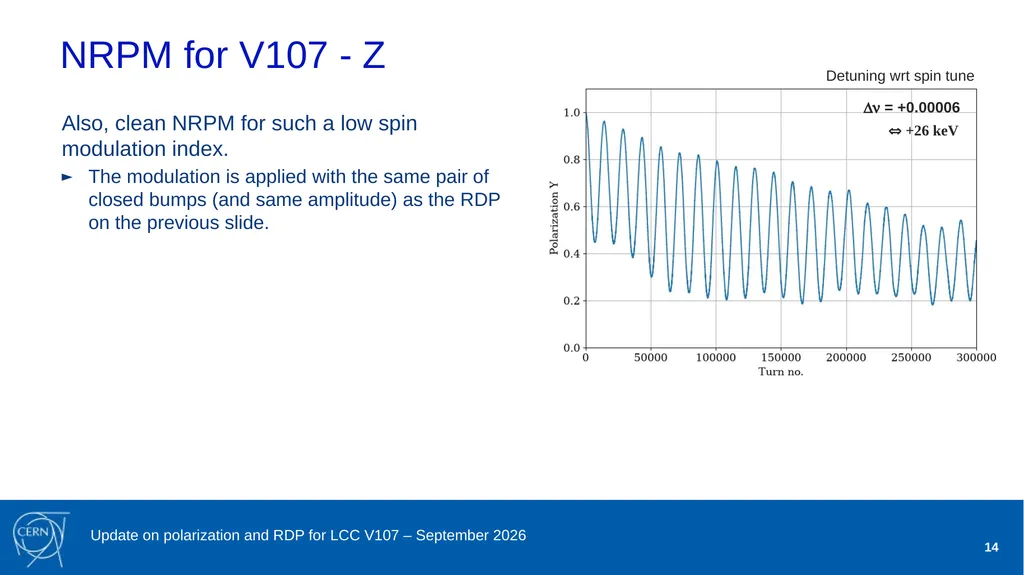
NRPM for V107 - Z Also, clean NRPM for such a low spin modulation index.
The modulation is applied with the same pair of closed bumps (and same amplitude) as the RDP on the previous slide. Dn = +0.00006 +26 keV Detuning wrt spin tune<br>
15
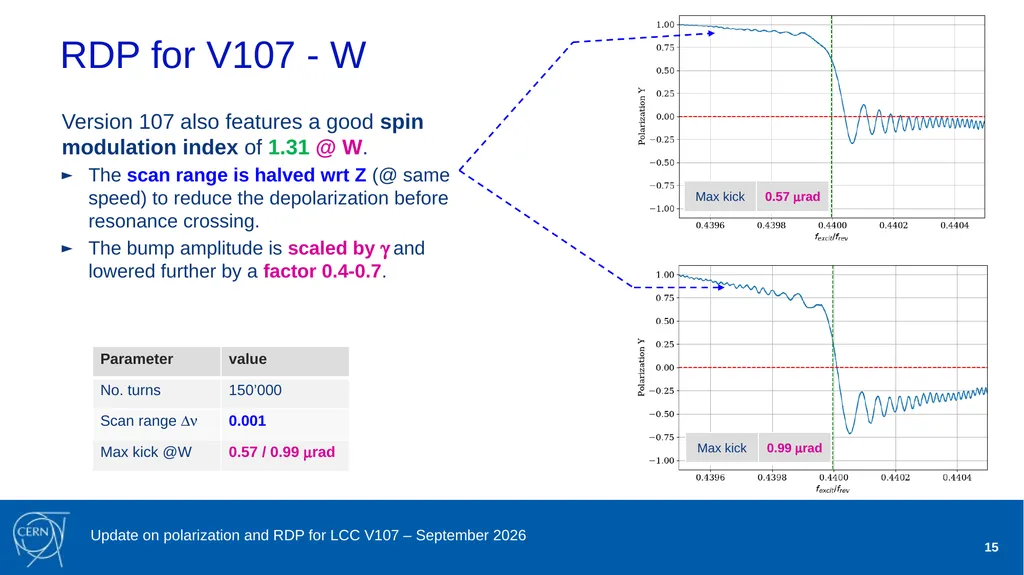
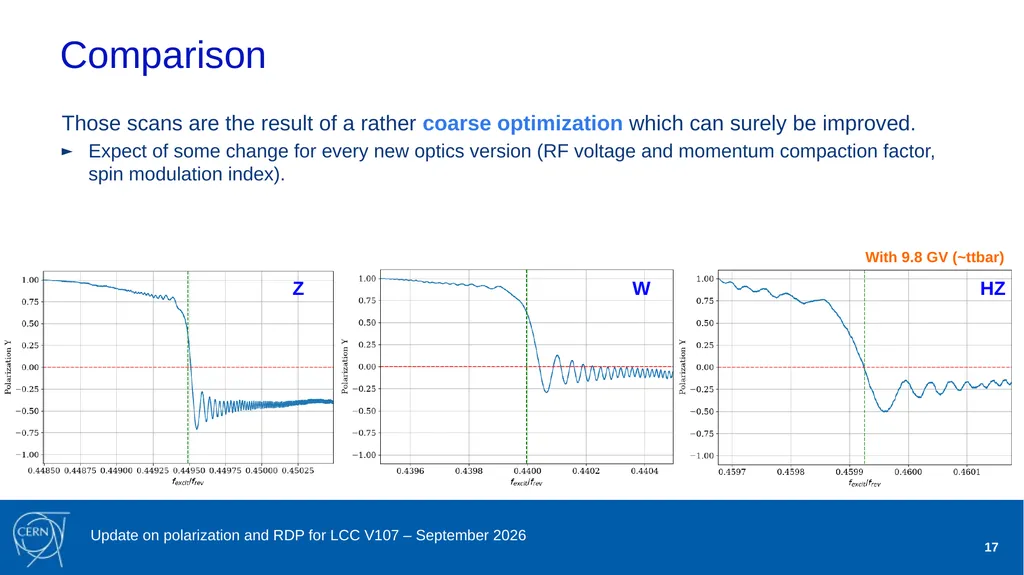
RDP for V107 - W Version 107 also features a good spin modulation index of 1.31 @ W.
The scan range is halved wrt Z (@ same speed) to reduce the depolarization before resonance crossing.
The bump amplitude is scaled by g and lowered further by a factor 0.4-0.7.<br>
16
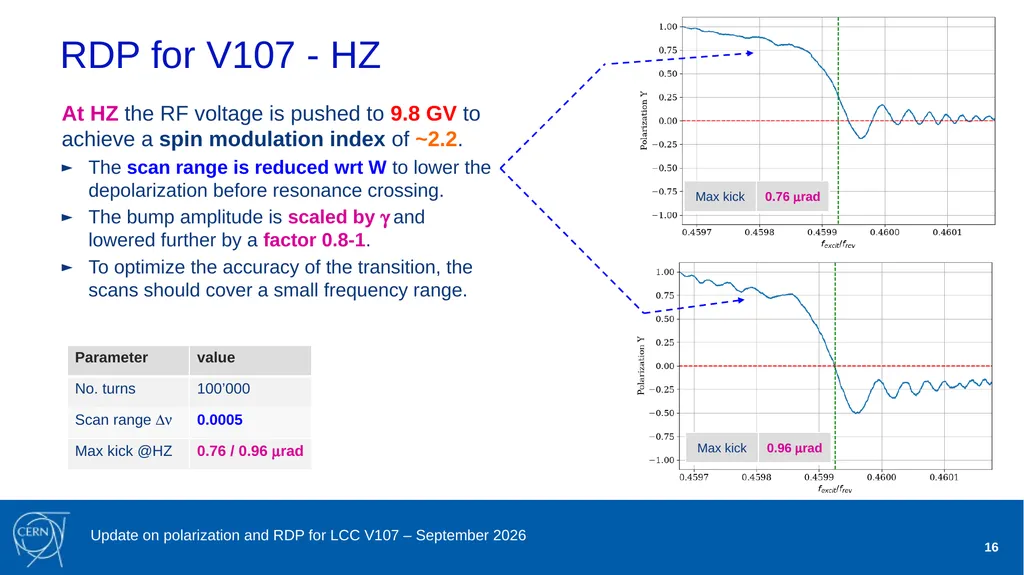
RDP for V107 - HZ At HZ the RF voltage is pushed to 9.8 GV to achieve a spin modulation index of ~2.2.
The scan range is reduced wrt W to lower the depolarization before resonance crossing.
The bump amplitude is scaled by g and lowered further by a factor 0.8-1.
To optimize the accuracy of the transition, the scans should cover a small frequency range.<br>
17
Comparison Those scans are the result of a rather coarse optimization which can surely be improved.
Expect of some change for every new optics version (RF voltage and momentum compaction factor, spin modulation index). Z W HZ With 9.8 GV (~ttbar)<br>
18
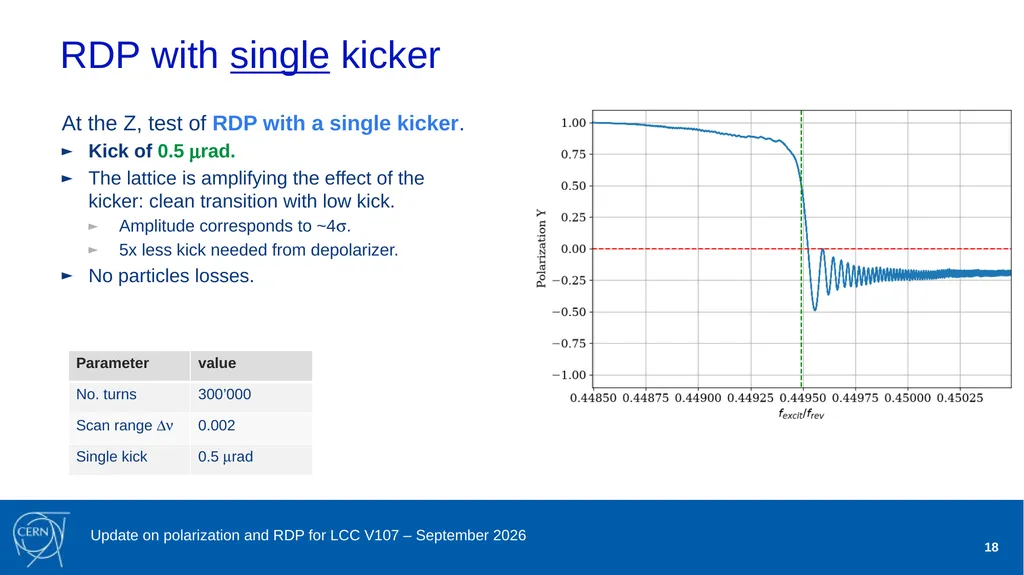
RDP with single kicker At the Z, test of RDP with a single kicker.
Kick of 0.5 mrad.
The lattice is amplifying the effect of the kicker: clean transition with low kick.
Amplitude corresponds to ~4s.
5x less kick needed from depolarizer.
No particles losses.<br>
19
Kicker bumps – to be revisited ? The current locations make the bumps efficient, but one kicker is installed in an arc cell.
The bump needs to be ~2p for good efficient wrt kicker strength.
Without modification of the arc cell hosting the kicker (shorter/stronger quad…), an alternative bump structure must be identified.
Try again a shorter bump in the DISS – limited to ~p phase advance.
Build a bump across a complete arc, from DISS to DISS. Given the modest amplitudes (< 1 mm), this could be an option.<br>
20
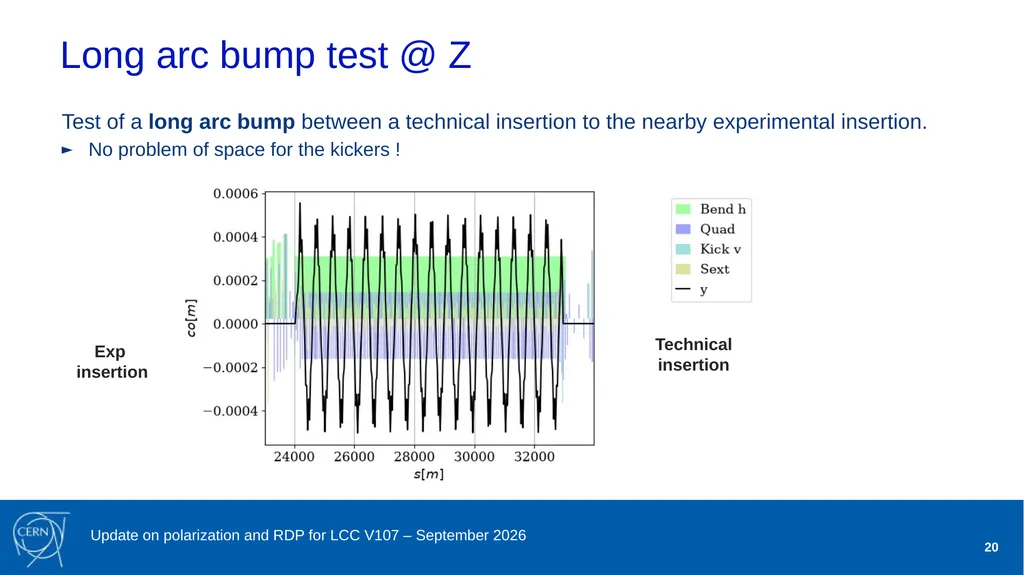
Long arc bump test @ Z Test of a long arc bump between a technical insertion to the nearby experimental insertion.
No problem of space for the kickers ! Technical insertion Exp
insertion<br>
21
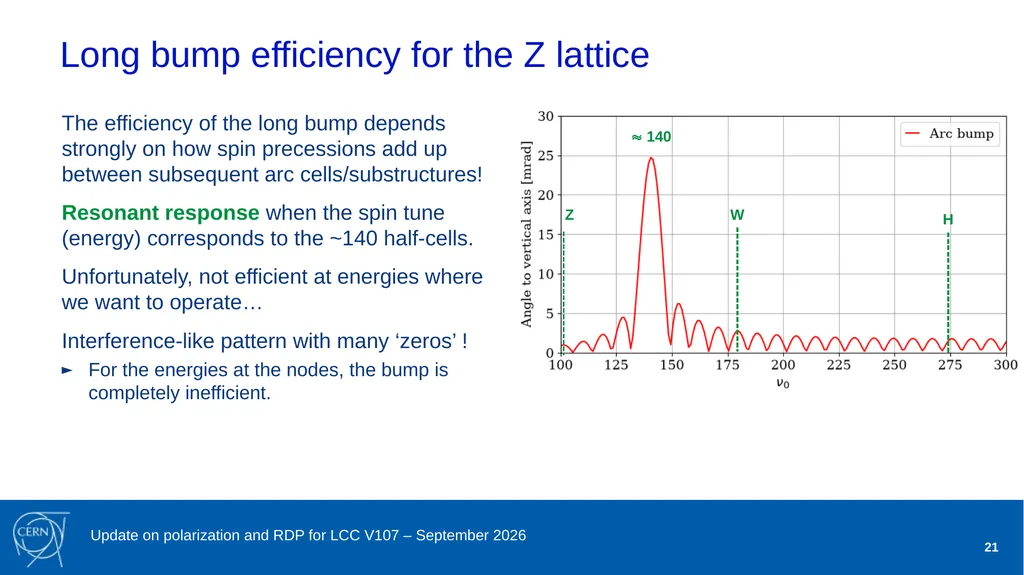
Long bump efficiency for the Z lattice The efficiency of the long bump depends strongly on how spin precessions add up between subsequent arc cells/substructures!
Resonant response when the spin tune (energy) corresponds to the ~140 half-cells.
Unfortunately, not efficient at energies where we want to operate…
Interference-like pattern with many ‘zeros’ !
For the energies at the nodes, the bump is completely inefficient. W H Z 140<br>
22
Summary Avoid using Xsuite polarization in twiss when radiation is switched on. The results are questionable / wrong.
First RDP parameters for RDP @ Z, W and HZ with LCC V107 are available.
V107 is good for RDP/NRPM because of a higher momentum compaction factor which lowers the spin modulation index, bringing it below 1 at the Z.<br>