
Judgment Writing Presentation By The Hon. Dame
NS
Published · 45 slides · 0 views
1 / 1










Description
Judgment Writing Presentation By The Hon. Dame Janice M. Pereira, Chief Justice For Magistrates Conference 26-28 August 2013 Why is it so important to have a proper written judgment? It tells the world the details and rational for the
Related Topics
Share
Embed code
Download this presentation From Below
"Judgment Writing Presentation By The Hon. Dame" is the property of its rightful owner. Permission is granted to download and print the materials on this website for personal, non-commercial use only, and to display it on your personal computer provided you do not modify the materials and that you retain all copyright notices contained in the materials. By downloading content from our website, you accept the terms of this agreement.
Presentation Transcript
01
Judgment
Writing Presentation By
The Hon. Dame Janice M. Pereira, Chief Justice
For Magistrate’s Conference
26-28 August 2013<br>
The Hon. Dame Janice M. Pereira, Chief Justice
For Magistrate’s Conference
26-28 August 2013<br>
02
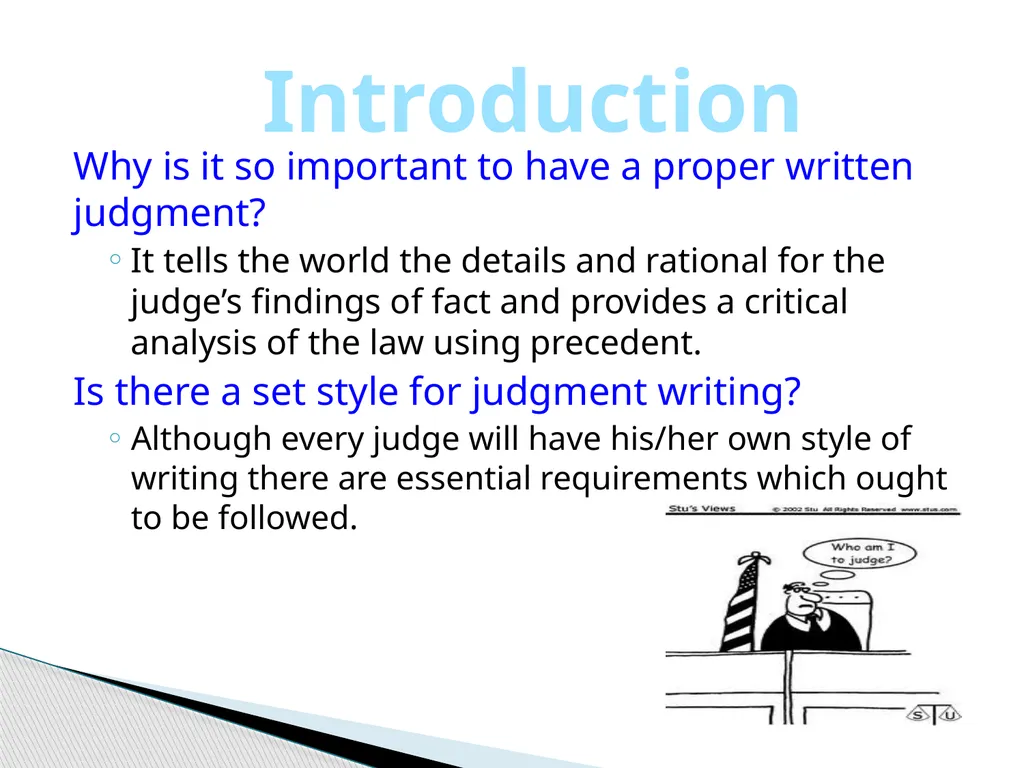
Why is it so important to have a proper written judgment?
It tells the world the details and rational for the judge’s findings of fact and provides a critical analysis of the law using precedent.
Is there a set style for judgment writing?
Although every judge will have his/her own style of writing there are essential requirements which ought to be followed. Introduction<br>
It tells the world the details and rational for the judge’s findings of fact and provides a critical analysis of the law using precedent.
Is there a set style for judgment writing?
Although every judge will have his/her own style of writing there are essential requirements which ought to be followed. Introduction<br>
03
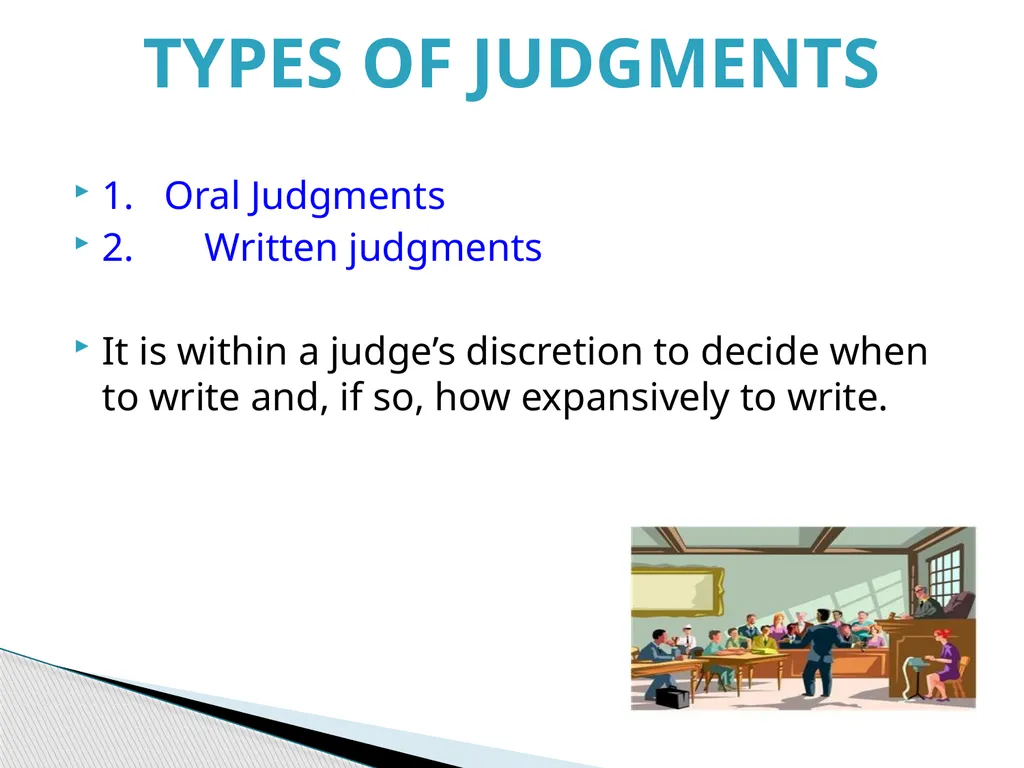
1. Oral Judgments
2. Written judgments
It is within a judge’s discretion to decide when to write and, if so, how expansively to write. Types of Judgments<br>
2. Written judgments
It is within a judge’s discretion to decide when to write and, if so, how expansively to write. Types of Judgments<br>
04
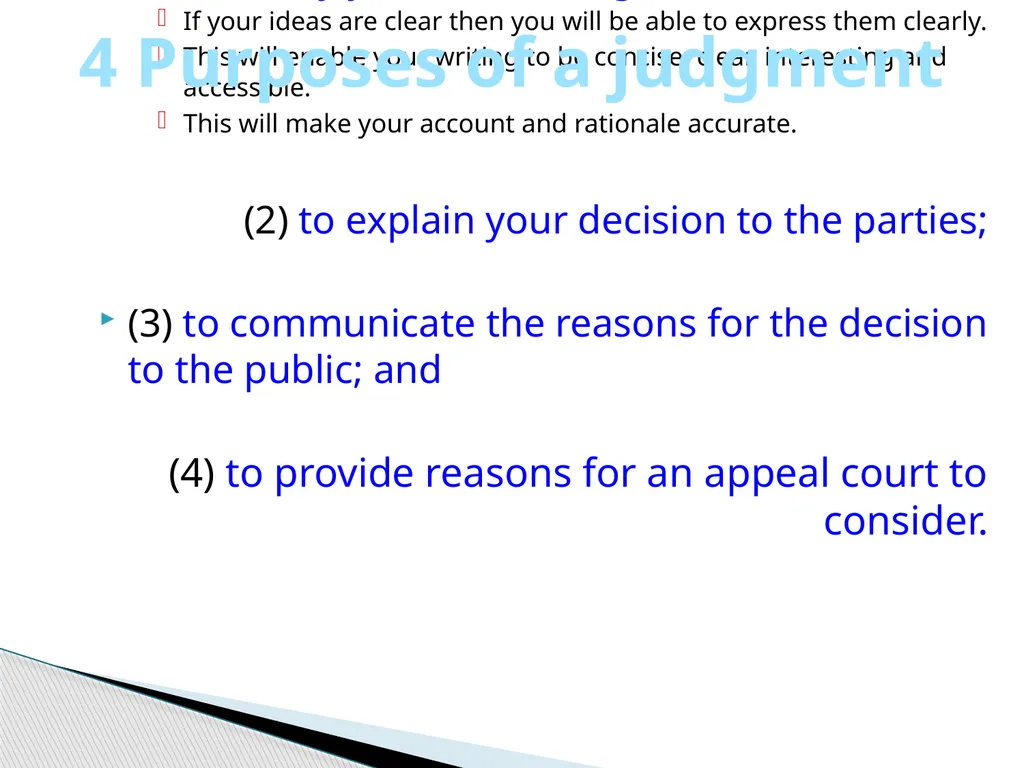
(1) to clarify your own thoughts;
If your ideas are clear then you will be able to express them clearly.
This will enable your writing to be concise, clear, interesting and accessible.
This will make your account and rationale accurate.
(2) to explain your decision to the parties;
(3) to communicate the reasons for the decision to the public; and
(4) to provide reasons for an appeal court to consider. 4 Purposes of a judgment<br>
If your ideas are clear then you will be able to express them clearly.
This will enable your writing to be concise, clear, interesting and accessible.
This will make your account and rationale accurate.
(2) to explain your decision to the parties;
(3) to communicate the reasons for the decision to the public; and
(4) to provide reasons for an appeal court to consider. 4 Purposes of a judgment<br>
05
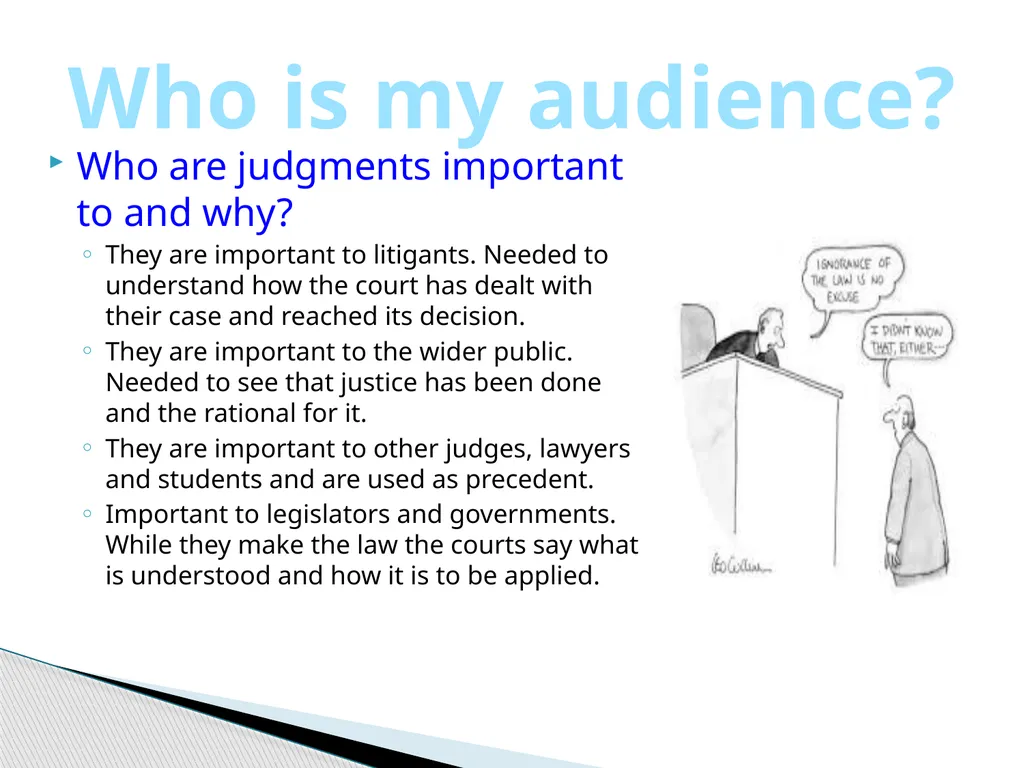
Who are judgments important to and why?
They are important to litigants. Needed to understand how the court has dealt with their case and reached its decision.
They are important to the wider public. Needed to see that justice has been done and the rational for it.
They are important to other judges, lawyers and students and are used as precedent.
Important to legislators and governments. While they make the law the courts say what is understood and how it is to be applied. Who is my audience?<br>
They are important to litigants. Needed to understand how the court has dealt with their case and reached its decision.
They are important to the wider public. Needed to see that justice has been done and the rational for it.
They are important to other judges, lawyers and students and are used as precedent.
Important to legislators and governments. While they make the law the courts say what is understood and how it is to be applied. Who is my audience?<br>
06
What is the issue for determination?
Ensure that you have a clear understanding of the issues for determination.
To do so you must look for the determinative issue.
Once identified, maintain focus on this.
Don’t get side tracked with irrelevant details. First things first …<br>
Ensure that you have a clear understanding of the issues for determination.
To do so you must look for the determinative issue.
Once identified, maintain focus on this.
Don’t get side tracked with irrelevant details. First things first …<br>
07
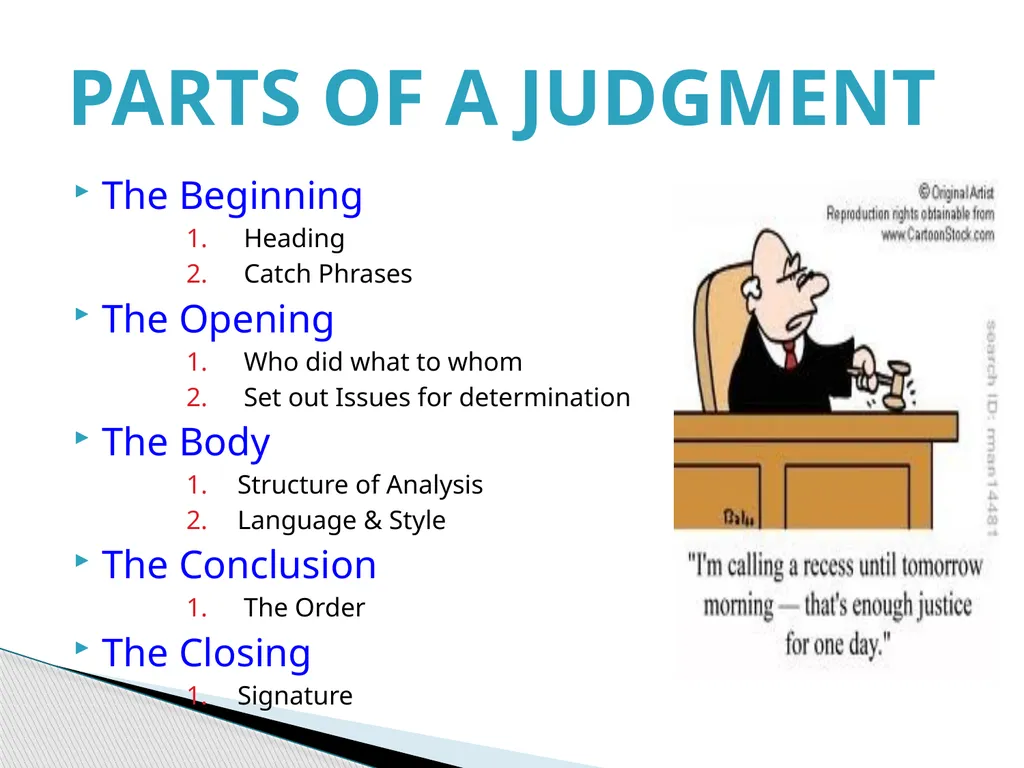
The Beginning
Heading
Catch Phrases
The Opening
Who did what to whom
Set out Issues for determination
The Body
Structure of Analysis
Language & Style
The Conclusion
The Order
The Closing
Signature Parts of a Judgment<br>
Heading
Catch Phrases
The Opening
Who did what to whom
Set out Issues for determination
The Body
Structure of Analysis
Language & Style
The Conclusion
The Order
The Closing
Signature Parts of a Judgment<br>
08
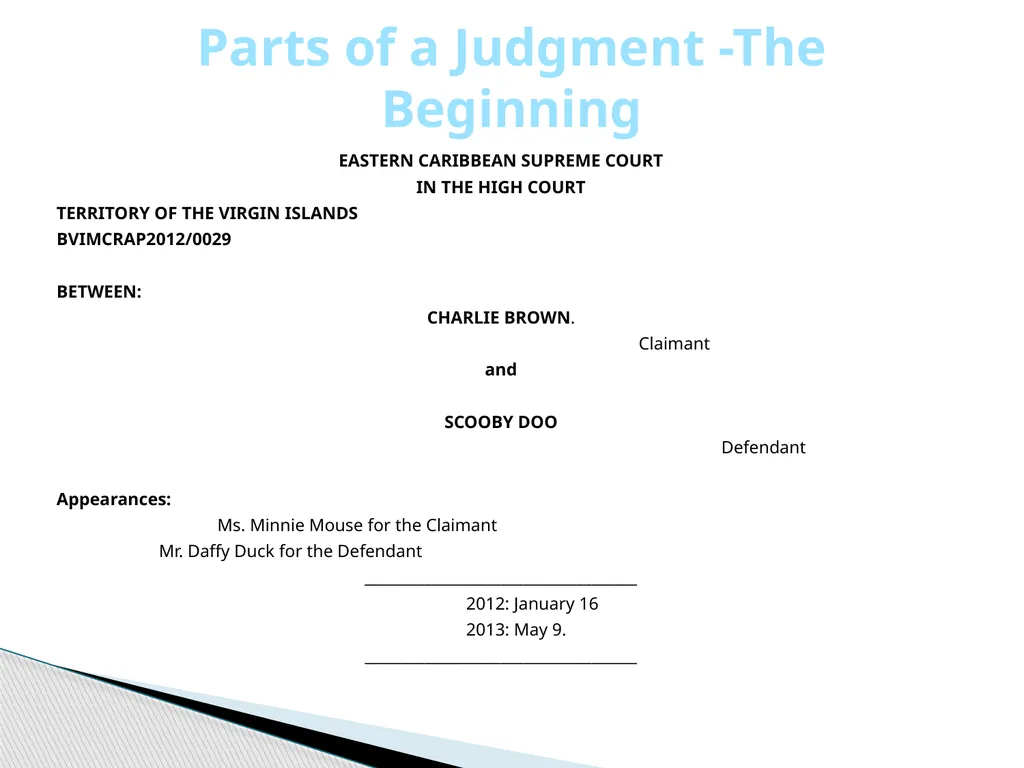
EASTERN CARIBBEAN SUPREME COURT
IN THE HIGH COURT
TERRITORY OF THE VIRGIN ISLANDS
BVIMCRAP2012/0029
BETWEEN:
CHARLIE BROWN.
Claimant
and
SCOOBY DOO
Defendant
Appearances:
Ms. Minnie Mouse for the Claimant
Mr. Daffy Duck for the Defendant
____________________________________
2012: January 16
2013: May 9.
____________________________________ Parts of a Judgment -The Beginning<br>
IN THE HIGH COURT
TERRITORY OF THE VIRGIN ISLANDS
BVIMCRAP2012/0029
BETWEEN:
CHARLIE BROWN.
Claimant
and
SCOOBY DOO
Defendant
Appearances:
Ms. Minnie Mouse for the Claimant
Mr. Daffy Duck for the Defendant
____________________________________
2012: January 16
2013: May 9.
____________________________________ Parts of a Judgment -The Beginning<br>
09
Catch Phrases
These contain the areas of law dealt with in the judgment and the main legislation or rules relied on.
Get into the practice of preparing catch phrases for your judgments.
These will help others search quicker for a particular area which a judge may have dealt with.
Since you are the author of the judgment you will be in the best position to identify these. Parts of a Judgment. -The Beginning<br>
These contain the areas of law dealt with in the judgment and the main legislation or rules relied on.
Get into the practice of preparing catch phrases for your judgments.
These will help others search quicker for a particular area which a judge may have dealt with.
Since you are the author of the judgment you will be in the best position to identify these. Parts of a Judgment. -The Beginning<br>
10
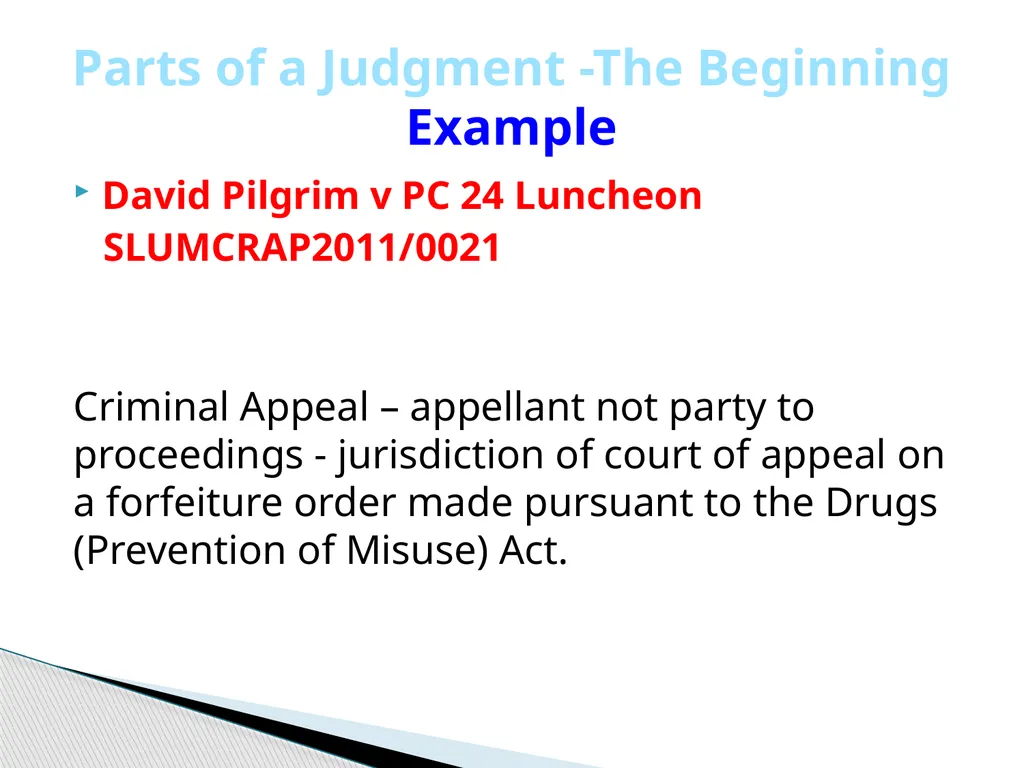
David Pilgrim v PC 24 Luncheon
SLUMCRAP2011/0021
Criminal Appeal – appellant not party to proceedings - jurisdiction of court of appeal on a forfeiture order made pursuant to the Drugs (Prevention of Misuse) Act. Parts of a Judgment -The Beginning Example<br>
SLUMCRAP2011/0021
Criminal Appeal – appellant not party to proceedings - jurisdiction of court of appeal on a forfeiture order made pursuant to the Drugs (Prevention of Misuse) Act. Parts of a Judgment -The Beginning Example<br>
11
An effective opening of a judgment gives a helicopter view i.e. a brief synopsis of the facts which are needed to understand the issues that follow.
It does 3 things: Parts of a Judgment. – The Opening<br>
It does 3 things: Parts of a Judgment. – The Opening<br>
12
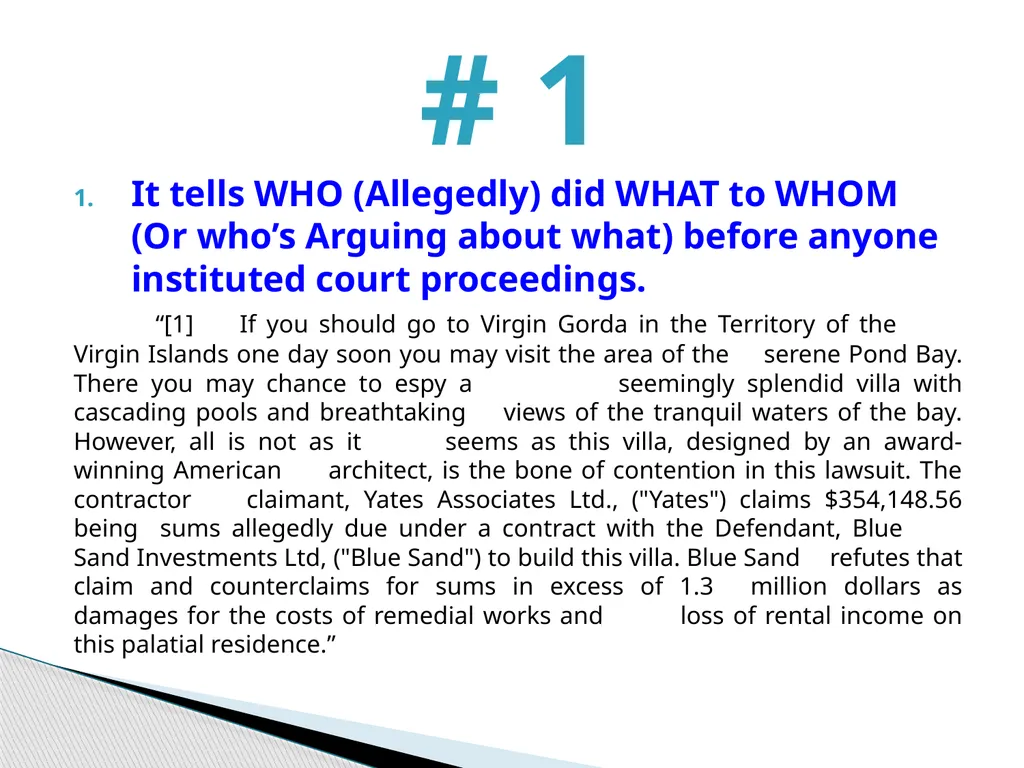
It tells WHO (Allegedly) did WHAT to WHOM (Or who’s Arguing about what) before anyone instituted court proceedings.
“[1] If you should go to Virgin Gorda in the Territory of the Virgin Islands one day soon you may visit the area of the serene Pond Bay. There you may chance to espy a seemingly splendid villa with cascading pools and breathtaking views of the tranquil waters of the bay. However, all is not as it seems as this villa, designed by an award-winning American architect, is the bone of contention in this lawsuit. The contractor claimant, Yates Associates Ltd., ("Yates") claims $354,148.56 being sums allegedly due under a contract with the Defendant, Blue Sand Investments Ltd, ("Blue Sand") to build this villa. Blue Sand refutes that claim and counterclaims for sums in excess of 1.3 million dollars as damages for the costs of remedial works and loss of rental income on this palatial residence.” # 1<br>
“[1] If you should go to Virgin Gorda in the Territory of the Virgin Islands one day soon you may visit the area of the serene Pond Bay. There you may chance to espy a seemingly splendid villa with cascading pools and breathtaking views of the tranquil waters of the bay. However, all is not as it seems as this villa, designed by an award-winning American architect, is the bone of contention in this lawsuit. The contractor claimant, Yates Associates Ltd., ("Yates") claims $354,148.56 being sums allegedly due under a contract with the Defendant, Blue Sand Investments Ltd, ("Blue Sand") to build this villa. Blue Sand refutes that claim and counterclaims for sums in excess of 1.3 million dollars as damages for the costs of remedial works and loss of rental income on this palatial residence.” # 1<br>
13
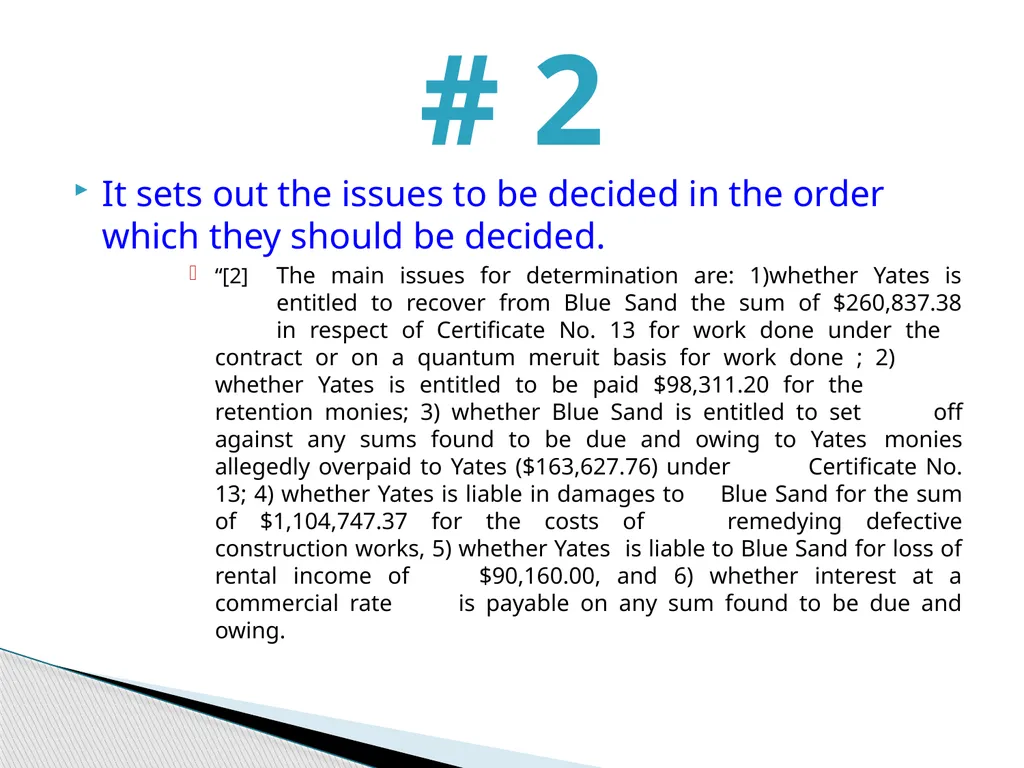
It sets out the issues to be decided in the order which they should be decided.
“[2] The main issues for determination are: 1)whether Yates is entitled to recover from Blue Sand the sum of $260,837.38 in respect of Certificate No. 13 for work done under the contract or on a quantum meruit basis for work done ; 2) whether Yates is entitled to be paid $98,311.20 for the retention monies; 3) whether Blue Sand is entitled to set off against any sums found to be due and owing to Yates monies allegedly overpaid to Yates ($163,627.76) under Certificate No. 13; 4) whether Yates is liable in damages to Blue Sand for the sum of $1,104,747.37 for the costs of remedying defective construction works, 5) whether Yates is liable to Blue Sand for loss of rental income of $90,160.00, and 6) whether interest at a commercial rate is payable on any sum found to be due and owing. # 2<br>
“[2] The main issues for determination are: 1)whether Yates is entitled to recover from Blue Sand the sum of $260,837.38 in respect of Certificate No. 13 for work done under the contract or on a quantum meruit basis for work done ; 2) whether Yates is entitled to be paid $98,311.20 for the retention monies; 3) whether Blue Sand is entitled to set off against any sums found to be due and owing to Yates monies allegedly overpaid to Yates ($163,627.76) under Certificate No. 13; 4) whether Yates is liable in damages to Blue Sand for the sum of $1,104,747.37 for the costs of remedying defective construction works, 5) whether Yates is liable to Blue Sand for loss of rental income of $90,160.00, and 6) whether interest at a commercial rate is payable on any sum found to be due and owing. # 2<br>
14
It omits details that have no relevance to any of the issues at that time. e.g. names, dates, procedural history, citation of laws or precedents.
In this case the opening didn’t state:
The full names of the parties
The date the contract was made,
The specifics of the contract,
The laws which are applicable,
Any further details of the transaction. # 3<br>
In this case the opening didn’t state:
The full names of the parties
The date the contract was made,
The specifics of the contract,
The laws which are applicable,
Any further details of the transaction. # 3<br>
15
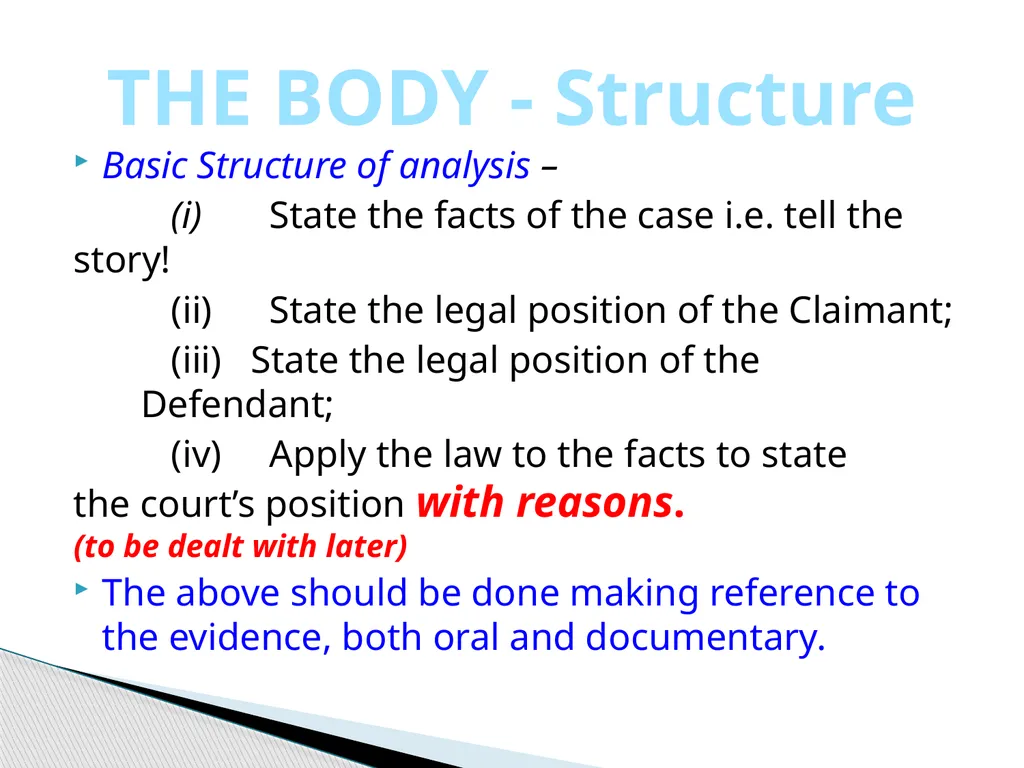
Basic Structure of analysis –
(i) State the facts of the case i.e. tell the story!
(ii) State the legal position of the Claimant;
(iii) State the legal position of the Defendant;
(iv) Apply the law to the facts to state the court’s position with reasons. (to be dealt with later)
The above should be done making reference to the evidence, both oral and documentary. THE BODY - Structure<br>
(i) State the facts of the case i.e. tell the story!
(ii) State the legal position of the Claimant;
(iii) State the legal position of the Defendant;
(iv) Apply the law to the facts to state the court’s position with reasons. (to be dealt with later)
The above should be done making reference to the evidence, both oral and documentary. THE BODY - Structure<br>
16
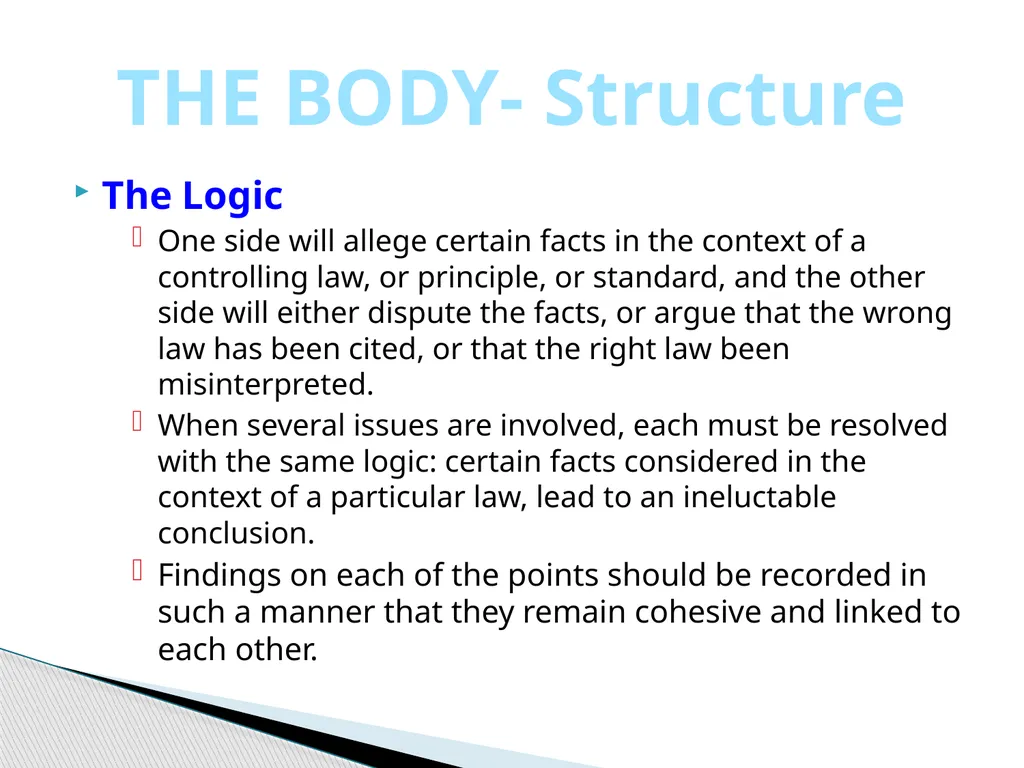
The Logic
One side will allege certain facts in the context of a controlling law, or principle, or standard, and the other side will either dispute the facts, or argue that the wrong law has been cited, or that the right law been misinterpreted.
When several issues are involved, each must be resolved with the same logic: certain facts considered in the context of a particular law, lead to an ineluctable conclusion.
Findings on each of the points should be recorded in such a manner that they remain cohesive and linked to each other. THE BODY- Structure<br>
One side will allege certain facts in the context of a controlling law, or principle, or standard, and the other side will either dispute the facts, or argue that the wrong law has been cited, or that the right law been misinterpreted.
When several issues are involved, each must be resolved with the same logic: certain facts considered in the context of a particular law, lead to an ineluctable conclusion.
Findings on each of the points should be recorded in such a manner that they remain cohesive and linked to each other. THE BODY- Structure<br>
17
F for facts;
L for law;
A for application, and
C for conclusion.
This basic structure of a judgment, modified to suit a particular situation, will ensure that you order your own thoughts in reaching a just, and indeed one might say, often inevitable conclusion. The BODY - Structure<br>
L for law;
A for application, and
C for conclusion.
This basic structure of a judgment, modified to suit a particular situation, will ensure that you order your own thoughts in reaching a just, and indeed one might say, often inevitable conclusion. The BODY - Structure<br>
18
Avoid the use of clichés.
Use the active voice rather than the passive.
Be particular rather than vague.
Avoid emotive language.
Avoid long sentences. The BODY - Language & Style<br>
Use the active voice rather than the passive.
Be particular rather than vague.
Avoid emotive language.
Avoid long sentences. The BODY - Language & Style<br>
19
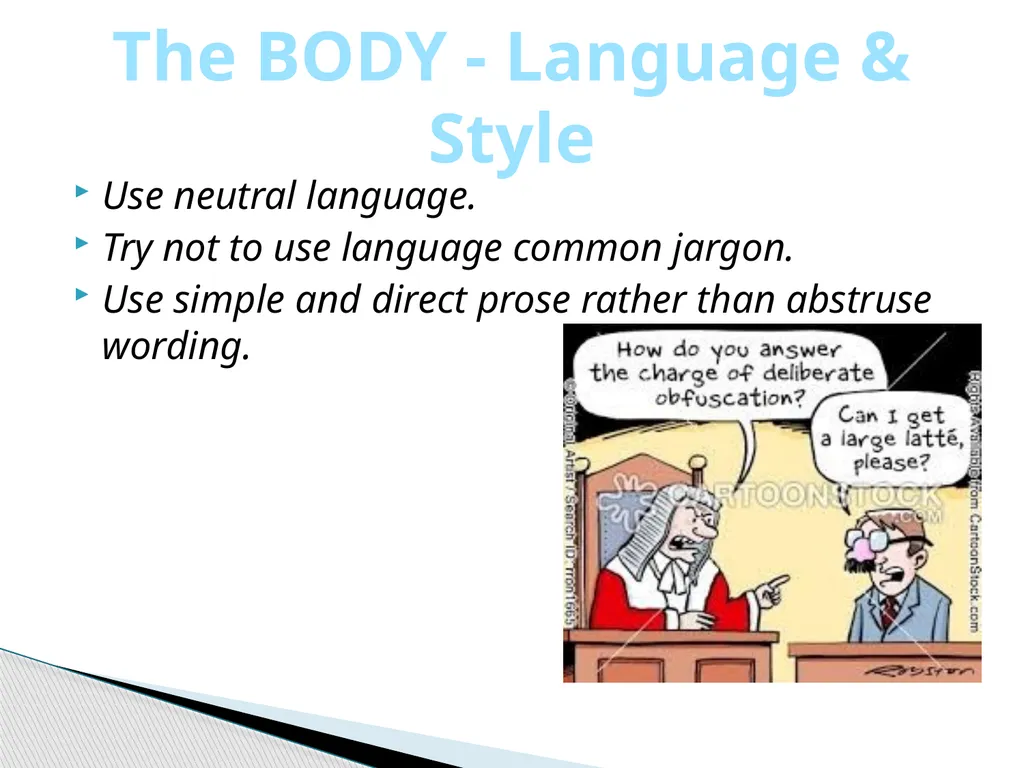
The BODY - Language & Style Use neutral language.
Try not to use language common jargon.
Use simple and direct prose rather than abstruse wording.<br>
Try not to use language common jargon.
Use simple and direct prose rather than abstruse wording.<br>
20
Try to make it interesting.
Be precise and to the point.
Be coherent.
Use footnotes where necessary to avoid clutter. The BODY - Language & Style<br>
Be precise and to the point.
Be coherent.
Use footnotes where necessary to avoid clutter. The BODY - Language & Style<br>
21
Avoid putting information about the History of the case or the evidence heard that would distract the readers.
Only details relevant to the analysis should be included. Omit unnecessary facts
Read over to avoid obvious grammatical errors. Such errors will make others think less of your work.
Avoiding quoting a long list of authorities which make the same point. Use the landmark decisions and make reference to the others in footnotes. Things to AVOID !<br>
Only details relevant to the analysis should be included. Omit unnecessary facts
Read over to avoid obvious grammatical errors. Such errors will make others think less of your work.
Avoiding quoting a long list of authorities which make the same point. Use the landmark decisions and make reference to the others in footnotes. Things to AVOID !<br>
22
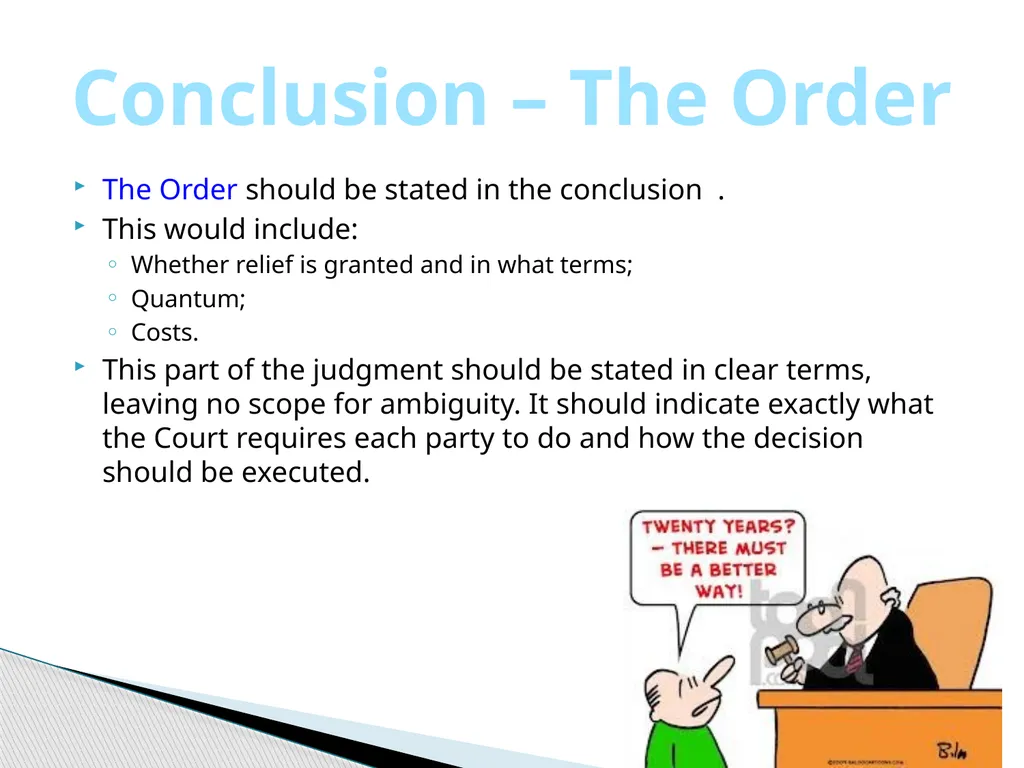
The Order should be stated in the conclusion .
This would include:
Whether relief is granted and in what terms;
Quantum;
Costs.
This part of the judgment should be stated in clear terms, leaving no scope for ambiguity. It should indicate exactly what the Court requires each party to do and how the decision should be executed. Conclusion – The Order<br>
This would include:
Whether relief is granted and in what terms;
Quantum;
Costs.
This part of the judgment should be stated in clear terms, leaving no scope for ambiguity. It should indicate exactly what the Court requires each party to do and how the decision should be executed. Conclusion – The Order<br>
23
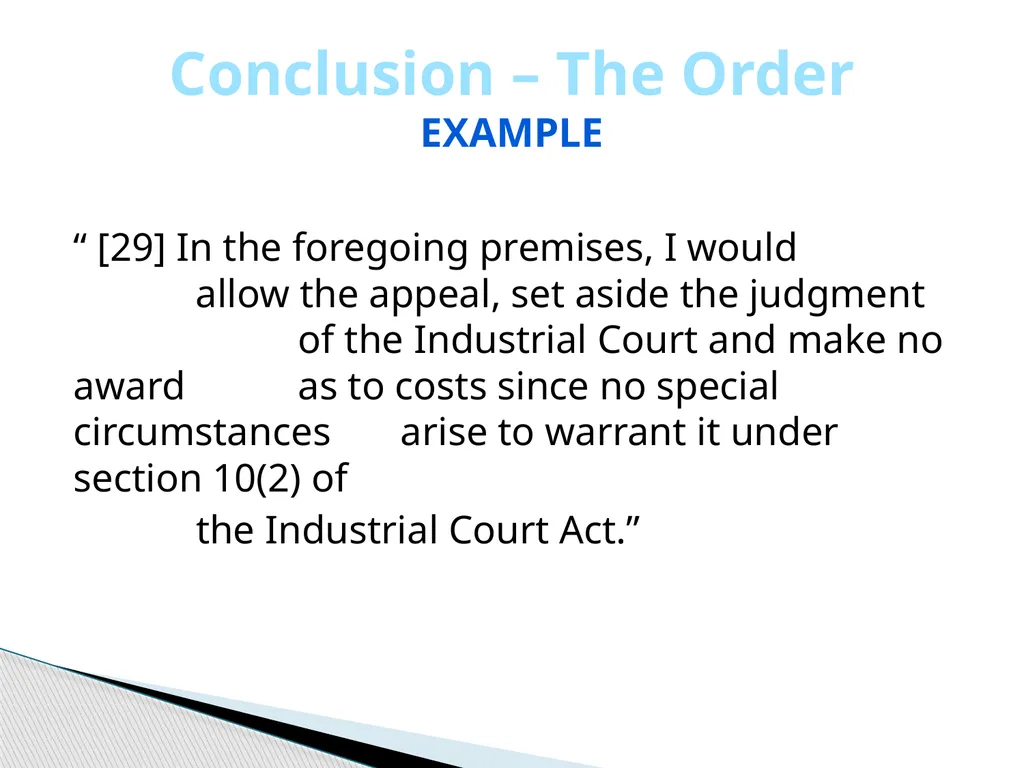
“ [29] In the foregoing premises, I would allow the appeal, set aside the judgment of the Industrial Court and make no award as to costs since no special circumstances arise to warrant it under section 10(2) of
the Industrial Court Act.” Conclusion – The Order Example<br>
the Industrial Court Act.” Conclusion – The Order Example<br>
24
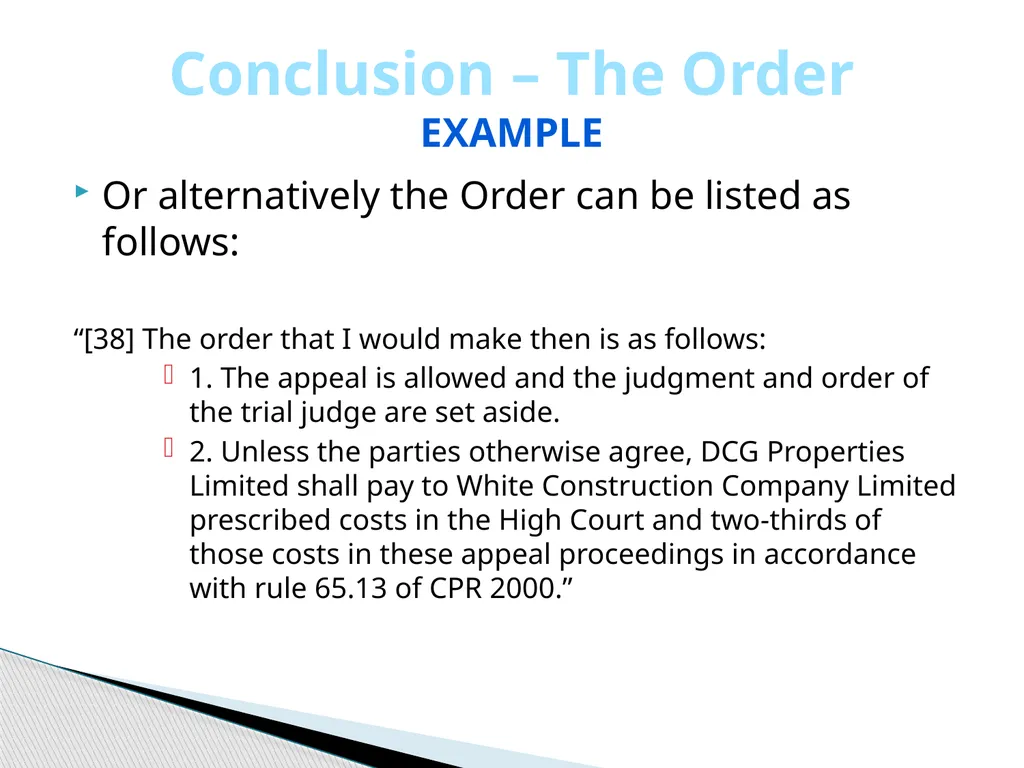
Or alternatively the Order can be listed as follows:
“[38] The order that I would make then is as follows:
1. The appeal is allowed and the judgment and order of the trial judge are set aside.
2. Unless the parties otherwise agree, DCG Properties Limited shall pay to White Construction Company Limited prescribed costs in the High Court and two-thirds of those costs in these appeal proceedings in accordance with rule 65.13 of CPR 2000.” Conclusion – The Order Example<br>
“[38] The order that I would make then is as follows:
1. The appeal is allowed and the judgment and order of the trial judge are set aside.
2. Unless the parties otherwise agree, DCG Properties Limited shall pay to White Construction Company Limited prescribed costs in the High Court and two-thirds of those costs in these appeal proceedings in accordance with rule 65.13 of CPR 2000.” Conclusion – The Order Example<br>
25
SIGNATURE:
At the end of the judgment, the judicial officer should place his/her signature above the format below, on the right side of the page .
Karyn Peter
Magistrate CLOSING<br>
At the end of the judgment, the judicial officer should place his/her signature above the format below, on the right side of the page .
Karyn Peter
Magistrate CLOSING<br>
26
Eagil Trust Co v Pigott-Brown [1985] 3 All ER 119
CA held that a judge must give reasons for his/her decision, although these reasons need not be elaborate and the particularity required will vary according to the circumstances of the case. It is sufficient if what the judge says shows the parties and, if need be, the Court of Appeal, the basis on which he/she has acted. Importance of Giving Reasons For Decisions<br>
CA held that a judge must give reasons for his/her decision, although these reasons need not be elaborate and the particularity required will vary according to the circumstances of the case. It is sufficient if what the judge says shows the parties and, if need be, the Court of Appeal, the basis on which he/she has acted. Importance of Giving Reasons For Decisions<br>
27
English v Emery Reinhold & Strike Ltd [2002] 1 WLR 2409
“[16] We would put the matter at its simplest by saying that justice will not be done if it is not apparent to the parties why one has won and the other has lost.” Importance of Giving Reasons For Decisions<br>
“[16] We would put the matter at its simplest by saying that justice will not be done if it is not apparent to the parties why one has won and the other has lost.” Importance of Giving Reasons For Decisions<br>
28
In some islands this is a statutory requirement;
Antigua and Barbuda; Section 172 (2) Magistrate’s Code of Procedure Act. Cap 255
“(2) The Magistrate shall also transmit to the Deputy Registrar of the Court of Appeal with the papers relating to such appeal a memorandum of the reasons for the decision.”
Anguilla; Section 200 Magistrate’s Code of Procedure Act
“After an appellant has served on the Magistrate a notice of his intention to appeal and entered into a recognizance or given security to prosecute an appeal, the Magistrate shall, within 10 days of the service of such notice of appeal, transmit to the Registrar of the Court of Appeal a copy of the proceedings and all papers relating to the appeal together with a concise memorandum of his reasons for decision.
Case: Hughes v Hughes (1993) 45 WIR 149 Importance of Giving Reasons For Decisions<br>
Antigua and Barbuda; Section 172 (2) Magistrate’s Code of Procedure Act. Cap 255
“(2) The Magistrate shall also transmit to the Deputy Registrar of the Court of Appeal with the papers relating to such appeal a memorandum of the reasons for the decision.”
Anguilla; Section 200 Magistrate’s Code of Procedure Act
“After an appellant has served on the Magistrate a notice of his intention to appeal and entered into a recognizance or given security to prosecute an appeal, the Magistrate shall, within 10 days of the service of such notice of appeal, transmit to the Registrar of the Court of Appeal a copy of the proceedings and all papers relating to the appeal together with a concise memorandum of his reasons for decision.
Case: Hughes v Hughes (1993) 45 WIR 149 Importance of Giving Reasons For Decisions<br>
29
Dominica; Section 146 (1) Magistrates Code of Procedure, Cap. 4.20
“The Magistrate shall record the reasons for the judgment in writing and sign at the time of pronouncing the judgment and within 14 days of the pronouncement of the judgment appealed against shall cause the reasons to be transmitted to the Registrar of the High Court and they shall be included in and form part of the record of appeal.”
Case: Graham & Another v The Police (2010) 79 WIR 288- Court of Appeal of The Eastern Caribbean States Importance of Giving Reasons For Decisions<br>
“The Magistrate shall record the reasons for the judgment in writing and sign at the time of pronouncing the judgment and within 14 days of the pronouncement of the judgment appealed against shall cause the reasons to be transmitted to the Registrar of the High Court and they shall be included in and form part of the record of appeal.”
Case: Graham & Another v The Police (2010) 79 WIR 288- Court of Appeal of The Eastern Caribbean States Importance of Giving Reasons For Decisions<br>
30
Grenada; Section 15 (3) Magistrates’ Judgments (Appeals) Act, Cap 178
“(3) The Magistrate shall also transmit with the copy of the proceedings a concise memorandum of the reasons for the judgement. Such memorandum shall be included in, and form part of, the record of the appeal.” Importance of Giving Reasons For Decisions<br>
“(3) The Magistrate shall also transmit with the copy of the proceedings a concise memorandum of the reasons for the judgement. Such memorandum shall be included in, and form part of, the record of the appeal.” Importance of Giving Reasons For Decisions<br>
31
Montserrat; Section 112 (1) Magistrate’s Court Act, Cap 2:02
The Appellant shall, if so required by the Magistrate, within three days after the day on which he served notice of his intention to appeal, enter into a recognizance before the Magistrate with or without sureties, as the Magistrate may direct, conditioned to appear before the Court of Appeal and to try the appeal and to abide the judgment thereon of the Court of Appeal and to pay such costs as may be awarded by the said Court, or if the Magistrate thinks it expedient he may require the appellant, instead of entering into recognizances, to give such other security by payment of money into Court or otherwise as the Magistrate deems sufficient; and the Magistrate shall without delay transmit to the Registrar of the Court of Appeal all papers relating to such appeal together with a concise
memorandum of his reasons for his decision. Importance of Giving Reasons For Decisions<br>
The Appellant shall, if so required by the Magistrate, within three days after the day on which he served notice of his intention to appeal, enter into a recognizance before the Magistrate with or without sureties, as the Magistrate may direct, conditioned to appear before the Court of Appeal and to try the appeal and to abide the judgment thereon of the Court of Appeal and to pay such costs as may be awarded by the said Court, or if the Magistrate thinks it expedient he may require the appellant, instead of entering into recognizances, to give such other security by payment of money into Court or otherwise as the Magistrate deems sufficient; and the Magistrate shall without delay transmit to the Registrar of the Court of Appeal all papers relating to such appeal together with a concise
memorandum of his reasons for his decision. Importance of Giving Reasons For Decisions<br>
32
St Kitts and Nevis; Section 169 of the Magistrate Code of Procedure Act, Cap 3.17
S.169 After an appellant has served on the magistrate a notice of his or her intention to appeal and entered into a recognisance or given security to prosecute such appeal, the magistrate shall within ten days of the service of the notice of appeal, transmit to the registrar of the Court of Appeal a copy of the proceedings and all papers relating to the appeal together with a concise memorandum of his or her reasons for decision. Importance of Giving Reasons For Decisions<br>
S.169 After an appellant has served on the magistrate a notice of his or her intention to appeal and entered into a recognisance or given security to prosecute such appeal, the magistrate shall within ten days of the service of the notice of appeal, transmit to the registrar of the Court of Appeal a copy of the proceedings and all papers relating to the appeal together with a concise memorandum of his or her reasons for decision. Importance of Giving Reasons For Decisions<br>
33
St Vincent and the Grenadines; Section 109 (3)Criminal Procedure Code
“Every judgment in a summary trial, except as otherwise expressly provided by this Code or any other law, shall be written by the magistrate and shall contain the point or points for determination, the decision thereon and the reasons for the decision and shall be dated and signed by such magistrate in open court at the time of pronouncing it”.
Case: Casanki et al v Commissioner of Police HRCAP 2010/022- Court of Appeal of The Eastern Caribbean States
NB: Casanki applied Aqui v Pooran Maharaj (1981) 34 W.I.R 282 (Aqui was from the Court of Appeal of Trinidad & Tobago and it considered where statute did not expressly provide for a Magistrate to give reasons) & English v Emery Reimbold & Strick Ltd; DJ & C Withers (Farms) Ltd v Ambic Equipment Ltd; Verrechia (Trading as Freightmasters Commercials) v Commisioner of Police of Metropolis (2002) 3 All E.R 385 (CA) Importance of Giving Reasons For Decisions<br>
“Every judgment in a summary trial, except as otherwise expressly provided by this Code or any other law, shall be written by the magistrate and shall contain the point or points for determination, the decision thereon and the reasons for the decision and shall be dated and signed by such magistrate in open court at the time of pronouncing it”.
Case: Casanki et al v Commissioner of Police HRCAP 2010/022- Court of Appeal of The Eastern Caribbean States
NB: Casanki applied Aqui v Pooran Maharaj (1981) 34 W.I.R 282 (Aqui was from the Court of Appeal of Trinidad & Tobago and it considered where statute did not expressly provide for a Magistrate to give reasons) & English v Emery Reimbold & Strick Ltd; DJ & C Withers (Farms) Ltd v Ambic Equipment Ltd; Verrechia (Trading as Freightmasters Commercials) v Commisioner of Police of Metropolis (2002) 3 All E.R 385 (CA) Importance of Giving Reasons For Decisions<br>
34
St. Lucia; Section 722 (1) of the Criminal Code Cap 3.01
No explicit statutory provision however, Section 722 (1) of the Criminal Code Cap 3.01 “When a party to a cause or matter in a district court has filed an appeal against the decision of the district court he or she shall, on making an application to the clerk of the court and on paying the prescribed fee obtain a copy of the proceedings in the case, including a copy of the written judgment, notes or memorandum of the reasons of the magistrate for the decision. Importance of Giving Reasons For Decisions<br>
No explicit statutory provision however, Section 722 (1) of the Criminal Code Cap 3.01 “When a party to a cause or matter in a district court has filed an appeal against the decision of the district court he or she shall, on making an application to the clerk of the court and on paying the prescribed fee obtain a copy of the proceedings in the case, including a copy of the written judgment, notes or memorandum of the reasons of the magistrate for the decision. Importance of Giving Reasons For Decisions<br>
35
Territory of the Virgin Islands; Section 160 Magistrate’s Code of Procedure Cap 44
“ The appellant shall within seven days after the day on which he served notice of his intention to appeal, enter into a recognizance before a Magistrate with one or more sufficient sureties as the magistrate may direct conditioned to appear before the Court of Appeal and to prosecute the appeal and to appear before the Court of Appeal and to pay such costs as may be awarded by the said court, or if the Magistrate thinks it expedient the appellant may instead of payment of money into court or otherwise as the Magistrate deems sufficient, except in cases where a sentence imposed involves the payment of a fine, such recognizance or security shall be in a sum not less than the amount of the fine; and the Magistrate shall without delay transmit to the registrar of the Court of Appeal all papers relating to such appeal together with a concise memorandum of the reasons for his decision.” Importance of Giving Reasons For Decisions<br>
“ The appellant shall within seven days after the day on which he served notice of his intention to appeal, enter into a recognizance before a Magistrate with one or more sufficient sureties as the magistrate may direct conditioned to appear before the Court of Appeal and to prosecute the appeal and to appear before the Court of Appeal and to pay such costs as may be awarded by the said court, or if the Magistrate thinks it expedient the appellant may instead of payment of money into court or otherwise as the Magistrate deems sufficient, except in cases where a sentence imposed involves the payment of a fine, such recognizance or security shall be in a sum not less than the amount of the fine; and the Magistrate shall without delay transmit to the registrar of the Court of Appeal all papers relating to such appeal together with a concise memorandum of the reasons for his decision.” Importance of Giving Reasons For Decisions<br>
36
SHANE GRAHAM, RAY JNO. BAPTISTE v THE POLICE; DOM MCRAP 2010/009
“[13] Even where there is no such legislative provision in some jurisdictions; the requirement to give reasons is regarded as a ‘rule of law’. In Alexander v Williams, the court of appeal of Trinidad and Tobago, whilst recognising that there was no legislative provision mandating a Magistrate to give reasons for his decision, held that ‘it was a rule of law that in criminal proceedings a Magistrate must provide his reasons when the defendant had lodged an appeal against his decision”, and that furthermore, ‘in cases involving the liberty of the subject, the furnishing of reasons by a Magistrate in cases against which appeals have been lodged was an indispensable requirement of “due process”’. Bernard JA, at page 344 stated that “ the practice for so doing in matters of appeal has so grown up and been adhered to over the years and has become so rooted in our system of justice that, in my opinion, it can now be regarded as a rule of law.”<br>
“[13] Even where there is no such legislative provision in some jurisdictions; the requirement to give reasons is regarded as a ‘rule of law’. In Alexander v Williams, the court of appeal of Trinidad and Tobago, whilst recognising that there was no legislative provision mandating a Magistrate to give reasons for his decision, held that ‘it was a rule of law that in criminal proceedings a Magistrate must provide his reasons when the defendant had lodged an appeal against his decision”, and that furthermore, ‘in cases involving the liberty of the subject, the furnishing of reasons by a Magistrate in cases against which appeals have been lodged was an indispensable requirement of “due process”’. Bernard JA, at page 344 stated that “ the practice for so doing in matters of appeal has so grown up and been adhered to over the years and has become so rooted in our system of justice that, in my opinion, it can now be regarded as a rule of law.”<br>
37
Forbes v Chandrabhan Maharaj (1998) 52 WIR 487 (UKPC)
Per Lord Clyde
“The judgments … clearly recognise the fundamental importance of furnishing reasons particularly in circumstances where the deprivation of liberty is at stake. … It is sufficient to observe that without the statement of reasons it will usually be impossible to know whether the magistrate has misdirected himself on the law or misunderstood or misapplied the evidence. The absence of reasons at the least enables the appellant to argue from a strong position that there cannot have been a sound reason for the decision in issue.” Importance of Giving Reasons For Decisions<br>
Per Lord Clyde
“The judgments … clearly recognise the fundamental importance of furnishing reasons particularly in circumstances where the deprivation of liberty is at stake. … It is sufficient to observe that without the statement of reasons it will usually be impossible to know whether the magistrate has misdirected himself on the law or misunderstood or misapplied the evidence. The absence of reasons at the least enables the appellant to argue from a strong position that there cannot have been a sound reason for the decision in issue.” Importance of Giving Reasons For Decisions<br>
38
Court of Appeal Rules
“21(2) If no written decision is given by the Judge at the time of giving judgment such Judge shall communicate his reasons for the judgment in writing to the Registrar of the court below and such reasons shall be included in the record.” Importance of Giving Reasons For Decisions<br>
“21(2) If no written decision is given by the Judge at the time of giving judgment such Judge shall communicate his reasons for the judgment in writing to the Registrar of the court below and such reasons shall be included in the record.” Importance of Giving Reasons For Decisions<br>
39
Challenges Regarding Reasons normally take 2 forms:
(i) where a Magistrate has provided no reasons at all or;
(ii) where the reasons given are inadequate and may require more detailed analysis. Importance of Giving Reasons For Decisions<br>
(i) where a Magistrate has provided no reasons at all or;
(ii) where the reasons given are inadequate and may require more detailed analysis. Importance of Giving Reasons For Decisions<br>
40
SHANE GRAHAM, RAY JNO. BAPTISTE v THE POLICE; DOM MCRAP 2010/009
“[16] The Azille, Hamilton, and Daniel appeals all involve considerable conflicts on the evidence. In Azille and Daniel, no reasons whatsoever have been provided. In the case of Hamilton, the Magistrate provided in her ‘reasons for decision’ reasons as to why she proceeded to try the case in the absence of the defendant’s counsel but I agree with counsel that no reason has been provided showing the basis on which she arrived at her decision to convict. That, to my mind is tantamount to failing to provide a reason for her decision. In the absence of reasons it may reasonably be concluded that no sound basis for the decision exists. Further, bearing in mind the observations of Lord Clyde in Forbes, this court would be hard put in seeking to resolve the conflicts on the evidence in particular since matters of credibility come into sharp focus. This quandary, in my view, leads to the ineluctable result that the convictions and sentences must be quashed and new trials ordered.” Importance of Giving Reasons For Decisions<br>
“[16] The Azille, Hamilton, and Daniel appeals all involve considerable conflicts on the evidence. In Azille and Daniel, no reasons whatsoever have been provided. In the case of Hamilton, the Magistrate provided in her ‘reasons for decision’ reasons as to why she proceeded to try the case in the absence of the defendant’s counsel but I agree with counsel that no reason has been provided showing the basis on which she arrived at her decision to convict. That, to my mind is tantamount to failing to provide a reason for her decision. In the absence of reasons it may reasonably be concluded that no sound basis for the decision exists. Further, bearing in mind the observations of Lord Clyde in Forbes, this court would be hard put in seeking to resolve the conflicts on the evidence in particular since matters of credibility come into sharp focus. This quandary, in my view, leads to the ineluctable result that the convictions and sentences must be quashed and new trials ordered.” Importance of Giving Reasons For Decisions<br>
41
Casanki Quow v Commissioner of Police; SVG MCRAP 2010/022
Aqui v Pooran Maharaj; (1981) 34 W.I.R. 282.
Verrechia (Trading as Freightmasters Commercials) v Commisioner of Police of Metropolis (2002) 3 All E.R 385 (CA)
Graham & Another v The Police (2010) 79 WIR 288
Cedeno v Logan (2000) 58 WIR 411
Hughes v Hughes (1993) 45 WIR 149
Flannery & Flannery v Halifax Estate Agencies Limited [2000] 1 W.L.R. 377
See The Caribbean Civil Court Practice 2011 Note 31.16, pp. 399-400 “The duty to give reasons”
Donald Frederick v Choo Loi Poi et al; GRENADA HCVAP 2012/005 Importance of Giving Reasons For Decisions<br>
Aqui v Pooran Maharaj; (1981) 34 W.I.R. 282.
Verrechia (Trading as Freightmasters Commercials) v Commisioner of Police of Metropolis (2002) 3 All E.R 385 (CA)
Graham & Another v The Police (2010) 79 WIR 288
Cedeno v Logan (2000) 58 WIR 411
Hughes v Hughes (1993) 45 WIR 149
Flannery & Flannery v Halifax Estate Agencies Limited [2000] 1 W.L.R. 377
See The Caribbean Civil Court Practice 2011 Note 31.16, pp. 399-400 “The duty to give reasons”
Donald Frederick v Choo Loi Poi et al; GRENADA HCVAP 2012/005 Importance of Giving Reasons For Decisions<br>
42
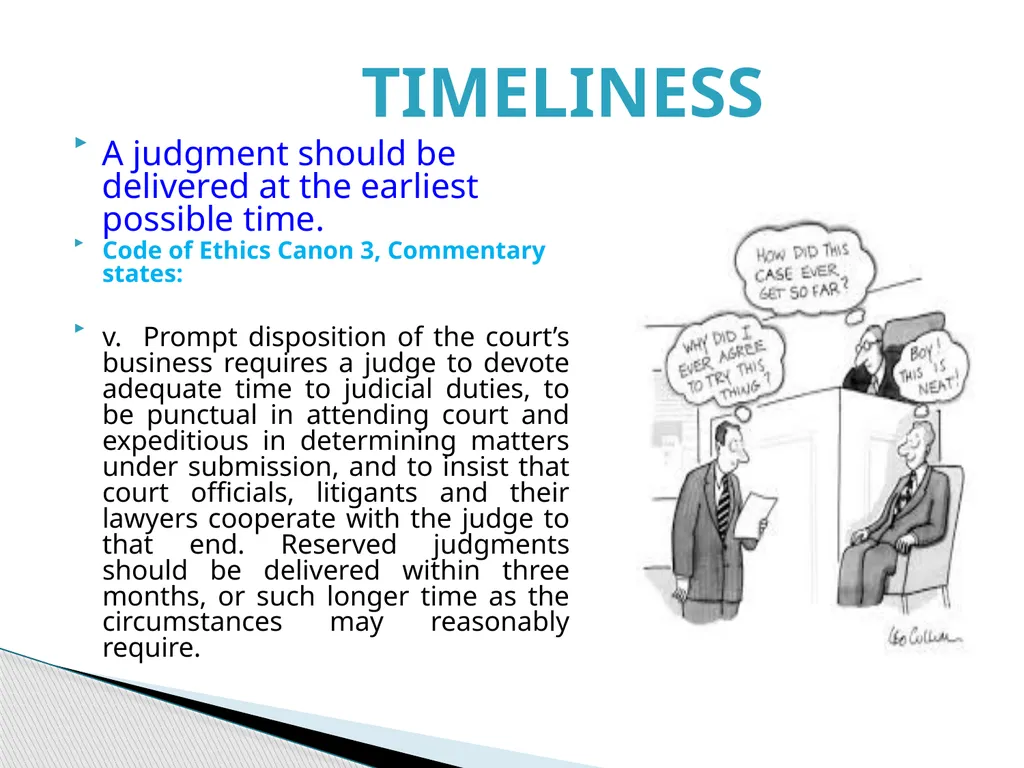
A judgment should be delivered at the earliest possible time.
Code of Ethics Canon 3, Commentary states:
v. Prompt disposition of the court’s business requires a judge to devote adequate time to judicial duties, to be punctual in attending court and expeditious in determining matters under submission, and to insist that court officials, litigants and their lawyers cooperate with the judge to that end. Reserved judgments should be delivered within three months, or such longer time as the circumstances may reasonably require. Timeliness<br>
Code of Ethics Canon 3, Commentary states:
v. Prompt disposition of the court’s business requires a judge to devote adequate time to judicial duties, to be punctual in attending court and expeditious in determining matters under submission, and to insist that court officials, litigants and their lawyers cooperate with the judge to that end. Reserved judgments should be delivered within three months, or such longer time as the circumstances may reasonably require. Timeliness<br>
43
Always remember the vision & mission statement of the court.
“access to a system of justice that is accountable and independent, and administered by officers in a prompt, fair, efficient and effective manner.” CONCLUSION “the achievement of professionalism and excellence in the timely, effective and efficient access to, and administration of a cohesive, independent and accountable system of justice for the benefit of its Member States.”<br>
“access to a system of justice that is accountable and independent, and administered by officers in a prompt, fair, efficient and effective manner.” CONCLUSION “the achievement of professionalism and excellence in the timely, effective and efficient access to, and administration of a cohesive, independent and accountable system of justice for the benefit of its Member States.”<br>
44
REMEMBER ! There are no exhaustive guidelines for writing judgments but it is my hope that those provided above will prove useful as you discharge your judicial functions.<br>