
July 2012 Lessons learnt on The Home Affairs
Description: July 2012 Lessons learnt on The Home Affairs Transformation Programme Transforming the ID Environment Discussions with Management of the PSC Building a New Home Affairs Support Intervention Task Team reports back urging action to fix the
Related Topics
Download Presentation
"July 2012 Lessons learnt on The Home Affairs" is the property of its rightful owner. Permission is granted to download and print the materials on this website for personal, non-commercial use only, and to display it on your personal computer provided you do not modify the materials and that you retain all copyright notices contained in the materials. By downloading content from our website, you accept the terms of this agreement.
Presentation Transcript
slide1. July 2012 Lessons learnt on
The Home Affairs Transformation Programme
Transforming the ID Environment
Discussions with Management of the PSC Building a New Home Affairs<br>
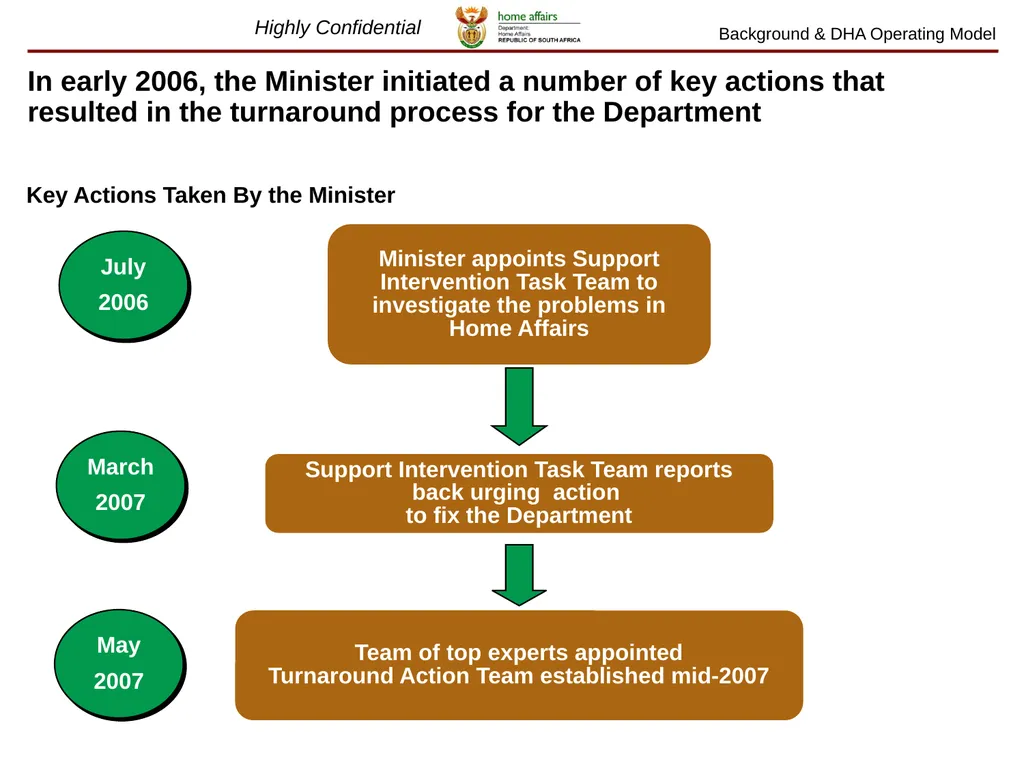
slide2. Support Intervention Task Team reports back urging action to fix the Department Minister appoints Support Intervention Task Team to investigate the problems in Home Affairs Team of top experts appointed Turnaround Action Team established mid-2007 July
2006 May
2007 March
2007 In early 2006, the Minister initiated a number of key actions that resulted in the turnaround process for the Department Key Actions Taken By the Minister Background & DHA Operating Model<br>
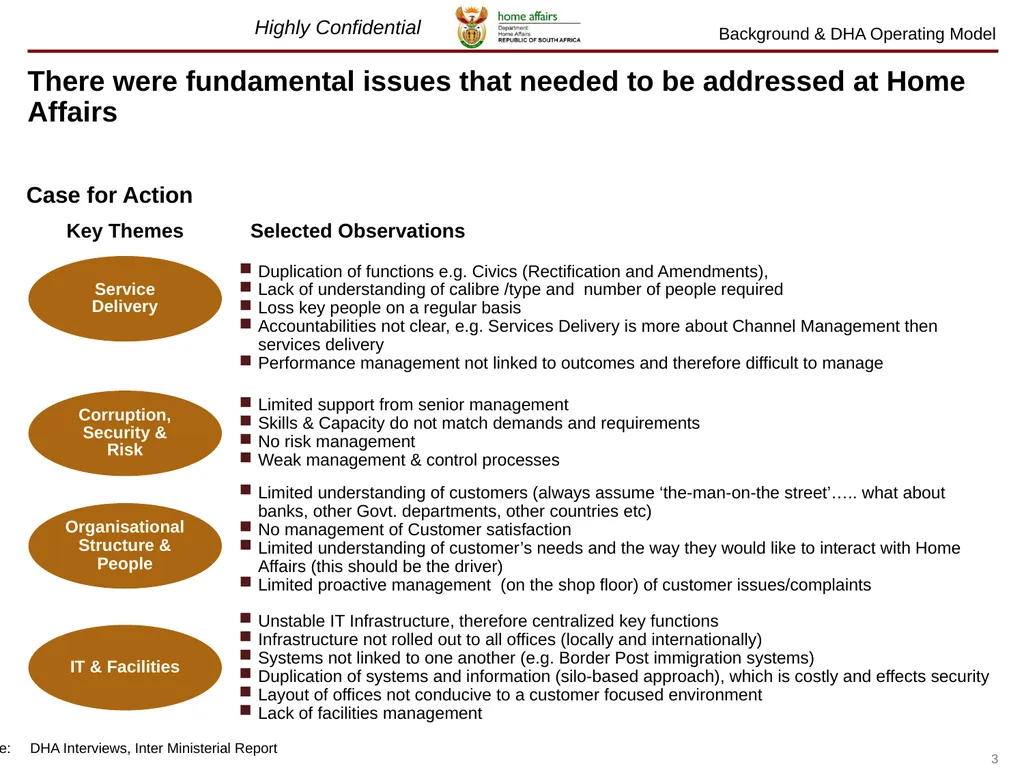
slide3. There were fundamental issues that needed to be addressed at Home Affairs Service Delivery Limited support from senior management
Skills & Capacity do not match demands and requirements
No risk management
Weak management & control processes Limited understanding of customers (always assume ‘the-man-on-the street’….. what about banks, other Govt. departments, other countries etc)
No management of Customer satisfaction
Limited understanding of customer’s needs and the way they would like to interact with Home Affairs (this should be the driver)
Limited proactive management (on the shop floor) of customer issues/complaints Duplication of functions e.g. Civics (Rectification and Amendments),
Lack of understanding of calibre /type and number of people required
Loss key people on a regular basis
Accountabilities not clear, e.g. Services Delivery is more about Channel Management then services delivery
Performance management not linked to outcomes and therefore difficult to manage Unstable IT Infrastructure, therefore centralized key functions
Infrastructure not rolled out to all offices (locally and internationally)
Systems not linked to one another (e.g. Border Post immigration systems)
Duplication of systems and information (silo-based approach), which is costly and effects security
Layout of offices not conducive to a customer focused environment
Lack of facilities management Selected Observations Key Themes Source: DHA Interviews, Inter Ministerial Report Case for Action Corruption, Security & Risk Organisational Structure & People IT & Facilities Background & DHA Operating Model<br>
slide4. Our objective for the Turnaround was clear To transform the department into a modern, efficient, cost-effective service organisation responsive to the needs of South African citizens, residents and visitors to our country while combating fraud & corruption Background & DHA Operating Model<br>
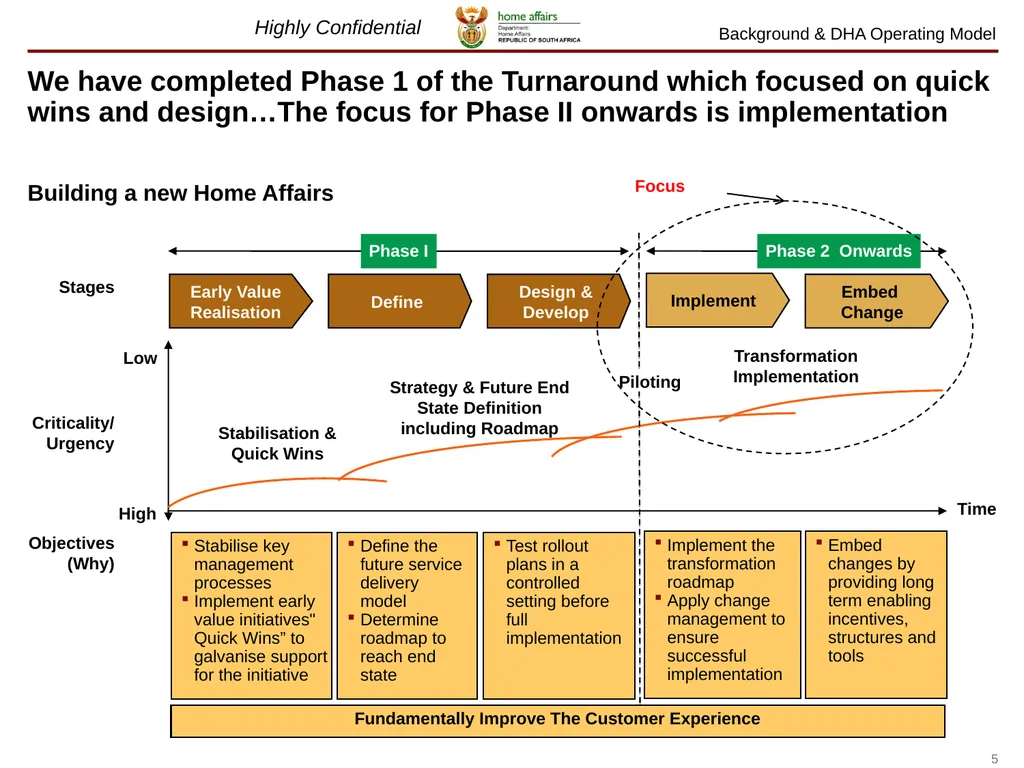
slide5. We have completed Phase 1 of the Turnaround which focused on quick wins and design…The focus for Phase II onwards is implementation Criticality/ Urgency Stabilisation & Quick Wins Strategy & Future End State Definition including Roadmap Transformation Implementation Time High Low Objectives (Why) Stabilise key management processes
Implement early value initiatives" Quick Wins” to galvanise support for the initiative Define the future service delivery model
Determine roadmap to reach end state Implement the transformation roadmap
Apply change management to ensure successful implementation Test rollout plans in a controlled setting before full implementation Early Value Realisation Define Design & Develop Embed Change Stages Implement Embed changes by providing long term enabling incentives, structures and tools Phase I Phase 2 Onwards Fundamentally Improve The Customer Experience Building a new Home Affairs Piloting Focus Background & DHA Operating Model<br>
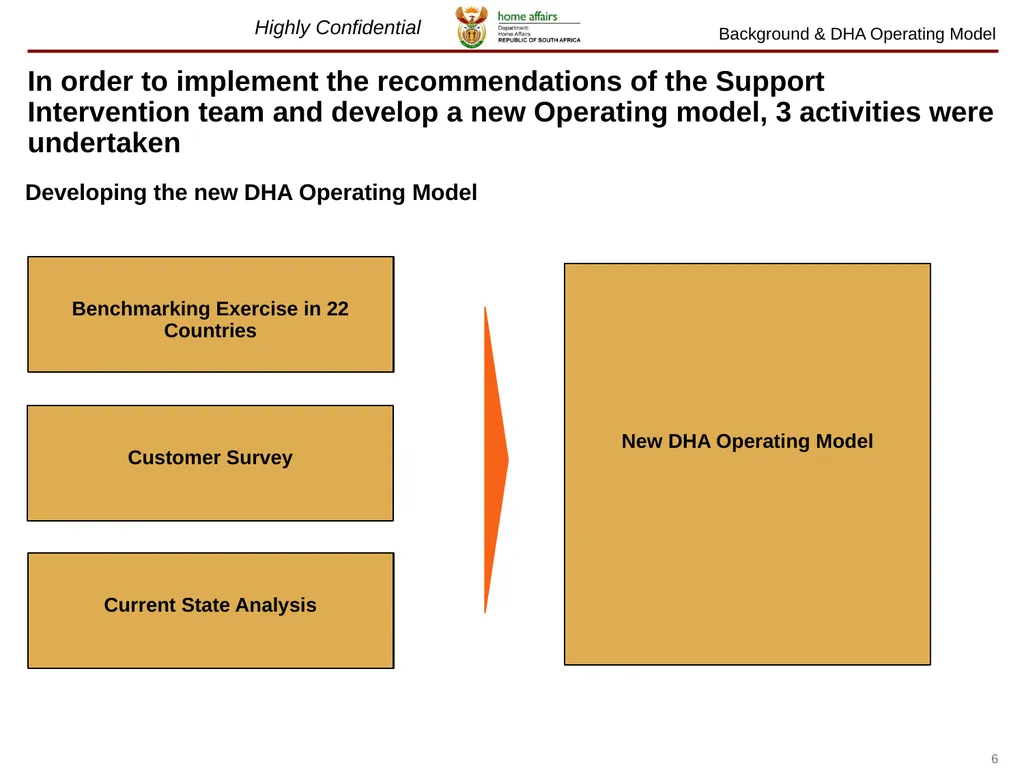
slide6. In order to implement the recommendations of the Support Intervention team and develop a new Operating model, 3 activities were undertaken Background & DHA Operating Model Benchmarking Exercise in 22 Countries Customer Survey Current State Analysis New DHA Operating Model Developing the new DHA Operating Model<br>
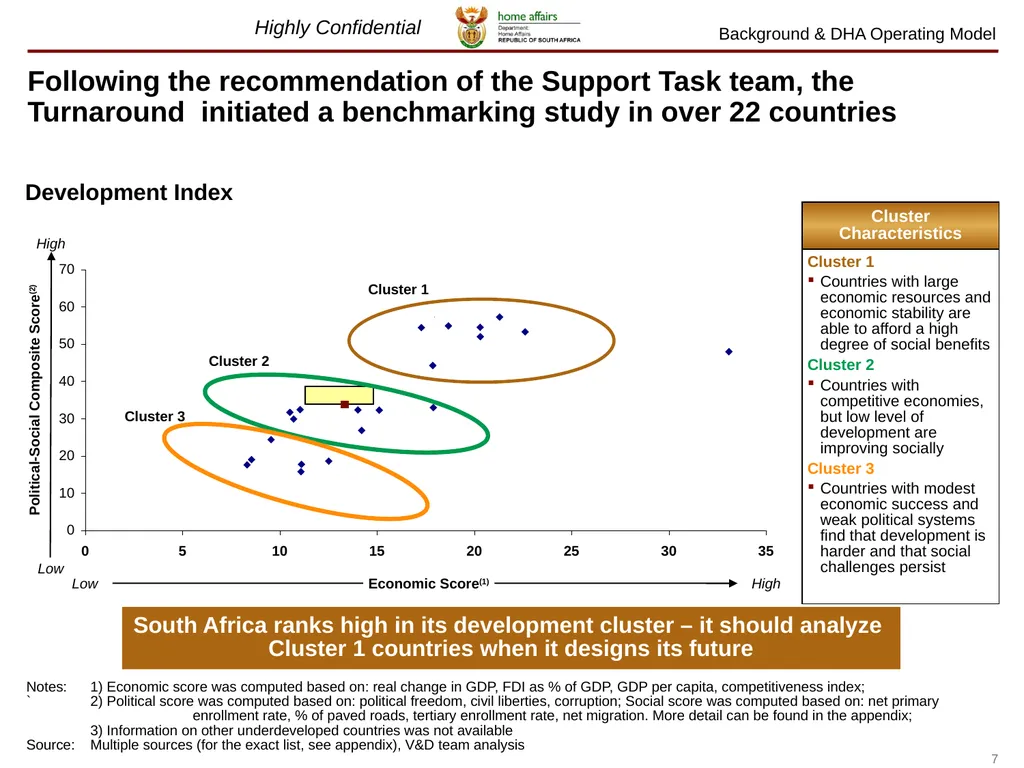
slide7. Following the recommendation of the Support Task team, the Turnaround initiated a benchmarking study in over 22 countries High Low Economic Score(1) High Political-Social Composite Score(2) Low Development Index Notes: 1) Economic score was computed based on: real change in GDP, FDI as % of GDP, GDP per capita, competitiveness index;
` 2) Political score was computed based on: political freedom, civil liberties, corruption; Social score was computed based on: net primary
enrollment rate, % of paved roads, tertiary enrollment rate, net migration. More detail can be found in the appendix;
3) Information on other underdeveloped countries was not available
Source: Multiple sources (for the exact list, see appendix), V&D team analysis South Africa ranks high in its development cluster – it should analyze Cluster 1 countries when it designs its future Cluster 1 Cluster 2 Cluster 3 Background & DHA Operating Model<br>
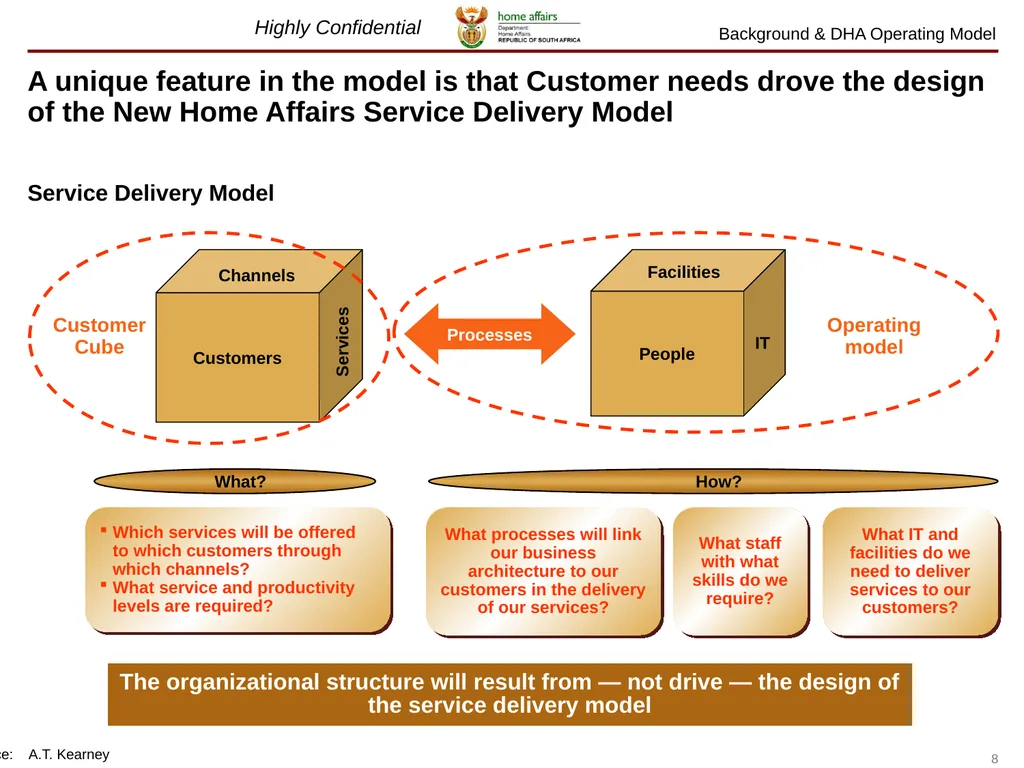
slide8. A unique feature in the model is that Customer needs drove the design of the New Home Affairs Service Delivery Model People IT Facilities Processes What processes will link our business architecture to our customers in the delivery of our services? What IT and facilities do we need to deliver services to our customers? How? What? The organizational structure will result from — not drive — the design of the service delivery model Service Delivery Model Customer Cube Operating model Which services will be offered to which customers through which channels?
What service and productivity levels are required? What staff with what skills do we require? Source: A.T. Kearney Background & DHA Operating Model<br>
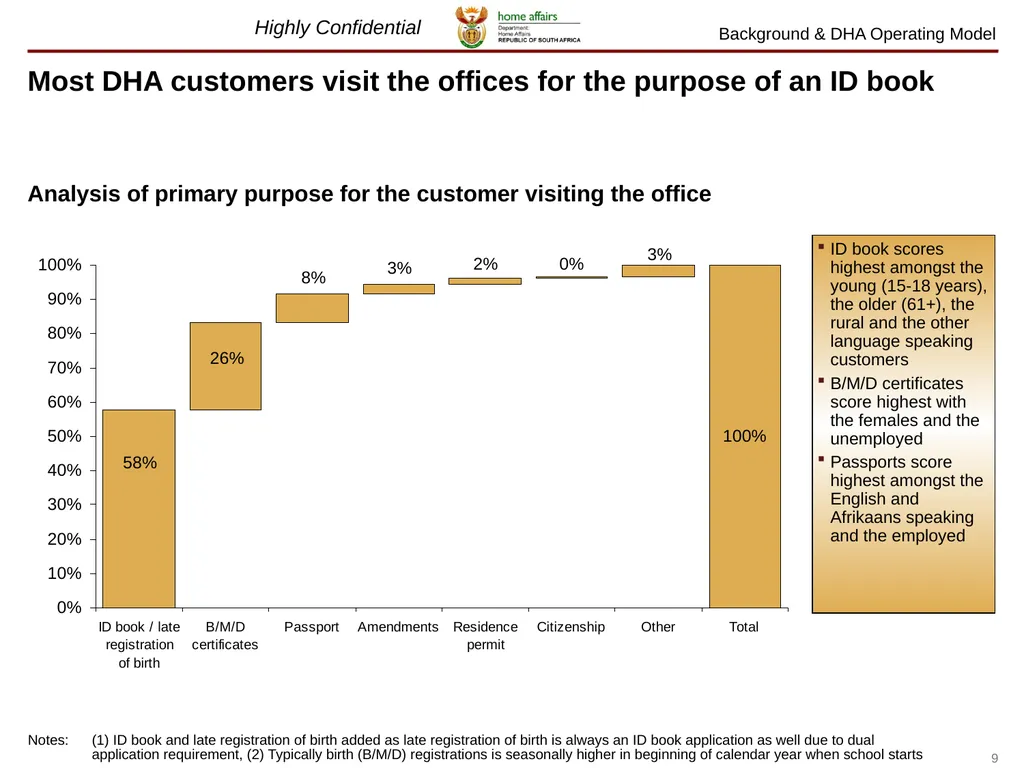
slide9. Most DHA customers visit the offices for the purpose of an ID book Analysis of primary purpose for the customer visiting the office ID book scores highest amongst the young (15-18 years), the older (61+), the rural and the other language speaking customers
B/M/D certificates score highest with the females and the unemployed
Passports score highest amongst the English and Afrikaans speaking and the employed Notes: (1) ID book and late registration of birth added as late registration of birth is always an ID book application as well due to dual application requirement, (2) Typically birth (B/M/D) registrations is seasonally higher in beginning of calendar year when school starts Background & DHA Operating Model<br>
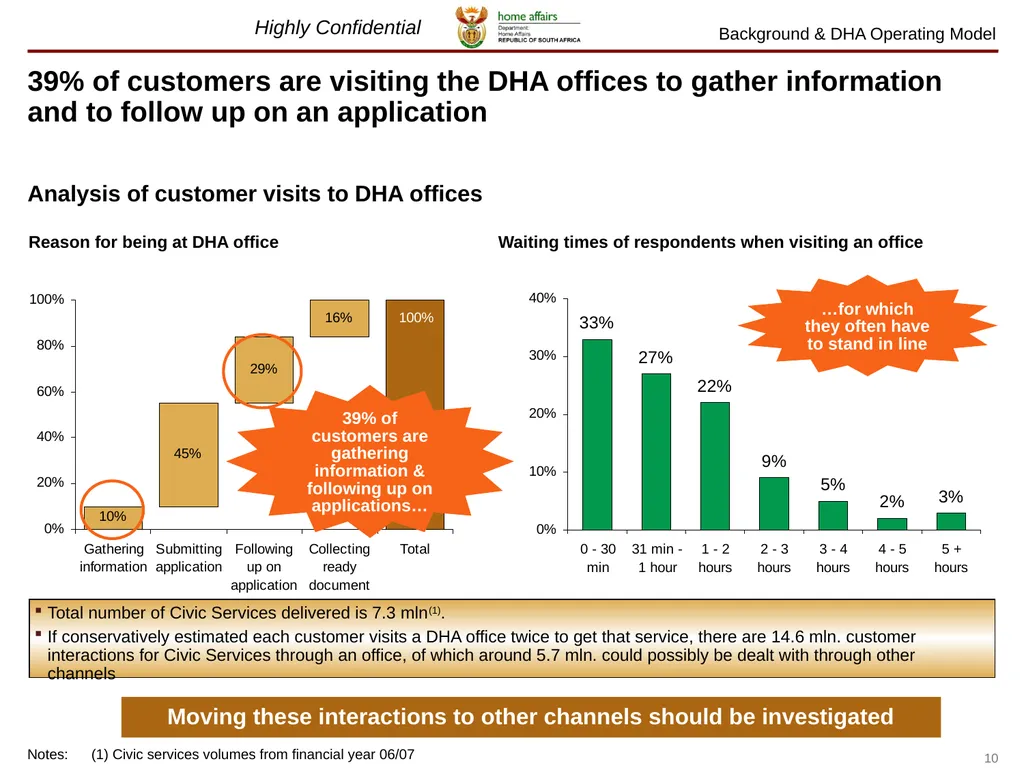
slide10. 39% of customers are visiting the DHA offices to gather information and to follow up on an application Analysis of customer visits to DHA offices 39% of customers are gathering information & following up on applications… Total number of Civic Services delivered is 7.3 mln(1).
If conservatively estimated each customer visits a DHA office twice to get that service, there are 14.6 mln. customer interactions for Civic Services through an office, of which around 5.7 mln. could possibly be dealt with through other channels Waiting times of respondents when visiting an office Reason for being at DHA office Moving these interactions to other channels should be investigated …for which they often have to stand in line Notes: (1) Civic services volumes from financial year 06/07 Background & DHA Operating Model<br>
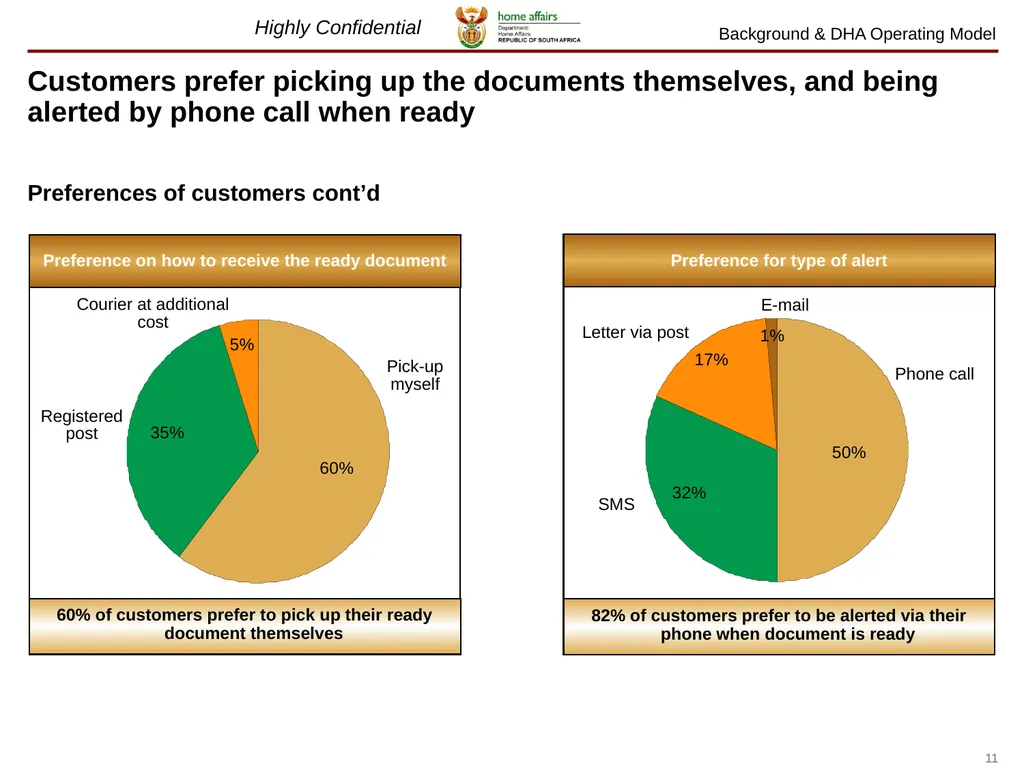
slide11. Customers prefer picking up the documents themselves, and being alerted by phone call when ready Preferences of customers cont’d Preference on how to receive the ready document 60% of customers prefer to pick up their ready document themselves Registered post Pick-up myself Courier at additional cost Preference for type of alert 82% of customers prefer to be alerted via their phone when document is ready Phone call SMS Letter via post E-mail Background & DHA Operating Model<br>
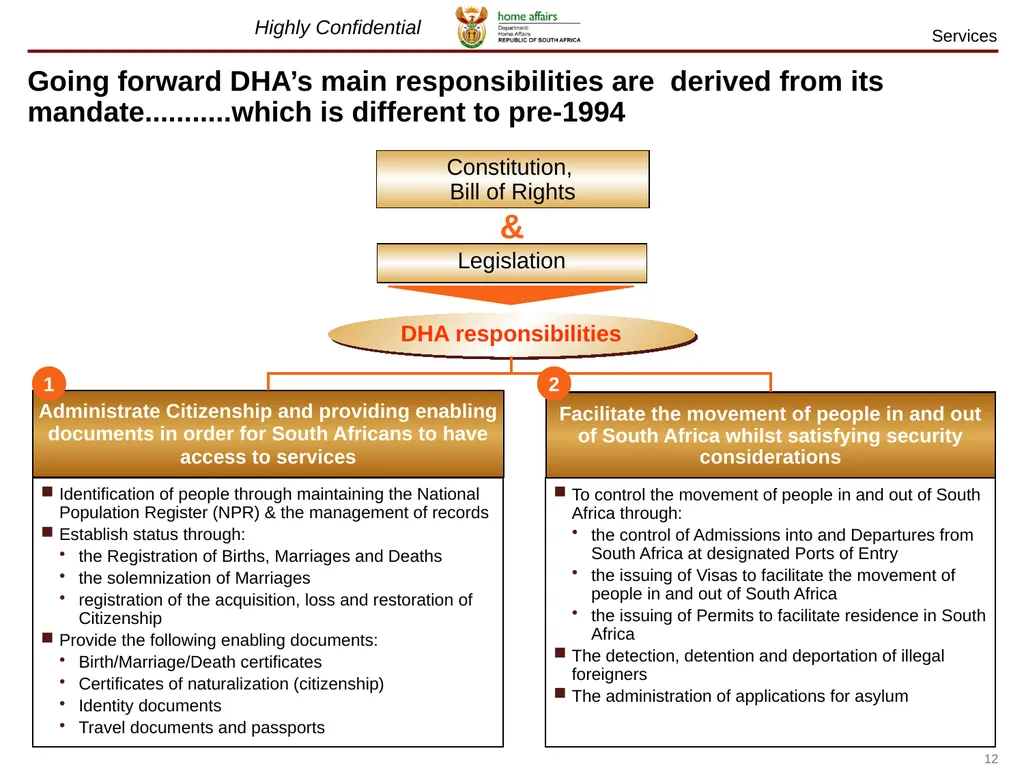
slide12. Going forward DHA’s main responsibilities are derived from its mandate...........which is different to pre-1994 Administrate Citizenship and providing enabling documents in order for South Africans to have access to services Identification of people through maintaining the National Population Register (NPR) & the management of records
Establish status through:
the Registration of Births, Marriages and Deaths
the solemnization of Marriages
registration of the acquisition, loss and restoration of Citizenship
Provide the following enabling documents:
Birth/Marriage/Death certificates
Certificates of naturalization (citizenship)
Identity documents
Travel documents and passports Facilitate the movement of people in and out of South Africa whilst satisfying security considerations To control the movement of people in and out of South Africa through:
the control of Admissions into and Departures from South Africa at designated Ports of Entry
the issuing of Visas to facilitate the movement of people in and out of South Africa
the issuing of Permits to facilitate residence in South Africa
The detection, detention and deportation of illegal foreigners
The administration of applications for asylum 1 2 Constitution,
Bill of Rights DHA responsibilities Legislation & Services<br>
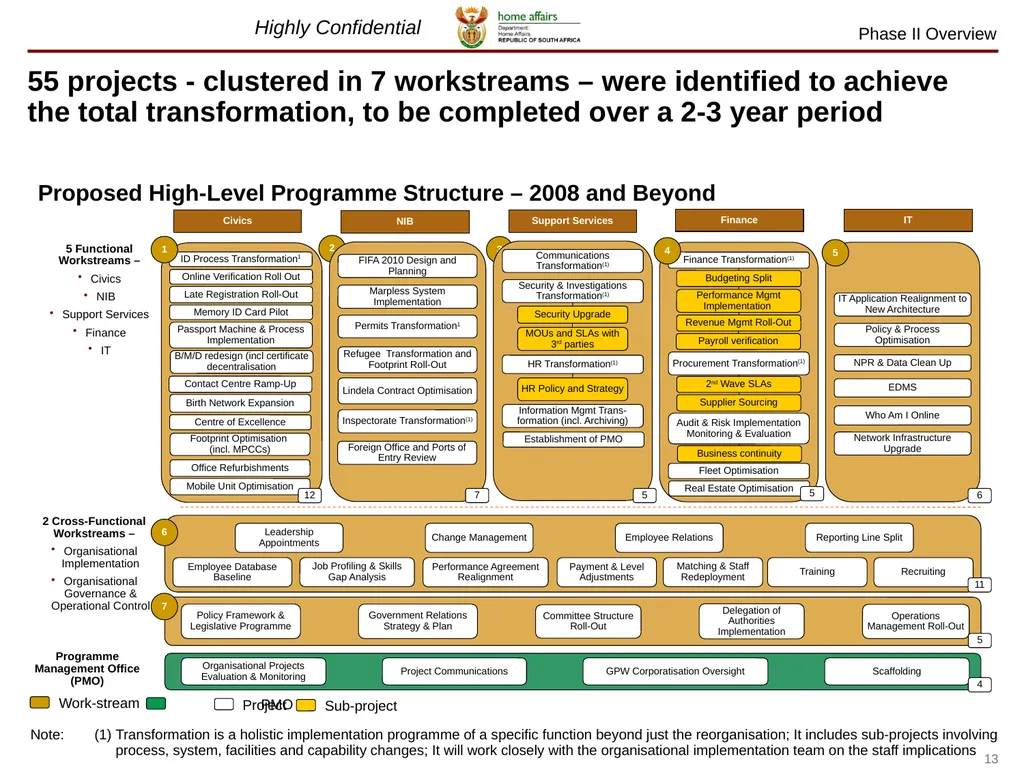
slide13. 55 projects - clustered in 7 workstreams – were identified to achieve the total transformation, to be completed over a 2-3 year period Note: (1) Transformation is a holistic implementation programme of a specific function beyond just the reorganisation; It includes sub-projects involving process, system, facilities and capability changes; It will work closely with the organisational implementation team on the staff implications Proposed High-Level Programme Structure – 2008 and Beyond 5 Functional Workstreams –
Civics
NIB
Support Services
Finance
IT 2 Cross-Functional Workstreams –
Organisational Implementation
Organisational Governance & Operational Control Programme Management Office (PMO) Sub-project Project Civics NIB Support Services IT Finance Work-stream PMO 3 2 1 Phase II Overview<br>
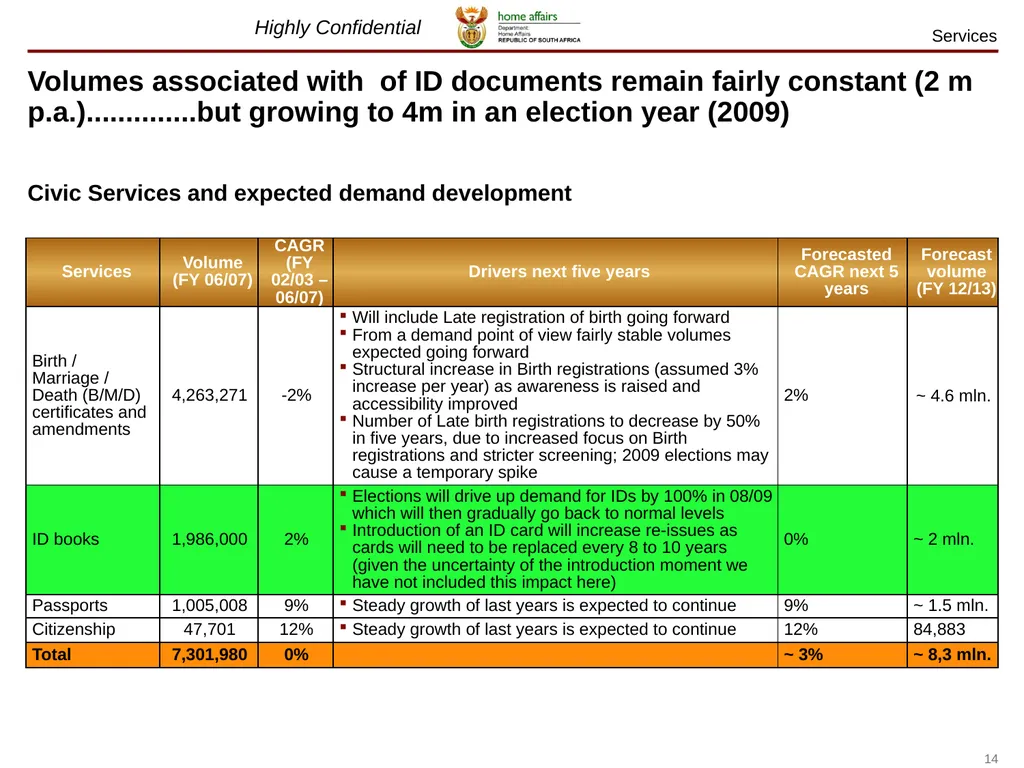
slide14. Volumes associated with of ID documents remain fairly constant (2 m p.a.)..............but growing to 4m in an election year (2009) Services Civic Services and expected demand development<br>
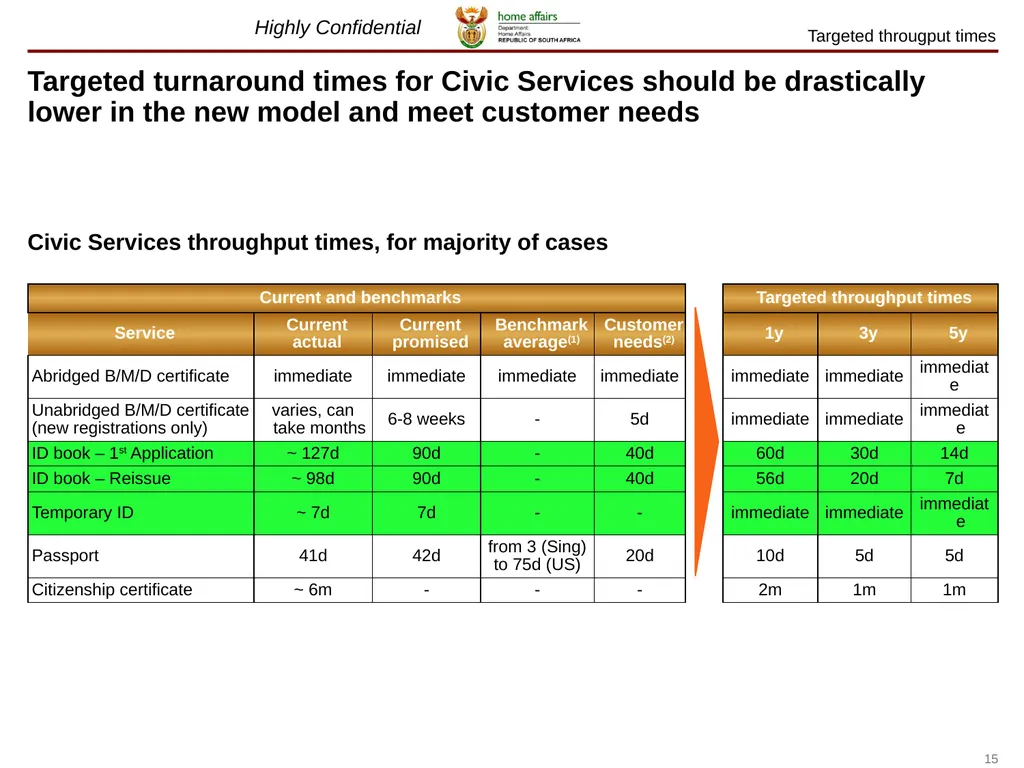
slide15. Targeted turnaround times for Civic Services should be drastically lower in the new model and meet customer needs Civic Services throughput times, for majority of cases Targeted througput times<br>
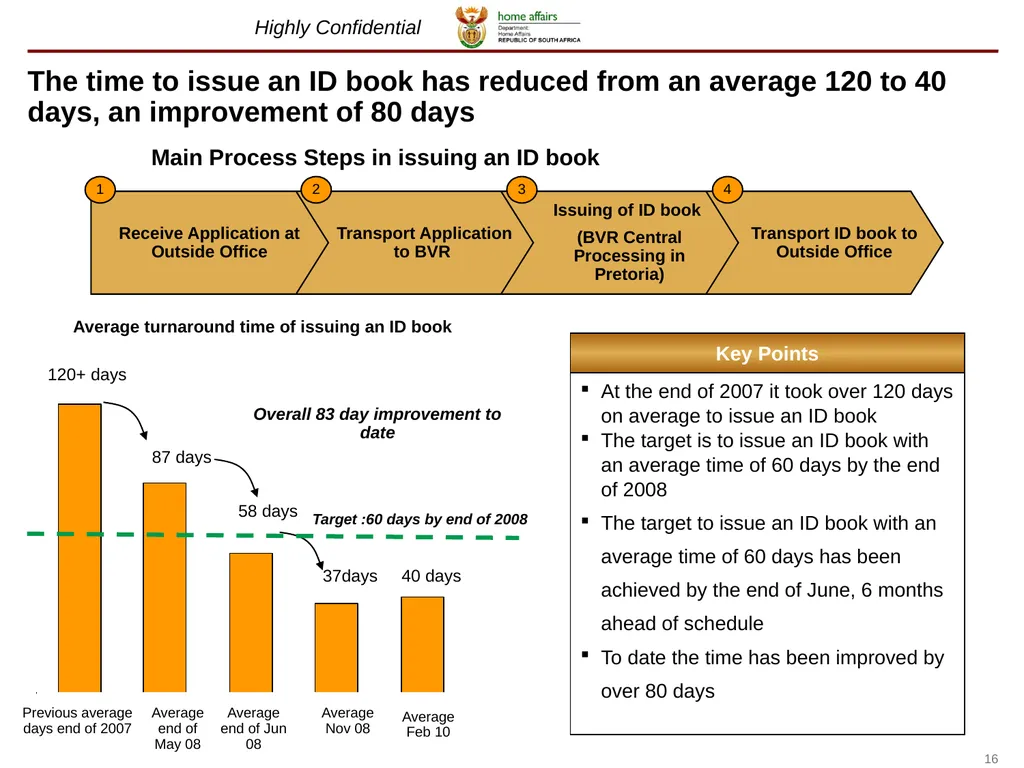
slide16. The time to issue an ID book has reduced from an average 120 to 40 days, an improvement of 80 days 120+ days 58 days Average turnaround time of issuing an ID book 87 days Average end of May 08 Average end of Jun 08 Average Nov 08 37days Target :60 days by end of 2008 Previous average days end of 2007 Transport ID book to Outside Office Issuing of ID book
(BVR Central Processing in Pretoria) Transport Application to BVR Receive Application at Outside Office Main Process Steps in issuing an ID book 1 2 3 4 Overall 83 day improvement to date 40 days Average Feb 10<br>
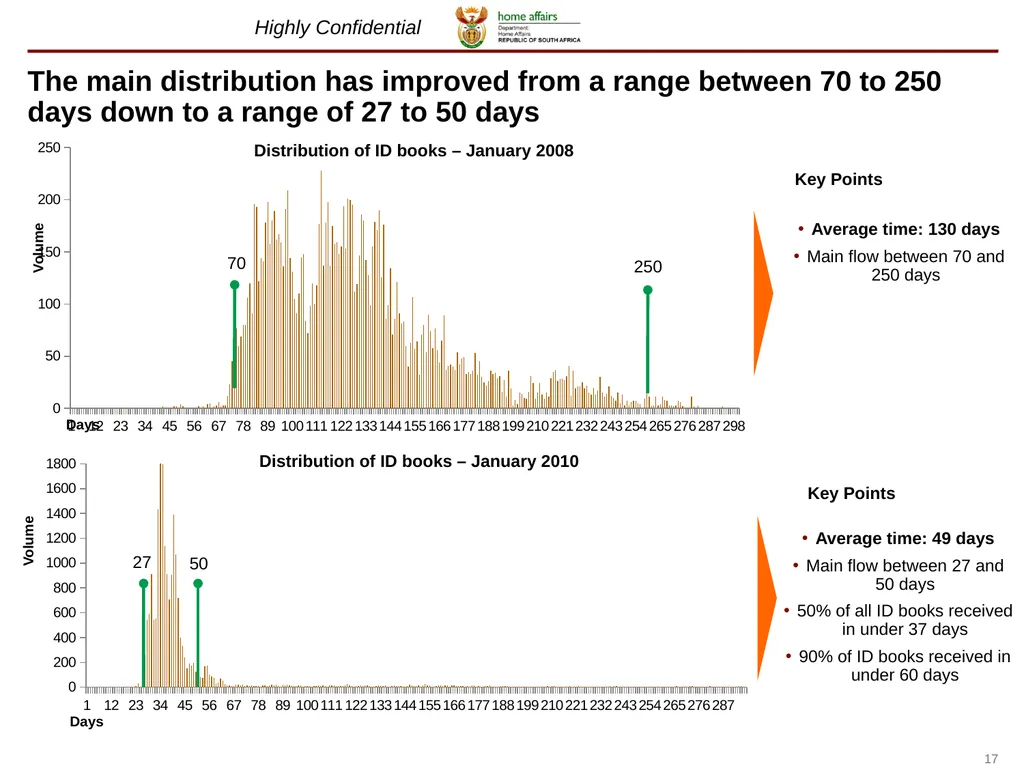
slide17. The main distribution has improved from a range between 70 to 250 days down to a range of 27 to 50 days 70 250 27 50 Distribution of ID books – January 2008 Distribution of ID books – January 2010 Volume Volume Days Days Key Points Average time: 130 days
Main flow between 70 and 250 days Key Points Average time: 49 days
Main flow between 27 and 50 days
50% of all ID books received in under 37 days
90% of ID books received in under 60 days<br>
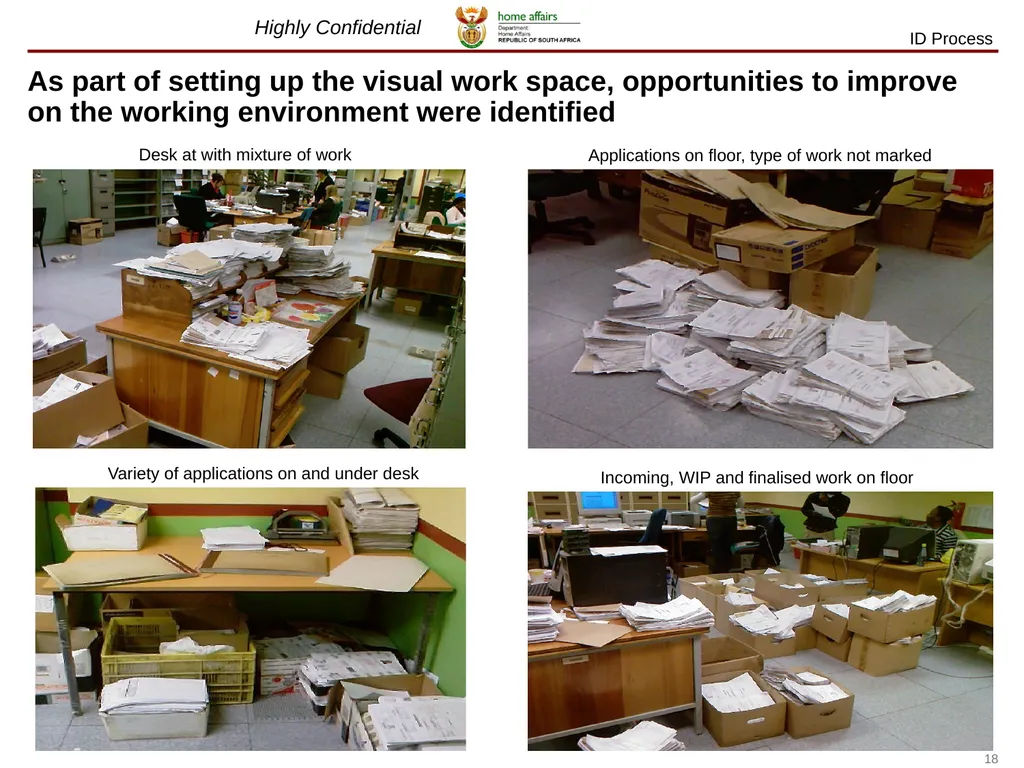
slide18. As part of setting up the visual work space, opportunities to improve on the working environment were identified Desk at with mixture of work Applications on floor, type of work not marked Variety of applications on and under desk Incoming, WIP and finalised work on floor ID Process<br>
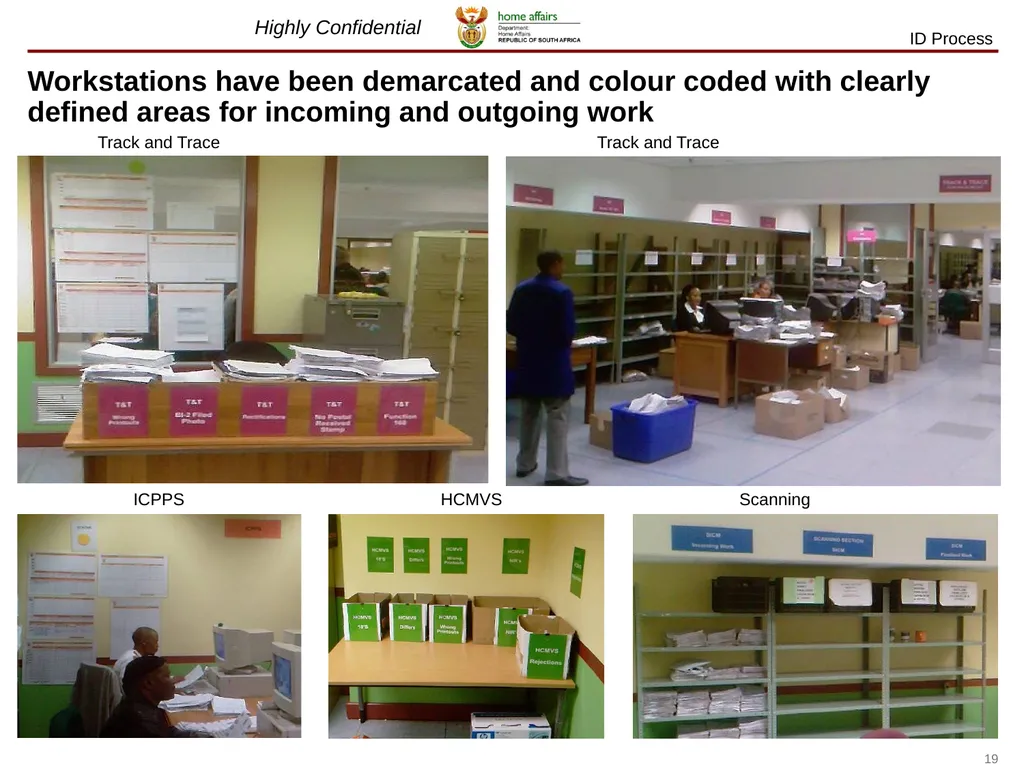
slide19. Workstations have been demarcated and colour coded with clearly defined areas for incoming and outgoing work Track and Trace Track and Trace ICPPS HCMVS Scanning ID Process<br>
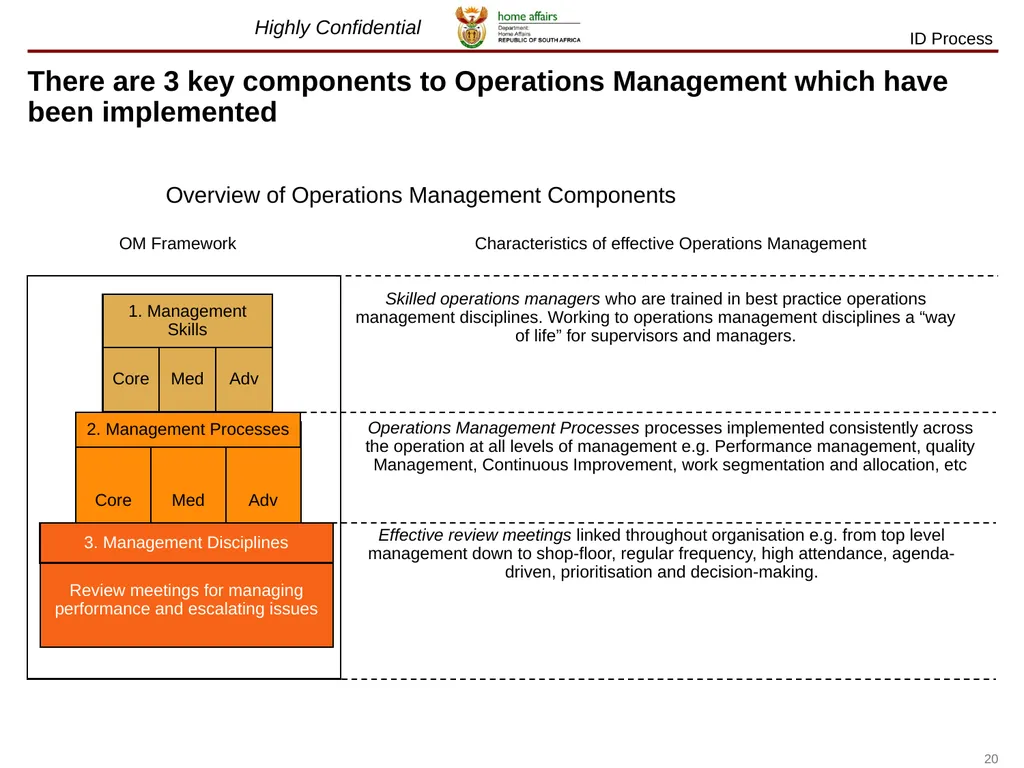
slide20. There are 3 key components to Operations Management which have been implemented OM Framework Review meetings for managing performance and escalating issues Core Med Adv Core Med Adv 1. Management Skills 2. Management Processes 3. Management Disciplines Characteristics of effective Operations Management Skilled operations managers who are trained in best practice operations management disciplines. Working to operations management disciplines a “way of life” for supervisors and managers. Operations Management Processes processes implemented consistently across the operation at all levels of management e.g. Performance management, quality Management, Continuous Improvement, work segmentation and allocation, etc Effective review meetings linked throughout organisation e.g. from top level management down to shop-floor, regular frequency, high attendance, agenda-driven, prioritisation and decision-making. Overview of Operations Management Components ID Process<br>
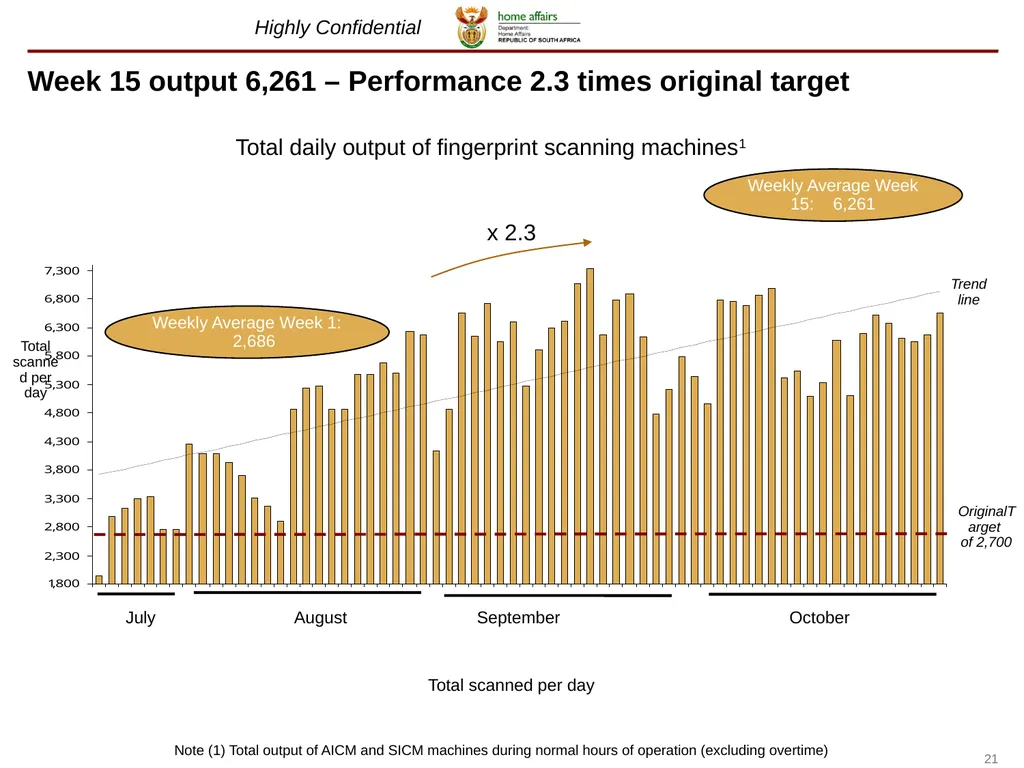
slide21. Week 15 output 6,261 – Performance 2.3 times original target OriginalTarget of 2,700 Weekly Average Week 15: 6,261 Weekly Average Week 1: 2,686 July August September x 2.3 Total scanned per day Total scanned per day Total daily output of fingerprint scanning machines1 Note (1) Total output of AICM and SICM machines during normal hours of operation (excluding overtime) October Trend line<br>
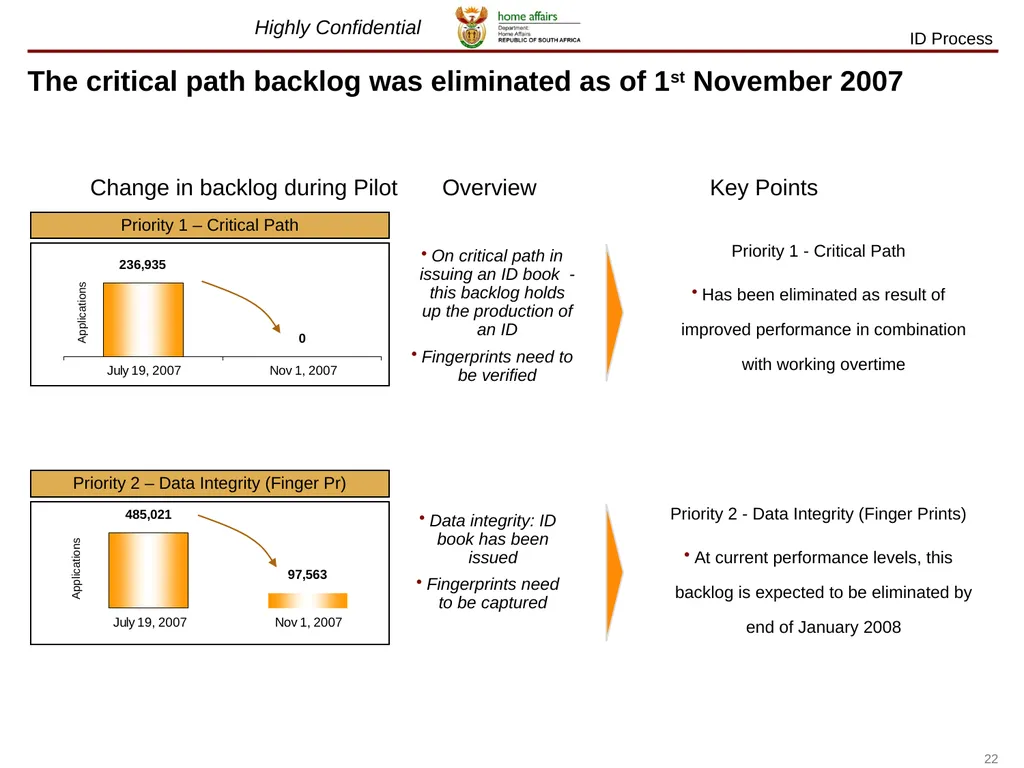
slide22. The critical path backlog was eliminated as of 1st November 2007 Priority 1 – Critical Path On critical path in issuing an ID book - this backlog holds up the production of an ID
Fingerprints need to be verified Data integrity: ID book has been issued
Fingerprints need to be captured Applications Applications Priority 2 – Data Integrity (Finger Pr) Change in backlog during Pilot Priority 1 - Critical Path
Has been eliminated as result of improved performance in combination with working overtime Overview Key Points Priority 2 - Data Integrity (Finger Prints)
At current performance levels, this backlog is expected to be eliminated by end of January 2008 ID Process<br>
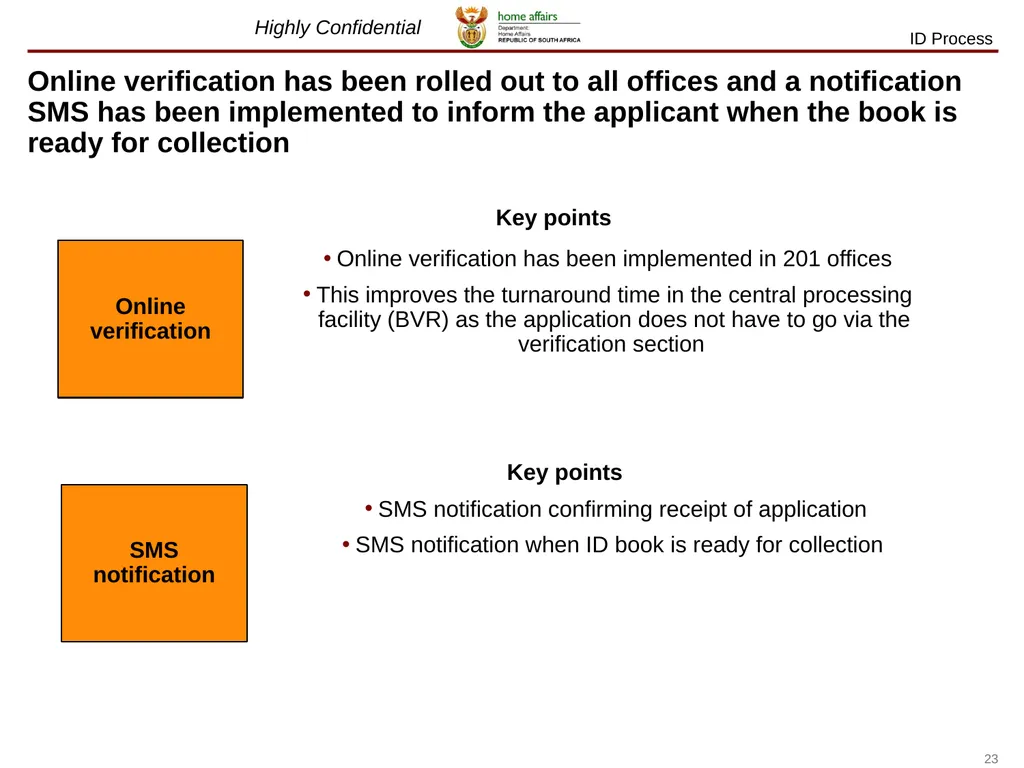
slide23. Online verification has been rolled out to all offices and a notification SMS has been implemented to inform the applicant when the book is ready for collection Online verification SMS notification Key points Online verification has been implemented in 201 offices
This improves the turnaround time in the central processing facility (BVR) as the application does not have to go via the verification section SMS notification confirming receipt of application
SMS notification when ID book is ready for collection Key points ID Process<br>
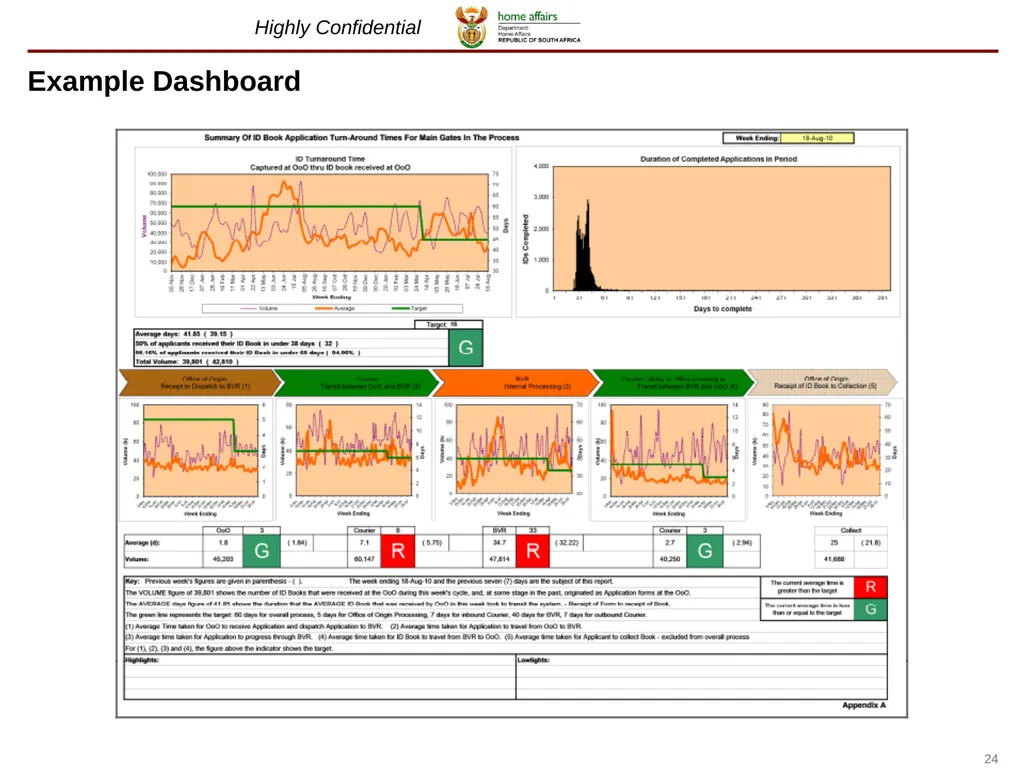
slide24. Example Dashboard<br>
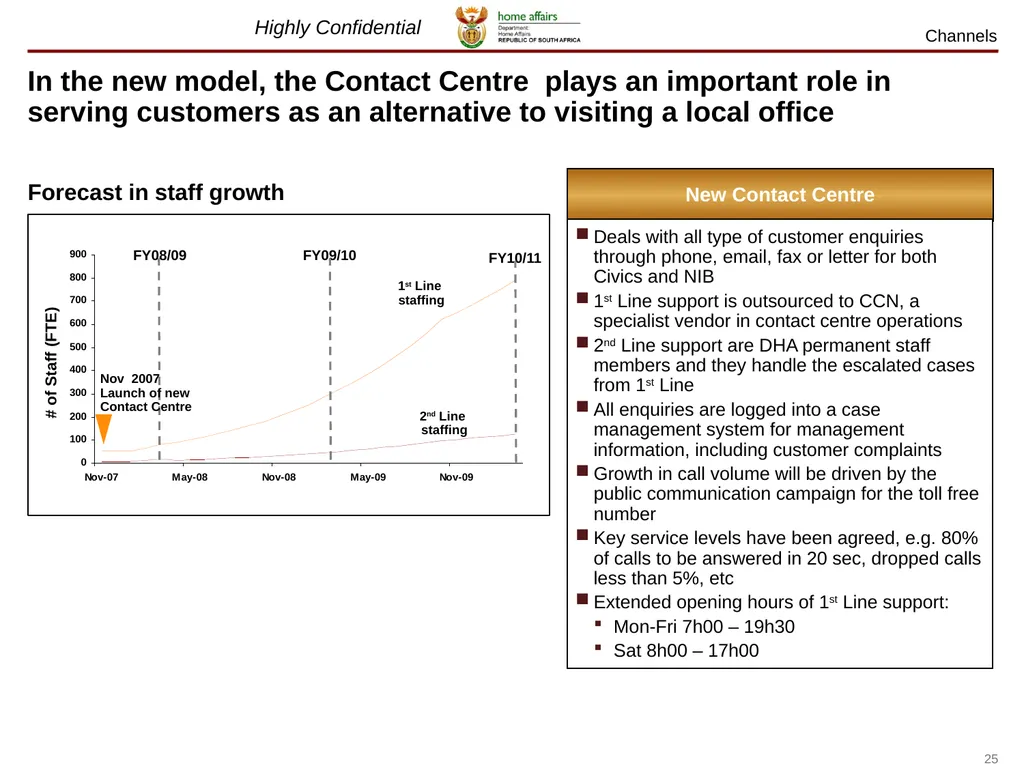
slide25. In the new model, the Contact Centre plays an important role in serving customers as an alternative to visiting a local office # of Staff (FTE) Forecast in staff growth FY09/10 FY08/09 Nov 2007 Launch of new Contact Centre New Contact Centre Deals with all type of customer enquiries through phone, email, fax or letter for both Civics and NIB
1st Line support is outsourced to CCN, a specialist vendor in contact centre operations
2nd Line support are DHA permanent staff members and they handle the escalated cases from 1st Line
All enquiries are logged into a case management system for management information, including customer complaints
Growth in call volume will be driven by the public communication campaign for the toll free number
Key service levels have been agreed, e.g. 80% of calls to be answered in 20 sec, dropped calls less than 5%, etc
Extended opening hours of 1st Line support:
Mon-Fri 7h00 – 19h30
Sat 8h00 – 17h00 FY10/11 1st Line staffing 2nd Line staffing Channels<br>
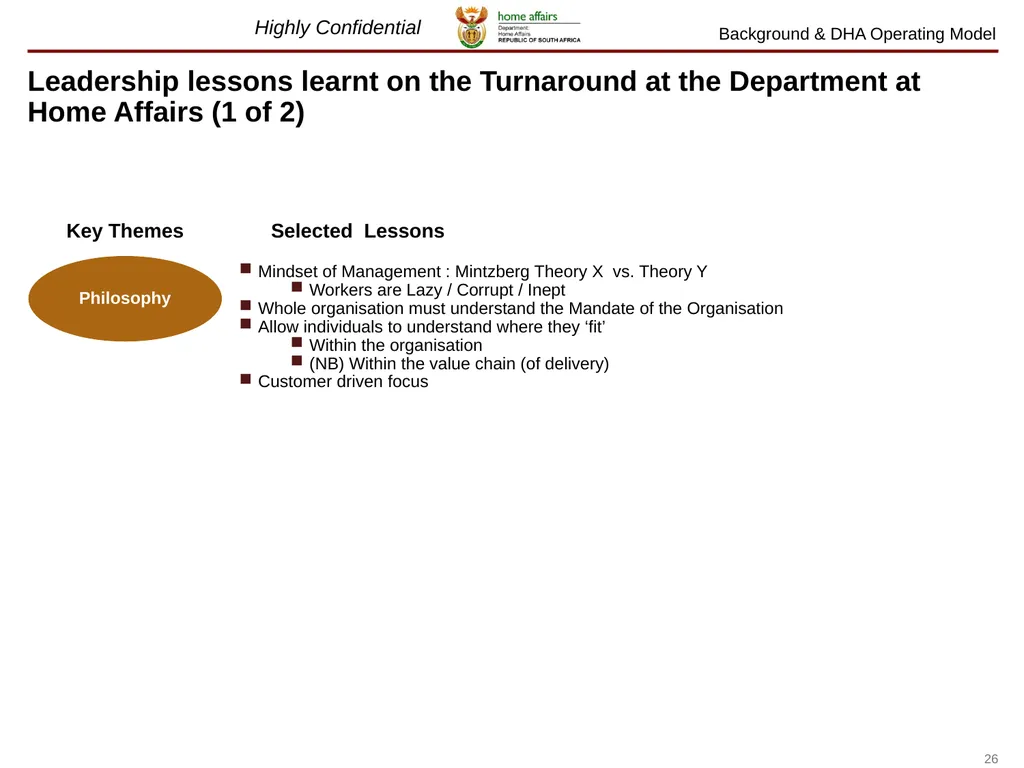
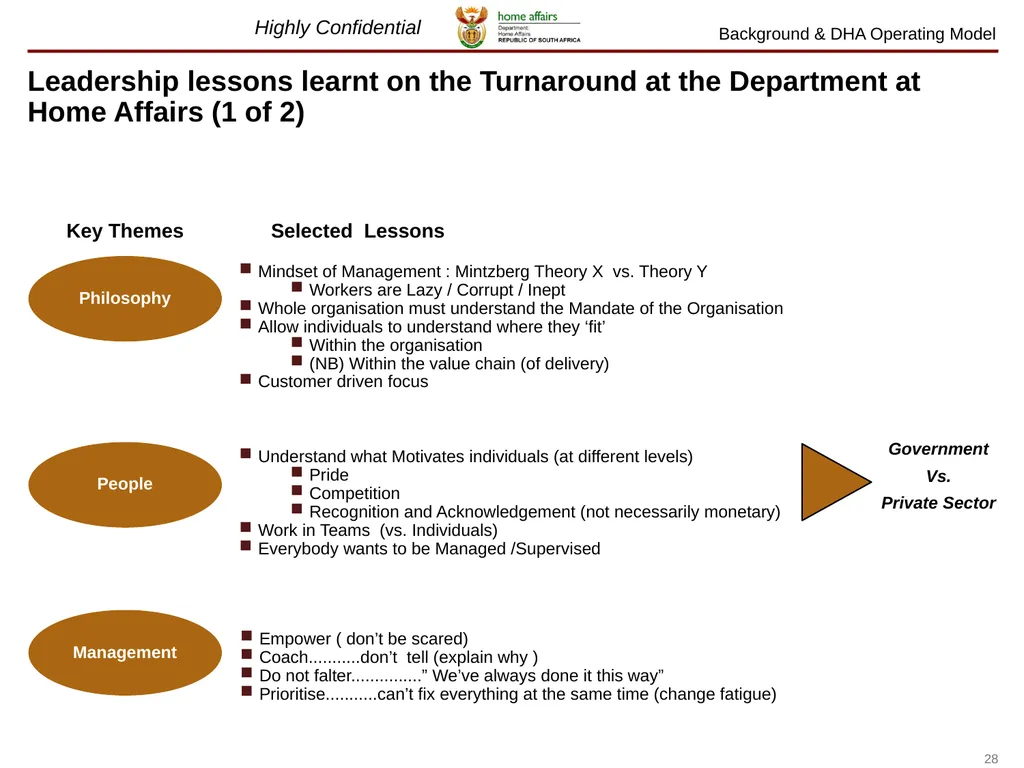
slide26. Leadership lessons learnt on the Turnaround at the Department at Home Affairs (1 of 2) Source: DHA Interviews, Inter Ministerial Report Background & DHA Operating Model<br>
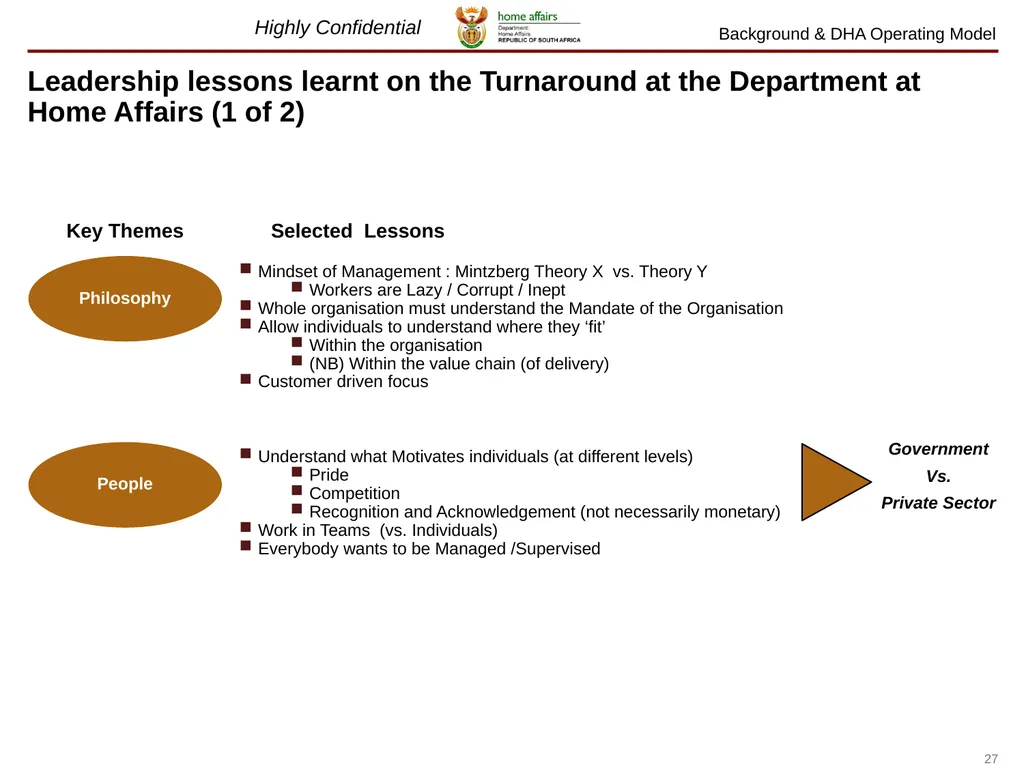
slide27. Leadership lessons learnt on the Turnaround at the Department at Home Affairs (1 of 2) Source: DHA Interviews, Inter Ministerial Report Background & DHA Operating Model Government
Vs.
Private Sector<br>
slide28. Leadership lessons learnt on the Turnaround at the Department at Home Affairs (1 of 2) Source: DHA Interviews, Inter Ministerial Report Background & DHA Operating Model Government
Vs.
Private Sector<br>
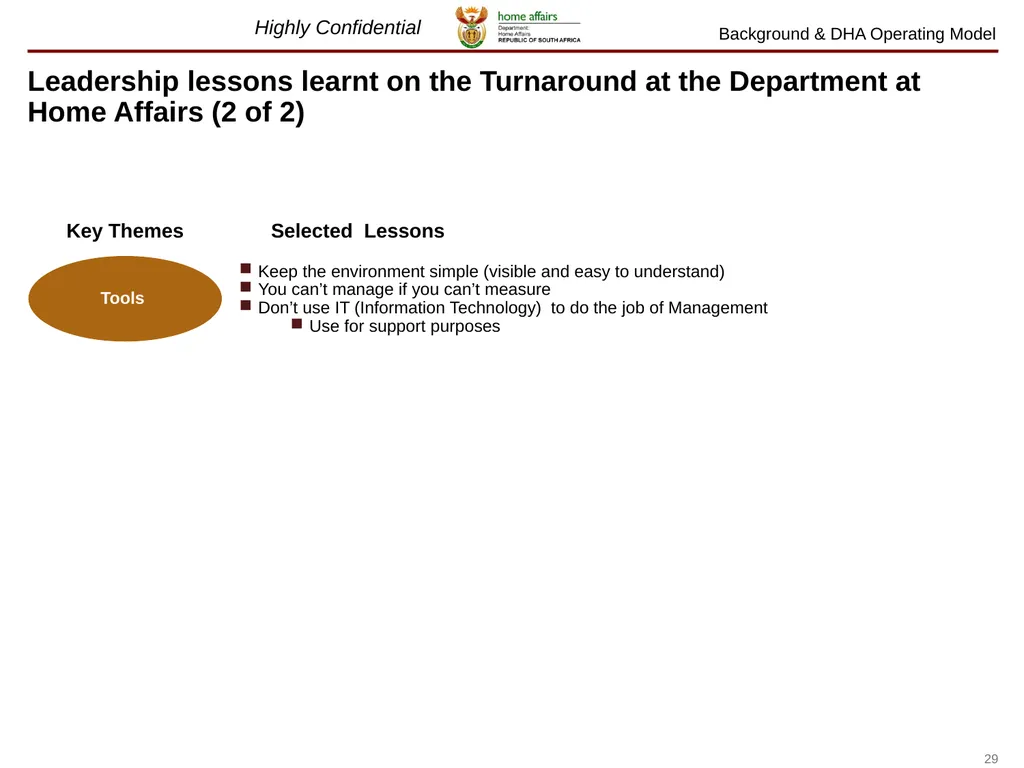
slide29. Leadership lessons learnt on the Turnaround at the Department at Home Affairs (2 of 2) Source: DHA Interviews, Inter Ministerial Report Background & DHA Operating Model<br>
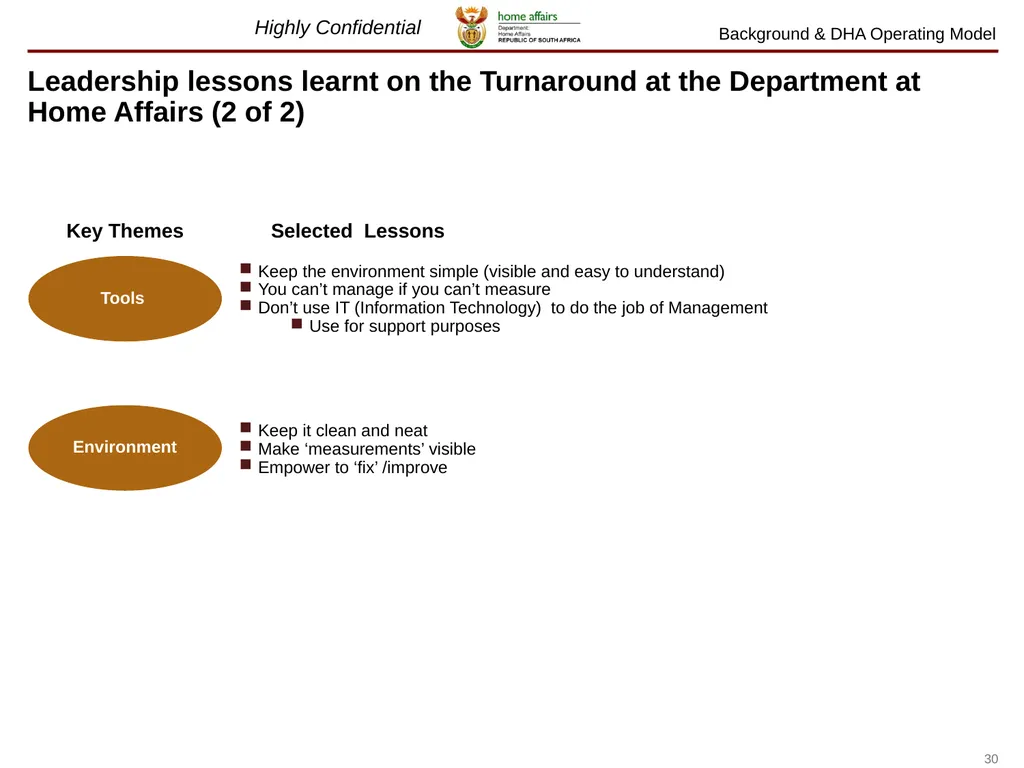
slide30. Leadership lessons learnt on the Turnaround at the Department at Home Affairs (2 of 2) Source: DHA Interviews, Inter Ministerial Report Background & DHA Operating Model<br>
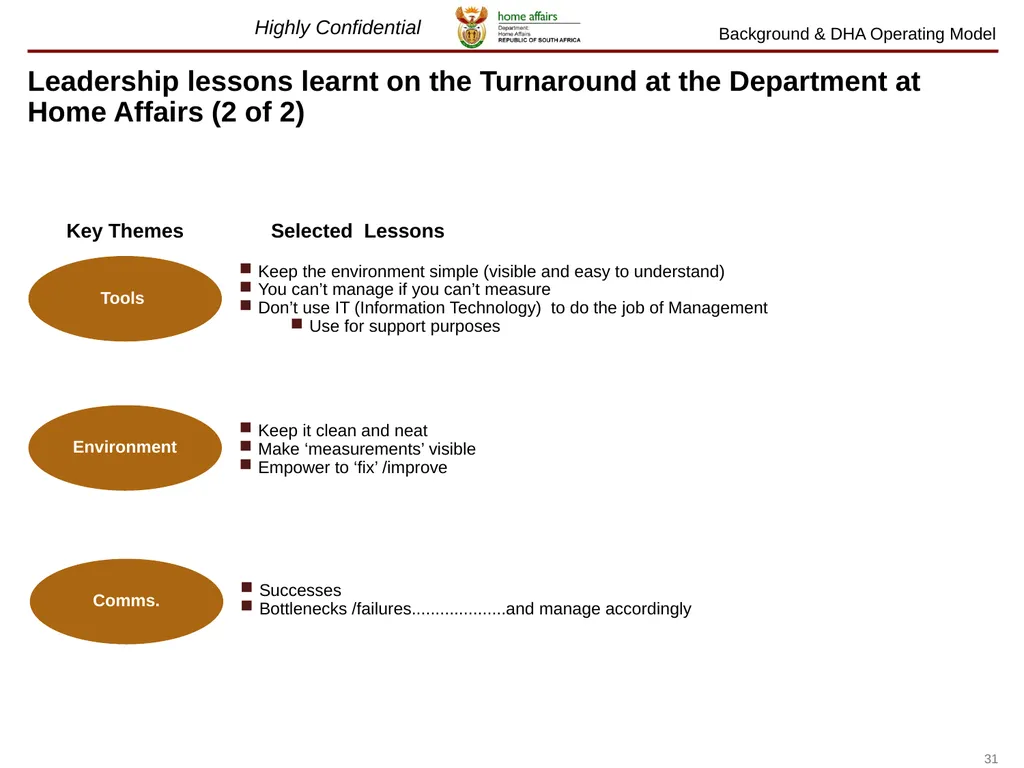
slide31. Leadership lessons learnt on the Turnaround at the Department at Home Affairs (2 of 2) Source: DHA Interviews, Inter Ministerial Report Background & DHA Operating Model<br>
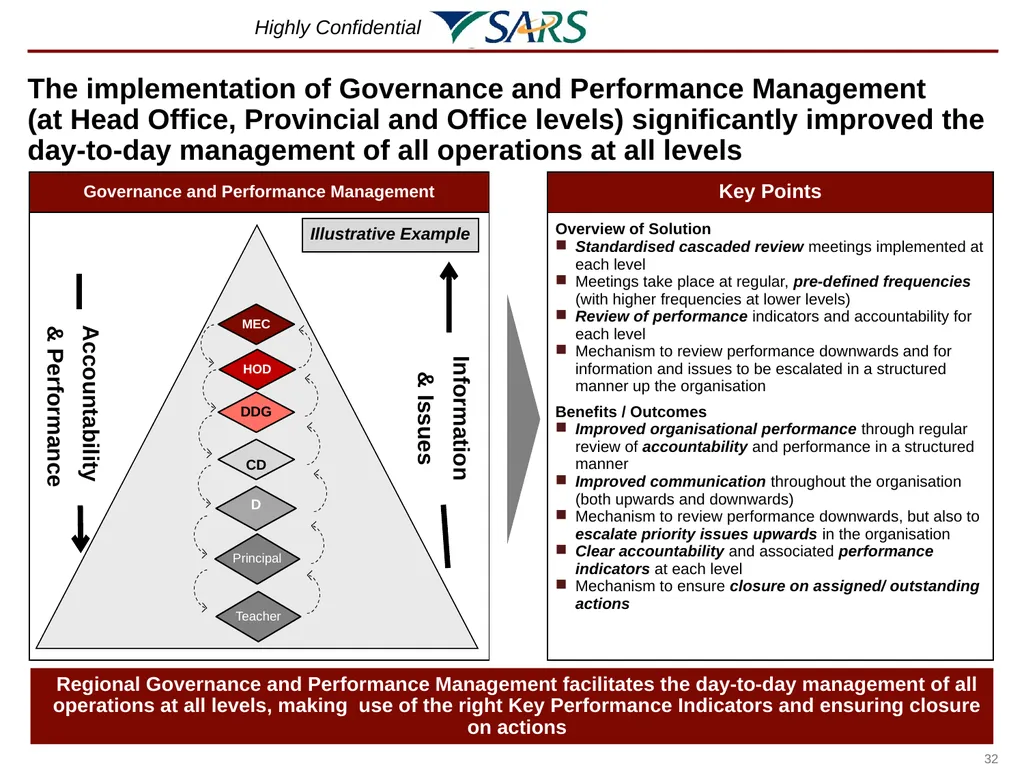
slide32. The implementation of Governance and Performance Management (at Head Office, Provincial and Office levels) significantly improved the day-to-day management of all operations at all levels Information
& Issues Accountability
& Performance HOD DDG CD D Principal Regional Governance and Performance Management facilitates the day-to-day management of all operations at all levels, making use of the right Key Performance Indicators and ensuring closure on actions MEC Teacher Illustrative Example<br>
The Home Affairs Transformation Programme
Transforming the ID Environment
Discussions with Management of the PSC Building a New Home Affairs<br>
slide2. Support Intervention Task Team reports back urging action to fix the Department Minister appoints Support Intervention Task Team to investigate the problems in Home Affairs Team of top experts appointed Turnaround Action Team established mid-2007 July
2006 May
2007 March
2007 In early 2006, the Minister initiated a number of key actions that resulted in the turnaround process for the Department Key Actions Taken By the Minister Background & DHA Operating Model<br>
slide3. There were fundamental issues that needed to be addressed at Home Affairs Service Delivery Limited support from senior management
Skills & Capacity do not match demands and requirements
No risk management
Weak management & control processes Limited understanding of customers (always assume ‘the-man-on-the street’….. what about banks, other Govt. departments, other countries etc)
No management of Customer satisfaction
Limited understanding of customer’s needs and the way they would like to interact with Home Affairs (this should be the driver)
Limited proactive management (on the shop floor) of customer issues/complaints Duplication of functions e.g. Civics (Rectification and Amendments),
Lack of understanding of calibre /type and number of people required
Loss key people on a regular basis
Accountabilities not clear, e.g. Services Delivery is more about Channel Management then services delivery
Performance management not linked to outcomes and therefore difficult to manage Unstable IT Infrastructure, therefore centralized key functions
Infrastructure not rolled out to all offices (locally and internationally)
Systems not linked to one another (e.g. Border Post immigration systems)
Duplication of systems and information (silo-based approach), which is costly and effects security
Layout of offices not conducive to a customer focused environment
Lack of facilities management Selected Observations Key Themes Source: DHA Interviews, Inter Ministerial Report Case for Action Corruption, Security & Risk Organisational Structure & People IT & Facilities Background & DHA Operating Model<br>
slide4. Our objective for the Turnaround was clear To transform the department into a modern, efficient, cost-effective service organisation responsive to the needs of South African citizens, residents and visitors to our country while combating fraud & corruption Background & DHA Operating Model<br>
slide5. We have completed Phase 1 of the Turnaround which focused on quick wins and design…The focus for Phase II onwards is implementation Criticality/ Urgency Stabilisation & Quick Wins Strategy & Future End State Definition including Roadmap Transformation Implementation Time High Low Objectives (Why) Stabilise key management processes
Implement early value initiatives" Quick Wins” to galvanise support for the initiative Define the future service delivery model
Determine roadmap to reach end state Implement the transformation roadmap
Apply change management to ensure successful implementation Test rollout plans in a controlled setting before full implementation Early Value Realisation Define Design & Develop Embed Change Stages Implement Embed changes by providing long term enabling incentives, structures and tools Phase I Phase 2 Onwards Fundamentally Improve The Customer Experience Building a new Home Affairs Piloting Focus Background & DHA Operating Model<br>
slide6. In order to implement the recommendations of the Support Intervention team and develop a new Operating model, 3 activities were undertaken Background & DHA Operating Model Benchmarking Exercise in 22 Countries Customer Survey Current State Analysis New DHA Operating Model Developing the new DHA Operating Model<br>
slide7. Following the recommendation of the Support Task team, the Turnaround initiated a benchmarking study in over 22 countries High Low Economic Score(1) High Political-Social Composite Score(2) Low Development Index Notes: 1) Economic score was computed based on: real change in GDP, FDI as % of GDP, GDP per capita, competitiveness index;
` 2) Political score was computed based on: political freedom, civil liberties, corruption; Social score was computed based on: net primary
enrollment rate, % of paved roads, tertiary enrollment rate, net migration. More detail can be found in the appendix;
3) Information on other underdeveloped countries was not available
Source: Multiple sources (for the exact list, see appendix), V&D team analysis South Africa ranks high in its development cluster – it should analyze Cluster 1 countries when it designs its future Cluster 1 Cluster 2 Cluster 3 Background & DHA Operating Model<br>
slide8. A unique feature in the model is that Customer needs drove the design of the New Home Affairs Service Delivery Model People IT Facilities Processes What processes will link our business architecture to our customers in the delivery of our services? What IT and facilities do we need to deliver services to our customers? How? What? The organizational structure will result from — not drive — the design of the service delivery model Service Delivery Model Customer Cube Operating model Which services will be offered to which customers through which channels?
What service and productivity levels are required? What staff with what skills do we require? Source: A.T. Kearney Background & DHA Operating Model<br>
slide9. Most DHA customers visit the offices for the purpose of an ID book Analysis of primary purpose for the customer visiting the office ID book scores highest amongst the young (15-18 years), the older (61+), the rural and the other language speaking customers
B/M/D certificates score highest with the females and the unemployed
Passports score highest amongst the English and Afrikaans speaking and the employed Notes: (1) ID book and late registration of birth added as late registration of birth is always an ID book application as well due to dual application requirement, (2) Typically birth (B/M/D) registrations is seasonally higher in beginning of calendar year when school starts Background & DHA Operating Model<br>
slide10. 39% of customers are visiting the DHA offices to gather information and to follow up on an application Analysis of customer visits to DHA offices 39% of customers are gathering information & following up on applications… Total number of Civic Services delivered is 7.3 mln(1).
If conservatively estimated each customer visits a DHA office twice to get that service, there are 14.6 mln. customer interactions for Civic Services through an office, of which around 5.7 mln. could possibly be dealt with through other channels Waiting times of respondents when visiting an office Reason for being at DHA office Moving these interactions to other channels should be investigated …for which they often have to stand in line Notes: (1) Civic services volumes from financial year 06/07 Background & DHA Operating Model<br>
slide11. Customers prefer picking up the documents themselves, and being alerted by phone call when ready Preferences of customers cont’d Preference on how to receive the ready document 60% of customers prefer to pick up their ready document themselves Registered post Pick-up myself Courier at additional cost Preference for type of alert 82% of customers prefer to be alerted via their phone when document is ready Phone call SMS Letter via post E-mail Background & DHA Operating Model<br>
slide12. Going forward DHA’s main responsibilities are derived from its mandate...........which is different to pre-1994 Administrate Citizenship and providing enabling documents in order for South Africans to have access to services Identification of people through maintaining the National Population Register (NPR) & the management of records
Establish status through:
the Registration of Births, Marriages and Deaths
the solemnization of Marriages
registration of the acquisition, loss and restoration of Citizenship
Provide the following enabling documents:
Birth/Marriage/Death certificates
Certificates of naturalization (citizenship)
Identity documents
Travel documents and passports Facilitate the movement of people in and out of South Africa whilst satisfying security considerations To control the movement of people in and out of South Africa through:
the control of Admissions into and Departures from South Africa at designated Ports of Entry
the issuing of Visas to facilitate the movement of people in and out of South Africa
the issuing of Permits to facilitate residence in South Africa
The detection, detention and deportation of illegal foreigners
The administration of applications for asylum 1 2 Constitution,
Bill of Rights DHA responsibilities Legislation & Services<br>
slide13. 55 projects - clustered in 7 workstreams – were identified to achieve the total transformation, to be completed over a 2-3 year period Note: (1) Transformation is a holistic implementation programme of a specific function beyond just the reorganisation; It includes sub-projects involving process, system, facilities and capability changes; It will work closely with the organisational implementation team on the staff implications Proposed High-Level Programme Structure – 2008 and Beyond 5 Functional Workstreams –
Civics
NIB
Support Services
Finance
IT 2 Cross-Functional Workstreams –
Organisational Implementation
Organisational Governance & Operational Control Programme Management Office (PMO) Sub-project Project Civics NIB Support Services IT Finance Work-stream PMO 3 2 1 Phase II Overview<br>
slide14. Volumes associated with of ID documents remain fairly constant (2 m p.a.)..............but growing to 4m in an election year (2009) Services Civic Services and expected demand development<br>
slide15. Targeted turnaround times for Civic Services should be drastically lower in the new model and meet customer needs Civic Services throughput times, for majority of cases Targeted througput times<br>
slide16. The time to issue an ID book has reduced from an average 120 to 40 days, an improvement of 80 days 120+ days 58 days Average turnaround time of issuing an ID book 87 days Average end of May 08 Average end of Jun 08 Average Nov 08 37days Target :60 days by end of 2008 Previous average days end of 2007 Transport ID book to Outside Office Issuing of ID book
(BVR Central Processing in Pretoria) Transport Application to BVR Receive Application at Outside Office Main Process Steps in issuing an ID book 1 2 3 4 Overall 83 day improvement to date 40 days Average Feb 10<br>
slide17. The main distribution has improved from a range between 70 to 250 days down to a range of 27 to 50 days 70 250 27 50 Distribution of ID books – January 2008 Distribution of ID books – January 2010 Volume Volume Days Days Key Points Average time: 130 days
Main flow between 70 and 250 days Key Points Average time: 49 days
Main flow between 27 and 50 days
50% of all ID books received in under 37 days
90% of ID books received in under 60 days<br>
slide18. As part of setting up the visual work space, opportunities to improve on the working environment were identified Desk at with mixture of work Applications on floor, type of work not marked Variety of applications on and under desk Incoming, WIP and finalised work on floor ID Process<br>
slide19. Workstations have been demarcated and colour coded with clearly defined areas for incoming and outgoing work Track and Trace Track and Trace ICPPS HCMVS Scanning ID Process<br>
slide20. There are 3 key components to Operations Management which have been implemented OM Framework Review meetings for managing performance and escalating issues Core Med Adv Core Med Adv 1. Management Skills 2. Management Processes 3. Management Disciplines Characteristics of effective Operations Management Skilled operations managers who are trained in best practice operations management disciplines. Working to operations management disciplines a “way of life” for supervisors and managers. Operations Management Processes processes implemented consistently across the operation at all levels of management e.g. Performance management, quality Management, Continuous Improvement, work segmentation and allocation, etc Effective review meetings linked throughout organisation e.g. from top level management down to shop-floor, regular frequency, high attendance, agenda-driven, prioritisation and decision-making. Overview of Operations Management Components ID Process<br>
slide21. Week 15 output 6,261 – Performance 2.3 times original target OriginalTarget of 2,700 Weekly Average Week 15: 6,261 Weekly Average Week 1: 2,686 July August September x 2.3 Total scanned per day Total scanned per day Total daily output of fingerprint scanning machines1 Note (1) Total output of AICM and SICM machines during normal hours of operation (excluding overtime) October Trend line<br>
slide22. The critical path backlog was eliminated as of 1st November 2007 Priority 1 – Critical Path On critical path in issuing an ID book - this backlog holds up the production of an ID
Fingerprints need to be verified Data integrity: ID book has been issued
Fingerprints need to be captured Applications Applications Priority 2 – Data Integrity (Finger Pr) Change in backlog during Pilot Priority 1 - Critical Path
Has been eliminated as result of improved performance in combination with working overtime Overview Key Points Priority 2 - Data Integrity (Finger Prints)
At current performance levels, this backlog is expected to be eliminated by end of January 2008 ID Process<br>
slide23. Online verification has been rolled out to all offices and a notification SMS has been implemented to inform the applicant when the book is ready for collection Online verification SMS notification Key points Online verification has been implemented in 201 offices
This improves the turnaround time in the central processing facility (BVR) as the application does not have to go via the verification section SMS notification confirming receipt of application
SMS notification when ID book is ready for collection Key points ID Process<br>
slide24. Example Dashboard<br>
slide25. In the new model, the Contact Centre plays an important role in serving customers as an alternative to visiting a local office # of Staff (FTE) Forecast in staff growth FY09/10 FY08/09 Nov 2007 Launch of new Contact Centre New Contact Centre Deals with all type of customer enquiries through phone, email, fax or letter for both Civics and NIB
1st Line support is outsourced to CCN, a specialist vendor in contact centre operations
2nd Line support are DHA permanent staff members and they handle the escalated cases from 1st Line
All enquiries are logged into a case management system for management information, including customer complaints
Growth in call volume will be driven by the public communication campaign for the toll free number
Key service levels have been agreed, e.g. 80% of calls to be answered in 20 sec, dropped calls less than 5%, etc
Extended opening hours of 1st Line support:
Mon-Fri 7h00 – 19h30
Sat 8h00 – 17h00 FY10/11 1st Line staffing 2nd Line staffing Channels<br>
slide26. Leadership lessons learnt on the Turnaround at the Department at Home Affairs (1 of 2) Source: DHA Interviews, Inter Ministerial Report Background & DHA Operating Model<br>
slide27. Leadership lessons learnt on the Turnaround at the Department at Home Affairs (1 of 2) Source: DHA Interviews, Inter Ministerial Report Background & DHA Operating Model Government
Vs.
Private Sector<br>
slide28. Leadership lessons learnt on the Turnaround at the Department at Home Affairs (1 of 2) Source: DHA Interviews, Inter Ministerial Report Background & DHA Operating Model Government
Vs.
Private Sector<br>
slide29. Leadership lessons learnt on the Turnaround at the Department at Home Affairs (2 of 2) Source: DHA Interviews, Inter Ministerial Report Background & DHA Operating Model<br>
slide30. Leadership lessons learnt on the Turnaround at the Department at Home Affairs (2 of 2) Source: DHA Interviews, Inter Ministerial Report Background & DHA Operating Model<br>
slide31. Leadership lessons learnt on the Turnaround at the Department at Home Affairs (2 of 2) Source: DHA Interviews, Inter Ministerial Report Background & DHA Operating Model<br>
slide32. The implementation of Governance and Performance Management (at Head Office, Provincial and Office levels) significantly improved the day-to-day management of all operations at all levels Information
& Issues Accountability
& Performance HOD DDG CD D Principal Regional Governance and Performance Management facilitates the day-to-day management of all operations at all levels, making use of the right Key Performance Indicators and ensuring closure on actions MEC Teacher Illustrative Example<br>