
June 2026 Prepared by Susan McCarthy, LCSW, MS
A
Published · 47 slides · 0 views

1 / 1


Description
June 2026 Prepared by Susan McCarthy, LCSW, MS Public Health, CCM Director of Social Work Services, Stony Brook University Hospital Governor Kathy Hochul recognized April as Child Abuse Prevention Month in New York State, issuing a
Related Topics
Share
Embed code
Download this presentation From Below
"June 2026 Prepared by Susan McCarthy, LCSW, MS" is the property of its rightful owner. Permission is granted to download and print the materials on this website for personal, non-commercial use only, and to display it on your personal computer provided you do not modify the materials and that you retain all copyright notices contained in the materials. By downloading content from our website, you accept the terms of this agreement.
Presentation Transcript
01
June 2026<br>
02
Prepared by Susan McCarthy, LCSW, MS Public Health, CCM
Director of Social Work Services, Stony Brook University Hospital<br>
Director of Social Work Services, Stony Brook University Hospital<br>
03
Governor Kathy Hochul recognized April as Child Abuse Prevention Month in New York State, issuing a proclamation and directing that 13 State landmarks be illuminated in blue on the night of April 3, in commemoration.
"All children deserve a warm and supportive environment to grow that is free from maltreatment and abuse,"
- Governor Hochul
"As we begin Child Abuse Prevention month, we are reminded that we all must do our part to keep New York's children safe. This year's theme for the month is 'Family Strengthening and Support’.” NYS CHILD ABUSE prevention month<br>
04
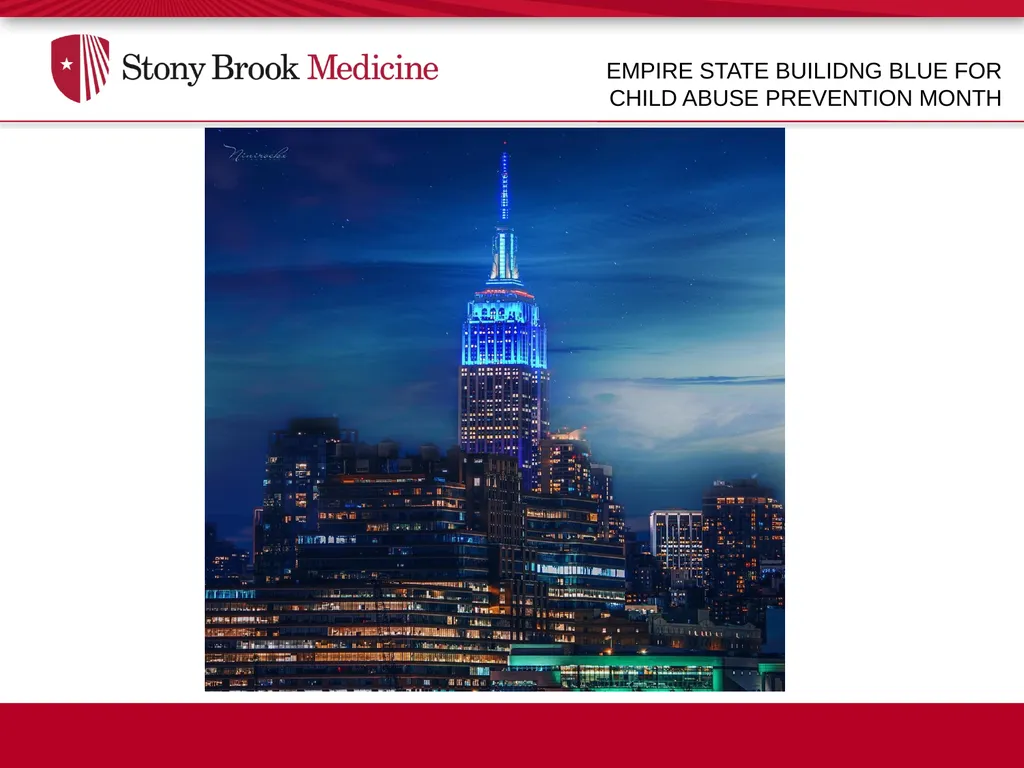
EMPIRE STATE BUILIDNG Blue for Child Abuse prevention month<br>
05
Definition Child Abuse and Neglect:
The Family Court Act of the state of New York defines child neglect or abuse as:
The act, or failure to act, by any parent or caretaker that results in the death, serious physical or emotional harm, sexual abuse, or exploitation of a child under the age of 18. Section 412 of the Social Services Law section 1012 of the Family court act<br>
06
*Child Abuse
Generally, the term abuse encompasses the most serious harms committed against children.
An abused child is a child whose parent or other person legally responsible for his/her care inflicts upon the child serious physical injury, creates a substantial risk of serious physical injury, or commits an act of sex abuse against the child.
A person who perpetrates any of these actions against a child in their care can be abusive, and so can a person who allows someone else to do things to a child.
*NYS Office of Children and Family Services Child Abuse and Neglect<br>
07
*Neglect and Maltreatment
Refers to the quality of care a child is receiving from those responsible for the child.
Maltreatment occurs when a parent or other person legally responsible for the care of a child harms a child or places a child in imminent danger of harm by failing to exercise the minimum degree of care in providing the child with any of the following: food, clothing, shelter, education or medical care when financially able to do so. ( Poverty is not neglect and maltreatment)
Maltreatment can also result from abandonment of a child or from not providing adequate supervision for the child.
A child may be maltreated if a parent engages in excessive use of drugs or alcohol such that it interferes with their ability to adequately supervise the child.
*NYS Office of Family and Children’s Services Child Neglect and Maltreatment<br>
08
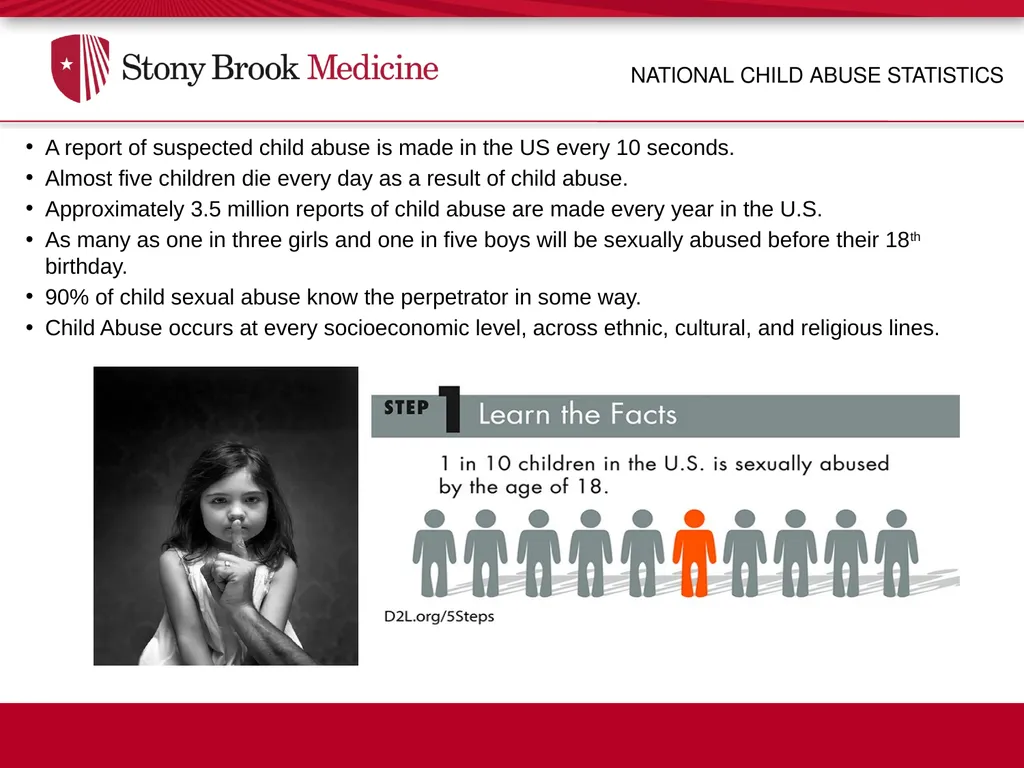
A report of suspected child abuse is made in the US every 10 seconds.
Almost five children die every day as a result of child abuse.
Approximately 3.5 million reports of child abuse are made every year in the U.S.
As many as one in three girls and one in five boys will be sexually abused before their 18th birthday.
90% of child sexual abuse know the perpetrator in some way.
Child Abuse occurs at every socioeconomic level, across ethnic, cultural, and religious lines. National Child Abuse Statistics<br>
09
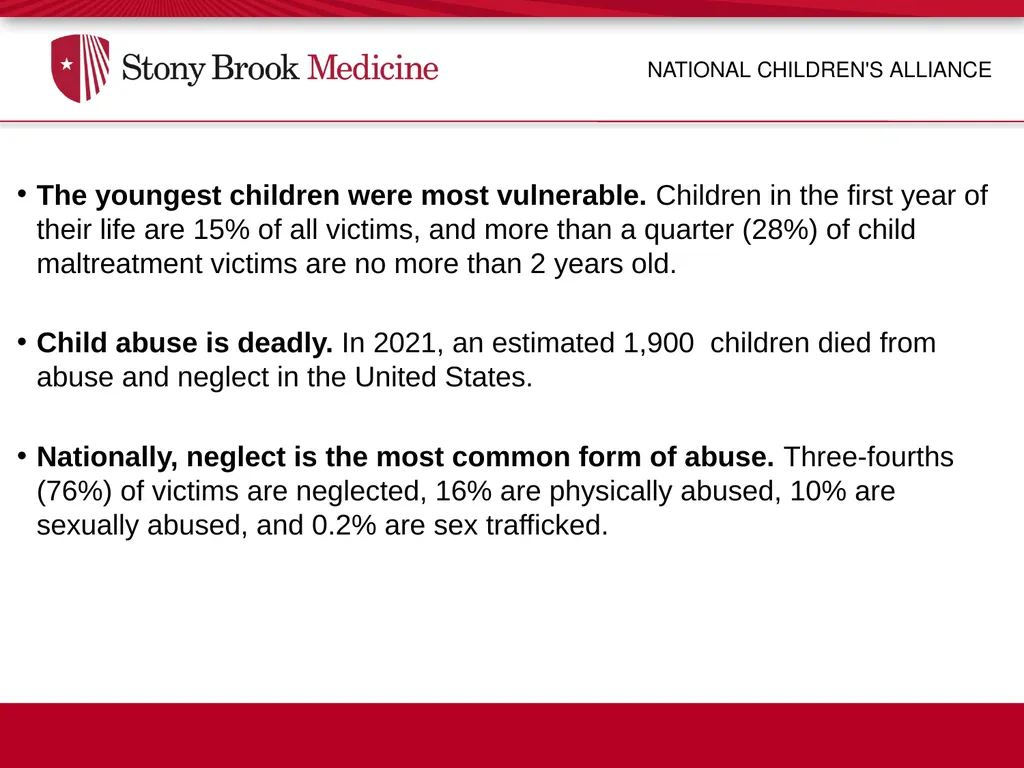
The youngest children were most vulnerable. Children in the first year of their life are 15% of all victims, and more than a quarter (28%) of child maltreatment victims are no more than 2 years old.
Child abuse is deadly. In 2021, an estimated 1,900 children died from abuse and neglect in the United States.
Nationally, neglect is the most common form of abuse. Three-fourths (76%) of victims are neglected, 16% are physically abused, 10% are sexually abused, and 0.2% are sex trafficked. National Children's alliance<br>
10
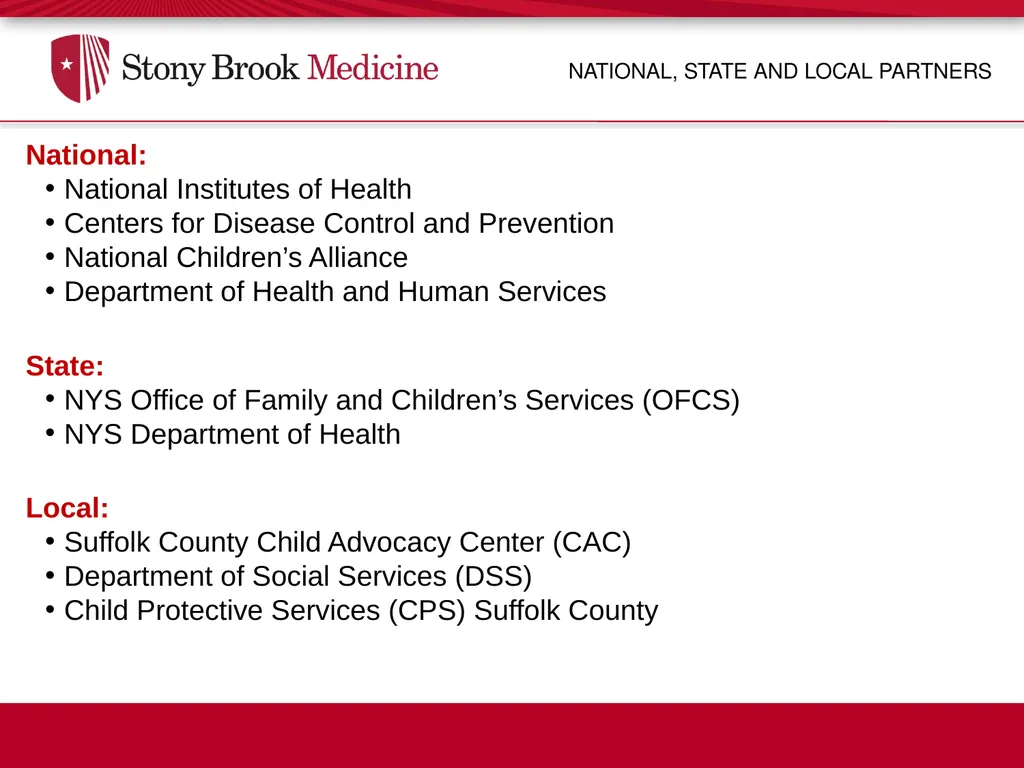
National:
National Institutes of Health
Centers for Disease Control and Prevention
National Children’s Alliance
Department of Health and Human Services
State:
NYS Office of Family and Children’s Services (OFCS)
NYS Department of Health
Local:
Suffolk County Child Advocacy Center (CAC)
Department of Social Services (DSS)
Child Protective Services (CPS) Suffolk County National, State and Local partners<br>
11
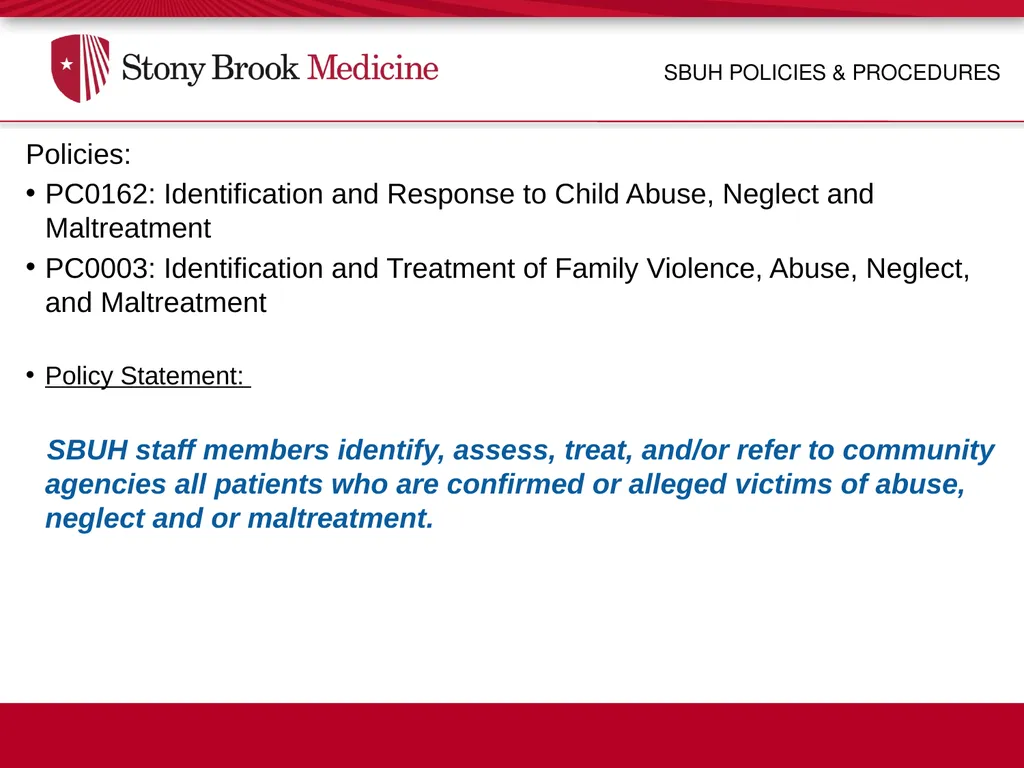
Policies:
PC0162: Identification and Response to Child Abuse, Neglect and Maltreatment
PC0003: Identification and Treatment of Family Violence, Abuse, Neglect, and Maltreatment
Policy Statement:
SBUH staff members identify, assess, treat, and/or refer to community agencies all patients who are confirmed or alleged victims of abuse, neglect and or maltreatment. SBUH Policies & Procedures<br>
12
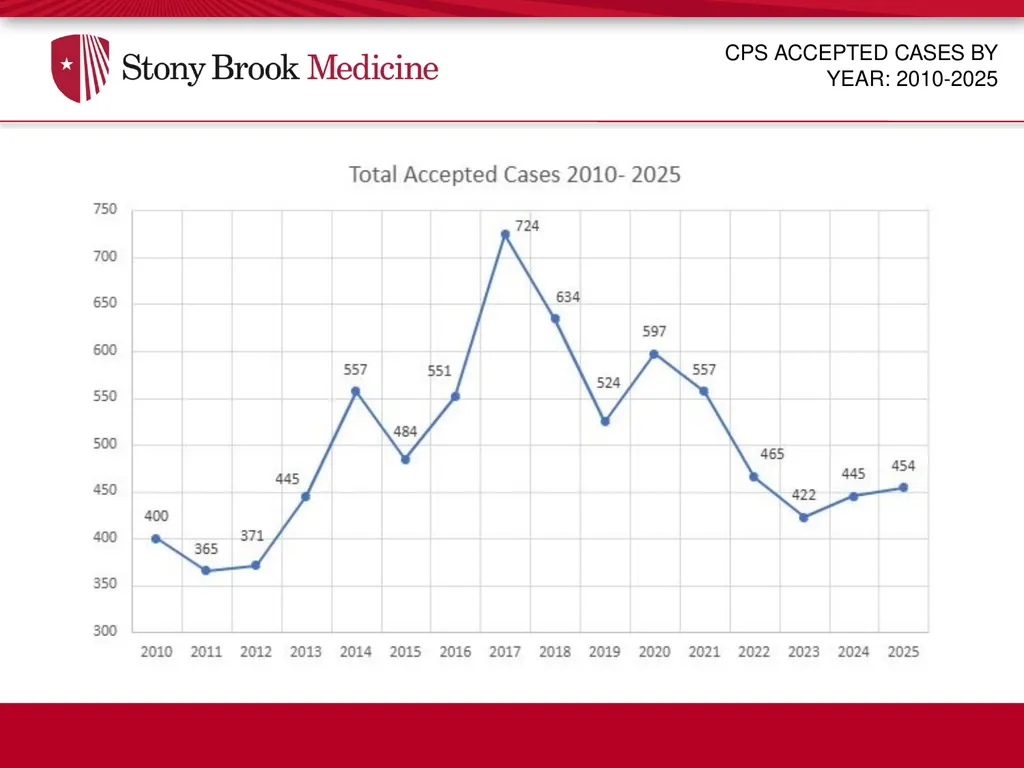
Stony Brook Medicine cases that were called in and accepted for suspected child abuse or maltreatment to the New York State Central Registry (SCR):*
2010: 400 Cases 2022: 465 Cases
2011: 365 Cases 2023: 433 Cases
2012: 371 Cases 2024: 445 Cases
2013: 445 Cases 2025: 454 Cases
2014: 557 Cases
2015: 484 Cases
2016: 551 Cases
2017: 724 Cases
2018: 634 Cases
2019: 524 Cases
2020: 597 Cases
2021: 557 Cases
*Number of Cases does not include number of children Suspected Cases of Child
Abuse at SBUH<br>
13
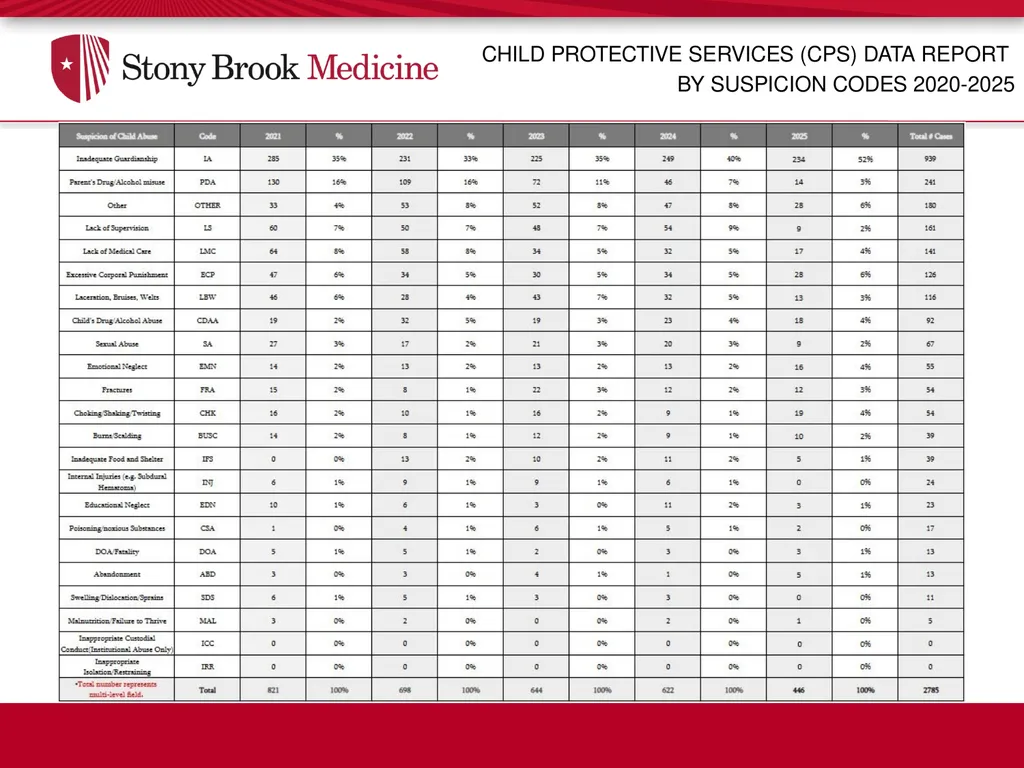
Child Protective Services (CPS) Data Report
By Suspicion Codes 2020-2025<br>
By Suspicion Codes 2020-2025<br>
14
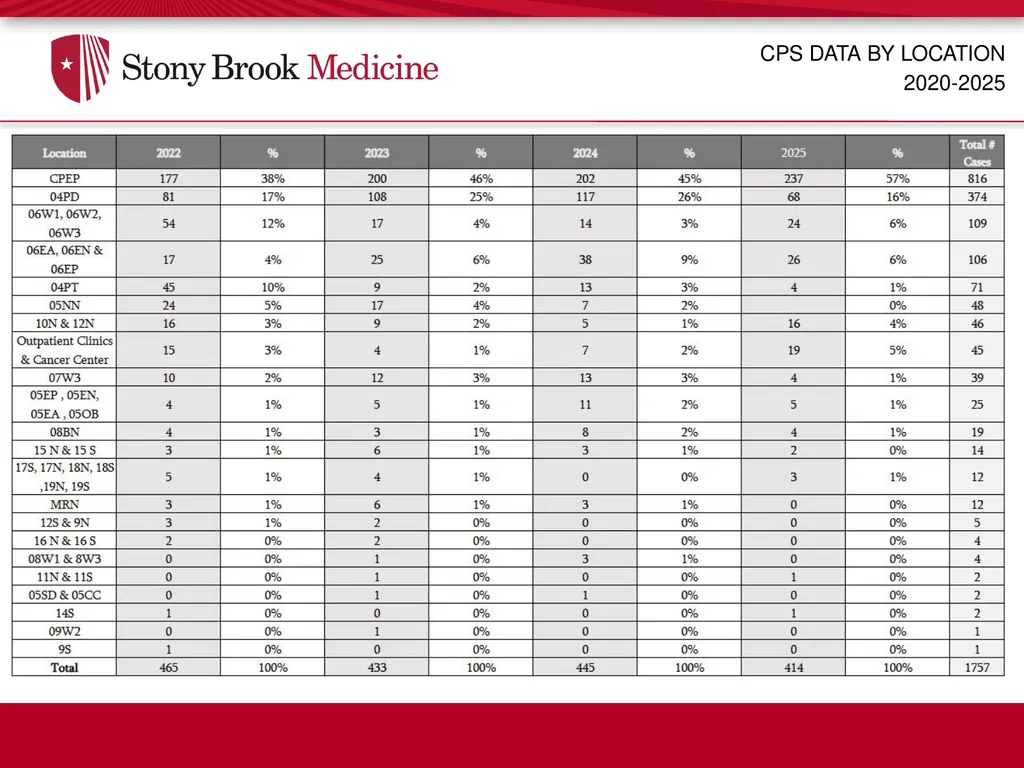
CPS Data by Location
2020-2025<br>
2020-2025<br>
15
CPS Accepted Cases by Year: 2010-2025<br>
16
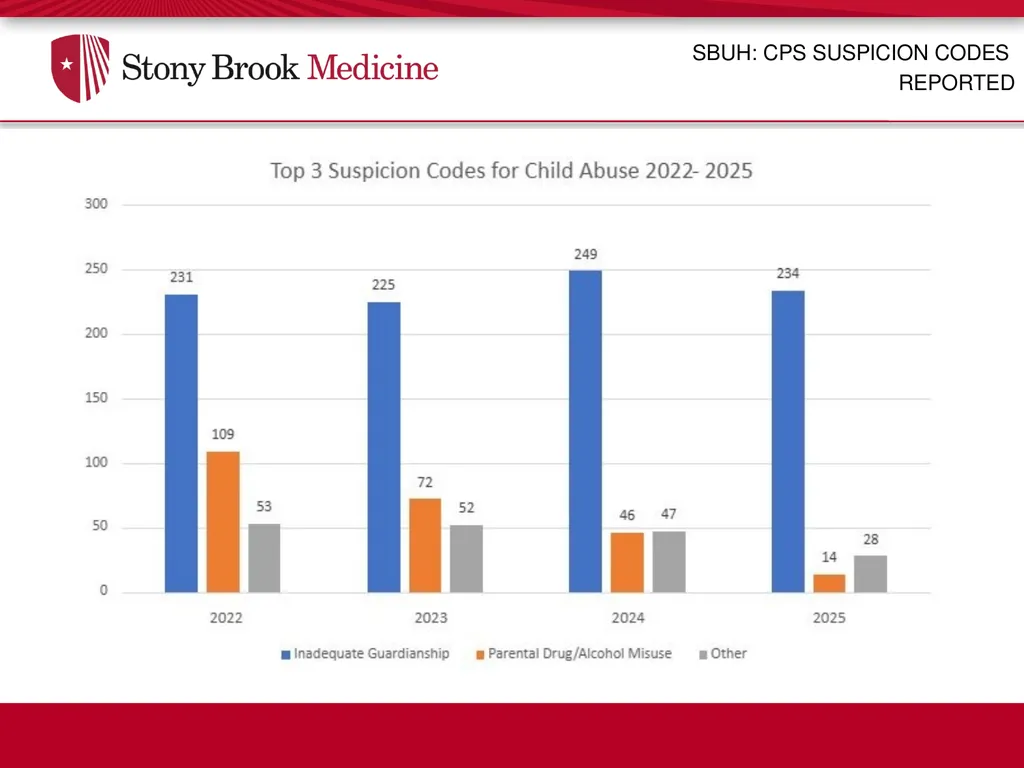
SBUH: CPS Suspicion Codes
Reported<br>
Reported<br>
17
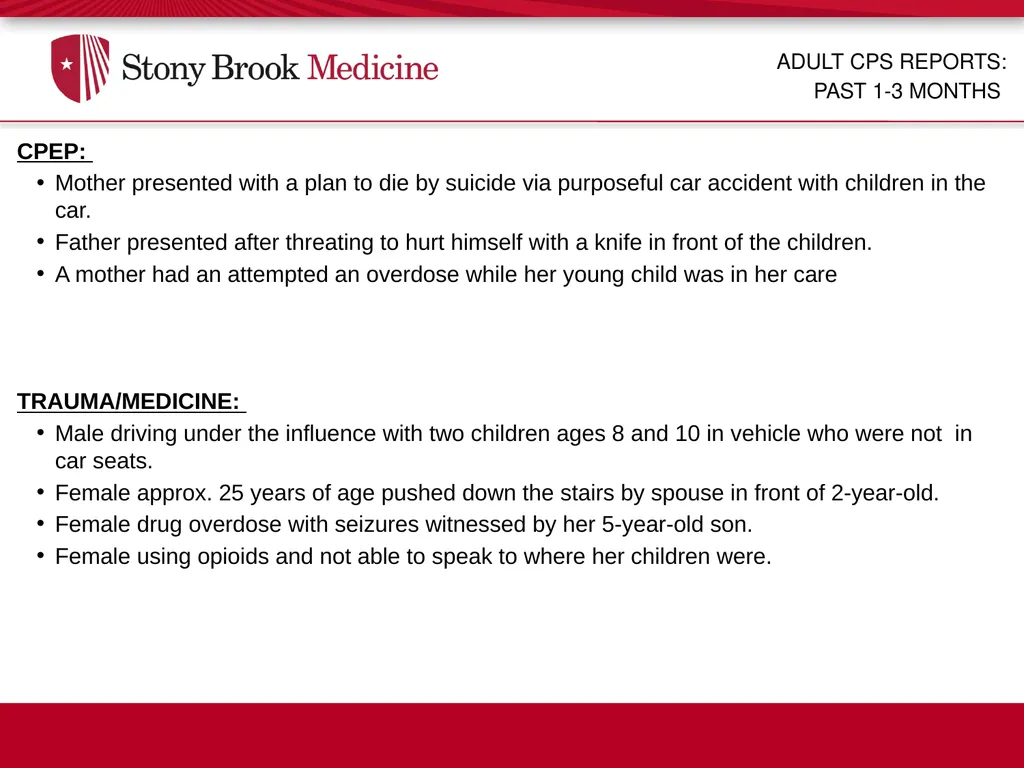
CPEP:
Mother presented with a plan to die by suicide via purposeful car accident with children in the car.
Father presented after threating to hurt himself with a knife in front of the children.
A mother had an attempted an overdose while her young child was in her care
TRAUMA/MEDICINE:
Male driving under the influence with two children ages 8 and 10 in vehicle who were not in car seats.
Female approx. 25 years of age pushed down the stairs by spouse in front of 2-year-old.
Female drug overdose with seizures witnessed by her 5-year-old son.
Female using opioids and not able to speak to where her children were. Adult CPS Reports:
past 1-3 months<br>
18
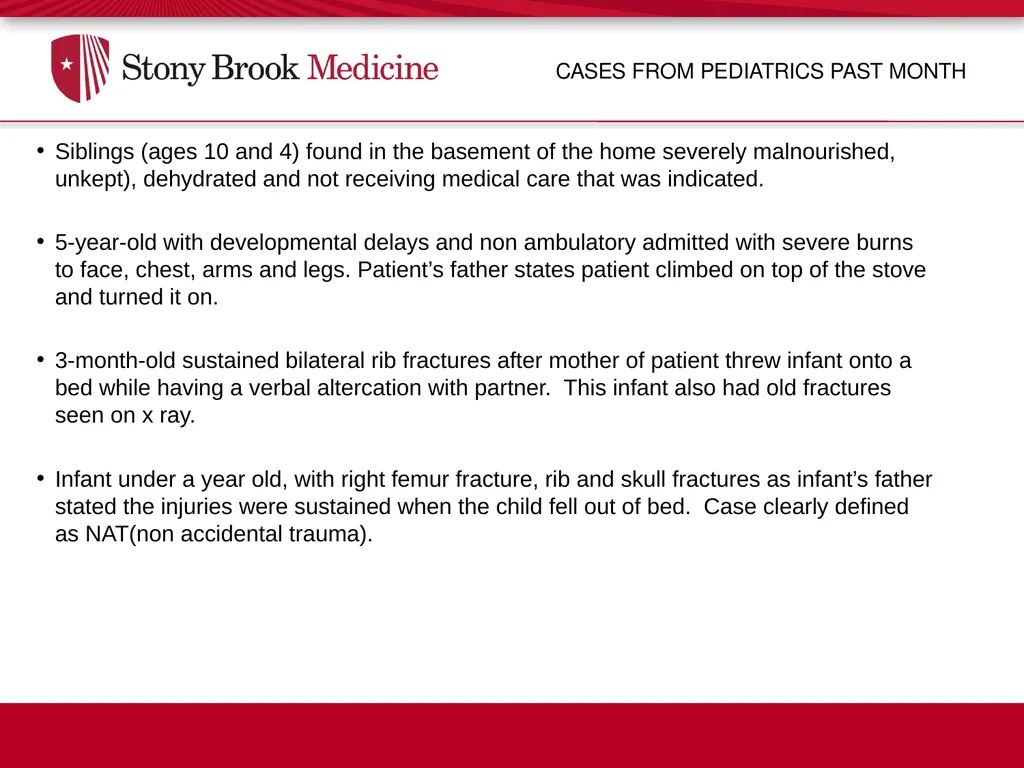
Siblings (ages 10 and 4) found in the basement of the home severely malnourished, unkept), dehydrated and not receiving medical care that was indicated.
5-year-old with developmental delays and non ambulatory admitted with severe burns to face, chest, arms and legs. Patient’s father states patient climbed on top of the stove and turned it on.
3-month-old sustained bilateral rib fractures after mother of patient threw infant onto a bed while having a verbal altercation with partner. This infant also had old fractures seen on x ray.
Infant under a year old, with right femur fracture, rib and skull fractures as infant’s father stated the injuries were sustained when the child fell out of bed. Case clearly defined as NAT(non accidental trauma). Cases from Pediatrics past month<br>
19
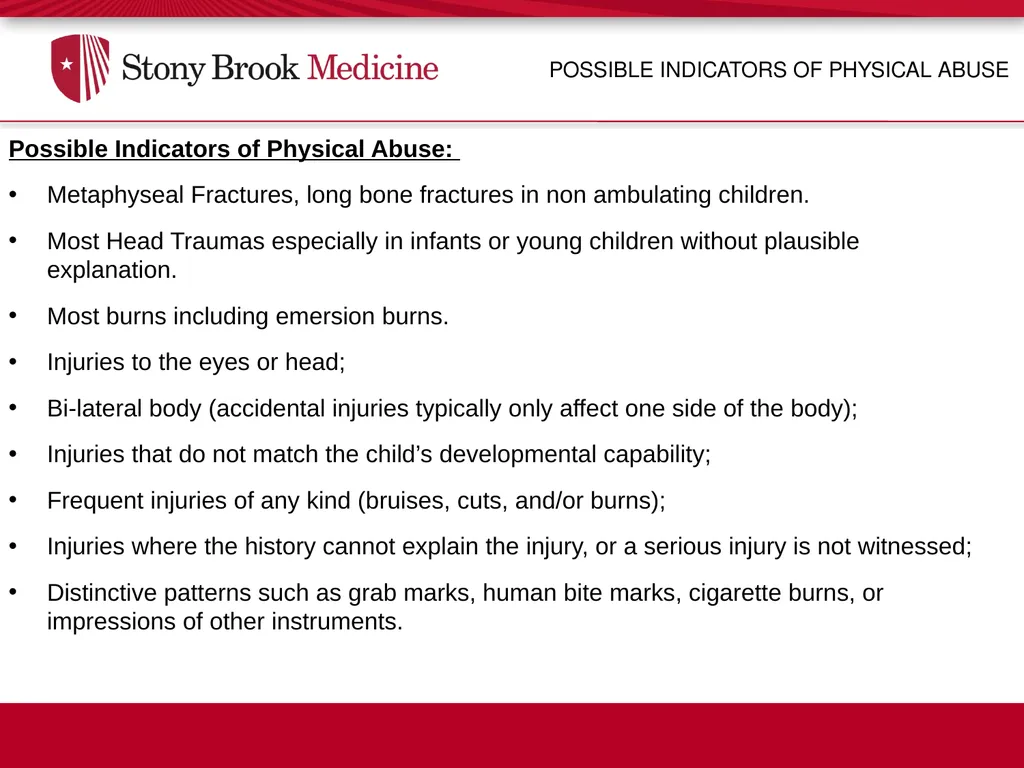
Possible Indicators of Physical Abuse:
Metaphyseal Fractures, long bone fractures in non ambulating children.
Most Head Traumas especially in infants or young children without plausible explanation.
Most burns including emersion burns.
Injuries to the eyes or head;
Bi-lateral body (accidental injuries typically only affect one side of the body);
Injuries that do not match the child’s developmental capability;
Frequent injuries of any kind (bruises, cuts, and/or burns);
Injuries where the history cannot explain the injury, or a serious injury is not witnessed;
Distinctive patterns such as grab marks, human bite marks, cigarette burns, or impressions of other instruments. Possible Indicators of Physical Abuse<br>
20
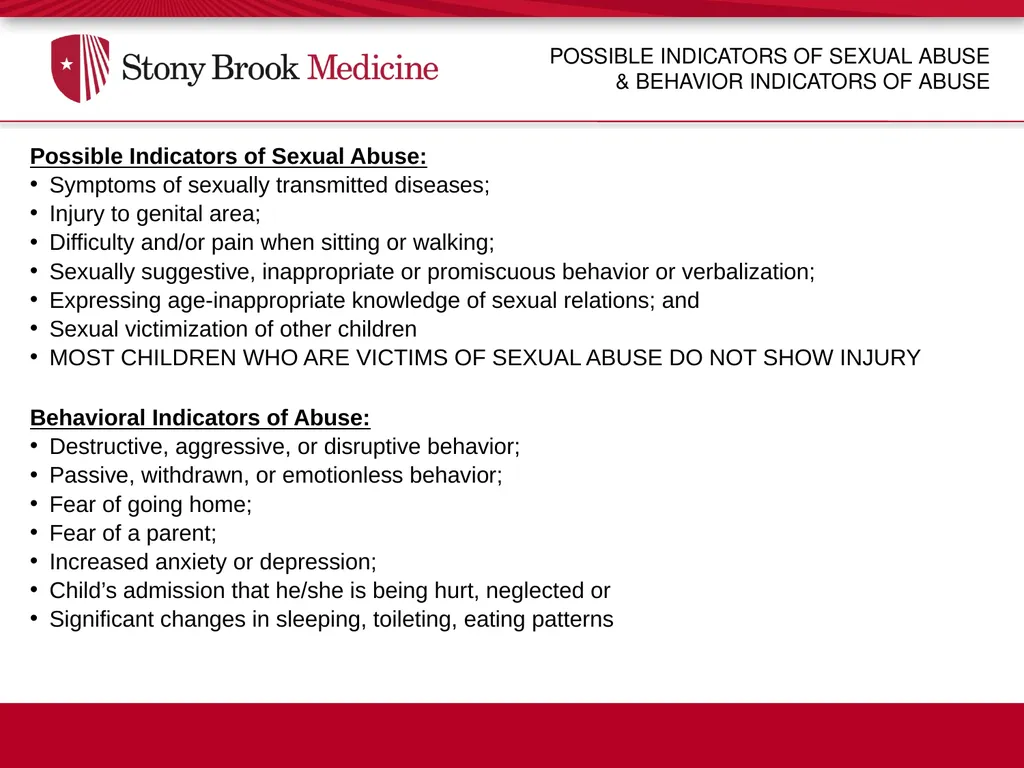
Possible Indicators of Sexual Abuse:
Symptoms of sexually transmitted diseases;
Injury to genital area;
Difficulty and/or pain when sitting or walking;
Sexually suggestive, inappropriate or promiscuous behavior or verbalization;
Expressing age-inappropriate knowledge of sexual relations; and
Sexual victimization of other children
MOST CHILDREN WHO ARE VICTIMS OF SEXUAL ABUSE DO NOT SHOW INJURY
Behavioral Indicators of Abuse:
Destructive, aggressive, or disruptive behavior;
Passive, withdrawn, or emotionless behavior;
Fear of going home;
Fear of a parent;
Increased anxiety or depression;
Child’s admission that he/she is being hurt, neglected or
Significant changes in sleeping, toileting, eating patterns Possible Indicators of Sexual Abuse
& Behavior Indicators of Abuse<br>
21
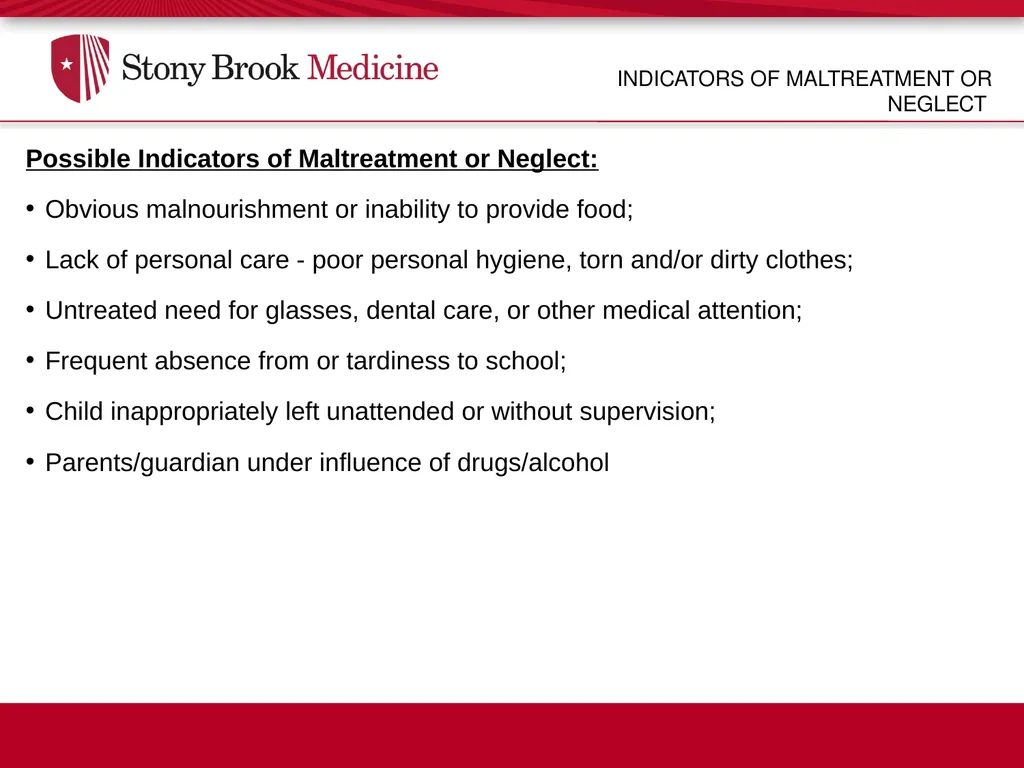
Possible Indicators of Maltreatment or Neglect:
Obvious malnourishment or inability to provide food;
Lack of personal care - poor personal hygiene, torn and/or dirty clothes;
Untreated need for glasses, dental care, or other medical attention;
Frequent absence from or tardiness to school;
Child inappropriately left unattended or without supervision;
Parents/guardian under influence of drugs/alcohol Indicators of Maltreatment or Neglect<br>
22
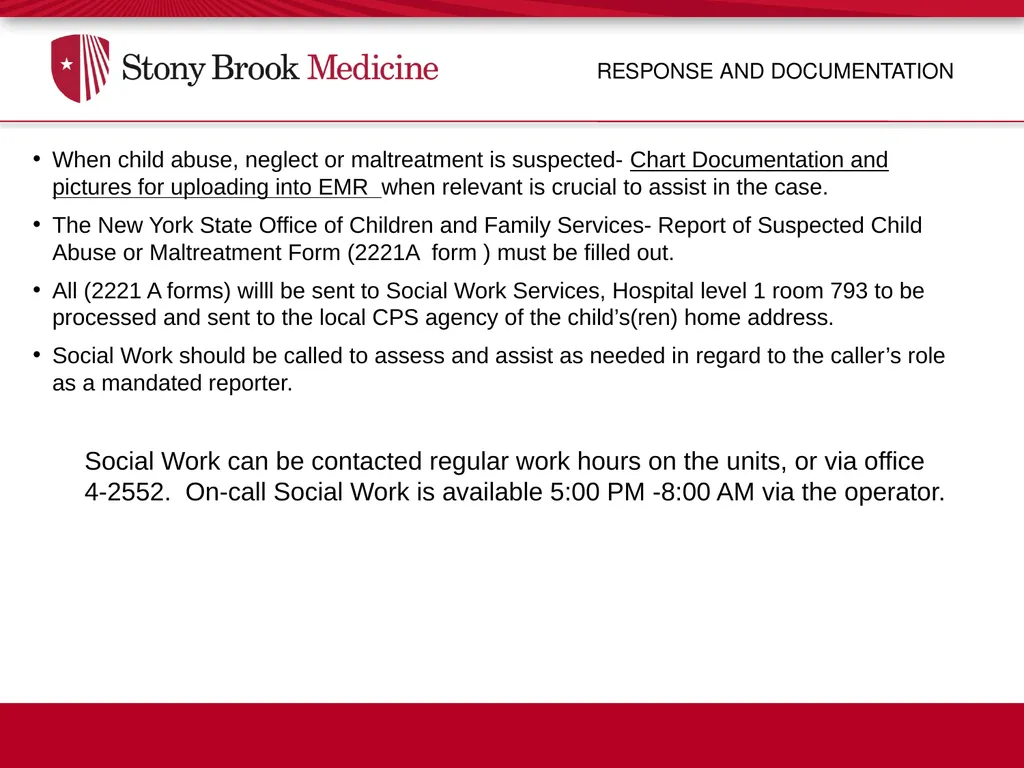
When child abuse, neglect or maltreatment is suspected- Chart Documentation and pictures for uploading into EMR when relevant is crucial to assist in the case.
The New York State Office of Children and Family Services- Report of Suspected Child Abuse or Maltreatment Form (2221A form ) must be filled out.
All (2221 A forms) willl be sent to Social Work Services, Hospital level 1 room 793 to be processed and sent to the local CPS agency of the child’s(ren) home address.
Social Work should be called to assess and assist as needed in regard to the caller’s role as a mandated reporter.
Social Work can be contacted regular work hours on the units, or via office 4-2552. On-call Social Work is available 5:00 PM -8:00 AM via the operator. Response and DOCUMENTATION<br>
23
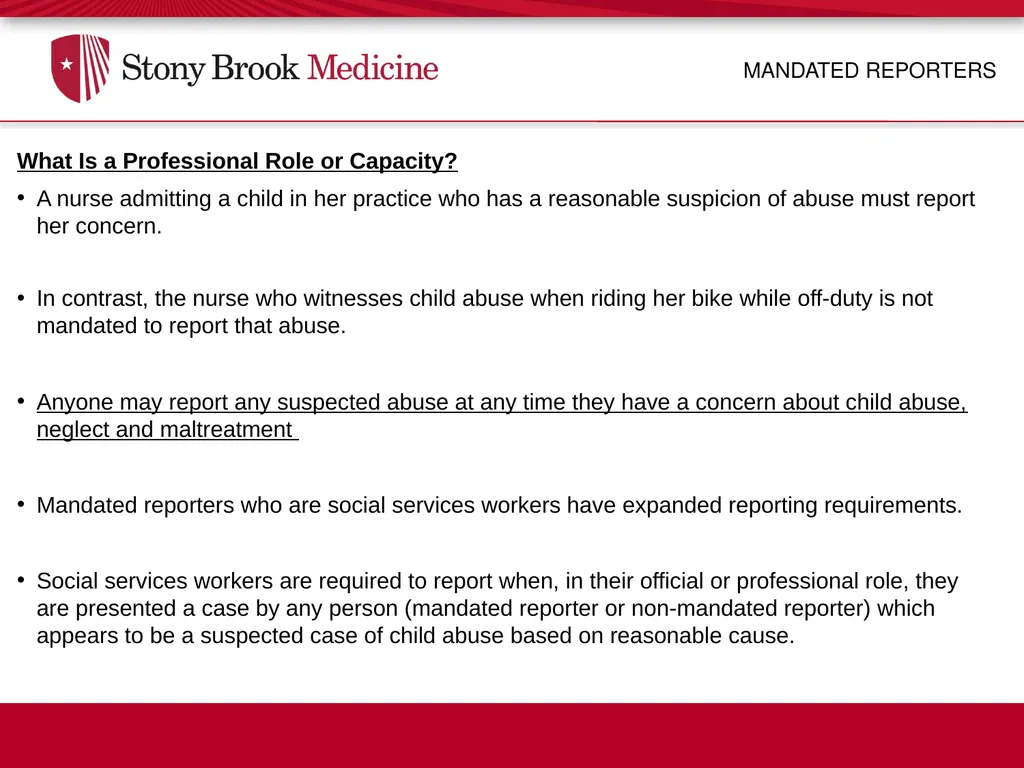
What Is a Professional Role or Capacity?
A nurse admitting a child in her practice who has a reasonable suspicion of abuse must report her concern.
In contrast, the nurse who witnesses child abuse when riding her bike while off-duty is not mandated to report that abuse.
Anyone may report any suspected abuse at any time they have a concern about child abuse, neglect and maltreatment
Mandated reporters who are social services workers have expanded reporting requirements.
Social services workers are required to report when, in their official or professional role, they are presented a case by any person (mandated reporter or non-mandated reporter) which appears to be a suspected case of child abuse based on reasonable cause. Mandated Reporters<br>
24
When it is reasonably believed that a child is being abused or maltreated, a Social Worker should be called to assist with patient/family and assess.
Call Social Work Services (4-2552) during normal work hours.
After normal working hours page the On-Call Social Worker through the hospital operator.
The Social Worker will assist you in fulfilling your responsibilities as a mandated reporter.
Inability to reach a Social Worker should not impact your obligation to fulfill your duties as a mandated reporter. The Role of Social Work<br>
25
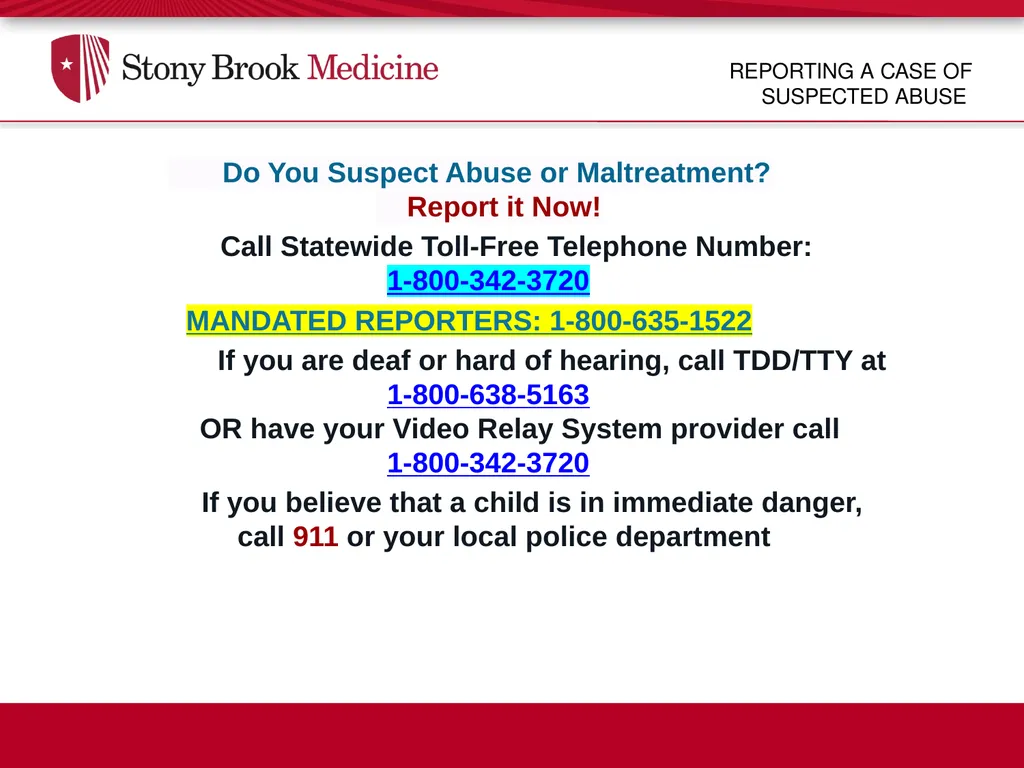
Do You Suspect Abuse or Maltreatment?
Report it Now!
Call Statewide Toll-Free Telephone Number: 1-800-342-3720
MANDATED REPORTERS: 1-800-635-1522
If you are deaf or hard of hearing, call TDD/TTY at 1-800-638-5163 OR have your Video Relay System provider call 1-800-342-3720
If you believe that a child is in immediate danger, call 911 or your local police department REPORTING A CASE OF SUSPECTED ABUSE<br>
26
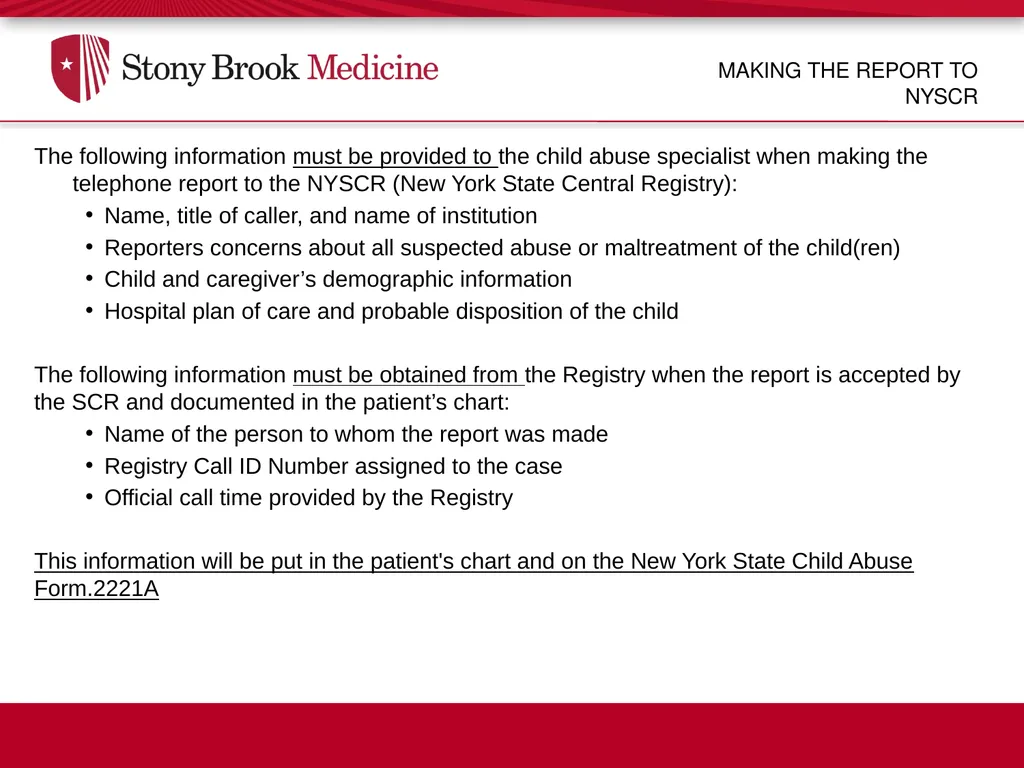
The following information must be provided to the child abuse specialist when making the telephone report to the NYSCR (New York State Central Registry):
Name, title of caller, and name of institution
Reporters concerns about all suspected abuse or maltreatment of the child(ren)
Child and caregiver’s demographic information
Hospital plan of care and probable disposition of the child
The following information must be obtained from the Registry when the report is accepted by the SCR and documented in the patient’s chart:
Name of the person to whom the report was made
Registry Call ID Number assigned to the case
Official call time provided by the Registry
This information will be put in the patient's chart and on the New York State Child Abuse Form.2221A Making The Report to NYSCR<br>
27
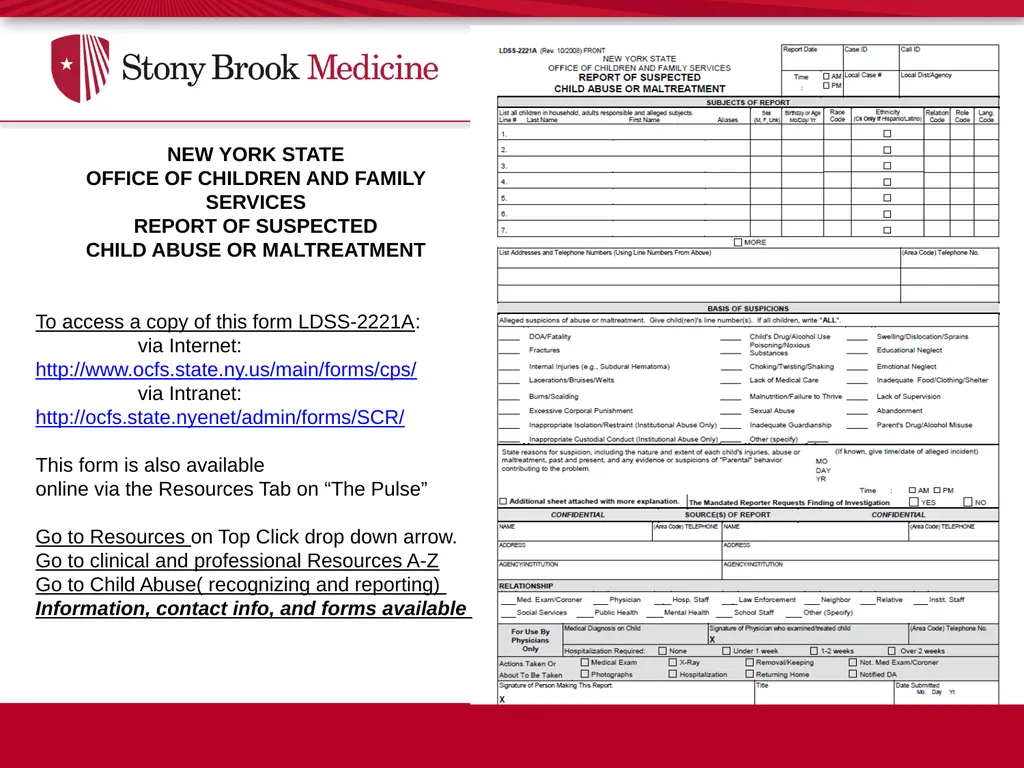
NEW YORK STATE
OFFICE OF CHILDREN AND FAMILY SERVICES
REPORT OF SUSPECTED
CHILD ABUSE OR MALTREATMENT
To access a copy of this form LDSS-2221A:
via Internet: http://www.ocfs.state.ny.us/main/forms/cps/
via Intranet: http://ocfs.state.nyenet/admin/forms/SCR/
This form is also available
online via the Resources Tab on “The Pulse”
Go to Resources on Top Click drop down arrow.
Go to clinical and professional Resources A-Z
Go to Child Abuse( recognizing and reporting)
Information, contact info, and forms available<br>
28
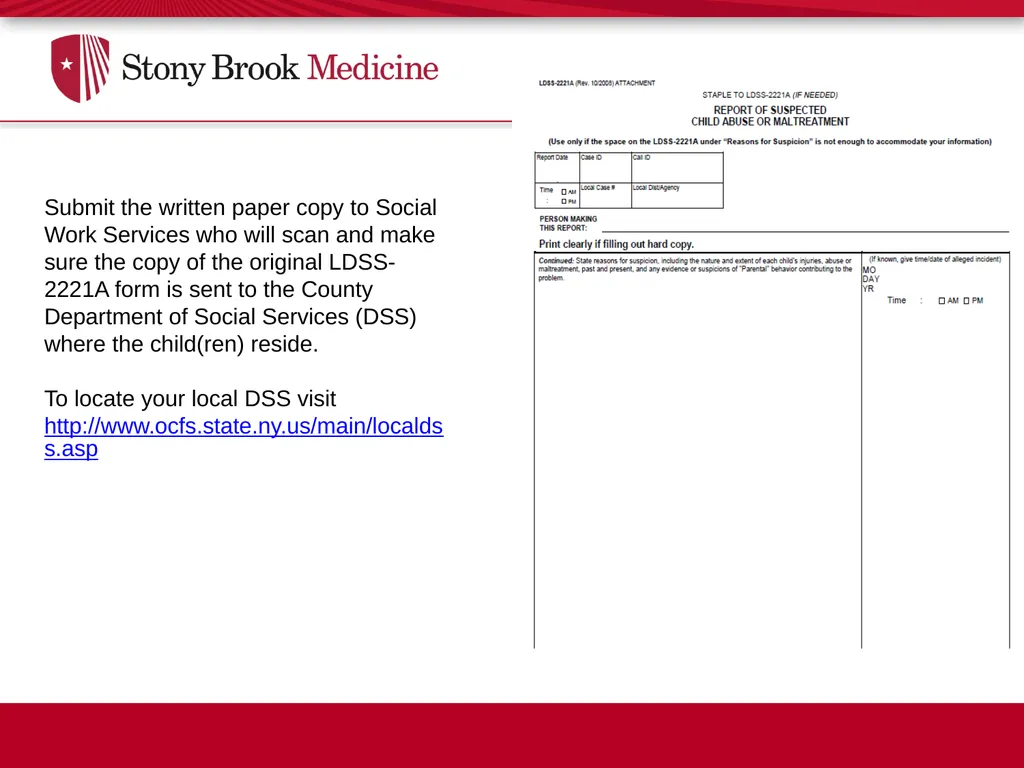
Submit the written paper copy to Social Work Services who will scan and make sure the copy of the original LDSS-2221A form is sent to the County Department of Social Services (DSS) where the child(ren) reside.
To locate your local DSS visit http://www.ocfs.state.ny.us/main/localdss.asp<br>
To locate your local DSS visit http://www.ocfs.state.ny.us/main/localdss.asp<br>
29
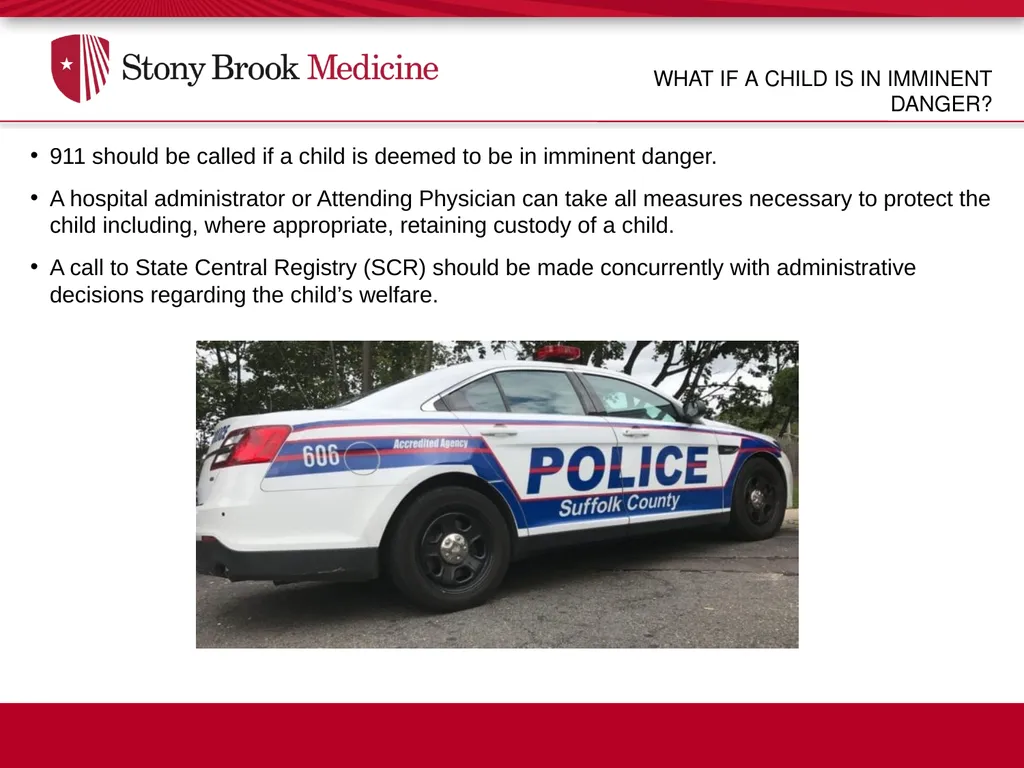
911 should be called if a child is deemed to be in imminent danger.
A hospital administrator or Attending Physician can take all measures necessary to protect the child including, where appropriate, retaining custody of a child.
A call to State Central Registry (SCR) should be made concurrently with administrative decisions regarding the child’s welfare. What If A Child Is In Imminent Danger?<br>
30
New to New York State 2024:
Changes to NY State Policy
Amendments to the law
Updated mandated reporter training
Child protection and family health initiatives
Prevention
Equity Health Care Equity<br>
Changes to NY State Policy
Amendments to the law
Updated mandated reporter training
Child protection and family health initiatives
Prevention
Equity Health Care Equity<br>
31
Health Equity: Creating a Sense of Belonging at Stony Brook Medicine
As part of our mission to provide world-class, compassionate care, we want to ensure that everyone associated with Stony Brook Medicine — patients, visitors, faculty, staff and those within the community — feels a sense of belonging in everything we do.
At Stony Brook Medicine, we have always been committed to creating a culture of health equity and belongingness for all — a healthcare environment in which everyone who walks through our doors feels safe, respected, valued and heard.
Our goal is to strengthen, amplify and sustain Stony Brook Medicine’s efforts around eliminating health inequities by improving health outcomes and closing any gaps in healthcare disparities that have been rooted in historical injustices, biases, and discrimination. Carol Gomes, CEO
Blog<br>
32
Updated Mandated Reporter Training Requirements:
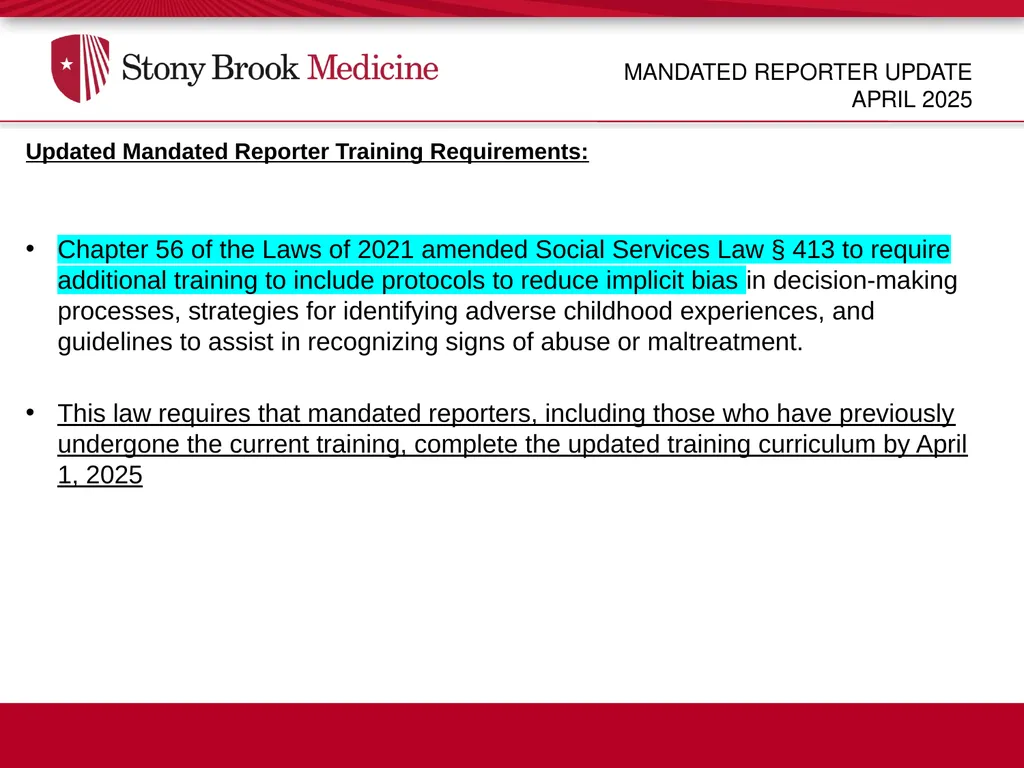
Chapter 56 of the Laws of 2021 amended Social Services Law § 413 to require additional training to include protocols to reduce implicit bias in decision-making processes, strategies for identifying adverse childhood experiences, and guidelines to assist in recognizing signs of abuse or maltreatment.
This law requires that mandated reporters, including those who have previously undergone the current training, complete the updated training curriculum by April 1, 2025 MANDATED REPORTER update April 2025<br>
33
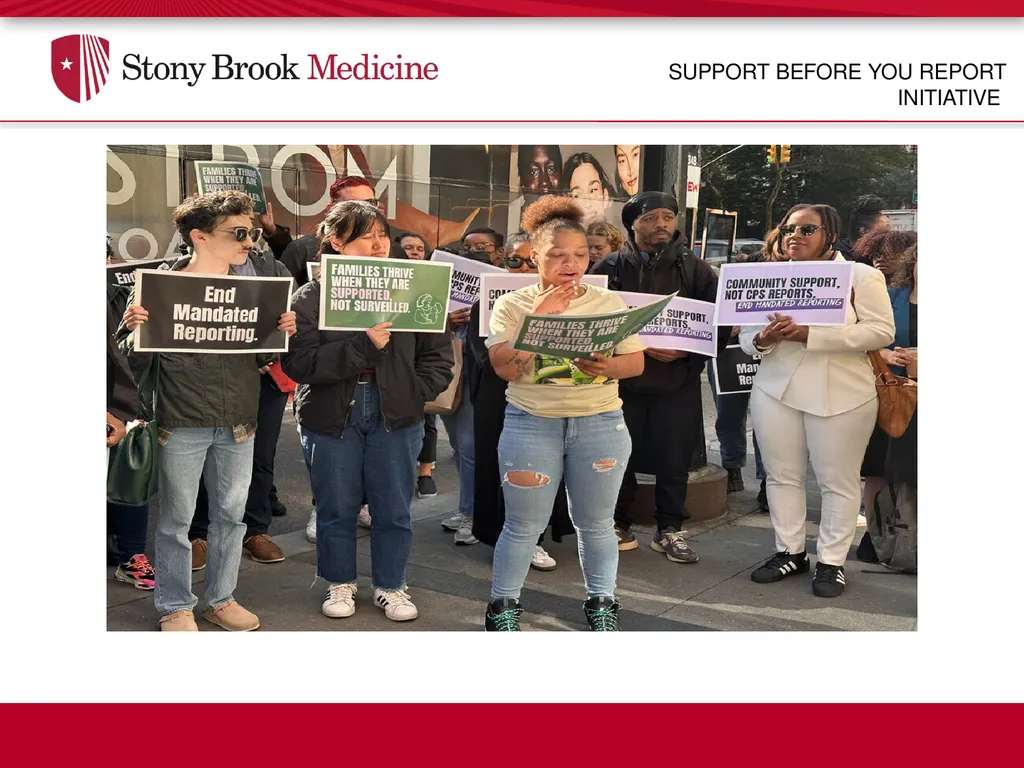
Support before you report Initiative<br>
34
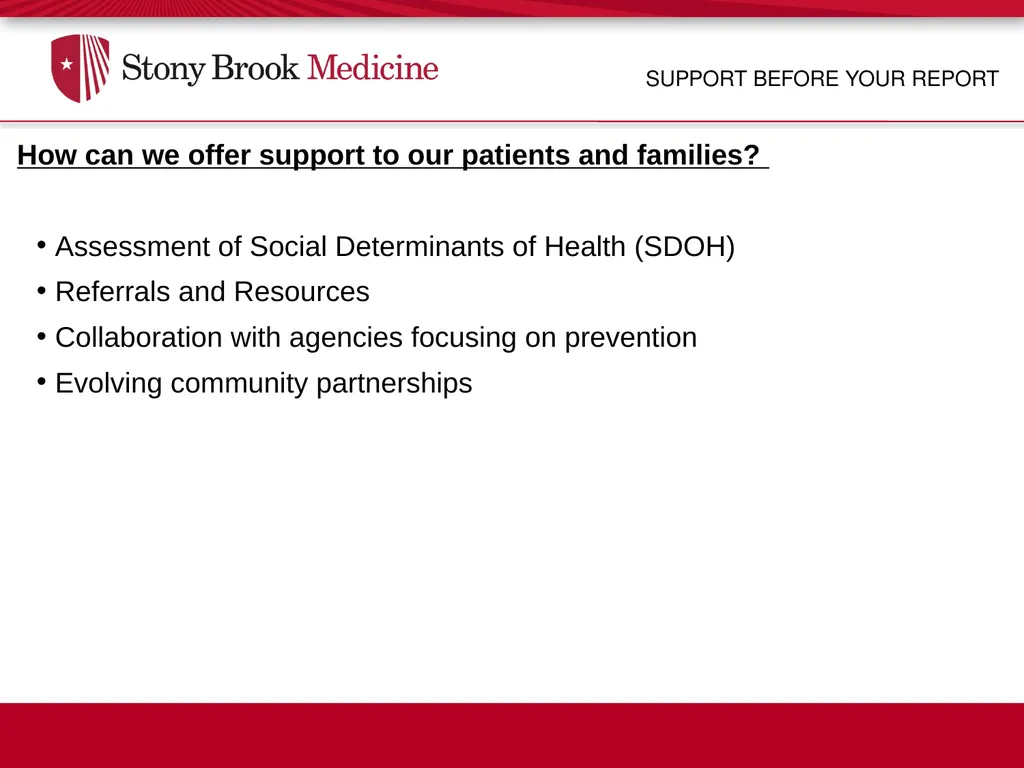
How can we offer support to our patients and families?
Assessment of Social Determinants of Health (SDOH)
Referrals and Resources
Collaboration with agencies focusing on prevention
Evolving community partnerships SUPPORT BEFORE Your REPORT<br>
Assessment of Social Determinants of Health (SDOH)
Referrals and Resources
Collaboration with agencies focusing on prevention
Evolving community partnerships SUPPORT BEFORE Your REPORT<br>
35
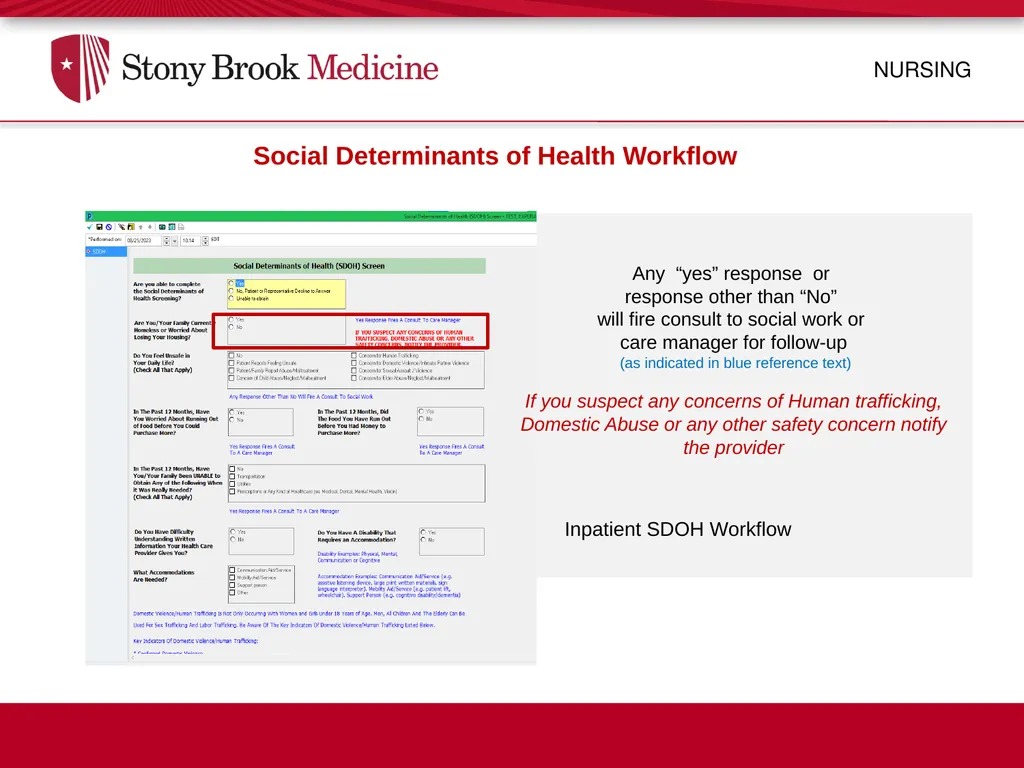
Social Determinants of Health Workflow Inpatient SDOH Workflow Nursing Any “yes” response or
response other than “No”
will fire consult to social work or
care manager for follow-up
(as indicated in blue reference text)
If you suspect any concerns of Human trafficking, Domestic Abuse or any other safety concern notify the provider<br>
response other than “No”
will fire consult to social work or
care manager for follow-up
(as indicated in blue reference text)
If you suspect any concerns of Human trafficking, Domestic Abuse or any other safety concern notify the provider<br>
36
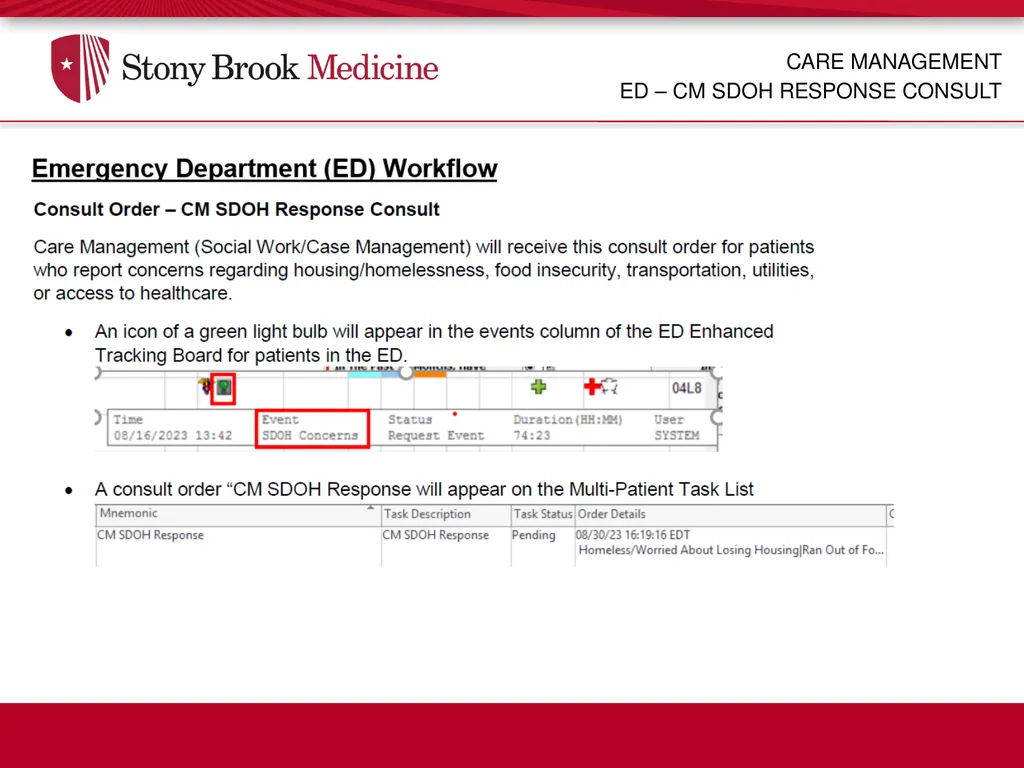
Care Management
ED – CM SDOH Response Consult<br>
ED – CM SDOH Response Consult<br>
37
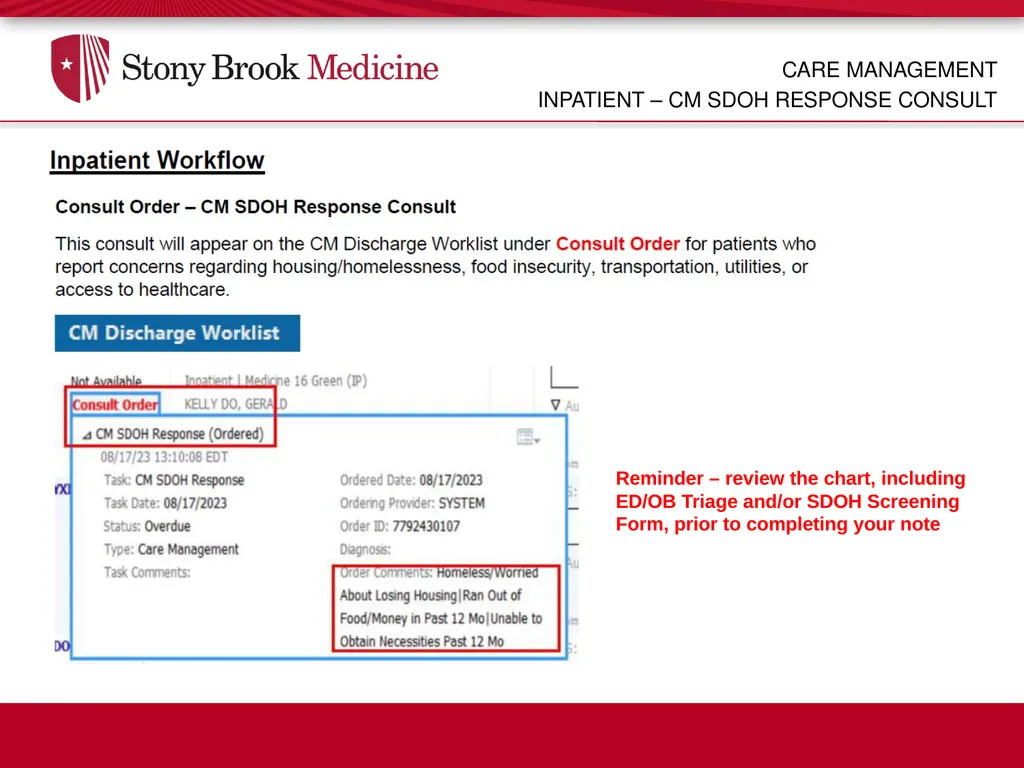
Care Management
Inpatient – CM SDOH Response Consult Reminder – review the chart, including ED/OB Triage and/or SDOH Screening Form, prior to completing your note<br>
Inpatient – CM SDOH Response Consult Reminder – review the chart, including ED/OB Triage and/or SDOH Screening Form, prior to completing your note<br>
38
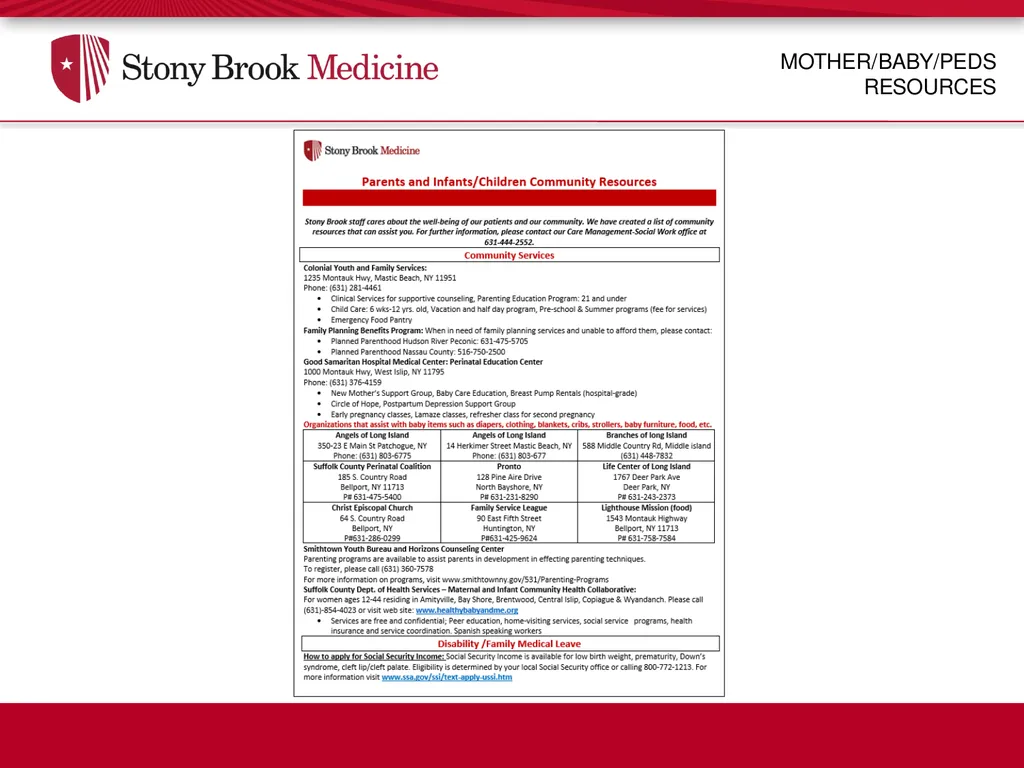
Mother/Baby/Peds Resources<br>
39
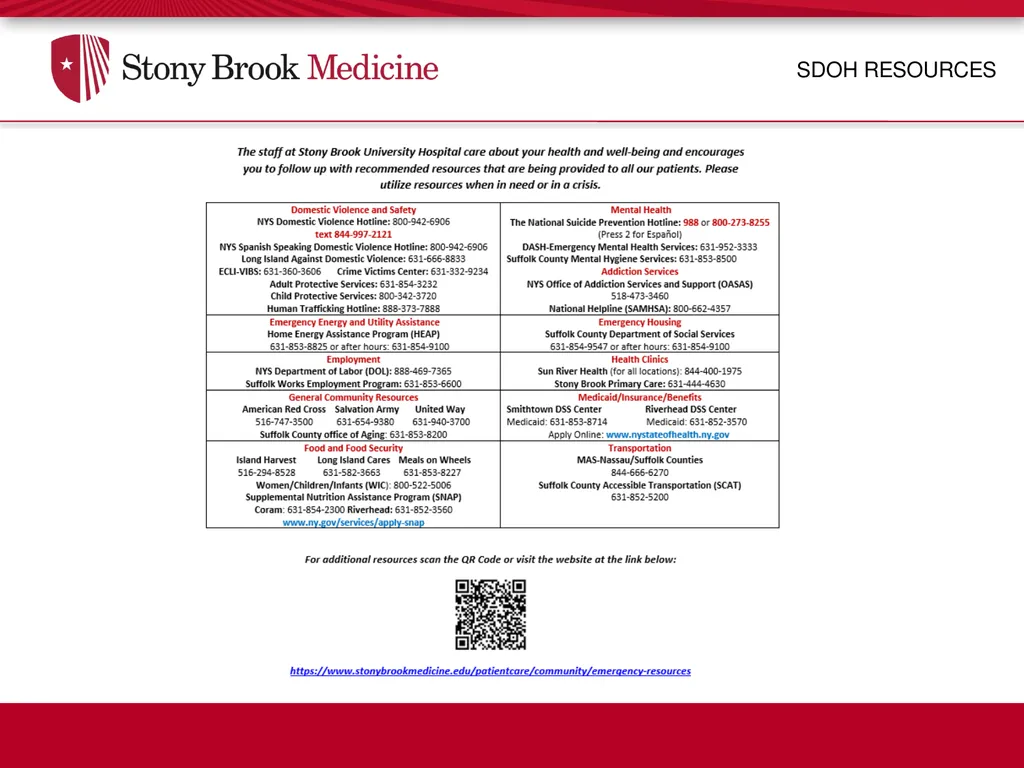
SDOH Resources<br>
40
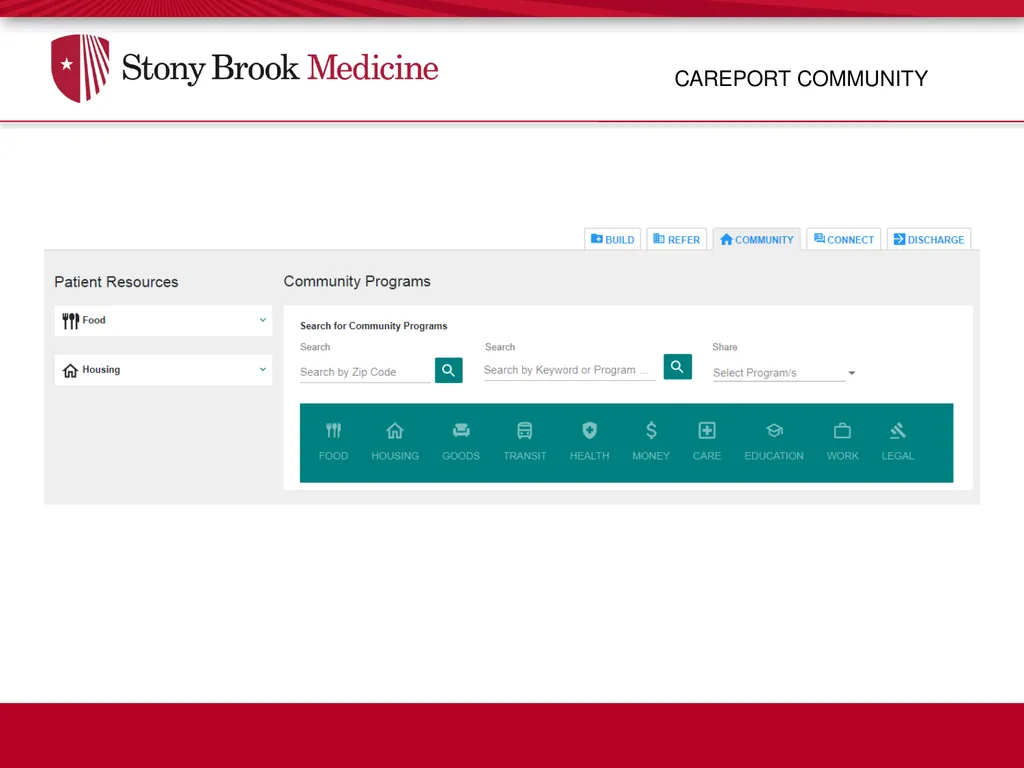
CAREPORT Community<br>
41
Child Advocacy Center (CAC) Suffolk County: Locations Central Islip and Riverhead
Director, Dr. Gillian Hopgood ( Stony Brook Medicine)
The mission of the Child Advocacy Center is to provide a comprehensive, culturally competent, and trauma -informed response to child abuse allegations. We utilize a multi -disciplinary team approach in a child -friendly environment in ways that support and protect children, non -offending parents, and other family members.
Using a multi -disciplinary team approach, the Child Advocacy Center:
• Provides a safe, child -focused setting for interviewing and examining child victims.
• Improves investigations and prosecutions of child physical and sexual abuse cases.
• Enhances interagency communication and cooperation.
• Provides the family with services and assists them throughout the investigation and legal processes.
Services at the CAC both sites include family advocacy, referrals for counseling, forensic interviews for children who disclose abuse, medical evaluation for children who have disclosed abuse, and case review. Child Advocacy centers in NYS counties<br>
42
Stonybrook needs to work with HR/Education/School leaders to meet new Mandated reporter regulation by April 1, 2025.
Enhance and update our pre-existing Child Protection Committee for increase in attendance, relevance, and discussion on specific patient issues.
Refer all active cases to Dr. Hopgood and Michelle Tepper to coordinate.
Increase of case discussion and analysis.
Cross Train Social Work for increased competency in Pediatric/mother baby/NICU cases.
Continued growth and development of a Child Abuse Response team headed by our Family Violence Prevention Team: Dr. Hopgood and Michelle Tepper, DNP. What is Next<br>
43
Michelle Tepper, DPN Director Family Violence Prevention Program: (631) 965-9568
Main Social Work Office: 4-2552
Susan McCarthy, Director of Social Work: 4-3215
Fatima Calle, Assistant Director Social Work: 4-1005
Shatara Jean, Supervisor Social Work Mother/baby/PEDS: 4-3104
Idania Hazlehurst, Supervisor, Out-patient Social Work 4-4343 CONTACTS<br>
Main Social Work Office: 4-2552
Susan McCarthy, Director of Social Work: 4-3215
Fatima Calle, Assistant Director Social Work: 4-1005
Shatara Jean, Supervisor Social Work Mother/baby/PEDS: 4-3104
Idania Hazlehurst, Supervisor, Out-patient Social Work 4-4343 CONTACTS<br>
44
We must protect families, we must protect children, who have inalienable rights and should be loved, should be taken care of physically and mentally, and should not be brought into the world only to suffer.
- Indira Ghandi<br>
- Indira Ghandi<br>
45
QUESTIONS?<br>