Junior Cycle Information A guide to the new Junior Cycle Framework Overview- what they are working towards. On completion of their three years in school, students will receive a Junior Cycle Profile of Achievement Certificate issued by the
"Junior Cycle Information A guide to the new Junior" is the property of its rightful owner. Permission is granted to
download and print the materials on this website for personal, non-commercial use only, and to display it
on your personal computer provided you do not modify the materials and that you retain all copyright
notices contained in the materials. By downloading content from our website, you accept the terms of this
agreement.
Presentation Transcript
01
Junior Cycle Information A guide to the new Junior Cycle Framework<br>
02
Overview- what they are working towards. On completion of their three years in school, students will receive a Junior Cycle Profile of Achievement Certificate issued by the school.
On this certificate appears
Their subject exam results (to a maximum of 10 subjects).
Their two Classroom Based Assessment results in these subjects.
Their Other Areas of Learning.
Wellbeing Reporting.<br>
03
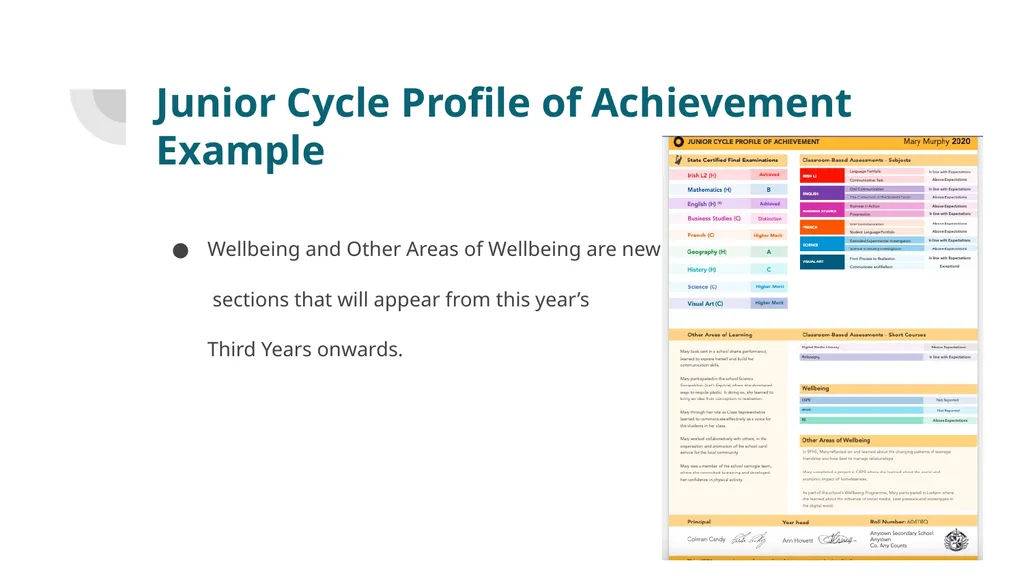
Junior Cycle Profile of Achievement Example Wellbeing and Other Areas of Wellbeing are new
sections that will appear from this year’s
Third Years onwards.<br>
04
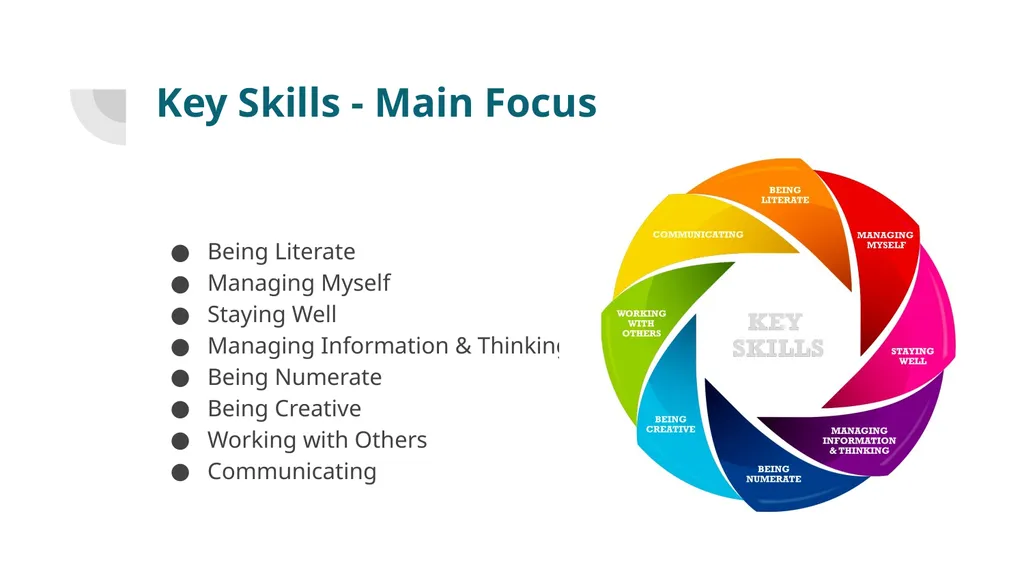
Key Skills - Main Focus Being Literate
Managing Myself
Staying Well
Managing Information & Thinking
Being Numerate
Being Creative
Working with Others
Communicating<br>
05
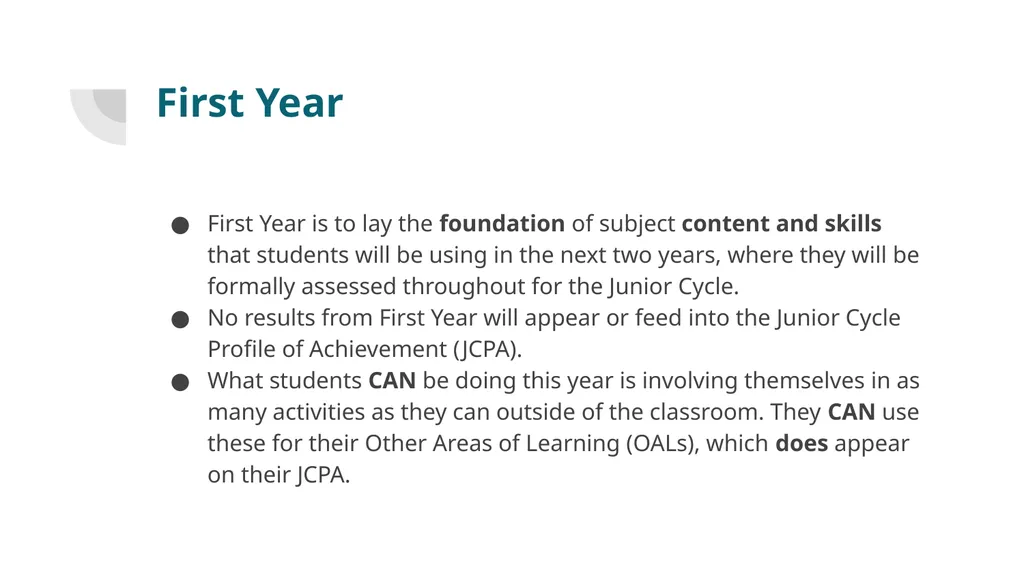
First Year First Year is to lay the foundation of subject content and skills that students will be using in the next two years, where they will be formally assessed throughout for the Junior Cycle.
No results from First Year will appear or feed into the Junior Cycle Profile of Achievement (JCPA).
What students CAN be doing this year is involving themselves in as many activities as they can outside of the classroom. They CAN use these for their Other Areas of Learning (OALs), which does appear on their JCPA.<br>
06
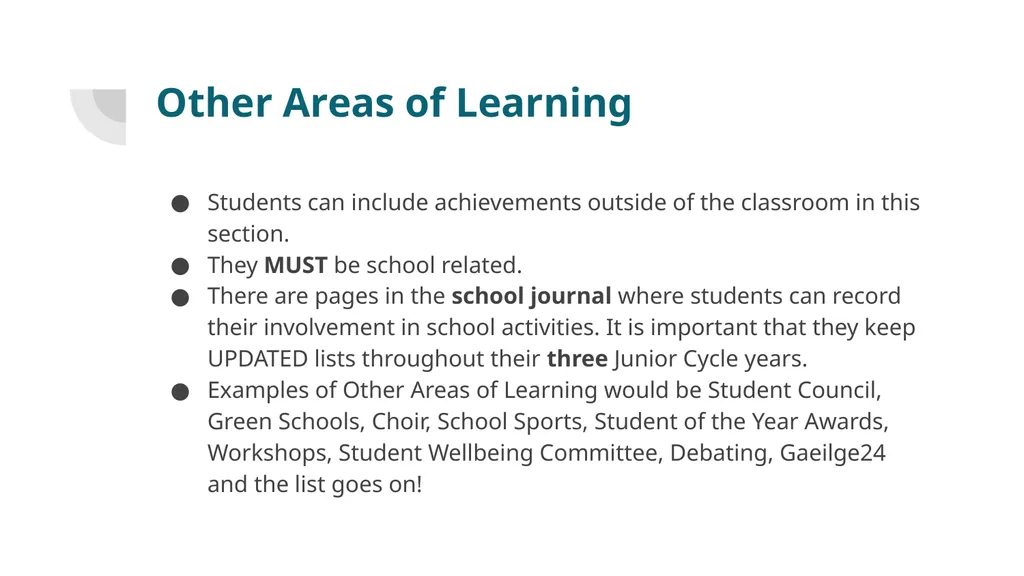
Other Areas of Learning Students can include achievements outside of the classroom in this section.
They MUST be school related.
There are pages in the school journal where students can record their involvement in school activities. It is important that they keep UPDATED lists throughout their three Junior Cycle years.
Examples of Other Areas of Learning would be Student Council, Green Schools, Choir, School Sports, Student of the Year Awards, Workshops, Student Wellbeing Committee, Debating, Gaeilge24 and the list goes on!<br>
07
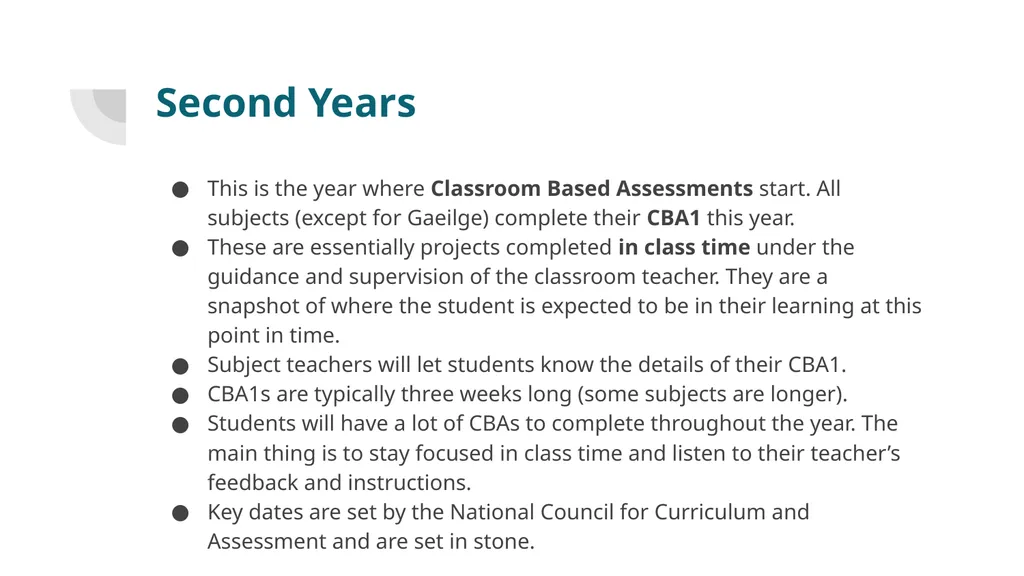
Second Years This is the year where Classroom Based Assessments start. All subjects (except for Gaeilge) complete their CBA1 this year.
These are essentially projects completed in class time under the guidance and supervision of the classroom teacher. They are a snapshot of where the student is expected to be in their learning at this point in time.
Subject teachers will let students know the details of their CBA1.
CBA1s are typically three weeks long (some subjects are longer).
Students will have a lot of CBAs to complete throughout the year. The main thing is to stay focused in class time and listen to their teacher’s feedback and instructions.
Key dates are set by the National Council for Curriculum and Assessment and are set in stone.<br>
08
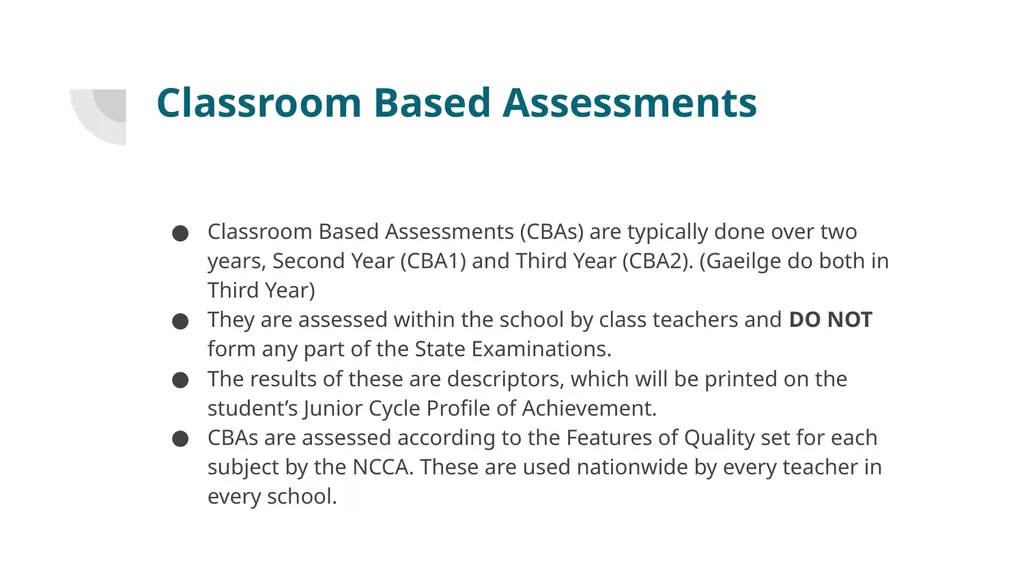
Classroom Based Assessments Classroom Based Assessments (CBAs) are typically done over two years, Second Year (CBA1) and Third Year (CBA2). (Gaeilge do both in Third Year)
They are assessed within the school by class teachers and DO NOT form any part of the State Examinations.
The results of these are descriptors, which will be printed on the student’s Junior Cycle Profile of Achievement.
CBAs are assessed according to the Features of Quality set for each subject by the NCCA. These are used nationwide by every teacher in every school.<br>
09
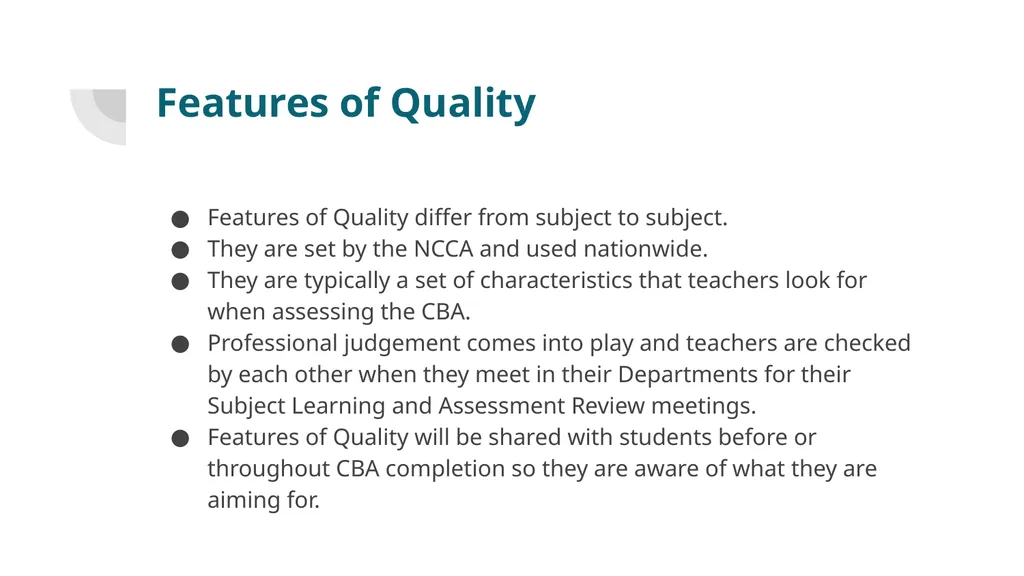
Features of Quality Features of Quality differ from subject to subject.
They are set by the NCCA and used nationwide.
They are typically a set of characteristics that teachers look for when assessing the CBA.
Professional judgement comes into play and teachers are checked by each other when they meet in their Departments for their Subject Learning and Assessment Review meetings.
Features of Quality will be shared with students before or throughout CBA completion so they are aware of what they are aiming for.<br>
10
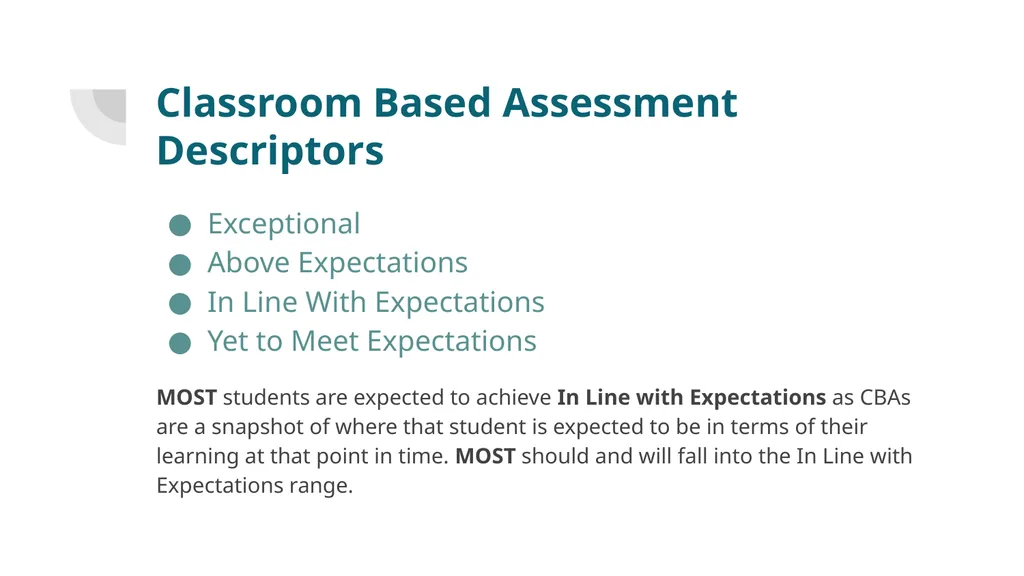
Classroom Based Assessment Descriptors Exceptional
Above Expectations
In Line With Expectations
Yet to Meet Expectations
MOST students are expected to achieve In Line with Expectations as CBAs are a snapshot of where that student is expected to be in terms of their learning at that point in time. MOST should and will fall into the In Line with Expectations range.<br>
11
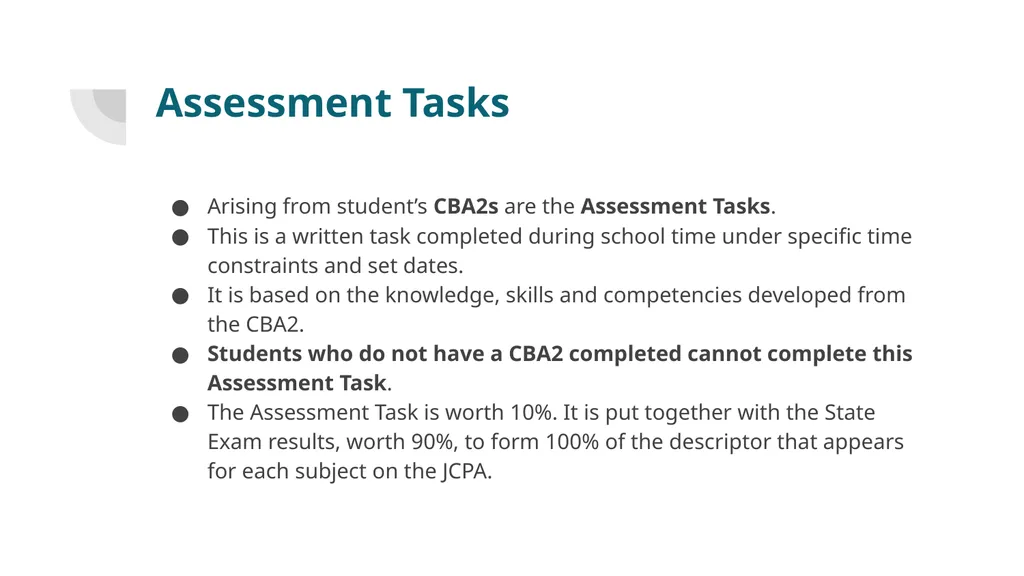
Assessment Tasks Arising from student’s CBA2s are the Assessment Tasks.
This is a written task completed during school time under specific time constraints and set dates.
It is based on the knowledge, skills and competencies developed from the CBA2.
Students who do not have a CBA2 completed cannot complete this Assessment Task.
The Assessment Task is worth 10%. It is put together with the State Exam results, worth 90%, to form 100% of the descriptor that appears for each subject on the JCPA.<br>
12
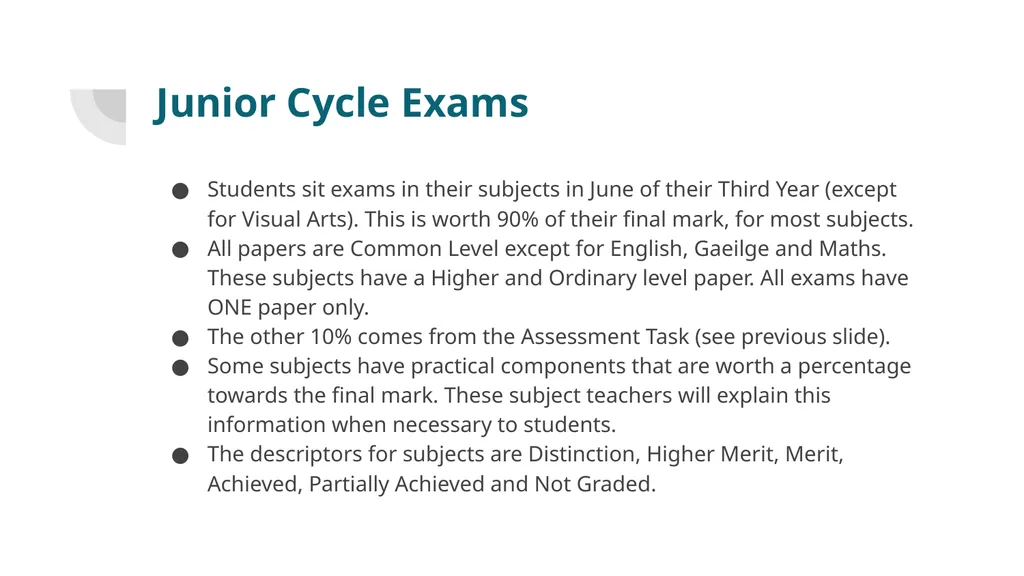
Junior Cycle Exams Students sit exams in their subjects in June of their Third Year (except for Visual Arts). This is worth 90% of their final mark, for most subjects.
All papers are Common Level except for English, Gaeilge and Maths. These subjects have a Higher and Ordinary level paper. All exams have ONE paper only.
The other 10% comes from the Assessment Task (see previous slide).
Some subjects have practical components that are worth a percentage towards the final mark. These subject teachers will explain this information when necessary to students.
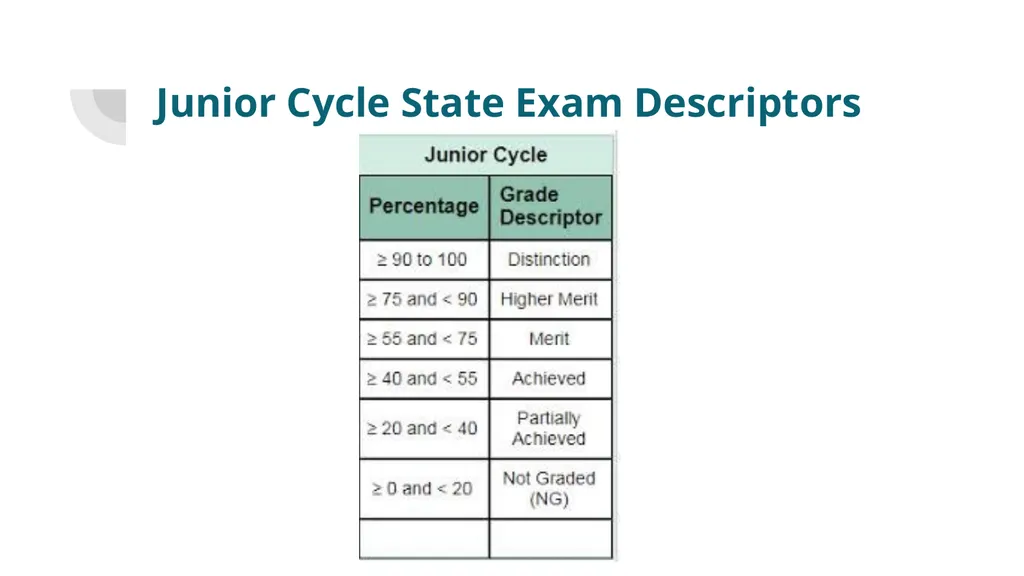
The descriptors for subjects are Distinction, Higher Merit, Merit, Achieved, Partially Achieved and Not Graded.<br>
13
Junior Cycle State Exam Descriptors<br>
14
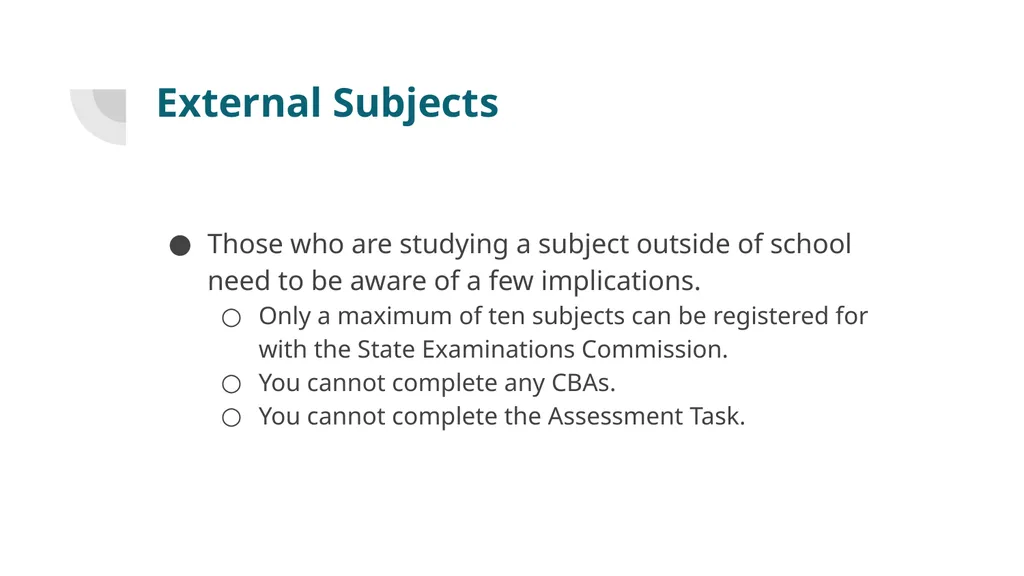
External Subjects Those who are studying a subject outside of school need to be aware of a few implications.
Only a maximum of ten subjects can be registered for with the State Examinations Commission.
You cannot complete any CBAs.
You cannot complete the Assessment Task.<br>
15
Queries Please don’t hesitate to get in touch with us over any queries you may have.
For general queries students can ask Ms. Maher or email mmaher@portmarnockcommunityschool.ie
For specific subject queries, students should ask their subject teacher in the first instance.
On the school site in the Parent section we have links to further information and background to the new Junior Cycle. These may be of help to some of you.<br>