
Jusy Hong, Senior Research Manager, Components &




Description: Jusy Hong, Senior Research Manager, Components Devices Mobile Handsets Zaker Li, Principal Analyst, Components Devices Mobile Handsets Aaron West, Senior Analyst, Components Devices Mobile Handsets askananalystomdia.com
Related Topics
Download Presentation
"Jusy Hong, Senior Research Manager, Components &" is the property of its rightful owner. Permission is granted to download and print the materials on this website for personal, non-commercial use only, and to display it on your personal computer provided you do not modify the materials and that you retain all copyright notices contained in the materials. By downloading content from our website, you accept the terms of this agreement.
Presentation Transcript
slide1. Jusy Hong, Senior Research Manager, Components & Devices – Mobile Handsets
Zaker Li, Principal Analyst, Components & Devices – Mobile Handsets
Aaron West, Senior Analyst, Components & Devices – Mobile Handsets
askananalyst@omdia.com Smartphone Need-To-Know – March 2024<br>
slide2. Contents Samsung, Xiaomi, Honor, and Lenovo showcase their latest technology updates at MWC Barcelona 2024 3
Xiaomi and Honor both announced launches of their new flagship lines at pre-MWC events in Barcelona 5
Nothing Phone (2a) launched 7
Apple released a statement that it will appeal the decision made by the EU’s Digital Markets Act 9
Appendix 11<br>
slide3. Samsung, Xiaomi, Honor, and Lenovo showcase their latest technology updates at MWC Barcelona 2024 Many major smartphone OEMs were either present at the MWC show from February 26–29 or in Barcelona during that week. Samsung, Xiaomi, Honor, Lenovo, and Huawei were the five biggest smartphone players present, while smaller brands such as Google Pixel, ZTE, HMD Global, Tecno, Infinix, TCL, Fairphone, and some rugged phone brands were also involved.
The biggest chipset makers displayed devices that use their system-on-chip (SoC), with both Qualcomm and MediaTek having large exhibiting spaces. UNISOC was also present.
The key smartphone trends at MWC Barcelona 2024 included on-device artificial intelligence (AI) for smartphones, with almost all major OEMs displaying new features. There were also extended reality (XR) glasses featured in some spaces and shared ecosystems showcasing the connection between devices.
Major announcements on new devices included:
Xiaomi will launch its 14 and 14 Ultra phones globally.
Honor will launch its Magic 6 Pro flagship phone globally.
HMD Global and Mattel will collaborate to make a Barbie flip phone that will be launched in the summer of 2024.
Samsung will launch its Galaxy Ring but has not yet confirmed a release date.
Additionally, key smartphone AI developments included:
Samsung demonstrated its AI image search and camera features.
Honor announced and showcased the Magic 6 Pro and its “Magic Portal” feature, generative AI (GenAI) language model, and camera features.
Qualcomm and MediaTek showcased their on-device AI large language model (LLM) capabilities. Gran Fira south entrance for MWC Barcelona 2024 Outside space at MWC Barcelona 2024 for Google Android Source: Omdia analyst photo Source: Omdia analyst photo © 2024 Omdia © 2024 Omdia<br>
slide4. “AI was the hot topic of this year’s MWC. Chipset makers, phone OEMs, software developers, and even major component companies all introduced AI features. However, most AI features available now are from OEMs and are implemented on-device. The spread of third-party apps with AI features is inevitable and will potentially transform the market in the future.” Jusy Hong Senior Research Manager,
Consumer Devices<br>
slide5. Xiaomi and Honor both announced launches of their new flagship lines at pre-MWC events in Barcelona Xiaomi announced the global launch of its flagship phone, the Xiaomi 14 Ultra, at a pre-MWC event on February 25, 2024. At the event, Xiaomi emphasized the camera quality of the 14 Ultra and its continued collaboration with photography brand Leica.
The Xiaomi 14 Ultra will be available from €1,499 and has a quad camera system. This includes a 12mm 0.5x 50MP ultrawide, a 22mm 1x 50MP main, a 75mm 3.2x 50MP telephoto, and a 120mm 5x 50MP periscope camera, all of which have optical image stabilization (OIS), making it one of the most impressive camera systems on any phone.
Xiaomi also discussed its new “AISP” chip in the 14 Ultra, which the company claims to be the world’s first AI large-model computational platform for photography, with 60 Tera operations per second (TOPS) of computing power.
The Xiaomi 14 Ultra also uses Qualcomm’s latest Snapdragon 8 Gen 3 platform but Xiaomi did not disclose the AI features that would be coming to the phone.
Similarly, at a pre-MWC event on February 25, 2024, Honor also announced the global launch of its flagship phone, the Honor Magic6 Pro, following its recent launch in the Chinese market in January 2024.
The Honor Magic6 Pro is available from €1,299 for the 12GB RAM and 512GB ROM model.
The Honor Magic6 Pro is the Honor’s first on-device AI smartphone featuring its Magic LLM. The phone uses Qualcomm’s Snapdragon 8 Gen 3 chipset and can run 7 billion LLM parameters to feature AI functions without the help of cloud AI.
Honor’s Magic Portal feature focuses more on understanding user intentions to suggest tasks and apps based on the user’s selections and habits. It also includes features that can create schedules based on complex graphic and textual understanding, search the phone’s image gallery, and generate images via text prompts. Honor Magic6 Pro launch event on February 25, 2024 Xiaomi 14 Ultra launch event on February 25, 2024 Source: Omdia analyst photo Source: Omdia analyst photo © 2024 Omdia © 2024 Omdia<br>
slide6. “Xiaomi and Honor’s phone launches were the two biggest smartphone announcements at MWC 2024, with both brands expanding their latest flagship smartphones worldwide. However, the prices of both brands’ flagship smartphones in the global market (in Euros) are much higher than their domestic prices (in Chinese Yuan). This could signal that Xiaomi and Honor are using a higher price anchor to break through to the high-end Western market, which is a highly valuable market that both brands’ have not yet seen much success in.” Zaker Li Principal Smartphone Analyst, Consumer Devices<br>
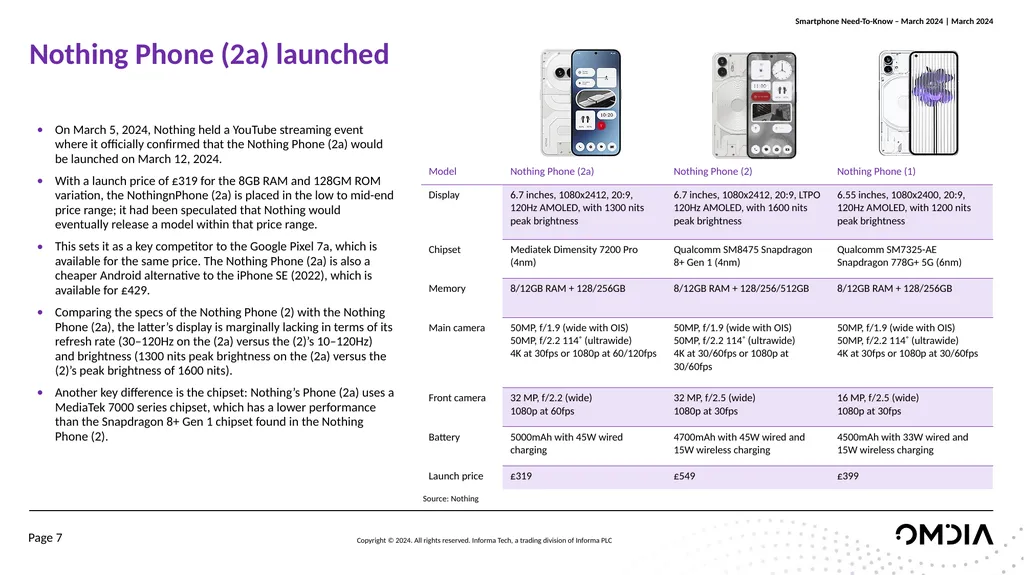
slide7. Nothing Phone (2a) launched On March 5, 2024, Nothing held a YouTube streaming event where it officially confirmed that the Nothing Phone (2a) would be launched on March 12, 2024.
With a launch price of £319 for the 8GB RAM and 128GM ROM variation, the NothingnPhone (2a) is placed in the low to mid-end price range; it had been speculated that Nothing would eventually release a model within that price range.
This sets it as a key competitor to the Google Pixel 7a, which is available for the same price. The Nothing Phone (2a) is also a cheaper Android alternative to the iPhone SE (2022), which is available for £429.
Comparing the specs of the Nothing Phone (2) with the Nothing Phone (2a), the latter’s display is marginally lacking in terms of its refresh rate (30–120Hz on the (2a) versus the (2)’s 10–120Hz) and brightness (1300 nits peak brightness on the (2a) versus the (2)’s peak brightness of 1600 nits).
Another key difference is the chipset: Nothing’s Phone (2a) uses a MediaTek 7000 series chipset, which has a lower performance than the Snapdragon 8+ Gen 1 chipset found in the Nothing Phone (2). Source: HMD Source: Nothing<br>
slide8. “Since the launch of the Nothing Phone (2) in July 2023, it had been suspected that the brand would release a cheaper version of the phone, just like how Google launched the Pixel 7a. Nothing has now confirmed this, mirroring not just the pricing strategy but also the naming convention of the Pixel series. While Nothing has yet to see enough mainstream success to be a true competitor against Google or Samsung in its key markets of Europe and North America, many will be keeping an eye on the brand as it expands its portfolio and consumer offerings.” Aaron West Senior Smartphone Analyst, Consumer Devices<br>
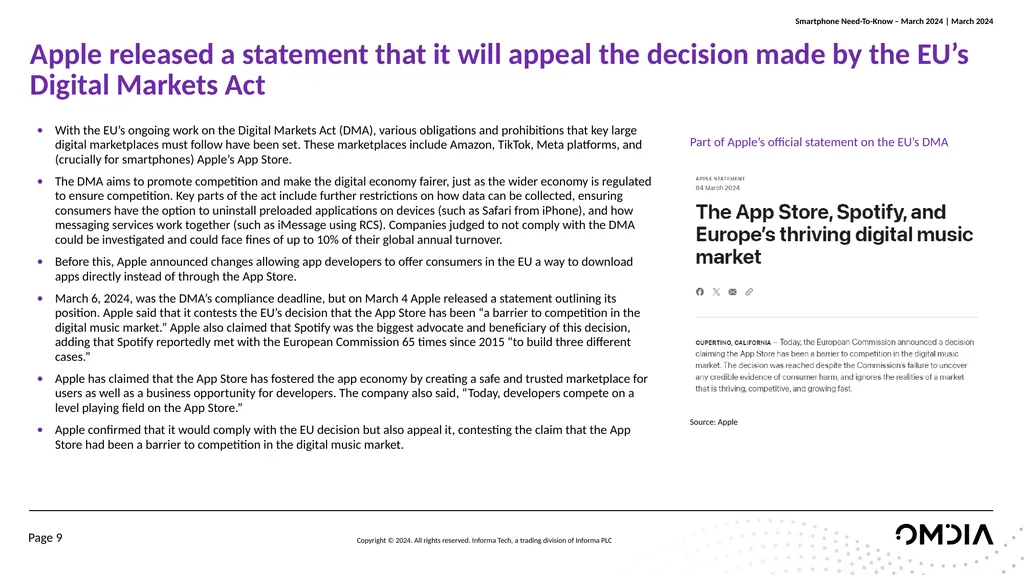
slide9. Apple released a statement that it will appeal the decision made by the EU’s Digital Markets Act With the EU’s ongoing work on the Digital Markets Act (DMA), various obligations and prohibitions that key large digital marketplaces must follow have been set. These marketplaces include Amazon, TikTok, Meta platforms, and (crucially for smartphones) Apple’s App Store.
The DMA aims to promote competition and make the digital economy fairer, just as the wider economy is regulated to ensure competition. Key parts of the act include further restrictions on how data can be collected, ensuring consumers have the option to uninstall preloaded applications on devices (such as Safari from iPhone), and how messaging services work together (such as iMessage using RCS). Companies judged to not comply with the DMA could be investigated and could face fines of up to 10% of their global annual turnover.
Before this, Apple announced changes allowing app developers to offer consumers in the EU a way to download apps directly instead of through the App Store.
March 6, 2024, was the DMA’s compliance deadline, but on March 4 Apple released a statement outlining its position. Apple said that it contests the EU’s decision that the App Store has been “a barrier to competition in the digital music market.” Apple also claimed that Spotify was the biggest advocate and beneficiary of this decision, adding that Spotify reportedly met with the European Commission 65 times since 2015 “to build three different cases.”
Apple has claimed that the App Store has fostered the app economy by creating a safe and trusted marketplace for users as well as a business opportunity for developers. The company also said, “Today, developers compete on a level playing field on the App Store.”
Apple confirmed that it would comply with the EU decision but also appeal it, contesting the claim that the App Store had been a barrier to competition in the digital music market. Source: Apple Part of Apple’s official statement on the EU’s DMA<br>
slide10. “The complex and ongoing battle between the EU and Apple shows no sign of ending. In many ways, the European Commission has tried to force Apple to adhere to regulations designed to make smartphones more fair, competitive, and environmentally friendly. On many counts, it has won, whether it is by Apple adopting USB-C charging ports or RCS messaging on iMessage. This latest development is just another step in the long road the EU is forcing Apple down, but Apple is showing no signs that it will give up and is contesting further regulation at every point.” Aaron West Senior Smartphone Analyst, Consumer Devices<br>
slide11. Appendix<br>
slide12. Authors
Jusy Hong, Senior Research Manager, Components & Devices – Wireless Devices
Zaker Li, Principal Analyst, Components & Devices – Mobile Handsets
Aaron West, Senior Analyst, Components & Devices – Mobile Handsets
askananalyst@omdia.com
Omdia Consulting
We hope that this analysis will help you make informed and imaginative business decisions. If you have further requirements, Omdia's consulting team may be able to help you. For more information about Omdia's consulting capabilities, please contact us directly at consulting@omdia.com.
Citation Policy
Request external citation and usage of Omdia research and data via citations@omdia.com. Appendix<br>
Zaker Li, Principal Analyst, Components & Devices – Mobile Handsets
Aaron West, Senior Analyst, Components & Devices – Mobile Handsets
askananalyst@omdia.com Smartphone Need-To-Know – March 2024<br>
slide2. Contents Samsung, Xiaomi, Honor, and Lenovo showcase their latest technology updates at MWC Barcelona 2024 3
Xiaomi and Honor both announced launches of their new flagship lines at pre-MWC events in Barcelona 5
Nothing Phone (2a) launched 7
Apple released a statement that it will appeal the decision made by the EU’s Digital Markets Act 9
Appendix 11<br>
slide3. Samsung, Xiaomi, Honor, and Lenovo showcase their latest technology updates at MWC Barcelona 2024 Many major smartphone OEMs were either present at the MWC show from February 26–29 or in Barcelona during that week. Samsung, Xiaomi, Honor, Lenovo, and Huawei were the five biggest smartphone players present, while smaller brands such as Google Pixel, ZTE, HMD Global, Tecno, Infinix, TCL, Fairphone, and some rugged phone brands were also involved.
The biggest chipset makers displayed devices that use their system-on-chip (SoC), with both Qualcomm and MediaTek having large exhibiting spaces. UNISOC was also present.
The key smartphone trends at MWC Barcelona 2024 included on-device artificial intelligence (AI) for smartphones, with almost all major OEMs displaying new features. There were also extended reality (XR) glasses featured in some spaces and shared ecosystems showcasing the connection between devices.
Major announcements on new devices included:
Xiaomi will launch its 14 and 14 Ultra phones globally.
Honor will launch its Magic 6 Pro flagship phone globally.
HMD Global and Mattel will collaborate to make a Barbie flip phone that will be launched in the summer of 2024.
Samsung will launch its Galaxy Ring but has not yet confirmed a release date.
Additionally, key smartphone AI developments included:
Samsung demonstrated its AI image search and camera features.
Honor announced and showcased the Magic 6 Pro and its “Magic Portal” feature, generative AI (GenAI) language model, and camera features.
Qualcomm and MediaTek showcased their on-device AI large language model (LLM) capabilities. Gran Fira south entrance for MWC Barcelona 2024 Outside space at MWC Barcelona 2024 for Google Android Source: Omdia analyst photo Source: Omdia analyst photo © 2024 Omdia © 2024 Omdia<br>
slide4. “AI was the hot topic of this year’s MWC. Chipset makers, phone OEMs, software developers, and even major component companies all introduced AI features. However, most AI features available now are from OEMs and are implemented on-device. The spread of third-party apps with AI features is inevitable and will potentially transform the market in the future.” Jusy Hong Senior Research Manager,
Consumer Devices<br>
slide5. Xiaomi and Honor both announced launches of their new flagship lines at pre-MWC events in Barcelona Xiaomi announced the global launch of its flagship phone, the Xiaomi 14 Ultra, at a pre-MWC event on February 25, 2024. At the event, Xiaomi emphasized the camera quality of the 14 Ultra and its continued collaboration with photography brand Leica.
The Xiaomi 14 Ultra will be available from €1,499 and has a quad camera system. This includes a 12mm 0.5x 50MP ultrawide, a 22mm 1x 50MP main, a 75mm 3.2x 50MP telephoto, and a 120mm 5x 50MP periscope camera, all of which have optical image stabilization (OIS), making it one of the most impressive camera systems on any phone.
Xiaomi also discussed its new “AISP” chip in the 14 Ultra, which the company claims to be the world’s first AI large-model computational platform for photography, with 60 Tera operations per second (TOPS) of computing power.
The Xiaomi 14 Ultra also uses Qualcomm’s latest Snapdragon 8 Gen 3 platform but Xiaomi did not disclose the AI features that would be coming to the phone.
Similarly, at a pre-MWC event on February 25, 2024, Honor also announced the global launch of its flagship phone, the Honor Magic6 Pro, following its recent launch in the Chinese market in January 2024.
The Honor Magic6 Pro is available from €1,299 for the 12GB RAM and 512GB ROM model.
The Honor Magic6 Pro is the Honor’s first on-device AI smartphone featuring its Magic LLM. The phone uses Qualcomm’s Snapdragon 8 Gen 3 chipset and can run 7 billion LLM parameters to feature AI functions without the help of cloud AI.
Honor’s Magic Portal feature focuses more on understanding user intentions to suggest tasks and apps based on the user’s selections and habits. It also includes features that can create schedules based on complex graphic and textual understanding, search the phone’s image gallery, and generate images via text prompts. Honor Magic6 Pro launch event on February 25, 2024 Xiaomi 14 Ultra launch event on February 25, 2024 Source: Omdia analyst photo Source: Omdia analyst photo © 2024 Omdia © 2024 Omdia<br>
slide6. “Xiaomi and Honor’s phone launches were the two biggest smartphone announcements at MWC 2024, with both brands expanding their latest flagship smartphones worldwide. However, the prices of both brands’ flagship smartphones in the global market (in Euros) are much higher than their domestic prices (in Chinese Yuan). This could signal that Xiaomi and Honor are using a higher price anchor to break through to the high-end Western market, which is a highly valuable market that both brands’ have not yet seen much success in.” Zaker Li Principal Smartphone Analyst, Consumer Devices<br>
slide7. Nothing Phone (2a) launched On March 5, 2024, Nothing held a YouTube streaming event where it officially confirmed that the Nothing Phone (2a) would be launched on March 12, 2024.
With a launch price of £319 for the 8GB RAM and 128GM ROM variation, the NothingnPhone (2a) is placed in the low to mid-end price range; it had been speculated that Nothing would eventually release a model within that price range.
This sets it as a key competitor to the Google Pixel 7a, which is available for the same price. The Nothing Phone (2a) is also a cheaper Android alternative to the iPhone SE (2022), which is available for £429.
Comparing the specs of the Nothing Phone (2) with the Nothing Phone (2a), the latter’s display is marginally lacking in terms of its refresh rate (30–120Hz on the (2a) versus the (2)’s 10–120Hz) and brightness (1300 nits peak brightness on the (2a) versus the (2)’s peak brightness of 1600 nits).
Another key difference is the chipset: Nothing’s Phone (2a) uses a MediaTek 7000 series chipset, which has a lower performance than the Snapdragon 8+ Gen 1 chipset found in the Nothing Phone (2). Source: HMD Source: Nothing<br>
slide8. “Since the launch of the Nothing Phone (2) in July 2023, it had been suspected that the brand would release a cheaper version of the phone, just like how Google launched the Pixel 7a. Nothing has now confirmed this, mirroring not just the pricing strategy but also the naming convention of the Pixel series. While Nothing has yet to see enough mainstream success to be a true competitor against Google or Samsung in its key markets of Europe and North America, many will be keeping an eye on the brand as it expands its portfolio and consumer offerings.” Aaron West Senior Smartphone Analyst, Consumer Devices<br>
slide9. Apple released a statement that it will appeal the decision made by the EU’s Digital Markets Act With the EU’s ongoing work on the Digital Markets Act (DMA), various obligations and prohibitions that key large digital marketplaces must follow have been set. These marketplaces include Amazon, TikTok, Meta platforms, and (crucially for smartphones) Apple’s App Store.
The DMA aims to promote competition and make the digital economy fairer, just as the wider economy is regulated to ensure competition. Key parts of the act include further restrictions on how data can be collected, ensuring consumers have the option to uninstall preloaded applications on devices (such as Safari from iPhone), and how messaging services work together (such as iMessage using RCS). Companies judged to not comply with the DMA could be investigated and could face fines of up to 10% of their global annual turnover.
Before this, Apple announced changes allowing app developers to offer consumers in the EU a way to download apps directly instead of through the App Store.
March 6, 2024, was the DMA’s compliance deadline, but on March 4 Apple released a statement outlining its position. Apple said that it contests the EU’s decision that the App Store has been “a barrier to competition in the digital music market.” Apple also claimed that Spotify was the biggest advocate and beneficiary of this decision, adding that Spotify reportedly met with the European Commission 65 times since 2015 “to build three different cases.”
Apple has claimed that the App Store has fostered the app economy by creating a safe and trusted marketplace for users as well as a business opportunity for developers. The company also said, “Today, developers compete on a level playing field on the App Store.”
Apple confirmed that it would comply with the EU decision but also appeal it, contesting the claim that the App Store had been a barrier to competition in the digital music market. Source: Apple Part of Apple’s official statement on the EU’s DMA<br>
slide10. “The complex and ongoing battle between the EU and Apple shows no sign of ending. In many ways, the European Commission has tried to force Apple to adhere to regulations designed to make smartphones more fair, competitive, and environmentally friendly. On many counts, it has won, whether it is by Apple adopting USB-C charging ports or RCS messaging on iMessage. This latest development is just another step in the long road the EU is forcing Apple down, but Apple is showing no signs that it will give up and is contesting further regulation at every point.” Aaron West Senior Smartphone Analyst, Consumer Devices<br>
slide11. Appendix<br>
slide12. Authors
Jusy Hong, Senior Research Manager, Components & Devices – Wireless Devices
Zaker Li, Principal Analyst, Components & Devices – Mobile Handsets
Aaron West, Senior Analyst, Components & Devices – Mobile Handsets
askananalyst@omdia.com
Omdia Consulting
We hope that this analysis will help you make informed and imaginative business decisions. If you have further requirements, Omdia's consulting team may be able to help you. For more information about Omdia's consulting capabilities, please contact us directly at consulting@omdia.com.
Citation Policy
Request external citation and usage of Omdia research and data via citations@omdia.com. Appendix<br>