
Jusy Hong Senior Research Manager, Components &
GB
Published · 13 slides · 0 views
1 / 1


Description
Jusy Hong Senior Research Manager, Components Devices Mobile Handsets Zaker Li Principal Analyst, Components Devices Mobile Handsets Aaron West Senior Analyst, Components Devices Mobile Handsets askananalystomdia.com Smartphone
Related Topics
Download this presentation From Below
"Jusy Hong Senior Research Manager, Components &" is the property of its rightful owner. Permission is granted to download and print the materials on this website for personal, non-commercial use only, and to display it on your personal computer provided you do not modify the materials and that you retain all copyright notices contained in the materials. By downloading content from our website, you accept the terms of this agreement.
Share
Embed code
Presentation Transcript
01
Jusy Hong
Senior Research Manager, Components & Devices – Mobile Handsets
Zaker Li Principal Analyst, Components & Devices – Mobile Handsets
Aaron West Senior Analyst, Components & Devices – Mobile Handsets
askananalyst@omdia.com Smartphone Need-To-Know – January 2025<br>
Zaker Li Principal Analyst, Components & Devices – Mobile Handsets
Aaron West Senior Analyst, Components & Devices – Mobile Handsets
askananalyst@omdia.com Smartphone Need-To-Know – January 2025<br>
02
Contents Samsung unveils Galaxy AI agent at S25 series Unpacked launch event 3
Honor Magic7 Pro goes global, and CEO steps down 5
Luxshare buys WingTech’s ODM business 7
Donald Trump becomes 47th US president and vows to protect US corporations 9
Appendix 11<br>
Honor Magic7 Pro goes global, and CEO steps down 5
Luxshare buys WingTech’s ODM business 7
Donald Trump becomes 47th US president and vows to protect US corporations 9
Appendix 11<br>
03
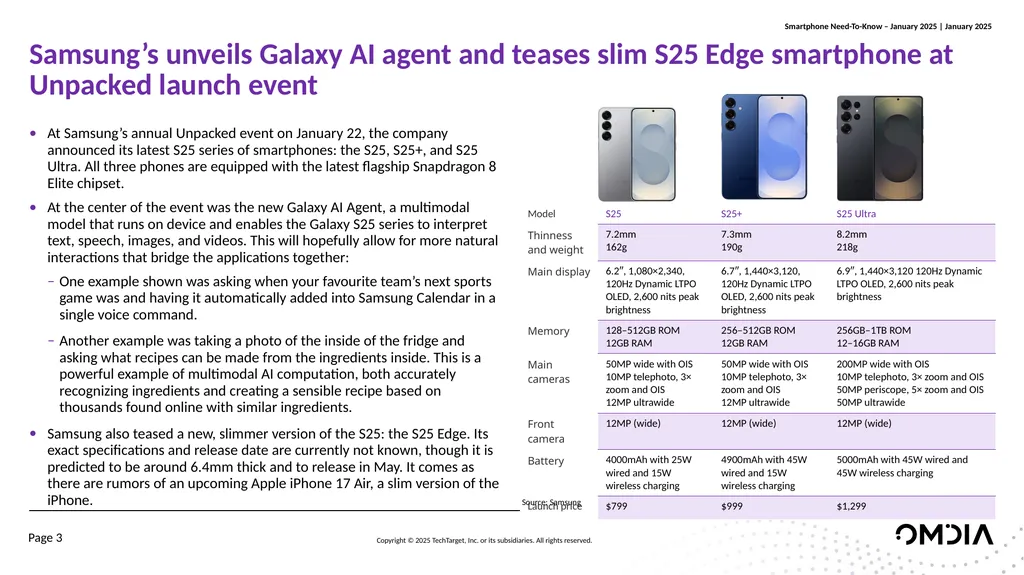
Samsung’s unveils Galaxy AI agent and teases slim S25 Edge smartphone at Unpacked launch event At Samsung’s annual Unpacked event on January 22, the company announced its latest S25 series of smartphones: the S25, S25+, and S25 Ultra. All three phones are equipped with the latest flagship Snapdragon 8 Elite chipset.
At the center of the event was the new Galaxy AI Agent, a multimodal model that runs on device and enables the Galaxy S25 series to interpret text, speech, images, and videos. This will hopefully allow for more natural interactions that bridge the applications together:
One example shown was asking when your favourite team’s next sports game was and having it automatically added into Samsung Calendar in a single voice command.
Another example was taking a photo of the inside of the fridge and asking what recipes can be made from the ingredients inside. This is a powerful example of multimodal AI computation, both accurately recognizing ingredients and creating a sensible recipe based on thousands found online with similar ingredients.
Samsung also teased a new, slimmer version of the S25: the S25 Edge. Its exact specifications and release date are currently not known, though it is predicted to be around 6.4mm thick and to release in May. It comes as there are rumors of an upcoming Apple iPhone 17 Air, a slim version of the iPhone. Source: Samsung<br>
At the center of the event was the new Galaxy AI Agent, a multimodal model that runs on device and enables the Galaxy S25 series to interpret text, speech, images, and videos. This will hopefully allow for more natural interactions that bridge the applications together:
One example shown was asking when your favourite team’s next sports game was and having it automatically added into Samsung Calendar in a single voice command.
Another example was taking a photo of the inside of the fridge and asking what recipes can be made from the ingredients inside. This is a powerful example of multimodal AI computation, both accurately recognizing ingredients and creating a sensible recipe based on thousands found online with similar ingredients.
Samsung also teased a new, slimmer version of the S25: the S25 Edge. Its exact specifications and release date are currently not known, though it is predicted to be around 6.4mm thick and to release in May. It comes as there are rumors of an upcoming Apple iPhone 17 Air, a slim version of the iPhone. Source: Samsung<br>
04
“Samsung’s past investments in Knox, Smart Things, and Samsung Health are starting to come together as one holistic solution. If Samsung can retain its premium user base through the S series, this will be vital to fully leveraging this. Premium device users are more likely to spend and are therefore highly valued by online marketplaces and internet service providers. Samsung could generate lucrative high-margin revenue from its internet services business by capturing more of this premium segment, also laying the groundwork for commercializing its AI features in future.” Jusy Hong
Senior Research Manager,
Consumer Devices<br>
Consumer Devices<br>
05
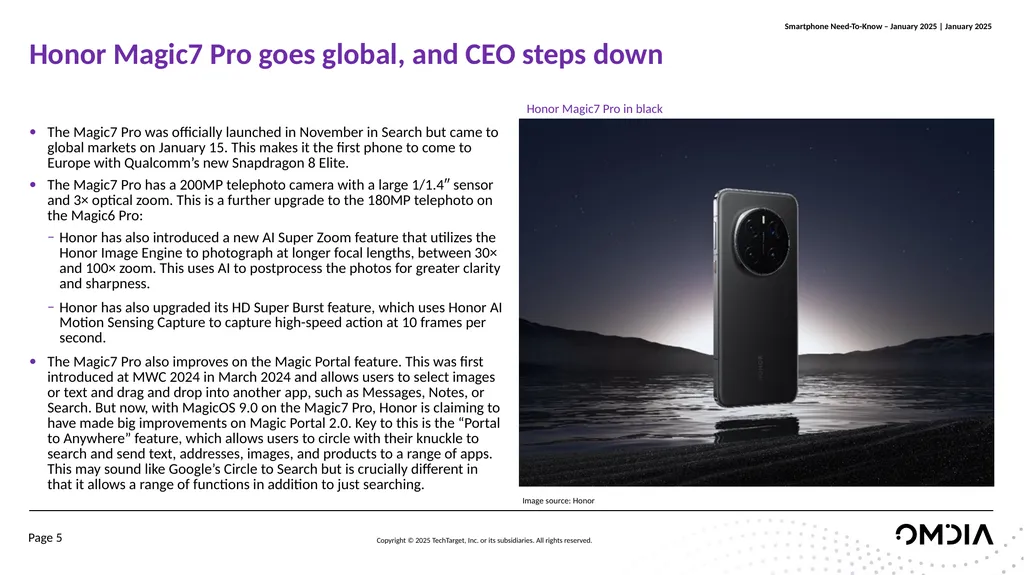
Honor Magic7 Pro goes global, and CEO steps down The Magic7 Pro was officially launched in November in Search but came to global markets on January 15. This makes it the first phone to come to Europe with Qualcomm’s new Snapdragon 8 Elite.
The Magic7 Pro has a 200MP telephoto camera with a large 1/1.4″ sensor and 3× optical zoom. This is a further upgrade to the 180MP telephoto on the Magic6 Pro:
Honor has also introduced a new AI Super Zoom feature that utilizes the Honor Image Engine to photograph at longer focal lengths, between 30× and 100× zoom. This uses AI to postprocess the photos for greater clarity and sharpness.
Honor has also upgraded its HD Super Burst feature, which uses Honor AI Motion Sensing Capture to capture high-speed action at 10 frames per second.
The Magic7 Pro also improves on the Magic Portal feature. This was first introduced at MWC 2024 in March 2024 and allows users to select images or text and drag and drop into another app, such as Messages, Notes, or Search. But now, with MagicOS 9.0 on the Magic7 Pro, Honor is claiming to have made big improvements on Magic Portal 2.0. Key to this is the “Portal to Anywhere” feature, which allows users to circle with their knuckle to search and send text, addresses, images, and products to a range of apps. This may sound like Google’s Circle to Search but is crucially different in that it allows a range of functions in addition to just searching. Image source: Honor Honor Magic7 Pro in black<br>
The Magic7 Pro has a 200MP telephoto camera with a large 1/1.4″ sensor and 3× optical zoom. This is a further upgrade to the 180MP telephoto on the Magic6 Pro:
Honor has also introduced a new AI Super Zoom feature that utilizes the Honor Image Engine to photograph at longer focal lengths, between 30× and 100× zoom. This uses AI to postprocess the photos for greater clarity and sharpness.
Honor has also upgraded its HD Super Burst feature, which uses Honor AI Motion Sensing Capture to capture high-speed action at 10 frames per second.
The Magic7 Pro also improves on the Magic Portal feature. This was first introduced at MWC 2024 in March 2024 and allows users to select images or text and drag and drop into another app, such as Messages, Notes, or Search. But now, with MagicOS 9.0 on the Magic7 Pro, Honor is claiming to have made big improvements on Magic Portal 2.0. Key to this is the “Portal to Anywhere” feature, which allows users to circle with their knuckle to search and send text, addresses, images, and products to a range of apps. This may sound like Google’s Circle to Search but is crucially different in that it allows a range of functions in addition to just searching. Image source: Honor Honor Magic7 Pro in black<br>
06
“Putting a smartphone’s highest-resolution sensor onto the telephoto camera is an unusual decision; typically, it’s reserved for the wide-angle lens because that is the most versatile and widely used focal length. However, this decision gives us insight into Honor’s camera strategy. This larger telephoto sensor should shorten the exposure time needed, benefiting low-light photography and action shots.” Aaron West
Senior Analyst,
Consumer Devices<br>
Consumer Devices<br>
07
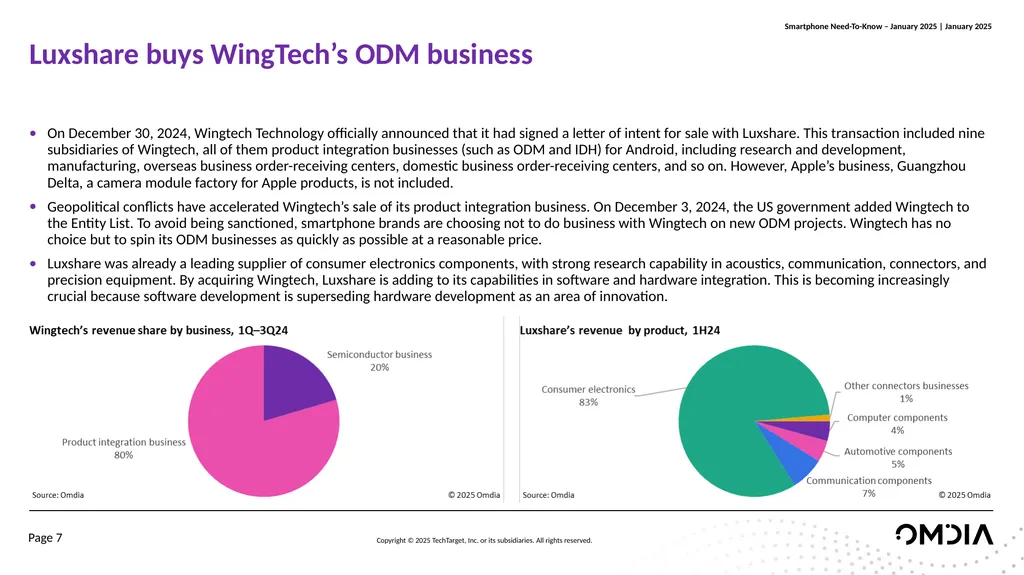
Luxshare buys WingTech’s ODM business On December 30, 2024, Wingtech Technology officially announced that it had signed a letter of intent for sale with Luxshare. This transaction included nine subsidiaries of Wingtech, all of them product integration businesses (such as ODM and IDH) for Android, including research and development, manufacturing, overseas business order-receiving centers, domestic business order-receiving centers, and so on. However, Apple’s business, Guangzhou Delta, a camera module factory for Apple products, is not included.
Geopolitical conflicts have accelerated Wingtech’s sale of its product integration business. On December 3, 2024, the US government added Wingtech to the Entity List. To avoid being sanctioned, smartphone brands are choosing not to do business with Wingtech on new ODM projects. Wingtech has no choice but to spin its ODM businesses as quickly as possible at a reasonable price.
Luxshare was already a leading supplier of consumer electronics components, with strong research capability in acoustics, communication, connectors, and precision equipment. By acquiring Wingtech, Luxshare is adding to its capabilities in software and hardware integration. This is becoming increasingly crucial because software development is superseding hardware development as an area of innovation.<br>
Geopolitical conflicts have accelerated Wingtech’s sale of its product integration business. On December 3, 2024, the US government added Wingtech to the Entity List. To avoid being sanctioned, smartphone brands are choosing not to do business with Wingtech on new ODM projects. Wingtech has no choice but to spin its ODM businesses as quickly as possible at a reasonable price.
Luxshare was already a leading supplier of consumer electronics components, with strong research capability in acoustics, communication, connectors, and precision equipment. By acquiring Wingtech, Luxshare is adding to its capabilities in software and hardware integration. This is becoming increasingly crucial because software development is superseding hardware development as an area of innovation.<br>
08
“Luxshare is buying Wingtech’s ODM/IDH business for three reasons. The consumer electronics business can return a much greater revenue than its other business, potentially adding more than CNY40bn in revenue. This acquisition will also optimize Luxshare’s customer structure because Wingtech has a wide range of Android clients, including Samsung, OPPO, Realme, and Lenovo. Wingtech has strong production sites in China, India, and Indonesia, so Luxshare can quickly expand production capacity globally.” Zaker Li
Principle Analyst,
Consumer Devices<br>
Consumer Devices<br>
09
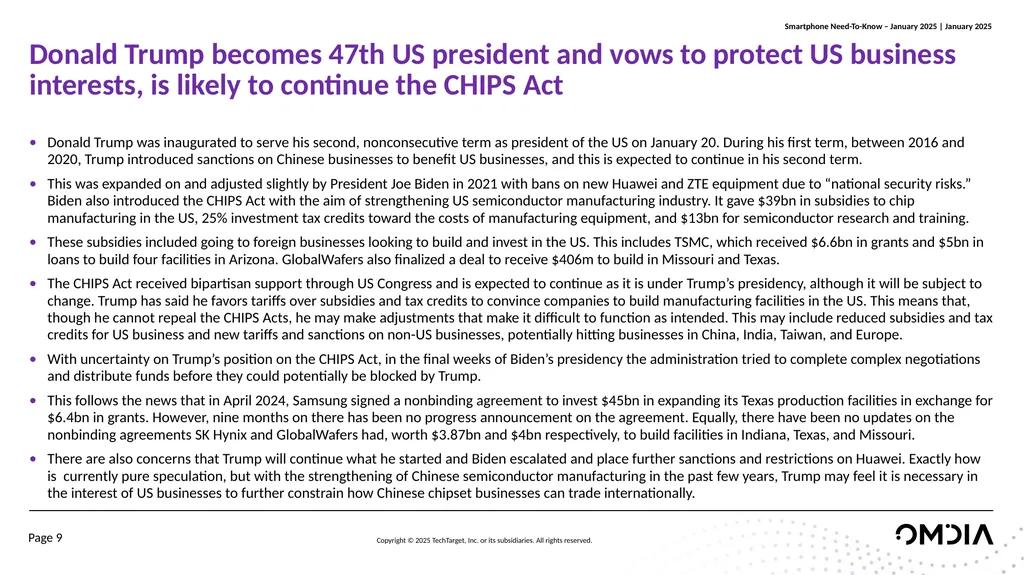
Donald Trump becomes 47th US president and vows to protect US business interests, is likely to continue the CHIPS Act Donald Trump was inaugurated to serve his second, nonconsecutive term as president of the US on January 20. During his first term, between 2016 and 2020, Trump introduced sanctions on Chinese businesses to benefit US businesses, and this is expected to continue in his second term.
This was expanded on and adjusted slightly by President Joe Biden in 2021 with bans on new Huawei and ZTE equipment due to “national security risks.” Biden also introduced the CHIPS Act with the aim of strengthening US semiconductor manufacturing industry. It gave $39bn in subsidies to chip manufacturing in the US, 25% investment tax credits toward the costs of manufacturing equipment, and $13bn for semiconductor research and training.
These subsidies included going to foreign businesses looking to build and invest in the US. This includes TSMC, which received $6.6bn in grants and $5bn in loans to build four facilities in Arizona. GlobalWafers also finalized a deal to receive $406m to build in Missouri and Texas.
The CHIPS Act received bipartisan support through US Congress and is expected to continue as it is under Trump’s presidency, although it will be subject to change. Trump has said he favors tariffs over subsidies and tax credits to convince companies to build manufacturing facilities in the US. This means that, though he cannot repeal the CHIPS Acts, he may make adjustments that make it difficult to function as intended. This may include reduced subsidies and tax credits for US business and new tariffs and sanctions on non-US businesses, potentially hitting businesses in China, India, Taiwan, and Europe.
With uncertainty on Trump’s position on the CHIPS Act, in the final weeks of Biden’s presidency the administration tried to complete complex negotiations and distribute funds before they could potentially be blocked by Trump.
This follows the news that in April 2024, Samsung signed a nonbinding agreement to invest $45bn in expanding its Texas production facilities in exchange for $6.4bn in grants. However, nine months on there has been no progress announcement on the agreement. Equally, there have been no updates on the nonbinding agreements SK Hynix and GlobalWafers had, worth $3.87bn and $4bn respectively, to build facilities in Indiana, Texas, and Missouri.
There are also concerns that Trump will continue what he started and Biden escalated and place further sanctions and restrictions on Huawei. Exactly how is currently pure speculation, but with the strengthening of Chinese semiconductor manufacturing in the past few years, Trump may feel it is necessary in the interest of US businesses to further constrain how Chinese chipset businesses can trade internationally.<br>
This was expanded on and adjusted slightly by President Joe Biden in 2021 with bans on new Huawei and ZTE equipment due to “national security risks.” Biden also introduced the CHIPS Act with the aim of strengthening US semiconductor manufacturing industry. It gave $39bn in subsidies to chip manufacturing in the US, 25% investment tax credits toward the costs of manufacturing equipment, and $13bn for semiconductor research and training.
These subsidies included going to foreign businesses looking to build and invest in the US. This includes TSMC, which received $6.6bn in grants and $5bn in loans to build four facilities in Arizona. GlobalWafers also finalized a deal to receive $406m to build in Missouri and Texas.
The CHIPS Act received bipartisan support through US Congress and is expected to continue as it is under Trump’s presidency, although it will be subject to change. Trump has said he favors tariffs over subsidies and tax credits to convince companies to build manufacturing facilities in the US. This means that, though he cannot repeal the CHIPS Acts, he may make adjustments that make it difficult to function as intended. This may include reduced subsidies and tax credits for US business and new tariffs and sanctions on non-US businesses, potentially hitting businesses in China, India, Taiwan, and Europe.
With uncertainty on Trump’s position on the CHIPS Act, in the final weeks of Biden’s presidency the administration tried to complete complex negotiations and distribute funds before they could potentially be blocked by Trump.
This follows the news that in April 2024, Samsung signed a nonbinding agreement to invest $45bn in expanding its Texas production facilities in exchange for $6.4bn in grants. However, nine months on there has been no progress announcement on the agreement. Equally, there have been no updates on the nonbinding agreements SK Hynix and GlobalWafers had, worth $3.87bn and $4bn respectively, to build facilities in Indiana, Texas, and Missouri.
There are also concerns that Trump will continue what he started and Biden escalated and place further sanctions and restrictions on Huawei. Exactly how is currently pure speculation, but with the strengthening of Chinese semiconductor manufacturing in the past few years, Trump may feel it is necessary in the interest of US businesses to further constrain how Chinese chipset businesses can trade internationally.<br>
10
“With the scale of uncertainty that surrounded Trump’s first presidency, there has been increasing concern for many businesses about what his second will mean. If he continues down the route of targeting Huawei and Chinese businesses, it is highly likely that the US will see retaliatory measures from China such as increased restrictions on rare earth metals. Some of Trump’s proposed measures on deporting immigrants and introducing tariffs are expected to increase inflation, and any kind of escalation in a US-China trade war will only further increase inflation, damaging smartphone markets.” Aaron West
Senior Analyst,
Consumer Devices<br>
Consumer Devices<br>
11
Appendix<br>
12
Further reading
Le Xuan Chiew (December 13, 2024) “iPhone 16 ban in Indonesia: what it means and why it matters,” Canalys, available at https://canalys.com/insights/iphone-ban-indonesia
Authors
Jusy Hong, Senior Research Manager, Components & Devices – Wireless Devices
Zaker Li, Principal Analyst, Components & Devices – Mobile Handsets
Aaron West, Senior Analyst, Components & Devices – Mobile Handsets
askananalyst@omdia.com
Omdia consulting
We hope that this analysis will help you make informed and imaginative business decisions. If you have further requirements, Omdia's consulting team may be able to help you. For more information about Omdia's consulting capabilities, please contact us directly at consulting@omdia.com.
Citation policy
Request external citation and usage of Omdia research and data via citations@omdia.com. Appendix<br>
Le Xuan Chiew (December 13, 2024) “iPhone 16 ban in Indonesia: what it means and why it matters,” Canalys, available at https://canalys.com/insights/iphone-ban-indonesia
Authors
Jusy Hong, Senior Research Manager, Components & Devices – Wireless Devices
Zaker Li, Principal Analyst, Components & Devices – Mobile Handsets
Aaron West, Senior Analyst, Components & Devices – Mobile Handsets
askananalyst@omdia.com
Omdia consulting
We hope that this analysis will help you make informed and imaginative business decisions. If you have further requirements, Omdia's consulting team may be able to help you. For more information about Omdia's consulting capabilities, please contact us directly at consulting@omdia.com.
Citation policy
Request external citation and usage of Omdia research and data via citations@omdia.com. Appendix<br>