
Juuling, Dripping, Dabbing and More: What School










Description: Juuling, Dripping, Dabbing and More: What School Professionals Need to Know About Vaping Fall 2020 What you need to know Vaping basics Whats the appeal? Hooking a new generation Vaping by the numbers Why the concern? Government oversight
Related Topics
Download Presentation
"Juuling, Dripping, Dabbing and More: What School" is the property of its rightful owner. Permission is granted to download and print the materials on this website for personal, non-commercial use only, and to display it on your personal computer provided you do not modify the materials and that you retain all copyright notices contained in the materials. By downloading content from our website, you accept the terms of this agreement.
Presentation Transcript
slide1. Juuling, Dripping, Dabbing and More:
What School Professionals Need to Know About Vaping
Fall 2020<br>
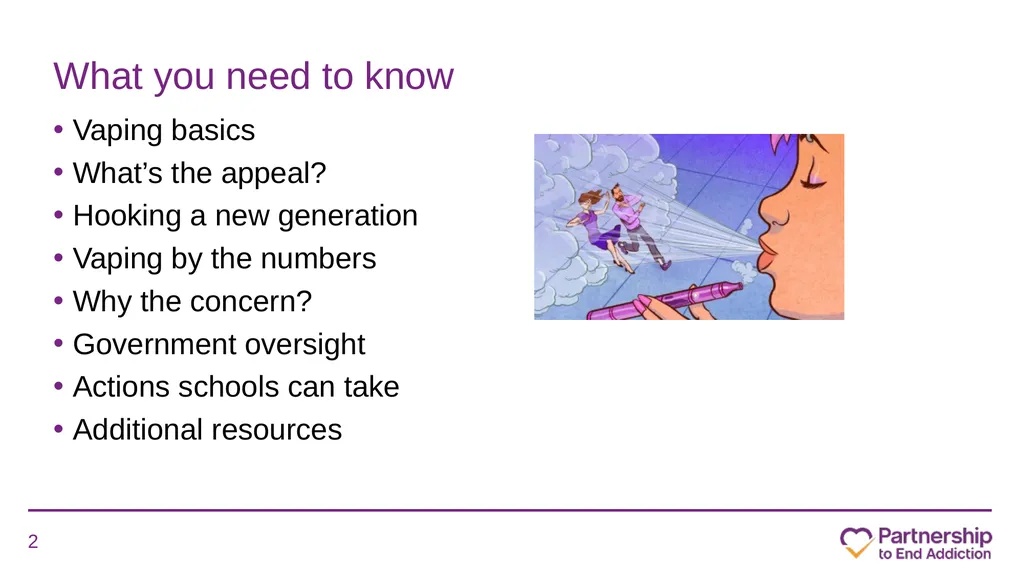
slide2. What you need to know Vaping basics
What’s the appeal?
Hooking a new generation
Vaping by the numbers
Why the concern?
Government oversight
Actions schools can take
Additional resources 2<br>
slide3. 3 Vaping Basics<br>
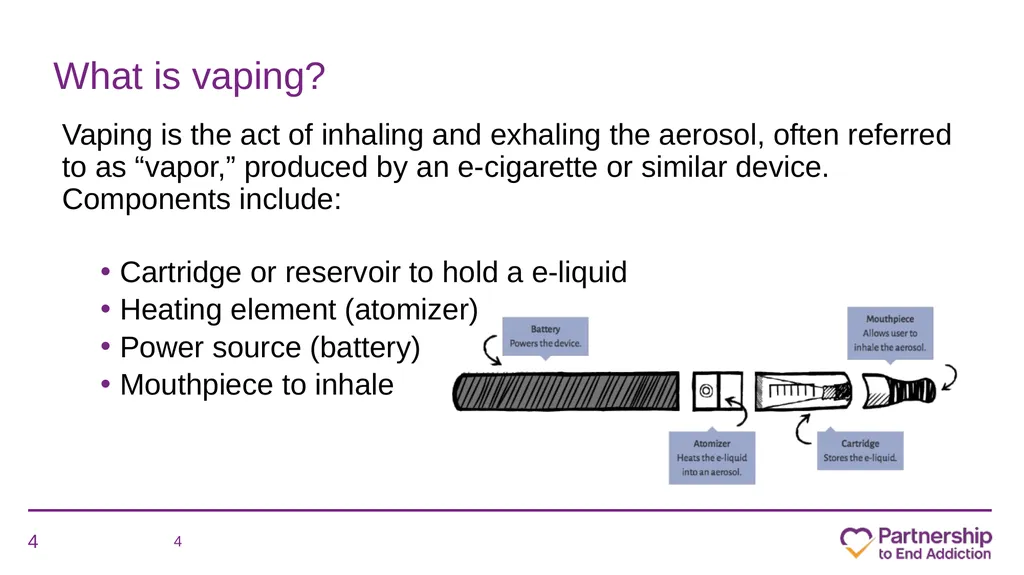
slide4. Vaping is the act of inhaling and exhaling the aerosol, often referred to as “vapor,” produced by an e-cigarette or similar device. Components include:
Cartridge or reservoir to hold a e-liquid
Heating element (atomizer)
Power source (battery)
Mouthpiece to inhale What is vaping? 4 4<br>
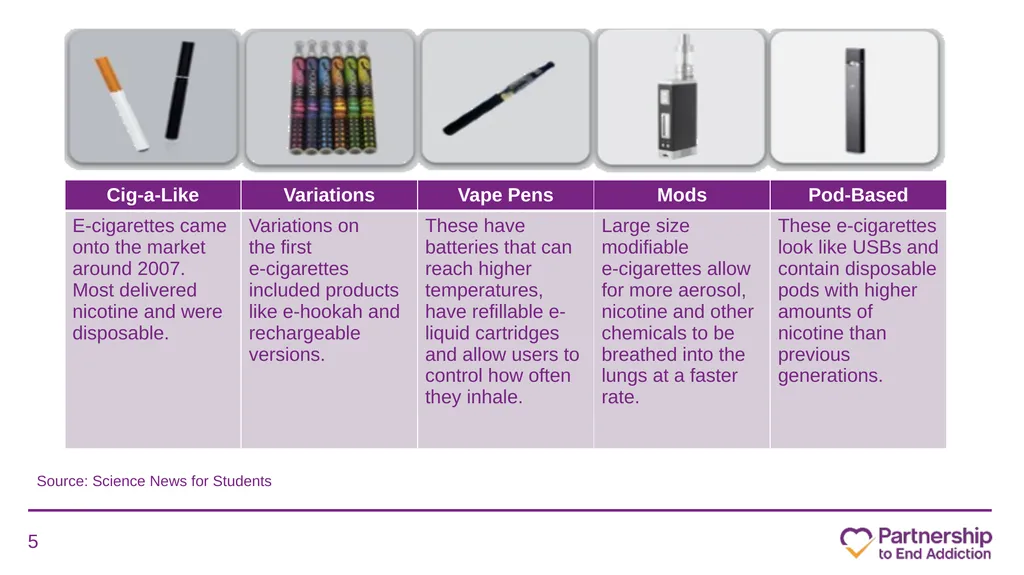
slide5. 5 Source: Science News for Students Cig-a-Like Vape Pens Variations Mods Pod-Based<br>
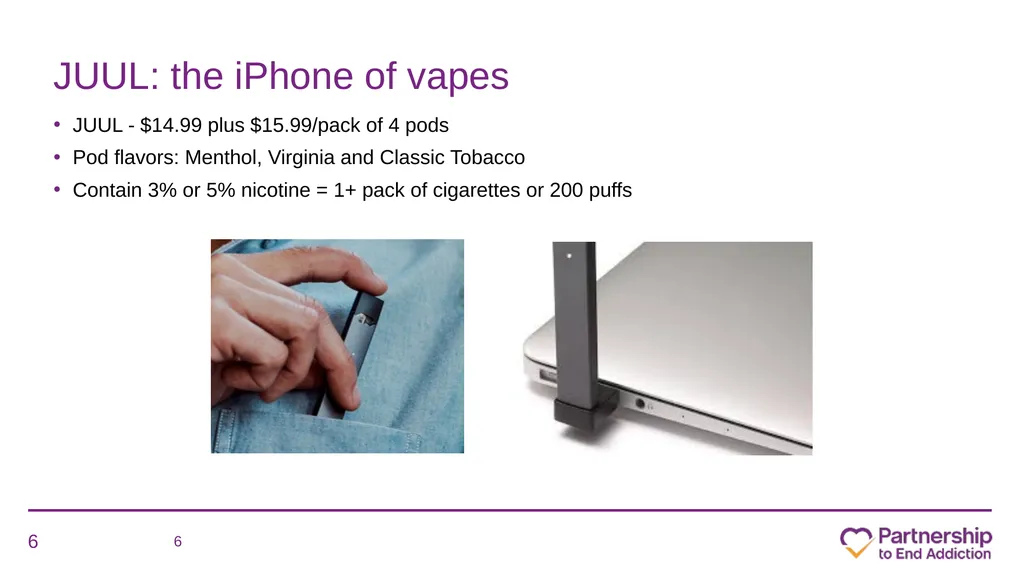
slide6. JUUL: the iPhone of vapes JUUL - $14.99 plus $15.99/pack of 4 pods
Pod flavors: Menthol, Virginia and Classic Tobacco
Contain 3% or 5% nicotine = 1+ pack of cigarettes or 200 puffs 6 6<br>
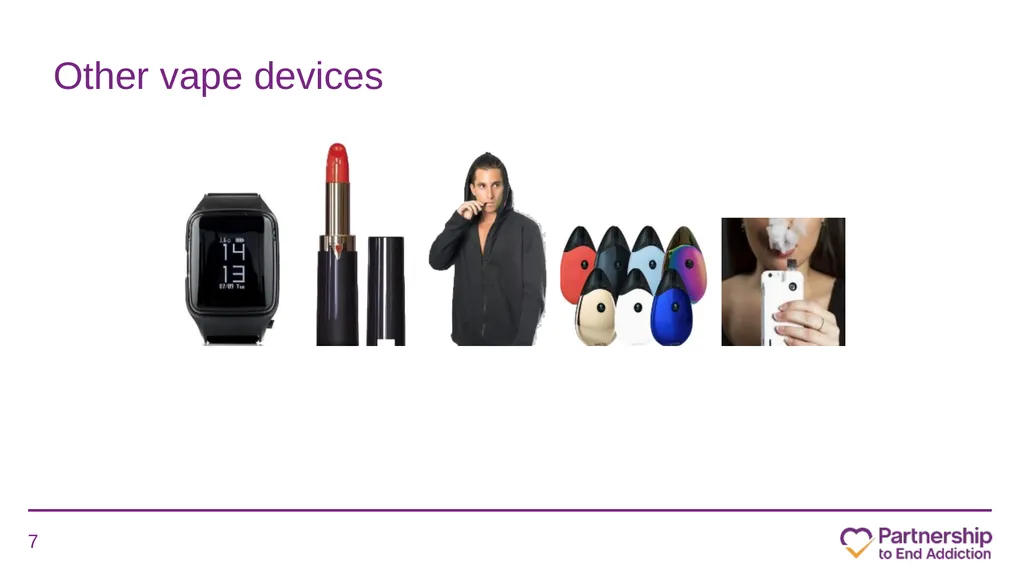
slide7. Other vape devices 7<br>
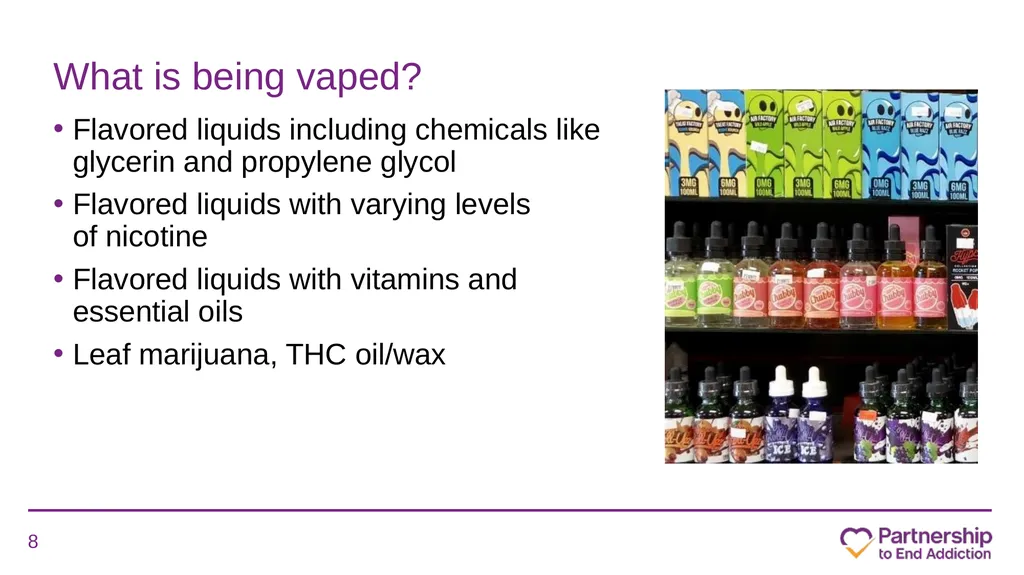
slide8. What is being vaped? Flavored liquids including chemicals like glycerin and propylene glycol
Flavored liquids with varying levels of nicotine
Flavored liquids with vitamins and essential oils
Leaf marijuana, THC oil/wax 8<br>
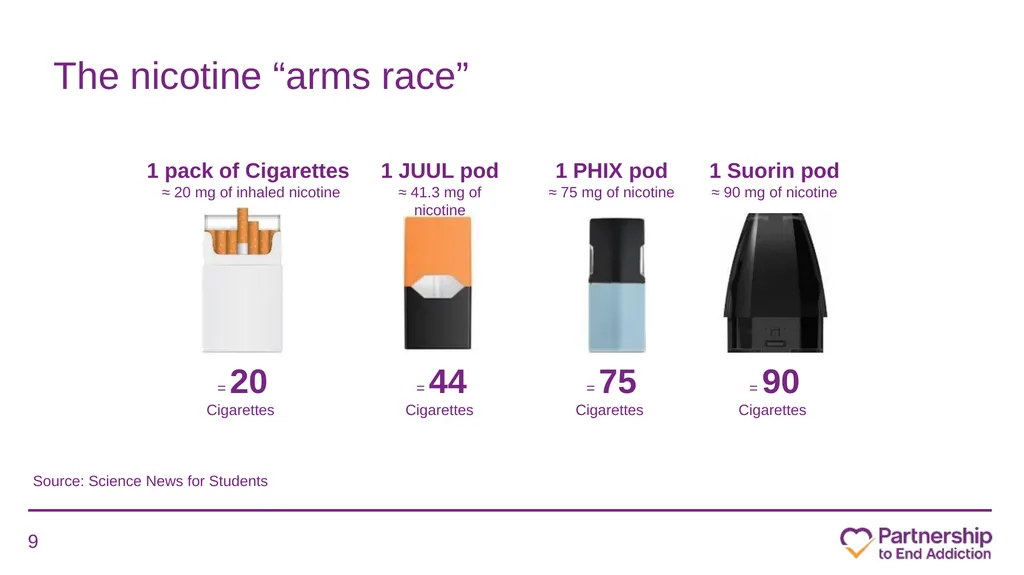
slide9. The nicotine “arms race” 9 Source: Science News for Students<br>
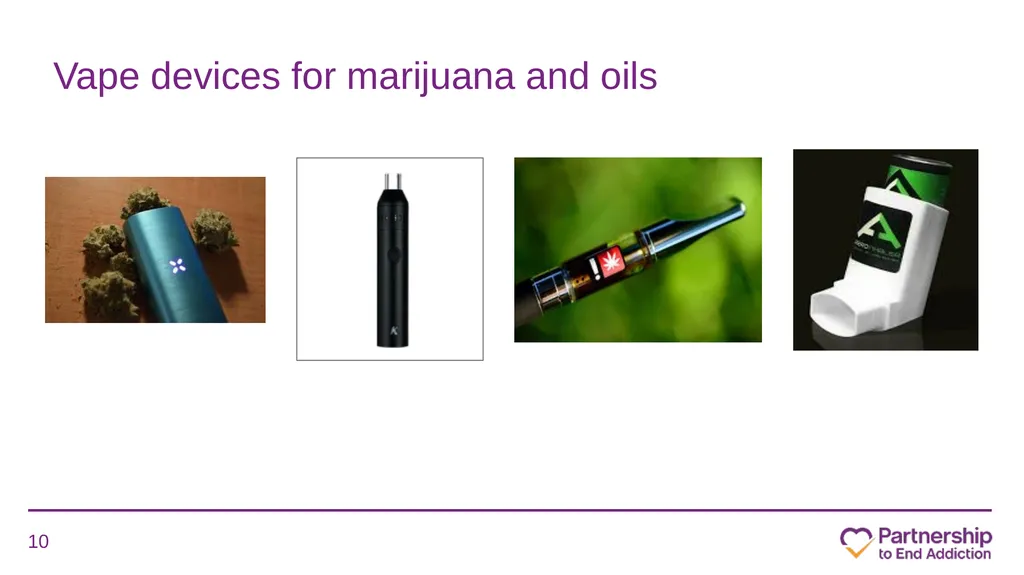
slide10. Vape devices for marijuana and oils 10<br>
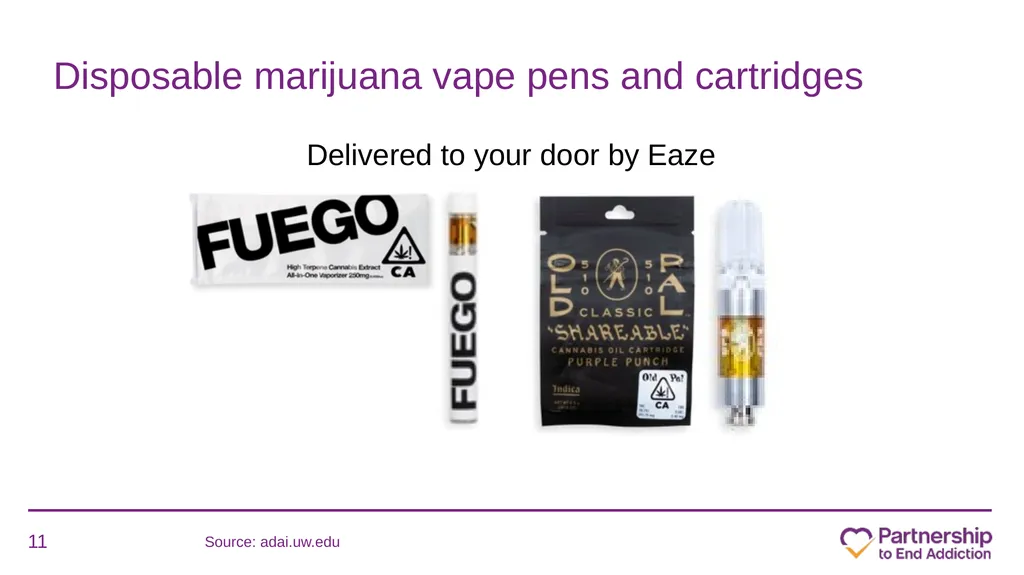
slide11. Disposable marijuana vape pens and cartridges Delivered to your door by Eaze 11 Source: adai.uw.edu<br>
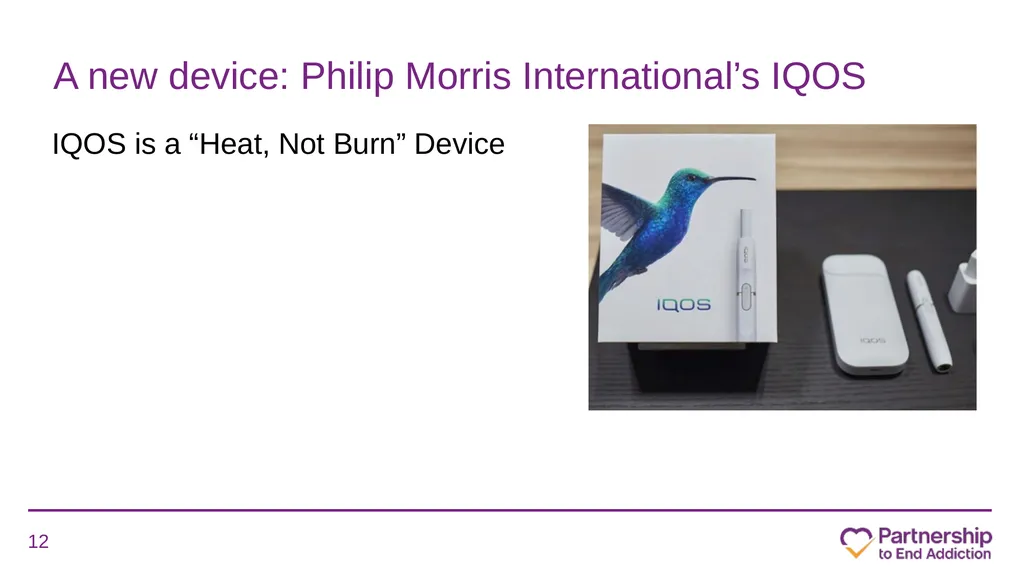
slide12. A new device: Philip Morris International’s IQOS IQOS is a “Heat, Not Burn” Device 12<br>
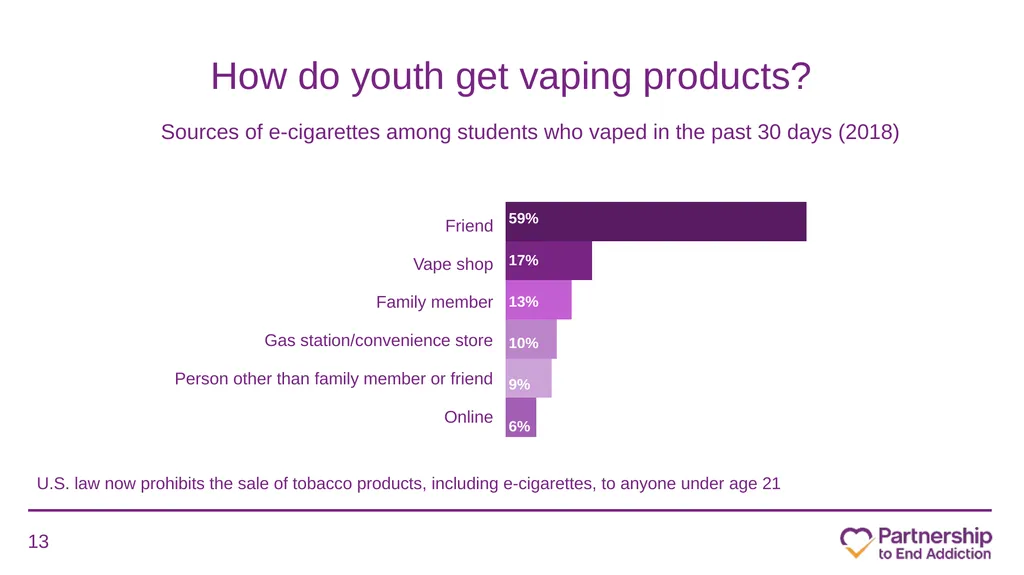
slide13. How do youth get vaping products? 13 U.S. law now prohibits the sale of tobacco products, including e-cigarettes, to anyone under age 21 Friend
Vape shop
Family member
Gas station/convenience store
Person other than family member or friend
Online Sources of e-cigarettes among students who vaped in the past 30 days (2018) 59%
17%
13%
10%
9%
6%<br>
slide14. Slang terms Analog: tobacco as the old physical or "analog" version
Juul, Pax, NJOY, Puff Bars, Stigs: styles/brands
Atty: atomizer to heat e-liquid
Cart: cartridge that holds the e-liquid
Carto: cartridge and atomizer combined into a single unit
Cloud chasing: e-cigarette/mod users tweak their hardware and liquid selections to produce ever bigger and thicker clouds of aerosol
Draw: amount of force required to accommodate inhalation through the mouthpiece of an e-cigarette
E-liquid, smoke juice: the liquids that are vaporized when using an e-cigarette
PV: personal vaporizer, often the mod style 14<br>
slide15. More slang terms O/Ohm: standard unit of electrical resistance
PG: propylene glycol is used as a diluent (a filler and diluting agent)
TH: throat hit is the sensation an e-cigarette user (and tobacco smoker) may experience when the aerosol hits the back of their throat
VG: vegetable glycerin acts as a diluent, or filler, and is a common ingredient found in e-liquid 15<br>
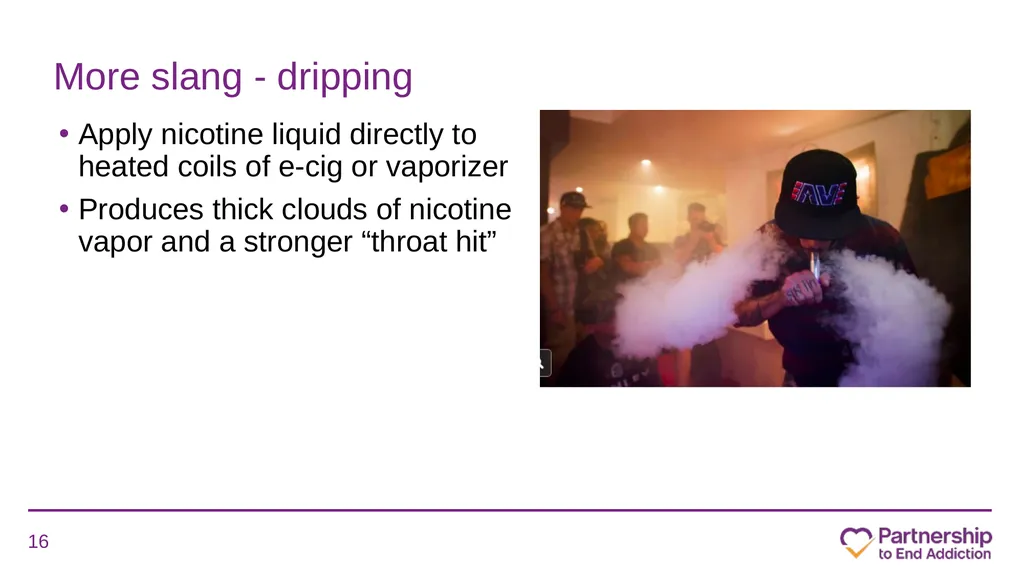
slide16. More slang - dripping 16 Apply nicotine liquid directly to heated coils of e-cig or vaporizer
Produces thick clouds of nicotine vapor and a stronger “throat hit”<br>
slide17. 17 What’s the appeal?<br>
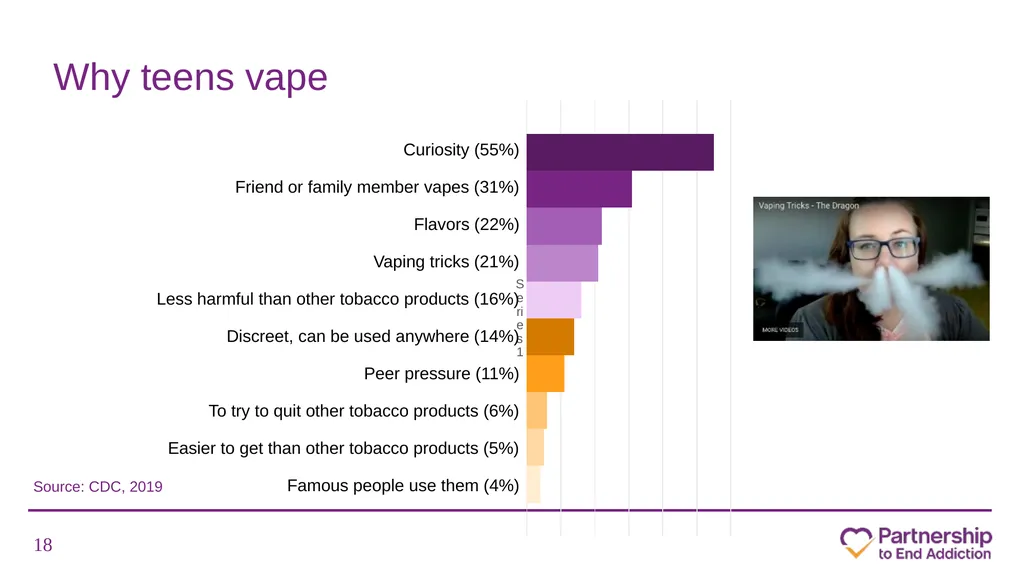
slide18. Why teens vape Curiosity (55%)
Friend or family member vapes (31%)
Flavors (22%)
Vaping tricks (21%)
Less harmful than other tobacco products (16%)
Discreet, can be used anywhere (14%)
Peer pressure (11%)
To try to quit other tobacco products (6%)
Easier to get than other tobacco products (5%)
Famous people use them (4%) 18 Source: CDC, 2019<br>
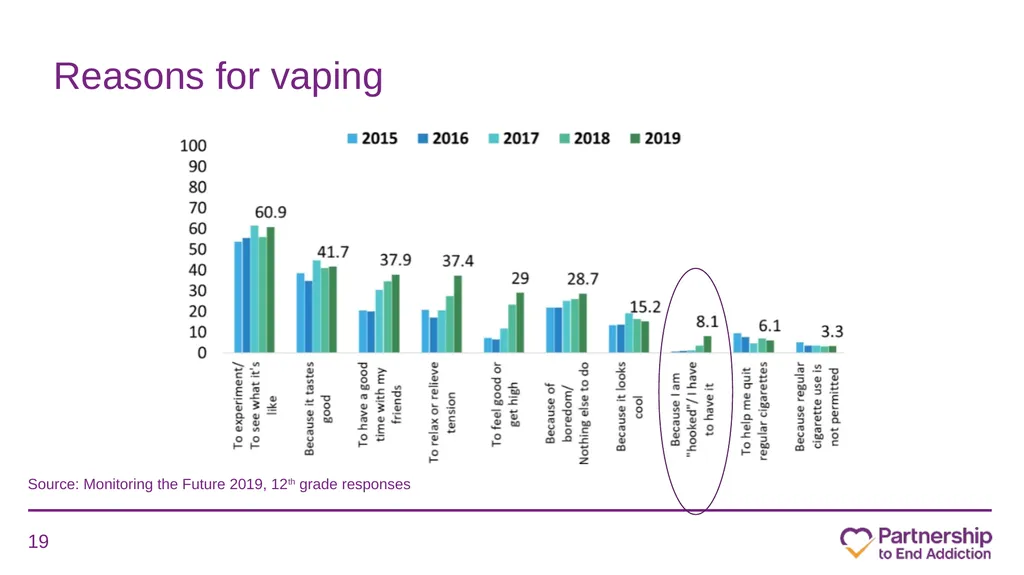
slide19. Reasons for vaping Source: Monitoring the Future 2019, 12th grade responses 19<br>
slide20. 20 Are we hooking a new generation?<br>
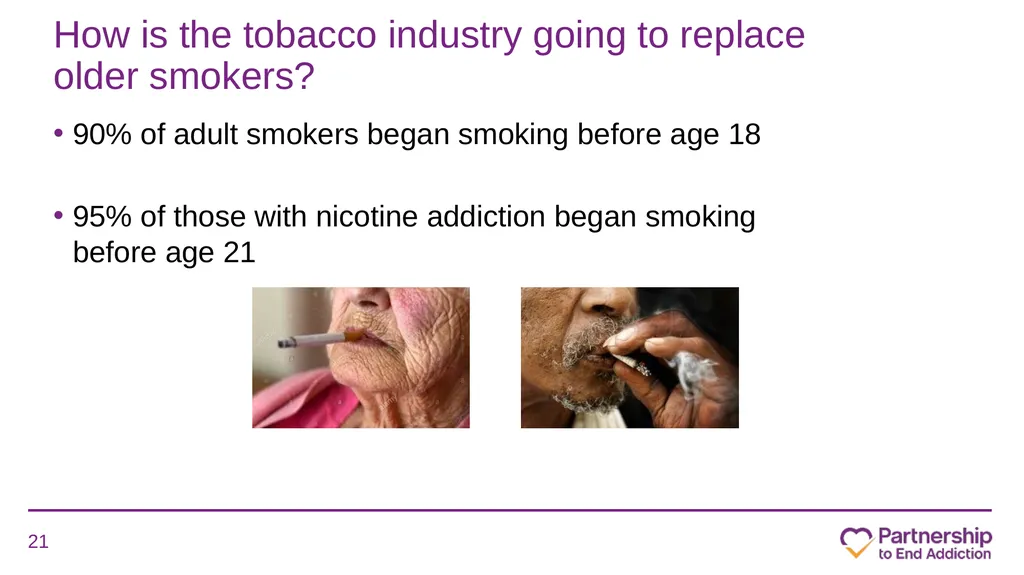
slide21. How is the tobacco industry going to replace older smokers? 90% of adult smokers began smoking before age 18
95% of those with nicotine addiction began smoking before age 21 21<br>
slide22. Big tobacco behind popular vaping products 22<br>
slide23. Tobacco + e-cigarettes: advertising 23<br>
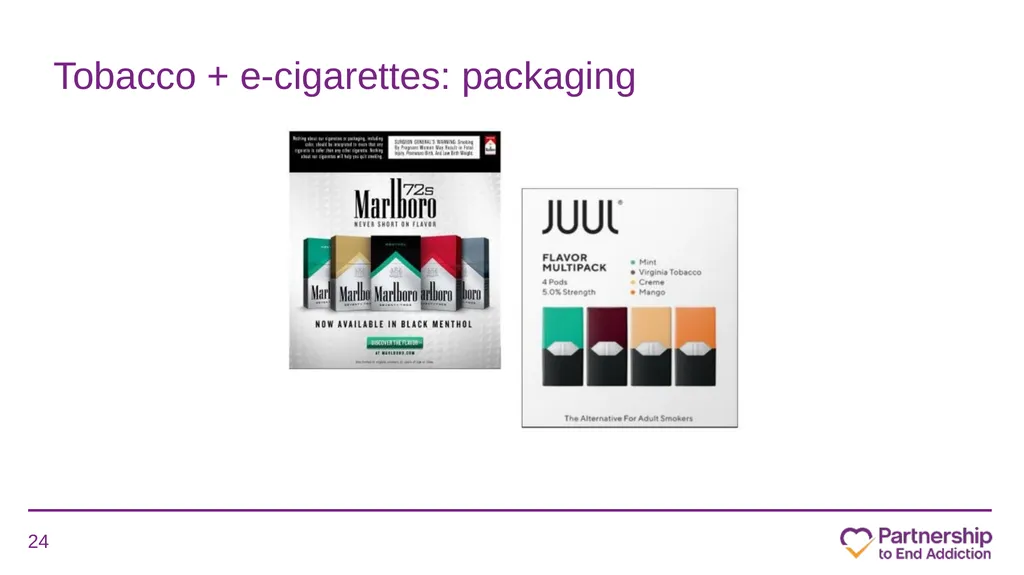
slide24. Tobacco + e-cigarettes: packaging 24<br>
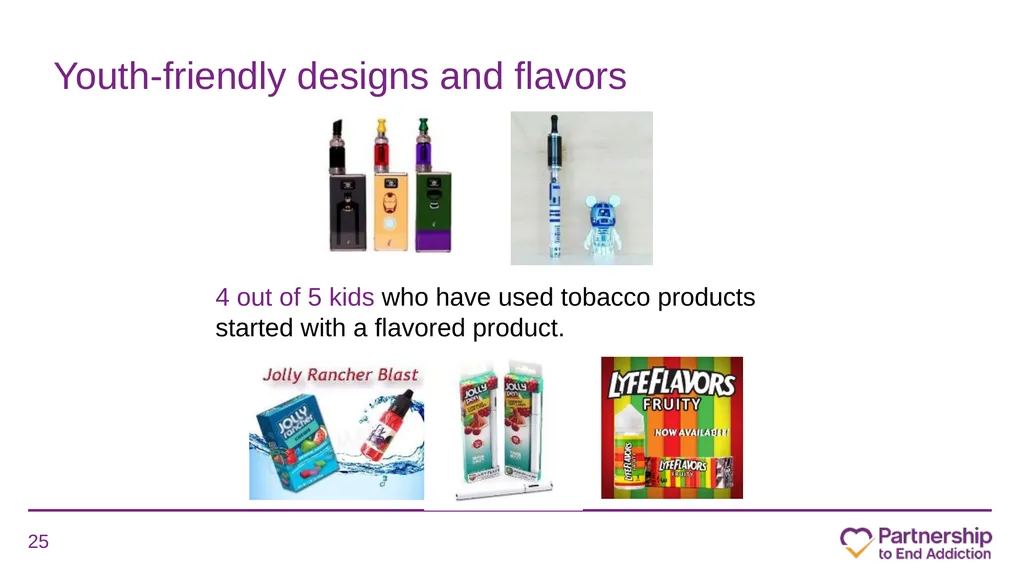
slide25. Youth-friendly designs and flavors 4 out of 5 kids who have used tobacco products
started with a flavored product. 25<br>
slide26. Social media marketing 26<br>
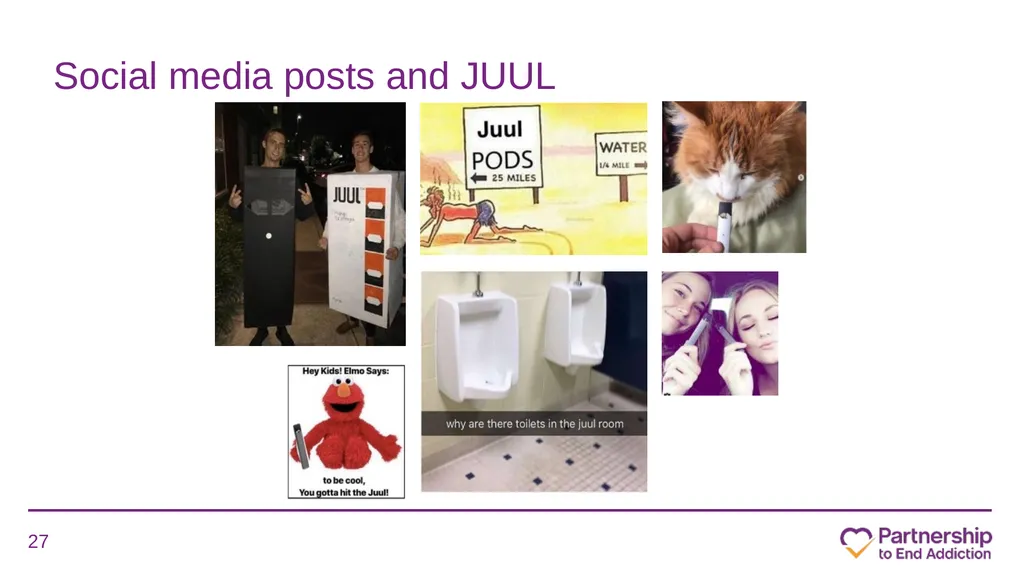
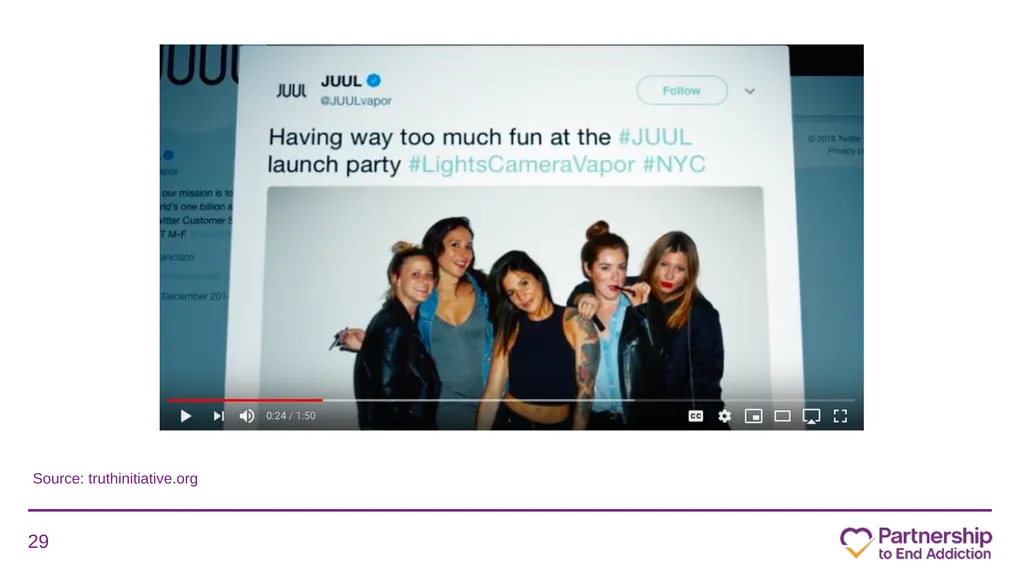
slide27. Social media posts and JUUL 27<br>
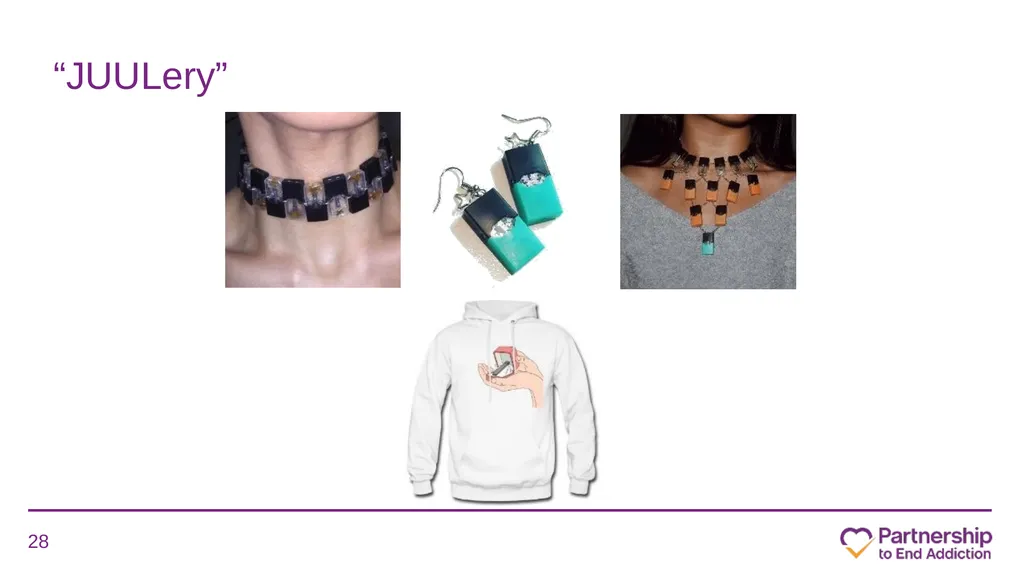
slide28. “JUULery” 28<br>
slide29. 29 Source: truthinitiative.org<br>
slide30. 30 Vaping by the numbers<br>
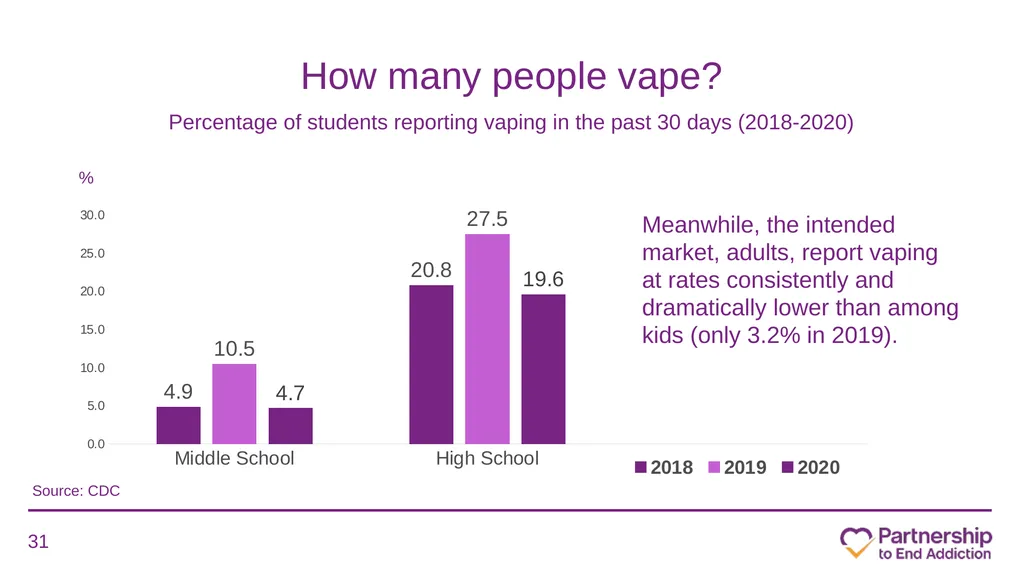
slide31. How many people vape? Source: CDC Percentage of students reporting vaping in the past 30 days (2018-2020) % 31<br>
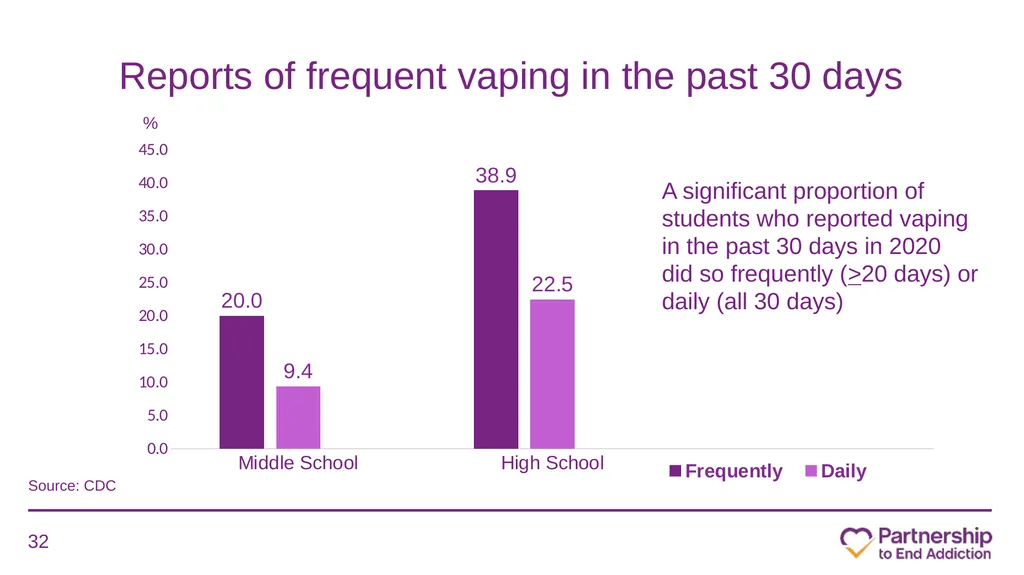
slide32. Reports of frequent vaping in the past 30 days A significant proportion of students who reported vaping in the past 30 days in 2020 did so frequently (>20 days) or daily (all 30 days) 32 Source: CDC %<br>
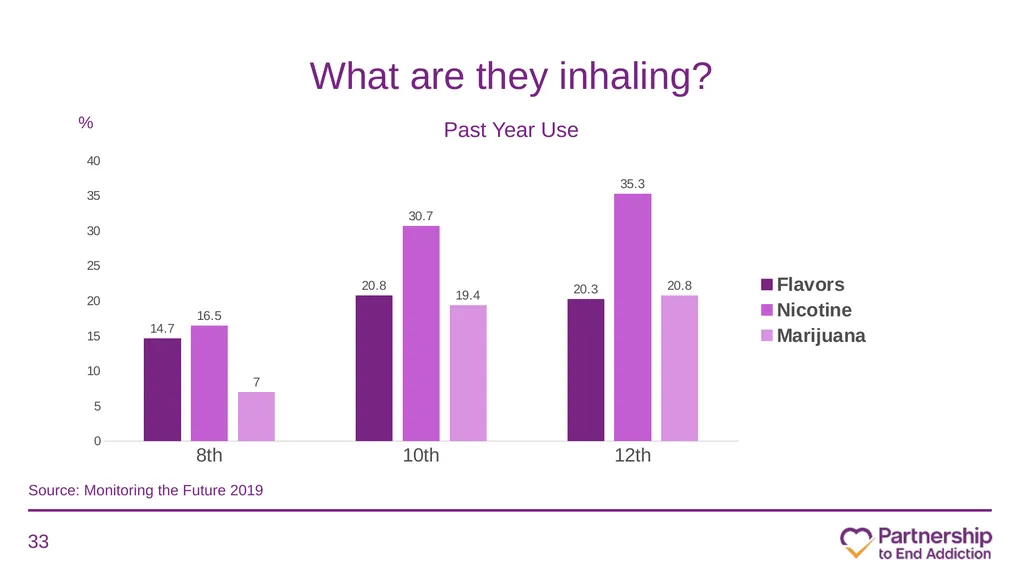
slide33. What are they inhaling? 33 Source: Monitoring the Future 2019 % Past Year Use<br>
slide34. 34 Why the concern?<br>
slide35. Harmful chemicals: cigarettes vs. vaping Cigarette smoke contains over 7,000 chemicals, including known cancer-causing (carcinogenic) compounds and hundreds of other toxins The aerosol created when vaping contains harmful ingredients:
Nicotine
Ultrafine particles
Flavorings
Volatile organic compounds (e.g., benzene, found in car exhaust)
Heavy metals (e.g., nickel, tin, lead) 35<br>
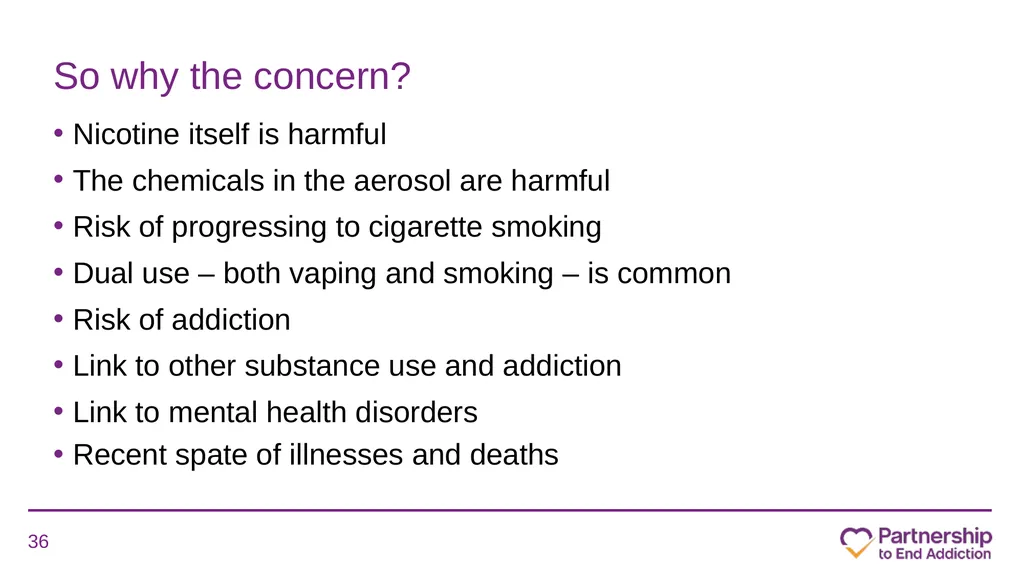
slide36. So why the concern? Nicotine itself is harmful
The chemicals in the aerosol are harmful
Risk of progressing to cigarette smoking
Dual use – both vaping and smoking – is common
Risk of addiction
Link to other substance use and addiction
Link to mental health disorders
Recent spate of illnesses and deaths 36<br>
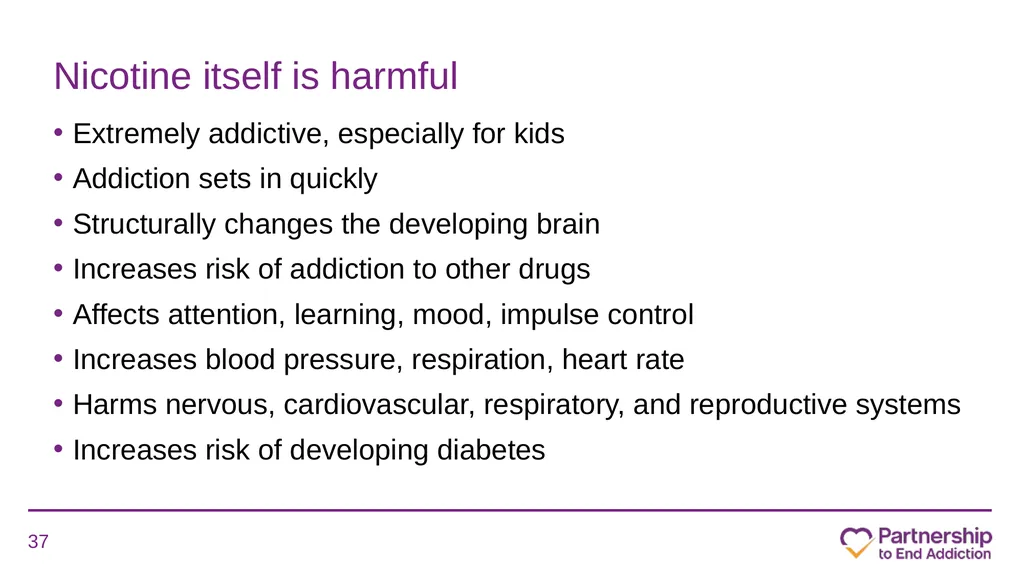
slide37. Nicotine itself is harmful Extremely addictive, especially for kids
Addiction sets in quickly
Structurally changes the developing brain
Increases risk of addiction to other drugs
Affects attention, learning, mood, impulse control
Increases blood pressure, respiration, heart rate
Harms nervous, cardiovascular, respiratory, and reproductive systems
Increases risk of developing diabetes 37<br>
slide38. Nicotine’s impact on teens Teen brain reacts differently to nicotine
Chronic nicotine exposure can, among other things, reduce attention span and increase reckless behavior
Effects are less intense and long-lasting in adults 38 Adolescent Adult Acute Nicotine Sensitivity Nicotine
Withdrawal High Dose
of Nicotine Nicotine
Pretreatment Enhances locomotor activity More sensitive to rewarding effects Display blunted withdrawal symptoms Well tolerated; lowers aversion to high doses later in life Enhances acquisition of cocaine, meth and alcohol Decreases locomotor activity More sensitive to aversive effects Display more severe withdrawal symptoms Aversive No effects on psychostimulant or alcohol self-administration Source: Child Mind Institute<br>
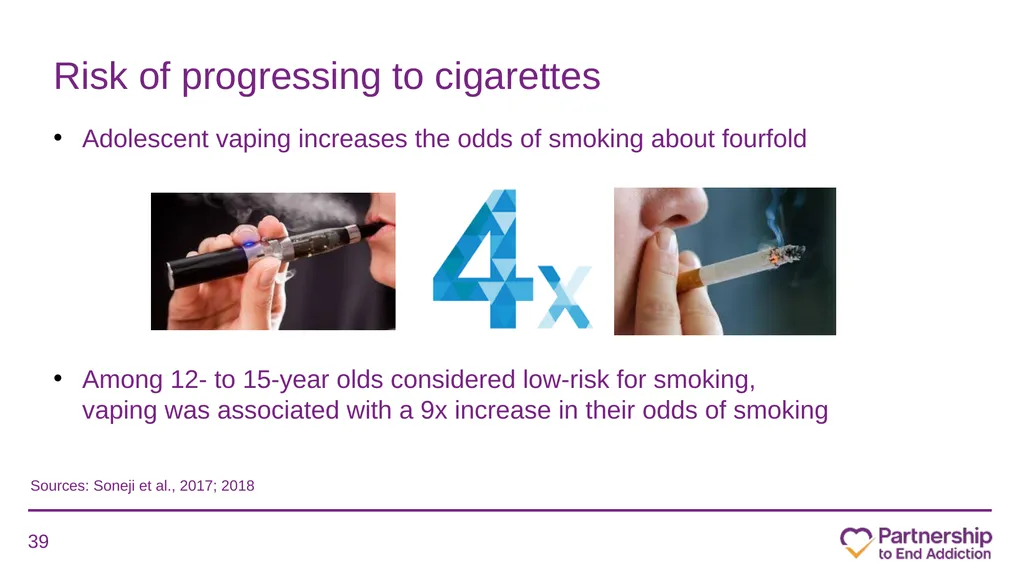
slide39. Risk of progressing to cigarettes Among 12- to 15-year olds considered low-risk for smoking, vaping was associated with a 9x increase in their odds of smoking Adolescent vaping increases the odds of smoking about fourfold Sources: Soneji et al., 2017; 2018 39<br>
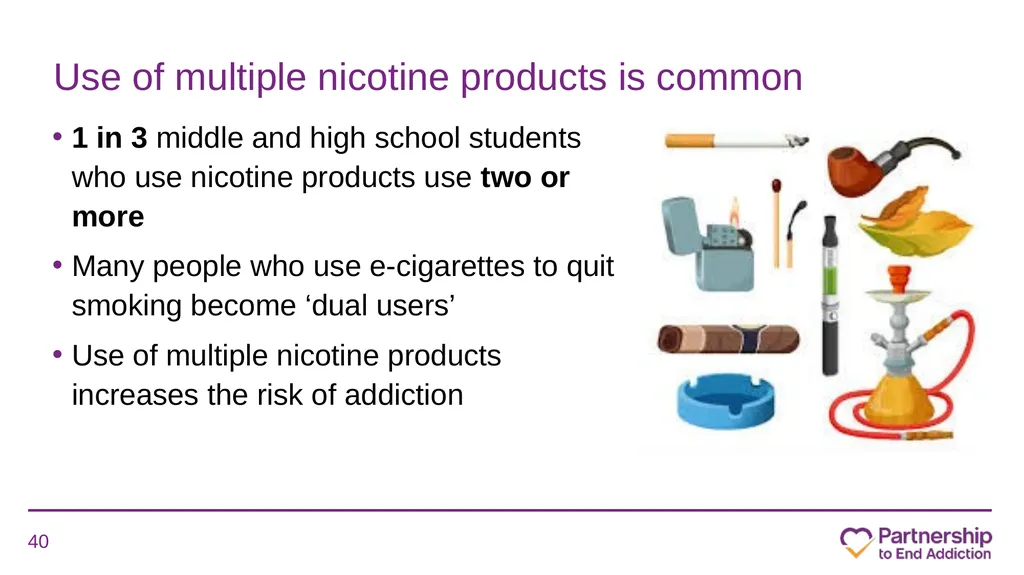
slide40. Use of multiple nicotine products is common 1 in 3 middle and high school students who use nicotine products use two or more
Many people who use e-cigarettes to quit smoking become ‘dual users’
Use of multiple nicotine products increases the risk of addiction 40<br>
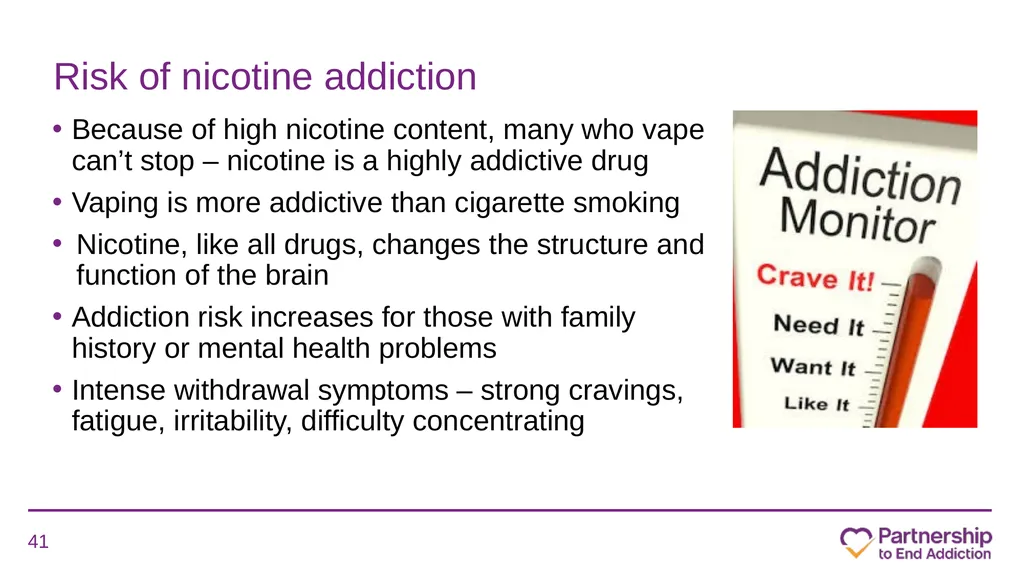
slide41. Risk of nicotine addiction Because of high nicotine content, many who vape can’t stop – nicotine is a highly addictive drug
Vaping is more addictive than cigarette smoking
Nicotine, like all drugs, changes the structure and function of the brain
Addiction risk increases for those with family history or mental health problems
Intense withdrawal symptoms – strong cravings, fatigue, irritability, difficulty concentrating 41<br>
slide42. Link to other substance use and addiction Young adults who vaped in the past year: 2x higher odds of having tobacco use disorder
Teens who used e-cigarettes but never marijuana: 2-4x higher odds of marijuana use
Nicotine exposure alters brain and increases vulnerability to other substance use, including marijuana and cocaine 42<br>
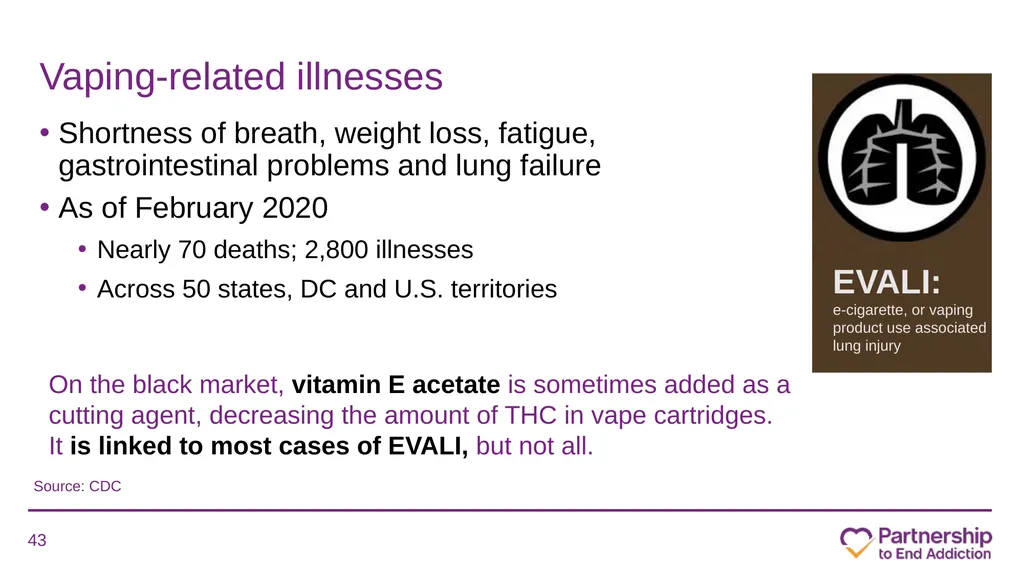
slide43. Vaping-related illnesses Shortness of breath, weight loss, fatigue, gastrointestinal problems and lung failure
As of February 2020
Nearly 70 deaths; 2,800 illnesses
Across 50 states, DC and U.S. territories On the black market, vitamin E acetate is sometimes added as a cutting agent, decreasing the amount of THC in vape cartridges. It is linked to most cases of EVALI, but not all. Source: CDC EVALI: e-cigarette, or vaping product use associated lung injury 43<br>
slide44. Hard metal lung disease When the metal coils of e-cigarettes heat up to turn e-liquids into aerosols, toxic metals like nickel, aluminum, manganese, lead, cobalt and chromium can leach into the liquid Coil under 2,000x magnification using an electron microscope At 150 burns, it shows pitting and flaking 44<br>
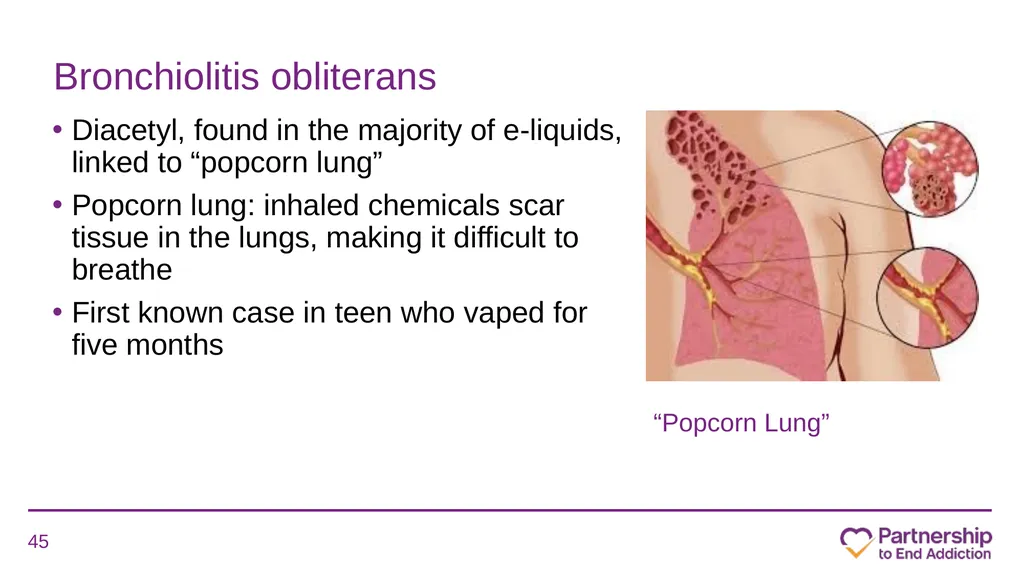
slide45. Bronchiolitis obliterans Diacetyl, found in the majority of e-liquids, linked to “popcorn lung”
Popcorn lung: inhaled chemicals scar tissue in the lungs, making it difficult to breathe
First known case in teen who vaped for five months 45 “Popcorn Lung”<br>
slide46. Vaping and COVID Vaping poses a significant risk to young people when it comes to contracting, transmitting and experiencing the health effects of COVID-19
Young people who have vaped are 5 times more likely than those who haven’t vaped to be diagnosed with the virus
Because vaping weakens the cardiovascular, respiratory and immune systems, vulnerability to the virus and its symptoms is elevated among those who vape
COVID symptoms are similar to those of EVALI 46<br>
slide47. 47 Government oversight<br>
slide48. What is the government doing? The 2016 “Deeming Rule”
Includes oversight of e-cigarettes, e-cigars, e-hookah, vape pens, e-liquids & apparatus
All manufacturers must receive marketing authorization from the FDA
Ingredients must be listed in addition to a nicotine warning
No claims like “lower risk” or “less harmful” without an FDA order in effect
No free samples
No vending machine sales except in adult-only venues
Cannot be sold to individuals under age 21
Prescription medications are illegal in e-liquids 48<br>
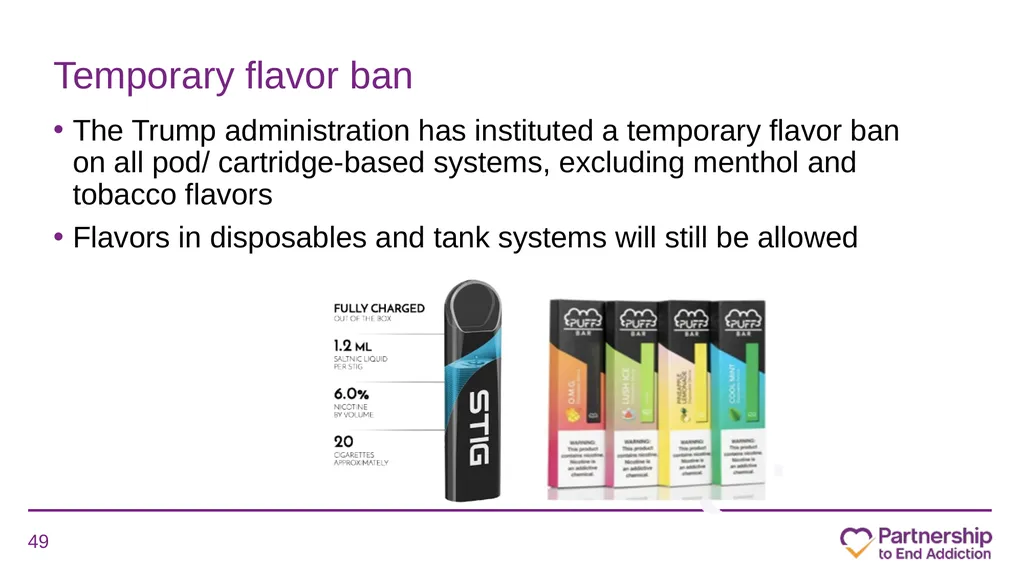
slide49. Temporary flavor ban The Trump administration has instituted a temporary flavor ban on all pod/ cartridge-based systems, excluding menthol and tobacco flavors
Flavors in disposables and tank systems will still be allowed 49<br>
slide50. Inadequate government regulation No national restrictions on advertising
Slow phase-in of “Deeming Rule”
No ban on all flavors
No requirement that products be kept behind the counter
Counterfeit products sold in plain sight on social media 50 50<br>
slide51. 51 What schools can do<br>
slide52. Prevention The main way to prevent nicotine addiction is to keep people from using nicotine products
Strategies that are implemented early work best
Effective approaches are comprehensive and involve:
Education and awareness
Appeal to students’ desires for independence and future success
Reduced access and availability
Early detection of risk, parent involvement
Compassionate, health-based interventions that promote cessation and improved mental health 52<br>
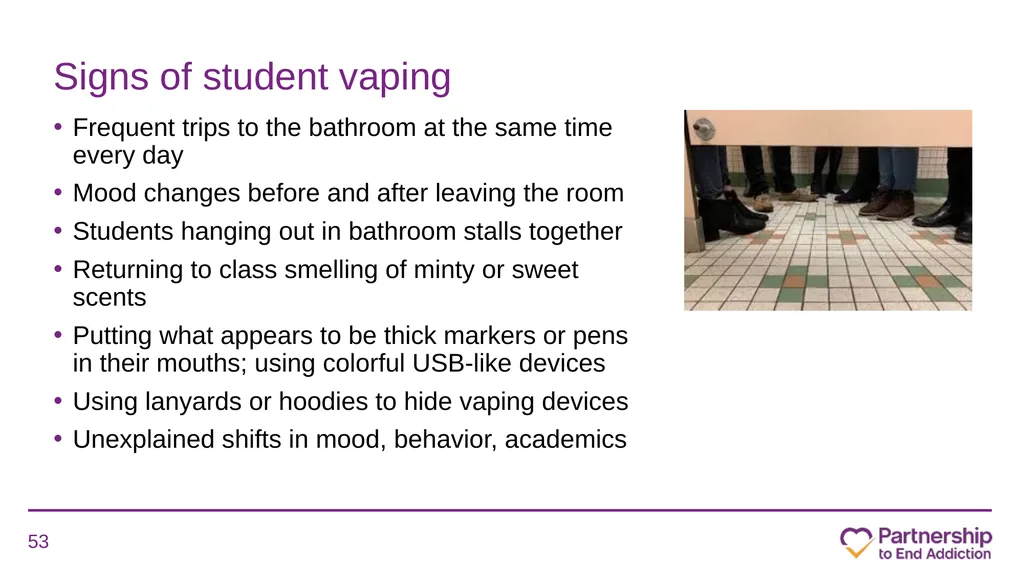
slide53. Signs of student vaping Frequent trips to the bathroom at the same time every day
Mood changes before and after leaving the room
Students hanging out in bathroom stalls together
Returning to class smelling of minty or sweet scents
Putting what appears to be thick markers or pens in their mouths; using colorful USB-like devices
Using lanyards or hoodies to hide vaping devices
Unexplained shifts in mood, behavior, academics 53<br>
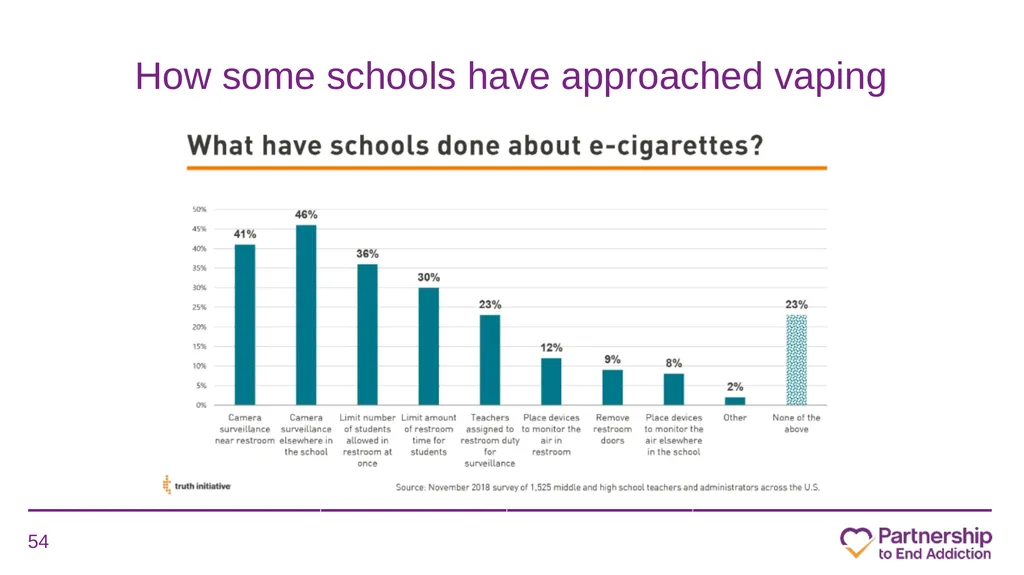
slide54. How some schools have approached vaping 54<br>
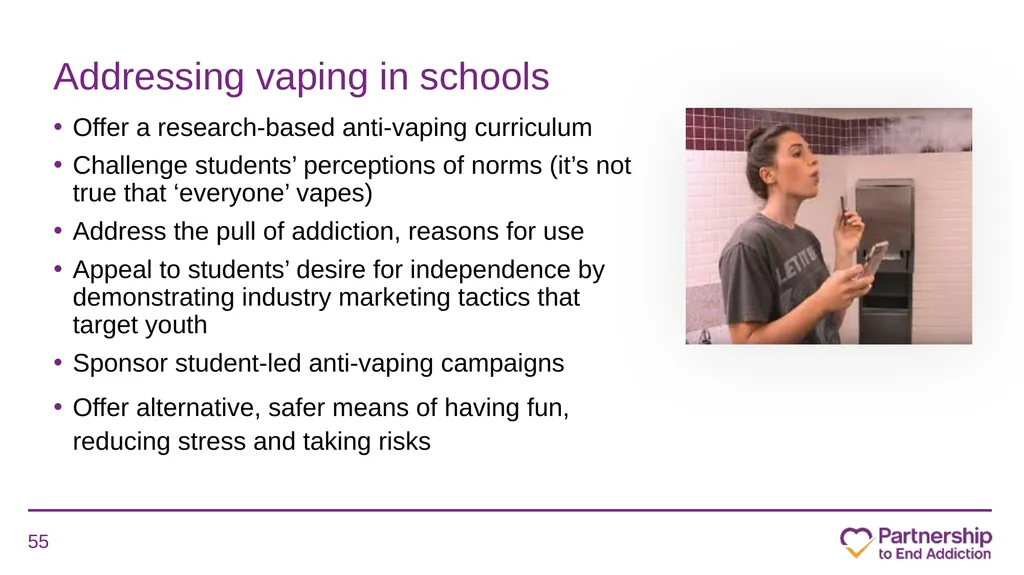
slide55. Addressing vaping in schools Offer a research-based anti-vaping curriculum
Challenge students’ perceptions of norms (it’s not true that ‘everyone’ vapes)
Address the pull of addiction, reasons for use
Appeal to students’ desire for independence by demonstrating industry marketing tactics that target youth
Sponsor student-led anti-vaping campaigns
Offer alternative, safer means of having fun, reducing stress and taking risks 55<br>
slide56. Helpful messages for teens Don’t fall for it
Don’t let big businesses take advantage of you, ruin your health, make you dependent
It’s not cool to be addicted to and dependent on a drug
Don’t be fooled by celebrity and social media promotions
There’s money behind them, not your best interests
Don’t contribute to environmental damage
Make smart and healthy choices
Vaping really is dangerous
You only have one brain and body and they’re in pretty great condition right now – why mess up your health? 56<br>
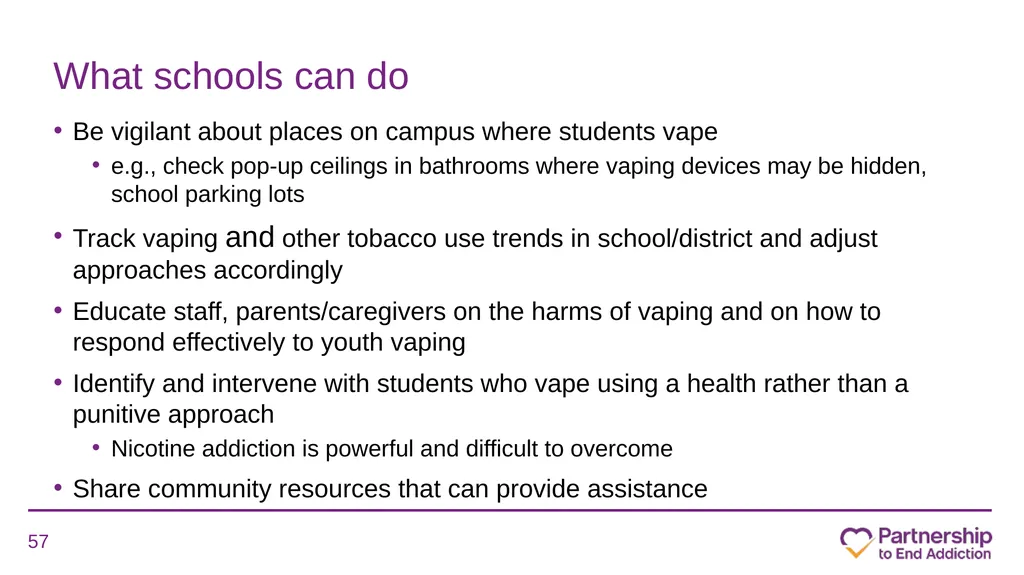
slide57. What schools can do Be vigilant about places on campus where students vape
e.g., check pop-up ceilings in bathrooms where vaping devices may be hidden, school parking lots
Track vaping and other tobacco use trends in school/district and adjust approaches accordingly
Educate staff, parents/caregivers on the harms of vaping and on how to respond effectively to youth vaping
Identify and intervene with students who vape using a health rather than a punitive approach
Nicotine addiction is powerful and difficult to overcome
Share community resources that can provide assistance 57<br>
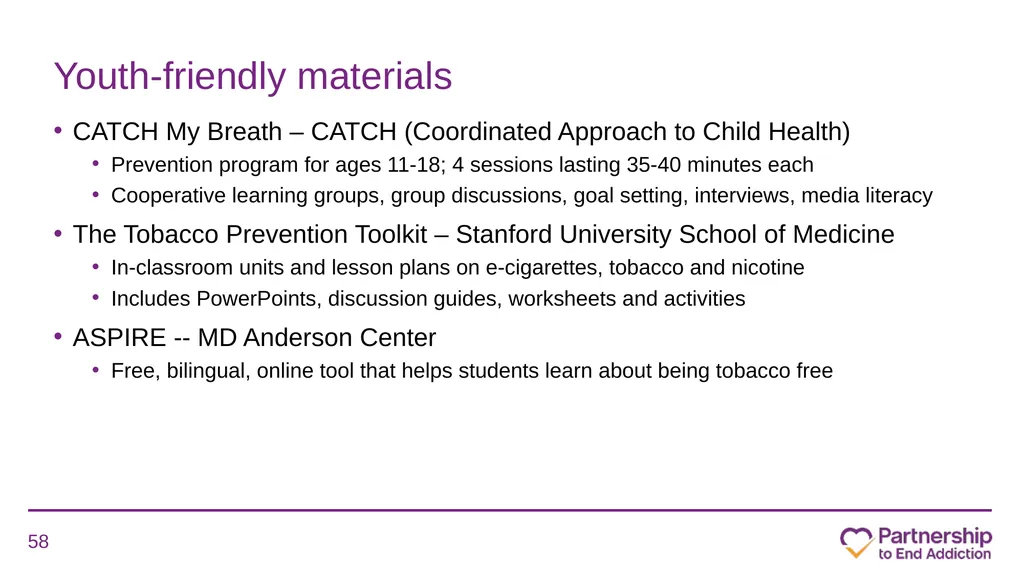
slide58. Youth-friendly materials CATCH My Breath – CATCH (Coordinated Approach to Child Health)
Prevention program for ages 11-18; 4 sessions lasting 35-40 minutes each
Cooperative learning groups, group discussions, goal setting, interviews, media literacy
The Tobacco Prevention Toolkit – Stanford University School of Medicine
In-classroom units and lesson plans on e-cigarettes, tobacco and nicotine
Includes PowerPoints, discussion guides, worksheets and activities
ASPIRE -- MD Anderson Center
Free, bilingual, online tool that helps students learn about being tobacco free 58<br>
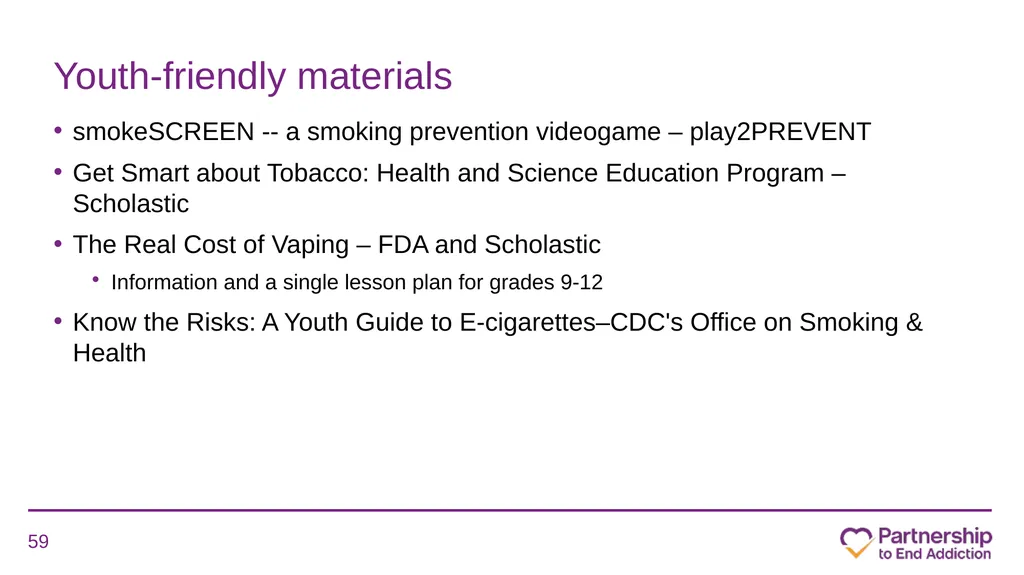
slide59. Youth-friendly materials smokeSCREEN -- a smoking prevention videogame – play2PREVENT
Get Smart about Tobacco: Health and Science Education Program – Scholastic
The Real Cost of Vaping – FDA and Scholastic
Information and a single lesson plan for grades 9-12
Know the Risks: A Youth Guide to E-cigarettes–CDC's Office on Smoking & Health 59<br>
slide60. 60 Additional Resources<br>
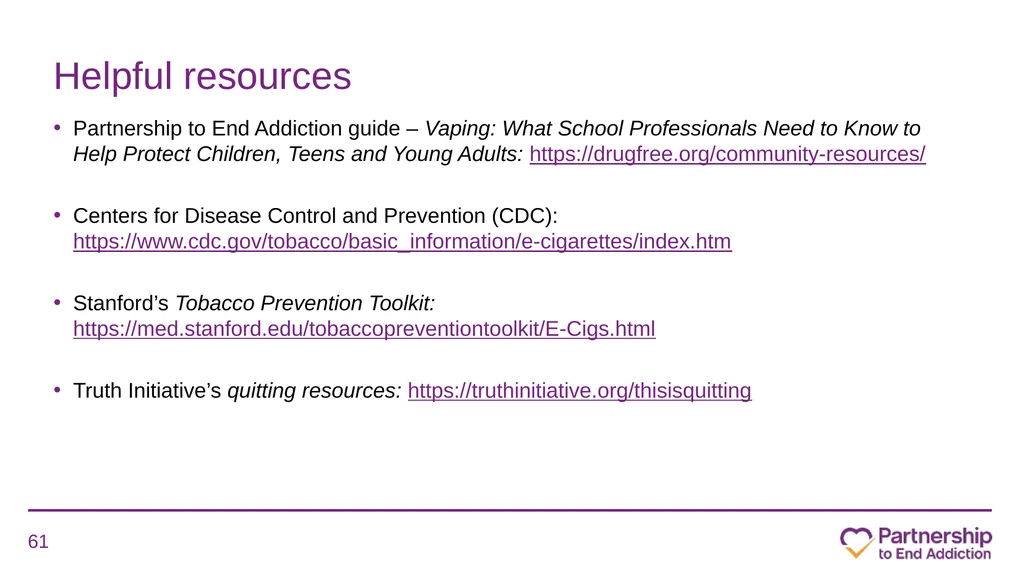
slide61. Helpful resources Partnership to End Addiction guide – Vaping: What School Professionals Need to Know to Help Protect Children, Teens and Young Adults: https://drugfree.org/community-resources/
Centers for Disease Control and Prevention (CDC): https://www.cdc.gov/tobacco/basic_information/e-cigarettes/index.htm
Stanford’s Tobacco Prevention Toolkit: https://med.stanford.edu/tobaccopreventiontoolkit/E-Cigs.html
Truth Initiative’s quitting resources: https://truthinitiative.org/thisisquitting 61<br>
slide62. Contact Pat Aussem
paussem@toendaddiction.org 62 Linda Richter
lrichter@toendaddiction.org<br>
slide63. © 2020 Partnership to End Addiction<br>
Fall 2020<br>
slide2. What you need to know Vaping basics
What’s the appeal?
Hooking a new generation
Vaping by the numbers
Why the concern?
Government oversight
Actions schools can take
Additional resources 2<br>
slide3. 3 Vaping Basics<br>
slide4. Vaping is the act of inhaling and exhaling the aerosol, often referred to as “vapor,” produced by an e-cigarette or similar device. Components include:
Cartridge or reservoir to hold a e-liquid
Heating element (atomizer)
Power source (battery)
Mouthpiece to inhale What is vaping? 4 4<br>
slide5. 5 Source: Science News for Students Cig-a-Like Vape Pens Variations Mods Pod-Based<br>
slide6. JUUL: the iPhone of vapes JUUL - $14.99 plus $15.99/pack of 4 pods
Pod flavors: Menthol, Virginia and Classic Tobacco
Contain 3% or 5% nicotine = 1+ pack of cigarettes or 200 puffs 6 6<br>
slide7. Other vape devices 7<br>
slide8. What is being vaped? Flavored liquids including chemicals like glycerin and propylene glycol
Flavored liquids with varying levels of nicotine
Flavored liquids with vitamins and essential oils
Leaf marijuana, THC oil/wax 8<br>
slide9. The nicotine “arms race” 9 Source: Science News for Students<br>
slide10. Vape devices for marijuana and oils 10<br>
slide11. Disposable marijuana vape pens and cartridges Delivered to your door by Eaze 11 Source: adai.uw.edu<br>
slide12. A new device: Philip Morris International’s IQOS IQOS is a “Heat, Not Burn” Device 12<br>
slide13. How do youth get vaping products? 13 U.S. law now prohibits the sale of tobacco products, including e-cigarettes, to anyone under age 21 Friend
Vape shop
Family member
Gas station/convenience store
Person other than family member or friend
Online Sources of e-cigarettes among students who vaped in the past 30 days (2018) 59%
17%
13%
10%
9%
6%<br>
slide14. Slang terms Analog: tobacco as the old physical or "analog" version
Juul, Pax, NJOY, Puff Bars, Stigs: styles/brands
Atty: atomizer to heat e-liquid
Cart: cartridge that holds the e-liquid
Carto: cartridge and atomizer combined into a single unit
Cloud chasing: e-cigarette/mod users tweak their hardware and liquid selections to produce ever bigger and thicker clouds of aerosol
Draw: amount of force required to accommodate inhalation through the mouthpiece of an e-cigarette
E-liquid, smoke juice: the liquids that are vaporized when using an e-cigarette
PV: personal vaporizer, often the mod style 14<br>
slide15. More slang terms O/Ohm: standard unit of electrical resistance
PG: propylene glycol is used as a diluent (a filler and diluting agent)
TH: throat hit is the sensation an e-cigarette user (and tobacco smoker) may experience when the aerosol hits the back of their throat
VG: vegetable glycerin acts as a diluent, or filler, and is a common ingredient found in e-liquid 15<br>
slide16. More slang - dripping 16 Apply nicotine liquid directly to heated coils of e-cig or vaporizer
Produces thick clouds of nicotine vapor and a stronger “throat hit”<br>
slide17. 17 What’s the appeal?<br>
slide18. Why teens vape Curiosity (55%)
Friend or family member vapes (31%)
Flavors (22%)
Vaping tricks (21%)
Less harmful than other tobacco products (16%)
Discreet, can be used anywhere (14%)
Peer pressure (11%)
To try to quit other tobacco products (6%)
Easier to get than other tobacco products (5%)
Famous people use them (4%) 18 Source: CDC, 2019<br>
slide19. Reasons for vaping Source: Monitoring the Future 2019, 12th grade responses 19<br>
slide20. 20 Are we hooking a new generation?<br>
slide21. How is the tobacco industry going to replace older smokers? 90% of adult smokers began smoking before age 18
95% of those with nicotine addiction began smoking before age 21 21<br>
slide22. Big tobacco behind popular vaping products 22<br>
slide23. Tobacco + e-cigarettes: advertising 23<br>
slide24. Tobacco + e-cigarettes: packaging 24<br>
slide25. Youth-friendly designs and flavors 4 out of 5 kids who have used tobacco products
started with a flavored product. 25<br>
slide26. Social media marketing 26<br>
slide27. Social media posts and JUUL 27<br>
slide28. “JUULery” 28<br>
slide29. 29 Source: truthinitiative.org<br>
slide30. 30 Vaping by the numbers<br>
slide31. How many people vape? Source: CDC Percentage of students reporting vaping in the past 30 days (2018-2020) % 31<br>
slide32. Reports of frequent vaping in the past 30 days A significant proportion of students who reported vaping in the past 30 days in 2020 did so frequently (>20 days) or daily (all 30 days) 32 Source: CDC %<br>
slide33. What are they inhaling? 33 Source: Monitoring the Future 2019 % Past Year Use<br>
slide34. 34 Why the concern?<br>
slide35. Harmful chemicals: cigarettes vs. vaping Cigarette smoke contains over 7,000 chemicals, including known cancer-causing (carcinogenic) compounds and hundreds of other toxins The aerosol created when vaping contains harmful ingredients:
Nicotine
Ultrafine particles
Flavorings
Volatile organic compounds (e.g., benzene, found in car exhaust)
Heavy metals (e.g., nickel, tin, lead) 35<br>
slide36. So why the concern? Nicotine itself is harmful
The chemicals in the aerosol are harmful
Risk of progressing to cigarette smoking
Dual use – both vaping and smoking – is common
Risk of addiction
Link to other substance use and addiction
Link to mental health disorders
Recent spate of illnesses and deaths 36<br>
slide37. Nicotine itself is harmful Extremely addictive, especially for kids
Addiction sets in quickly
Structurally changes the developing brain
Increases risk of addiction to other drugs
Affects attention, learning, mood, impulse control
Increases blood pressure, respiration, heart rate
Harms nervous, cardiovascular, respiratory, and reproductive systems
Increases risk of developing diabetes 37<br>
slide38. Nicotine’s impact on teens Teen brain reacts differently to nicotine
Chronic nicotine exposure can, among other things, reduce attention span and increase reckless behavior
Effects are less intense and long-lasting in adults 38 Adolescent Adult Acute Nicotine Sensitivity Nicotine
Withdrawal High Dose
of Nicotine Nicotine
Pretreatment Enhances locomotor activity More sensitive to rewarding effects Display blunted withdrawal symptoms Well tolerated; lowers aversion to high doses later in life Enhances acquisition of cocaine, meth and alcohol Decreases locomotor activity More sensitive to aversive effects Display more severe withdrawal symptoms Aversive No effects on psychostimulant or alcohol self-administration Source: Child Mind Institute<br>
slide39. Risk of progressing to cigarettes Among 12- to 15-year olds considered low-risk for smoking, vaping was associated with a 9x increase in their odds of smoking Adolescent vaping increases the odds of smoking about fourfold Sources: Soneji et al., 2017; 2018 39<br>
slide40. Use of multiple nicotine products is common 1 in 3 middle and high school students who use nicotine products use two or more
Many people who use e-cigarettes to quit smoking become ‘dual users’
Use of multiple nicotine products increases the risk of addiction 40<br>
slide41. Risk of nicotine addiction Because of high nicotine content, many who vape can’t stop – nicotine is a highly addictive drug
Vaping is more addictive than cigarette smoking
Nicotine, like all drugs, changes the structure and function of the brain
Addiction risk increases for those with family history or mental health problems
Intense withdrawal symptoms – strong cravings, fatigue, irritability, difficulty concentrating 41<br>
slide42. Link to other substance use and addiction Young adults who vaped in the past year: 2x higher odds of having tobacco use disorder
Teens who used e-cigarettes but never marijuana: 2-4x higher odds of marijuana use
Nicotine exposure alters brain and increases vulnerability to other substance use, including marijuana and cocaine 42<br>
slide43. Vaping-related illnesses Shortness of breath, weight loss, fatigue, gastrointestinal problems and lung failure
As of February 2020
Nearly 70 deaths; 2,800 illnesses
Across 50 states, DC and U.S. territories On the black market, vitamin E acetate is sometimes added as a cutting agent, decreasing the amount of THC in vape cartridges. It is linked to most cases of EVALI, but not all. Source: CDC EVALI: e-cigarette, or vaping product use associated lung injury 43<br>
slide44. Hard metal lung disease When the metal coils of e-cigarettes heat up to turn e-liquids into aerosols, toxic metals like nickel, aluminum, manganese, lead, cobalt and chromium can leach into the liquid Coil under 2,000x magnification using an electron microscope At 150 burns, it shows pitting and flaking 44<br>
slide45. Bronchiolitis obliterans Diacetyl, found in the majority of e-liquids, linked to “popcorn lung”
Popcorn lung: inhaled chemicals scar tissue in the lungs, making it difficult to breathe
First known case in teen who vaped for five months 45 “Popcorn Lung”<br>
slide46. Vaping and COVID Vaping poses a significant risk to young people when it comes to contracting, transmitting and experiencing the health effects of COVID-19
Young people who have vaped are 5 times more likely than those who haven’t vaped to be diagnosed with the virus
Because vaping weakens the cardiovascular, respiratory and immune systems, vulnerability to the virus and its symptoms is elevated among those who vape
COVID symptoms are similar to those of EVALI 46<br>
slide47. 47 Government oversight<br>
slide48. What is the government doing? The 2016 “Deeming Rule”
Includes oversight of e-cigarettes, e-cigars, e-hookah, vape pens, e-liquids & apparatus
All manufacturers must receive marketing authorization from the FDA
Ingredients must be listed in addition to a nicotine warning
No claims like “lower risk” or “less harmful” without an FDA order in effect
No free samples
No vending machine sales except in adult-only venues
Cannot be sold to individuals under age 21
Prescription medications are illegal in e-liquids 48<br>
slide49. Temporary flavor ban The Trump administration has instituted a temporary flavor ban on all pod/ cartridge-based systems, excluding menthol and tobacco flavors
Flavors in disposables and tank systems will still be allowed 49<br>
slide50. Inadequate government regulation No national restrictions on advertising
Slow phase-in of “Deeming Rule”
No ban on all flavors
No requirement that products be kept behind the counter
Counterfeit products sold in plain sight on social media 50 50<br>
slide51. 51 What schools can do<br>
slide52. Prevention The main way to prevent nicotine addiction is to keep people from using nicotine products
Strategies that are implemented early work best
Effective approaches are comprehensive and involve:
Education and awareness
Appeal to students’ desires for independence and future success
Reduced access and availability
Early detection of risk, parent involvement
Compassionate, health-based interventions that promote cessation and improved mental health 52<br>
slide53. Signs of student vaping Frequent trips to the bathroom at the same time every day
Mood changes before and after leaving the room
Students hanging out in bathroom stalls together
Returning to class smelling of minty or sweet scents
Putting what appears to be thick markers or pens in their mouths; using colorful USB-like devices
Using lanyards or hoodies to hide vaping devices
Unexplained shifts in mood, behavior, academics 53<br>
slide54. How some schools have approached vaping 54<br>
slide55. Addressing vaping in schools Offer a research-based anti-vaping curriculum
Challenge students’ perceptions of norms (it’s not true that ‘everyone’ vapes)
Address the pull of addiction, reasons for use
Appeal to students’ desire for independence by demonstrating industry marketing tactics that target youth
Sponsor student-led anti-vaping campaigns
Offer alternative, safer means of having fun, reducing stress and taking risks 55<br>
slide56. Helpful messages for teens Don’t fall for it
Don’t let big businesses take advantage of you, ruin your health, make you dependent
It’s not cool to be addicted to and dependent on a drug
Don’t be fooled by celebrity and social media promotions
There’s money behind them, not your best interests
Don’t contribute to environmental damage
Make smart and healthy choices
Vaping really is dangerous
You only have one brain and body and they’re in pretty great condition right now – why mess up your health? 56<br>
slide57. What schools can do Be vigilant about places on campus where students vape
e.g., check pop-up ceilings in bathrooms where vaping devices may be hidden, school parking lots
Track vaping and other tobacco use trends in school/district and adjust approaches accordingly
Educate staff, parents/caregivers on the harms of vaping and on how to respond effectively to youth vaping
Identify and intervene with students who vape using a health rather than a punitive approach
Nicotine addiction is powerful and difficult to overcome
Share community resources that can provide assistance 57<br>
slide58. Youth-friendly materials CATCH My Breath – CATCH (Coordinated Approach to Child Health)
Prevention program for ages 11-18; 4 sessions lasting 35-40 minutes each
Cooperative learning groups, group discussions, goal setting, interviews, media literacy
The Tobacco Prevention Toolkit – Stanford University School of Medicine
In-classroom units and lesson plans on e-cigarettes, tobacco and nicotine
Includes PowerPoints, discussion guides, worksheets and activities
ASPIRE -- MD Anderson Center
Free, bilingual, online tool that helps students learn about being tobacco free 58<br>
slide59. Youth-friendly materials smokeSCREEN -- a smoking prevention videogame – play2PREVENT
Get Smart about Tobacco: Health and Science Education Program – Scholastic
The Real Cost of Vaping – FDA and Scholastic
Information and a single lesson plan for grades 9-12
Know the Risks: A Youth Guide to E-cigarettes–CDC's Office on Smoking & Health 59<br>
slide60. 60 Additional Resources<br>
slide61. Helpful resources Partnership to End Addiction guide – Vaping: What School Professionals Need to Know to Help Protect Children, Teens and Young Adults: https://drugfree.org/community-resources/
Centers for Disease Control and Prevention (CDC): https://www.cdc.gov/tobacco/basic_information/e-cigarettes/index.htm
Stanford’s Tobacco Prevention Toolkit: https://med.stanford.edu/tobaccopreventiontoolkit/E-Cigs.html
Truth Initiative’s quitting resources: https://truthinitiative.org/thisisquitting 61<br>
slide62. Contact Pat Aussem
paussem@toendaddiction.org 62 Linda Richter
lrichter@toendaddiction.org<br>
slide63. © 2020 Partnership to End Addiction<br>