04
Importanace of kala /prayojanam Kleda, which is present in between the dhatu and ashaya, metabolized under the influence of dehoshma, thus forms the Kala.<br>
05
Classification Kalas are described as seven –
1. Mamsadhara,
2. Rakta- dhara,
3. Medodhara,
4. Shleshmadhara,
5. Purishadhara,
6. Pittadhara and
7. Shukradhara.<br>
06
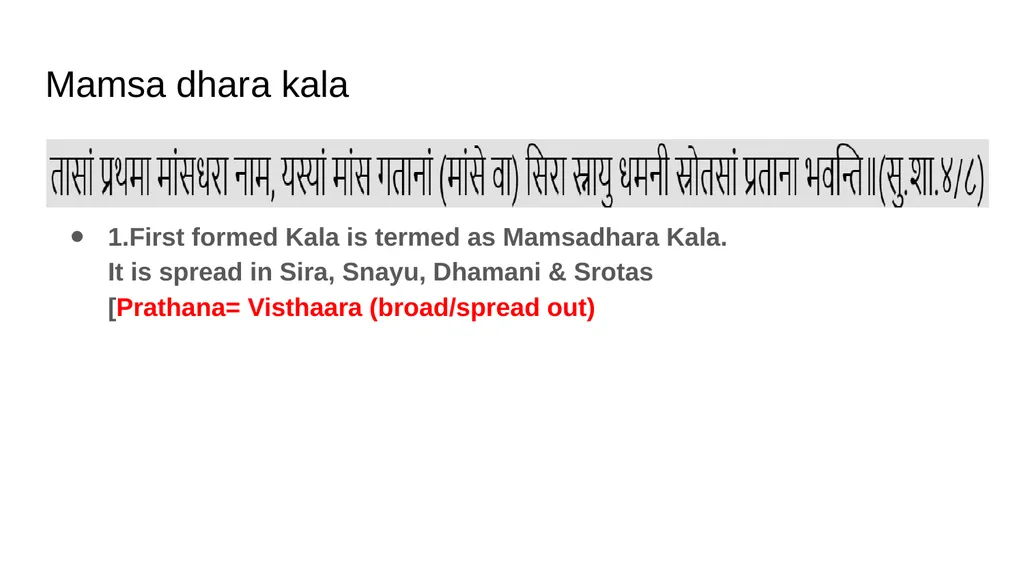
Mamsa dhara kala 1.First formed Kala is termed as Mamsadhara Kala.�It is spread in Sira, Snayu, Dhamani & Srotas�[Prathana= Visthaara (broad/spread out)<br>
07
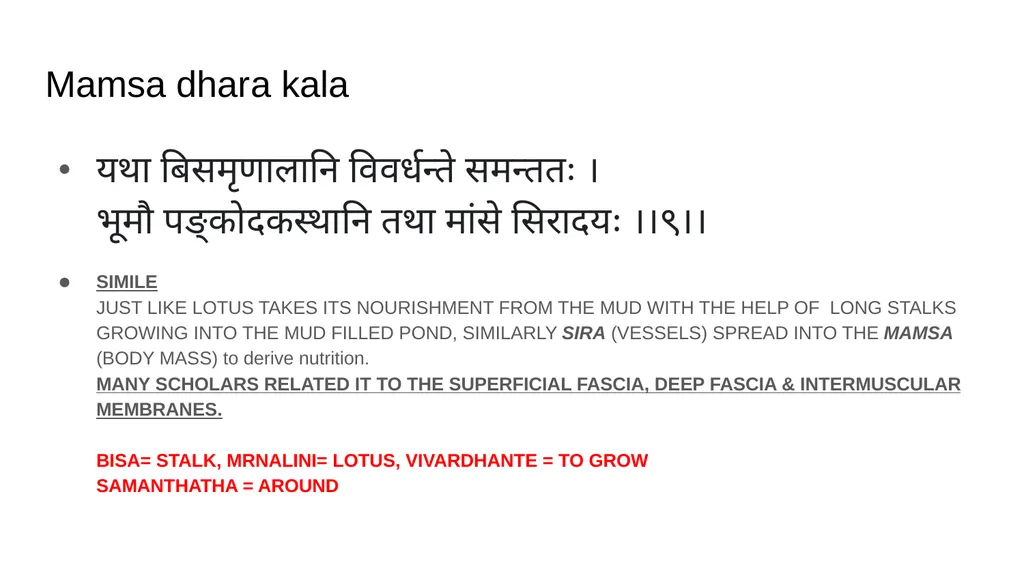
Mamsa dhara kala यथा बिसमृणालानि विवर्धन्ते समन्ततः । �भूमौ पङ्कोदकस्थानि तथा मांसे सिरादयः ।।९।।
SIMILE�JUST LIKE LOTUS TAKES ITS NOURISHMENT FROM THE MUD WITH THE HELP OF LONG STALKS GROWING INTO THE MUD FILLED POND, SIMILARLY SIRA (VESSELS) SPREAD INTO THE MAMSA (BODY MASS) to derive nutrition.�MANY SCHOLARS RELATED IT TO THE SUPERFICIAL FASCIA, DEEP FASCIA & INTERMUSCULAR MEMBRANES.��BISA= STALK, MRNALINI= LOTUS, VIVARDHANTE = TO GROW�SAMANTHATHA = AROUND<br>
08
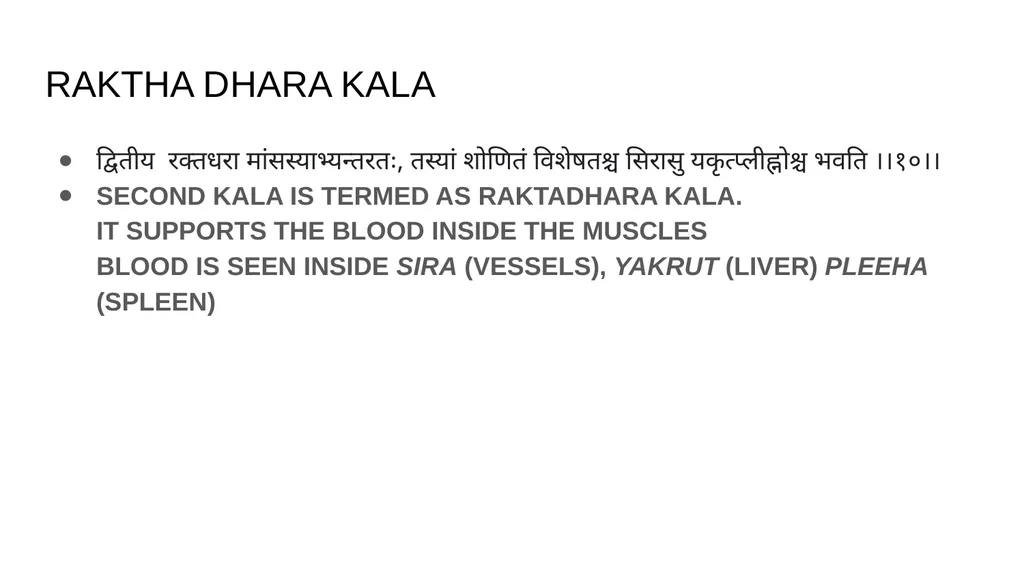
RAKTHA DHARA KALA द्वितीय रक्तधरा मांसस्याभ्यन्तरतः, तस्यां शोणितं विशेषतश्च सिरासु यकृत्प्लीह्नोश्च भवति ।।१०।।
SECOND KALA IS TERMED AS RAKTADHARA KALA.�IT SUPPORTS THE BLOOD INSIDE THE MUSCLES�BLOOD IS SEEN INSIDE SIRA (VESSELS), YAKRUT (LIVER) PLEEHA (SPLEEN)<br>
09
वृक्षाद्यथाभिप्रहतात् क्षीरिणः क्षीरिमावहेत् । �मांसादेवं क्षतात् क्षिप्रं शोणितं सम्प्रसिच्यते ।।११।। SIMILE ��JUST LIKE LATEX/SAP FLOWS/OOZES FROM A CUT TREE,�SIMILARLY BLOOD FLOWS OUT WHEN MAMSA (BODY MASS) IS INJURED OR CUT�MANY SCHOLARS BELIEVE IT TO BE THE ENDOTHELIAL LINING OF BLOOD VESSELS.��ABIPRAHATHATH = TO CUT, KSHEERA= MILK (HERE LATEX/SAP)��AVAHETH = FLOW OUT, KSHIPRA = FAST, SAMPRASICHYATHE = SECRETE,OOZE
RAKTHADHARA KALA<br>
10
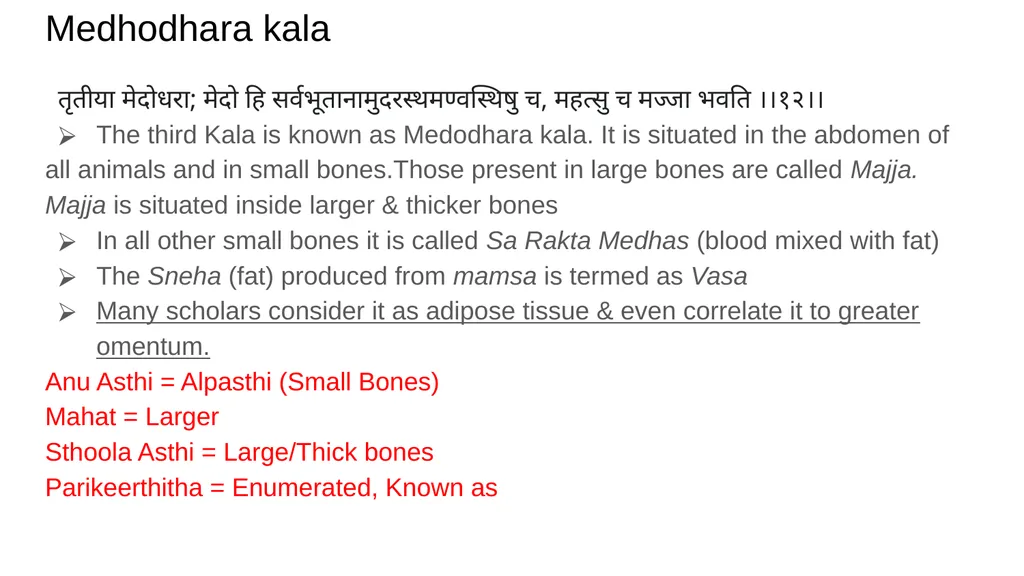
Medhodhara kala तृतीया मेदोधरा; मेदो हि सर्वभूतानामुदरस्थमण्वस्थिषु च, महत्सु च मज्जा भवति ।।१२।।
The third Kala is known as Medodhara kala. It is situated in the abdomen of
all animals and in small bones.Those present in large bones are called Majja.
Majja is situated inside larger & thicker bones
In all other small bones it is called Sa Rakta Medhas (blood mixed with fat)
The Sneha (fat) produced from mamsa is termed as Vasa
Many scholars consider it as adipose tissue & even correlate it to greater omentum.
Anu Asthi = Alpasthi (Small Bones)
Mahat = Larger
Sthoola Asthi = Large/Thick bones
Parikeerthitha = Enumerated, Known as<br>
11
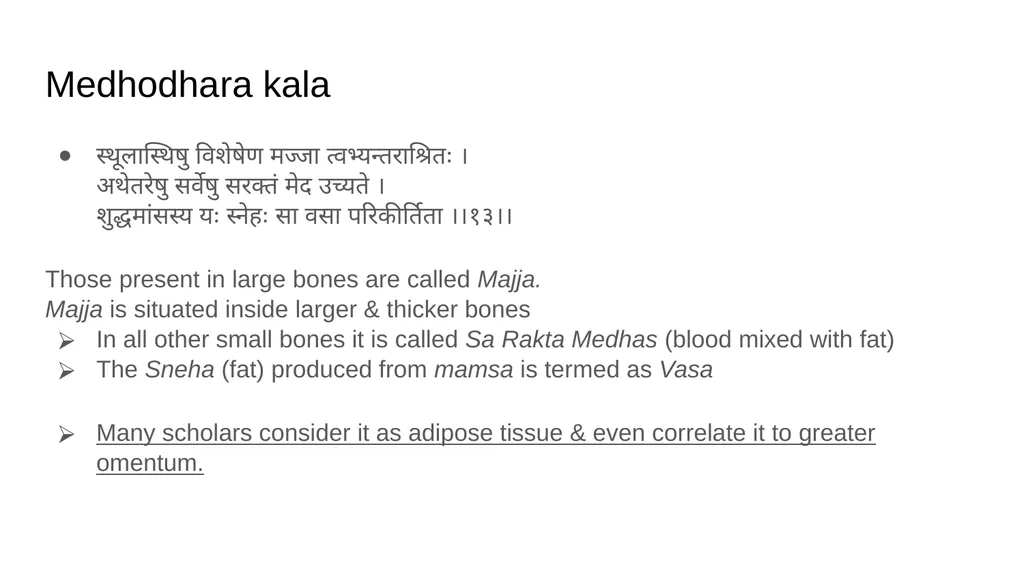
Medhodhara kala स्थूलास्थिषु विशेषेण मज्जा त्वभ्यन्तराश्रितः । �अथेतरेषु सर्वेषु सरक्तं मेद उच्यते । �शुद्धमांसस्य यः स्नेहः सा वसा परिकीर्तिता ।।१३।।
Those present in large bones are called Majja.
Majja is situated inside larger & thicker bones
In all other small bones it is called Sa Rakta Medhas (blood mixed with fat)
The Sneha (fat) produced from mamsa is termed as Vasa
Many scholars consider it as adipose tissue & even correlate it to greater omentum.<br>
12
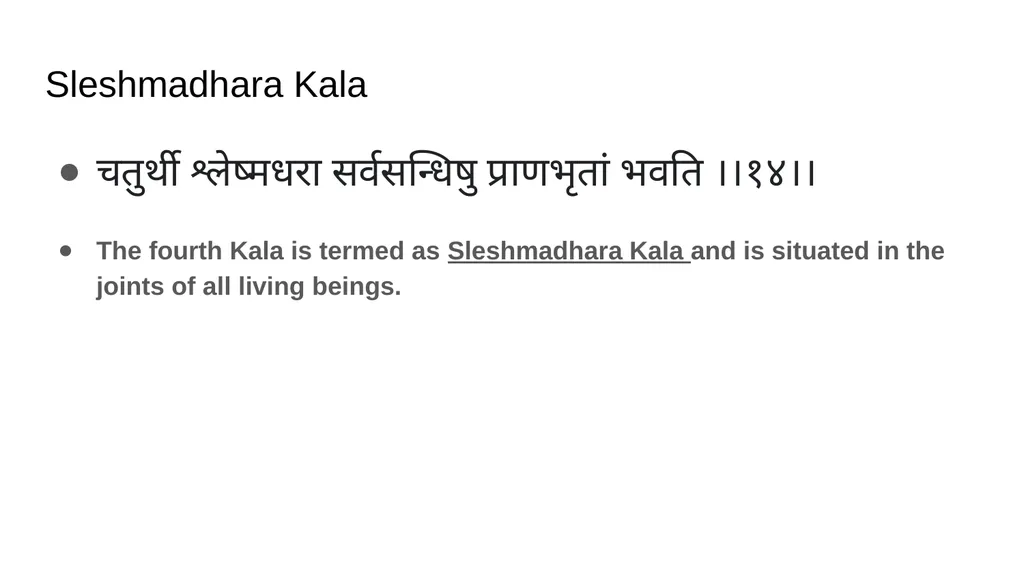
Sleshmadhara Kala चतुर्थी श्लेष्मधरा सर्वसन्धिषु प्राणभृतां भवति ।।१४।।
The fourth Kala is termed as Sleshmadhara Kala and is situated in the joints of all living beings.<br>
13
स्नेहाभ्यक्ते यथा ह्यक्षे चक्रं साधु प्रवर्तते । �सन्धयः साधु वर्तन्ते संश्लिष्टाः श्लेष्मणा तथा ।।१५।।
SIMILE�A wheel rotates well when its axis is lubricated (properly oiled).Similarly�a JOINT functions well when it is properly lubricated with synovial fluid�IN THIS WE CAN CONSIDER SYNOVIAL FLUID/MEMBRANE AS SLESHMADHARA KALA.�Sneha Abhyakthe= properly lubricated, Aksha=Axis, Sadhu= Good, Correct�Samslishta = attach or bring together<br>
14
पञ्चमी पुरीषधरा नाम; याऽन्तःकोष्ठे मलमभिविभजते पक्वाशयस्था ।।१६।। The fifth Kala is termed as Pureeshadhara Kala
It separates the Mala (into Drava mala= Mootra & Ghana mala = Pureesha) within the Pakwashaya (large intestine)
Yakrit (Liver) is situated near the Koshta (GI tract)
Undooka is said to be the place were the separation of mala into mootra & pureesha occurs
Undooka is explained by Dalhana as Pottalaka (retort shape).
So we have to assume that the vibhajana of mala starts in Undooka which
can be correlated to Caecum
Many scholars consider it to be the coats of large intestine which play an important role in formation of feces.
Antha Koshta = Koshtamadhye (Inside Koshta)
Samanthata = all around,everywhere, nearby<br>
15
यकृत्समन्तात् कोष्ठं च तथाऽन्त्राणि समाश्रिता । �उण्डु(न्दु)कस्थं विभजते मलं मलधरा कला ।।१७।।�
Yakira (Liver) is situated near the Koshta (GI tract)
Undooka is said to be the place were the separation of mala into mootra & pureesha occurs
Undooka is explained by Dalhana as Pottalaka (retort shape).
So we have to assume that the vibhajana of mala starts in Undooka which
can be correlated to Caecum
Many scholars consider it to be the coats of large intestine which play an important role in formation of feces.
Antha Koshta = Koshtamadhye (Inside Koshta)
Samanthata = all around,everywhere, nearby<br>
16
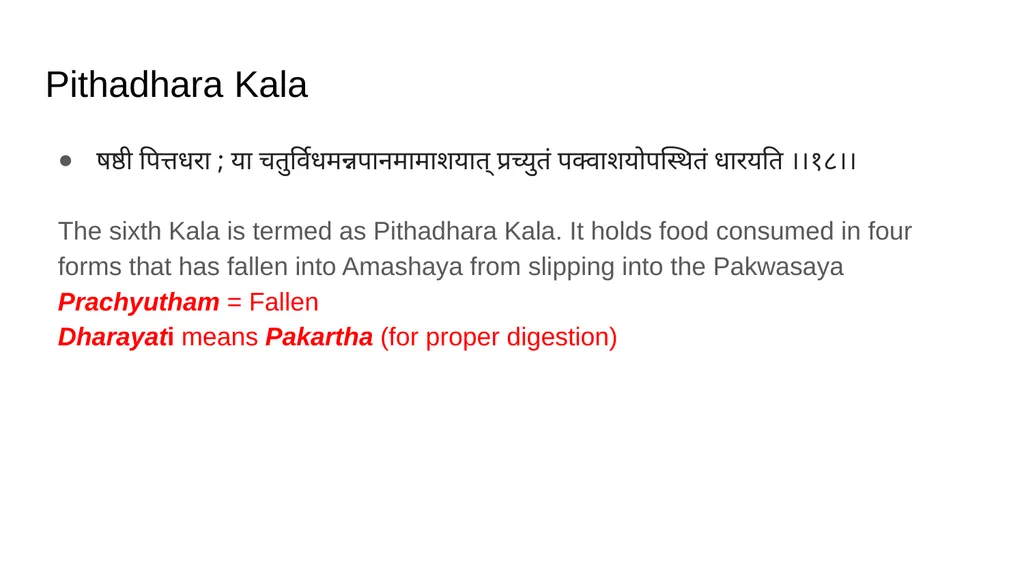
Pithadhara Kala षष्ठी पित्तधरा ; या चतुर्विधमन्नपानमामाशयात् प्रच्युतं पक्वाशयोपस्थितं धारयति ।।१८।।
The sixth Kala is termed as Pithadhara Kala. It holds food consumed in four forms that has fallen into Amashaya from slipping into the Pakwasaya �Prachyutham = Fallen�Dharayati means Pakartha (for proper digestion)<br>
17
अशितं खादितं पीतं लीढं कोष्ठगतं नृणाम् । �तज्जीर्यति यथाकालं शोषितं पित्ततेजसा ।।१९।।
FOOD CONSUMED IN FOUR FORMS (CHEWED,LICKED,DRUNK AND SWALLOWED) REACH THE KOSHTA & GETS DIGESTED DUE TO THE ACTION OF PITTA.�ASHTANGA HRUDAYA MENTIONS PITHADHARA KALA AS GRAHANI.�PITTADHARA KALA IS CONSIDERED BY MANY SCHOLARS AS THE DUODENAL SPHINCTER, SOME REGARD IT TO BE THE GASTRIC JUICES AND SOME AS THE COATS OF STOMACH<br>
18
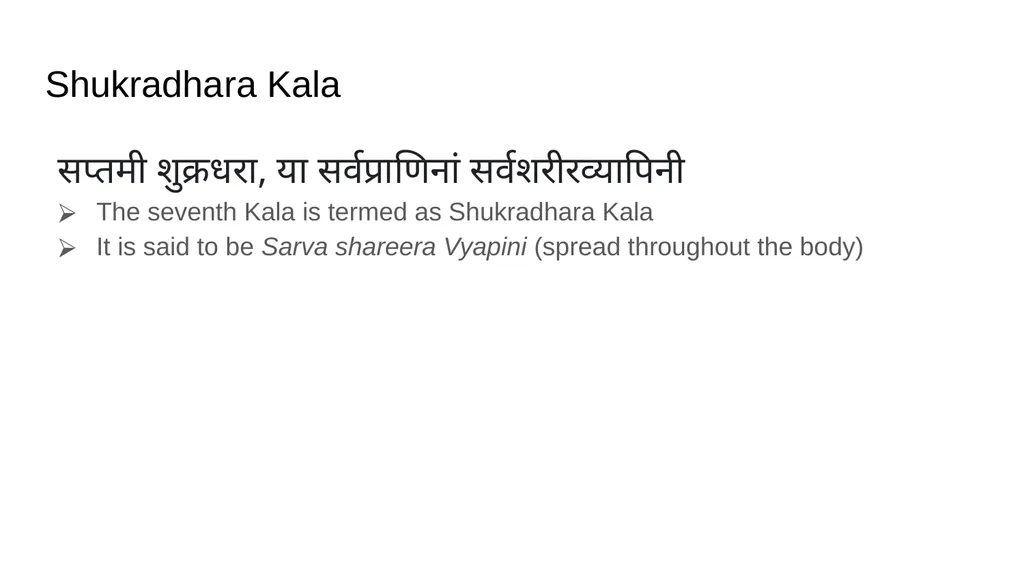
Shukradhara Kala सप्तमी शुक्रधरा, या सर्वप्राणिनां सर्वशरीरव्यापिनी
The seventh Kala is termed as Shukradhara Kala
It is said to be Sarva shareera Vyapini (spread throughout the body)<br>
19
यथा पयसि सर्पिस्तु गूढश्चेक्षौ रसो यथा । �शरीरेषु तथा शुक्रं नृणां विद्याद्भिषग्वरः ।।२१।।
SIMILE
Just like ghee remains hidden in milk and attains its form when processed
just like jaggery is hidden in sugarcane, similarly
Shukra (Semen) is ejaculated by arousal of male during coitus.
Payas = Milk, Sarpi = Ghee, Guda = Jaggery, Ikshu rasa = Sugarcane juice
Explanation
The entire genetic make up of an individual is present in the semen of a male
which fertilizes with ovum to produce a new progeny.
SO IT IS BETTER TO CONSIDER SHUKRADHARA KALA AS
DNA SEQUENCE OF AN INDIVIDUAL<br>
20
CONCLUSION TO UNDERSTAND KALA IN TERMS OF MACRO ANATOMY OR
MICRO ANATOMY IS A BIG QUESTION ???
BUT IT HAS TO BE ASSUMED THAT MICROANATOMY IS EXPLAINED
USING THE TERMINOLOGY KALA.<br>