
‘Keeping Orchids’ Jackie Kay The persona –
A
Published · 37 slides · 0 views

1 / 1






Description
Keeping Orchids Jackie Kay The persona probably Kay herself reflects on meeting her birth mother for the first time. The poem is written in couplets and touches on themes of secrets and discoveries, as well as adoption and family
Related Topics
Share
Embed code
Download this presentation From Below
"‘Keeping Orchids’ Jackie Kay The persona –" is the property of its rightful owner. Permission is granted to download and print the materials on this website for personal, non-commercial use only, and to display it on your personal computer provided you do not modify the materials and that you retain all copyright notices contained in the materials. By downloading content from our website, you accept the terms of this agreement.
Presentation Transcript
01
‘Keeping Orchids’ Jackie Kay<br>
02
The persona – probably Kay herself – reflects on meeting her birth mother for the first time.
The poem is written in couplets and touches on themes of secrets and discoveries, as well as adoption and family relationships.<br>
The poem is written in couplets and touches on themes of secrets and discoveries, as well as adoption and family relationships.<br>
03
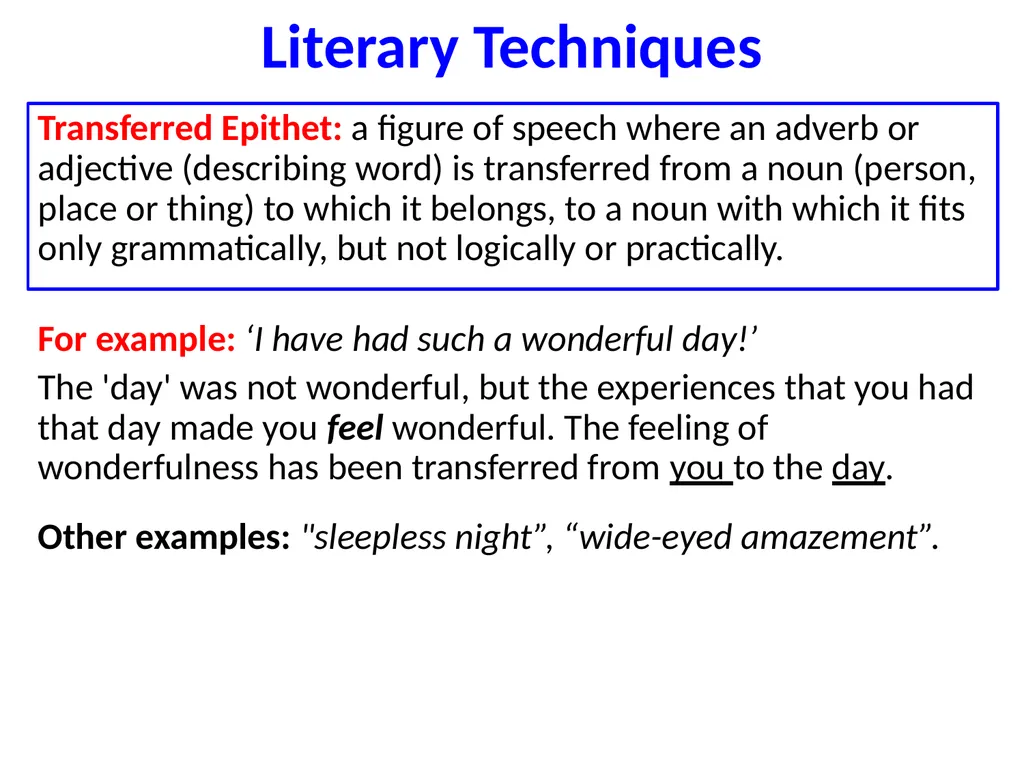
Literary Techniques Transferred Epithet: a figure of speech where an adverb or adjective (describing word) is transferred from a noun (person, place or thing) to which it belongs, to a noun with which it fits only grammatically, but not logically or practically. For example: ‘I have had such a wonderful day!’
The 'day' was not wonderful, but the experiences that you had that day made you feel wonderful. The feeling of wonderfulness has been transferred from you to the day.
Other examples: "sleepless night”, “wide-eyed amazement”.<br>
The 'day' was not wonderful, but the experiences that you had that day made you feel wonderful. The feeling of wonderfulness has been transferred from you to the day.
Other examples: "sleepless night”, “wide-eyed amazement”.<br>
04
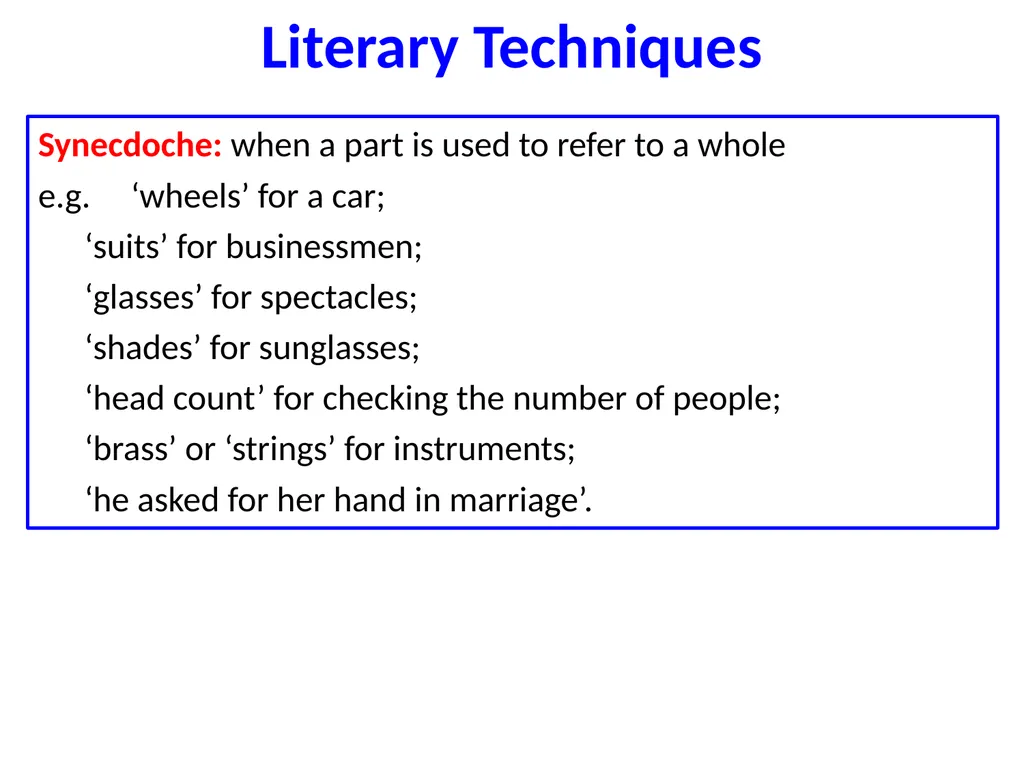
Literary Techniques Synecdoche: when a part is used to refer to a whole
e.g. ‘wheels’ for a car;
‘suits’ for businessmen;
‘glasses’ for spectacles;
‘shades’ for sunglasses;
‘head count’ for checking the number of people;
‘brass’ or ‘strings’ for instruments;
‘he asked for her hand in marriage’.<br>
e.g. ‘wheels’ for a car;
‘suits’ for businessmen;
‘glasses’ for spectacles;
‘shades’ for sunglasses;
‘head count’ for checking the number of people;
‘brass’ or ‘strings’ for instruments;
‘he asked for her hand in marriage’.<br>
05
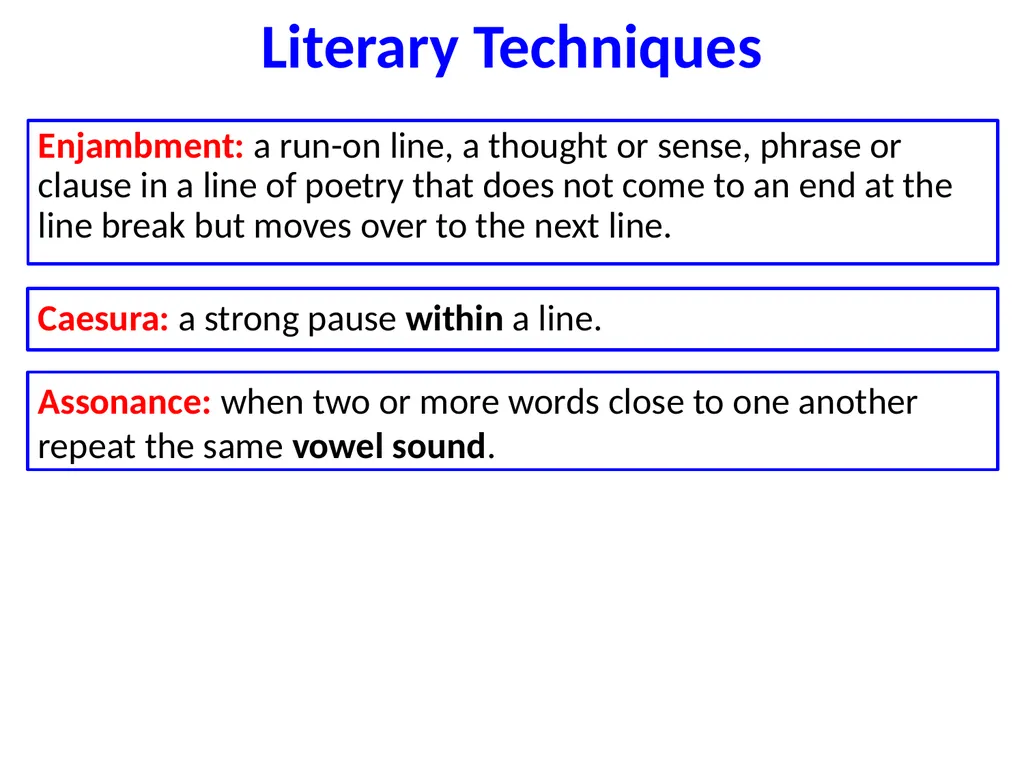
Literary Techniques Enjambment: a run-on line, a thought or sense, phrase or clause in a line of poetry that does not come to an end at the line break but moves over to the next line. Caesura: a strong pause within a line. Assonance: when two or more words close to one another repeat the same vowel sound.<br>
06
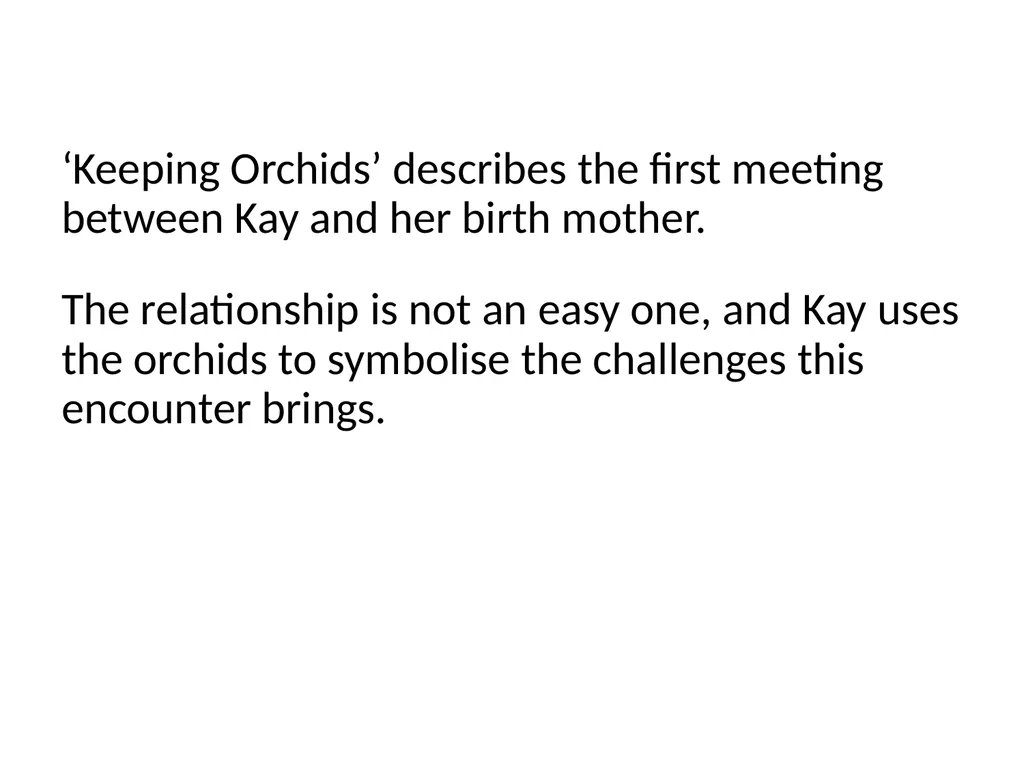
‘Keeping Orchids’ describes the first meeting between Kay and her birth mother.
The relationship is not an easy one, and Kay uses the orchids to symbolise the challenges this encounter brings.<br>
The relationship is not an easy one, and Kay uses the orchids to symbolise the challenges this encounter brings.<br>
07
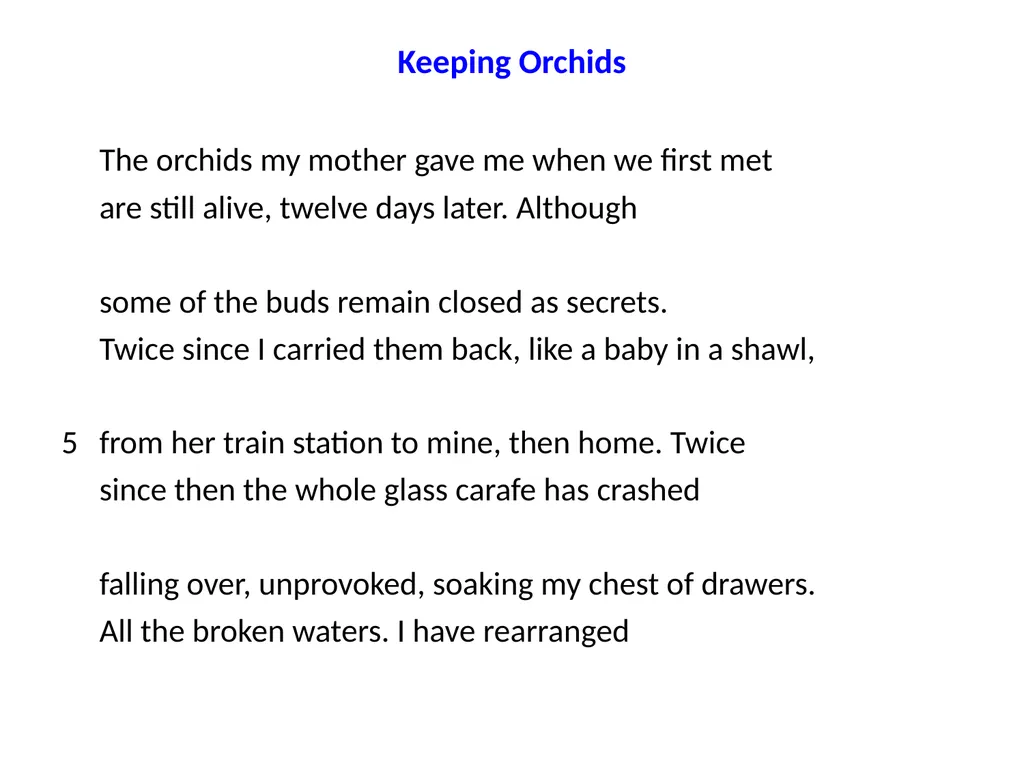
Keeping Orchids
The orchids my mother gave me when we first met
are still alive, twelve days later. Although
some of the buds remain closed as secrets.
Twice since I carried them back, like a baby in a shawl,
5 from her train station to mine, then home. Twice
since then the whole glass carafe has crashed
falling over, unprovoked, soaking my chest of drawers.
All the broken waters. I have rearranged<br>
The orchids my mother gave me when we first met
are still alive, twelve days later. Although
some of the buds remain closed as secrets.
Twice since I carried them back, like a baby in a shawl,
5 from her train station to mine, then home. Twice
since then the whole glass carafe has crashed
falling over, unprovoked, soaking my chest of drawers.
All the broken waters. I have rearranged<br>
08
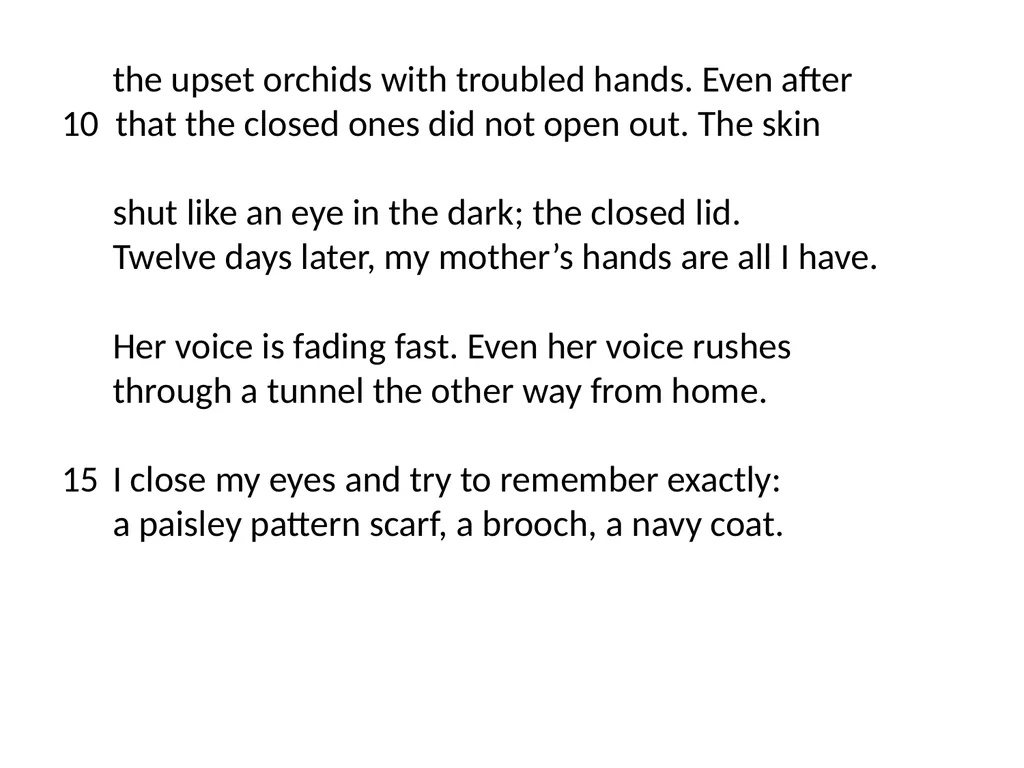
the upset orchids with troubled hands. Even after
10 that the closed ones did not open out. The skin
shut like an eye in the dark; the closed lid.
Twelve days later, my mother’s hands are all I have.
Her voice is fading fast. Even her voice rushes
through a tunnel the other way from home.
15 I close my eyes and try to remember exactly:
a paisley pattern scarf, a brooch, a navy coat.<br>
10 that the closed ones did not open out. The skin
shut like an eye in the dark; the closed lid.
Twelve days later, my mother’s hands are all I have.
Her voice is fading fast. Even her voice rushes
through a tunnel the other way from home.
15 I close my eyes and try to remember exactly:
a paisley pattern scarf, a brooch, a navy coat.<br>
09
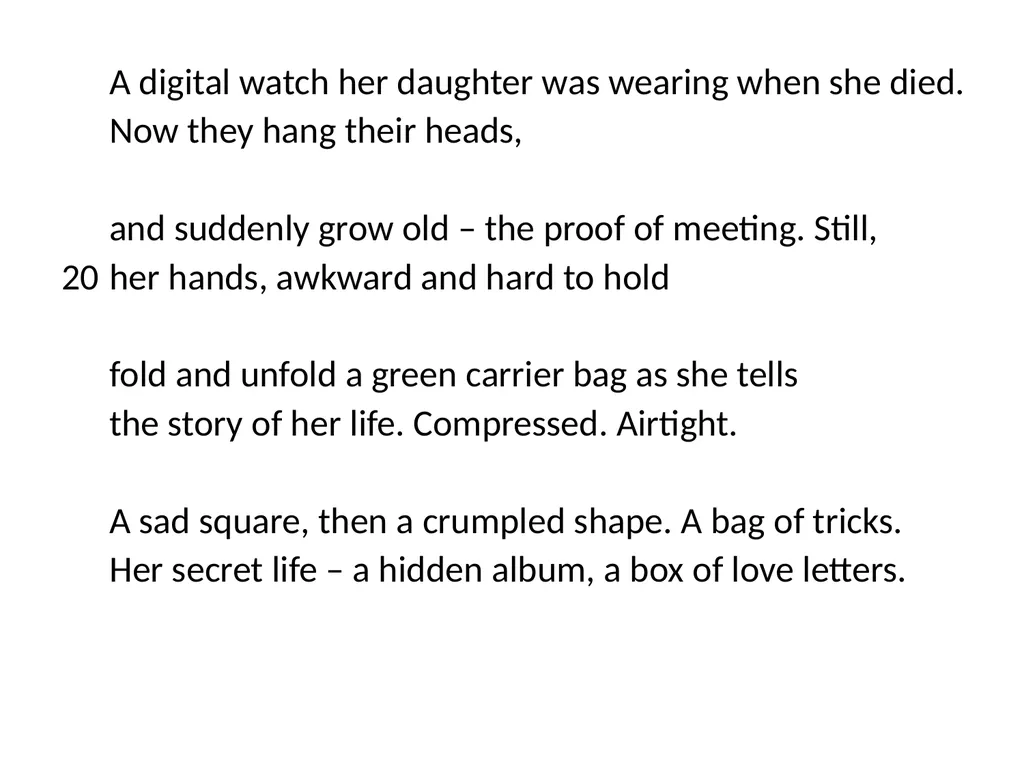
A digital watch her daughter was wearing when she died.
Now they hang their heads,
and suddenly grow old – the proof of meeting. Still,
20 her hands, awkward and hard to hold
fold and unfold a green carrier bag as she tells
the story of her life. Compressed. Airtight.
A sad square, then a crumpled shape. A bag of tricks.
Her secret life – a hidden album, a box of love letters.<br>
Now they hang their heads,
and suddenly grow old – the proof of meeting. Still,
20 her hands, awkward and hard to hold
fold and unfold a green carrier bag as she tells
the story of her life. Compressed. Airtight.
A sad square, then a crumpled shape. A bag of tricks.
Her secret life – a hidden album, a box of love letters.<br>
10
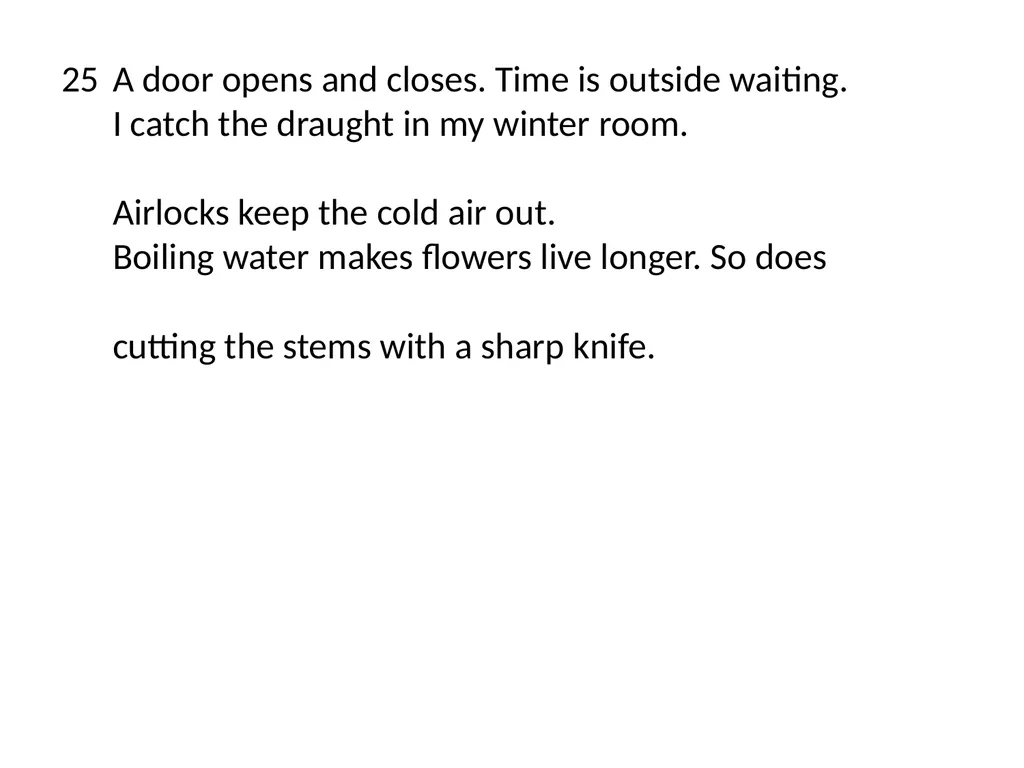
25 A door opens and closes. Time is outside waiting.
I catch the draught in my winter room.
Airlocks keep the cold air out.
Boiling water makes flowers live longer. So does
cutting the stems with a sharp knife.<br>
I catch the draught in my winter room.
Airlocks keep the cold air out.
Boiling water makes flowers live longer. So does
cutting the stems with a sharp knife.<br>
11
The poem deals with Kay meeting her birth mother for the first time.
Kay uses the symbol of the orchid, a gift from her mother, to portray the difficulties in their relationship.<br>
Kay uses the symbol of the orchid, a gift from her mother, to portray the difficulties in their relationship.<br>
12
The orchid is an exotic flower that is challenging to look after. It comes to represent:
Kay as a baby, given up for adoption;
the reunion between the women;
the difficulty of keeping their relationship alive. The meeting is emotionally complicated. The mother is very reticent and keeps the ‘story of her life’ hidden and secret.
Kay finds it hard to understand her mother and to process her own feelings and responses to the situation. She uses the orchid to explore emotion stirred up by her past and this woman.<br>
Kay as a baby, given up for adoption;
the reunion between the women;
the difficulty of keeping their relationship alive. The meeting is emotionally complicated. The mother is very reticent and keeps the ‘story of her life’ hidden and secret.
Kay finds it hard to understand her mother and to process her own feelings and responses to the situation. She uses the orchid to explore emotion stirred up by her past and this woman.<br>
13
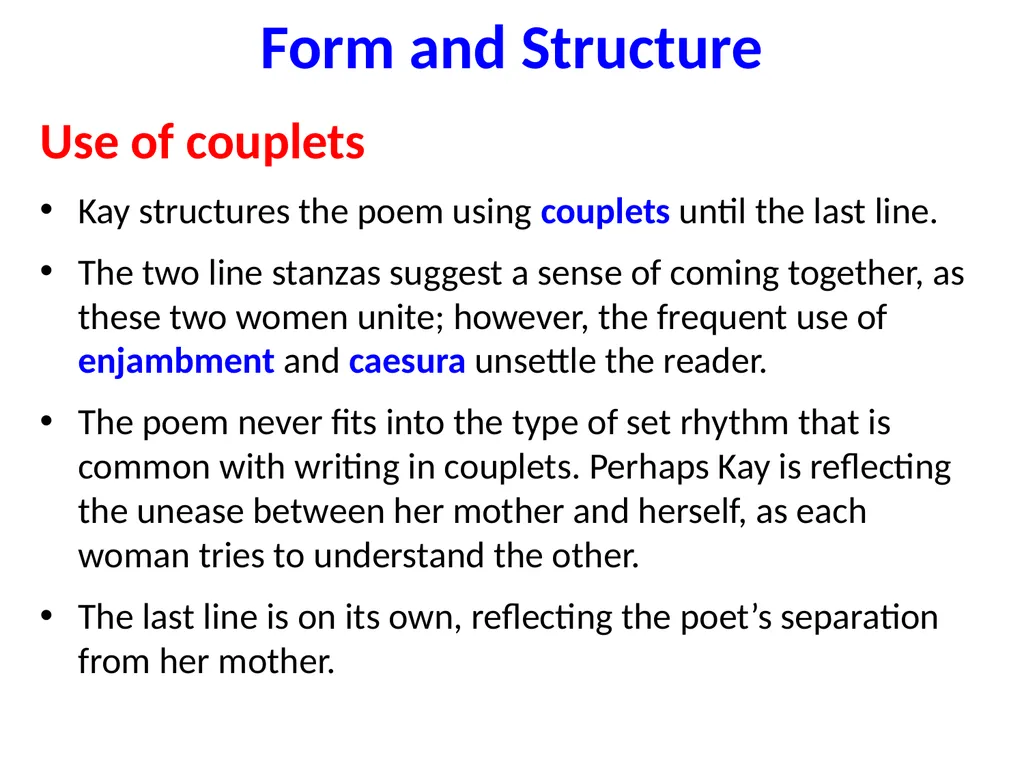
Form and Structure Use of couplets
Kay structures the poem using couplets until the last line.
The two line stanzas suggest a sense of coming together, as these two women unite; however, the frequent use of enjambment and caesura unsettle the reader.
The poem never fits into the type of set rhythm that is common with writing in couplets. Perhaps Kay is reflecting the unease between her mother and herself, as each woman tries to understand the other.
The last line is on its own, reflecting the poet’s separation from her mother.<br>
Kay structures the poem using couplets until the last line.
The two line stanzas suggest a sense of coming together, as these two women unite; however, the frequent use of enjambment and caesura unsettle the reader.
The poem never fits into the type of set rhythm that is common with writing in couplets. Perhaps Kay is reflecting the unease between her mother and herself, as each woman tries to understand the other.
The last line is on its own, reflecting the poet’s separation from her mother.<br>
14
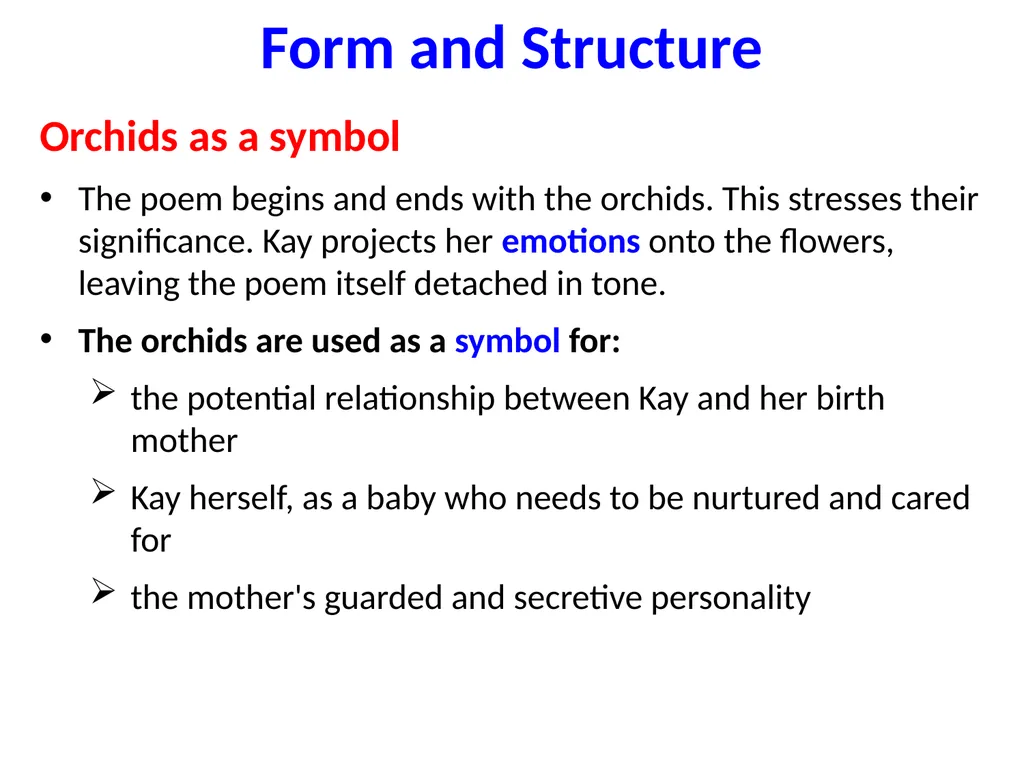
Form and Structure Orchids as a symbol
The poem begins and ends with the orchids. This stresses their significance. Kay projects her emotions onto the flowers, leaving the poem itself detached in tone.
The orchids are used as a symbol for:
the potential relationship between Kay and her birth mother
Kay herself, as a baby who needs to be nurtured and cared for
the mother's guarded and secretive personality<br>
The poem begins and ends with the orchids. This stresses their significance. Kay projects her emotions onto the flowers, leaving the poem itself detached in tone.
The orchids are used as a symbol for:
the potential relationship between Kay and her birth mother
Kay herself, as a baby who needs to be nurtured and cared for
the mother's guarded and secretive personality<br>
15
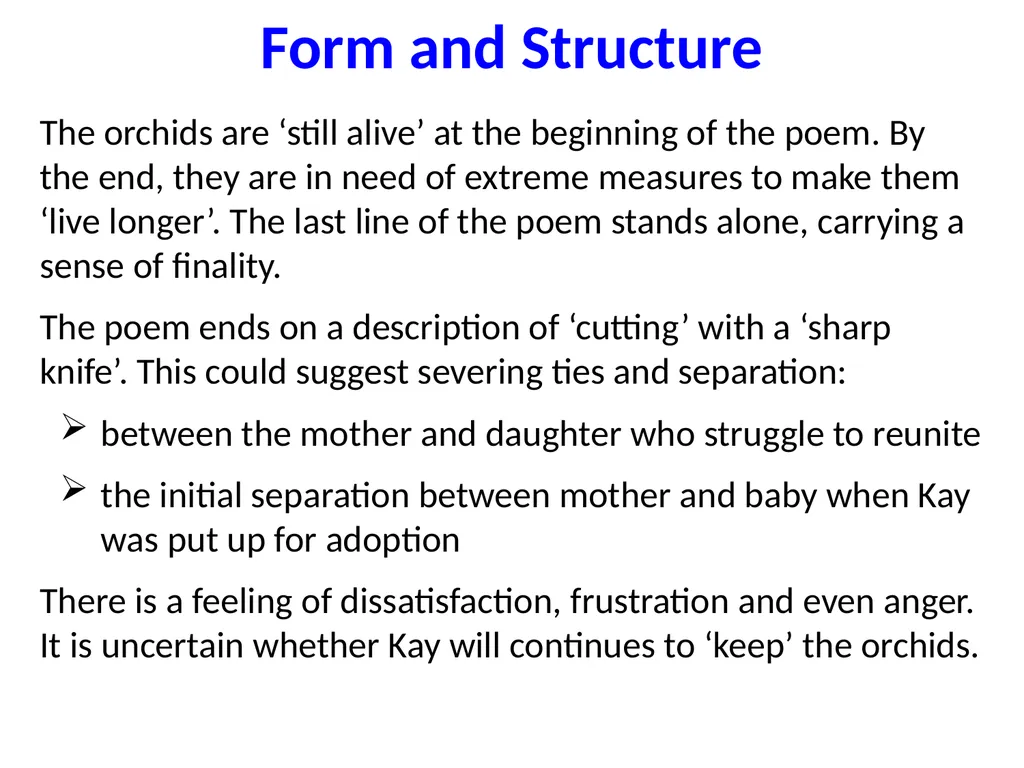
Form and Structure The orchids are ‘still alive’ at the beginning of the poem. By the end, they are in need of extreme measures to make them ‘live longer’. The last line of the poem stands alone, carrying a sense of finality.
The poem ends on a description of ‘cutting’ with a ‘sharp knife’. This could suggest severing ties and separation:
between the mother and daughter who struggle to reunite
the initial separation between mother and baby when Kay was put up for adoption
There is a feeling of dissatisfaction, frustration and even anger. It is uncertain whether Kay will continues to ‘keep’ the orchids.<br>
The poem ends on a description of ‘cutting’ with a ‘sharp knife’. This could suggest severing ties and separation:
between the mother and daughter who struggle to reunite
the initial separation between mother and baby when Kay was put up for adoption
There is a feeling of dissatisfaction, frustration and even anger. It is uncertain whether Kay will continues to ‘keep’ the orchids.<br>
16
Keeping Orchids
The orchids my mother gave me when we first met
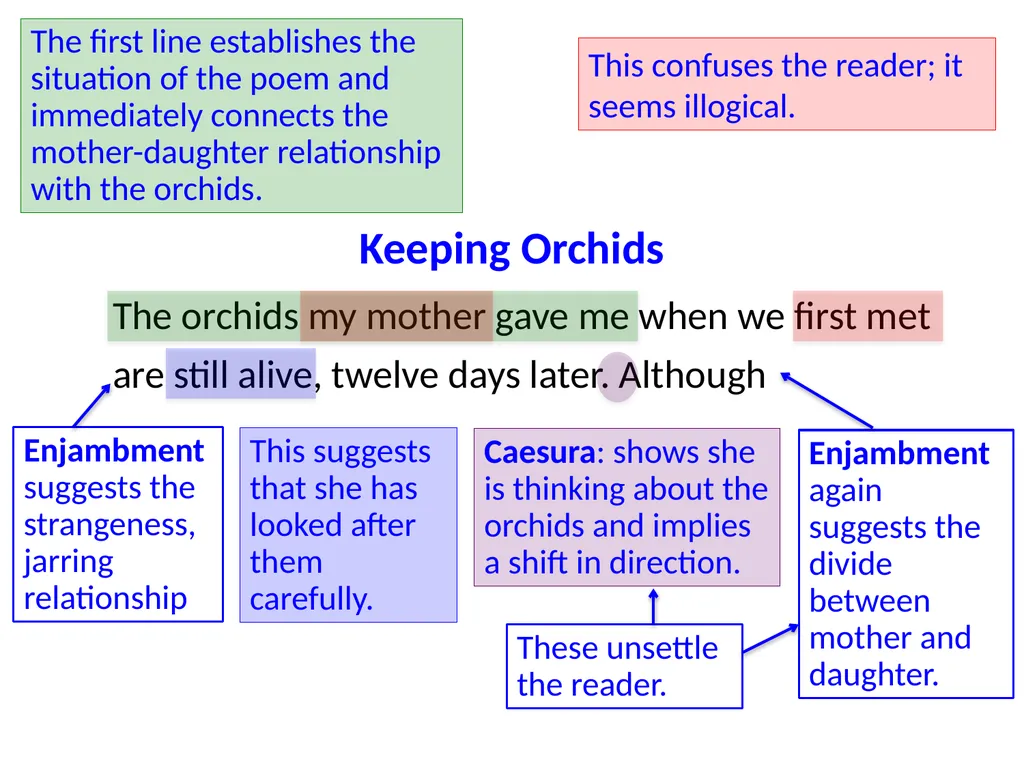
are still alive, twelve days later. Although This confuses the reader; it seems illogical. Enjambment suggests the strangeness, jarring relationship Caesura: shows she is thinking about the orchids and implies a shift in direction. The first line establishes the situation of the poem and immediately connects the mother-daughter relationship with the orchids. This suggests that she has looked after them carefully. Enjambment again suggests the divide between mother and daughter. These unsettle the reader.<br>
The orchids my mother gave me when we first met
are still alive, twelve days later. Although This confuses the reader; it seems illogical. Enjambment suggests the strangeness, jarring relationship Caesura: shows she is thinking about the orchids and implies a shift in direction. The first line establishes the situation of the poem and immediately connects the mother-daughter relationship with the orchids. This suggests that she has looked after them carefully. Enjambment again suggests the divide between mother and daughter. These unsettle the reader.<br>
17
Although
some of the buds remain closed as secrets.
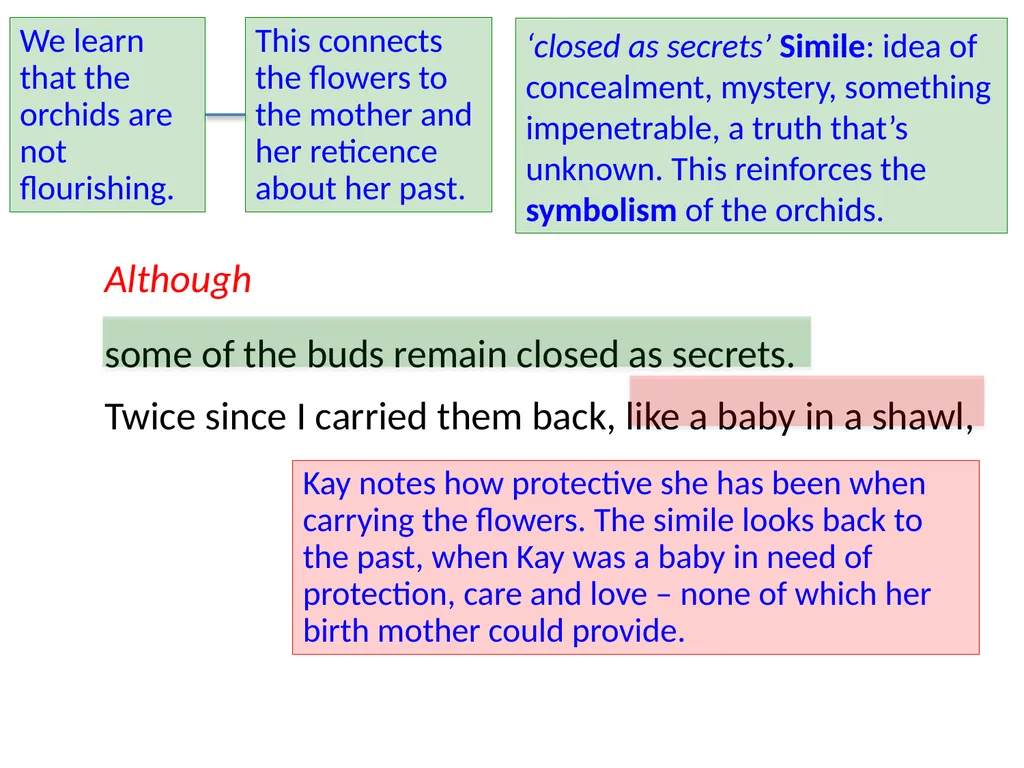
Twice since I carried them back, like a baby in a shawl, We learn that the orchids are not flourishing. This connects the flowers to the mother and her reticence about her past. Kay notes how protective she has been when carrying the flowers. The simile looks back to the past, when Kay was a baby in need of protection, care and love – none of which her birth mother could provide. ‘closed as secrets’ Simile: idea of concealment, mystery, something impenetrable, a truth that’s unknown. This reinforces the symbolism of the orchids.<br>
some of the buds remain closed as secrets.
Twice since I carried them back, like a baby in a shawl, We learn that the orchids are not flourishing. This connects the flowers to the mother and her reticence about her past. Kay notes how protective she has been when carrying the flowers. The simile looks back to the past, when Kay was a baby in need of protection, care and love – none of which her birth mother could provide. ‘closed as secrets’ Simile: idea of concealment, mystery, something impenetrable, a truth that’s unknown. This reinforces the symbolism of the orchids.<br>
18
5 from her train station to mine, then home. Twice
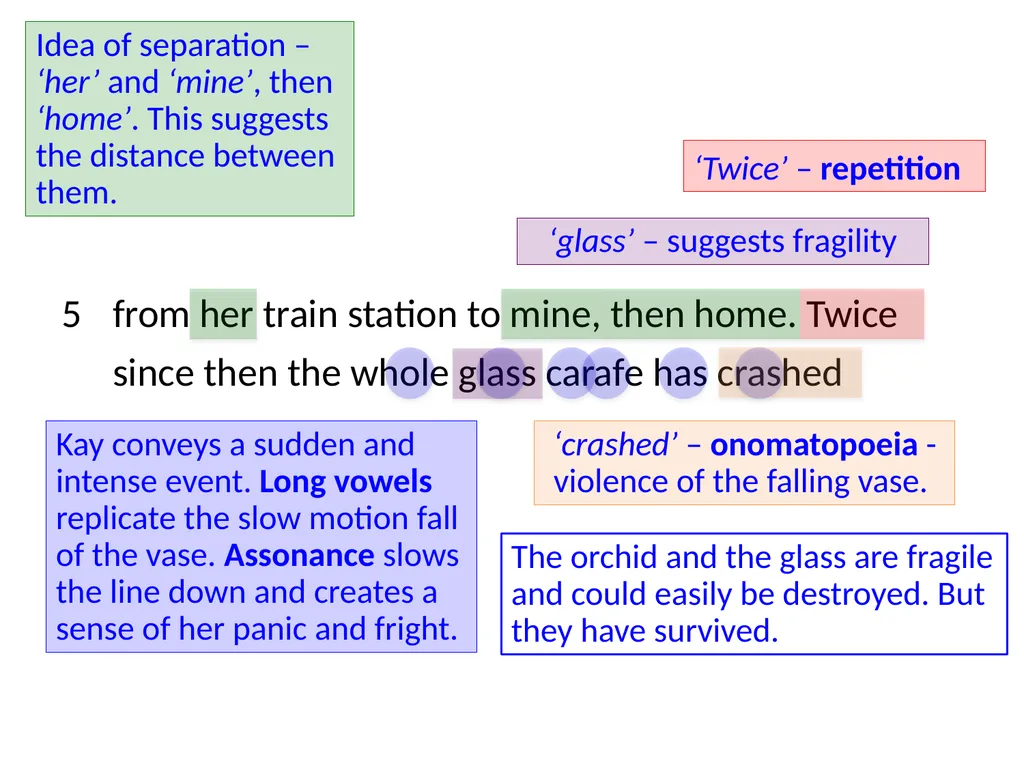
since then the whole glass carafe has crashed Idea of separation – ‘her’ and ‘mine’, then ‘home’. This suggests the distance between them. Kay conveys a sudden and intense event. Long vowels replicate the slow motion fall of the vase. Assonance slows the line down and creates a sense of her panic and fright. ‘Twice’ – repetition ‘glass’ – suggests fragility ‘crashed’ – onomatopoeia - violence of the falling vase. The orchid and the glass are fragile and could easily be destroyed. But they have survived.<br>
since then the whole glass carafe has crashed Idea of separation – ‘her’ and ‘mine’, then ‘home’. This suggests the distance between them. Kay conveys a sudden and intense event. Long vowels replicate the slow motion fall of the vase. Assonance slows the line down and creates a sense of her panic and fright. ‘Twice’ – repetition ‘glass’ – suggests fragility ‘crashed’ – onomatopoeia - violence of the falling vase. The orchid and the glass are fragile and could easily be destroyed. But they have survived.<br>
19
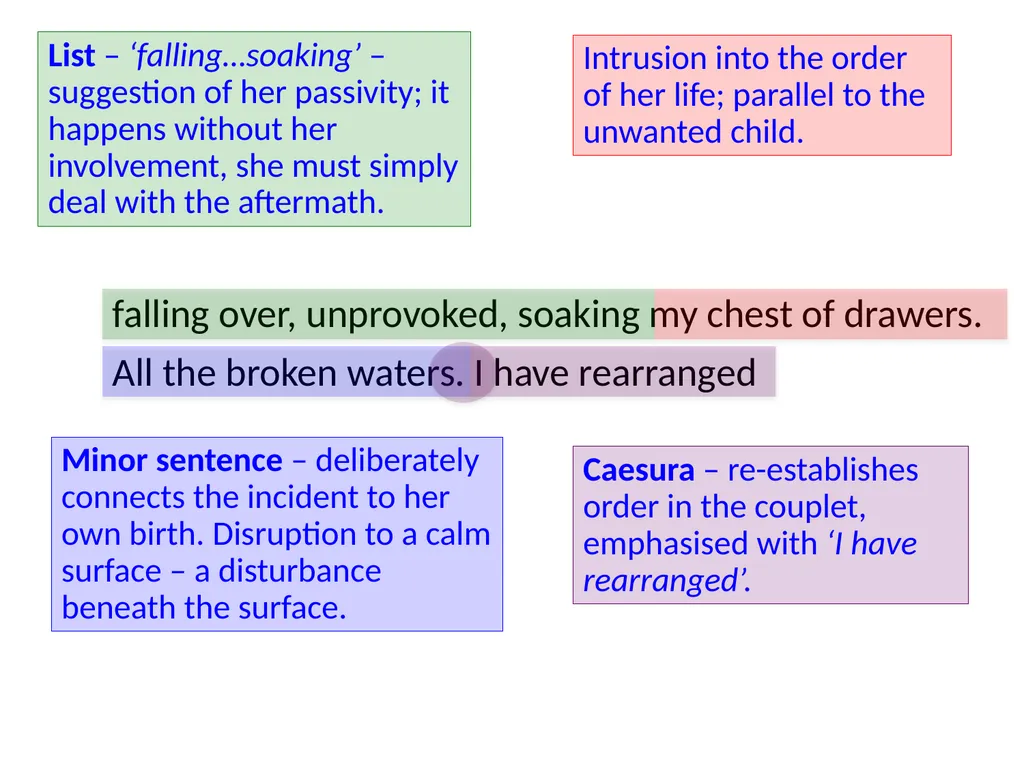
falling over, unprovoked, soaking my chest of drawers.
All the broken waters. I have rearranged List – ‘falling…soaking’ – suggestion of her passivity; it happens without her involvement, she must simply deal with the aftermath. Intrusion into the order of her life; parallel to the unwanted child. Minor sentence – deliberately connects the incident to her own birth. Disruption to a calm surface – a disturbance beneath the surface. Caesura – re-establishes order in the couplet, emphasised with ‘I have rearranged’.<br>
All the broken waters. I have rearranged List – ‘falling…soaking’ – suggestion of her passivity; it happens without her involvement, she must simply deal with the aftermath. Intrusion into the order of her life; parallel to the unwanted child. Minor sentence – deliberately connects the incident to her own birth. Disruption to a calm surface – a disturbance beneath the surface. Caesura – re-establishes order in the couplet, emphasised with ‘I have rearranged’.<br>
20
I have rearranged
the upset orchids with troubled hands. Even after
10 that the closed ones did not open out. The skin Transferred epithet – ‘upset’ and ‘troubled’ – word choice to reflect her feelings. The poet attempts to ‘rearrange’ the ‘upset orchids’ but she has ‘troubled hands’. Her emotion is affecting her deeply. It is implied that meeting her birth mother for the first time has unsettled her. This suggests a link between the upset vase and the meeting with the mother. ‘ones’ suggests people as well as the flowers: there are things unresolved that Kay wants to know, but her mother will not open up to her: the closed buds do not open.<br>
the upset orchids with troubled hands. Even after
10 that the closed ones did not open out. The skin Transferred epithet – ‘upset’ and ‘troubled’ – word choice to reflect her feelings. The poet attempts to ‘rearrange’ the ‘upset orchids’ but she has ‘troubled hands’. Her emotion is affecting her deeply. It is implied that meeting her birth mother for the first time has unsettled her. This suggests a link between the upset vase and the meeting with the mother. ‘ones’ suggests people as well as the flowers: there are things unresolved that Kay wants to know, but her mother will not open up to her: the closed buds do not open.<br>
21
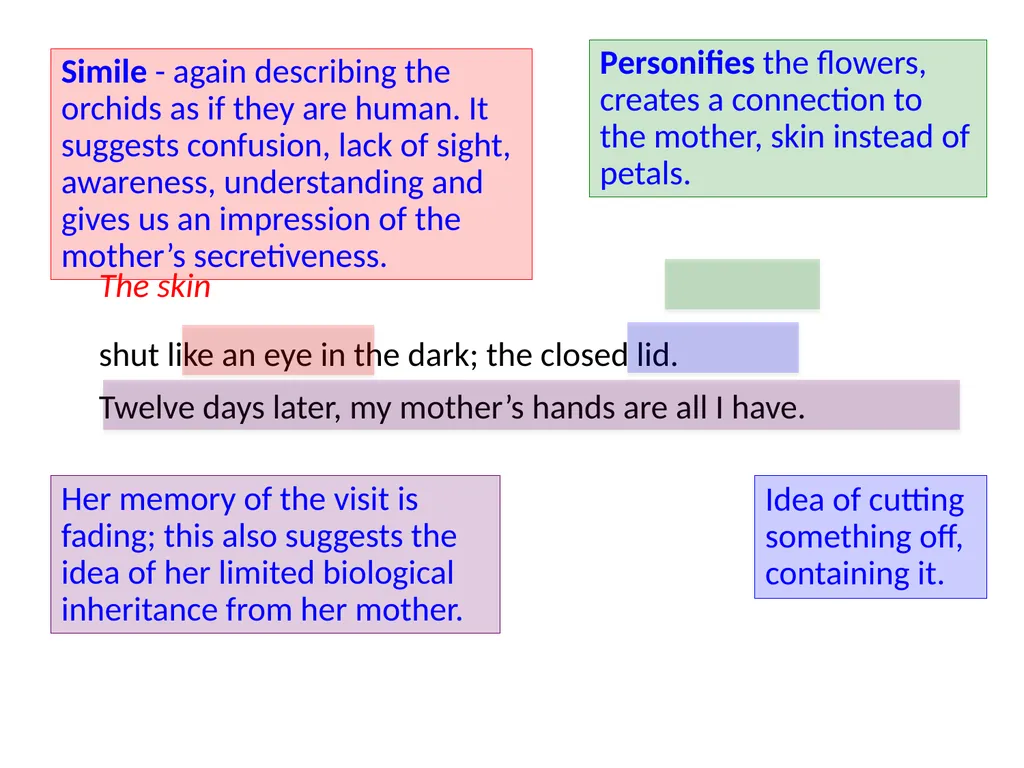
Idea of cutting something off, containing it. The skin
shut like an eye in the dark; the closed lid.
Twelve days later, my mother’s hands are all I have. Simile - again describing the orchids as if they are human. It suggests confusion, lack of sight, awareness, understanding and gives us an impression of the mother’s secretiveness. Personifies the flowers, creates a connection to the mother, skin instead of petals. Her memory of the visit is fading; this also suggests the idea of her limited biological inheritance from her mother.<br>
shut like an eye in the dark; the closed lid.
Twelve days later, my mother’s hands are all I have. Simile - again describing the orchids as if they are human. It suggests confusion, lack of sight, awareness, understanding and gives us an impression of the mother’s secretiveness. Personifies the flowers, creates a connection to the mother, skin instead of petals. Her memory of the visit is fading; this also suggests the idea of her limited biological inheritance from her mother.<br>
22
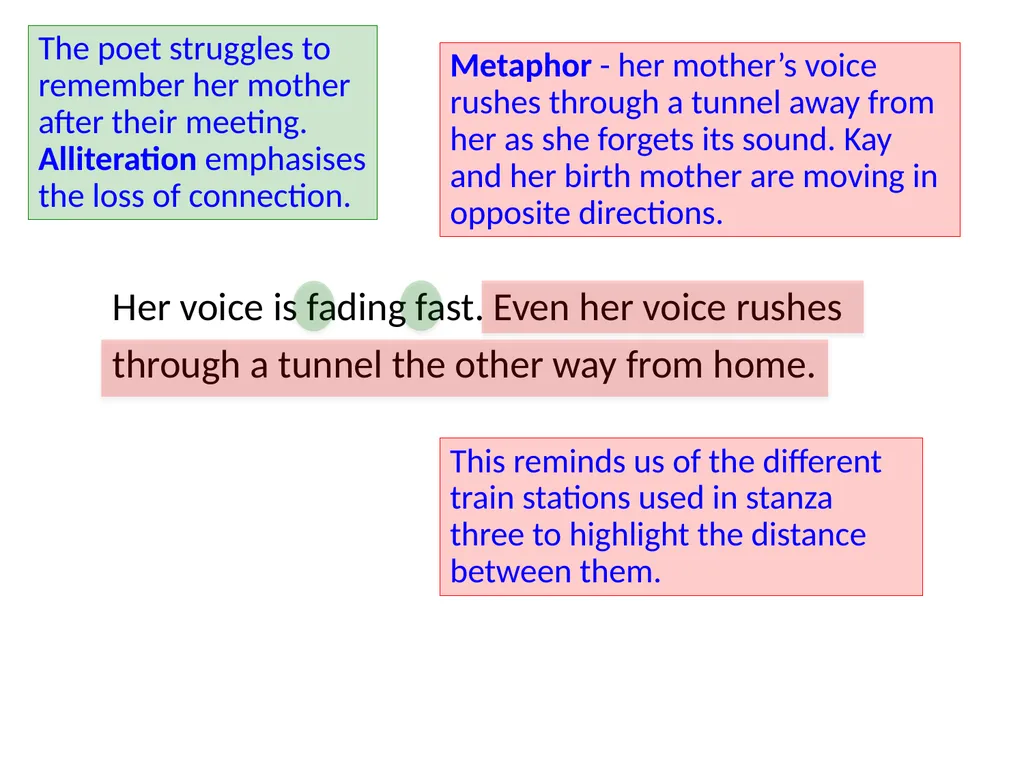
Her voice is fading fast. Even her voice rushes
through a tunnel the other way from home. Metaphor - her mother’s voice rushes through a tunnel away from her as she forgets its sound. Kay and her birth mother are moving in opposite directions. The poet struggles to remember her mother after their meeting. Alliteration emphasises the loss of connection. This reminds us of the different train stations used in stanza three to highlight the distance between them.<br>
through a tunnel the other way from home. Metaphor - her mother’s voice rushes through a tunnel away from her as she forgets its sound. Kay and her birth mother are moving in opposite directions. The poet struggles to remember her mother after their meeting. Alliteration emphasises the loss of connection. This reminds us of the different train stations used in stanza three to highlight the distance between them.<br>
23
15 I close my eyes and try to remember exactly: a paisley pattern scarf, a brooch, a navy coat. Synecdoche – Kay lists the fragments of memories. In trying to recall her, Kay lists her mother’s items of dress - a paisley pattern scarf, a brooch, a navy coat - but she significantly fails to mention her mother’s face, her expressions and gestures.<br>
24
A digital watch her daughter was wearing when she died.
Now they hang their heads, This provides an interesting parallel:
Does the mother tell the story of one daughter without registering that the woman in front of her is also her daughter?
Does she place more importance on the life of one child over the other?
Or does she regret giving her daughter away, feeling that she has lost both? In stanza nine what the mother is wearing takes on more personal significance. A digital watch reveals that she had another daughter who died. Kay is, of course, also ‘her daughter’ but we get a sense she doesn’t see it like this. There has been another daughter – who lived a whole lifetime unknown to Kay. Back to the flowers again – ambiguous imagery. Does it suggest shame? Guilt?<br>
Now they hang their heads, This provides an interesting parallel:
Does the mother tell the story of one daughter without registering that the woman in front of her is also her daughter?
Does she place more importance on the life of one child over the other?
Or does she regret giving her daughter away, feeling that she has lost both? In stanza nine what the mother is wearing takes on more personal significance. A digital watch reveals that she had another daughter who died. Kay is, of course, also ‘her daughter’ but we get a sense she doesn’t see it like this. There has been another daughter – who lived a whole lifetime unknown to Kay. Back to the flowers again – ambiguous imagery. Does it suggest shame? Guilt?<br>
25
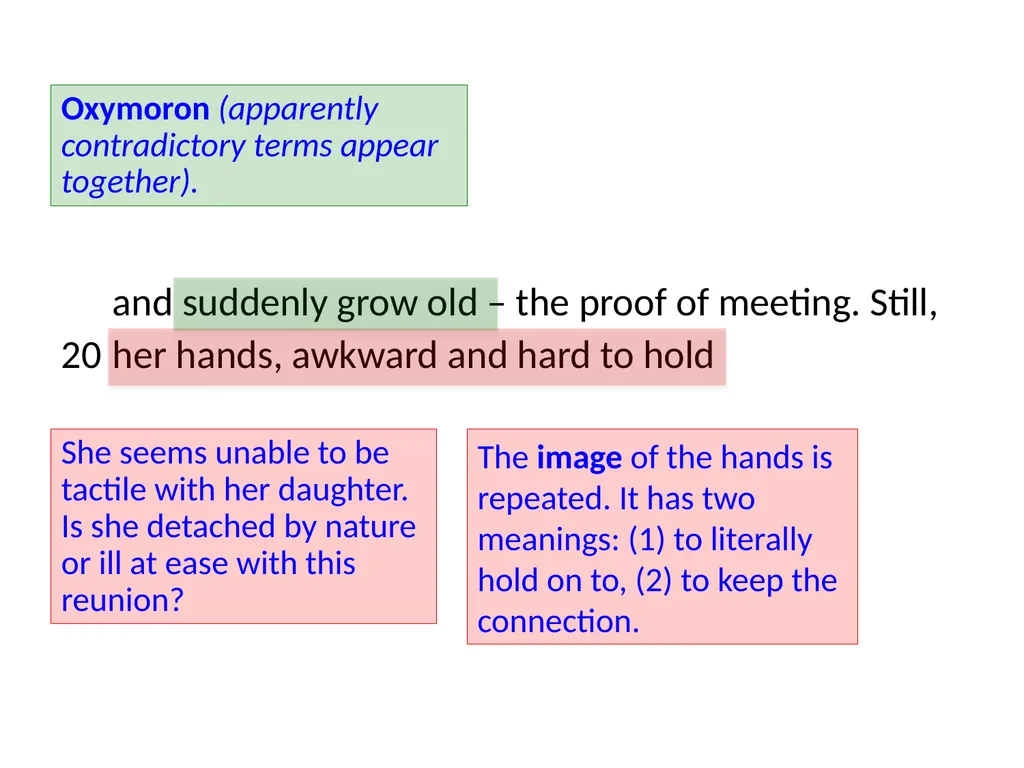
and suddenly grow old – the proof of meeting. Still,
20 her hands, awkward and hard to hold She seems unable to be tactile with her daughter. Is she detached by nature or ill at ease with this reunion? Oxymoron (apparently contradictory terms appear together). The image of the hands is repeated. It has two meanings: (1) to literally hold on to, (2) to keep the connection.<br>
20 her hands, awkward and hard to hold She seems unable to be tactile with her daughter. Is she detached by nature or ill at ease with this reunion? Oxymoron (apparently contradictory terms appear together). The image of the hands is repeated. It has two meanings: (1) to literally hold on to, (2) to keep the connection.<br>
26
her hands, awkward and hard to hold
fold and unfold a green carrier bag as she tells
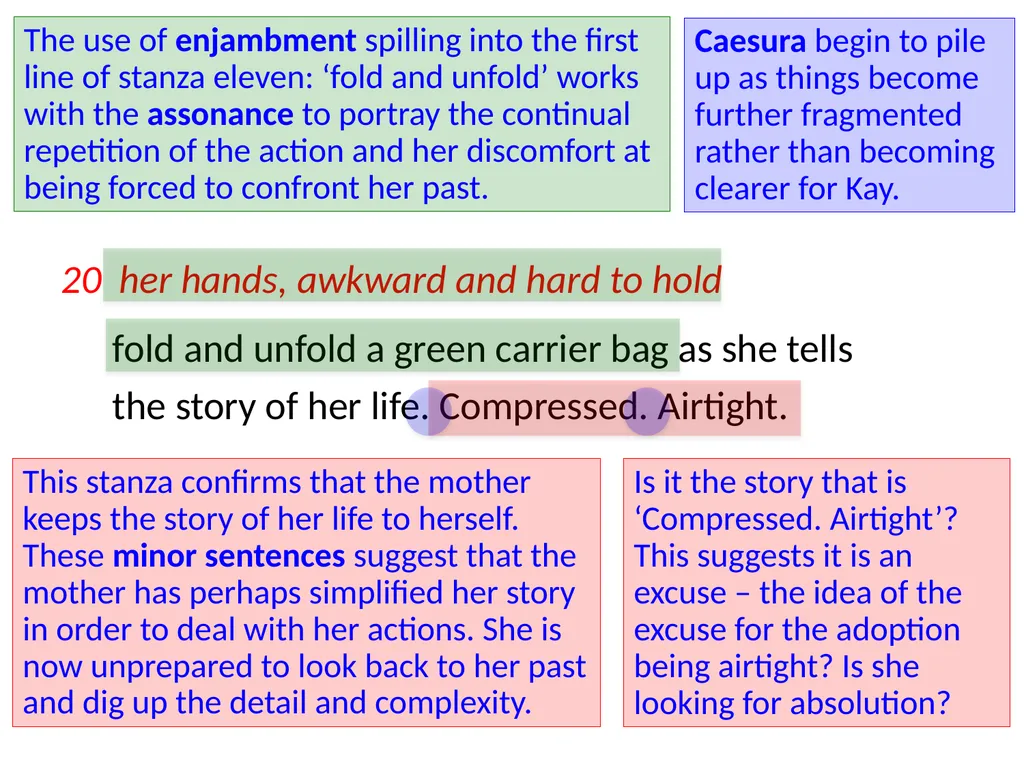
the story of her life. Compressed. Airtight. The use of enjambment spilling into the first line of stanza eleven: ‘fold and unfold’ works with the assonance to portray the continual repetition of the action and her discomfort at being forced to confront her past. This stanza confirms that the mother keeps the story of her life to herself. These minor sentences suggest that the mother has perhaps simplified her story in order to deal with her actions. She is now unprepared to look back to her past and dig up the detail and complexity. Caesura begin to pile up as things become further fragmented rather than becoming clearer for Kay. Is it the story that is ‘Compressed. Airtight’? This suggests it is an excuse – the idea of the excuse for the adoption being airtight? Is she looking for absolution?<br>
fold and unfold a green carrier bag as she tells
the story of her life. Compressed. Airtight. The use of enjambment spilling into the first line of stanza eleven: ‘fold and unfold’ works with the assonance to portray the continual repetition of the action and her discomfort at being forced to confront her past. This stanza confirms that the mother keeps the story of her life to herself. These minor sentences suggest that the mother has perhaps simplified her story in order to deal with her actions. She is now unprepared to look back to her past and dig up the detail and complexity. Caesura begin to pile up as things become further fragmented rather than becoming clearer for Kay. Is it the story that is ‘Compressed. Airtight’? This suggests it is an excuse – the idea of the excuse for the adoption being airtight? Is she looking for absolution?<br>
27
A sad square, then a crumpled shape. A bag of tricks.
Her secret life – a hidden album, a box of love letters. The repetition of the indefinite article suggests the mother’s detachment from these items, as well as the strangeness they must have for Kay as she sees them for the first time. We do not know whether the love letters mentioned are from Kay’s father, but the implication is that the mother has kept her past deeply concealed while she pursued a new life. The plastic bag changes shape before her eyes – as so much in life does. Tone seems to become more bitter here (‘bag of tricks.’) Her life as the speaker’s mother (photos and letters) seems to have been hidden away.<br>
Her secret life – a hidden album, a box of love letters. The repetition of the indefinite article suggests the mother’s detachment from these items, as well as the strangeness they must have for Kay as she sees them for the first time. We do not know whether the love letters mentioned are from Kay’s father, but the implication is that the mother has kept her past deeply concealed while she pursued a new life. The plastic bag changes shape before her eyes – as so much in life does. Tone seems to become more bitter here (‘bag of tricks.’) Her life as the speaker’s mother (photos and letters) seems to have been hidden away.<br>
28
25 A door opens and closes. Time is outside waiting.
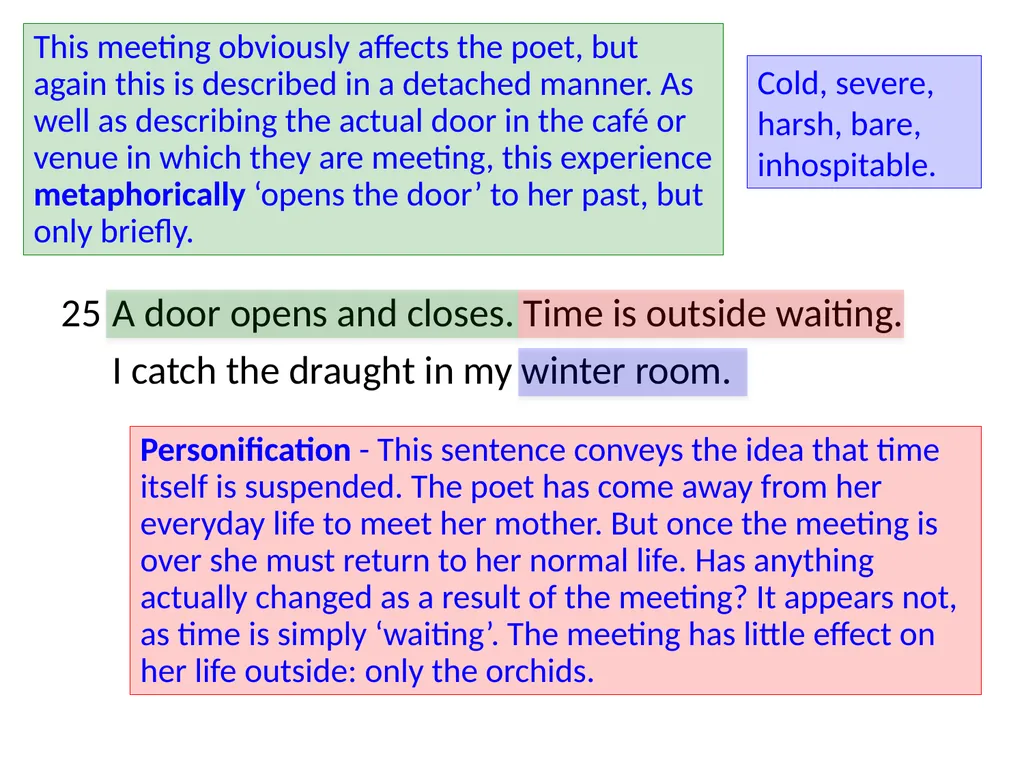
I catch the draught in my winter room. This meeting obviously affects the poet, but again this is described in a detached manner. As well as describing the actual door in the café or venue in which they are meeting, this experience metaphorically ‘opens the door’ to her past, but only briefly. Personification - This sentence conveys the idea that time itself is suspended. The poet has come away from her everyday life to meet her mother. But once the meeting is over she must return to her normal life. Has anything actually changed as a result of the meeting? It appears not, as time is simply ‘waiting’. The meeting has little effect on her life outside: only the orchids. Cold, severe, harsh, bare, inhospitable.<br>
I catch the draught in my winter room. This meeting obviously affects the poet, but again this is described in a detached manner. As well as describing the actual door in the café or venue in which they are meeting, this experience metaphorically ‘opens the door’ to her past, but only briefly. Personification - This sentence conveys the idea that time itself is suspended. The poet has come away from her everyday life to meet her mother. But once the meeting is over she must return to her normal life. Has anything actually changed as a result of the meeting? It appears not, as time is simply ‘waiting’. The meeting has little effect on her life outside: only the orchids. Cold, severe, harsh, bare, inhospitable.<br>
29
Airlocks keep the cold air out.
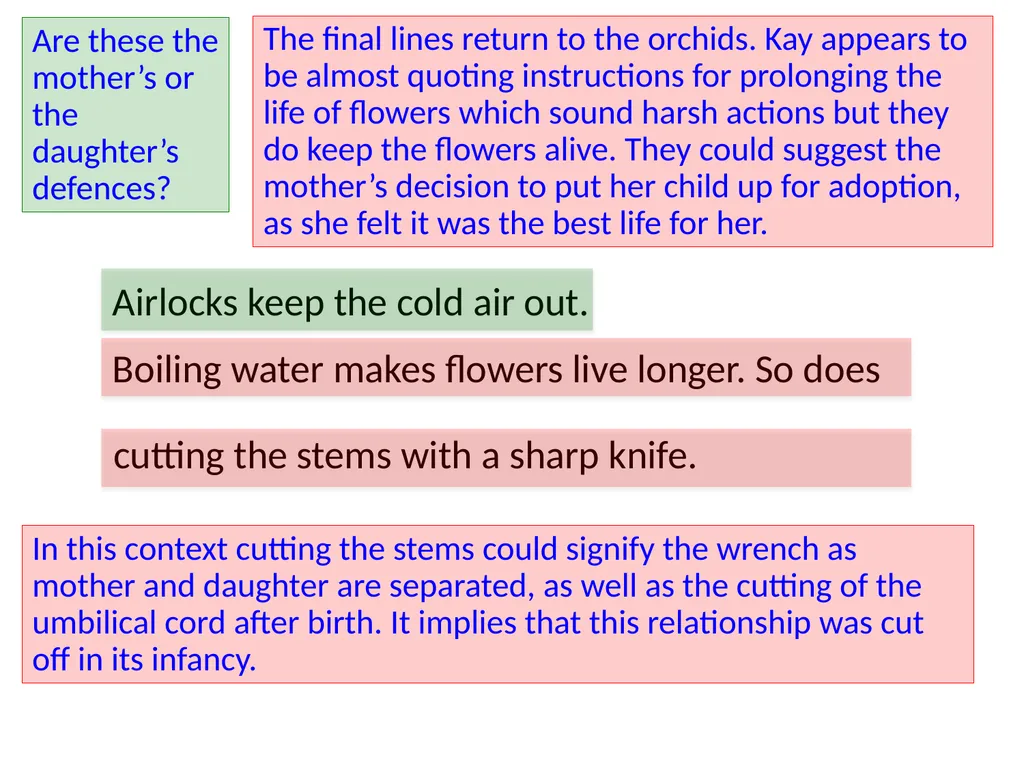
Boiling water makes flowers live longer. So does The final lines return to the orchids. Kay appears to be almost quoting instructions for prolonging the life of flowers which sound harsh actions but they do keep the flowers alive. They could suggest the mother’s decision to put her child up for adoption, as she felt it was the best life for her. In this context cutting the stems could signify the wrench as mother and daughter are separated, as well as the cutting of the umbilical cord after birth. It implies that this relationship was cut off in its infancy. Are these the mother’s or the daughter’s defences? cutting the stems with a sharp knife.<br>
Boiling water makes flowers live longer. So does The final lines return to the orchids. Kay appears to be almost quoting instructions for prolonging the life of flowers which sound harsh actions but they do keep the flowers alive. They could suggest the mother’s decision to put her child up for adoption, as she felt it was the best life for her. In this context cutting the stems could signify the wrench as mother and daughter are separated, as well as the cutting of the umbilical cord after birth. It implies that this relationship was cut off in its infancy. Are these the mother’s or the daughter’s defences? cutting the stems with a sharp knife.<br>
30
Airlocks keep the cold air out.
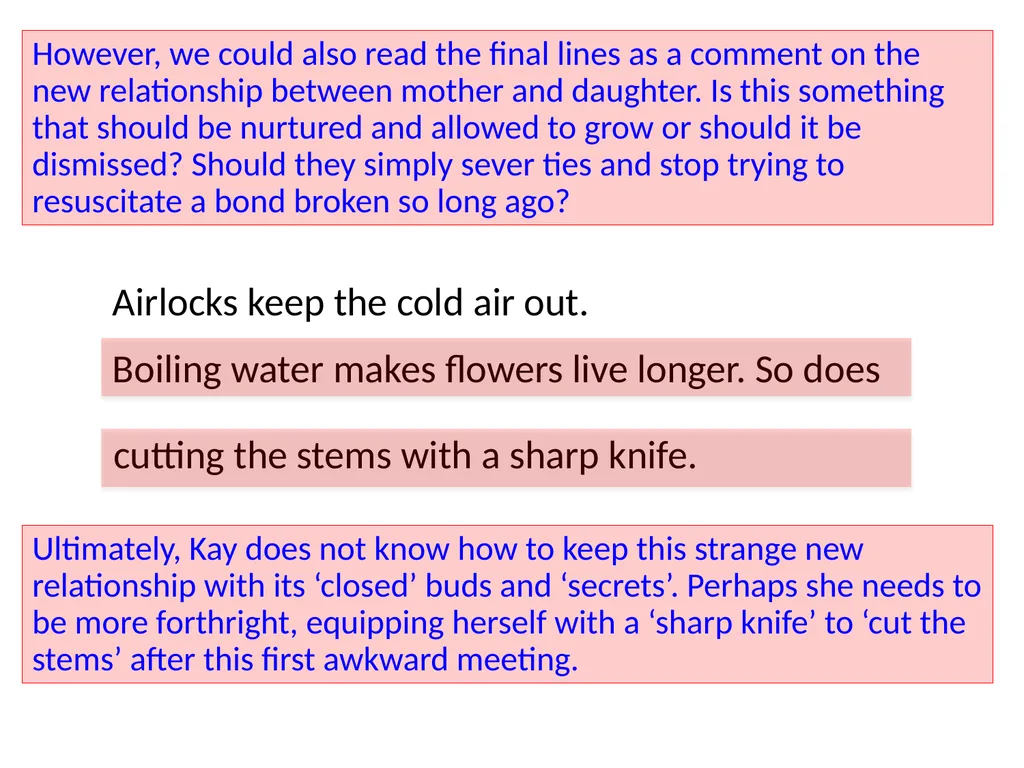
Boiling water makes flowers live longer. So does However, we could also read the final lines as a comment on the new relationship between mother and daughter. Is this something that should be nurtured and allowed to grow or should it be dismissed? Should they simply sever ties and stop trying to resuscitate a bond broken so long ago? Ultimately, Kay does not know how to keep this strange new relationship with its ‘closed’ buds and ‘secrets’. Perhaps she needs to be more forthright, equipping herself with a ‘sharp knife’ to ‘cut the stems’ after this first awkward meeting. cutting the stems with a sharp knife.<br>
Boiling water makes flowers live longer. So does However, we could also read the final lines as a comment on the new relationship between mother and daughter. Is this something that should be nurtured and allowed to grow or should it be dismissed? Should they simply sever ties and stop trying to resuscitate a bond broken so long ago? Ultimately, Kay does not know how to keep this strange new relationship with its ‘closed’ buds and ‘secrets’. Perhaps she needs to be more forthright, equipping herself with a ‘sharp knife’ to ‘cut the stems’ after this first awkward meeting. cutting the stems with a sharp knife.<br>
31
Overview notes
Symbolism of the orchids – idea of a rarefied flower; difficult to raise and to nurture. They need special growing conditions.
Title parallels the adoption. But in this case, Kay attempts to keep and nurture the challenging orchids that refuse to open.
Written over 14 couplets – structure is very formal and precise. Pared back to bare bones almost. Coldness of the voice?
Focuses on a hugely emotional moment/topic but actually about emptiness. Stripped back and emotionless.
Seems more about objects than emotions – displacement.<br>
Symbolism of the orchids – idea of a rarefied flower; difficult to raise and to nurture. They need special growing conditions.
Title parallels the adoption. But in this case, Kay attempts to keep and nurture the challenging orchids that refuse to open.
Written over 14 couplets – structure is very formal and precise. Pared back to bare bones almost. Coldness of the voice?
Focuses on a hugely emotional moment/topic but actually about emptiness. Stripped back and emotionless.
Seems more about objects than emotions – displacement.<br>
32
Themes Adoption
This poem examines the consequences and challenges of adoption.
‘The orchids my mother gave me when we first met’
The first line throws the reader, as we are surprised to find she has only just met her mother. We then realise the context and the paradox of meeting someone you are so closely related to but who is a complete stranger at the same time.
Kay uses the orchids to depict the mother’s reticence. They also symbolise the difficulties Kay faces in beginning a relationship with someone she lacks connection with.<br>
This poem examines the consequences and challenges of adoption.
‘The orchids my mother gave me when we first met’
The first line throws the reader, as we are surprised to find she has only just met her mother. We then realise the context and the paradox of meeting someone you are so closely related to but who is a complete stranger at the same time.
Kay uses the orchids to depict the mother’s reticence. They also symbolise the difficulties Kay faces in beginning a relationship with someone she lacks connection with.<br>
33
Themes Adoption
The meeting must be an emotionally charged one, and yet the mother’s response is to shut down and keep her secrets. She holds her past in a ‘green carrier bag’ and unpacks it in a systematic fashion. Kay is affected greatly by her mother’s detachment. It is implied that Kay seeks much more from this meeting than her mother is prepared to give.
The line ‘Time is outside waiting’ suggests that Kay doesn’t need her mother. Her life can go on without her - after all she has lived without her all these years.
But although she can get back to her life, she is left disappointed. Instead of the warmth of reconciliation, she leaves with fragile flowers that appear unresponsive to her care.<br>
The meeting must be an emotionally charged one, and yet the mother’s response is to shut down and keep her secrets. She holds her past in a ‘green carrier bag’ and unpacks it in a systematic fashion. Kay is affected greatly by her mother’s detachment. It is implied that Kay seeks much more from this meeting than her mother is prepared to give.
The line ‘Time is outside waiting’ suggests that Kay doesn’t need her mother. Her life can go on without her - after all she has lived without her all these years.
But although she can get back to her life, she is left disappointed. Instead of the warmth of reconciliation, she leaves with fragile flowers that appear unresponsive to her care.<br>
34
Areas of comparison Divorce
'Keeping Orchids’ shares similarities with ‘Divorce’ as both are about strained parent / child relationships.
In ‘Keeping Orchids’ the mother is detached from her daughter emotionally and keeps her secrets hidden.
In ‘Divorce’ there is poor understanding between parent and child, and the speaker seeks better parents ‘whose faces turn/ up to the light’.
This implies that her current family hides the truth (perhaps an impending divorce) from her, in a similar way to the mother in 'Keeping Orchids' keeping details of her life secret like the flowers that ‘did not open out’.<br>
'Keeping Orchids’ shares similarities with ‘Divorce’ as both are about strained parent / child relationships.
In ‘Keeping Orchids’ the mother is detached from her daughter emotionally and keeps her secrets hidden.
In ‘Divorce’ there is poor understanding between parent and child, and the speaker seeks better parents ‘whose faces turn/ up to the light’.
This implies that her current family hides the truth (perhaps an impending divorce) from her, in a similar way to the mother in 'Keeping Orchids' keeping details of her life secret like the flowers that ‘did not open out’.<br>
35
Areas of comparison Bed
‘Keeping Orchids’ could also be compared to ‘Bed’, which portrays a disintegrated relationship between mother and daughter.
In ‘Bed’ it is clear that the mother resents the daughter for neglecting her and wants her to feel guilty.
In ‘Keeping Orchids’ similar feelings are implied, but they are by no means explicit. Rather, the daughter is left in her ‘winter room’, unable to open the ‘hidden album’ of her mother’s past.
In both poems, there is a lack of warmth and communication that leads to resentment and a detatchment between parent and child.<br>
‘Keeping Orchids’ could also be compared to ‘Bed’, which portrays a disintegrated relationship between mother and daughter.
In ‘Bed’ it is clear that the mother resents the daughter for neglecting her and wants her to feel guilty.
In ‘Keeping Orchids’ similar feelings are implied, but they are by no means explicit. Rather, the daughter is left in her ‘winter room’, unable to open the ‘hidden album’ of her mother’s past.
In both poems, there is a lack of warmth and communication that leads to resentment and a detatchment between parent and child.<br>
36
Areas of comparison Gap Year
Unlike 'Keeping Orchids', the relationship in 'Gap Year' is close and positive.
While memory of the brief meeting in 'Keeping Orchids' is quickly lost as Kay and her birth mother travel off to different destinations, in 'Gap Year' Kay's relationship with her son stays strong despite the geographical distance between them.
There is an openness and a sense of sharing experience that brings them together. In contrast, in 'Keeping Orchids' the mother's closed nature and secretiveness prevents a close bond forming.<br>
Unlike 'Keeping Orchids', the relationship in 'Gap Year' is close and positive.
While memory of the brief meeting in 'Keeping Orchids' is quickly lost as Kay and her birth mother travel off to different destinations, in 'Gap Year' Kay's relationship with her son stays strong despite the geographical distance between them.
There is an openness and a sense of sharing experience that brings them together. In contrast, in 'Keeping Orchids' the mother's closed nature and secretiveness prevents a close bond forming.<br>
37
Areas of comparison Lucozade
Both poems deal with a mother-daughter relationship from the daughter's perspective. But there is a significant contrast in how the daughters feel about their mothers, and in the mothers' personalities.
In 'Lucozade' the daughter feels worried and protective towards her mother. There is warmth and openness in the relationship and it is clear the mother is willing to tell her daughter what she is feeling.
Both poems make symbolic use of flowers. In 'Lucozade' the chrysanthemums represent negative associations with illness and death. It is their rejection that is positive.
In contrast the orchids are a more complex representation of many different aspects of Kay's relationship with her birth mother.<br>
Both poems deal with a mother-daughter relationship from the daughter's perspective. But there is a significant contrast in how the daughters feel about their mothers, and in the mothers' personalities.
In 'Lucozade' the daughter feels worried and protective towards her mother. There is warmth and openness in the relationship and it is clear the mother is willing to tell her daughter what she is feeling.
Both poems make symbolic use of flowers. In 'Lucozade' the chrysanthemums represent negative associations with illness and death. It is their rejection that is positive.
In contrast the orchids are a more complex representation of many different aspects of Kay's relationship with her birth mother.<br>