Key ideas: retirement identity, identity continuity, life transitions and the centrality of doing Dr Sheena E. E. Blair My disclaimer My talk is not intended as a blueprint for how to retire or even how to reflect upon retirement That
"Key ideas: retirement identity, identity" is the property of its rightful owner. Permission is granted to
download and print the materials on this website for personal, non-commercial use only, and to display it
on your personal computer provided you do not modify the materials and that you retain all copyright
notices contained in the materials. By downloading content from our website, you accept the terms of this
agreement.
Presentation Transcript
01
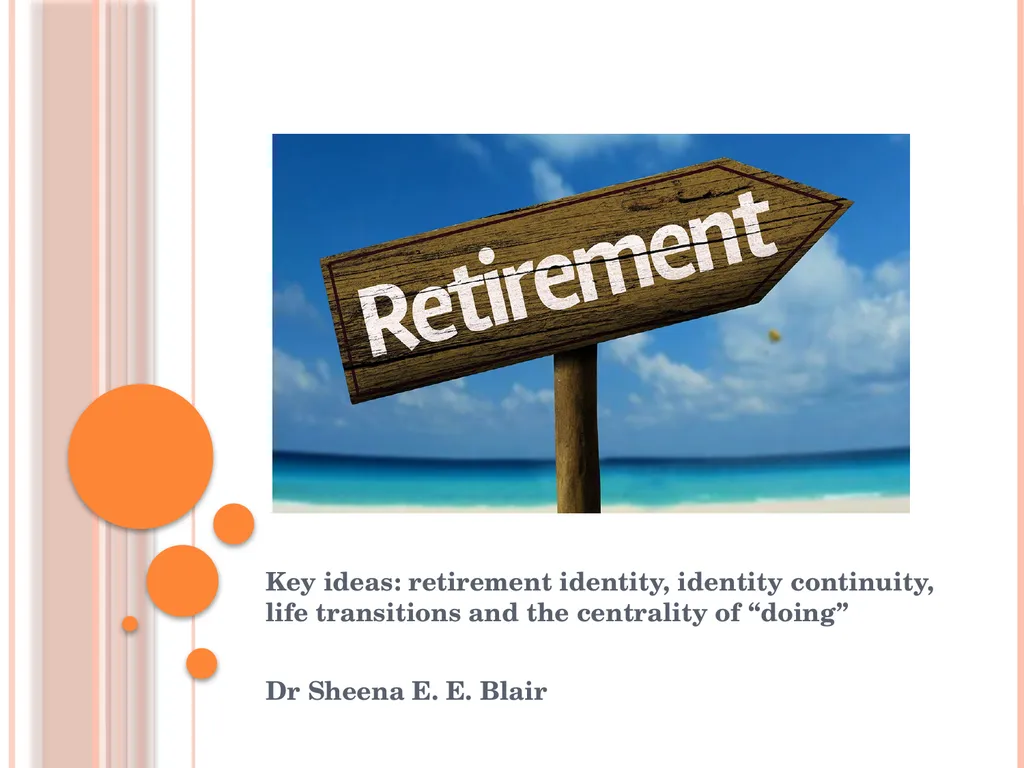
Key ideas: retirement identity, identity continuity, life transitions and the centrality of “doing”
Dr Sheena E. E. Blair<br>
02
My disclaimer My talk is not intended as a blueprint for how to retire or even how to reflect upon retirement
That life transition is unique and multi-layered
It requires negotiation and re-negotiation with self over time
However
Prompted by the notion that amongst all the preparations for retirement, the socio-emotional and rethinking of our occupational lives (what we actually do or will do) can be overlooked<br>
03
Theoretical Ideas which inform the presentation The Psychology of Life Transitions: how this helps make sense of retirement, identity continuity and can highlight potential resilience factors
Ideas from Occupational Science about the centrality of doing in our lives, how this contributes to our identity and life balance<br>
04
Brief profile Age 72, live alone, two children and one grandson
Retired occupational therapist and educationalist
Been retired from full time post for 12 years and from part time post for 10 years
For last ten years I have worked as a freelance educationalist
Have ad hoc post as an Assistant Registrar conducting weddings
Hobbies include gardening, Pilates, walking, cooking, upcycling, reading and travel<br>
05
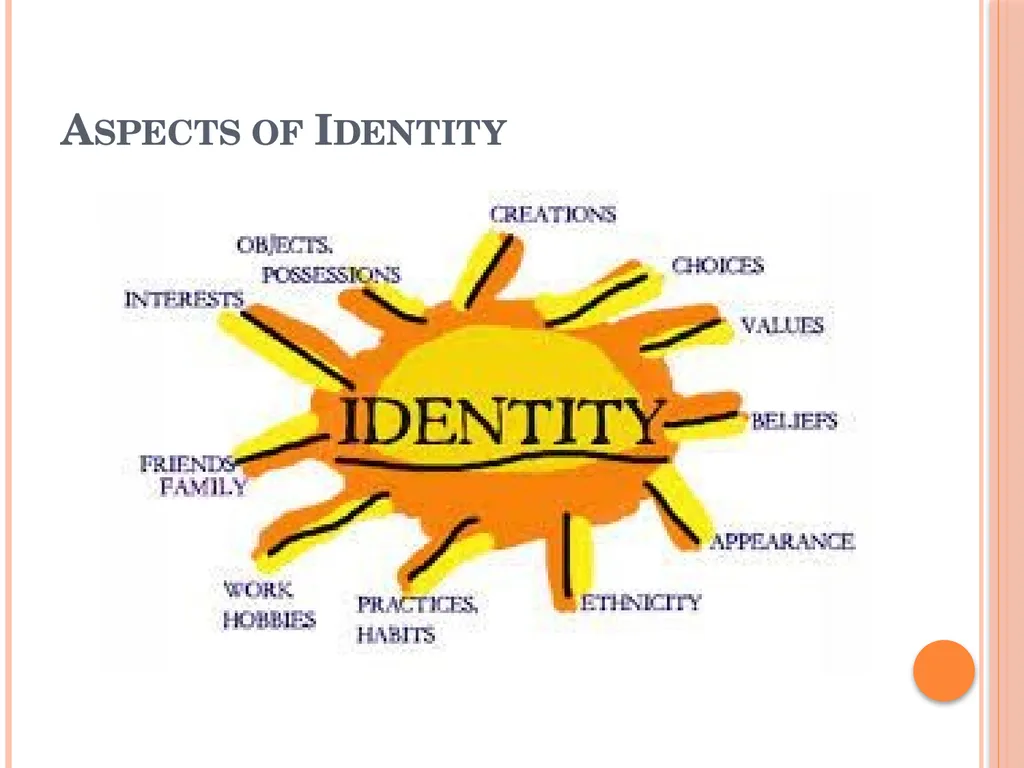
Aspects of Identity<br>
06
What do the last two slides say about identity and constructing identity? They reveal chosen and valued roles
Attempts to negotiate retirement
Chosen alternatives to previous work but retaining some key components/traits
Key influences in terms of chosen theoretical ideas – those which shape thinking
Reveals continuity of informing ideas
Longstanding fascination with what people do, the form that this takes, the function it occupies but most importantly – what it means<br>
07
Ideas from life transitions A life transition has been explained as a discontinuity
A transition can have specific characteristics such as whether it is predictable/voluntary
It can test our ability to adjust
Identity can remain linked (by you and others) to previous important roles…..did you not used to be?
Retirement often runs concurrently with other important life transitions concerning for example health, caring responsibilities
By the time of retirement, we have successfully negotiated many other transitions and built some resilience<br>
08
Retirement is a significant transitional event Arguably predictable and voluntary
Planning for retirement usually occurs but the attention to emotional, social issues and what we will do with more time than we have had in decades can be overlooked
Who will we be, what will we do, how will we structure our days, weeks and years
It often coincides with other life events such as caring responsibilities, changes in family structure
Multiple transition events can strain the ability to adjust<br>
09
ideas from life transitions We build capacity for adaptation and resilience
We strive to achieve a sense of control, continuity and meaningfulness
Life transitions impact upon our sense of self, identity and self esteem
Need to recognise and acknowledge our stability factors – people, ideas, places, faith or objects
How to make transitions safe and the idea of transitional objects<br>
10
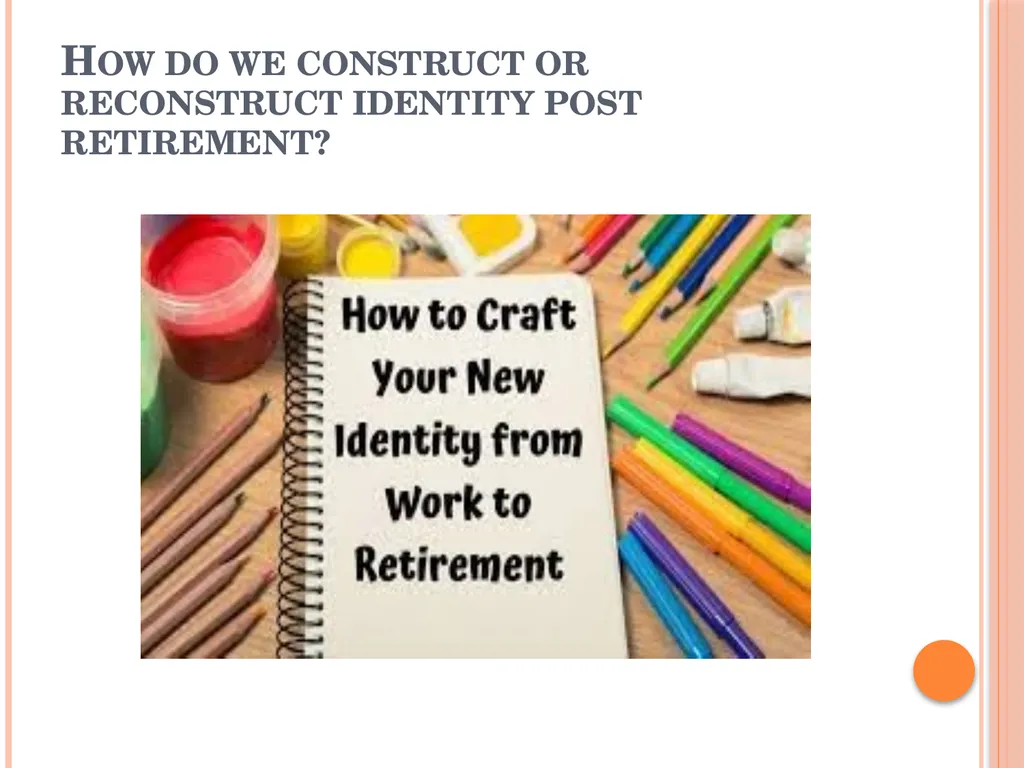
How do we construct or reconstruct identity post retirement?<br>
11
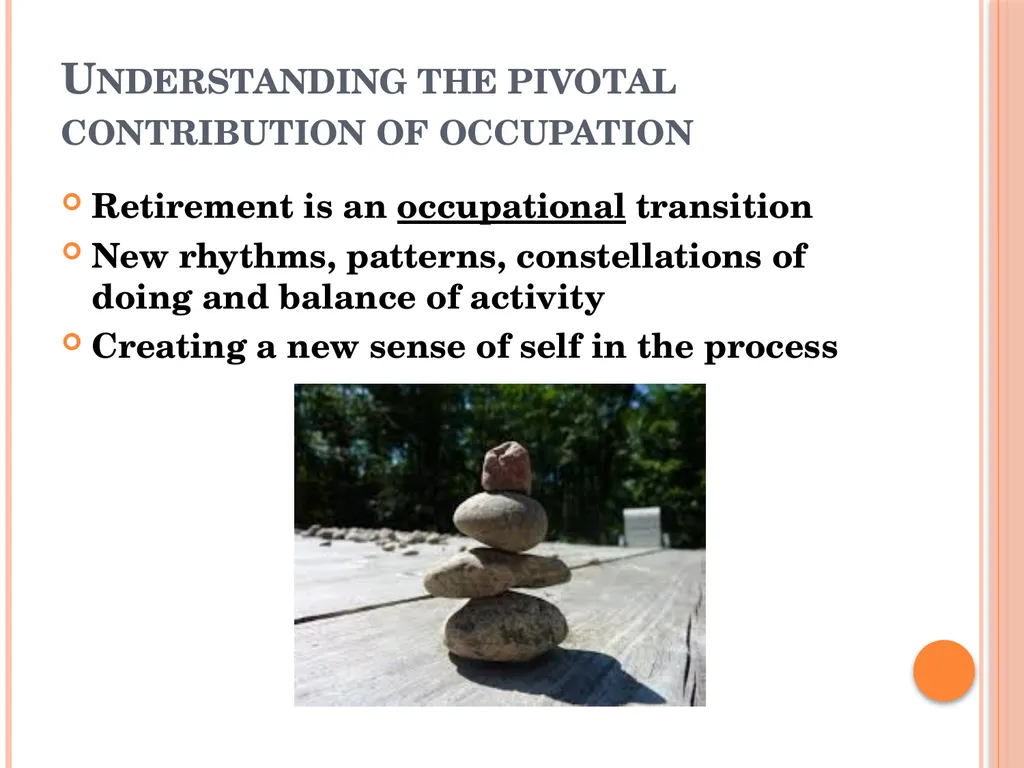
Understanding the pivotal contribution of occupation Retirement is an occupational transition
New rhythms, patterns, constellations of doing and balance of activity
Creating a new sense of self in the process<br>
12
An occupational scientists view Form – what are the patterns, roles and range of activities characterising our lives
Function – what are the chosen occupations for – self maintenance, leisure, social, creative, spiritual….
Meaning – what is invested in the chosen occupations. This is the most crucial for reflecting upon our identity and retirement identity<br>
13
Concluding ideas in words and pictures There is copious literature on key organisational issues of retirement and less upon what it means to retire or how to make sense of a new sense of self and identity
Our sense of self and identity is constantly re-framing - especially at the time of a life transition and retirement is a major life transition
Ideas from social psychology and occupational science can assist in thinking, re-thinking and sense making of retirement<br>
14
Remember how theCreate your own retirement fingerpost titles! Remember how the opening slide had only one direction (retirement) on the fingerpost?
Now create your own multiple directions on your own fingerpost<br>
15
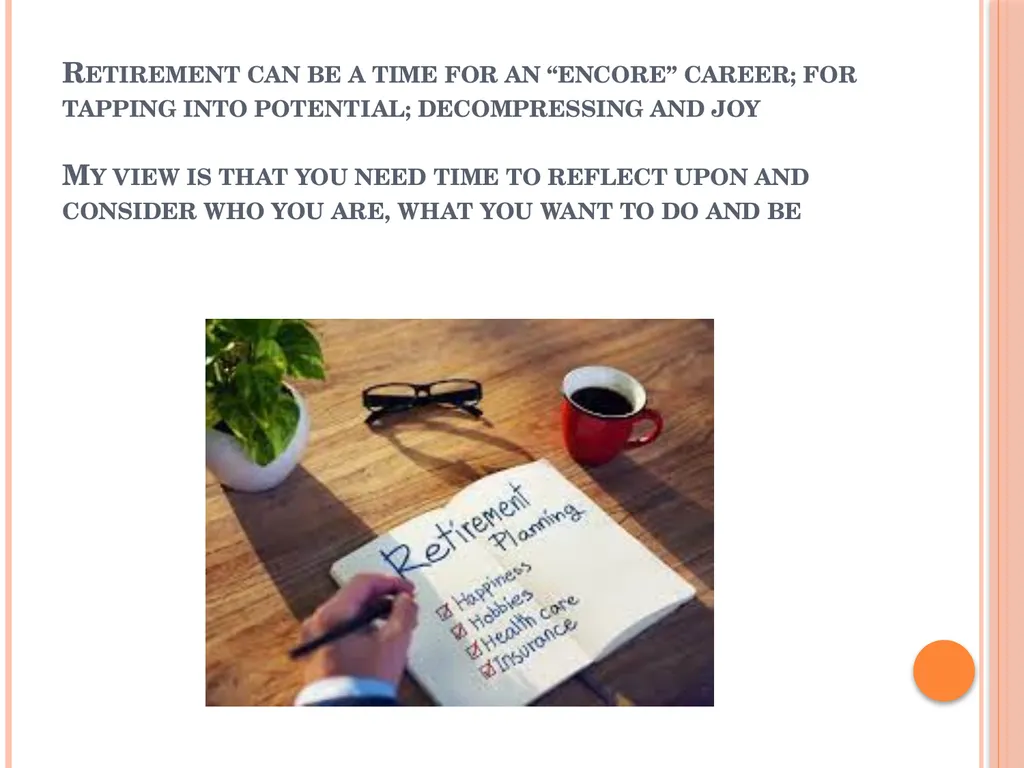
Retirement can be a time for an “encore” career; for tapping into potential; decompressing and joy My view is that you need time to reflect upon and consider who you are, what you want to do and be<br>