
Key Topics Ch 11 & 12 © 2015 Cengage Learning
AS
Published · 43 slides · 0 views
1 / 1
Description
Key Topics Ch 11 12 2015 Cengage Learning 1 Learning Outcomes Articulate a brief history of governments role in its relationship with business. Appreciate the complex interactions among business, government, and the public. Identify
Related Topics
Share
Embed code
Download this presentation From Below
"Key Topics Ch 11 & 12 © 2015 Cengage Learning" is the property of its rightful owner. Permission is granted to download and print the materials on this website for personal, non-commercial use only, and to display it on your personal computer provided you do not modify the materials and that you retain all copyright notices contained in the materials. By downloading content from our website, you accept the terms of this agreement.
Presentation Transcript
01
Key Topics
Ch 11 & 12 © 2015 Cengage Learning 1<br>
02
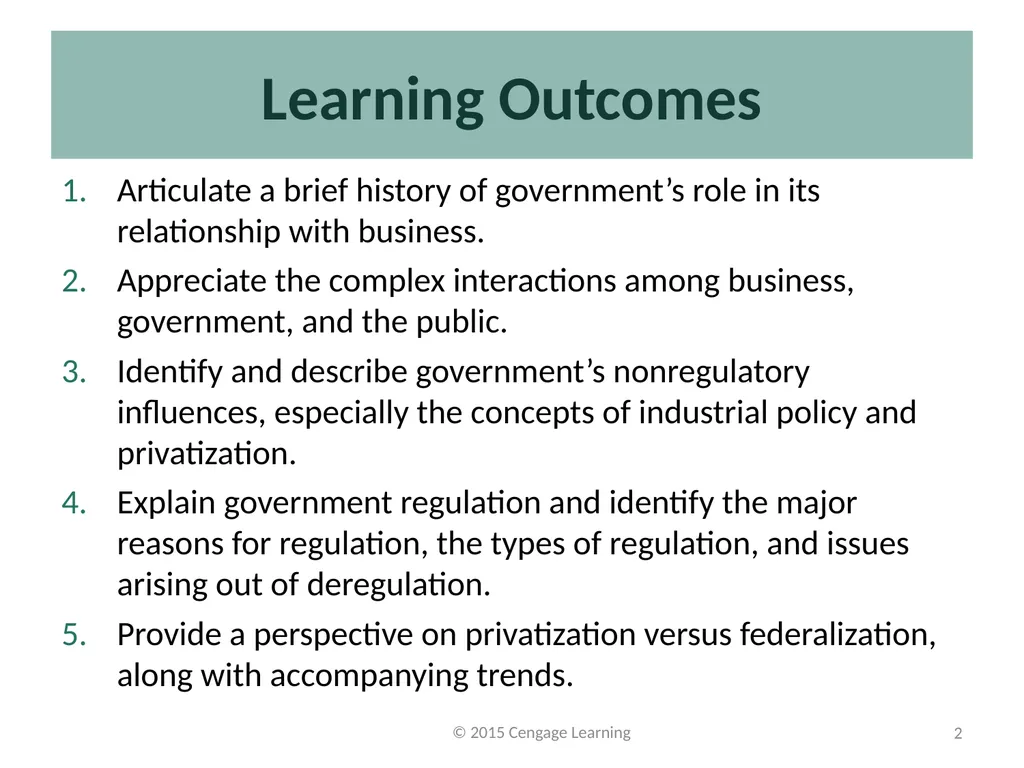
Learning Outcomes Articulate a brief history of government’s role in its relationship with business.
Appreciate the complex interactions among business, government, and the public.
Identify and describe government’s nonregulatory influences, especially the concepts of industrial policy and privatization.
Explain government regulation and identify the major reasons for regulation, the types of regulation, and issues arising out of deregulation.
Provide a perspective on privatization versus federalization, along with accompanying trends. © 2015 Cengage Learning 2<br>
Appreciate the complex interactions among business, government, and the public.
Identify and describe government’s nonregulatory influences, especially the concepts of industrial policy and privatization.
Explain government regulation and identify the major reasons for regulation, the types of regulation, and issues arising out of deregulation.
Provide a perspective on privatization versus federalization, along with accompanying trends. © 2015 Cengage Learning 2<br>
03
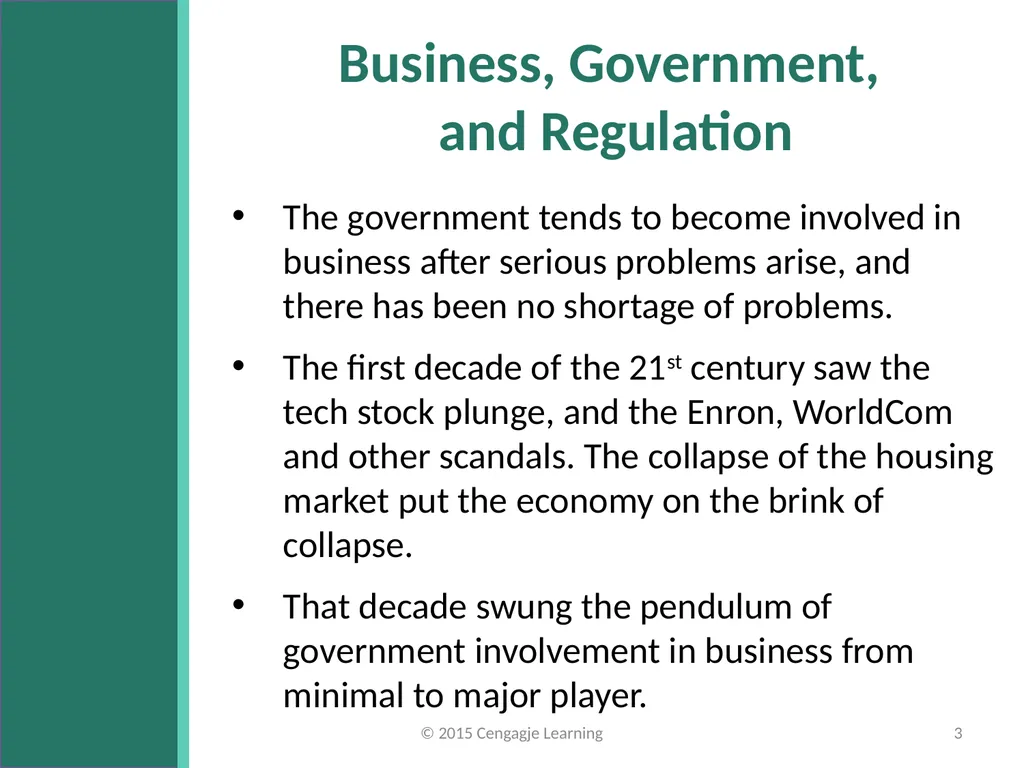
Business, Government,
and Regulation The government tends to become involved in business after serious problems arise, and there has been no shortage of problems.
The first decade of the 21st century saw the tech stock plunge, and the Enron, WorldCom and other scandals. The collapse of the housing market put the economy on the brink of collapse.
That decade swung the pendulum of government involvement in business from minimal to major player. © 2015 Cengagje Learning 3<br>
The first decade of the 21st century saw the tech stock plunge, and the Enron, WorldCom and other scandals. The collapse of the housing market put the economy on the brink of collapse.
That decade swung the pendulum of government involvement in business from minimal to major player. © 2015 Cengagje Learning 3<br>
04
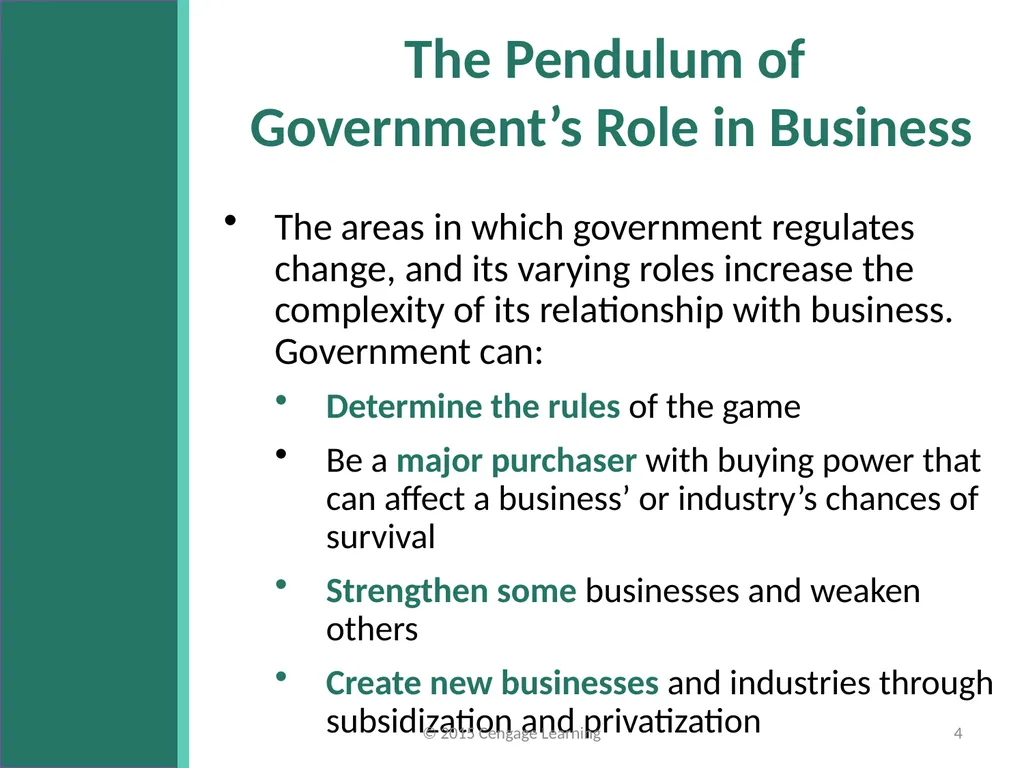
The Pendulum of
Government’s Role in Business The areas in which government regulates change, and its varying roles increase the complexity of its relationship with business. Government can:
Determine the rules of the game
Be a major purchaser with buying power that can affect a business’ or industry’s chances of survival
Strengthen some businesses and weaken others
Create new businesses and industries through subsidization and privatization © 2015 Cengage Learning 4<br>
Determine the rules of the game
Be a major purchaser with buying power that can affect a business’ or industry’s chances of survival
Strengthen some businesses and weaken others
Create new businesses and industries through subsidization and privatization © 2015 Cengage Learning 4<br>
05
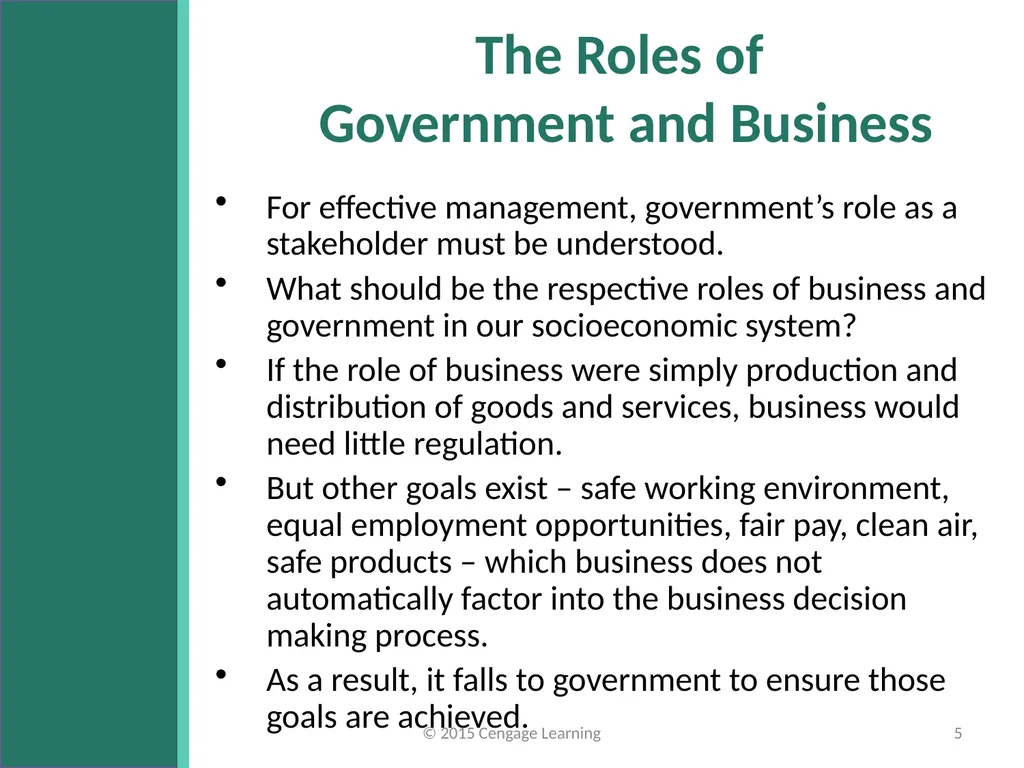
The Roles of
Government and Business For effective management, government’s role as a stakeholder must be understood.
What should be the respective roles of business and government in our socioeconomic system?
If the role of business were simply production and distribution of goods and services, business would need little regulation.
But other goals exist – safe working environment, equal employment opportunities, fair pay, clean air, safe products – which business does not automatically factor into the business decision making process.
As a result, it falls to government to ensure those goals are achieved. © 2015 Cengage Learning 5<br>
What should be the respective roles of business and government in our socioeconomic system?
If the role of business were simply production and distribution of goods and services, business would need little regulation.
But other goals exist – safe working environment, equal employment opportunities, fair pay, clean air, safe products – which business does not automatically factor into the business decision making process.
As a result, it falls to government to ensure those goals are achieved. © 2015 Cengage Learning 5<br>
06
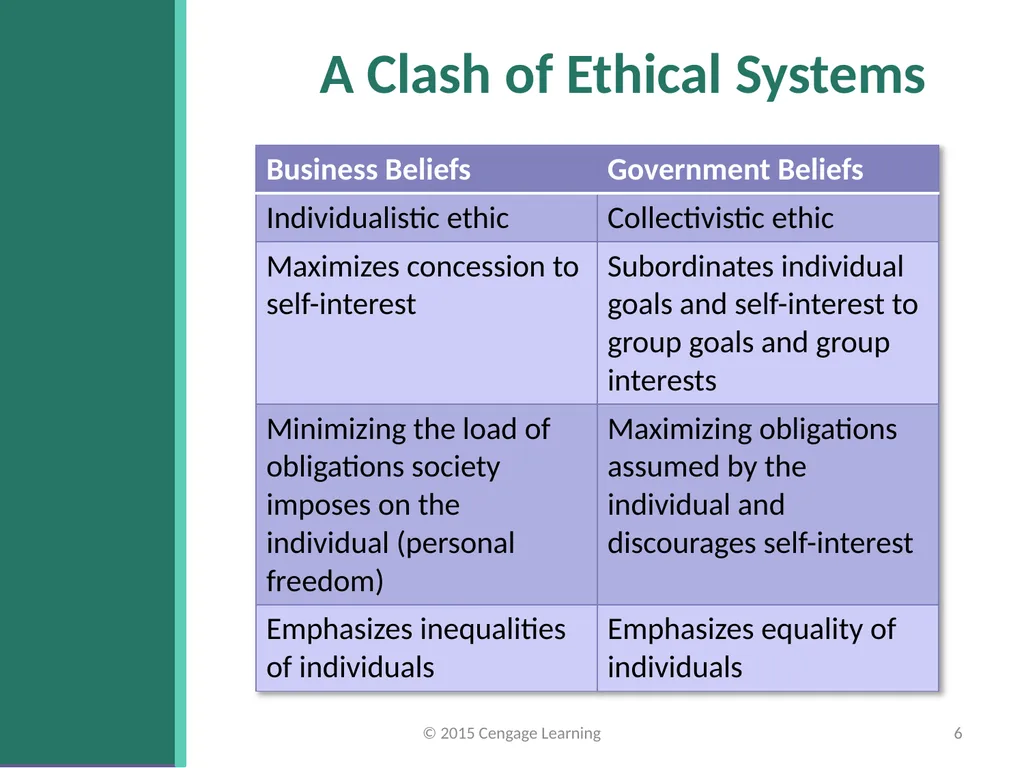
A Clash of Ethical Systems © 2015 Cengage Learning 6<br>
07
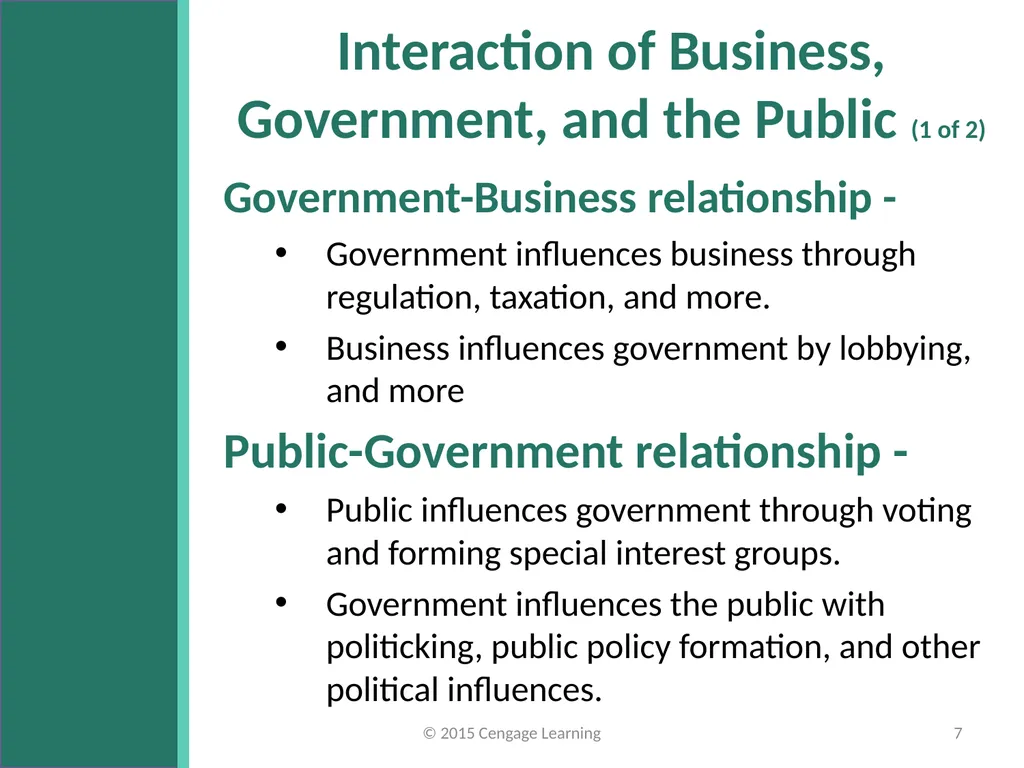
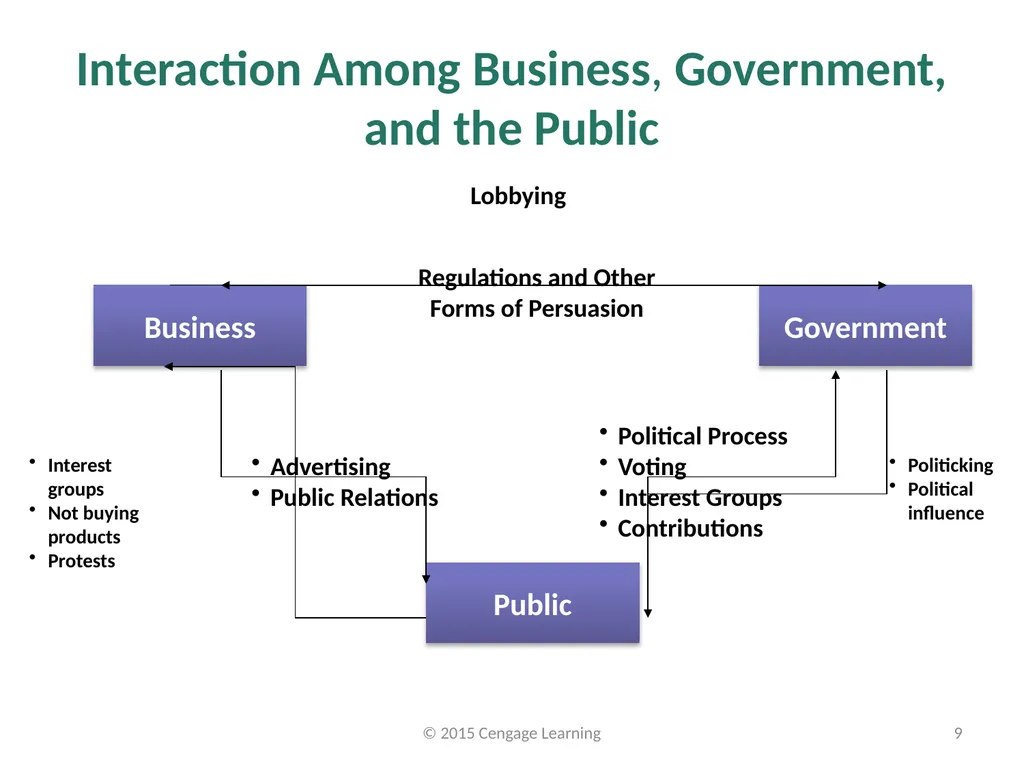
Interaction of Business, Government, and the Public (1 of 2) Government-Business relationship -
Government influences business through regulation, taxation, and more.
Business influences government by lobbying, and more
Public-Government relationship -
Public influences government through voting and forming special interest groups.
Government influences the public with politicking, public policy formation, and other political influences. © 2015 Cengage Learning 7<br>
Government influences business through regulation, taxation, and more.
Business influences government by lobbying, and more
Public-Government relationship -
Public influences government through voting and forming special interest groups.
Government influences the public with politicking, public policy formation, and other political influences. © 2015 Cengage Learning 7<br>
08
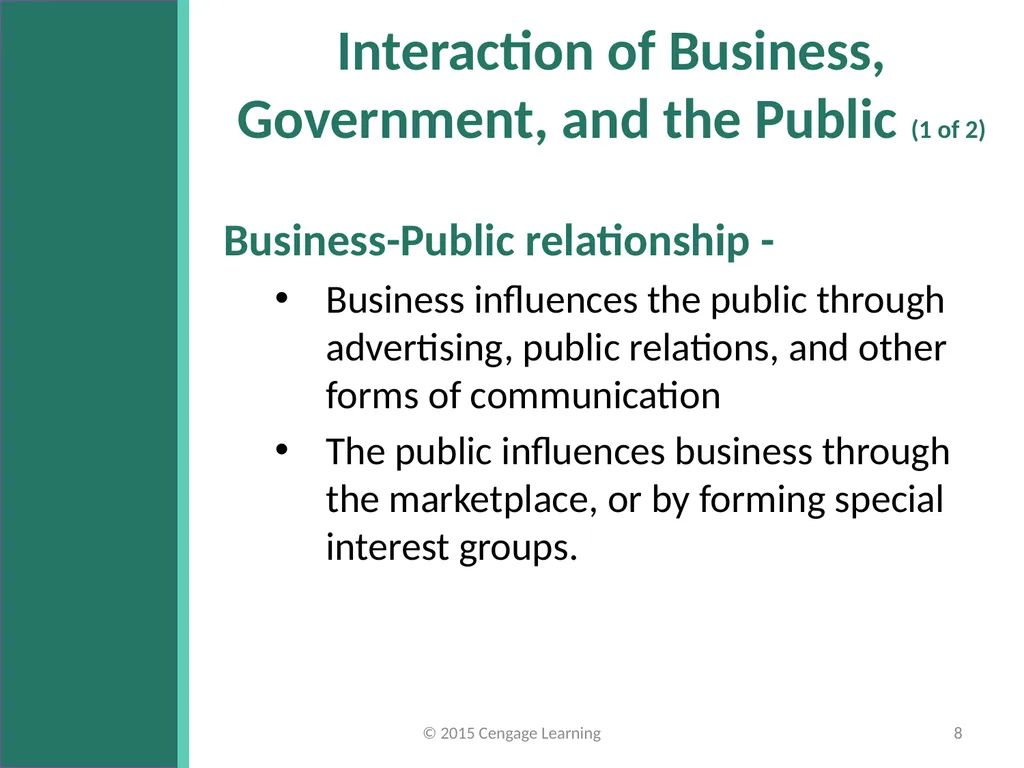
Interaction of Business, Government, and the Public (1 of 2) Business-Public relationship -
Business influences the public through advertising, public relations, and other forms of communication
The public influences business through the marketplace, or by forming special interest groups. © 2015 Cengage Learning 8<br>
Business influences the public through advertising, public relations, and other forms of communication
The public influences business through the marketplace, or by forming special interest groups. © 2015 Cengage Learning 8<br>
09
Interaction Among Business, Government, and the Public 9 © 2015 Cengage Learning<br>
10
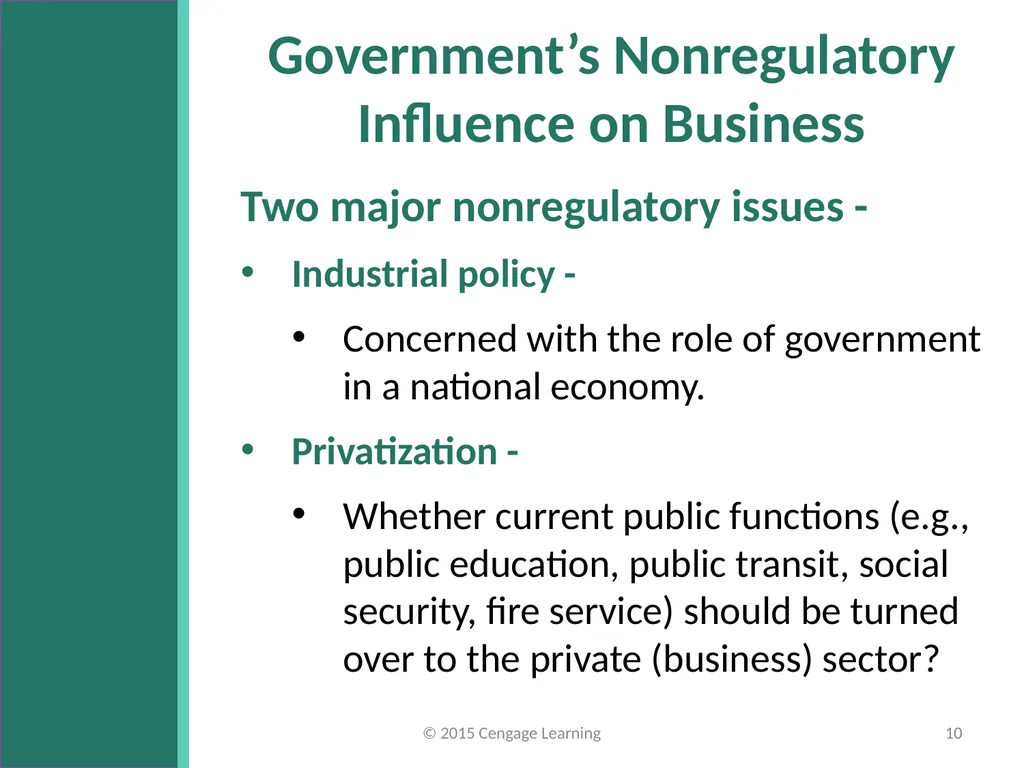
Government’s Nonregulatory Influence on Business Two major nonregulatory issues -
Industrial policy -
Concerned with the role of government in a national economy.
Privatization -
Whether current public functions (e.g., public education, public transit, social security, fire service) should be turned over to the private (business) sector? © 2015 Cengage Learning 10<br>
Industrial policy -
Concerned with the role of government in a national economy.
Privatization -
Whether current public functions (e.g., public education, public transit, social security, fire service) should be turned over to the private (business) sector? © 2015 Cengage Learning 10<br>
11
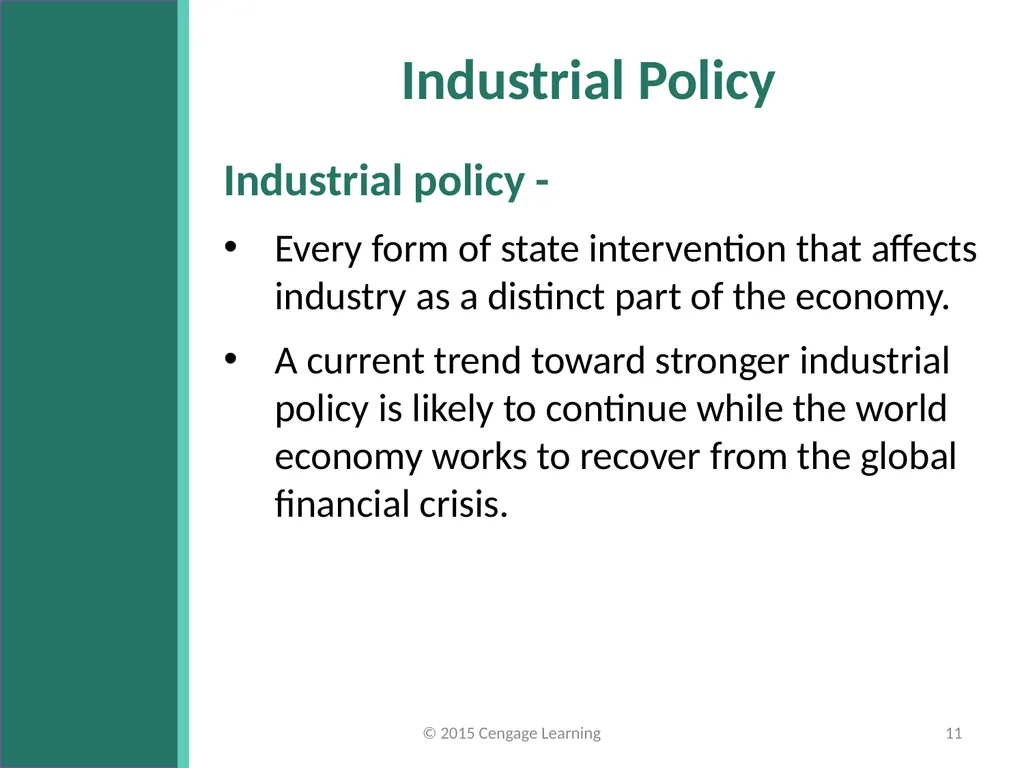
Industrial Policy Industrial policy -
Every form of state intervention that affects industry as a distinct part of the economy.
A current trend toward stronger industrial policy is likely to continue while the world economy works to recover from the global financial crisis. © 2015 Cengage Learning 11<br>
Every form of state intervention that affects industry as a distinct part of the economy.
A current trend toward stronger industrial policy is likely to continue while the world economy works to recover from the global financial crisis. © 2015 Cengage Learning 11<br>
12
Privatization Privatization -
The process of changing a public organization to private control or ownership.
The intent is to capture the discipline of the free market and a spirit of entrepreneurial risk-taking.
Two functions a government might perform:
Producing a service
Providing a service © 2015 Cengage Learning 12<br>
The process of changing a public organization to private control or ownership.
The intent is to capture the discipline of the free market and a spirit of entrepreneurial risk-taking.
Two functions a government might perform:
Producing a service
Providing a service © 2015 Cengage Learning 12<br>
13
The Privatization Debate Pro-Privatization -
Government has no comparative advantage in many functions.
Government is less efficient and less flexible.
Anti-Privatization -
Some activities cannot be effectively handled by the private sector.
Privatization produces uneven results in efficiency gains and cost savings.
Privatization works best when the pursuit of profits does not work against broader social goals or public policy. © 2015 Cengage Learning 13<br>
Government has no comparative advantage in many functions.
Government is less efficient and less flexible.
Anti-Privatization -
Some activities cannot be effectively handled by the private sector.
Privatization produces uneven results in efficiency gains and cost savings.
Privatization works best when the pursuit of profits does not work against broader social goals or public policy. © 2015 Cengage Learning 13<br>
14
Other Nonregulatory
Government Influences Government is:
A major employer
A standard setter
One of the largest purchasers
Government influences business by:
The use of Subsidies
Transfer payments
Loans and loan guarantees
Taxation
Monetary policy
Moral suasion © 2015 Cengage Learning 14<br>
A major employer
A standard setter
One of the largest purchasers
Government influences business by:
The use of Subsidies
Transfer payments
Loans and loan guarantees
Taxation
Monetary policy
Moral suasion © 2015 Cengage Learning 14<br>
15
Government’s
Regulatory Influence on Business © 2015 Cengage Learning 15 Government Regulation has become the most controversial in the business-government relationship, affecting every aspect of how business functions.
Most people agree that some regulation is necessary to ensure that consumers and employees are treated fairly, and not exposed to hazards, and to protect the environment.
However, businesses also think that regulation has often been too extensive in scope, too costly, and burdensome in terms of red tape.<br>
Most people agree that some regulation is necessary to ensure that consumers and employees are treated fairly, and not exposed to hazards, and to protect the environment.
However, businesses also think that regulation has often been too extensive in scope, too costly, and burdensome in terms of red tape.<br>
16
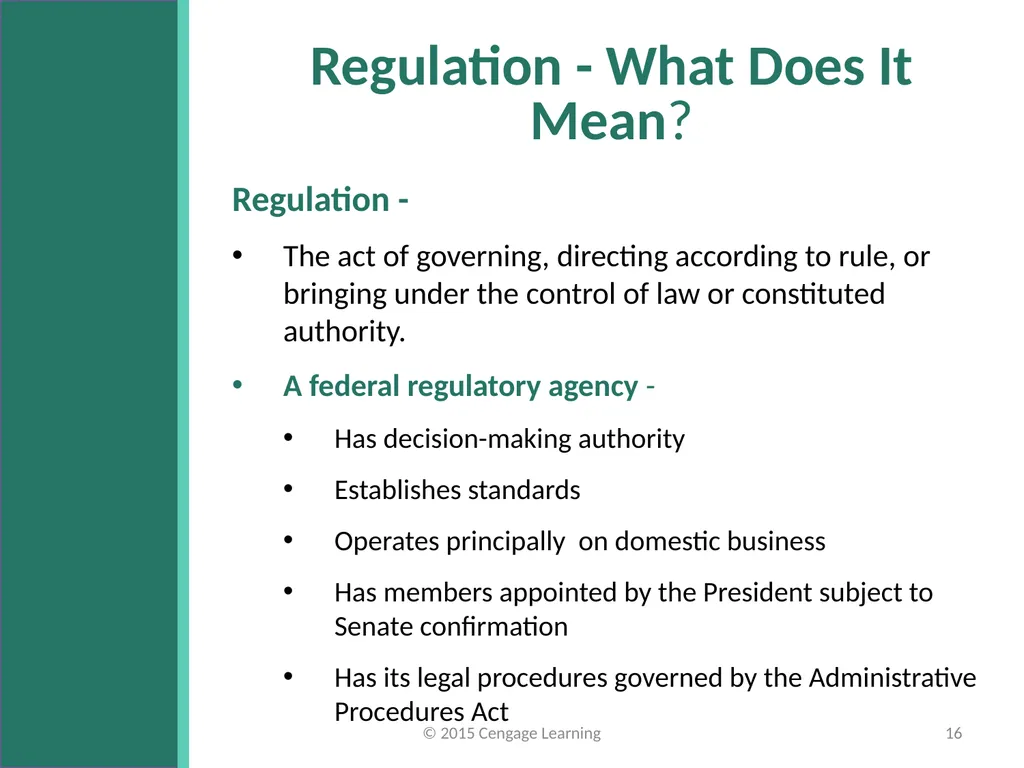
Regulation - What Does It Mean? Regulation -
The act of governing, directing according to rule, or bringing under the control of law or constituted authority.
A federal regulatory agency -
Has decision-making authority
Establishes standards
Operates principally on domestic business
Has members appointed by the President subject to Senate confirmation
Has its legal procedures governed by the Administrative Procedures Act © 2015 Cengage Learning 16<br>
The act of governing, directing according to rule, or bringing under the control of law or constituted authority.
A federal regulatory agency -
Has decision-making authority
Establishes standards
Operates principally on domestic business
Has members appointed by the President subject to Senate confirmation
Has its legal procedures governed by the Administrative Procedures Act © 2015 Cengage Learning 16<br>
17
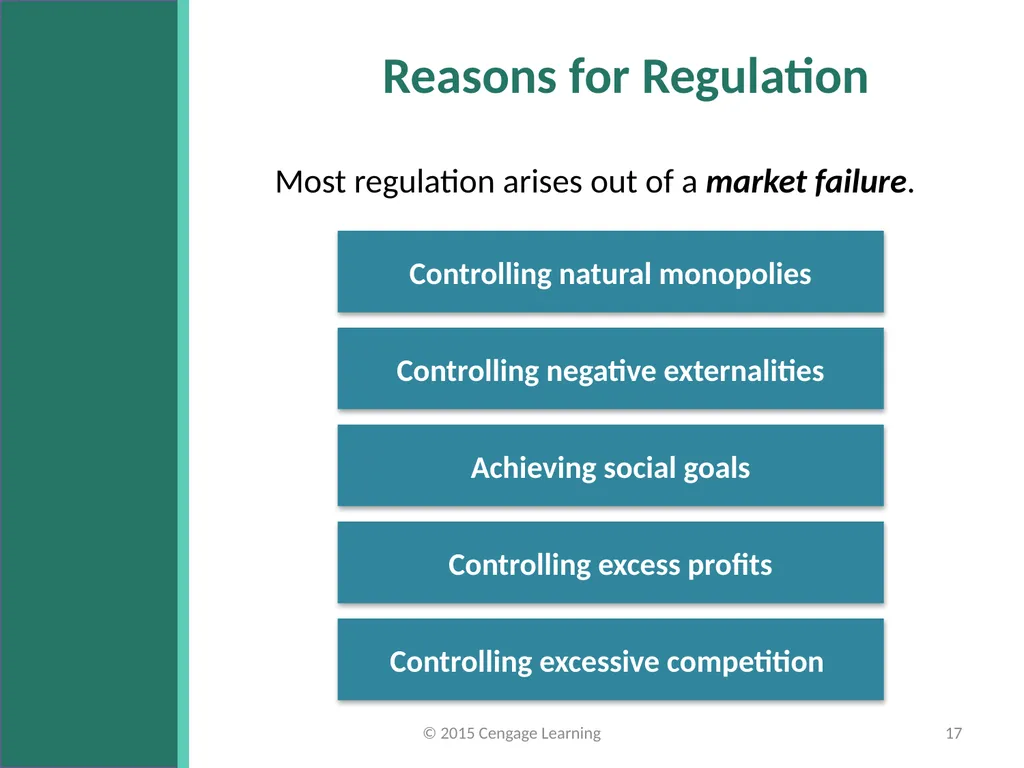
Reasons for Regulation Most regulation arises out of a market failure. © 2015 Cengage Learning 17<br>
18
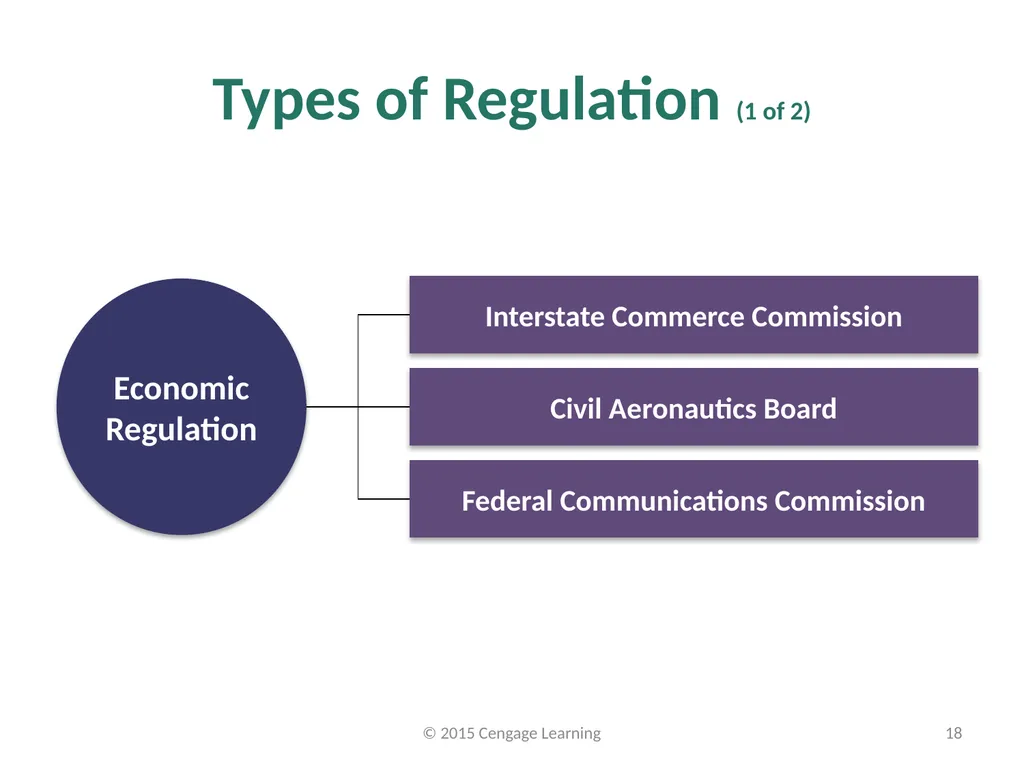
Types of Regulation (1 of 2) 18 © 2015 Cengage Learning<br>
19
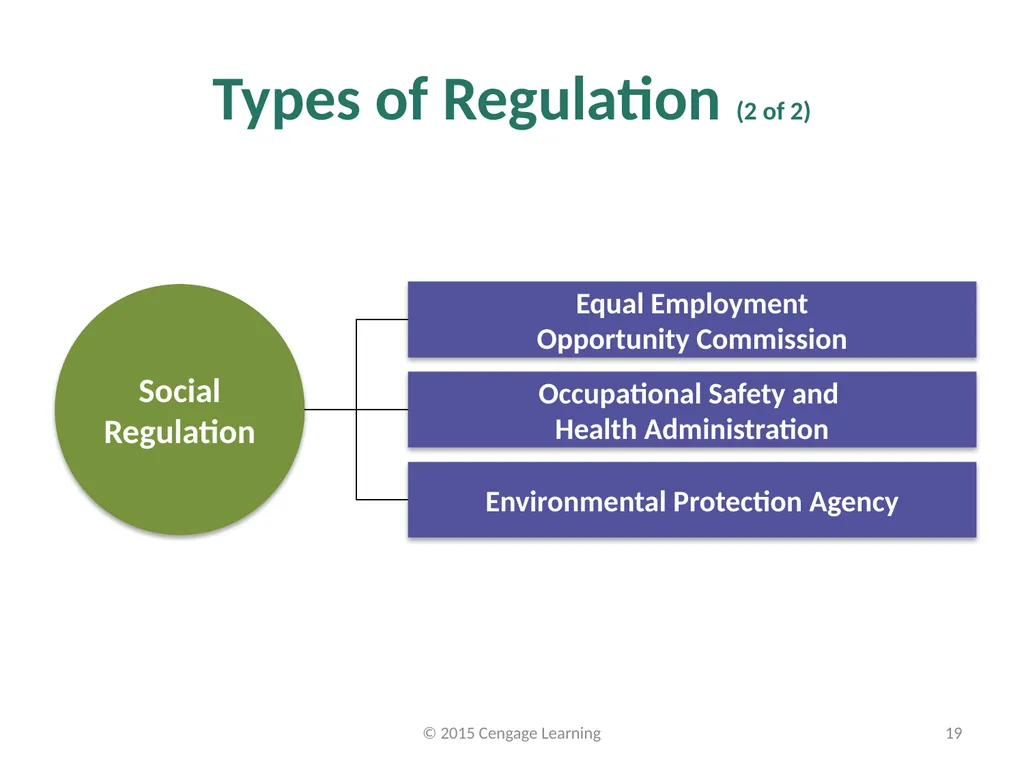
Types of Regulation (2 of 2) 19 © 2015 Cengage Learning<br>
20
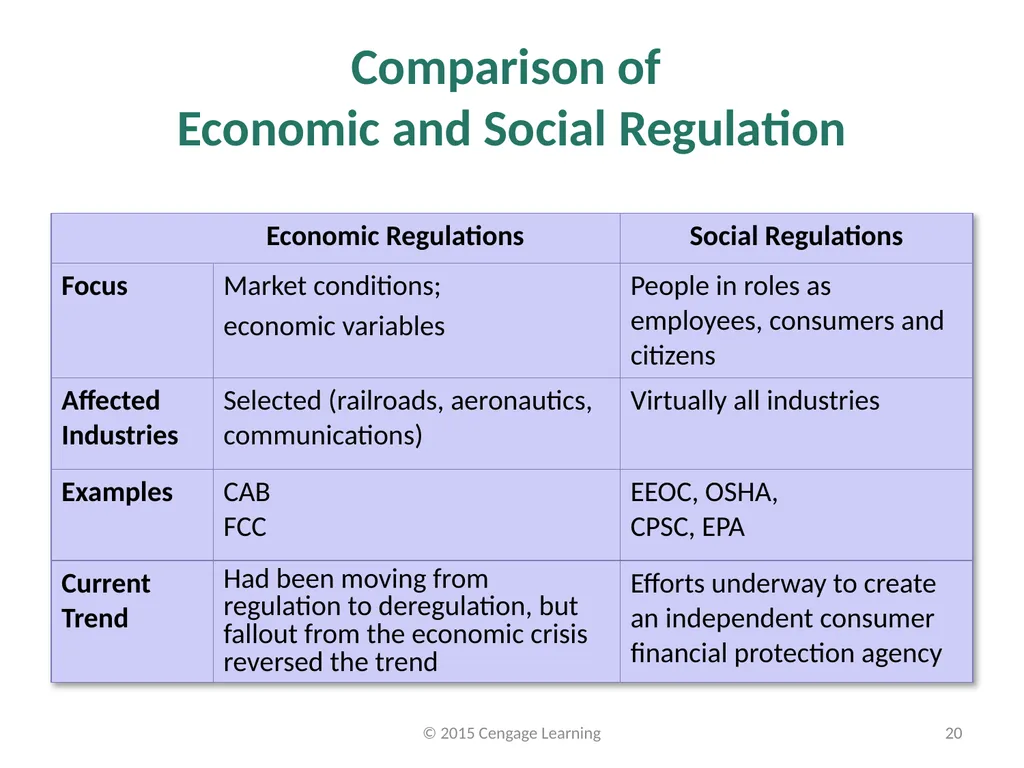
Comparison of
Economic and Social Regulation 20 © 2015 Cengage Learning<br>
21
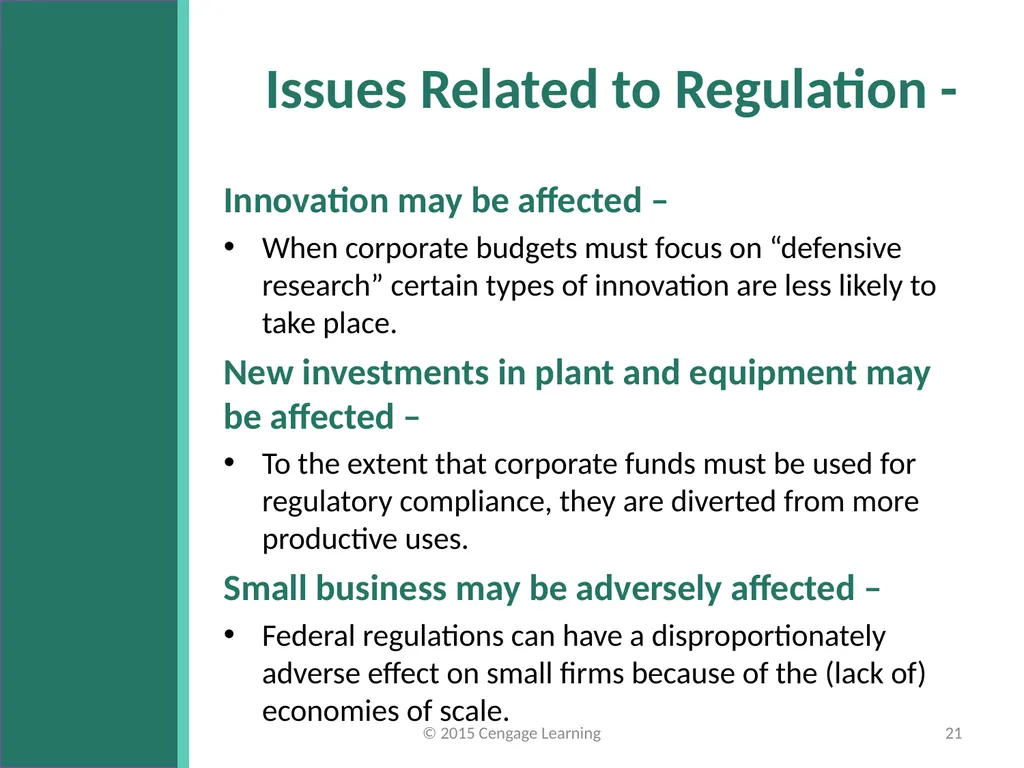
Issues Related to Regulation - Innovation may be affected –
When corporate budgets must focus on “defensive research” certain types of innovation are less likely to take place.
New investments in plant and equipment may be affected –
To the extent that corporate funds must be used for regulatory compliance, they are diverted from more productive uses.
Small business may be adversely affected –
Federal regulations can have a disproportionately adverse effect on small firms because of the (lack of) economies of scale. © 2015 Cengage Learning 21<br>
When corporate budgets must focus on “defensive research” certain types of innovation are less likely to take place.
New investments in plant and equipment may be affected –
To the extent that corporate funds must be used for regulatory compliance, they are diverted from more productive uses.
Small business may be adversely affected –
Federal regulations can have a disproportionately adverse effect on small firms because of the (lack of) economies of scale. © 2015 Cengage Learning 21<br>
22
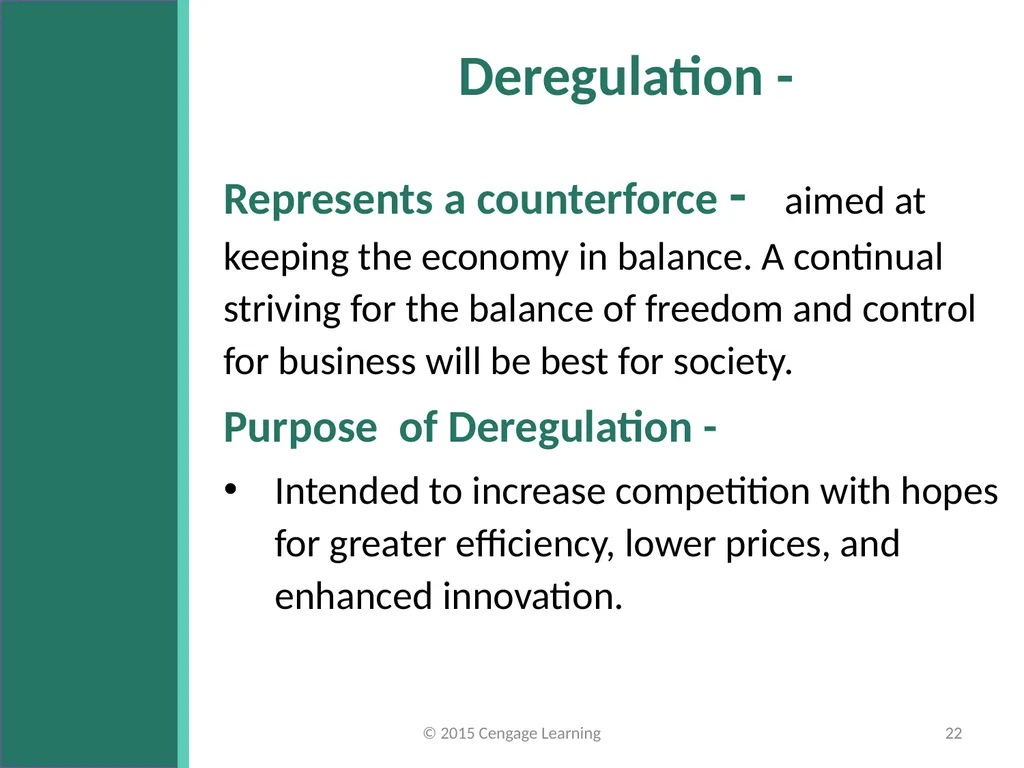
Deregulation - Represents a counterforce - aimed at keeping the economy in balance. A continual striving for the balance of freedom and control for business will be best for society.
Purpose of Deregulation -
Intended to increase competition with hopes for greater efficiency, lower prices, and enhanced innovation. © 2015 Cengage Learning 22<br>
Purpose of Deregulation -
Intended to increase competition with hopes for greater efficiency, lower prices, and enhanced innovation. © 2015 Cengage Learning 22<br>
23
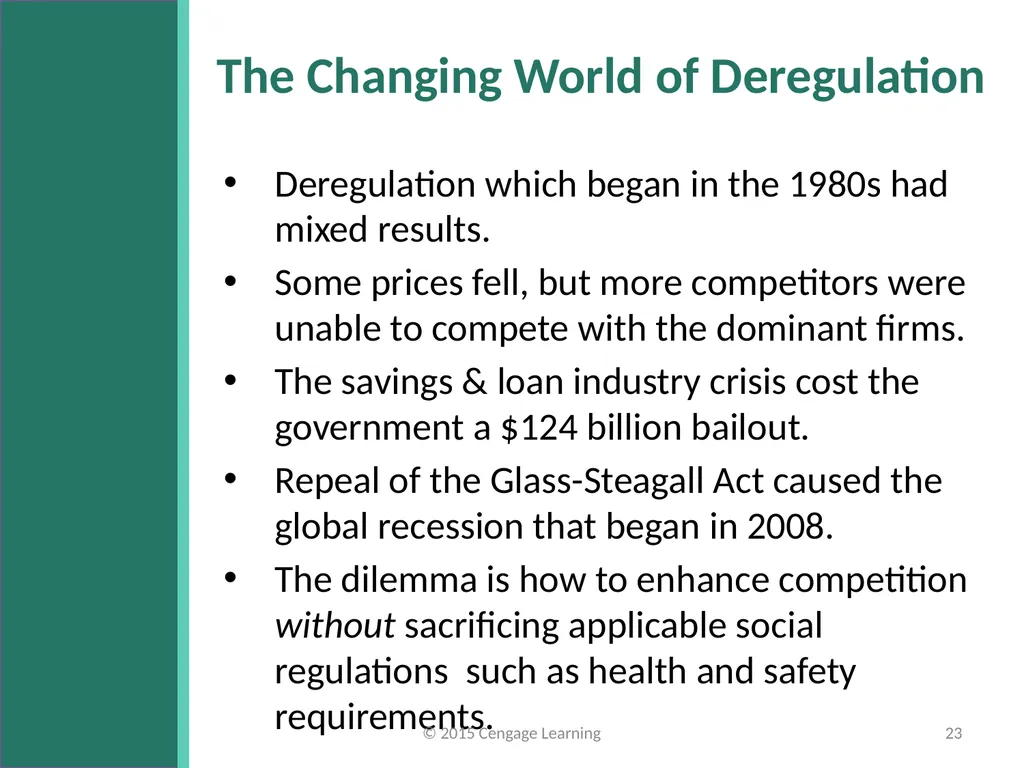
The Changing World of Deregulation Deregulation which began in the 1980s had mixed results.
Some prices fell, but more competitors were unable to compete with the dominant firms.
The savings & loan industry crisis cost the government a $124 billion bailout.
Repeal of the Glass-Steagall Act caused the global recession that began in 2008.
The dilemma is how to enhance competition without sacrificing applicable social regulations such as health and safety requirements. © 2015 Cengage Learning 23<br>
Some prices fell, but more competitors were unable to compete with the dominant firms.
The savings & loan industry crisis cost the government a $124 billion bailout.
Repeal of the Glass-Steagall Act caused the global recession that began in 2008.
The dilemma is how to enhance competition without sacrificing applicable social regulations such as health and safety requirements. © 2015 Cengage Learning 23<br>
24
Learning Outcomes Describe the evolution of corporate political participation.
Differentiate among the different levels at which business lobbying occurs.
Explain the phenomenon of political action committees (PACs) in terms of their historical growth, the magnitude of their activity, and the arguments for and against them.
Define coalitions and describe the critical role they now assume in corporate political involvement.
Discuss the Bipartisan Campaign Reform Act and other issues surrounding campaign financing.
Outline the principal strategic approaches to political activism that firms are employing. © 2015 Cengage Learning 24<br>
Differentiate among the different levels at which business lobbying occurs.
Explain the phenomenon of political action committees (PACs) in terms of their historical growth, the magnitude of their activity, and the arguments for and against them.
Define coalitions and describe the critical role they now assume in corporate political involvement.
Discuss the Bipartisan Campaign Reform Act and other issues surrounding campaign financing.
Outline the principal strategic approaches to political activism that firms are employing. © 2015 Cengage Learning 24<br>
25
Business Influence on
Government and Public Policy Government is a central stakeholder of business, and its interest is broad and multifaceted.
Government’s power is derived from its legal and moral right to represent the public in its dealings with business.
Society would be best served if the system maintained a balance of power, but a controversial U.S. Supreme Court ruling (Citizens United v. Federal Election Commission) has left business with the power to drive the political agenda unchecked. © 2015 Cengage Learning 25<br>
Government’s power is derived from its legal and moral right to represent the public in its dealings with business.
Society would be best served if the system maintained a balance of power, but a controversial U.S. Supreme Court ruling (Citizens United v. Federal Election Commission) has left business with the power to drive the political agenda unchecked. © 2015 Cengage Learning 25<br>
26
Corporate Political Participation Political Involvement -
Participation in the formulation and execution of public policy at various levels of government.
Two major approaches to corporate political activity:
Lobbying
Political spending © 2015 Cengage Learning 26<br>
Participation in the formulation and execution of public policy at various levels of government.
Two major approaches to corporate political activity:
Lobbying
Political spending © 2015 Cengage Learning 26<br>
27
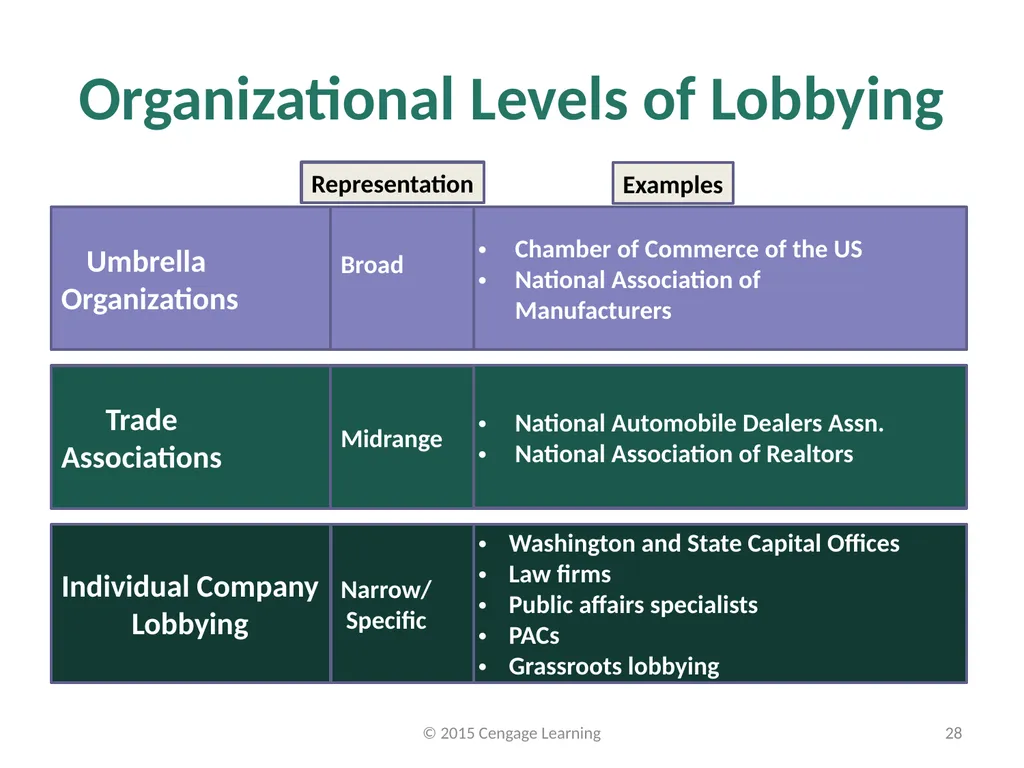
Business Lobbying Lobbying -
The process of influencing public officials to promote or secure passage or defeat of legislation.
Lobbyists are intensely self-interested.
Their goals are to promote legislation that is in the interest of their organization, and to defeat legislation that runs counter to that goal.
Because of the large amounts of money involved, people will cross the legal and ethical line.
Lawrence Lessig – “There’s all the difference in the world between a lawyer making an argument to the jury, and a lawyer handing out $100 bills to the jurors.” © 2015 Cengage Learning 27<br>
The process of influencing public officials to promote or secure passage or defeat of legislation.
Lobbyists are intensely self-interested.
Their goals are to promote legislation that is in the interest of their organization, and to defeat legislation that runs counter to that goal.
Because of the large amounts of money involved, people will cross the legal and ethical line.
Lawrence Lessig – “There’s all the difference in the world between a lawyer making an argument to the jury, and a lawyer handing out $100 bills to the jurors.” © 2015 Cengage Learning 27<br>
28
Organizational Levels of Lobbying © 2015 Cengage Learning 28<br>
29
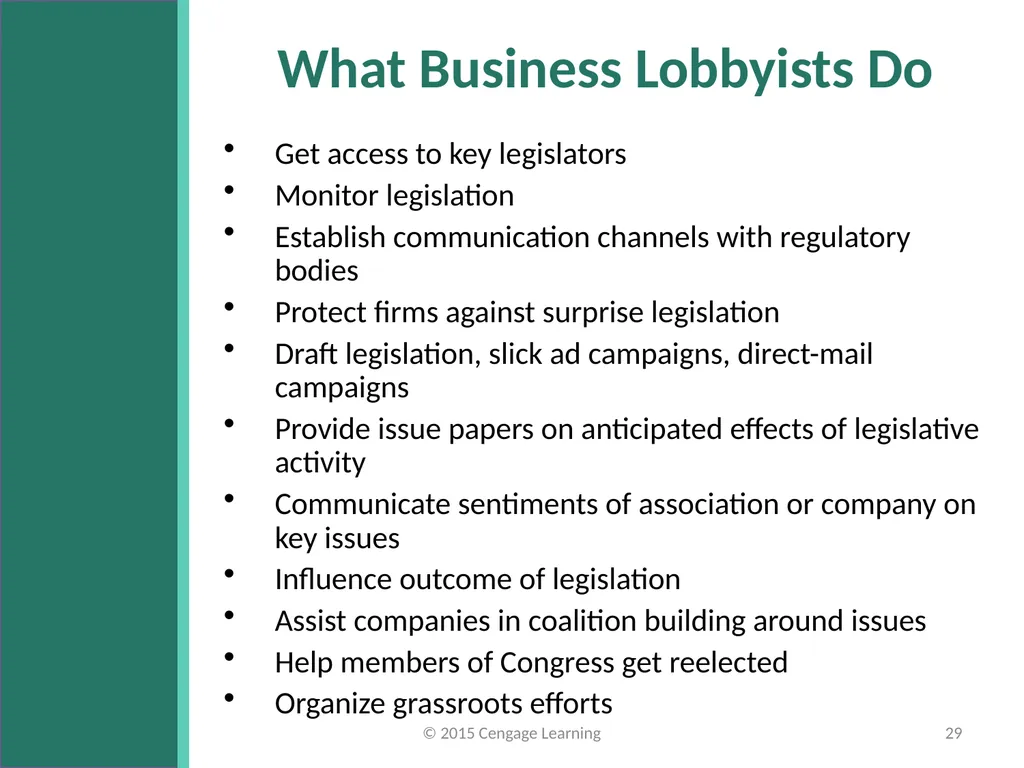
What Business Lobbyists Do Get access to key legislators
Monitor legislation
Establish communication channels with regulatory bodies
Protect firms against surprise legislation
Draft legislation, slick ad campaigns, direct-mail campaigns
Provide issue papers on anticipated effects of legislative activity
Communicate sentiments of association or company on key issues
Influence outcome of legislation
Assist companies in coalition building around issues
Help members of Congress get reelected
Organize grassroots efforts © 2015 Cengage Learning 29<br>
Monitor legislation
Establish communication channels with regulatory bodies
Protect firms against surprise legislation
Draft legislation, slick ad campaigns, direct-mail campaigns
Provide issue papers on anticipated effects of legislative activity
Communicate sentiments of association or company on key issues
Influence outcome of legislation
Assist companies in coalition building around issues
Help members of Congress get reelected
Organize grassroots efforts © 2015 Cengage Learning 29<br>
30
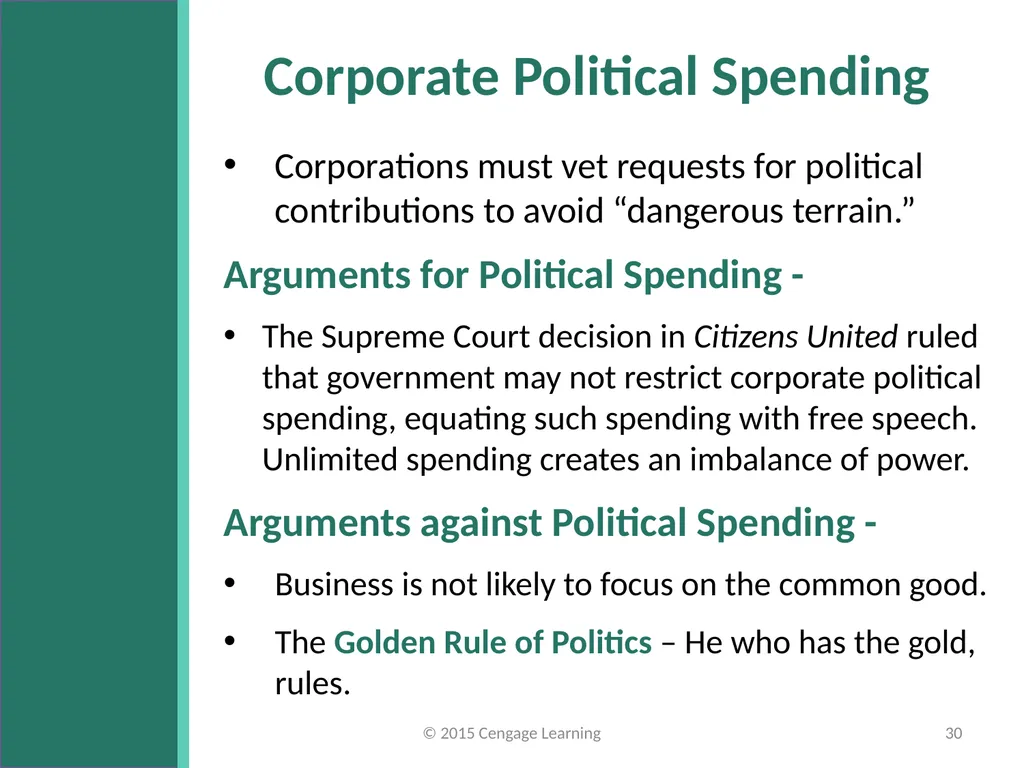
Corporate Political Spending Corporations must vet requests for political contributions to avoid “dangerous terrain.”
Arguments for Political Spending -
The Supreme Court decision in Citizens United ruled that government may not restrict corporate political spending, equating such spending with free speech. Unlimited spending creates an imbalance of power.
Arguments against Political Spending -
Business is not likely to focus on the common good.
The Golden Rule of Politics – He who has the gold, rules. © 2015 Cengage Learning 30<br>
Arguments for Political Spending -
The Supreme Court decision in Citizens United ruled that government may not restrict corporate political spending, equating such spending with free speech. Unlimited spending creates an imbalance of power.
Arguments against Political Spending -
Business is not likely to focus on the common good.
The Golden Rule of Politics – He who has the gold, rules. © 2015 Cengage Learning 30<br>
31
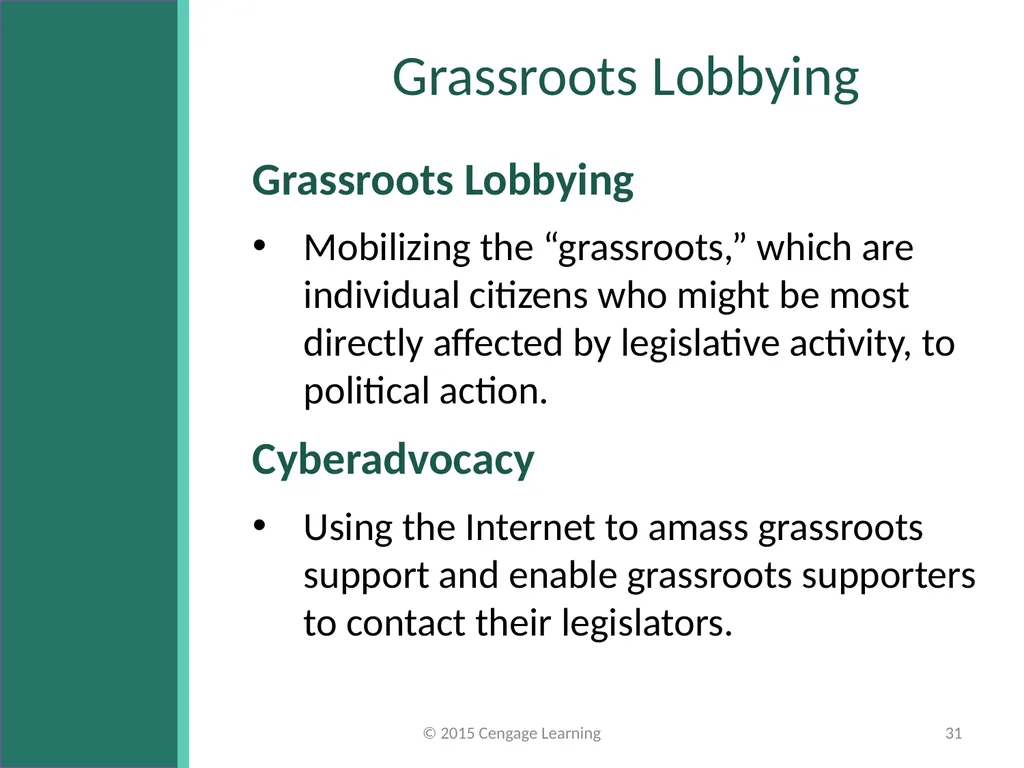
Grassroots Lobbying Grassroots Lobbying
Mobilizing the “grassroots,” which are individual citizens who might be most directly affected by legislative activity, to political action.
Cyberadvocacy
Using the Internet to amass grassroots support and enable grassroots supporters to contact their legislators. © 2015 Cengage Learning 31<br>
Mobilizing the “grassroots,” which are individual citizens who might be most directly affected by legislative activity, to political action.
Cyberadvocacy
Using the Internet to amass grassroots support and enable grassroots supporters to contact their legislators. © 2015 Cengage Learning 31<br>
32
Grassroots Lobbying (continued) Astroturf Lobbying/Grasstops Lobbying
Fake groups that appear to be genuinely grassroots but are largely created and funded by a professional organization or trade association. © 2015 Cengage Learning 32<br>
Fake groups that appear to be genuinely grassroots but are largely created and funded by a professional organization or trade association. © 2015 Cengage Learning 32<br>
33
Trade Association Lobbying The Center for Political Accountability revealed that trade associations helped companies conceal and spend over $100 million in just one year.
Industry-level lobbying is common. © 2015 Cengage Learning 33<br>
Industry-level lobbying is common. © 2015 Cengage Learning 33<br>
34
Umbrella Organizations Two major U.S. umbrella organizations
Chamber of Commerce of the United States
National Association of Manufacturers (NAM)
Other umbrella organizations
Business Roundtable
National Federation of Independent Businesses (NFIB) © 2015 Cengage Learning 34<br>
Chamber of Commerce of the United States
National Association of Manufacturers (NAM)
Other umbrella organizations
Business Roundtable
National Federation of Independent Businesses (NFIB) © 2015 Cengage Learning 34<br>
35
Coalition Building Coalition
Forms when distinct groups or parties realize they have something in common that might warrant their joining forces for joint action.
Building a coalition
Manage the sequence in which issues are addressed.
Increase the visibility of certain issues.
Unbundle issues into smaller sub-issues. © 2015 Cengage Learning 35<br>
Forms when distinct groups or parties realize they have something in common that might warrant their joining forces for joint action.
Building a coalition
Manage the sequence in which issues are addressed.
Increase the visibility of certain issues.
Unbundle issues into smaller sub-issues. © 2015 Cengage Learning 35<br>
36
Political Action Committees Political Action Committees (PACs) - are committees organized to raise and spend money for political candidates, ballot initiatives, and proposed legislation.
Connected PAC – is associated with a specific group or organization, and can only raise money from that group.
Nonconnected PAC – can accept funds from any individual or organization, including a connected PAC, as long as those contributions are legal. © 2015 Cengage Learning 36<br>
Connected PAC – is associated with a specific group or organization, and can only raise money from that group.
Nonconnected PAC – can accept funds from any individual or organization, including a connected PAC, as long as those contributions are legal. © 2015 Cengage Learning 36<br>
37
Top 10 PAC Contributors
to Federal Candidates National Association of Realtors
National Beer Wholesalers Association
Honeywell International
Operating Engineers Union
National Auto Dealers Association
International Brotherhood of Electrical Workers
American Bankers Association
AT&T, Inc.
American Association for Justice
Credit Union National Association © 2015 Cengage Learning 37<br>
National Beer Wholesalers Association
Honeywell International
Operating Engineers Union
National Auto Dealers Association
International Brotherhood of Electrical Workers
American Bankers Association
AT&T, Inc.
American Association for Justice
Credit Union National Association © 2015 Cengage Learning 37<br>
38
The Impact of Super PACS © 2015 Cengage Learning 38 Super PACS have facilitated outside spending in politics, and the effect has been huge.
Outside spending in presidential elections has gone from $17 million in 1992 to almost $1.3 billion in 2012.
72% of money spent in 2010 came from groups that were barred from making political contributions in 2006.
47% of outside spending now comes from donors whose identities are not disclosed.
Super PACs are still relatively new, so their full impact is not yet known.<br>
Outside spending in presidential elections has gone from $17 million in 1992 to almost $1.3 billion in 2012.
72% of money spent in 2010 came from groups that were barred from making political contributions in 2006.
47% of outside spending now comes from donors whose identities are not disclosed.
Super PACs are still relatively new, so their full impact is not yet known.<br>
39
Agency Issues Agency issues arise when actions of managers are not in the shareholders’ best interests.
Corporate political spending, like all corporate spending, should have the best interests of the firm, its shareholders and its stakeholders in mind.
Political spending should not provide an opportunity for managers to pursue their own agendas, or for trade associations to pursue theirs. © 2015 Cengage Learning 39<br>
Corporate political spending, like all corporate spending, should have the best interests of the firm, its shareholders and its stakeholders in mind.
Political spending should not provide an opportunity for managers to pursue their own agendas, or for trade associations to pursue theirs. © 2015 Cengage Learning 39<br>
40
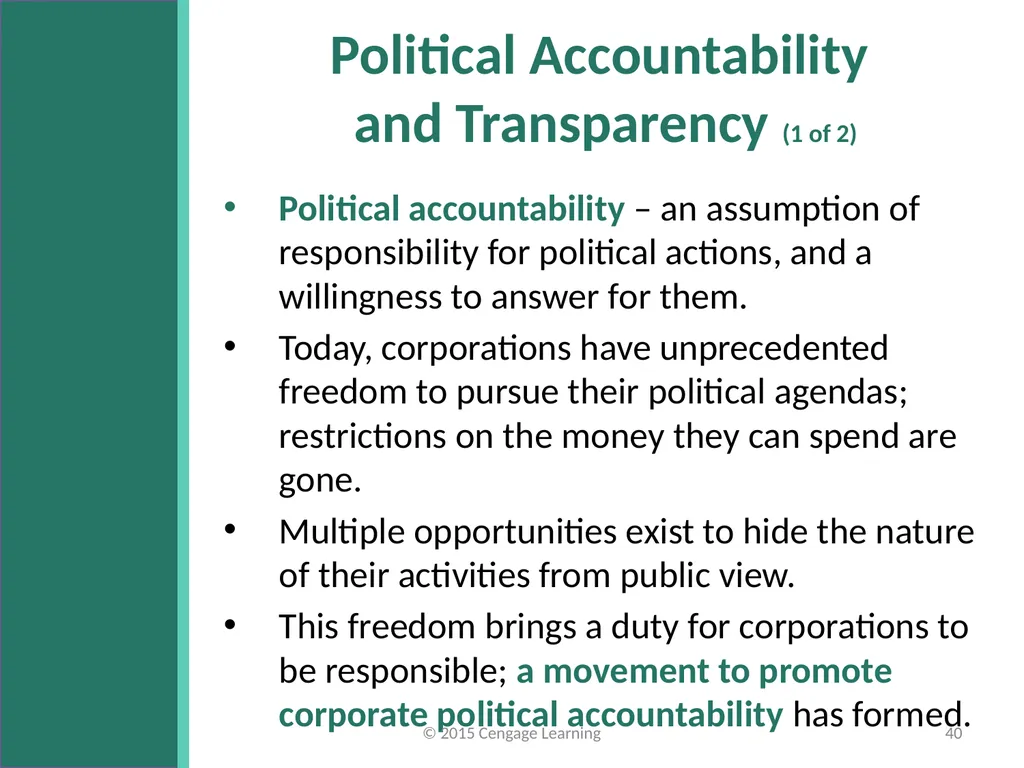
Political Accountability
and Transparency (1 of 2) Political accountability – an assumption of responsibility for political actions, and a willingness to answer for them.
Today, corporations have unprecedented freedom to pursue their political agendas; restrictions on the money they can spend are gone.
Multiple opportunities exist to hide the nature of their activities from public view.
This freedom brings a duty for corporations to be responsible; a movement to promote corporate political accountability has formed. © 2015 Cengage Learning 40<br>
Today, corporations have unprecedented freedom to pursue their political agendas; restrictions on the money they can spend are gone.
Multiple opportunities exist to hide the nature of their activities from public view.
This freedom brings a duty for corporations to be responsible; a movement to promote corporate political accountability has formed. © 2015 Cengage Learning 40<br>
41
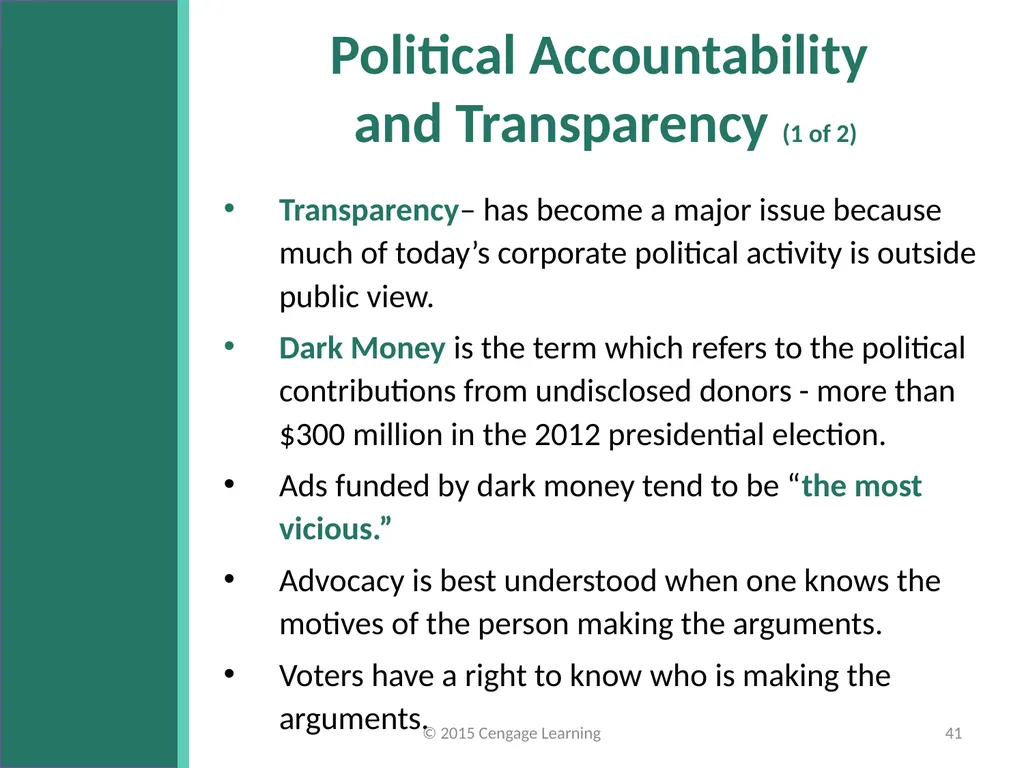
Political Accountability
and Transparency (1 of 2) Transparency– has become a major issue because much of today’s corporate political activity is outside public view.
Dark Money is the term which refers to the political contributions from undisclosed donors - more than $300 million in the 2012 presidential election.
Ads funded by dark money tend to be “the most vicious.”
Advocacy is best understood when one knows the motives of the person making the arguments.
Voters have a right to know who is making the arguments. © 2015 Cengage Learning 41<br>
Dark Money is the term which refers to the political contributions from undisclosed donors - more than $300 million in the 2012 presidential election.
Ads funded by dark money tend to be “the most vicious.”
Advocacy is best understood when one knows the motives of the person making the arguments.
Voters have a right to know who is making the arguments. © 2015 Cengage Learning 41<br>
42
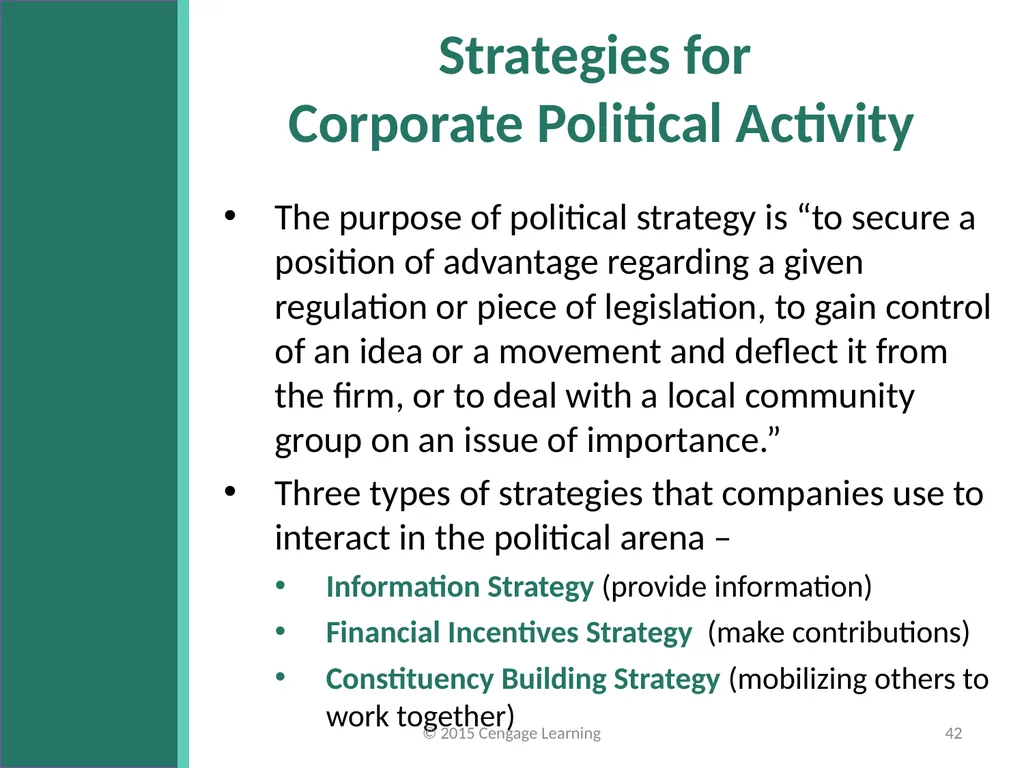
Strategies for
Corporate Political Activity The purpose of political strategy is “to secure a position of advantage regarding a given regulation or piece of legislation, to gain control of an idea or a movement and deflect it from the firm, or to deal with a local community group on an issue of importance.”
Three types of strategies that companies use to interact in the political arena –
Information Strategy (provide information)
Financial Incentives Strategy (make contributions)
Constituency Building Strategy (mobilizing others to work together) © 2015 Cengage Learning 42<br>
Three types of strategies that companies use to interact in the political arena –
Information Strategy (provide information)
Financial Incentives Strategy (make contributions)
Constituency Building Strategy (mobilizing others to work together) © 2015 Cengage Learning 42<br>
43
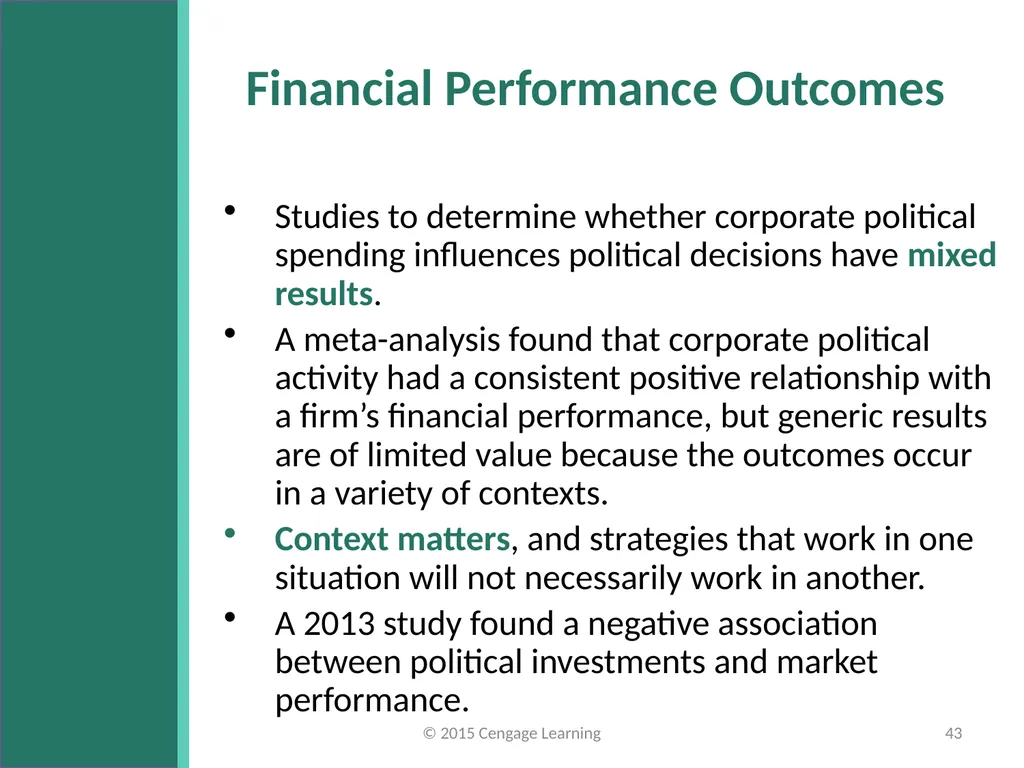
Financial Performance Outcomes Studies to determine whether corporate political spending influences political decisions have mixed results.
A meta-analysis found that corporate political activity had a consistent positive relationship with a firm’s financial performance, but generic results are of limited value because the outcomes occur in a variety of contexts.
Context matters, and strategies that work in one situation will not necessarily work in another.
A 2013 study found a negative association between political investments and market performance. © 2015 Cengage Learning 43<br>
A meta-analysis found that corporate political activity had a consistent positive relationship with a firm’s financial performance, but generic results are of limited value because the outcomes occur in a variety of contexts.
Context matters, and strategies that work in one situation will not necessarily work in another.
A 2013 study found a negative association between political investments and market performance. © 2015 Cengage Learning 43<br>