01
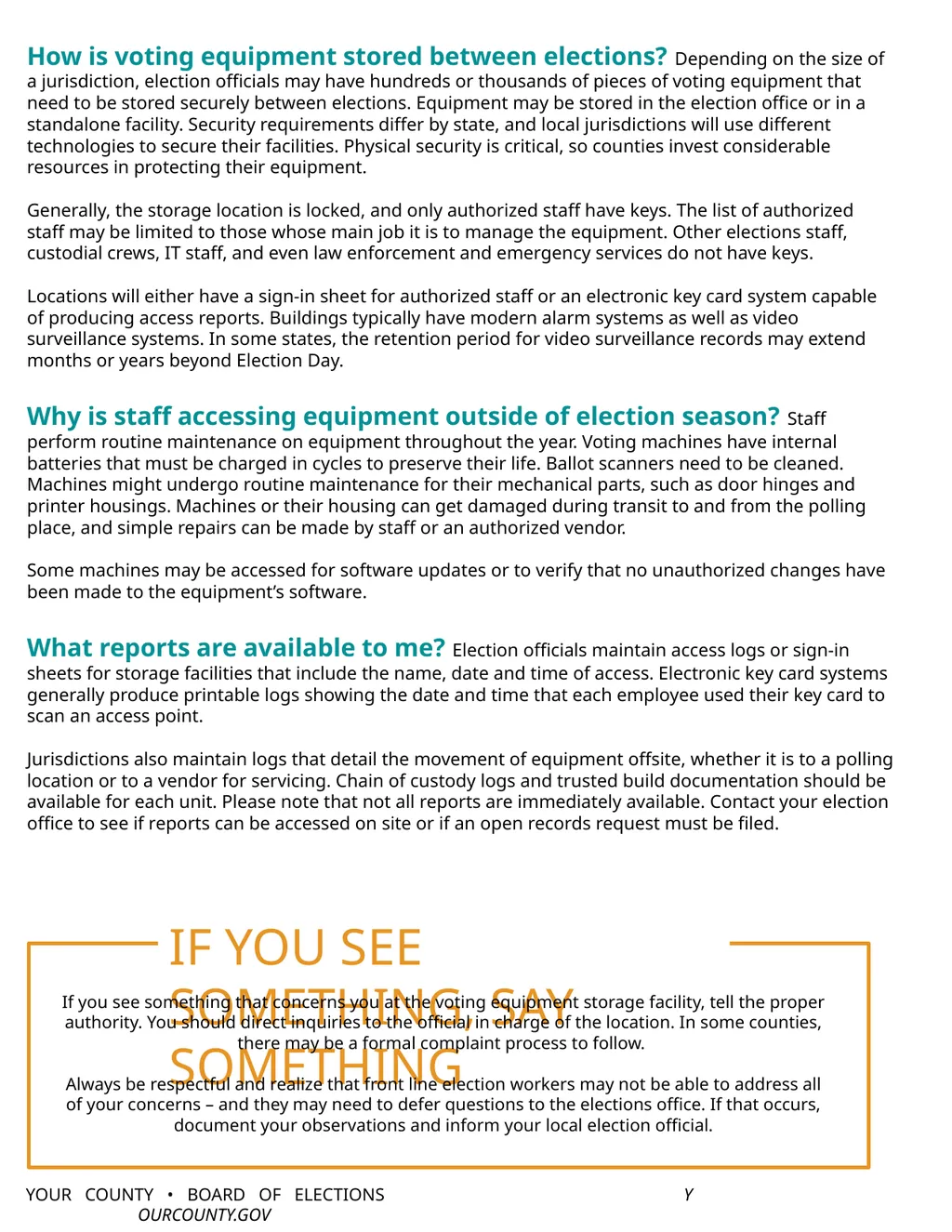
KEYS TO MEANINGFUL OBSERVATION YOUR COUNTY LOGO SECURITY AND STORAGE OF VOTING EQUIPMENT YOUR COUNTY • BOARD OF ELECTIONS YOURCOUNTY.GOV Meaningful observation is essential for healthy elections. Many observers want to know more about how voting equipment is securely stored. While observers should not touch voting equipment for security reasons, they can learn by watching pre-election testing of the equipment or visiting the storage facility. Observers can also learn by watching election workers receive, setup, break down and stage voting equipment during early voting or on Election Day What is my role at the storage facility? In most cases, there is no formal role for observers at a voting equipment storage facility. However, if you attend a public event there or take a tour and have concerns, raise them with local or state election officials What should I look for to verify that equipment is stored securely? You can take note of facility security measures. All staff should have official county-issued identification. There should be security cameras throughout the building. There will likely be physical barriers and additional keyed access points between the building entrance and the equipment. Adequate signage should be posted throughout designating secure areas. When can I observe? The voting equipment warehouse is under tight security protocols., but there are publicly scheduled events such as pre-election testing. At all other times, access is limited to authorized staff who have passed background checks. Contact our office to find out about public events or to see if tours of the storage facility are available. What should I expect when visiting a storage facility? When you arrive at the facility, expect to be greeted by authorized staff or even an officer of the law. You will likely be asked to sign in and may have to show identification and wear a visitor’s badge.
Outside of a guided tour, you should expect to have limited access throughout the facility. There might be viewing areas designed to allow observation and also keep the equipment secure and staff safe. States and counties may have policies restricting the use of smartphones, photography and recording devices.
Stored equipment may be collapsed or packed in travel cases, so it may look different from what you see Election Day.
Know that the facility is likely under video surveillance and that your likeliness on video might be preserved for an extended period of time or even be made public. Some jurisdictions might be able to display surveillance footage on monitors in the observer area.<br>
02
How is voting equipment stored between elections? Depending on the size of a jurisdiction, election officials may have hundreds or thousands of pieces of voting equipment that need to be stored securely between elections. Equipment may be stored in the election office or in a standalone facility. Security requirements differ by state, and local jurisdictions will use different technologies to secure their facilities. Physical security is critical, so counties invest considerable resources in protecting their equipment.
Generally, the storage location is locked, and only authorized staff have keys. The list of authorized staff may be limited to those whose main job it is to manage the equipment. Other elections staff, custodial crews, IT staff, and even law enforcement and emergency services do not have keys.
Locations will either have a sign-in sheet for authorized staff or an electronic key card system capable of producing access reports. Buildings typically have modern alarm systems as well as video surveillance systems. In some states, the retention period for video surveillance records may extend months or years beyond Election Day.
Why is staff accessing equipment outside of election season? Staff perform routine maintenance on equipment throughout the year. Voting machines have internal batteries that must be charged in cycles to preserve their life. Ballot scanners need to be cleaned. Machines might undergo routine maintenance for their mechanical parts, such as door hinges and printer housings. Machines or their housing can get damaged during transit to and from the polling place, and simple repairs can be made by staff or an authorized vendor.
Some machines may be accessed for software updates or to verify that no unauthorized changes have been made to the equipment’s software.
What reports are available to me? Election officials maintain access logs or sign-in sheets for storage facilities that include the name, date and time of access. Electronic key card systems generally produce printable logs showing the date and time that each employee used their key card to scan an access point.
Jurisdictions also maintain logs that detail the movement of equipment offsite, whether it is to a polling location or to a vendor for servicing. Chain of custody logs and trusted build documentation should be available for each unit. Please note that not all reports are immediately available. Contact your election office to see if reports can be accessed on site or if an open records request must be filed. IF YOU SEE SOMETHING, SAY SOMETHING If you see something that concerns you at the voting equipment storage facility, tell the proper authority. You should direct inquiries to the official in charge of the location. In some counties, there may be a formal complaint process to follow.
Always be respectful and realize that front line election workers may not be able to address all of your concerns – and they may need to defer questions to the elections office. If that occurs, document your observations and inform your local election official. YOUR COUNTY • BOARD OF ELECTIONS Y OURCOUNTY.GOV<br>